




Abstract
In times of crisis, citizens’ support for democracy can depend on how well they think their democracy can address that crisis compared to authoritarian alternatives. Mexico is in the midst of just such a crisis, as its war on drug trafficking organisations has brought an unprecedented rise in violence and, in some areas, posed a direct challenge to the state’s capacity to govern. At the same time, its subnational political landscape ranges from vibrant, multi-party states to those with continued connections to a dominant one-party past. We leverage these variations in subnational political context and levels of drug-related violence to examine how the subnational political context mediates the relationship between a crisis and support for non-democratic alternatives. When faced with a violent shock to the system, public attitudes towards democracy depend in part on one’s experiences with non-democratic alternatives and whether these authoritarian options appear to solve the crisis at hand more effectively.
Introduction
Public opinion scholars have long noted a willingness of mass publics to consider undemocratic answers to problems democracy seems incapable of solving. The extent to which citizens “give up” on democracy in times of crisis, however, depends not just on the perceived incapacity of a democratic system to fix the problem, but also on the perceived viability of an undemocratic alternative. As Chang et al. (2007) note in their analysis of declining levels of support for democracy in East Asia, “When people have experienced (within memory) a variant of soft authoritarianism that delivered social stability . . . democracy now seems to be having a hard time winning hearts” (p. 75). Much of the work on people’s willingness to consider authoritarian solutions, however, has focused on the national level, masking important subnational variations in both the degree of the crisis affecting citizens and the perceived viability of authoritarian solutions.
In 2019, Mexico was well into its second decade of confronting just such a crisis, recording unprecedented levels of drug-related violence. In Mexico’s years-long war on drug trafficking organisations, the number of homicides linked to this conflict now exceeds 200,000. In addition to these victims, the conflict (involving the military, law enforcement forces and warring drug cartels) has threatened essential institutions of Mexico’s fledgling democracy, silenced many media outlets, and eroded citizen confidence in the government’s ability to protect them. The drug war, and all of its incendiary consequences, have impeded the ability of Mexico’s nascent democracy to deepen and make durable citizen support for the regime.
Though certainly a tragedy that has touched all corners of the country, the drug war has had uneven effects on Mexico’s thirty-one states and Federal District (D.F.). For example, the impact of the drug war has been limited in Oaxaca, yet the neighbouring state of Guererro has long been a battleground for violent drug-related clashes. Just as the drug war’s violent consequences vary tremendously across Mexico’s states, so too does the subnational political landscape. By the turn of the century, some states had already moved beyond one-party rule even before the historic ouster of the Institutional Revolutionary Party (PRI) from the presidency in 2000, while in other states the PRI’s grip on the governor’s office continued unabated.
The Mexican states vary substantially in terms of their exposure to the violence of the drug war and their experience with multi-party rule. This within-nation variation allows us to examine how the subnational political context may mediate the relationship between a crisis and citizen support for democracy. In order to do so, we focus on Mexico’s thirty-one states at a critical moment: the year 2010, when the drug war’s violence first peaked in several parts of the country, with homicides jumping from historic lows to an unprecedented high (at the time) of 22 per 100,000. Headlines around the country portrayed a nation under siege, with detailed accounts of cartels controlling parts of the country and carrying out unspeakable acts of violence against those who opposed them. By focusing on the year 2010, we are able to assess citizen support for democracy when the drug war crisis first hit the country. As this crisis affected citizens differently across the Mexican states, and these states had very different political contexts, we are able to leverage this subnational variation to test our principal proposition: that the political context mediates the relationship between a crisis and citizens’ support for democracy and its authoritarian alternatives.1, 2
We argue that in Mexico, the most salient component of this subnational political context is the extent to which states have moved beyond dominant-party rule, a staple of Mexico’s seventy-year authoritarian past. Though several states led the way in Mexico’s democratisation process by ousting the PRI from the governor’s office, in other states (e.g. Hidalgo) the PRI remained unchallenged through 2019. As the violence of the drug war first reached its peak in 2010, Mexico’s states varied a great deal in terms of their experiences with democratic alterations of power. We view the timing of a state’s transition away from one-party rule, if it occurred at all, as an important element in shaping how drug-war violence affected citizens’ views towards democracy and its alternatives.
Such intra-national variations on these two key variables – the drug war crisis and one’s subnational political context – allow us to evaluate the role each plays in shaping citizen support for an authoritarian solution in times of crisis. We argue that in the context of a violent and publicly graphic drug war, the more connected an individual’s subnational political system is to an authoritarian past that demonstrated some success in controlling drug-related violence, the more likely they will be to express support for a return to that authoritarian solution of the past.
The article is organised into four parts. We begin with a theoretical overview, which explains how a crisis, particularly a widely publicised drug war, can affect citizens’ political attitudes. We expand upon this literature to theorise how system characteristics in Mexico’s thirty-one states may have shaped citizens’ views of democracy and its authoritarian alternatives across distinct levels of drug war violence. Second, we describe the situation Mexico faced in 2010 and explain why this was such a watershed year for the country’s war on drug trafficking organisations (DTOs). In this section, we document the differential impact the drug war had on Mexican states. In the third section, we explore the subnational political landscape and create three categories of state political contexts. In the fourth section, we employ these three categories, along with state exposure to the drug war, to analyse Mexicans’ views towards democracy. Here, we rely upon public opinion data from the 2010 Encuesta Nacional de Valores (ENVUD), a survey of over 15,000 Mexicans designed to provide representative samples for each of Mexico’s states and the Federal District. Surveys were conducted at the height of drug violence of that year, in November of 2010. 3
We find that in states where the drug war posed a significant threat to citizens, support for an authoritarian regime tended to be higher, but particularly in those states with strong ties to Mexico’s one-party regime of the past. In states where multi-party competition had become firmly established by 2010, citizens’ level of support for democracy appears less vulnerable, even in the face of exceedingly high levels of violence. Our findings are limited to cross-sectional data, and based on two concepts-drug-war violence and subnational political context-that are notoriously hard to measure precisely. However, taken together, they offer evidence that the subnational political context, particularly linkages to an authoritarian style of rule that seemed effective in managing security threats, can shape how citizens view democracy and its alternatives in times of crisis.
Support for Democracy in Times of Crisis
Much of the early work explaining support for democracy focused on individual-level factors such as income, education, and support for the incumbent government. As Davis and Silver (2004) point out, however, in their study of the impact of 9/11 on Americans’ attitudes towards civil rights, “one of the most important findings of research on mass beliefs about democracy and civil liberties is the importance of context” (p. 28). In both emerging and established democracies, periods of foreign conflict, economic depression or an internal security crisis can erode levels of support for democracy and citizens’ commitment to the protection of civil and political rights for all. Indeed, it is one thing to profess support for democracy when times are good, but quite another when one’s country is under attack or suffering through a destabilising period of domestic strife.
In terms of citizen support for democracy, it is not only the magnitude of the crisis itself that matters but also the (perceived) ability of one’s current political system, and possible alternative systems, to respond to that crisis effectively. For example, Pennings (2017) finds that in Europe the “Great Recession” contributed to a decline in support for democracy among those states with weak welfare systems, but support remained stable if not increased in those countries with well-developed welfare systems that could effectively respond to the needs of citizens. This problem of performance is even more pronounced in relatively new democracies (Carrión and Balasco, 2016; Dammert, 2012). As Diamond (1999) noted twenty years ago, “in relatively new and crisis-ridden democracies, the effectiveness of the government in meeting public expectations directly affects the prospects for democratic consolidation” (p. 20). This posited role for system effectiveness in shaping the impact a crisis might have on citizen support for democracy does not bode well for Mexico, which has found itself bogged down in an internal war against DTOs for more than fourteen years, with no end in sight (Heinle et al., 2017).
Diamond was among the first to caution that high levels of crime and violence could undermine democratic governance, particularly in emerging democracies where in “the context of weak states and inefficient, poorly disciplined police, crime may inspire drastic, illegal, unconstitutional, and grotesquely sadistic responses to try to control it” (Diamond, 1999: 91). Over the past two decades, scholars concerned with democratic sustainability have increasingly cast their analytical lens on the relationship between crime and a variety of democratic attitudes and behaviours (Bailey, 2013; Bateson, 2012; Carrión and Balasco, 2016; Dammert, 2012; Malone, 2012; Parás and Coleman, 2006; Pérez, 2003). 4
Though limited, the few empirical works that incorporate regime characteristics into their accounts of how a crisis can shape public support for (and opposition to) democracy tend to confirm Diamond’s observations. In a comparative study of Mexico and the United States, Merolla et al. (2009) found that that under conditions of threat, respondents exhibited “weaker effects in the U.S. [that] are consistent with our argument that support for democracy in established democracies should be less inclined to fall in the face of threat” (p. 11). In an analysis of democratic breakdown in interwar Europe, Bermeo (1997) finds that crime may have played a decisive role in undermining support for many of the region’s young democracies. She contends that what “seems to distinguish the casualties from the survivors in the interwar story is less the behavior of an actively anti-democratic public than the state’s capacity to provide what might be called civic order” (p. 19; see also Bermeo, 2003). New democracies tend to have a more difficult time maintaining civic order during times of crisis, as they typically must overhaul law enforcement institutions as part of the transition to democracy, a process requiring considerable time and investment. Consequently, due to the often lower capacity of those institutions charged with maintaining civic order, new democracies tend to be more vulnerable to spikes in crime and violence.
Studies of crime and political attitudes in Latin America provide additional evidence that the impact of a security crisis can vary across political systems. In a comparative analysis of post-conflict Central American countries, Cruz (2003) finds that in Guatemala and El Salvador, crime significantly reduced citizens’ satisfaction with democracy, but in Nicaragua, there was no relationship between the two. A study by Malone (2012) of Central American countries finds that crime can render citizens more willing to support authorities’ circumvention of the law in some cases, but its impact varied according to the national homicide rate and the perceived performance of a country’s justice institutions. In sum, the literature indicates that security crises can undermine democratic attitudes, but this effect varies across cases.
The Drug War Threat and Mexico’s One-Party Solution
To understand how such variations in political systems can mediate the relationship between a crisis and support for democracy, we turn to the subnational political landscape of Mexico. We focus on one defining feature of Mexican political development – a state’s initial ouster of the PRI (or lack thereof) – as a proxy for the degree to which citizens have direct experience with a functioning democracy, a dominant-party system, or both.
During its seventy-year period of hegemonic rule, the PRI largely controlled drug-related violence by imposing political authority over drug trafficking operations. When the PRI’s highly centralised system began to break down in the late 1980s, opposition parties in some states were able to oust the PRI from the executive office and end decades of one-party rule. 5 Dube and Garcia-Ponce (2013) offer compelling evidence that this initial ouster of the PRI contributed to the rise in drug-related violence, as “increased [electoral] competition associated with Mexico’s democratic transition disrupted implicit agreements between DTOs and the long-ruling PRI” (p. 415) which, in turn, led to an increase in drug-related violence. 6 According to Trejo and Ley (2018), the “subnational party alternation in gubernatorial power . . . [led to] the breakdown of protection" that in turn "motivated drug lords to create their own private militias to defend their turf” (p. 930). Using a database of intercartel murders, Trejo and Ley (2018) link transitions away from the one-party rule of the PRI to increases in cartel-related violence, as DTO militias sought to protect (and perhaps expand) their territories from both new political authorities and rival drug traffickers. Tragically, in the case of Mexico, “party alternation—one of the defining features of representative democracy—can be a trigger of large-scale violence” (Trejo and Ley, 2018: 930). 7
Our theory linking a state’s political transition with citizen support for democracy in the face of extreme violence rests on the degree to which citizens associate the solution to that violence with the electoral ouster of incumbents (the democracy option) or the retrenchment of a dominant-party system (the authoritarian option). By the time drug war violence first peaked in 2010, citizens in some states had more than a decade of experience with multi-party politics and concrete evidence that they have the ability to remove an incumbent who proves ineffective through democratic means. Such concrete experiences with the electoral removal of a governor from office should increase the likelihood that more citizens in these states will view democracy as the most peaceful route towards a viable solution.
In contrast, in dominant-party states where citizens have not witnessed such peaceful alternations in power, citizens may perceive the most viable solution to the sudden emergence of drug war-related violence to be the strengthening of the PRI’s political control in order for the system to work most effectively. In this context, the appeal of democratic elections and the ability to remove the incumbent government may be minimal; citizens may think that only a more powerful, dominant party can exert the power of the state to contain the threat of DTO violence. This appeal of a dominant-party solution to drug war-related violence may be even stronger in those states where the spike in such violence coincided with the initial ouster of the PRI. In such states, it is likely that citizens could associate the outbreak of violence with the onset of multi-party democracy, and thus favour a return to dominant-party rule.
We can test these ideas in Mexico. The Mexican states vary along the two important dimensions driving our expectations. First, in terms of the state’s political context, in some states the critical first electoral defeat of the PRI took place in the 1990s, in others it coincided with the onset of the country’s drug war in the mid-2000s, and in others such an alternation never took place. Second, the spatial distribution of drug war-related violence varies substantially. In some states, violence and insecurity related to the drug war were minimal, while other states faced near wartime levels of violence. These subnational variations allow us leverage in assessing the degree to which political context and drug-related violence influence citizens’ attitudes towards democracy. More concretely, we posit the following:
Citizens living in PRI-dominant states with high levels of drug violence may be more likely to see democracy as an impediment to the dominant-party’s ability to exert control over cartels and curb the violence associated with the drug trade.
Citizens living in states where the PRI’s one-party dominance had long eroded by the time cartel violence emerged, however, would perhaps have a more nuanced understanding of what democracy can, and cannot, accomplish. These citizens may be reluctant to turn on democracy, and more likely to simply employ democratic mechanisms to remove the incumbent from office. Arguably, citizens with a more realistic understanding of what a democratic regime can and cannot provide should be more resistant to the appeal of an authoritarian solution to the crisis.
In states where the ouster of the PRI coincided with the onset of the drug war, citizens may be more likely to associate the arrival of democracy with the instability, uncertainty, and increased lawlessness that came with the war on DTOs. These citizens may be more inclined to express support for the perceived stability offered by the one-party political system of the past. We argue that this is particularly likely given the very public displays of violence, murder and extortion that characterise Mexico’s drug war, which were designed to frighten and intimidate citizens.
We aim to understand how these subnational variations in political context (i.e. PRI-dominant states, multi-party states and first alternation states) interact with different levels of drug war intensity to shape attitudes towards democracy and its authoritarian alternatives. In order to do so, we turn now to our classification of the thirty-one Mexican states in terms of political context and the intensity of the drug war (circa 2010).
Mexico’s Drug War and Its Subnational Consequences
The year 2010 represented the nadir of Mexico’s first decade of democracy. Not only did the country still confront the aftermath of the debilitating economic crisis of 2008–2009, it also faced an unprecedented rise in drug war violence. This year marked the point at which the government’s war on DTOs became a full-blown crisis in some parts of the country, with extreme violence increasingly characterised by highly publicised “beheadings, dismemberment, torture, and other acts of unimaginable cruelty” (Ríos and Shirk, 2011: 13). Notably, though, even by 2010, there were many states that remained virtually untouched by the drug war (Ríos and Shirk, 2011: 9).
Of particular import for our analysis is the fact that much of this violence was orchestrated in a way to capitalise on publicity, involving particularly gruesome images of beheadings, bodies hanging from bridges and audacious grenade attacks on public buildings (Ríos and Shirk, 2011). The notoriety of this wave of violence underscores the importance of local context, as all citizens living in certain areas were made aware of the bloodiness of the war on a daily basis, even if they were not directly affected by it.
Another important feature of this wave of violence was its geographic concentration in certain parts of the country. As is clear in Figure 1, 8 citizens in some states were caught on the front lines of the drug war in 2010, while others enjoyed relative peace. In the case of Chihuahua, the drug-related homicide rate reached a shocking 152 homicides per 100,000. 9 In contrast, in states like Yucatán, the war on DTOs-at least as measured by drug-related homicide data-barely registered. The selectivity of the drug war violence is most notable in the neighbouring states of Morelos and Puebla, where the former registered over twenty drug-related homicides per 100,000 in the 2009–2010 period, while the latter recorded a rate of just over one per 100,000. We have, then, significant variation in one of our critical independent variables, levels of drug-related violence.
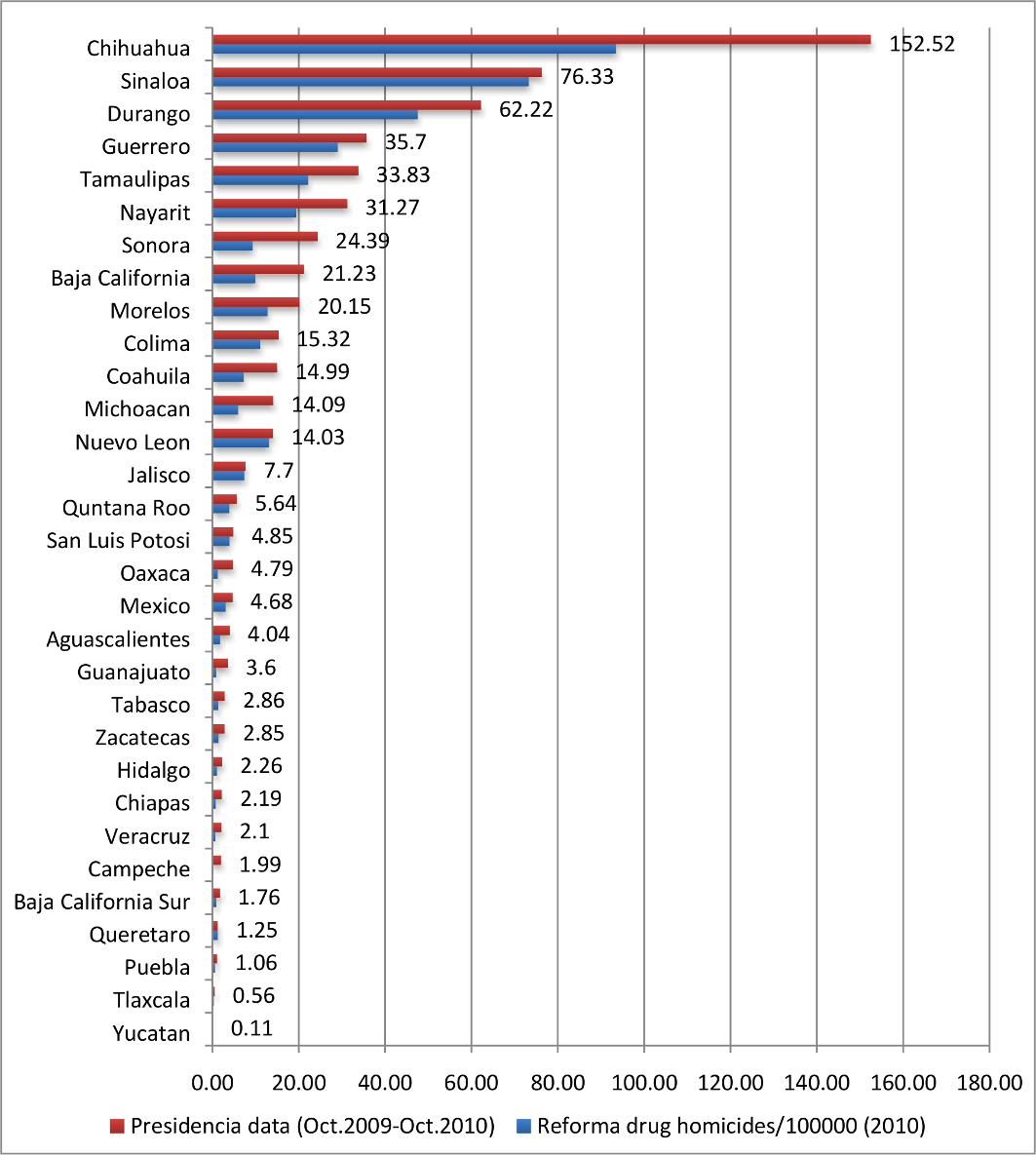
State Drug-Related Homicide Rates (2009–2010).
Not surprisingly, there is a strong correlation between states with high levels of drug-related homicides and those with high levels of overall homicide rates. 10 There are, however, a few states that recorded very low levels of drug-related violence but registered significantly higher overall homicide rates. Most notably, Oaxaca reported under five drug-related homicides per 100,000, but a total homicide rate nearly four times higher (18.6 per 100,000). This high level of overall homicides in states like Oaxaca, one of the least developed in Mexico, was due to longstanding problems of inequality, poverty and human development; indeed, empirical models find that these root causes typically explain almost half the variance in homicide rates (Fajnzylber et al., 2002).
Our present analysis, however, is not motivated by these stable, long-standing homicide trends. We aim to focus instead on the very abrupt change in the status quo linked to the Mexican drug war, as such sharp changes in a state’s insecurity context tend to engender a much stronger response from citizens than do longstanding trends in violence and insecurity. 11 We are interested in understanding the impact of the extreme violence of the drug war, which abruptly did not just raise the overall level of homicide in some states but also ushered in a qualitatively different type of publicly displayed violence designed to intimidate local communities (see Table 1A and Figure 4A in the Supplemental Appendix). 12 States on the front lines of the drug war deviated, in some cases quite sharply, from their more stable, long-term homicide trends, supporting our contention that for citizens living in these states, the arrival of the drug war during these years represented a highly visible departure from the status quo.
A principal challenge we face in evaluating the impact of drug war violence in isolation from other types of crime and violence taking place in a state is the availability of reliable data that distinguish between the two. As Shirk and Wallman note, "the availability of data on organized-crime-style homicides from the Mexican government has been limited and inconsistent" (2015: 1352). Because of these issues with government data, several private media outlets began compiling information on drug-related homicides as well. Though these data vary in scope and quality, when taken together they paint a similar picture of a rapid rise in homicides in certain states during the 2008–2012 period. In our analyses below, we recognise the noise inherent in these measurements, and analyse all of the data we have access to in testing our hypotheses. 13
Mexico’s Subnational Political Landscape
We now turn to a brief discussion of our second critical variable, state-level political systems. By most accounts, Mexico’s regime transition from an authoritarian, one-party system to a multi-party democracy took its most definitive step with the 2000 election of Vicente Fox of the centre-right National Action Party (PAN) to the presidency. Though other significant points in Mexico’s democratic transition also merit mention (such as the PRI’s loss of majority control of the legislature in 1997), the peaceful alternation of control over the country’s most powerful political office in 2000 signalled the beginning of a new era of competitive, multi-party electoral politics. While still a long way from being fully democratic, the ouster of the PRI in 2000 was a significant step away from the country’s one-party, authoritarian past. It is this watershed moment of the PRI’s ouster from the executive branch that we view as equally important in understanding the political transitions of Mexico’s thirty-one states. 14 As we noted earlier, in some states this watershed moment undermined prior arrangements with the PRI and DTOs, ushering in unprecedented levels of drug-related violence (Trejo and Ley, 2018).
By 2010, all of Mexico’s state political systems were democratic to varying degrees. By this point, all held reasonably free and fair elections, multiple political parties competed for and won elections for local mayorships and state legislative seats, and few exhibited overt signs of retaining the authoritarian machines that characterised many parts of Mexico throughout much of the 20th century. Yet in some of these states, the PRI still had yet to relinquish its more than eighty-year control over the governor’s office. 15
Does this automatically brand these states as “authoritarian”? No, but the uninterrupted rule of the PRI, in our mind, is indicative of a political system that has yet to fully and undeniably leave behind its one-party past (Lawson, 2000). 16 To be clear, this critical first alternation in power does not necessarily mean the state suddenly becomes more democratic, or that it will forever be immune to political malfeasance, or the emergence of a new era of one-party rule under a non-PRI party. 17 What the ousting of the PRI does tell us, however, is that the citizens of this state have managed to end eight decades of rule by a single party. We view the PRI’s initial exit from the governor’s office, just as many view the PRI’s 2000 exit from the president’s office, as a critical benchmark – an indicator of a potential transition towards widespread acceptance of competitive, multi-party politics in the future.
We focus on state political systems rather than municipal governments to assess political context. By 2010, those states that had yet to see the PRI exit power clearly stood as the last, and strongest, links to the PRI’s one-party regime of the past (e.g. Langston, 2017). Though such PRI dominance may have persisted at the local level in some of Mexico’s more than 2,400 municipalities, it was at the state level, and particularly in electoral battles over the gubernatorial office, where the strongest connections to the country’s one-party past persisted. While there was certainly significant intra-state variation in terms of both the level of violence and the degree of one-party dominance that existed in 2010, the most significant subnational political units in Mexico’s political transition and its war on drug trafficking were the states. It is for these reasons, then, that we focus our analytical lens in the following discussions on the state level. 18
Our first category of state political systems is what we refer to as a “contested one-party” system. In these states a multi-party electoral environment exists, but the PRI has never accepted gubernatorial defeat. In 2010, ten of Mexico’s thirty-one states were in this category, with another three voting the PRI out of office in the July gubernatorial elections of that year (Oaxaca, Puebla and Sinaloa). Our second category of subnational political environments includes those states that had successfully ousted for the first time the PRI from the executive office by November of 2010 – the point at which our survey data were collected. 19 We classify these cases as “first alternation” states, a period we see as lasting through the initial six-year term of the first non-PRI governor. These states were trying to move beyond eight decades of PRI rule at precisely the time when the country’s drug war-related violence reached unprecedented levels. Further, the PRI’s defeat in these states required an enormous, collective effort on the part of all opposition parties, often with two ideologically opposed parties, the National Action Party (PAN) and the Democratic Revolution Party (PRD), joining forces to present a coalition candidate in order to eject the PRI from the governor’s office. Thus, even in the best of times, these first non-PRI administrations would have faced significant governance challenges. When combined with the dramatic rise in violence and, in 2009, one of the worst economic crises ever to hit Mexico, the obstacles confronted by these “first alternation” states were considerable.
Our final category of political environments is “established multi-party” states, where at least one alternation in power had occurred and a subsequent round of gubernatorial elections had taken place prior to 2010. Once completing that critical first term of alternation, it should be clear to all relevant actors that a credible multi-party system is in place where any political party can lose, even the PRI. Though these political systems may have many flaws, indeed some may be just as corrupt and nepotistic as some of our “contested one-party” states, citizens in “established multi-party” states at least will have concrete evidence that their political system has moved forward from the PRI’s one-party system of the past. In sum, we have ten “contested one-party” states, five “first alternation” states and sixteen states in the “established multi-party” category. 20
Before moving to our analysis of the ways in which these distinct subnational political contexts interact with levels of drug war violence to influence citizens’ views of democracy, we first need to briefly address the question of why some states were able to oust the PRI in the 1990s while in others the PRI remains in power to this day. If all dominant-party states for example were poor, rural states concentrated in one region of the country, one might posit that these characteristics also might help explain variations in citizens’ views of democracy. In fact though, the group of states that have ousted the PRI and those states where the PRI retains its grip on power are quite heterogeneous. As indicated in Table 1, the average gross state product in 2010 of multi-party states was in fact lower than that of dominant-party states. The literacy rates of the two groups of states is nearly identical, while the size of the manufacturing sector of multi-party states is only slightly larger than that of the dominant-party states.
Development Levels Across State Political Contexts.
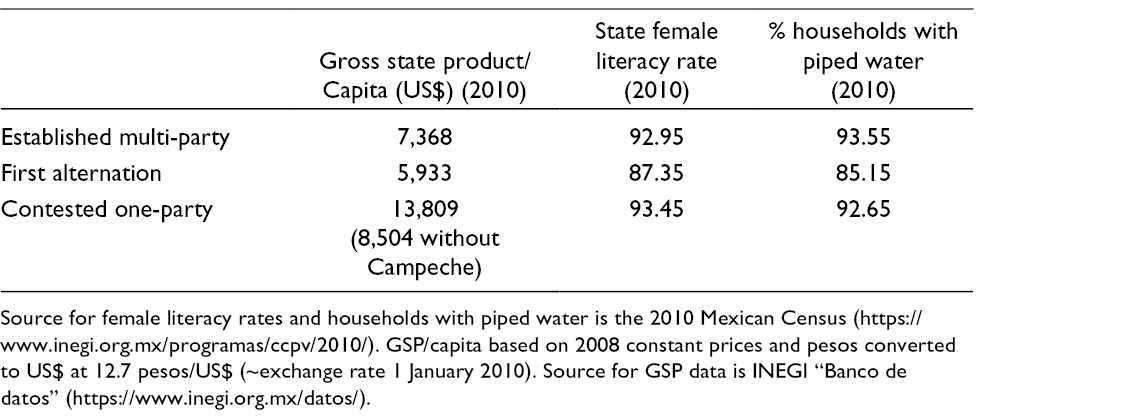
Source for female literacy rates and households with piped water is the 2010 Mexican Census (https://www.inegi.org.mx/programas/ccpv/2010/). GSP/capita based on 2008 constant prices and pesos converted to US$ at 12.7 pesos/US$ (~exchange rate 1 January 2010). Source for GSP data is INEGI “Banco de datos” (https://www.inegi.org.mx/datos/).
If not socioeconomic development factors, then what does explain why some states were able to move beyond the country’s one-party past while others were not? Extant research on this question focuses on two critical, and somewhat stochastic, factors related to state-level political elites. The first concerns the PRI itself and whether or not the state-level party elites have been able to maintain a united front in the face of myriad economic and political crises they have had to confront. The second factor is whether or not rival opposition party leaders within the state, typically those from the left-of-centre PRD and the right-of-centre PAN, were able to put aside their differences and put forth a coalition-backed candidate for the governor’s race. When this perfect storm came together for a state, the chances of ousting the PRI improved considerably. As Petersen (2018) concluded in his study of these critical elections across Mexico, “one important finding is that the behaviour of either elites alone [authoritarian and the opposition] does not explain turnovers in these cases, and that for turnovers to happen, this [PRI] rupture should appear jointly with the unification of the opposition, including the groups that defected from the authoritarian elite” (p. 34). Given the disparate socioeconomic settings in which such watershed defeats of the PRI have occurred over the past thirty years, and the confluence of elite behaviours that appear necessary for these to occur, we are confident that there is not some underlying factor in either group of states that we do not include in our analyses below that is systematically driving differences in citizens’ attitudes towards democracy when confronted with high levels of violence.
As our analysis rests on data gathered at a single point in time, we do not pretend to be able to establish a causal relationship between one’s subnational political system and one’s views of democracy when confronted with high levels of violence. What we do hope to offer, however, is a set of evidence that is consistent with our theoretical expectations and supports the proposition that one’s views of democracy are in part a function of the characteristics of the subnational democracy in which one lives.
Subnational Variations in Violence and Political Context
Our next step is to combine these distinct state-level political system characteristics with an assessment of each state’s proximity to the front lines of the drug war. In order to construct a measure that identifies the states in which the drug war had reached crisis levels by 2010, as a first step we rely on data released by the office of the president on drug-related homicides gathered by various sources. 21 As noted above, we fully recognise the concerns with the drug war-related homicide data released by the Calderón government in 2011 that purported to offer information on homicides connected specifically to drug trafficking organisations. 22 We nonetheless begin our analyses with those data as they allow for the most direct, albeit noisy, measure of the concept we wish to capture – the extent to which a state found itself in the midst of the drug war in 2010. In addition, we carry out extensive analyses of total homicide data collected by the Instituto Nacional de Estadística y Geografía (2018) in order to further evaluate our propositions.
Our argument is not necessarily a linear one that requires evidence of a positive correlation between an increasing number of murders and declining support for democracy. Rather, our intent is simply to identify those states where the drug war violence was most evident in 2010. With that rather blunt measurement goal we are afforded the opportunity to employ a range of measurement strategies, with the hope that all ultimately produce similar results. To that end, we run myriad analyses using both drug war-related and overall homicide data provided by distinct sources. To ensure our findings are robust, we use both sets of these data to categorise and identify those states most significantly caught in the drug war by 2010. Our hope is that by employing these various measurement strategies we can mitigate concerns with any one approach in particular. In the process, we endeavour to account for the highly imprecise nature of both the concept we are attempting to capture, drug war violence, and the data we have available to us.
To identify those states with high levels of drug-related violence, we begin with the data provided by the Office of the President and the Trans-Border Institute. Both sets of data find a sharp divide in 2010 between thirteen states that recorded double- (or triple-) figure levels of drug war homicides (per 100,000), and the remainder of the states in which drug-related violence was significantly lower. As Figure 4A in the Supplemental Appendix indicates, most of the states with high levels of drug-related violence also experienced a sudden and sizeable increase in long-term overall homicide trends. Citizens in these states would have witnessed a sudden rise in homicide rates, which tends to provoke a stronger reaction from citizens than more gradual increases. Since the survey data we analyse in the following section were collected in November of 2010, we use the monthly “drug-related homicides” data supplied by the Office of the President to calculate a rate for October 2009 to October 2010 as a basis for categorising states as either on the front lines of the drug war or not. 23 In recognition of the inherently imprecise nature of where one draws a line in the construction of a dichotomous variable, we also employ continuous treatments of our measure of violence in subsequent analyses.
Though largely similar, a comparison of overall homicide rates and drug-related homicides do reveal one notable difference: the state of Oaxaca. As we briefly discussed above, this difference highlights our rationale for beginning our analysis with these drug-related homicide data, however noisy those data may be, to identify those states most afflicted by the drug war in 2010, and to distinguish them from states like Oaxaca that have historically registered high homicide rates but were relatively untouched by the country’s drug war. Indeed, by 2010, Oaxaca was in the midst of a significant decline in violence from levels in the 1990s, with the state experiencing a 64 per cent reduction in its homicide rate between 2003 and 2012, moving in the exact opposite direction to those states on the front lines of the drug war (Institute for Economics and Peace, 2014). It is precisely for this reason that we first analyse the drug-related homicide data before exploring the overall homicide data.
A second measurement choice we make also merits discussion – namely our decision to dichotomize a “drug war” variable that is based on continuous homicide data. Our theoretical account of the drug war crisis and how it may have affected citizens’ views towards democracy and authoritarianism informs this measurement decision. As we are concerned more with the contextual effects of the drug war, as opposed to individuals’ direct experiences with the violence associated with that war, we view a dichotomous treatment of this concept as more useful and accurate than a continuous treatment. Further, the bluntness of our dichotomous approach to measuring a state’s level of violence is consistent with the imprecise nature of the homicide data we are relying on to assess that violence.
Though clearly involving some degree of subjectivity in determining where to draw the line between the drug war hot spots in 2010 and other less affected areas, we feel comfortable relying on the sizable gap in the homicide rates of Jalisco and Nuevo Leon in both the Reforma and Presidencia data as a basis for this choice (see Figure 1). Further, this gap in homicide rates also corresponds to the divisions employed by the World Health Organization (WHO), which classifies a country as suffering from a “violence epidemic” when it registers homicide rates above 10/100,000 (World Bank, n.d.). That said, and again with an eye towards assessing the robustness of our findings, we also evaluate our propositions using a continuous form of our homicide data, with the results of these presented in the Supplemental Appendix (see Table 8A).
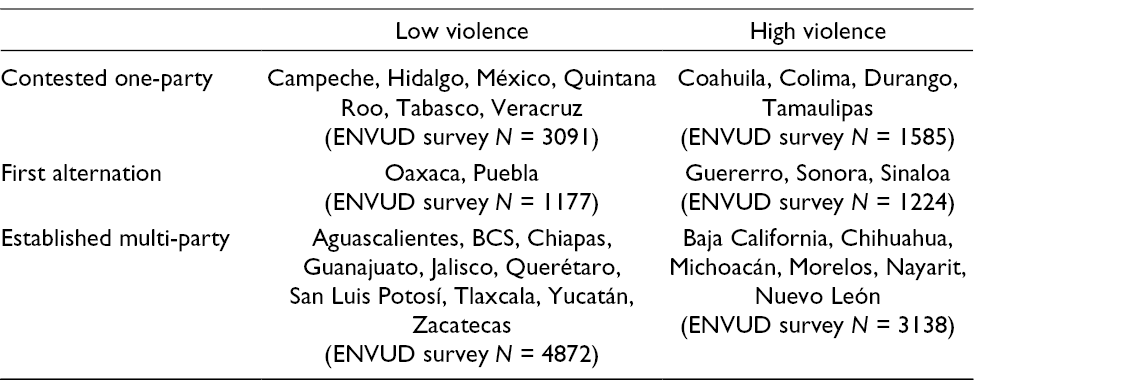
We categorise each state in terms of our three political context categories (“contested one-party, “first alternation”, and “established multi-party”) and the context of the drug war (“high” or “low” violence), providing us with six categories of states. Table 2 offers a look at how Mexico’s thirty-one states are sorted across these six categories, and Map 1 displays their geographic distribution. For purely analytical purposes, the fact that each category includes at least two states allows a bit more leverage for us to carry out meaningful comparisons of respondents across these six categories. 24
Political Context and Violence Categories.
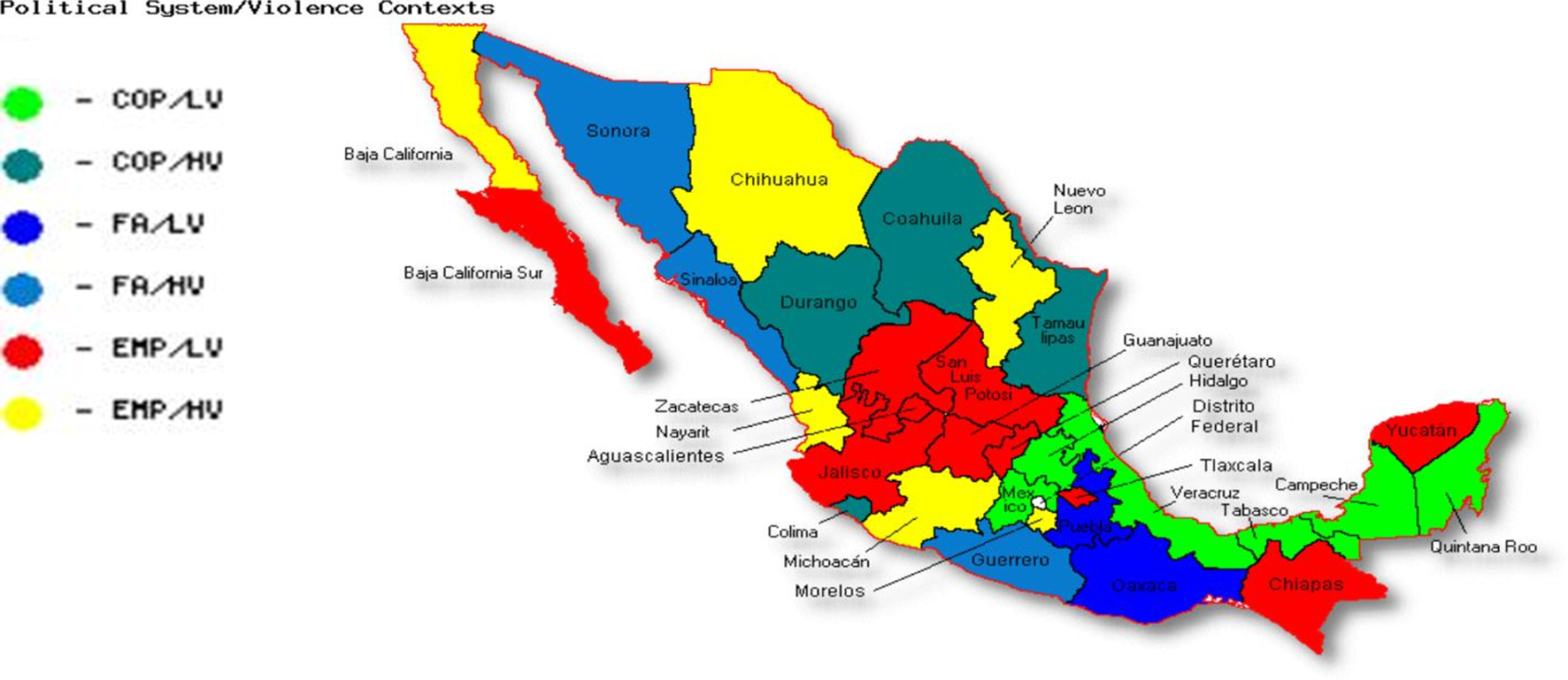
Subnational Political System/Violence Contexts.
Subnational Variations in Crime’s Impact on Support for Democracy
We now turn to assess how well these categories help us understand the impact of the drug war on political attitudes and behaviours. To measure respondents’ levels of support for democracy, we rely on two items from the ENVUD survey:
(1) “Do you think democracy is a good or bad form of government for Mexico?”
“Good”
“Bad”
“Neither good nor bad”
(2) “With which of the following statements do you most agree?
“Democracy is preferable to any other form of government.”
“In some situations, an authoritarian government is preferable.”
“For people like me, having a democratic regime doesn’t really matter.” 25
We expect citizens living in states with high levels of violence to be less supportive of democracy than those in states with low levels of violence. However, we argue that this effect should be conditional on the characteristics of the individual’s state political system. Figure 2 provides initial, bivariate support for our argument: a state’s political context seems to moderate the degree to which a crisis such as the drug war affects support for democracy. Most notable are the differences among respondents living in high- and low-violence “contested one-party” and “first alternation” states. With low levels of violence, individuals in these two political contexts appear least likely to “prefer [an] authoritarian regime.” Given that these individuals have the most direct experience with uninterrupted one-party rule, this low level of support for an authoritarian regime in a low violence context makes sense. These are citizens ready to move beyond the one-party rule of the PRI. Once we add high levels of violence, however, we find that respondents in contested one-party states are those most likely to consider an authoritarian regime as preferable in certain situations.
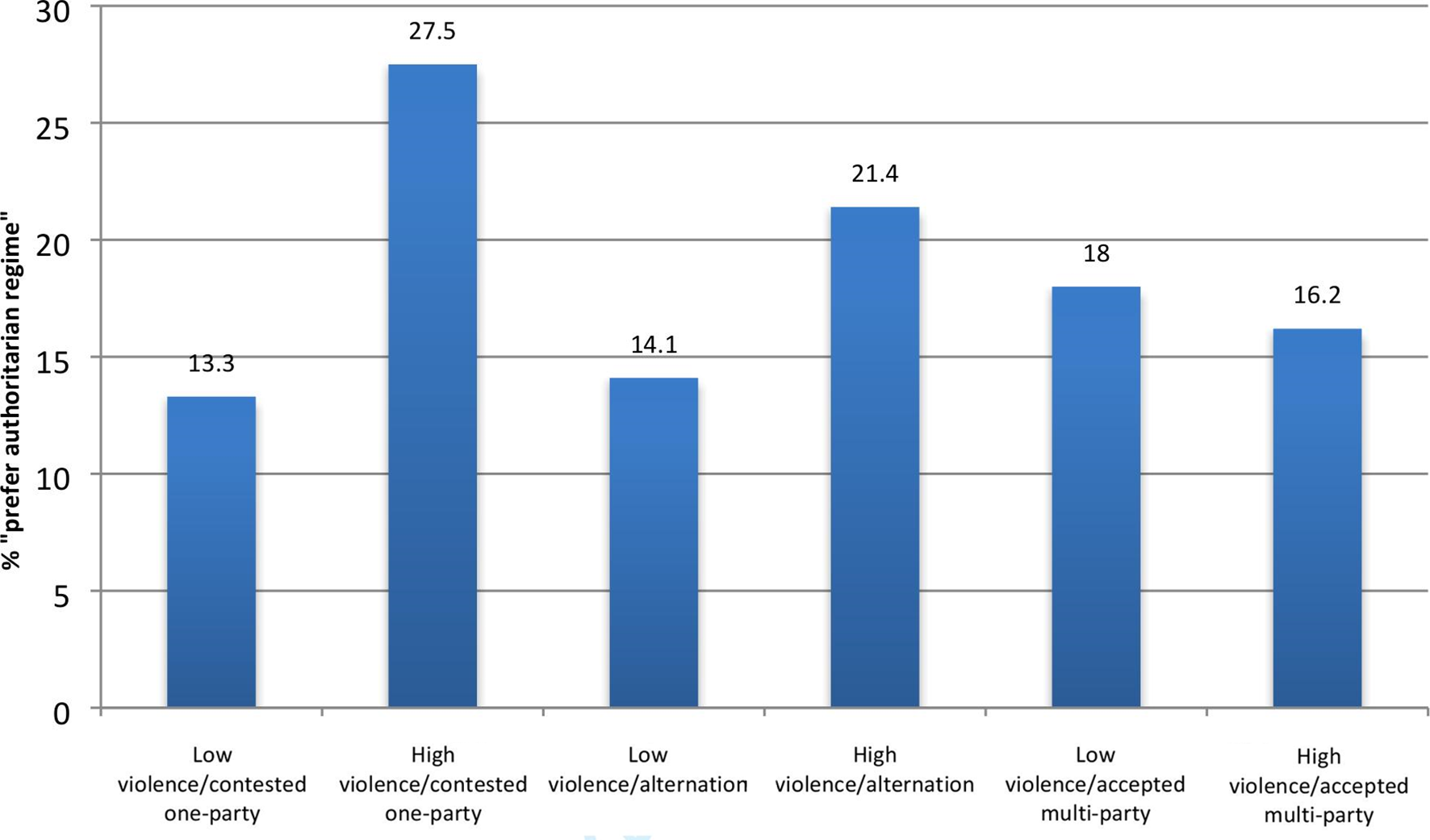
Preferences for Authoritarianism Across Subnational Contexts.
Conversely, the level of violence appears not to have much impact on citizens in established multi-party states. A slightly lower percentage of respondents in multi-party/high-violence states expressed a preference for an authoritarian regime, compared to those living in multi-party/low-violence states. This finding is particularly intriguing as one of the states in the multi-party/high-violence category is Chihuahua, where the drug-related homicide rate was more than double that of any other state in 2010. The fact that we see very little effect of violence on support for democracy in this category speaks to the role that “regime characteristics” may play in shaping how crime and violence affect citizens’ views of democracy. We recognise, though, the need to submit these initial findings to a more rigorous multivariate analysis in order to put much stock in them.
In order to estimate the probability that a respondent will opt for the anti-democracy option in each of the two survey items above, we run a series of binary logistic regression analyses for our three categories of states. In each model we include a series of standard socioeconomic controls (education, age, gender and wealth) 26 along with numerous other potentially important factors that may influence attitudes towards democracy (see Table 4A in the Supplemental Appendix for a list of these variables, their measurements and descriptive statistics).
The one item we lack in the ENVUD survey that almost certainly would contribute to the overall model is a crime victimisation question. Such an item would allow us to assess both the impact of a high-violence context as well as personal experience with crime on support for democracy. We do include, however, a measure of a respondent’s perception of security that is based on responses to the question “How safe do you feel in your state?” While this item certainly does not fully suffice for a crime victimisation measure, our hope again is that it will serve as an adequate control for the individual feelings of insecurity that likely accompany crime victimisation. 27
To assess the contextual effects that violence and the state political system have on a respondent’s views towards democracy, we take advantage of the state-level sampling design of the ENVUD survey data that essentially provides us with thirty-one representative state-level surveys. Rather than analysing the responses of the close to 16,000 ENVUD respondents as a single sample, then, we carry out a split-sample analysis based on the particular political context of their states. Thus, we run separate models for the 4,342 respondents living in “contested one-party” states, the 2,319 respondents living in “first alternation” states, and the 7,094 respondents from “accepted multi-party” states. We begin these analyses using the Mexican government drug-related homicide data as the basis for our “high violence” variable.
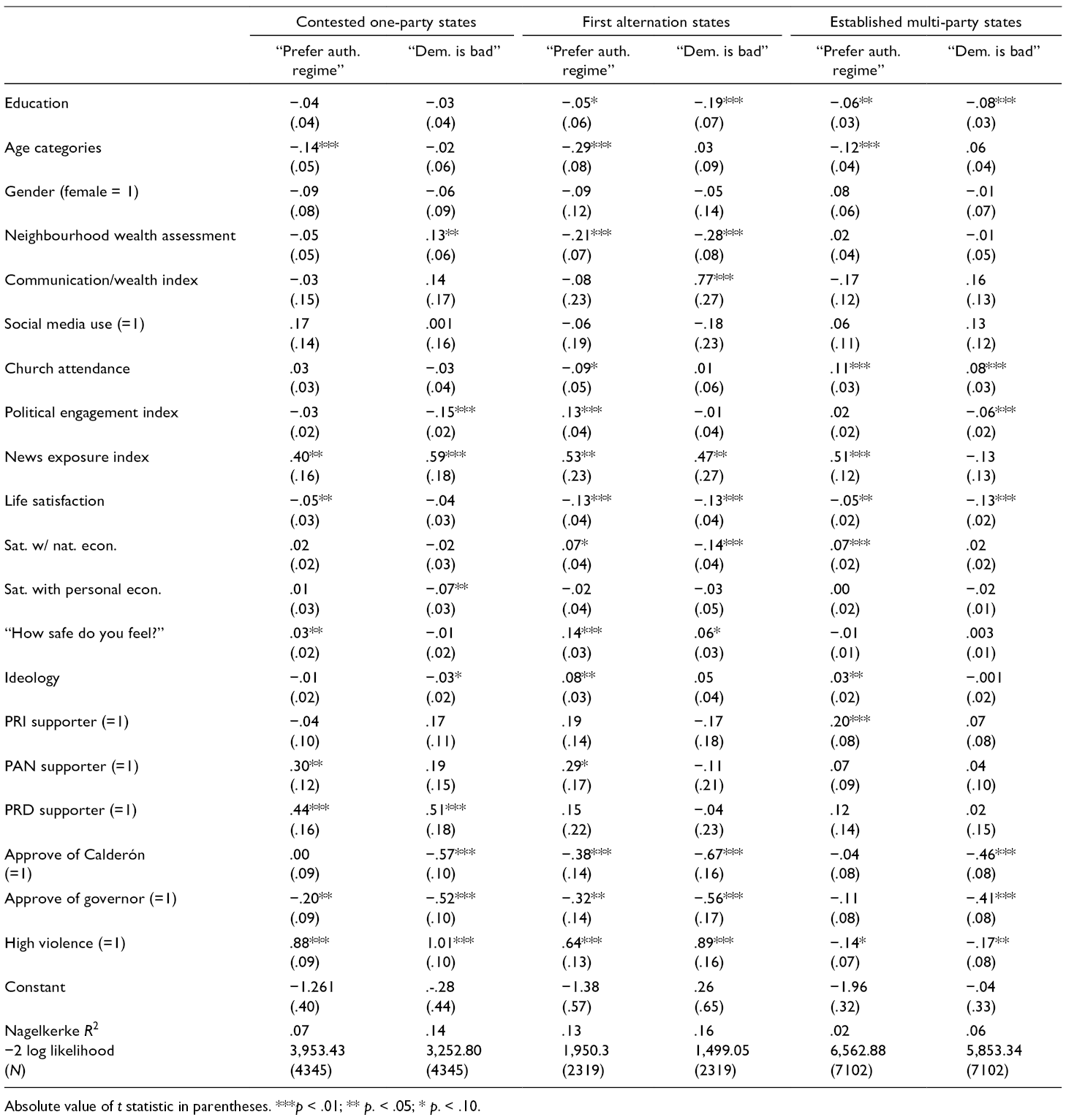
Table 3 displays the results of these analyses. Looking first at the various control variables we have included in the model, several results deserve mention. First, we find that our results for education and age largely comport with the conventional view that those with more education and older respondents are more likely to opt for the democracy options in our two items of interest. It is worth noting that this finding for age also is consistent with the idea that for older individuals the appeal of a dominant-party, authoritarian solution to the drug war violence of the first decade of the twenty-first century would be decidedly coloured by their experiences during the PRI’s disastrous years of the 1970s and 1980s, when the party managed to bankrupt the country despite discovering one of the richest oil reserves in the world. Second, our index of news exposure emerges as an important predictor of an individual’s proclivity to express reservations about democracy. Given the overwhelming prevalence of media reports about the drug war and its many victims in Mexico, it is perhaps no surprise that respondents who were more attentive to those media reports were more likely, all else equal, to view democracy as “bad for Mexico” and be more inclined to see authoritarian rule as a viable alternative. Finally, in most cases, respondents’ general satisfaction with President Calderón or the governor of their state corresponded to more support for democratic rule as well.
Opposing Democracy Across Subnational Political Systems.
Absolute value of t statistic in parentheses. ***p < .01; ** p. < .05; * p. < .10.
Moving to the variable of most interest to us, we see that the violence coefficient performs as we expect. In both the “contested one-party” and “first alternation” models, we find that respondents in those states experiencing high levels of violence were much more likely to opt for the undemocratic response than their counterparts in low-violence states. Conversely, those respondents living in “established multi-party”/high-violence contexts are in fact more supportive of democracy than those living in low-violence contexts. Once again, these results suggest highly divergent patterns of opposition to democracy depending on the interaction of one’s subnational political system and the degree of drug-related violence in their state’s political system. 28
For those states that have not yet completely moved beyond the one-party legacy of the PRI, support for democracy is high when violence is low but that support plummets when violence reaches critically high levels. In contrast, in states that were confronting such violence but had in place relatively well-established democratic political systems, respondents seemed less willing to give up on democracy. Simply put, the relationship between high levels of violence and support for democracy appears to depend in part on the characteristics of the democratic system in which the violence occurs.
Next, we run similar models using an assortment of other data and measurement strategies, including the use of overall homicide data, inclusion of respondents from the Federal District (classified as an "established multi-party" state), and a continuous treatment of the homicide variable in order to assess the degree to which our initial findings hold up to alternative data and measurement specifications.The Supplemental Appendix includes results for the following modifications:
A continuous variable using the Mexican government’s drug-war homicide data (Table 5A).
Models with dichotomous and continuous treatments of the drug-war homicide data that include respondents from the Federal District (Table 6A).
A dichotomous violence variable using the overall homicide data provided by Mexico’s census bureau (INEGI) (Table 7A).
A continuous variable using the overall homicide data provided by Mexico’s census bureau (INEGI) (Table 8A).
Models with dichotomous and continuous treatments of the drug-war homicide data that re-categorise Oaxaca, Puebla and Sinaloa as "contested one-party" states rather than "first alternation" given the timing of their first opposition governors taking office (Table 9A).
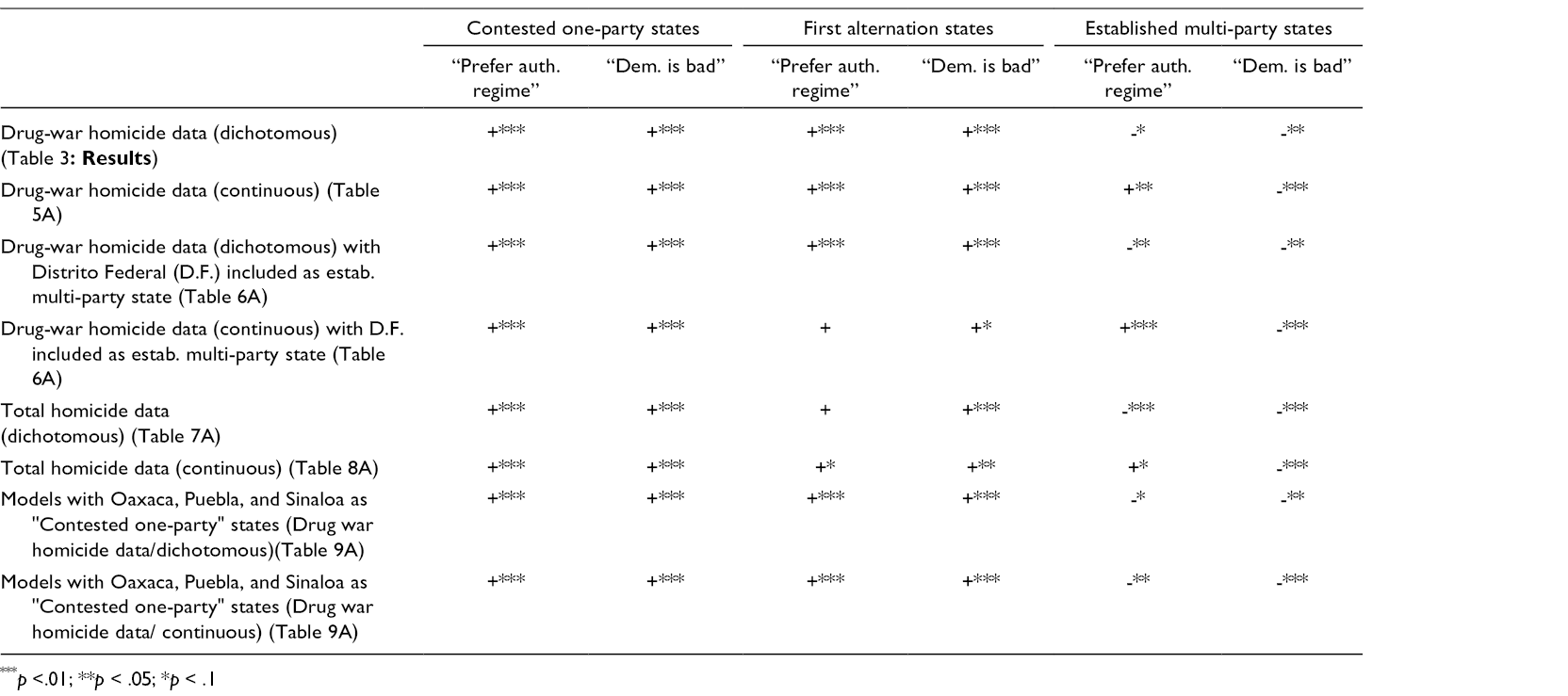
Table 4 offers a summary of these various analytical strategies and highlights the degree to which our central findings hold across these distinct sources of data and specifications of the violence measure. 29 The first row of Table 4 summarises the key findings from our models in Table 3, and compares these to the results of models with different homicide data, measurements and specifications. The results for our contested one-party states are identical across all models in terms of significance and direction. In our first alternation states, the relationship remains positive across all models, but there are some changes in significance levels, and two coefficients are no longer significant. We see slightly more variation in the results for our established multi-party systems. In these states, the results for “democracy is bad” are largely consistent with our theoretical expectations across all the models, with only minor changes in significance levels. The results for the “preference for an authoritarian regime” models, however, reveal a less robust set of findings, with the coefficients in three of the eight models emerging as positive, counter to our expectations, and significant. What this highlights, perhaps, is the impact that the difference in wording may have on respondents in established multi-party systems confronting high violence – with more individuals willing to express a preference for an authoritarian solution but not ready to pronounce democracy as "bad for Mexico.” While it is important to keep these variations in mind when discussing our results, across all of these models, the core findings from our analysis remain – respondents in states that retained strong ties to the PRI’s one-party past appear more willing to forgo democracy in the face of high levels of violence than those in established multi-party states facing similar levels of violence. Indeed, in forty-three of the forty-eight distinct models run, we found support for the propositions outlined above.
Summary of Results W/ Alternative Data/Measurement Specifications.
*** p <.01; **p < .05; *p < .1
Conclusion
Taken together, our findings indicate that variations in political systems are an important component in answering the question “How do crime and violence affect support for democracy?” The cross-sectional nature of our data does limit our ability to establish a causal relationship between the onset of drug violence and the abandonment of democracy by citizens living in certain states. Still, our data do provide the opportunity to compare citizens’ attitudes across distinct political and crisis contexts within a single country, which enhances our confidence that variations in subnational political contexts do indeed influence the ways in which the outbreak of a crisis may affect citizens’ attitudes.
Further, these findings are consistent with the many studies that have linked high levels of crime to declining levels of support for democracy, but we build upon this literature by placing the political system itself into the equation. When people respond to survey items about their views on democracy, they likely do not all have the same form of democracy in mind, nor do they share similar experiences of living in a democracy. We see these variations in political systems as essential in understanding how a crisis situation, such as a drug war with unprecedented levels of homicides, may influence levels of support for democracy.
Though our analysis focuses on the year the drug war first reached its peak in 2010, alarmingly high levels of crime and violence continue, tragically, to be a part of Mexico in 2019. 30 Further, there remains more to be done to understand the relationship between the characteristics of a political system and citizen support for democracy in a context of crisis. Our analysis focuses on one pivotal year, and sets the stage for future longitudinal analyses of the relationship between crime and support for democracy in different political contexts, as well as for the exploration of the crime-democracy relationship in other subnational units, such as municipalities. By contextualising the linkage between crime and public support for democracy, we can understand how crime erodes public support for democracy, and take into account the characteristics of the political system that citizens are being asked to support. If that political system offers very little, or is perhaps even linked with the rise in crime in the minds of citizens, then we should not be surprised when those same citizens consider other, non-democratic alternatives as a possible solution.
More importantly, our findings suggest that for those Latin American democracies (both at the national and subnational level) that have established some type of governing credibility, high levels of crime may not be as damaging to citizens’ support for democracy as previous research suggests. In other words, the stronger the democracy, the more able it is to withstand such challenges as high levels of crime and violence. Unfortunately, those countries most afflicted by drug-related violence in recent years, including Mexico and several Central American countries, arguably have some of the least established democratic systems in all of Latin America (World Bank, 2010). Further, at the subnational level, many of these countries have political systems that are decidedly less than democratic, suggesting that high levels of crime and violence in these areas will lead citizens to increasingly consider authoritarian solutions, making efforts to deepen democracy in those areas even more difficult.
Supplemental Material
Supplementary Material 1 - Supplemental material for Authoritarian Recall: Mexico’s Drug War and Subnational Patterns of Opposition to Democracy
Supplemental material, Supplementary Material 1, for Authoritarian Recall: Mexico’s Drug War and Subnational Patterns of Opposition to Democracy by Jonathan Hiskey, Mary Fran T. Malone and Alejandro Diaz-Dominguez in Journal of Politics in Latin America
Footnotes
Declaration of Conflicting Interests
The author(s) declared no potential conflicts of interest with respect to the research, authorship, and/or publication of this article.
Funding
The author(s) received no financial support for the research, authorship, and/or publication of this article.
Notes
Author Biographies
E-mail:
E-mail:
E-mail: