



Abstract
How do crime and conflict compare in relation to victims’ support for their political system? Latin American Politics scholarship has emphasized the distinct motivations of criminal and political violence. However, victims might not distinguish meaningfully between these types of insecurity. Scholars have used surveys extensively to understand crime victimization's consequences, but we know less about conflict victimization's relationship with political attitudes. Analyzing public opinion surveys from Colombia (2012–2018), we find that crime and conflict victimization share a minimal relationship with system support at the national level. In conflict zones, however, victimization from political violence corresponds negatively with system support. Decreased confidence in security forces may be the explanation. Our findings have three implications: scholars risk overemphasizing the crime-conflict distinction without micro-level insight; analyzing public opinion in areas beyond state control is necessary to build such knowledge; and, amidst acute insecurity, attention to victims has systemic importance.
Policy proposals both within and outside the region have urged Latin American states to control powerful drug trafficking organizations and street gangs with the same strategies used to fight insurgencies. In response, Latin American Politics scholarship has contributed a nuanced understanding of the differences between criminal and political violence. This contribution has revolved around a valuable insight: insurgents generally seek to conquer the state in order to govern; drug trafficking organizations and street gangs generally seek to constrain the state in order to conduct their illicit enterprises with minimal interference (Kalyvas, 2015; Lessing, 2015).
It is possible, however, that the region's citizens experience insecurity due to crime and insecurity due to political conflict in similar ways without distinguishing between perpetrators’ motivations. Moreover, it is possible that Latin American states face similar challenges in responding to these sources of insecurity (Barnes, 2017). Indeed, regional scholarship on governance by criminal organizations (Arias, 2018) and insurgent groups (Arjona, 2016) suggests that these armed actors similarly develop social and political orders. They also respond similarly to challenges from the state.
Regional scholarship has not explored these possibilities extensively. We know a great deal about the corrosive relationship between crime victimization and individuals’ perceptions of their countries’ institutions (e.g., Carreras, 2013). We know considerably less about how crime victimization compares to victimization from political conflict in shaping support for the political system. Exploring this comparison is crucial for understanding the political consequences of citizen insecurity in Latin America more comprehensively.
We contribute to this knowledge by analyzing how crime victimization versus conflict victimization relate to individuals’ support for the political system. Political system support encompasses “generalized attitudes toward the system as a whole” (Almond and Verba, 1963: 63) or “a feeling that the system can be counted on to provide equitable outcomes” (Muller et al., 1982: 241). Robust system support enables regime survival by deterring aggressive political or antisystem behavior (Finkel et al., 1989; Muller et al., 1982; Seligson, 2002). Compared to incumbent support, system support “is thought to be a far more consequential antecedent” of illegal collective actions intended to disrupt the government (Muller and Jukam, 1977: 1562). To understand political systems’ (in)stability, we therefore must examine how violence might inhibit or facilitate system support through political attitudes.
We focus on system support because democracy presupposes trust in, and satisfaction with political institutions’ performance. System support enables the survival of democratic regimes as such survival depends on the interaction between effectiveness and legitimacy (Lipset, 1960). Examining system support allows capturing this interaction's micro-foundations, a key step in the causal chain from micro-level insecurity to macro-level regime survival.
Moreover, considering (lack of) system support an enabler of antisystem behavior, it is relevant to understand the relationship between system support and different insecurity types as facilitators or inhibitors of antisystem behavior. System support also is underexplored in the crime and violence literature compared to outcomes like political behavior (see Nussio, 2019), regime support (see Blanco and Ruiz, 2013; Ceobanu et al., 2011; Visconti, 2019), and political trust (De Juan and Pierskalla, 2016; Hong and Kang, 2017). This literature gap presents an opportunity to strengthen understanding of different insecurity types and their implications for political attitudes.
Our empirical analysis centers Colombia, which has a regionally unparalleled overlap of high crime rates, internal armed conflict, and democratic regime stability. We examine LAPOP's 2012–2018 nationally representative survey data and 2015 conflict zone sample. Our primary finding is that crime victimization and conflict victimization have similarly insignificant relationships with individuals’ support for the political system. Robustness checks nonetheless suggest that victimization from political violence within conflict zones corresponds with decreased system support. Our secondary finding is that trust in security forces helps explain the negative relationship between political conflict and system support in conflict zones.
These findings suggest that, independent of insecurity type, victimization does not shape system support significantly outside conflict zones and beyond victims’ perceptions of security forces. The analysis has three main implications for research and policy. First, Latin American Politics scholarship might have overemphasized the difference between crime and conflict by under-accounting for micro-level experiences and attitudes. Second, combining public opinion surveys with scholarship on armed actors’ governance could help build our knowledge. Third, to bolster stability, states must attend to conflict victims more.
We structure the paper as follows. We begin by reviewing Latin American Politics scholarship on the relationship between crime victimization, conflict victimization, perceptions of security forces, and political system support. To introduce our case, we describe these dynamics in 2012–2018 Colombia. Next, we introduce the empirical model's main and control variables. We then present the empirical model based on 2012–2018 LAPOP nationwide samples. We analyze the LAPOP's 2015 conflict zone sample. We examine explanations based on perceptions of security and, specifically, of security forces as a factor with greater leverage over system support than victimization. We discuss our models’ results. Finally, we offer implications for Latin American Politics scholarship and for citizen security policy in Colombia and elsewhere.
Victimization, Security Forces, and System Support in Latin America
Using LAPOP survey data to examine the statistical relationship between individuals’ experiences of being victimized by crime and their political attitudes has been Latin American Politics’ main approach to understanding the micro-level implications of insecurity. Ceobanu et al. (2011) use LAPOP to show that crime victimization corresponds negatively with satisfaction with democracy but not with preference for democracy over alternative political regimes. Bateson (2012) uses LAPOP data to argue that crime victimization corresponds with increased political participation but, also, decreased satisfaction with democracy and increased support for police repression, vigilante justice, and authoritarian politics (also Visconti, 2019).
In addition, Carreras (2013) uses LAPOP to illustrate how crime victims and individuals with worse perceptions of local security support their political systems less. As crime intensifies, citizens typically become more critical of the state's ability to provide public safety, more skeptical of the judicial system's ability to punish perpetrators of crime, and less trustworthy of other citizens. Cruz and Kloppe-Santamaría (2019) use LAPOP to complicate the direction of these relationships. They illustrate how support for extralegal violence is higher not only where crime victimization is more widespread but, also, where support for the political system is lower. Altamirano et al. (2020) use LAPOP to distinguish between perceptions of crime, which correspond with decreased support for social welfare provision, and crime victimization, which correlates with increased support.
The above works vary in using LAPOP data to analyze the relationship between experiences and attitudes amidst high insecurity due to crime. However, they generally agree that crime victimization corresponds with decreased political system support. Less scholarship has used LAPOP to understand how crime victimization compares to victimization from political violence vis-à-vis system support. Main attempts include Centeno et al. (2013) and Nussio (2019) while Pérez (2003/2004), Cruz (2015), and Sung et al. (2022) highlight a potential mechanism.
Centeno et al. (2013) discuss why internal armed conflicts between the states of Colombia, El Salvador, and Mexico and the Revolutionary Armed Forces of Colombia (FARC) insurgency, street gangs, and drug trafficking organizations, respectively, have not increased political system support. Motivated by descriptive LAPOP data, these authors argue that political violence in Colombia and criminal violence in El Salvador and Mexico are similar. Outright victory by government forces is difficult in such protracted intra-state conflicts. Political system support therefore might remain limited regardless of whether government forces are undertaking mainly counterinsurgency, counternarcotics, or counter-gang efforts.
Without analyzing system support directly, Nussio (2019) uses LAPOP to show that being victimized by either crime or political violence corresponds with increased social participation in Colombia. Independent of insecurity type, victimization's psychological impact leads individuals to seek emotional support through voluntary organizations. Participation in such organizations includes “neighborly activities, religious organizations, parents’ associations, community committees, neighborhood organizations against crime, political parties and movements, municipal councils, and protests” (658). That many of these organizations are outside the political system further illustrates how crime victimization and conflict victimization might have comparably negative correlations with system support.
Additional scholarship suggests that states’ ability to protect citizens is a crucial factor in the victimization-system support relationship. Pérez (2003/2004) uses Latinobarómetro to show that crime victimization in El Salvador and Guatemala undermines perceptions of democratic legitimacy by casting doubt on police effectiveness. Cruz (2015) uses LAPOP to illustrate how experiences with, and perceptions of police misconduct decrease support for the police, criminal justice system, and broader democratic regime.
Most recently, Sung et al. (2022) use LAPOP to show that confidence in the armed forces and trust in the police decrease as crime increases and as regime instability due to factors like conflict deepens. These dynamics fuel demands for militaries to participate more in policing and for police to assume the limited accountability, heavy weaponry, lethal training, and centralized and hierarchical structures of militaries. Such law enforcement militarization risks undermining democratic governance by exacerbating insecurity, fueling human rights violations, and eroding accountability.
Taken together, these works imply that security forces represent political systems’ ability to protect citizens. They also imply that, whether perpetrated by insurgents or gang members, victimization corresponds negatively with confidence in security forces. Another implication is that victimization from either insecurity type corresponds negatively with system support.
Victimization and System Support in Colombia
Latin American Politics scholarship evidently suggests that Colombia is a generative case for understanding the relationship between crime, armed conflict, confidence in security forces, and system support (Centeno et al., 2013; Nussio, 2019). As per our subsequent methodological section, we use both LAPOP's 2012–2018 nationwide survey and 2015 conflict zone-specific survey in Colombia to examine the correlation between victimization from crime versus conflict, on the one hand, and support for the political system, on the other.
The 2012–2018 timeframe in Colombia is illustrative of the dynamic relationship between crime, conflict, and system support. It encompasses Juan Manual Santos’ presidency, which involved counterinsurgency warfare against the FARC and National Liberation Army (ELN), a 2012 victims reparation and land restitution law, 2016 FARC peace accords, and initial ELN peace talks. A slim majority voted against Santos’ 2016 plebiscite to ratify the FARC peace accords, demonstrating how Colombians were divided in support for political efforts at conflict resolution (Comisión de la Verdad, 2022: 540–568).
Some research suggests that both victimization from (Dávalos et al., 2018), and local experience with (Branton et al., 2019; Esparza et al., 2020) conflict corresponded with increased support for the peace accords. Other work claims that local experience outweighed individual experience (García-Sanchez and Camilo Plata-Caviedes, 2020; Meernik, 2020). A renegotiated peace agreement took effect in late 2016. While many Colombians’ policy priorities began to focus more on anticorruption than security, assassinations of social leaders increased dramatically in 2017 and 2018 (Comisión de la Verdad, 2022: 540–568).
Amidst these conflict developments, Santos also deepened state efforts to dismantle large-scale criminal organizations like the Clan del Golfo. Santos concurrently sought to increase public and local participation in public safety planning. Santos shifted Colombia's crime reduction approach from combatting extortion and kidnapping, specifically, to fostering social peace through prevention and institution building (Gélvez-Ferreira et al., 2023: 138–140).
Colombia nonetheless exhibited extreme militarization during this period. The National Police, which are under Ministry of Defense command, had levels of accountability, weaponry, training, and hierarchy that are typical of militaries. The Army conducted domestic security operations that are typical of police (Aviles, 2020; Sung et al., 2022).
We can preview our analysis by illustrating the extent of crime versus political violence, including within and beyond conflict zone, from 2012 to 2018. Municipal-level data (Universidad de los Andes, 2021) helps proxy for the extent to which certain crime and conflict events occur in a conflict zone by determining whether they happen where coca is cultivated. Coca, a traditional Andean crop that today is an essential raw material for producing cocaine, reflects and reinforces Colombia's criminal and conflict dynamics (Britto, 2020).
This preliminary analysis implies that, in municipalities with coca, crime was less likely to occur between 2012 and 2018. It also implies that political violence was more likely to occur in such places. We thus might expect LAPOP's 2015 conflict zone survey to capture more conflict over crime victimization than LAPOP's 2012–2018 nationwide surveys.
On the one hand, Colombians reported 1,628,628 instances of theft, 34,971 instances of extorsion, and 276,767 instances of violent threats. Less than seven per cent of theft and 18 per cent of extorsion occurred in municipalities with coca while 53 per cent of violent threats occurred in such municipalities. Half of the 1,280 homicides, 22 per cent of the 504 kidnappings, and 20 per cent of the 143 terrorist acts attributed to either criminal or demobilized paramilitary groups occurred in municipalities with coca (Universidad de los Andes, 2021).
On the other hand, 73 per cent of the 501 homicides, 58 of the 100 kidnappings, and 68 per cent of the 996 terrorist acts attributed to the FARC or ELN occurred in municipalities with coca. Fifty-seven per cent of the 871 reports of land abandonment or dispossession occurred in such municipalities. Of the 1,568,753 Colombians who were forcibly displaced, 66 per cent were displaced from municipalities with coca (Universidad de los Andes, 2021).
We also see variation in the number of victims reported for each insecurity type. LAPOP's 2012–2018 national samples suggest that 49 per cent of Colombians have been a victim of conflict by proxy, defined as having a relative who has been victimized by forced displacement, forced expatriation, kidnapping, or land dispossession. Approximately half of Colombians therefore know a conflict victim. Meanwhile, 23 per cent report having been a victim of robbery, burglary, assault, fraud, blackmail, extortion, violent threats, or another type of crime within the past 12 months.
That half of Colombians know a conflict victim itself is daunting and has important implications for ongoing transitional justice and reparation programs. The state might have long-lasting debts with victims and with victims by proxy. Expecting conflict victimization to correspond significantly and negatively with political system support therefore is reasonable.
In the LAPOP samples, crime and conflict victimization are positively correlated and 13 per cent of respondents report having been victims of both insecurity types. A Pearson
LAPOP's 2015 conflict zone sample suggests that more residents of such zones know a conflict victim than report being a crime victim. Sixty-three per cent report being a victim by proxy. Fourteen per cent report having been victimized by crime within the past 12 months.
The extent of conflict victimization is reflected in what Colombians consider their country's main problems. 1 LAPOP's national samples suggest that the economy and conflict were the most important problems, followed by crime issues, in 2012 and 2014.
Likely due to the FARC peace accords, this distribution changed in 2018. The economy alone became the most important problem. The percentage considering conflict the main problem decreased by two-fifths. This change pushed conflict to the fourth most important problem, closer to the position of crime. Figure 1 illustrates these trends.
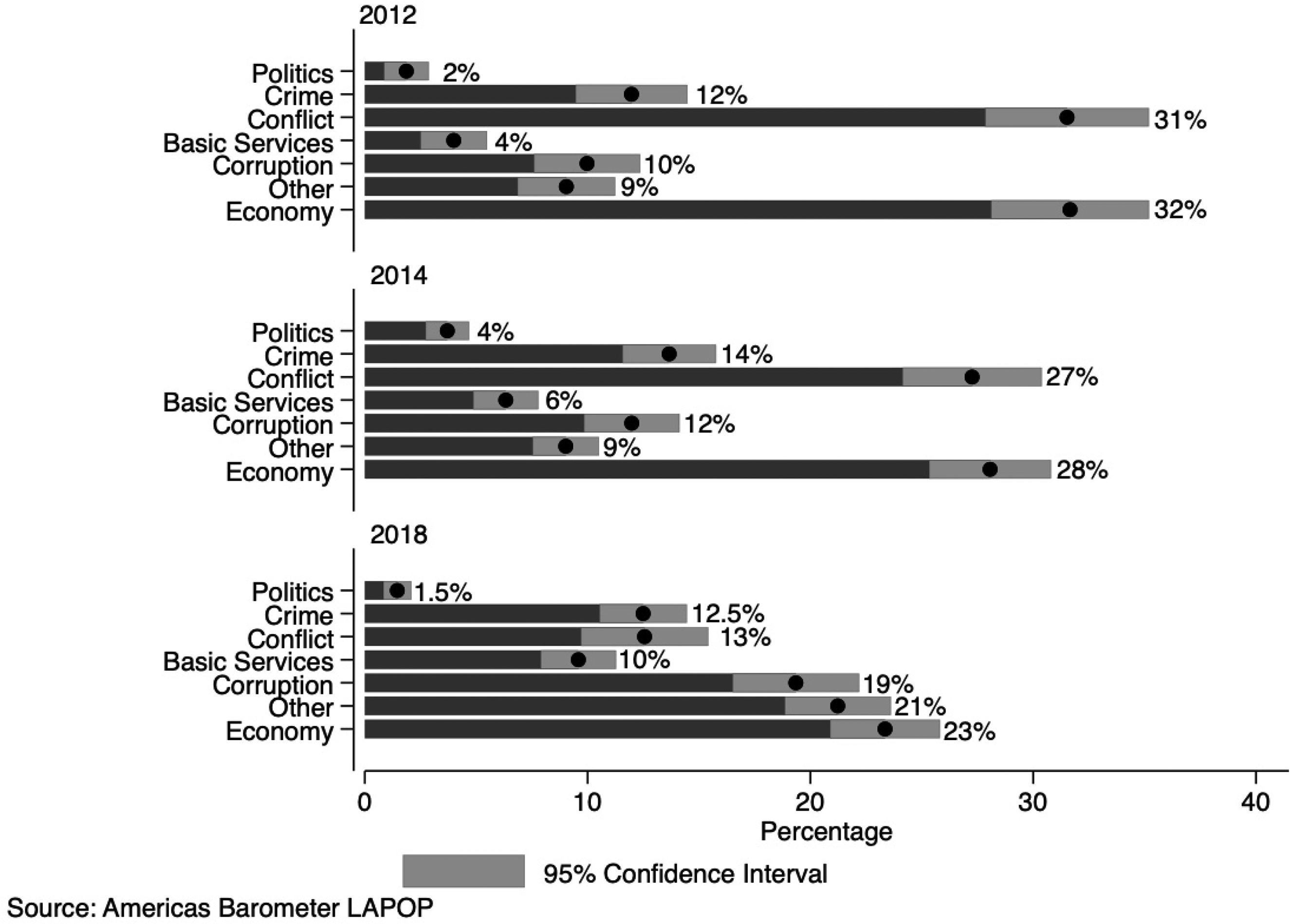
Main problem that the country is facing, 2012–2018. Source: LAPOP (2023a).
Given similarities in how Colombians came to prioritize conflict and crime as their country's main problems, these experiences and perceptions might have similar implications for political system support. We use 2012–2018 LAPOP data on Colombians’ victimization and system support to probe this possibility. These surveys are representative at the country level, using a national multi-stage probability design of voting-age adults stratified by geographical regions and sub-stratified by size of municipality and urban–rural areas within municipalities. 2 Each annual sample has approximately 1,500 participants.
We then use LAPOP's 2015 conflict zone survey, with 1,390 respondents. It has similar questions related to victimization and system support. LAPOP designed the conflict zone survey for a representative sample of areas that the Colombian government's Territorial Consolidation policy had targeted. This policy prioritized areas with presence of FARC insurgents and coca cultivation (García Sánchez et al., 2015: 107–110). 3
Operationalization of Victimization and System Support
We operationalize the outcome variable with LAPOP's system support index (Zechmeister and Lupu, 2019). This index is based on Muller and Jukam (1977)'s system affect measure and revised by Seligson (1983) as the Political Support-Alienation scale, coining Muller's (1979) nomenclature. The scale measures affect as diffuse political support, a concept that captures “the sense of belief in the legitimacy of the system of government” (Muller and Jukam, 1977: 1566). It is distinct from political trust and the more short-term incumbent affect. The index has been cross-nationally validated (Cassell et al., 2018; Finkel et al., 1989; Muller et al., 1982; Seligson, 1983; Seligson and Carrión, 2002).
System support is a “wide-ranging, multifaceted concept, for which single-item indicators are inappropriate” (Muller and Jukam, 1977: 1567). We therefore follow previous work in using an additive index of the following five survey questions that respondents answer on a scale from 1 (“not at all”) to 7 (“a lot”): (1) To what extent do you think the courts in Colombia guarantee a fair trial?, (2) To what extent do you respect the political institutions of Colombia?, (3) To what extent do you think that citizens’ basic rights are well protected by the political system of Colombia?, (4) To what extent do you feel proud of living under the political system of Colombia?, and (5) To what extent do you think that one should support the political system of Colombia?
This measure of system support reflects three interrelated perceptions (Muller and Jukam, 1977: 1566) of the political system's legitimacy, or its appropriateness and effectiveness (March and Olsen, 2011): how well the system upholds basic political values in which a person believes, captured by Item 3; how well the authorities conform to a person's sense of what is right, captured by Item 1; and how well institutions conform to a person's sense of what is right, captured by Items 2, 4, and 5.
Our study does not disaggregate system support empirically into its three components. However, we would expect both crime and conflict victimization to correspond negatively with each component based on a cascading logic. First, independent of whether the perpetrator is an insurgent or a gang member, victimization engenders negative perceptions of how effectively the political system upholds basic political values like the fundamental rights to life, liberty, and personal security. Second, these threats to basic political values lead individuals to desire remedies from relevant authorities. They realize, however, that authorities’ ineffectiveness enabled their victimization in the first place. This dilemma reduces individuals’ respect for the appropriateness of authorities. Third, as respect for authorities decreases, perceptions regarding the legitimacy of the institutions that comprise the system also decreases.
If our data suggests that the relationship between victimization and system support varies with victimization type, one of two potential mechanisms likely would explain how. The first is perception of insecurity. If an individual considers crime a greater problem, this perception might increase the importance of crime over conflict victimization in shaping system support (Carreras, 2013). The second mechanism is perceptions of relevant authorities, which relates closely to the second component of system support.
Conventionally, preventing crime is a police responsibility while waging armed conflict is a military responsibility (Aviles, 2020; Sung et al., 2022). If an individual views the police as behaving less appropriately and less effectively than the military, this perception therefore might increase the importance of crime over conflict in shaping system support. Perceptions of insecurity and of security forces’ legitimacy, in these ways, might have greater leverage than experience with insecurity in shaping system support.
This second mechanism challenges the assumption that all three perceptions of system support move similarly in response to victimization. It suggests instead that each perception might shape system support changes differently. We do not analyze mechanisms related to each independent perception. As a starting point, we propose analyzing a mechanism linked to the second perception (how well the authorities conform to a person's sense of what is right). This perception best captures the intersection between effectiveness and legitimacy.
Our analysis uses a battery of indirect questions to measure conflict victimization. LAPOP asks respondents whether a relative has been a victim of different types of political violence, including forced displacement, kidnapping, murder, and/or land dispossession. 4 We code respondents as 1 to indicate conflict victimization if they answer any of these questions affirmatively and, otherwise, as 0.
Such indirect framing of conflict victimization questions aims to curb under-reporting, social desirability bias, and fear of retaliation (Fisher, 1993; McNeeley, 2012). LAPOP does not ask whether respondents themselves have experienced such types of political violence. However, measuring individual conflict experiences dichotomously based on answers to these indirect questions about relatives is consistent with other scholarship on victimization in Colombia (Nussio, 2019). In addition, the Colombian armed conflict's pattern of violence involves extensive social group targeting (Gutiérrez-Sanín and Wood, 2017). Individuals with victimized relatives might be more likely to have been victimized themselves if armed actors use kinship networks to select targets.
We use the following LAPOP question to measure crime victimization: “Have you been a victim of any type of crime in the past 12 months? That is, have you been a victim of robbery, burglary, assault, fraud, blackmail, extortion, violent threats, or any other type of crime in the past 12 months?” We code this variable as 1 if respondents answer affirmatively and, otherwise, as 0.
We control for other factors that could influence system support. System support could be greater among individuals who consider the state more effective at providing public services, a key state capacity indicator (Cárdenas, 2010). We control for satisfaction with public service provision using the following LAPOP question: “Would you say that the services the municipality is providing to the people are…? (1) Very good (2) Good (3) Neither good nor bad (fair) (4) Bad (5) Very bad.” We invert the responses’ order for ease of interpretation. 5
System support also could be greater among those who consider the elite more responsive to citizens’ needs. Views of elite responsiveness are key measures of “external efficacy” or citizens’ perceived ability to influence the political system (Rhodes-Purdy, 2017). We control for elite responsiveness perceptions with the following LAPOP question: “Those who govern this country are interested in what people like you think. How much do you agree or disagree with this statement?” Response options are scaled from “1” (“Strongly Disagree”) to “7” (“Strongly Agree”).
Additional controls include age, gender, ethnicity, years of education, urban versus rural residence, religiosity, and ideology. Full descriptive statistics for the national and conflict zones samples are in Tables S2 and S3 of the online appendix.
This paper constitutes an exploratory examination, not an attempt at causal inference, of the relationship between victimization and system support. We lack exogeneity leverage to determine whether victimization affects political system support, or vice versa, and to control for numerous additional confounders. We therefore frame our analysis in terms of correlations and correspondences between variables, not effects, where necessary.
Structural Equation Model of System Support
Our structural equation model is as follows:

The subscript i represents each individual observation for survey participants.
We estimate our models with ordinary least squares, accounting for survey weights. Our specification helps address concerns with omitted variable bias by controlling for demographic characteristics, time-variant unobservables, and time-invariant unobservables. We nonetheless are cautious about asserting causal claims. We cannot rule out endogeneity due to simultaneity, measurement error, recall and social desirability biases, and collinearity. To address collinearity concerns, we estimate different specifications of the main model to examine coefficient variation.
We are confident that LAPOP minimizes potential endogeneity due to simultaneity. It does so by asking about crime victimization in the 12 months preceding the date of survey administration. This questioning suggests that victimization occurs before reported system support as collected on the survey date. Similarly, LAPOP’s indirect questioning about conflict victimization limits concerns with social desirability bias. The limitations of our analysis therefore are those shared by most observational studies. Although not indicative of causal effects, our results are suggestive of the relationship between the phenomena of interest and robust to several checks.
Statistical Models of Victimization and System Support
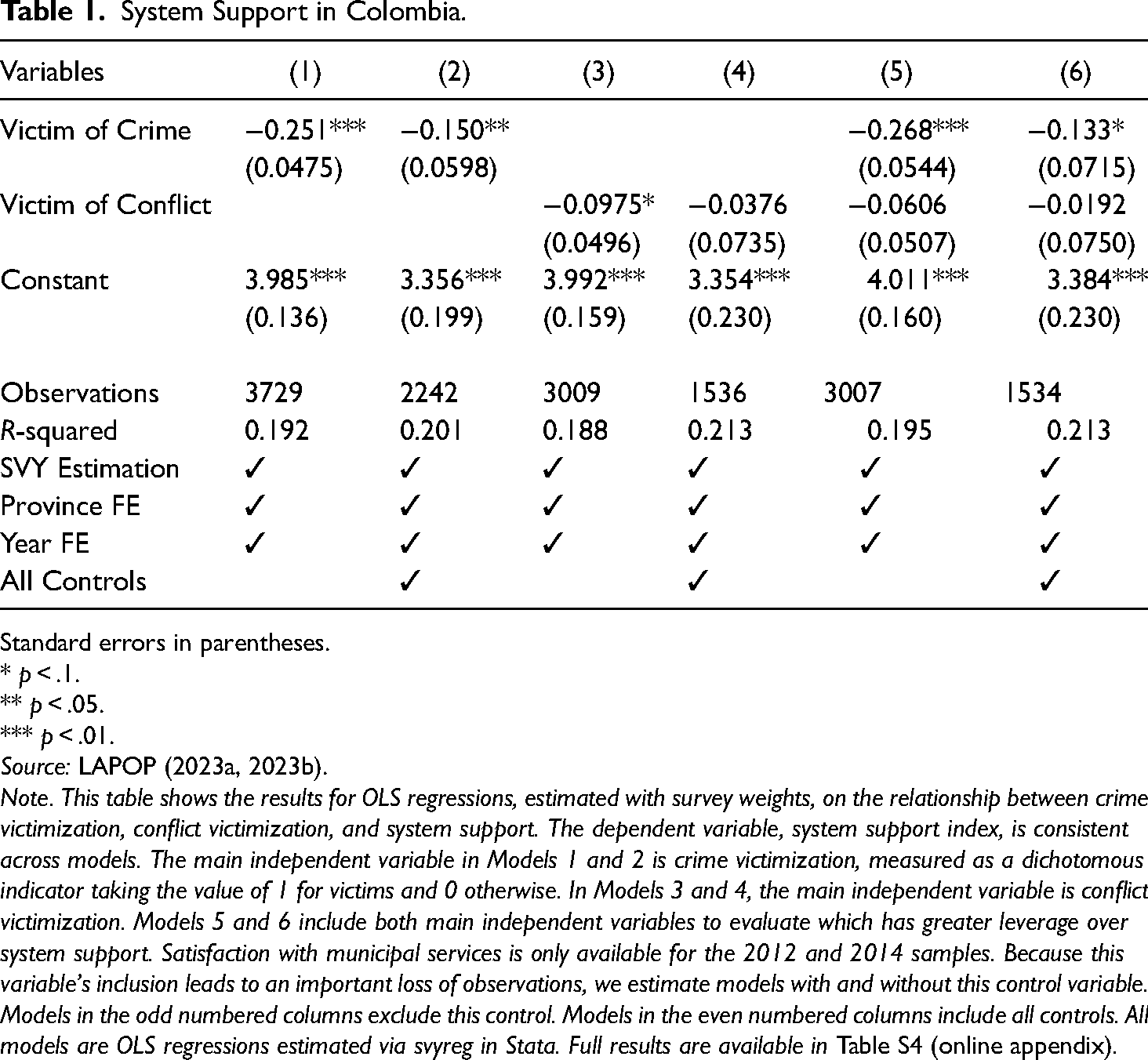
Models in Table 1 show the relationship between crime victimization and system support for the Colombian national representative sample. The results in Models 1 and 2 suggest that crime victimization corresponds with lower levels of system support. The same does not hold with conflict victimization. In Models 3 and 4, conflict victimization has little to no leverage in shaping system support. Indeed, when including both victimization types in Models 5 and 6, we see that crime victimization correlates negatively and significantly with system support while conflict victimization's coefficient is not statistically different from zero. This null result might reflect the comparatively low conflict victimization levels beyond conflict zones.
System Support in Colombia.
Standard errors in parentheses.
* p < .1.
** p < .05.
*** p < .01.
Source: LAPOP (2023a, 2023b).
Note. This table shows the results for OLS regressions, estimated with survey weights, on the relationship between crime victimization, conflict victimization, and system support. The dependent variable, system support index, is consistent across models. The main independent variable in Models 1 and 2 is crime victimization, measured as a dichotomous indicator taking the value of 1 for victims and 0 otherwise. In Models 3 and 4, the main independent variable is conflict victimization. Models 5 and 6 include both main independent variables to evaluate which has greater leverage over system support. Satisfaction with municipal services is only available for the 2012 and 2014 samples. Because this variable's inclusion leads to an important loss of observations, we estimate models with and without this control variable. Models in the odd numbered columns exclude this control. Models in the even numbered columns include all controls. All models are OLS regressions estimated via svyreg in Stata. Full results are available in Table S4 (online appendix) .
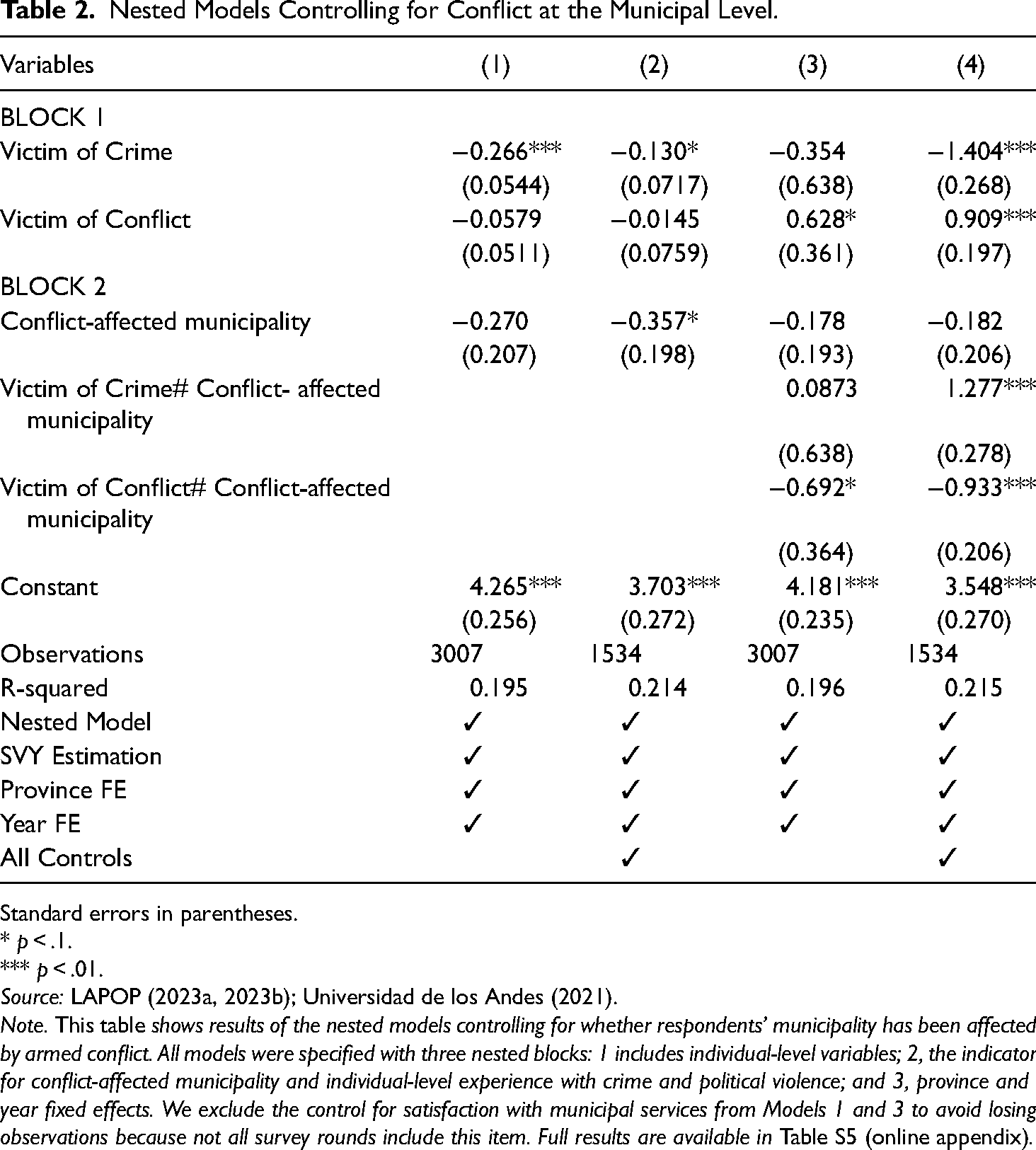
We also replicate Models 5 and 6 by including a time-invariant dichotomous indicator of whether a respondent's municipality previously had experienced violence by at least one of the three strongest non-state armed groups in Colombia's armed conflict: the FARC insurgency; the United Self-Defense Forces of Colombia (AUC) paramilitary; and the ELN insurgency. We construct this indicator with the Center for Studies on Economic Development's (CEDE) municipal data on the Colombian conflict from 1993 to 2011 (Universidad de los Andes, 2021). 7 Including data up to one year before the first LAPOP survey round limits simultaneity bias. We estimate them as nested (hierarchical) models because they pool individual- and municipal-level data. The models are in Table 2 and the online appendix (Tables S5–S9).
Nested Models Controlling for Conflict at the Municipal Level.
Standard errors in parentheses.
* p < .1.
*** p < .01.
Source: LAPOP (2023a, 2023b); Universidad de los Andes (2021).
Note. This table shows results of the nested models controlling for whether respondents’ municipality has been affected by armed conflict. All models were specified with three nested blocks: 1 includes individual-level variables; 2, the indicator for conflict-affected municipality and individual-level experience with crime and political violence; and 3, province and year fixed effects. We exclude the control for satisfaction with municipal services from Models 1 and 3 to avoid losing observations because not all survey rounds include this item. Full results are available in Table S5 (online appendix).
The results show that past contextual violence on its own does not have a statistically significant correlation with system support. However, conflict victims in conflict-affected municipalities have significantly lower system support than conflict victims residing in unaffected municipalities. Crime victims in conflict-affected municipalities report higher levels of system support compared to crime victims in unaffected municipalities. 8
Figure 2 shows the predictive margins of the interactions in Model 4. It illustrates how victims of crime in unaffected municipalities report lower levels of system support, echoing the negative sign of the coefficient for crime victimization. It also illustrates how victims of conflict in unaffected municipalities report higher levels of system support, echoing the positive sign of the coefficient for conflict victimization. These results highlight that proximity to conflict by itself does not account for system support and that it is necessary to analyze further these dynamics in conflict-affected zones.
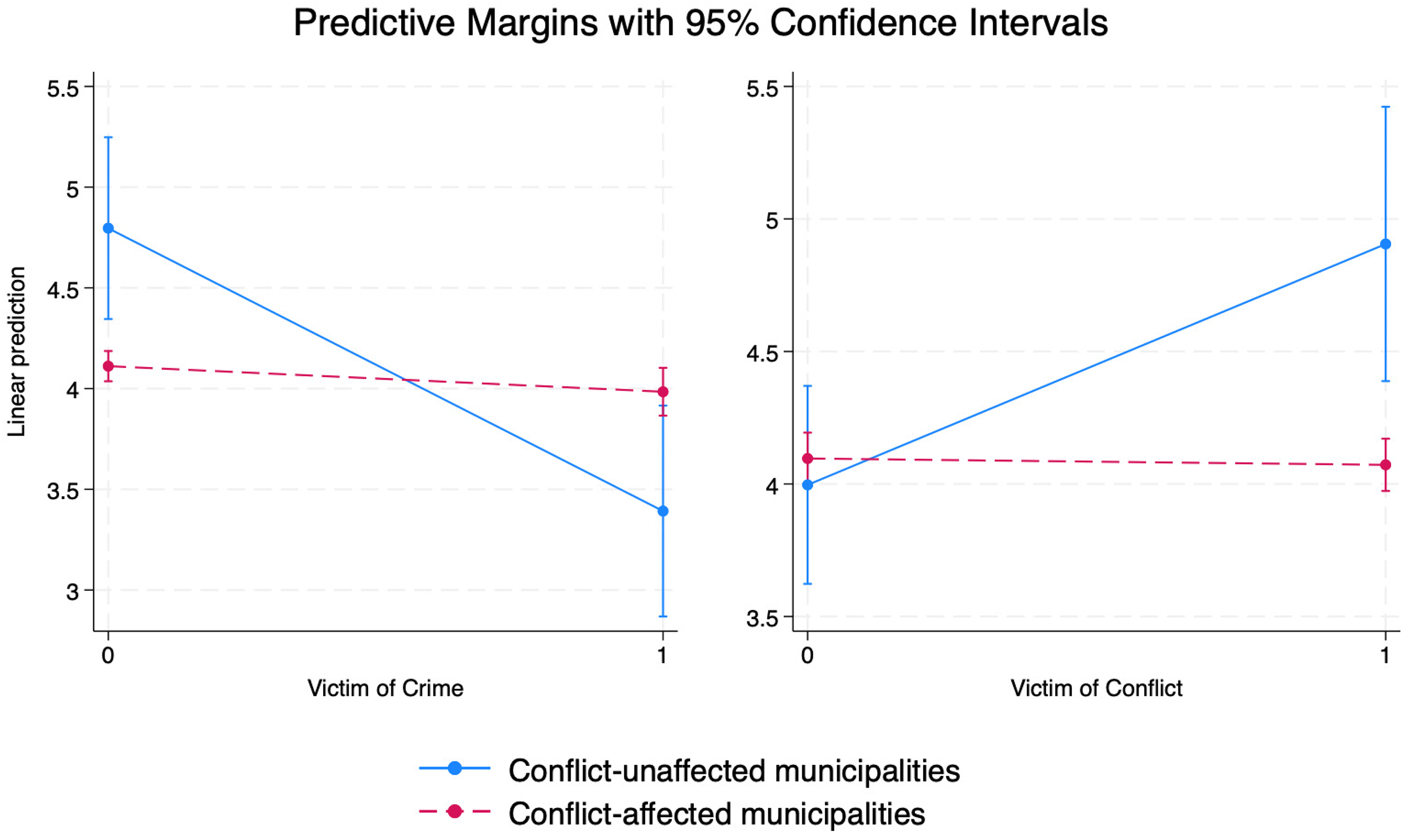
Predictive Margins of System support. Source: LAPOP (2023a, 2023b); Universidad de los Andes (2021).
Considering these results and how crime and violence dynamics differ in conflict zones, we replicate the previous analysis using data on conflict zones from a special LAPOP sample. 9 This survey round was fielded in 2015. The sample is representative of the population in the most conflict-affected territories. Compared to the national sample, respondents in this special sample experience more conflict victimization and less crime victimization.
The conflict zone sample includes smaller, more rural municipalities with lower education levels, indicating weaker state presence (García Sánchez et al., 2015). This sample thus offers important insights on how conflict victimization can shape system support where state capacity is limited.
Some LAPOP questions used in our previously presented models were excluded from this survey round. We substitute these questions with alternative but similar survey items. We lack a perfect overlap on survey items. Our model of the 2015 survey therefore replaces the measure on quality of municipal public services from the previously presented models with an index of the quality of healthcare, electricity, and water and sewage services. 10
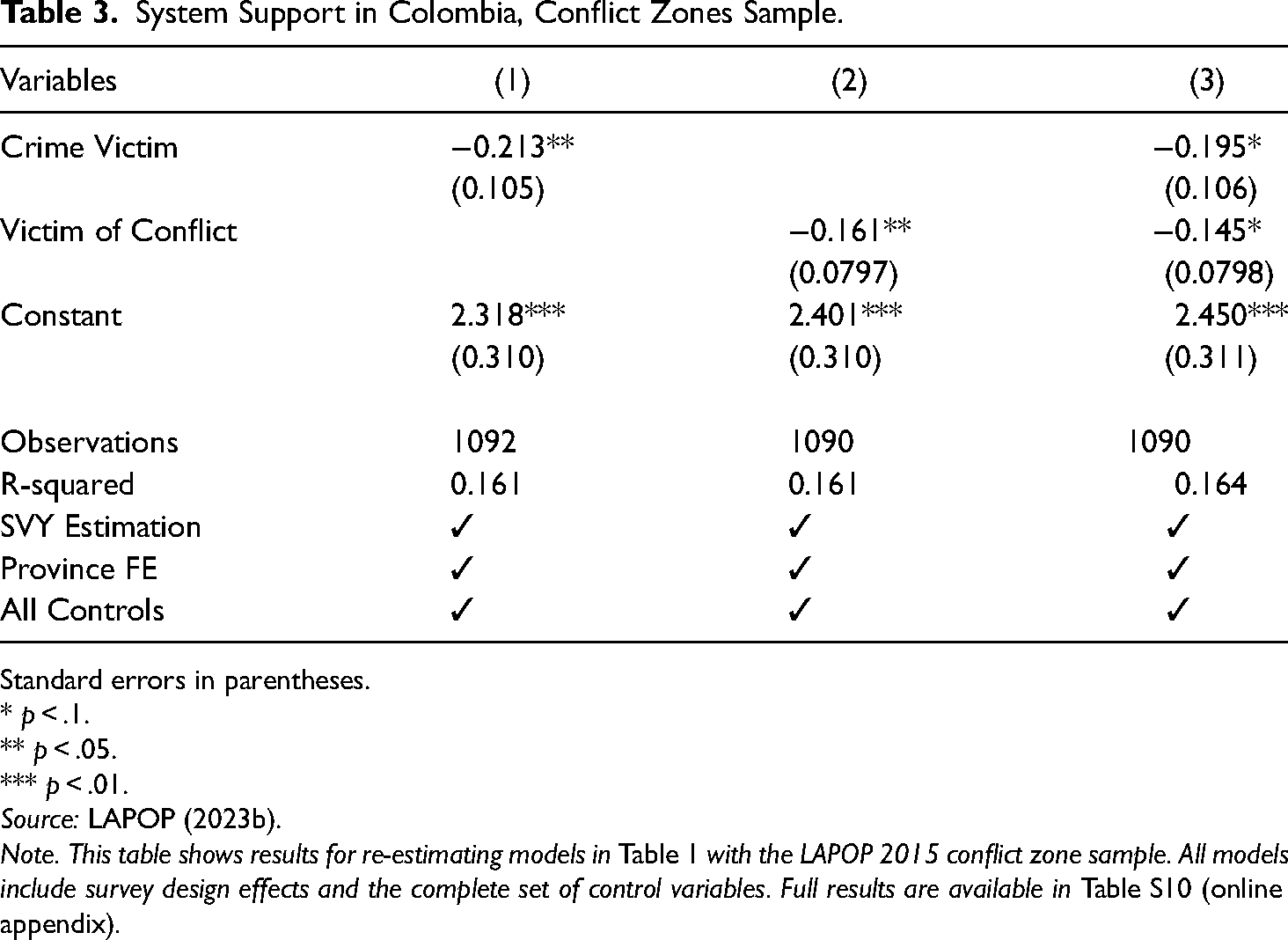
Table 3 shows the results of this analysis, suggesting that both crime and conflict victimization correspond with system support in conflict zones. Both victimization types correlate negatively with system support and have statistically significant coefficients even with all control variables, although not at conventional levels in Model 3.
System Support in Colombia, Conflict Zones Sample.
Standard errors in parentheses.
* p < .1.
** p < .05.
*** p < .01.
Source: LAPOP (2023b).
Note. This table shows results for re-estimating models in Table 1 with the LAPOP 2015 conflict zone sample. All models include survey design effects and the complete set of control variables. Full results are available in Table S10 (online appendix).
These results suggest that, although victimization has an important impact on system support in conflict zones, different victimization types have different impacts. Conflict victimization shapes system support more within conflict zones than within Colombia overall. While they might stem from sample design differences, such divergences between conflict and non-conflict zones highlight the need for further exploration of victimization-support dynamics in conflict zones. The next section offers such analysis.
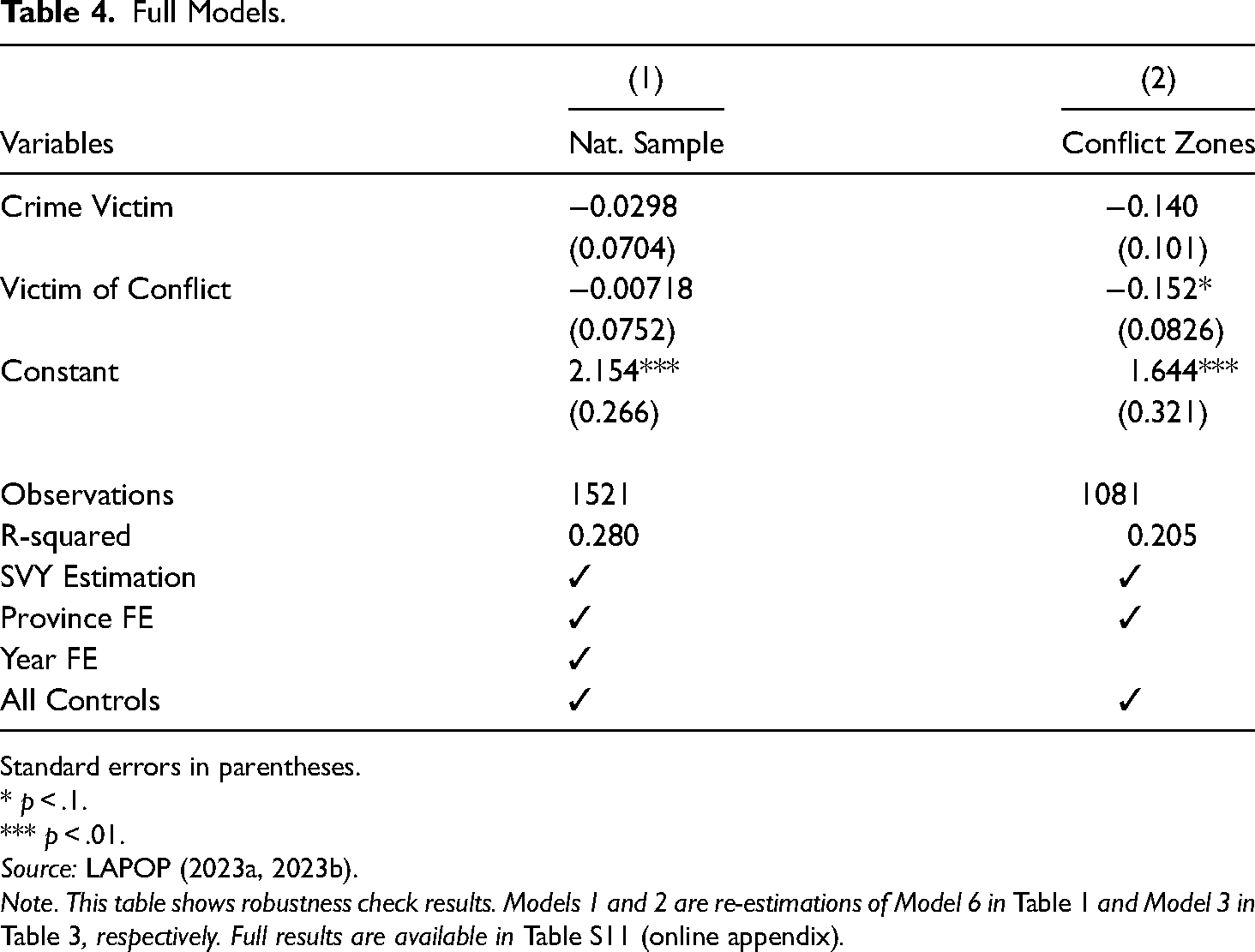
We evaluate our full models’ robustness by adding two variables that might correspond positively with system support. These are respondents’ economic situation 11 (Córdova and Seligson (2010) and evaluation of presidential performance (Ortíz Ayala and Sánchez (2014). Table 4 presents the results. The results for victimization by political violence in conflict zones hold even with these controls (Model 2). However, both victimization types lose statistical significance in the national sample (Model 1). Economic situation and presidential evaluation absorb victimization's significance. This suggests that, outside conflict zones, economic situation and presidential evaluation have stronger leverage than either victimization type on system support.
Full Models.
Standard errors in parentheses.
* p < .1.
*** p < .01.
Source: LAPOP (2023a, 2023b).
Note. This table shows robustness check results. Models 1 and 2 are re-estimations of Model 6 in Table 1 and Model 3 in Table 3, respectively. Full results are available in Table S11 (online appendix).
Victimization, Trust in Security Forces, and System Support in Conflict Zones
Our analysis has shown that crime victimization and conflict victimization have different leverage on system support in conflict and non-conflict areas. We now examine what is driving the consistently negative impact of conflict victimization in conflict zones by considering mechanisms that could link victimization type and system support.
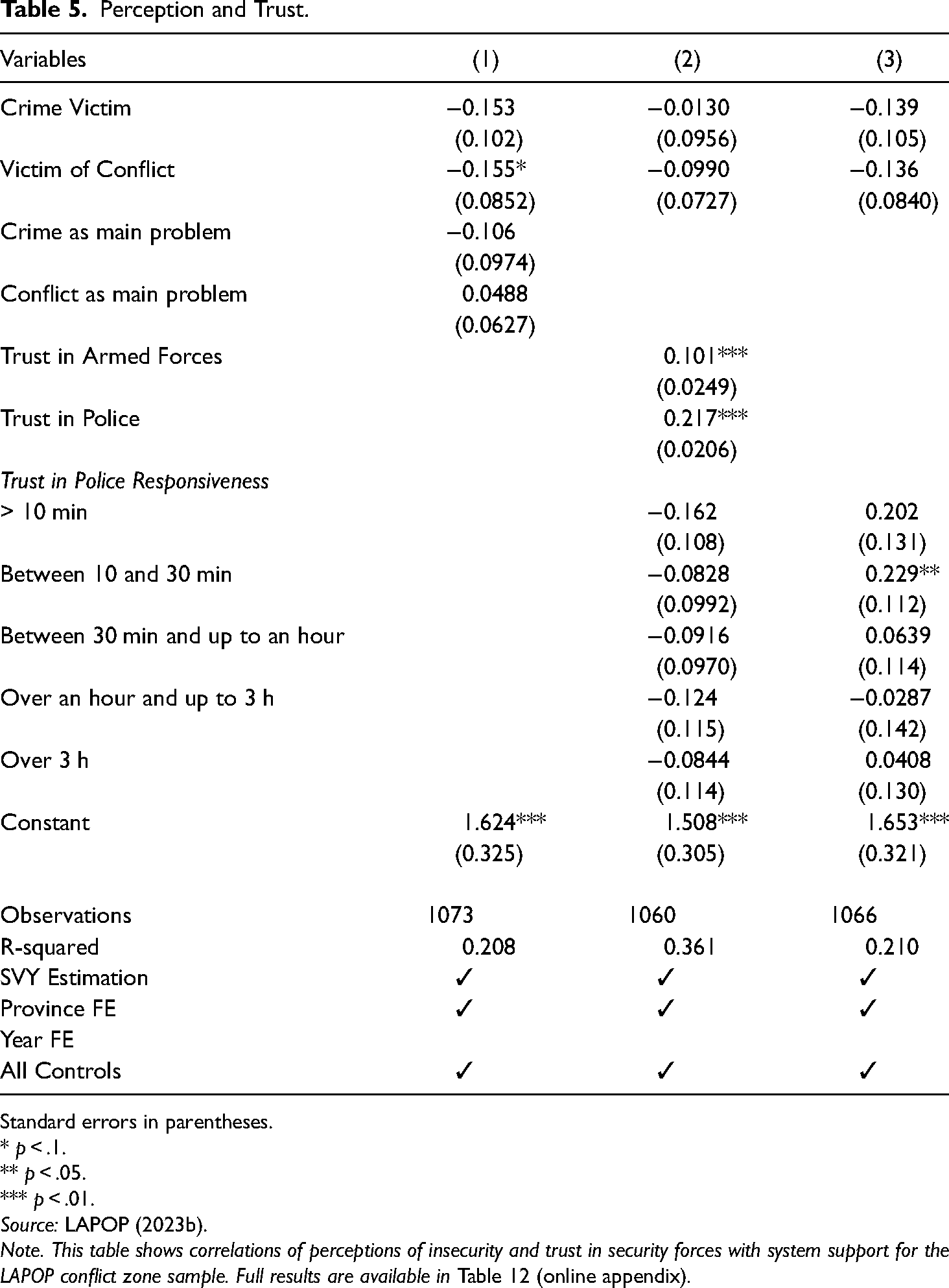
Regarding the first potential mechanism, Carreras (2013) suggests that perceptions of insecurity help explain the victimization-support relationship. We therefore re-estimate Model 2 in Table 4 with dichotomous indicators of whether individuals consider crime or conflict Colombia's most serious problem. Table 5 presents the results. Conflict victimization remains statistically significant at p < .1, implying that perceptions of insecurity do not dilute conflict victimization's impact on system support and are not what drives our results.
Perception and Trust.
Standard errors in parentheses.
* p < .1.
** p < .05.
*** p < .01.
Source: LAPOP (2023b).
Note. This table shows correlations of perceptions of insecurity and trust in security forces with system support for the LAPOP conflict zone sample. Full results are available in Table 12 (online appendix) .
Regarding perceptions of relevant authorities, we examine how victimization relates to system support through trust in police and military forces. Because the police and military represent the political system's and its security institutions’ ability to protect citizens, we analyze how their perceived performance shapes system support (Cruz, 2015; Pérez, 2003/2004; Sung et al., 2022).
LAPOP includes two direct questions about trust in the police and military forces. Including these items in Model 2, Table 5 statistically dilutes the impact of conflict victimization on system support. It suggests that trust in police impacts system support more than trust in the military. 12 However, these questions might capture diffuse system support instead of confidence in police and military capacity. To address this issue, in Model 3 we switch trust in the police and military for the following survey question about perception of police capacity: “Suppose someone enters your home to burglarize it and you call the police. How long do you think it would take the police to arrive at your house on a typical day around noon? 1) Less than 10 minutes, 2) Between 10 and 30 minutes, 3) More than 30 minutes and up to an hour, 4) More than an hour and up to three hours, 5) More than three hours, 6) [not read to interviewees] There are no police/they would never arrive.”
Table 5, column 3 presents the results. Perception of police capacity to respond dilutes victimization's impact on system support. The coefficient for conflict victimization loses statistical significance and magnitude. This result echoes our previous finding on trust in police, highlighting the centrality of law enforcement in conflict zones. While police response may depend on time-invariant province-level factors like topography, our model accounts for such factors through province fixed effects.
LAPOP has no equivalent survey item regarding the military. We take into consideration how both the Army and National Police fall under Colombia's Ministry of Defense, have counterinsurgency and counternarcotics missions, and perform some overlapping tasks (Sung et al., 2022). Perhaps due to this similar institutional profile, trust in police and trust in the military are strongly and positively correlated. 13 Therefore, we consider Model 3 a reflection of confidence in security forces overall and how it drives conflict victimization's impact on system support in Colombia.
Discussion of Findings on Victimization, Security Forces, and Political System Support
We have aimed to enhance micro-foundational knowledge of the crime-conflict distinction by analyzing how different victimization types relate to individuals’ support for the Colombian political system. Our multi-variate statistical analysis offers descriptive evidence to suggest that, beyond conflict zones, crime victimization crowds out conflict victimization in decreasing individuals’ support for the system. However, executive approval and economic considerations dilute this impact. Within conflict zones, the relationship between victimization from political violence and system support is not weakened by either economic considerations or executive approval.
We suggest that the mechanism through which conflict victimization relates to system support in such areas is trust in security forces’ capacity. Besides capacity, low trust in security forces’ may occur because their incursions into such areas incentivize insurgents to increase violence against civilians. Incursions thus disrupt rebel-imposed social orders. This disruption leads civilians to blame the political system that these government forces represent for this decrease stability and for their personal suffering and trauma (Arjona, 2016). Such incursions also could lead security forces to commit violence against civilians who, due to living in insurgent-controlled areas, are seen by soldiers as ideological enemies (Ortiz-Ayala, 2021b).
In coca cultivation areas, specifically, security forces’ incursions aimed at forcibly eradicating illicit crops tend to result in state violence against civilians (Ortiz-Ayala, 2021a) and in civilians’ resentment for destruction of their livelihoods. These dynamics fuel perceptions that state agents behave inappropriately and ineffectively, likely undermining system support (Acero and Thomson, 2021). We have offered initial statistical evidence of these conflict zone dynamics to link political violence victimization and system support.
Regarding internal validity (Gerring, 2012), we have examined conflict victimization through indirect LAPOP questions that proxy for respondents’ experience with political violence. Measuring victimization with more direct questions that are sensitive to respondents’ trauma and with additional survey analysis (e.g., Roper Center for Public Opinion Research, 2020) could help examine how accurately our results have captured Colombia's victimization-support dynamics. Moreover, because we have analyzed conflict victimization without a specific recall timeframe, our results hold insofar as victimization's importance is independent of how recently it has occurred. 14 The time factor thus warrants further research.
Another potential time impact is that the lead-up to Colombia's 2016 peace accords could have influenced Colombians’ responses to LAPOP's 2015 conflict zone survey. In municipalities with coca cultivation, 2015 saw 25 per cent fewer homicides and 17 per cent fewer theft instances than the average other year within our 2012–2018 sample (Universidad de los Andes, 2021). This suggests that the 2015 LAPOP conflict zone survey might capture unique victimization and system support dynamics. Analyzing perceptions of conflict zone residents at other times would help probe our results’ historical accuracy. 15
Disaggregating system support also could illuminate accuracy. We analyze how the second dimension of system support relates to conflict victimization through perceptions of security institutions. However, we do not rule out movements across the other two dimensions of system support. Examining how victimization relates to these other dimensions would help understand how and why victimization might relate to each perception of system support.
As for external validity (Gerring, 2012), while major insurgencies are not present elsewhere in Latin America, we expect our findings to hold where the state remains somewhat functional in providing services despite acute insecurity. The Colombian state has been able to sustain a level of capacity that is necessary for moderate political order amidst the conflict (Flores-Macías, 2014). States without such capacity might be less capable of responding to crime and political violence.
For example, we might expect crime in Paraguay (Alcaraz et al., 2021) and political violence associated with the Paraguayan People's Army (EPP) insurgency (Nickson, 2019) to have different relationships to trust in the security forces and to system support than those suggested by our Colombia findings. This difference might stem not only from to the EPP's small scale relative to the FARC and ELN. It also might stem from the Paraguayan state's comparatively limited capacity (Grassi and Memoli, 2016).
We also can assess generalizability by considering how our conflict zone sample is based on the presence of not only insurgents but, also, coca cultivation. Furthermore, we can consider how our analysis operationalizes the mechanisms linking victimization and system support mainly through confidence in police and how Colombian security forces have overlapping counternarcotics missions. With these considerations in mind, we expect our results to hold where police and militaries behave similarly in confronting criminal organizations that control territory for illicit drug production and trafficking.
Such countries might include Brazil, the Dominican Republic, Ecuador, El Salvador, Guatemala, Honduras, Nicaragua, Mexico, and Venezuela. LAPOP data suggests that these countries’ extreme level of law enforcement militarization amidst acute insecurity typically corresponds with decreased trust in police (Sung et al., 2022).
Implications for Latin American Politics in Theory and Practice
The insight that insecurity associated with organized crime versus political conflict differ in armed actors’ objectives of constraining versus controlling the state, respectively (Kalyvas, 2015; Lessing, 2015), has contributed important nuance to Latin American Politics scholarship. Namely, it has illustrated the misguidedness of suggestions that states should fight crime with counterinsurgency.
We have sought to supplement this insight by comparing the relationship of crime victimization and conflict victimization with Colombians’ support for the political system that is supposed to provide for their security. We have found that these victimization types have similarly insignificant relationships with system support nationally. However, possibly by eroding confidence in the security forces, victimization from political violence in conflict zones significantly undermines system support.
Our finding underscores how comparing criminal and political violence solely based on armed actors’ objectives would offer incomplete knowledge of these phenomena. Our micro-level analysis of the crime-conflict distinction suggests that there might be little difference between, or systemic consequence of variation in these insecurity types. It also suggests that the armed actor who most shapes citizens’ perception of their political systems is that system's agent in areas of contested authority. It is not necessarily the armed actor who challenges that system by seeking to constrain or control the state.
Our analysis also suggests that, insofar as this distinction is meaningful for how individuals understand politics, such meaning lies primarily in conflict zone dynamics. This is not to say that we should dismiss conflict zones as exceptions to the norm. Rather, we must work to understand these dynamics to a greater degree. We accordingly echo researchers’ calls for a more integrated approach to organized crime and political violence, including around how individuals experience these sources of insecurity (Barnes, 2017).
A cynical interpretation of our results might be that, in order to sustain and bolster support for the political system that they seek to uphold, Latin American states need not care for crime and conflict victims. After all, victimization by either insecurity type increases Colombians’ likelihood of participating in social organizations that can help cope with this trauma (Nussio, 2019). Can states simply delegate this difficult work to civil society as a means of avoiding potential blame for insecurity?
Our finding that victimization from political violence in conflict zones corresponds with decreased system support suggests that evading public responsibility for insecurity might not work in every circumstance. Rather, increasing state contributions to civil society for victims assistance, especially in conflict zones, might help support individuals dealing with trauma while strengthening their evaluations of, and confidence in the political system.
Of course, preventing political violence in the first place is the more comprehensive step toward reducing victimization and its potentially corrosive consequences. Colombia has attempted to do exactly this through recent peace negotiations. Insurgent groups nonetheless might understand how their violence can undermine system support in conflict zones.
On top of using violence to ensure cooperation and extract information (Arjona, 2016), insurgents might use it to undermine system support once armed conflict is underway. Governments doing whatever necessary to protect civilians in conflict zones, including by establishing agreements with insurgents to safeguard human rights as a prerequisite for advancing peace talks, might be crucial for both saving lives and preserving systemic stability.
Supplemental Material
sj-docx-1-pla-10.1177_1866802X231214276 - Supplemental material for Examining the Crime-Conflict Distinction: Victimization and Political System Support in Colombia *
Supplemental material, sj-docx-1-pla-10.1177_1866802X231214276 for Examining the Crime-Conflict Distinction: Victimization and Political System Support in Colombia * by Maria Camila Angulo Amaya and Ned Littlefield in Journal of Politics in Latin America
Footnotes
Declaration of Conflicting Interests
The authors declared no potential conflicts of interest with respect to the research, authorship, and/or publication of this article.
Funding
The authors received no financial support for the research, authorship, and/or publication of this article.
Supplemental Material
Supplemental material for this article is available online.
Notes
Author Biographies
References
Supplementary Material
Please find the following supplemental material available below.
For Open Access articles published under a Creative Commons License, all supplemental material carries the same license as the article it is associated with.
For non-Open Access articles published, all supplemental material carries a non-exclusive license, and permission requests for re-use of supplemental material or any part of supplemental material shall be sent directly to the copyright owner as specified in the copyright notice associated with the article.
