




Abstract
In the aftermath of war and large-scale violence, how can nations function as societies? How can people learn to live together again? Or, have the foundations of trust, civility, and predictability upon which fully functioning societies depend been irrevocably damaged? If we want to understand why reconciliation does or does not take root, we must begin by understanding the perspectives and interests of individuals. In this article, I develop such a model of individual attitudes towards reconciliation. In particular, I analyse the determinants of individual beliefs about reconciliation, with a particular emphasis on the impact of violence in Colombia. I combine survey data from the Latin American Public Opinion Project survey on individual attitudes regarding reconciliation with data on political violence to measure the extent to which individuals live in environments characterised by violence and how this shapes their opinions about reconciliation.
Introduction
Many observers and scholars have commented on the bloodiness and brutality of civil wars (see Kalyvas, 2006 for an excellent review). The violence where neighbour fights neighbour, brother battles brother, and daughters fight fathers is thought to be exceptionally severe because it is intimate and because the stakes could not be higher. The Rwanda genocide, the ethnic cleansing in Bosnia–Herzegovina, and the staggering civilian death tolls in Syria, the Congo, and Colombia all attest to the exceptional destruction of civil wars. My concern in this article is what happens next. In the aftermath of such violence, how can nations function again as societies? How can people learn to live together again? Or, have the foundations of trust and civility upon which fully functioning societies depend been irrevocably damaged? There has been a spate of research regarding reconciliation after conflict, and if there is one simple fact that nearly all scholars agree on, it is that reconciliation is a profoundly human and social encounter (Clark, 2014; Gibson, 2004a, 2004b; Hamber, 2007; Hewstone et al., 2006; Meernik and Guerrero, 2014; Meernik et al., 2016; Mendeloff, 2004, 2009; Olsen et al., 2010; Staub, 2006, 2013). If we want to understand why reconciliation does or does not take root, we must begin by understanding the perspectives and interests of individuals. In this article, I develop such a model of individual attitudes towards reconciliation. In particular, I analyse the determinants of individual beliefs about reconciliation emphasising the impact of personally experienced as well as community-level violence. As well, I find that individual attitudes regarding the most salient issues raised by the war, especially their views on coca and cocaine, play a critical role in explaining people’s opinions about reconciliation.
After a long and destructive war, some individuals may wish to forget the past, focus on the future, and prefer to consign questions of blame and consequences to history books. Other people may simply wish for retribution. Their pain and suffering may demand that the perpetrators of violence be held accountable for their crimes and punished to the full extent of the law. And then there are other persons who become more resilient in the face of bloodshed and tragedy and discover inner strength that propels them towards social reconstruction. Research regarding the impact of violence on reconciliation has been growing. While some research has shown that many individuals develop positive attitudes and engage in socially constructive activities as a result of their personal exposure to violence (e.g. Bauer et al., 2016; Elcheroth and Spini, 2009; Hall et al., 2018), others have found that victims of violence are often less likely to forgive the perpetrators (Bakke et al., 2009). Yet others find a lack of evidence of any specific impact (Nussio et al., 2015; Rettburg and Ugarriza, 2016). I contend that personal experience with violence is likely to have diverse impacts depending on a host of social and psychological factors, which are beyond the range of this study to assess, but are likely not to produce a consistent effect on individual attitudes regarding reconciliation. Conversely, I argue that individuals who reside in former conflict zones in general will tend to develop more positive attitudes regarding reconciliation. I suggest that the contextual effects of violence will tend to increase the resilience of many individuals and communities, and hence lead to a greater belief in the prospects for reconciliation.
I also highlight the impact of attitudes regarding the political issues that motivated the conflict violence. At the conclusion of such conflicts, one of the most critical questions for a society will be how its problems, as identified and highlighted by rebels and opposition forces, are to be addressed, especially when there is a negotiated peace agreement and not outright victory. Will society and politicians take seriously the issues raised by conflict actors, which in the case of Colombia generally focused on poverty in neglected regions of the country, the unequal distribution of wealth, and the lack of support and services for those residing in such areas? We would expect that those individuals who believe that government should take action to address the problems identified by the rebels will be more likely to support reconciliation. When individuals’ political preferences align with the objectives of those fighting against the government, I suggest they are more predisposed to support reconciliation.
To investigate the determinants of belief in reconciliation, I focus on violence and politics in Colombia. I do so for several reasons. First, Colombia has been involved in internal conflicts since the early 1960s and thus makes the question of reconciliation especially vital and deserving of scholarly attention. The leftist revolts of the early 1960s ushered in two groups that have been at the centre of the violence in Colombia – the Revolutionary Armed Forces of Colombia (FARC) and the National Liberation Army (ELN). Just recently, the Colombian government reached a peace agreement with the FARC guerillas and has sought to integrate them into society. Thus, after many years peace is at hand, but the real battle for reconciliation among the people of Colombia now begins. Second, Colombia is a data-rich environment. The Colombian government has kept extensive records for many years on the various types of political and war violence that have affected that nation. And while there are always concerns regarding the accuracy of such data and problems with under-reporting, we have among the most extensive data available on subnational violence across the 1100+ municipalities that comprise Colombia. Together, the critical importance of reconciliation in Colombia as well as extensive localised data make Colombia an ideal case to better understand the determinants of reconciliation among individuals. Thus, I combine survey data from the Latin American Public Opinion Project (LAPOP) to measure attitudes regarding reconciliation and personal experience with violence, with data on political violence from the Colombian government to measure the extent to which individuals live in environments characterised by violence. While my principal goal is to understand the role of violence regarding reconciliation, I also utilise a variety of other key factors regarding trust, government policy, and demographic indicators to better understand Colombian attitudes towards reconciliation.
The article is organised as follows. I begin by reviewing research on reconciliation after war and periods of human rights repression. Next, I develop my model of reconciliation and derive several hypotheses. I then discuss the other key parameters and control variables in the model, the methods used, and I test the model of attitudes regarding reconciliation using both a standard probit model and a multilevel probit model to account for the environments in which individuals develop these attitudes. I find while individuals who live in areas characterised by political violence are more likely to believe in the prospects for reconciliation, those who have personally experienced violence are neither more nor less likely to hold such attitudes. I also find that individuals’ political preferences regarding the issues over which the conflict was fought play a powerful role in shaping attitudes towards reconciliation. Finally, I comment in the conclusion on how such models can be refined and how the results can inform future research.
The Many Faces of Reconciliation
Reconciliation after war or periods of severe human rights repression has proven to be one of the most vexing concepts to define, measure, and assess change at all levels – the individual, group, and nation (Clark, 2009, 2011; Rettberg and Ugarriza, 2016; Tellez, 2019). While rather simplistic, a distinction between thin and thick depictions of reconciliation is useful for establishing key benchmarks and distinct ends of a spectrum of beliefs and actions. A “thin” definition of reconciliation, in essence, expects little out of people and is mostly content with a basic modicum of tolerance among individuals and peoples that would hinder a return to hostility and violence. Staub (2006: 868) writes that reconciliation, “…may be defined as mutual acceptance by groups of each other.” In his path breaking research on reconciliation in South Africa, Gibson (2004a: 13) contends that, “When people talk about reconciliation, they often mean nothing more than people of different races getting along better with each other – that is, a diminution of racial animosities.” Indeed, in the context of civil wars and other forms of violence in which hundreds if not thousands are killed, simple acceptance of the “other” is something of a victory. Deeper reconciliation may be necessary for a healthy and secure society, but in the aftermath of violence, the mere avoidance of war can mark a significant milestone.
There are adherents to the perspective that truly meaningful reconciliation is deep, difficult and drawn-out (Clark, 2014). Such “thick” definitions and expectations for reconciliation would demand changes in attitudes and behaviour that reflect truly meaningful transformation and progress towards acceptance and interaction with one’s former adversaries (Strupinskienė, 2017). On the one hand, a thin depiction of reconciliation might be limited to adherence to a particular belief in tolerance, and as such may constitute “cheap talk.” A thick version of reconciliation, however, might demand the individual to not just “talk the talk, but walk the walk” and change behaviours, such as being willing to work with, live next to, and accept marriages with members of the “other.” Thick definitions of reconciliation emphasise its dynamic nature (i.e. reconciliation should be conceptualised as a process or journey rather than a single state of mind); its complexity (it encompasses personal beliefs, social behaviours, political actions), as well as its elusive qualities (the intermixture of personal feelings and social mores). Indeed, as Strupinskienė (2017) points out, there have been over sixty definitions of reconciliation in the political science literature, to say nothing of research emanating from anthropology, psychology, and sociology. The challenges involved in defining and studying such a concept are substantial enough to be discouraging, but I would argue that the research demonstrates that we can learn more about this concept despite its complexity by remaining cognisant of problems of measurement and inference.
Not surprisingly, research has offered a number of diverse findings regarding what particular personal, social, and political factors may affect the degree to which individuals develop reconciliatory attitudes. Hewstone et al. (2006: 107) find that in the context of Northern Ireland, those individuals “who reported having more contact with out-group members held a more positive attitude toward mixing with the out-group” (see also Meernik et al., 2016). Some research has found that public education can help bridge divides (Cole, 2007; Jones, 2012; Smith, 2005). Hewstone and Brown (1986) and Hewstone et al. (2006) examined Protest and Catholic schools in Northern Ireland and found that “contact predicts attitude toward mixing with the out-group, and is in turn predicted by education” (Hewstone et al., 2006: 106). Gordon Allport’s “contact hypothesis” (1954) also holds that contact between groups can help to reduce intergroup prejudices and promote tolerance. Works by Gibson (2004b) and Staub (2006, 2013) demonstrate that if reconciliation is promoted in an integrated group environment in which citizens from all sides of a conflict are represented, there is a greater chance that attitudes and behaviours may change. Other research (Kostic, 2008, Staub, 2013, Gibson, 2004a, 2004b) indicates that when such environments promote mutual acknowledgement of suffering, a common view of the relevant events of the past and a vision for the future, reconciliation is more likely. However, such demands are almost as onerous as reconciliation itself and suggest that substantial amounts of effort and time are needed to prepare the way to bring people together.
A number of scholars, however, are not so optimistic about the prospects for reconciliation (Cole, 2007) in divided societies. Clark (2014) finds that in the Balkans, reconciliation is but a distant prospect, and that (2009: 372), “It is therefore imperative that the problems of denial and multiple truths, which both attest to the absence of, and fundamentally mitigate against reconciliation, are addressed.” Indeed, since reconciliation became a buzzword in studies of transitional justice (especially after the formation of the South African Truth and Reconciliation Commission) and was held out as a rationale for the creation of the international criminal tribunals, there have been a number of sceptics. Many scholars are doubtful that reconciliation can be deliberately engineered by politicians (Mendeloff 2004, 2009; Snyder and Vinjamuri, 2003). In fact, some research has found that schools in ethnically divided nations may promote a one-sided and divisive view of history and society that holds one’s own group out as the victor or the victim and the “other” as the aggressive and uncompromising force bent on domination (Cole, 2007). Such post-conflict political strategies are implicitly or even explicitly designed to prevent groups from coming together to reconcile.
I am most concerned, however, with the impact of violence on reconciliation. The violence of war is, in fact, the very reason why reconciliation becomes necessary. Therefore, if we are to understand its determinants, we must take cognisance of the role violence played, and may continue to play, in affecting people’s beliefs about their former/current adversaries. Here the research offers contradictory expectations. On the one hand, even the casual observer of war and violence would understand that individuals who have suffered harm and human rights repression might tend to harbour negative emotions regarding the adversary generally and the perpetrator more specifically. The desire for vengeance arising from personal human rights violations is natural. Those who have been victims might also develop psychological difficulties, such as post-traumatic stress disorder that interfere with the ability to reconcile (Staub, 2006). As Meernik and Guerrero (2014: 395) write, “Mistrust, a loss of a sense of control of their lives, a negative self-identity, and a lack of positive connections with other groups create psychological barriers for reconciliation amongst formerly warring parties.”
Therefore, we might expect that greater personal exposure to violence may lead some individuals to become more reluctant to reconcile, in whatever form. The lack of trust, feelings of personal insecurity and trauma, and desire for retribution may cause individuals to reject outright efforts made to foster reconciliation (Hall et al., 2018; Posner, 2004; Widner, 2004). Even individuals who may be willing to consider the possibility of reconciliation may require a “price” for that effort that is expensive. They may demand a degree of truth (e.g. attribution of responsibility no matter how high in the chain of command it extends) and a severity of punishment (e.g. life imprisonment) that conflict actors are unwilling to accept. Using a mixed individual and contextual model to assess the impact of violence on attitudes towards reconciliation and forgiveness in the Caucasus region of Russia, Bakke et al. (2009: 1018) find that, “Respondents who feel that their lives have been significantly changed by violence in the region are also less likely to forgive than those who have not experienced such violence-induced life changes.”
One finds evidence of such antagonism towards former adversaries in many post-conflict environments. For example, even when the International Criminal Tribunal for the Former Yugoslavia handed down a 46-year prison sentence to Radislav Krstic, a Bosnian Serb general who played a prominent role in the Srebrenica genocide, there was substantial outrage that he was not given a life sentence at trial. Individuals with the Association of Mothers of Srebrenica and Zepa Enclaves expressed their anger that he was given “just” a 46-year sentence. One woman stated that, “Today, among the mothers with wounded souls, I do not see even a bit of satisfaction at the length of his sentence.” 1 Indeed, the Colombian people narrowly rejected the peace treaty with the FARC in a public referendum for a variety of reasons, not the least of which was the perceived leniency accorded former FARC members for their crimes as well as their guaranteed political representation in the legislature. For many Colombians, especially those behind the “No” campaign, this was too much forgiveness, in effect, to offer. Ultimately in this case and in many others, conflict victims can be more interested in justice than peace.
On the other hand, there is research that suggests that some individuals become more engaged in and make positive contributions to their communities in the aftermath of violence. Bauer et al. (2016) provide an extensive overview of research on people’s reactions to violence and find that often such individuals grow more cooperative, participate in more social activities, assume leadership positions, and give altruistically. Further, the research suggests that these positive effects are not conditional upon gender, age, and victim/perpetrator status. They write: The evidence suggests that war affects behavior in a range of situations, real and experimental. People exposed to more war-related violence tend to increase their social participation, by joining more local social and civic groups or taking on more leadership roles in their communities. They also take actions intended to benefit others in experimental laboratory games, such as altruistic giving. (Bauer et al., 2016: 3) …perhaps I ought to put it as simply as possible, which means that when you have been through a number of storms it is clearly easier to bear the next storm. Because you get a little harder, you have more experience, you know that there is sunshine after the rain, and after the sunshine, there is the rain again, so that, in that sense, you must accept it, with a lot of optimism, particularly from that side in order to preserve the mental health of both yourself and your family. (Meernik and King, 2019)
As the research review has shown, there is not a solid consensus among scholars regarding the impact of violence on individual attitudes towards reconciliation after violence. The most thorough analysis to date, however, by Bakke et al. (2009), demonstrates that both the individual and the contextual level of analysis should be incorporated into our research designs to best model the effects of the internal and external worlds in which people live. And as Rettburg and Ugarriza (2016: 533) write: Notably, the findings fail to suggest any significant difference between victims and non-victims in terms of their opinions and preferences, a finding that we also arrived at in an earlier work (Nussio et al., 2015) and which suggests that either the violent experience of armed conflict impacts people’s opinions on transitional justice mechanisms less than previously expected, or permeates the general population in a spill-over effect to such an extent that it levels people’s preferences.
Theoretical Expectations
Background
Before delving more deeply into the theoretical expectations driving this article, it is important to understand a bit of Colombian history to put the questions of violence, peace, and reconciliation into context. Colombia has experienced decades of violence of all kinds. There was the political violence between liberals and conservatives, which reached its peak during the period known simply as “La Violencia” in the late 1940s and 1950s (although it too was preceded by other outbreaks of political violence). Leftist guerilla movements were organised in the early 1960s, although their violence peaked more in the last 20–30 years. There were the drug wars and violence among the drug cartels, the government, the paramilitaries, and eventually the guerillas beginning in the late 1970s. In short, Colombia has suffered much violence over the last 70 years and was, presumably, ready for a respite. After several failed attempts at peace, President Alvaro Uribe (elected in 2002 and again in 2006) took a much more hard-line position against the FARC guerillas, greatly increased spending on the Colombian military, countenanced alliances with paramilitary groups fighting against leftist rebels, and secured billions of dollars in aid from the United States. Uribe’s hard-line tactics helped push the FARC to the negotiating table. Under President Uribe’s former defence secretary and successor, President Juan Manuel Santos, the government pursued peace negotiations with the FARC for several years in Havana, Cuba. The 2016 peace accord between the Colombian government and the FARC rebels is among lengthiest and most codified peace agreements ever engineered (Quinn and Joshi, 2019). However, shortly after the parties reached an agreement, the peace treaty was defeated in a referendum on 2nd October, by a narrow margin of Colombian voters. Subsequently, the Colombian government and the FARC rebels returned to the negotiating table to try to address some of the areas of the agreement where there was opposition. That revised agreement was eventually ratified by the Colombian legislature. The difficult and expensive peacebuilding effort began.
I contend that the impact of violence on people’s attitudes in this post-conflict era will depend on whether we are assessing the personal experiences of individuals who have been affected by violence, or the social context in which they experience violence. Simply stated, I argue that the effects of personal experience with violence are likely to differ substantially depending on a variety of factors, but most especially the psychological context through which the individual interprets and processes violence. Some individuals are more likely to be resilient and channel the abuses they suffered in productive directions as suggested by scholars like Bauer et al. (2016). Other individuals may develop more of a desire for retribution to confront their personal experience with violence. Therefore, I would not expect a consistent relationship between personal experience with violence and attitudes regarding reconciliation, and especially so in a place like Colombia where the violence involved multiple actors and various spells of violence and warfare over a number of years. Given the lack of consistent findings on this topic and in the absence of more in-depth psychological data that might allow us to identify individuals who are more or less inclined to reconciliation because of their own personality and history, I hypothesise that we are not likely to find a statistically significant relationship between personal exposure to violence and reconciliation.
Conversely, I would argue that those living in a context of violence in their community would, in general, be more supportive of reconciliation. To be sure, some number of those in communities across Colombia that have experienced bloodshed will have first-hand knowledge of violence and will likely exhibit the same degree of diversity in their opinions regarding reconciliation. More generally, however, I argue that community-level or contextual violence will produce attitudes more supportive of reconciliation among members of the community, in general. Such pro-reconciliation beliefs might stem from several factors.
First, living in communities that have experienced violence may lead many individuals to be supportive of security and stability in general, as well as those social developments, such as reconciliation among adversaries that presage peace and prosperity. Having suffered through violence in their municipalities, these community members may be favourably inclined towards reconciliation as one method by which to establish and fortify peace. The consequences of the long war with the FARC impeded economic development and contributed to political and economic alienation in these municipalities from the rest of the nation. Those communities that have been especially harmed by the violence would, in theory, stand to gain economically because of the peace and the hoped for reconciliation. Research has shown in the Colombian context that those individuals who lived in the regions that saw the most conflict violence were more likely to support the peace treaty referendum (Dávalos et al., 2018).
For example, there were numerous, local peace initiatives during the conflict in Colombia that brought community members together in their common interest of ending violence committed by all sides. In Antioquia, there were two especially notable peace initiatives, the Peace Community of San José de Apartadó and the Tarso’s Constituent Assembly (Uribe-López and Correa-Barrera, 2019). In both cases, community members banded together and grew their social capital as a response to violence, which is quite similar to what scholars like Bauer et al. (2016) have argued about community resilience in general. Resilient communities come together to work against violence and for peace. It is reasonable to suppose that communities that engage in such productive responses because of violence might also be more inclined to support efforts at reconciliation as well.
Second, when the potential and reality of being affected by violence exist throughout a municipality, there develops in such communities a sense of “shared risk.” This perception of sharing the same fate can then contribute towards greater community support for prosocial attitudes and norms such as reconciliation (see Spini et al., 2008). This community-level resilience in which the bonds among community members grows stronger as a result of their shared exposure to the effects of violence may also help to produce other prosocial attitudes that contribute towards recognition of the importance of reconciliation in the eventual and ultimately important healing and restoration of the community.
Finally, for individuals living in communities that have been substantially affected by violence and must coexist with the architects of such violence, reconciliation may be more of a necessity than a choice. Those community members who have remained in these areas despite the risks may well understand that their own political and economic security depends to some degree on tolerating, if not reconciling with those who have done them harm. For example, since the peace agreement was reached, in several communities where the FARC had been demobilised and residing in reintegration camps, local residents have asked that the FARC be allowed to remain in these camps. Even though the FARC may have committed acts of violence against community members, they recognised that they were better off reconciling with the FARC in their midst than saying goodbye to them. They feared that if the FARC were to leave, those who replace them may produce more violence and bloodshed.
2
Therefore, I hypothesise that because of more prosocial attitudes in Colombian municipalities that have lived through much violence, and because of the expected benefits of peace the treaty promised, we should expect that individuals in communities that experienced higher levels of wartime violence will be more supportive of reconciliation (see also García-Sánchez, 2016; Steele, 2017; Weintraub et al., 2015).
I utilise three measures for personal exposure to violence and one measure of contextual violence. First, I utilise a question in the LAPOP survey that asks whether the individual has registered as a victim of violence in Colombia. This provides a measure of personal exposure to violence throughout the history of the conflict. I note, however, that we would expect there to be some undercounting in the data as some individuals may not wish to declare their status as a victim. As well, it is possible that there may be other individual or institutional errors in the recording and recollecting of this status. The second measure is derived from the LAPOP variable that asks survey respondents whether any family members had their human rights violated in the last twelve months. Third, I measure whether a member of the respondent’s family was lost to the conflict from the LAPOP data. By using different types of indicators, we can better understand how the complex, individual-level effects influence beliefs in the prospects for reconciliation. 3 Finally, I create a measure of the overall level of conflict violence in the municipality in which the survey respondent resides using data from the Colombian government’s victim registry. I count the total number of incidents per capita in each municipality for the preceding three years before the 2016 survey. 4
The variable I use to measure attitudes regarding reconciliation is from the LAPOP survey data for Colombia for 2016 – colpaz6a – which asks respondents, “Do you think it is possible for citizens to forgive and reconcile with demobilised members of – The FARC?” Of the 1,504 respondents, 51.6 per cent (777) said “yes,” while 48.3 per cent (727) indicated they did not think it was possible. The Colombian population could scarcely be more evenly split – a division that was reflected in the 2016 plebiscite that was just narrowly defeated. I discuss below those additional factors that I expect will affect attitudes regarding reconciliation with FARC.
It is important to note some critical issues regarding this measure. First, the question asks individuals if they think that “citizens” can forgive and reconcile with the FARC. Hence, it does not directly inquire about their personal attitudes, although one might infer that there will be a rough equivalence among the two attitudes. Second, it speaks of the “demobilised” FARC members in particular and not necessarily the membership of the organisation as a whole, some of whom have not demobilised. As well, we cannot be certain as to the meaning of reconciliation that an individual may hold and how this might affect their interpretation of the question. Some may have in mind a thick or thin view of reconciliation that demands more or less of the individual and the FARC. Despite these qualifications, however, I would still contend that this is a reasonable measure of attitudes on a critical subject that is worthy of serious scholarly consideration, even if it is not a perfectly designed vehicle for understanding such attitudes. 5
Before proceeding, it is also important to understand just whom the violence in Colombia is affecting and whether there are any differences among groups as violence is experienced. In order to do so, I ran several tables to generate the percentages of each group that experienced low, medium, and high levels of violence (divided at the 33rd and 66th percentiles) in Figure 1. For example, the reader will see that within the sample of women in the LAPOP study (777 females), 38 per cent lived in areas that experienced low levels of violence; 35 per cent in areas of medium levels of violence; and 27 per cent lived in areas with high levels of violence. Indeed, we see that the percentages of men and the percentages of women in the LAPOP sample who experienced low, medium, and high levels of violence are remarkably similar. However, we can clearly see an urban/rural divide among the survey sample. Greater percentages of rural people live in areas of medium and high levels of violence – nearly 80 per cent reside in these areas. The urban population is concentrated more in areas with less violence – only 56 per cent live in areas that saw medium and high levels of violence. We see the most pronounced differences when we look at ethnicity. While nearly 50 per cent of the whites in the sample reside in areas with the least amount of violence and only 19 per cent reside in areas with high levels of violence, the relationship is flipped for the indigenous and the Afro-Colombian groups in the sample. Roughly 47%–48% of both groups live in communities that experienced high levels of violence. Only 8 per cent of the indigenous population surveyed in the LAPOP study live in areas of low violence. We see here the stark differences in the way people experienced the violence in Colombia, which also tends to mirror the breakdown in support for the peace referendum. Those living in the most violent areas were most in favour of peace.
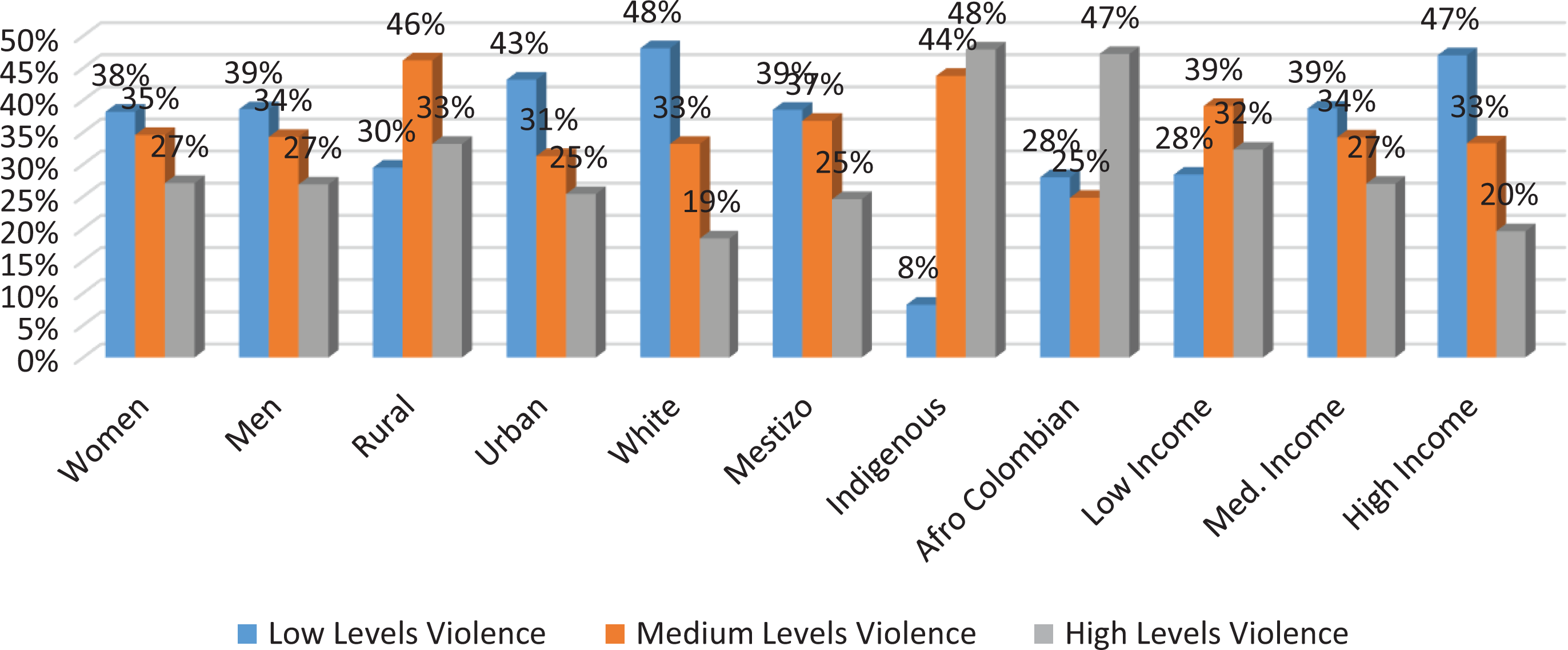
Percentage of group that experienced various levels of violence.
The Key Conflict Issues
Negotiations to reach a peace agreement and the contours of such settlements often highlight political divisions in a society that may make public acceptance and successful implementation contentious. Research has shown that support for the peace treaty with the FARC was strongly influenced by partisan ties (Demeritt et al., 2019; Dávalos et al., 2018). Therefore, I include several variables designed to tap into individual’s support for some of the principal objectives of the peace treaty: justice, government efforts to reduce economic inequality, and attitudes regarding the treatment of coca, which played a major role in the conflict. The first variable measures individuals’ support for increased punishment for criminal convictions. This question is not specific to the FARC or any other armed group and should indicate individuals’ more general preferences towards getting “tough on crime,” and thus it should not be directly related to individuals’ attitudes regarding treatment of the FARC rebels. I expect that those individuals who believe criminal penalties should be increased will be less likely to support the FARC peace agreement and be less willing to reconcile with them. Given that one of the principal criticisms levelled against the peace treaty was that it was soft on guerillas who violated international laws, those who are “tough on crime” may be more likely to oppose reconciliation.
Second, I include a variable measuring the extent to which an individual believes the government should take steps to reduce economic inequality in Colombia. It was the poor, the campesinos and others in remote regions of Colombia the government had long neglected who were the backbone of the FARC movement. Much of the fighting also took place in these areas, which were also often critical turf in the drug cartel violence. There seems to be general agreement that these long-neglected areas of Colombia are home to some of the most egregious cases of unequal wealth distribution. As well, the FARC claimed to be speaking for these long-suffering individuals and their needs (Arjona, 2016; Daly, 2016). I suggest that individuals who believe the government should do more to reduce economic inequality will be more favourably disposed towards reconciliation, as that is one of the principal, overall goals of the agreement.
Finally, it is important to consider individual opinions on the coca plant and the cocaine that is made from it. Cocaine production and transportation have exercised an outsize role not only in Colombia’s economy but also its politics. Fortunes have been made, politicians have risen and fallen because of these ties, and it has helped produce a substantial degree of corruption in the government. The coca plant, however, has also played an important role in many of the indigenous communities that suffered much of the drug and political violence in the last forty years. While the indigenous communities, as well as other sectors of the Colombian population, have advocated for less intrusive and violent measures to address cocaine trafficking (e.g. preferring crop substitution programmes over aerial eradication), the Colombian government (especially under its more conservative presidents Uribe and Duque) has often pursued more violent measures to disrupt the cocaine trade.
6
Thus, there exists a critical difference of opinion in Colombian society. On the one hand, there are those who accept some legitimate uses of coca/cocaine (as the peace treaty envisions), as well as crop substitution programmes for marginalised indigenous communities and other poor farmers to address the compelling economic rationales for growing this crop. There are also powerful forces in society that believe drug production should be addressed using more aggressive measures (aerial fumigation, more severe criminal penalties). We might expect that individuals who are willing to accept the circumscribed use of coca by these communities or the medical/scientific communities, as an important part of the Colombian peace treaty, would also be in favour of another key aspirational goal of the treaty – reconciliation. Therefore, I suggest that those who perceive legitimate scientific or medical reasons for the continued production of coca will be more likely to support reconciliation, while those who find no such value will be more likely to be hostile to those involved in its production.
Control Variables
I also include several other measures to capture the influence of socioeconomic and demographic characteristics that might be related to favourable attitudes towards reconciliation. These include measures of age, gender, years of education, religiosity, and the respondent’s perception of the current, economic situation in Colombia. 8 I do not provide a specific prediction for these variables as there are no theoretically based expectations regarding their impact or the results have been mixed. 9
Analysis
I begin by using a simple probit model to evaluate the hypotheses (Table 1). Subsequently, I use a multilevel probit model to account for the potential effects of the departments (i.e. provinces) and municipalities in which violence occurs. The fit of the first probit model, as measured by the percentage of cases correctly predicted (63 per cent) and the proportionate reduction of error – 24.4 per cent (which tells us the improvement of the model over predicted the modal category in each case) is fairly modest.
Probit estimates of Colombians’ belief in the prospects for forgiveness and reconciliation.
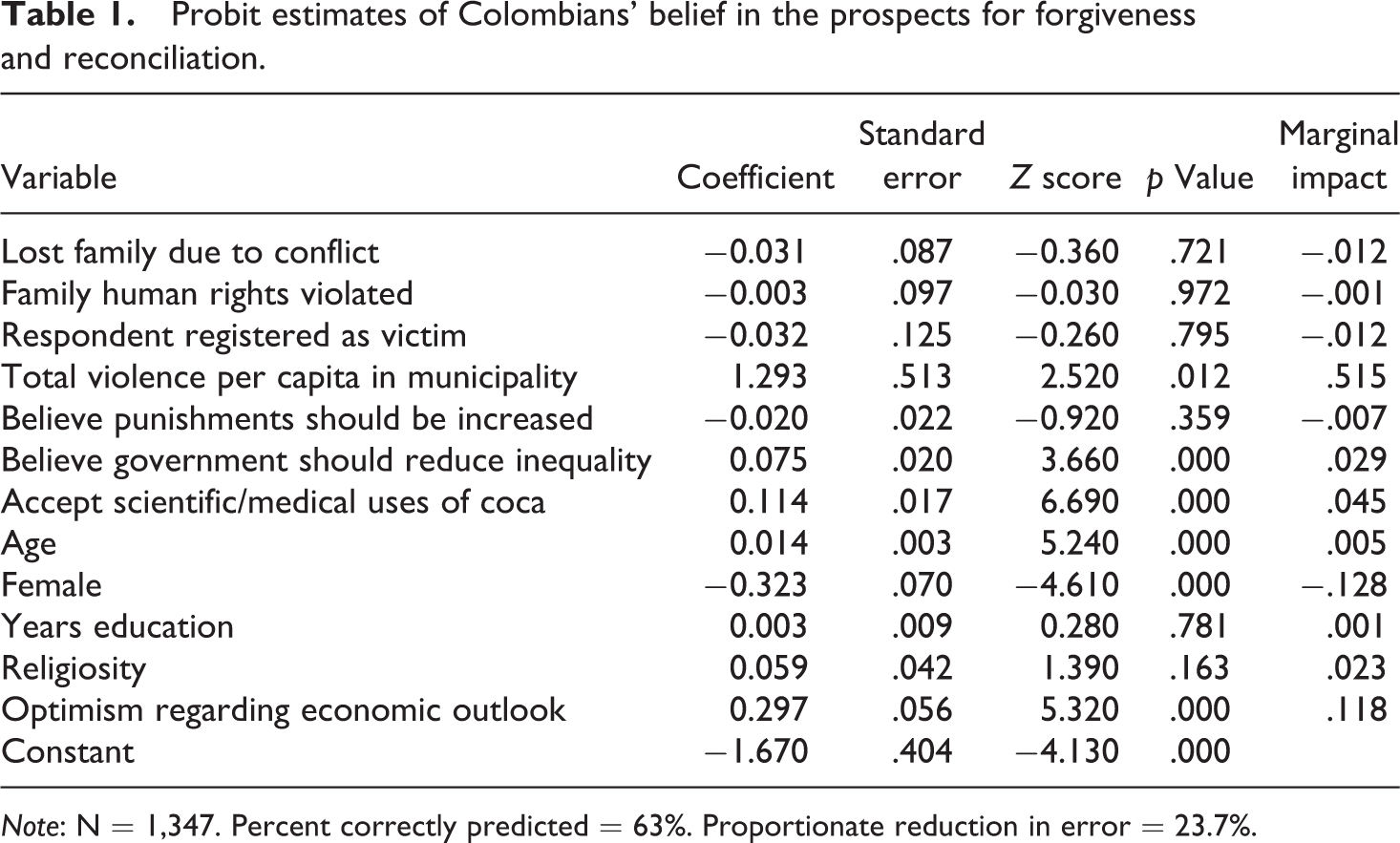
Note: N = 1,347. Percent correctly predicted = 63%. Proportionate reduction in error = 23.7%.
The probit estimates provide confirmation of both hypotheses regarding the effects of violence on individual attitudes regarding reconciliation. On the one hand, I find that the coefficients for the variables measuring whether the survey respondent was registered as a victim of the conflict; lost a family member to the conflict; or was in a family that experienced a human rights violation recently are not statistically significant, which is in keeping with hypothesis #1. More specifically, among those individuals who report having lost a family member or relative to the conflict, 52.3 per cent believe reconciliation is possible, while 51.6 per cent of those who did not experience such a loss hold similar beliefs. The lack of differentiation largely remains when we examine those individuals who registered as victims of the Colombian conflict. Of those who did register, 53.8 per cent believe reconciliation is possible, while the percentage drops just slightly to 51.2 per cent for those who are not registered as victims. I had argued that given the lack of consistent findings on this subject, as well as the recognition that individual victim reaction to the prospects of reconciliation would be highly diverse, the lack of a consistent impact was to be expected. On the other hand, the coefficient for the variable measuring the level of violence against individuals due to the armed conflict over the period 2013–2015 in the municipality is positive and statistically significant. Its substantive impact, however, is not so large. The marginal impact coefficient indicates that for every one-unit increase in this measure, there is a 51 per cent increase in the probability of favourable attitudes towards reconciliation. However, because this is a per capitised measure and the values of the independent variable range from .0001 to approximately 1, it would take a fairly sizeable increase in such violence to exercise any meaningful impact on individual opinions. Yet, the community-level impact of violence on attitudes does indicate a robust relationship. Communities that experienced more violence may have a greater desire for the peace and prosperity associated with reconciliation, as well as a recognition of the necessity of reconciliation given the realities of power relationships in such violence-afflicted communities. Further, because of the destruction, disruption, and violence Colombians living in these zones have experienced, the response of the Colombian government to community needs will be critical in ensuring peace, security and reconciliation.
The findings suggest that to the extent there might be clear and direct relationships between personal and contextual violence and attitudes about reconciliation, the substantive effects are modest at best. We know that the thought processes by which the effects of violence manifest themselves (e.g. do they lead to PTSD, health problems, etc.?) in the development of opinions on reconciliation have largely remained a black box. We have not yet identified in the research cited above what psychological factors may mediate between the experience of violence and the development of attitudes regarding reconciliation (e.g. one’s outlook on life, previous mental health struggles), or what external factors may interpose in the development of attitudes (e.g. poverty, community-level experience with violence). If we are to uncover any systematic patterns regarding the effects of violence on reconciliation, it would seem to demand a more in-depth psychological assessment.
We can, however, examine whether belief in the prospects for reconciliation among those who have experienced a personal loss is mediated by whether they were living in a community that also suffered a great deal of violence as shown in Figure 2. I created a binary variable to distinguish individuals who lived in municipalities that were at the 75th percentile or higher on the contextual violence measure, and those who lived in less violent communities to investigate whether there were any conditional affects of personal experience on attitudes towards reconciliation. I find that among those individuals who lived in the most violent municipalities and who lost a family member, 56 per cent believe reconciliation is possible, while 51 per cent of those Colombians living in these communities, but who did not lose a family member report believing reconciliation is possible. Among those who lived in less violent areas, 47 per cent of those who lost a family member believe in reconciliation, while 52 per cent of those who live in less violent areas and did not lose a family member believe in the prospects for reconciliation. Hence, those who both lost a family member and lived in violent areas are most likely to express a more optimistic attitude about reconciliation. The percentages and the differences across the categories are largely the same when we look at whether the respondent’s family experienced any human rights violation recently, or whether the respondent had registered as a victim. The most pronounced support for the possibility of reconciliation, however, is found among those individuals who live in less violent areas, but did register as victims – 58 per cent believe that reconciliation is possible.
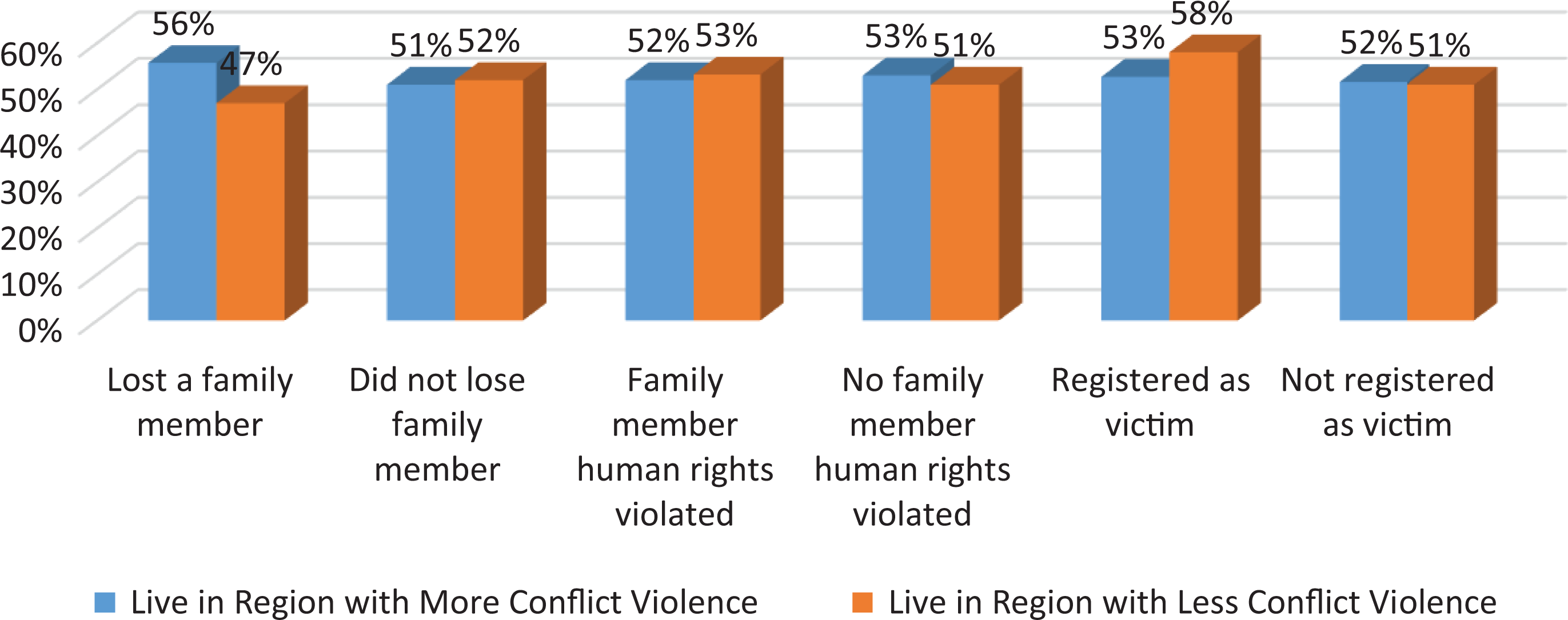
Effects of contextual violence and personal experience with violence on attitudes about reconciliation.
What is clear from the probit analysis, however, is that other measures are important and substantively meaningful in explaining reconciliation. We see the impact of politics in the relationship between support for some of the underlying goals of the peace agreement and attitudes regarding reconciliation. Those individuals who believe strongly that the government should take steps to reduce economic inequality (a key provision of the peace agreement envisions the government taking a number of steps to help impoverished communities within conflict zones) are more likely to believe in the likelihood of reconciliation. A one-unit increase in this variable (it ranges between “1” and “7”) tends to increase the probability of favourable opinions regarding reconciliation by 3 per cent. Similarly, individuals who are more likely to believe that there are scientific/medical purposes for cultivating coca are more likely to believe in the prospects of reconciliation (the variable ranges between “1” and “7”). The marginal impact of this variable – 4.5 per cent – indicates that greater belief in this notion leads to more support for reconciliation. However, the hypothesised relationship between those who believe in general that the justice system should impose more severe penalties on those who violate the law is not borne out, as the coefficient for this variable is statistically insignificant.
The effects of the control variables are especially interesting as there are very strong relationships between gender and age and beliefs regarding reconciliation. First, we see that older Colombians are much more inclined to believe in the prospects for reconciliation. Given that older respondents are more likely to have lived through previous peacemaking and peacebuilding efforts, we might have suspected that these individuals would hold more sceptical attitudes regarding reconciliation. Instead, the marginal impact coefficient demonstrates that every one-year increase in age is associated with a 0.5 percentage point in belief in the prospects for reconciliation. A ten-year increase would thus be associated with a 5 per cent increase in the belief in reconciliation.
The gender effects are quite pronounced. Women are 12.8 per cent less likely to support reconciliation. Previous research (James Meernik) has also found that females are less likely to believe in or support reconciliation after armed conflict. Whether this is because women are typically singled out for abusive treatment because of their gender (sexual violence towards women has long been a weapon of war), or because women are often the ones left to pick up the pieces of their families and communities after the violence, I cannot say. This powerful finding would seem to call for a more in-depth examination of gender differences regarding reconciliation to identify what might be causing this significant difference of opinion. We would be most helped by more intensive studies that probe individuals’ attitudes regarding which aspects of reconciliation are more or less critical for men and women, such as forgiveness and trust. At the same time, individuals’ past and present experiences, such as previous encounters with political violence, familial violence, and crime may also mediate their opinions on reconciliation. Individuals’ present circumstances should also be incorporated in more depth to determine the extent to which women have more social and economic challenges to navigate, especially for those who are internally displaced persons; whether family ties mediate the effects of violence on reconciliation and so forth. This finding calls for greater theoretical development to identify the nature of these gender differences and more intensive survey research to identify the relative importance of these potential causal and mediating factors.
Finally, we see in the probit model that those individuals who have a more optimistic outlook regarding Colombia’s economic prospects are more likely to also believe in the prospects for reconciliation. The results suggest that perhaps such attitudes share a correlational relationship as each may tap into individual’s overall outlook on life. Nonetheless, we should not rule out the possibility that as individuals perceive the country has a more secure economic future, they feel more secure in the country’s social future as well as economic scarcity becomes less of an issue.
In the next stage of the analysis, I utilise a multilevel probit model to provide an alternative method of accounting for the contextual effects on attitudes towards reconciliation (Table 2). Multilevel modelling can be used to estimate the impact of larger units or groups in which individuals reside on their behaviour and opinions. For example, a model of student learning might incorporate the impact of the classroom environment, which resides within a particular school, which in turn exists in a particular school system. Each context can influence various aspects of student learning, such as the quality of individual instruction, school-wide curriculum plans, and the resources of the school system. Multilevel modelling techniques have been used in a variety of studies of individual attitudes (Anderson and Singer, 2008; Arzheimer, 2009; van der Meer et al., 2009; Weldon, 2006).
Multilevel probit estimates of Colombians’ belief in the prospects for forgiveness and reconciliation.
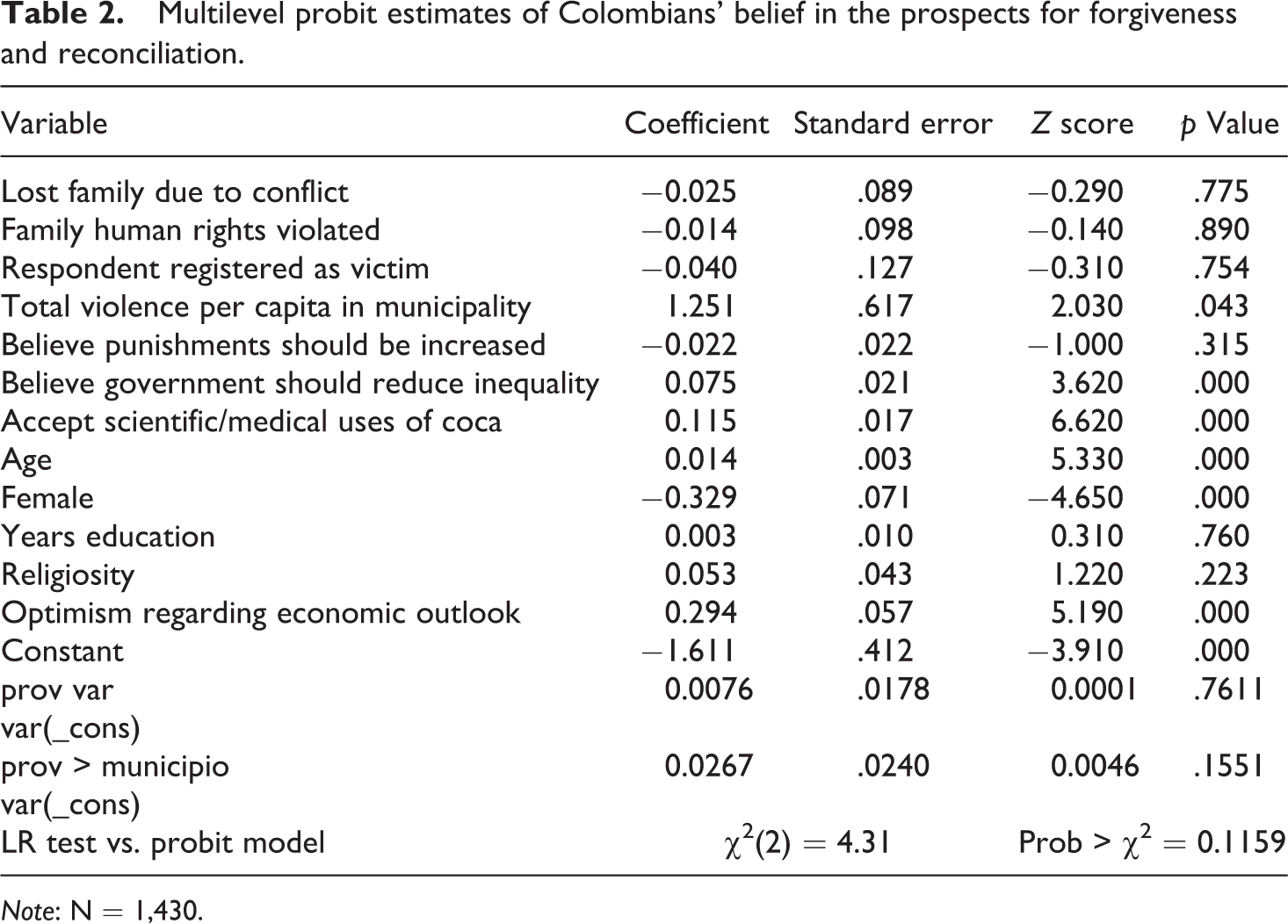
Note: N = 1,430.
The χ2 statistic, which tests whether a multilevel modelling process is more appropriate than a standard probit model, however, is not statistically significant. I note too that the statistical significance of the individual coefficients mostly remains from the initial probit analyses. The results would suggest that there is not a statistically significant rationale for utilising a multilevel model in this case.
Finally, it is also important to determine the extent to which support for the peace treaty overall affects support for reconciliation. I elected not to include this variable in the initial analysis because while it is highly correlated with reconciliation, it is not clear if one causes the other, or whether they both tap into a larger construct of support for the peacebuilding efforts of the Santos government. Nonetheless, it is important to ascertain how peace and reconciliation are related. Therefore, I reran the same model, but with the inclusion of the variable, “colpropaz1b,” which asks the question, “The government of president Juan Manuel Santos and the FARC have signed a peace agreement (Table 3). To what extent do you support the peace agreement?” The fit of the model improves dramatically as evidenced by the pseudo R2, which increases from .08 to approximately .20. Not surprisingly, the coefficient for the peace support variable is statistically significant and also exercises a major substantive impact on belief in the likelihood of reconciliation. For every one unit increase in the scale of this variable (“1”–“7,” where “1” is no support and “7” is “support a lot”), there is a 10 per cent increase in the likelihood of the individual supporting reconciliation. The two variables are closely related to one another, but we do not yet know whether this is a correlational or causal relationship. While this research has given us a comprehensive understanding of what factors reconciliation, we still have much work to do in order to better understand not only the relationship between peace and reconciliation, but other relationships such as the connection between violence personally experienced and experienced contextually, and why women are markedly more distrustful of the prospects for reconciliation.
Probit estimates of Colombians’ belief in the prospects for forgiveness and reconciliation with support for peace measure.
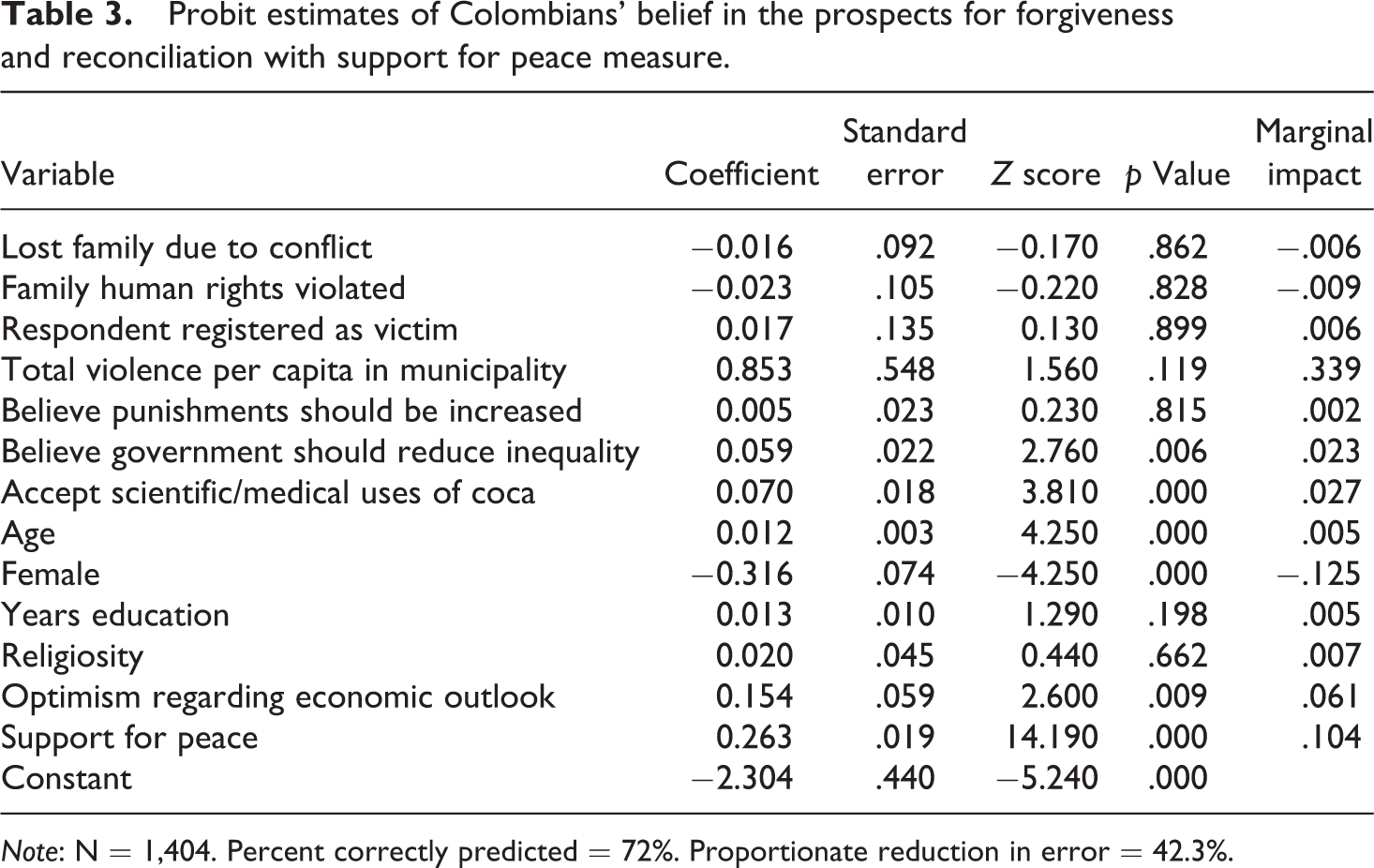
Note: N = 1,404. Percent correctly predicted = 72%. Proportionate reduction in error = 42.3%.
Conclusion
The purpose of this research has been to better elucidate those factors that lead individuals to be more likely to believe in the prospects of reconciliation with their former adversaries in Colombia. Previous research has evidenced mixed findings on one of the most critical factors related to reconciliation – personal and contextual experience with the violence that created the need for reconciliation (Bauer et al., 2016; Clark, 2009, 2011; Elcheroth and Spini, 2009; Gibson, 2004; Hall et al., 2018; Rettberg and Ugarriza, 2016; Staub, 2006). While some argue and find that personal experience can matter a great deal and even spur individuals to engage in prosocial behaviours that would tend to benefit reconciliation, others argue that such experiences may lead to a desire for retribution or an unwillingness to forgive those who committed crimes. While I cannot claim this article has answered such questions, the results do provide insight regarding what may be happening in these cognitive processes and what further information we need to reach more definitive conclusions. Nevertheless, there are several key findings that can inform future research.
Those individuals who personally experienced violence were neither more nor less likely to exhibit favourable beliefs regarding reconciliation. Contrarily, individuals from communities that were more affected by violence were more likely to indicate they believed the prospects for reconciliation with the FARC were positive. I had argued that because of the expected benefits of peace and reconciliation, as well as the community-level prosocial attitudes that are more likely to exist in these Colombian municipalities harmed by years of violence, contextual violence would lead to pro-reconciliatory beliefs. The challenges of advancing peace and reconciliation in these Colombian municipalities are extraordinary as a result of the government’s long neglect of these hinterlands in which many marginalised communities live, such as indigenous groups, Afro Colombians, and campesinos. Given that the individuals who are residing in these Colombian municipalities do support peace and reconciliation, there is fertile ground on which to build. Whether the current and future Colombian governments are compelled to address their challenges, however, is uncertain. Because there is currently support for the aims of the peace agreement in these formerly violent areas, it would seem that the time to act is sooner rather than later lest the same cycles of neglect, mobilisation, and violence, with which Colombia is all too familiar, recur.
While the findings bore out the hypotheses regarding violence, the results are also suggestive of the need for researchers to learn more about individual attitude formation and the manner in which these personal and contextual experiences are processed and then affect subsequent attitudes. Such research would entail a more in-depth psychological assessment of mediating factors that affect both how people emotionally deal with violence, and how the experiences and their attitudes towards the violence affect beliefs about reconciliation. Interdisciplinary research bringing together psychologists and political scientists (as well as anthropologists and sociologists) would be most helpful in the development of such an instrument for use in former conflict zones.
The model more conclusively demonstrated that opinions regarding critical conflict issues and demographic factors matter a great deal, such as those variables measuring support for the objectives of the peace treaty. I argued that if an individual supported the goals of the peace treaty, she would also be more likely to exhibit support for reconciliation as one more component of the peace process. We saw that support for government efforts to reduce inequality and an individual’s opinion on possible legitimate uses of coca increase confidence in the potential for reconciliation. Thus, some degree of sympathy or understanding of the ostensible goals of the FARC enhances one’s belief in the likelihood of reconciliation.
Finally, I suggest that future research should investigate the components of reconciliation in order to understand more deeply what this concept means to individuals. At the risk of being repetitive, we know that reconciliation is a complex and dynamic individual attitude as well as a process of social interaction. We do not know what individuals are thinking when they are considering the question posed by LAPOP. The next step in the development of our understanding of reconciliation must be to unpack the social, political, and personal factors that define reconciliation to the individual. We need to know whether individuals possess thick or thin demands of reconciliation; whether such opinions change over time; whether there is a particular component of reconciliation that is critical to the individual, such as the need to hear the perpetrator seek forgiveness, or perhaps the fate of a loved one(s). Such psychological data can be combined with the attitudinal and contextual data to develop a more holistic understanding of what reconciliation means to the individual, and what will determine whether she believes in such possibilities. Colombia would be an excellent place to address such questions.
Footnotes
Declaration of Conflicting Interests
The author(s) declared no potential conflicts of interest with respect to the research, authorship, and/or publication of this article.
Funding
The author(s) received no financial support for the research, authorship, and/or publication of this article.