



Abstract
This article discusses the issue of inclusion in peace negotiations, in particular the Colombian peace process with the Fuerzas Armadas Revolucionárias de Colombia, with special emphasis to a perceived tension between “direct” and “indirect” inclusive initiatives. It argues that, as currently discussed by the Peace and Conflict literature, inclusion tends to be seen as neutral and benign, which leaves little room for critical discussions about the political contention behind peace negotiations deemed “inclusive.” It thus proposes to discuss inclusion through the theoretical lens of political representation and apply such reflections to the specific case of the Colombian victims’ delegations that travelled to Havana in 2014 in order to take part in the table’s discussions on the victims and transitional justice topic. Ultimately, I will argue there was simultaneous utilisation and rejection of the language of representation.
Introduction
The Havana talks between the Colombian government and the FARC (formerly known as Fuerzas Armadas Revolucionárias de Colombia) received high international praise for their effort in promoting inclusion despite the fact civil society did not have negotiators at the table. The recognition received by the process is mainly related to its creative promotion of indirect inclusion without losing focus on the final target of reaching an agreement between the parties. Although inclusion was traditionally viewed by scholars and practitioners as a disruption to peace processes, the post–Cold War years witnessed a shift in paths for dealing with conflict, especially internal ones. Recent studies revealed that inclusive peace processes build more sustainable peace, which moved the discussion from an “if” to a “how” – specialists began searching for ways of promoting inclusion while at the same time avoiding that the echo of too many voices makes agreements impossible.
Within this tension between “direct” and “indirect” inclusions lie fundamental concerns of historically excluded social groups, usually the ones hit the hardest by civil wars, and relations not taken into consideration when thinking of inclusion as a vague and benign entity. In order to reflect on this issue, I will draw from political theory of representation and use it to try to understand the role of Colombian victims in the Havana dialogues (2012–2016) from a fresh perspective. In 2014, the negotiation table agreed to welcome five twelve-member delegations of victims into the discussions on the agreement on victims and transitional justice. The initiative was celebrated for its symbolic and practical effects, and will serve as an illustration for the theoretical discussion provided by the first two sections.
Two main sets of questions will thus serve as a guide for this article. First, can civil society actors serve as representatives of broader social sectors such as conflict’s victims? How would that work? More specifically, is it possible to say that the Colombians chosen as victims’ delegates were representatives of the conflict’s victims? Debating this question entails contemplating the concept of representation in a wide and problematised way, considering not only its electoral component but all aspects involved in the establishment and conduction of representative relationships in non-institutionalised settings such as peace processes. This involves a second set of questions: What can the concept of political representation as a theoretical lens add to the current debate on inclusion in peace processes? How is it different from using the inclusion lexicon?
Ultimately, I will argue the actors involved in the case at hand both utilised and rejected the language of representation to define the victims’ delegations. Representation was repeatedly rejected in official discourse, which stated the delegates were individual participants that spoke on behalf of no one but themselves. At the same time, however, all parties involved relied on a vocabulary of representativeness in order to claim and attempt to gather a group of people that reflected the variety of Colombian victims. By taking representation as a two-way street, a constant (additional) negotiation between the table and society, it becomes possible to try and identify representative relationships in peace processes and only then evaluate if they are inclusive or not – and, most importantly, inclusive of whom. In short, it allows for one to see inclusion as the result of political contention and as a means for guaranteeing rights.
The article will thus mobilise theoretical and empirical strategies that are supposed to complement and dialogue with each other. In the first section, I will provide an overview of the discussion on inclusion in Peace and Conflict Studies. The following section will propose a theoretical framework on political representation, relying on the works of Hanna Pitkin and Andrew Rehfeld on the concept. Finally, the last section will discuss the case of Colombia’s victims’ delegations in light of this framework, utilising for this assessment the work of specialists, official declarations, media and think tank reports, and impressions drawn from a few interviews.
From Exclusion to Inclusion
The Inevitability of Inclusion
The construction of lasting peace in contexts of deep-rooted, entrenched social conflict gained renewed attention in the post–Cold War world. In the early 1990s, with the unleashing of “new wars” (Kaldor, 2012) – especially intrastate conflicts triggered by social, ethnic, and religious issues – traditional approaches of conflict resolution were progressively deemed insufficient and gave way to projects of conflict transformation and peacebuilding. Instead of aiming to stop immediate violence, transformation attempts to engage different conflicts in a different way. By the end of the twentieth century, boundaries between war and peace were even more blurred, and violent conflict continued imposing the reinvention of political communities. It was not enough to simply halt confrontations or try to negotiate a definite end to them anymore – as conflict becomes more complex and ingrained, specialists say, so too should any attempt of constructing peace.
In this scenario, experts such as John Paul Lederach (1997, 2003) contend that more profound approaches to peacebuilding initiatives are needed, which no longer can artificially separate the battlefield and everyday life. Aside from stopping violence in the present, it becomes necessary to address conflicts’ roots and transform relations in order for peace to get a real chance. Dealing with pervasive conflict, therefore, entails its contemplation over a wider time horizon, a careful analysis of its root causes and the fostering of transformed relations among all parties (intentionally or not) involved in it. Peace processes indeed move beyond stopping immediate violence and start directing increasing attention towards past violations and future guarantees – for example, establishing victim’s reparations and devising measures for non-repetition of human rights abuses. These are part of a deeper agenda of social transformation and change in interests, objectives, identities, and perceptions of former conflict parties, a project capable of establishing less violent and more inclusive relationships. 1
Thus, secretive and closed-door negotiations become less acceptable for those who, despite not having picked up weapons, were somehow affected by those who did. If negotiation tables are to put in place wholesome, long-term peace processes, it now seemed reasonable to believe that negotiated agreements need to surface amidst a social consensus robust enough to sustain their implementation. Building consensual solutions that are also accepted and wilfully put in practice by the people becomes, for that reason, one of the greatest challenges of contemporary peace processes.
This weaved together the issue of inclusion and the debate on peace sustainability and legitimacy (see Zanker, 2014, 2018). As both the nature of conflict and its potential solutions suffer changes throughout the last few decades, popular pressure for transparency and participation gains strength, as well as the belief in the inclusion of diverse social groups (other than conflict parties) as a source of legitimacy for peace processes. For both practitioners and academics, understanding the motivations and effects of inclusive peace processes turns into a relevant topic and a much-needed investigation. There is a growing sense that, at the very least, the idea of openness to popular demands needs to be conveyed by negotiation tables.
The practice of inclusion and the norm of inclusivity cannot be taken as substitutes – while the first conveys the idea of something that either happens or not, the latter is vaguer and involves “the assumption that an inclusive process has the best chance to be seen as legitimate, to address all substantive issues and to reach a comprehensive and sustainable peace agreement” (Von Burg, 2015: 8, my emphasis). The launch of the United Nations Guidance for Effective Mediation, in 2012, was a moment of consolidation for the discourse of inclusivity. The document, aimed to support mediation efforts worldwide and help them succeed, lists the questions of inclusivity and national ownership – alongside traditional aspects such as consent, impartiality, and international law and normative frameworks – as some of their fundamentals. According to the United Nations (UN), “[i]nclusivity refers to the extent and manner in which the views and needs of conflict parties and other stakeholders are represented and integrated into the process and outcome of a mediation effort” (UN, 2012: 11, my emphasis). The UN cautions that exclusive consideration of conflict parties’ viewpoints by mediators may overlook the needs of the wider public and, in effect, reward violence. It thus advises that preconditions for participation are minimised, stimulating civil society engagement and the inclusion of women in official delegations (p. 13).
Inclusion versus Effectiveness
If, on the one hand, inclusion undeniably marches towards becoming an indispensable topic of discussion and has been recognised as a necessary step for long-term peace processes, it is not free of complex implications and ambiguities. The same experts who see it as a source of legitimacy and a potential for durable peace warn that the echo of too many voices obstructs the chances of a negotiation reaching an agreement. There is broad consensus among both practitioners and specialists that the more people have a say in a matter, the harder it gets to reach a collective decision regarding such matter (Kew and Wanis-St John, 2008; Nilsson, 2012; Zanker, 2014). Of course, when the decision at hand involves the end of an armed conflict, things get even more sensitive – depending on the power accumulated by the parties, they may simply refuse to see it diluted among additional participants and walk away before negotiations even begin (Paffenholz, 2014). In this point of view, peace negotiations deal with a trade-off between inclusion and effectiveness – peace processes either get to include all relevant actors or be effective enough in reaching a deal. In short, there is an inclusion versus effectiveness dilemma in peace processes.
Although most authors generally agree that inclusive peace talks may face more difficulties in the path towards successful closure, empirical research has also demonstrated the positive impact and even the indispensability of inclusion for the durability of post-agreement peace. Darren Kew and Anthony Wanis-St John (2008) and Desireé Nilsson (2012) have conducted studies on this topic and found similar evidence that, in cases where there was inclusion of civil society actors during peace processes, a more stable and durable peace was reached afterwards than in negotiations where they were not involved nor allowed to participate. Exclusive negotiations, in other words, represented a much more fertile ground for the return of violence than inclusive ones.
At this point, two key yet contradicting conclusions may be recognised from such investigations: (i) inclusion may make consensus harder to achieve in negotiation tables; (ii) however, once reached, an inclusive consensus will have much stronger chances of building sustainable peace. In sum, inclusion is considered to have both negative and positive practical influence over the single goal of lasting peace. While it turns agreements into much more difficult breakthroughs, delaying them and even at times precluding them, it is now clear that an agreement without it may miss the whole point of a peace process, which has to do not only with terminating a violent conflict but also with avoiding its resumption. Inclusion is perceived, therefore, as a paradoxical objective that represents both a risk and a necessity. Essentially, it is portrayed by the literature as a chimera: albeit desperately needed, it seems incongruent and impossible.
Trying to overcome this contradiction, several authors (Bell and O’Rourke, 2007; Hemmer et al., 2006; Lanz, 2011; McKeon, 2004) have been trying to “unpack” what inclusive peace processes are, what inclusion ultimately means, and which types of inclusion are supposed to exert positive influence over the post-conflict phase. The above-cited empirical conclusions on the benefits of inclusion gave way to a series of additional questions: Does inclusion mean direct participation at the negotiation table? Who should be allowed to participate? How does the selection of participants take place? Is there an ideal timing for participation to occur?
Whereas there are no definitive answers to such questions, the ponderations they trigger are a starting point to deeper practical and theoretical analyses. David Lanz (2011) tackled the dynamics of inclusion and exclusion in peace processes by questioning how direct participation is delimited, that is, “who gets a seat at the table.” For the author, two independent yet interacting factors help explain who makes the cut. First, practical requirements tend to exclude whoever will complicate negotiations and include those who “add value to the process and augment the chances of reaching a sustainable settlement” (p. 281). The second factor is the normative dimension of participant selection, that is, the validation of those selected by international norms and the values of mediators and sponsors. If the two factors converge – for example, a candidate is seen as relevant in practical terms and acceptable or necessary in normative terms – there are higher chances he or she will be included. The opposite happens when both factors suggest the exclusion of a given postulant. There is always a chance, however, that the two factors do not match – a candidate is seen as practically relevant but normatively reprehensible (e.g. terrorists), or he or she is normatively acceptable but seen as an impractical addition to the table (e.g. social movements).
The emphasis given to the practical element in the choice of direct participants reinforces the idea that, at some point, a peace process is faced with a choice between effectiveness and inclusion. This is especially true for social groups such as victims’ movements, whose incorporation to the table can be considered overcrowding despite their legitimate (and perhaps post-conflict pertinent, sustainability-wise) demands and proposals. A few authors have attempted to overcome this dichotomy by urging researchers to look further and identify alternatives to direct inclusion, claiming there are other paths, observed in practice, that do not necessarily involve a seat at the table (Paffenholz, 2014).
Thania Paffenholz strives to move away from the trap posed by this “exclusion–inclusion dichotomy.” She chooses to focus, instead, on “how and under what conditions inclusion can work” (2014: 70). Through a research project entitled Broadening Participation, 2 the author compiled nine modalities of inclusion previously exercised by civil society actors in peace processes (see Table 1). From the most direct model of participation (i.e. sitting at the table) to the least (i.e. mass mobilisation), Paffenholz clarifies that there is no direct correspondence between specific peace negotiations and a single inclusion modality. What actually happens is a “mix and match” – inclusion does not always translate into only one method for each peace process, often, instead, combining more than one modality at a time. Direct participation, as one would expect, encounters resistance from conflict parties, which forces civil society actors to associate creativity and social pressure in their attempts to influence the negotiation table’s agenda and decision-making.
Paffenholz’s Nine Modalities of Inclusion.
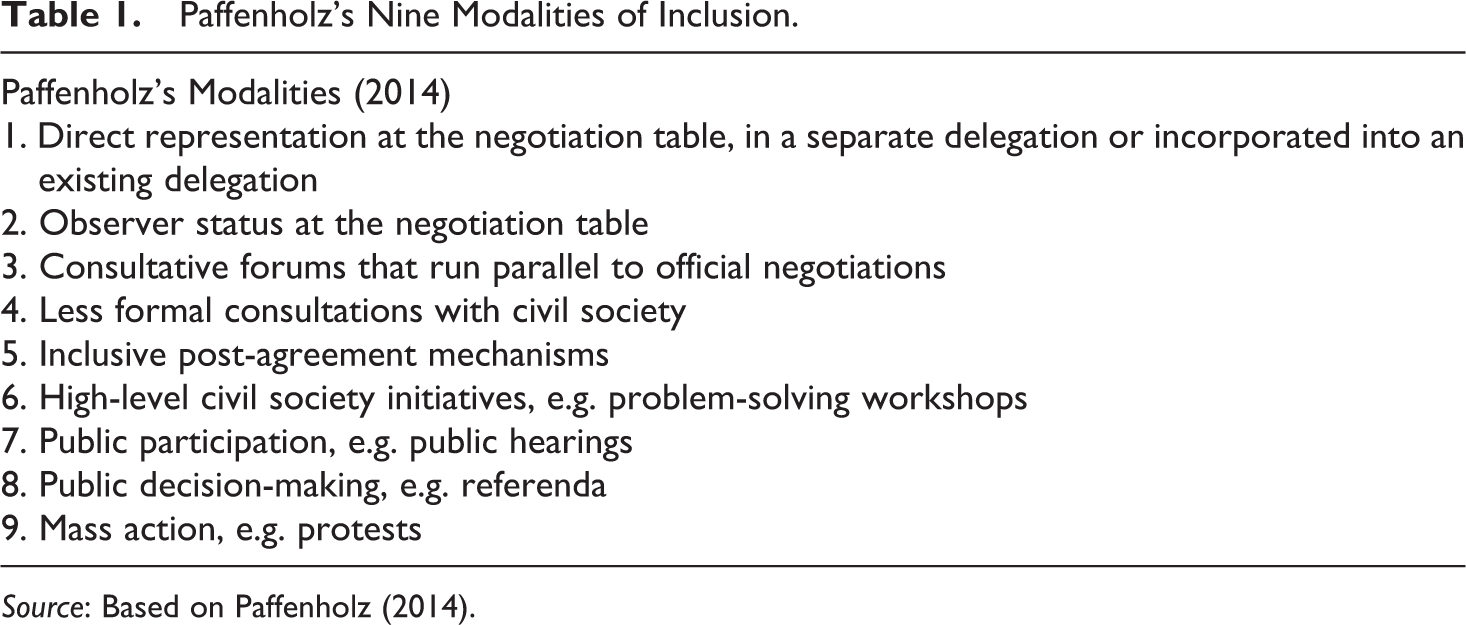
Source: Based on Paffenholz (2014).
With all this in mind, a few reflections come up. The first issue concerns the already cited question of practical and normative realms of inclusion and the relationship between them (Lanz, 2011). Even though the effects from practical and normative factors of inclusion are probably too difficult to dissociate on the ground, the “attainable” observation of norms, conditioned by practical needs, may well serve to instrumentalise inclusive initiatives as empty mechanisms of legitimisation with little or no actual impact. Franzisca Zanker argues the Conflict Resolution literature on inclusion treats legitimacy in a circular way – “[p]ublic buy-in results in legitimacy, and because of legitimacy, there is public buy-in” – without actually diving into its mechanisms (2018: 7). A crucial part of further dissecting the notion of inclusion in peace processes thus involves overcoming a view of legitimacy that is not only circular, I would say, but also static and depoliticised, as if it were one thing, one uncontroversial goal associated with societal inclusion. In this regard, one must keep in mind legitimacy means different things for different people, and this is absolutely central for discussing the role of inclusion and its implications. As Zanker stresses, “the very idea of legitimacy in contemporary peacebuilding and inclusive negotiation debates results in questions of how legitimacy is actually constructed, as well as for whom and by whom” (p. 25, my emphasis).
Also, it is worth highlighting that the devising of rules and “practical requirements” in the selection of participants cannot be taken as a given or seen as neutral – they have to be seen as results of political contention. Perhaps no collectivity better expresses this than a conflict’s victims. Tami Amanda Jacoby (2015) differentiates between victimisation and victimhood, tracing a path between the first and the second in which people perceive a harm suffered as wrongdoing beyond “ordinary state of affairs,” seek redress, and organise politically in order to be recognised and compensated as victims (pp. 527–528). Jacoby sees the construction of victimhood identity as a contested process, arguing “[it] depends on a choice, however limited in its options, to use the experience of harm as the basis for identity, subject to the expectations of a political culture and its power relations” (2015: 527). Victims will be precisely the focus of the last section of this article, which will approach the role of Colombian victims in the Havana talks.
The purpose of inclusivity as a norm therefore lies not only on making “negative peace” 3 more effective, but also on addressing structural inequalities and opening up the way to the realisation of rights. The identification of the “right” or “effective” inclusion encompasses opening up the black box where it is often placed and looking at what/who allows for it to take place and in what manner. In other words, the mostly technical debate on inclusion, as it defines and redefines its potential modalities, needs to recognise its own political origins and implications.
From Inclusion to Representation
Between the cautious perception of direct inclusion – everyone wants a seat, not everyone can get one – and the intention to move past this by looking at “indirect” modalities of inclusion, there needs to be a discussion of peace negotiations as political and representative ventures. The added value of introducing representation into this equation pertains, in particular, the exposure of exclusions that remain ingrained in the current literature’s discourse of inclusion. Such exclusions cannot be unveiled nor evaluated unless they are taken as part of the political struggles that permeate peace processes. Figuring out how inclusion emerges at different levels demands a closer look at the elements mediating direct and indirect loci of inclusion. It also demands an analysis of the parameters and categorisations that shape and are shaped by the consecutive political decisions involved in letting certain sectors of society, but not others, reach the table and/or exercise certain roles. The choice of who to involve matters, as do the methods employed in aggregating those who wish to participate.
Another crucial aspect of this investigation concerns questioning what lies within the concept of inclusion. In formal political contexts, “inclusion” usually refers to the integration of a certain sector of society into an institutionalised political procedure – for example, the extension of the right to vote to women. There is no singular definition for what Conflict Resolution authors mean when they use this word, which, in its vagueness, ultimately serves to depoliticise a debate that is political to the core. Thus, the technical use of the language of inclusion needs to be broken down to account for politically driven choice of actors for all levels of a peace process, as well as the roles played by them. Much like “inclusion,” both “participation” and “representation” (and their accompanying lexicons) are found in the literature of inclusive peace processes; however, there is seldom a semantic or theoretical exercise of differentiating the three words, which become muddled in their application.
The use of the word inclusion in peace processes, in the absence of formal political instances and procedures, refers to both participation (individual engagement in name of oneself) and representation (engagement of a representative acting on behalf of one person or a collective of people). At each modality of inclusion, from more direct to more indirect, actors may be participants, representatives, or both. As one would expect, the closer to the negotiation table, the heavier the weight of representative mechanisms versus participatory ones. Political representation is herein taken in its wider interpretation (Urbinati and Warren, 2008), not taking for granted its recurrent “crises.” It is thus not excluded that social actors other than elected and government officials do exercise representation in various contexts, especially if one considers the legitimacy crisis experienced by party politics worldwide and the increasing capture of representation by non-institutionalised and “outsider” social movements (Castells, 2018). Civil organisations may exercise what Lavalle et al. (2006) call “representation by intermediation,” which in fact makes participation and representation harder and harder to differentiate. Even if most of the time not explicitly, the literature on inclusion presumes that, faced with the impossibility of massive social participation, civil society and social movements become natural representatives of those absent from negotiation tables (Zanker, 2018: 6).
More than drawing borders between participation and representation, however, or artificially seeing society as the locus of participation and the negotiation table as the locus of representation, the intention is to dissect what is meant by these expressions, especially when it comes to the establishment of rules and the distribution of political functions in a negotiation process. Representation, be it institutionalised or not, democratic or not, embodies a common language and lens of analysis that is able to act as a common thread between the before, the during, and the after of an armed conflict. Unlike the somewhat nebulous idea of inclusion, the concept of representation sheds light on social pressures and power distributions that have much to say about the decisions being made at negotiations. Instead of using the inclusion lexicon, therefore, I choose to consider peace processes non-institutionalised representative instances that may, in turn, be deemed inclusive or not. The contrast between representative and participatory means of inclusion, on the other hand, will also serve to highlight the elucidatory potential of political representation in better grasping what inclusion is, or should be, in peace processes. The fourth section will look into the meanings attached to the words “participation” and “representation” in official discourse regarding inclusion, as well as the tensions involved in and between such labels.
The Concept of Representation
Representation is a multifaceted, complex concept that precedes its political application. Its current political interpretation, however, often translates into an automatic association with contemporary electoral democracy. Beyond the ballot, political representation is a broader and older phenomenon than modern democracy, recognisable in a gamut of political interactions that, as peace processes, escape traditional, institutionalised settings. In this sense, Hanna Pitkin (1967) observes that the basic meaning of political representation in fact has not changed a lot since the seventeenth century and its formulation by Thomas Hobbes (1994). In its shortest, simplest etymological definition, Pitkin deems it “the making present in some sense of something which is nevertheless not present literally or in fact” (pp. 8–9). Other authors observe representation does not even need to be legitimate or just – it merely needs to be collectively credible. Andrew Rehfeld argues it “results from an audience’s judgment that some individual, rather than some other, stands in for a group in order to perform a specific function” (2006: 2). In peace negotiations, it is possible to say those engaged in formal and informal instances are groups of representatives speaking on behalf of larger segments of society – the represented – with the shared function of stopping violence.
In The Concept of Representation, Pitkin proposes looking at apparently opposing takes on representation as pieces of the same puzzle. The author pinpoints two main criteria in such effort. First, there are formalistic views of representation, which identify it with the formal procedures that establish or verify it. The second one concerns the actual substance of representative activity, be it regarding the characteristics of the representative or the actions he or she takes on behalf of his or her represented constituency (see Figure 1 above).
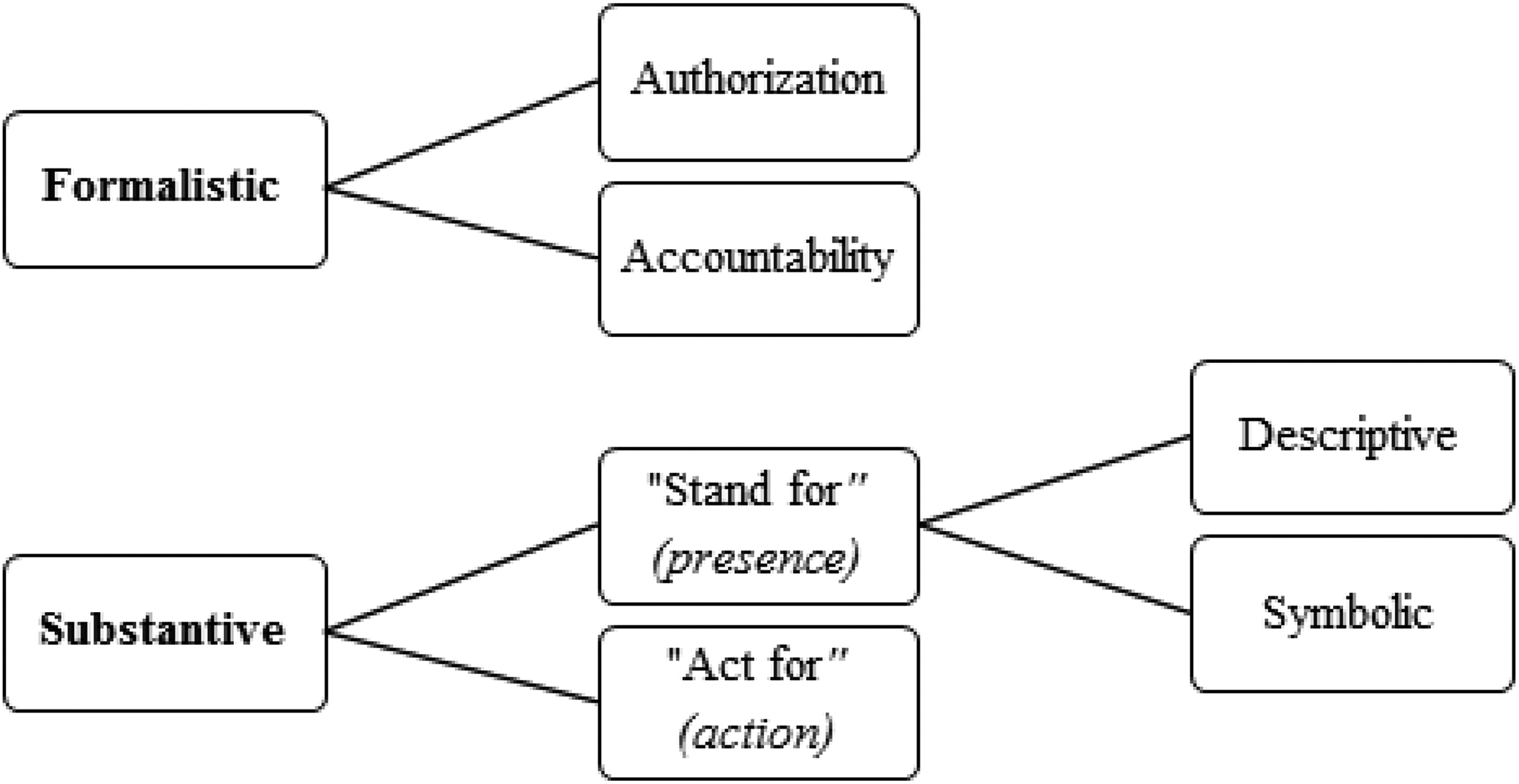
Hanna Pitkin’s Typology (1967). Source: Based on Pitkin (1967).
Formalistic approaches concern either the “before” or the “after” of representation, claiming previous authorisation or posterior accountability of the representative as its defining trait. Most important between the two is the authorisation view, which maintains that representation is a transfer of authority from represented to representative. This was the unlimited Hobbesian interpretation of the social contract as early as the 1650s, but it is also a huge protagonist of modern democracies’ electoral element. The duration and extent of authorisation, as well as the method utilised to recognise it, are subject to debate. Still, it leaves out fundamental aspects of representation; “it cannot tell us what ‘misrepresenting’ or ‘misrepresentation’ might be, nor can it explain the noun ‘representativeness’ or the adjective ‘representative’” (Pitkin, 1967: 49). Who is the right representative for a certain social group? Once chosen, can a representative act as he or she wishes, regardless of his or her constituency’s preferences? The conflict put in motion by these questions demonstrates the importance of attaching the formalistic debate to another one, concerning the actual content of representation – namely who the representative should be, and what he or she should do while acting in name of those represented.
These last two issues translate precisely into the two interpretations that make up the substance of representation according to Pitkin. First, she says representation can work as a substitutive tool, such that representatives stand for the ones they represent, taking their places where they cannot be present. Secondly, one can also argue representatives are in fact acting for their constituencies. Once formally delineated, therefore, two dimensions to the substance of representation emerge: let’s call them “presence” and “action.”
The central question around the issue of presence, as mentioned, is who is best suited for the job – should he or she be similar to the ones represented or not? For instance, is a conflict victim best suited to represent the conflict’s victims as a collective during a peace process? Based on this, Pitkin concludes there are two main types of “stand for” representation: (i) it can be descriptive, prioritising similarity between representatives and represented, and aiming at overall proportionality in representation; (ii) it can be symbolic, relying on bonds forged between representatives and represented, allowing the first ones to serve as symbols of the second without necessarily being similar to them or belonging to the same social group. The element of action, in turn, raises the essential question of whether the representative should strictly act as the represented would, and how far s/he can act differently from the wishes of the represented – a mandate versus independence dilemma.
It is the substance of representation that allows us to think in terms of representativeness, or deem a representative “good” or “bad.” Pitkin reminds us, in this sense, that representation entails simultaneous similarity and difference. This means neither complete faithfulness nor complete difference translate into actual representation, which requires, ultimately, a delicate balance between the metaphorical presence/action of the represented and the literal presence/action of the representative.
Each of the main features of representation portrayed by Pitkin is relevant for reframing inclusion in peace negotiations. From formalistic representation, more specifically the authorisation view, I may interrogate which procedures and categorising methods surround the choice of participants as well as the structuring of negotiation tables and other informal instances pertaining peace processes. Substantive representation may inspire a reflection on the opposition between descriptive and symbolic representatives in negotiations, stimulating the seizing of such concepts to discover possible advantages and disadvantages of having minority groups represent themselves. It may also bring attention to the fact that securing descriptive or symbolic presence does not guarantee representative action nor representative results. The next section will try to take the first steps towards a conceptual framework capable of evaluating not only how political representation gains life on the negotiation table, but also how it is portrayed in practice.
Political Representation in Peace Process Structuration
The dynamics around peace processes are generally shaped before negotiations occur, during prenegotiations. Despite the fact they are frequently mentioned as an essential phase of a peace process by authors of diverse perspectives, this is a phase seldom talked about due to its fragility and secrecy. As the “negotiations that unleash negotiations,” they tend to prioritise getting parties to the negotiation table, staging their very first contact and a lot of decisions that are dragged throughout the whole negotiation and implementation processes.
It is precisely during prenegotiations, for example, that most direct participants are selected, the overall format and rules afterwards adopted by the negotiation table are defined, as well as the agenda that will guide the conversations (Saunders, 1985; Zartman, 1989). This is also a phase that tends to be conducted in secret and with limited access to actors other than the parties and international mediators and sponsors. The characteristics of the table and its participants, once defined, probably unfold into more or less openness to other forms of inclusion, as well as reactions from indirect initiatives in order to influence the work of the delegations.
The authorisation view of representation, in its classical interpretation, seems incompatible with “informal” political scenarios such as peace negotiations. However, understanding this idea of authorisation – or lack thereof – may be informative. Andrew Rehfeld (2006) made an effort to demystify the idea that all representative endeavours involve being authorised, observing that the literature’s focus on procedural criteria for authorisation ignores cases of “illegitimate” or “unauthorized” representation (p. 3). In this sense, he argues the general claim that political representation necessarily involves being authorized by those you represent is just false: even democratic political representatives represent people who did not authorize them to act, say those who voted for the losing candidate or those who did not vote at all. (p. 10)
According to Rehfeld, the habit of equalising political representation and representative democracy blurs the fact that the formal selection of a representative involves more separate deciding roles than we can ordinarily put our fingers on. He highlights, then, that the choice of representatives depends on three main actors: the represented, the audience, and the selection agent. The represented consists of the group of people whose interests will be defended by the representative. The audience is the group before whom the representative, according to specific decision rules, needs to be considered acceptable. The selection agent, finally, is the one who chooses a representative among all candidates deemed “qualified” by the audience’s decision rule, in order to perform a specific function.
Rehfeld maintains that these three roles are hard to distinguish in practice because they happen to coincide in representative democracies, where represented, audience, and selection agent are the same collectivity of people: the electorate (see Figure 2 below). The “qualified set” of candidates to representative positions, in turn, is defined through electoral law and party politics. The representative’s function, finally, is likewise a predictable decision guided by law. When representation escapes this format, as is the case with intermediate representative roles taken up by civil society organisations (Lavalle et al., 2006), or the attainment of peace through negotiated settlements, a few fundamental questions come up: who shapes the (non)authorisation initiating representative activities, who makes up the “qualified set” of candidates to become representatives, who exercises each of the three above-cited roles (which, unlike what is seen in representative democracies, do not perfectly overlap), and how functions are delegated to such representatives.
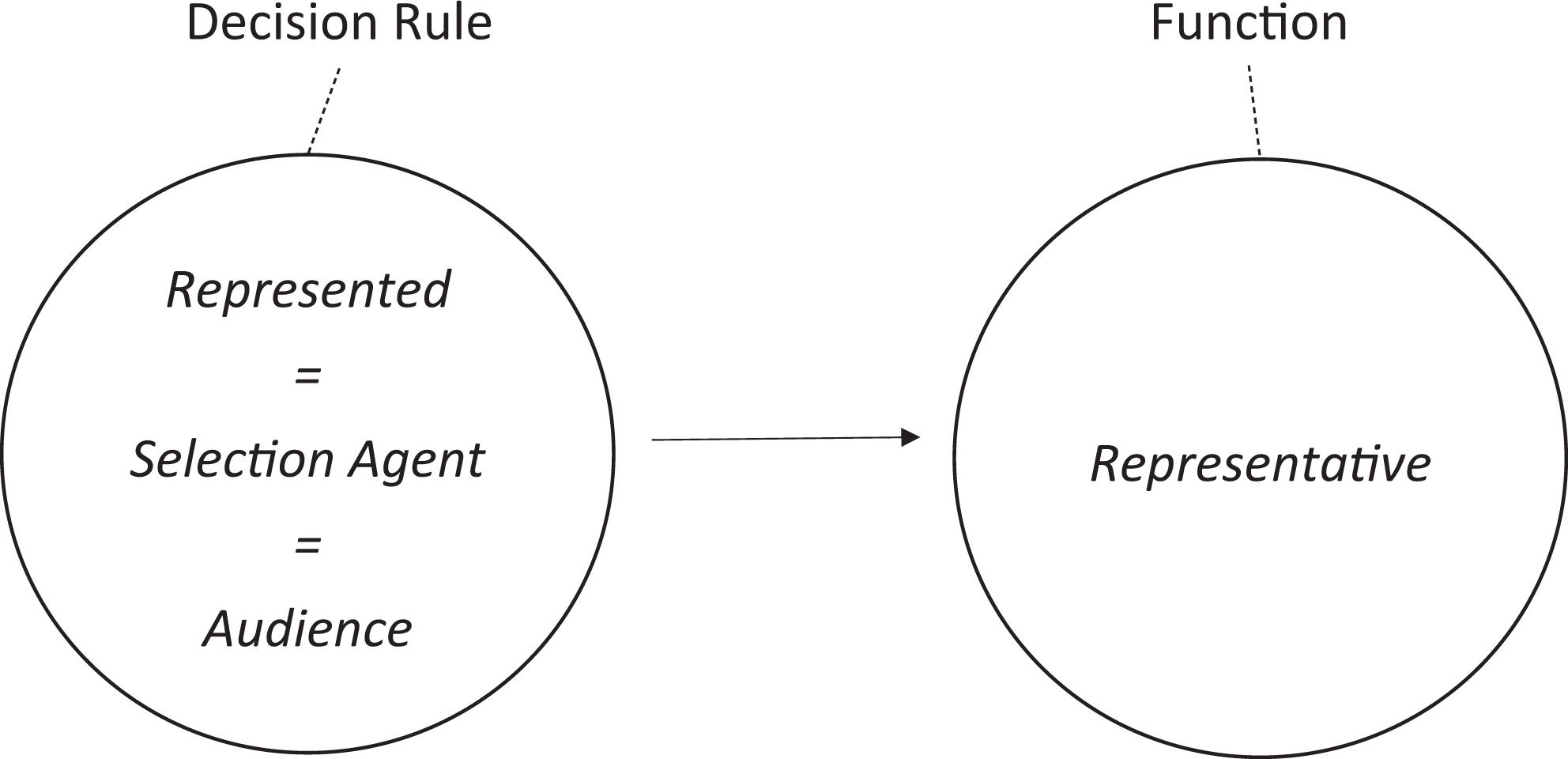
Representative Selection in Representative Democracies. Source: Based on Rehfeld (2006).
In the absence of institutions that provide political predictability to a peace process, Rehfeld’s model and Pitkin’s typology are a good starting point for scrutinising the establishment of rules, the selection of decision-makers and the roles attributed to them. I will thus analyse two main elements defining negotiation table participants, each illustrated by one side of the Venn diagram in Figure 3: their choice and the function they perform.
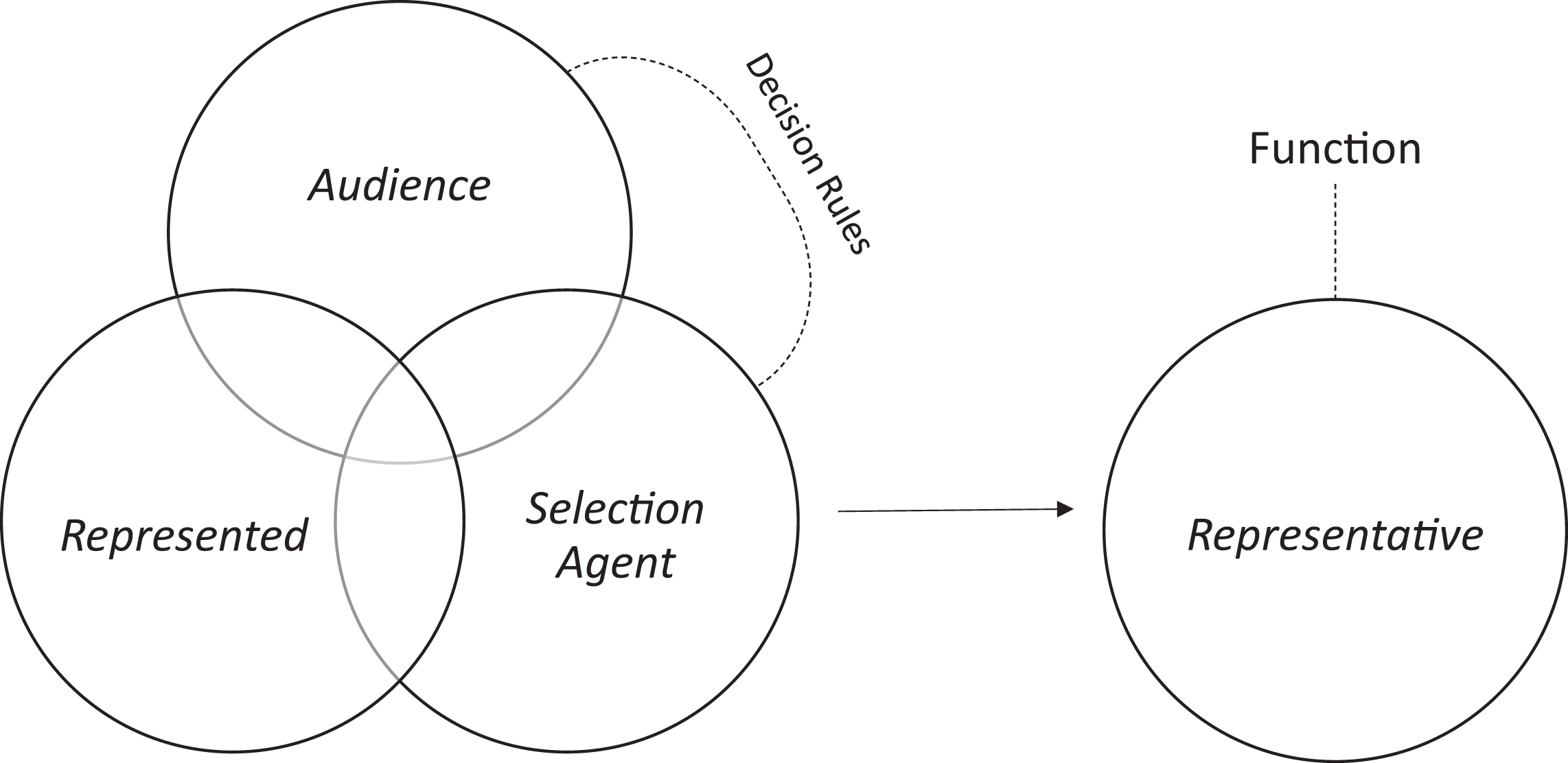
Representative Selection in Peace Processes. Source: Based on Rehfeld (2006).
First, figuring out the choice of participants at negotiation tables means exploring the left side of Figure 3. The choice of representatives requires the identification of the audience, the selection agents, and the represented involved in this process. The interaction between them is revealing of the substance of representatives chosen to sit at the table, and of whether there is room for descriptive representation of marginalised sectors of society or not. Identifying these three actors and how they interact with each other in peace processes can shed light on structural attributes that may thus prove decisive for a better understanding of inclusive peace. In this sense, it is also important to estimate where conflict parties, international mediators, and popular movements fall within these three categories. During prenegotiations, the selection agents of direct participants most likely will be the conflict parties themselves, mediators, and international sponsors. The parties may also prefer to establish general parameters and criteria for such choice, delegating it to experts or actors seen as neutral by the general public.
The audience, in turn, has a strategic role that deserves special attention. Rehfeld notes that the formal existence of representation depends not on the observation of decision rules, but on the beliefs of the audience. He ponders that “representation depends formally on the recognition by an audience, not on the coherence (or lack of coherence) of a purported case to a set of rules that the audience uses. In short, it is the beliefs of the Audience that matter, not whether those beliefs are true” (2006: 15). It is therefore important to emphasise the role of the audience’s perception in defining whether or not an actor is eligible to be a representative and if he or she can indeed be considered a representative. As Rehfeld stresses in his work, representation may also unfold “illegitimately” and may rely, more than it does on legitimacy, on the perception (and perhaps acceptance) that it is indeed happening. 4
Even more so than the other two actors listed above, the audience ends up centralising, in great measure, the political disputes that surround peace negotiations. By concentrating the power to determine decision rules on representation and, based on its own beliefs, decide whether such rules were observed or not, the audience accumulates another kind of power: it sets the parameters that gather or break up agendas; it gets to categorise people by grouping them together in this and not that way. Modes of organising constituencies in societies facing reconstruction are thus a source of power less recognised than those most associated to violent conflict. Take, for example, the practice of gerrymandering 5 in established political systems: classification matters, and it should matter all the more so when overall political rules are up for grabs and in process of renegotiation.
It is noteworthy, then, that these three protagonists in the choice of representatives are not fixed categories, but fluid objects of political contention. Civil society actors can try to force their way into the represented category via public advocacy (i.e. entering the audience), with the sole purpose of influencing decision rules, the beliefs of the audience in general, and, consequently, the choice of direct participants by selection agents. The inevitable incorporation of the issue of inclusion in conflict resolution over the last decades may have (i) widened the portion of society that makes up the audience and, as a consequence, forced the reviewing of decision rules to incorporate inclusivity norms, and/or (ii) shifted perceptions of an audience that used to accept or even defend exclusive decision rules, but no longer does. If the involved audience is now demanding for decision rules that consider not only practical, but also normative standards such as inclusivity, there are higher chances more diverse social groups will join the “represented” category, be it through descriptive representatives or symbolic ones. But let’s not forget the role of the audience’s beliefs in these dynamics: if it believes its rules are being respected, the chosen representatives will be deemed acceptable. Having said all of the above on the issue of choice, thus, two important points come up. First, the existence itself of political representation is a constant negotiation that is, in turn, always up for contestation. Second, not only do the represented constitute representation, representation also constitutes the represented, helping define represented groups’ identities by categorising them and claiming that they exist in a certain way. Represented groups are not a static, given reality that are simply there to be apprehended – they are forged by selection agents and audience and shaped by the power dynamics under which they function.
The second main element of representation mentioned above is the function it is supposed to perform. Rehfeld stresses that “any particular case of representation is always context-limited: it is defined by the Function towards which it aims, and that Function always specifies that ‘The Representative stands for the Represented in order to do X’” (2006: 17). The function is therefore the starting point of representation, and it is also crucial to determine the audience it activates: “the Function of representation specifies who the relevant parties are; that is, who is the Audience” (p. 9). The more strategic the representative’s function, of course, the more impervious to activism powerful actors tend to become. This means that marginalised sectors of society will have better chances of getting descriptive representatives when the function they are expected to perform is not considered too strategic by conflict parties and negotiation sponsors. Aside from the “presence” factor, another important point to consider regarding function is the “action” dimension mentioned in the previous subsection. Pitkin raises the issue of a “mandate versus independence” dilemma concerning a representative’s actions and his or her constituency’s demands. Rehfeld labels this “performance” – the final result of a representative process. It is necessary not only to ask what function was attributed to a certain actor, but also in which kind of performance it resulted.
The different categories and roles of representation are helpful for building another version of inclusion in the sense that they capture it in a wider manner. More than placing inclusive initiatives on a “direct–indirect spectrum,” aiming for an elusive (and flattened) goal of legitimisation, representation allows for their dynamic dissection in every step of the way, identifying how and why some were included but others were not, what kind of functions are delegated to civil society representatives and what were the effects of their inclusion. The representational lens, as a common language uniting the place of society before, during, and after peace processes, also allows for an approach that sees inclusion as a constant political negotiation, resulting from power dynamics, instead of deeming it a benign and instrumental element. In this sense, the recognition or rejection of representative relationships, their goals and processes reveal key for a deeper grasp on inclusion. In hopes of illustrating the theoretical ideas raised by this section, next I will evaluate the issue of inclusion in the context of the Colombian peace process with the FARC (2012–2016). More specifically, I will look at the case of the victims’ delegations sent to Havana in 2014 in light not of the usual inclusion language, but of the concept of political representation, in order to explore what this approach may bring to the table.
Inclusion and Representation in the Colombian Peace Process: The Case of the Victims’ Delegations
The Colombian conflict has been unfolding for over fifty years and involves several actors – not only the armed guerrillas and the government, but also narcotraffickers, paramilitary groups, and bandas criminales (“bacrims”) – which helps explain its level of complexity and the difficulty encountered in reaching a peaceful closure for it. Its origins may be found in a deep-rooted association between politics and violence in the country, the people’s exclusion from politics as an instrument of social change, as well as issues with land use, ownership, and distribution. The conflict between the government and FARC originated precisely in rural areas in the 1960s, when the guerrilla was founded following years of severe violence in the country. This period (1948–1958), known as La Violencia, resulted in an elite political pact that further eluded the population’s hopes of receiving state protection and having their social rights guaranteed through non-violent channels (Skidmore and Smith, 2005).
In conflicts as long and complex as this one, victimisation is naturally a huge issue to be addressed once peace and reconciliation efforts are launched. Colombia’s conflict has left more than 8.4 million victims to date – over 17 per cent of the population. 6 The difficulty of dealing with victimhood in this context thus has to do with the multiplicity of angles involved: a wide variety of actors committed a wide variety of crimes against a wide variety of people. Victimisers include not only the guerrillas but also paramilitary groups and the state itself. Victims include people from urban and rural areas, from different social classes, ethnicities, genders, and so on. On top of the list of victimising crimes by far is internal displacement (currently more than 7.5 million), followed by homicide (over 1 million, including direct and indirect victims) and death threats (400,000). 7 Other perpetrated crimes include forced disappearance, kidnapping, sexual violence, torture, and the recruitment of minors.
After decades of confrontations, a handful of failed peace negotiation attempts, and a particularly belligerent few years under former president Álvaro Uribe in the 2000s, then president Juan Manuel Santos and the FARC established exploratory talks and finally agreed to initiate negotiations. In August 2012, the parties announced that, after a phase of prenegotiations, they would be pursuing a peaceful solution to their conflict. At the occasion, they signed and released the General Agreement for the termination of the conflict and the construction of stable and durable peace, which stated their intentions, the rules of negotiation and the agenda it would discuss. Over the four following years later, the Havana dialogues – guaranteed by Cuba and Norway, with support from Chile and Venezuela – concluded discussions of their six-point agenda 8 and reached an agreement.
Although the process was structured as a bilateral negotiation that did not foresee a high volume of direct participation or the granting of permanent seats to civil society representatives, the negotiation table made it a point to adopt an inclusive discourse particularly reliant on indirect participation initiatives. These initiatives, which are now seen by experts as successful and innovative (e.g. see Herbolzheimer, 2016; Maldonado, 2017), can be attributed not only to the spaces formally stipulated by the table, but also to the pressure exerted by civil society organisations throughout the process.
There were three official inclusion channels established by the table from the beginning: the launch of a website (as well as physical forms distributed in post offices and town halls) for submission of suggestions from the population, the thematic forums held at regional and national levels, and consultations with experts and civil society as seen fit by the table. In a recent publication, the government explicitly alluded to Paffenholz’s modalities, identifying its early inclusive initiatives with modalities 3 and 4, and also adding modality 8, that is, the posterior approval of the agreements by the popular vote in a referendum 9 (Alto Comisionado para la Paz, 2018: 218–219). Other means of inclusion, such as the creation of the Gender Subcommission, were clear results of civil society co-ordination. Lastly, the forums on the topic of victims became a platform for the appointment of victims’ delegations tasked with discussing the issue with the negotiators. These delegations will be the focus of this section.
It is important to highlight that the absence of modality 1 of inclusion (and perhaps also of 2) does not eliminate representative dynamics from this process. Political representation is present, at the very least, due to the fact one of the parties was a democratically elected government. But it also holds if I choose to interpret political representation as something that goes beyond formal authorisation and can occupy loci other than formal politics. While the Havana talks prioritised a language of political participation – in the first version of the sixty-three-page agreement on victims, the word “participation” showed up seventy-three times – the employment of the representation lexicon was selective, as discussed ahead. One can notice a lack of clarity in the employment of the two words by the government – it declared, for example, that the process witnessed “a model of participation that depended on multiple interactions, with distinct degrees of representation and inclusion” (Alto Comisionado para la Paz, 2018: 226, translated from Spanish). This is detrimental to a deeper understanding of inclusion in peace processes.
This tension is especially evidenced in the case of the victims’ delegations, in which the intensity of having victims invited to the table (albeit temporarily) led to simultaneous utilisation and rejection of the language of representation. It is fitting to enquire, then, if the role played by the delegations can be labelled representation or not, applying the framework discussed above in an attempt to look at inclusive initiatives such as this one from a different standpoint than usual. I am not searching to provide definite answers in raising this question, which is why it is important to separate the perception of the actors involved on the nature of the delegates’ roles and, on the other hand, the choice of representation in a wider sense as a lens of analysis.
The starting point for this discussion in the Colombian peace process was the acceptance by decision-makers that the victims had to be placed at the centre of the whole peace process. This meant that both parties had to recognise their responsibility in the victimisation of the Colombian population throughout the conflict and vow not to “exchange impunities” (Presidencia de la República, 2014). Having done that, the parties acknowledged that victims deserve not only the truth about what happened to them and their loved ones, reparations and guarantees of non-repetition, but also a direct voice in this phase of negotiations. Given the brief scenario on the conflict’s victims provided above, it becomes clear that including them in a fair way was no easy task – especially considering the delegations amounted to 60 people out of a universe of 8.4 million victims. Such difficulty seems to simultaneously reinforce and challenge the choice of political representation as a lens of analysis.
On 7 June 2014, driven by the above commitment, the parties released a joint communiqué in which the principles that would guide the debates on victims were established. 10 This declaration determined the holding of regional and national thematic forums 11 by the Centro de Pensamiento y Seguimiento al Diálogo de Paz (a think tank part of the National University of Colombia) and UN Colombia. It also announced that a first delegation of victims would soon fly to Havana to “present their proposals and expectations about peacebuilding in the territories and about the satisfaction of the victims’ rights” (Alto Comisionado para la Paz, 2014a).
Although the negotiators were not completely clear as to who would get to go, they mentioned, at that point, that “this delegation will be made up in such a manner as to ensure the plural and balanced representation of the different victims, as well as of the different victimizing events, but not intending to ensure that a delegation may represent the millions of victims left by the armed conflict” (Alto Comisionado para la Paz, 2014a). Virginia Bouvier wrote, at the time, that “[w]ith more than 6.5 million victims registered with the government’s Victims’ Unit, and tremendous diversity among them, it will be difficult to ensure complete representation at the table” (Bouvier, 2014). Indeed, despite the above-average level of organisation perceived among Colombian victims, differences invariably led to some tensions over who would go to Havana. It seemed, at first, that the ten to fifteen expected delegates would come from the Mesa Nacional de Víctimas – an organ that functions within the Victims’ Unit as a participatory instance for formally identified victims and a product of the Law of Victims 12 (Ley 1448 de 2011). Yet, concerns were raised that these choices could be influenced by political preferences, and such a group would consequently not be a representative sample of the totality of the conflict’s victims (La Silla Vacía, 2014a, 2014b).
On 17 July 2014, the delegations issued another communiqué to announce the selection criteria for participants. It was announced then that the National University and the UN would also be in charge of the selection process, with support from the Episcopal Conference of Colombia (assigned with securing the observation of said criteria). The main parameters for the choice of victims’ delegates would be balance, pluralism and fairness, which should be reflected in the composition of each one of the delegations. In particular, the delegations should reflect the whole universe of human rights violations and IHL [international humanitarian law] infractions that have taken place throughout the internal conflict, taking the different social sectors, populations and the regional approach into account. […] The delegations’ members shall be direct victims of the conflict and they will participate in that capacity and not in representation of others. The foregoing does not exclude the cases of collective victimization. (Alto Comisionado para la Paz, 2014b, my emphasis)
At the occasion of the first delegation’s trip to Havana on 15 August, the three institutions responsible for the choice of participants, seeking to elucidate and detail the criteria established by the negotiation table, released a joint statement with further explanation on the guiding principles of their work. It reaffirmed the table’s warning of the impossibility of perfect representativeness, as well as its request that the delegations contemplated the widest spectrum possible of victims, considering all types of victimisation from all categories of armed actors, from different affected territories and from varied social sectors, with special attention to marginalised groups and a gender focus (UNDP, 2014a). The institutions argued against calls for proportionality, claiming that (i) some types of victims, such as the internally displaced, are quantitatively disproportional in their large numbers, which could compromise the integration of important albeit smaller groups of victims; and (ii) it was not their role to tally or categorise the whole universe of the conflict’s victims, a job, in reality, to be fulfilled later by the Truth Commission (p. 3).
Based on Rehfeld’s standards of representation (see Figure 4 above), the negotiation table (alongside parties’ leaders) were the “audience” in the sense they came up with the decision rule and were the one actor who needed to validate the choice of participants. The National University of Colombia, UN Colombia, and the Episcopal Conference were the “selection agents” whom – according to the selection criteria made public by the parties’ delegations and considering the input received in regional and national forums – in fact decided which victims were best suited to attend the debates. The “represented,” finally, would be the conflict’s victims. It is worth noting that diverse victims’ leaderships exerted pressure over both audience and selection agents during the selection phase – hence the dashed arrows in Figure 4 – attempting in this manner to leave behind a mostly passive role of represented and infiltrate the two other remaining circumferences in order to have a say in the decision rule and the selection of delegates itself.
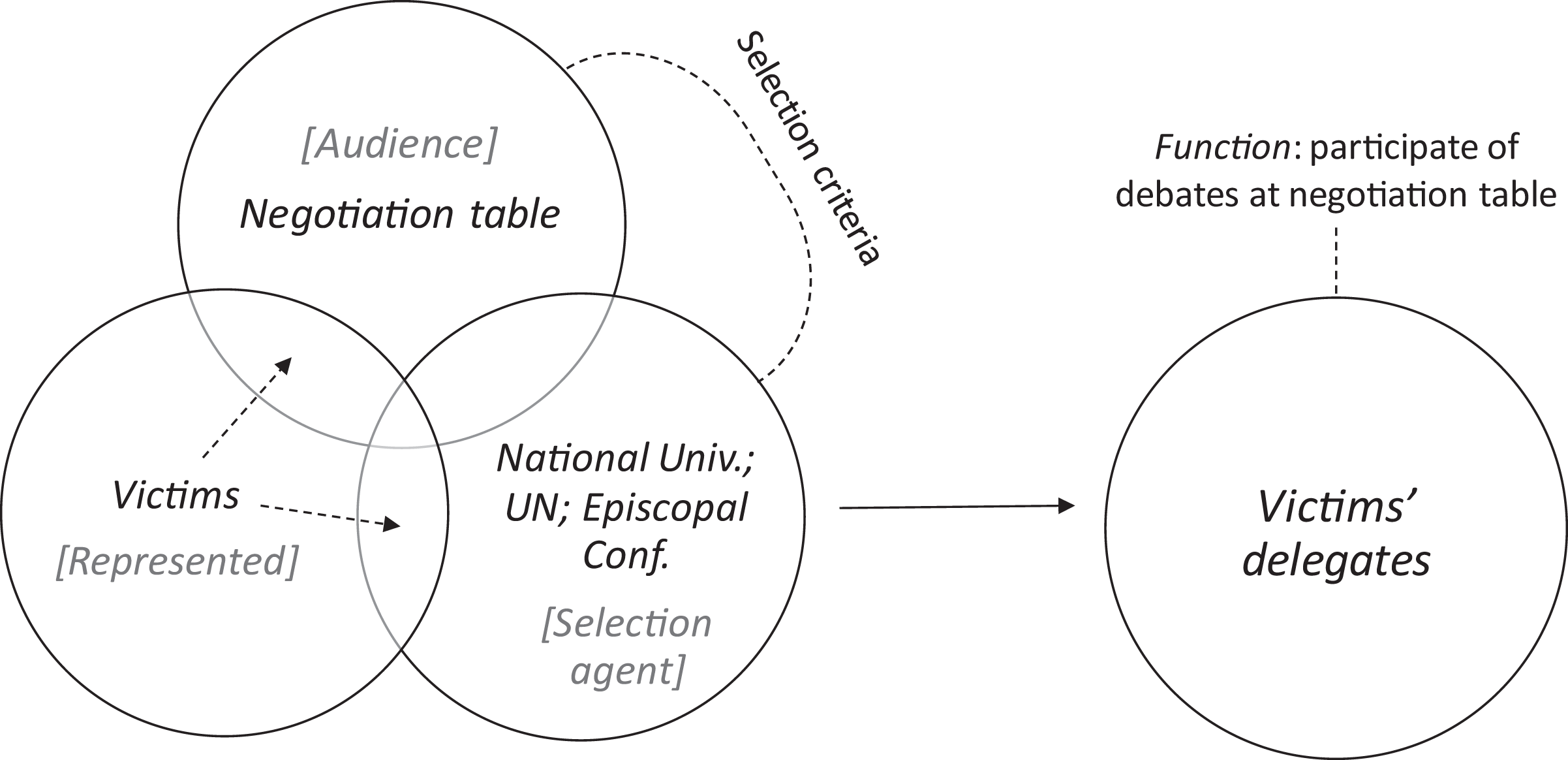
Selection of Victims’ Delegations in the Colombian Peace Process. Source: Based on Rehfeld (2006).
Although assessing the real impact of such pressure is a matter that remains to be further dissected, it is important to highlight that the definition of the representative function at hand (temporary participation at negotiation table discussions, with no decision power) was off-reach for victims and hermetic to social pressure. 13 In other words, whereas the choice of participants seemed like a fairly open-ended conversation, the actual role attributed to the victims that were picked was not up for debate.
The substantive facet of representation, on the other hand, brings attention to the issues of representativeness (presence/descriptive representation) and policy impact by the victims’ delegates (action/“act for” representation). Despite the negotiators’ reluctance to commit to proportionality or precise representativeness, it looks as if its request for balance and pluralism in the composition of the five delegations was fulfilled. Women made up 60 per cent of the delegates, and a wide variety of victimisations were represented by victims or their family members – kidnapping, massacres, forced displacement, gender-based and sexual violence, homicide, child recruitment, disappearances, false positives, 14 use of prohibited weapons, violence against vulnerable ethnic groups, and so on. Roddy Brett observes that the issue of victimisation variety was the single most difficult one to find balance for, seeing that the political opposition wanted only victims of FARC to attend and the FARC, in turn, was sensitive when it came to the numbers of victims from their violations (Brett, 2018: 281). Several social sectors were made present, from rural to urban, from powerful politicians and well-known journalists to human rights and minorities’ activists of Afro-Colombian, indigenous, and women’s groups. Keeping in mind that some territories were more affected by the conflict than others, the regional parameter was also respected – twenty-eight out of the thirty-two Colombian departments were represented. 15 Still, for Camilo Villa, a member of the fifth delegation, “this is a participation that lacks volume; […] we know that 5 or 6 thousand people participated of the forums, but only 60 made it to Havana” (Trindade Viana and Mendes, 2016).
Lastly, the action dimension of this representative process may be seen from different perspectives. The initiative was celebrated as having made a lasting impression on negotiators and therefore exercised indirect influence on the negotiations from that point on. Brett argues “the encounter with victims and the clarity of their proposals provided the negotiators with a framework concerning specific measures for the design of the victims’ accord” (2018: 292). At times, however, it seems as if the actual policy influence and impact of the victims (their “performance”) stood beneath their own desired outcomes. One of the proposals brought up in the national forum at Cali, for example, maintained that “participation in the process is a right of the victims, as is its binding character” (UNDP, 2014f: 6, translated from Spanish). As mentioned earlier, however, the function performed by the victims’ delegates was non-negotiable – they would share their experiences and voice their proposals, but no binding pledges were made on the part of government and FARC negotiators. Villa observes, in this regard, that “a lot of proposals were cut, mainly the ones that called for a commitment of policy modification on the part of the Armed Forces and the topic of state depuration” (Trindade Viana and Mendes, 2016).
Ultimately, what lies at the bottom of this process is a certain contradiction between the use of a language of representation and its simultaneous rejection. At the same time that the negotiation table vowed to “ensure the plural and balanced representation of the different victims” (Alto Comisionado para la Paz, 2014a), it was quick to clarify that victims would “participate in that capacity and not in representation of others” (Alto Comisionado para la Paz, 2014b). Much like the language adopted by the Conflict Resolution literature, Colombian negotiators are interested in (attainable) representativeness, but refuse to recognise popular engagement in formal instances as political representation. As a counterargument, one may say the delegates themselves did not believe they would be able to represent the extremely multifaceted universe of Colombia’s victims – something that perhaps many of the millions of victims who never got to go to Havana would agree with. 16
Even though the formal representative role was not there, as Brett concludes, a cohesive and unified victim-led peacebuilding agenda began to emerge. This agenda emerged directly out of the collective voice and thinking of the 60 members of the delegations, and logically did not speak for all victims and their organisations. However, it began to gain leverage at the national level and sought, to a degree, to represent itself as a formalised politics of victimhood within the context of peacemaking and peacebuilding. In this respect, to a degree, the delegations then amplified the voices of specific individual victims, while seeking to represent partially the broader demands of victims’ organisations. (Brett, 2018: 287)
A second point is that representation allows for inclusion to be seen as a political endeavour. Rehfeld’s view on representation opens the possibility of approaching representation as a two-way street involving numerous actors that work through power dynamics and collective mobilisation. As mentioned earlier, not only do existing identities turn up in representation; representation itself – or those audiences defining decision rules for recognising representation – help turn loose social groups into collectivities by convening them as such. When it comes to the specific case of victims, for example, Jacoby observes that “often [parallels between personal and group experiences] are constructed on the victims’ behalf” (2015: 522). As opposed to constituting a mere legitimising end in and of itself, approaching inclusive representation as another form of negotiated political contention permeated by power dynamics opens up the possibility of deeming inclusion a means towards the end of finally granting long denied rights.
Final Remarks
This article tried to evidence the theoretical usefulness and potential empirical validity of reframing inclusive mechanisms of peace negotiations in light of the concept of political representation. While literature on the subject mostly speaks a language of inclusion, the vagueness of the term ultimately conceals fundamental (political) aspects of efforts to give voice to those social groups particularly affected by armed conflicts. The more technical approach used by specialists, in turn, often treats inclusion as a legitimising “bureaucratic box” to be checked off a list and makes no distinction between the notions of participation and representation.
This discussion was illustrated through the Colombian peace process with the FARC – emblematic in its intention to be both inclusive and effective – more specifically the invitation of victims’ delegations in 2014, in which all the above cited issues manifested quite clearly. Official discourse showed clear preference for the language of participation, rejecting that the role of victims’ delegates could be seen as representative. Representation can be a thousand things at the same time, however; it may be taken as the formal procedure behind the choice of representatives, but it is also about a feeling of identification, a convincing act of incarnation, that allows for one to think of a process as representative or not.
By refusing to accept the representative feature of the victims’ delegations while focusing on the lack of the formal, clear mandate to perform a specific decision-making function, they missed some of the most important aspects of representation involved in this effort. While there were no formal authorising mechanisms for the delegates to represent the complex universe of Colombia’s victims, the parties themselves widely employed the representative lexicon in regard to substance, specifically in relation to the goal of representativeness in the gathering of the group. The language of representation is both utilised and discarded, and such selectivity may be important to deepen our outlook on inclusive peace negotiations. While still walking a fine line between inclusion and effectiveness, the representational lens inserts yet another tightrope into this equation – one between political interaction and the creation of “technical” models capable of tracking concrete results. Therefore, more than simply treating inclusion as a condition for the creation of legitimacy, political representation in this context interacts with participatory initiatives and underscores, above all, the realisation of long denied rights.
Footnotes
Acknowledgement
The author is thankful to Monica Herz and Claudia Fuentes Julio for their comments on earlier versions of this article, and to the reviewers for their helpful feedback on the manuscript.
Declaration of Conflicting Interests
The author(s) declared no potential conflicts of interest with respect to the research, authorship, and/or publication of this article.
Funding
The author(s) disclosed receipt of the following financial support for the research, authorship and/or publication of this article: This study was financed in part by the Coordenação de Aperfeiçoamento de Pessoal de Nível Superior - Brasil (CAPES) - Finance Code 001.