




Abstract
During the first two decades of the twenty-first century, Mexico’s so-called drug war claimed around a quarter of a million lives. Adapting to this enduring epidemic of violence, the print media have adopted a minimalist reporting style that gives only thin, formulaic accounts of violent events. As I argue, established journalistic minimalism does more than provide little information about violence. With practised impassiveness, it frames violence in a way that creates a certain narrative: not of social actors to be understood but of natural events to be endured. Through a qualitative content analysis of over 1200 news reports, I examine the persistent force of this “natural” frame in the face of an extraordinary development: the unprecedented intrusion of political violence into the 2018 general elections, when forty-eight candidates were assassinated.
Introduction
Since the closing days of its authoritarian regime in the late 1990s, Mexico has been living through a strange kind of civil war, the so-called drug war, a tenacious lethal conflict among an ever-evolving multiplicity of armed business enterprises, aka “drug cartels.” After simmering in the background, this “criminal war” (Trejo and Ley, 2020) escalated under President Felipe Calderón (2006–2012) and has persisted at high levels of lethality ever since. It has claimed around a quarter of a million lives.
Navigating multiple existential pressures of markets, governments, and organised crime, Mexico’s print media have been adapting to the new realities of violence by embracing a minimalistic reporting style that reduces organised deaths, if not to mere body counts, then to thin, detached, formulaic accounts of anonymous murder (see e.g. Reyna, 2014, 2018). As I argue, minimalist reporting of organised violence does more than conveying little information. Neither neutral nor amorphous, it does not create a vacuum but tells a story. It presents violence as a natural event, rather than a human act. By the classic distinction introduced by Erving Goffman (1986 [1974]), rather than choosing a “social frame” that treats perpetrators and victims as sentient and intelligible social actors, it adopts a “natural frame” that registers violent acts as blind movements of nature.
Through a qualitative content analysis of over 1200 news reports, I will examine the resilience of such minimalistic storytelling in the face of an extraordinary development: the unprecedented escalation of political violence in the 2018 general elections. To prepare the terrain for my analysis, I will first sketch the irruption of electoral violence in 2018, describe the profiles of the 48 slain candidates, and introduce the dataset that serves as the empirical basis for my qualitative content analysis. I will then outline the standard coverage of organised violence by Mexican print media: their “minimalist” reporting routines, their abstract “issue framing” of criminal organised violence, and the acceptance of specific forms of violence (assaults and abductions) as “frame triggers.” In the remainder of the article, I reconstruct step-by-step how the print media traced two sequential processes: the assassinations of candidates and their subsequent investigations by police and judicial authorities. As I find, through their minimalistic reporting routines, the media indeed constructed consistent naturalising narratives. They described these murders as well as their investigations as if they were movements of nature: mute choreographies of organised death and bureaucratised impunity. 1
The Irruption of Electoral Violence
Since its official inauguration with the opposition’s victory in the 2000 presidential elections, Mexican democracy has been sliding into the so-called drug war, an opaque “economic civil war” in which everchanging criminal organisations have been battling among themselves as well as against the State and civil society (de la Calle and Schedler, 2021; Trejo and Ley, 2020). The death toll has been staggering: over the first two democratic decades, an estimated 180,000 homicides and 70,000 disappearances have been attributed to the conflict. 2
Organised criminal violence had already produced a steady stream of political victims, including candidates, local officials, judges, journalists, and human rights activists (see e.g. Pérez and de Paz, 2018; Trejo and Ley, 2021), but during the 2018 elections, violence against political actors escalated. Over 18,000 elected positions were at stake: the federal presidency, both national legislative chambers, nine governorships, twenty-seven local legislatures, and 1612 city councils (Sonnleitner, 2020: 454). During the ten months preceding the 2 July election day, 104 elected officials and forty-eight candidates were assassinated (Etellekt, 2018: 11). In some countries, such as Pakistan and the Philippines, electoral violence is endemic, and it is habitual to see elections produce high numbers of lethal victims (Birch, 2020). In Mexico, however, electoral violence had been rare in the early 2000s, and no more than episodic after the escalation of the drug war under President Felipe Calderón (2006–2012). 3 The scale of electoral violence in 2018 was unprecedented. It turned the multi-level contest into “the most violent election in Mexico’s modern history” (Etellekt, 2018: 11).
How did the Mexican media process the surge of political assassinations? Did the irruption of electoral violence disrupt established routines of journalistic reporting on criminal violence? Before summing up these routines and trying to answer my question, I will lay out the basic facts of the 2018 candidate killings and their coverage by Mexico’s print media.
The Coverage of Candidate Killings
To document the public treatment of lethal violence against candidates in the 2018 elections, I have analysed the universe of newspaper articles on all forty-eight registered cases in accordance with the dataset compiled by Víctor Hernández (2020) (with a few minimal name and date corrections). The victims were assassinated between September 2017 (the official start of the federal electoral period) and election day, 2 July 2018. Twenty-six of them were so-called “pre-candidates” competing for their parties’ nomination, while twenty were “official” candidates already chosen by their parties. 4 Table 1 provides the full listing.
Murdered Candidates in Mexico’s 2018 Elections.
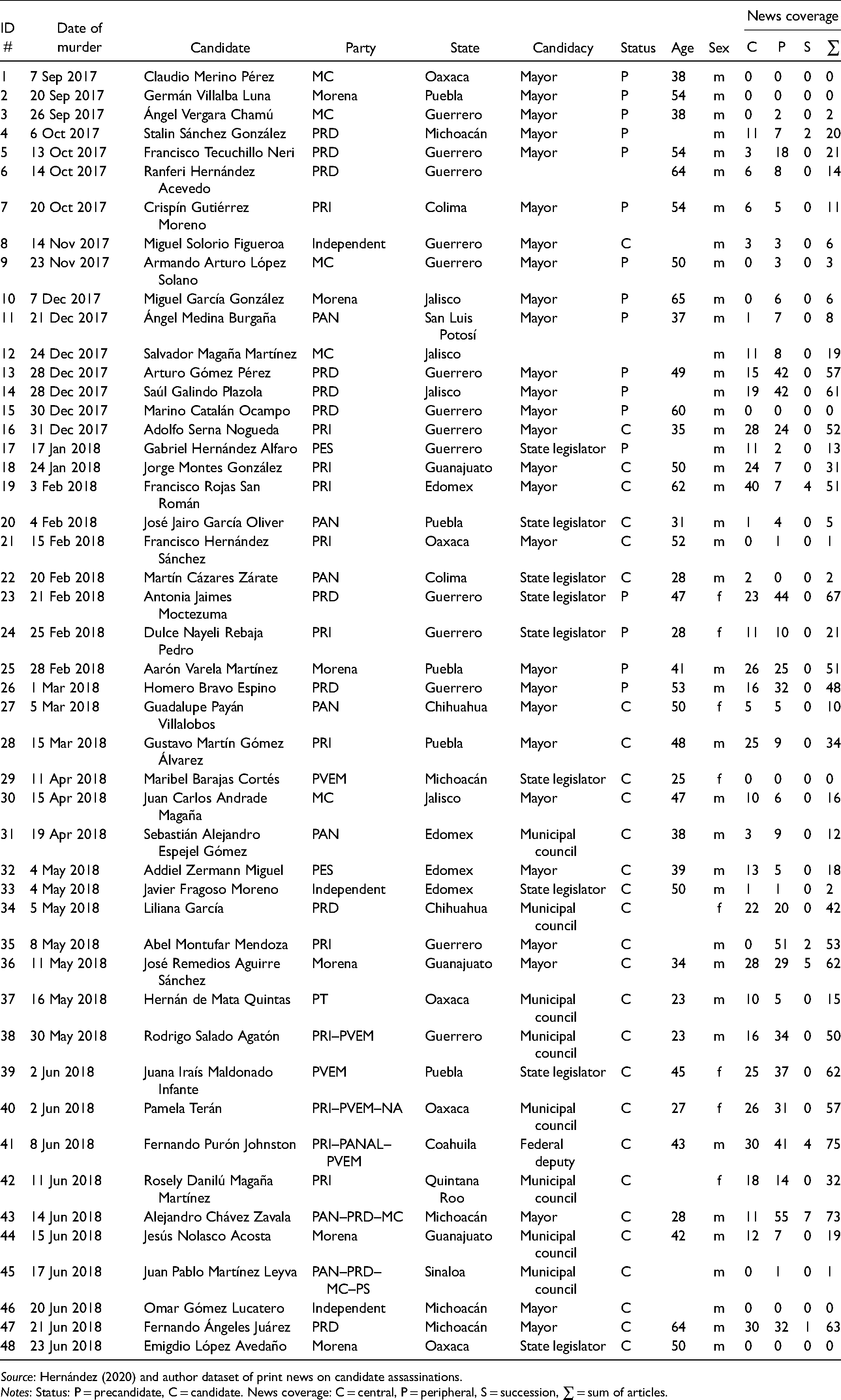
Source: Hernández (2020) and author dataset of print news on candidate assassinations.
Notes: Status: P = precandidate, C = candidate. News coverage: C = central, P = peripheral, S = succession, ∑ = sum of articles.
As the table shows, with one exception (Fernando Purón, who ran for a seat in the Federal Chamber of Deputies), all competed for local offices: twenty-eight aspired to be mayors, eight municipal councillors, and nine state legislators. In terms of party membership, twelve of the murdered candidates belonged to the ruling PRI, ten to the left-wing PRD, seven to the conservative PAN, six to AMLO’s Morena, and all others to minor parties. They were aged between twenty-three and sixty-five, with a mean of forty-four years (N = 38). Most of them were men (83.3 per cent). In geographical terms, the state of Guerrero took the brunt of lethal electoral violence (fourteen cases or 29.2 per cent), followed by Michoacán, Oaxaca, and Puebla (five cases each) and Jalisco and the State of Mexico (four cases each).
In contrast to the vast majority of reported victims of organised violence, the assassinated candidates were not anonymous but named victims. The “universe” of reports I have collected consists of all the articles that contained the names of individual victims and were published between the day of their assassination and the subsequent three months in any of the print media included in the digital archive EMIS API Infolatina, which contains major national as well as a broad array of local Mexican newspapers. 5 The ensuing dataset comprises 1266 news reports, an average of 26.4 per case. However, much less than half of them (542, i.e. 42.8 per cent) focus on the case at hand (the killing, the investigations, political and private responses, tributes, and funeral proceedings). Most of the articles (699, i.e. 55.2 per cent) mention the victim only in passing. Such “peripheral” notes often include the event as a mere example in a larger string of similar events. A small portion of articles (twenty-five, i.e. 2 per cent) report debates or decisions on successor candidates. Given the syndicated nature of numerous local newspapers, the dataset contains numerous perfect or near repetitions. Searching primarily for similarities, rather than frequencies, I have excluded these repetitive notes from my content analysis.
The last four columns in Table 1 show the highly unequal coverage of individual cases. The Infolatina database does not contain any reports on the murder of six candidates, yet over twenty “central” and over thirty “peripheral” notes on about a dozen cases. Like most events, candidate assassinations have a short news cycle. Almost two-fifths of all central articles appear within the first three days following the event (423, i.e. 78 per cent).
To establish the extent to which these media reports reproduce ingrained practices of journalistic minimalism and to reconstruct in a precise and nuanced fashion the “naturalising” stories these practices conveyed about electoral violence, my qualitative content analysis of candidate killings and their subsequent criminal investigations proceeded in two steps. I first created a full collection of relevant text fragments on each phase of unfolding event sequences, from the appearance of the killers on the scene of death to their disappearance (for candidate assassinations), and from the arrival of the police at the crime scene to the possible identification of subjects (for their criminal investigations). 6 Subsequently, I dissected the microstructure of these thematic fragments, coded their granular analytic components, and arranged the corresponding quotes in extensive tables of structured primary material. While the original dataset contains the raw material of my analysis (the complete text of all news reports in my sample), the tables put the entirety of my empirical textual evidence on display. For the sake of methodological transparency, they are available in full in the Online Appendix. In their depressing repetitiveness, they make for fascinating reading. 7 Before we wade into this material, however, we need to clarify the nature of established reporting styles and narrative frames.
Minimalistic Reporting Routines
When extraordinary acts of violence, such as terrorist attacks or private massacres, irrupt into the tranquil life of a peaceful, consolidated democracy, media reporting immediately and massively turns towards the event to do four things. (a) The reports reconstruct the crime, as well as the precise sequences of actions and omissions that led to it. (b) They investigate the perpetrator’s personality, life history, and social environment to understand his motives. (c) To honour the victims, they reconstruct their individual personalities and their lives cut short or damaged by the crime. (d) They reflect on the broader political and societal factors that may have aided the commission of the crime, either by encouraging it or by failing to prevent it. To see such journalistic practices at work, it suffices to take a cursory look at national media reports after events such as the Connecticut Sandy Hook elementary school shooting in December 2014, the attack on the Parisian Charlie Hebdo satirical newspaper in January 2015, or the gun assault on two mosques in Christchurch, New Zealand, in March 2019. 8
In Mexico’s chronic security crisis, print media tend not to do any of this. Over the long years of war, they have been subject to manifold pressures that have pushed them towards stringent limitations in their coverage of criminal violence: (a) The sheer numbers of homicides and disappearances turn acts of lethal violence into ordinary events that lack newsworthiness and are impossible to cover in a comprehensive manner (see also Reyna, 2014: 112–7). (b) Over the years, dozens of journalists have been assassinated by criminal organisations. Persistent, diffuse threats of violence have created “informative holes” of silence, self-censorship, and selective reporting (see Cepeda, 2017; del Palacio, 2015, 2018; Durin, 2019; Hughes and Márquez, 2017; Relly and González, 2014; Reyna, 2014). (c) Both local and national governments have put pressure on the media to reduce the visibility of organised violence (see del Palacio, 2018; González, 2018). (d) To avoid serving as propaganda platforms for criminal organisations, some media organisations have agreed to limit their coverage and stop reproducing public declarations by cartels (see Reyna, 2014: 71–2). (e) Legal restrictions prevent journalists from talking to suspects and publicising sensitive information (see del Palacio, 2018: 185–8). (f) Last but not least, most Mexican print media lack the material and human resources to conduct in-depth investigations (Reyna, 2014: 26–47).
Overall, given these convergent constraints, the Mexican print media coverage of organised violence has been minimalistic. Only a small percentage of organised homicides make it into the newspapers. 9 The notes that do appear seldom go beyond bare sketches of the most elemental facts. “Without the luxury of details” (Reyna, 2014: 100), they report that a certain number of people of a certain sex and approximate age were killed in certain ways with certain types of arms by unknown men riding certain types of cars. Little more. As a rule, newspapers do not reveal anything further either about the victims or the perpetrators, nor do they seek out information from them (Reyna, 2014: 123). Structurally dependent on governmental sources, they do not actively investigate these crimes but passively transcribe official reports and declarations (Reyna, 2014: 119–32). The modal type of news report for a cartel murder is a statistical count: one more body (see Reyna, 2014: 135–45; 2018). As I will be documenting, the passiveness of reporting goes hand in hand with impassiveness, with an almost absolute normative and emotional detachment that infuses its stories with an air of social unreality.
Naturally, there are exceptions. (a) When journalists identify victims as fortuitous and innocent, they are ready to move from the minimalism of body counts to more empathic and emotional frames of “trauma and tragedy” (Reyna, 2014: 145–54). (b) Rather than textual minimalism, some newspapers offer visual maximalism: the frivolous gore of graphic violence (see del Palacio, 2018: 223–49; Ovalle, 2010; Reguillo, 2012). (c) Last but not least, under great personal risk, outstanding journalists keep conducting admirable work of investigative journalism on organised crime. 10
Framing Organised Criminal Violence
Minimalist reporting routines are usually thought of as information poor, as they tell us very little about the actual events (see Reyna, 2014). They can well play narrative roles, however. In terms of a distinction proposed by Erving Goffman in his seminal Frame Analysis (1986 [1974]), minimalistic accounts of violence in the Mexican media tend to adopt a “natural” rather than a “social frame.” They describe violent crimes as blind acts of nature rather than purposeful acts by intelligible humans.
What is Going on Here?
Students of political frames are generally interested in frame variance, in strategic choices among competing frames by elites or counter elites. 11 They do not study frames as cultural givens but as strategic constructions by collective actors such as mass media, electoral campaign teams, or social movements. In contradistinction, in Frame Analysis, Erving Goffman (1986 [1974]) did not conceive frames as elite projects or as choices, but as conventions. Instead of conceiving them as “alternative ways of defining issues” (de Vreese, 2005: 53), he took them as “the basic frameworks of understanding available in our society for making sense out of events” (Goffman, 1986 [1974]: 10).
In the Goffmanian perspective, frames are commonsensical “principles of organization” of experience (10 and 13) that allow actors to reach “seeming agreement” (9) about the “social reality” (2) they inhabit. Rather than alternative modes of presenting shared realities, they are “conventional understandings” that are constitutive of a shared reality, allowing us “to cope with the bizarre potentials of social life” (15). In ordinary life, they provide answers to the question: “What is going on here?” (8). Arguably, the Mexican media have developed such commonsensical “definitions of a situation” (10) towards the epidemic of organised violence that has been engulfing the country.
The framing literature habitually distinguishes abstract accounts of political problems that discuss general trends, causes, and consequences (“issue frames”) from concrete approaches that illustrate general problems through the personal experiences of affected individuals (“episodic frames”). 12 In Mexican media reports on organised violence, their abstract “issue framing” defines their commonsensical vision of the general problem, while their concrete “episodic framing” defines the perspective on specific instances of violence. The former describes, in essence, their standard vision of actors and motives of violence, while the latter prescribes their standard version of violent events.
Actor Framing: Who Does What to Whom and Why?
Even though the creation of multiple private armies by drug cartels in the 1990s had sown the seeds for the epidemic of violence to come (Trejo and Ley, 2020: Part II), nobody had foreseen the catastrophe. Its rapid descent into the everyday horrors of a “violent democracy” (Arias and Goldstein, 2010) took Mexican society by surprise and it has been struggling ever since with how to understand “the hell” it found itself dragged into. 13 The public vocabulary of violence has been unstable and contested. Academic analyses and media reports commonly refer to “drug violence,” “organized crime,” or “organized violence.” Abstractions such as “violence and insecurity” are common and so is the language of war: “the drug war,” “the criminal war,” and “the war among cartels.” 14 Beneath conflicting conceptual and terminological choices, however, a common narrative has emerged, a dominant frame of interpretation that conceives certain types of violence as routine activities by criminal organisations (“cartels”).
The frame of organised crime serves to make sense of the bewildering intrusion of senseless violence into the life of a happy, gentle, democratic nation. It delineates a category of violence that is neither anomic nor incomprehensible but calculating and strategic. It defines its actors, means, and motives. Its protagonists are rational barbarians, ruthless and faceless business firms, who use physical violence as a means of maximising illicit profits and rents. They do so in recognisable ways, either by attacking their victims with assault rifles in public or by kidnapping and making them disappear. Their additive mass murder (one by one) is assumed to obey the economic imperatives of illicit markets. Their victims are largely seen as self-selected and, thus, self-responsible: they are killed because they have left the path of virtue. 15 Even when victims are political actors, their killers are assumed to be not. They are assumed to be profit-driven criminal organisations that do not have a political agenda beyond the maximisation of their monetary income. 16
Event Framing: What is Going on?
Typical accounts of organised violence in the Mexican print media are “episodic” in the sense that they focus on specific actors and events, leaving the larger context implicit. They are the opposite of classic “episodic” accounts of “emotions and empathy” (Boukes, 2022: 377). Rather than telling concrete, personal, humane stories of individual experiences, they present mere accounting lines of death that provide some thin facts and figures in a distant, stereotypical manner. Their lifeless sketches serve to convey the standard narrative of criminal organised violence. And they also serve to “naturalise” organised violence.
Goffman distinguished between “natural frameworks” of blind causality and “social frameworks” of meaningful action (Goffman, 1986 [1974]: 21–6 and 188–97). As I will be showing, in their aseptic (and often trivialising) minimalism, the Mexican news media pictured candidate murders as well as their subsequent criminal investigations within a “naturalising” frame that registered the actions performed by assassins and investigators as if they were movements of nature: mute choreographies of organised death and bureaucratised impunity. Their impassive “hyper-objectivity” (Reyna, 2018) removed these events from the social world, where murder and injustice still matter to people, where they still hurt and create sorrow and anger, into a realm in which they do not seem to matter anymore, where things are as they are, and we can watch them without affect or affectation, from a distance, like the movements of clouds. Before turning to these “naturalising” stories though, we need to know how journalists pick their genre of storytelling. How can they decide that it is a story of organised violence they need to tell? What is it that triggers episodic frames of organised violence?
The Frame Trigger
Political elections are a civilising device. They open peaceful roads to state power. Still, a significant minority of elections worldwide, some of them democratic, others authoritarian, are afflicted by violence (Birch and Muchlinski, 2020; Daxecker et al., 2019; Hafner-Burton et al., 2014). Conventional definitions of electoral violence include its timing and its targets: it takes place during elections (before, during, or after election day) and targets the electoral process (its actors, institutions, or infrastructure). 17 Though its goals may be systemic (an attack against elections by their ideological enemies), most electoral violence is competitive (an attack against electoral contenders by their adversaries). Its “main organisers” are “political parties” (Höglund, 2009: 416) in the pursuit of “electoral advantage” (Meadow, 2009: 233). Incumbents tend to use it as a tool of exclusion and opposition parties as a tool of mobilisation (Birch, 2020).
However, since violence is an illicit strategy of electoral competition, its use is “typically not widely advertised” (Birch and Muchlinski, 2020: 233). Its masterminds often seek to maintain deniability by delegating it to ostensibly non-state, non-partisan agents, such as groups of thugs, youth groups, rebel groups, and private militias who preserve varying degrees of autonomy from their political sponsors (Staniland, 2015). 18 Identifying the authors of electoral violence is therefore notoriously difficult and often shrouded in controversy (see e.g. Daxecker and Jung, 2018: 59; Mehler, 2007).
In the 2018 candidate assassinations, nobody claimed public responsibility for any of the murders. The assassins did not use uniforms or official cartel vehicles. They did not shout any slogans or leave written statements on site. And their organisations did not issue any declarations of authorship afterwards. Furthermore, in general terms, the Mexican judicial system offers little hope for clarifying such crimes. The Non-Governmental Organization Cero Impunity estimates that around 90 per cent of all murder cases in Mexico (regardless of their individual or organisational authorship) go without punishment (Zepeda and Jiménez, 2019: 14). Under the existing conditions of structural opacity, how could the media “know” that a candidate was killed by “organised crime”? How do they manage to attribute authorship? Very simple: criminal organisations are assumed to reveal themselves through their distinctive modi operandi.
Early in the Mexican drug war, “the narcos” established their lethal handwriting and their characteristic “style” of violence. Rather than just killing people, they would kill them in certain ways. Aside from public confrontations between armed groups, Mexican public opinion has come to recognise two forms of murder as distinctive operational routines of organised crime: public assaults with firearms (“executions”) and public abductions (“levantamientos”). Typically, it is small groups of motorised men who carry out these crimes. When “picking up” someone from a public place, they either make them “disappear” or torture and kill them to discard or display their bodies in a public place (see Schedler, 2018: 60–68).
Given the absence of reliable judicial information, all Mexican data on “homicides related to organised crime” or “executions” are based on such “symptomatic” pieces of observable evidence. Observers use objective characteristics of either the assassination or its victim to establish criminal authorship. For instance, if a victim was killed in public with assault weapons, or appears after a kidnapping with signs of torture, everybody tends to attribute the murder to criminal organisations. Everybody includes public officials, citizens, scholars, and journalists. 19 For the media, these distinctive forms of assassination serve as factual cues that trigger the interpretative frame of organised crime. They serve as discriminating messages (Bateson, 2006: 325) that allow journalists to attribute, straight away and without hesitation, responsibility for the crime: the form of murder reveals the murderer.
With one exception, 20 all candidate killings in the 2018 Mexican elections followed such prototypical patterns of organised crime operations. As far as available public information permits to infer, seven of the forty-eight murdered candidates suffered abductions: Francisco Tecuchillo (C5), Salvador Magaña (C12), José Jairo García (C20), Dulce Rebaja (C24), Guadalupe Payán (C27), Addiel Zermann (C32), and Liliana García (C34). All others were victims of public assaults with firearms. Such “narco-style” killings carry two basic messages. First, they rule out alternative causes of death. They tell everybody: this was an act of murder – not suicide, not an accident, not a fatal disease, not poisoning, but open assassination. Second, they rule out alternative agents of death. They tell everybody: “the narcos” did it.
The Choreography of Organised Death
After tens of thousands of deaths have been attributed to organised crime, it is easy to understand any additional “narco-style” assassination as a normal event in an unending flow of organised death. Yet, as they aim at the very heart of democracy, candidate assassinations, one may think, are different. They clamour for attention, for outrage and solidarity, for close and careful inquiries into what happened and why. So, even though recognisable modes of violence against candidates induced its immediate attribution to organised crime, did the media treat these killings in the same “normalising” and “naturalising” way as other, non-political assassinations? As the subsequent analysis reveals, they did indeed. Print media delivered “naturalising” accounts that described the murderous events in a choreographic manner, as quasi-natural “sequences of movements of physical bodies.” 21 Rather than adopting a “social frame” that describes the (destructive) acts of purposeful social actors, homicide reports adopted a “natural frame” that described the killings as natural events that irrupted the ordinary lives of people and transforms them into damaged bodies (see Online Appendix Table A.1). 22
(a) Stage Setting: Ordinary Life
From the viewpoint offered by Mexican print media, organised violence operates like a natural catastrophe that disrupts the ordinary lives of peaceful people, a deadly surprise that snatches them away from scenes of ordinary life. At the moment of the assault, unsuspecting victims were leaving home or returning home, taking a selfie or eating breakfast, attending a funeral or a public meeting, walking a named street or hanging out at a familiar place. Usually, the reports would not reveal anything beyond such sparse hints at the routines of ordinary life cut short by deadly force. The contrast between the familiarity of everyday scenes and the violence that follows constitutes the silent horror of these stories (see Online Appendix Table A.1: Moment of attack).
(b) Perpetrators: Killer Robots
When violence tears the surface of normal life, its carriers are presented as anonymous and faceless. They do not carry markers of personal or corporate identity. They do not wear flags or uniforms. They do not shout religious or revolutionary slogans. They do not publicise their reasons. As a matter of fact, they do not talk at all but carry out their job in silence. Only one article refers to a “discussion” between victim and perpetrator (66), and only on one occasion, the killer announces: “We came to kill you” (1085). Reports on these mute murderers only include a small series of observables: sex, numbers, clothing, means of transportation, and means of destruction (see Online Appendix Table A.1: Perpetrators).
It is always men who perpetrate these attacks. Sometimes, if witnesses or surveillance cameras spot them, articles would mention pieces of clothing (masks, hoods, and military fatigue) or means of transportation: motorbikes or cars, seldom with more detail than their colour, such as “a white van” (188) or “a black car without license plates” (585). References to their instruments of death are routine: “armed men” (11) or “men armed with assault rifles” (19). These male assassins are often described as “subjects,” with similar references to their accessories (clothes, cars, and arms). Of course, these are not the “subjects” of modern philosophy: autonomous, self-reflexive, and responsible human agents. They are shady fellows of unknown identity: “non-identified subjects” (393) or “until now unknown subjects” (86).
Most reports though describe perpetrators in neutral language. Many reflect their collective nature: “an armed group” (6), “a heavily armed group” (671), or “various armed individuals” (77). In clinical impartiality, some refer to “various persons” (289) or “a group of unknown people” (383). In twisted efforts of legal correctness, others grant the presumption of innocence, not to named individuals, but to unknown perpetrators who killed in full daylight: “the presumptive criminals” (1049), “the presumptive murderer” (355), or “the presumptive aggressor” (355). It is uncommon for these reports to name the killers as what they actually are: “assassins” (386), “homicides” (599), “criminals” (10), “authors of crime” (5), “assailants” (63), and “aggressors” (314).
Few articles identify perpetrators as members of criminal organisations and even if they do, they do so in an indirect manner, through the language of “commandos” (1209) that points at assailants who carry out orders as members of a hierarchical organisation. Only one single article describes killers as “members of organised crime” (667), while another one uses the figure of the “sicario” (1036), the hired assassin.
(c) Assaults: Routine Killings
What do the armed men do when they arrive at the scene of crime? Well, as reliable workmen, they use their tools. They have firearms, they shoot (see Online Appendix Table A.1: Assault). The verb “shooting” (disparar) or the noun “shot” (disparo) appears almost eighty times in the 240 clipped text fragments on “assaults.” Providing additional details, some reports describe the scenery: “Armed men approached the candidates … shot him and fled” (761), “a group of unknown men started shooting at the persons who had gathered at the center of the square” (383), and “some men shot him from a moving vehicle” (599). With an air of technical precision, others mention the types of arms employed: they shot their victim “more than 20 times with cuerno de chivo [AK-7 machine guns] and small weapons” (314), and “they fired 9-mm guns, apparently squadron type arms” (768). Still, others specify the number of shots fired: “he fired a single shot” (1021), “they executed him with two shots” (174), and “they entered and shot eleven times” (588).
Some references to the use of weapons are strangely technical. Rather than killing somebody, the technicians of death are “operating” (accionar) their weapons (115, 1092) or producing the noise that shots produce: they “carry out detonations” (314, 585). In some renderings, the killers are absent from the scene of crime, with elusive abstractions taking their place. Some reflect the violent nature of the event: “the mortal attack” (299), “the violent act” (975), or “the aggression” (174). Others hide it euphemistically: “the facts” (86), “the incident” (383), or the “execution” (247). Still, others use informal, trivialising language which defies translation: killers are described as murdering or attacking their victims “a tiros” (5, 231) or “a balazos” (4, 206, 307), that is, spraying them with bullets like happy video game shooters.
Overall, perpetrators appear as proficient technicians of death. They disrupt normal life, but through normal forms of death. Prefabricated language, technical, abstract, or frivolous, describes prefabricated events. Men, arms, and shots. Simple stories without surprises or emotional echoes.
(d) Victims: Damaged Bodies
Deadly assaults produce dead bodies. Minimalistic reports state that a person was “found dead” (487), “without life” (86), or “signs of life” (283). Others aid their readers’ imagination by describing not just that “bloodied bodies” (74) were discovered, but where and how: “inside the car” (71), “thrown to the ground between two cars” (286), “lying on the ground in a pool of blood” (609), “sitting and leaning lifelessly against the metal curtain of a store” (634) (see Online Appendix Table A.1: Bodies).
Furthermore, assaults with firearms produce damaged bodies. The Mexican print media tend to describe them with detached objectivity. They register shotgun wounds: “the body displayed firearm wounds” (487) and “at simple eyesight, one could see various hits of firearms on the body” (627). They count or estimate the number of bullet wounds: the victim had “three bullet hits in various parts of the body” (489) and “he was found with six bullet wounds on his body” (525). They reveal where the bullets hit the body: “in the head” (586), “at the height of the temple” (291), “in the chin and clavicle” (481), “in both arms and the thorax” (117), or “one in the pelvis and one more in the chest” (1092). Some lighthearted reports describe victims as having been taken down (“abatido,” 765), sprayed with bullets (“baleado,” 308), riddled (“acribillado, 568), or finalised (“ultimado,” 233) (see Online Appendix Table A.1: “Forms of death”).
Overall, these “hyper-objective” (Reyna 2018) descriptions of material objects – damaged, discarded bodies – are tributes to the power of firearms: you pull a trigger, destroy a body, and take a life. There are also tributes to the power of the killers. In fact, they adopt their perspective as they contemplate the products of their work: lifeless matter.
(e) Flight
Invariably, media vignettes of organised death conclude with the murderers abandoning the scene of crime. They are like stage actors who play their roles, open and conclude their act and exit the stage. No one ever keeps them from getting away: “the murderers continued their journey” (599), “they fled after doing their job” (5), and “they shot the candidate various times and fled” (1133). The only source of variance is their means of transport: they “fled on a motorbike” (386) or they “fled in a white car with American license plates” (761). Those who converted a scene of ordinary life into a crime scene leave it as they had entered it: as anonymous, “unknown” (passim) role carriers (see Online Appendix Table A.1: Flight).
Summing up: Conventionally, frame analysis rests upon the distinction between facts and frames, between reality and its packaging. On the one hand, there is the realm of unique objective facts, the substance of “what is being communicated” (Scheufele and Iygenar, 2014: 1), the “basic descriptive information” (Chong and Druckman, 2007: 109). On the other hand, there are variable interpretative frames that decide “how a given piece of information is being presented” (Chong and Druckman, 2007: 109) or conceptualised. As William Gamson put it: “A frame is a central organizing idea for making sense of [objective] events … It is possible to tell many different stories about the same event” (1989: 157 and 158).
In Mexican newspaper accounts of candidate assassinations, however, the central organizing idea seems to be the refusal of “making sense” of these events. The media recount them with “pure objectivity.” They describe their material dimension only: men, cars, arms, shots, and bodies. Causes and effects. There is no meaning, no emotion, and no reasoning. There are no humans either and no social environment. The perpetrators are zombies, their victims organic waste. The production of death unfolds in a social vacuum. The facts are assumed to speak for themselves. They carry an ideological role: designating a perpetrator. And they tell a story: it was organised crime that lashed out at the candidate, like a stroke of nature, senseless and comprehensible at the same time, a blind force we can only watch and accept in resignation.
The Choreography of Organised Impunity
Now, when the arms have spoken, the body lies still, and the killers got away, what follows? Even though the “bare facts” suggest a simple story of organised violence, observers will still want to know who exactly killed the candidate and why. In principle, the media might contribute to criminal investigations in various ways. Even if they abstain from investigating the crime on their own, they might, at the very least, ask critical questions and admit critical voices. At least during the first three months of criminal investigations following the candidate assassinations, however, the print media within my broad sample did nothing of this kind but kept to their ingrained habits of passive reporting.
Given their manifest ineffectiveness, it is tempting to assign criminal investigations to the realm of symbolic politics. To all appearances, they served governments and security agents to signal their determination to capture and punish the perpetrators. In their reports, the Mexican print media again adopted a narrative frame we might describe as “naturalising.” They related official actions and declarations in neutral, detached ways, without questions, commentaries, or external perspectives. Their factual, monologic accounts of criminal investigations carried the air of weather reports. Instead of the endless movements of clouds, temperatures, and rainfall, they would relate the endless movements of investigative authorities who take numerous, purposeful steps – without going anywhere. After the silent choreographies of organised death, the news media presented futile choreographies of criminal investigation (see Online Appendix Table A.3: “Crime Investigation”).
(a) Arrival
Once the murderers have “done the deed” (Macbeth) 23 and fled, “authorities” descend on the crime scene to ascertain the facts. They cordon off the scene to avoid its invasion by onlookers and do their usual crime scene stuff: “police officers arrived … secured the place … and certified the death” of the victim (24). These activities are routine, and their recounts are vague. The police arrive and carry out “the corresponding diligences” (233). Readers seldom learn more. With little practical purpose but legal correctness, crime scene investigators conclude their work by taking away the body for forensic examination “as ordered by the law” (71) (see Online Appendix Table A.3: Arrival at crime scene and removal of body).
(b) Search for Fugitives
After they have ascertained that a murder occurred, the police often chase the perpetrators in spectacular “operations” that involve street blockades, police patrols, and helicopter searches. As it appears, though, they all concluded in failure: “they were not successful” (489), “no detention was achieved” (188), and “it was not possible to track down the suspects” (314). As these routine statements suggest, no one would expect otherwise. Such “mega operations” (27) appear as a form of symbolic politics. Even if ineffective, they communicate that authorities are doing something (see Online Appendix Table A.3: Search for fugitives).
(c) Condolences and Promises of Justice
Once the public learns about the crime, local political authorities respond. Mayors or governors extend their “heartfelt condolences” (399) to families, friends, party members, and citizens. They express their regrets, “deplore” the murder (64, 299), “condemn” (32, 300), and “reject” (1092) it. Though their expressions of sorrow and indignation may be sincere, they fail to convey either. Each murder is a “terrible event” (64) that “fills us with indignation” (63). Politicians reproduce set phrases that allow them to handle extraordinary events that have morphed into routine events. To condemn the murder of a political adversary, one governor resorts to the language of aesthetic preferences: “these are things I do not like” (479) (see Online Appendix Table A.3: Condolences and condemnation).
Along with public condemnations come public promises of justice. Authorities promise or order (6, 962) to investigate the crime (which sounds obvious but in the Mexican context is not). They commit themselves to carrying out “all the necessary investigations” (962) and announce “precise investigations” (298) or “quick” ones (400). Since investigating a crime without solving it would be an idle enterprise, politicians tend to promise more. They promise to uncover the truth: a “total illumination of the facts” (307). And they promise to identify and capture “the material and intellectual authors of the crime” (7), and to “do everything in their power to track down the murderers” (35). With baroque determination, they vow to “exhaust all the resources within the investigation within the investigative file [sic] … to capture the accused” (307).
Since truth without punishment would mean little in the context of a murder investigation, political authorities often order, promise, or announce “punishment for the criminals” (308): “everything will be done to punish the guilty ones” (299), “those responsible will be brought to justice and punished as the law demands” (32), “zero tolerance to impunity” (299), “there can be no impunity” (63), and “there will be no impunity” (1214). Again, given the pervasiveness of impunity in the country, such promises of effective justice ring hollow. They form a collage of mechanical formulae which lead to the next bureaucratic step, the formal initiation of criminal investigations (see Online Appendix Table A.3: Promise of justice).
(d) File Opening
Almost invariably, initial official declarations about candidate killings announce the formal opening of criminal investigations. Sometimes they simply state that responsible authorities “began an investigation to solve the crime” (653), “took knowledge of the facts” (664), or “designated a team” to solve the case (762). The standard formula, though, proclaims the opening of a case file (“carpeta de investigación”). Over and over again, a candidate is killed, and what do agencies of justice do? They open a case file. Materially, opening case files means nothing, except that the judicial system has taken notice of the murder. Symbolically, it signals professional competence and restores a semblance of normality after the irruption of violence. The case is taken care of, it says, justice will be done (see Online Appendix Table A.3: Formal initiation of investigation).
(e) The Process of Investigation
Once criminal investigations are on their way, Mexican authorities tend to offer little information. Reports tend to be generic, offering no specifics about investigative activities or findings: the police “carry out the corresponding investigations” (483), perform “a series of investigative acts” (“diligencias”) (1251), and do so in “a detailed and professional manner” (347). At times, authorities hint at sophisticated techniques of forensic “assessment of evidence” (“pruebas periciales”) (360), such as “laboratory studies, biometric tests, ballistic tests, and field investigations” (318), inform about the number of witnesses they have heard or the hours of video recordings they have watched, or list the experts they have been calling in: “coroners, criminologists, ballistic experts, photography analysts, and investigative police” (347) (see Online Appendix Table A.3: Process of investigation).
With few exceptions, investigating officials do not reveal any substantive findings. Some issue honest statements of ignorance: the “causes of the murder are unknown” (94) or “the motive of the crimes has not been determined yet” (11). At other times, they declare, enigmatically, that they “already have a theory of the case” (318) and pursue “two” (1218), “three” (201), “four” (1044), “five” (1045), or “various” (1013) lines of inquiry (“líneas de investigación”). They follow them “all” (201) and discard “none” (477) – while refusing to explain any of them (see Online Appendix Table A.3: Declarations of ignorance).
(f) The Identification and Detention of Suspects
Are security agents able to lift the fog of ignorance through their diligent inquiries? Within three months of the murder, print media informed of the identification and detention of suspects in ten cases, a little over about a fifth (20.8 per cent) of the forty-eight homicides: Crispín Gutiérrez (C7), Saúl Galindo (C14), Jorge Montes (C18), Francisco Rojas (C19), Maribel Barajas (C29), Addiel Zermann (C32), Juana Maldonado (C39), Pamela Terán (C40), Fernando Purón (C41), and Fernando Ángeles (C47). In five of these cases, the police gave names (at least first names, if not family names) (see Online Appendix Table A.3: Identification and capture of suspects). In two cases, family members protested the innocence of the accused and denounced their maltreatment (see Online Appendix Table A.3: Contentious detentions). In five cases, authorities say they were able to identify the concrete criminal organizations behind the murder of candidates but would not name them (see Online Appendix Table A.3: Suspected masterminds).
In only three cases (6.2 per cent) did the identification of suspects help shedding public light on the motives of the crime. One was a story of resistance: Fernando Purón was killed by criminal organisations which he had confronted, and which had publicly announced his assassination two years before. One was a story of ordinary crime: apparently, Addiel Zermann was killed in a botched burglary attempt. And one was a story of agency rebellion: Maribel Barajas was killed by the woman she had hired to kill the ex-girlfriend of her partner. In all other cases (93.7 per cent), three months of crime investigations did nothing but prolong the uncertainty about who killed the candidates and why. No case was brought to court and no investigation received significant journalistic input (see Online Appendix Table A.3: Revealed or suspected motives).
Summing up: Given the pervasive ineffectiveness of criminal investigations, it is tempting to see them primarily as communicative acts. New reports create the oppressive impression that police activities are generally meant to convey, not the promise of justice, which would be demanding too much, but proof of institutional activism. Those who care and watch are assured: trust us, be patient, the police do not rest idle, they are doing things, and the case remains open and active. Besides, there is little anybody is allowed to see of these investigations. We only learn about them through official declarations which newspapers reproduce faithfully.
Overall, Mexican papers do not portray investigating authorities the same way they portray the assassins. Unlike killers, police officials appear as social actors who do meaningful things and follow a purpose: solving the crime. However, the news reports describe the overall investigative process in a similar way in which they describe acts of killing: as a quasi-natural movement of actions and declarations that we can observe but neither alter nor question. Like participants in a hypnotic session, the print media repeat what authorities tell them. Whether official reports make sense or not, whether the news is good or bad, whether there is anything new or not, it does not matter. The media convey it dispassionately, unquestioningly. This is the way things are, they signal to readers, this is the nature of things, the nature of nature.
Conclusion
Democracy involves the renunciation of violence, and the intrusion of lethal force into the electoral arena threatens its very institutional core. Mexican print media nevertheless chose to normalise electoral violence the same way they had been normalising the so-called drug war. Outside the political arena, they have learned to report acts of violence that carry the handwriting of organised crime with detached minimalism, and they have maintained their reporting style in the face of unprecedented political violence. As the preceding analysis of print articles on candidate assassinations during the 2018 elections has documented, their hyper-objective minimalism does more than opening informative holes. It tells compelling stories. It recounts organised assassinations through a “natural frame” that converts gruesome acts of violence into monotonous routines of corpse production. And it chronicles their subsequent investigation by police and judicial authorities through a “naturalising frame” that transforms systematic failures of justice into rational routines of bureaucratic activism. Minimalist news reports sketch these choreographies of deaths and impunity from the viewpoint of both passive and impassive observers who look on from a distance, do not take sides, and ask no questions.
My findings challenge certain well-established elements of frame analysis, such as the distinction between facts and frames (as the detached reporting of “mere facts” may convey a story, too) and the equation of “episodic frames” with human interest stories (as hyper-objective reports on single events and actors may inhibit, rather than invite, empathic understanding). In addition, my endeavour to reconstruct a dominant frame of interpretation, rather than competing ones, shows the promise of going back to “Goffmanian roots” by reintroducing frame analysis into the study of common sense.
In fact, in the study of societal violence in Latin America, an awareness of shared social assumptions seems vital for understanding how societies have been dealing with endemic violence. In the US, gun violence has turned into another trench in the “cultural war” between political camps that embrace contrasting causal diagnoses. Liberals defend structural explanations (the ease of access to weapons) and conservatives defend actor-based ones (the evil or sickness of perpetrators). They have no common understanding of “what is going on here.” By contrast, Mexico, like other Latin American societies, has been torn apart by violence … yet not by opposing visions of violence. It has managed to normalise, and, indeed, naturalise the steady flow of organised death by incorporating it into shared views about the violent ways in which the world, unfortunately, works. While in the United States political paralysis in the face of social violence is rooted in political divisions, in Latin America it seems to be rooted in social consensus.
Supplemental Material
sj-docx-1-pla-10.1177_1866802X221124032 - Supplemental material for Minimalist Storytelling: The Natural Framing of Electoral Violence by Mexican Media
Supplemental material, sj-docx-1-pla-10.1177_1866802X221124032 for Minimalist Storytelling: The Natural Framing of Electoral Violence by Mexican Media by Andreas Schedler in Journal of Politics in Latin America
Footnotes
Acknowledgements
I thank David Jáuregui for his most valuable assistance in assembling the dataset of news reports; Víctor Hernández for granting access to his pre-publication list of candidate assassinations; Mauricio Aguilar, Ana Arjona, Luis de la Calle, Agustina Giraudy, Lucas González, Alisha Holland, Henio Hoyo, Sandra Ley, Juan Pablo Luna, Gerardo Munck, Paula Muñoz, Aníbal Pérez-Liñán, Amalia Pulido, Rodolfo Sarsfield, Daniela Serrano, Salvador Velázquez, and the two anonymous reviewers of the Journal of Politics in Latin America for comments on previous versions of the paper.
Declaration of Conflicting Interests
The author declares no potential conflicts of interest with respect to the research, authorship, and/or publication of this article.
Funding
The author received no financial support for the research, authorship, and/or publication of this article.

Supplemental Material
Supplemental material for this article is available online.
Notes
Author Biography
References
Supplementary Material
Please find the following supplemental material available below.
For Open Access articles published under a Creative Commons License, all supplemental material carries the same license as the article it is associated with.
For non-Open Access articles published, all supplemental material carries a non-exclusive license, and permission requests for re-use of supplemental material or any part of supplemental material shall be sent directly to the copyright owner as specified in the copyright notice associated with the article.
