




Abstract
Previous research has shown that presidential debates have “minimal effects” on aggregate electoral preferences because they mainly reinforce people's pre-existing political preferences. However, most of what we know about the behavioural effects of debates comes from research conducted in the United States and other institutionalised democracies. We re-evaluate the effects of debates on electoral preferences by focusing on Latin American elections. Given higher levels of electoral volatility, weaker partisan brands, lower partisanship, and more personalised voter linkages, we expect that debates play a significant role in shaping vote choice in Latin America. We test these expectations by conducting an analysis of presidential debates on aggregated vote preferences in thirty-two elections across fourteen Latin American countries from 2002 to 2019. Our results show that presidential debates shape electoral preferences in countries with weakly institutionalised party systems.
Introduction
Latin American presidential candidates behave as if nationally televised debates could make or break their presidential aspirations. For instance, many candidates who were clearly ahead in the polls decided not to participate in presidential debates during recent campaigns in Argentina, Chile, Colombia, Ecuador, El Salvador, Guatemala, and Mexico (Juárez-Gámiz et al., 2020). Presumably, this decision signals an apprehension that a lousy debate performance could hurt their standing as frontrunners. On the other hand, when candidates representing small parties are excluded from debates, they voice their discontent in no uncertain terms; with one Colombian candidate going so far as to enter the studio and interrupt a debate between the two frontrunners in 1994 (García-Sánchez, 2020). Again, this suggests that candidates perceive debates as a tool to shape people's electoral preferences. More broadly, most presidential candidates engage in intense preparation before televised debates and try to develop messaging strategies to attract voters, avoid major gaffes, and hurt the electoral prospects of other candidates (see for instance Hilsenrad, 2017).
The importance candidates attach to presidential debates in Latin America is hard to reconcile with what previous research has shown about the effects of debates on electoral preferences in other contexts, particularly in the United States. In fact, the conventional wisdom is that presidential debates have minimal effects on aggregate electoral preferences because they mainly serve to reinforce people's pre-existing political preferences rather than to persuade a large sector of the electorate to change its vote choice (Abramowitz, 1978; Benoit and Hansen, 2004; Holbert, 2005; Sigelman and Sigelman, 1984).
In this article, we develop a theoretical framework that suggests nationally televised presidential debates should have a stronger impact on voter preferences in Latin America. Unlike in the United States and other institutionalised political systems, Latin American party systems are weakly institutionalised (Mainwaring, 2018), which leads to higher electoral volatility (Carreras and Acácio, 2019) and weaker party brands (Lupu, 2016). Moreover, most partisan attachments in the region tend to be weak and unstable (Lupu, 2015; Mainwaring, 2018; Mainwaring et al., 2006). The combination of high electoral volatility and weak partisanship might lead to stronger debate effects because voters exposed to presidential debates are often unfamiliar with the candidates (and parties) participating in those debates. Moreover, citizens who do not have strong partisan priors are less equipped to resist campaign messages, focus more on personality and valence considerations, and are more likely to be persuaded by a strong debate performance (Lupu et al., 2019).
To assess the effects of pre-election polls on electoral preferences, we built a database with poll results for the candidates in thirty-two elections in the region from 2002 to 2019. We also include information about the dates for 105 televised presidential debates in the region for the period covered. Our main finding is that electoral preferences are more likely to change after a presidential debate only in contexts of low-party system institutionalisation. The results hold across different robustness checks and specifications to account for potential omitted factors.
This article makes two broad contributions to the study of campaign effects. First, it offers a novel theory of debate effects in poorly institutionalised political systems, building on existing literature on campaign effects in developing democracies (Bidwell et al., 2020; Brierley et al., 2020). Given the instability in interparty competition and weak partisan attachments, we expect debates to have stronger effects on electoral preferences in Latin America than in more institutionalised settings. Second, it translates this theory of debate effects into hypotheses testable with a large dataset of pre-election polls. We move beyond studies that show the impact of debates in a given country or election, which might not be representative of other developing democracies. This approach of analysing how debates shape electoral preferences by conducting a time-series analysis of pre-election polls can be replicated for other campaign events. We hope that this article will lead to a renewed interest in an empirical investigation of how campaign effects might vary across institutional contexts.
In the next section, we situate our contribution within the theoretical and empirical literatures concerning debate effects on electoral preferences. The third section presents our theoretical expectations concerning debate effects in weakly institutionalised democracies. The fourth section discusses a contextual factor (party system institutionalisation) that should influence the size of debate effects. The subsequent sections present our data, results, and robustness checks, and the last section concludes.
Existing Literature on Debate Effects
Several scholars suggest that presidential debates might have stronger effects on electoral preferences than other campaign events. Debates allow voters to learn and compare candidates’ personalities and issue positions simultaneously (Martel, 1983). Also, debates are somewhat more spontaneous than other campaign messages (e.g. TV ads or campaign rallies). The heat of the debate can lead candidates to reveal new information to voters about their policy preferences or their leadership traits (Benoit and Hansen, 2004; Martel, 1983). Debates are also a very useful source of information, where candidates tend to be less bombastic and offer more precise assertions about policy than in other campaign events (Hart and Jarvis, 1997). Finally, presidential debates are “media events” (Tsfati, 2003) that attract a large audience. Even people who do not watch debates might be influenced by them if they are exposed to the media coverage of the debates.
However, the empirical literature on presidential debates is decidedly mixed. Several studies have analysed the impact of presidential debates on candidate evaluation and vote choice focusing on campaigns in the United States and other advanced democracies. While some works suggest that exposure to debates can shape candidate evaluations and vote choice (Schrott, 1990; Shaw, 1999), other studies find that presidential debates have minimal effects on vote preference (Erikson and Wlezien, 2012; Le Pennec and Pons, 2020).
In the US context, several studies suggest that presidential debates serve mainly to strengthen existing preferences rather than to alter vote choice (Benoit and Hansen, 2004; Holbert, 2005; Lang and Lang, 1961; Pfau et al., 2001; Sigelman and Sigelman, 1984). This “reinforcement effect” has a psychological underpinning. Schrott and Lanoue (2013) argue that people try to avoid cognitive dissonance, so they tend to perceive their preferred candidate as the debate winner regardless of performance. Another possible factor explaining the strengthening of pre-existing preferences is interpersonal discussion. Voters who watch debates are more likely to talk about them with people in their networks (who in general share their political views), which leads to partisan reinforcement of previously held views (Cho and Ha, 2012). Finally, American citizens often self-select into ideologically congruent media outlets (Prior, 2013). This can also lead to partisan reinforcement because voters are exposed to media coverage that is biased in a direction that is consistent with their pre-existing ideological and partisan leanings. For instance, previous research has shown that post-debate coverage is much more favourable to Republican candidates on Fox than on CNN (Brubaker and Hanson, 2009; Fridkin et al., 2007).
The literature on motivated reasoning provides another important clue to explain weak debate effects in the United States. A recent study comparing cross-country trends in affective polarisation demonstrates that the United States is a clear outlier, with a much larger increase in polarisation over the last four decades than other OECD countries (Boxell et al., 2021). Partisan-motivated reasoning is more likely to occur in polarised contexts due to elite signals and strong partisan identities (Donovan et al., 2020; Druckman et al., 2013; Rogowski and Sutherland, 2016). This suggests that motivated reasoning – way more than something like televised candidate debates – is going to drive candidate evaluation in places that are highly polarised.
In sum, due to the partisan polarisation of the electorate and the fact that the main presidential candidates are pretty well-known before the debates take place, the effects of debates on vote preferences tend to be weak and short-lived when measured at the aggregate level (Le Pennec and Pons, 2020). However, the literature studying debate effects in the United States suggests that exposure to presidential debates can shape candidate evaluation and vote choice under some specific circumstances related to the characteristics of the voters and of the presidential candidates. First, independent and undecided voters are more likely to change their evaluation of presidential candidates and their vote preference following a debate (Geer, 1988; Hillygus and Jackman, 2003; Lang and Lang, 1961). This is due to the fact that these voters lack the strong priors of partisan identifiers. Second, voters tend to learn more from debates about candidates with whom they are unfamiliar – non-incumbents and third-party candidates – (Benoit and Hansen, 2004; Holbrook, 1999; Yawn and Beatty, 2016).
Moreover, debates might have a stronger effect on vote choice in the United States in contexts where the partisan heuristic is not available and information about the candidates is not as abundant before the debate. In particular, in primary debates the candidates belong to the same party, so partisanship is not an important cue. The absence of party labels might lead voters to rely more heavily on candidate image or debate performance to inform their voting decisions. Moreover, voters tend to have little information about primary candidates, so new information gained during the debate is more likely to influence voters’ preferences. Several studies have indeed demonstrated that US primary debates produce significant changes in electoral preferences in those who are exposed to them (Benoit et al., 2002; Lanoue and Schroff, 1989; Yawn et al., 1998).
Debate Effects in Latin America
The literature reviewed in the previous section analyses the effects of presidential debates in the United States and other advanced democracies. We argue that the focus on consolidated and well-institutionalised democracies is a limitation of existing knowledge on this topic. We lack an understanding of how presidential debates shape voter preferences and electoral results in sociopolitical settings marked by high electoral volatility and weak party system institutionalisation.
In order to address this imbalance, this article focuses on presidential debates in Latin America, a region where most of the countries have democratic regimes and presidential systems of government (Mainwaring and Pérez-Liñán, 2014). Once rare, presidential debates are now commonplace in Latin America (Schroeder, 2020). Before each presidential election in most Latin American countries, the candidates face off in US-style presidential debates, where prominent policy issues are discussed. Participating in presidential debates has become a democratic norm in the past few decades, so most candidates who are invited decide to join them in order to avoid paying a high political price. 1 Presidential debates are major campaign events that receive a lot of media attention and attract large audiences (García-Sánchez, 2020; Hilsenrad, 2020). In the last decades, presidential debates have stimulated a lot of engagement on social media (D’Alessandro and Amadeo, 2020; Juárez-Gámiz, 2020). However, the political and institutional characteristics of Latin American countries are very different from the ones existing in the United States. These differences lead us to expect stronger presidential debate effects in the Latin American context (akin to what we observe in primary debates in the US context).
First, the party systems in Latin America are less institutionalised than in the United States and in most other Western democracies. One of the major markers of this weak institutionalisation is the high levels of electoral volatility (Carreras et al., 2015; Mainwaring, 2018). It is not uncommon to observe traditional parties abruptly collapse or weaken significantly in Latin American elections (Mainwaring et al., 2006; Morgan, 2011; Seawright, 2012). On the other hand, new parties (or electoral movements) and political outsiders often attract considerable electoral support in presidential elections in the region (Carreras, 2012; Corrales, 2008). The high electoral volatility in Latin America weakens the ability of voters to rely on established political party “brands” (Lupu, 2011) as powerful heuristics in the vote decision process. Similarly, the rise of political newcomers as viable presidential candidates means that voters are often confronted with unfamiliar faces. These two factors should increase the importance of presidential debates since, as we mentioned above, voters can learn more about political parties or candidates with whom they are unfamiliar (Benoit and Hansen, 2004; Holbrook, 1999; Yawn and Beatty, 2016).
Second, and relatedly, partisan attachments tend to be weaker in Latin American countries (Mainwaring, 2006, 2018), even in countries with more stable party systems (Luna and Altman, 2011). Previous research has shown that these weaker partisan linkages leave Latin American voters less equipped than US voters to resist campaign messages (Greene, 2011; Hart, 2013; Lawson and McCann, 2005; Lupu et al., 2019). In fact, citizens who lack a strong partisan identification are more likely to be persuaded to change their electoral preferences (or to adopt a preference if they are undecided) when they become more familiar with the different candidates through presidential debates (Geer, 1988; Hillygus and Jackman, 2003). 2
We discussed above how in the US context motivated reasoning might lead to weak debate effects in presidential debates when partisan cues are salient. However, work on motivated reasoning also suggests that partisan/directional motivated reasoning is not the only kind of motivated reasoning there is when it comes to voting and making political evaluations. The other goal driving it is accuracy (Kunda, 1990; Lodge and Taber, 2013; Taber and Lodge, 2006). It is very likely that, in the absence of strong institutionalised parties (and strong party brands), voters will be moved by debates because they provide information that can help voters arrive at the most accurate decision given their policy preferences. The motivated reasoning literature underscores the need for cross-national comparative work to understand campaign effects outside of the United States in contexts where the partisan-directional goal is less likely to be operative.
Third, debate effects in Latin America might be heightened by the “charismatic linkage” that often exists between citizens and politicians in weakly institutionalised democracies.
3
In fact, the literature on party systems and campaigns in Third Wave democracies have shown that in weakly institutionalised party systems where party brands are not stable or clear, voter linkages are often rooted in personal or charismatic (rather than programmatic or ideological) appeals (Kitschelt et al., 2010; Mainwaring and Torcal, 2006; Mainwaring and Zoco, 2007; Roberts, 2002). In the absence of partisan and programmatic attachments, voters might weigh more heavily on valence considerations and personality in their voting decisions (Lupu et al., 2019). In these contexts, presidential debates represent an important source of information about the personality and the (likely) competence of the different candidates on stage. One gaffe, a question handled poorly, or an overall lack of charisma can potentially shape voters’ electoral preferences. The first hypothesis of the article follows from this discussion:
Heterogeneous Effects of Debates on Electoral Preferences
Our key argument is that debates matter more in shaping electoral preferences in Latin America because party systems are more weakly institutionalised and more volatile than in the United States and other consolidated democracies. However, it is important to keep in mind that party systems have not weakened in the same way everywhere in the region. There is enormous variation in party system institutionalisation and electoral volatility within and across Latin American countries (Carreras et al., 2015; Carreras and Acácio, 2019; Cohen et al., 2018; Mainwaring, 2018; Roberts and Wibbels, 1999). While the party system has entirely collapsed and electoral volatility is extremely high in countries such as Peru or Ecuador, other countries have much more stable patterns of interparty competition (e.g. Uruguay). Yet other countries such as Argentina and Brazil fall somewhere in between these two extremes with the presence of at least one party (the Peronist Party in Argentina and the PT in Brazil) that benefits from stable roots in society. Latin America's cross-national variation in terms of party system institutionalisation makes it an especially good context for understanding the institutional and political conditions under which debate effects should occur. We expect stronger debate effects in countries with more weakly institutionalised party systems.
Note that while this article focuses on Latin American presidential debates, our theoretical framework can be applied more broadly to other campaign events and regions with weakly institutionalised party systems and high levels of electoral volatility (e.g. Eastern Europe). As Converse (1969) noted in a classic paper, there is a progressive habituation or “binding in” of popular loyalties to traditional political parties in stable and well-institutionalised party systems that happens over several election cycles. Voters that are affectively or ideologically attached to a political party are less likely to be influenced by campaign messages and other short-term shocks when they make their voting decisions (see also Kayser and Wlezien, 2011). By contrast, when new parties regularly emerge, and electoral volatility is high, voters do not have time to develop stable attachments. Their electoral preferences are therefore much more likely to be shaped by new information obtained during the campaign (including presidential debates).
Research Design
We are interested in assessing whether presidential debates have an impact on the electoral preferences of Latin American voters. The ideal study to test this would consist of comparing voters’ electoral preferences by interviewing them at different points during the campaign (Le Pennec and Pons, 2020; Lloyd et al., 2021). In practice, however, gathering data for individuals interviewed at least twice (i.e. pre- and post-debate) is unfeasible for the entire region. Our research design, which analyses aggregated vote preferences according to published pre-election polls during the presidential campaigns, provides the closest approximation given the data available. 4
We combine multiple information sources for our analysis. We first use the dataset of Jennings and Wlezien (2018) to obtain the candidates’ support reported by the pre-election polls during the presidential elections from 2002 to 2014. We extend the time range of the data with an original collection of all the polls published in each presidential campaign in Latin America from 2014 to 2019. It consisted of an extensive search of polls reported by pollsters and local newspapers during the 100 days previous to Election Day. We are aware of the wide variance of poll quality in the region (Seligson, 2005). To mitigate the data quality problem concerns, we consider only those pre-election polls reports that fulfil two conditions: (1) inclusion of a technical note where we can verify the sample size and (2) precise specification of the interview dates. We registered the date for each poll as the last day of the interviews. For days where multiple polls report support for a particular candidate, we pool the information getting a weighted average according to the size of each poll. We only consider data from those campaigns where there was at least one presidential debate. The dataset then includes 2,358 poll results for 132 candidates in thirty-two elections across fourteen countries from 2002 to 2019. Our unit of analysis is the reported support for a candidate on any given day within a period that starts 100 days before the election and ends on election day. Our estimations do not include the number of respondents who were undecided or who did not report any preference.
Given the nature of the pre-election polls, our data is sparse and recorded at irregular intervals. We impute missing data by applying linear interpolation to daily voter preferences from available polls (Erikson and Wlezien, 2012; Jennings and Wlezien, 2016). 5 This allows us to analyse the estimated support for each candidate for any date after the first poll is reported within the last 100 days of the campaign. The analysis below presents the information with and without interpolated data.
We complement the data on electoral preferences with the dates for 105 televised presidential debates in the region for the period covered. The information for such debates comes from an original database with the audio of presidential debates in fourteen countries. 6 The dates were verified and complemented with an exhaustive online search for each presidential campaign in our database. The dates for each of the debates are available in the Supplemental Appendix (Table A14).
Our dependent variable, weekly change, is the absolute change in the reported support for a given candidate in the last seven days. In other words, the value of weekly change for candidate i at day t is
Figure 1 shows the average value of weekly change in our database by proximity to Election Day. Each vertical bar depicts a particular debate in our dataset, and thicker bars correspond to dates where multiple elections held debates. The figure shows moderate weekly variations of the reported preferences throughout the campaign. Overall, the changes are smaller than 2 per cent. There is, however, a slight rise during the last month of the campaign, reaching about 2.5 per cent the day before the election. At the same time, we observe that debates are more likely to be held at the end of the campaign. On average, debates were held twenty-one days before Election Day. A potential concern with the analysis is that the variation in the preferences depends on the number of polls and interviews held around debate dates, which might vary systematically from periods with no debates. Figure A2 in the Supplemental Appendix shows that the number of pre-election polls in an election fluctuates with no clear pattern when comparing the two weeks before and the two weeks after a presidential debate.
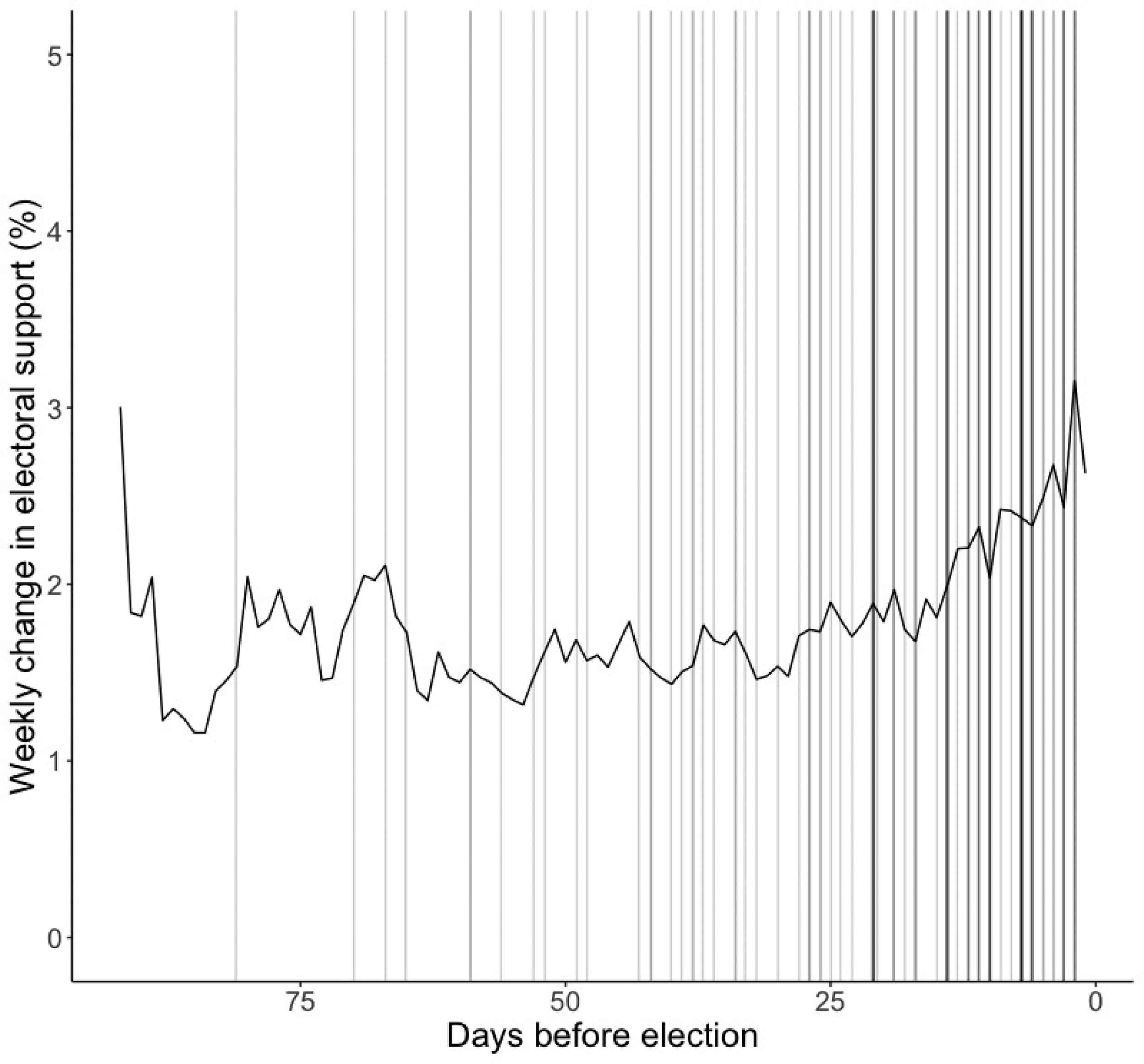
Weekly Variations on Electoral Support and Debate Dates.
Figure 2 presents a preliminary descriptive analysis of our research question. The figure plots the kernel density of weekly change for two subsets of observations: (1) those in which a debate was held within the previous seven days and (2) those with no debate held within the previous seven days. The thicker tail of the distribution of weekly change when a debate occurred within the last seven days, as opposed to the rest of the observations in our dataset, indicates that candidates’ support tends to vary more after a debate. The difference in values for weekly change between those observations within a week after a debate and those otherwise is statistically significant (p-value = 0.001, Wilcoxon rank-sum test).
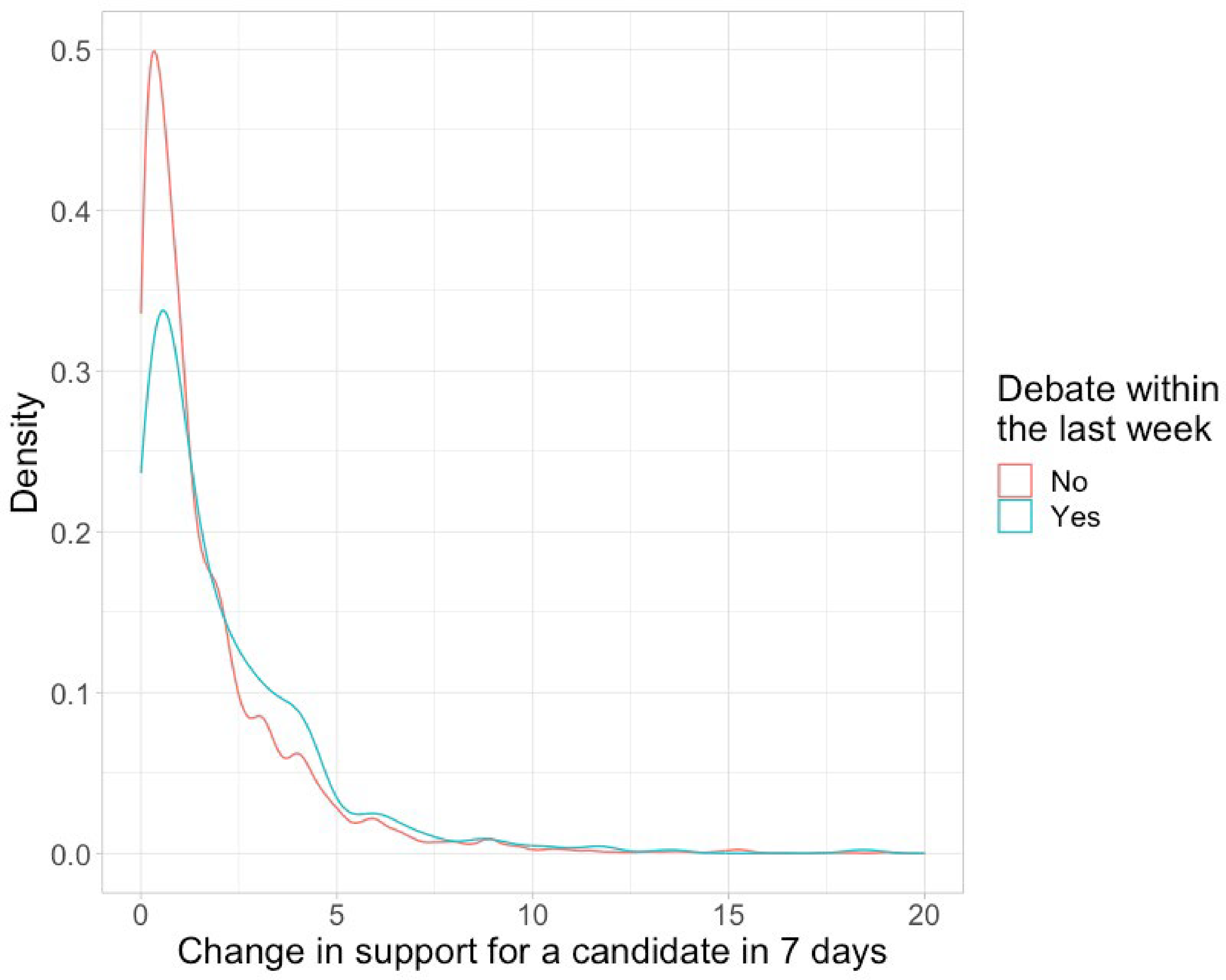
Kernel Density of Weekly Change Between Observations by Whether a Debate Has Occurred in the Last Week.
To explore this pattern in a more systematic way, we estimate weekly change as a function of whether a debate has been held in the last seven days. In particular, we first use the following regression model for each candidate i in election j on day t of the campaign:

All our estimations include control variables that account for other time and variation factors of our dependent variable. time captures the number of days before Election Day. To consider non-linear time trends, we include a logistic transformation of time. Finally, we account for the standard error for each observation,

To explore our conditional hypothesis, we include additional regression models with the following specifications:

Before presenting the results, we openly acknowledge three limitations of our approach. First, we are unable to evaluate the specific direction of the changes in support for each candidate. Since there is no systematic assessment of candidates’ performance during a debate, our analysis can only predict the magnitude of the change, if any, but not its direction. Second, note that the support for candidates may shift for things other than a debate. There could be concurrent campaign events that introduce noise to the estimated effects. Changes in candidates’ reported support can also be due to measurement errors in the pre-election polls. Our goal then is to disentangle the noise in our dependent variable by exploring multiple elections, exploiting the time in which debates (if any) were held, and assessing how much of the variation could be attributable to the existence of presidential debates. Finally, we are aware of the potential variance in the sampling methods, response rate, and quality of the pre-election polls in our dataset. As explained above, we restrict our data to face-to-face interviews that contain a detailed technical note, including interview dates and sample size. Since all our models present the results with and without interpolated data, the former should mitigate potential bias from particular polls toward a candidate.
Results
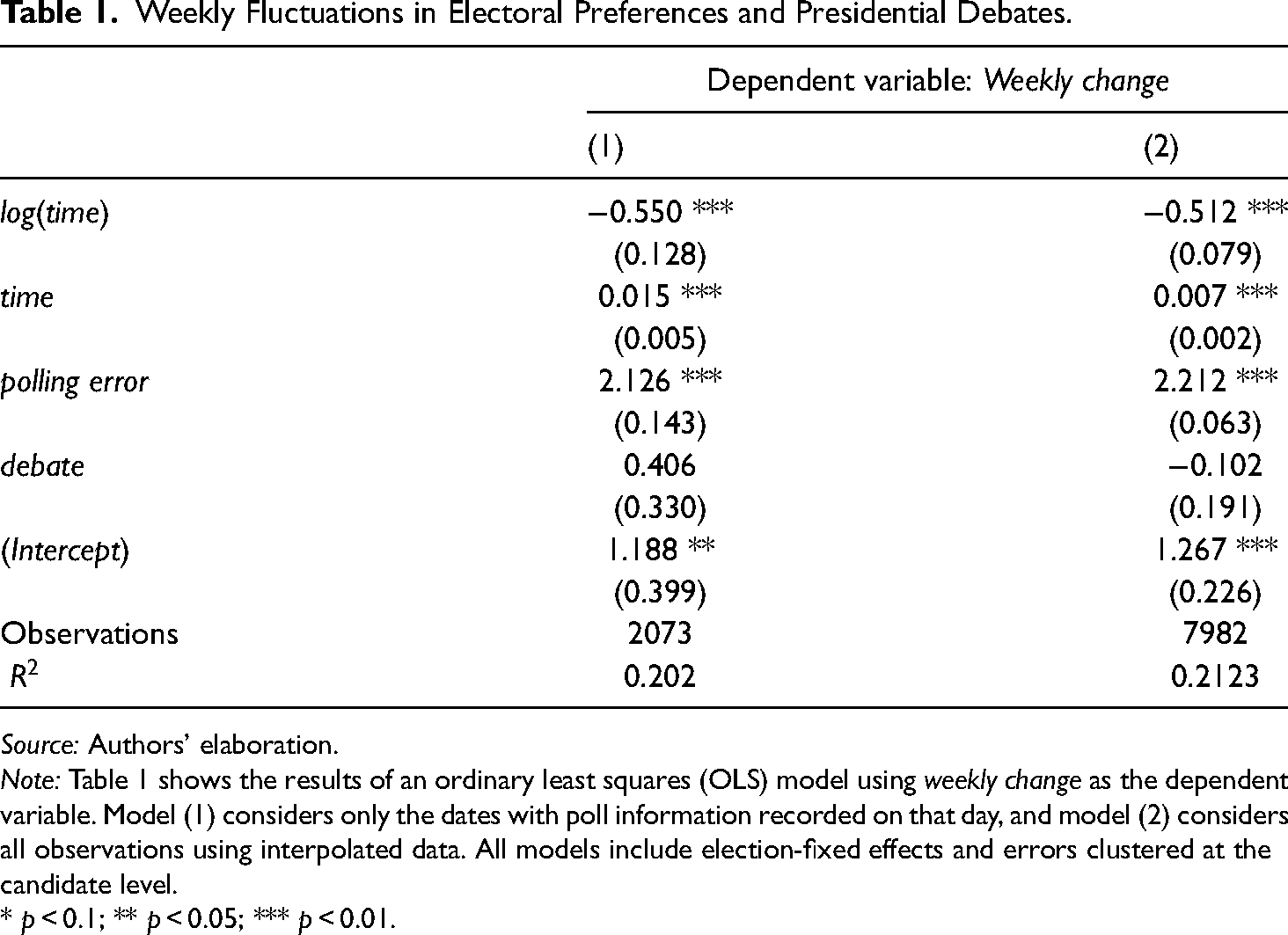
Our first set of results is presented in Table 1, which shows the results for our Hypothesis 1 based just on raw pre-election polls and interpolated data. The coefficients for debate present opposite signs and are not statistically significant, suggesting that the overall effect of presidential debates on the fluctuations of electoral preferences is statistically indistinguishable from zero. In other words, on average, presidential debates have no discernible effect on electoral preferences. This is a surprising outcome given our theoretical expectation for the case of presidential debates in Latin America. While this null finding is consistent with the arguments made in the literature (Erikson and Wlezien, 2012; Le Pennec and Pons, 2020), we suspect that not accounting for the wide variance of institutional conditions in the region might blur the effect of debates on electoral preferences.
Weekly Fluctuations in Electoral Preferences and Presidential Debates.
Source: Authors’ elaboration.
Note: Table 1 shows the results of an ordinary least squares (OLS) model using weekly change as the dependent variable. Model (1) considers only the dates with poll information recorded on that day, and model (2) considers all observations using interpolated data. All models include election-fixed effects and errors clustered at the candidate level.
* p < 0.1; ** p < 0.05; *** p < 0.01.
Before showing the results of the models testing our conditional hypotheses, we briefly discuss the results of our control variables, which have similar effects across all models. First, and confirming the pattern illustrated in Figure 1, the time effects on our dependent variable seem to be small. In particular, and considering the effects of log(time) and time in model (1), the average time effect 100 days before the election is 0.4 (i.e. (log(100)*−0.55) + (100*0.015)), and the effect decays to 0.015 the day before the election. This suggests that the variation in the weekly preferences decreases in the last 100 days of the campaign by about 0.35 points. On the other hand, an important source of variation in our dependent variable is the standard error of our poll reports. In particular, an additional point in polling error has a positive effect of about 2.1 points on weekly change. This is particularly important for our discussed findings, as the effect of debates seems to persist after accounting for other potential sources of noise in our measurement.
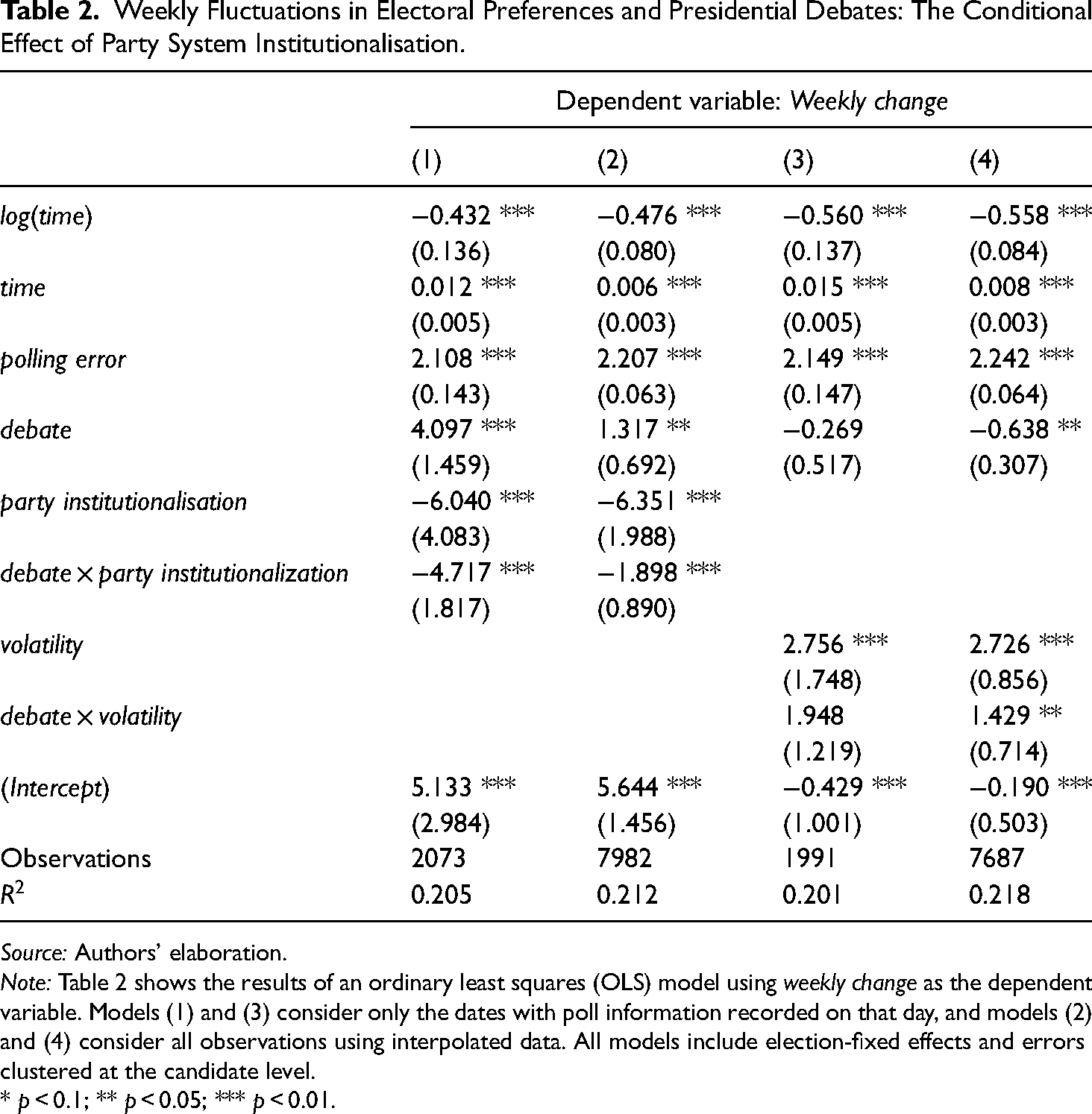
Table 2 shows the results for the models testing our conditional hypothesis, H2, considering the relationship between weekly change and our two measures of party system institutionalisation. For models (1) and (2), the negative coefficient of party institutionalisation indicates that electoral preferences are more stable in highly institutionalised party systems. In other words, electoral preferences should present larger fluctuations in Guatemala during 2019 than in Chile during 2017 – the cases in our database with the lowest and highest values for party institutionalisation, accordingly. Also, the degree of institutionalisation of the parties neutralises any potential effect of presidential debates on electoral preferences. Consider, for example, the case of Argentina in 2019, which presents the median value in our database for party institutionalisation (0.69). According to column (2), the estimated marginal effect of debate, in this case, is 4.10−(4.71*0.69) = 0.85, or less than a percentage point. Such a small effect suggests that the repercussions of debates on electoral preferences are muted in countries with at least some degree of party system institutionalisation, and it might explain why previous studies have found that presidential debates have “minimal effects” on vote preferences in the United States. In contrast, the average estimated effect of debate for the candidates in Peru's 2016 presidential election, a data point with one of the lowest values for party institutionalisation in our database, is 2.21. Figure A3 in the Supplemental Appendix illustrates the predicted values of debate when the value of party institutionalisation is at its first and third quartiles (0.52 and 0.91, respectively).
Weekly Fluctuations in Electoral Preferences and Presidential Debates: The Conditional Effect of Party System Institutionalisation.
Source: Authors’ elaboration.
Note: Table 2 shows the results of an ordinary least squares (OLS) model using weekly change as the dependent variable. Models (1) and (3) consider only the dates with poll information recorded on that day, and models (2) and (4) consider all observations using interpolated data. All models include election-fixed effects and errors clustered at the candidate level.
* p < 0.1; ** p < 0.05; *** p < 0.01.
The effect of the institutionalisation of the party system is confirmed by exploring the relationship of the dependent variable with electoral volatility, as columns (3) and (4) show. In line with the party institutionalisation models, electoral preferences show larger changes in contexts of high volatility. That is, considering the cases with the lowest and highest values for volatility in our dataset, we would expect larger fluctuations of electoral preferences during the 2006 campaign in Peru than during the 2019 campaign in Uruguay. Also, the effects of electoral debates on the fluctuation of electoral preferences are neutralised in contexts of low volatility. However, while the coefficients suggest the expected directions, the results are only significant with our database with imputed observations, and the magnitude of the effect is smaller. For the case of Colombia in 2018, with an estimated volatility value of 0.418, the average estimated effect of debate for the candidates is −0.64 + (1.43*0.42) = −0.04. By contrast, in the case of the 2015 presidential campaign in Guatemala, the average effect of debate for the candidates was 0.4. In sum, the effects of debates are only observable in contexts of weakly institutionalised party systems.
Persistence of the Effects
Our results suggest that presidential debates move electoral preferences in contexts of weak party system institutionalisation. As discussed above, our main analysis considers a time span of seven days, which we consider a reasonable period not only for voters to be informed about the last debate but also for pre-election polls to capture any effect from the debates. A still open question is for how long such an effect persists. We tackle this question by considering different time segments for the differences in electoral support and the effect of the debates to then compare the results across models. In other words, we perform a battery of regressions of the form:
The results of this exercise are presented in Figure 3. Each point represents the mean estimate for a change between two and fifteen days after the debate, and the vertical lines are the 95 per cent confidence interval for each estimation. We first observe that changes in electoral preferences are less likely to be observed in the first three days after the debate. This result suggests that the effects of the debates are not necessarily captured by the pre-election polls with a “last interview date” just after the debate, which are likely to include pre-debate responses. Debates appear to be positively related to larger changes in electoral preferences during the ten days that follow their occurrence. In particular, when compared to times in which a debate has not been held recently, we observe larger variations in the reported support for the candidates in polls released five to ten days after a debate. This result suggests that debates are more likely to influence electoral outcomes when they are conducted a few days before an election. When we consider time periods of eleven days or longer, the marginal effect becomes statistically indistinguishable from zero. Our interpretation of such a result is that debates have a fleeting effect on electoral preferences, showing a disruptive effect within the first ten days after their broadcast. However, debate effects become muted after that point, possibly because of other campaign events that provide new information to the voters.
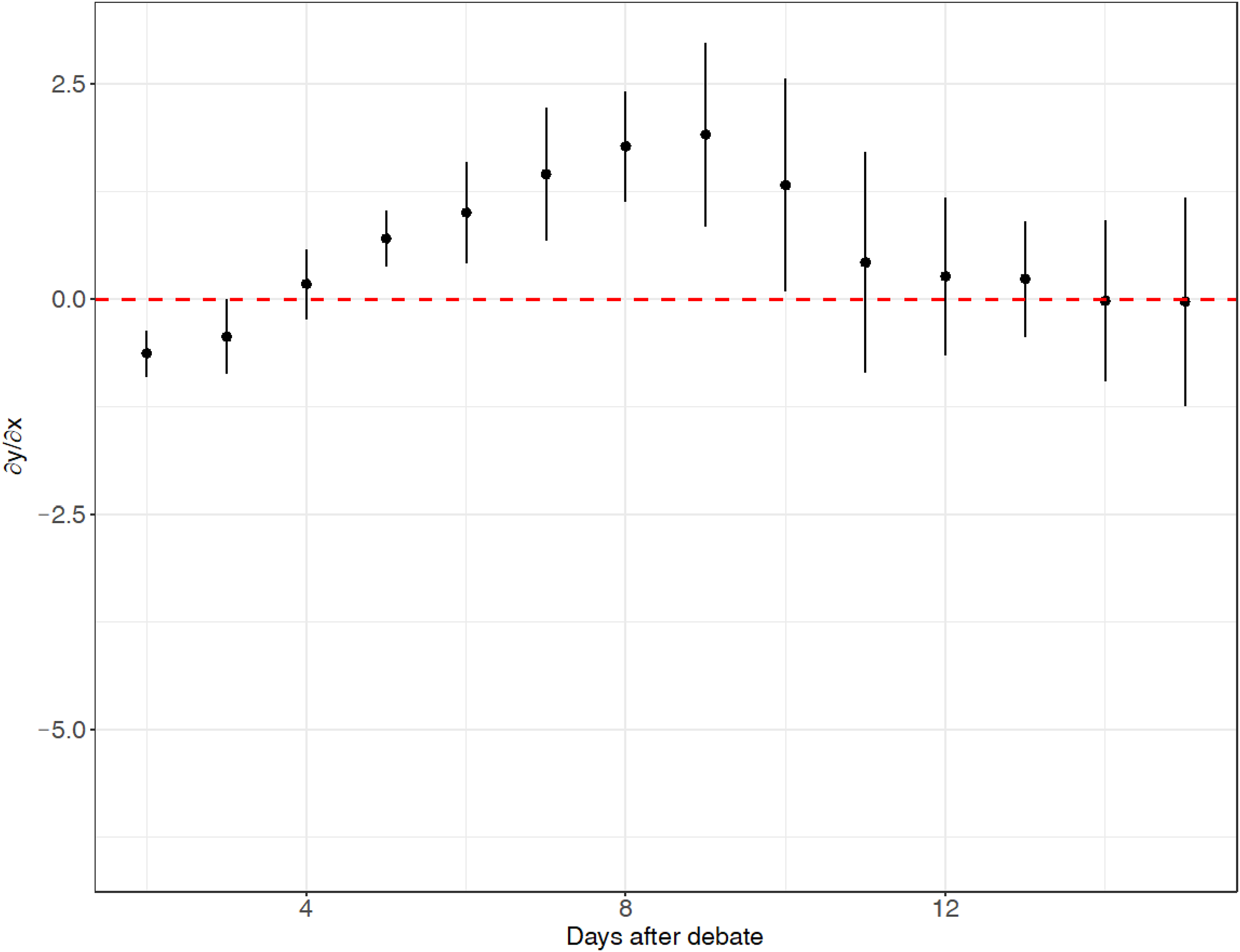
The Persistence of the Effects.
Robustness Checks
We check for the robustness of our findings using alternative model specifications and variable codings. First, Tables A1 and A2 in the Supplemental Appendix show that the results hold when considering a multi-level model where observations are nested within candidates, and candidates are simultaneously nested within elections. Also, Supplemental Table A3 shows that our results are robust when replacing debate with an alternative measure that only identifies whether the observation is within the first seven days after a debate. Finally, we also run the analysis at a different aggregation level. In this case, we aggregate changes in preferences for all the candidates in the campaign and estimate the volatility of preferences over time. Supplemental Table A4 shows that the results are similar in direction and significance to those presented in Tables 1 and 2.
An additional test considers whether the results hold by distinguishing runoff from first-round elections. For this estimation, we consider election round, a binary variable that identifies whether the reported support is for an election in the first or second round. The results in Table A5 in the Supplemental Appendix suggest that electoral preferences fluctuate less during the first rounds than during runoffs. In particular, among those cases with no presidential debates, runoff elections present variations in electoral preferences about five points larger than first-round elections. However, the fluctuations observed in runoff elections cannot be attributable to the existence of debates. We interpret the negative sign of debate × election round as evidence that debates are more likely to move electoral preferences in the first round. These findings are consistent with what Lloyd et al. (2021) presented for the case of Brazil, where debates in runoffs are less likely to change voters’ preferences.
As another robustness test, we performed jack-knifed estimates, which are displayed in Supplemental Table A6. The table shows the maximum, median, and minimum coefficient values when running the main model while excluding one of the elections in the analysis. While the coefficients vary in magnitude, they keep the same direction and statistical significance. The results are also robust to excluding countries without presidential debates (Supplemental Table A8), controlling for the number of debates in the campaign (Supplemental Table A9), including country fixed effects (Supplemental Table A10), splitting the cases according to their level of party institutionalisation (Supplemental Table A11), 8 and controlling for the number of pre-election polls (Supplemental Table A12).
Finally, we consider the possibility that the results could be an artefact of the error structure in the data. If that is the case, our null hypotheses could be rejected regardless of the timing of the debates. To account for this potential problem, we implement randomisation inference (Gerber and Green, 2012). This exercise consists of running 1,000 iterations of the model specified in equation (2). For each iteration, we randomly assign the 105 debate dates in our dataset to any observation in our timeline, re-estimate the independent variable, and recompute its corresponding coefficient from the model. Our null hypothesis expects no effect of debate dates on the variation of the candidates’ reported support. If there is a problem of over-rejection of the null hypothesis because of the error structure, the coefficients reported in the previous section should lie within 95 per cent of the simulated coefficients closer to the mean. Supplemental Figure A1 summarises the result of this exercise as a density plot for the distribution of debate across the iterations. The observed coefficient using the real dates of the debates is higher than 971 out of the 1,000 simulations (p-value = 0.03), mitigating the concerns of a potential over-rejection of the null hypothesis.
Discussion and Conclusion
Televised debates before presidential (or parliamentary) elections are “media events” that attract large audiences and receive wide media coverage. Yet, they appear to have minimal effects on electoral preferences in the United States and other advanced democracies. Debates mainly reinforce voters’ partisan or political predispositions, but rarely persuade citizens to change their electoral preferences in highly institutionalised settings where a lot of information about the candidates is already available before the debates take place.
In this paper, we analysed debate effects in Latin America, where many of the institutional and sociopolitical characteristics that explain weak debate effects in advanced democracies are often not present. The instability of interparty competition (i.e. high electoral volatility), the decline or collapse of established parties, the erosion of party brands, and the rise of political newcomers all contribute to election campaigns where voters have much less information about presidential candidates and the parties they represent. Citizens are also less likely to have strong priors about the different candidates in contexts with low party system institutionalisation and weak partisanship. Due to these factors, Latin American voters might remain undecided until the very last days of the campaign.
Our expectation that presidential debates lead to rapid fluctuations in electoral preferences in Latin America is supported by the empirical results presented above. However, these debate effects are only found in a subset of Latin American elections. As expected, presidential debates are more likely to shape electoral preferences in countries that have a weak party system institutionalisation. In countries with more institutionalised party systems and stronger party brands, the effects of debates on electoral preferences are muted, just as we would expect from the literature on debate effects in institutionalised democracies. This heterogeneous effect lends credence to our theoretical intuition that weak party systems and partisan dealignment generate stronger debate effects.
These results open fruitful avenues for further research. As acknowledged above, the data available at this moment let us focus on the changes in the electoral preferences without saying anything about their specific direction. We propose two ways to overcome this limitation. The first one opens the black box of presidential debates by coding the messages and featuring the performances of the candidates on stage. This can help us understand why voter preferences move in a specific direction. We are currently analysing the speech content of the candidates in presidential debates and plan to revisit this question in the future.
Another way of exploring debate effects focuses on how watching a debate might affect voters’ perceptions about the candidates. Brierley et al. (2020) present the only experimental evidence about the effects of debates in developing democracies we are aware of. Building on that important contribution, future research could randomly assign citizens to watch specific segments of debates in order to determine which mechanism is responsible for the treatment effects. Such a design could help us explore not only the direction of debate effects but also the individual-level factors that mediate the link between debate exposure and electoral preferences.
This is the first step in a broader project which aims to study parties’ and candidates’ communication strategies during presidential debates and their effects on electoral preferences. We invite scholars to join this research agenda in order to study debates as a real source of communication for candidates.
Supplemental Material
sj-docx-1-pla-10.1177_1866802X231213668 - Supplemental material for Presidential Debates and Electoral Preferences in Weakly Institutionalised Democracies: Evidence From 32 Latin American Elections
Supplemental material, sj-docx-1-pla-10.1177_1866802X231213668 for Presidential Debates and Electoral Preferences in Weakly Institutionalised Democracies: Evidence From 32 Latin American Elections by Francisco Cantú and Miguel Carreras in Journal of Politics in Latin America
Footnotes
Acknowledgement
We thank Christopher Wlezien and Indridi Indridason for their useful comments and suggestions. All errors are our own.
Declaration of Conflicting Interests
The author(s) declared no potential conflicts of interest with respect to the research, authorship, and/or publication of this article.
Funding
The author(s) received no financial support for the research, authorship, and/or publication of this article.
Supplemental Material
Supplemental material for this article is available online.
Notes
Author Biographies
References
Supplementary Material
Please find the following supplemental material available below.
For Open Access articles published under a Creative Commons License, all supplemental material carries the same license as the article it is associated with.
For non-Open Access articles published, all supplemental material carries a non-exclusive license, and permission requests for re-use of supplemental material or any part of supplemental material shall be sent directly to the copyright owner as specified in the copyright notice associated with the article.
