



Abstract
While there has been a flurry of research on party system institutionalisation (PSI) and regionalist parties, very little research has been conducted on their imbrication. This study aims to fill this gap by analysing the impact of local parties on the party system in post-conflict Aceh, Indonesia. It contends that the presence of local parties in Aceh has had a hybrid effect on the institutionalisation of the party system. Similar to national parties, local parties in Indonesia have weak societal roots and party organisations that obstruct PSI in Aceh. That notwithstanding, local parties in post-conflict Aceh have assisted in solidifying the party system by improving the legitimacy of parties and elections and by creating a less fragmented party system. This hybrid effect is also strongly influenced by Aceh’s long wartime history and its post-conflict status.
Introduction
In the last two decades, scholars have shown an increasing interest in local political parties, defined here as local political organisations that represent the interests and/or identities of specific subnational territories and their communities (Brancati, 2008: 135; Soos, 2008: 67). The focus of this research encompasses electoral victories, factors that strengthen parties’ political power, roles in local governance and policymaking, and the development of party organisation and ideology (Bottel et al., 2016; Brancati, 2008; Brice, 2011; Jou, 2015; Mazzoleni and Mueller, 2017). The scope of such studies on local parties and party system institutionalisation (PSI), however, is limited.
Recent studies on PSI, defined here as the process by which party systems achieve a certain level (condition) of competition among parties (Hicken and Kuhonta, 2015: 3; Randall and Svåsand, 2002: 7), evince two major limitations: First, they tend to focus on competition among national political parties rather than the relationship between local parties and party systems. Second, most analyses focus on party systems in settings marked by political stability, democratic transition, and post-democratic transition, while rarely investigating post-conflict situations.
This article attempts to fill the gap in previous studies by examining the impact of local parties in post-conflict Aceh’s multi-party system. Aceh, Indonesia, provides an interesting case, because it is the only province in the country permitted to have local parties within the party system. For decades, the Indonesian government prohibited local parties on the grounds that they ostensibly undermined national unity and PSI (Budiatri, 2017: 133). As part of the 2005 Aceh Peace Agreement, however, the Indonesian government agreed to permit the establishment of local parties in the autonomous province of Aceh. This research, therefore, seeks to examine the impact of local parties on PSI and to understand how this relationship develops in post-conflict situations.
This study relies on a triangulation of primary and secondary sources. My primary sources comprise interviews conducted with academicians, party members, and activists in Aceh and Jakarta in 2012 and 2020, while my secondary sources comprise election result reports and academic papers. Based on an analysis of the data, the study argues that the presence of local parties has had a hybrid effect on PSI in Aceh. While the weak societal roots and party organisation of Aceh’s local parties have had a detrimental effect on PSI, they have also solidified the party system, insofar as they have improved the legitimacy of parties and elections and have created a less fragmented party system. This is, in large part, a manifestation of both Aceh’s history of intense conflict and its current post-conflict status.
Aceh’s post conflict status has enabled local parties to solidify the province’s party system. A case in point is the way in which the post-rebel Aceh Party (Partai Aceh, PA) has successfully mobilised former pro-independence rebels – namely, by way of patronage relationships in order to win elections. If these patronage relationships are not accompanied by efforts to modernise its party organisation, however, the party’s presence will fragment and potentially destabilise Aceh’s provincial party system over time.
I begin by delineating existing theories on the impact of local parties on PSI and explicating the concept of PSI introduced and developed by Mainwaring and Scully (1995), which I use as the study’s main framework. In the second section, I provide the context of the establishment and development of local parties in Aceh, focusing on how the peace agreement resulted in the formation of, and competition among, local parties in the election. Based on Mainwaring and Scully’s dimensions of PSI – inter-party competition patterns, the party–society relationship, the legitimacy of parties and elections, and party organisation – I conclude with an analysis of the relationship between PSI and the existence of local parties in post-conflict Aceh.
Local Parties and Local Party System Institutionalisation
In this research, I use Mainwaring and Scully’s dimensional framework to discuss the impact of local parties on PSI in Aceh. Mainwaring and Scully (1995: 4–5) name four preconditions of PSI. First, there must be regularity in a party’s competition pattern; indeed, institutionalisation will occur only when the rules and the nature of inter-party competition are stable. Second, parties must have strong societal roots, insofar as a strong connection between parties and society supports regularity. Third, key political actors must agree to legitimise electoral processes and parties as the sole way to access political power and to govern. Finally, parties must be well organised, independent, and autonomous, keep elite interests in check, establish organisational structures, and be territorially comprehensive.
Mainwaring and Scully’s PSI concept is, of course, not without its weaknesses, such as the tendency to amalgamate party and party system into one framework; the problems of operationalising the concept and finding comparable, valid empirical information for all dimensions; and its negligence of society and societal dynamics in determining the nature of parties and the party system (Bértoa, 2018: 63; Luna, 2014; Mainwaring and Torcal, 2006: 205; Rodrı’guez and Rosenblatt, 2020: 249). Mainwaring and Scully’s framework, however, is suitable for analysing the case of Aceh, to the extent that its dimensions facilitate a comprehensive exploration of the workings of Aceh’s party system as a transitional-democratic and post-conflict province. For example, the framework emphasises the legitimacy of parties and elections, which is a typical point of concern in conflict areas. Indeed, the legitimacy of elections is often impugned in conflict areas and improves only when conflict ceases (Lyons, 2004: 1, 8, 13). Furthermore, the dimensions related to stability enable a comparative analysis of the party system and local parties in Aceh and the rest of Indonesia, which includes ranking them based on their level of institutionalisation.
Since the scope of previous studies on local parties and local PSI is limited, it is difficult to predict whether the presence of local parties will weaken or solidify the institutionalisation of Aceh’s local party system. On the one hand, the theory of fragmentation points to the potential of local parties weakening local PSI. On the other hand, the experience of local parties across countries does not follow a clear trajectory.
Most theories posit that high fragmentation will result in frail PSI because high fragmentation creates instability within a party system (Hicken, 2006: 7; Mainwaring and Scully, 1995: 33–34). As Sartori (2005: 106) notes, “the greater the number of parties, the greater the complexity and probably the intricacy of the system.” This suggests that if a greater number of parties create a more fragmented party system, the presence of local parties, in addition to national parties already vying for local popular support, will create even further fragmentation within a local party system. Indeed, electoral competition would then exist not only between national parties, but also between national parties and local parties, as well as between local parties themselves. With more parties, elections may also result in more parties each being granted fewer electoral seats, which would lead to further fragmentation within the party system.
With regard to local party influence on local party systems in a number of countries, it is difficult to draw any concrete conclusions regarding fragmentation and instability. In several regions in Germany, Belgium, Spain, and Italy, for example, patterns have emerged showing that the presence of local parties, along with their split, have increasingly fragmented the local party system and reduced the number of effective parties (De Winter, 1998: 240; Otjes, 2020: 106; Sandri, 2012: 299; Van Haute, 2017: 101). Conversely, in Italy and Switzerland, there have been fewer fragmentations in local party systems because local parties have obtained a significant portion of the popular vote (Brice, 2011: 345–346; Mazzoleni, 2017: 153; Sandri, 2012: 299).
The existing literature on local parties and party systems does not illuminate how local parties might shape Aceh’s party system. Civil wars, according to John Ishiyama, have no impact on the fractionalisation of post-conflict party systems. States that have experienced more intense and violent civil wars tend to have dominant party systems with less electoral volatility than states without any experience of civil war (Ishiyama, 2014: 425). Based on their research on seventy-seven parties in thirty-seven countries participating in 286 elections, Manning and Smith (2018: 17) contend that countries with more than one post-rebel party tend to have fragmented party systems. That study, however, as well as another by Ishiyama, are comparative in nature and blend local and national parties in their analyses, meaning that patterns cannot necessarily be distilled from them. The case of Aceh therefore brings new perspectives to the study of political parties, specifically to the debate about local party systems, local/regionalist parties, and post-rebel parties.
The Presence of Local Parties in Post-Conflict Aceh
The conflict between the people of Aceh and the Indonesian government is one of the most protracted and tragic chapters in Indonesian history. After the long road to ending the conflict, which included military operations under Suharto’s New Order (Orde Baru) regime between 1976 and 1998, the granting of Acehnese autonomy in 2001, and peaceful negotiations in the first decade of the 2000s, the Helsinki Memorandum of Understanding was signed in 2005. This memorandum marked the resolution to the conflict and, importantly, permitted the Acehnese people to establish local political parties.
In 2007, ex-combatants from the Free Aceh Movement (Gerakan Aceh Merdeka, GAM) declared that GAM had repurposed itself as a local political party, the Free Aceh Movement Party (Partai GAM). The decision, however, was overruled by the Indonesian government on the grounds that the party’s name preserved the rebel group’s identity. The party changed its name to the Aceh Party (PA) in 2008 and, for the first time in 2009, PA participated in Aceh’s local election (Budiatri, 2017: 140–141). Fourteen other local parties registered to run in the election, but only five parties met the requirements to do so. These five parties were the Prosperous and Safe Aceh Party (Partai Aceh Aman Sejahtera, PAAS), the Aceh Sovereignty Party (Partai Daulat Aceh, PDA), the Independent Voice of the Acehnese Party (Partai Suara Independen Rakyat Aceh, SIRA), the Aceh People’s Party (Partai Rakyat Aceh, PRA), and the Aceh Unity Party (Partai Bersatu Aceh, PBA). These parties met the requirements to establish a new party, including having party executives stationed in at least 50 per cent of districts/cities and in at least 25 per cent of subdistricts in Aceh. 1
Compared to the 2009 election, the elections in 2014 and 2019 involved fewer local parties. In the 2014 election, there were only three local parties, whereas in the 2019 election, there were four. Only PA consistently participated in elections between 2009 and 2019, without having to re-register or change its party identity, having been able to pass the 5 per cent electoral threshold. 2 The other parties who participated in both the 2014 and 2019 elections were new parties or “old parties” with new names: in the 2014 election, the Aceh National Party (Partai Nasional Aceh, PNA) and the Aceh Peace Party (Partai Damai Aceh, PDA), and in the 2019 election, the Nanggroe Aceh Party (Partai Nanggroe Aceh, PNA), the Aceh Regional Party (Partai Daerah Aceh, PDA), and SIRA. PDA, which participated in the 2009, 2014, and 2019 elections, remained the same party throughout, but changed its name, symbol, and/or party governing structure after failing to pass the electoral threshold. SIRA and PNA also experienced the same issues. 3
Local parties in Aceh’s legislatures, at both the provincial and municipal levels, have less of a presence than the national parties (Tables 1 and 2). Based on the 2009, 2014, and 2019 election results, local parties have, on average, occupied between 28 per cent and 49 per cent of the seats in Aceh’s local legislatures. This means that, in total, national parties hold more than 50 per cent of seats. Today, national party dominance in the Acehnese local legislature is even greater. Local parties, which in the 2009 election controlled over 40 per cent of all seats in local legislatures, now control only 28.4 per cent of seats in municipal legislatures (Dewan Perwakilan Rakyat Kota/Kabupaten, DPRK) and 34.5 per cent of seats in provincial parliament (Dewan Perwakilan Rakyat Aceh, DPRA).
Percentage of Local Party Seats in Aceh’s Provincial (DPRA) and Municipal Legislatures (DPRK), 2009 and 2024.
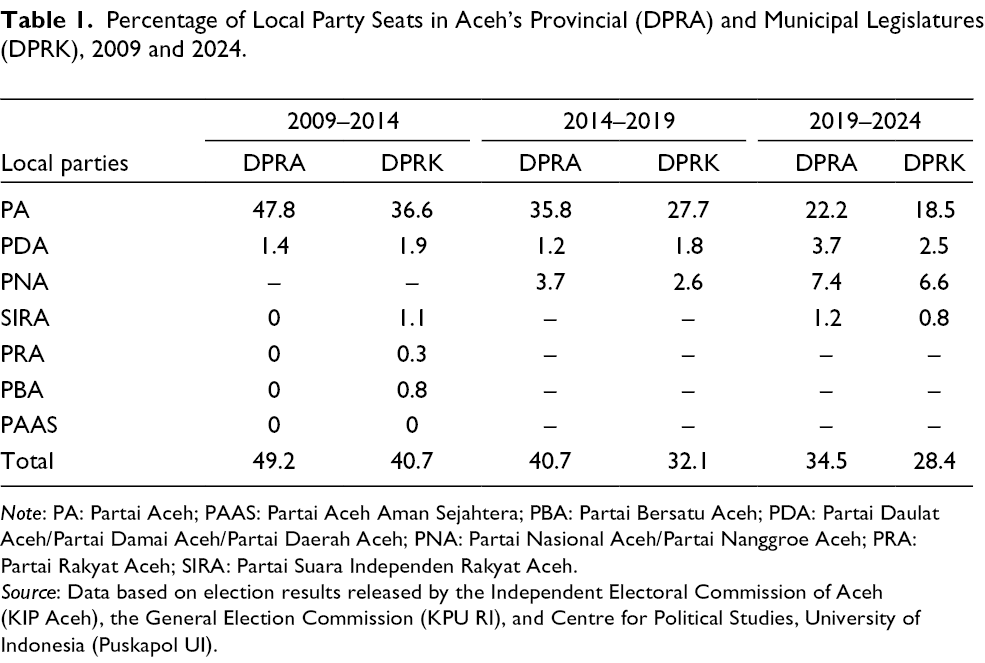
Note: PA: Partai Aceh; PAAS: Partai Aceh Aman Sejahtera; PBA: Partai Bersatu Aceh; PDA: Partai Daulat Aceh/Partai Damai Aceh/Partai Daerah Aceh; PNA: Partai Nasional Aceh/Partai Nanggroe Aceh; PRA: Partai Rakyat Aceh; SIRA: Partai Suara Independen Rakyat Aceh.
Source: Data based on election results released by the Independent Electoral Commission of Aceh (KIP Aceh), the General Election Commission (KPU RI), and Centre for Political Studies, University of Indonesia (Puskapol UI).
Percentage of National Party Seats in Aceh’s Provincial (DPRA) and Municipal Legislatures (DPRK), 2009–2024.
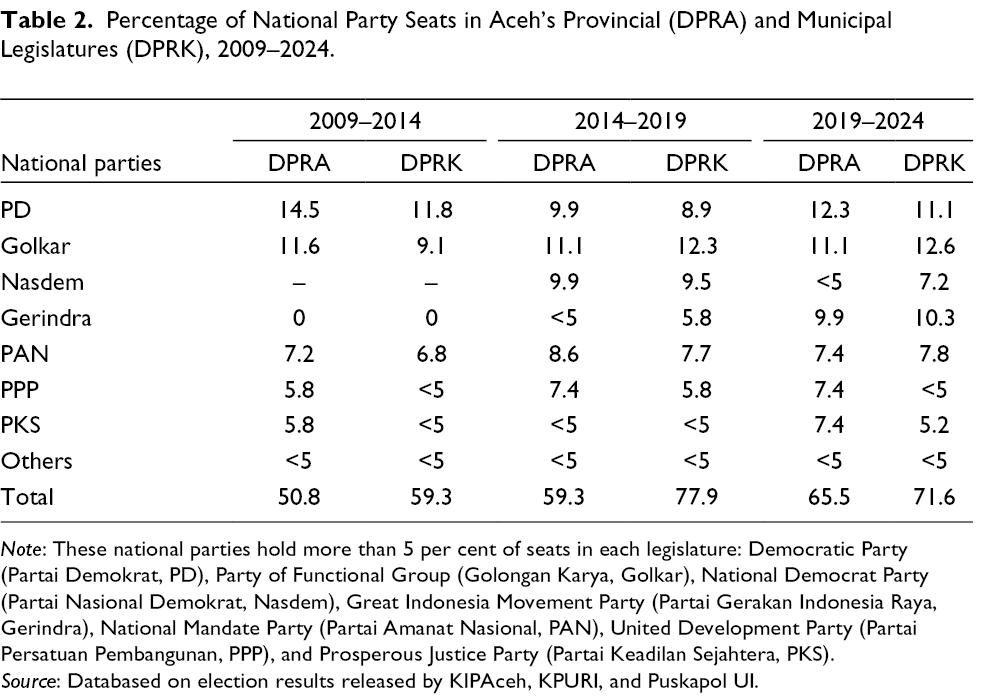
Note: These national parties hold more than 5 per cent of seats in each legislature: Democratic Party (Partai Demokrat, PD), Party of Functional Group (Golongan Karya, Golkar), National Democrat Party (Partai Nasional Demokrat, Nasdem), Great Indonesia Movement Party (Partai Gerakan Indonesia Raya, Gerindra), National Mandate Party (Partai Amanat Nasional, PAN), United Development Party (Partai Persatuan Pembangunan, PPP), and Prosperous Justice Party (Partai Keadilan Sejahtera, PKS).
Source: Databased on election results released by KIPAceh, KPURI, and Puskapol UI.
Since 2009, PA has secured the greatest number of seats in local legislatures in every election, though that trend is decreasing (Table 1). In 2009, PA had almost 50 per cent of seats in the DPRA. In subsequent elections, however, PA experienced a decline, securing only 35.8 per cent of DPRA seats in 2014 and 22.2 per cent of seats in the 2019 election. PA’s average number of seats in municipal legislatures was even lower, with a mere 27.7 per cent in 2014 and 18.5 per cent in 2019.
Other local parties have not managed to secure the same number of votes as PA in local elections. Besides PA, the parties receiving the highest number of votes have been national parties, while the local parties that were expected to bring change to Aceh’s legislature failed to compete with the national parties. Indeed, the local parties, except PA and PNA in 2019, failed to obtain more than 5 per cent of the votes in the 2009, 2014, and 2019 elections. In the most recent election, however, local parties, except PA, increased their number of seats in the legislatures. PNA even managed to pass the 5 per cent electoral threshold, winning 7.4 per cent of DPRA seats and 6.6 per cent of DPRK seats. PNA is therefore the only local party besides PA that can automatically participate in the next election in 2024 without having to change its party identifiers.
The Party System in Post-Conflict Aceh
The Party Competition Pattern
One of Mainwaring and Scully’s dimensions for assessing PSI is the pattern of competition among parties (1995: 6–12). A strong party system emerges when inter-party competition is stable. This is achieved through stability in voters’ party preferences between elections. The competition pattern is also influenced by elite-driven changes within the party system, which include creating new parties, switching parties, and splitting parties.
This section analyses this stability by measuring the electoral volatility (EV) using the results of legislative elections at the provincial level during a period of democratisation, but only after local parties were adopted in post-conflict Aceh (2009–present). It is important to note that it may not be possible to accurately compare EV in Aceh during the conflict period with that of the post-conflict period. Before the peace accord was struck, and before Aceh had its own local political parties, Aceh did not have legitimate elections. In fact, the composition of its legislatures often reflected government decisions rather than actual election results. Hence, the legitimacy of the 1999 and 2004 elections was inherently dubious, as compared to the post-conflict 2009, 2014, and 2019 elections. In Figures 1 -3, I compare EV in Aceh with that of other provinces, based on the provincial legislative elections of 2009, 2014, and 2019. The concept of EV refers to the aggregate turnover among different political parties from one election to the next (Bartolini and Mair, 1990: 27; Mainwaring and Zoco, 2007: 158). 4
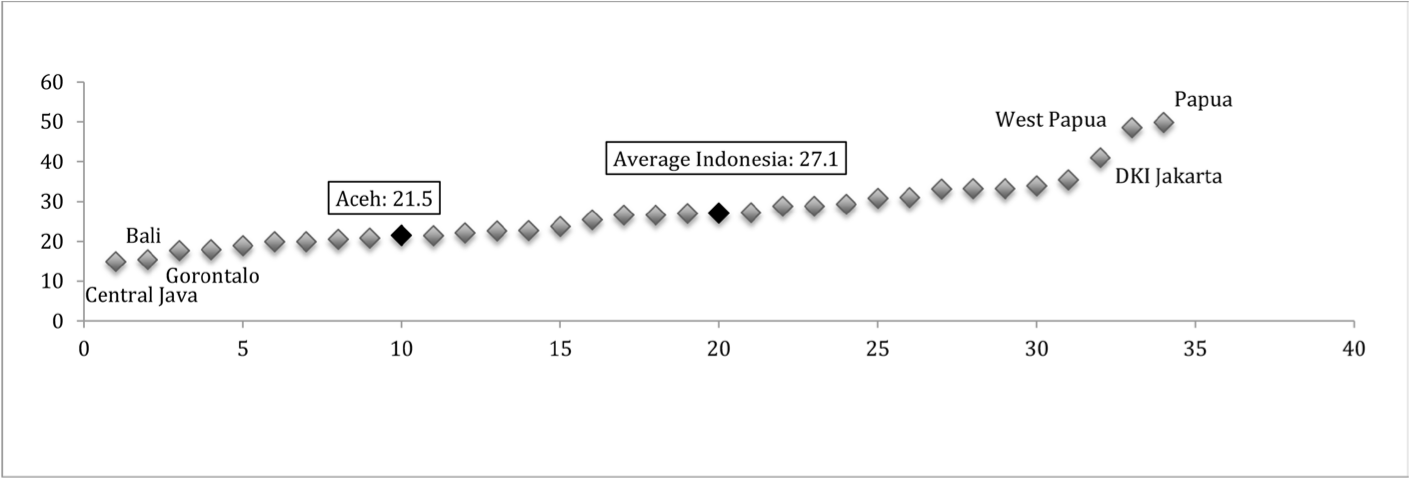
Comparison of Electoral Volatility in Thirty-Three Indonesian Provinces, Based on Provincial Legislative Election Results from 2009 and 2014 (EV 2009–2014).
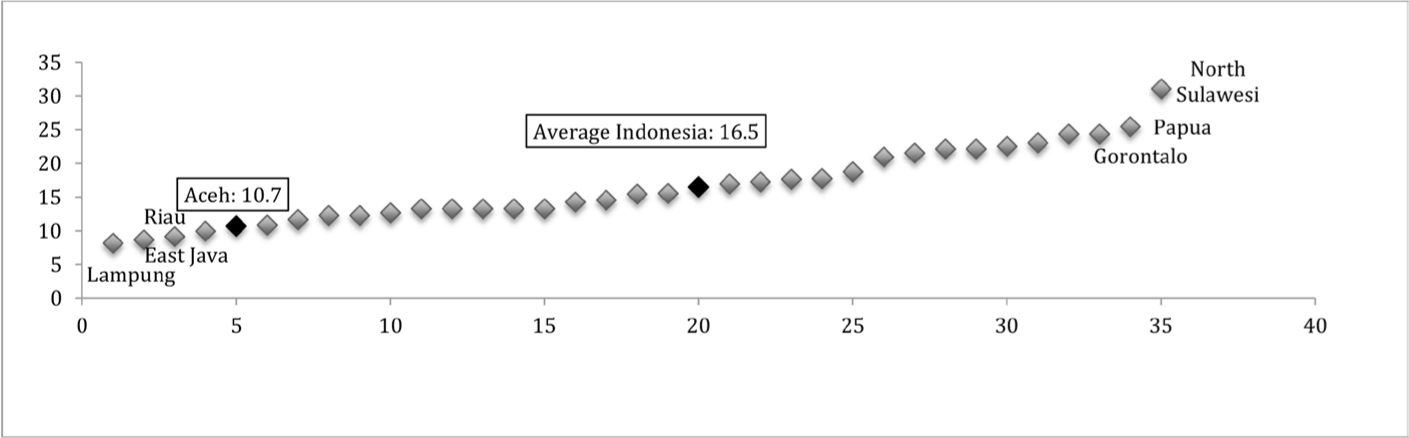
Comparison of Electoral Volatility in Thirty-Four Indonesian Provinces, Based on Provincial Legislative Election Results from 2014 and 2019 (EV 2014-2019).
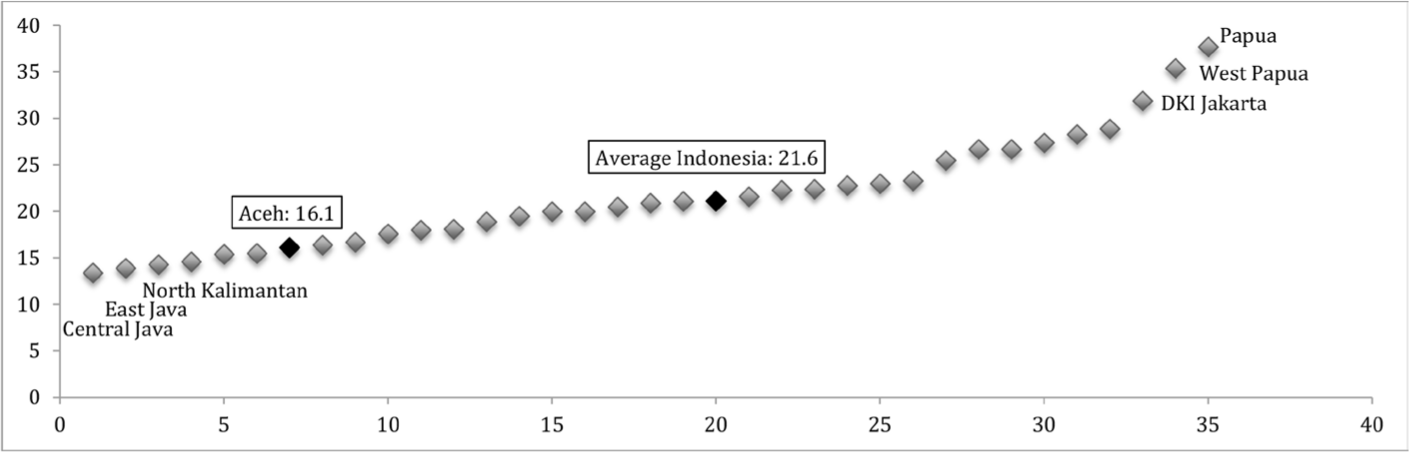
Comparison of Electoral Volatility in Thirty-Four Indonesian Provinces, Based on Provincial Legislative Election Results in 2009, 2014, and 2019 (Average EV 2009–2019).
Based on the results of the 2009, 2014, and 2019 elections, EV in Aceh was consistently below the average rate of all Indonesian provinces. Aceh also consistently made the list of ten provinces with the lowest EV value. The EV value in Aceh also decreased from 21.5 between 2009 and 2014 to 10.7 between 2014 and 2019. Aceh’s score remained higher than a number of other provinces, including Central Java, East Java, and Bali, possibly because voters in these areas have strong affinities with certain political parties. For example, the Indonesian Democratic Party of Struggle (Partai Demokrasi Indonesia Perjuangan, PDIP) has strong supporter bases in Java and Bali, which explains why inter-party competition on these two islands tends to be more stable. This does not provide a complete explanation, however, because other provinces that claim to provide the strongest supporter bases for certain parties may also have high EV scores. Golkar, for instance, claims to have strong bases in Sulawesi, Maluku, and Papua, but these regions do not have low EV levels (Allen, 2014: 235; Ismanto, 2004: 27; Tomsa, 2014: 265–266).
While it may be too early to draw any conclusion from three elections, certain scholars note that three elections are enough to detect system changes (Nwokora and Pelizzo, 2017: 12). Based on EV scores from 2009, 2014, and 2019, I infer that although Aceh’s party system comprises more parties than other provinces due to the participation of local parties, it also turns over fewer parties than most of other provinces. This suggests that the presence of local parties might contribute to a less fragmented party system. In this sense, the presence of local parties does not undermine PSI.
Figure 4 also suggests that party competition is more stable in a party system containing local parties than one lacking them. EV scores in Aceh’s national legislative (Dewan Perwakilan Rakyat, DPR) elections in 2009, 2014, 2019 are higher than those in local DPRA elections. The EV scores of national elections in which only national parties have participated is more than twice that of local elections participated in by both local and national parties. This shows that the pattern of party competition in Aceh’s party system is more stable when local parties are competing.
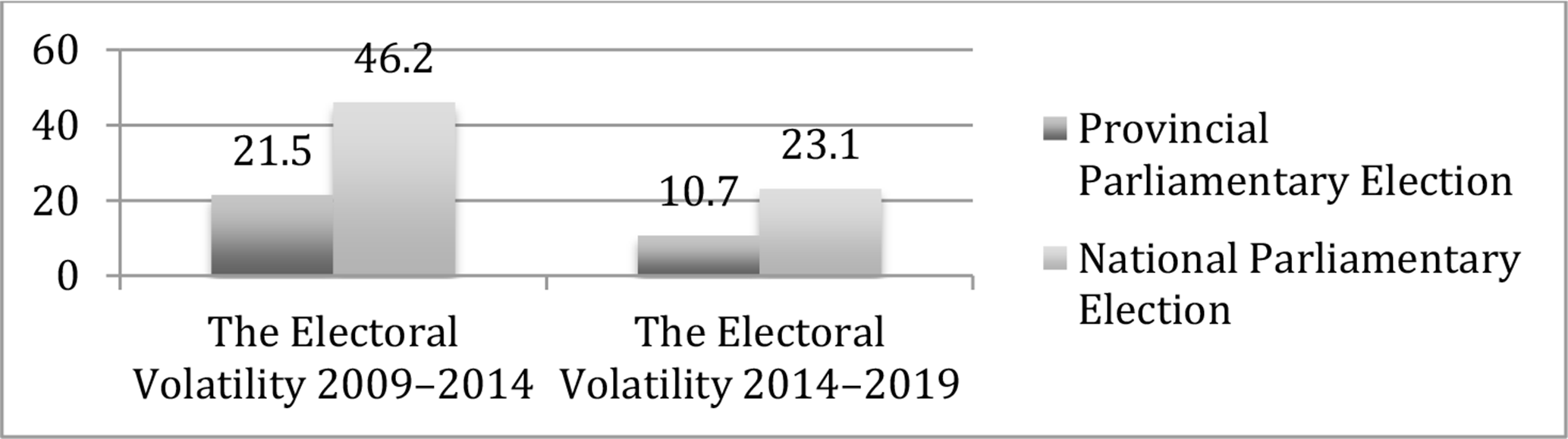
Comparison of EV in Aceh’s Provincial and National Legislative Elections from 2009 to 2019.
Besides a low EV score, other evidence of the institutionalisation of the party system is when a smaller and more effective number of parties (ENP) has been reached. Having fewer but more effective parties indicates a condition whereby parties attempt to avoid distinctive fragmentation with other parties, but also one in which they endeavour to accommodate broad-based public interest (Reilly, 2006: 126). Hence, the smaller ENP typically means a more stable party system. However, we cannot conclude what the most efficient ENP should be. Diamond (1994: 16) argues that it should be one or two broadly based parties, while Sartori (2005: 117) opines that the maximum is five or six parties (Reilly, 2006). The ENP is measured by dividing 1 by the sum of the squares of each party’s vote or seat share: 1 / Σn pi 2 (Reilly, 2006: 126). 5
Figure 5 shows the ENP of Aceh’s provincial elections from 2009 to 2019. The presence of local parties in Aceh does not make the Acehnese party system more fragmented compared to those of provinces without local parties. This is proven by the average value of Aceh’s ENP, which, according to the results from the 2009, 2014, and 2019 provincial legislative elections, is lower than in other provinces. Aceh’s ENP average score is 6.5, while the national average is well above that, at 7.8.
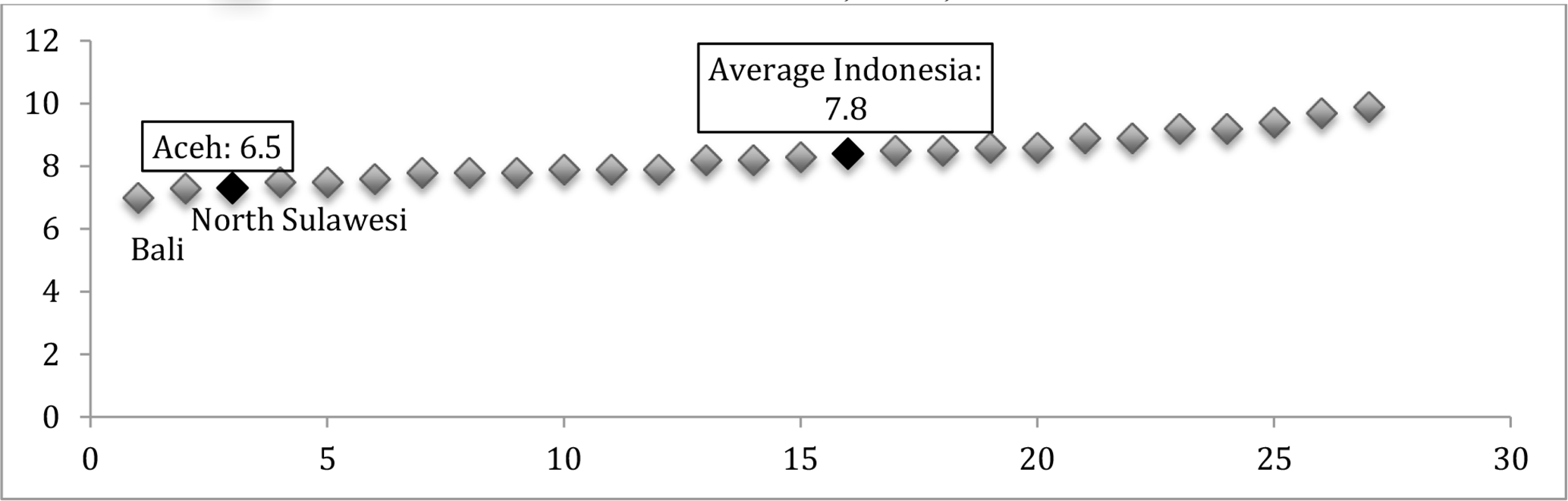
Comparison of the Average ENP in Thirty-Four Indonesian Provinces, Based on Provincial Legislative Election Results from 2009, 2014, and 2019.
Although Aceh’s average ENP score is lower than that of other provinces, the score from the election results for each period is not always below the national average (Table 3). Aceh’s low average ENP score is the result of very low ENP scores in 2009 and 2014, with scores of 5 and 5.6, respectively. At that time, PA secured more than 35 per cent of DPRA seats, while other local parties failed to secure a significant number of seats (Table 1). In this sense, local parties did not exacerbate the fragmentation of Aceh’s party system. Meanwhile, based on the 2019 election result, Aceh’s ENP score jumped to 8.9, which is above the national average of 7.8. What is striking is that the increase of the 2019 ENP was much greater than that of the 2014 ENP, though the increase in the absolute number of parties in the 2014 and 2019 elections remained at two (Table 3). The increase in the 2019 ENP is influenced by the acquisition of PA seats, which decreased considerably in 2019 compared to the previous period (Table 1). This is also influenced by PNA’s presence as a local party with a relatively high number of DPRA seats (Table 1). This demonstrates that in the third election, local parties began to have a fragmenting impact on Aceh’s party system.
Comparison of the Absolute Number and ENP in Aceh and in Indonesia (on Average), Based on Provincial Legislative Elections Results in 2009, 2014, and 2019.
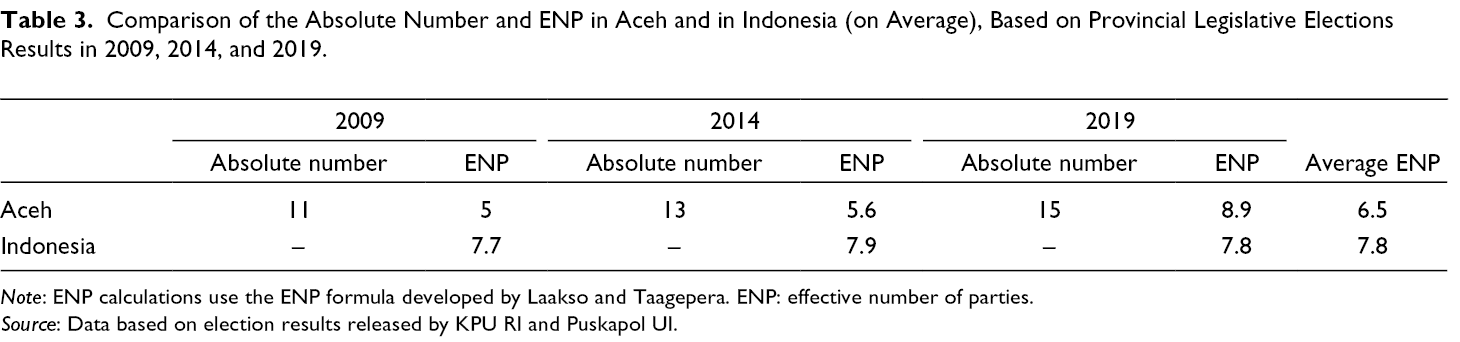
Note: ENP calculations use the ENP formula developed by Laakso and Taagepera. ENP: effective number of parties.
Source: Data based on election results released by KPU RI and Puskapol UI.
The Party–Society Relationship
Parties’ strong societal roots typically lead to lower EV and increased stability in the party system (Hicken, 2006: 7, 11). Thus, EV not only explains the dimension of party competition patterns, but it can also, in fact, reflect the dimension of party–society connections. In terms of the relationship between society and parties, based on EV scores, parties in Aceh appear to have stronger societal roots compared to other local party systems in Indonesia (Figures 1 -3).
As part of cultivating their relationships with society, local parties focus on particular segments of society. Since its establishment, PA has targeted ex-combatants, despite presenting themselves as the reincarnation of GAM and an inclusive party for the “Acehnese people” (Sindre, 2019: 14). PA has co-opted the Aceh Transitional Committee (Komite Peralihan Aceh, KPA), an organisation that assists ex-combatants in integrating into civilian life, as a part of its political machinery in order to cultivate relations with ex-combatants. Both KPA and PA are led by Muzakir Manaf, also known as Mualem.
This affiliation between KPA and PA lays the groundwork for a strong patronage relationship. KPA has extorted funds to finance the establishment of PA and its party campaigns during elections (Anderson, 2013: 38; Lee, 2020: 125). KPA has also helped the PA campaign to secure voters, and a number of KPA members were even caught committing election-related acts of intimidation (Anderson, 2013: 52). KPA, which is led by former senior GAM combatants, also has the power to mobilise ex-GAM members to vote for PA. As former combatants, they are required to obey orders from superiors and to reinforce the chain of command (Jones, 2012). As an ex-GAM combatant, voting for PA is therefore an order rather than a political right. In return, KPA members occupy strategic government positions, including village heads and heads of departments in local government (Sindre, 2016b: 506; Stange and Patock, 2010: 107). Simultaneously, they gain access to government funds through construction projects (Sindre, 2016b: 508; Stange and Patock, 2010: 107).
Other local parties have also attempted to establish ties with specific groups within society. Most of them claim to enjoy the support of a specific group of voters. Table 4 shows the different groups targeted by local parties in the 2009, 2014, and 2019 elections.
Targeted Constituencies of the Local Parties.
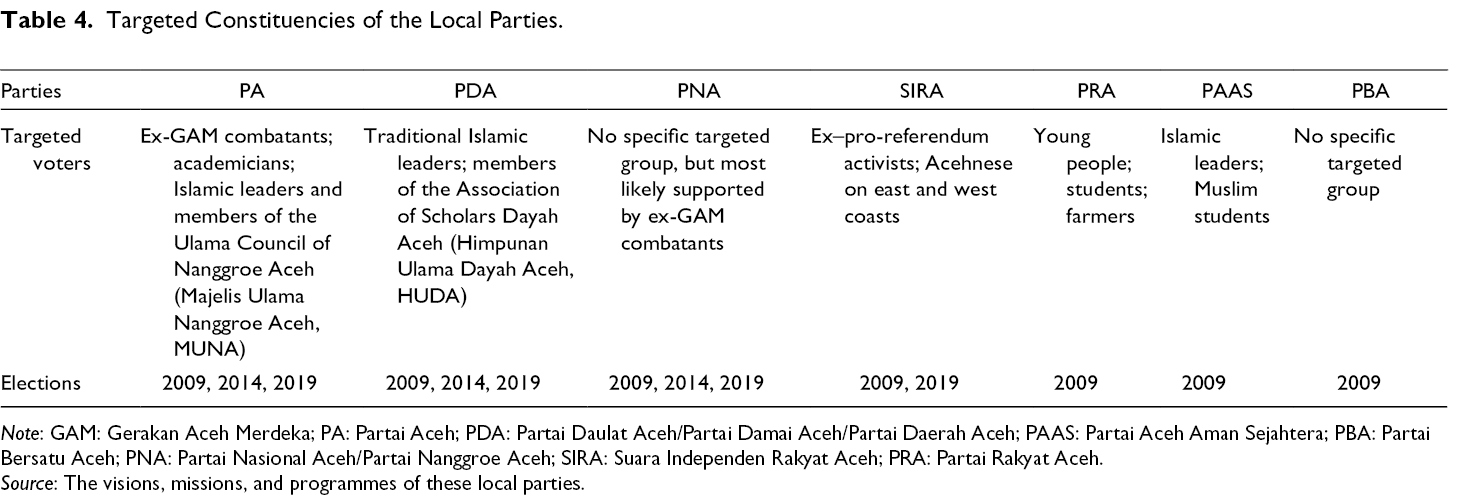
Note: GAM: Gerakan Aceh Merdeka; PA: Partai Aceh; PDA: Partai Daulat Aceh/Partai Damai Aceh/Partai Daerah Aceh; PAAS: Partai Aceh Aman Sejahtera; PBA: Partai Bersatu Aceh; PNA: Partai Nasional Aceh/Partai Nanggroe Aceh; SIRA: Suara Independen Rakyat Aceh; PRA: Partai Rakyat Aceh.
Source: The visions, missions, and programmes of these local parties.
Table 4 shows that each of the local parties, with the notable exception of PBA, seek to secure the votes of specific societal groups. To attain electoral success, these parties have developed party images that resonate with specific sets of voters, ideally sizeable groups that enjoy significant traction within society. They are yet to develop political agendas focused on these groups, however, and instead develop agendas of general applicability to all Acehnese people.
Unlike local parties, national parties have adopted political agendas applicable to every province in Indonesia and do not target any specific group in Aceh. Interestingly, they were most likely to win in the most ethnically diverse areas, including Singkil, Southeast Aceh, Subussalam, South West Aceh (ABAS), and Aceh Leuser Antara (ALA), which are home to the Gayo people, the Javanese, and other migrant (pendatang) groups (Barter, 2011: 122–124; interviews with Otto Syamsuddin Ishak, 2 May 2012; Feri Malik, 1 October 2020). These people fought against GAM and supported the Indonesian military during the conflict (International Crisis Group (ICG), 2008; Jones, 2014: 5), which demonstrates their longstanding connections to national parties and, in particular, Golkar (Stange and Patock, 2010: 103).
Another aspect of party–society relationships worthy of analysis is the consistency of partisan support at elections. In the 2009, 2014, and 2019 local elections, Golkar, PKS, PAN, and PPP consistently maintained their partisan support. The number of seats they held in both municipal and provincial legislatures either dropped or increased by less than or about 3 per cent. Golkar and PPP maintained the same number of DPRA seats between the 2014 and 2019 elections, while PD experienced a 4.6 per cent drop between the 2014 DPRA election and the previous election in 2009. Based on these data, it appears that more than half of the parties with more than 5 per cent of seats in Aceh’s local legislatures enjoy strong relationships with their partisans (Table 5).
Changes in the Percentage of Party Seats Held by Parties in Aceh’s Provincial and Municipal Legislatures from 2009 to 2019.
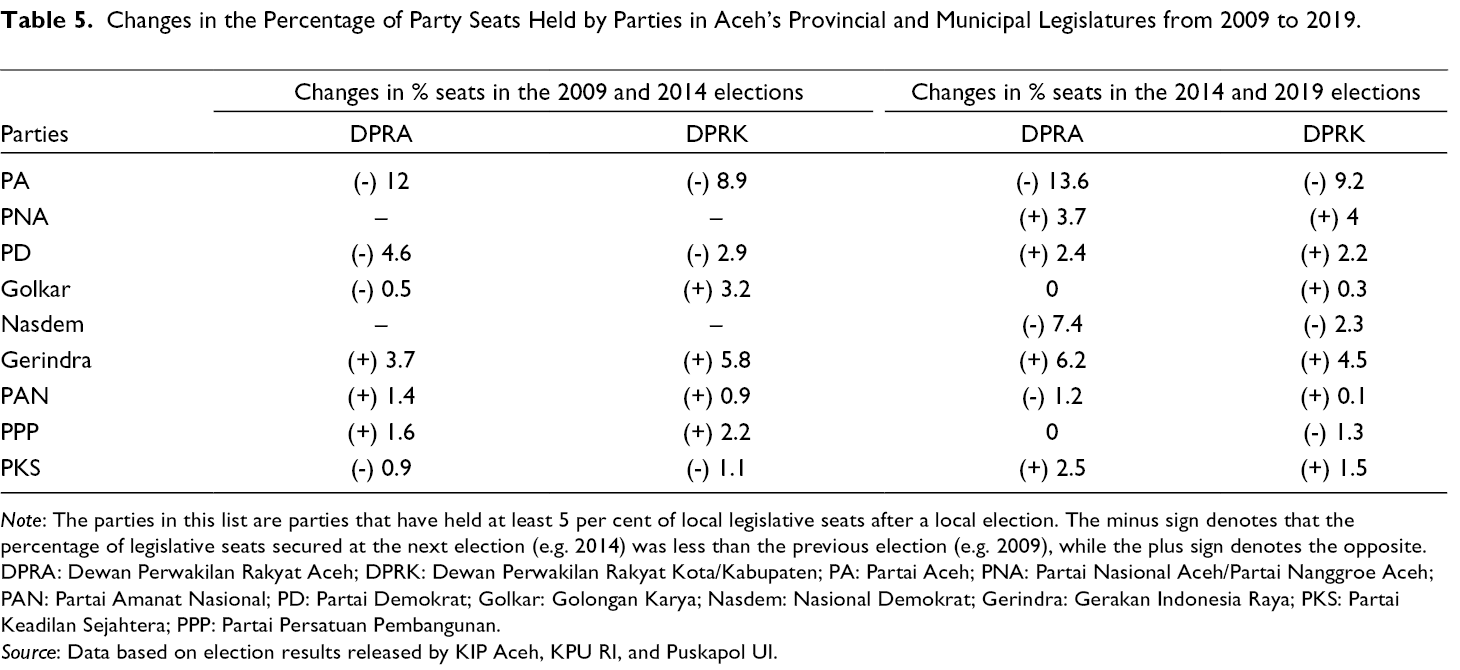
Note: The parties in this list are parties that have held at least 5 per cent of local legislative seats after a local election. The minus sign denotes that the percentage of legislative seats secured at the next election (e.g. 2014) was less than the previous election (e.g. 2009), while the plus sign denotes the opposite. DPRA: Dewan Perwakilan Rakyat Aceh; DPRK: Dewan Perwakilan Rakyat Kota/Kabupaten; PA: Partai Aceh; PNA: Partai Nasional Aceh/Partai Nanggroe Aceh; PAN: Partai Amanat Nasional; PD: Partai Demokrat; Golkar: Golongan Karya; Nasdem: Nasional Demokrat; Gerindra: Gerakan Indonesia Raya; PKS: Partai Keadilan Sejahtera; PPP: Partai Persatuan Pembangunan.
Source: Data based on election results released by KIP Aceh, KPU RI, and Puskapol UI.
Table 5 also shows that several parties experienced significant changes in the number of local legislative seats they held, including PA, Gerindra, Nasdem, and PNA. PA, which held the most seats in local legislatures from 2009 to 2019, lost a significant number of seats. PA lost more than 10 per cent of its DPRA seats during that period, with a 12 per cent reduction in the 2014 election and a 13.6 per cent loss between 2014 and the 2019 election. Nasdem faced the same issue, losing 7.4 per cent of its DPRA seats in the last election. Conversely, Gerindra increased its number of seats compared to other parties in 2019. This has made Gerindra a major party in Aceh today, a far cry from when it first participated in the 2009 election and failed to secure seats in either the DPRA or the DPRK (Table 2). PNA also enjoyed an uptick in votes in 2019 and became the only local party besides PA to hold more than 5 per cent of DPRA seats (Table 2).
Ironically, while PA holds the most seats in the DPRA, it also experienced the greatest drop in the number of votes received between the 2014 and 2019 elections. This shows that even though PA has great support from its loyalists, the party has failed to maintain strong roots with its constituency. This dip in popularity could be attributed to, among other things, the constituency’s disappointment with PA’s performance, internal conflicts, and elites aligning themselves with other parties.
As previously mentioned, Aceh’s local parties typically have specific constituencies but lack agendas that represent the interests of those constituencies. Despite the close relationship between PA and KPA, PA has failed to represent the needs and interests of ex-GAM combatants. The patronage relationship with KPA benefits only a certain group of people, not all ex-combatants. Those who were previously mid- to higher-level combatants are members of KPA and are more likely to reap political and financial benefits, which has left many low-level ex-combatants disillusioned as they are excluded from this patronage (Sindre, 2016a: 204–205; interviews with Muhammad Alkaf, 2 October 2020; Feri Malik, 1 October 2020). The exclusive relationship between PA and KPA has also led to discontent among people who once fought alongside GAM but were not formally in its ranks. These people feel as though their needs and interests are being ignored, despite their history of solidarity with GAM. The accumulative effect of this has been the weakening of the party’s ties to its constituents and a drop in PA’s electoral popularity (interviews with Feri Malik, 1 October 2020; Muhammad Alkaf, 2 October 2020).
Other parties have benefitted from people’s disillusionment with PA, especially Gerindra and PNA, both of which are affiliated with ex-GAM combatants, PA’s partisans. Members of Gerindra, a national party that has officially been affiliated with PA since 2013, sit on the party’s executive board in Aceh alongside a number of ex-GAM elites. KPA and PA leader Muzakir Manaf, for example, is also on Gerindra’s advisory board in Aceh. Meanwhile, PNA is a local party that was founded by the former GAM commander and ex-PA elites in 2012. PNA is the result of an internal conflict within PA between the old GAM leadership and the younger members, who supported different candidates to represent ex-GAM combatants in the Aceh gubernatorial elections in 2006 and 2012 (Budiatri, 2017: 158–159; Hillman, 2012: 438; Sindre, 2016b: 506; interview with PNA politician in 2012). Their affiliation with ex-GAM combatants explains why Gerindra’s and PNA’s popularity increased, while PA lost popular support. PA voters, especially ex-GAM combatants, who were disappointed by PA but supported the existence of local parties became PNA voters, while those with a preference for the national party voted for Gerindra (interviews with Feri Malik, 1 October 2020; Muhammad Alkaf, 2 October 2020).
The Legitimacy of Local Parties and Elections
The legitimacy of electoral processes and parties, another dimension proposed by Mainwaring and Scully to evaluate PSI, is particularly relevant to Aceh, especially when assessing conditions prior to and following the signing of the peace accord. In conflict areas, it is common for elections and parties to be delegitimised. This also occurred in Aceh during the period of conflict. Before the hostile parties signed the Helsinki MoU, separatists greatly distrusted the government and the legislature. Under these conditions, the separatists delegitimised all political processes initiated and held by the government, including elections. They also delegitimised political parties because they were assumed to be part of the Indonesian government and did not represent the Acehnese people.
In 1999, when other regions in Indonesia began to democratise by allowing freer and fairer elections, Aceh delegitimised its elections. Campaigns boycotting the elections galvanised not only GAM, but also students and NGO activists, who proposed a referendum for Aceh (Aspinall, 2008: 129; Crow, 2000: 94). GAM single-handedly initiated a boycott of the election on Aceh’s north coast, with total voter turnout at a dismal 1.4 per cent in North Aceh and even lower (1 per cent) in Pidie, while in East Aceh turnout was significantly higher but still relatively low at 50 per cent (Barter, 2014: 49). In order to keep the legislature in session, the Indonesian government issued a presidential decree determining which parties would have seats in the legislature. The government used the provincial legislative election results as the basis for distributing seats in city-level legislatures. Similar conditions also emerged in 2004; many pro-referendum and pro-independence Acehnese people boycotted the election, and the government made the political decision to fill legislative seats (Marhaban, 2010: 36).
The situation has changed since the Helsinki accord, which sought to end the conflict between Aceh and the government and, more crucially, consolidate democracy. One aim of the peace agreement was to legitimise political parties and elections as the only way to attain political power. In order to achieve its goal, the government and GAM agreed to allow the establishment of local parties in Aceh. It was, in fact, GAM, the most anti-government and anti-political party group in Aceh, that pushed for the establishment of local parties in the autonomous province (Budiatri, 2017: 136–138). Former GAM elites saw the negotiation process as an opportunity to make the government accede to their demands. Indeed, local parties offered them the only way to become involved in politics and independent from a national party. Local parties were also expected to provide the Acehnese people with an alternative platform to represent their aspirations and interests.
After much consideration, the peace accord accommodated the proposition that local parties be permitted to operate in Aceh. The agreement gave the Acehnese people, including the rebel group GAM, the opportunity to participate in politics through local party vehicles. The Acehnese people responded positively; indeed, after the MoU was signed, GAM, local politicians, activists, and others formed local parties and registered them for the 2009 elections. GAM even transitioned into a political party and participated in the elections. All elements of society accepted political parties as the only political vehicle to gain power and access the policymaking process.
Aside from the societal legitimacy of political parties and Aceh’s major political actors, which include ex-GAM elites and activists, the legitimacy of elections has also increased. The government has been able to effectively run legislative and presidential elections, as well as direct elections for local leaders (Pemilihan Kepala Daerah, Pilkada). Although acts of intimidation and violence are known to occur around election time, the government, at the very least, has been able to facilitate electoral processes from party campaigning to the counting of votes. Just as important is the fact that no major actors in Aceh have attempted to boycott elections or encouraged others to do so.
Greater electoral legitimacy is evidenced by higher voter turnouts in post-conflict elections, including in areas that experienced election-boycott campaigns during the conflict. Voter turnout in the elections between 2009 and 2019 reached more than 75 per cent each – a far greater turnout than the measly 30 per cent in the 1999 election (KPU, 2010: 29, 2017: 461; KPU, n.d.; Nurhasim, 2004: 61). 6 Based on the most recent election results from 2019, the voter turnout rates for areas with low turnouts during the conflict, such as North Aceh, Pidie, and East Aceh, exceeded 70 per cent. The voter turnout rate was 70.57 per cent in East Aceh, 75.04 per cent in North Aceh, and 78 per cent in Pidie (Danirandi, 2019). This indicates that the elections have been recognised and approved by society as the sole way to govern Acehnese society.
Comparing conditions in Aceh prior to and after the conflict has revealed a significant increase in the legitimacy of political processes and elections. The presence of local parties as new political vehicles for all citizens in Aceh has improved public trust and confidence in political parties in general. There is a growing belief that local parties may accommodate the specific needs and interests of the Acehnese people, especially those who distrust national parties. Furthermore, GAM has refrained from using violence as an expression of disillusionment with government policies and channelled its frustration into establishing a local party and participating in the elections. GAM and all other major political actors therefore acknowledge the importance of political parties and elections. Thus, the presence of local parties in Aceh’s party system has had a positive impact on what is now a more institutionalised party system.
The Political Party as an Organisation
Hicken (2006: 16–17) argues that one reason Indonesia has a weak party system is the unorganised and unprofessional characteristics of its national parties. Hicken explicates this argument by pointing out how these political parties are not centred on political programmes, but rather on a few charismatic political elites. This problem exists not only at the national level of the party system, but also at the local level.
Looking at the 2009, 2014, and 2019 elections, the impact of charismatic leaders on both national and local parties is striking. The success of national parties in the local elections was strongly influenced by their political leaders or elites, rather than their political programmes or ideologies. Two examples that help provide a clear picture of this phenomenon are PD in 2009 and Nasdem in 2014. In general, neither Nasdem nor PD accommodated specific agendas for the Acehnese people. They had wide-ranging agendas applicable to all provinces in Indonesia, but still managed to secure more legislative seats than other national parties with similar broad-ranging agendas, largely due to their charismatic leaders. Nasdem has Bachtiar Aly and Surya Paloh, both national figures from Aceh, while PD has Susilo Bambang Yudhoyono (SBY), a PD elite and Indonesia’s sixth president, whose presidency also contributed to bringing the conflict in Aceh to an end and peace to the province (Jones, 2014: 1, 3; interview with Munawar Liza, 1 October 2020). These figures, rather than their political ideologies and agendas, were instrumental in winning Nasdem and PD the vote of the Acehnese people.
The influence of charismatic party leaders can also be observed in the cases of Hasan Tiro and Mualem in PA. Tiro is the founder of GAM and was self-exiled in Sweden before returning to Indonesia just before the 2009 election to campaign for PA. His presence in Aceh to support PA in the election most likely garnered votes for PA. Besides Tiro, Mualem is another figure admired by many ex-GAM combatants, not only because of his current role as PA’s chairman, but also his position as a former GAM commander. Mualem’s previous experience as Muammar Qaddafi’s bodyguard in Libya attracted voters, since Qaddafi and Libya played important roles during GAM’s struggle. Mualem has been instrumental in PA’s ability to hold sway over the majority of its voters, especially in hardline GAM areas (interview with Feri Malik, 1 October 2020).
The decline in PA’s vote share at the 2019 DPRA election reinforces the view that political figures are influential and hold the key to victory. In the 2019 election, many PA politicians who were incumbent DPRA members but no longer candidates for local legislative elections decided to participate in the national legislative election. They then moved to national parties because PA, as a local party, could not run in the national elections. As a result, PA lost not only those people it nominated for the local elections, but also their supporters (interview with Feri Malik, 1 October 2020). This resulted in PA losing thousands of votes in the 2019 election, emphasising the degree to which PA’s popular support turned on party figures, rather than party programmes. Put differently, when the party figure leaves the party, so do its partisans.
Another indicator of a party’s level of organisation is its ability to finance political activities. In highly institutionalised party systems, parties’ financial resources are managed professionally. In Indonesia, however, national parties’ financial sources typically rely on their relationships with business elites or bureaucrats, which do not necessarily make for reliable sources of income. After party candidates are elected to the legislature, they then provide business elites with access to government projects (Hadiz, 2003: 597–598; Hicken, 2006: 17). Thus, instead of securing reliable sources of funding by, for instance, requiring party membership fees and developing party business, they prefer to build and strengthen patronage relationships.
Similar to the national parties, local parties in Aceh also have precarious sources of funding, which primarily derive from patronage relationships with business elites. This is well illustrated by the case of PA. After the peace accord was reached, Aceh began rebuilding its infrastructure, which was destroyed in the 2004 tsunami. By the end of 2007, the Aceh–Nias Rehabilitation and Reconstruction Agency (Badan Rehabilitasi dan Rekonstruksi, BRR) had been allocated IDR 57.2 trillion (at that time, approximately USD 5.2 billion) from international agencies and the Indonesian government to rebuild infrastructure (Aspinall, 2009: 10). Many ex-GAM combatants saw this as an opportunity to develop new businesses. Many of them, especially those who had been regional commanders, established new construction companies and obtained contracts by way of political influence and intimidation, with many becoming successful contractors despite having no previous experience in construction. PA’s victory in the elections, both in legislative elections and in terms of Pilkada, strengthened this patronage system, with ex-combatants now having access to political power in both local executive and legislative branches. The contractors, all of whom are ex-GAM combatants, funded the activities and campaign programmes of PA and were “repaid” by access to government’s infrastructure projects (Aspinall, 2009: 2, 13; ICG, 2007; Putri, 2019).
Conclusion: The Impact of Local Parties on Party System Institutionalisation in Aceh
Using Mainwaring and Scully’s dimensions as a framework, the case of Aceh demonstrates that the presence of local parties has had a hybrid effect on local PSI; indeed, as I have argued, both positive and negative effects on PSI are attested in Aceh. While local parties have helped institutionalise the party system by stabilising the inter-party competition pattern and by strengthening the legitimacy of parties and the electoral process, their weak societal roots and party organisation have obstructed the institutionalisation of the system.
Based on EV and ENP measurements, local parties in Aceh have undoubtedly helped solidify PSI by increasing the stability of inter-party competition patterns. It is, however, PA’s specific presence that has created this stability. PA has so far been the only local party to garner a significant number of votes in an election and to hold a large number of legislative seats. PA’s significance as a political player in Aceh today is influenced strongly by Aceh’s long wartime history and its post-conflict status.
GAM’s role as the sole negotiator at the Helsinki peace talks with the Indonesian government in 2005 proved that it is a legitimate rebel organisation that Acehnese people believe will ensure a bright future for post-conflict Aceh. GAM also has a solid hierarchical structure, and the long history of conflict in Aceh has contributed to the loyalty of its members. Similar to post-rebel parties in other countries, such as FRETILIN in Timor-Leste and the M19 Democratic Alliance in Colombia, PA, as the political incarnation of GAM, has maintained and mobilised a strong ex-combatant network to achieve electoral success (Sindre, 2016a: 192, Sindre, 2016b: 504-505: 4–5; Söderström, 2016: 217, 228). Notwithstanding terrible economic and political conditions in post-conflict Aceh, with the help of ex-combatant loyalties, PA was able to effectively exploit the ex-GAM members’ network and build patronage relationships, enabling it to – at least initially – dominate local Acehnese politics. Indeed, it enjoyed a much greater rise to prominence than other local parties, such as SIRA, which also transitioned into a politically salient post-conflict political party.
More recent events have shown the extent to which the legacy of conflict has affected PSI. PA’s continuous decline in popularity, as evidenced by the results of the last two elections, has revealed that its ability to stabilise the local party system could, in fact, be counterproductive. Based on the 2019 election results, Aceh’s EV score is low, even though Aceh’s ENP is above the national average. Its high ENP was the result of the drastic decline in the number of PA seats already distributed to other parties, especially Gerindra and PNA; indeed, the higher the ENP, the more fragmented and unstable the party system.
Notwithstanding PA’s electoral successes – it gained the most votes in the last two elections, proving it still has a large number of loyal voters – PA also experienced the greatest decline in popular support in the last two elections (Table 5). PA’s continued decline shows that the party has failed to maintain strong societal roots, particularly among its strongest constituencies. Its voters are easily swayed, especially when they feel under-represented. If PA fails to develop a strong relationship with its voters and therefore continues to experience a decline in popular support at the next election, its decline might destabilise the party system.
Besides strengthening the stability of party competition, the establishment of local parties has improved the legitimacy of political parties and elections. This progress will undoubtedly lead to a more institutionalised party system in Aceh. In order to understand why local parties may contribute to greater party institutionalisation, Aceh needs to be viewed as a post-conflict region. In the post-conflict transition period, local parties represented the political interests of citizens in the policymaking process and worked to end the conflict by converting an independence movement into a formal political unit. In this context, the local party serves as a political tool for all Acehnese people, especially the rebels, in order that they might take part in the policymaking process. This condition effectively improved the legitimacy of the political party system in Aceh.
In post-conflict settings, the existence of local parties may lead to a more institutionalised party system and a more democratic and stable political climate. As evidenced by the Aceh case, politics and the party system are significantly more stable today than during the conflict. In terms of party organisation, however, the presence of local parties makes no difference to the party system; it may even further weaken the system. Similar to national parties, local parties still need to develop a well-established and professional party organisation. Their strengths lie in their elite presence and patronage relationship, rather than in their party organisation or platforms. PA, for example, has a patronage system that uses the party as an electoral vehicle for ambitious politicians and business elites to access power and resources. This patronage relationship benefits only certain groups, however, and has left many outside the patron–client link disillusioned. Lacking a strong programme and ideological ties, PA disappointed many of its voters, which led to its 2019 election loss, exacerbated by the aforementioned patronage practices. This loss is not only an internal problem for PA itself, but because PA is a post-rebel party that holds the majority of seats in the local legislatures, it has a broader weakening effect on the institutionalisation of Aceh’s party system.
In the future, Aceh’s party system could become either destabilised or institutionalised. Its fate does not, however, rest with national parties, but with local parties, most notably PA. If PA can work to develop and crystallise its ideology, listen to the interests of its constituents, and build a modern party organisation that reinforces its cadres, it could, at least in theory, reassert its dominant position in the Aceh party system. Lack of change to the parties’ functions and performance, however, will lead to its inevitable decline and the deinstitutionalisation of the party system. Indeed, local parties in Aceh may even cease to exist.
Footnotes
Acknowledgements
I would like to thank Professor Meredith Weiss, PhD, for the patient guidance, input, and advice to develop this article. I also would like to thank the editors of Journal of Current Southeast Asian Affairs, especially Andreas Ufen, as well as three anonymous reviewers for their helpful efforts and inputs to the article. I also thank to Daniel Peterson for his inputs to develop this article and to Feri Malik who helped me with the interviews during the difficult time of Covid-19 Pandemic. Moreover, I thank all the interviewees, including local party politicians, academics, and activists in Aceh and Jakarta.
Declaration of Conflicting Interests
The author(s) declared no potential conflicts of interest with respect to the research, authorship, and/or publication of this article.
Funding
The author(s) received no financial support for the research, authorship, and/or publication of this article.
Notes
Author Biography
Email: