




Abstract
Although comparative research has relied heavily on electoral volatility as a proxy for party system institutionalisation (PSI), this measure cannot account for the patterns of interparty interactions that are key to determine the degree of party system stability. I develop a new measure – the party bloc volatility (PBV) index – to account for consistency in the ideological positions and in the partisan composition of the government and opposition blocs. I demonstrate the limitations of the index of electoral volatility by analysing the case of Brazil. Although electoral volatility substantially decreased between 1994 and 2010, the patterns of interparty alliances became less and less predictable from 2002 onwards, as party fragmentation increased while interparty ideological differences decreased. In combination with a major economic and political crisis, these trends led to the discrediting of the established parties and thus favoured the rise of the extreme right in the 2018 elections.
Comparative research has relied heavily on measures of electoral volatility as a proxy for party system institutionalisation (PSI). The basic assumption behind these approaches is that the interparty interactions that constitute the system are most likely to stabilise if the same major parties obtain similar vote shares election after election, with no new challengers entering the electoral arena. The stability of system members is therefore thought to be a necessary and sufficient condition for PSI (Chiaramonte and Emanuele, 2017; Mainwaring et al., 2018). Despite the popularity of this conceptual framework, conventional measures of electoral stability and change cannot fully account for the patterns of interparty interactions, as parties may enter into new alliances or exit old ones, even while major players remain the same and their levels of electoral support do not change substantially from one election to another (Mair, 1996). In addition, electoral stability can co-exist with substantial changes in the ideological positioning of the major coalitions competing for office, as new and ideologically incongruent alliances are formed and/or parties move away from their previous ideological positions.
In this article, I propose a framework for analysing PSI and de-institutionalisation, which takes into account the dimension of stability, both in components of the system (Chiaramonte and Emanuele, 2017; Mainwaring and Zoco, 2007; Mainwaring et al., 2018) and in patterns of interparty interactions (Casal Bértoa and Enyedi, 2016; Mair, 1996, 2002). I argue that the two core components of PSI deserve to be analysed and measured separately, given that they are not always or necessarily correlated. Indeed, party systems may experience a process of destabilisation, as the patterns of interparty alliances become less and less predictable, despite substantial continuity in the identity of the major parties over time.
I demonstrate these claims by analysing the multi-party presidential system of Brazil. The Brazilian case provides a telling example of the difficulties and controversies surrounding the operationalisation and measurement of PSI. Some scholars have argued that, by the late 2000s, Brazil’s party system was clearly moving towards consolidation, as electoral volatility stabilised at rather low levels and competition over the presidency acquired a bipolar format, with opposing centre-left and centre-right coalitions (Braga, 2010; Melo and Câmara, 2012; Zucco Jr, 2011). Comparative data gathered by Mainwaring et al. (2017), covering the period between the transition elections and the mid-2000s for fourteen Latin American countries, showed that Brazil had the second lowest average extra-system volatility in the region (Honduras was ranked first and Chile third). However, although standard measures of electoral stability placed Brazil among the most institutionalised party systems in Latin America, another group of scholars was sceptical of these analyses. They pointed to growing levels of party fragmentation and the decreasing importance of ideology for party strategies in the electoral and governing arenas, as evidence that the party system remained poorly institutionalised (Carreirão, 2014; Lucas and Samuels, 2010).
I argue that these opposing interpretations are both correct in part. Electoral volatility in presidential and lower-chamber races did decrease between 1994 and 2010 and membership in the party system stabilised (Tarouco, 2010). However, these changes were not followed by the stabilisation of interparty interaction patterns. In contrast to 1985–2002, when the competition structure gradually consolidated, with centre and right-wing parties forming all governments and the political left consistently in opposition, from 2003 onwards, the patterns of government formation became increasingly unpredictable. These changes were associated with a rapid increase in party fragmentation; at the same time, ideological differences among parties decreased.
As the structure of competition became less and less intelligible, it became more difficult for voters to distinguish between governing alternatives. This made the established parties vulnerable to competition from new challengers. The shaky foundations of the party system were further unsettled by a series of major corruption scandals and a deep economic crisis between 2016 and 2018. The discrediting of within-system alternatives led to the election of a right-wing, authoritarian populist in the 2018 presidential election, while traditional parties experienced severe electoral losses. In sum, Brazil’s party system experienced a process of erosion between 2003 and 2018, involving the gradual destabilisation of patterns of interparty competition, despite substantial continuity in the components of the system, at least until 2014.
Despite its obvious limitations, a single-country study like the one pursued here is justifiable because it allows various dimensions and indicators of PSI to be analysed and compared in much greater depth than would usually be the case in cross-national research. Furthermore, to the extent that PSI concerns the pattern of interactions among parties, large-N quantitative studies have the disadvantage of not being able to “scale down” and analyse components of the system and their strategies.
Although my analysis builds, to a substantial extent, on previous work by Mair (2002, 2006) and Casal Bértoa and Enyedi (2017), I contribute to the literature by developing an innovative approach to the study of party systems in multi-party democracies, while at the same time highlighting some of the limitations of conventional measures of electoral stability used as proxies for PSI. Moreover, I develop and test a new measure of PSI – the party bloc volatility (PBV) index – to account for consistency in patterns of government alternation and in the ideological positions of the governing alternatives. I validate this new measure by relying on additional data drawn from Chile and Bolivia and by comparing PBV scores with alternative PSI measures.
Party System Institutionalisation and Erosion
In their oft-quoted book on Latin American party systems, Mainwaring and Scully (1995) defined PSI in terms of the strength and durability of party organisations, rootedness in society, and social legitimacy, as well as stable patterns of interparty competition. Although this approach has been highly influential, it does not clearly differentiate between the properties of the individual parties that comprise the system and properly systemic features. In the Mainwaring–Scully conceptual scheme, only the fourth dimension – stable and regular patterns of competition – is relevant to understanding the institutionalisation of party systems (Casal Bértoa and Enyedi, 2017; Luna, 2014; Mainwaring et al., 2018).
Mainwaring et al. (2018: 24) have responded to critiques of the Mainwaring–Scully conceptual scheme by adopting a much simpler concept of PSI, which emphasises the stability of members of the system and stability and predictability in interparty competition. They argue that stability in the components of the system (the individual parties) is a crucial element of institutionalisation and that, therefore, their operationalisation of PSI relies on various measures of continuity in the identity of major parties. Although some of these measures are innovative and represent a relevant methodological contribution, Mainwaring and his collaborators adhere closely to a large and well-established literature that has focused on electoral stability as a central dimension of PSI (Mainwaring and Zoco, 2007; Roberts and Wibbels, 1999; Tavits, 2005). 1 The concept behind these approaches is intuitively simple: if the same major parties obtain similar vote shares in many successive elections, while new parties are mostly unsuccessful in mobilising a substantial share of the electorate, then the interparty interactions that constitute the system are likely to stabilise gradually. The Pedersen index of electoral volatility has become the workhorse of these approaches, as it presents a summary score of the average change in parties’ vote shares across two elections.
To date, Chiaramonte and Emanuele (2017) have proposed the most rigorous operationalisation of PSI, based on existing measures of electoral volatility. They argue that not all increases in volatility can be interpreted as indicators of party system de-institutionalisation. Volatility by alteration (or within-system volatility) is only due to vote shifts among established parties. These vote transfers indicate a change in the balance of power among established parties and are less likely to change the overall structure of competition. Volatility through regeneration (extra-system volatility) is distinct from within-system volatility in that it results from the emergence of new challengers and/or the disappearance of old political forces. This type of volatility has a much more direct effect on the predictability of interparty interactions, especially when it occurs across several electoral cycles (Chiaramonte and Emanuele, 2017: 2–3).
Although Chiaramonte and Emanuele (2017) present a very strong case in favour of distinguishing between extra- and within-system volatility and focusing on the former, instead of the latter, they implicitly assume that low levels of regeneration volatility imply that the structure of competition is stable. This is not always or necessarily the case, however, as it is both theoretically and empirically possible to observe low levels of extra-system and total volatility, in the sense that the same major parties may compete in many successive elections, while the alliances established by those parties to win elections and gain access to government change substantially over time (Mair, 1996). To the extent that changes in the structure of competition can occur, regardless of the stability of party system components, extra-system volatility is, at best, a limited and imprecise indicator of stability in patterns of interparty interactions.
Mair (2002, 2006) and Casal Bértoa and Enyedi (2016 and 2017) have criticised previous approaches to the conceptualisation and measurement of PSI, which have relied on indexes of electoral volatility. Instead, they have proposed an alternative approach that focuses on interparty interactions in the governmental arena. Mair (1996) has defined PSI as the degree of party system closure. The structure of party competition is said to be closed when the process of government formation is restricted to a small group of parties that establish regular and predictable alliances among themselves (Casal Bértoa and Enyedi, 2016: 266).
Overall, the concept of party system closure rests on the assumption that party systems institutionalise as political parties interact in predictable ways, providing voters with a clear set of government alternatives (Mair, 1996, 2006). Closure consists of three dimensions. The first dimension concerns the prevailing pattern of alternation in government and the extent to which it is wholesale, partial, or non-existent. Wholesale alternation implies that a set of incumbents are wholly displaced by a former opposition. By contrast, no alternation occurs when a party or coalition of parties remains in government for an extended period of time. Partial alternation is halfway between these two polar patterns; it refers to a situation in which a newly incumbent government includes at least one party that also formed part of the previous government (Mair, 1996: 90–92). When alternation is wholesale – or there is no alternation – the composition of the major governing alternatives will have more consistency and stability.
The second dimension concerns the degree to which the governing formulas (the combinations of parties in government) are either familiar or innovative (Mair, 1996: 92–93). In closed party systems, innovation is almost non-existent, in that governments are always formed by a few coalitions, comprised of the very same parties. Finally, the third dimension of party system closure is access to government. It differentiates between party systems by considering the extent to which access to government is open to a wide range of parties or limited to a smaller subset of parties (Mair, 1996). Governments are closed when they consist exclusively of parties that were previously in government. Governments are open when they include, or are even dominated by, novices (Casal Bértoa and Enyedi, 2016: 267).
The main advantage of this conceptualisation is that it provides a framework for analysing and classifying the patterns of interparty interactions that constitute a core dimension of PSI. Such a framework is obviously missing from the approaches proposed by Mainwaring et al. (2018) and Chiaramonte and Emanuele (2017). However, the exclusive focus on government formation is hard to justify, given that the electoral ground comes first with respect to other arenas (Chiaramonte and Emanuele, 2017), while changes in the components of the system occur mainly through elections. In this sense, patterns of government formation should not be analysed in isolation from more traditional measures of electoral stability and change.
A second limitation of the party system closure approach is the fact that it ignores the ideological dimension when analysing patterns of government formation. This is a serious limitation, since the prevailing patterns of interparty interactions cannot be fully understood without knowing how parties differ in ideological terms (Mainwaring et al., 2018; Wolinetz, 2004). To the extent that institutionalised party systems provide voters with a clear set of governing alternatives, consistency in the ideological positions of parties and coalitions must be a necessary condition for institutionalisation, alongside consistency in the patterns of interparty alliances. Party systems institutionalise when party competition in the policy space acquires a clear and stable format. For this reason, the relative ideological positions of major players in the system do not change substantially between elections. By contrast, in the absence of an institutionalised structure of competition, there will be little consistency in the ideological positions of the major governing alternatives across electoral and government cycles. Unexpected coalitions between parties situated at opposite sides of the ideological spectrum will be much more likely to form.
In view of the aspects mentioned above, I adopt a bidimensional approach to PSI that takes into account (1) stability in the components of the system, and (2) stability in the patterns of interparty interactions. Party systems are unlikely to stabilise if system components change substantially from one election to another. For this reason, extra-system volatility is a key indicator of membership stability. However, electoral volatility alone cannot reveal the degree of stability in the pattern of interparty interactions. I therefore rely on a modified version of Mair’s (1996) party system closure approach. I consider patterns of government formation to be stable and thus indicate higher levels of PSI when changes in the partisan composition and ideological positions of the major government alternatives are infrequent or relatively minor. By the same token, when innovative coalitions are the rule and/or the direction and nature of competition change substantially across electoral cycles, the patterns of interparty interactions are mostly unstable.
Party systems experience de-institutionalisation when an old structure of competition experiences destabilising changes through time and when patterns of government formation become increasingly unpredictable. In some cases, changes in both the components of the system and in patterns of interparty interaction are very substantial and abrupt, leading to party system collapse. Typically, collapse occurs when all major parties disappear or become lesser contenders in a very short time, leading to the emergence of a new party system that is completely distinct from the previous one (Mainwaring et al., 2018; Morgan, 2011). In other instances, however, de-institutionalisation is a more gradual process, occurring throughout several electoral cycles. These are cases of party system erosion, in which recurring and cumulative party system changes result in the gradual destabilisation of the previous structure of competition, but are insufficient to bring about the full replacement of the old party system with a new one. Party system erosion through gradual de-institutionalisation also differs from short-term changes that cause established parties to adapt to an exogenous shock, such as a major economic crisis or an abrupt change in voter preferences. In such instances, even if the structure of competition or system components change temporarily, the established parties adapt successfully by making organisational or ideological changes that allow the system to return to its previous equilibrium (or allow a new equilibrium to emerge).
Chiaramonte and Emanuele (2017) suggest that de-institutionalisation is generally associated with extra-system electoral volatility. However, party system erosion is not synonymous with the electoral decay of old parties and the emergence of new challengers. As I demonstrate in my analysis of the Brazilian case, party systems can erode despite substantial continuity in the components of the system. In these instances, the party system gradually de-institutionalises because ideological, strategic, or electoral shifts have modified the direction of competition or the patterns of government formation (Mair, 1997), while leaving the identity of major competitors unaltered. Over time, however, the persisting lack of regularity and predictability in interparty interactions can gradually undermine stability in the components of the system by making it harder for voters to differentiate clearly among government alternatives. Thus, some voters may feel that the established parties no longer represent them and opt to support new party alternatives instead (Morgan, 2011).
Figure 1 presents a 2 × 2 chart that synthetises variations in the two dimensions of PSI. The lower right-hand corner (D) indicates a fully institutionalised party system, characterised by both membership stability and predictable and stable interactions among components of the system. Typically, party system collapse requires a rapid and abrupt shift from (D) to the upper left-hand corner (A), leading to the replacement of established parties and patterns of interparty interactions by a completely different party system. Party system erosion, in contrast, involves more gradual change. For instance, patterns of interparty interactions become more and more unpredictable, while the main components of the system remain stable, causing the party system to move from (D) to (C). As these changes accumulate over time, the established parties eventually lose the capacity to adequately perform their representative and governing functions; new governing alternatives emerge, moving the party system from (C) to (A).

The Dimensions of Party System Institutionalisation.
The upper right-hand corner (B) represents a situation in which new parties replace established ones and yet patterns of interparty interaction remain stable. In practice, broad changes in the components of the party system are almost always followed by substantial shifts in patterns of party competition, and, thus, this is a rather unlikely scenario.
Measuring Party System Institutionalisation
I operationalise PSI by relying on two distinct and complementary indicators. The first is a measure of extra-system or regeneration volatility that accounts for the change in parties’ electoral support between elections, caused by the emergence of new parties and the disappearance of old ones. I calculate extra-system volatility for lower-chamber and presidential races as the total votes obtained by new parties in election t plus the total votes obtained by disappearing parties in the previous election (t–1) divided by 2. Following Chiaramonte and Emanuele (2017), I have established a threshold of 1 per cent of the national vote for parties to be included in the index calculation. Parties are considered outside the system until the first election in which they obtain a vote share equal or superior to the 1 per cent threshold. I have also calculated total volatility scores for both presidential and lower-chamber races, grouping all parties that obtained less than 1 per cent of the vote in a single category, labelled “other parties.” I rely on extra-system volatility to measure the first dimension of PSI: stability in the components of the system. I also compare total and extra-system electoral volatility to ascertain how much of the electoral change over time is due to the emergence of new parties.
The second measure of PSI – PBV – accounts for the degree of stability in the composition of the government and opposition blocs, considering both the partisan composition and the mean ideological position of each bloc. In highly institutionalised party systems, parties form cohesive and consistent political blocs that do not substantially change between elections. However, even if the composition of party blocs remains constant across time, the structure of competition may be altered, due to changes in the mean ideological positions of the government and opposition blocs. In some instances, this may occur simply because one or more of the major parties moves away from its original position, making competition either more or less polarised. In other cases, parties’ ideological positions may remain constant, while the nature of competition changes, due to a change in the relative strength of party-bloc members. 2
The measure of PBV accounts for all of these types of changes, which relate to the second dimension of PSI: stability in the patterns of interparty interactions. The index requires information on the partisan composition of presidential cabinets, the size of government and opposition parties (seats in the legislature), and the ideological position of each party on the left–right scale. It is calculated in three steps. First, it is necessary to obtain the mean ideological position of the government and opposition blocs for each cabinet. These are calculated as the sum of the ideological positions of each party multiplied by the proportion of seats it holds in relation to the total number of seats in each bloc. Mean ideological positions are calculated for all cabinet parties and for the three largest opposition parties. 3
The second step in ascertaining PBV involves calculating the absolute ideological distance between the government and opposition blocs. These distances are calculated for each presidential term, weighting distances estimated for each coalition formed within a presidential term by cabinet duration.
The third and last step involves calculating a measure of variation of the distribution of ideological distances between two periods t 1 and t 2 . Scores by presidential term are calculated by comparing absolute distances (weighted by cabinet duration) for each government z and z –1 . I also calculate scores for each cabinet observation by comparing the distances calculated for cabinet t of government z with the weighted ideological distance observed for government z –1. Yearly scores are obtained by repeating cabinet scores for the whole duration of each cabinet. When more than one cabinet is formed in the same year, the cabinet scores are averaged.
Focusing on differences across presidential terms is justified because, in presidential systems, the president’s party is always the formateur party, and wholesale alternation is very unlikely to occur between elections, except when the president is unable to finish his or her term, due to impeachment, resignation, or another exceptional circumstance. Cabinet changes throughout the same presidential mandate tend to be less substantial and more incremental than changes across terms. Moreover, the ideological positions and sizes of parties in the legislature are unlikely to change significantly from one year to another. 4 For all these reasons, to adequately measure change and stability in the structure of competition, it is necessary to compare variations in ideological distance across presidential terms. Including within-term variation in the calculus of PBV would likely produce underestimated scores, because ideological distances tend to change more gradually in the period between presidential elections.
PBV is the standard deviation divided by the mean of the distances observed between two periods t1 and t2 . This is equal to the co-efficient of variation of the distribution. When both parties’ ideologies and the composition of the government and opposition blocs remain constant over time, PBV is equal to zero. Analogously, when either party’s ideological position or the partisan composition of the government and opposition blocs changes, PBV scores are necessarily greater than zero.
Although the PBV index lacks an upper bound, using the co-efficient of variation favours cross-case comparability because its values are independent from the unit in which the measurement has been taken. Moreover, the distribution of yearly PBV scores for the three cases investigated here (Brazil, Bolivia, and Chile) varies mostly between zero and one (92 per cent of scores), and outlier scores are never higher than 1.3.
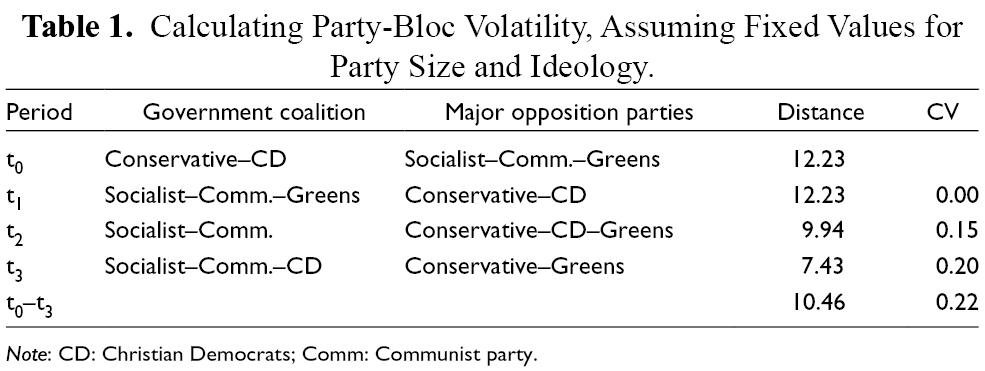
Below, I present examples of the calculation of the PBV index for a hypothetical party system comprised of five parties: Socialist and Communist parties (left), Greens (centre-left), Christian Democrats (centre-right), and a Conservative Party (right). I have attributed ideology scores to each of these parties on a scale ranging from 1 to 20. 5 The Communist and Conservative parties have received the lowest and highest scores, respectively.
Table 1 shows the composition of the government and opposition blocs for four presidential terms (t 0 to t 3 ). For the sake of simplicity, each president forms a single cabinet and there is no need to weight distances by cabinet duration. The table shows the values for ideological distance between the government and opposition, as well as PBV, assuming that the size and ideological positions of the parties do not vary over time.
Calculating Party-Bloc Volatility, Assuming Fixed Values for Party Size and Ideology.
Note: CD: Christian Democrats; Comm: Communist party.
As Table 1 shows, between periods t 0 and t 1 , alternation is wholesale: the incumbent coalition is expelled from power, while members of the former opposition form a new government. As party-bloc composition remains rigorously the same and both party size and ideology are kept constant, variation in ideological distance is zero. Between t 1 and t 3 , patterns of government formation become increasingly unstable and alternations in power are always partial, as only part of the incumbent coalition changes from one election to another. Moreover, both the opposition and government blocs become less ideologically congruent over time. Due to these changes, the distance between government and opposition decreases substantially between t 1 and t 3 , while PBV increases from zero to 0.20.
When the ideological positions of parties do not change over time, PBV captures the dimension of alternation in government in Mair’s (1996) scheme. Indeed, when alternation in power is wholesale, the absolute ideological distance between government and opposition tends to remain constant (assuming that all else remains constant); thus, PBV is equal to zero (as shown in the example above). The same applies to instances of no alternation, in which the government and opposition blocs remain constant. PBV is sensitive to innovation in governing formulas as well. For instance, between t 2 and t 3 , an innovative coalition brings together the Socialists, Communists, and Christian Democrats. Because this coalition is inconsistent with previous patterns of government formation, PBV increases.
Overall, the PBV index captures both patterns of government alternation and innovation and the degree of stability or instability in the ideological positions of parties and party blocs. Supplemental Appendix A explains in greater detail how the index changes when either ideology or party size changes over time, using the same hypothetical party system shown in Table 1 to simulate scores.
As a validity test, I compare PBV scores calculated for Brazil (1985–2018), Chile (1989–2014), and Bolivia (1982–2014) with other measures of party institutionalisation (extra-system and total electoral volatility, and party system closure) estimated for the same cases. Supplemental Appendix B lists the sources used to obtain data on the partisan composition of presidential cabinets and the ideological positions of parties.
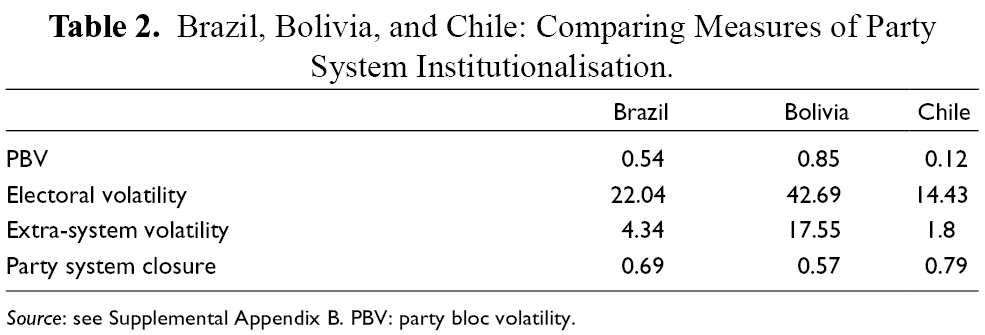
Chile and Bolivia provide an informative comparison because they are both multi-party systems in which coalitions are rather frequent (like Brazil), and yet they constitute extreme cases in terms of patterns of interparty competition. Chile has been characterised by the consolidation of highly stable and predictable patterns of government formation opposing the Concertación centre-left coalition and centre-right Alianza. Bolivia has been described in the comparative literature as a highly fluid and unstable party system that experienced collapse during the early 2000s (Alemán and Saiegh, 2007; Faguet, 2019; Luna and Altman, 2011). By contrast, Brazil is an intermediate case, in which low levels of volatility co-exist with increasingly unstable patterns of interparty competition. Consistent with our knowledge of these three cases, Chile has the lowest PBV score and Bolivia the highest, with Brazil standing somewhere in between. Levels of extra-system and total electoral volatility are significantly lower in Chile and Brazil than in Bolivia, which is also to be expected. Finally, levels of party system closure are highest in Chile and lowest in Bolivia. 6 Thus, the PBV score reveals cross-case differences that are consistent with those found using alternative measures of PSI.
It is telling that differences in PBV scores between Brazil and Chile are significantly larger than the differences in extra-system volatility. PBV in Brazil is 4.5 times higher than in Chile, while average extra-system volatility is 2.4 times higher. Variation in PBV is consistent with differences across cases: Chilean coalitions since the transition in 1989 have been characterised by extraordinary stability, while coalitions in Brazil lack ideological consistency and their partisan composition changes substantially across elections (Borges and Turgeon, 2019). Thus, the comparative data presented in Table 2 provide preliminary evidence to support the claim that measures of stability in components of the system provide an incomplete picture of the patterns of party system stability and change.
Brazil, Bolivia, and Chile: Comparing Measures of Party System Institutionalisation.
Source: see Supplemental Appendix B. PBV: party bloc volatility.
I have also calculated correlations between PBV scores and the measures of electoral volatility and party system closure, in addition to the absolute change in party fragmentation across elections, pooling yearly observations for Bolivia, Brazil, and Chile. Large changes in the effective number of parties are generally associated with related changes in the size and/or number of relevant players, thus modifying the structure of competition. As expected, PBV correlates positively with total and extra-system volatility, although the correlations are not especially large (r = .25 and 0.23, respectively). This is consistent with the claim that PBV and electoral volatility measure related yet distinct dimensions of PSI. PBV correlates negatively with closure (r = −0.22) and positively with the absolute variation in party fragmentation (r = .34), also as expected. The full correlation matrix is presented in Supplemental Appendix D.
The Case of Brazil: Electoral Stability and Party System Erosion
I have analysed the case of Brazil to explore longitudinal variation in the components of the party system and in patterns of interparty interactions, as well as the complex relationship between these dimensions. Brazil’s contemporary party system emerged in parallel to the democratic transition in the early 1980s. With very few exceptions, parties that have competed in elections since the transition did not exist prior to the bureaucratic authoritarian regime (1964–1985) and had no roots in the previous democratic era (1946–1964). The major parties on the right were founded by former supporters of the dictatorship (1964–1985) and descended from the authoritarian ruling party, the ARENA. These included the Liberal Front Party (Partido da Frente Liberal, PFL) and the Social Democratic Party (Parido Democrático Social, PDS). 7 Centre and left parties, for their part, were organised by the opposition to the authoritarian rule. The major centre parties at the time of the transition and at least until 2014 were the Brazilian Democratic Movement (Partido do Movimento Democrático Brasileiro, PMDB) and the Brazilian Social Democratic Party (Partido da Social-Democracia Brasileira, PSDB). The PMDB descended directly from the legal opposition to the military organised within the artificial two-party system created by authoritarian rulers, whereas the PSDB was created by a dissident faction of the former party. The Worker’s Party (Partido dos Trabalhadores, PT) was founded by middle-class intellectuals, union leaders, and social movements in 1980 and gradually consolidated as the most important party on the left.
From the democratic transition in 1985 until the mid-1990s, Brazil experienced substantial economic instability, including hyperinflation during the Sarney government (1985–1990) and stagflation in the early 1990s. The poor economic performance of incumbent governments, in addition to the reorganisation of the party system after twenty-one years of dictatorship, both contributed for high levels of electoral volatility throughout this period (Mainwaring et al., 2018; Melo and Câmara, 2012). From 1994, however, successful economic stabilisation and moderate GDP growth rates were followed by the gradual stabilisation of electoral competition (Braga and Pimentel, 2011; Mainwaring et al., 2018; Zucco Jr, 2011).
Most scholars have associated these trends with the consolidation of a bipolar pattern of competition in the presidential race between the PT and the PSDB (Borges, 2015; Braga, 2010; Mainwaring et al., 2018; Melo and Câmara, 2012). Between 1994 and 2014, no party other than the PT and the PSDB succeeded in either electing the president or obtaining sufficient electoral support to dispute a runoff election. The PSDB remained in power for eight years, during F H Cardoso’s two presidential terms (1995–2002), whereas the PT defeated the PSDB for the first time in 2002 and obtained successive victories in 2006, 2010, and 2014. In 2016, two years before the end of her term, President Dilma Rousseff was impeached. Vice-president Michel Temer (PMDB) assumed power, putting an end to thirteen years of PT rule.
As the number of feasible competitors in the presidential arena declined sharply, so did the opportunities for the entry of outside challengers. At the same time, most of the relevant parties opted for joining the pre–electoral coalitions led by either the PT or the PSDB. In the latest two elections (2014 and 2018), however, the share of the national vote obtained by newly created parties significantly increased in lower chamber races. Furthermore, the 2018 presidential election witnessed the breakdown of the PT–PSDB bipolarity, as extreme-right populist Jair Bolsonaro won the runoff election against the PT.
In sum, Brazil’s party system has moved from stabilisation of electoral competition between 1994 and 2010 to destabilisation in the recent period. These trends can be seen in the evolution of total and extra-system electoral volatility in lower chamber elections, presented in Figure 2.
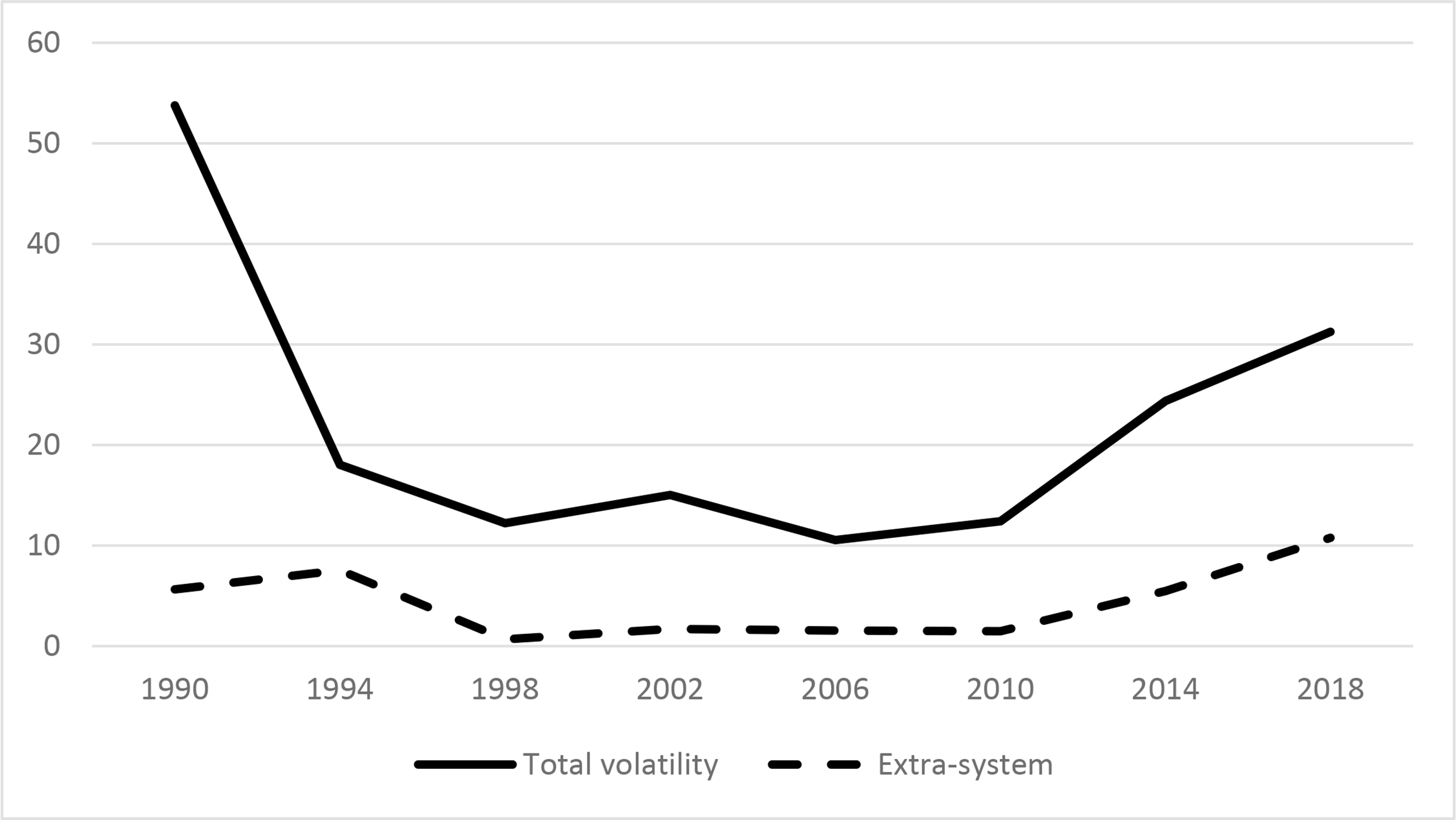
Total and Extra-System Volatility, Lower Chamber Elections, 1990–2018 (Volatility in % is shown in the y-axis).
As seen in the figure, levels of total and extra-system volatility remained low and mostly stable between 1994 and 2010, but increased in the following two elections, and especially so in 2018. Extra-system volatility stabilised around 1–2 per cent between 1998 and 2010, which indicates remarkable continuity in the components of the party system. By 2014, despite a relevant increase from 1.4 per cent to 5.6 per cent, extra-system volatility remained well below the Latin American average (10 per cent) (Mainwaring et al., 2017).
Figure 3 shows the evolution of total and extra-system volatility in presidential races. Note that the first post-transition president was indirectly elected in 1984. Direct presidential elections would only occur five years later, in 1989. Thus, volatility rates can only be calculated from 1994.
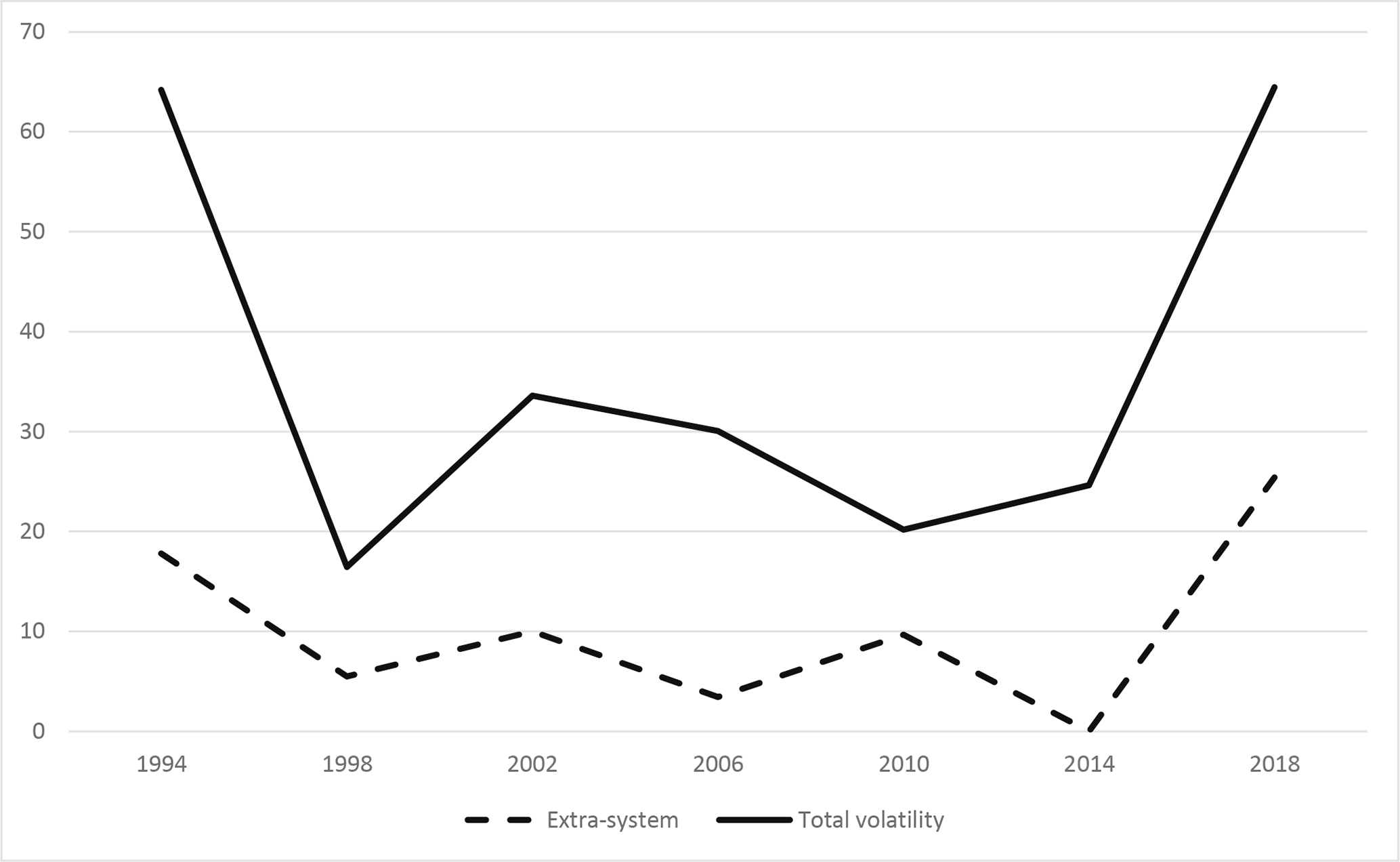
Total and Extra-System Volatility in Presidential Elections, 1994–2018 (Volatility in % is shown in the Y-axis.)
Levels of volatility in presidential races were consistently higher than in lower chamber elections. This is partly explained by the fact that not all the relevant parties competed with candidates of their own in all elections. 8 Despite these differences, variation in volatility in presidential elections follows a pattern similar to that observed in Figure 1. Total volatility experienced a sharp decrease after the first year in the series and substantially increased again in 2018.
Based on the indicators shown in Figures 2 and 3, one might have concluded that Brazil’s party system was moving towards consolidation until 2010. Figures 2 and 3 also suggest that the 2018 election represented a clear turning point. However, once one adds to the picture the patterns of interparty interactions, it becomes clear that the party system was already experiencing substantial and destabilising changes well before 2018.
Figure 4 shows the evolution of PBV for the 1990–2018 period. As explained in the previous section, the PBV index accounts for variation in the mean ideological distance between the government and the opposition blocs across two presidential terms. To obtain a more nuanced picture of party system stability and change, I opted for calculating yearly scores that compare ideological distances for each cabinet-year observation with the distance estimated for the previous presidential term. Thus, the first scores in the series compare ideological distances estimated for each of the cabinets formed during the Fernando Collor de Mello (1990–1992) government with the average ideological distance between the government and opposition blocs estimated for the José Sarney government (1985–1990).
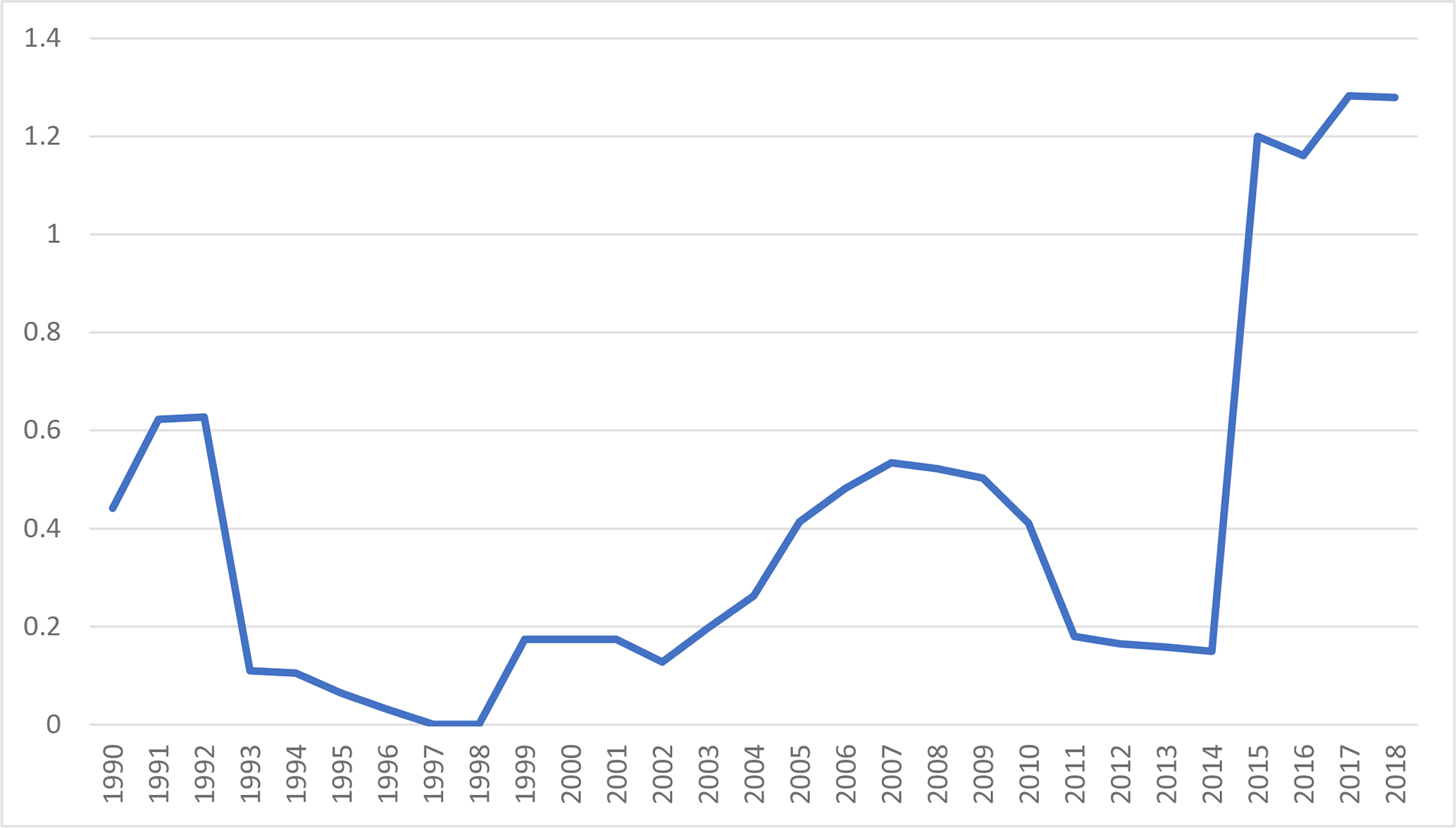
Party Bloc Volatility, 1990–2018 (Vertical axis shows the coefficient of variation of the ideological distance between party blocs over time).Sources: Brazilian Legislative Surveys and PREPS Expert Surveys, several years. Amorim Neto (2018) and Figueiredo (2007). Author’s elaboration.
Figure 4 demonstrates that the structure of competition was gradually stabilising between the Collor government (1990–1992) and the second Fernando Henrique Cardoso government (1999–2002), as PBV decreased systematically, apart from a small increase in PBV between 1999 and 2002. There was also a marked decrease in electoral volatility in lower chamber elections, from 54 per cent in 1990 to 12 per cent in 1998 (extra-system volatility fell from 5.6 per cent to 0.6 per cent). Overall, all the three measures of PSI show a consistent move towards stability in the components of the system and in the patterns of interparty interactions in this period. After the PT’s rise to the presidency in 2002, however, levels of PBV varied widely and showed no consistent trend, although total and extra-system electoral volatility remained low during most of the period. There was a significant increase in PBV between 2003 and 2010 (first and second Luiz Inácio Lula da Silva governments). In part, this increase is a by-product of alternation in power, as left-wing parties had never been in government before 2003, and Lula’s cabinet coalitions were bound to differ from all governments formed until then. However, alternation in power was only partial, as Lula formed coalitions that included some of the parties that had supported Cardoso. Furthermore, PBV remained high even after Lula was re-elected in 2007 and, thus, the PT remained in control of the national executive. 9 PBV decreased in the first Rousseff government (2011–2014), but it increased again between 2015 and 2018 and reached the highest values of the whole series during the second Rousseff (2015–2016) and the Temer (2016–2018) governments, to around 1.2. This sharp increase in PBV occurred years before the 2018 electoral tsunami, which reinforces the claim that electoral volatility fails to adequately capture the dynamics of party system change and stability.
In addition to short-term, yearly PBV scores, I calculated medium-term scores for the periods 1993–2002 and 2003–2018, using weighted distances for each presidential term. In the first period, which includes the Itamar Franco and Cardoso presidencies, aggregate PBV was equal to 0.12. In the second period, starting with Lula’s first presidential term, PBV was six times higher: 0.62. When one extends the first period to include scores estimated for the Collor government (1990–1992), levels of PBV are substantially higher (0.36 as compared to 0.12), but still lower than the figures calculated for the post-Lula period.
From Centripetal Atomisation to the Rise of the New Right
Party system instability after the second Cardoso presidency and especially after the first Roussef government (2011–2014) is associated with a consistent and very substantial decrease in ideological distances between the government and opposition blocs during the PT presidential administrations (2003–2016). While the mean distance calculated for the second Cardoso government was around 12, the same figure for the second Roussef government was only 0.35, indicating that the government and opposition blocs were virtually indistinguishable from each other in ideological terms.
In part, the trends shown in Figure 5 reflect the increasing ideological convergence between the major parties in the system. Throughout the 2000s, the major left party – the PT – moved consistently towards the centre of the spectrum as part of a vote-seeking strategy to obtain the support of moderate voters in the presidential race. This rightward movement was followed by the PT’s allies on the left, while at the same time the major parties of the right, with the notable exception of the PFL/DEM, moved leftward. By the late 2000s, the party system was significantly less polarised than in the early 1990s (Lucas and Samuels, 2010; Power and Zucco, 2009; Zucco and Power, 2021). Although the PT’s major rival, the PSDB, moved from the centre-left to the centre-right throughout the 1990s and 2000s, the two parties became increasingly similar in what concerns ideology and party programme due to centripetal competition in the presidential race (Madeira et al., 2017).
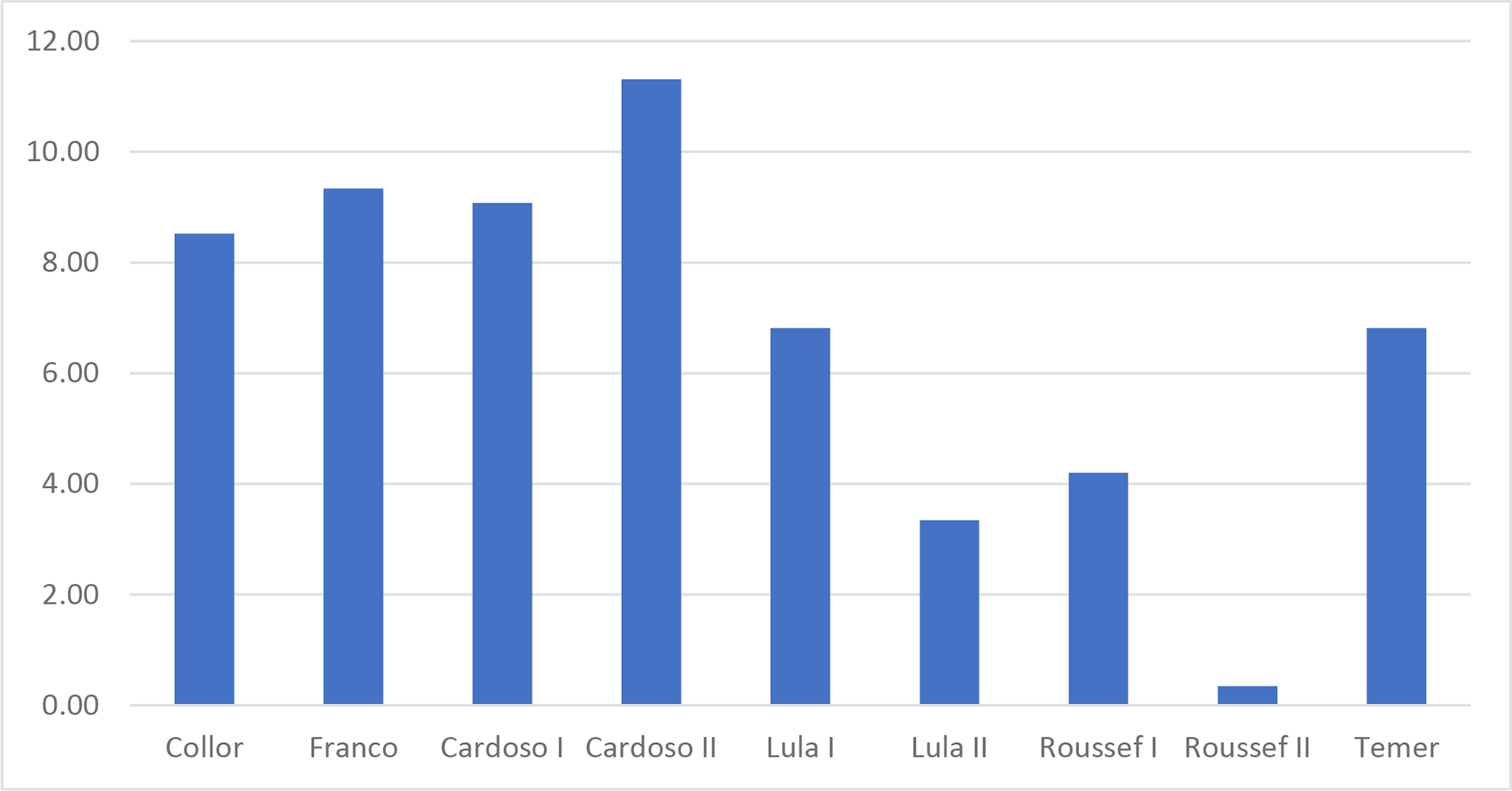
Mean Ideological Distance between Government and Opposition, 1990–2018 (The y-axis shows the mean ideology score in a scale ranging from 0 to 20). Source: Figure 3.
Decreasing ideological polarisation was followed by major changes in the coalition-making strategies of the major parties in the electoral and governing arenas. Before 2002, pre-electoral coalitions formed in the presidential race were mostly ideologically congruent. Center and right-wing parties were in government, whereas the left remained in opposition. Following the defeat of PT presidential candidates in 1989, 1994 and 1998, the political left remained in opposition while all government coalitions were formed by right-wing parties (as in the Collor government) or both right and centre parties (from the Franco government until the second Cardoso government). Throughout the Franco government (1993–1994) and the first and second Cardoso governments (1995–2002), the same centre-right coalition formed by PSDB, PMDB, PDS/PP, and PFL/DEM and, eventually, by the PTB, remained in power for most of the time.
In the 2002 presidential election, the PT adopted a vote-seeking strategy to mobilise centrist voters. As part of this strategy, the PT made an alliance with a small right-wing party – the Liberal Party (Partido Liberal, PL) (Amaral, 2003; Hunter, 2010). After Lula’s victory, the PL and other right-wing parties were invited to Lula’s cabinet. Moreover, Lula’s coalitions included parties that had previously supported the PSDB in Congress (the PMDB, the PDS/PP, and the PTB). Electoral and governing alliances lacking in ideological consistency became increasingly frequent, not only because all parties were moving towards the centre of the spectrum, but also due to the rapid electoral growth of particularistic right-wing parties at the expense of the most programmatic party of the right, the PFL/DEM. Centre-right, office-seeking parties gradually and systematically increased their participation in the cabinets formed by PT presidents throughout this time, at the expense of the PT’s traditional left allies.
The large decrease in ideological distance between the government and opposition blocs between the first and second Roussef governments is explained not only by the growing ideological heterogeneity of the governing coalitions, but also by the defection of the second largest left-wing party – the Brazilian Socialist Party (PSB) – from the cabinet. As the PSB left the government, Roussef’s coalition became slightly more rightist, whereas the opposition bloc moved to the left. The breakdown of the long-term PT–PSB alliance thus contributed to the record-high levels of PBV observed in this period.
The caretaker Temer administration (2016–2018) that followed the interruption of Rousseff’s second presidential term fostered a significant re-alignment, as Rousseff’s coalition was divided regarding her impeachment in May 2016. Throughout most of his term, Temer governed with the support of the centre-right. The PT and its left-wing allies voted against impeachment and thus remained in opposition during the Temer government, except for the PSB. However, such re-alignment did not imply a return to the structure of competition that existed before 2003 because Brazil’s party system had substantially changed. Levels of polarisation were significantly lower, while party fragmentation had significantly increased, and small parties in the legislature had much greater bargaining power than before.
Indeed, coalitions became increasingly large and fragmented after 2002. Whereas Cardoso formed cabinets comprised by four or five parties to obtain supermajorities of two-thirds or more of the seats in both houses of Congress, Temer had to invite eleven parties to his first cabinet in order to obtain similar levels of support. The effective number of parties in the Chamber of Deputies increased from around seven at the end of the second Cardoso government to almost twelve at the beginning of Rousseff’s second term. Most certainly, Brazil’s permissive electoral rules, combining open-list PR, high district magnitudes, and a peculiar system of electoral coalition-making in legislative races that systematically favours small parties have contributed to these trends (Calvo et al., 2015).
The increasing atomisation of the party system occurred simultaneously with a marked decrease in polarisation, as shown in Figure 6 (fragmentation is plotted on the right vertical axis and polarisation on the left vertical axis). 10 As seen in the figure, between 2002 and 2014 fragmentation in the lower chamber increased in all elections, while polarisation consistently decreased. Note that party fragmentation is mostly a consequence of the continuous transfer of votes and seats from the larger parties to the smaller ones, given the low levels of extra-system volatility observed throughout most of the period. In the 2018 election (not shown in the figure), fragmentation continued to increase and reached a record high of 13, but the trend of decreasing interparty ideological differences was interrupted: polarisation grew from 3.1 to 4.2.
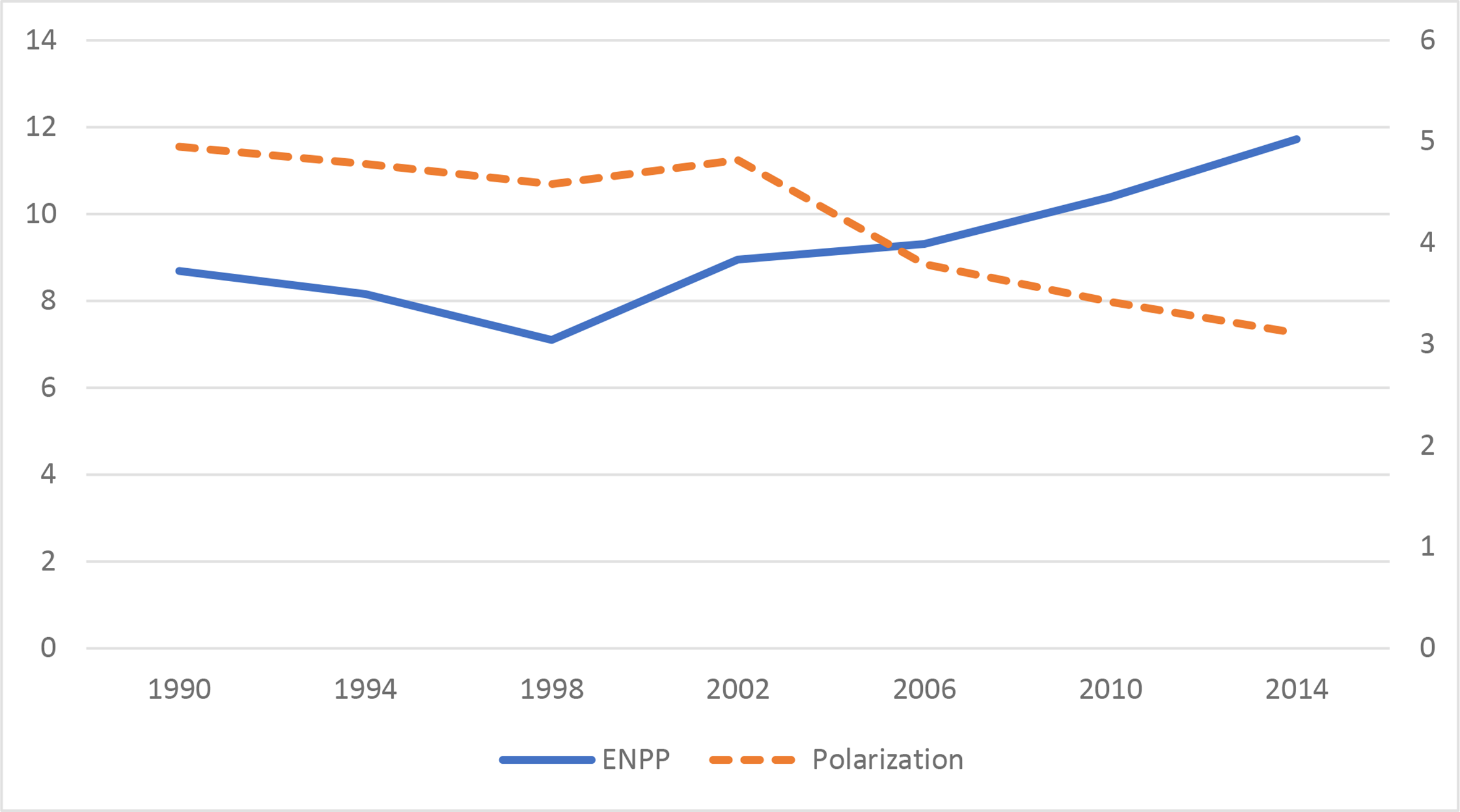
Effective Number of Parties and Polarisation in the Chamber of Deputies, 1990–2014 (The effective number of electoral parties is plotted on the right vertical axis and the mean polarization score on the left vertical axis).Sources: Brazilian Legislative Surveys and PREPS Expert Surveys, several years. Website of the Chamber of Deputies (www.camara.leg.br).
In terms of Sartori (1976)’s typology, Brazil has gradually become an atomised party system, in which fragmentation is so extreme that the addition of one more party has little if any impact on the pattern of interparty interactions. Although polarisation and fragmentation tend to go hand in hand, atomised multi-partyism in the Brazilian case has not resulted from centrifugal competition. Instead, fragmentation increased at the same time that parties converged towards the centre of the ideological spectrum between 2002 and 2014. This process of centripetal atomisation has undermined party system institutionalisation by inducing presidents to form increasingly large and ideologically heterogeneous coalitions, thus introducing an element of permanent instability in the structure of competition.
As ideological differences separating incumbent and opposition party blocs markedly decreased between 2003 and 2016, so did the ability of voters to differentiate the major parties in the left–right axis (Rebello, 2012). Moreover, because government coalitions became less and less congruent in ideological terms, at the same time particularistic parties increased their bargaining power, presidents were induced to rely heavily on non-policy and, at times, illicit rewards to keep coalitions together (Pereira et al., 2009). These trends likely contributed to the erosion of parties’ social legitimacy and to the fostering of anti-party and anti-system attitudes. Indeed, between 2002 and 2014, the proportion of anti-partisan voters who strongly rejected all the major parties increased from 2.5 per cent to 15 per cent. 11 In July 2013, a series of mass demonstrations that swept over Brazil’s major cities revealed citizens' deep dissatisfaction with widespread corruption and inefficient public services, in addition to a profound hostility towards party politics. Generalised opposition to political parties was thematised via signs, slogans, and social media postings by demonstrators from varied ideological orientations (Alonso and Mische, 2017).
The growing rejection of parties and party politics was further reinforced by a major anti-corruption operation initiated in 2014. The Operação Lava Jato (so-called “Operation Car Wash”) started as an investigation of a bribery scheme in the Petrobrás state oil company, but gradually expanded and revealed several corrupt schemes involving other public companies, construction firms, and politicians affiliated with several different parties. 12 In addition to the systemic corruption revealed by Operation Car Wash that led to the discrediting of all major parties, a deep economic contraction in 2015 and 2016 fuelled popular anger against President Rousseff, and the Rousseff’s PT successor, Temer, fared no better: he not only failed to deliver robust growth rates, but several key government officials (including Temer himself) were caught up in corruption scandals. 13 As the parties that were formerly in opposition to the PT government – PSDB and DEM – opted to maintain their support to President Temer despite the charges of corruption and obstruction of justice filed by the prosecutor general, their anti-corruption rhetoric was undermined. To make matters worse, the PSDB’s likely presidential candidate in 2018, Aécio Neves, was caught on tape in March 2017 asking the CEO of Brazil’s meat-packing multi-national – JBS – a cash payment of 2 million reais ($580,000).
In the 2018 presidential election, extreme right populist Jair Bolsonaro benefited from the discrediting of the major parties to effectively challenge the PT–PSDB polarisation and win the runoff race against Fernando Haddad of the PT. Most certainly the rise of right-wing populism was facilitated by the extra-constitutional strategies pursued by Operation Car Wash to accelerate the indictment and conviction of politicians charged of corruption, while at the same gaining popular support in favour of the “cleansing” of the political system. 14 However, the role of these short-term factors cannot be overstated, as voters’ rejection of parties and party politics was on the rise years before Operation Car Wash unveiled systemic corruption. It is, thus, arguably the case that Bolsonaro’s anti-system and populist rhetoric against traditional politics was favoured by long-term processes of party system erosion that contributed to the growing perception that all parties were alike and were no longer able to present meaningful alternatives. Not surprisingly, anti-partisan voters were much more likely to vote for Bolsonaro in 2018 (Fuks et al., 2021).
Conclusion
Overall, the case of Brazil demonstrates how major processes of party system de-institutionalisation can develop gradually over time, while at the same time the components of the system remain mostly stable. These patterns contradict the oft-made claim that stability in the members of the system is a sufficient condition for party system consolidation. Between the Collor and the second Cardoso governments, a clear structure of party competition emerged, as the left and the center-right formed stable and cohesive and blocs. However, after the rise of the PT to national government in 2003, the party system experienced cumulative and destabilising changes, despite the low levels of extra-system volatility observed from 2002 to 2014. Throughout this period, party fragmentation increased consistently in all elections, while polarisation decreased, and parties moved towards the centre of the spectrum. As the relative ideological distance between the components of the system decreased, at the same time as the number of relevant players in the electoral and governing arenas increased, patterns of coalition formation became much more unstable and unpredictable. Moreover, centripetal atomisation likely fostered anti-party attitudes by diluting the ideological differences among the established parties and by allowing for the growth of particularistic, office-seeking party organisations devoid of programmatic content. As Operation Car Wash unravelled widespread corruption, the established parties were further discredited, thus leading to the rise of anti-system and ideologically extreme alternatives in the 2018 elections.
Previous research on party politics in Brazil assumed that electoral stability before Bolsonaro’s election was proof that the party system had consolidated (Braga, 2010; Braga and Pimentel, 2011; Zucco Jr, 2011). However, electoral volatility is clearly limited as a synthetic measure of PSI, to the extent that low levels of within-system and extra-system volatility over time may obscure cumulative changes in the number of relevant parties in the system leading to concomitant shifts in the pattern of interparty interactions. Furthermore, electoral stability may co-exist with significant changes in the ideological positions of the major parties, and in their coalition-making strategies in the electoral and governing arenas.
In addition to pointing out the shortcomings of electoral volatility as a synthetic measure of institutionalisation, the article contributes to the party system closure approach originally developed by Mair (1996). While my analysis closely follows the concept of PSI utilised by Mair (1996) and Casal Bértoa and Enyedi (2016), I diverge from these authors in that I incorporate the degree of stability in the ideological positions of the governing alternatives as a key dimension for analysing the patterns of interparty interactions. Although the PBV score does correlate with party system closure, as expected, statistical association between these two measures is not especially strong, which suggests that PBV is indeed different from the composite indicator developed by Casal Bértoa and Enyedi (2016).
Despite its focus on a single case, the article proposes an innovative framework to analyse PSI in multi-party presidentialism that can be easily applied to presidential democracies in Latin America and other regions of the world. Indeed, additional data on the cases of Chile and Bolivia indicate that the PBV score produces measures that are consistent with other indicators of PSI and with our empirical knowledge of these cases. By moving beyond the analysis of aggregate indexes of electoral volatility, this approach allows one to obtain a much more fine-grained understanding of party system stability and change. This is an important contribution because party systems all over the world are under stress, and there are cases previously considered to be successful examples of institutionalisation that have either collapsed (Venezuela) or have witnessed the rapid growth of anti-system, populist forces (Hungary) (Batory, 2016; Morgan, 2011). A more careful consideration of the patterns of interparty interactions would surely increase our ability to obtain a more accurate understanding of variation over time and across countries in levels of PSI.
Supplemental Material
Online supplementary file 1 - Supplemental material for The Illusion of Electoral Stability: From Party System Erosion to Right-Wing Populism in Brazil
Supplemental material, Online supplementary file 1, for The Illusion of Electoral Stability: From Party System Erosion to Right-Wing Populism in Brazil by and André Borges in Journal of Politics in Latin America
Footnotes
Acknowledgements
A previous version of this article was presented at the seminar series of the Department of Politics at the University of California, Santa Cruz, on the 30th of October, 2019. I am especially thankful to Sara Niedzwiecki, Kent Eaton and Patrícia Pinho for their comments and criticisms. I would also like to thank JPLA’s two anonymous reviewers. Their extremely detailed comments and suggestions have helped me to significantly improve and clarify the article’s theoretical and empirical contributions.
Declaration of Conflicting Interests
The author(s) declared no potential conflicts of interest with respect to the research, authorship, and/or publication of this article.
Funding
The author(s) disclosed receipt of the following financial support for the research, authorship, and/or publication of this article: This publication was partly supported by the Federal District Research Foundation (FAPDF) in the form of a visiting fellowship (005/2018). Thanks to financial support provided by FAPDF, I was able to gather and organize most of the data utilized in this article during my visiting scholar appointment at the Center for Iberian and Latin American Studies (CILAS) at the University of California, San Diego from August 2019 to January 2020.
Supplemental Material
Supplemental material for this article is available online.
Notes
Author Biography
Email:
References
Supplementary Material
Please find the following supplemental material available below.
For Open Access articles published under a Creative Commons License, all supplemental material carries the same license as the article it is associated with.
For non-Open Access articles published, all supplemental material carries a non-exclusive license, and permission requests for re-use of supplemental material or any part of supplemental material shall be sent directly to the copyright owner as specified in the copyright notice associated with the article.
