




Abstract
This paper maps the gender balance in the discipline of political science in Latin America by examining data from 16 countries where we could find the number of female professors in political science departments (over 100 departments) as well as from 69 journals publishing political science research in Latin America and from 16 Latin Americanist journals in Canada, the United States, and Europe. We compare the proportion of female political science faculty members to the proportion of women serving as editors and as members of editorial and advisory committees for relevant academic journals. We find that a significant gender gap remains, both in political science departments and in journals, and that the gender gap is worse in journals based in Latin America than in those based outside the region.
Introduction
As the proportion of female university students has overtaken that of male students in most regions of the globe, interest in the underrepresentation of women in the professoriate has risen (EIGE, 2022; UNESCO, 2021). Among the social science disciplines, political science has been highlighted as particularly resistant to including women (Freidenberg, 2018). Academic attention to the gender gap in political science has steadily increased in recent years as well, often with a focus on publication patterns (Breuning and Sanders, 2007; Teele and Thelen, 2017). In the few studies dedicated to female representation in political science in Latin America, based on a limited number of countries, one finds that while the proportion of women enrolling and completing undergraduate political science degrees is close to parity with men, in many university departments the presence of women declines or even disappears the higher up one goes in the hierarchy, with relatively few female professors at the highest ranks (Rocha Carpiuc, 2016: 463–4). In Europe and the United States, the mobilisation of women has raised awareness of the negative implications of the absence of women in decision-making positions in political science and reports have been produced to document and account for the state of affairs and the progress that has been made (APSA, 2005, Mauleón et al., 2013, Palmer et al., 2020).
We focus here on an understudied aspect of the presence of women in leadership positions – their participation on editorial teams and editorial boards of academic journals (exceptions include Rocha Carpiuc, 2016; Mendes and Figueira, 2019). Why does this matter? Editors and editorial boards play a central role operating as science's gatekeepers because they help ensure the quality of academic journals, influence which topics and methodological approaches are published, and are selected in accordance with their experience and prestige in their fields; in turn, they attain higher visibility and serve as models for students and younger members of the scientific community (Mauleón et al., 2013; Stegmaier et al., 2011; Verge Mestre et al., 2018). Editors are responsible for the processes for accepting, peer-reviewing, and final decisions for article manuscripts and can encourage particular research directions, all of which affect the development of disciplinary knowledge.
Analysing the presence of women on journal editorial teams and boards is relevant because these publications are one of the leading sources in the evaluation of academic performance, while the prestige of the journals, especially in Latin America, often correlates with that of the research centers or university departments that publish them. Additionally, there is a symbolic effect of the presence (or absence) of women on journal mastheads as they function as role models and may affect the propensity to submit manuscripts for review. This symbolic effect is important given that, for top political science journals in the United States at least, while articles published by men vastly outnumber those by women (Teele and Thelen, 2017), this is because women submit fewer manuscripts than men and not that their manuscripts are rejected at higher rates (Djupe et al., 2019).
Finally, while seeking gender parity through making structural changes to academic departments faces economic restrictions that impede the expansion of the faculty at the necessary pace, the same is not true of academic journals, where renewal and growth are more flexible and could be done more quickly. With fewer hard constraints, change here is an expression of the will to work towards parity (or not). Diversifying editorial boards in terms of gender is virtually costless and would allow journals to demonstrate their predisposition to “level the playing field.”
Thus, the goal of this study is to map the representation of women in Latin American political science in two ways: registering the number of women in the political science departments of the region's universities (16 countries, 107 departments) and on the mastheads of academic journals that publish political science articles (69 journals in Latin America and 16 Latin Americanist journals in Canada, the United States, and Europe). We compare the proportion of female faculty members in political science with the proportion of women serving as editors or members of editorial and advisory boards across countries in the region. In addition, we compare Latin America–based journals with those outside of the region and contrast our findings with similar studies based on the United States. When we update and broaden the scope of prior studies of women in Latin American political science to include a wider range of countries, we find that the gender gap is not restricted to those countries where political science is more institutionalised, that there is substantial variation across the region with no trend towards diminishing, and that women's presence on editorial boards is especially low. The next sections describe our methodology and criteria for data collection, present our findings, and offer conclusions about the continuing gender gap in Latin American political science.
Methods
Using prior studies on this topic in the United States (Palmer et al., 2020; Stegmaier et al., 2011), Latin America (Rocha Carpiuc, 2016), and Brazil specifically (Mendes and Figueira, 2019) as guides, we emphasise three basic descriptive questions: What proportion of the political science professoriate is made up of women in Latin American countries? What proportion of the editorial teams in Latin Americanist and Latin American political science journals is made up of women? And what proportion of the editorial boards and/or international advisory boards of these same journals is made up of women?
With the goal of presenting a broad panorama of the gender balance in the region's political science field, we do not focus on a single country or the small group of countries where political science is more established, nor on only the most recognised journals. Instead, we include all the countries in the region where we could find at least one academic journal and one department that dedicated a large part of its efforts to political science, and where their websites included a list of the editors and board members or of the full-time faculty, respectively. We included 107 Political Science departments (see Appendix 1), 69 journals in 16 Latin American countries, and 16 journals based outside of the region (see Appendix 2) in an iterative process. The first wave of data collection went from January 2021 to May 2021 and was conducted primarily by research assistants. Most of the data was collected during this wave, which we then verified by July 2021. The second wave went from January to March 2022, when we included an additional six Brazilian and two Nicaraguan journals.
To select the university departments, we began with a list of more than 200 that offer a bachelor's degree (or licenciatura) in Political Science (or Political Studies or other similar degree) that was compiled by the Red de Politólogas (Network of Female Political Scientists) for its own research on curricula. 1 Fewer than half of these departments had an adequate website. Therefore, we began additional searches based on prior studies of the discipline in the region, both those with a gender focus (Mendes and Figueira, 2019; Rocha Carpiuc, 2016) and more general articles (Altman, 2012; RCP, 2015). Finally, for those countries with fewer political science departments or those with less accessible universities (which claimed that strict privacy policies prevented them from providing public lists of the faculty), we resorted to Internet searches and suggestions and data from colleagues. In two countries, Costa Rica and Guatemala, we found only one department that met the criteria. At the other extreme, in Brazil, we included 25 departments.
To select political science journals in and focused on Latin America, we started with the lists used in prior studies (Codato et al., 2020; Mendes and Figueira, 2019; Rocha Carpiuc, 2016). Based on the main selection criteria used by Codato et al. (2020, 10) – that the journals included a significant focus on politics of the region and were not principally focused on other topics – we chose nine journals analysed by Rocha Carpiuc (2016), 22 of the 23 utilised in the study by Codato et al. (2020), and 11 of the 15 considered by Mendes and Figueira (2019), all from Brazil. 2 Given the high degree of overlap on these three lists, which included only the more prestigious journals (e.g. those indexed by Scopus), we found that journals from only eight countries in the region and five out of the region were included. We, therefore, expanded the list after reviewing the journals available on Latindex that complied with our criteria to reach 69 journals in 16 Latin American countries. In two of these, Bolivia and El Salvador, we could find only one journal that met our selection criteria. Keeping in mind that Latin Americanist journals from other world regions often rely on editors and editorial boards partially from the region, we also added sixteen prominent journals based in Europe and North America that publish frequently on Latin American politics. Following Palmer et al. (2020), to count the number of editors, we included the positions of editor, co-editor, and director, but not the positions of book review editor or editorial staff (redacción). In addition, given the heterogeneous usage of editorial and advisory boards – and the frequent usage of more than one such board – we followed Mendes and Figueira (2019) in comparing the total number of board members, combining them when there was more than one board or committee.
We recognise that these two samples are not strictly representative of the universe of departments and journals in Latin American political science. In terms of departments, there is a bias against less prestigious universities and those with underdeveloped websites, where faculty jobs might be less stable; we do not know how this bias affects the sample, that is, whether we are missing departments with more female faculty or less female faculty. We also could have included more Brazilian departments, but we did not want to unbalance the sample too much given our goal of a general mapping of the discipline in the region. With regards to the academic journals, the sample includes all those that fit the criteria in the smaller countries but excludes some journals in the larger countries, again to better achieve a balanced sample. Despite their potential defects, these samples have the advantages of being the largest ever published on the presence of women in Latin American political science departments and on the editorial teams and boards of Latin American political science journals, and of containing sub-samples that are comparable with previous studies, which allows us to evaluate change over time for some cases.
Analysis
This section starts with a broad look at the data concerning the three principal ways we are assessing the gender gaps in political science – in the professoriate, editorial teams, and editorial boards. Next, we present several intra- and inter-regional comparisons and, where possible, comparisons over time in a selection of countries and journals. 3 These comparisons illustrate that gender gaps continue to exist in the region, though with considerable differences across countries, that recent advances have been made in some countries but not others, and that, while the proportion of female political scientists in Latin America lags behind the percentage in the United States, the proportion of female journal editors is slightly higher.
As in earlier studies based on a few countries, we too find, first, that Latin American political science departments remain far from gender parity. In our sample of 107 departments, there are 729 female professors and almost double that number of male professors (1441). Women make up 34% of the political science faculty in our sample. Second, in our sample of 85 journals, 41% of the editorial leadership positions are held by women, or 37% counting only the 69 journals based in Latin American countries. Third, in the whole sample, the proportion of women on editorial boards is lower, at 30%, and descends to 28% for the journals based in the region. Table 1 shows these results and the differences between the two types of journals.
Women in Political Science Journals.
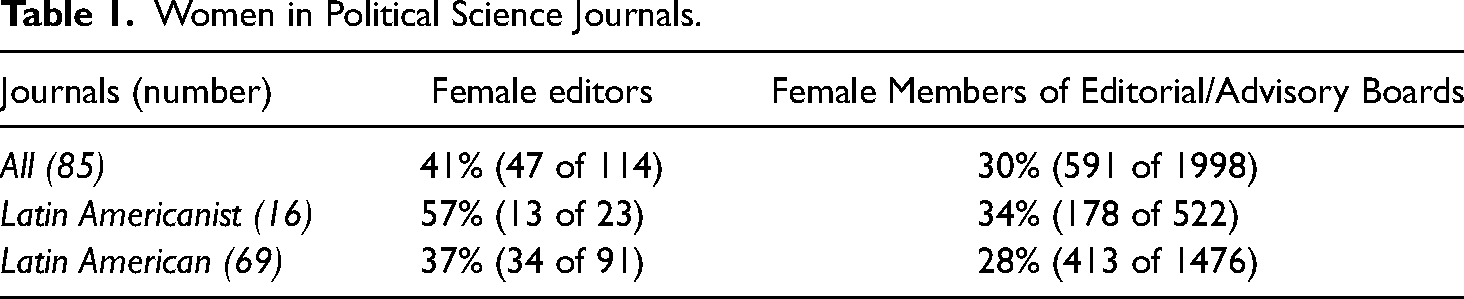
The data shows that the percentage of female editors of Latin American political science journals is slightly higher than the percentage of female faculty in political science departments (37% compared with 34%). Women's participation on editorial and advisory boards is considerably lower, such that they are underrepresented even in proportion to their presence in the faculty (28% compared with 34%). The percentages of women on journal mastheads are higher for the Latin Americanist journals based outside the region, notably in the case of editors, where women hold more than half the positions. By contrast, if we focus solely on the 40 Latin America–based journals that publish strictly political science (excluding the 25 social science and four Latin American studies journals in the original sample), the percentage of female editors declines slightly to 33% while the percentage of women on editorial boards stays essentially the same, at 29%. The differences are fairly marginal and do not change our principal conclusion: women are underrepresented in Latin American academic journals focusing on politics.
Moving to the national level, a high degree of variation is apparent, especially concerning the participation of women as editors. However, in no country is there gender parity when it comes to political science departments and editorial boards. Table 2 shows that in four Latin American countries, political science journals do not have a single woman in the role of editor or co-editor, while in five, women hold 50% or more of the positions on editorial teams. In terms of the composition of editorial and advisory boards, the figures vary from a minimum of 0% in Bolivia (in the one journal included) to a maximum of 37% in Costa Rica. The percentage of full-time female faculty in political science departments varies from a minimum of 13% in Peru to a maximum of 44% in Costa Rica (in the one department included). Given that in some cases there are very few departments and/or journals, especially in Central America, we focus our analysis below on those countries with more available data and on subregional comparisons.
Variations Among Countries.
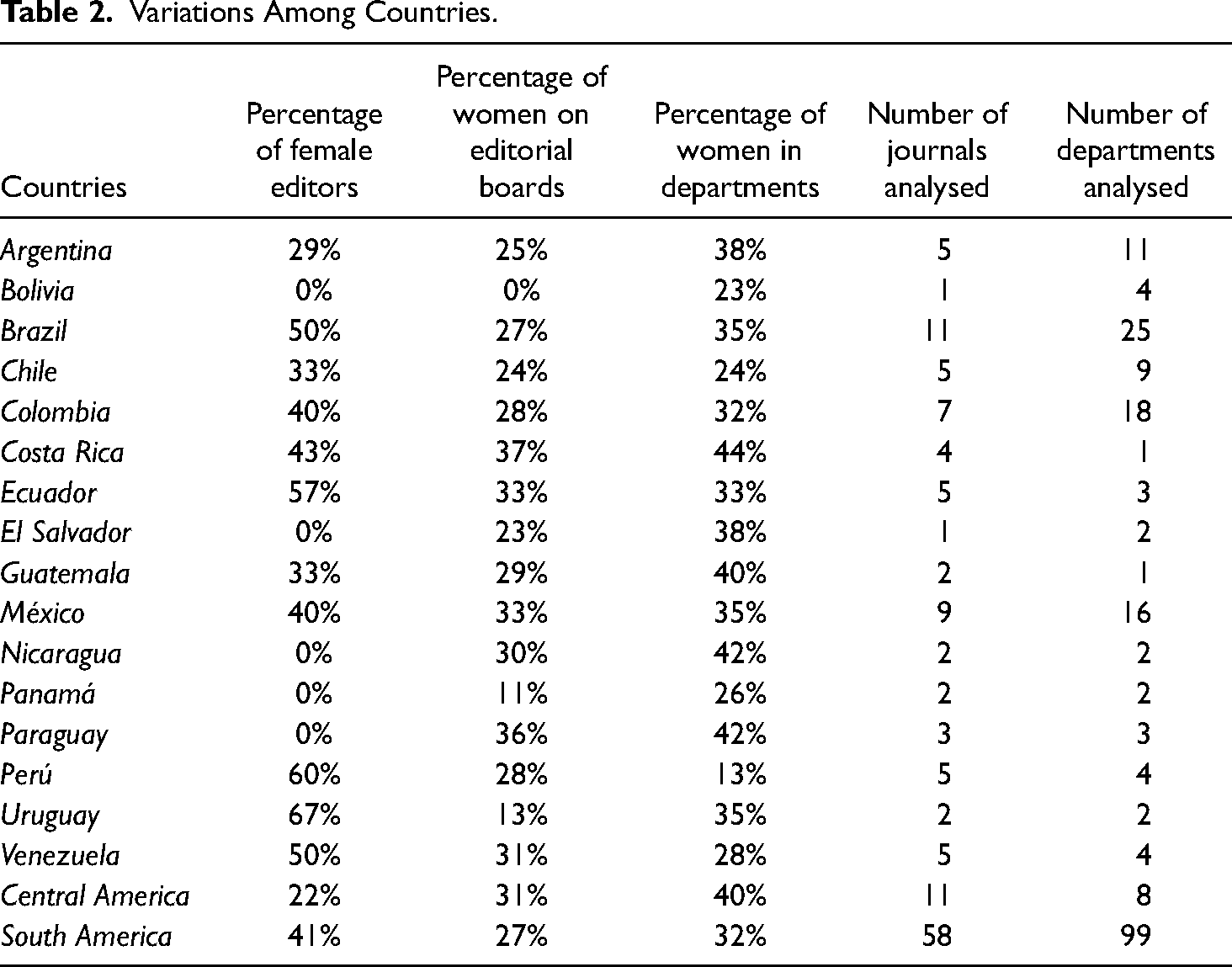
It is evident in Table 2 not only that substantial variation exists across all three measures throughout the region but that there appears to be little correlation amongst these measures within countries or sub-regions. The percentage of female professors by country shows no correlation with either the percentage of female editors or the percentage of women on editorial committees. This (null) result holds up in the sub-regional samples as well. While the percentage of female faculty is higher in Central America than in South America, the percentage of female editors is substantially lower, and the percentage of women on editorial boards is roughly the same. The relatively high percentage of female political science professors in Central America and the low percentages in Bolivia, Peru, and Chile present a striking contrast. In Bolivia and Peru, this could be explained by the small number of departments analysed, but this is not the case for Chile, one of the countries in the region – alongside Argentina, Brazil, Colombia, Mexico, and Uruguay – where political science is considered highly institutionalised by Rocha Carpiuc (2016). 4 Chile also stands out for its low rates of women on editorial teams and boards in comparison not only with some of the other countries where political science is a consolidated field but also with the entire sample. 5 Brazil, Colombia, and Mexico score better on these metrics than Chile, and Brazil's journals have achieved gender parity in terms of editorial teams.
We find no obvious explanations for these variations across countries nor across journals. As noted, the degree of political science institutionalisation does not correlate consistently with any of the three gender gap measures across countries. When testing correlations across journals, we find no evidence that journals linked to universities have greater parity in their gender ratios for either editorial teams or boards compared to other types of journal host, nor that having more female editors correlates with higher percentages of women on editorial boards, though future studies might test for this with time series data. Those journals indexed by Scopus (22 of the 69) have roughly the same percentage of women on editorial boards as those that are not (32% compared to 30%). Interestingly, Scopus-indexed journals are more likely to have at least one female editor or co-editor: 55% of them do compared to 38% of those that are not indexed by Scopus. Given the lack of time-series data, we do not know whether having a diverse editorial team helps journals achieve Scopus indexation or if already-indexed journals subsequently closed the gender gap (nor what causal mechanisms, if any, were involved). Finally, like Palmer et al. (2020) for political science journals in the U.S., we find no evidence that the membership size of the editorial and advisory boards affects the percentage of female members. These preliminary analyses suggest that there is significant room for the agency of those at the helm of academic journals to improve gender parity.
While there are few studies of the gender balance in Latin American political science, we can compare our results in some cases to verify if there have been changes in recent years. Rocha Carpiuc (2016) used a sample of 21 political science departments in countries where political science is more institutionalised and found that women made up 30% of the faculty in 2015, which is slightly lower than our figure for the entire sample for 2021. When we look only at the same 21 universities, the figure is 32% in 2021, which suggests that at least in those departments, little changed in six years.
For Chile, thanks to prior studies, we can report that there has been no increase in the percentage of female professors in political science departments since 2005. That year, women made up 24.5% of the faculty, a figure that fell slightly to 23% in 2015 (Fuentes and Santana 2005; Heiss 2015), which barely differs from our figure of 24% for 2021.
For Mexico, we can compare our findings with those of Barrientos del Monte (2015), who found that 29% of the political science researchers registered in the National System of Researchers (Sistema Nacional de Investigadores) were women in 2015. Using the same method, we found that for 2020, the last year with available data, 34% of registered political science researchers were women. 6 That figure is essentially the same as what we found for the percentage of female faculty in political science departments in Mexico (35%), and shows that, unlike in Chile, there has been an increase in politólogas (female political scientists) in Mexico in a short period of time.
For Brazil, our results are similar to those of Candido et al. (2019), who report that, in 2017, 33% of the faculty in political science masters and doctoral programs throughout the country were women, a figure close to the one in our sample of 35%. For Brazilian journals, our data correspond with the figures reported by Mendes and Figueira (2019) concerning the percentages of female editors – 50% in 2017 and in 2022 – and of female editorial board members – 24% in 2017 and 28% in 2022.
Finally, we can compare our Latin American data with similar data regarding political science in the United States, where the same research team published two studies a decade apart examining the same questions (Palmer et al., 2020; Stegmaier et al., 2011). There are two main differences in our study. One is that these articles focused on the 50 “top” political science journals in the United States. The other is that, to calculate the percentage of female political science professors, first in 2010 they used a comprehensive APSA report and later they used surveys of APSA members in 2015 and APSA conference attendees in 2017. Therefore, both their figures and our figures for the proportion of women in political science are estimates, derived in different ways and in different years, which makes the following comparisons rather rough. Nonetheless, in Table 3, one can see that the differences between Latin America and the United States are not especially large. While the proportion of women on the faculty and on editorial boards is higher in the United States compared to Latin America, the percentage of female journal editors is slightly lower.
Politólogas in Latin America and the United States.
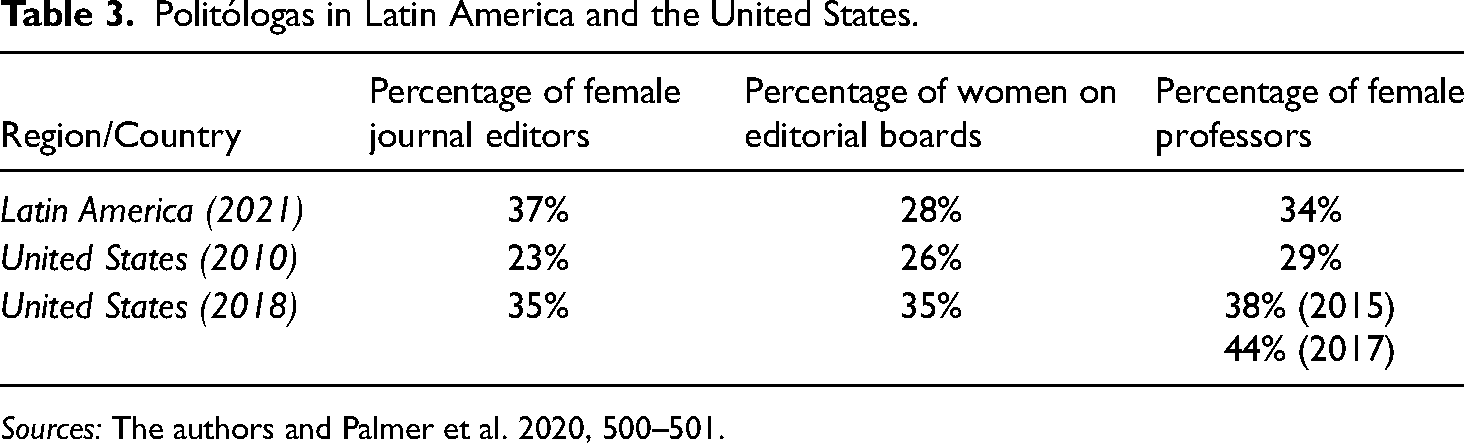
Sources: The authors and Palmer et al. 2020, 500–501.
One key point that stands out in Table 3 is the increase in the percentage of women on editorial teams and boards in the United States between 2010 and 2018, a relatively short period. Although these journals remain far from parity, there is a clear improvement that shows that change is possible. Recalling our findings in Table 2, especially the large proportion of female journal editors in several countries – reaching 50% or greater in five – it becomes clearer that particular emphasis should be placed on the editorial and advisory boards.
Conclusions
The underrepresentation of women in academia has negative implications in terms of inclusion and for the production of knowledge more broadly, narrowing topics and options for innovation and adaptation (EIGE, 2022). With this context, we set out to investigate the presence of women in the field of political science in Latin America. We mapped the presence of women on the faculty of more than 100 political science departments in the region's universities as well as on the editorial teams and boards of 69 journals that publish political science research in Latin America and 16 Latin Americanist journals in Canada, the United States, and Europe.
Analysing the presence of women on the faculty continues previous research, allowing for over time comparisons, while combining this with a survey of female presence on journal mastheads provides new data that allows a deeper understanding of the status quo and helps identify future lines of action. Publications are crucial criteria for selecting faculty and editorial teams operate as gatekeepers helping shape what is considered knowledge and which manuscripts do and do not enter the evaluation process. The presence of women in these positions also has symbolic effects on future generations of political scientists.
Our preliminary conclusions show, first, that gender gaps remain relevant in the region. For Latin America, the proportions of women as both political science journal editors (37%) and professors (34%) remain far from parity. Their rate of participation on editorial and advisory boards is even lower (28%); understanding the causes and consequences of this low rate requires further analysis. Because journal editors have more influence than editorial board members, the greater presence of female editors appears to be good news. Yet further research is required given that these positions entail heavy workloads and are not necessarily or always well compensated monetarily or with promotions within the faculty ranks. At the same time, the paucity of women on journal editorial and advisory boards is surprising. After all, in general, those roles are typically more symbolic, and the cost of increasing or adapting the membership is minuscule.
Second, there are differences between countries in which lukewarm progress is observed and others anchored in situations of high disparity. Mexico's recent progress is remarkable, while Chile's stagnation is surprising, especially because it has experienced an intense wave of protest in which gender demands have been central. Further research should focus on identifying which specific conditions help to achieve gender parity. As an example of such drivers, it can be mentioned that the evolution of women's participation on the executive committee of ALACIP (Latin America's regional political science association) increased remarkably after ALACIP adopted a gender quota in 2015 (Rocha Carpiuc, 2016: 465).
Third, if the 2017 APSA survey accurately captures the presence of women among US political science faculty, the corresponding proportion of women in Latin America is substantially lower. Nonetheless, the broader movement for equal rights and gender parity that has surged in Latin America in recent years is also present in academia, and perhaps especially in political science. Professional networks like the Red de Politólogas, with more than 800 members in thirty-two countries, continue to advance this transformative path. Our research is intended to provide information and ideas in support of this agenda.
Footnotes
Declaration of Conflicting Interests
The author(s) declared no potential conflicts of interest with respect to the research, authorship, and/or publication of this article.
Funding
The author(s) received no financial support for the research, authorship, and/or publication of this article.

Notes
Author Biographies
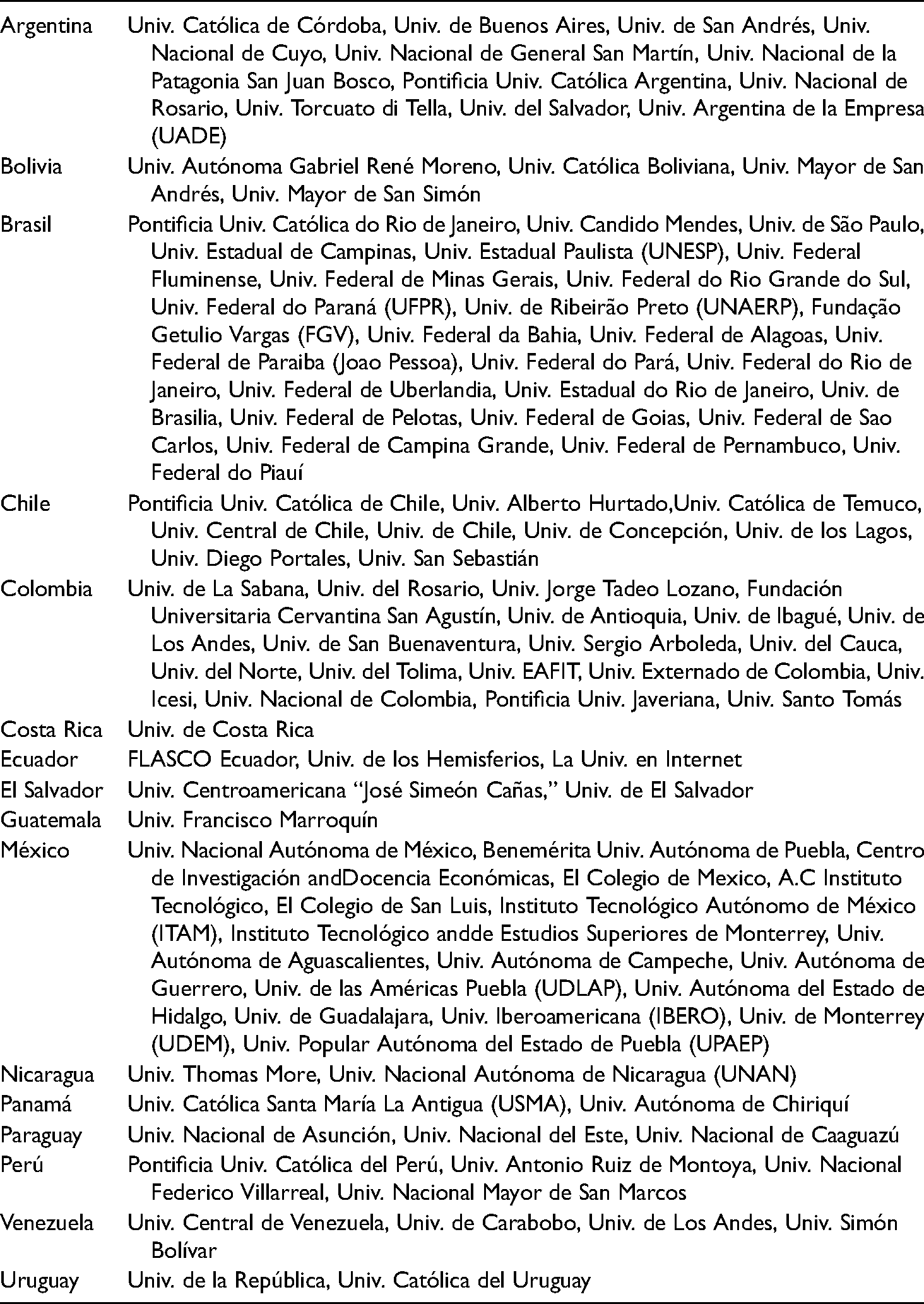
Appendix 1: Universities Included.
| Argentina | Univ. Católica de Córdoba, Univ. de Buenos Aires, Univ. de San Andrés, Univ. Nacional de Cuyo, Univ. Nacional de General San Martín, Univ. Nacional de la Patagonia San Juan Bosco, Pontificia Univ. Católica Argentina, Univ. Nacional de Rosario, Univ. Torcuato di Tella, Univ. del Salvador, Univ. Argentina de la Empresa (UADE) |
| Bolivia | Univ. Autónoma Gabriel René Moreno, Univ. Católica Boliviana, Univ. Mayor de San Andrés, Univ. Mayor de San Simón |
| Brasil | Pontificia Univ. Católica do Rio de Janeiro, Univ. Candido Mendes, Univ. de São Paulo, Univ. Estadual de Campinas, Univ. Estadual Paulista (UNESP), Univ. Federal Fluminense, Univ. Federal de Minas Gerais, Univ. Federal do Rio Grande do Sul, Univ. Federal do Paraná (UFPR), Univ. de Ribeirão Preto (UNAERP), Fundação Getulio Vargas (FGV), Univ. Federal da Bahia, Univ. Federal de Alagoas, Univ. Federal de Paraiba (Joao Pessoa), Univ. Federal do Pará, Univ. Federal do Rio de Janeiro, Univ. Federal de Uberlandia, Univ. Estadual do Rio de Janeiro, Univ. de Brasilia, Univ. Federal de Pelotas, Univ. Federal de Goias, Univ. Federal de Sao Carlos, Univ. Federal de Campina Grande, Univ. Federal de Pernambuco, Univ. Federal do Piauí |
| Chile | Pontificia Univ. Católica de Chile, Univ. Alberto Hurtado,Univ. Católica de Temuco, Univ. Central de Chile, Univ. de Chile, Univ. de Concepción, Univ. de los Lagos, Univ. Diego Portales, Univ. San Sebastián |
| Colombia | Univ. de La Sabana, Univ. del Rosario, Univ. Jorge Tadeo Lozano, Fundación Universitaria Cervantina San Agustín, Univ. de Antioquia, Univ. de Ibagué, Univ. de Los Andes, Univ. de San Buenaventura, Univ. Sergio Arboleda, Univ. del Cauca, Univ. del Norte, Univ. del Tolima, Univ. EAFIT, Univ. Externado de Colombia, Univ. Icesi, Univ. Nacional de Colombia, Pontificia Univ. Javeriana, Univ. Santo Tomás |
| Costa Rica | Univ. de Costa Rica |
| Ecuador | FLASCO Ecuador, Univ. de los Hemisferios, La Univ. en Internet |
| El Salvador | Univ. Centroamericana “José Simeón Cañas,” Univ. de El Salvador |
| Guatemala | Univ. Francisco Marroquín |
| México | Univ. Nacional Autónoma de México, Benemérita Univ. Autónoma de Puebla, Centro de Investigación andDocencia Económicas, El Colegio de Mexico, A.C Instituto Tecnológico, El Colegio de San Luis, Instituto Tecnológico Autónomo de México (ITAM), Instituto Tecnológico andde Estudios Superiores de Monterrey, Univ. Autónoma de Aguascalientes, Univ. Autónoma de Campeche, Univ. Autónoma de Guerrero, Univ. de las Américas Puebla (UDLAP), Univ. Autónoma del Estado de Hidalgo, Univ. de Guadalajara, Univ. Iberoamericana (IBERO), Univ. de Monterrey (UDEM), Univ. Popular Autónoma del Estado de Puebla (UPAEP) |
| Nicaragua | Univ. Thomas More, Univ. Nacional Autónoma de Nicaragua (UNAN) |
| Panamá | Univ. Católica Santa María La Antigua (USMA), Univ. Autónoma de Chiriquí |
| Paraguay | Univ. Nacional de Asunción, Univ. Nacional del Este, Univ. Nacional de Caaguazú |
| Perú | Pontificia Univ. Católica del Perú, Univ. Antonio Ruiz de Montoya, Univ. Nacional Federico Villarreal, Univ. Nacional Mayor de San Marcos |
| Venezuela | Univ. Central de Venezuela, Univ. de Carabobo, Univ. de Los Andes, Univ. Simón Bolívar |
| Uruguay | Univ. de la República, Univ. Católica del Uruguay |
Appendix 2: Academic Journals Included.
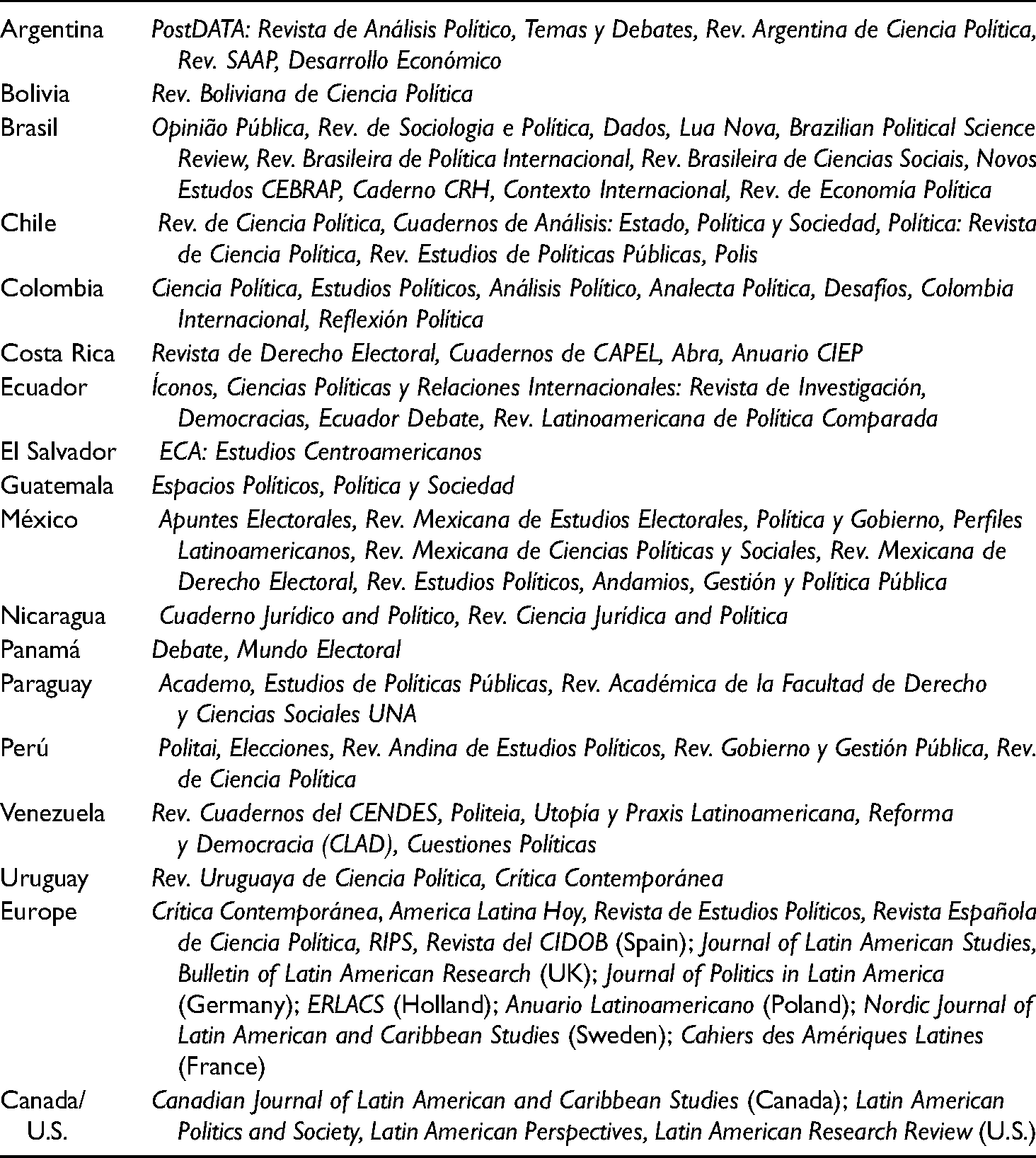
| Argentina | PostDATA: Revista de Análisis Político, Temas y Debates, Rev. Argentina de Ciencia Política, Rev. SAAP, Desarrollo Económico |
| Bolivia | Rev. Boliviana de Ciencia Política |
| Brasil | Opinião Pública, Rev. de Sociologia e Política, Dados, Lua Nova, Brazilian Political Science Review, Rev. Brasileira de Política Internacional, Rev. Brasileira de Ciencias Sociais, Novos Estudos CEBRAP, Caderno CRH, Contexto Internacional, Rev. de Economía Política |
| Chile | Rev. de Ciencia Política, Cuadernos de Análisis: Estado, Política y Sociedad, Política: Revista de Ciencia Política, Rev. Estudios de Políticas Públicas, Polis |
| Colombia | Ciencia Política, Estudios Políticos, Análisis Político, Analecta Política, Desafíos, Colombia Internacional, Reflexión Política |
| Costa Rica | Revista de Derecho Electoral, Cuadernos de CAPEL, Abra, Anuario CIEP |
| Ecuador | Íconos, Ciencias Políticas y Relaciones Internacionales: Revista de Investigación, Democracias, Ecuador Debate, Rev. Latinoamericana de Política Comparada |
| El Salvador | ECA: Estudios Centroamericanos |
| Guatemala | Espacios Políticos, Política y Sociedad |
| México | Apuntes Electorales, Rev. Mexicana de Estudios Electorales, Política y Gobierno, Perfiles Latinoamericanos, Rev. Mexicana de Ciencias Políticas y Sociales, Rev. Mexicana de Derecho Electoral, Rev. Estudios Políticos, Andamios, Gestión y Política Pública |
| Nicaragua | Cuaderno Jurídico and Político, Rev. Ciencia Jurídica and Política |
| Panamá | Debate, Mundo Electoral |
| Paraguay | Academo, Estudios de Políticas Públicas, Rev. Académica de la Facultad de Derecho y Ciencias Sociales UNA |
| Perú | Politai, Elecciones, Rev. Andina de Estudios Políticos, Rev. Gobierno y Gestión Pública, Rev. de Ciencia Política |
| Venezuela | Rev. Cuadernos del CENDES, Politeia, Utopía y Praxis Latinoamericana, Reforma y Democracia (CLAD), Cuestiones Políticas |
| Uruguay | Rev. Uruguaya de Ciencia Política, Crítica Contemporánea |
| Europe | Crítica Contemporánea, America Latina Hoy, Revista de Estudios Políticos, Revista Española de Ciencia Política, RIPS, Revista del CIDOB (Spain); Journal of Latin American Studies, Bulletin of Latin American Research (UK); Journal of Politics in Latin America (Germany); ERLACS (Holland); Anuario Latinoamericano (Poland); Nordic Journal of Latin American and Caribbean Studies (Sweden); Cahiers des Amériques Latines (France) |
| Canada/U.S. | Canadian Journal of Latin American and Caribbean Studies (Canada); Latin American Politics and Society, Latin American Perspectives, Latin American Research Review (U.S.) |