




Abstract
Are presidential democracies inherently unstable and prone to breakdown? Recent work on Latin America suggests that the region has seen the emergence of a new kind of instability, where individual presidents do not manage to stay in office to the end of their terms, but the regime itself continues. This article places the Latin American experiences in a global context, and finds that the Latin American literature helps to predict the fates of presidents in other regions. The first stage of a selection model shows that presidents who are personally corrupt and preside over economic decline in contexts where democracy is paired with lower levels of GDP/capita are more likely to face challenges to their remaining in office for their entire terms. For the challenged presidents in this set, the risk of early termination increases when they use lethal force against their challengers, but decreases if they are corrupt. These factors help account for the disproportionately large number of South American presidents who have actually been forced from office, the “South American anomaly” of the title.
Introduction
Are presidential democracies inherently unstable and prone to breakdown? 1 Since Juan Linz first made this claim (1978: 71-74), a generation of scholars has amassed a great deal of conflicting evidence on whether democratic breakdown is in fact more frequent in presidential than parliamentary systems. Observers of Latin America have recently noted the emergence of an additional kind of instability in that region: a large number of presidents are not “surviving” to the end of their constitutionally “fixed” terms, even as democratic regimes continue (Hochstetler 2006; Negretto 2006; Pérez-Liñán 2003; Pérez-Liñán 2007; Samuels 2007; Valenzuela 2004). Most previous research on presidential failures beyond Latin America has been limited to case studies (e.g., Baumgartner and Kada 2003; Fukuyama, Dressel, and Chang 2005; Lee 2005). This study joins just one other (Kim and Bahry 2008) in extending systematic analysis of presidential failure outside the region, asking whether the causes that Latin Americanists have identified help to explain outcomes in other presidential systems as well. We argue that these questions should be evaluated through a selection model that first considers why various actors might try to remove a president from office early, before examining the smaller set of presidents who are actually forced out. We conclude that the true South American anomaly is that presidencies in this region generally display more of the risk factors that lead to abbreviated presidencies. However, regional variation appears in both the propensity to challenge presidents and in the likelihood of their failure, suggesting further work is necessary to understand this phenomenon in a global context.
We would like to thank Jorge Gordin, Wendy Hansen, Leiv Marsteintredet, Andrew Schrank, and two anonymous reviewers for helpful comments, while absolving them of all responsibility for any remaining errors.
A Brief Empirical Overview
Table 1 shows that between 1978 and 2005, 33 democratically elected presidents around the world faced challenges to their remaining in office for their full institutional terms. Challenges – attempts by civilian actors to remove presidents from office early – occurred in presidential regimes around the world. The table identifies the country and year of each challenge, including whether the challenge was made through legislative removal processes, street protests demanding the president leave office early, or both together. Some authors have chosen to focus primarily on the legislative removal process of impeachment (e.g., Baumgartner and Kada 2003; Pérez-Liñán 2007), but we agree with others that the various kinds of challenges and failures are more similar than not (Hochstetler 2006; Negretto 2005; Pérez-Liñán 2007, chapter 7). As Table 1 shows, challenges often take place in the street and legislature simultaneously, and the stories of particular challenges indicate that these are frequently complementary processes that arise out of similar causal sequences.
Civilian Challenges to Elected Presidents, 1978-2005
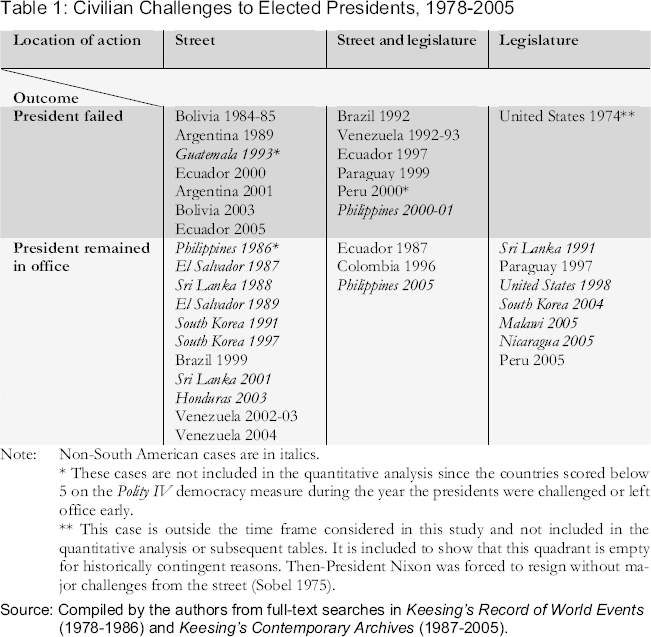
Note: Non-South American cases are in italics.
These cases are not included in the quantitative analysis since the countries scored below 5 on the Polity IV democracy measure during the year the presidents were challenged or left office early.
This case is outside the time frame considered in this study and not included in the quantitative analysis or subsequent tables. It is included to show that this quadrant is empty for historically contingent reasons. Then-President Nixon was forced to resign without major challenges from the street (Sobel 1975).
Source: Compiled by the authors from full-text searches in Keesing's Record of World Events (1978-1986) and Keesing's Contemporary Archives (1987-2005).
Many authors do not single out the challenge stage as a separate stage, but there are both methodological and theoretical reasons to do so. Methodologically, ignoring challenges means that studies typically examine only successful efforts to remove presidents, thus selecting on the dependent variable (Geddes 2003; Hochstetler 2006). Identifying all cases of challenges focuses analysis on the failed efforts as well and aids in understanding why a subset of challenged presidents is actually removed. Theoretically, there should be somewhat different causes of challenge and failure, since each involves different actors. Efforts to remove presidents institutionally can usually be launched primarily by lower houses of bicameral legislatures or unicameral legislatures, while street based challenges are typically led by social movements and the subset of opposition parties with linkages to them. Unless these actors put presidential removal on the open political agenda, the actors with the ability to constitutionally remove presidents – presidents themselves who can resign, or upper houses or more rarely courts who can actually vote to remove presidents – will not (presidents) or cannot (upper houses, courts) themselves act. Challenges were especially common in the South American region, which had more challenged presidents than the rest of the presidential regimes combined (see Table 2).
Challenges and Failures in Presidential Regimes, 1978-2005
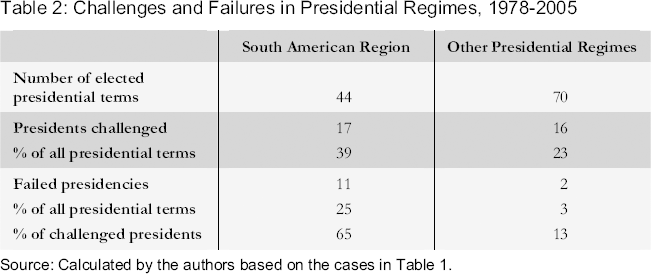
Source: Calculated by the authors based on the cases in Table 1.
A total of 13 presidents eventually saw their administrations terminated early in some way, generally through resignations or congressional removals, as just outlined. 2 We call these presidential failures, since they are all deviations from the institutionally rigid terms of presidentialism. As with challenges, we argue for treating all failures together, contending that they are not as different in practice as they are sometimes conceived to be in theory. That is, many procedures to remove presidents that take place in the legislature skirt unconstitutionality, and the difference between one mechanism and the other is often a matter of timing and politics. To cite one particularly colorful example, the Peruvian legislature chose to ignore the resignation then-President Fujimori faxed from Japan in 2000, and removed him through a vote of “moral incapacity.”
This number excludes several who died in office or stepped down for reasons of serious illness. Presidents who were not democratically elected, including the unelected presidents who succeeded failed presidents, are excluded from the analysis altogether. Several of them were challenged and failed as well. In addition, after consulting with several country experts, we do not include the constitutionally shortened presidential term of Balaguer (1994-1996) in the Dominican Republic as a failed presidency.
The failure rates are again especially high for the South American region, where 25 percent of all presidents and 65 percent of the challenged ones failed to finish their terms. These numbers contrast sharply with the much lower 3 percent of presidents outside of South America who failed to finish their terms (one in Central America, one in Asia), and the lower failure rate (13 percent) even among those presidents who were challenged. Stated bluntly, South American presidents must enter their presidencies understanding that many of their counterparts have not been able to govern through their full terms, despite the institutional rules meant to guarantee that outcome. In contrast, presidents outside the region face quite low failure rates, even when various civilian actors try to force them out before term's end – the South American anomaly of our title.
This article seeks to make sense of these similarities and differences in presidential failure rates in different global regions. In particular, it examines institutional, economic, corruption, and protest data to see if the factors identified as causally important in the Latin American cases can help to explain outcomes for presidents in the larger set of presidential regimes. This project is consistent with the recent call for studies that take the possibility of cross-regional causal heterogeneity seriously (Mainwaring and Pérez-Liñán 2007), and provides some support for that claim.
Presidentialism, Instability, and Explanations of Failed Presidencies
A series of essays by Juan Linz (1978; 1990; 1994) set the stage for a generation's scholarship on the possible perils of presidentialism. Linz argued that the simple institutional choice of a presidential regime caused a series of regime stability problems. He singled out the separate popular selection and survival of executives and legislatures, the defining feature of institutional presidentialism, as especially important for generating regime breakdown. With both institutions able to claim democratic legitimacy, Linz argued that no democratic principle can resolve deadlocked conflicts among them, and the military would eventually do so (1994: 6). Linz also contrasted the rigid length of presidential terms with the flexibility of parliamentarism as another cause of breakdown (ibid: 9-10). This means that presidents continue in office even when they have lost legislative support; it also means that electoral losers are locked out for long periods of time. These and other features of presidentialism led Linz to conclude that such regimes were more prone to breakdown than parliamentary democracies.
Linz's claims have been subjected to extensive empirical investigation and the results are much more complex than can be treated here in any detail (for overviews, see Cheibub 2007; Elgie 2005; Power and Gasiorowski 1997). With just a few confirmatory exceptions (e.g., Stepan and Skach 1993), these studies have concluded that Linz's expectations are not supported empirically. Some have concurred with the overall outlines of Linz's argument that presidentialism is more inclined to breakdown, but find no evidence that the causal pathways he proposes lead to that outcome (Cheibub 2007; Cheibub and Limongi 2002). Others have argued that other variables such as the party and electoral systems, levels of development, or the exact powers of presidents and legislatures need to be considered as well – or instead of – regime type (e.g., Mainwaring 1993; Power and Gasiorowski 1997; Shugart and Carey 1992; Tsebelis 2002). Despite this body of evidence, many scholars continue to express not just the belief that the choice of presidential versus parliamentary regime types will affect regime stability, but also that the choice of presidentialism is a problematic one (Cheibub 2007: 4-5).
This article cuts into the debate from another angle. Most importantly, we refocus attention on the nature of the purported consequence of presidentialism: instability. There is no question that Linz conceives of presidentialism's likely instability in terms of regime breakdown, and the transition from democracy to dictatorship in particular. He uses the language of breakdown throughout his work and considers the military to be the likely mediator of legislative-presidential conflict. All of the empirical studies of the previous paragraph also conceptualize instability as regime breakdown. Linz even explicitly rejects the likelihood of the forms of presidential failure that are the focus of this paper: in his view, impeachment is too difficult to use, presidents are unlikely to resign voluntarily, and publics will not allow the presidents they elect to leave office (Linz 1994: 10).
Against Linz's expectations, Mainwaring and Pérez-Liñán document a sea change in Latin American politics around the year 1978. Before then, regime breakdowns were common in this region of presidential states, while after 1978 they “virtually ceased to occur” (Mainwaring and Pérez-Liñán 2005: 20). We agree with them that the years since 1978 have seen the emergence of “a new pattern of instability” in the region (ibid: 49; see also Pérez-Liñán 2007), led by legislators and civilian protesters rather than the military and characterized by the early exit of elected presidents within continuing democratic regimes.
As a kind of instability, presidential failure bears significant similarities to the phenomenon of government survival and termination in parliamentarism. It is also a change of government without a change of regime, and thus carries less of the inherently undemocratic implications of democratic breakdown. On the other hand, it cannot be directly compared to parliamentarism, as executive exit before the end of the term is a normal and institutionalized option in parliamentarism while it is a deviation from institutional rules in presidentialism. In any case, it seems important to establish whether this is a development exclusive to the Latin American region or characteristic of presidential regimes in some general but unanticipated way, before moving on to cross-regime comparisons.
What the literature on parliamentary government termination can best contribute at this time is a framework for considering the rather disparate elements Latin Americanists have used to explain presidential failure. For some time, scholars of parliamentarism have conceived of the explanatory alternatives as “events vs. institutions” (see especially Warwick 1994; also Browne, Frendreis, and Gleiber 1984; Strom 1988). In other words, one school spotlights the institutional variables of parliamentary democracy itself to explain when and why governments end, while the other sees government termination as responsive to events that are exogenous to the nature of the institutions. Some consider both, and this is now the starting point of such empirical studies (e.g., King et al. 1990; Warwick 1994). We also consider both here. An additional way of understanding this distinction is that institutional variables affect the capacity of various actors to move against presidents, while events affect their level of motivation to do so.
Institutional variables have played a prominent role in explanations of presidential failure in Latin America. By far and away the most common is the question of whether the president's party (or sometimes party coalition) controls the legislature. The minority or majority status of the president preoccupies all of the major works so far that try to explain presidential failure (Hochstetler 2006; Kim and Bahry 2008; Negretto 2006; Pérez-Liñán 2003; Pérez-Liñán 2007; Samuels 2007; Valenzuela 2004). Presidentialism and possible challenges to presidents are related to minority status both directly and indirectly. Directly, presidents and legislatures are actually elected in separate elections in presidentialism, sometimes concurrently and sometimes not. Voters may usually freely choose to cast their ballots for different parties. These features of elections in presidentialism make it more likely that presidents will find themselves without a majority in the legislature. Prime ministers, selected by parliaments, more commonly have majority legislative support. In general, these expectations are born out empirically, although there are more minority prime ministers than is often expected (Cheibub 2007).
This feature becomes a factor in challenges in that the executive and legislature in presidentialism do not formally rely on the other for their survival once in office. This is seen to reduce their incentives to form coalitions across parties, to cooperate in more general terms, and to sustain party discipline. Since presidentialism lacks this “majoritarian imperative,” minority governments are not only expected to be more likely, but they are also expected to face more conflictual relations with their congresses. For Linz, this meant breakdown was more likely in presidentialism, and a similar logic underlies the expected role of minority government in presidential failures (Cheibub 2007; Kim and Bahry 2008; Linz 1994; Samuels 2007). It should be noted that Cheibub and his collaborators have regularly found that minority government is not related to regime breakdown (Cheibub 2007), but as Negretto (2006) points out (and finds), it may still be relevant for the less disruptive presidential failure.
What we add to this discussion is the observation that since challenges and failures typically are the purview of different bodies, minority/majority status in the relevant body should be assessed. For example, the most common arrangement in bicameral legislatures gives the lower house the right to impeach, while the upper house actually tries and potentially removes the president. In unicameral legislatures, the legislature may perform both functions, or may only impeach, while a court of some kind tries the president (Kada 2003). Each relevant body will contribute separately to the likelihood that a legislature might be able to move against a president. The level of partisan support thus affects the capacity of a president's opponents to move against him or her using the standard institutions of constitutional democracy. When the president's opponents form a partisan majority in the body enabled to impeach, the president faces increased risks of not completing his or her term, which are magnified when the president lacks a majority in the removal body as well.
Other institutional variables might be included in future studies and, indeed, Kim and Bahry (2008) consider a fuller array. Many of their institutional variables find only limited empirical support, however, and only the level of partisan support is widely accepted in the theoretical literature. Therefore we limit ourselves to this factor here, while including the level of democracy as a control variable (discussed below) that may account for other unspecified institutional variations.
Several scholars of presidentialism have begun to identify social protest as an additional kind of challenge potentially shortening the fates of presidents in Latin America (Hochstetler 2006; Kim and Bahry 2008; Mainwaring and Pérez-Liñán 2005; Pérez-Liñán 2007). Most of them have focused on mass protests specifically aimed at driving presidents from power, and Hochstetler concludes that no efforts to remove presidents early have succeeded without such protests, a conclusion supported by the nearly empty upper-right quadrant of Table 1 in this study as well. We relegate such antipresident protests to the dependent variable side of our equations. This is because we conceptualize protests that specifically ask the president to leave as challenges to the president.
On the other hand, we argue that it is important to consider a history of other kinds of contention (protests and strikes) as a factor that might enable such large president-challenging protests, in order to explain when and how such challenges happen. With social movements scholars have long seen that there is a gap between real and/or perceived grievances and mobilizations about them (Eckstein 1989). Thus presidential corruption or poor economic conditions are not expected to lead directly to challenges from the street. 3 The gap between grievance and mobilization is filled – or not – by a variety of mobilizational and cultural resources that include the presence of existing organizations or social networks, leaders who can articulate compelling arguments about the need and usefulness of protest, elite allies, and so on. The net result is that new mobilizations of any kind, including a challenge to a president, are much more likely to emerge where there are already networks, repertoires, and success stories of protest. Known as “mobilizing structures,” these are a standard part of the explanation for social movement emergence and success (McAdam, McCarthy, and Zald 1996). High levels of social contestation even when not directed against a president are also likely to contribute to a sense that a president has lost control of the political situation and is unable to govern. Moving beyond perceptions, social contestation may in fact prevent normal political and economic activities, especially when protesters use strategies like general strikes, road blockages, and occupations of government buildings. Such ungovernability, perceived and real, may motivate either legislatures or protesters or both to subsequently challenge the president's very continuation in office.
Our measure of protest is not strongly correlated with any of the other factors potentially explaining challenges and presidential failure, including economic performance and corruption/scandal data, which might be expected to generate protest.
In addition to these factors that affect the capacity of other political actors to move against presidents, “events” or historical developments may drive the challenges and failures of presidents. These event factors operate by providing political actors with the motivations to challenge presidents’ completion of their terms. One such potential development may link social contention to failure through the ways presidents respond to it. Hochstetler (2006: 411) found that many South American presidents chose to respond to street-based challenges with extensive repressive force. Virtually all of these presidents were eventually forced from office, as the sight of security forces killing unarmed opponents itself became a new source of illegitimacy for their administrations. Protesters’ resolve was typically increased rather than decreased by repression, and mobilizations often grew larger and more inclusive after the crackdown. International actors weighed in in several especially violent cases, as when the Argentine and Brazilian Presidents pressured Bolivian president Sanchez de Lozada to step down in 2003 after his security forces caused dozens of deaths. Thus when presidents try to protect their presidencies at all costs, this paradoxically becomes a risk factor likely to shorten their terms.
In addition, Latin Americanists have pointed to the president's involvement in scandalous actions, especially corruption, as a pervasive exogenous reason for presidential failure (Hochstetler 2006; Pérez-Liñán 2007; see also Kim and Bahry 2008). This kind of event is actually anticipated and included in most legal justifications for impeachment, an institutional process to address a non-institutional behavior. A cross-regional study of impeachments also found that
most successful impeachment attempts are accompanied by a fair amount of public and elite outrage surrounding allegations of presidential wrongdoing; in simple terms, the greater the degree of outrage, the more seriously the legislature is forced to consider it (Baumgartner 2003: 14).
We would add that a similar logic can lead to street-based efforts to remove presidents as well, especially when legislatures hesitate to act.
Economic variables are also addressed as regime-exogenous event variables in several of the past analyses of Latin American presidential failure, in varied form. Hochstetler (2006) and Pérez-Liñán (2007) use an index of neoliberal policy orientation and find it has a small impact on the likelihood of both challenges and failures. Various economic outcome variables – rates of growth, inflation, and unemployment – prove to be partial predictors of regime breakdown (Mainwaring and Pérez-Liñán 2005: 34-37) and presidential failure (Kim and Bahry 2008; Pérez-Liñán 2007). The logic behind all of these proposals is the same: presidential terms may end early because presidents pursue economic policies that are unpopular and/or ineffective. Similar processes also are commonly implicated in the failure of parliamentary governments.
The presidential regimes of the world present a rather daunting array of additional characteristics, ranging as they do from the advanced postindustrial long-term democracy of the United States to countries like Malawi where both democracy and development are much more precarious and recent achievements. Therefore, we include a pair of controls that account for some of the variation among our cases even though they have not usually been identified as directly causal variables for understanding presidential failure. They are especially important as we extend the study of presidential failure beyond the comparatively more homogenous Latin American region.
There is only one truly long-standing presidential democracy, the United States. Presidential regimes historically have had shorter durations than have parliamentary regimes and many of the current presidential regimes are still consolidating their democracies and perhaps even slipping in democratic quality (Cheibub 2007; Mainwaring and Pérez-Liñán 2005). Therefore we consider several measures of the quality and duration of democracy as a background consideration or set of control variables, but it stands to reason that they could be more directly causal. Weaker democracies might well be less able to manage political conflict and thus exhibit greater instability, including in the form of the presidential failures of interest here. In contrast, higher levels of democracy should push all of the actors involved in challenges and failures to playing within the fully constitutional rules of the game, rather than cutting institutional corners in the different ways they do in the “new instability.”
Our second control is the level of socioeconomic development. The relationship between socioeconomic development and democracy is, of course, a long standing theoretical and empirical debate within comparative politics. While we do not intend to enter directly into this debate, we will control for the possible effect of the level of modernization.
Each of these variables has been shown to be significant in explaining presidential challenge and/or failure in at least one study of Latin or South America. We use them here as a starting point for assessing the causes of presidential failure in global presidentialism. In general terms, significant results for the institutional factors would indicate greater problems in presidential regimes themselves. If the event variables are the most important, these would point to non-institutional variations across the regions as the origin of the evident differences in regional rates of presidential failure. Finally, if none of the proposed causes are significantly related to presidential failure in this study of global presidentialism, we will conclude that our understanding of presidential failure has been in some way biased by too much emphasis on the empirics of the Latin American cases, a charge that has been levied at Linz himself (Horowitz 1990).
Hypotheses and Data
This study aims to understand why some democratically elected presidents are forced out of office before the end of their constitutionally determined terms, a presidential failure. We examine processes of challenge and failure in 25 presidential regimes from around the world since 1978, when this new pattern of presidential rather than regime instability appears to have begun in Latin America (Mainwaring and Pérez-Liñán 2005: 20). 4 We focus on processes of presidential failure that do not breach civilian democratic government, so all the cases we consider in the statistical analysis are rated at least a +5 in the Polity IV index of democracy in the year that a presidential challenge or failure takes place. In addition, the primary actors must be civilian, and the successor must be a civilian in the constitutional line of succession or otherwise selected by the legislature. Presidential failure as we conceive it takes place within a continuing democratic regime.
Of the 25 democratic regimes analyzed here and called presidential 23 are in Siaroff's Categories 2 and 6 (Siaroff 2003), which have popularly elected heads of state and government, not accountable to the legislature. Our initial universe of cases of democratic presidentialism and their time periods were identified by this work. The remaining two regimes are Bolivia and Peru, which have some constitutional features of other regime types, but are commonly considered to be and act as presidential regimes. Four presidential regimes with less than one million people (Cyprus, Guyana, Palau, and the Seychelles) are excluded from the analysis, as are three with very short periods of democratic presidentialism (Ghana, Indonesia, and Nigeria).
We are also interested in identifying and analyzing all challenges, efforts by such actors to remove presidents that may succeed or fail. While actual failures have drawn the most academic and media attention, the mere effort to force a president from office, even if unsuccessful, is methodologically and theoretically important for the reasons discussed above. To briefly recap, we argue that presidential failure is a two-stage process that involves different actors at each stage with different capacities and incentives to seek to shorten presidential terms. Every president who fails must have been challenged, but not all challenged presidents fail. To study only the failed presidents loses valuable information about this two-stage process. In contrast, identifying all challenges first allows us to see if those who were subsequently actually forced out disproportionately shared risk factors that those who remained – despite challenge – did not. This provides a fuller understanding of what causes failed presidencies. We identified the universe of challenges with full-text electronic searches of Keesing's Record of World Events (1978-86) and Keesing's Contemporary Archives (1987-2005).
Each of these dependent variables is assessed through analyses with dichotomous outcome codings of no challenge/challenge and no failure/failure. We could have used a simple probit regression model to evaluate challenge, but not failure outcomes – since the failure outcome is dependent on a previous positive outcome for challenge. We therefore use the two-equation Heckman probit model, which is a probit regression with selection, to estimate the fit of our equations (Greene 1993; Stolzenberg and Relles 1997). 5 The Heckman probit model uses information about unchallenged presidents to improve the estimates of the parameters in the failure regression model. The use of this model prevents the underestimation of explanatory effects that would occur with a model that drew on the full set of president-years 6 to explain failed presidencies (e.g., Kim and Bahry 2008), while also preventing the overestimation of explanatory effects that would occur if we modeled only the challenge years without nesting them in the previous analysis of the causes of challenge. The full estimation sample for the challenge equation is 470 president-years, while the model for failure includes only the 39 country-years when challenges took place. 7 Our two-equation model also includes independent variables that operationalize each of the arguments introduced above, using three institutional variables, one variable that measures mobilizing capacity, four event variables, and four control variables (described individually below). A correlation matrix of our independent variables showed very low levels of correlation between most variables, except among the control variables and between the levels of presidential partisan support in the bodies that carry out impeachment and trial. 8
The Stata10 command for this model is heckprob. The Heckman models generally, and their probit variants in particular, can be difficult to use and can even increase the sampling bias they are meant to correct (Stolzenberg and Relles 1997). Some of the problems can be ameliorated with analytical techniques such as specifying exclusion restrictions or using modern statistical software (Bushway, Johnson, and Slocum 2007). However, the standard software programs for the probit version, including the Stata version we used, have significant numerical and convergence problems that cannot be easily addressed by the user (Freedman and Sekhon 2008). Despite these many drawbacks, there is no obvious estimation alternative, especially given the dichotomous dependent variables.
For the most part, these are simple country-years. Two years appear twice among the observations because a failed elected president was replaced by another elected, but unchallenged president.
Because we include regional dummies and some of the regions have very small numbers of failures that may cause them to be excluded from the analysis by the statistical software, the actual number of observations used by the Heckman probit models varies from model to model.
The latter is not surprising, as the levels of partisan support reflect at least partially overlapping electoral cycles or may even be identical, as when a unicameral legislature both impeaches and tries. The correlations are not a problem for the analyses, since no more than one of the inter-correlated variables is ever entered in each equation of the Heckman two-equation model.
In order to avoid actually increasing the standard errors, the Heckman approach almost always requires exclusion restrictions, “variables that affect the selection process but not the substantive equation of interest” (Bushway, Johnson, and Slocum 2007: 153; see also Stolzenberg and Relles 1997). We achieve this by specifying an initial equation for challenge that focuses on variables that indicate that lower houses and potential street challengers will be able to act against presidents, while these are replaced in the equation for failures by variables that now address the calculations of upper houses and presidents. In addition, the primary models of challenges to presidents include the full set of possible conditions – economic, presidential corruption, and so on – that might motivate potential challengers to move against presidents, while the equations for removal include only the motivations that might justify removal for the reasons typically included in constitutions, notably corruption and the use of excessive force that results in deaths of anti-presidential protesters. 9
Logically, capacity and motivation to move against presidents presumably causally interact. That is, even very high levels of motivation to challenge a president will not lead to challenges unless there is also capacity to do so. We thank an anonymous reviewer for making this point. We were not able to directly test interactive variables in this analysis given other limits from the estimation techniques. In our results below, however, the capacity variables were in fact virtually never significant, meaning high levels of motivation effectively drove our results on their own. This is clearly a topic for further investigation.
Model 1 presents the results of this basic analysis for all kinds of challenges to presidents. Model 2 examines just the subset of street-based challenges, which may happen on their own or at the same time as congressional challenges (too few congressional challenges occurred to carry out a similar analysis for that subset of challenges). The equations also include regional dummies and specify robust standard errors clustered by country. We tested a number of additional model and error specifications and alternate measures, but do not have space to reproduce them all here. In our discussion of the results, we note where there were substantively important differences in the results of these alternative specifications and measures.
Turning to the specific independent variables, the first is the minority/majority status of the president in the legislature. All scholars of presidential failure share the same basic hypothesis about this status: a majority president whose party or party coalition controls the legislature is more likely to remain in office for his or her full term. Majority status is likely to protect presidents from challenges that arise in the legislature and from conclusive legislative removal votes, since legislators will hesitate to take down a co-partisan and presumed party leader – although majority status cannot protect presidents from challenges that arise in the streets. There is less agreement on how to operationalize majority status. In the results reported below, we report those of a stringent version, a dichotomous measure that labels a president a majority president only when his or her party has a majority in the relevant house of congress. Negretto (2005: 85) found that a measure of majority coalition status was positively associated with presidential survival in Latin America while simple majority presidents were not. We do not have coalition data for all global presidential regimes, but would also argue theoretically that challenges and removals might well be expected to split legislative coalitions, especially if leaders of coalition parties are in the constitutional line of succession. We take our data on legislative results from electronic and online sources listed in the Data Sources section of the bibliography.
In assigning values for levels of partisan support for presidents, we pay careful attention to the exact institution allowed to act at each stage. 10 The vast majority of the countries follow one of two modal patterns. Most of the bicameral legislatures (11 cases) give the lower house the capacity to impeach a president while the upper house actually decides whether or not the president should be removed, and so the president's partisan support in the lower house forms the relevant value in the selection (challenge) equation while the partisan support in the upper house is the relevant value in the outcome (failure) equation. Countries with unicameral legislatures either give the legislature the capacity to both impeach and judge (six cases – same value in both equations) or the legislature impeaches while a court determines removal (eight cases). In the latter arrangement, we continue to include data on the president's level of support in the legislature in the failure equation (since these bodies can usually still remove presidents for reasons such as incapacity) and code a dummy “court” variable as 1 for the presence of the court as an actor. This is not a fully satisfactory solution, but there is only one example among all the challenges – South Korea in 2004 – where a court actually has ruled on an impeachment trial. In that case, it retained a popular president who had been impeached by an opposition Congress. 11
Coding information on most cases comes from Kada (2003: 139-143), while that of Malawi and Namibia is based on Hatchard, Ndalo, and Slinn (2004: 88-89). The Venezuelan arrangements after the 1999 constitutional revisions were determined by reading its constitution (pdba.georgetown.edu/Constitutions/Venezuela/Ven1999.html, accessed January 4, 2009). Interestingly, this constitution removed the right of impeachment from the Congress altogether, and gave the population the right to remove the president by national referendum instead, the only such case in our dataset. Perhaps through an oversight, the Supreme Judicial Tribunal retains the right to rule on the appropriateness of presidential impeachment, and the unicameral legislature retains the capacity to vote the president out of office for abandoning his or her office or being incapacitated.
In this rather interesting case, mass mobilizations supported rather than targeted the president, and subsequent midterm elections brought the president's party to a majority position in the National Congress – actually, even before the court ruled in his favor. This case offers strong support for the argument that popular opinion and mobilization can be decisive in the fates of presidents, shielding as well as threatening them and even overruling legislative preferences.
The variable that evaluates the capacity of societal actors to mount a street-based challenge to a president departs from the observation that high levels of general contentiousness in society, marked by frequent large protests and general strikes, indicate a strong infrastructure of contention. This provides a foundation for directly generating street based challenges to presidents, which can draw on existing mobilization networks and repertoires of action. In addition, it can also support or spur legislative challenges, as legislatures worry about whether popular movements will turn on them for inaction. For a measure of social contention, we returned to full-text searches of the Keesing's reports. These monthly reports capture only the very largest and/or most contentious protest events. However because these depend in turn on networks built in many smaller protests, they capture overall levels of contentiousness. Counts from national newspapers would be ideal, but given the geographically far-flung character of presidential regimes, the Keesing's reports have the virtue of more-comprehensive and consistent cross-regional coverage than any other single source of event data. We use an annual count of reported contentious events in the equation for challenge. We subtracted protest events that were actual challenges to presidents from the total event count, so as not to conflate dependent (street-based challenge) and independent (generalized contention) variables.
For understanding the role of contention in failures, we turn our attention from the actions of protesters themselves to the policing choices of presidents who face street-based challenges. This is a dichotomous variable coded 1 if challenges to the president result in protester or other opposition deaths caused by government security forces. Challenger deaths should be associated with a greater likelihood of presidential failure, as these deaths rally opposition forces of all kinds and undermine presidential legitimacy very directly. 12 Information on challenger deaths also was taken from the Keesing's reports.
The case of South Korea presented an interesting coding challenge, as numerous protesters died – but through self-immolation or other forms of suicide. Since this was a protester rather than policing choice and thus less likely to undermine presidential legitimacy, we did not code these as challenges with deaths.
The president's personal involvement in corruption or other forms of scandal is an obvious risk factor for completing his or her institutional term. Such involvement should be positively associated with both challenges and failures. In most countries, it both spurs rejection by populations and is a constitutional justification for impeachment and legal removal. The importance of corruption or scandal is matched only by the difficulty of identifying when it occurs. We looked in the Lexus-Nexus database for published reports of corruption or scandal that was linked to the president by name, using regional and international news sources. Such reports had to indicate actual evidence of the president's personal involvement, direct responsibility (like presidential campaign funds), or active sheltering of administration and family members accused of corruption. 13 Whether such published reports were true is far beyond our ability to judge, in much the same way that it is for domestic actors who must decide whether to challenge and remove a president based on often incomplete information.
This makes our coding of corruption somewhat stricter than the coding used by Kim and Bahry (2008), as we do not count corruption as present when allegations are made without some supporting evidence.
The final set of event variables are related to economic performance, and there are numerous possible measures of economic outcomes. (Annual data on the broader choice of economic model, e.g., degree of economic liberalization, as well as unemployment figures are not readily available for this set of global cases, especially for the African countries.) We used standard measures of economic performance (Kim and Bahry 2008; Pérez-Liñán 2007), the log of the annual change in the inflation rate and the annual change in the Gross Domestic Product (GDP) (World Development Indicators). In all cases, we expect the inflation figures to be positively associated with challenge and failure and the GDP figures to show a negative association.
Several control variables take account of additional potential sources of variation among our countries. We include a control variable for level of socioeconomic modernization, taking the log of the GDP per capita (World Development Indicators). We are concerned with presidential challenges and failure in democracies. Therefore we exclude all country-years from our dataset where the level of democracy is less than +5 on the Polity IV scale. This standard continuous measure of democracy ranks countries on the basis of largely institutional factors from −10 (fully authoritarian) to +10 (fully democratic). Our cases still vary from +5 to +10 in their level of democracy. We expect that more fully democratic countries will display fewer challenges and failures, as there will be better operating systems of controls on individuals and more effective mechanisms for making policies and channeling demands before they reach the crisis levels implied in a challenge to a president and his or her failure. Higher levels of democracy are disabling with respect to challenges, by encouraging presidents, legislatures, and protesters to avoid many behaviors that would lead to them. The Polity value of democracy we use is lagged by one year, as current year measures may reflect the occurrence of challenge and failure.
The institutional dimensions of the Polity index seem to be the best fit to our understanding of the possible impact of levels of democracy on challenge and failure, but we experimented with additional measures of democratic quality and duration. We include a perceptual measure of democratic accountability in our failure equations, on the logic that the response to a challenge – especially from the streets – is likely to be related to the general responsiveness to popular preferences. This measure is a 6-point scale generated through the PRS Group's International Country Risk Guide (PRS Group 2006). Other measures of democracy, such as the stock of democracy or the number of years since a country dipped below level 5 on the Polity scale, either were highly correlated with the variables reported here or proved to have no measurable causal effect.
Finally, one of the premises of this article is that there may be a regional effect on presidential failure rates. South America may be an anomalous region with unusually high rates of both challenge and failure for reasons that we have not identified here. To directly evaluate this, we run the equations with dummy variables representing five major geographical regions where presidential regimes are found: South America, Central America and Mexico, the United States, Africa, and Asia. We omit the South American dummy variable in the analysis, so the regional results from these models indicate whether that region is significantly different from the South American region.
Results and Discussion
As Table 3 shows, charges of the president's personal involvement in corruption or other scandals are strongly significant and positive in the first equation of this two-stage model, which identifies which presidents are likely to face challenges to remaining in office for their full terms. This result was highly robust, appearing in virtually every specification of the model. Corruption is also significant in the second stage of the models reported, which distinguish between those presidents who do and do not survive a challenge. Counter-intuitively, such presidents are less likely to actually fail, but the significance of this effect was much less robust to alternative model specifications.
Institutions, Events, and Presidential Fates, 1978-2005
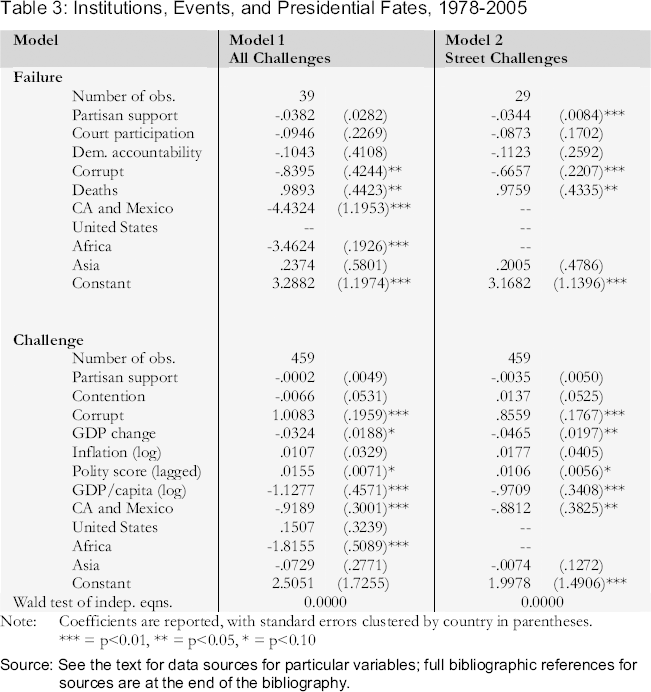
Note: Coefficients are reported, with standard errors clustered by country in parentheses.
= p<0.01
= p<0.05
= p<0.10
Source: See the text for data sources for particular variables; full bibliographic references for sources are at the end of the bibliography.
The two control variables, the Polity IV democracy score for the country and the national GDP/capita, were also consistently associated with challenges to presidents. Wealthier countries are significantly less likely to have presidents who face challenges to their remaining in office for their full terms, an unsurprising conclusion as wealth is often associated with greater stability. On the other hand, the sign on the Polity IV score is positive, counter to our expectations. We had suggested that institutionalized democracy would be less likely to experience challenges, but the higher levels of democracy may instead make potential challengers more confident that they can challenge a president without endangering a democratic regime – or there might be other explanations that would emerge with further research on this issue.
As the rate of growth of the GDP increases, the likelihood of challenges to presidents drops. This relationship is strongly significant for challenges that arise from the streets but only weakly significant for all challenges, indicating that protesters are more likely to target presidents for their economic performance than are legislatures. Inflation is not significant in any of the models. Alternative specifications also tested the assumption that the economic variables should only be a part of the first selection model for challenges, placing the GDP growth and inflation variables in the failure equation as well. However, they were never significant.
Interestingly, the two variables intended to measure the capacity of different actors to mount challenges to presidents, the president's level of partisan support in the body allowed to impeach and the general level of contention in society, are not significant in any of the models. This may be in part because challenges can be initiated by different actors – legislatures or mass protest movements – but even in Model 2 which looks only at challenges by mass protest movements, the associated capacity variable of the general level of contention in society is not significant. 14 We could not analyze legislative challenges on their own, because there were too few cases to complete the statistical analysis. However, since we count as challenges any scheduling of a removal vote (as opposed to a conclusively positive removal vote), it is not clear what the result would be here. The president's partisan level of support in the removal body is significantly related to the likelihood of presidential failure when challenges arise from the street; as the president's level of support rises, he or she is less likely to actually fail or be removed from office. This relationship is not significant for the full set of challenges.
In an earlier version of this paper, we failed to make a distinction between general levels of contention and contention directed specifically at presidents, using a count that included the latter. We found a very strong causal effect of this conflated variable that disappeared in this analysis when the variable was properly measured. See also Kim and Bahry (2008: 816) on the importance of distinguishing between generalized protest and mobilizations that specifically target the president's continuation in office.
The variable most strongly and consistently associated with presidential failure is deaths of protesters who challenge the president. In other words, when presidents choose to use deadly force against their own citizens, presumably with the intention of protecting their terms in office, they instead set in motion their own demise. This outcome was also strongly robust, appearing in virtually every specification of the relationships.
All of the models identify several variables that are significantly associated with presidential challenge and failure across global presidentialism. Yet many of the regional dummies are also significant, indicating that there are additional regional variations not accounted for by the models, which rely heavily on causal variables identified in studies of Latin America. The small numbers of challenges and especially failures outside of South America caused significant problems of estimation for this study, so regional effects could not always be calculated. Where they could be, an interesting pattern emerges. Africa as well as Central America and Mexico consistently experience lower levels of challenge and failure than the South American reference category, even after all the standard variables are taken into account. It is particularly difficult to study “non-events,” but this outcome suggests the need for continued study of the sources of presidential stability as well as instability.
Finally, in the Heckman probit model, information from the process of “selection” of different president-years into the challenge outcome is included in the regression estimates of which of those challenged presidents actually failed to complete their terms. The appropriateness of this kind of selection model is evaluated by the Wald test, where significance indicates that we can reject the argument that the two equations are in fact independent of each other. This statistic is highly significant in both of these models. Substantively, this means that presidential failures should be evaluated through a selection model that first identifies which presidents are likely to be challenged.
Further confirmation of this point is made by comparing this study's results to those of Kim and Bahry (2008), the only other quantitative study of presidential failure outside Latin America. There are two major opposed results in this study: Kim and Bahry find a significant role for the seat share of the president's party in the parliament, but none for presidential corruption, while our study concludes the reverse. Setting aside differences of measurement (some identified above), our use of a selection model also accounts for this difference. We evaluate when presidents fail after they have been selected for challenge, a two-stage process, while Kim and Bahry effectively estimate what distinguishes the subset of failed presidents from all other presidents, challenged and not. When we use our same data for a logit analysis that is similar to theirs, modeling failed presidents as distinguished from all presidents, our results also show that minority status is significant while presidential corruption is not. 15 Because the two-stage selection model is more appropriate for the methodological and theoretical reasons outlined above, we stand by the opposite results, which also fit better with previous research that considers both institutional and non-institutional factors (Hochstetler 2006; Pérez-Liñán 2007).
The full analysis is available from the authors.
Conclusion
Observers of Latin America and especially South America have begun to argue for increased attention to a new kind of instability within presidential regimes, failed presidents. This kind of instability is different from the democratic breakdown often associated with presidentialism, because civilian democracy remains even as individual presidents are forced to leave office before their terms are up. Their supposedly rigid terms do not protect them. At the most general level, we have shown that this is a phenomenon not geographically limited to Latin America despite the fact that early research has focused there. Presidents in regions around the world have faced challenges to their presidencies between 1978 and 2005, and the numbers are large enough to be alarming: roughly 30 percent (33 of 114) of them. Of the South American presidents much higher percentages are ultimately pushed from office. The rate of challenges and failures is accelerating, with 42 percent of the challenges occurring in 2000-2005, and 43 percent of the failures in the same period.
In the face of this result, there is an urgent need for further study of both the causes and consequences of this new form of instability, possible only in presidentialism. This study has shown that presidents themselves hold the key to explaining part of this phenomenon. Their personal corruption stands out as a significant predictor of whether they will face a challenge to completing their terms and whether they will actually be forced out (although many corrupt presidents weather their scandals). Their performance – real or attributed – as overall managers of their national economies also helps predict their fates. This study's conclusion matches most of the existing literature that considers the role of scandal (Hochstetler 2006; Pérez-Liñán 2007), adding the observation that scandal and corruption are most important in the first stage – challenge – of removing a president from office. In addition, when presidents decide to confront challenges with deadly force, they are more likely to be removed themselves. Overall, presidents who do not serve their countries well can be removed from office much more easily than Linz, for one, expected, so the high rates of this “new instability” may actually indicate new problem-solving capacities. Since corruption and state repression in particular are both normatively problematic and well within the control of presidents and their administrations, presidents who hope to serve their full terms can personally take steps to make that happen.
This study also confirms the important role of mass protest in the removal of presidents. As Table 1 shows, much as in Hochstetler's (2006) study of just South America, successful efforts to remove presidents around the world are virtually always accompanied by large mobilizations against the presidents. We do not yet have a good understanding of how and when this happens, however, except as a response to presidential malfeasance. The argument proposed in this article, that a strong social infrastructure for protest contributes to the likelihood of such challenges, is not supported by the evidence here.
All of these results confirm that the new instability of both South American and global presidentialism are associated more with regime-exogenous “events” than with characteristics more closely tied to the presidential regime type. A model based only on institutional variables, such as the president's support in the legislature, is unlikely to be able to account on its own for outcomes which themselves are so unconstrained by institutional rules. Institutional factors did sometimes matter, however. Presidents with majority support in the legislature are sometimes able to face down challenges, although they are not protected from being challenged. Thus an “events plus institutions” approach appears useful for understanding the outcomes of particular presidential terms as well as of parliamentary administrations. In general, though, we need more analysis of the kinds of factors that provide potential challengers with the capacity, institutional and otherwise, to take on presidents.
Turning to what we have learned about presidentialism as a regime type, we can conclude that the Latin Americanists have done a fairly good job at isolating factors that help explain political outcomes in presidentialism around the world. Where South America still appears as an anomaly, it is because South American presidents display comparatively more of the risk factors that help lead to presidential challenge and termination. The comparative lack of those same risk factors in other presidential regimes accounts for their lower incidence, especially of presidential failure. Yet we have not identified at least some of the factors that account for presidential survival and termination in other parts of the world, especially in Africa, Central America, and Mexico. This suggests a need for additional studies of the global phenomenon of presidential failure and stability, with attention to possible causal heterogeneity across regions (Mainwaring and Pérez-Liñán 2007). It is interesting to note that the risk factors for presidential failure have many cognates among the risk factors of government failure in parliamentarism and there may be additional useful borrowing to be done there. As in parliamentarism, a combination of both institutional and non-institutional factors helps explain when governments fail.
Data Sources
African Elections database, online: africanelections.tripod.com.
Europa World Year Books (1978-2005), London: Europa Publications Limited.
Keesing's Record of World Events (1978-1986), London: Longman. [electronic resource].
Keesing's Contemporary Archives (1987-2005), London: Longman. [electronic resource].
Lexus-Nexus. [electronic resource].
Latin American Elections, online: observatorioelectoral.org.
Polity IV, online: www.cidcm.umd.edu/polity/.
PRS Group (2006), International Country Risk Guide. Codebook and researcher's dataset, in Microsoft Excel format, Syracuse (NY): PRS Group.
Sri Lankan Elections, online: www.srilankanelections.com.
World Bank (2006), World Development Indicators. [electronic resource].