




Abstract
What activates individuals’ support for autocratic governments? Some suggest that the answer is perceptions of increased corruption and/or poor economic performance. We do not dispute this explanation but instead contend that it depends on individual differences in personality. We hypothesise that introverted and closed-minded citizens are generally resistant to democracy. When democracies appear unable to address problems, introverted and closed-minded citizens defer to authoritarian leaders for efficient solutions. We test our hypotheses with cross-national survey data from Latin America. Our findings have important implications for how we understand the roots of autocratic attitudes.
Introduction
The twentieth century will be remembered as one of the most politically violent periods in human history. Even beyond the brutal dictatorships of Hitler, Mao, and Stalin that murdered millions, dictators in Latin America killed, tortured, and disappeared approximately 500,000 people (Ibarra, 2001). Elsewhere, thousands and even millions suffered at the hands of brutal dictators. Despite all the human tragedy associated with autocracy, many still believe that it is a desirable form of government.
Public opinion data offer evidence of this autocratic support. In 2017, 26 per cent of people in twenty countries said it was desirable for a state to be ruled by a strong leader who does not have to bother with the legislature or courts (Wike et al., 2017). Data from the AmericasBarometer show that there has been a significant decrease in the average support for democracy in the region (Zechmeister & Lupu, 2019). In 2004, 67 per cent of respondents affirmed that democracy is the best form of government, while in 2018 this proportion dropped to 57 per cent.
Perhaps more alarming is the fact that these numbers coincide with worrying levels of support for autocracy. According to the Latinobarómetro, in 2018, 15 per cent of Latin Americans believed that an authoritarian government is preferable to a democratic one. Likewise, data from the AmericasBarometer show that, in 2018, almost 40 per cent of Latin Americans justified military coups when crime or corruption is high, and 24 per cent of citizens supported executive takeovers when the country was facing difficult times.
Scholars have widely studied the antecedents of attitudes towards autocracy. A long-standing literature has sustained that when democratic countries undergo crises and experience economic, political, and security issues, citizens become disenchanted with democracy and, subsequently, are more likely to support autocratic forms of governance (Booth and Seligson, 2009; Salinas and Booth, 2011; Smith and Sells, 2017). Yet, recent arguments have shown that citizens perceiving improved conditions of their country’s situations are more likely to over-delegate authority to incumbent leaders who are seeking to concentrate power and undermine democracy (Singer, 2018).
To expand upon such context-based efforts and address the scholarly debate, we offer a novel approach based on insights from research on the “Big Five” personality traits in psychology. Political psychologists have long suggested that certain personality characteristics are consequential for political behaviour (Mondak, 2010). We argue that personality traits shape individuals’ reactions to environmental stimuli such as economic growth or corruption. The interaction of personality and context, in turn, shapes individual attitudes towards autocracy and democracy.
We situate our discussion of personality within Latin American society and political culture, shaped by a history of hierarchy and statism. Given such social and political expectations in the region, we anticipate that individual differences in assertiveness and tolerance of difference will influence attitudes towards regime type, citizen rights, and political accountability. We thus hypothesise that two of the Big Five traits have important consequences for understanding individual support for autocracy. Specifically, introverts who lack the assertiveness to engage in social interactions and closed-minded citizens who seek uniformity of thought and action tend to prefer non-democratic structures of power. Introverts, we argue, support autocracy because they prefer political systems that limit citizen involvement in politics. Likewise, closed-minded people support autocracy because it represses diversity and enforces homogeneity.
Returning to context-based research on autocratic support, we argue that the influence of political and social conditions on regime attitudes is shaped by an individual’s personality traits (Mondak et al., 2010). When democracies appear unable to address severe economic recessions and other problems, we expect introverted citizens (due to their lack of assertiveness and peer communication about societal problems) and closed-minded citizens (due to their sensitivity to threat) to defer to strong government leaders for efficient solutions to the crisis. In sum, we hypothesise that personality factors moderate the impact of contextual factors (e.g. economic conditions and levels of corruption and crime) on individuals’ support for autocratic forms of governance.
We test our direct and conditional effects hypotheses with public opinion data from the Americas. Our findings allow us to understand what types of individuals, and under what circumstances, are more likely to support autocratic forms of governance, which may pave the way for authoritarian leaders to rise to power.
This study expands the political psychology literature on citizen support for non-democratic forms of governance. Thus far, studies have revealed autocratic tendencies for closed-minded citizens and less consistent results for introverted citizens, but the outcome variables are limited to two closely related regime attitudes: tolerance of political minorities and attitudes towards criminal rights (Johnston et al., 2017; Marcus et al., 1995; Mondak and Halperin, 2008; Mondak and Hurwitz, 2012; Oskarsson and Widmalm, 2016; Swami et al., 2012). Our study offers a comprehensive account, including not only political intolerance and opposition to minorities’ rights, but also opposition to citizen participation and support for executive accumulation of power, coups, unelected leaders, and autocracy as a system of government. To our knowledge, this is the first attempt to link personality traits to non-tolerance and non-criminal rights modes of autocratic support.
Additionally, this research broadens the study of political psychology to developing countries. With the exception of Oskarsson and Widmalm’s (2016) study on personality and political tolerance in India and Pakistan, all of the extant literature on the Big Five and regime support attitudes utilises respondents from the USA and Europe. Our data consist of eighteen countries in Latin America and the Caribbean.
The article is structured as follows. In the next section, we present a review of the literature on citizen support for autocracy and democracy. We then present the theory regarding the psychological roots of autocratic support in Latin America. Following that, we present evidence from public opinion data that supports our main arguments: closed-mindedness and introversion are predictive of support for autocracy, and this relationship is conditioned by contextual factors regarding the state of the economy, crime, and corruption. Finally, we present some conclusions on the importance of this evidence for the study of autocracy and democracy.
What We Know about Autocratic Attitudes
How can we explain citizen support for autocratic forms of governance? We should be able to answer this question by examining the literature on democratic support. As per the civic culture and modernisation literatures, the expansion of education and economic growth allows societies to develop and foster democratic principles of fairness, equality, trust, and tolerance (Almond and Verba, 1989; Inglehart and Welzel, 2005). The expansion of such values, along with an increase in social capital, is theorised to cultivate mass-level support for democracy (Booth and Seligson, 2009).
Geographically, our article focuses on Latin America. Scholars have shown that there is no lack of democratic values in the region and, in fact, its political culture is compatible with democracy (Booth and Seligson, 1984; Smith and Sells, 2017). However, evidence in support of modernisation theory in Latin America is mixed as the effects of interpersonal trust, social capital, and tolerance on citizen support for democracy are not stable across different contextual and temporal spaces (Booth and Seligson, 2009; Seligson, 2001, 2007). Finally, while increasing levels of education and income raise individuals’ support for democratic ideals, this does not affect their willingness to support non-democratic forms of governance (Carlin and Singer, 2011). Indeed, recent evidence shows that more educated individuals are as equally likely as less educated ones to support autocratic measures – such as the president closing down branches of government (Singer, 2018).
If long-term factors give us little leverage to explain citizens’ support for autocratic measures, we might find some answers by considering short-term explanations. Individuals may judge democracy based on its performance on issues such as economic growth, and levels of crime and corruption. According to these individuals, when performance metrics are not met, democracy’s legitimacy weakens. Hence, good (bad) economic and political performance bolsters (weakens) democratic support (Bratton et al., 2005). Additionally, perceptions and experience of corruption, as well as crime victimisation, have been found to diminish citizen support and trust in democratic institutions (Carlin and Singer, 2011; Pérez, 2003; Wike et al., 2017). We seek to advance this stream of research by explaining how the effects of governmental performance on citizen attitudes towards autocracy and democracy depend on individual differences in personality.
Since Adorno et al.’s (1950) influential work The Authoritarian Personality, in which the authors identified specific personality characteristics linked to autocratic attitudes (e.g. submission, cynicism, aggression, rigidity, and conventional values), most of the research has gravitated towards identifying individual-level characteristics associated with intolerance of difference, prejudice, and social polarisation (Altemeyer, 1996; Stenner, 2005). However, few studies have theorised about the relationship between personality traits – as exemplified in the Big Five – and citizen support for actual autocratic forms of government.
Extant work focuses on citizen support for punitive measures against minorities and social deviants, and the use of such outcomes is labelled as authoritarian attitudes. However, such attitudes do not ask whether citizens support autocratic measures such as the executive limiting the opposition’s political rights or eliminating Congress or the Courts. Given that most research on personality and politics has been conducted in the USA and Western Europe – contexts where democracy is stable – it is possible that scholars have assumed that citizens in these countries naturally prefer democratic regimes. This is precisely why Latin America provides a good case for understanding what makes some citizens support autocratic governance. While democracy has survived for forty years since the last wave of democratisation in Latin America, it is certainly not as developed as in the West. For example, according to the AmericasBarometer in 2014, only 8 per cent of US citizens believed that under some circumstances an authoritarian government is desirable. In Latin America, 16 per cent of the people support autocracy – a two-fold increase to what we observe in the USA. This gives us some room to theorise about the nature and roots of citizens’ preferences for autocratic versus democratic political arrangements.
Theory
We incorporate insights from the Big Five model of personality into the study of autocracy and democracy to address this conflict in the literature. The Big Five summarises differences in human personality as captured by five traits: openness/closed-mindedness, conscientiousness, extraversion/introversion, agreeableness, and neuroticism/emotional stability (DeYoung, 2015). The model has been validated in numerous cultures and languages (McCrae and Costa, 1997; McCrae et al., 1998). Moreover, analyses of monozygotic and dizygotic twins indicate that most of the variation in each trait is attributable to genetics rather than the unshared environment such as the political context (e.g. McCrae et al., 2001; Riemann et al., 1997), lending a reasonable biological and causal basis to the Big Five (Mondak et al., 2010). Although contextual factors may not directly influence an individual’s personality traits, 1 the situation can cue the relevance of one trait or another for a particular attitude or action (Tett and Burnett, 2003; Tett and Guterman, 2000). Research on person–situation interactions is thus to be encouraged (Funder, 2008; McCrae and Costa, 2008; Mondak et al., 2010).
Political psychologists have long suggested that certain personality characteristics are consequential for political behaviour (Mondak, 2010). We argue that personality influences individuals’ reactions to environmental stimuli, such as economic, political, and security conditions, that are crucial in the formation of political attitudes. The interaction of personality and context, in turn, shapes attitudes towards democracy and autocracy.
Personality traits are stable individual-level differences in people’s patterns of emotion, motivation, cognition, and behaviour in response to environmental stimuli (DeYoung, 2015). These traits speak to the overall style of a person’s adjustment and engagement with the social world: how one thinks, acts, and feels about things in general (McAdams and Pals, 2006). Citizens are exposed to a variety of politically related stimuli that necessitate the development of strategies and behaviours to cope with varying circumstances. Economic changes, crime, and corruption scandals are some of the key political issues encountered by citizens. These situations create uncertainty in citizens’ minds due to their limited ability to influence outcomes. Citizens do, however, have opinions regarding political ideals, and they develop political attitudes depending on the ways in which they respond to political stimuli. Given a set of environmental conditions, individuals’ adjustment and engagement with the social and political world is largely shaped by their dispositional traits (Denissen and Penke, 2008).
We hypothesise that two of the Big Five traits are crucial for understanding people’s support for autocracy and democracy. Specifically, individuals who are unassertive and wary of engaging in social interactions (introverted personalities) and those who seek uniformity of thought (closed-minded personalities) tend to prefer autocratic structures of power.
Closed-minded individuals are motivated to maintain societal conformity through strict enforcement of order, stability, and social cohesion (Duckitt and Sibley, 2017). As such, they tend to support autocracy because it represses diversity and enforces uniformity. In contrast, open individuals value the free exchange of ideas and individual freedom. Hence, they seek to support (and protect) democracy because they fundamentally agree with its most basic principles of tolerance of difference and self-expression.
Previous literature on the Big Five and regime attitudes is limited to political intolerance and views about criminal rights. Nevertheless, scholars have found consistent evidence of an antidemocratic bias among closed-minded individuals (Johnston et al., 2017; Mondak and Halperin, 2008; Mondak and Hurwitz, 2012; Oskarsson and Widmalm, 2016; Swami et al., 2012), who tend to be highly prejudiced towards minorities, intolerant of difference, and conservative in their traditions and beliefs. In sum, closed-mindedness encourages preferences for hierarchical political arrangements that repress diversity and enforce uniformity of thought and action (Kruglanski, 2004).
Scholars have also found that introverted individuals tend to be wary of engaging in cross-cutting interactions with those who think differently (Mondak et al., 2010). Introverts tend to avoid participatory aspects of the democratic process that involve group interactions, such as joining a political party or participating in a rally or civil society movement (Mondak et al., 2010). Introverts’ wariness to engage politically and participate in cross-cutting political discussion leads us to expect that such individuals might prefer political systems where the exchange of ideas is uncommon and where citizen participation is suppressed.
Taking this into consideration, our first hypothesis can be stated as follows:
Hypothesis 1: Both introversion and closed-mindedness are positively related to autocratic support.
Personality in the Latin American Context
The way in which closed-mindedness and introversion shape autocratic attitudes can be noted through a focus on some general cultural and historical aspects of the Latin American context. First, Latin America is a region characterised by a lack of civic and individual responsibility, popular political participation, and weak institutions of representation (e.g. political parties). This is partly a product of the state intervening and exercising power in almost every aspect of social life, on the one hand, and being the main driver of the region’s political and social processes, on the other.
A history of statism and centralisation of power has led to the formation of a culture in which citizens depend on their immediate authorities to make decisions, rather than one in which individuals are encouraged to solve their own problems (Gómez, 2004; Wiarda and Mott, 2003). As a result, individual autonomy becomes increasingly difficult, and people become accustomed to the state providing an answer for everyday situations (Veliz, 2014). Hence, those who are motivated to seek cognitive closure by choosing to fixate on a single answer to a problem, who prefer to limit their exposure to information, and who resort to a single way out of problems are much more likely to prefer overprotection by the state because this provides certainty that things will be just fine (Mondak and Halperin, 2008).
Statism also discouraged individual participation in order to maintain a system where citizens’ relationship with politics is through direct links with their rulers rather than through representative institutions and associations. As such, extraversion, a personality trait that describes individuals’ predispositions to engage in social interactions and a tendency to be lively and active (DeYoung et al., 2007; Mondak and Halperin, 2008), is crucial to understand the sort of individuals who are willing to take an active role in politics to protect individual liberty, tolerance, and diversity of thought (Oesterreich, 2005).
The political values in Latin American culture are also highly influenced by Catholicism. Historically, the Church’s normative influence – especially its emphasis on self-sacrifice (for a greater common good) and submission to authority (Worcester, 2003) – has guided social and political life in the region (Veliz, 2014). Latin Americans are brought up to believe that individuals have limited influence on the course of life events (Dealy, 1974; Ebel and Taras, 2003) and, as such, in the majority of cases citizens seek to limit their engagement with politics and prefer instead to delegate this task to authorities perceived to be capable of doing the job. Dealy (1974) refers to the Latin American conceptualisation of democracy as “monistic democracy,” an election-based system with concentration of power, rooted in the region’s Catholic culture and prioritising the common good as defined by the executive.
It is important to highlight that we are aware that there are differences in cultural patterns across Latin American countries. As such, we do not claim that there is a single Latin American culture that characterises all countries in the region. Rather, we are arguing that the aforementioned factors are important at least to some degree to understand the historical and cultural factors that make some personality traits more consequential for political behaviours than others. Given these contextual conditions, it is of utmost importance to focus on basic predispositions that motivate individuals to be assertive and tolerant of difference, as these traits can help in building an active citizenry to hold governments accountable. These traits – captured by extraversion and openness, respectively – influence the extent to which individuals conform to the prevailing value structures that centralise power or whether they seek to promote those that reward individuality.
Contextual Triggers
We return to the discussion of context and autocratic support. As noted above, scholars generally find that citizens’ attitudes towards democracy wane (wax) when conditions are poor (good) and individuals lose (strengthen) faith in the legitimacy of the system, turning to (rejecting) autocratic alternatives (Bratton et al., 2005; Carlin and Singer, 2011; Norris, 1999; Pérez, 2003; Salinas and Booth, 2011; Wike et al., 2017). Good performance can encourage Latin Americans to delegate more authority to elected executives (Singer, 2018), but such an approach (1) comports with the region’s conception of monistic democracy (Dealy, 1974) and (2) falls short of graver and more blatant threats to democracy in the region’s history, namely military coups (e.g. Pinochet in Chile) and self-coups (e.g. Fujimori in Peru and Maduro in Venezuela). 2
What these arguments miss is the interaction of context and personality. We argue that societal conditions (e.g. levels of corruption, crime, and economic performance) can signal the relevance of personality in the formation of autocratic attitudes (Tett and Burnett, 2003; Tett and Guterman, 2000). Therefore, good or bad performance does not cause everyone in a society to support or oppose authoritarianism; the impact of environmental stimuli depends in part on an individual’s personality traits.
Peru illustrates the heterogenous effects of context on individual views about autocracy. In 1992, the country was undergoing an extreme economic and security crisis, prompting then-President Fujimori to dissolve Congress, intervene in the judicial system, and suspend political rights and civil liberties in the country. After these measures took effect, approximately 80 per cent of the public supported the self-coup. Although Peruvians experienced the same context, some individuals adhered to democratic ideals while others endorsed Fujimori’s autocratic approach. We expect that part of the heterogenous contextual effect in Peru was attributable to individual differences in personality, particularly the trait dimensions of open-mindedness/closed-mindedness and introversion/extraversion.
Let us begin with the interplay of environmental stimuli and an individual’s level of closed-mindedness. Overall, support for autocracy is expected to increase as conditions worsen (e.g. rising violence by the Shining Path in Peru in the 1980s and 1990s), but the hypothesised strength and direction of this relationship differs for closed-minded and open-minded individuals. Closed-minded citizens are particularly affected by economic, security, and political crises (Johnston et al., 2017; Thórisdóttir and Jost, 2011), and are expected to seek stability and peace of mind through self-coups, military coups, and other efficient autocratic “solutions” to societal threats (Smith and Sells, 2017). Meanwhile, good performance provides closed-minded individuals with fewer reasons to (1) be intolerant of different parties and political minority groups and (2) express their conservatism through support for the region’s history of strong-person rule. Thus, endorsement of autocracy among the closed-minded should attenuate during unthreatening times compared with threatening situations, although it may remain higher than the same attitudes for open-minded citizens in the same context because of the baseline differences in support for hierarchy and uniformity between individuals high and low in this trait dimension.
On the opposite end of the spectrum, open-minded individuals emphasise ideas and idealism (John et al., 2008) and are thus likely to embrace the free exchange of ideas in a democracy and defend the system against autocracy. Such sentiments should emerge effortlessly for open-minded citizens in contexts of good performance, where temptations to authoritarian support are absent. However, open-minded citizens should exhibit resilience or even greater autocratic opposition during recessions, crime waves, corruption scandals, and other threats. Individuals with high levels of openness are more likely to embrace novelty and view a crisis as another opportunity for improving the democratic status quo (Johnston et al., 2017).
We anticipate similar conditional effects for introverts and extraverts. As discussed above, introverts have a baseline hesitance towards political participation and cross-cutting political discussion in democratic systems. Such concerns are inherent in the nature of democracy and should thus be present during times of good performance and magnified under the pressures of poor performance, leading introverts to be especially likely to abandon democratic government during economic, security, and political crises. Moreover, in situations of stress and uncertainty, introverts have a hard time solving problems on their own and their reserved nature and lack of assertiveness predispose them to look for authorities – and not their peers – to solve problems and reduce anxiety (Amirkhan et al., 1995; Gudjonsson et al., 2004). Such “solutions” may be especially credible in Latin America given its history of statism, strong leadership, military coups, and self-coups (Cameron, 1998; Gómez, 2004).
Meanwhile, extraverts have a natural affinity for the horizontal (participatory and conversational) components of democracy. Good times, of course, present no reason for extraverts to shift to the vertical alternative of authoritarianism. When conditions deteriorate, extraverts are expected to exhibit their characteristic assertiveness and avoid blind acceptance of hierarchical rule, and, instead, would be likely to discuss the circumstances with a variety of other people, incorporate a diverse set of information into their political decision-making, and uncover solutions to societal problems that allow citizen input and the democratic system to persevere. Thus, extraverts may exhibit similar levels of opposition to autocracy during times of strong and poor performance.
Our second hypothesis, therefore, is:
Hypothesis 2: The effect of introversion and closed-mindedness on support for self-coups, military coups, and other clear rejections of democracy will become more positive as societal conditions worsen (i.e. societies experience less economic growth, higher political corruption, and greater physical insecurity).
A brief note about our conditional hypothesis is in order. We focus on strong forms of autocracy such as military coups and self-coups, as they have been especially threatening to democracy’s stability in Latin America. Our argument underscores “power refrainer” attitudes that permit autocratic approaches to institutions and processes as opposed to softer autocratic deviations from polyarchy on the dimensions of public contestation, inclusive participation, and limits on executive authority (Carlin and Singer, 2011). According to Carlin and Singer (2011: 11), “Power refrainer is the only profile that tacitly supports such a virtual autogolpe [self-coup]. This precarious support suggests a general distrust of democratic institutions of all stripes.” Because of the basic support of open-minded and extraverted citizens for democracy and our attention to the gravest risks to democratic government, we do not perceive a persuasive alternative argument that could motivate us to expect divergent results for interactions involving personality and context. As the Supplemental Appendix shows, cross-level interactions for other, softer forms of autocratic support are more inconsistent.
Data and Methods
Data assessing individuals’ personality traits outside of the USA and Western Europe are extremely difficult to find. An exception is the 2010 AmericasBarometer from the Latin American Public Opinion Project (LAPOP), which included a revised version of the Ten-Item Personality Inventory (TIPI) as a measurement of the Big Five in Latin America and the Caribbean. The survey also contains a series of questions on autocratic support. LAPOP’s surveys are nationally representative studies based on stratified and clustered samples of approximately 1,500 or more voting-age individuals interviewed in their homes (Latin American Public Opinion Project, 2010). 3
The TIPI is a short measure derived from longer instruments used to assess personality. Empirical evidence shows that the TIPI reaches adequate levels of convergent and discriminant validity, and test–retest reliability (Ehrhart et al., 2009). When compared with longer measures of personality, the TIPI is less reliable and correlates less strongly with other (relevant) variables (Gosling et al., 2003). Moreover, the TIPI typically shows low internal consistency, which is probably attributable to the limited number of items that measure each trait (Ehrhart et al., 2009; Storme et al., 2016). Given this, scholars advise using the TIPI when researchers face time constraints.
Turning to our outcomes of interest, to distinguish the different ways that support for autocracy manifests itself, we divide our outcomes of interest into soft and strong autocratic support. We conceptualise soft support for autocracy as attitudes that imply democracy’s undermining, but not necessarily its destruction (e.g. presidents limiting opposition rights, but still permitting some competition). Strong support for autocracy, meanwhile, refers more directly to democratic breakdown (e.g. military coups and self-coups). This distinction resembles the diminished subtypes of polyarchy in Latin America studied by Carlin and Singer (2011): power constrainer (ambivalent on inclusive participation), power checker (ambivalent on public contestation and inclusive participation), power delegator (ambivalent on inclusive participation and illiberal on limits on executive authority), and power refrainer (ambivalent on inclusive participation and illiberal on institutions and processes). 4
For soft autocratic support, we begin with a question on whether democracy is the best form of government. Second, we use three questions that ask about letting the executive: (1) limit the opposition’s political rights, (2) bypass Congress, and (3) bypass Courts. We combine these variables into an index of delegation of authority (α = .78). We also create an index of political intolerance by combining three questions that ask respondents whether those who say bad things about their country’s form of government should have the right to vote, conduct peaceful demonstrations, run for office, and make public speeches. We reverse-code these variables so that higher values represent less tolerance towards governments’ critics (α = .85).
To measure the extent to which individuals are willing to support rulers with autocratic tendencies, we use a question that asks respondents whether they think that their country needs a government with an iron fist, or that problems can be resolved with everyone’s participation. Finally, we include an index on approval of people participating in (1) legal demonstrations, (2) a group to solve community problems, and (3) political parties’ campaigns. These variables are reverse-coded so that higher values imply greater disapproval (α = .73).
For strong support for autocracy, first we sum two questions that ask individuals their support for the executive closing (1) Congress and (2) the Supreme Court and governing without these institutions when the country is facing very difficult times (α = .77). Second, we use three variables that ask respondents whether they support military coups when unemployment, corruption, and crime are high. We combine these questions into an index of support for military coups (α = .81).
Third, we use a variable that asks individuals for their preference between an electoral democracy and a strong leader who does not have to be elected. Finally, we tap onto people’s preference for autocracy as a form of government by employing a question that asks respondents whether they believe that (1) democracy is preferable to any other form of government, (2) it does not matter whether a regime is democratic or not, and (3) under some circumstances an authoritarian government may be preferable to a democratic one. The first two categories are combined into one measuring support for democracy/ambivalence, while the third one comprises support for autocracy. We carried out factor analyses and did not find compelling evidence that the dependent variables should be structured differently. These results are presented in the Supplemental Appendix. 5
The wide range of autocratic attitudes affords us with advantages over studies that focus on one form of regime support (Marcus et al., 1995; Mondak and Halperin, 2008; Mondak and Hurwitz, 2012; Oskarsson and Widmalm, 2016; Swami et al., 2012). For one, this approach allows us to understand the pathways through which individuals may support one form of autocratic rule but not another. Second, given our attention to strong versus soft autocratic support, we can gauge the extent to which democracy is in danger.
The logic for our conditional hypothesis (hypothesis 2) applies most directly to strong autocratic support, so we focus on such dependent variables in the main results. Person–situation interactions for the soft autocratic outcome variables are available in the Supplemental Appendix.
To test the conditional hypothesis, we assess the effects of economic, corruption, and crime conditions with region-based indicators that take advantage of intranational variation and provide measures of the larger context in which individuals are embedded. We employ the “strata” variable in the AmericasBarometer data to identify regions. This variable indicates geographic units within a given country based on political or other relevant boundaries. Given LAPOP’s survey design, the survey data collected within these regions are representative of those strata (Zechmeister and Zizumbo-Colunga, 2013).
The survey sampled between fifty-four and 2,783 individuals from eighty-eight regions within our sample of eighteen countries. Attending to the regional level, as opposed to the national level, is defensible from a methodological and theoretical standpoint. First, a higher N at the contextual level (i.e. eighty-eight regions instead of eighteen countries) increases hierarchical models’ power (Snijders and Bosker, 1999), and attenuates the probability of model non-convergence (Gim, 2017). Second, prior studies have explored the role of subnational contexts on citizen decision-making (Canache et al., 2014; Gélineau and Remmer, 2006; Hiskey and Canache, 2005; Zechmeister and Zizumbo-Colunga, 2013), and for good reason: many politically relevant contextual experiences occur close to home (e.g. local economic environment for business decision-making). Moreover, contextual conditions can vary widely within the same country (Canache et al., 2014). In El Salvador in 2010, for instance, the crime rate in Región Occidental (0.08) was less than three times the crime rate in Región Central II (0.26).
We measure subnational contextual factors as follows. For economic performance, we aggregate responses to the items on current and retrospective personal and national economic circumstances. 6 Bribery questions asked whether respondents had corruption experiences with police officers, courts, public health employees, the municipal government, or any government employee. Responses were coded 1 = one or more bribery experiences, 0 = all other individuals. This measure of individual-level bribery was then aggregated to the regional level. Finally, for the crime rate, respondents stated whether (coded 1) or not (coded 0) they had been the victim of a crime in the past year. Scores also were coded 0 for anyone whose most recent victimisation experience occurred outside of the country. This variable was aggregated to the regional level.
As we focus on the effects of personality on support for autocracy, we control for a series of demographic factors (i.e. sex, age, highest level of education obtained, whether the respondent lives in an urban or rural area, and a measure of quintiles of wealth that captures people’s income 7 ) and theoretical confounders (i.e. interpersonal trust, executive approval, perceptions of the national economy, perceptions of insecurity, and beliefs about corruption in the country) that might also affect this relationship. The interpersonal trust item allows us to control for modernisation theory’s argument that attitudes of trust among individuals should foster support for democracy and weaken support for autocracy. The other theoretical confounders enable us to control for perceptions of governmental performance.
Individual-Level Results
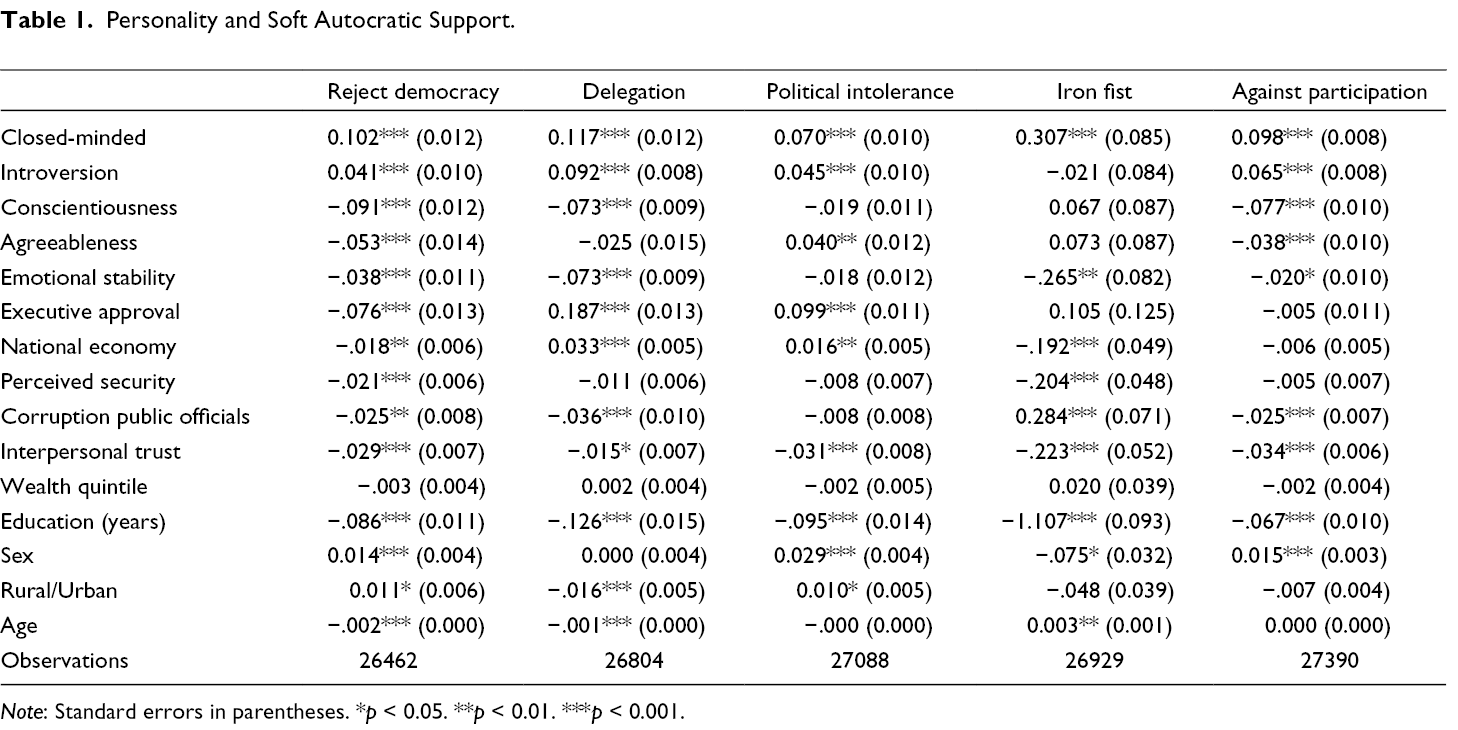
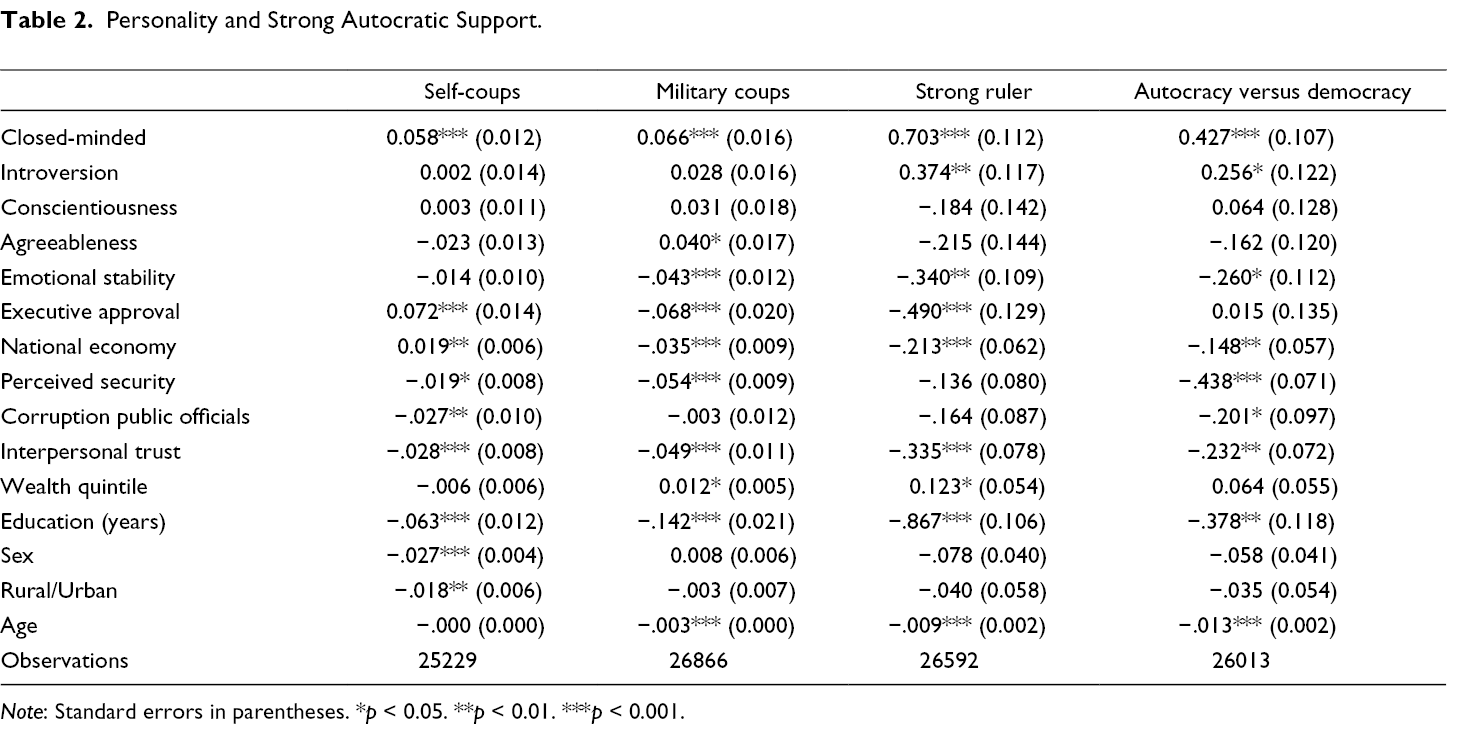
The first set of models presents hierarchical models, with random intercepts and individuals embedded in regions, employing individual-level data only. Depending on the nature of the outcome variable, we used ordinary least squares (OLS) 2 or logistic regression analyses. In our second set of models, we carry out hierarchical analyses with random intercepts and slopes that allow us to control for cross-regional contextual differences. These models also allow us to assess whether in fact environmental factors affect certain personalities igniting closed-minded and introverted individuals’ support for autocracy. In what follows, we present the results for all outcomes of interest. Then, we move on to present quantities of interest to understand the substantive impact that personality exerts on autocratic support. Tables 1 and 2 present the full results for our models containing individual-level data only.
Personality and Soft Autocratic Support.
Note: Standard errors in parentheses. *p < 0.05. **p < 0.01. ***p < 0.001.
Personality and Strong Autocratic Support.
Note: Standard errors in parentheses. *p < 0.05. **p < 0.01. ***p < 0.001.
The results show that, across all outcomes of interest, closed-mindedness and introversion are crucial to predict individuals’ support for autocracy. However, closed-mindedness is more consistently related to autocratic attitudes than introversion.
In the case of soft autocratic support, both closed-minded and introverted people are less supportive of democracy as the best form of government and are significantly less tolerant of those who hold different political views. Closed-mindedness and introversion are related to instances where citizens are willing to let the incumbent president concentrate power and bend democratic norms. Finally, both closed-minded and introverted people are less supportive of citizens’ participation and engagement in politics. However, only closed-mindedness is related to preferences for iron fist rulers over solving the country’s problems with everyone’s participation. In the case of strong autocratic support, closed-mindedness and introversion are related to support for military coups, preferences for unelected strong rulers, and increased support for a non-democratic government over a democratic one. Yet, only closed-mindedness is related to individuals’ support for self-coups.
Regarding other personality traits, only emotional stability rendered an effect somewhat comparable to closed-mindedness and introversion. Emotional stability is negatively related with seven of our outcomes. As individuals are more emotionally stable and react more calmly to stressful events, they are less likely to support autocratic forms of governance. Most of the literature on political psychology has found no relationships between emotional stability and political attitudes (Gerber et al., 2011). However, one study found that less emotionally stable individuals have greater levels of intolerance towards minorities (Marcus et al., 1995). Hence, it is possible that citizens who tend to react with greater anxiety to stressful events (e.g. economic crises) are willing to support autocratic measures that might bring solutions to such issues.
Of special interest is that higher levels of conscientiousness are not consistently related to autocratic attitudes. If anything, conscientiousness is related with less support for autocracy. Conscientiousness is associated with personal rigidity, a need for order, and an aversion to change. The literature in political psychology has found that more conscientious individuals tend to be conservative and authoritarian in their political attitudes (Duckitt and Sibley, 2017). However, this research has focused on conscientiousness effects on morality, and on economic, social, and security issues (Gerber et al., 2010). And they have done so mostly in the context of developed democracies (e.g. the USA). Perhaps, the tenuous link between conscientiousness and opposition to autocracy is based on an aversion by the highly conscientious to political change (i.e. de-democratisation).
It could be the case that the relationship between closed-mindedness and introversion differs across countries, depending on their experience with democracy. We believe that in countries with a history of democratic stability (e.g. Chile, Costa Rica, Uruguay), the relationship between these personality traits will be stronger for soft autocratic attitudes than for strong ones. While for countries that have flirted with autocracy, personality should be more strongly related to strong autocratic attitudes.
For example, in our data we find that in Uruguay – often considered a democratic exemplar in the region – closed-mindedness and introversion are significantly related with citizen rejection of democracy. However, there is no relationship between these traits and preferences for autocracy over democracy. In contrast, in Venezuela and Ecuador – two countries that by 2010 were experiencing democratic backsliding – we find that closed-mindedness and introversion are significantly related to preferences for autocracy over democracy.
Now that we have a sense of how the personality traits of closed-mindedness and introversion influence individuals’ support for autocracy, we turn to the substantive effect of these personality traits on our outcomes of interest. Figures 1 -4 present quantities of interest regarding the effect of personality on autocratic support. For models with binary dependent variables (iron fist, self-coups, military coups, strong rulers, and autocracy vs. democracy), we present predicted probabilities; while for models with continuous outcomes, we present linear predictions. All the graphs are derived directly from our models and, as such, contain the rest of the covariates at their mean or modal values.
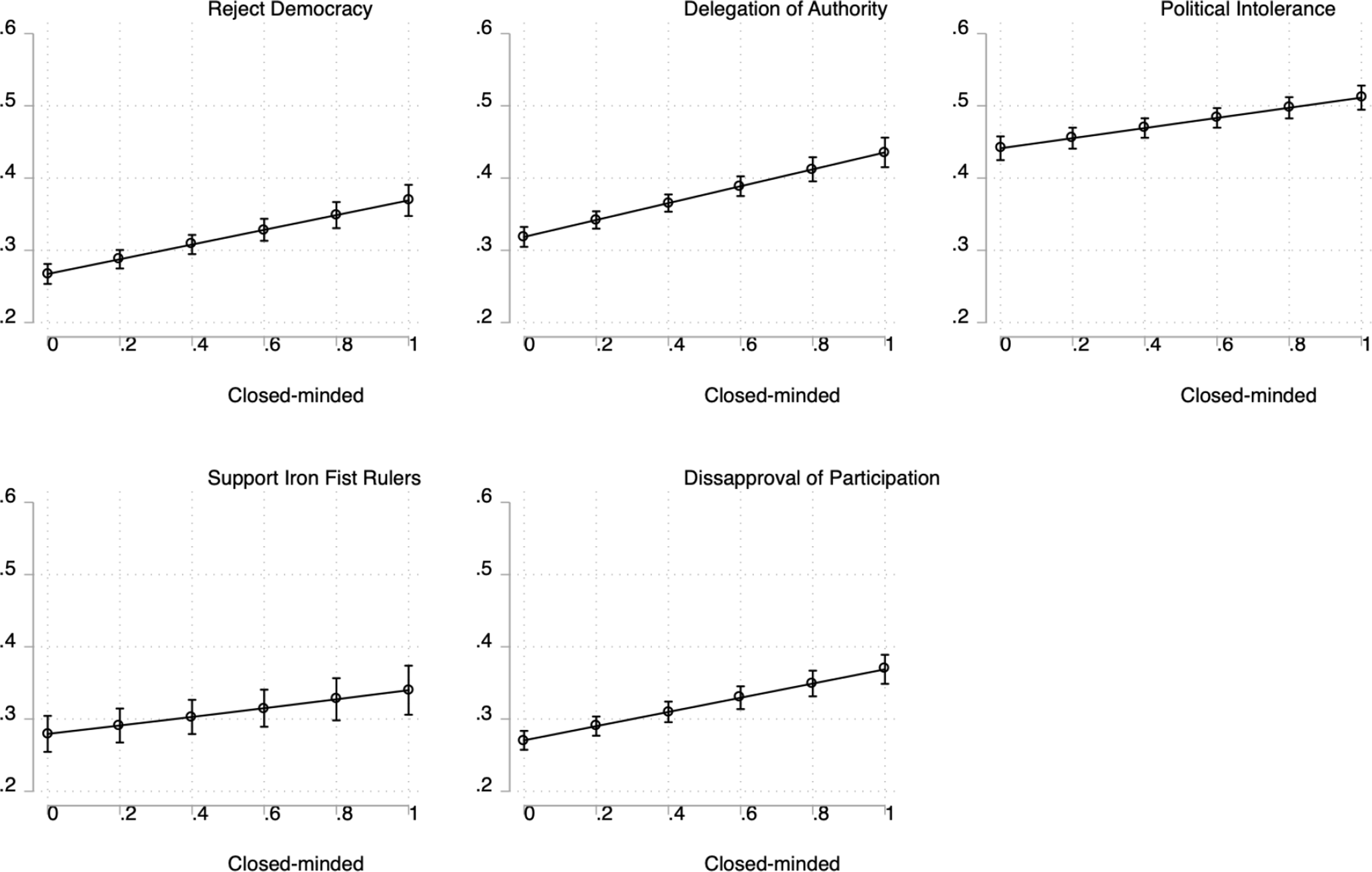
Closed-Mindedness and Soft Autocratic Support.
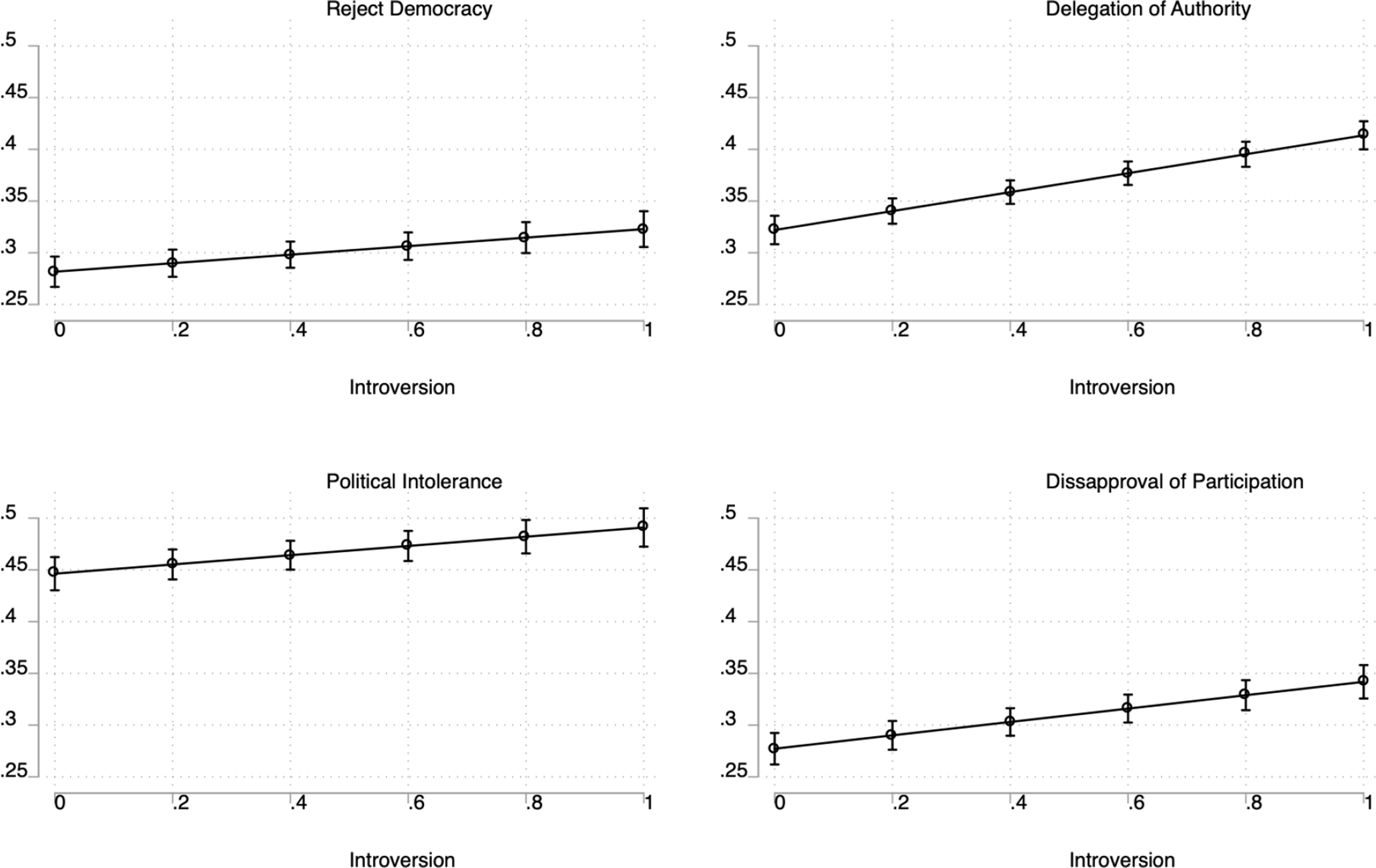
Introversion and Soft Autocratic Support.
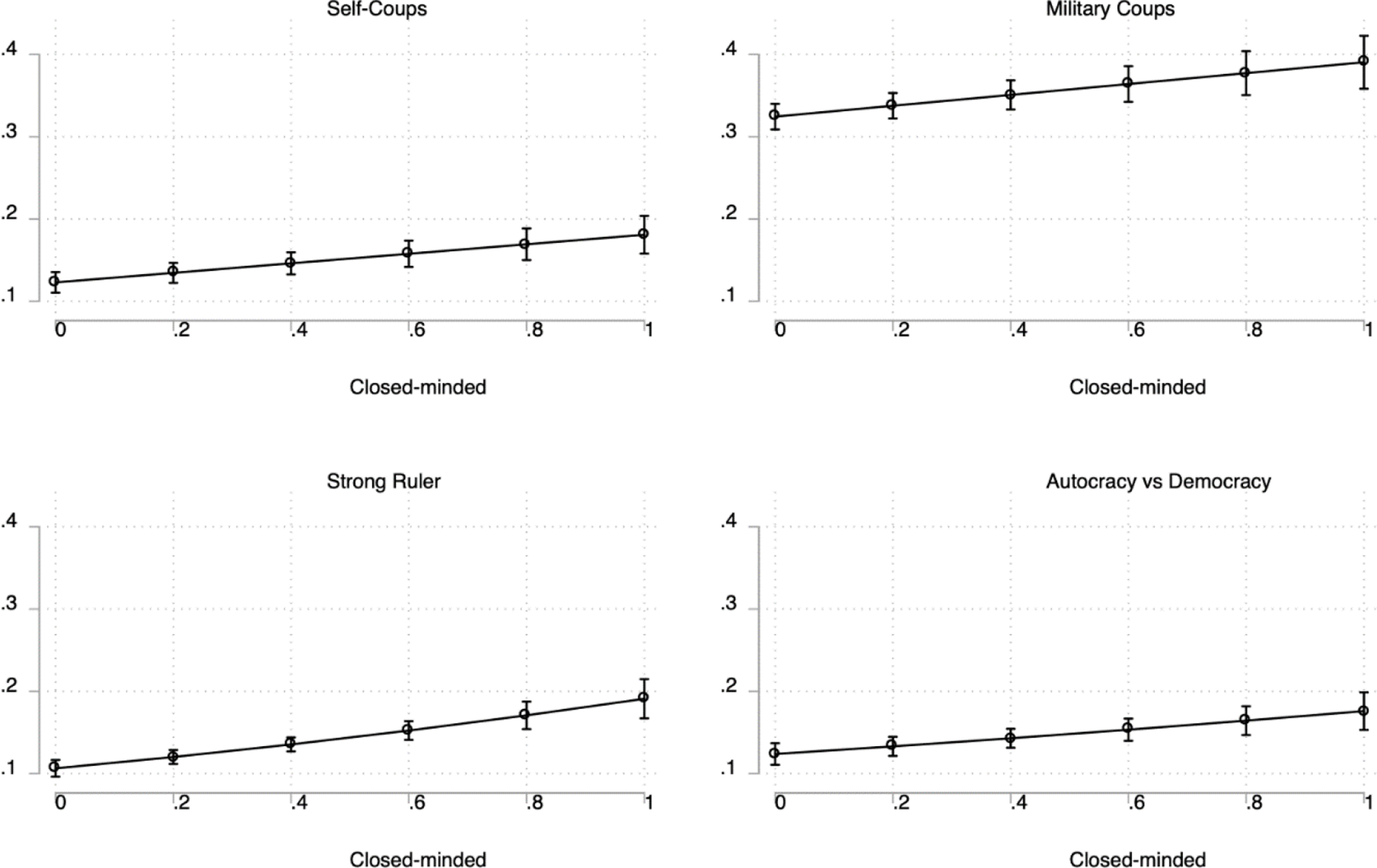
Closed-Mindedness and Strong Autocratic Support.
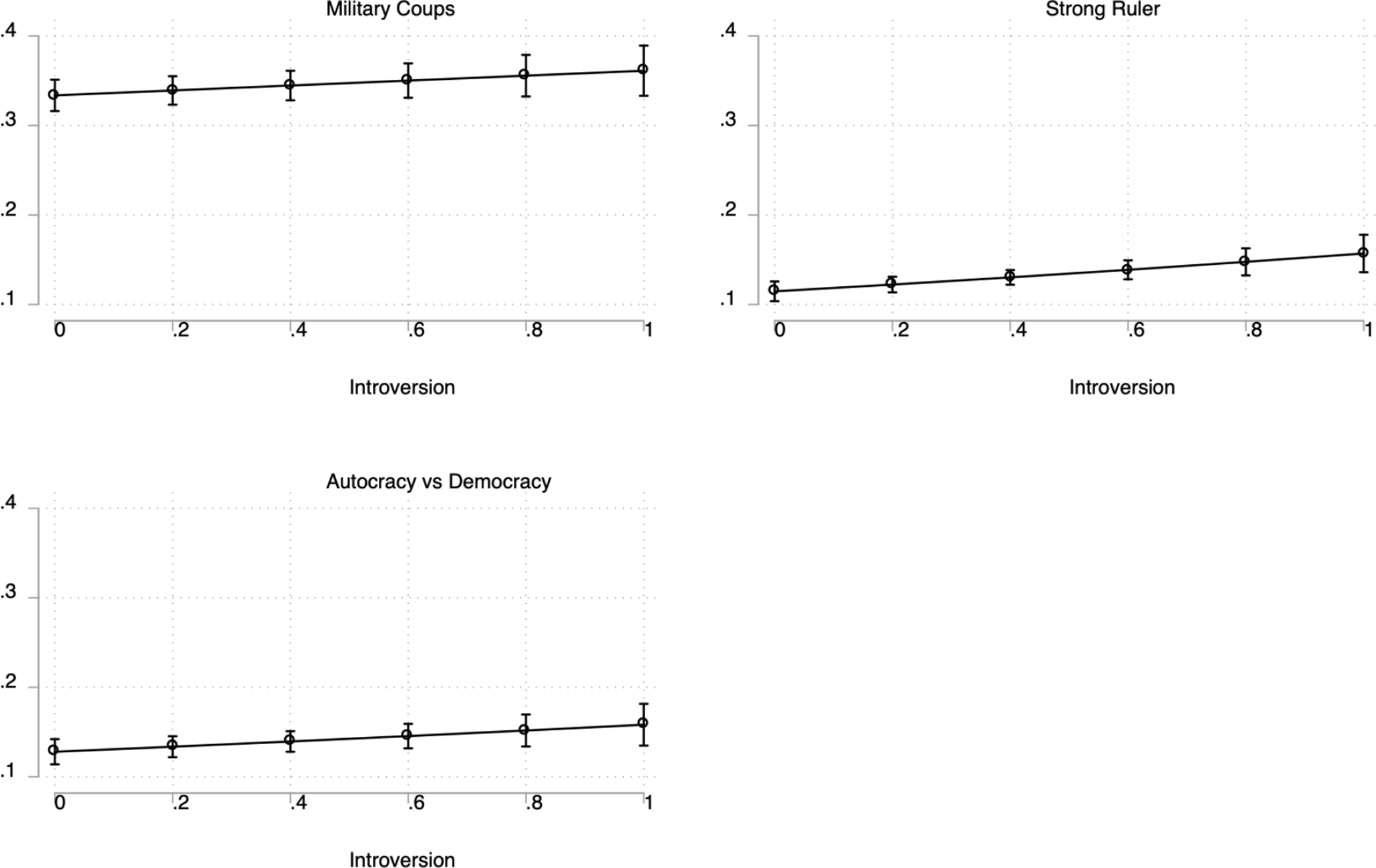
Introversion and Strong Autocratic Support
Figures 1 -4 show the effect of closed-mindedness and introversion on soft and strong autocratic support. The figures show that the effects of personality on individual support for autocracy are not only statistically significant but also substantively meaningful. Closed-mindedness increases support for different forms of autocracy by around 10 per cent to 15 per cent for all outcomes of interest. Additionally, being introverted increases one’s support for autocratic measures that imply the restriction of citizens’ political rights and civil liberties by about 11 per cent. Introversion also raises the probability that one prefers autocratic systems over democratic ones by approximately 6 per cent.
The effects that closed-mindedness and introversion have on autocratic support are comparable to the effects of education. Increasing education from no education to eighteen years or more of education decreases the probability that one is willing to support autocracy by about 10 per cent. The results in the figures show the effect of moving from the minimum to the maximum of closed-mindedness and introversion. Although people tend to avoid placing themselves too high on these scales (due to social desirability bias), we observe 805 (936) respondents in the 75th percentile of introversion (closed-mindedness), which amounts to an average of 44.72 (52) respondents per country.
Conditional Results
Recall that we hypothesised closed-mindedness and introversion to be particularly affected by conditions of economic, political, and security disarray. Closed-minded individuals are highly sensitive to threat (Johnston et al., 2017), and introverts are particularly affected by conditions of stress (Gudjonsson et al., 2004). Thus, in these situations, introverted and closed-minded people are more likely to seek shelter in autocratic leaders and structures of power perceived as capable of solving pressing issues and reducing uncertainty.
In the absence of such conditions of threat, we expect support for autocracy among introverts and closed-minded individuals to be significantly lower. For open-minded and extroverted individuals, we believe that their motivation to exchange ideas, protect participation, and embrace novelty should make them exhibit resilience and even greater opposition to autocracy during times of threat. To simplify the presentation of the interaction results, we only show graphs that test our conditional hypothesis. Full results for the other variables in the models are presented in the Supplemental Appendix. 8
Figures 5 -8 show support for our second hypothesis. Closed-minded and introverted citizens who experience threat are more likely to support self-coups, military coups, and strong unelected rulers. That is, closed-minded and introverted individuals who live in regions with poor economic conditions, widespread corruption, and high crime rates tend to seek order and stability by supporting autocratic structures of governance that imply the concentration of power in a single authority and an imminent erosion of democracy.
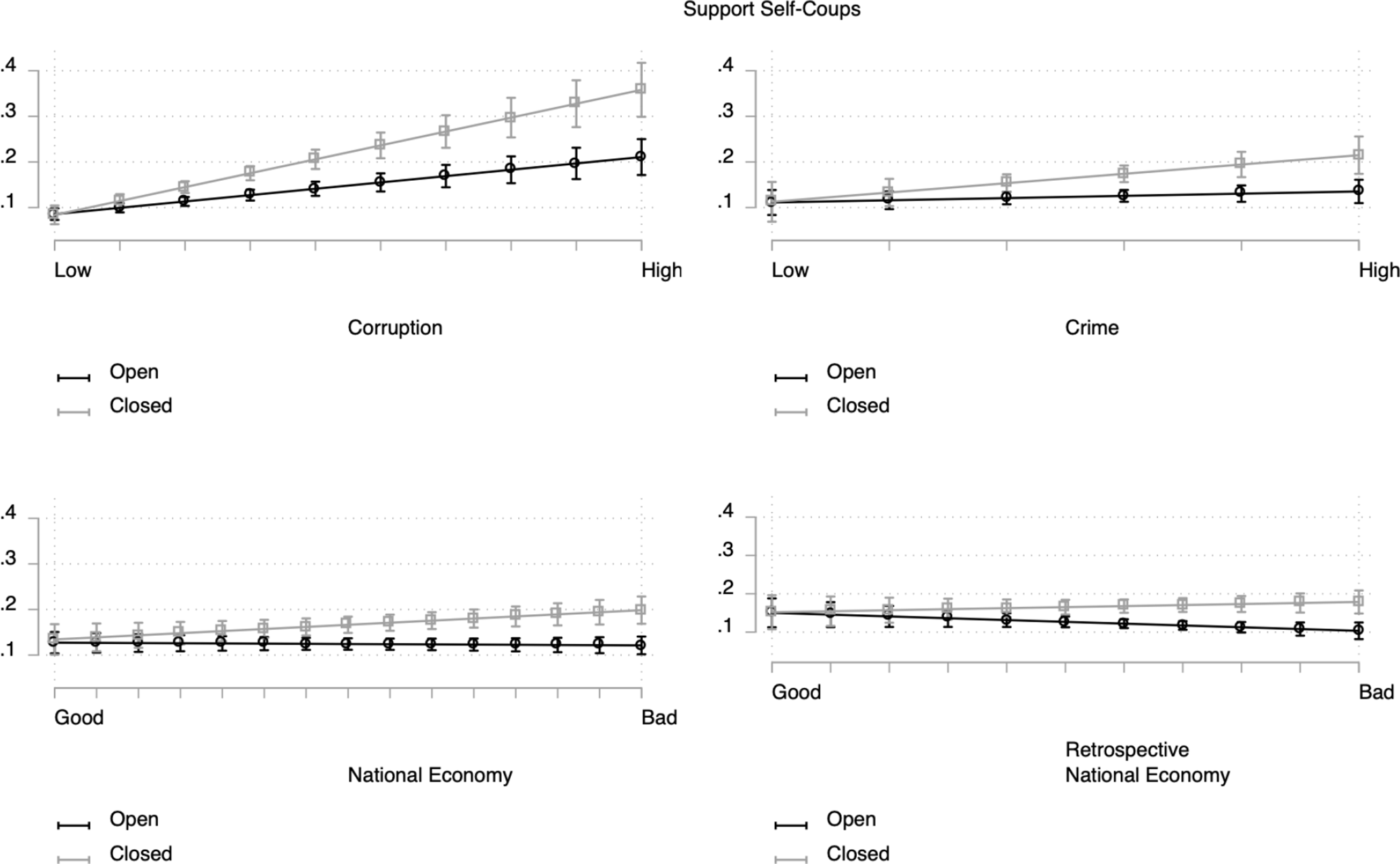
Closed-Mindedness × Context: Self-Coups.
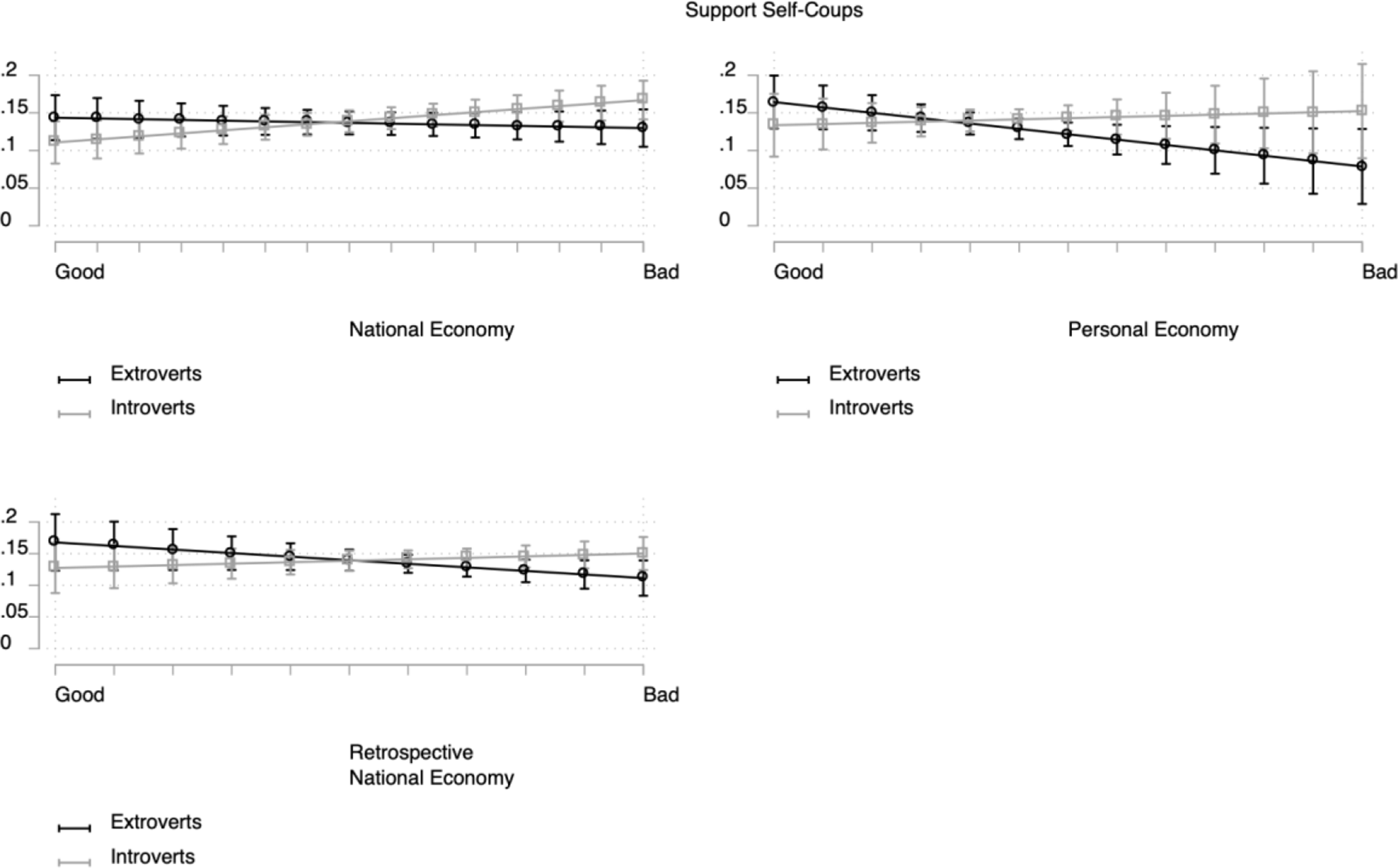
Introversion × Context: Self-Coups.
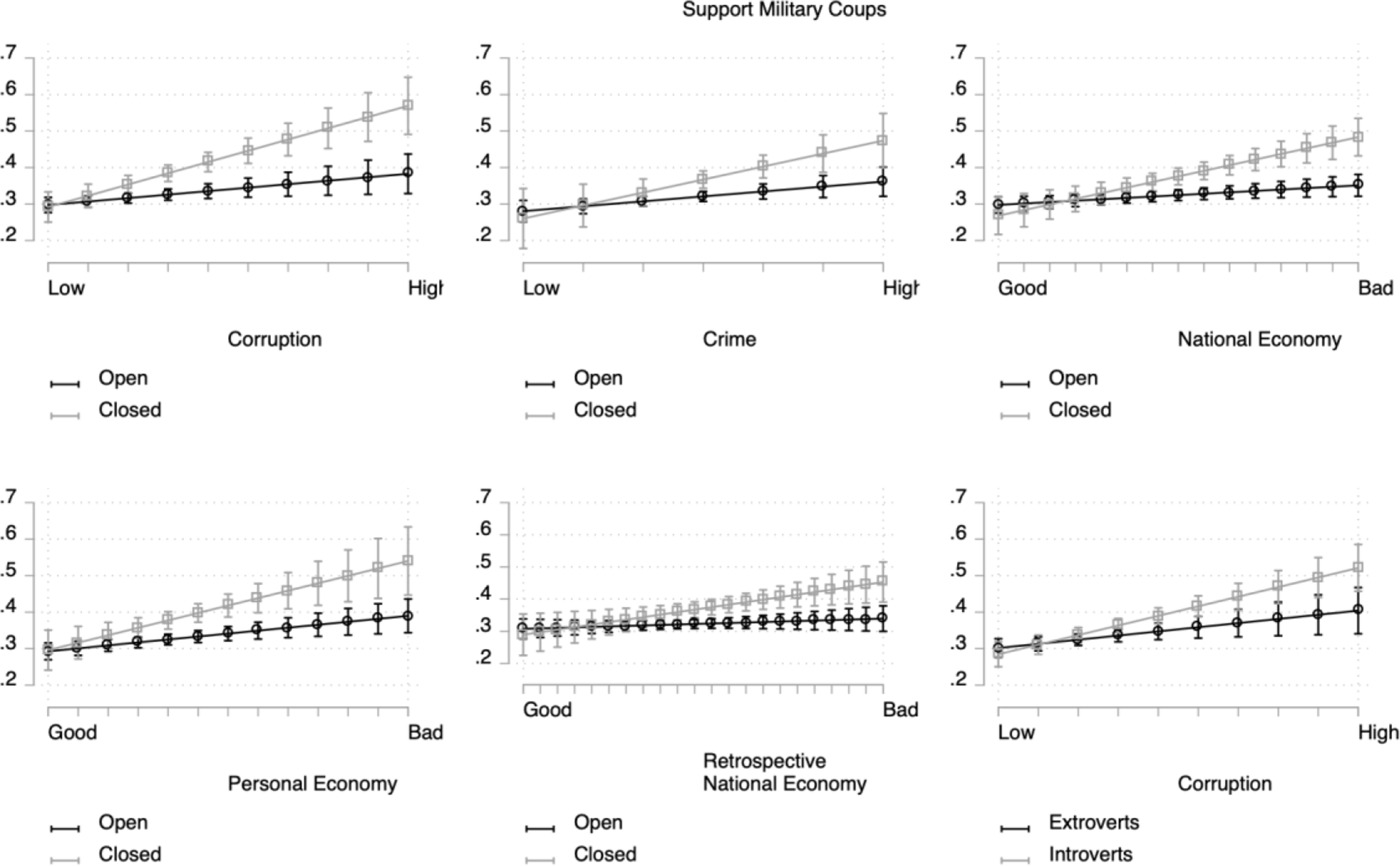
Closed-Mindedness/Introversion × Context: Military Coups.
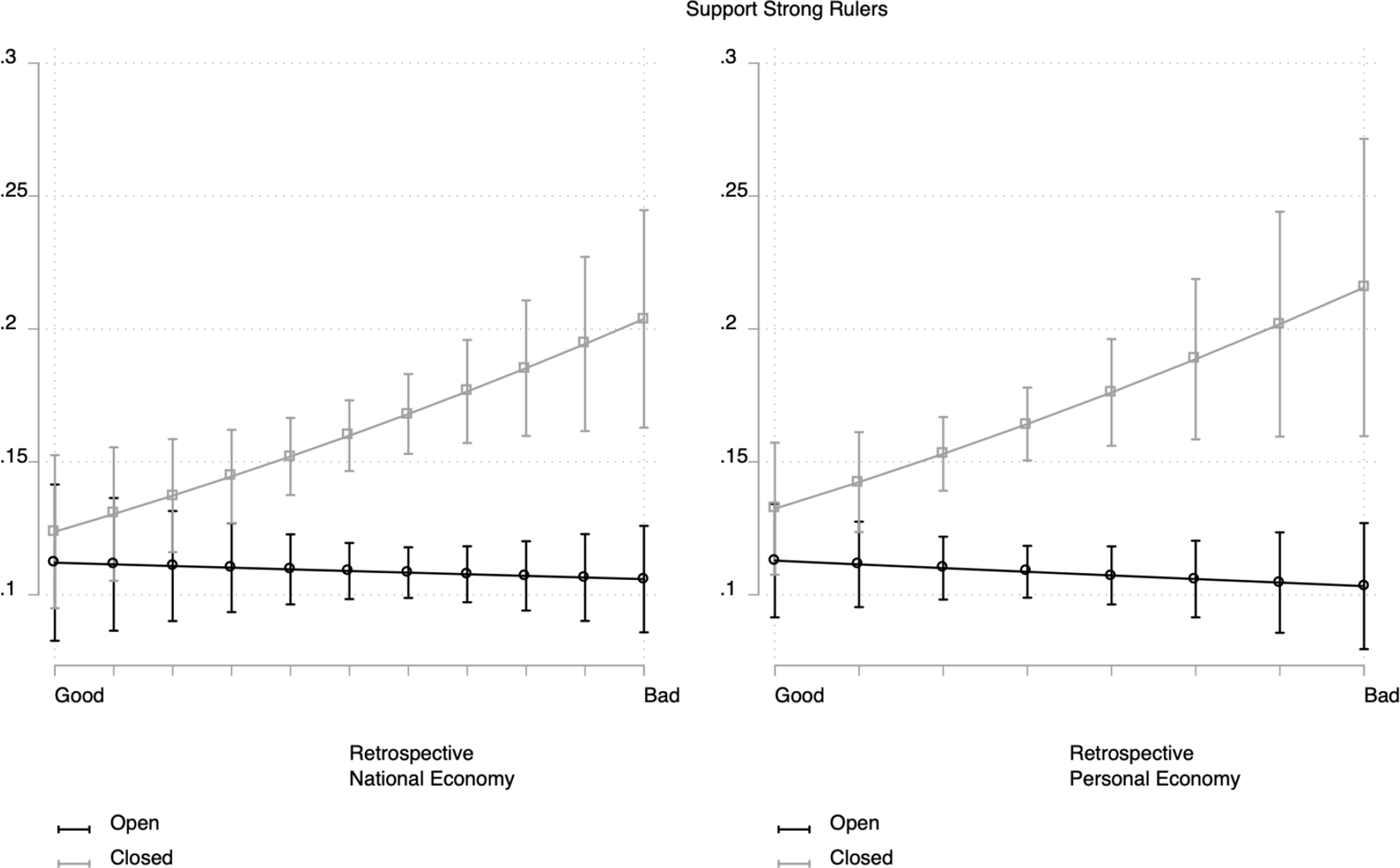
Closed-Mindedness × Context: Strong Rulers.
We did not find evidence for contextual threats igniting preferences for autocracy over democracy among closed-minded and introverted individuals. We believe that there are two possible explanations for this. For one, it could be the case that people are already reluctant – possibly due to social desirability bias – to admit a preference for autocracy over democracy. 9 Second, it is also possible that for closed-minded and introverted people to increase their support for a full-blown autocracy, the perception of threat needs to be higher.
Importantly, for our conditional hypothesis – as with the direct hypothesis – the effects of closed-mindedness on autocratic support are stronger and more consistent than introversion’s effects. This may imply that closed-minded personalities have a greater sensitivity to economic, political, and security threats than introverted ones, and that closed people are more likely than introverts to see autocracy as a viable solution to pressing issues.
As should be clear, personality is affected by context. In this case, closed-minded and introverted individuals seem to be particularly affected by poor economic conditions, high corruption, and rampant insecurity. These results allow us to understand not only the kinds of individuals who – because of their psychological predispositions – might be more likely to support and prefer autocracy over democracy, but also the environmental stimuli that ignite the expression of personality in autocratic attitudes. Contextual factors do not influence everyone in identical ways but instead are moderated by personality – in this case, one’s levels of introversion and closed-mindedness.
Discussion and Conclusion
We posit that when it comes to understanding support for autocracy, we need to consider individuals’ personalities and their reaction to environmental stimuli. Moreover, scholars need to differentiate instances in which citizens manifest soft autocratic support, such as support for executives limiting political rights and bypassing Congress and Courts when governing, from strong autocratic support that implies, for example, the dissolution of democratic institutions. By recognising the importance of these factors, we can elucidate the unique pathways through which some individuals hold autocratic attitudes, while others embrace democratic ones. Moreover, our analysis of the psychological roots of autocratic support incorporated a greater array of regime attitudes than considered in prior studies (Marcus et al., 1995; Mondak and Halperin, 2008; Mondak and Hurwitz, 2012; Oskarsson and Widmalm, 2016).
We focused on two personality traits: closed-mindedness/openness and introversion/extraversion. Some people are closed in their political views and support autocracy (closed-mindedness), while others are motivated to seek novel political ideas and defend democracy as a system of government (openness). Similarly, some citizens are unwilling (or poorly motivated) to engage in social interactions with those who think differently (introversion), but others enjoy social interactions and cross-cutting political discussions (extraversion). The latter are more supportive of democracy, including the principle of citizen participation. By exploring personality, we can understand why citizens living in the same context and experiencing the same economic, political, and security conditions manifest different political attitudes and preferences. Likewise, by looking at how basic human dispositions (i.e. personality traits) interact with the environment, we can begin to understand why some countries have a large proportion of citizens that prefer autocracy.
In this article, we have shown that closed-minded and introverted individuals are supportive of autocracy. Moreover, in regions undergoing hard times, closed-minded and introverted citizens are likely to support autocratic measures that concentrate power in a single authority and that ultimately pave the way for democracy’s erosion. Our article bears directly on the prospects for democracy in Latin America. The region’s history of deference to authority and history of state centralisation are important factors that allow us to understand why closed-mindedness and introversion are crucial to understanding citizen support for autocratic forms of government. These historical developments point to the importance of personality characteristics that motivate individuals to be critical of such centralised structures of power and, instead, voice their support for more dispersed forms of governance.
The study of personality traits and their effects on citizens’ political attitudes is incomplete if we do not consider countries’ unique histories, as well as their contemporary experiences with democracy. Therefore, we argue that the main way through which we should be studying autocratic tendencies in the population is through the interaction between personality characteristics and contextual factors that put citizens in a unique position in the political world. By taking into consideration these factors, we can form a coherent and holistic theory that explains the existence of autocratic attitudes in Latin America.
Supplemental Material
Supplementary Material 1 - Supplemental material for Introverted and Closed-Minded: The Psychological Roots of Support for Autocracy in Latin America
Supplemental material, Supplementary Material 1, for Introverted and Closed-Minded: The Psychological Roots of Support for Autocracy in Latin America by Paula Armendariz Miranda and Matthew Cawvey in Journal of Politics in Latin America
Footnotes
Declaration of Conflicting Interests
The author(s) declared no potential conflicts of interest with respect to the research, authorship, and/or publication of this article.
Funding
The author(s) received no financial support for the research, authorship, and/or publication of this article.
Supplemental Material
Supplemental material for this article is available online.
Notes
Author Biographies
Email:
Email:
References
Supplementary Material
Please find the following supplemental material available below.
For Open Access articles published under a Creative Commons License, all supplemental material carries the same license as the article it is associated with.
For non-Open Access articles published, all supplemental material carries a non-exclusive license, and permission requests for re-use of supplemental material or any part of supplemental material shall be sent directly to the copyright owner as specified in the copyright notice associated with the article.
