




Abstract
The COVID-19 pandemic had severe impacts in Latin America, with small businesses intensely affected. Beyond its economic consequences, the pandemic also exacerbated structural flaws in some of the region's weakly institutionalised democracies, diminishing State legitimacy and expanding that of organised criminal groups. In considering how State governance from above is challenged by non-state governance from below, this article examines a “pandemic micropolitics” as seen through the lens of support to the small business sector. We outline a framework to understand co-governance in hybrid political orders during crises; and examine this using case studies of urban informal markets and the transport sector in El Salvador. In showing that the pandemic contributed to a renegotiation of co-governance between the State, criminal organisations, and business associations, we contribute to understandings of the dynamics of distributive politics and the co-governance of crisis; and the potential implications for a post-COVID-19 political economy in Latin America.
Keywords
Introduction
Latin America was hard hit by the COVID-19 pandemic, registering almost 27 per cent of COVID-related deaths globally despite having only 8 per cent of the global population. 1 Most Latin American countries responded with severe measures including total lockdowns and curfews (Garcia et al., 2020). This saw considerable macro- and micro-economic impacts (Lanchimba et al., 2020) and contributed to the regions steepest economic recession on record (Ocampo, 2021). Some of the hardest hit were micro, small, and medium-sized enterprises (MSMEs). Uniquely vulnerable to exogenous shocks (Miklian and Hoelscher, 2022), lockdown measures severely impacted MSMEs given their dependence on physical circulation of staff and customers, and lack of capital to weather the economic downturn (ITC, 2020).
In response, most Latin American countries announced economic support measures to assist MSMEs, including tax-exemptions, loan payment deferrals and direct cash support (Heredia Zurita and Dini, 2020; López Calva, 2021; OIT, 2021). Yet following initial announcements in April/May 2020, concrete implementation of support programs was opaque (OECD, 2020). Many MSMEs failed to access support schemes, held bleak views of their futures (Guerrero-Amezaga et al., 2022) and suffered from increased violence and extortion (Hoelscher and Garcia, 2022). Furthermore, as the pandemic demanded rapid decision making, procurement and financial support, it exacerbated conditions for misuse of public funds (CIPE, 2021). Graft and corruption blossomed (Amundsen, 2020; UNCAC Coalition, 2020; Wetherbee, 2020) with small business support seen as vulnerable to clientelist distribution (OECD, 2021).
Such outcomes reflect the challenges of effective and transparent public goods provision in hybrid democratic systems, particularly in contexts of persistent insecurity and diminished rule of law. 2 Unsurprisingly, research has begun to examine the governance implications of COVID-19 in the region (Abad Cisneros et al., 2021; Fernandez and Machado, 2021) with concerns voiced over the extension of authoritarian tendencies, erosion of trust in government, and the emergence of populist and anti-democratic sentiment (Avritzer and Rennó, 2021; International Idea, 2020; Williams, 2021). Yet while the pandemic influenced how the State governed during crisis, it also shifted the roles and actions of non-state actors (Berg and Vasori, 2020). Criminal organisations, for instance, operate as de facto parallel governance actors who challenge formal State legitimacy and territorial control (Lessing, 2021; Magaloni et al., 2020). During the pandemic, these groups often moved to fill governance voids through activities related to enforcing lockdown rules, delivery of masks and antigen tests, cash handouts, and price controls on basic goods (Aziani et al., 2021; Cavgias et al., 2021; Muggah and Dudley, 2021). In governing from below through both the threat of violence and community solidarity, organised criminal groups in certain instances appear to have bolstered their authority and legitimacy in opposition to the state in support of their own economic and political interests (Gomez, 2020).
Parsing this, we argue that in pursuit of legitimacy and political support, the pandemic led to shifts in constraints and opportunities regarding how both State and non-state actors sought to formally or informally govern. Drawing on theories of governance from above and below (Lea and Stenson, 2007), and State and criminal co-governance of territories, markets and populations in Latin America (Arias, 2017; Blume, 2022; Cruz and Durán-Martínez, 2016) this article examines the emergence of what we term a “micropolitics of pandemic governance.” By “micropolitics” we refer to the socio-political relationships, interactions and bargaining between a range of State and/or non-state actors in a local context, generally aimed at influencing a particular area, policy or activity without the explicit goal to alter national-level power relations or institutions. Using the case of El Salvador, we examine how State (above) and non-state (below) actors (re)negotiated co-governance arrangements during the pandemic, as seen through the lens of support to the MSME sector.
El Salvador is a theoretically and empirically interesting case to examine the evolution of co-governance patterns and the position of small businesses within them. The country faces longstanding challenges with organised criminal groups and has a sizable MSMEs sector. 3 These businesses must negotiate the demands of both formal State governance and the logics of criminal governance in territories in which they operate, dynamics which are particularly relevant to the transport and market vendor sectors we focus on in this article. Moreover, a broader political shift in the country occurred immediately prior to the onset of the pandemic with the election of a new government. Outlining an agenda for change, President Nayib Bukele's administration promised to combat both the country's high levels of violence and the social and economic impacts of the pandemic. Each of these reasons makes the focus on El Salvador, small businesses, and the transport and vendors sectors theoretically and empirically appealing.
In studying the emergence of governing patterns during the pandemic, we utilised three methods. First, a smartphone based survey including over 3000 MSME owner/managers in San Salvador as a part of a broader survey of MSMEs during the pandemic in Latin America (Bull et al., 2021). Second, we reviewed legislation and public documents related to policies surrounding COVID-19 support. 4 Finally, we undertook fifteen qualitative interviews with government officials, MSME-owners and former gang leaders. Three were made online, while the rest were conducted in San Salvador in January 2022, focusing on urban street vendors and the transport sector given their vulnerability to both violence and lockdown measures.
Utilising a framework that sees governance as a reflexive process influenced by actors from above and below, we interrogate how issues of claims-making, exchange relationships, political representation and violent coercion were deployed and enacted and how MSMEs were impacted and responded. We argue that the public health measures and compensatory schemes implemented during the COVID-19 pandemic shaped a renegotiation of the roles of State and non-state – including criminal – actors in the governance of urban territories and the economic activity occurring therein. Here, State and non-state actors have “co-governed” in an unstable relationship that was altered with the infusion of economic resources and imposition of new pandemic restrictions. Within this dynamic MSMEs tended to be subordinate to actions of both States and non-state and criminal actors but in certain instances were able to exert a degree of agency over pandemic co-governance.
Hybrid Co-governance During the Pandemic: Theorising the Governance Implications of MSME Support
During the pandemic, governments globally struggled to respond to social, economic, and health-related needs (OECD, 2021), with wide-reaching impacts for their legitimacy (Forman and Kohler, 2020; Jones, 2020). In Latin America – where 88 per cent of the region's businesses are microenterprises and whose workers earn less than half that of those in large enterprises (Correa et al., 2018) – the pandemic produced an acute need for support among small businesses (Heredia Zurita and Dini, 2020). Given their important socio-economic role, governments have supported MSMEs during previous crises to prevent broader deteriorations in living and welfare conditions (Ferraro, 2011). Similar support measures were enacted during the COVID-19 pandemic (CEPAL, 2020), although many companies, particularly those most in need, failed to receive support.
Non-state actors also sought to support MSMEs during the pandemic. Business associations frequently acted as collective bargaining representatives on behalf of MSMEs, engaging with governments and lobbying for support measures of varying kinds (CEPAL, 2020). Organised criminal groups also increased their informal governance roles. Where the state was unwilling or unable to provide support to MSMEs – particularly smaller or informal businesses – criminal organisations strategically modified their relationships of protection and extortion to support MSMEs and grow their own legitimacy as governance actors (UNODC, 2020). Below we outline a framework that offers an exploratory analytic lens to understand the implications of shifting governance practices from above and below in hybrid political orders during exogenous shocks and their impacts on MSMEs.
Conceptualising Hybrid Governance
Many Latin American countries can be considered hybrid political orders, where diverse and competing authority structures, logics of order and violence, and claims to power co-exist, overlap, interact, and intertwine (Arias and Goldstein, 2010; Jaffe, 2013). Here the State lacks a monopoly in providing security, welfare, and representation; it instead shares authority, legitimacy, and capacity with other institutions and actors (Boege et al., 2009; Cruz, 2019). Within this dynamic, non-state actors – ranging from civil society organisations, trade unions, business associations and criminal organisations – take part in the local “co-production” of key state functions, including provision of public goods and services, social protection, environmental management, security and taxation. Often, this exists as a set of loose and/or shifting alliances – at times conflictual – between state and non-state actors (Voorberg et al., 2015). Yet co-production may also evolve into a form of co-governance of sectors and spheres of society, as various non-state actors gain influence over the areas in which they contribute (Ackerman, 2013) Consequently, “co-production” may emerge as a way for non-state actors to advocate for their communities needs’ and negotiate a degree of influence to co-govern with local and national governments.
This co-governance may exist as contentious encounters between the State – which possesses de jure authority to govern, and non-state agents who seek to exert de facto claims to govern or influence governance at the local level. Here, formal governance from above may be met with oppositional forms of community and non-state governance from below, reconstructing or rearticulating the practices of governance within local communities (Lea and Stenson, 2007; Stenson, 2008). Yet such encounters may also be “cooperative” forms of co-governance, such as where states and criminal groups share the responsibilities to govern through pacts or agreements (Arias, 2017; Blume, 2022; Cruz and Durán-Martínez, 2016). For instance, Lessing argues that criminal governance, “the imposition of rules and restrictions by an armed criminal group,” is embedded in spheres of state power, and thus simultaneously born of, shaped by, in opposition to – but in subtle ways complementing – state power (Lessing, 2021: 857). While Lessing insists that criminal governance is analytically distinct from other forms of governance, we contend that this sharp distinction is often blurred. Both criminal actors and other actors (both the state and non-state actors like business associations) often engage in criminal, illegal or illicit activity in the pursuit of resources, legitimacy, and control, rendering ambiguous the “non-state”/“state” binary (Michaels, 2010). Moreover, there is often an explicit and implicit coexistence of the formal and informal state (Colona and Jaffe, 2016) where State and non-state relationships range from the contentious to the cooperative.
In examining how governance from above and below intersect, our framework (Figure 1) suggests that the interplay between governance from above and governance from below creates various impacts on societal actors – for this article MSMEs. We view governance from above as broadly existing on a continuum between universal/collective and contingent/selective; and governance from below on a spectrum from solidarity-based/voluntary to threat-based/coercive. The interactions between these approaches then co-produce governance outcomes that affect MSMEs and condition the nature of their responses.
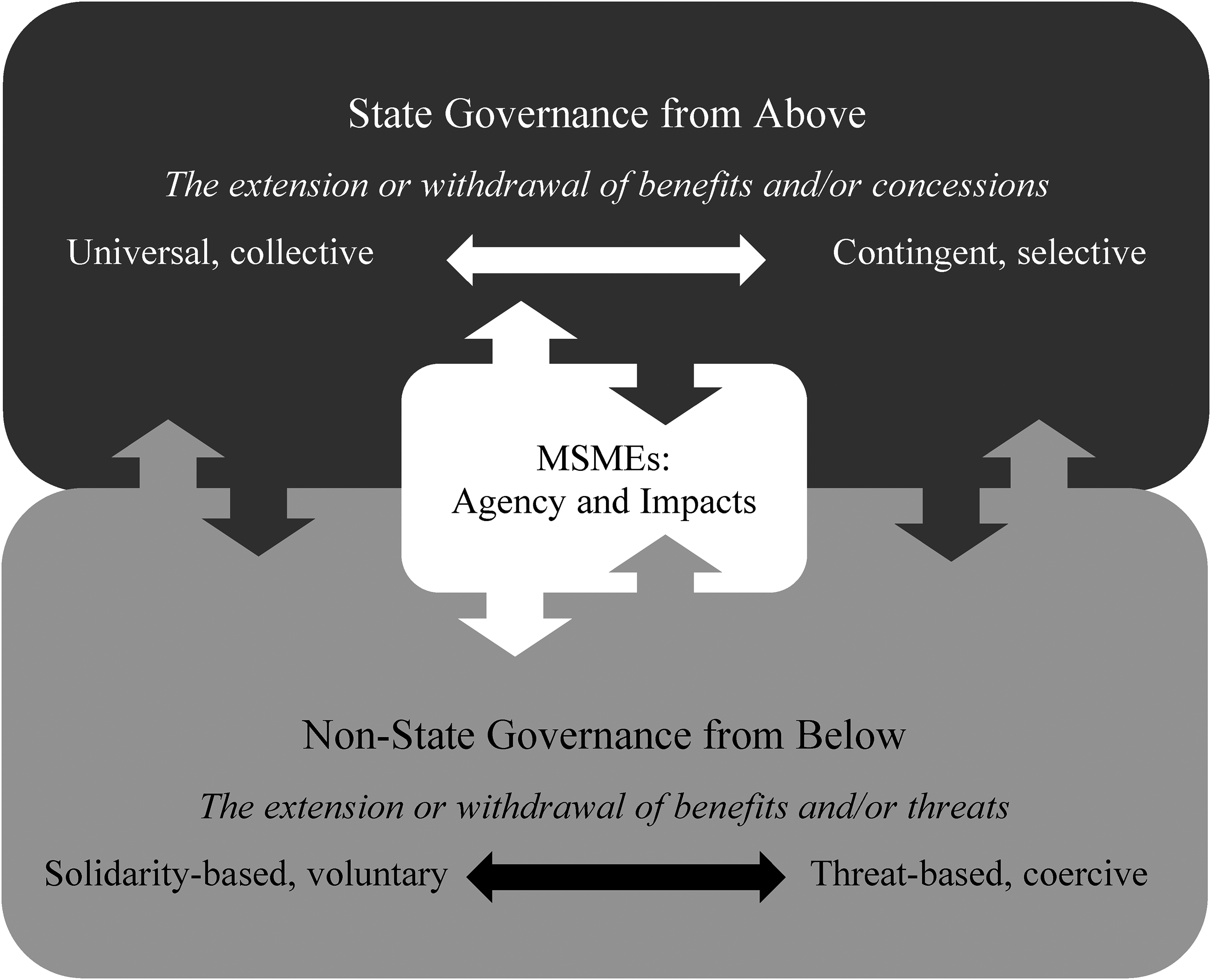
Micro, small, and medium-sized enterprises (MSMEs) and governance from above and below in hybrid political orders.
Governance From Above: Collective Representation and Personalised Claims Making
States govern “from above” by extending or withholding benefits or concessions. Following Kitschelt and Wilkinson (2007), we consider this as a continuum from broadly programmatic (collective and universal) to broadly clientelist (selective and contingent). At its core, programmatic politics relies on impersonal public service delivery that is not conditional on political support, and where formalised, public criteria shape distribution of public goods or resources (Stokes et al., 2013). Under such conditions, MSMEs in theory operate within a formal rules-bound institutional context that is “good for business,” such as clear legal and regulatory frameworks, protection of property rights, and impartial adjudication of contracts. Yet owing to historical political economic development trajectories (Kitschelt et al., 2010), late twentieth century economic shocks (Roberts, 2013) and persistent economic informality (Gottlieb, 2022), programmatic politics has been hindered in Latin America. Often, elements of programmatic and clientelist governance co-exist – for instance, between different levels of government or political parties – reflecting the complex nature of programmatic governance from above and its implications for co-governance. 5
Commonly, however, voter-party interactions in Latin America tend to be more clientelist, or transactional and contingent in nature (North et al., 2013), characterised by “particularistic targeting and contingency-based exchange” (Hicken, 2011: 289). The exact nature of clientelism may itself vary (Gans-Morse et al., 2014) from one-off exchanges such vote buying in single elections to “relational clientelism” (Nichter, 2018) involving the distribution of public resources through ongoing relationships among politicians, their agents, and voters. Here, clientelism may create highly institutionalised practices based on established networks, a kind of informal institution itself (Helmke and Levitsky, 2006) that businesses must operate within. Clientelist exchange may also entail offers of club goods to groups based on particular eligibility categories. This includes the concept of “forbearance” (Holland, 2017), where the state selectively declines to enforce laws for certain groups, such as “rewarding” ‘a supportive community of street vendors or slum dwellers with tacit permission to continue their encroachments' (Berenschot and Aspinall, 2020: 5). In such contexts, MSMEs operating informally without social security or pension systems are particularly vulnerable for mobilisation through clientelist appeals. Such practices contribute to what Brinks et al. (2020) consider a lack of institutional ambition, or “state weakness by design,” incentivising personalised and favour-based relationships to facilitate business operations.
Governance From Below: Voluntary and Coercive Exchange Relationships
Governance from below considers how different types of non-state actors seek to influence governance processes, which we conceptualise on a continuum between two opposing approaches. The first is cohesive, characterised by being solidarity-based and voluntary, where membership or inclusion in a non-state organisation such as a business association or trade union provides collective bargaining power, mutual support and other forms of action able to influence how non-state actors shape co-governance dynamics in concert with the State. The second relates to the nature of criminal governance, characterised by threat-based and coercive relations, such as the demand for protection money backed by threats of force. Similar to contrasts between one-off and relational clientelism, threat-based forms of extortion may be “one off” events, with minimal ramifications for the broader dynamics of governance from below. However, in many cases it evolves into a regularised relationship where criminal groups, victims and authorities act according to a set of informal rules (Moncada, 2020) and the authority and influence of criminal governance actors becomes entrenched. In such cases, MSMEs – as with other citizens and organisations – are notoriously vulnerable to extortion-as-governance strategies by criminal groups (Amaya and Martínez d'Abuisson, 2021). In contrast, due to their sheer number and presence in local communities, MSMEs may also exert a degree of agency in shaping both how the state (from above) responds to their needs; and negotiating the “terms of domination” (Moncada, 2019) under which they are governed by criminal actors (from below).
Varieties of Co-governance in Hybrid Political Orders
The framework above sees governance in hybrid political orders as a reflexive process where both state and non-state agents pursue actions to promote their own interests, exert authority and build legitimacy. In conceptualising this as a process of co-governance, we contend that MSMEs are often subordinate to and predominantly governed by the actions of both States and non-state and criminal actors; but also that under certain conditions MSMEs can exert a degree of agency on how co-governance is enacted. It also suggests that where certain governance conditions from above (programmatic vs. clientelist) intersect with certain governance dynamics from below (coercive or cohesive), different varieties of co-governance may emerge. While beyond the scope of this paper to theorise such relationships more fully, we make initial speculations on these co-governance conditions in Figure 2.
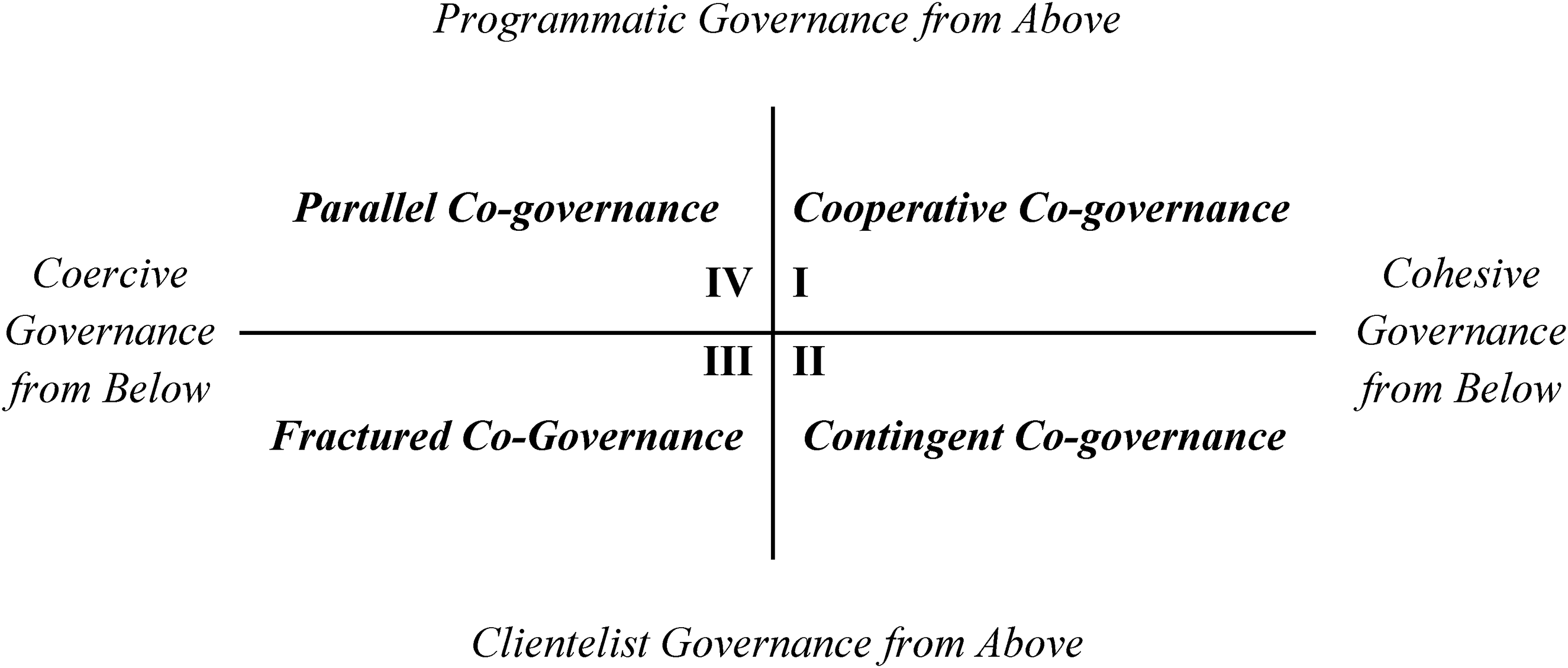
Varieties of co-governance in hybrid political orders.
Quadrant I, where programmatic governance from above meets cohesive governance from below, we consider cooperative co-governance. Formal criteria guide state service delivery, supported and checked by cohesive governance efforts from below, allowing a degree of relative agency and assurances for civic actors and MSMEs. Quadrant II, where clientelist approaches from above meet cohesive governance from below, we consider contingent co-governance. Where service delivery is personalised it may be countered by – or supplemented with – a cohesive attempt to govern from below through solidarity-based association. However, this likely diminishes the agency of individual MSMEs, favouring collective action to negotiate exchange-based relationships with the State. Quadrant III sees clientelist approaches from above intersect with coercive governance from below, which we consider fractured co-governance. Formal institutions are undermined by the predominance of both clientelism and criminal coercion, leading to unstable and corrupted co-governance arrangements between State and criminal actors that likely vary from cooperative to outright contentious. Such conditions likely inhibit MSME agency unless their interests align with those of either or both the clientelist State or coercive criminal organisations. Quadrant IV sees programmatic governance from above meet coercive governance from below, which we consider as parallel governance. Here, cooperation between a less-clientelist State and criminal organisations is likely curtailed, with parallel, often geographically territorialised “formal State” and “informal criminal” governance regimes emerging. Here the agency of MSMEs may be dependent on where they are physically located and the extent to which they must relate to the programmatic State or coercive criminal governance in various physical territories.
Based on our framework in Figure 1 and these brief theoretical reflections in Figure 2, the following section examines the micropolitics of pandemic support to MSMEs in El Salvador.
Pandemic Micropolitics: The Case of El Salvador
Background
El Salvador has long struggled with low levels of economic growth and high levels of violence. Homicide rates have consistently been among the world's highest – around 50–70 per 100,000 population – and fluctuated in recent years. Homicides declined related to a gang truce in 2013, subsequently spiked to 105 per 100,000 in 2016, and dropped dramatically to around 50 per 100,000 in 2018, and 19 per 100,000 in 2020. Despite this, the security situation remains fragile, with the presence, authority and threats posed by gangs persisting. Most MSMEs operate in these conditions of chronic violence, with extortion their most prevalent threat (Barrios and Abrego, 2021). MSMEs also comprise the vast majority of economic activity and employment in El Salvador, where according to the state agency for MSME support, CONAMYPE, only 4 per cent of businesses are formal. Approximately 1.1 million registered businesses-owners are self-employed, 6 meaning that two-thirds of Salvadorans depend on the income from informal MSMEs or self-employment. Already vulnerable to violence and extortion, as non-taxpaying enterprises MSMEs can neither participate in government tenders nor benefit from tax-deductions or social security for employers, further increasing their precarity.
In El Salvador, COVID-19 arrived after the Government of Nayib Bukele had been in power for approximately 9 months. Bukele won the 2019 elections on an anti-establishment platform, criticising both major political parties that dominated El Salvador since the end of the 1980–1992 civil war: The right-wing ARENA party and the left-wing former guerrilla party FMLN. Bukele was excluded from FMLN despite previously representing them as mayor of two municipalities; and unable to register his fledgling party New Ideas before the election, he joined the smaller right-wing party GANA. Castigating years of government corruption and mismanagement in his anti-establishment discourse, Bukele won the election with a record high percentage of votes but record low turnout (50.5 per cent), entering power with extremely weak support in congress. GANA held only ten of eighty four congressional seats, with Bukele only managing to gain support from six additional representatives, and soon encountered severe challenges in governing, including congressional opposition to proposed legislation. Initially, Bukele made attempts to bypass this through extensive use of presidential decrees and strong-arm approaches. When trying to pass a large, extraordinary security budget in February 2020, he brought armed members of the El Salvadorian Armed Forces and the National Civilian Police into congress to intimidate representatives. When the pandemic struck merely one month later, Bukele utilised the crisis to continue to centralise power, deploying support schemes to reinforce his own political control.
The El Salvadoran government was among those that reacted most rapidly and firmly to the COVID-19 pandemic with a full national quarantine announced by Executive Decree 14 of March 30, 2020. Initially slated to last for one month, the decree was extended to May 16th, and included the closure of all businesses, with the exception of a select few deemed critical for the functioning of society. During these two months, all circulation was prohibited, with the exception of critical personnel (López and Domiguez, 2021), with the military charged with ensuring adherence to quarantine regulations.
However, conflict with congress also eventually marked Bukele's handling of the COVID-19 crisis. When a unanimous Constitutional Chamber of the Supreme Court of Justice determined it was unconstitutional to detain people for having disobeyed the quarantine, Bukele attacked the Chamber for wanting El Salvadoreans to die from COVID and announced he would not respect their decision (BBC News Mundo, 2020). Furthermore, although initial measures were introduced through a consensus-process in congress, this soon broke down. Bukele began unilaterally introducing policy, issuing a record twenty one presidential decrees during his first year in government, nine of which related to the pandemic (Tobar, 2020). Bukele's attempts at centralising power were labelled as “millennial authoritarianism,” combining ‘traditional populist appeals and classic authoritarian behaviour with a youthful and modern personal brand built on social media’ (Meléndez-Sánchez, 2021: 19). This was evidenced on May 1, 2021, when El Salvador celebrated elections of representatives to its legislative assembly, resulting in landslide for the president's party. The government went from holding ten seats (with support from an additional six) to sixty four of eighty four seats, allowing Bukele to exert full control over all political institutions in the country. Soon after, Bukele and his legislative allies fired the independent attorney-general and the judges of the Constitutional Chamber, El Salvador's highest court. This saw COVID-19 support enacted and distributed in a context of power-struggles between the government and the opposition, and was the backdrop for Bukele's attempts at explicitly and implicitly tying delivery of COVID-19 assistance to reciprocated political support.
MSMEs, COVID-19 and Government Support
In this context of a president seeking to centralise power and appeal directly to the majority of El Salvadorians, MSMEs became an important target of COVID-19 support. However, the distribution of support measures showed both features of a formal institutionalised process, and of “relational clientelism,” where MSMEs became important clients in a contingent exchange relationship. Initial measures to rescue MSMEs were announced in April 2020, and represented 60 per cent of the COVID-19 emergency support budget. This consisted of a credit line of USD 360 million, a fund of USD 100 million (later increased to USD 147 million) to help informal businesses and a plan to pay 50 per cent of MSME's employee salaries for four months (Presidencia El Salvador, 2020a).
Over the following months, the government also secured assistance from the United States, World Bank and EU for additional emergency measures. The agency in charge of MSMEs, CONAMYPE, also provided subsidies on the costs of gas, as well as 30,000 “solidarity packages” to the self-employed and the postponement of payments for taxes and rents. In July, the “Law of Creation of the Trust for the Economic Recovery of Salvadoran Companies” (FIREMPRESA) was adopted, establishing a trust managed by the Salvadorian Development Bank (BANDESAL) to disburse funds to MSMEs. FIREMPRESA registered a total of USD 295 million disbursed between its establishment in October 2020 and August 2021. By then, they had already provided funds to 13,503 MSMEs with half-payroll subsidies, 4000 MSMEs with productive loans and 22,800 productive units categorised within the informal sector, with BANDESALs president estimating the trust was granting between 250 and 400 loans a day. Further international aid arrived in 2021 from the Inter-American Development Bank (IDB), contributing USD 1.8 million to assist MSMEs in the marine coastal zone hard hit by both the pandemic and climate change.
The main institution in charge of administering funds was CONAMYPE – an autonomous institution answering directly to the government. Bukele had strengthened CONAMYPE when entering power by appointing Paul Steiner, a professional with a long track record in national and international organisations, as its director. CONAMYPE was required by law to keep a register of MSMEs in the country, which showed a total of 1.2 million businesses. Of these, 95 per cent made less than the minimum wage of USD 240 a month, suggesting the vast majority of MSMEs were subsistence livelihood mechanisms. CONAMYPE's figures also made clear that informal MSMEs comprised the majority of El Salvador's companies: 99.67 per cent are MSMEs, employing 80.62 per cent pf the labour force, with 57 per cent of companies informal (defined as not being in the VAT registry) (CONAMYPE, 2020b). This made CONAMYPE's registry even more important in identifying eligible recipients for COVID-19 support. It collaborated with BANDESAL for disbursement of credits, and with the Armed Forces and the Agricultural Ministry to distribute door-to-door “solidarity packages” to the self-employed. According to CONAMYPE's own numbers, by December of 2020, 80 per cent of the MSMEs in El Salvador had received support, with 96 per cent of these satisfied with results (CONAMYPE, 2020a).
While aid was distributed according to formal criteria, it occurred in parallel with a transition towards a more authoritarian politics, including Bukele's frequent public attacks on the media and political opponents. Bukele also emphasised that support to MSMEs depended on the President's goodwill, and that other politicians in the country – particularly congress members – sought to jeopardise it. This was made particularly clear after the legislative assembly delayed the approval of the funds requested to fund FIREMPRESA. Customary of Bukele's social media-driven populist authoritarianism, he tweeted repeatedly about congress’ failure to respond to the needs of MSMEs, receiving overwhelming support from his three million followers. On October 15, 2020, he announced he had personally withdrawn the request to congress, instead issuing USD 127 million worth of governmental bonds (Certificados del Tesoro or Cetes), securing a total of USD 600 million for FIREMPRESA without relying on congress: The Assembly, as always, approved the trust of BANDESAL, but it did not fund it. They left us without funding. But we achieved to place $600 million in Cetes, and with that we have the money to support the companies.
7
On one hand then, the process of distributing benefits related to COVID-19 in El Salvador was to a considerable degree based on formal, universal and collective rules-based criteria and distributed by designated institutions. However, Bukele's rhetoric sought to establish a direct relationship between the beneficiaries of governmental assistance and the implicit expectation that MSMEs would reciprocate with political support. Moreover, preferential processing of emergency support may have occurred for strategically important sectors. Drawing on our recent survey examining the impacts of COVID-19 among SMEs in Latin American cities (Bull et al., 2021), Figure 3 presents data from SME owner/managers in urban areas in El Salvador who reported their operating sector and whether (or not) they received government assistance (n = 528). Undertaken in December 2020, SMEs in the transport sector reported the highest rates of receiving government support (45 per cent), close to twice that of the average across all sectors (28 per cent). With the caveat that sample sizes are relatively low (n = 22 for the transport sector) these figures are consistent with our findings below that the transport sector was possibly given preferential support due to their political importance.
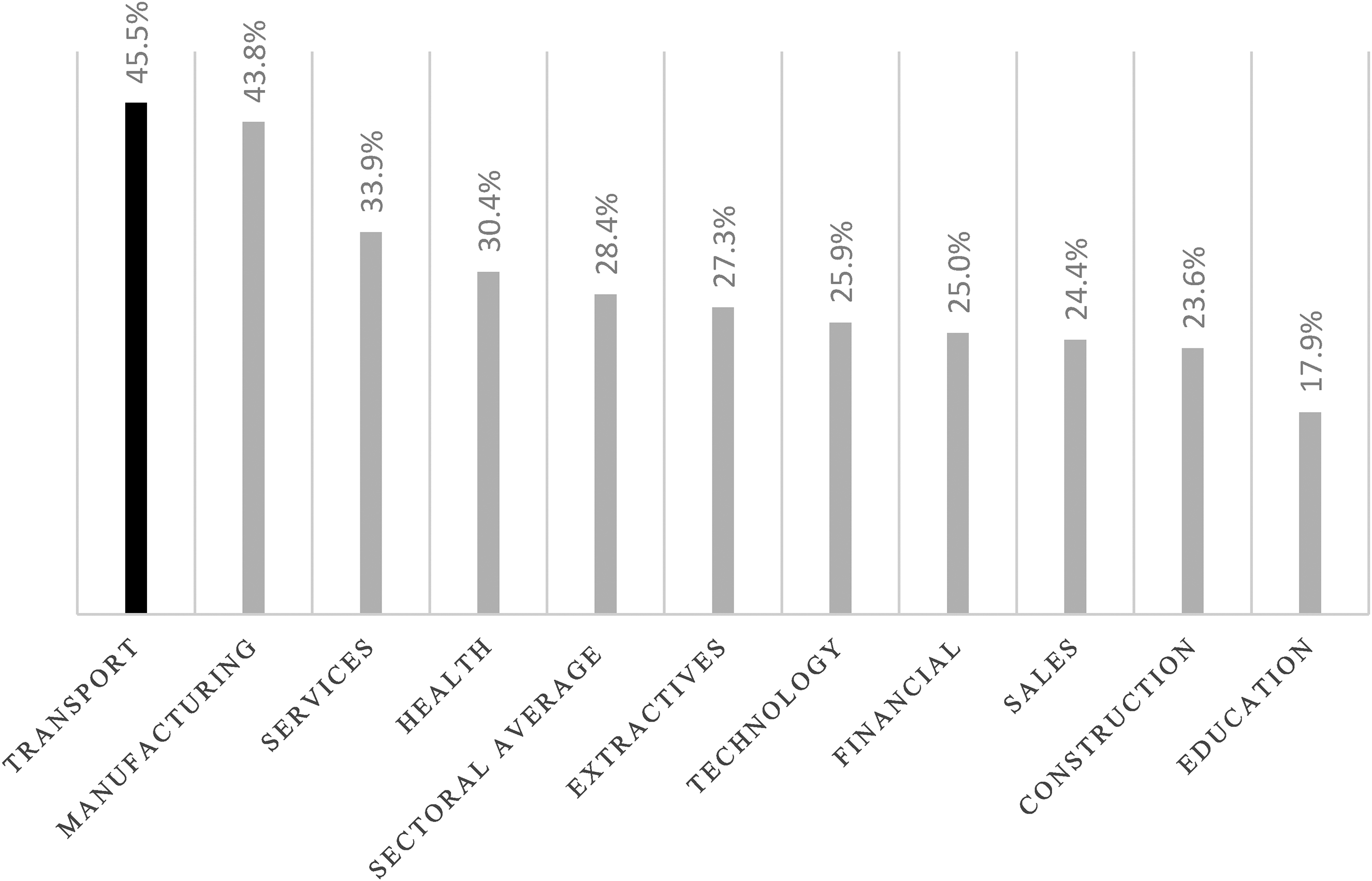
Small and medium enterprise (SME) owners reporting receipt of COVID-19 support in El Salvador by sector, 2020.
Varieties of Co-governance During the COVID-19 Pandemic in El Salvador
The States approach to pandemic governance ‘from above’ incorporated formal universal mechanisms constrained by particularistic targeting and relational clientelism. This was soon confronted with alternative and contentious non-state approaches to governance “from below' in El Salvador as hybrid political order. Various territories are co-governed by both the State and the three (formerly two) street gangs [Mara Salvatrucha (MS13), Eighteen Street Gang – Revolucionarios (18R), and the Eighteen Street gang – Sureños (18S)], and other associations that negotiate security and economic arrangements both with the State and the gangs (Bergmann, 2020; Cruz, 2019; Mercado et al., 2021). The relationship between the gangs and the State changed profoundly with the 2012 gang-truce, where the then two main gangs (MS13 and 18) agreed to reduce homicides in exchange for improved conditions in prisons. Additionally – and importantly – the gangs were to receive a cash payment from the State, to be invested in legal businesses to provide livelihoods outside the gangs (Wheeler, 2020). In the pandemic context, both new inflows of funds – such as emergency support measures – and restrictions related to lockdowns, were resources or limitations used in a quest for power and control.
Conflictual Co-governance of the Transport Sector
The transport sector in El Salvador consists of some 10,500 buses and microbuses, owned mostly by MSMEs. It also includes one large company, owned by the legendary transport-tsar Catalino Miranda, who was estimated to have controlled 40 per cent of the sector, totalling around 4500 buses and microbuses. The transport sector holds a unique position in the Salvadoran economy, having access to large parts of its territory and contact with a vast amount of the population. Consequently, it is also among the sectors most exposed to gang-related extortion. According to the sector association, the Federación de Empresarios del Transporte (FECOATRANS), the sector paid between USD 15 and USD 39 million annually in extortion prior to the pandemic. 8
Part of this extortion is semi-formalised, with payments organised or “agreed” between gangs and bus-companies and paid regularly. These agreements commonly allow for gangs to demand additional ad hoc “bonuses” at special occasions or if they have alleged high expenses (Christmas or costly health-problems such as surgery are two typical examples). Other aspects of extortion remain disorganised and precarious. Gang members often board buses and threaten drivers to pay additional small amounts, or “renta” (Amaya and Martínez d'Abuisson, 2021). There are also frequent episodes of bus company employees impersonating gang members in order to extort competitors or even their own company. Moreover, as the country's gang-truce agreements allowed gangs to invest in various productive activities, several buses are owned by gang members themselves. 9 This multiplicity of extortion payments makes governance of the sector volatile and violent, with fourteen bus-drivers killed in 2019 as a result of failure to pay.
As a result of extortion dynamics, transport-sector MSMEs are among the most vulnerable in the country. Nonetheless, bus company owners are also a powerful political force. As the majority of El Salvadorans (around 70 per cent) depend on public transport, the sector is capable of paralyzing urban mobility, affording it a degree of political influence. In addition, the sector's public-facing nature and reach also means it can effectively be used as a medium for electioneering. Politicians frequently pay transport-companies to canvass on their behalf by displaying campaign materials and playing political messaging on bus radio systems. 10 Furthermore, given the population's reliance on the buses for urban mobility, the price of public transport is often a decisive – and conflictual – electoral issue. As a result, politicians seek to both control the sector to keep transport prices low, while at the same time maintaining good relations with operators to utilise busses for political messaging and campaigning purposes – as well as limiting the reach of opposition parties. This dynamic has resulted in a delicate political balance between the government and the transport-sector. Criminal governance in the form of extortion intervenes in this relationship, with the potential to weaken cohesive governance among the transport-sector, possibly to the interest of the government.
The lockdown and compensatory resources during the COVID-19 pandemic contributed to a shift in the balance of this co-governance relationship. While the national lockdown and quarantine introduced on March 21, 2020 prohibited most everyday activities (Suadi et al., 2020), public transport services were initially not cancelled entirely. Fifty per cent of the busses were allowed to run, along with a limited number of other “critical industries.” Yet by April 14th, these services were also ordered to close (Presidencia El Salvador, 2020b) with the exception of approximately 800–1000 buses contracted by the government to transport healthcare workers. For the rest of the sector, the government issued a fixed payment of USD 400 per bus and USD 200 per microbus per month while operations were prohibited. Nevertheless, FECOATRANS claimed the sector lost approximately USD 300 million during the pandemic – USD 50 million between March and August 2020 alone (Ramírez, 2020). This included both lost income for non-operational bus owners and operators, and inadequately low government payments to bus operators providing essential transportation services (102Nueve, 2020).
These pandemic effects were exacerbated by already high levels of indebtedness among bus companies, in large part due to rising gasoline prices and government policies to maintain low bus fares to benefit the broader population and their own political popularity. According to interviews, State-provided COVID-19 compensation payments did not even cover operators’ fixed costs. 11 Moreover, although the transport sector was allowed to reopen after three months of lockdown, revenues declined due to passenger usage dropping to around 80 per cent of pre-pandemic levels. Additionally, the COVID-crisis contributed to higher prices on spare parts and repairs due to supply chain challenges. Yet despite reduced demand, increased operational costs and more intense competition within the sector, the pandemic provided bus operators a temporary relief from the burdens of extortion payments. According to FECOATRANS, extortion payments within the sector dropped to USD 10 million in 2020, down from USD 15 million in 2019 (elsalvador.com, 2020). 12 Nonetheless, for most companies, extortion became just “one more cost,” with operators even lobbying to deduct costs of these payments from their taxable income.
It is thus not surprising that it was the owner of the largest transport company, Catalino Miranda, who made a principle of not paying extortion. Instead, he invested in AK47s and surveillance equipment and hired former military personnel at a cost of USD 30.000 a month (Martínez and Lemus, 2016). His bus-empire and control over key transport routes made him an important political figure, and one of few critical voices against Bukele. While other bus-company owners interviewed expressed that they would never criticize Bukele, fearing public harassment and personal attacks, 13 Miranda kept arguing for the need to raise tariffs to cover rising costs. On March 12, 2022, Miranda was arrested for unlawfully having increased bus tariffs and resisting arrest, and two days later military personnel confiscated several of his buses (Barerra, 2022). Later, several additional charges were pressed, and the Ministry of Public Works took over Miranda's bus routes (Jordán, 2022).
Other smaller bus companies continued but found themselves weakened by both the government's price control policies and the gradual re-instatement of extortion by the gangs. By the end of 2021, FECOATRANS estimated that extortion payments had risen 20 per cent from the previous year to USD 12 million (Redacción YSUCA, 2021). Moreover, as the economic effects of the pandemic took hold, bus companies became increasingly reliant on government connections to operate – from ensuring access to lines of credit, to simply being able to find spare parts for repairs. As one interviewee remarked: “If I need a spare part, you can be sure that nobody has it – only Nayib's brother-in-law.” 14
The pandemic opened new spaces for the renegotiation of contentious co-governance of the transport sector in El Salvador. This led to the strengthening of governmental agencies vis-à-vis non-state actors, but in an informalised manner that sought to undermine the control of legal bus-associations as well as individual bus-owners. The take-over of bus routes by the government also disturbed the gangs’ collection of extortion money on highly trafficked and profitable bus-routes run by Miranda's company. The discontent over government policy towards the sector has since been intimated as one of the reasons for the almost eighty gang-related homicides across a single weekend in late March 2022 (Mejía, 2022). It was widely suspected that Bukele had negotiated a co-governance arrangement with the gangs, involving a tacit governmental acceptance that gangs would be quietly permitted to extort bus operators. When this significant source of extortion income was abruptly removed, it led to an act of “revenge” by the gangs, with homicides spiralling to levels not seen in peace-time. Such experiences exemplify the complex interlinkages between COVID-19 support and volatile co-governance arrangements between governments and criminal organisations, with small businesses caught in between.
Negotiated Co-governance of Street Vendors and Microenterprises
Another group of businesses vital to the government and highly vulnerable to extortion are street vendors. The Historical Center of San Salvador is an area of around 7 km2 that once housed the main business district. However, since the civil war, when people sought refuge from conflict-plagued rural areas, it has been the main hub for street vendors, housing up to 40,000 (Dudley and Papadovassilakis, 2020). Currently, there are about 6000 physical stalls, yet many more itinerant vendors, 15 and over time street vendors became both major victims of gang extortion and collaborators with them (Papadovassilakis and Dudley, 2020). According to interviewees, the Historic Centre is split into four zones with different compositions of gang control and association. In addition to the three main gangs (MS13, 18R, and 18S), various business associations seek to maintain order and mediate both with and between the government and the gangs. Previously there were seventy five such vendor-associations (or “block referees”), yet this number has today fallen to fifty one, mainly due to some associations being gang-affiliated or turning to criminal activity, and seeing their leaders arrested. While prone to gang extortion, these associations could also exert a considerable degree of agency themselves and were partly used to fund the gangs. According to one informant in the municipality: “We have no control over the associations. They become collaborators with the gangs. They ask a ‘social share’ for the association: 1 dollar for the association, 1 dollar for the gangs. There are also associations that contract private security.” Underscoring these links between the gangs and vendors, it was stated: “The vendors have a network of intelligence information here. They have lots of relations with the gangs. They are mothers and fathers of gang members. Some don’t bring their kids to the stalls, because here, they recruit minors. But there are a lot of youngsters already involved.”
The street vendors in the Historical Centre have also been supporters of Bukele since he was mayor of San Salvador (2015–2018). Bukele focused intently on this area and bloc of voters during his election campaign for Mayor, holding frequent “audiences” to listen to concerns of street vendors. Indeed one informant claimed that 8000 “audiences” were held during Bukele'sfour years in office. Bukele's popularity among vendors occurred despite one of his grand plans as mayor was to rejuvenate the Historical Centre, involving the establishment of a new shopping mall (Cuscatlan Market) and the relocation of thousands of vendors. Understandably, the vendors did not want to relocate, both because they preferred their existing locations, and they feared repercussions if they moved from MS13 and 18R that controlled the area. Upon hearing of the vendors opposition, a leader of 18R called the municipality and promised to fix the problem for USD 100,000. The municipality ended up striking a bargain with 18R to assist in pressuring vendors to relocate, and in lieu of payment the government instead secured the gang the most attractive and lucrative stalls in the market to where the vendors were moved (Dudley and Papadovassilakis, 2020).
As the pandemic hit, Bukele had become president and initiated new steps in the process of rejuvenating the city centre. This first involved the removal of another sizable number of vendors to build a large new national library with Chinese funding. This relocation further exacerbated the negative effects of COVID-19 on the vendors. With streets emptied and mobility and circulation prohibited due to pandemic lockdowns, the street vendors lost their livelihoods overnight. However, as most of the street vendors operated as MSMEs scarcely making a subsistence living, they were eligible for the USD 300 cash transfer from the government. After initial failures distributing the cash directly that provoked major protests outside the Centro Nacional de Atención y Administración de Subsidio (CENADE) in the midst of the pandemic (EFE, 2020), transfers were made based on applications.
In the Centro Historico, it was the street vendors associations that sent lists of those eligible for support payments to the government. These associations took care of the required paperwork and ensured delivery of funds to individual street vendors. This service, however, came at a cost. Generally, support payments were divided in three: USD 100 for the vendors association, USD 100 for the affiliated gangs, and USD 100 for the individual vendor. In effect, the COVID-19 support program strengthened the amalgamation between street vendor associations and gangs and deepened the co-governance of the area. This particular form of co-governance also linked various levels of formal and informal power and authority. We see the emergence of a system wherein an increasingly authoritarian president governed through “negotiations” with other actors – both voluntary and criminal associations – and that the dividing lines between what may be regarded as licit or illicit became increasingly blurred. It also suggests that within this context, MSMEs themselves exerted a collective political agency rather than simply being atomised market participants. As one interviewee expressed it: “The vendors here are not only businesses, they are an urban commando.”
Conclusion: COVID-19 Support and Varieties of Co-governance
The COVID-19 pandemic had wide-reaching impacts across Latin America. In El Salvador, a variety of co-governance arrangements influenced the outcomes of COVID-19 support schemes to MSMEs. Programmatic governance from above sought to enable MSME survival by distributing support measures according to formal, public criteria. However, the State also governed using aspects of contingent distribution, building on previous clientelist ties between Bukele and street vendors; and including explicit and implicit expectations that issuing support should strengthen Bukele vis-à-vis congress. At the same time, voluntary and criminal organisations governed from below by both negotiating with and confronting the State, which strengthened formal–informal linkages and practices of hybrid co-governance. Within this dynamic, MSMEs themselves were both agents and subjects – influencing to a degree how government and non-government actors sought to appeal to them, but also highly susceptible to the actions of more powerful or organised groups of actors.
The Bukele government's COVID-19 support also influenced the relationships between different actors taking part in co-governance arrangements. In the Historical Center of San Salvador, COVID-19 support became an important resource in the contingent governance of the street vendors. The vendor associations appeared as powerful interlocutors due to individual street vendor's low capacity to comply with governmental requirements. In the transport sector, COVID-19 support schemes did not create a similar possibility for non-state actors (gangs and business associations and individual businesses) to assert themselves. Individual transport companies were able to comply with governmental requirements and act strategically without the help of business associations. Furthermore, the State also had several reasons for seeking to break up any form of cohesive governance from below in the transport sector to deter it from developing into a political challenge to the Bukele government. Thus, although support schemes infused the sector with resources compensating (in part) for losses incurred during the pandemic, this did not translate into more cohesive from-below governance.
These case studies illustrate the complexity of co-governance arrangements in hybrid orders and how they intersect with the economic and political interests of state and non-state actors. Moreover as our typology infers, these different governance approaches produced distinct varieties of co-governance. The transport sector suggests a form of fractured co-governance, where the clientelist State approach to governing the sector from above in cooperation with criminal interests from below became fractured and contentious when the State curtailed transport sector operations during the pandemic. For the street vendor case, while delivery of COVID support was designed to be programmatically distributed, it was undermined by Bukele's personalised relationships with the vendors. Moreover, a stronger cohesive-based governance from below represented by the “urban commando” in collaboration with criminal interests saw a form of contingent co-governance emerge, Here, stronger collective action by vendor associations increased their ability to collectively bargain. While resulting in a sufficiently favourable outcome in terms of support measures being delivered, it ultimately both weakened the States leverage, and strengthened business associations and gangs at the expense of individual MSMEs.
However, our cases also suggest somewhat blurred distinctions between co-governance varieties. Rather than being clear-cut, varieties of co-governance are likely dependent on specific issues, shifting over time, or incorporating elements of several of our four typologized varieties. While the precise relationships of co-governance may differ depending on context, recent research points to similar dynamics in other countries (Behrens, 2015; Mercado et al., 2021; Moncada, 2021). Future research could further develop and extend these theoretical understandings of co-governance dynamics, with verification in comparative case studies.
The shifting dynamics of co-governance in the wake of the pandemic also poses important questions regarding the long-term effects on democratic governance in Latin America (Blofield, 2021). In addition to further theorising the varieties of co-governance, fruitful avenues for comparative research could examine: the extent to which co-governance arrangements in other hybrid democracies have been challenged or strengthened during the pandemic; how different actors both in the private sector and civil society have been impacted by shifting landscapes of co-governance; and the key political economic outcomes that any such changes may lead to.
This article outlined how the pandemic response in El Salvador strengthened the government in co-governance arrangements through the largely personalised distribution of funds and attempted weakening of competing voluntary associations and influential individual business owners. This occurred in parallel with a weakening of formal institutions and organised political opposition (Tobar, 2020), justified by the need to combat criminal organisations. This was exacerbated after Bukele responded draconianly to the aforementioned March 2022 killing spree by introducing a state of emergency, characterised by widespread human rights violations and the incarceration of 58,000 people (HRW, 2022). The pandemic and its micropolitics therefore appear to have contributed to a renegotiation of co-governance arrangements that will have enduring impacts. This likely includes the continuation or exacerbation of weak formal institutions, the strengthening of clientelism and parallel and fractured co-governance arrangements, and sustained hardship for many thousands of small businesses, both in El Salvador and across Latin America.
Footnotes
Acknowledgements
The authors would like to thank Adrian Bergmann and Rafael Jose Gude for organising and co-conducting interviews in El Salvador.
Declaration of Conflicting Interests
The author(s) declared no potential conflicts of interest with respect to the research, authorship, and/or publication of this article.
Funding
The author(s) disclosed receipt of the following financial support for the research, authorship, and/or publication of this article: This work was supported by the Norglobal2 Program of the Research Council of Norway.
Notes
Author Biographies
Email: benedicte.bull@sum.uio.no
Email: