



Abstract
This study explores electoral accountability in federative systems during crises, with a focus on the COVID-19 pandemic in Brazil. It analyses how voters assign blame across government levels in contexts of fragmented responsibilities. Employing a mixed-methods approach, the research integrates a difference-in-differences design to examine the impact of COVID-19 mortality on electoral outcomes and multinomial logistic regression on survey data to assess voters’ perceptions. The findings indicate that voters penalised the president in municipalities with higher COVID-19 mortality rates, while governors were shielded. Survey results underscore the importance of information, showing that voters who were more informed about federal actions attributed greater blame to the president. These results demonstrate that voters rely on available information to navigate the complexities of multilevel governance, focusing accountability on actors with higher visibility and perceived authority, thereby emphasising the pivotal role of federal executives in times of crisis.
Introduction
Electoral accountability is essential for fostering government responsiveness, as it connects leaders’ actions to voter choices (Powell, 2004). However, this relationship is often undermined by practical challenges, such as multiple principals, limited voter information, and intricate political structures (Fearon, 1999). In federative systems, where responsibilities are fragmented across different levels of government, voters’ ability to assign responsibility becomes critical for effective governance and political representation (Cutler, 2004a). This challenge becomes even more complex during crises or calamities, as voters often hold politicians accountable for outcomes beyond their control (Achen and Bartels, 2016). In this context, how do voters assign blame during crises, and how are these patterns influenced by institutional design, information availability, and partisan dynamics? This study seeks to address how voters attribute responsibility across different levels of government in federative systems during crises, focusing specifically on the mechanisms underlying blame attribution.
By examining Brazil during the COVID-19 pandemic, this research explores a federative structure where the Unified Health Care System (SUS) relies on state and municipal governments for policy implementation. Brazil's federalism, combined with the unique challenges of the pandemic, provides an ideal context to analyse how voters navigate multilevel governance to assign blame during crises. Jair Bolsonaro, the incumbent president during the 2022 election, shaped the pandemic response with polarising rhetoric and opposition to public health measures, reflecting broader trends among populist leaders (Cerda et al., 2024; Kestler, 2022). Despite SUS's capacity for an effective response (Greer et al., 2021), Bolsonaro's denialist stance and blame avoidance strategy fragmented the national response, delegating key responsibilities to state governments and leaving governors and mayors to manage the crisis locally (Barberia et al., 2022; De Arruda Castro and Reich, 2025).
The study examines Brazil's pandemic response through the lens of electoral accountability and retrospective voting theories, focusing on how voters make decisions during an exogenous shock in a federative system with low clarity of responsibility. Existing theories on retrospective voting emphasise the role of institutional clarity and voter information in shaping blame attribution, particularly in federative systems where responsibilities are often fragmented. In such scenarios, voters may rely on different modes of decision-making: cognitive shortcuts like partisan cues (Brody and Page, 1972; Bartels, 2000; Jin, 2023), blind retrospection that punishes incumbents for unrelated welfare losses (Achen and Bartels, 2016), or more deliberate evaluations of government performance based on credible information and observable actions (Gasper and Reeves, 2011). The interplay between heuristic-driven and informed decision-making is influenced by institutional clarity, access to information, and media framing, which together shape how accountability is assigned during crises.
To address the research question, the article employs a mixed-methods approach. Using a difference-in-differences (DiD) design, it estimates the impact of local COVID-19 mortality rates on the electoral performance of incumbents during the 2018 and 2022 elections at the presidential and gubernatorial levels. To complement these findings, multinomial logistic regression is applied to survey data, capturing how perceptions of government actions, levels of pandemic control, and partisan biases influenced voters’ blame attribution. Robustness tests and advanced estimators address potential biases and ensure methodological validity.
The results reveal a concentrated pattern of blame attribution: the incumbent president faced significant electoral penalties in municipalities with higher COVID-19 mortality rates, while governors were spared. The survey analysis indicates that voters relied on available information and perceived levels of responsibility to guide their decisions, although partisan bias still has some influence. Media coverage and the visibility of federal actions further intensified the focus on the presidency. Despite being an important determinant of electoral behaviour, partisan bias did not diminish the effect of access to information. In contrast, the fragmented responsibilities of subnational governments seem to have diluted voters’ ability to hold governors and mayors accountable. Our contribution, therefore, is to show that in times of crisis, voters use available information to assign blame across actors from different levels of government, rather than relying solely on simpler heuristics such as blind retrospection or partisan cues.
This article is organised as follows: the next section reviews the theoretical background on electoral accountability in multilevel governance, emphasising its challenges in crisis contexts. After, the empirical context is described. The subsequent section outlines the empirical strategy, including the data sources and methods used for causal inference. The results section presents findings at each governmental level, followed by a discussion contextualising these outcomes within broader theoretical frameworks. The article concludes by reflecting on the implications for understanding voter behaviour in federative systems during crises.
Background
In federal systems, where power is divided across different levels of government, clarity of responsibility may be undermined, complicating voters’ ability to attribute responsibilities accurately. Decentralisation is considered a mechanism to bring governments closer to their constituents, thereby fostering greater accountability. This process incentivises elected officials to implement policies more attuned to local contexts (Weingast, 1995), in contrast to centralised governments, where there is a lack of incentives to address local issues that do not directly impact electoral performance (Seabright, 1996). However, accountability in federal systems is shaped by a variety of interactions of economic, institutional, and behavioural factors that influence electoral decisions and perceptions of responsibility.
The theory of retrospective voting suggests that voters assess the performance of incumbents based on past economic conditions (Key, 1966; Fiorina, 1981; Lewis-Beck and Stegmaier, 2000; Lewis-Beck and Stegmaier, 2008). This theory supports the idea that decentralisation and accountability are connected because it assumes that voters can hold different levels of government responsible based on their past performance. A key element of this argument is the presence of retrospective voting for incumbents at each level of government (Cutler, 2004b; León and Orriols, 2016; León, 2018). This perspective expects voters to distinguish outcomes within the jurisdictions of each governmental level and evaluate the corresponding incumbents accordingly. However, the ability of voters to accurately assign blame or credit is influenced by the clarity of responsibility.
The clarity of responsibility depends primarily on two factors: (1) the institutional design of the state (León and Orriols, 2016) and (2) voters’ access to and ability to process information (Powell and Whitten, 1993; Rudolph, 2003; Anderson, 2006). Regarding institutional design, clarity decreases when responsibilities are highly interwoven within a given policy area (León and Orriols, 2016). On voters’ capacity to attribute responsibility, evidence from the United States suggests that they can distinguish responsibilities among different levels of government to some extent (Arceneaux, 2006). However, research on accurate attribution offers mixed results. For example, Atkeson and Partin (1995) found that voters differentiate between gubernatorial and senatorial elections, associating governors with state economic conditions and senators with presidential popularity. In contrast, studies by Carsey and Wright (1998) and Rogers (2016) indicate that presidential approval heavily influences state elections, leading voters to reward or punish the president's party regardless of the specific office being contested.
Maestas et al. (2008) argue that in situations where institutional responsibilities are not clearly perceived, voters tend to assign responsibility to the level of government that appears most powerful. This can result in evaluations disconnected from the actual competencies of each authority, especially in contexts with a high degree of policy overlap between federal and state levels.
Furthermore, exogenous shocks affect citizens’ well-being in ways beyond the control of political leaders. When the electorate attributes blame and penalises incumbents, this is often interpreted as an irrational, unstable, or inconsistent response (Bartels, 2008; Bean, 2009; Achen and Bartels, 2016; Freeder, Lenz and Turney, 2019). Examples include electoral punishment of incumbents due to shark attacks (Achen and Bartels, 2016) or rewarding disaster relief expenditures but not disaster preparedness (Healy and Malhotra, 2009). This phenomenon has been described as “blind retrospection” (Achen and Bartels, 2016) or as reflecting a “responsive electorate” (summarised by Gasper and Reeves, 2011).
However, crises present an opportunity for voters to assess incumbents’ capacity to implement effective policies, potentially minimising ideological biases. In such cases, voters, interpreting a noisy signal that combines the disaster itself with the government's actions, attempt to distinguish between random shocks and political accountability based on available information. This concept has been labelled the “attentive electorate” by Gasper and Reeves (2011). Indeed, evidence indicates that voters are more likely to punish incumbents when disasters occur, particularly when incumbents fail to meet local demands (Gasper and Reeves, 2011).
Blame Attribution Hypothesis: During exceptional crises, such as the COVID-19 pandemic, voters tend to hold incumbents more severely accountable in areas with higher mortality rates, regardless of the effectiveness of the actions taken.
Media coverage also has a critical impact on the behaviour of the attentive electorate. Media framing influences how voters assign blame in federal systems by defining responsibility for policy outcomes across different levels of government. Research indicates that media narratives significantly shape public perceptions, often reinforcing political predispositions. For example, the coverage of Hurricane Katrina demonstrated how elite framing and partisan media narratives shifted blame between state and federal authorities. This effect was particularly evident among politically attentive viewers, highlighting the media's role in amplifying partisan blame attribution (Maestas et al., 2008). Further evidence from Norway's decentralised healthcare system shows that media can redirect blame from central authorities to regional governments, depending on the degree of formal authority and the issue's salience (Mortensen, 2013). These findings emphasise that the media not only report events but actively shape accountability by spotlighting specific actors and contextualising narratives of blame.
Nevertheless, voter behaviour does not always rely on complete information. For example, during the pandemic, many American voters were unaware of Trump's and Biden's positions on COVID-19 policies (Guntermann and Lenz, 2022). This information asymmetry facilitates blame avoidance strategies (Maestas et al., 2008). Hinterleitner (2017) defines such strategies as efforts by political agents to distance themselves from events that might generate blame. Due to the negativity bias described by Kahneman and Tversky (1984), politicians tend to prioritise avoiding blame for unpopular decisions rather than seeking credit for popular actions (Weaver, 1986). During the pandemic, these strategies included delegating unpopular decisions to experts (Zahariadis, Petridou and Oztig, 2020), linking the virus to specific groups (Porumbescu et al., 2023), and shifting responsibilities to other entities (Maestas et al., 2008)
In addition, severe crises accompanied by extensive media coverage can trigger the “rally around the flag” effect (Newman and Forcehimes, 2010), where political leaders receive heightened popular support regardless of the quality of their policies. This phenomenon occurs because crises often shift public attention from policy details to the symbolic role of leadership, resulting in temporary surges in approval.
Informational Mediation Hypothesis: Voters attribute responsibility based on available information, penalising more frequently those identified as directly responsible for unsatisfactory outcomes.
Voters may adopt less cognitively demanding strategies when casting their votes. They often rely on the partisan alignment of incumbents as a cognitive shortcut for forming judgments (Brody and Page, 1972; Bartels, 2000). Partisan alignment thus serves as a reference point for voters when assessing the performance of officeholders in relation to economic conditions and public policies (Geys and Vermeir, 2014a). This mechanism is particularly relevant in federal systems, given the lack of clarity in responsibility. In this way, partisan alignment simplifies voters’ decision-making processes and shapes how they interpret political responsibilities in complex contexts. Therefore, the performance of politicians from the same party at different levels can serve as proxies in their elections (Geys and Vermeir, 2014b).
Party Cues Hypothesis: Voters use partisan alignments as cognitive shortcuts to evaluate and penalise incumbents across different levels of government.
Voters also use partisan-motivated reasoning to attribute blame. The partisan bias shapes how individuals interpret political information (Hennessey, Feinberg and Wilson, 2021). Empirical evidence demonstrates that voters are more likely to blame out-party officials for policies they oppose, particularly at the state and federal levels, whereas mayors, often perceived as less politicised, tend to face less blame. This dynamic reduces the impact of affective polarisation at the local level (Jin, 2023).
Partisan Bias Hypothesis: Partisan bias significantly influences blame attribution, leading voters to assign responsibility to political actors based on their preexisting partisan preferences.
While party cues supply a heuristic based on the partisanship of elected representatives at another level, partisan bias reflects motivated reasoning rooted in voters’ pre-existing preferences. The “cue” is an informational tool that simplifies a choice, whereas the “bias” is the cognitive and affective filter that determines how that information is processed.
Contextual and institutional factors are also crucial in shaping how voters perceive and evaluate different levels of government. While theories from Europe focus on how clear responsibilities are in parliamentary systems, the situation in Latin America is different, showing the effects of decentralisation and shared responsibilities among different government levels. Studies such as Gélineau et al. (2025) highlight that, in Latin American countries, state-level economic performance has a greater impact on gubernatorial support compared to national economic conditions. Nevertheless, partisan alignments and presidential approval remain critical factors, particularly in more centralised states, where voters often misattribute economic responsibilities to the state level.
On the other hand, Escobar-Lemmon and Ross (2014), in their analysis of Colombia, demonstrate that administrative and fiscal decentralisation is associated with improved perceptions of accountability, primarily by bringing governors closer to citizens and granting greater autonomy to subnational governments. However, political decentralisation, such as electoral competition, appears to have a limited impact on these perceptions. Individual factors, such as local political participation, play a crucial role in shaping voters’ evaluations of accountability, proving to be more influential than political knowledge.
Empirical Context
Brazil's federative system is characterised by shared responsibilities across three government levels: the Union, states, and municipalities. This decentralised framework is particularly significant in health policy, where the SUS relies on subnational governments for policy implementation (Arretche and Fonseca, 2018; Massuda et al., 2018). Elections at all levels follow a majority voting system, permitting incumbents to seek re-election for a second term. These institutional arrangements pose significant accountability challenges due to the overlapping responsibilities among federative entities, which can shift rapidly during crises, shaping how voters perceive and attribute responsibility.
During the COVID-19 pandemic, Jair Bolsonaro played a central role in shaping the country's response to the crisis. Bolsonaro exemplified radical right-wing populism, characterised by polarising rhetoric, nationalist discourse, and support for authoritarian measures to consolidate his political base (Kestler, 2022). This opposition manifested through a denialist stance and the systematic undermining of the administrative state through false narratives and information manipulation (De Arruda Castro and Reich, 2025).
Despite the comprehensive coverage and capacity of SUS, which could have facilitated a rapid and effective pandemic response (Greer et al., 2021), Bolsonaro's approach severely compromised its potential. Rather than coordinating a unified national strategy, he delegated critical responsibilities – such as social distancing, suspension of commercial activities, and hospital care for COVID-19 patients – to state governments, pursuing a blame avoidance strategy that ultimately fragmented the national response (Dunn and Laterzo, 2021; Greer et al., 2021; Peters, Grin and Abrucio, 2021; Barberia et al., 2022).
While Bolsonaro abdicated his responsibilities in managing the pandemic, he aimed to maintain political capital through the conditional cash transfer program known as Emergency Aid (Auxílio Emergencial) (Abrucio, Grin and Segatto, 2021; Greer et al., 2021). In contrast, most governors in Brazil's 26 states adopted policies that significantly diverged from Bolsonaro's denialist stance. These measures prioritised containing the spread of the virus and addressing public health needs.
The actions of Bolsonaro's government in response to COVID-19 came under scrutiny through a Parliamentary Commission of Inquiry (CPI). Established in 2021, this CPI served as a critical institutional mechanism to examine and evaluate the federal government's handling of the pandemic. Over the course of six months, the CPI conducted nationally televised hearings that uncovered allegations of corruption in vaccine procurement, denialist actions by federal authorities, and failures in pandemic management, including delays in acquiring vaccines and insufficient coordination with state governments (Rodrigues and Costa, 2022). The visibility of the CPI's proceedings significantly shaped public perceptions, as its findings emphasised the federal government's central role in the crisis. Literature on blame attribution highlights how such high-profile investigations can increase accountability by amplifying the visibility of government actions and aligning public perceptions with available information (Maestas et al., 2008; Gasper and Reeves, 2011). In this context, the CPI provided a critical lens through which voters could evaluate the federal government's pandemic response, reinforcing the informational mediation hypothesis that links media coverage and public awareness to patterns of blame attribution.
Data
To test our hypotheses, we use two datasets: electoral and survey data. For Blame Attribution and Party Cues hypothesis, we created a municipal-level panel dataset combining electoral outcomes of 2018 and 2022 with COVID-19 mortality data with socioeconomic controls. This dataset evaluates voter punishment of presidential and gubernatorial incumbents based on mortality rates and partisan alignments between these two levels. For Informational Mediation and Partisan Bias hypothesis, we use the Cesop-Datafolha survey exploring respondents’ pandemic responsibility perceptions, information exposure, and party preferences. Subsequent subsections detail dataset development methodologies. To test the Informational Mediation and Partisan Bias hypothesis, and to further explore the mechanisms underlying our electoral findings, we use data from the Cesop-Datafolha survey on pandemic management. This survey, conducted in July 2021 with a nationally representative sample of 2,074 respondents, was designed to assess public perception of the pandemic and the performance of political incumbents and institutions. Subsequent subsections detail these two datasets.
Electoral Data
Electoral Performance
Testing the Blame Attribution hypothesis requires an assessment of the impact of COVID-19 on electoral outcomes for presidential and gubernatorial elections. The main dependent variable, the percentage of votes for the incumbent in each municipality, was obtained from official data from Brazil's Superior Electoral Court (TSE). For the presidency, this is calculated from the first and second-round results. For governorships, we use first-round vote shares in every state to ensure comparability, because among the fourteen states with incumbents on the ballot in 2022, only five contests advanced to a runoff.
Local COVID-19 Impact and Endogeneity
To test the proposition that greater crisis severity leads to more intense blame attribution, our main independent variable captures the local impact of the COVID-19 pandemic. We used the mortality rate per 100,000 inhabitants, calculated with data from SIM (Mortality Information System), a metric more reliable than case counts, which are prone to severe underreporting (Kupek, 2021). To operationalise this measure, we created a binary treatment indicator classifying jurisdictions with mortality rates exceeding the national mean (2.11 deaths per 100,000 inhabitants) plus one standard deviation (0.32) as “high-mortality,” resulting in a treatment group of 748 municipalities.
An endogeneity problem arises when analysing the electoral impacts of COVID-19 because of: (a) in areas aligned with denialist politicians, non-pharmacological measures were often ignored, leading to higher mortality (Ajzenman et al., 2023; Fernandes and Fernandes, 2022); (b) high mortality can influence voters’ assessments of the incumbent, potentially leading to both support for and punishment of Bolsonaro.
To mitigate this, our strategy is to restrict the sample to municipalities with similar pre-pandemic political dispositions. Specifically, we selected a subsample of 1,092 municipalities where President Bolsonaro's vote share in the 2018 runoff election exceeded the mean (46.5 per cent) by more than one standard deviation (22.2 per cent). This approach creates a “hard test” for the Blame Attribution hypothesis, as these pro-incumbent areas are the least likely to engage in punishment. A similar procedure was applied within each state for the analysis of gubernatorial elections. Details on the number of municipalities classified as treated are in the Section S.1 in Supplementary Material.
Political Alignment
To test the Party Cues hypothesis, we required a measure of political alignment between the president and state governors. As formal party affiliation is an unreliable proxy in contemporary Brazil, we coded alignment based on a qualitative assessment of public endorsements and political support for President Bolsonaro by incumbent governors in the 2018 and 2022 elections. As a robustness check, we also conduct an alternative analysis using formal party affiliation. Details are provided in Table S2 in the Supplementary Material.
Control Variables
To isolate mortality and partisan effects, we include logged indicators of healthcare capacity (public and private hospital beds, CNES); social assistance coverage and average benefit (Bolsa Família/Auxílio Brasil, MDS, deflated to 2018 via IPCA); federal transfers (SICONV, IPCA deflated); population size (MS); share of residents aged 60+ (MS); formal employment per capita (IBGE; MS; IPCA); and GDP per capita (IBGE).
Table 1 presents means and standard deviations for all variables, disaggregated by COVID19 mortality threshold (nonextreme vs. extreme) and by presidential versus gubernatorial contests. Extreme mortality municipalities exhibit markedly higher death rates alongside larger incumbent vote shares, greater hospital bed availability, higher GDP per capita, and older populations, differences that highlight the need to control for underlying socioeconomic and healthcare capacity when modelling the pandemic's electoral effects.
Summary Statistics by Local COVID Mortality Severity and Federal Level.
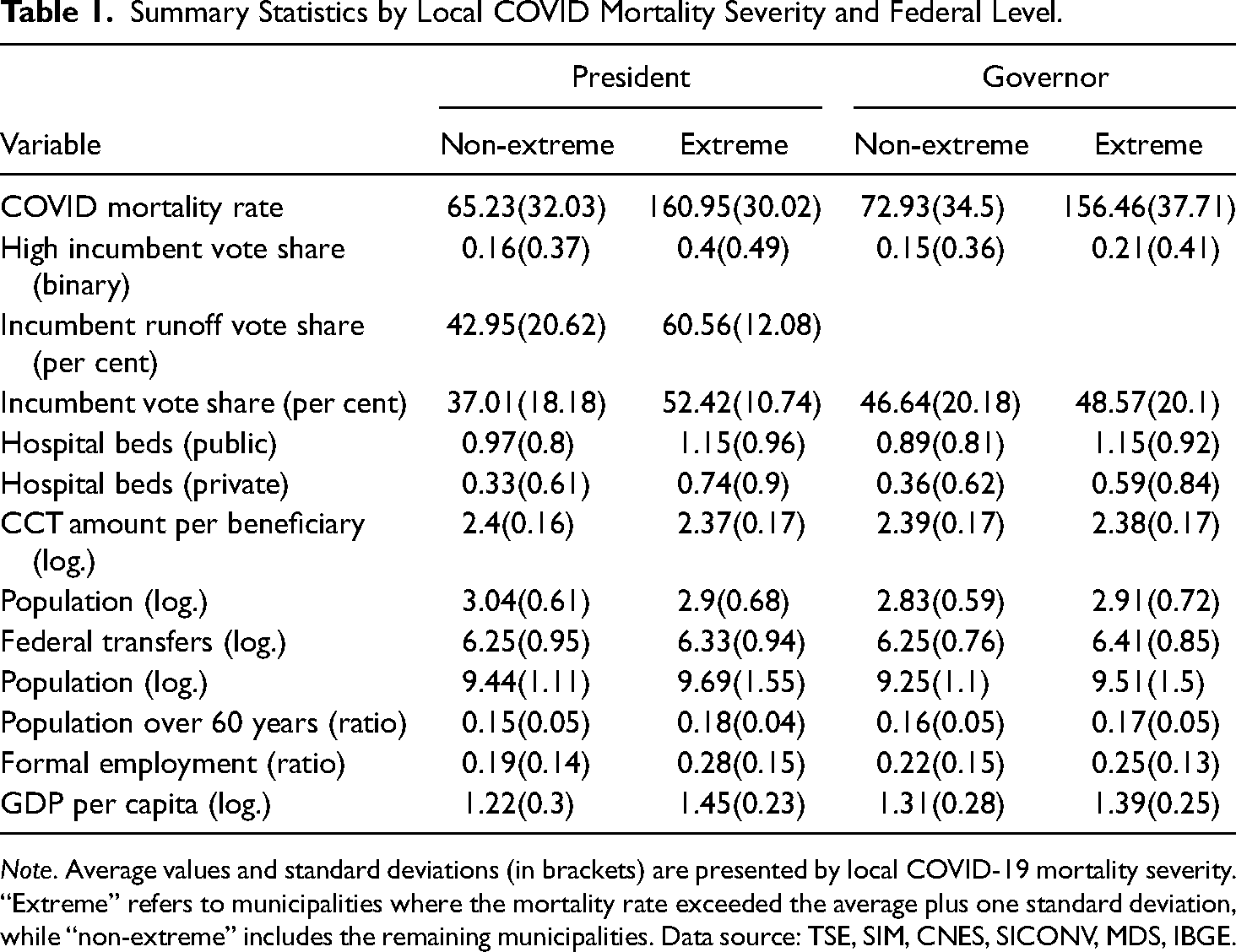
Note. Average values and standard deviations (in brackets) are presented by local COVID-19 mortality severity. “Extreme” refers to municipalities where the mortality rate exceeded the average plus one standard deviation, while “non-extreme” includes the remaining municipalities. Data source: TSE, SIM, CNES, SICONV, MDS, IBGE.
Survey Data
Blame Attribution
The survey provides information about blame attribution, which directly captures how voters assign responsibility for the pandemic's impacts. The survey asked respondents to identify the main party responsible for these outcomes, with choices including the president, state governors, city mayors, all or none. This variable allows us to directly test the cognitive and partisan mechanisms that drive voter accountability.
Information and Partisanship
To test the Informational Mediation hypothesis, we use the voters’ information awareness and their perception of government performance. These include a measure of respondents’ attention to the CPI into the pandemic response and their perception of a lack of control over the pandemic's spread. We expect that voters with greater information exposure will be more likely to assign blame to the relevant authorities.
To test the Partisan Bias hypothesis, our key independent variables measure pre-existing political preferences. We use indicators of partisanship with the most prominent opposition party to Bolsonaro government, the Workers’ Party (PT), and respondents’ rejection of its leader, Lula. These variables allow us to determine the extent to which partisan preferences predict how voters attribute responsibility for the crisis.
Electoral Behaviour
To complement the electoral analysis, we leverage a question on vote intention for President Bolsonaro from the survey. By using this as a final dependent variable, we can directly test whether the blame attributed to the president, as shaped by information and partisan bias, influences voting behaviour. This provides a crucial micro-level link that helps explain the aggregate patterns observed in the election results.
The survey also contains important demographic and socioeconomic variables such as income, gender, education, and whether the respondent was a beneficiary of the Emergency Aid program. These are included in our models as control variables to account for potential confounding factors. Table 2 provides a detailed description and descriptive statistics for all variables used in the survey analysis, categorised by how respondents assigned blame. Most of the respondents (46.9%) attributed primary responsibility for the pandemic's impacts to the president, followed by state governors (18.2%). The table also details the distribution of our key independent variables related to partisanship and information awareness, along with the demographic controls.
Summary Statistics of Survey Data.
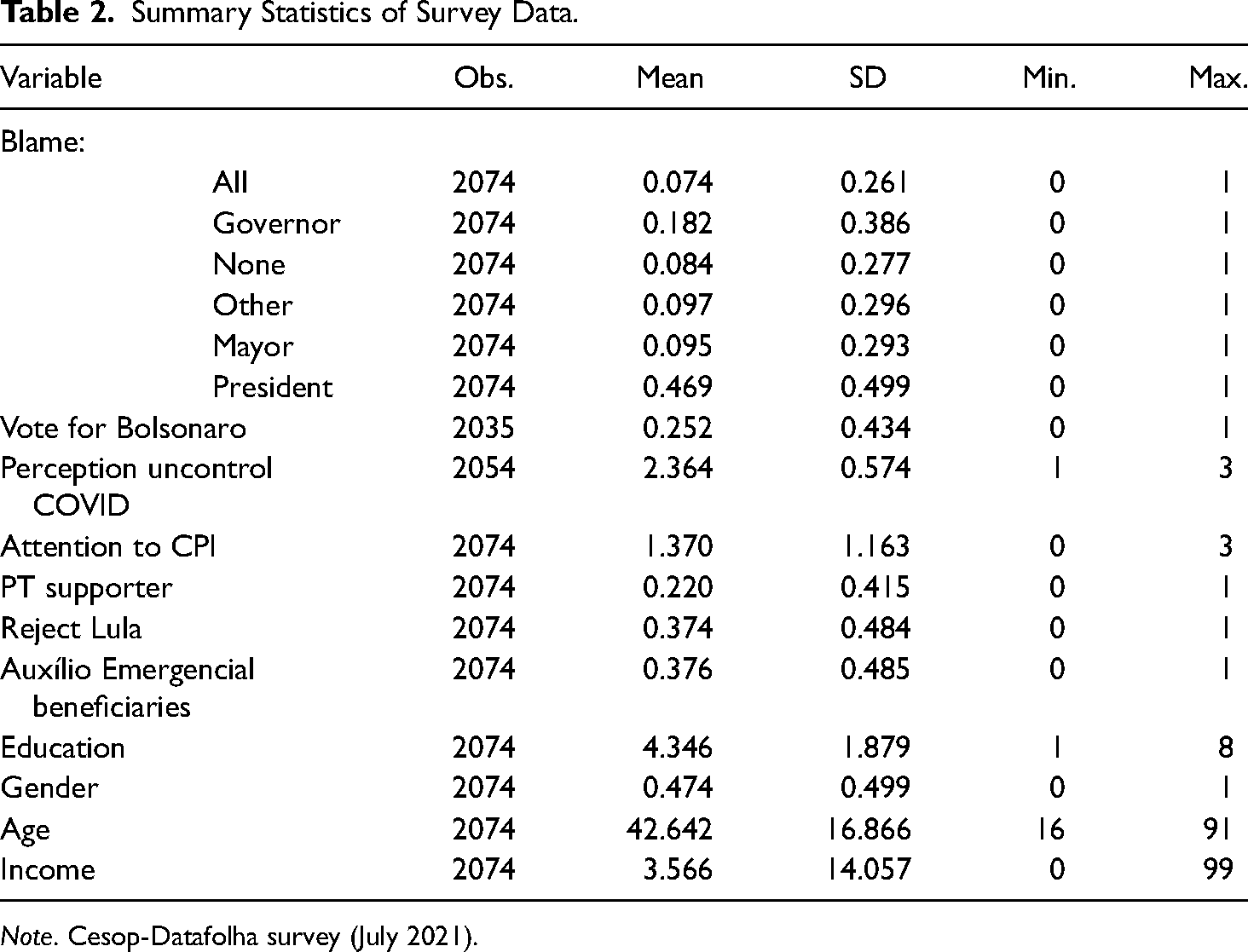
Note. Cesop-Datafolha survey (July 2021).
Empirical Strategy
Our empirical combines an analysis of electoral results with a micro-level analysis of survey data. To evaluate the Blame Attribution and Partisan Bias hypotheses, we use a Difference-in-Differences (DiD) model to assess the electoral performance of incumbents between municipalities that had a high level of COVID mortality and ones that had a lower level. To test the Partisan Bias hypothesis specifically, we extend this framework by introducing an interaction term between COVID severity and the political alignment of state governors with the president. Second, we analyse survey data using multinomial logistic regression to test the Informational Mediation and Partisan Bias hypotheses by examining how individual-level information exposure and partisan preferences predict who voters hold responsible for the pandemic. The following sections detail the specification of each model.
Aggregate Level: Election
Model Specification for Blame Attribution Hypothesis
We applied the DiD causal inference method to investigate the effect of COVID-19 on voting behaviour for incumbents. This approach compares outcomes for the treatment group (municipalities more affected by COVID-19) and the control group (municipalities less or normally affected by the pandemic) before and after the intervention (the pandemic) to estimate the causal effect of the treatment.
We estimate the following DiD model for the presidential election:
In which Vote represents the percentage of votes for the incumbent president or governor in the runoff in municipality i in year t. The binary variable Treatment indicates whether a municipality was severely affected by COVID-19 (defined as having mortality rates above the mean plus one standard deviation from the municipal distribution). According to the Blame Attribution hypothesis, we expect
Model Specification for Party Cues Hypothesis
To test the Party Cues hypothesis, we modify the Model 1 by adding an interaction term with political alignment between the governor's political alignment with the incumbent president.
Here, Align is a binary variable indicating whether the incumbent governor in state of the municipality i was politically aligned with President Bolsonaro. Thus, the coefficient of interest,
Robustness Checks
To account for the continuous variation in COVID-19's impact, we employ a more robust DiD approach using a discretised indicator of mortality. Since traditional Two-Way Fixed Effects (TWFE) methods can introduce bias with multiple treatment levels (de Chaisemartin and D’Haultfœuille, 2020), we apply the dynamic DiD estimator proposed by de Chaisemartin and D’Haultfœuille (2020), known as DiDL, which is designed for treatments with varying intensities. We use mortality quintiles as our treatment doses for this analysis.
Although our preferred estimation uses a restricted sample to ensure similar political preferences, we also implement several placebo and robustness tests. For the presidential election, we test for parallel trends by using the vote share of the main presidential opponent to the PT between 2014 and 2022 as the dependent variable. Following standard practice in voting behaviour studies (Baccini et al., 2021; Fernandes and Fernandes, 2022), we conduct an additional placebo test on pre-pandemic elections (2010 and 2014), using the vote share of the main opposition party to ensure our findings are not spurious. We also conduct the analysis using alternative definitions for the treatment and control groups and using age-adjusted mortality rates.
Survey Analysis: Electorate Perception
Model Specification for Informational Mediation and Partisan Bias Hypothesis
To elucidate the possible mechanisms underlying the results of the DiD analysis, we propose using cross-sectional survey data to assess the validity of the partisan bias and informational mediation hypotheses. These hypotheses are evaluated through a multinomial logistic regression model:
where Blame is the choice j of blame attribution related to pandemic of individual i among the president, state governors, mayors, all, none and others. To test the Informational Mediation hypothesis, we added the A level of attention in relation to CPI (discrete variable where 0 represents not informed, 1 – not aware, 2 – misinformed, 3 – partially informed, and 4 – well informed). To assess partisan bias, we included two variables that capture political polarisation in Brazil: identification with the PT, the most popular party in the country, and R rejection of its presidential candidate, Lula. To verify whether partisan bias nullifies the potential effects of access to information, we added the interaction of R * A. We also added C the perception of lack of control of the pandemic (discrete variable in which 1 represents the perception of being totally controlled, 2 – partially, 3 – out of control). Additionally, we included controls for Auxílio Emergencial beneficiaries, education, gender, and income. Since the marginal effects of this model may not necessarily align with the signs of the estimated coefficients, we present the marginal effects and confidence intervals graphically for clarity.
Model Specification for Linking Blame Attribution on Vote Behaviour
To determine whether the pandemic influenced voting decisions, we employed the following logistic regression model:
In this model, the intention to vote for Bolsonaro (1) or not (0) is explained by B, blame attribution to the president, and
Results
Local COVID Impact on Elections
Presidential Elections
The results for the presidential election provide support for the Blame Attribution hypothesis. As shown in Table 3, where we estimate the Model 1 (DiD) on the municipal vote share of Bolsonaro. The incumbent President Bolsonaro experienced a statistically significant decline in electoral support in municipalities with higher local COVID-19 mortality rates.
Impact of Extreme COVID Mortality on the Vote Share for Incumbent President.
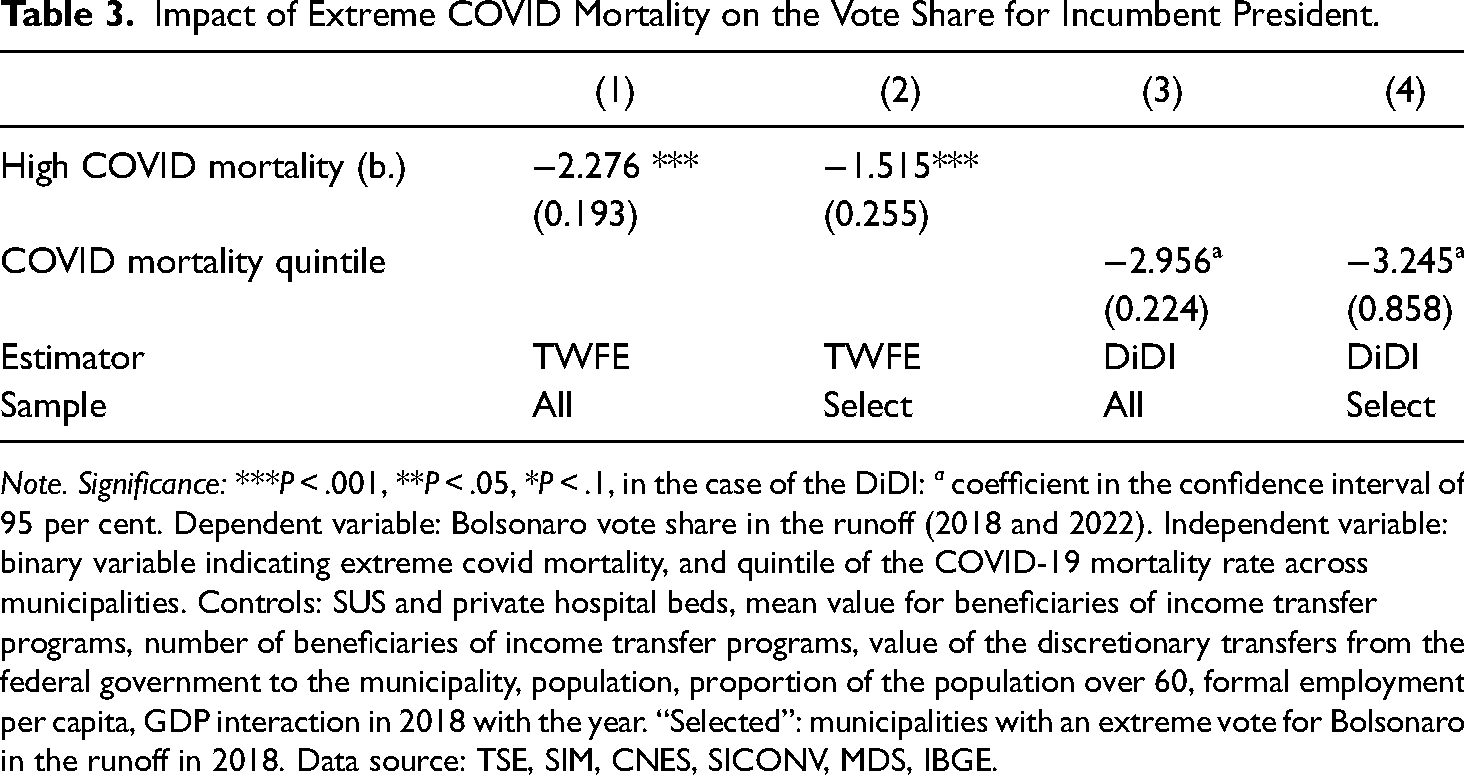
Note. Significance: ***P < .001, **P < .05, *P < .1, in the case of the DiDl: ª coefficient in the confidence interval of 95 per cent. Dependent variable: Bolsonaro vote share in the runoff (2018 and 2022). Independent variable: binary variable indicating extreme covid mortality, and quintile of the COVID-19 mortality rate across municipalities. Controls: SUS and private hospital beds, mean value for beneficiaries of income transfer programs, number of beneficiaries of income transfer programs, value of the discretionary transfers from the federal government to the municipality, population, proportion of the population over 60, formal employment per capita, GDP interaction in 2018 with the year. “Selected”: municipalities with an extreme vote for Bolsonaro in the runoff in 2018. Data source: TSE, SIM, CNES, SICONV, MDS, IBGE.
In the full sample of municipalities (Column 1), high mortality was associated with a 2.28 percentage point reduction in Bolsonaro's vote share. More notably, our preferred “hard test” specification (Column 2), which focuses only on municipalities with strong prior support for the incumbent, still reveals a significant electoral loss of 1.52 percentage points. This finding is particularly compelling as it indicates that blame attribution occurred even among the president's core constituencies.
These findings are robust to a more nuanced dosage-response model (Columns 3 and 4). Using the DiDl estimator with mortality quintiles, we find a similarly negative effect. Each one-quintile increase in COVID-19 mortality is associated with a vote share reduction of 2.96 percentage points in the full sample and 3.25 percentage points in the selected sample. Taken together, these results consistently show that voters held the incumbent president electorally accountable for the severe outcomes of the pandemic.
Gubernatorial Election
In contrast to the presidential results, we find no consistent evidence to support the Blame Attribution hypothesis for state-level incumbents. The electoral performance of incumbent state governments in municipalities most affected by COVID-19 did not differ significantly from that in other municipalities. Results of the estimation of Model 1 on the vote share of incumbent governors at the municipal level are displayed in Table 4. This result holds even when focusing on municipalities where the governor received the highest vote share in their initial election. However, when accounting for the continuous nature of COVID-19 mortality rates, there is a 3.68 p.p decline in vote share for each increase in COVID-19 mortality quintile. Nevertheless, in the preferred sample, no significant difference is observed, although the estimated coefficient remains negative.
Impact of Extreme COVID Mortality on the Incumbent Governor Vote Share.
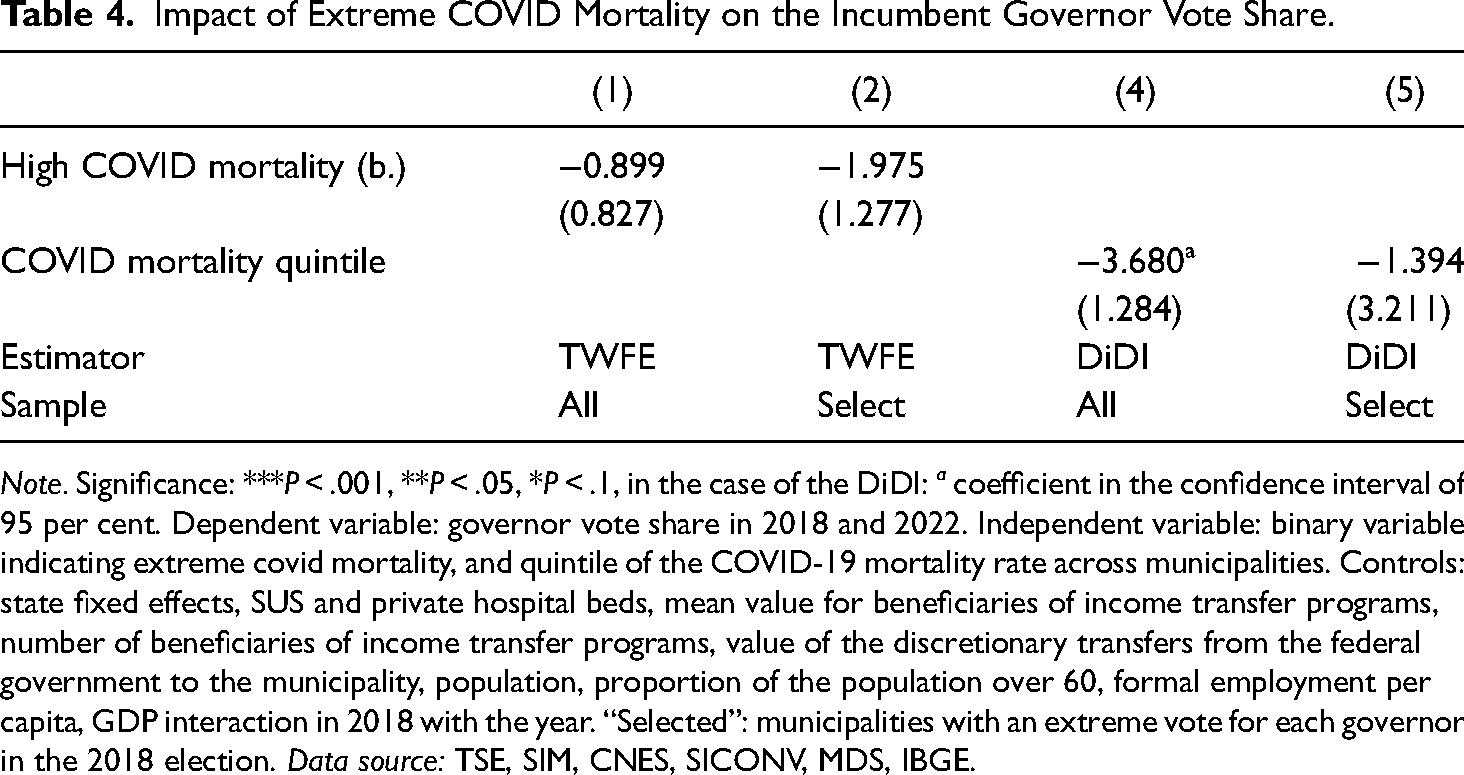
Note. Significance: ***P < .001, **P < .05, *P < .1, in the case of the DiDl: ª coefficient in the confidence interval of 95 per cent. Dependent variable: governor vote share in 2018 and 2022. Independent variable: binary variable indicating extreme covid mortality, and quintile of the COVID-19 mortality rate across municipalities. Controls: state fixed effects, SUS and private hospital beds, mean value for beneficiaries of income transfer programs, number of beneficiaries of income transfer programs, value of the discretionary transfers from the federal government to the municipality, population, proportion of the population over 60, formal employment per capita, GDP interaction in 2018 with the year. “Selected”: municipalities with an extreme vote for each governor in the 2018 election. Data source: TSE, SIM, CNES, SICONV, MDS, IBGE.
Therefore, the evidence suggests that voters did not systematically hold their state governors electorally accountable for the severity of the pandemic in the same way they did the president. This indicates that voters appear to differentiate blame across different levels of government. An analogous analysis for the 2,020 mayoral elections, presented in Table S3 in the Supplementary Material due to the different electoral timing, yielded similarly null results, further indicating a differentiation of blame.
Robustness Tests
To ensure the validity of our findings, we conducted robustness tests, beginning with an assessment of the crucial parallel trends assumption. Since term limits prevent a direct pre-treatment test, we use the 2014 vote share for Aécio Neves, the main presidential opponent before Bolsonaro, as a proxy (0.85 Pearson correlation between Bolsonaro and Aécio). A dynamic DiD analysis, shown in Figure 1, validates this approach by confirming that pre-existing trends disappear when we restrict the sample to comparable municipalities. This test not only supports our research design but also reinforces our core finding: Bolsonaro faced a significant electoral penalty in municipalities with higher COVID-19 mortality.
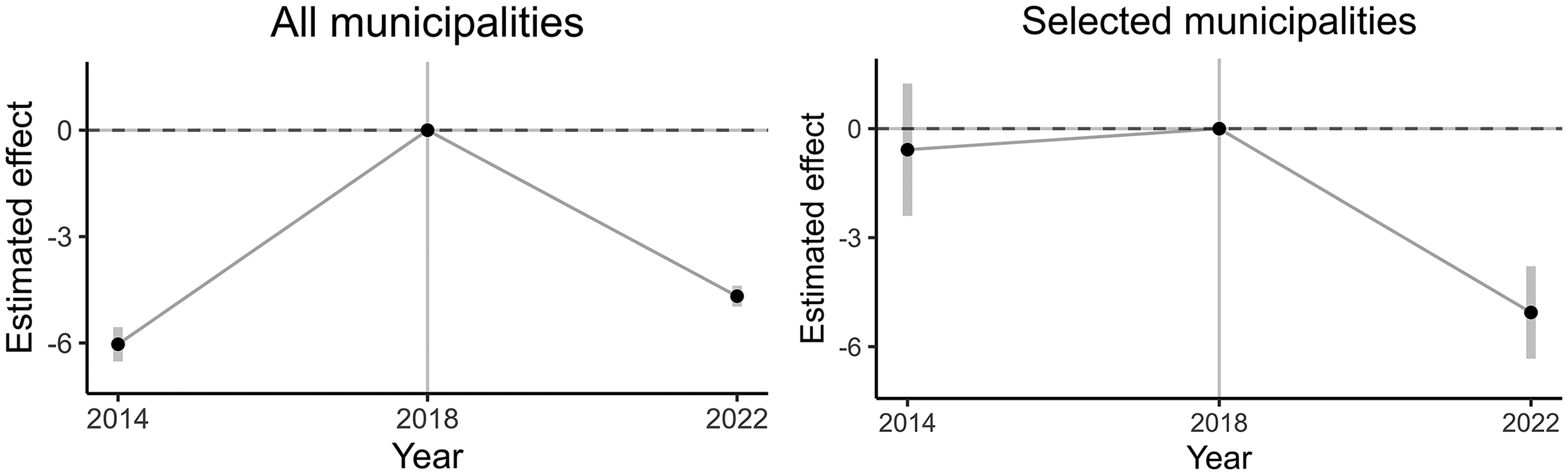
Dynamic Effects of Quintile COVID Mortality on PT Rivals Second Turn Vote Share.
Our results are robust to a placebo test and several alternative specifications, detailed in the Supplementary Material (Table S5). A placebo test using pre-pandemic elections (2010 and 2014) shows no relationship between current mortality rates and historical voting patterns, confirming our findings are not spurious. The results also remain consistent when using first-round vote shares, applying a different sample selection criterion, and using the crude death rate. The consistency of these results across multiple tests strengthens our confidence in our central claim.
Party Cues
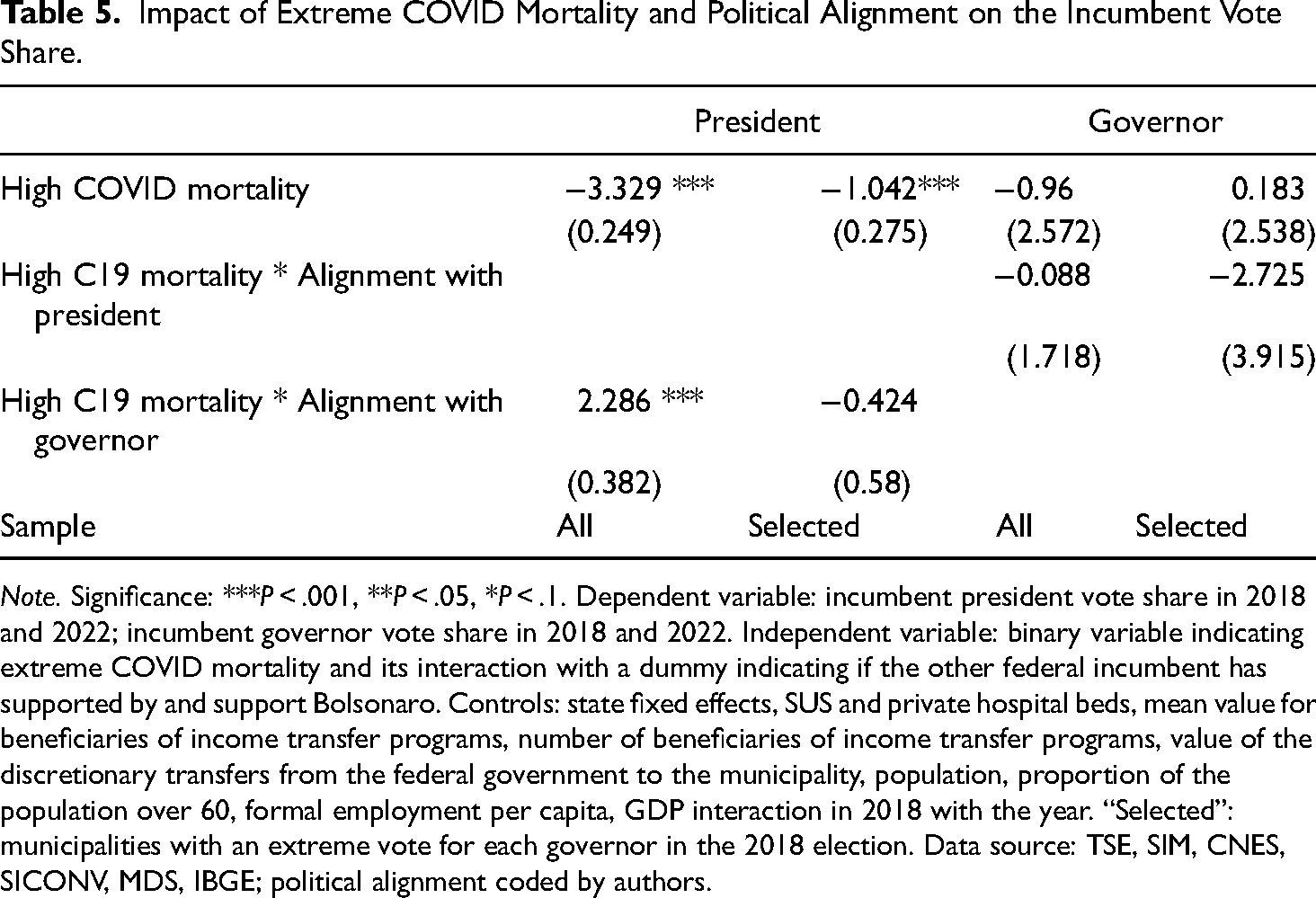
We test the Party Cues hypothesis by examining whether alignment across different levels of government conditioned the electoral consequences of the pandemic. As shown in Table 5, we find no clear evidence that these party cues influenced voter behaviour.
Impact of Extreme COVID Mortality and Political Alignment on the Incumbent Vote Share.
Note. Significance: ***P < .001, **P < .05, *P < .1. Dependent variable: incumbent president vote share in 2018 and 2022; incumbent governor vote share in 2018 and 2022. Independent variable: binary variable indicating extreme COVID mortality and its interaction with a dummy indicating if the other federal incumbent has supported by and support Bolsonaro. Controls: state fixed effects, SUS and private hospital beds, mean value for beneficiaries of income transfer programs, number of beneficiaries of income transfer programs, value of the discretionary transfers from the federal government to the municipality, population, proportion of the population over 60, formal employment per capita, GDP interaction in 2018 with the year. “Selected”: municipalities with an extreme vote for each governor in the 2018 election. Data source: TSE, SIM, CNES, SICONV, MDS, IBGE; political alignment coded by authors.
We first assess the “bottom-up” cue: the effect of COVID-19 on the Bolsonaro vote share in municipalities that the governor was allied with him. In the full sample (Column 1), high mortality was associated with a 3.33 percentage point decrease in President Bolsonaro's vote share. However, this penalty was significantly weaker (by 2.29 percentage points) in municipalities where the governor was an ally. However, this effect disappears in “selected” sample (Column 2), indicating the finding is not robust.
We then test the “top-down” cue: whether governors were punished differently based on their alignment with the president. The results in Columns 3 and 4 show no statistically significant effect. Governors’ vote shares were not impacted by their alignment with the president in high-mortality areas. These results do not change if we use the party as cue, as displayed in Table S4 in the Supplementary Material. In summary, our analysis does not provide robust support for the hypothesis that voters used cross-level party alignments to assign blame during the 2022 election.
Survey Analysis
Information Mediation and Partisan Bias Hypothesis
The results from the DiD analysis at each federal level indicate that only the incumbent president was penalised for worse pandemic outcomes. However, it cannot fully capture individual-level reasoning or exposure to the crisis. As a result, survey analysis becomes essential to address these limitations and to explore the potential mechanisms underlying the main findings of aggregated election analysis (Gélineau and Remmer, 2006).
We first test the Informational Mediation and Partisan Bias hypotheses using a multinomial regression model to predict whom voters blame for the pandemic. The marginal effects, presented graphically in Figure 2, reveal how both information and partisanship shape this process.
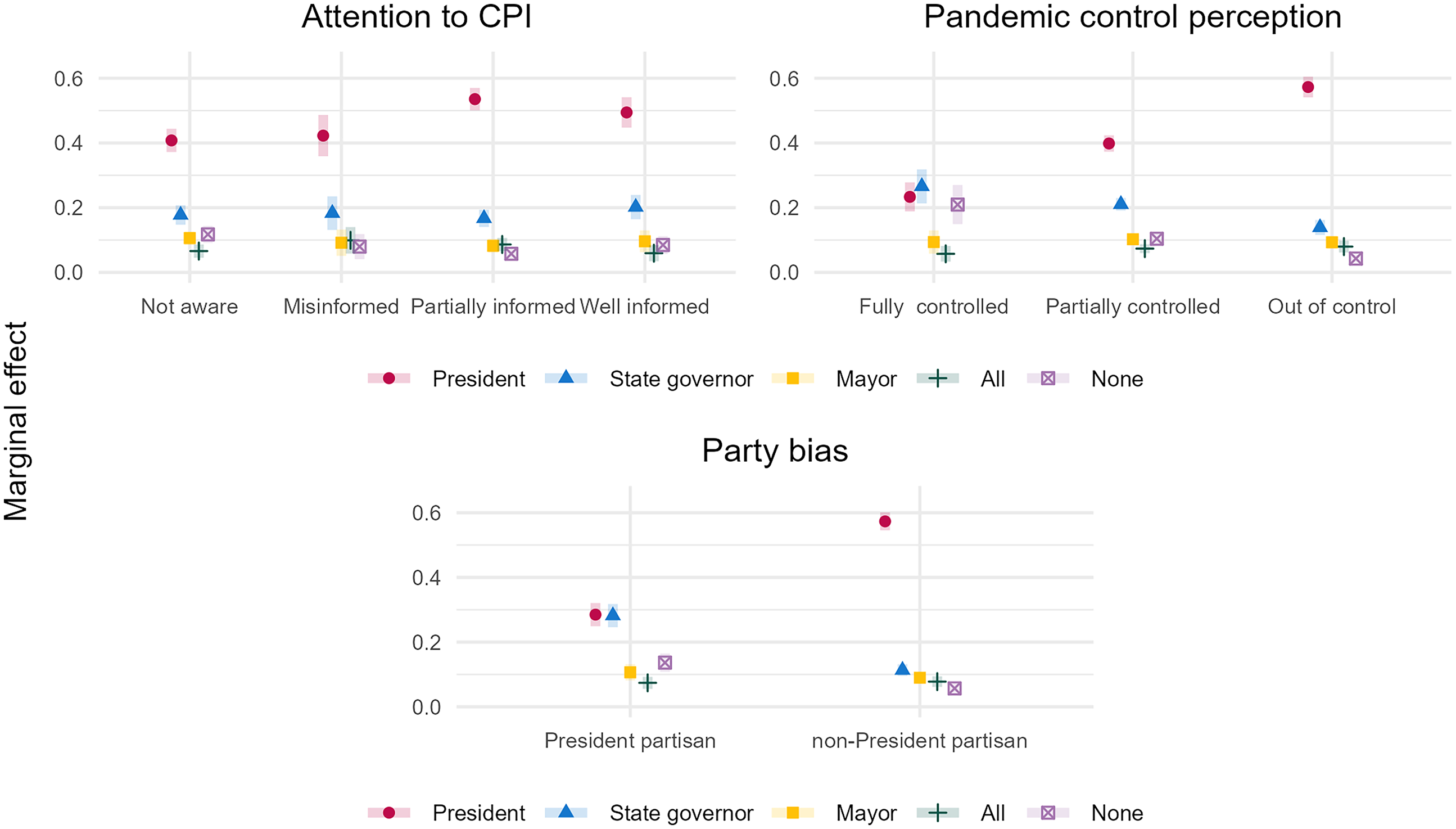
Marginal Effects of Multinomial Regression on Blame Attribution.
Supporting the Informational Mediation hypothesis, we find that information exposure is a strong predictor of accountability. Attention to the COVID-19 Parliamentary Inquiry (CPI), our proxy for awareness of the president's specific actions, is associated with a higher likelihood of blaming the president. Well-informed individuals were 12.5 percentage points more likely to blame the president compared to those unaware of the CPI. Similarly, individuals who perceived the pandemic as “out of control” were 34.4 percentage points more likely to blame the president. These findings suggest that greater awareness of government performance directed blame toward the federal executive.
As expected by the Partisan Bias hypothesis, pre-existing political preferences also played a decisive role. Figure 2 shows that partisan preferences strongly influenced blame attribution, often leading voters to assign responsibility away from their preferred candidates. This confirms that both information and partisan filtering were at play in shaping voter assessments.
Linking Blame Attribution to Electoral Behaviour
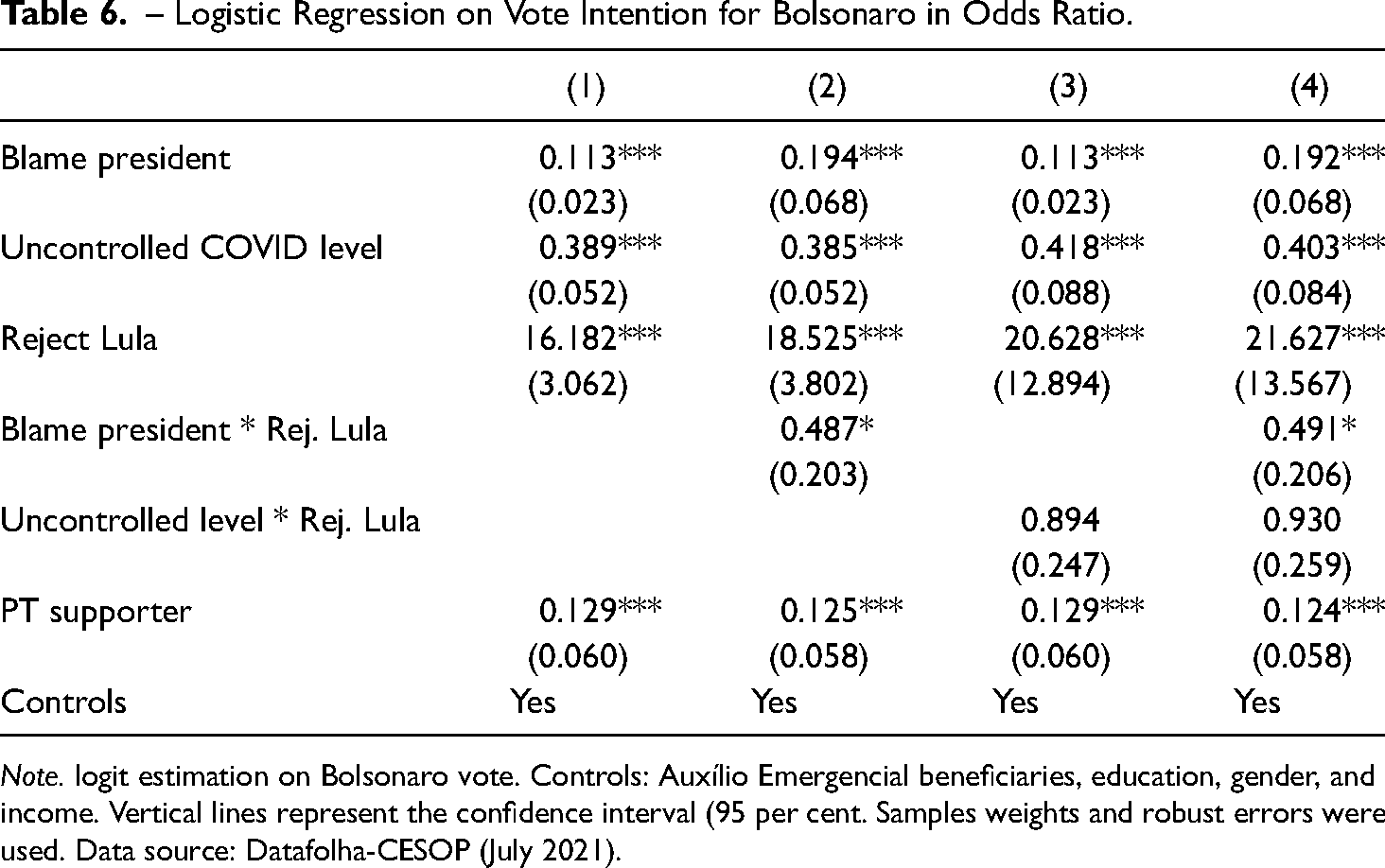
Finally, we test whether this blame attribution translates into tangible electoral consequences. Table 6 presents the results of a logistic regression model predicting the intention to vote for President Bolsonaro. The evidence is clear: blaming the president for the pandemic dramatically reduces the odds of voting for him by 88.7% (Regression 1). This powerful effect holds across all specifications. Likewise, perceiving a lack of control over the pandemic reduced the odds of voting for Bolsonaro by 61.1%.
– Logistic Regression on Vote Intention for Bolsonaro in Odds Ratio.
Note. logit estimation on Bolsonaro vote. Controls: Auxílio Emergencial beneficiaries, education, gender, and income. Vertical lines represent the confidence interval (95 per cent. Samples weights and robust errors were used. Data source: Datafolha-CESOP (July 2021).
The model also confirms the immense influence of partisanship on voting choice, as both rejection of Lula and support for the PT are highly significant predictors. Crucially, even when controlling for these strong partisan attachments, the direct effect of blaming the president remains large and significant. This provides powerful micro-level evidence that complements our aggregate findings, demonstrating that voters’ assessments of the incumbent's handling of an exogenous shock had a direct and substantial influence on their voting behaviour.
Discussion
This study investigated how voters assign accountability during a national crisis within a multilevel governance system. By analysing the electoral impact of the COVID-19 pandemic in Brazil and the micro-level mechanisms of voter reasoning, we tested four key hypotheses concerning blame attribution, partisan cues, informational mediation, and partisan bias. Our results, summarised in the findings Table 7, demonstrate that during crises, voters in democratic systems utilise available information to attribute blame across different levels of government, moving beyond simpler heuristics such as partisan bias or blind retrospection.
Summary of Findings.
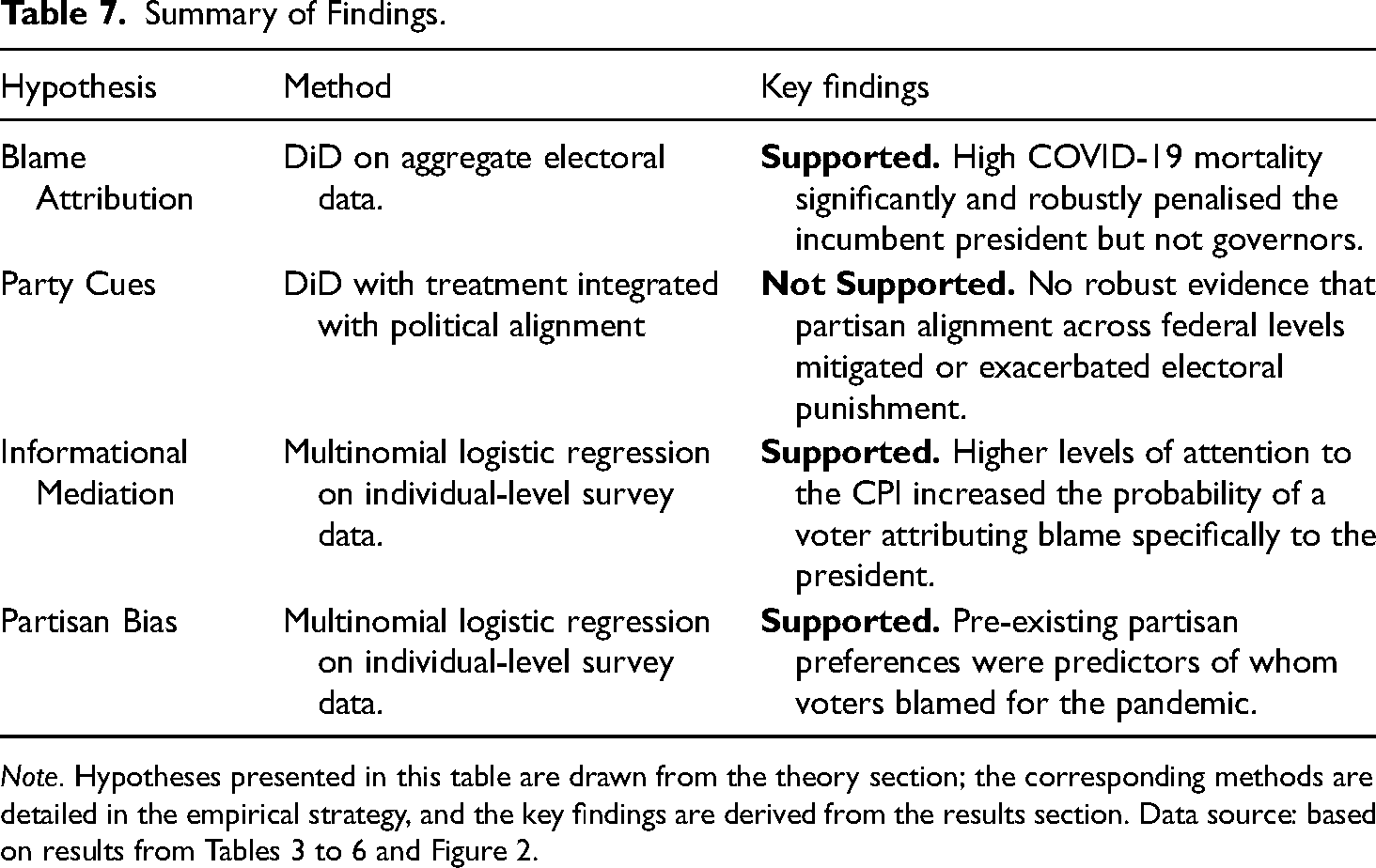
Note. Hypotheses presented in this table are drawn from the theory section; the corresponding methods are detailed in the empirical strategy, and the key findings are derived from the results section. Data source: based on results from Tables 3 to 6 and Figure 2.
In support of our Blame Attribution hypothesis, the findings reveal that electoral accountability was sharply focused on the federal executive. The incumbent president suffered a direct and robust electoral penalty, losing up to 3.25 percentage points in his vote share in municipalities with higher COVID-19 mortality. In contrast, governors were not affected by the pandemic excess mortality. This concentration of blame aligns with literature suggesting voters hold the level of government with the greatest perceived power and visibility most accountable during a crisis (Maestas et al., 2008) and is consistent with growing public distrust in the Brazilian federal government as the primary decision-making authority (Ferrari et al., 2024). Trevisan and de Moura (2024) identified comparable evidence, asserting that Bolsonaro's management of the pandemic was an important factor contributing to losing the election. However, the findings diverge from those of Pignataro (2021), who shows that in Costa Rica, the number of contagions is unrelated to the chance of presidential approval.
This concentration of responsibility at the federal level can be explained by the central role of the federal executive in managing national crises and the heightened visibility of presidential actions, which are amplified by media coverage. Our analysis provides a clear explanation for this focused accountability, lending strong support to the Informational Mediation hypothesis. The survey data confirms that voters who were more informed about federal government actions, particularly those attentive to the COVID-19 CPI, were more likely to blame the president. This suggests that voters did not punish blindly; rather, they used available information to make their assessments, reinforcing the theory of an attentive electorate capable of making reasoned judgments even in complex crises.
In contrast, the lack of electoral punishment for governors, even in high-mortality areas, highlights a crucial dynamic. For governors, the overlapping responsibilities inherent in federal systems may have diluted the clarity of who should be held accountable, consistent with studies on accountability in decentralised contexts (Anderson, 2006; Rudolph, 2003). We argue that media coverage is the critical factor differentiating between the two executives: while the intense national media spotlight created a clear, if simplified, narrative centred on the president's role, the more fragmented coverage of state-level responses failed to cut through the ambiguity of these overlapping duties. Without a strong informational signal from the media clarifying their specific responsibilities, voters defaulted to holding only the most visible actor accountable.
The study also assessed the role of partisan alignment as a cognitive shortcut for voters, the Party Cues hypothesis, where voters might use party affiliation to assign punishment to other levels within federalism. Our findings show that partisan alignment across federal levels did not consistently mitigate or exacerbate electoral punishment. However, at the individual level, the Partisan Bias hypothesis was strongly supported. The survey analysis confirms that pre-existing partisan preferences were a powerful filter in determining whom an individual blamed for the pandemic. Nevertheless, the electoral impact of blaming the president or perceiving mismanagement remained large and significant even after accounting for partisanship. Thus, the analysis suggests that voters’ performance evaluations, guided by information, prevailed over party cues in their voting decisions and remained important even after accounting for political preferences.
In summary, the study shows that in situations with multiple levels of government and complicated problems, how voters hold leaders accountable depends on how visible their actions are, how the public views their authority, and how clear their responsibilities are. The concentrated punishment at the federal level underscores the influence of centralised decision-making on voter behaviour during crises. In contrast, limited impact at subnational levels reflects the complexities of divided competencies and the reduced prominence of these actors in crisis management. This dynamic underscore the significance of educated, contextualised judgments in establishing accountability, as scattered responsibilities within federal systems can undermine electoral responsibility at local and state levels. These findings carry critical implications for crisis management in federative systems, suggesting that enhancing the clarity of responsibilities across government levels and improving the dissemination of information about subnational actions could mitigate voter reliance on federal visibility alone.
Conclusion
This study examined how voters attribute responsibility during crises in federative systems, focusing on Brazil during the COVID-19 pandemic. The findings reveal a concentrated pattern of electoral punishment directed at the incumbent president in municipalities with higher COVID-19 mortality rates, indicating that voters held the federal executive accountable for the pandemic's outcomes. Survey results further highlight the mediating role of information, showing that voters who were more aware of federal government actions were significantly more likely to attribute blame to the president.
These results contribute to the literature by illustrating how crises amplify the centrality of federal executives in voter evaluations while shielding subnational leaders from equivalent scrutiny. They also emphasise the importance of institutional design and media coverage in shaping patterns of blame attribution. Moreover, voters in federative systems utilise available information to navigate the complexities of multilevel governance, often focusing accountability on actors with higher visibility and perceived authority. This nuanced understanding of voter behaviour challenges simpler heuristics, such as blind retrospection or partisan cues, and contributes to a deeper comprehension of democratic accountability in times of crisis.
However, the study is not without limitations. The lack of individual-level survey data for state and municipal elections constrains a deeper exploration of voter perceptions at subnational levels. Furthermore, the inability to replicate robustness checks for gubernatorial and mayoral elections limits the scope of conclusions regarding blame attribution in these contexts. Future research should address these gaps to provide a more comprehensive understanding of electoral accountability across federative systems.
Supplemental Material
sj-docx-1-pla-10.1177_1866802X251390577 - Supplemental material for Who Do Voters Blame in Times of Crisis? Electoral Accountability in Brazil's Federalism During COVID-19
Supplemental material, sj-docx-1-pla-10.1177_1866802X251390577 for Who Do Voters Blame in Times of Crisis? Electoral Accountability in Brazil's Federalism During COVID-19 by Lucas Falcão, Rayane Vieira Rodrigues and Fernando Luiz Abrucio in Journal of Politics in Latin America
Supplemental Material
sj-7z-2-pla-10.1177_1866802X251390577 - Supplemental material for Who Do Voters Blame in Times of Crisis? Electoral Accountability in Brazil's Federalism During COVID-19
Supplemental material, sj-7z-2-pla-10.1177_1866802X251390577 for Who Do Voters Blame in Times of Crisis? Electoral Accountability in Brazil's Federalism During COVID-19 by Lucas Falcão, Rayane Vieira Rodrigues and Fernando Luiz Abrucio in Journal of Politics in Latin America
Footnotes
Acknowledgements
This research was supported by the São Paulo School of Business Administration of the Getulio Vargas Foundation (FGV).
Additional Identifying Information
This work was previously presented at the
Author Contributions
Lucas Falcão: conceptualisation, methodology, validation, formal analysis, investigation, writing – original draft, writing – review and editing. Rayane Vieira Rodrigues: conceptualisation, methodology, validation, formal analysis, investigation, writing – original draft, writing – review and editing. Fernando Luiz Abrucio: writing – original draft, writing – review and editing, funding acquisition.
Data Availability Statement
The data used in this study will be made available in a relevant public data repository and are appropriately cited within the manuscript.
Declaration of Conflicting Interest
The authors declared no potential conflicts of interest with respect to the research, authorship, and/or publication of this article.
Ethical Approval and Informed Consent Statements
This study does not involve human subjects, and ethical approval was therefore not required.
Funding
The authors disclosed receipt of the following financial support for the research, authorship, and/or publication of this article: This work was supported by the São Paulo School of Business Administration of the Getulio Vargas Foundation (FGV).

Supplemental Material
Supplemental material for this article is available online.
Author Biographies
References
Supplementary Material
Please find the following supplemental material available below.
For Open Access articles published under a Creative Commons License, all supplemental material carries the same license as the article it is associated with.
For non-Open Access articles published, all supplemental material carries a non-exclusive license, and permission requests for re-use of supplemental material or any part of supplemental material shall be sent directly to the copyright owner as specified in the copyright notice associated with the article.

