




Abstract
Has social assistance expansion contributed to political inclusion in Latin America? The current literature favours a “policy exchange” approach, hypothesising that social assistance is an electoral asset exploited by governing coalitions. The findings from this literature are mixed. The article proposes an alternative approach emphasising political inclusion. In unequal societies where economic cooperation is regulated by institutions generating inequality and disadvantage, social assistance contributes to the political inclusion of disadvantaged groups. Analysis of Latin American Public Opinion Project data for 2010 to 2019 data finds support for this hypothesis.
Latin America has led a remarkable expansion of social assistance in the past two decades. Social assistance consists of budget-financed programmes and policies addressing poverty, vulnerability, and exclusion. A large and growing literature examines the design and effectiveness of social assistance in the context of poverty reduction (Bastagli et al., 2016; Cecchini and Atuesta, 2017; Stampini and Tornarolli, 2012). By comparison, a smaller but important literature has studied political outcomes associated with the rise in social assistance. 1 The bulk of the existing literature on this issue adopts a policy exchange approach, with social assistance taken as an instrument of electoral advantage. The findings from this literature are mixed. This article proposes an alternative hypothesis emphasising political inclusion. In unequal societies in which economic cooperation is regulated by institutions generating inequality and disadvantage, large-scale and rules-based social assistance has the potential to facilitate the political inclusion of disadvantaged groups. The study sketches a conceptual approach to the linkages between social assistance and political inclusion of disadvantaged groups and examines empirically whether it can be productively applied to Latin America.
Focusing on Latin America has several advantages for our purposes. First, the region is characterised by high levels of inequality and disadvantage. Second, the recent expansion of social assistance began earlier, and has been deeper, than in other developing regions. Today, social assistance programmes reach between a quarter and a third of the population in the region (Barrientos, 2018) and are managed by dedicated Ministries of Social Development or high-level agencies (Abramo et al., 2019). Third, social assistance is not the product of evolutionary change in pre-existing institutions. In fact, it has emerged in the context of mature occupational insurance institutions.
The literature on the politics of social assistance expansion in the region has focused on its role as an electoral tool, paying close attention to the incentives and motivations of governing coalitions. I describe this as a policy exchange approach. To date, the findings from this literature are mixed, at best. They have generated more questions than reliable answers. Modern social assistance programmes are rules-based, but it is unclear that rules-based instruments best facilitate electoral manipulation, compared to public goods, for example (Díaz-Cayeros et al., 2016). Confirmatory evidence on strategic allocation of budgets and programme coverage is scarce. The spatial distribution of programme budgets and places often fails to match core voter or swing voter predictors (Fried, 2012). Studies show that programme participants do support incumbents, but several diverging interpretations for this finding are available (Corrêa and Cheibub, 2016; Layton and Smith, 2011). Available research offers, at best, mixed support for the hypothesis that the expansion of social assistance in the region is solely, or primarily, explained by short-term electoral gain.
The article proposes an alternative approach focusing on political inclusion. It hypothesises that the expansion of social assistance facilitates political inclusion among disadvantaged groups. Some studies already point in this direction. They find that social assistance programmes raise electoral registration and turnout among participants (Baez et al., 2012; De la O, 2015; Manacorda et al., 2011), or encourage political legitimacy (Layton and Smith, 2015) and citizenship (Hunter and Borges Sugiyama, 2014). 2
The article outlines a framework within which to define the association between social assistance and political inclusion of disadvantaged groups, a framework capable of supporting the main hypothesis and guiding the empirical work. It draws from Rawlsian concerns that in societies where economic cooperation is regulated by institutions generating inequality and disadvantage, sustaining commitment to core institutions is problematic, especially for disadvantaged groups. In these conditions, effective social transfers can help prevent these “strains of commitment” from becoming excessive and ensure the political participation of disadvantaged groups. From this perspective, political inclusion is defined by commitment to core institutions and the role of social assistance in securing it is important.
Analysis of attitudinal data from the AmericasBarometer (Latin American Public Opinion Project [LAPOP], 2020) for the period 2010 to 2019 applies this approach to the region. LAPOP surveys identify respondents participating in social assistance and conditional income transfer programme and report on a wide range of political attitudes. The analysis finds that social assistance and conditional income transfer participants show stronger respect for political institutions compared to non-participants. This is interpreted as lending support to the commitment hypothesis.
The article makes two main contributions to the literature. First, it offers an alternative approach to understanding the political outcomes associated with the expansion of social assistance in Latin America, focused on political inclusion. Second, it focuses on the region as a whole, or at least on the countries with appropriate LAPOP data. This is important because findings for particular countries cannot be validly extrapolated for the region as a whole. 3
This article is organised as follows. “Social Assistance Expansion as Electoral Instrument?” section assesses the literature on the politics of social assistance growth in Latin America and motivates the search for alternatives. “Social Assistance and Political Inclusion in Theory” section develops a framework to study the relationship existing between social assistance and political inclusion. “Social Assistance and Inclusion in Practice” section provides a brief reminder of inclusion outcomes associated with the design and outcomes of social assistance transfers. “Testing for the ‘Commitment’ Hypothesis” section reports on the analysis of LAPOP data. “Discussion” section interprets the findings. A final section concludes.
Social Assistance Expansion as Electoral Instrument?
Most studies researching political outcomes associated with the expansion of social assistance transfers in Latin America start from a policy exchange model of the relationship between governing parties or coalitions on the one hand and target groups on the other. Their main hypothesis is that governing coalitions implement social assistance as an instrument to capture electoral support from potential beneficiaries. Politicians have incentives to use transfer programmes to collect political support among disadvantaged groups. The majority of these studies, based on programme evaluation or attitudinal data, measure voting preferences for incumbents among potential beneficiaries and find support for this hypothesis (Manacorda et al., 2011; Zucco and Power, 2013). It is straightforward to interpret positive pro-incumbent effects within a policy exchange approach. Positive pro-incumbent findings are taken as confirming the presence of some form of vote buying strategy on the part of politicians. 4
However, the policy exchange approach raises important concerns. Policy exchange politicians would be best served by discretionary, reversible, and excludable transfers. They would be well advised to stay clear of non-discretionary, non-excludable, and non-reversible human development income transfers (Díaz-Cayeros and Magaloni, 2009). As Stokes (2009) notes in the context of Brazil, “… ccts allow us to ask how voters behave in the presence of tangible, identifiable and quantifiable benefits…but in the absence of a requirement to vote in a certain way, or to be part of specific networks” (p. 8). Why would political elites opt for rules-based social assistance transfers in preference to public goods and unconditional discretionary transfers? De la O (2015) argues that where the opposition is entrenched in parliament, they may force presidents to adopt rules-based non-discretionary programmes. With respect to conditional income transfers, it is not clear why politicians would favour social investment instruments with medium-term and long-term returns in order to secure short-term support.
Social assistance transfers are not a one-way ticket to electoral success. Sanches Corrêa and Cheibub (2016) argue that the incumbent effect might be a net effect combining mobilisation of apathetic voters and repelling of programme detractors. Social assistance transfers likely add and subtract political support. Nowhere are the estimated electoral effects sufficient to turn national elections in favour of particular parties or candidates. Assessing the contribution of Bolsa Família in the re-election of President Lula in Brazil, studies fail to confirm that it had a deciding role and suggest instead that public perceptions of the strength of the economy were perhaps the primary factor (Bohn, 2011; Hunter and Power, 2007; Shikida et al., 2009; Zucco, 2013; Zucco and Power, 2013). Pro-incumbent effects might depend on context. Electoral effects might be more powerful at the local level (Linos, 2013) perhaps associated with programme implementation (De Janvry et al., 2010).
Relying on social assistance as an electoral strategy would leave a footprint of strategic allocation of budgets or coverage. Matching electoral and Bolsa Família administrative data, Fried (2012) fails to find a correlation between the distribution of Bolsa Família budgets and population coverage on the one hand and indicators of potential core voter or swing voter strategies on the other. The absence of strategic allocation of conditional income transfers is confirmed for Colombia’s Familas en Acción by Nupia (2011).
There is uncertainty over whether the pro-incumbent effect reflects retrospective reward for the politicians who introduced the programme or a prospective concern with preventing reforms to the programme that might affect its continuation. Using LAPOP data covering several Latin American countries, Sanches Corrêa and Cheibub (2016) find that the incumbent effect persists in time for longstanding programmes. Programme participants continue to support incumbents long time after the politicians who introduced the programmes, and their parties, are replaced.
This brief review underlines concerns with the policy exchange framework as a sole, or principal, explanation of political outcomes associated with the growth of social assistance in Latin America.
Studying the political outcomes of social assistance transfers within an inclusion perspective suggest alternative lines of research. Some studies point in this direction. Studies have found programme participation effects on registration and turnout at elections. Baez et al. (2012) find a 1.5 to 2.5 percentage points higher probability of registration and 7 to 9 percentage points higher probability of voting among Colombia's Familias en Acción participants. Layton et al. (2017) draw a distinction between programme participation effects on voting on the one hand, and on attitudes to state legitimacy on the other. 5 They conclude that “… the immediate political consequences of conditional cash transfers (CCTs) are not limited to support for incumbents” (p. 113).
The next section develops a specific framework for examining the association between social assistance participation and political inclusion.
Social Assistance and Political Inclusion in Theory
This section outlines a framework specifying the conditions in which the expansion of rules-based social assistance could contribute to the political inclusion of disadvantaged groups. It explores the linkages between social assistance and political inclusion in the context of societies with economic structures generating poverty and exclusion. The discussion draws from Rawls’ notion of the “strains of commitment” and of the role of the “social minimum” in lending stability to highly unequal societies.
In Political Liberalism (2005), Rawls’ aim was to develop a political notion of justice that could inform a society in which pluralism of values and world views coexisted with economic relations not intrinsically oriented to meeting the needs of the population. In such societies, disadvantage and inequality arise from the workings of the economic system, threatening continued economic cooperation and the stability of core institutions. A political conception of justice requires that the members of society are willing to endorse its core institutions. Yet, in conditions of significant inequality and disadvantage continued commitment to economic cooperation and institutions is problematic, particularly for disadvantaged groups. The “strains of commitment” seriously undermine a political notion of justice. How can disadvantaged, perhaps even chronically disadvantaged, groups be persuaded to remain committed to core institutions?
Rawls’ two principles of justice provide the higher order response: “[(i)] Each person has the same indefeasible claim to a fully adequate scheme of equal basic liberties, which scheme is compatible with the same scheme of liberties for all; and [(ii)] Social and economic inequalities are to satisfy two conditions: first they are to be attached to offices and positions open to all under conditions of fair equality of opportunity; and second, they are to be to the greatest benefit of the least advantaged members of society (the difference principle)” (Rawls, 2001, p. 44). The first principle defines the conditions for equality. The second principle identifies the conditions under which inequalities might be justified.
A social minimum is a key institution giving material effect to the difference principle, “… the difference principle requires a minimum that together with the whole family of social policies, maximises the life prospects of the least advantaged over time” (Rawls, 2001, p. 129). Social transfers are an important component of the social minimum. The social minimum is guaranteed “either by family allowances and special payments for sickness and unemployment, or more systematically by such devices as a graded income supplement (a so-called negative income tax)” (Rawls, 1999, p. 243). 6 A social minimum constitutes the lower order response to the questions raised above.
The social minimum must address the urgent basic needs of disadvantaged groups, 7 but its primary objective goes beyond needs satisfaction. It must facilitate the political inclusion of disadvantaged groups as the only way to ensure the “strains of commitment” are not excessive. Crucially, the social minimum is inclusion-based, not needs-based. In Justice as Fairness, Rawls distinguishes two ways in which disadvantaged groups react when the strains of commitment are excessive: “In the first way we become sullen and resentful, and we are ready as the occasion arises to take violent action in protest against our condition. In this case the least advantaged are bitter, they reject society's conception of justice and see themselves as oppressed. The second way is milder: we grow distant from political society and retreat into our world. We feel left out, and withdrawn and cynical…” (Rawls, 2005, p. 128). Rawls argues that a needs-based social minimum might work to prevent the reaction of disadvantaged groups to the strains of commitment associated in the first way. 8 But preventing the strains of commitment from becoming excessive in the second way “requires that the least advantaged feel they are part of political society” (Rawls, 2001, p. 129). An effective social minimum places the political inclusion of disadvantaged groups and the maximisation of their life prospects at its core. 9
For our purposes, this discussion outlines a helpful framework within which to investigate the association between social assistance and political inclusion of disadvantaged groups. In distinguishing the social minimum from a prudential scheme compensating the unfortunate, it points to a dividing line between social assistance and social insurance. 10 In defining the role of the social minimum as inclusion-based, as opposed to purely needs-based, it defines with greater precision the association between an effective social assistance and the political inclusion of disadvantaged groups. Political inclusion is an expected, and central, outcome of effective social assistance.
Social Assistance and Inclusion in Practice
This brief section establishes that the inclusion of disadvantaged groups is a primary objective behind the expansion of social assistance in Latin America. It underlines three main points: (i) the growth of social assistance has incorporated a large section of the population under social protection institutions; (ii) the design of social assistance programmes pays attention to the need to strengthen the productive capacity of disadvantaged groups as a means of reducing poverty; and (iii) explicit social investment components in conditional income transfer programmes are designed with a view to address intergenerational poverty persistence. These points are sufficiently well-established in the literature and merit only a brief review here.
The expansion of social assistance in Latin America has extended public support to a significant share of the population in the region, largely excluded from social protection institutions. From a very low base in mid 1990s, estimates suggest that social assistance now reaches between a quarter and a third of the population in the region (Barrientos, 2018; Cecchini and Atuesta, 2017). The population groups participating in social assistance programmes include low-income households often dependent on informal employment. They had been excluded from social protection institutions due to the nature of their employment. There are significant issues associated with the conditions of their incorporation. The growth of social assistance has resulted in “vertical,” as opposed to “horizontal” inclusion leading to dual social protection institutions. In all, social assistance expansion has extended the reach of social protection institutions in the region.
Social assistance programmes aim to facilitate the economic inclusion of disadvantaged households. Conditional income transfers are explicitly designed to facilitate improvements in the productive capacity of participant households (Barrientos, 2013). Unconditional transfer programmes, especially social pensions, can also facilitate economic inclusion but their outcomes in this respect are dependent on context (Abramo et al., 2019). For example, old age transfers can facilitate economic inclusion in conditions where pensioners co-reside with their extended households and female pensioners are able to provide care. Importantly, entitlements to social assistance programmes, including old age transfers, are independent of employment status, ensuring that work incentives are minimally affected. 11
The expansion of social assistance in Latin America has focused on two main instruments: budget-financed old age transfers and conditional income transfers. Social assistance programmes have innovated in including social investment components, especially conditional income transfers. The social investment orientation of conditional income transfers, difficult to rationalise in the policy exchange framework, fits in well within an inclusion perspective. In the medium-term and longer-term, the expectation is that children’s improvement in health and schooling will improve their labour market opportunities, occupational choice, and productivity (Kugler and Rojas, 2018; Molina-Millan et al., 2016). Social investment components aim to break the intergenerational persistence of poverty and could be reasonably expected to influence the “life prospects” of disadvantaged groups. 12
The discussion in this section underlined the significance of inclusion objectives in the expansion of social assistance. It considered primarily economic and institutional inclusion. The next section focuses on political inclusion.
Testing for the “Commitment” Hypothesis
This section reports on the findings from an empirical analysis of the “commitment” hypothesis using pooled data from LAPOP 2010 to 2019 (LAPOP, 2020). In the framework developed above, participation in social assistance programmes contributes to strengthening disadvantaged groups’ commitment to core political institutions. Data from LAPOP will be used to test for the “commitment” hypothesis. The hypothesis is that participants in social assistance programmes demonstrate stronger preferences for respecting political institutions than non-recipients. The analysis will also test for the pro-incumbent hypothesis that support for incumbents should be stronger among recipients compared to non-recipients. The empirical analysis will compare responses across social assistance and conditional income transfer programme participants on the one hand and non-participants on the other.
There are few pointers in the literature to help guide the empirical work reported in this section. Using pooled LAPOP data from Brazil, Layton et al. (2017) test for improved system legitimacy among Bolsa Família participants. Their methodological approach approximates a quasi-experimental setting by constructing a counterfactual group from LAPOP respondents. Their identification of the control group relies on propensity score matching using a range of respondents’ variables: education, employment, residence, gender, age, and wealth index. 13 Comparison of stated preferences from participant and control groups does not find strong support of the hypothesis that conditional income transfer participation in Brazil strengthens “broader perceptions of legitimacy of state institutions and democratic value” (p. 100). Their proxy for political legitimacy is a complex index constructed from responses to six dimensions of 17 separate variables.
The approach adopted here does not follow their quasi-experimental approach. First because it covers several Latin America countries with diverse and, in cases, highly imperfect targeting protocols. 14 Second, LAPOP was not designed as an experimental dataset and consequently a more conservative approach to counterfactuals is appropriate. The “commitment” hypothesis in this article offers a simpler and conceptually well-defined approach to identifying a variable serving as empirical counterpart. In fact, respect for political institutions, the dependent variable in the analysis below is 1 of the 17 variables used to construct the political legitimacy index in Layton et al. (2017).
Beginning in 2010, LAPOP included a set of questions enabling the identification of respondents living in households with a social assistance or conditional income transfer recipient. The social assistance transfers question asked respondents: Do you, or does someone in the household, receive monthly assistance in the form of money or goods from the government? In 2014, a rider was added at the end of the question to exclude pensions. A follow-up question identified conditional income transfer recipients. It asked: Now referring specifically to [a name of the country’s flagship programme followed] are you or someone in your household a beneficiary from this programme? The country coverage of these questions varies across the waves. 15 In short, data for social assistance participation is available from 2012 onwards and for conditional income transfer participation in 2010, 2012, 2014, 2016, 2017, 2018, and 2019. The working dataset pools data from all countries and waves with available information. It includes respondents who were asked the relevant question.
To identify support for incumbents I rely on a variable asking whether, in the event an election is held next week, respondents would vote for the candidate or party of the current president.
To test for the “commitment” hypothesis, a variable is constructed from responses to a question on the extent to which the respondent has respect for political institutions in the country. On a seven-point scale from 1 “None” to 7 “A lot,” respect was coded 1 if responses were 6 or 7. Within the limitations of the available data, this variable provides the closest empirical counterpart to the “commitment” hypothesis. To the extent that social assistance or conditional income transfer participation helps ensure the continued political participation of disadvantaged groups, programme participants would show statistically significantly higher probability of reporting respect for the political institutions than a non-participant respondent chosen at random, having controlled for other relevant factors.
Independent variables are included to control for factors other than social assistance participation that independently might explain support for incumbents or commitment to political institutions. The models estimated include controls for individual characteristics of respondents, including age, sex, and rural residence (Layton and Smith, 2011).
Four variables controlling for potential political confounders are included: whether respondents feel that government leaders listen to people like them; whether people like them have an interest in politics; whether they support democracy, and whether they have left views.
Three variables control for short-term factors influencing public perceptions: including whether respondents experienced corruption, or crime victimisation. Two variables control for the influence of economic factors: perceptions of changes in the economy and in the personal economic situation of the respondent compared to 12 months before.
Finally, membership of wealth index quintiles was included to control for differences in socio-economic status.
The models are estimated using logistic regression, including country and year dummies. 16 Table 1 reports on the summary results from the estimation.
Logistic Regression Results – Svy Command.
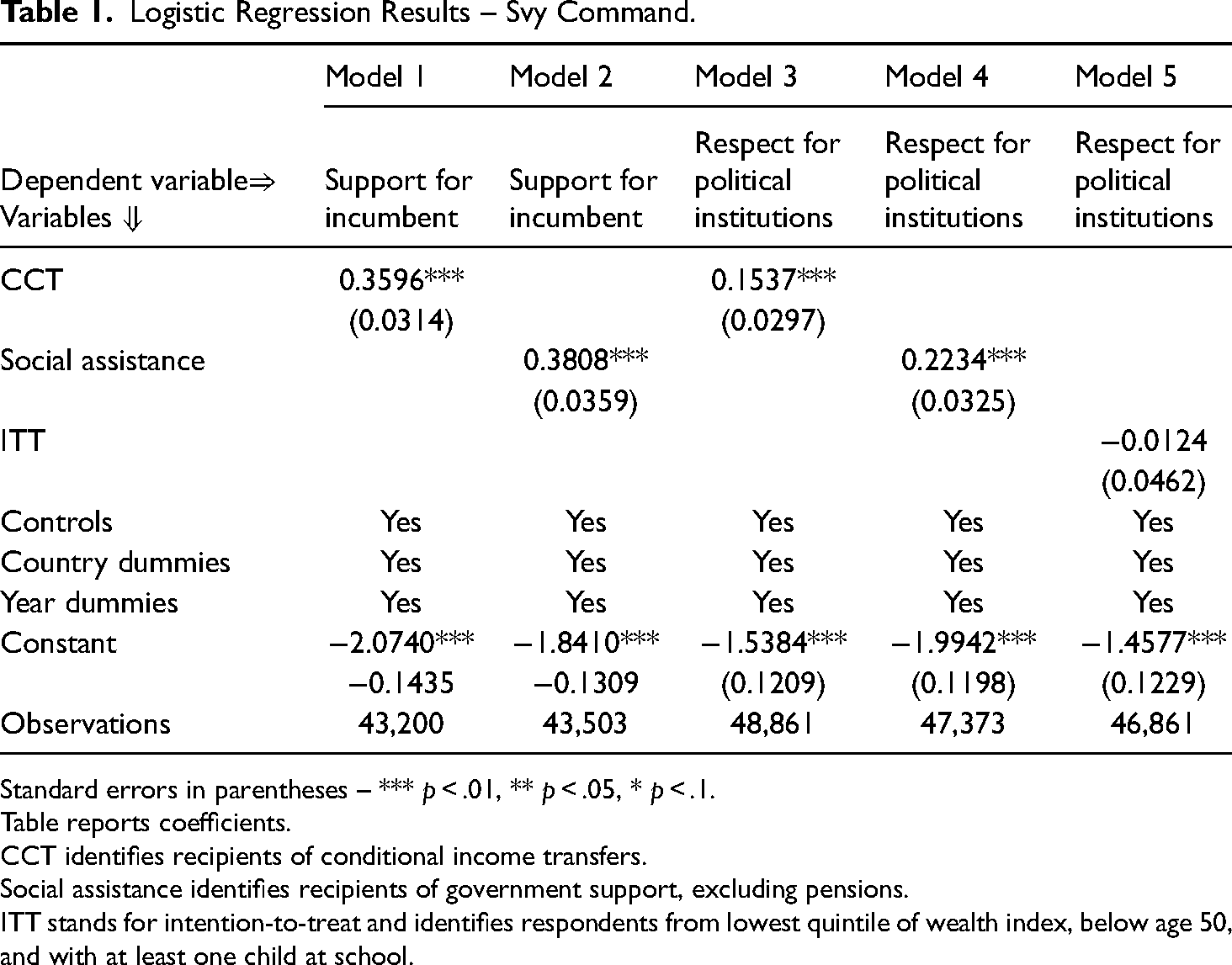
Standard errors in parentheses – *** p < .01, ** p < .05, * p < .1.
Table reports coefficients.
CCT identifies recipients of conditional income transfers.
Social assistance identifies recipients of government support, excluding pensions.
ITT stands for intention-to-treat and identifies respondents from lowest quintile of wealth index, below age 50, and with at least one child at school.
Focusing first on the incumbent Models 1 and 2, the estimated coefficients on the programme participant identifier confirm the findings from other studies to the effect that participation in conditional income transfer programmes and social assistance programmes is associated with a higher probability of support for the incumbent than a non-beneficiary respondent selected at random. 17
In Models 3 and 4, the dependent variable is respect for political institutions. Programme participation is positive and significant. The main finding is that households participating in social assistance or conditional income transfer programmes show a significantly higher likelihood of reporting strong respect for political institutions than a non-beneficiary respondent selected at random.
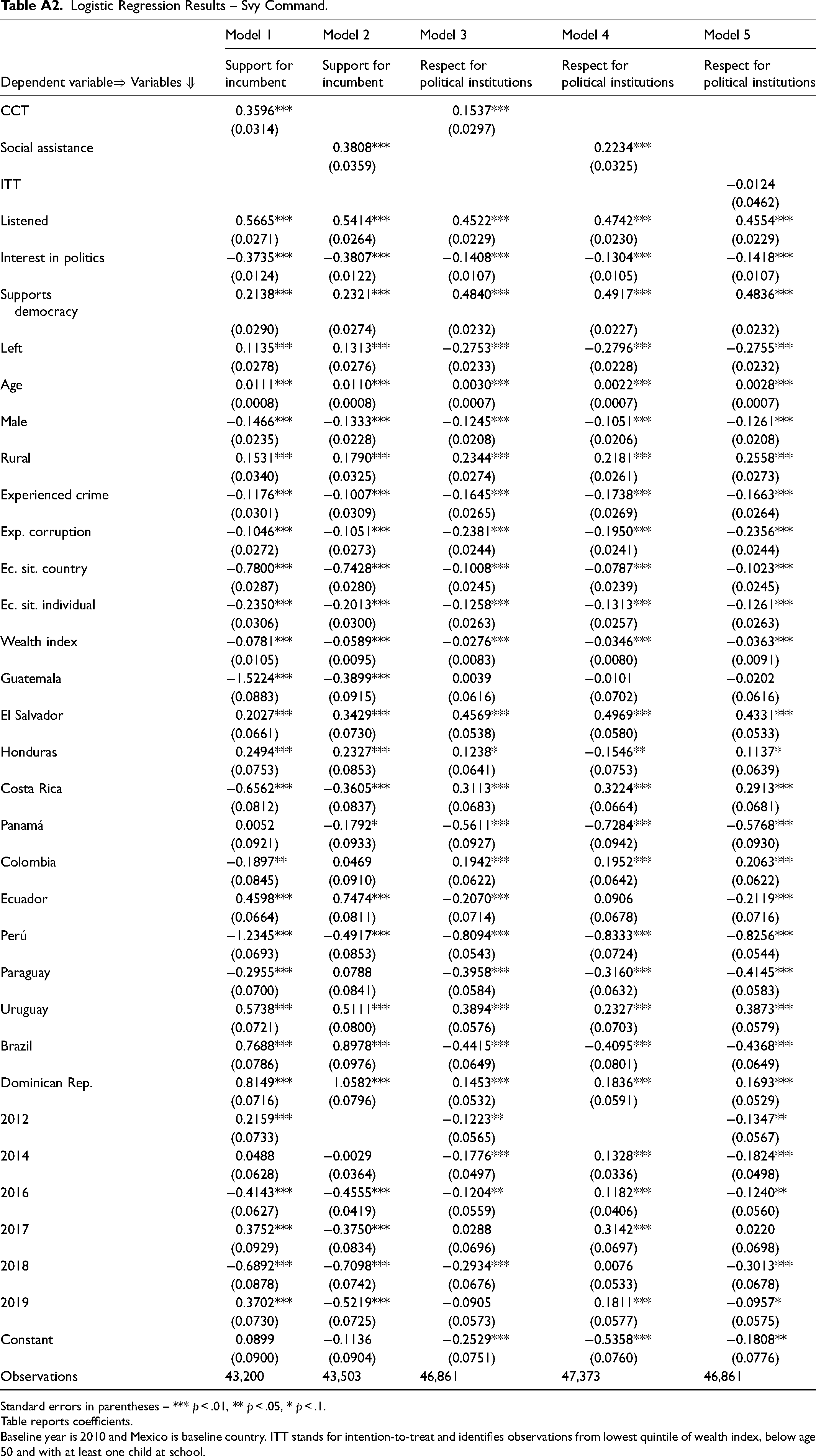
The control parameters are not reported in Table 1 but can be inspected in Table B2 in Appendix B containing the full estimation results. The parameters associated with the control variables all make sense. In Models 1 and 2, support for the incumbent is positively related to being listened to by government leaders, negatively related to having a strong interest in politics, and positively related to having left propensities. Support for incumbents is stronger among older people and women. Rural residence is marginally significant and positive. Corruption, but not victimisation, experiences are negatively associated with support for incumbents. Negative assessments of trends in the economy and in respondents’ personal economic situation lower the probability of supporting incumbents. Higher quintiles of the wealth index are negatively correlated with support for incumbents.
The coefficients associated with the control variables in Models 3 and 4 are also as expected. Respect for political institutions is positively correlated with positive views on being listened to by leaders and, in contrast to support for incumbents, positively and significantly correlated with positive views on democracy. Respect for political institutions is inversely correlated with interest in politics and with reporting left orientation. Women, older people, and rural residents appear to show stronger positive views on supporting political institutions. Victimisation and corruption negatively influence respect for political institutions. Assessments of the economic situation at the household and economy levels were found not to be correlated with respect for political institutions, except for a positive correlation with country level economic situation in Model 4. The wealth index is not significantly correlated with respect for political institutions. Respect for institutions declines with later waves in Model 3 but rises in Model 4.
In conclusion, analysis of LAPOP data provides support for the commitment hypothesis and for the incumbent hypothesis. The next section interprets the results and discusses potential confounders.
Discussion
The estimated relationships need to be interpreted with care. Regression analysis identifies correlations among variables, not causality. The latter would require experimental data, lacking at this present time.
Models 1 and 2 find that those participants in social assistance and conditional income transfer programmes show stronger support for incumbents, in line with findings in the literature. This is usually interpreted to provide support for the policy exchange hypothesis. However, it remains uncertain whether social assistance participants intend to reward politicians who introduced the relevant programmes, hope to prevent incumbents from withdrawing them, support politicians committed to poverty reduction and redistribution, or whether their responses reflect name recognition. And, as discussed in the first section, this interpretation of the finding would need to address the lack of consistency between elite incentives and social assistance design and implementation.
In Models 3 and 4, the coefficients report on conditional correlation existing between social assistance and conditional income transfer programme participation, respectively, and respect for political institutions. Social assistance and conditional income transfer recipients are more likely to report respect for political institutions than non-beneficiary respondents selected at random. The estimated parameters confirm that social assistance and conditional income transfers are associated with political inclusion of disadvantaged groups understood as commitment to core political institutions. The discussion in the second section is crucial to this interpretation of the results.
This finding is conditional on potential confounders having been controlled for in the regression analysis. This assumes that, aside from participating in social assistance programmes, there are no other systematic differences between participants and non-participants as regard the variable of interest. But social assistance recipients are selected on the basis of socio-economic and demographic factors. To what extent is it valid to compare participants with non-participants? The discussion in the second section is relevant here. It rules out the possibility that, in the absence of an effective social minimum, disadvantaged groups would show a stronger commitment to political institutions than non-disadvantaged groups. In fact, the framework developed in the second section predicts that, in the absence of an effective social minimum, the stress of commitment would lead disadvantaged groups to withdraw support for core institutions. The empirical literature lends support for the proposition that low-income groups have political attitudes broadly similar to the rest of the population. 18
The proposition that the observed outcomes can be explained by the conditions underlying beneficiary selection as opposed to transfer receipt can be tested by replacing the social assistance identifier with an intention-to-treat (ITT) identifier. It was constructed in a very simple fashion by selecting respondents in the bottom quintile of the wealth index, aged below 50, and having a child at school. These criteria were chosen to capture typical conditional income transfer recipients. As can be seen from the results reported in Model 5 of Table 1, the estimated correlation between the ITT group and respect for institutions is not statistically significant, with the implication that respect for institutions is no different across the ITT group and other respondents. This is helpful in lending confidence to the view that the correlations revealed by the regression analysis are not confounded by selection issues.
The findings in the analysis reported above could be criticised for resting on the analysis of a single dependent variable, respect for political institutions. Analysis not reported here found statistically significant and positive correlation between social assistance or conditional income transfer participation on the one hand and alternative variables – whether the political system deserves support or whether basic rights are being protected – on the other. These results are of interest, but they are not directly relevant to the focus of this article. The key contribution of the “commitment” conceptualisation of the social minimum is in helping identify with precision the link between social assistance and political inclusion. Disadvantaged groups may or may not give flag waving support for a political and economic system responsible for their disadvantage. They may or may not agree that their basic rights are being upheld. It is interesting that they do, but this not directly relevant to the “commitment” hypothesis. Some “strains of commitment” will still be there even if an effective social minimum is in place, but economic cooperation and political engagement could only be secured if these strains are not excessive.
The finding that social assistance recipients are more likely than non-beneficiaries to report respect for political institutions provides reliable and direct evidence on the contribution of social assistance to the political inclusion of disadvantaged groups in Latin America.
Conclusions
The article aimed to throw light upon the potential contribution of the remarkable expansion of social assistance in Latin America to the political inclusion of disadvantaged groups. Social assistance programmes now reach between a quarter and a third of the population in the region, mainly low-income and disadvantaged groups left outside formal insurance institutions.
Available research on the politics of social assistance expansion has privileged a policy exchange approach, in which transfers are examined primarily as an electoral instrument. Overall, the findings from this literature are mixed. Social assistance programmes are increasingly rules-based, non-discretionary, non-excludable and often enjoy cross-partisan support. Conditional income transfers have explicit social investment components with medium-term to longer-term objectives. There is scarce evidence on strategic allocation of budgets or reach. As the sole, or principal, explanation for the political outcomes associated with the expansion of social assistance, this approach has significant weaknesses.
The article developed an alternative approach centred on the role of social assistance in contributing to the political inclusion of disadvantaged groups. It outlined a framework for explaining the association between social assistance and political inclusion of disadvantaged groups, drawing on Rawls’ discussion of the “social minimum” and the “strains of commitment.” Societies in which economic cooperation is regulated by inequality-generating institutions impose significant “strains of commitment,” especially among disadvantaged groups. A social minimum is essential to secure their political participation. This framework identifies a specific role, and outcomes, associated with the expansion of social assistance in Latin America.
Analysis of attitudinal LAPOP data 2010 to 2019 finds that participants in social assistance and conditional income transfer programmes report stronger respect for political institutions than non-participants respondents selected at random. The expansion of social assistance in Latin America has contributed to the political inclusion of disadvantaged groups.
Footnotes
Acknowledgments
I am grateful to two anonymous referees for their helpful comments. I am alone responsible for all remaining errors.
Declaration of Conflicting Interests
The author declared no potential conflicts of interest with respect to the research, authorship, and/or publication of this article.
Funding
The author received no financial support for the research, authorship, and/or publication of this article.
Notes
Author Biography
Appendix A. Social assistance identifiers in Latin American Public Opinion Project
Variable Name in dataset [Social Assistance (SA)/CCT assignment]
2010
Cct1[CCT] p.20 “Usted o alguien en su casa recibe ayuda mensual en dinero o en productos por parte del gobierno, como por ejemplo [list of largest programmes up to 3]?”
2012
Cct1[SA] p.27 “Usted o alguien en su casa recibe ayuda mensual en dinero o en productos por parte del gobierno?” Note the list is missing
Cct1b [CCT] p.28 “Ahora hablando específicamente [Programa de transferencias condicionadas] usted o alguien en su casa es beneficiario del programa?”
2014–2019
Wf1 [SA] p.27 “Usted o alguien en su casa recibe ayuda mensual en dinero o en productos por parte del gobierno, sin contar las pensiones?”
Cct1b [CCT] p.28 “Ahora hablando específicamente [Programa de transferencias condicionadas] usted o alguien en su casa es beneficiario del programa?”
Appendix B. Full estimation results
Logistic Regression Results – Svy Command.
| Model 1 | Model 2 | Model 3 | Model 4 | Model 5 | |
|---|---|---|---|---|---|
| Dependent variable⇒ Variables ⇓ | Support for incumbent | Support for incumbent | Respect for political institutions | Respect for political institutions | Respect for political institutions |
| CCT | 0.3596*** | 0.1537*** | |||
| (0.0314) | (0.0297) | ||||
| Social assistance | 0.3808*** | 0.2234*** | |||
| (0.0359) | (0.0325) | ||||
| ITT | −0.0124 | ||||
| (0.0462) | |||||
| Listened | 0.5665*** | 0.5414*** | 0.4522*** | 0.4742*** | 0.4554*** |
| (0.0271) | (0.0264) | (0.0229) | (0.0230) | (0.0229) | |
| Interest in politics | −0.3735*** | −0.3807*** | −0.1408*** | −0.1304*** | −0.1418*** |
| (0.0124) | (0.0122) | (0.0107) | (0.0105) | (0.0107) | |
| Supports democracy | 0.2138*** | 0.2321*** | 0.4840*** | 0.4917*** | 0.4836*** |
| (0.0290) | (0.0274) | (0.0232) | (0.0227) | (0.0232) | |
| Left | 0.1135*** | 0.1313*** | −0.2753*** | −0.2796*** | −0.2755*** |
| (0.0278) | (0.0276) | (0.0233) | (0.0228) | (0.0232) | |
| Age | 0.0111*** | 0.0110*** | 0.0030*** | 0.0022*** | 0.0028*** |
| (0.0008) | (0.0008) | (0.0007) | (0.0007) | (0.0007) | |
| Male | −0.1466*** | −0.1333*** | −0.1245*** | −0.1051*** | −0.1261*** |
| (0.0235) | (0.0228) | (0.0208) | (0.0206) | (0.0208) | |
| Rural | 0.1531*** | 0.1790*** | 0.2344*** | 0.2181*** | 0.2558*** |
| (0.0340) | (0.0325) | (0.0274) | (0.0261) | (0.0273) | |
| Experienced crime | −0.1176*** | −0.1007*** | −0.1645*** | −0.1738*** | −0.1663*** |
| (0.0301) | (0.0309) | (0.0265) | (0.0269) | (0.0264) | |
| Exp. corruption | −0.1046*** | −0.1051*** | −0.2381*** | −0.1950*** | −0.2356*** |
| (0.0272) | (0.0273) | (0.0244) | (0.0241) | (0.0244) | |
| Ec. sit. country | −0.7800*** | −0.7428*** | −0.1008*** | −0.0787*** | −0.1023*** |
| (0.0287) | (0.0280) | (0.0245) | (0.0239) | (0.0245) | |
| Ec. sit. individual | −0.2350*** | −0.2013*** | −0.1258*** | −0.1313*** | −0.1261*** |
| (0.0306) | (0.0300) | (0.0263) | (0.0257) | (0.0263) | |
| Wealth index | −0.0781*** | −0.0589*** | −0.0276*** | −0.0346*** | −0.0363*** |
| (0.0105) | (0.0095) | (0.0083) | (0.0080) | (0.0091) | |
| Guatemala | −1.5224*** | −0.3899*** | 0.0039 | −0.0101 | −0.0202 |
| (0.0883) | (0.0915) | (0.0616) | (0.0702) | (0.0616) | |
| El Salvador | 0.2027*** | 0.3429*** | 0.4569*** | 0.4969*** | 0.4331*** |
| (0.0661) | (0.0730) | (0.0538) | (0.0580) | (0.0533) | |
| Honduras | 0.2494*** | 0.2327*** | 0.1238* | −0.1546** | 0.1137* |
| (0.0753) | (0.0853) | (0.0641) | (0.0753) | (0.0639) | |
| Costa Rica | −0.6562*** | −0.3605*** | 0.3113*** | 0.3224*** | 0.2913*** |
| (0.0812) | (0.0837) | (0.0683) | (0.0664) | (0.0681) | |
| Panamá | 0.0052 | −0.1792* | −0.5611*** | −0.7284*** | −0.5768*** |
| (0.0921) | (0.0933) | (0.0927) | (0.0942) | (0.0930) | |
| Colombia | −0.1897** | 0.0469 | 0.1942*** | 0.1952*** | 0.2063*** |
| (0.0845) | (0.0910) | (0.0622) | (0.0642) | (0.0622) | |
| Ecuador | 0.4598*** | 0.7474*** | −0.2070*** | 0.0906 | −0.2119*** |
| (0.0664) | (0.0811) | (0.0714) | (0.0678) | (0.0716) | |
| Perú | −1.2345*** | −0.4917*** | −0.8094*** | −0.8333*** | −0.8256*** |
| (0.0693) | (0.0853) | (0.0543) | (0.0724) | (0.0544) | |
| Paraguay | −0.2955*** | 0.0788 | −0.3958*** | −0.3160*** | −0.4145*** |
| (0.0700) | (0.0841) | (0.0584) | (0.0632) | (0.0583) | |
| Uruguay | 0.5738*** | 0.5111*** | 0.3894*** | 0.2327*** | 0.3873*** |
| (0.0721) | (0.0800) | (0.0576) | (0.0703) | (0.0579) | |
| Brazil | 0.7688*** | 0.8978*** | −0.4415*** | −0.4095*** | −0.4368*** |
| (0.0786) | (0.0976) | (0.0649) | (0.0801) | (0.0649) | |
| Dominican Rep. | 0.8149*** | 1.0582*** | 0.1453*** | 0.1836*** | 0.1693*** |
| (0.0716) | (0.0796) | (0.0532) | (0.0591) | (0.0529) | |
| 2012 | 0.2159*** | −0.1223** | −0.1347** | ||
| (0.0733) | (0.0565) | (0.0567) | |||
| 2014 | 0.0488 | −0.0029 | −0.1776*** | 0.1328*** | −0.1824*** |
| (0.0628) | (0.0364) | (0.0497) | (0.0336) | (0.0498) | |
| 2016 | −0.4143*** | −0.4555*** | −0.1204** | 0.1182*** | −0.1240** |
| (0.0627) | (0.0419) | (0.0559) | (0.0406) | (0.0560) | |
| 2017 | 0.3752*** | −0.3750*** | 0.0288 | 0.3142*** | 0.0220 |
| (0.0929) | (0.0834) | (0.0696) | (0.0697) | (0.0698) | |
| 2018 | −0.6892*** | −0.7098*** | −0.2934*** | 0.0076 | −0.3013*** |
| (0.0878) | (0.0742) | (0.0676) | (0.0533) | (0.0678) | |
| 2019 | 0.3702*** | −0.5219*** | −0.0905 | 0.1811*** | −0.0957* |
| (0.0730) | (0.0725) | (0.0573) | (0.0577) | (0.0575) | |
| Constant | 0.0899 | −0.1136 | −0.2529*** | −0.5358*** | −0.1808** |
| (0.0900) | (0.0904) | (0.0751) | (0.0760) | (0.0776) | |
| Observations | 43,200 | 43,503 | 46,861 | 47,373 | 46,861 |
Standard errors in parentheses – *** p < .01, ** p < .05, * p < .1.
Table reports coefficients.
Baseline year is 2010 and Mexico is baseline country. ITT stands for intention-to-treat and identifies observations from lowest quintile of wealth index, below age 50 and with at least one child at school.