



Abstract
This paper assesses the impact of political and fiscal accountability mechanisms on the severity and scope of human rights violations in Mexico's states during its democratic transition. First, we argue that elites in states with lower levels of electoral accountability are free of constraints that would normally result in their removal from office should they engage in human rights violations. Similarly, we argue that local elites maintain power while evading accountability when supported by transfers from the central government, and are thereby freer to use force. We find statistical support for our claims that lower levels of procedural democracy and higher levels of central transfers are associated with higher levels of human rights and physical integrity rights violations. These results are robust to subsample and numerous economic and other factors. Our findings suggest that particularly during democratic transitions, subnational institutions are salient in explaining the frequency of human rights violations.
Introduction
Substantial variance in the quality and scope of democracy between and across subnational administrative units merits study. Initially identified as unfinished democratic transition (Lawson, 2000), subnational units offer highly variant levels of democratic practice that differ from national levels of democratisation (Cornelius and Hindley, 1999): a phenomenon now recognised as subnational authoritarian persistence. Authoritarian persistence at the subnational level is directly reflected in a lack of competitive electoral democracy in subnational governments (Giraudy, 2010). Subnational authoritarianism can also occur because of fiscal federalism, when federal subsidies exceed locally derived rents, creating “zero cost” support for local officials (Gervasoni, 2018: 135), paralleling the political independence leaders’ experience in rentier states. While the patterns of authoritarian persistence are well established, less work demonstrates the consequences of these regime realities although research suggests significant implications for the respect for human rights (Beer and Mitchell, 2004; Peréz Aguirre, 2018).
Little work examines variance within accountability mechanisms and consequences for the scope and severity of human rights violations subnationally during democratic transitions. We offer an examination of accountability through political and fiscal mechanisms and the severity and scope of human rights in Mexican states during a period of democratic transition. 1 Building on research of Mexico's observance of human rights at the subnational level (Beer and Mitchell, 2004; Peréz Aguirre, 2018), we add to this literature by examining political and fiscal accountability mechanisms and correlates with the prevalence of human rights violations and violations focused on physical integrity. Utilising data from thirty one Mexican states and one federal district, we posit that states characterised by higher levels of accountability are likely to have fewer human rights violations and fewer physical integrity violations. Consistent with work at the national level on the respect for human rights and regime type, we suggest that states with lower levels of accountability are more likely to create permissive conditions for local authorities and actors to disregard human rights (Schatz, 2011).
A second theoretical contribution of this project includes insight into why a mixed relationship between democracy and human rights is demonstrated during political transitions (Pierskalla, 2010). Two phenomena on the state exercise of repression include “More Murder in the Middle” which posits a domestic democratic peace based on accountability (and a lack of repression required in pure authoritarian systems identifying heighted political violence in “the middle”) and a “Law of Coercive Responsiveness” summarising the empirical regularity that elites respond to internal threats to their power with repression (Fein, 1995; Regan and Henderson, 2002). Subnational examination of variance in democracy and human rights can assist in resolving this tension and explain why transition periods demonstrate higher levels of human rights violations than found in enduring democracies or autocracies. When elites and leaders experience variance in accountability mechanisms at the state level, human rights violations become unevenly distributed across geographic areas. A federal system, such as Mexico's, offers a microcosm for examination of how coexistence of these empirical realities occurs within a singular country given subnational variance in accountability structures.
Mexico offers an ideal case for comparative examination of accountability mechanisms. Mexico became a consolidated democracy at the national level during the temporal period of our examination. The transition to democracy in Mexico included efforts to dismantle the clientelist apparatus of the PRI through decentralisation of both fiscal and political systems. Mexico experienced a protracted democratic transition – with economic liberalisation preceding electoral competition and including fiscal decentralisation through the elimination of clientelist networks and local-level electoral competition (Camp, 2015). Consistent with our expectations, and controlling for economic sectoral composition and population, we find support for the argument that both electoral and fiscal accountability are associated with respect for subnational human rights. In the following section, we discuss existing literature on the relationship between human rights and accountability mechanisms. We then consider the Mexican context and subnational variance in democracy and localisation of human rights. We then generate hypotheses relating our expectations between subnational democratic accountability and human rights violations. Finally, we outline our data, methods, discuss results, and conclude.
Accountability & Human Rights
Cross-national studies establish strong correlations between democracy and human rights, a number identify democratic transitions as likely to increase individual liberty, security, and agency – core attributes of human rights (Landman, 2018). Accountability structures comprise the core mechanisms of democracy; institutional processes that allow polities to remove corrupt or non-responsive officials from political office assume a pivotal role. Established scholarship supports procedural mechanisms of democracy as upholding human rights due to the ability to vote officials and/or parties out of office (e.g. Dahl, 1989; Gurr and Lichbach, 1979; Gurr, 1970). A second and equally important literature identifies accountability through the lens of elite insulation and independence from constituents outside of electoral mechanisms. Fiscal insulation of elites from the population is found in literatures on rentier states (e.g. Gervasoni, 2010, 2018), state capacity, and fiscal extraction (Arbetman and Kugler, 1997; Hutchison and Johnson, 2011; Organski and Kugler, 1980). These dual mechanisms offer critical albeit distinct channels by which political leaders are beholden to or function independently from populations.
As democracy advocates dismantle authoritarian institutions, decentralisation and the devolution of responsibilities, political power, and administrative independence to province level institutions can be a viable strategy for increasing democratisation, particularly in clientelist regimes (García-Guadilla and Pérez, 2002). Federal systems and decentralisation efforts may yield advances at the federal level in electoral competition, democratic norms, and the rule of law, with varied impact on subnational governments newly endowed with policy and fiscal autonomy (Schatz, 2011). With examples of authoritarian enclaves persisting at the subnational level in democratic and semi-democratic regimes including Nigeria, India, Argentina, Venezuela, and Mexico, examination of the consequences of these patterns of variance merit attention and offer insights into lived realities of well-being.
Procedural Democracy & Human Rights
Scholarly work establishes a negative theoretical and empirical relationship between levels of democracy and the number of human rights violations in a country (Davenport, 1995; Harff, 2003; Henderson, 1991; Krain, 1997; Meernik et al., 1998; Mitchell and McCormick, 1988; Poe and Tate, 1994; Zanger, 2000). Explanations offered for this finding include limits on elite exercise of power. Effective democracy provides citizens with instruments to remove leaders from office should they exceed the bounds of designated authority. Elites, aware of these constraints and wishing to remain in office, employ alternative mechanisms for societal control that are more effective and less costly. Democratic mechanisms, emphasising bargaining and compromise, supply a realistic way to accommodate demands while minimising conflict (Dallin and Breslauer, 1970; Gurr and Lichbach, 1979; Gurr, 1986; Gurr, 1970; Henderson, 1991; Poe and Tate, 1994).
A second complementary explanation identifies the influence of political institutional structures and practices on repressive behaviour (Dahl, 1966). Political competition and peaceful party opposition allow for “stages of evolution” in political reform, functionally bringing the opposition into the legitimate political sphere (Davenport and Armstrong, 2004). This approach centres on procedural democracy, identifying the ability to seek redress through existing political channels as integral to maintaining human rights. Individuals in office where turnover is regular and elections are clean and transparent are subject to removal from office should they resort to the use of force (Giraudy, 2009, 2010; Przeworski et al., 2000; Schumpeter, 1974).
We assume that leaders intend to remain in office and respond to credible demands from key constituents with policies that both satisfy stakeholders and circumstances to avoid removal (Siverson and Bueno de Mesquita, 2017, among other work on selectorate theory). Procedural democracy is a foundational accountability mechanism within democratic transitions. Other work identifies low visibility strategies to limit electoral competition as a means to retain office: these for example the exclusion of political candidates from participation or manipulation of the electoral process, and are captured in part in the competitiveness of elections (Gervasoni et al., 2016).
Studies of rentier states and human rights establish a parallel lack of accountability. Rentier states function as distributive states, with government legitimacy gained through a combination of allocation and repression – with periods of relative affluence allowing leaders to purchase “social peace” through the allocation of benefits and periods of hardship characterised by repression (De Soysa and Malmin Binningsbo, 2005). Distributive models of governance are not confined to oil producing regions, distributive models of fiscal independence can result because of foreign aid dependency for a government or federal subsidies from a federal to state governments (Gervasoni, 2018). Local level units functioning with fiscal autonomy can, through unearned resources accumulating from nontax revenues (Morrison, 2009) or fiscal transfers (Gervasoni, 2018), function the same way. Resource flows derived independently from the population result in legitimacy hinging on distributive outcomes and often weak states unable to effectively govern (Hutchison and Johnson, 2017), resulting in an inability for individuals to mediate competing demands within institutional frameworks, but also offering repression as a means for maintaining stability. Reliance on local and state revenues to finance important initiatives requires the institutional capacity to extract revenues and a willingness on the part of the population to transfer individual resources to local governments: states reliant on these revenues for key policy objectives are more likely to be responsive to populations (Hutchison and Johnson, 2017).
These perspectives provide powerful insights into the distribution of political authority in explaining the prevalence of human rights violations. Each identifies the degree to which elites are insulated from the demands of the population as instrumental in determining if demands for the protection of human rights are worth the enforcement effort, either to retain political office or as a calculated cost of policy implementation.
Circumstance and experience within even a consolidated democracy can vary. Studies of democratic transitions cite substantive differences in the quality of democracy within geographically distinct political units. Variance in democratic reform may be substantial when decentralisation of political authority occurs in federalist regimes. Snyder (1998) suggests that focus on within nation variation is warranted; major processes of political and economic transition are likely to vary across territorial political units. The phenomenon of subnational democratic variance is widespread, with scholars examining subnational authoritarian enclaves in countries ranging from Mexico, Argentina (Giraudy, 2010; Gervasoni, 2010, 2018), Russia (Petro, 2004), India (Beer and Mitchell, 2006), Honduras, and the Philippines (Blair, 2000).
We posit that human rights violations at the subnational level are likely a consequence of deficits in accountability of political leaders and institutions at the state level. Insulation from demands of the population can occur in several ways. Lack of political competition, electoral irregularities, limitations on political speech, control over police and judicial appointments, administration, and enforcement may contribute to persistent impunity for human rights violators (Schatz, 2011). Leaders facing limited threat in retaining political office have little incentive to alter patterns of political support or respond to local demands for the observance of human rights, resulting in permissive conditions/implicit authorisation of human rights violations.
High levels of fiscal transfers from the central government to state and local leaders can insulate elites from local demands, as they do not require tax revenue from localities in order to implement policies or retain political control and are less constrained in using public revenues for private gain (Gervasoni, 2010, 2018). These structures can also offer substantial public employment and service delivery expenditure without increasing tax burden (Gervasoni, 2018). In federal systems of government, state and local fiscal and policy responsibilities often result in substantial autonomy for local actors, supporting our contention that lower levels of reliance on fiscal transfers at the state and local level are likely to result in fewer human rights violations.
In the following section, we examine these propositions in Mexican states between 1997 and 2008.
Mexico's Democratic Transition & State Level Human Rights
Mexico offers an ideal case for examination of the relationship between subnational democracy and the observance of human rights. The scholarly and empirical record on subnational democracy is well established. Regime juxtaposition, where authoritarian subnational structures exist in conjunction with national democratic practice is common in Mexico; decentralisation accompanying national level reform facilitated uneven democratisation in Mexico that has penetrated some states more than others (Eisenstadt, 2004; Gibson, 2005; Giraudy, 2010; O’Donnell, 1999; Solt, 2003; Snyder, 1998, 2001a, 2001b). In some regions, electoral competition is broadly acknowledged, alternation in office common, and margins of victory in elections are close; in others alternation in office does not occur, electoral fraud remains rampant, and political power is consolidated in single party dominance (Moreno, 2005). These procedural electoral elements constitute accountability mechanisms core to our examination of human rights violations within Mexican states.
Mexico's system of federal transfers to state and municipal governments creates reliance on federal distribution of revenues: states and local authorities enjoy limited authority in levying their own generated revenues (taxes) leaving the bulk of service provision to federal fiscal transfers or private purchasing of services (Velasco-Alvarez, 2018). Mexico is alone among federal OECD members in resembling a unitary government in terms of tax effort, with significant and substantive distortions in expenditures or transfers relative to level of government extraction (Mendoza, 2013). Aggregate state and local revenues comprised less than 10 per cent of overall tax effort, while state and local governments comprise nearly 50 per cent of public expenditures (Mendoza, 2013). 2 Even as authority to levy taxes has increased, many state and local governments lack capacity to extract allowable collections including their main opportunity for revenue generation: property tax (Mendoza, 2013). Distortions in taxes and transfer balance by level of administrative unit incentivise continued reliance on federal transfers for state and local government functions; in many instances, this distortion is deemed to decrease efficiency and/or incentivise corruption at the local level.
Even within this constrained framework, substantial variance exists in the share of federal transfers relative to overall economic activity within states – while a common range of federal transfers as a percentage of total economic output is in the 5–10 per cent of state product, in states such as Chiapas and Oaxaca federal transfers are often equivalent to 20 per cent or more of state product (INEGI). All Mexican states rely on federal transfers; the share of overall economic activity represented by fiscal transfers from the central government varies widely, in some states constituting a small share of overall economic output, while in others resembling a rentier state in terms of economic share of state and local output. This renders some state and local governments fiscally independent of local populations and less accountable to fiscal pressure from the state and local populations.
Since 1998, Mexico has been identified at the national level as a consolidated democracy and a middle-income country. Figure 1 outlines the degree of polyarchy (electoral competition and participation) for Mexico based on V-Dem's Additive Polyarchy Index (Coppedge et al., 2021). Complementary assessments of Mexico's political status from Freedom House International characterise Mexico as “free” from 2000 to 2010 (Freedom House, 2010). Polity IV's democracy-autocracy scale identifies Mexico as an anocracy from 1976 to 1996, becoming democracy in 1997 (Marshall et al., 2010). The DD dataset classifies Mexico as a democracy starting in 2000 (Cheibub et al., 2010).
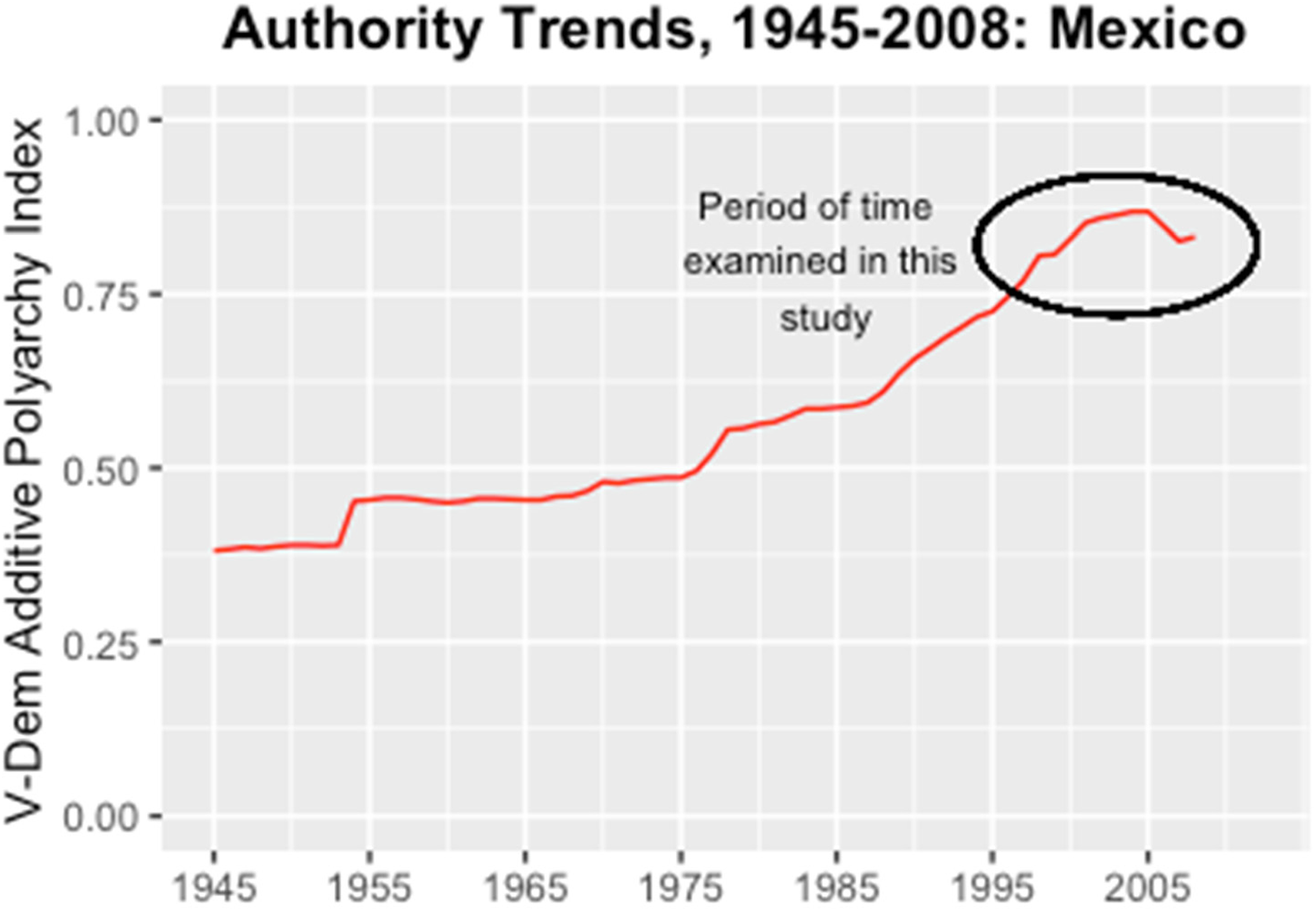
V-Dem Additive Polyarchy Scores in Mexico. Source: Coppedge et al., 2021.
Mexico offers an example of a transition from a strong one-party state to a competitive democracy at the federal level. Following seventy years of Partido Revolucionario Institucional (PRI) rule, Vincente Fox, the Partido Acción Nacional (PAN) candidate won the 2000 Presidential election following the 1997 loss of the PRI majority in the National Chamber of Deputies and significant 1996 electoral reforms (Schatz, 2011). These changes cemented earlier institutional reforms including the 1996 establishment of an independent Federal Election Commission composed of non-PRI officials including professors, journalists, and citizen activists and the elimination of formal political corporatism (Tulchin and Selee, 2003).
An elaborate system of fiscal transfers from central to state governments was a key facet in the stability of Mexico's one-party dominance (Brandenburg, 1964). An allocation system utilised by the PRI tying public expenditures to states based on the strength of ruling party support induced allegiance to the dominant party (Ames, 1970). Geddes (1999) argues that the threat of loss in fiscal resources prompts support for local dominant parties even when the opposition parties are preferred by local citizens. Diaz-Cayeros et al. (2000) find evidence for the political support for the PRI in local government throughout the 1980s and 1990s based on this logic. Earlier examinations of this phenomenon are difficult to examine, as PRI party dominance was endemic to Mexico at all levels of government (Camp, 1976). As Mexico began to develop a multiparty system, retaliatory cuts in fiscal transfers were evident in states where opposition leaders gained office (Diaz-Cayeros et al., 2000).
Cracks appeared in the facade of Mexico's one-party dominance when divisions among elites resulted in movement toward development programs and projects that directly targeted the poor in the 1980s in contrast to subsidy along lines of political patronage (Fox, 1994). The political apparatus of the PRI concentrated benefits among industrial workers and small farmers. NAFTA, in 1994, changed the political landscape by no longer designating these populations as “winners,” they were the most vulnerable to economic impacts of agricultural and manufacturing liberalisation (Schwentesius Rinderman and Gómez, 2005). Coupled with the 1994 uprising in Chiapas, 3 challenges became too great for the PRI to subdue opposition with patronage. Political competition and subsequent changes in the clientelist regime ensued. Disruption of resource distribution tied to the political party machine of the PRI and dismantling of the welfare state altered political and economic foundations of politics in Mexico.
Despite substantial economic and political reforms in Mexico between 1990 and 2008, Mexico's human rights record lags behind other democracies. Ranked a “worst offender” by Amnesty aggregated scores between 2005 and 2009, Mexico is one of the only OECD members in this category other than the Occupied Territories of Israel (Wood and Gibney, 2010). The substantive Political Terror Data Project categorises Mexico as a country where human rights violations ranged from “extensive political imprisonment, or a recent history of such imprisonment. Execution or other political murders and brutality may be common. Unlimited detention, with or without a trial, for political views is accepted” to “…violations have expanded to large numbers of the population. Murders, disappearances, and torture are a common part of life.” The mean score for Latin American and Caribbean countries was much lower and less pervasive in terms of human rights violations during the same period (Wood and Gibney, 2010).
Mexico's characterisation as a consolidated democracy belies its high levels of human rights violations. Political decentralisation accompanying democratisation and the disruption of PRI clientelist networks imbued state governments with increasing discretionary power in terms of policy. Schatz (2011) argues that despite tremendous advances accompanying democratic reforms since 1994 at the federal level, judicial systems at the local and state level are responsible for over 80 per cent of legal jurisdiction with limited federal oversight. The two branches of state police, preventive police responsible for maintaining order and public safety and judicial police responsible for enforcing mandates of the prosecutor's office, are subject to the oversight of local and state offices (Schatz, 2011; Haber et al., 2008). Human rights violations occur within the context of a governing and institutional system. In states characterised by electoral competition, different rights can be guaranteed in contrast to states lacking the ability to remove leaders from office. The continued persistence of elite domination in states lacking electoral competition insulates of security forces from judicial reprisal and contributes to an environment where permissive conditions exist for violation of human rights. Schatz (2011) notes in numerous cases local authorities are free from sanction when engaged in theft, bribery, or the use of force through legal systems that fail to adequately investigate, prosecute, or pursue offenders.
The United States Bureau of Democracy, Human Rights, and Labor (DRL) issued reports in both 2006 and 2007 identifying local government officials in Mexico as responsible for the majority of human rights violations, noting “the government generally respected and promoted human rights at the national level,” but were unable to control impunity and corruption of some security forces, “particularly at the state and local level” (US Department of State, 2006). Examples of state-perpetrated violence range from individual disappearances and extrajudicial killings, to acts of police brutality and violence targeted at large groups of citizens. In 2006 alone, we note many varied violations ranging from intimidation to sexual assault to murder across Mexican states. In Oaxaca, a twenty-six-year-long tradition of teacher strikes at the governor's palace turned into a nonviolent protest of corruption; Oaxacan state police responded using clubs, rubber bullets, and tear gas (Wende, 2007). An estimated 17–23 people were killed over several protests, hundreds were wounded. (Denham, 2008). Journalist Bradley Wills, investigating corruption in public office, was murdered in Oaxaca the same year with evidence suggesting municipal police were responsible (Denham, 2008). The same year, clashes between local vendors and state police following protests in State of Mexico resulted in two deaths and forty-seven arrests. Allegations of sexual assault of female vendors taken into custody by local police resulted in the dismissal of fifteen local police and several “pending” investigations (US Bureau of Democracy, Human Rights, and Labor, 2006). In Chihuahua, the director of the state police and municipal police officers were implicated in a kidnapping ring (US Bureau of Democracy, Human Rights, and Labor, 2006). Six municipal police officers were implicated in the torture and murder of Jose Gabriel Velasquez while held in a local jail in Chiapas (Centro de Derechos Humanos Fray Bartolome de las Casas, 2006).
Figures 2 and 3 provide detail on human rights violations and the mean level of procedural democracy in each of Mexico's states and federal district between 1997 and 2008.
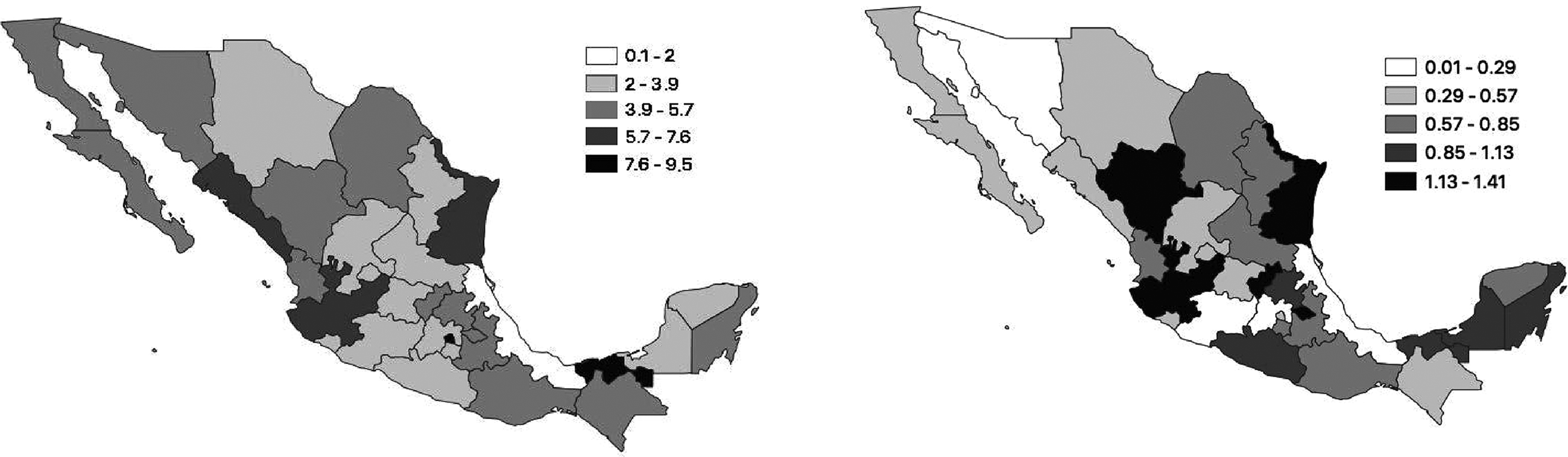
Mean Human Rights Violations (left panel) and Physical Integrity Rights Violations (right panel) per 10,000 Residents, 1997–2008. Source: CNDH.
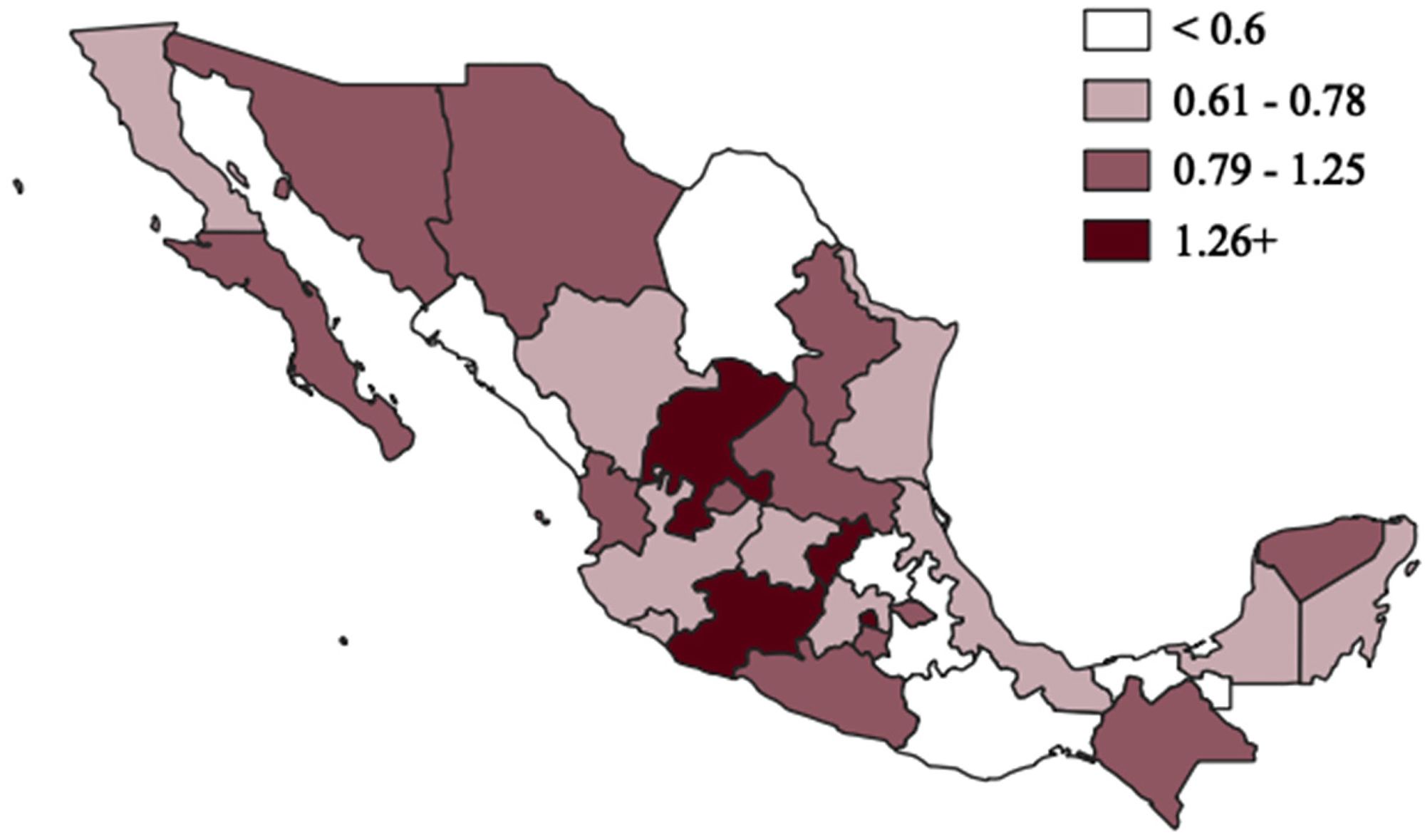
Mean Level of Procedural Democracy, 1997–2008. Source: Giraudy (2015).
Beer and Mitchell (2004) identify an inverse relationship between the extent of polyarchy (competitive elections and participation) and the total number of human rights violations in Mexican States. Peréz Aguirre (2018) examines the relationship between political competition, local level service provision (water allocation), and total human rights violations in a post-transition period, arguing that competitiveness and institutional competency in policy implementation offer constraints on human rights violations. Our argument is in line with these propositions however we focus on two distinct institutional accountability mechanisms, electoral and fiscal, and correlates with both the overall number of human rights violations, and the number human rights violations that imperil physical integrity (violations that involve the most severe use of force including extra judicial killings and disappearances). 4
We cannot ignore the role of federal security forces and authorities in the perpetuation of human rights violations. Despite attribution of violations to state and local authorities, federal security forces often assist in maintaining public order in conjunction with state police, the military shares responsibility for internal security with federal and state police. We anticipate that systems of impunity influence actions of these actors. In states where local and state authorities are responsive and accountable to the population, that demand for investigation and response into violent occurrences might be higher and serves to mitigate some violent actions on the part of the federal authorities. A case in point is the arrest of Omar Alberto Morales Patiño, former head of the federal police in Chihuahua, in State of Mexico for the murder of confidential informants in 2003 by state authorities (US Department of State, 2003).
A strength of our examination of human rights violations is differentiation between the concept of repression and human rights violations. Much of the literature deploys terms interchangeably and in fact tests levels of repression in the form of limits or a lack of limits on state authority making the logical extension to human rights. There is a distinction between human rights violations that occur “legally” through institutionalised exercise of power and individual restraint on the part of a government and human rights violations that constitute “illegal” actions on the part of government officials and authorities. Our research concentrates on explaining the number of acts on the part of police, officials, and governmental officers that violate Mexico's human rights accords and laws rather than repression codified into law. We find both empirical and anecdotal support for our argument that state level actors are responsible for human rights violations within Mexican states.
In the following section, we develop hypotheses surrounding democratic variation and the number of human rights violations in the thirty-one Mexican states and the one federal district from 1997 to 2008.
Political Influences on Human Rights Violations
Utilising procedural democracy at the subnational level in Mexico developed by Giraudy (2009, 2010, 2015), we expect higher levels of democratic procedure to be associated with lower levels of human rights violations. The ability to seek redress through existing political channels is integral to maintaining human rights. Individuals and parties in office with regular turnover and clean elections are subject to the consequences of their actions when using force against civilian populations. In procedurally democratic environments, where elections are contested, voters have the option of removing individuals from office should they fail to protect the population. Systems of impunity are less likely under these conditions, as political leaders have incentives to pursue individuals who imperil their tenure in office by creating conditions where sanctioning coercion is less costly than locating alternate solutions for satisfying demands (Schatz, 2011).
Human rights violations vary in extent and severity. Physical integrity violations, where individuals are visibly harmed, killed, or disappeared are likely to garner substantial attention and enact pressure on political leaders (Schatz, 2011; Poe and Tate, 1994; Richards et al., 2015). These highly visible forms of violence exert political pressure from populations and demand government response.
Fiscal transfers can insulate political leaders from the consequences of their actions through two channels: in an environment where the state is richer than the society, the state can offer distributive incentives for individuals to support leaders (Gervasoni, 2018). States are no longer reliant on extraction of resources from the population in order to function, allowing leaders more freedom to act with repression (Arbetman and Kugler, 1997).
Physical integrity violations exert the most pressure on leaders and result in political pressure on elites. Insulation from political pressures may function the same way as electoral mechanisms; where leaders face limited consequences in continuing patronage or other programs, repression may require individuals consider a tradeoff between acceptance and continued regime support or opposition and losing access to resources.
Studies of authoritarian persistence in Mexico's subnational governments identifies the retention of party machines and subnational mobilisation for national candidates as remaining structures of the patron-client network formed under the PRI (Giraudy, 2010), allowing the executive to function outside the purview of civic oversight. One mechanism for incentivising this process and indicating continuity of patron-client structures in Mexico rests on transfers from the central to state governments. Reliance on political linkages at the national level for transfers from the central to state governments to maintain existing political apparatus indicates lower levels of political reform and democratic function. Our argument is consistent with Gervasoni (2010, 2018) who finds high reliance of fiscal transfers is related to lower levels of state level democracy in Argentina. We posit that the effect of transfers as a percent of GDP in a state contributes to the retention of a more authoritarian state apparatus. Giraudy (2010) argues that states receiving a higher percentage of transfers than their revenues or population warrant are likely to remain entangled in patrimonial networks. Further, as transfers comprise a larger quantity of state economic production, public sector rents increase in their scope and impact.
Dependent Variable
The measurement of human rights violations is a difficult task, those best in a position to collect data often operate under the governments responsible for their perpetuation. The Comisión Nacional de los Derechos Humanos (CNDH) tracks and evaluates reported human rights violations in Mexico, and provides information intended to increase access to resources and grievance procedures to the Mexican population. CNDH has a mixed reputation as a human rights organisation. Sources ranging from Amnesty International (1993) to Human Rights Watch (2008) identify weakness in CNDH related to remedies and reforms related to human rights recommendations. Each of these organisations does acknowledge CNDH reporting and chronicling of human rights violations as accurate and consistent (Amnesty International, 1993; Human Rights Watch, 2008). The United States State Department relies on reports by CNDH in publishing its annual assessments of human rights in Mexico; prior work on repression and political assassination in Mexico utilise case studies and data obtained from CNDH (Schatz, 2008, 2011). CNDH receives accolades as a human rights group, including designating border crossing deaths as a humanitarian crisis, and publishing maps designating routes with sufficient water accompanied by warnings of exploitation and detailing dangers surrounding illegal border transit (Jimenez, 2009).
State offices of the CNDH are tasked with investigation and substantiation of claims. CNDH has existed for over thirty years functioning independently from government oversight since 1990. The national office is comprised of a president and a 10-member council, confirmed by the Senate. Eight individuals have fulfilled terms as president of the organisation, with two additional individuals serving as interim presidents. Most elected presidents have held a doctorate in law, and nearly all had experience as jurists and law professors. The ten council members are typically individuals with legal training and represent a range of political party affiliations.
CNDH state offices collect information regionally and report to the national office offering the ability to report anonymously. Abuses are likely to be underreported, with regions where higher levels of abuse occur more likely to experience underreporting. CNDH may offer one of the only options for recourse for populations where state and local officials fail to respond to demands for increased protection (Human Rights Watch, 2008). Historical political domination by the PRI may contribute to an overall distrust in institutions resulting in individuals failing to report violations. For our study, this biases our examination toward no effect.
Human rights violations in this study are the number of reported violations by state to CNDH in a given year. 5 The mean number of human rights violations in a state year is 1353.3 with a standard deviation of 1646.29, indicating a slightly inflated level of variance in our dependent variable. Five observations account for much of this variance, all occurring in the Federal District. Excluding these five observations, the mean number of human rights violations per state year is 1232 with a standard deviation of 1266.41.
CNDH classifies each human rights violation into eighteen categories. We measure physical integrity violations as the most severe category of violations: the right to life. CNDH describes the right to life (derecho a la vida) as the State's obligation to respect life and limit individuals from depriving others of their life (CNDH, 2021). 6 Physical integrity violations are the most easily verified and the hardest to hide. Reducing our focus to physical integrity violations eliminates violations that may be included in our first measure of procedural democracy; violations related to electoral integrity. This represents a hard test for our theory of accountability mechanisms. The mean number of physical integrity rights violations in a state year in our sample is 0.53 with a standard deviation of 1.38.
Key Explanatory Variables
We utilise Giraudy's (2015) measure of subnational procedural democracy. This is a minimalist procedural definition, based on an electoral approach to democracy comprised of three elements: fully contested legislative elections, turn over or alternation in office, and free and fair or clean elections (Giraudy, 2010, 2015; Przeworski et al., 2000; Schumpeter, 1974). The measure is comprised of seven indicators, including the governor's tenure, the incumbent party's tenure, effective number of parties competing in gubernatorial elections, effective number of parties competing in legislative elections, margin of victory in gubernatorial elections, percent of the legislature controlled by opposition parties, and an index of post-electoral conflict (Giraudy, 2015). Higher values of Giraudy's measure indicate higher levels of procedural democracy.
We use transfers from central to state governments as a percent of GDP to capture the insulation of elites from demands of the population. We find substantial evidence that the use of fiscal resources allows elites to function independently of locally generated tax revenues, allowing the continuation of the exchange of resources for political support. We use transfers to states as a percent of GDP to account for variance typically found in economic data, primarily because of inflation and to lend comparative assessment related to the variance in the size of state economies. State level transfers were obtained from INEGI (Instituto Nacional de Estadística y Geografía).
Control Variables
Aspects of economic security merit consideration. We include economic security in terms of basic needs provision (absolute levels of economic insecurity) in the form of infant mortality rates and in terms of GDP per capita (mean levels of economic insecurity). Higher levels of economic security are associated in the literature with increases in democracy and reductions in governmental repression and human rights abuses (Sloan, 1984). Governments are expected to keep citizens satisfied; increasing demands employment, housing, health, or food may cause governments to sanction violence to ensure stability (Gurr, 1985; Sloan, 1984). Studies of corruption often argue that individuals in positions of power unable to support themselves through their regular salary, may engage in extortion, violence, and coercion enabled by their positions and resource access (Rose-Ackerman, 2008). Economic insecurity can also contribute to rent seeking behaviour by municipal and state officials. Mexico demonstrates substantial regional variance in each of these indicators. The Federal District has a GDP per capita nearly three times and Coahuila nearly two times that of Chiapas or Oaxaca. Data on GDP per capita are reported in constant national units, obtained from INEGI.
Infant mortality rates were selected as they capture several facets of development. Infant mortality rates are infant deaths per 1000 live births and are not subject to significant variance caused by seasonal or permanent migration, inflation, or seasonal reporting (INEGI, various years). Infants remain among the most vulnerable in a population and are often impacted immediately by income and resource ebbs and flows. Data on infant mortality rates are from INEGI.
We include measures for sectoral change to reflect “winners” and “losers” because of the decline of patronage systems and networks following economic liberalisation associated with NAFTA. The adoption of NAFTA dramatically shifted agricultural production from small-scale farming enterprises to industrial agriculture. Small farmers were among the primary beneficiaries of the PRI patron client network. Agriculture value added and GDP data for each state were obtained from INEGI. Ratios were used to account for changes in currency and inflation, as values are reported in current prices.
Manufacturing is the second sector of Mexico's economy impacted by political and economic transition. Industrial producers and labourers were substantial beneficiaries of the PRI network, elimination of these subsidies produced substantial changes in political and economic structures. Manufacturing value added and GDP data for each state were obtained from INEGI. Ratios were used for reasons listed above.
Foreign Direct Investment (FDI) can be a boon to state economies, bolstering elites and providing rent seeking opportunities. The relationship in the literature surrounding foreign capital inflows and human rights violations remains murky. Neoclassical economics contends that acceptance of liberal economic doctrine and increased foreign investment increases economic growth, stabilising the political environment and widening policy options of domestic elites (Bayoumi and Eichengreen, 1997). This lessens the likelihood that the government will abuse human rights (Richards et al., 2001). Conversely, growth attained through increased foreign investment by Multinational Corporations (MNCs) may constrain the policy choices made by elites, providing rent-seeking opportunities. Policy decisions generally benefit MNCs by extracting local resources, widening unequal exchange and providing incentives for repressive behaviour and state sponsored violence toward civilian populations. FDI data are obtained from INEGI. Ratios were used for reasons listed above.
We must consider the role of federal authorities in the study of human rights abuses. Despite our theoretical and anecdotal arguments indicating primary perpetration by state and local actors, reports of federal security forces involved in the violation of human rights do occur. We anticipate that federal forces are more likely to participate in human rights violations when local and state actors are unlikely to demand oversight. We anticipate that higher numbers of interactions between army personnel and the general population will occur in areas where they are stationed. The Mexican Army does support public order and is functionally located by region within the country (Díez and Nicholls, 2006). We are unable to disaggregate human rights violations by actor type, we can roughly examine the presence of military authorities by region. We code all states with army bases located within their territory a 1 and those without as a 0.
We include a measure of population in our model because we expect more human rights violations in more populous states. Population data are obtained from INEGI.
Model and Methods
Base Model:
Human Rights Violationsit = α + β1Yearit + β2Democracyit + β3Transfersit−1 + β4IMRit + β5GDPpercapitait−1 + β6Militaryit + β7FDIit−1 + β8AG + β9Manuf + β10Population + ε
Where:
- Human Rights Violations are the number of reported incidents to CNDH in a state-year. - Year is year fixed effects. - Democracy is the level of procedural democracy in a state-year. - Transfers are lagged transfers allocated by the central government as a percentage of GDP. - IMR are infant deaths per 1000 live births in a state-year. - GDP per capita is the lagged average income per person reported in constant national monies for a state-year. - Military is coded as a value of 1 if an army base is located in the state-year. - FDI is the lagged total foreign direct investment as a percentage of GDP. - AG is the value added from agriculture as a percentage of GDP. - Manuf is the value added from manufacturing as a percentage of GDP. - Population is the total number of people living in a state in a state-year.
Methods
The structure of our data limits our estimation options. Our dependent variable is a count variable, requiring Poisson or Negative Binomial estimation. We choose a Negative Binomial model, due to over-dispersed dependent variables. We estimate the model with robust standard errors to allow for correction of any type of correlation within panels and addressing best the structure of errors in our data (Winkelmann, 2008). As a robustness check, we run Poisson models and OLS models with panel-corrected standard errors with substantively identical results.
Multicollinearity can be a problem with economic data. We used ratios to address this concern (e.g. transfers as a percent of GDP) to eliminate noise in measurement likely present in our data. We quantify the severity of multicollinearity in our independent variables by estimating the variance inflation factor (VIF) (Allison, 1999). The largest VIF value we obtained is 5, well below the most conservative values indicating concern.
Results & Discussion
The results reported in Table 1 demonstrate confirmation for our first hypothesis, H1a: a significant and negative relationship between the level of procedural democracy and human rights in each of our estimations (Models 1–3). We cannot interpret the coefficients for negative binomial models as we would for OLS regression coefficients, so calculate incidence rate ratios for each independent variable. These results of our full-sample model (Model 1) indicate that for every one-unit increase in Giraudy's procedural democracy measure, we expect to see a 45.5 per cent decrease in human rights violations in a state-year. 7
Human Rights and Democracy in Mexico 1997–2008.
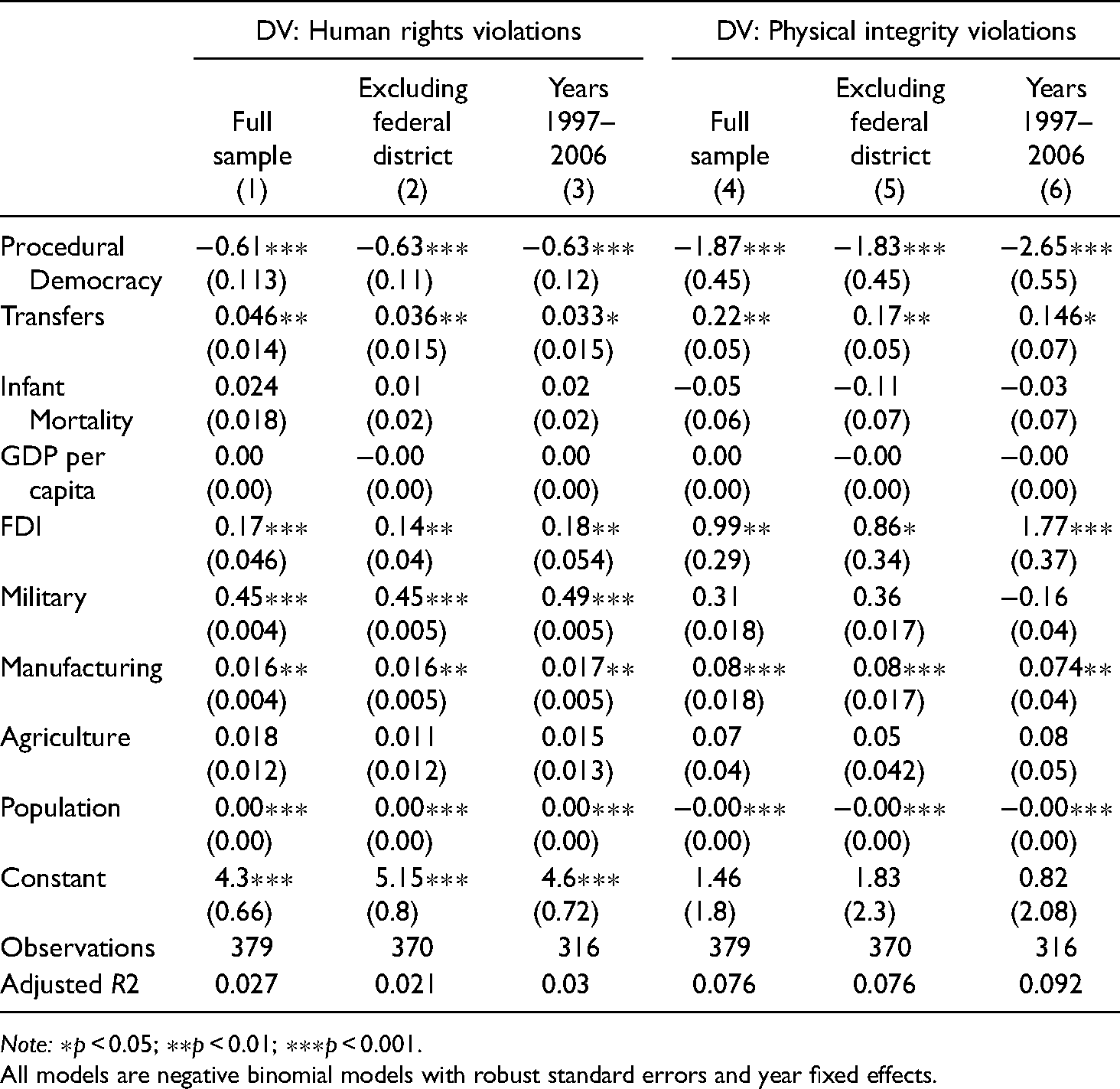
Note: ∗p < 0.05; ∗∗p < 0.01; ∗∗∗p < 0.001.
All models are negative binomial models with robust standard errors and year fixed effects.
Models 4–6 report results for physical integrity violations. Consistent with our expectations, the level of procedural democracy is negative and significant. In our full-sample model (Model 1), a one-unit increase in Giraudy's measure of procedural democracy is associated with an 84.6 per cent decrease in physical integrity violations.
We find a significant relationship between central fiscal transfers to state governments and the number of human rights violations in models 1–3, and central fiscal transfers and physical integrity violations in models 4–6. This suggests that fiscal independence of elites influences the number of human rights violations in a state. Every one percentage-point increase in transfers for our full sample (Model 1) leads a 3 per cent increase in human rights violations in a state-year. The impact of central transfers on physical integrity rights is even more substantial, with a one percentage-point increase in transfers leading to a 24.6 per cent increase in physical integrity rights violations in a state-year.
These results remain strong despite removing Mexico DF from the sample in Models 2 and 5. The federal district was responsible for the nine highest values of human rights violations, and the second-highest sum of physical integrity violations in our sample, the relationship between procedural democracy and human rights violations remains negative and significant when we restrict the sample to Mexico's states. In Models 2 and 5, procedural democracy is associated with an even stronger 46.6 per cent decrease in human rights violations, and an 83.9 per cent decrease in physical integrity violations. The relationship between central transfers and both human rights and physical integrity rights remain positive and significant.
We are primarily interested in studying subnational variations in democracy during national-level democratic transitions, we restrict our sample in columns 3 and 6 to the years 1997–2006. This includes the 1997 loss of the PRI's majority in the National Chamber of Deputies, the PRI's presidential loss to PAN candidate Vincente Fox in 2000, and the first presidential transition between non-PRI candidates (Vicente Fox to Felipe Calderón) in 2006. It excludes 2007 and 2008, in which we may consider Mexico to be fully transitioned. This truncated period also excludes the years in which the Mérida Initiative, an anti-drug trafficking agreement between the United States and Mexico, was announced (2007) and signed into law (2008). The resulting militarisation in response to drugs and organised crime arguably increased human rights violations at the hands of federal authorities, thereby complicating our focus on accountability mechanisms at the local level.
We continue to find support for our hypotheses for this truncated period of Mexico's democratic transition, suggesting further democratic consolidation and increased militarisation in 2007 and 2008 are unlikely to be driving forces behind our results.
The significant and positive association between the presence of a military base in a state and the number of human rights violations, but not physical integrity violations also merits consideration. Discussed above, we note that in these states, democratic practice is particularly important in limiting human rights violations. We note that these findings merit substantial additional research, suggesting that military use to enforce public order should be examined.
We also find mixed results for our economic control variables and human rights violations. In models 1–6, infant mortality rates and GDP per capita do not have significant effects on human rights violations or physical integrity violations. We note that higher levels of FDI are associated with higher levels of human rights violations across each of our models. The effect size is substantial: in Model 1, a one percentage-point increase in FDI is associated with a 15 per cent increase in human rights violations in a state-year. Foreign investment may minimise accountability mechanisms.
Conclusions
Our study demonstrates that the number of human rights violations in Mexican states are influenced by democratic penetration during its transition. Rather than identifying Mexico as an “outlier” among established consolidated democracies, we infer that the process of democratisation is complex and variation in human rights observance can be explained by the retention of authoritarian practice and the insulation of elites subnationally.
The contribution of this work is twofold. In regimes that are either federal or include decentralised decision-making, the national level alone remains insufficient in examining democratic transition. We extend existing theoretical work on the relationship between democracy and human rights by examining variance in subnational democratic practice; identification of democracy as “consolidated” misrepresents political processes that occur within countries and fail to identify countries like Mexico where regionally some states are still in transition. The second contribution is support for insulation theories of repression; when elites at the local level rely on central transfers to maintain their political apparatus, they are more insulated from civic oversight, and more likely to tolerate violations of human rights.
Studies of human rights focus mostly on national levels of increasing democratisation without acknowledging possible authoritarian subnational structures. By studying subnational levels of democracy, we highlight substantial differences in state level democratic exercise that a national analysis would otherwise ignore. In the case of Mexico, democratisation without decentralisation would have made it exceedingly difficult to dismantle the patron-client networks extensively established under the PRI.
The struggle between drug cartels and the federal government is Mexico's contemporary challenge. Enforcement of Mexico's increasingly militarised anti-narcotics campaign is reputedly accompanied by human rights violations and by heightened violence. In earlier estimations, we included a control variable for drug involvement, finding no significance. In subsequent assessments of human rights in Mexico seeking to expand the temporal period under consideration, we anticipate this may not be the case. As centralisation increases, we theoretically expect to see more human rights violations, consistent with current observations of the post-transition period. These issues lie beyond the theoretical and empirical scope of this paper.
In addition, new research examines the quality of democracy across states in Mexico in the period immediately post-democratic transition: 2000–2012 (Loza and Méndez, 2016). The dynamics of state society relations and evolving influences on human rights observance offer an important future extension of our research. Promising work on the impact of media bias and media freedoms on demands for human rights also offer an avenue for consideration. Increased access to human rights reporting through social media and internet expansion have changed the landscape in reporting and potential for civil society actors for engagement since 2010, a discussion exemplified in a 2016 Journal of Human Rights (volume 15 issue 3) special issue: Human Rights in the News.
Supplemental Material
sj-docx-1-pla-10.1177_1866802X221127711 - Supplemental material for Human Rights During Transition: Accountability Mechanisms in Mexican States 1997–2008
Supplemental material, sj-docx-1-pla-10.1177_1866802X221127711 for Human Rights During Transition: Accountability Mechanisms in Mexican States 1997–2008 by Bernard Brennan, Kristin Johnson and Ashlea Rundlett in Journal of Politics in Latin America
Footnotes
Declaration of Conflicting Interests
The author(s) declared no potential conflicts of interest with respect to the research, authorship, and/or publication of this article.
Funding
The author(s) received no financial support for the research, authorship, and/or publication of this article.
Supplemental Material
Supplemental material for this article is available online.
Notes
Author Biographies
References
Supplementary Material
Please find the following supplemental material available below.
For Open Access articles published under a Creative Commons License, all supplemental material carries the same license as the article it is associated with.
For non-Open Access articles published, all supplemental material carries a non-exclusive license, and permission requests for re-use of supplemental material or any part of supplemental material shall be sent directly to the copyright owner as specified in the copyright notice associated with the article.
