




Abstract
This paper traces the evolution of mining law in Mexico, including the most recent round of reform, and discusses the social and environmental impacts of mining in the region of Soconusco in the state of Chiapas. A set of mining reforms that passed between 2013 and 2014 provided the necessary impetus for a rise in mining investments in Mexico. These reforms have been couched in the language of “new extractivism.” In this approach favored by the left, extractivism is embraced as a development strategy along with the goal of redistributing some of the revenues to rural areas where these activities take place. In addition, these communities are to be consulted on how the funds will be spent. As fortunes have been made, however, the results have fallen short where environmental protection and community support are concerned.
“I am not blind to the unison of opinion, expressed by scientists and experts, that Mexico will some day furnish the gold, silver and copper of the world that will build the empires of tomorrow and make future cities of the world veritable new Jerusalems.” – Cecil Rhodes, mining magnate, nineteenth century (from T. W. Osterheld 1916)
Over the last 15 years, Mexico has met with spectacular success as a result of mining investments in that country. It now stands as the world's leading producer of silver and is ninth in the production of gold, tenth in copper, and among the top 10 producers of zinc, lead, barite, gypsum, molybdenum, and other metals (Morales 2017). According to the Mining Chamber of Mexico, total investment in mining reached USD 5.2 billion in 2015, a 5.1 percent increase over the 2014 amount. This marked a decisive reversal in the downward trend of the two previous years (Negocios 2016).
These gains have been made possible in part through the development of new technologies that have enabled companies to extract approximately twice as much gold and half again as much silver from Mexico in the last 15 years as was extracted in the entire 300-year period of colonialism (Tetreault 2015). The process has also been facilitated by a series of structural reforms that began in the early 1990s, with the latest round taking place between 2013 and 2014.
These reforms have been borne out through what is referred to as the “new extractivism.” Extractivism itself is the process of removing large quantities of natural resources and exporting them as raw material rather than processed goods (Gudynas 2010). During the 1980s and 1990s, this was facilitated by neoliberal policies that gave more free reign to the private sector by greatly reducing the role of the government in state-owned enterprises and cutting regulations in support of labor and environmental protection. As a result, capital flows were liberalized in mining, gas, and oil and foreign access to natural resources in Mexico surged.
While still out of power, leftist parties opposed these policies and proposed instead to diversify the economy by linking existing extractive industries to domestically owned processing companies. Yet once in power, the left essentially embraced extractivism as a development strategy while at the same time promising to apply some of the revenue from extractive industries to public infrastructure and social programs, particularly for those in rural areas where mining was taking place.
While the methods of accomplishing this broader distribution of wealth have varied from one country to the next, they typically include new taxes and royalties on foreign-owned companies that can then be applied in part to poverty reduction programs. Those regions where mining takes place are promised schools, clinics, roads, bridges, transportation systems, and environmental preservation projects. In addition, arrangements are made to include the surrounding communities in decision making regarding these projects. In this way, investors continue to make substantial profits while politicians are able to shore up support among the poor and marginalized groups.
In Mexico, the idea of the new extractivism was adopted soon after the traditionally socialist Institutional Revolutionary Party (PRI, Partido Revolucionario Institucional) won the presidency with the election of Enrique Pena Nieto in 2012. This paper explores how two municipalities in Chiapas have been affected by these reforms, including the federal government's commitment to include them in decisions about local mining projects. The author visited two sites in Soconusco where antimining protests have been taking place since 2015, when mining-related contamination of the water supply was first discovered.
Early Mining Law
After Mexico's Revolution of 1910, land and water rights were regarded as non-commodities that were to remain under the auspices of the state. A cooperative ejido system was established that allowed laborers to collectively manage a larger portion of the country's land, water, and other resources while leaving another portion to the private sector. Article 74 of the constitution stated that land could not be transferred to third parties and that land rights could not expire or be seized through an injunction. Water rights were linked to agricultural property rights and as such could not be bought, sold, rented, used on other lands, or used for purposes other than those made explicit in the grant (Stoltenborg and Boelens 2016).
In the 1930s, a series of left-wing reforms swept the country. Land reform was undertaken and basic industries including oil and the railroads were nationalized. With regard to mining, the government established the Commission of Mining Promotion (FIFOMI, El Fideicomiso de Fomento Minero) to promote mining while limiting the size of mining concessions. Through further reform in 1961, all mining companies in Mexico were required to be 51 percent owned by Mexican nationals and the role of the federal government was increased. By the late 1970s, the state owned approximately 15 percent of the country's mining interests, while private Mexican capital controlled approximately 40 percent.
Much of the remainder was in the hands of US companies (Tetreault 2014: 1–17).
From Debt Crisis to NAFTA
In 1982, falling oil prices, rising inflation, and other economic difficulties forced the government to declare default on the national debt. In alarm, international lenders appealed to the World Bank, the International Monetary Fund (IMF), and the Inter-American Development Bank (IDB) for help. These institutions rushed to offer international credit to the Mexican government in return for passing a series of neoliberal adjustments designed to open up the economy to greater foreign investment. Among these were the reduction of tariffs on imported machinery and equipment, the elimination of taxes on exports of minerals, and the repression of wage scales. They also included the privatization and denationalization of land and water, which could only be managed through major reform of the existing mining, agricultural, and foreign investment laws (Stoltenborg and Boelens 2016).
The period between 1988 and 1996 saw a great many new laws to further open Mexican lands to foreign investment in mining and other types of extraction. Publicly owned mineral reserves and mining companies were sold off, often at prices well below market value, and Article 6 of the 1992 Mining Law stated that mining activities “will be given preference over any other use or productive utilization of the land” (Tetreault 2014). Article 27 of the constitution was revised to end the post-revolutionary ejido system and allow the buying and selling of ejido lands. Other laws provided greater freedom to mining companies in the exploration and extraction of minerals and full foreign ownership of resources with the simple establishment of a mailing address in Mexico. The Foreign Investment Law of 1996 endowed foreign companies with rights and privileges equal to those of Mexican companies. Mining concession periods were extended from 25 to 50 years and taxes were reduced (Tetreault 2015).
Among the top beneficiaries of these policies are some of the richest men in Mexico today: Jorge Larrea, whose son German Larrea, now owner of mining firm Grupo Mexico, is the third richest man in the country; Alberto Bailleres, owner of Industrias Peñoles and the second richest man in Mexico; and Carlos Slim, owner of Minera Frisco and one of the wealthiest men in the world. Among those paying the greatest price are smallholders and cooperative farmers, including indigenous communities, as the federal government now has the authority to dispossess them of their lands to allow mining (Tetreault 2014).
These reforms were followed by the North American Free Trade Agreement (NAFTA), which opened 95 percent of tariff classifications for Mexican mining products destined for the northern market and included new fiscal and legal measures to promote further privatization (Musik Asali 2015). Perhaps most importantly, NAFTA allowed private companies to bypass national law should the terms of the agreement come into question by taking the matter to the World Bank's International Centre for the Settlement of Investment Disputes (ICSID). These companies can also turn to this court to protect themselves from new environmental laws or social security measures that adversely affect their interests. At the same time, NAFTA denies this right to those communities dealing with forced evictions, contaminated land and water, and intimidation and other injustices at the hands of mining proponents (Stoltenborg and Boelens 2016).
By 1999, the granting of mining concessions no longer had to include public hearings. This has meant that those living at the proposed mining sites have often remained uninformed about the prospects of having a mine nearby. Furthermore, a mining concession could only be fined but not cancelled as a result of environmental pollution it had caused (Vargas-Hernandez 2006: 185–194). This last provision has been especially detrimental in light of the increasing practice of open-pit mining to extract gold and other minerals. This technique
completely destroys the land that contains minerals, leaving behind gigantic craters and heaps of contaminated rubble that emit toxins into the environment. Aside from aesthetic considerations, this implies the loss of habitat for wildlife and, more important for our analysis, deprives local communities of the use of the land for agriculture, forestry, or other purposes. What is more, powerful explosives are used in open-pit mining, meaning not only that communities located near mining sites have to put up with a lot of noise but that buildings may suffer structural damage. (Tetreault 2015)
The leaching process common to different types of mining is also highly destructive. Here toxic chemicals such as cyanide, mercury, and arsenic are used to separate minerals from ore. Waste rock is then stored in tailings ponds where leach pads at the bottom may be subject to cracking as a result of heavy rainfall or seismic activity. Chemicals can then be leaked into ground water, rivers, and soil, posing a serious threat to local residents and the surrounding environment. In addition, mines typically require massive quantities of water. This causes water scarcity and thereby endangers agriculture, livestock, fish, and other wildlife that many people in rural areas depend on to survive.
The Latest round of Reform
Between 2012 and 2013, mining investment rates, which had been steadily rising, suddenly dropped by nearly USD 1.5 billion. This prompted a new round of reforms after Mexico's president Enrique Pena Nieto came to office in December 2012. Having adopted the strategy of new extractivism, the administration established the Fund for Sustainable Regional Development of States and Mining Municipalities, the stated objective of which is “to raise the quality of life of the inhabitants in mining areas.” 1 The reforms also included the passage of three new mining fees, including a royalty of 7.5 percent on net mining profits. Of the total amount collected through these three fees, 80 percent was to go toward the financing of social development projects in the regions surrounding the mines. Of this amount, 37.5 percent would go to states where mining was taking place and 62.5 percent would go to the mining municipalities (Gutiérrez Haces 2016).
The fund was established in 2014 (Tetreault 2014).
Development committees have been established to manage the dispensation of the funds. These committees include representatives of the state, the municipalities where mines are located, the mining companies, and indigenous or agrarian communities where mines are operating. The funds can be allocated for social, environmental, and urban projects such as the construction, remodeling, and equipping of schools; installation and upkeep of roads; transportation; public lighting; landfills; water treatment plants; public drainage; and solid waste management. They can also be used for environmental purposes (Mundo Minero 2017).
In fact, a 2014 amendment of federal law states that “mineral extraction must be done carefully so that when it is depleted there is no devastated land, no polluted water, no hazardous waste in high-risk sites […]” (LXIII Legislatura 2016). As the name suggests, the Sustainable Development Fund must address the concept of sustainable development, which the General Law of Equilibrium and Protection of the Environment describes as projects “based on appropriate measures that preserve the ecological balance, protect the environment, and use natural resources so as not to compromise the satisfaction of the needs of future generations” (Mundo Minero 2017).
In the May 2015 issue of Negocios ProMexico put out by Mexico's Ministry of Economy, President Pena Nieto's photo appears on the second page. In the message below the photo, he declares this to be Mexico's “positive moment,” with recent reforms “designed to increase economic growth and improve the well-being of millions of Mexicans” (Negocios, 1). Further into the magazine, an author describes how Mexico's new phase of mining modernization and investment promotion includes the aim of “strengthening the south and west in relation to mining activities” and “consolidating perspectives for social responsibility and sustainable development” (Negodos 11). In addition,
the new tax system will not only lead to a better distribution of wealth, but also social participation in the decisions that determine how that wealth is used. Therefore, it also provides an opportunity to create channels of communication and joint work with businesses, communities, and local authorities, which can and should be used to create better conditions for cooperation and growth. (Negocios 13)
Negocios also raises the issue of environmental protection as a priority:
Protected areas are also part of a general policy for boosting sustainable, environmentally friendly development. This implies harmonious development that meets the needs of economic growth, social development, respect and care for nature […]. (Negocios 14)
In other sections of the magazine, the efforts of mining companies to protect the environment are described. One has been “careful and responsible both to the environment and its human capital” and has “done a good job with a focus on environmental preservation” (Negocios 24). The company had improved the quality of drinking water near the mining site and had built homes, churches, schools, and a new road. Another company
respects and protects the environment and vulnerable species, as well as areas of high biodiversity and places that have special social and cultural significance. The company is aware that this vision of its operations will continue to grow and benefit all stakeholders, maintaining a positive balance between mining activities, the community, and the environment. (Negocios 27)
On top of all this, Mexico's General Directorate of Mining Regulation “provides environmental advice to mining licensees, and gives notice of the location of lots in protected natural areas” (Negocios 37).
Yet another side of this new phase in Mexican mining development is that of company security. Here Negocios describes a joint effort
being conducted between the authorities and businesses in order to provide timely solutions for the problems the industry is facing. The Ministry of Economy, through the General Coordination of Mines, has created working groups comprising mining companies and the Federal Police, which through the Gendarmerie is strengthening the presence of security forces in each state to protect the productive sectors of the economy. (Negocios 14)
While it is stated that these armed forces will be protecting the mines, there is no mention of who the enemy is. And, in carrying out their mission to defend the mines, the federal police are to join forces with the mining companies, which will also benefit from the intelligence the police can provide.
A safety task force was formed between the authorities of the federal police and the mining companies. At the head of this effort is the Gendarmerie Division, in coordination with the Investigation Division and the Territorial Deployment Commission. The aim is to use the available federal police force in four areas: on-site presence, intelligence, information sharing, and communication channels. (Negocios 14)
Mining in Chiapas
The latest round of mining law reform has stimulated new mining investment in the southern state of Chiapas. Our team traveled to the southern region of Soconusco in November–December 2016 as part of a joint delegation from the University of Denver and the Denver Justice and Peace Committee of Denver, Colorado. Our visit to the two municipalities of Escuintla and Acacoyagua revealed that the promise of environmental protection is far from being fulfilled and that, for some communities at least, the plan for community participation in decision making about development funds has not been meaningful.
In planning for mining development, the Mexican Ministry of Economy has carefully divided the state of Chiapas into seven districts based on their potential for resource extraction. Minerals that have been identified include gold, copper, lead, iron, zinc, titanium, limestone, quartz, barite, zhanghengite, and amber. Non-metallic minerals such as clay, sand, limestone, and sulfur have also been geographically mapped (Burguete 2017). Mapped areas include the northeast region held largely by the Zapatista National liberation Army (EZLN, Ejército Zapatista de liberatión Nacional), which has been designated for oil and other types of exploration. The bulk of current concessions, however, are located along the Pacific coast and Sierra Madre in the southern and western areas of the state (Administrador Regeneratión 2015).
Map 1 shows the region of Soconusco, home to the communities of Escuintla and Acacoyagua, where anti-mining protests are being carried out.
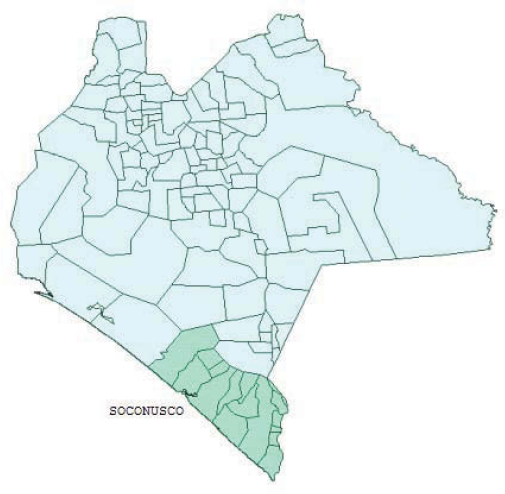
Map Showing the Soconusco Region, Chiapas State, Where the Communities of Escuintla and Acacoyagua Are Located
The map in Figure 2 shows mining and other concessions by municipality along with environmentally protected areas and mangrove forests. As we can see, Soconusco and its surroundings make up the most intensively mined area in the state of Chiapas. We can also note that protected areas overlap substantially with areas now under concession, including areas with some of the highest concentrations of mining projects. In the eastern region of the state lies a large protected area, which appears to be untouched by mining.
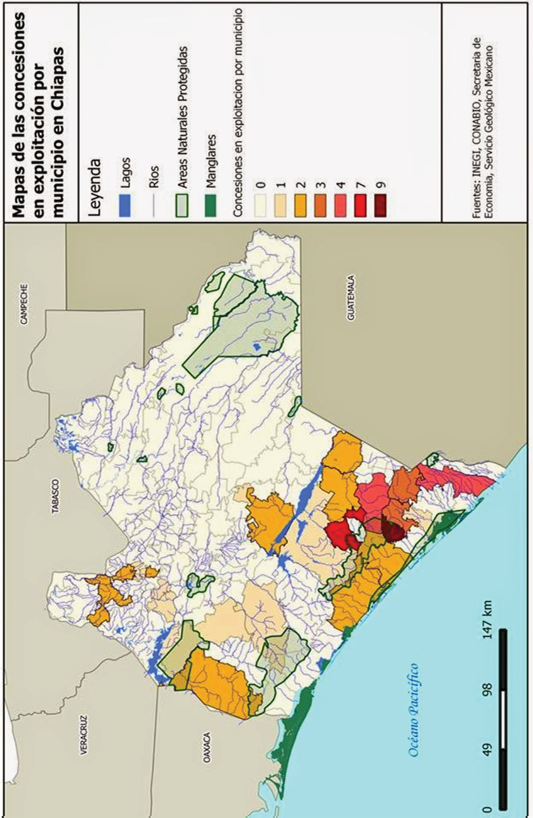
Map of Chiapas Mining Concessions by Municipality Showing the Density of Concessions in the Southern Region of Soconusco
Between 2000 and 2015, the Mexican government issued concessions for a total of approximately 20 percent of the land in Chiapas to mining companies for the purpose of extracting gold, silver, copper, lead, zinc, titanium, iron, and barite (Mariscal 2016). According to one report, of the 99 active mining concessions granted by the federal government in Chiapas in the first eight months of 2015, 44 were located in the southern region of Soconusco. Of these, at least half are engaged in the extraction of titanium, which is used in many high-tech products such as cellphones, laptops, aircraft, medical supplies, and components of modern architecture (Bassi 2015).
The Failures of New Extractivism
As we recall, the purpose of the Sustainable Regional Development Fund is to “raise the quality of life of the inhabitants in mining areas.” Land is not to be devastated, water is to remain unpolluted, and ecological balance and the needs of future generations are to be safeguarded. Our tour in Soconusco revealed not only a stark failure to achieve these goals but also hostility towards those who have sought to make the problem of contamination known.
Escuintla and Acacoyagua are situated near two titanium mines, one of which is the Casas Viejas owned by El Puntal. The two major rivers in the region from which residents get their drinking water are now so contaminated we were warned not to even touch the water. The fish stock in these rivers and nearby streams has declined drastically, and those fish that survive are often severely deformed. With the help of two local medical professionals, the residents have established that the cancer death rate in the area rose from 7 percent in 2005 to 22 percent in 2015. The cases include stomach, testicular, and especially liver cancer and are occurring with high frequency in children and young adults. Local doctor Juan Velasquez attributes this and skin rashes resulting from bathing in the rivers to the release of toxic and radioactive particles integral to the mining process, such as thorium and silicon (Mandujano 2016).
In fact, the Chiapan government undertook its own evaluation of Casas Viejas and, contrary to the company's own impact assessment, declared that the mine would “cause irreversible damage to the environment.” The findings have, however, been ignored by the federal government (ICD 2015).
During our team's visit to Soconusco, residents also spoke of the decline of fishing and farming as livelihoods and how this has led some, especially among the youth, to turn to illegal drug dealing as a way to survive. Again and again we heard how begging and crime were on the rise. Some people were giving up, often selling their property to the mining company and moving away.
Those who had remained came together with Tonalá and other neighboring municipalities in August 2015 and, through a general assembly of some 300 representatives, declared themselves “mining free” communities. With this move, they joined over 2,000 other communities throughout the country that had made the same declaration. Since then, residents and local officials have carried out numerous public demonstrations to get their point across, including blocking the passage of mining machinery along roads to the mines.
Having joined together as the Popular Front in Defense of the So-conusco (FPDS), Escuintla and Acacoyagua are demanding the closure of Casas Viejas and 13 other concessions in the area. These include at least one in the Encrucijada Biosphere Reserve on the coast, an area known for its complex ecosystems, mature mangrove forests, and hundreds of species of mammals, birds, reptiles, and amphibians. The FPDS holds that the mining company has failed to take necessary measures to protect the environment and the health of the residents, and that there has been no open discussion of the legal and technological aspects of Casas Viejas that included community input. The residents’ goals go beyond just local concerns. Along with many other communities and organizations throughout Mexico, they are calling for a “refounding” of the country to reconsider the role of mining in development and the prevalence of large-scale commercial projects in Mexico (Red Mexicana 2015).
Remarkably, the FPDS has succeeded in temporarily shutting down three mines in the area pending investigation by the Chiapan government. The companies and their supporters are fighting back, however. Activists in the FPDS have related that a few area residents had been paid by a mining company to oppose the assemblies and the protests, distribute false information, and spy on activists. A number of FPDS members have been the victims of intimidation and harassment as well. As residents explained to us, the companies follow a strategy of divide and conquer through the buying of support, blackmail, and other kinds of pressure.
For the anti-mining residents of Acacoyagua and Escuinda, the goal is clear: clean water and lands free of contamination, an ecological balance that includes an abundance of healthy fish and wildlife, safe grazing for their animals, and a safe future for their children. This is no more, in fact, than the promises made by the proponents of Mexico's new extractivism.
Conclusion
From this brief study of mining and its impacts in Soconusco, Chiapas, it is evident that Mexico's “positive moment” of reform – its own expression of new extractivism – is not delivering on the promises made to the rural people whom the Fund for Sustainable Development was supposed to benefit. These include maintaining a clean, healthy environment around mining sites that will satisfy the needs of future generations. Instead, drinking water in local communities has become undrinkable and no one can safely bathe in or even come into contact with it. The poisoning of the water along with the loss of fish has forced many out of farming and fishing, both of which are traditional livelihoods in the area. While a few are able to get jobs in tourism, others are turning in desperation to the sale of illegal drugs.
New extractivism has also failed to bring the two communities discussed here together with officials and business interests to make critical decisions about development in the area. Of course, one could argue that the negotiating system was never designed to allow the communities to reject mining projects outright. It was only designed to allow them representation in determining how fund money would be spent once the concessions had been granted. Rather than be shut out, however, the residents here have opted at some risk to use social protest to make their decisions known. In the process, they have become increasingly politicized at the national level.
A final observation here has to do with the role of the EZLN. The map of mining concessions shows that the eastern portion of the state of Chiapas, much of which is under the control of the EZLN, has been less affected by mining than areas in the south and west, most of which are not under EZLN control. Also noteworthy is the existence of a large protected natural area within EZLN territory that, unlike the Encrucijada Biosphere Reserve in Soconusco, appears to be free of mining. The indigenous rural base of the EZLN, while divided at times, has tended to favor protecting the natural environment over large-scale commercial development and the opening of new landholdings in the forests and reserves. This is but one example of the central role indigenous groups are playing in the fight against extractivism, not only in Mexico but throughout the western hemisphere. Being among the first to suffer the harms of mining, indigenous groups have become the front line in a struggle which will likely affect us all in time.