




Abstract
Direct democracy (DD) – including initiatives and referendums – is increasingly used by citizens and governments to establish new policies around the world. Although framed as a tool that benefits citizens, it is also common for government actors, including parties, to utilise DD in initiating and pushing through new policies. To explain this puzzling development, existing research examines the regulative design of DD. Going a step further, this article explains how the design of DD originates. Using process tracing methodology, I examine the case of Mexico – the most recent adopter of DD in 2014 – and illustrate how, when, and how DD can be used and modified. I argue that DD is endogenous: we cannot conceive of it independently of the political forces that generated it. Other prominent cases, such as Uruguay, suggest that DD was adopted to pursue party goals or to shape a particular government structure. Legislatures certainly provide the masses the option of engaging in DD but they do so on their own terms.
Introduction
Direct democracy (DD) is often framed as an instrument that empowers the populace to circumvent the worst ills of representative democracy. For example, DD can help increase government responsiveness, create laws closer in line with citizens’ needs, expand political participation, and increase the general satisfaction of the people towards their government. As part of a growing literature – and reflecting the rise of DD around the globe – research on the fulfilment of these promises has produced mixed conclusions. Specifically, while DD is indeed a tool that can benefit citizens, it also enables governments to pursue their own interests, leading some to conclude that DD is Janus-faced (Altman, 2011).
The observation that DD is often used and influenced by governments and political parties frames the puzzle of this article: Why is DD, which has been applauded as a tool for citizens against unresponsive governments, often co-opted by political parties and governments? A common approach to answer this question is to scrutinise the regulative design of DD, which establishes when, how, and who is capable of utilising DD as a policymaking tool (Altman, 2017; Reidy and Suiter, 2015). Institutional functionalism, however, leaves something to be desired. A complete answer requires an understanding of why and how DD came about in the first place, a process which remains understudied.
By studying the origins of DD, I argue that it is endogenous. Its adoption is inherently political and its design and capabilities depend on the political forces that brought it to life. That is, the adoption, rules, and use of DD are determined by other variables in the system, namely the composition of representative institutions (Lewis-Beck et al., 2004; Pearl, 2000). While citizens may use DD – often equated with the role of a veto player in politics – to challenge representative institutions, ironically its power rests on those same representative institutions. As the primary case study of this article demonstrates, DD in Mexico was meant to empower citizens, but it was adopted by a gridlocked legislature which created DD with significant barriers to citizens realising their demands. Furthermore, the use of DD so far – four attempts at national consultations, one each by the major political parties – has resulted in its modification to make it more readily available to use.
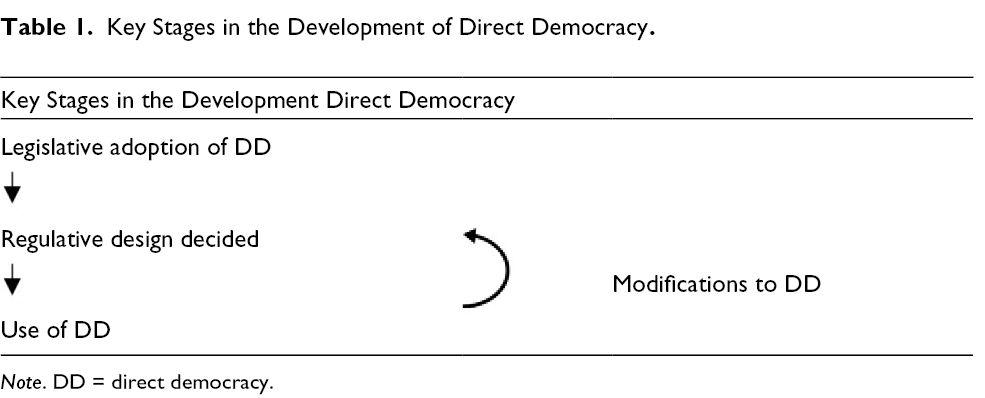
These two observations – adoption and modification of DD – frame the main argument of this article, depicted in Table 1. I contend that in order to grasp how DD is used, we must understand its design but also take a step back and probe how this design came to be in the first place. Furthermore, it is also critical to understand how the experience with DD can lead to its modification, demonstrated by the curved arrow in Table 1. Modifications are undertaken with certain purposes in mind – for example, to expand the role of citizens, to reduce the role of courts in DD, to increase the ability of parties to use DD, among others – and also require explanation to understand how the use of DD will change. As a secondary case study, I examine the adoption and modification of DD in Uruguay, the most frequent user of national-level DD in the developing world, to demonstrate the changing regulations that govern DD. Grasping the politics of adoption and modification are hitherto understudied aspects of DD.
Key Stages in the Development of Direct Democracy.
Note. DD = direct democracy.
The remainder of this article expands on this argument and is organised as follows. The next section explains the methodology and case selection. The third section provides a detailed case study of Mexico, demonstrating the adoption, use, and reform of DD, as well as its endogenous nature. I then review DD in Uruguay to demonstrate the changing regulations that govern its popular consultations. The fifth section discusses the theoretical implications of my argument and how it contributes to the existing literature on DD. The final section summarises my findings and discusses recent subnational popular consultations in Mexico as suggestions for future research.
Key Terms and Methodology
To focus the scope of this article, DD refers to publicly recognised institutions “wherein citizens decide or emit their opinion on issues—other than through legislative and executive elections—directly at the ballot box through universal and secret suffrage” (Altman, 2011: 7). The mechanisms of DD include referendums and initiatives (together here called popular consultations) among other tools undertaken to either create or repeal an existing law. The preoccupation here is with government-initiated (top-down) consultations (Breuer, 2009), but also with citizen-initiated consultations (bottom-up), which we would not expect governments to use or control. I only deal with DD in democracies, although non-democratic regimes have also deployed this tool.
To grasp the nature of DD requires the ability to carefully trace politicians’ reasoning and vacillation when adopting DD as a venue for policymaking. In order to do so, I examine Mexico, which in 2014 became the most recent adopter of DD at the national level, which affords us a detailed look into this entire process. I supplement the main case by considering the history of DD in Uruguay because it has held the largest number of national popular consultations in Latin America. Given the nature of the question, I use process tracing methodology to examine the case of Mexico by considering the steps outlined in Table 1.
Process tracing is appropriate because it allows us to investigate the development of a variable (in this case, DD) by placing central importance on changes of the variable over time (including the adoption, use, and modification of DD). This, in turn, facilitates the identification of causal mechanisms (George and Bennett, 2005). Doing so necessitates a meticulous description of DD developments at several points in time, the effects of such developments on subsequent changes, and their final manifestation in politics (Collier, 2011: 824). As Mahony proposes, observing a causal process can help establish that specific events took place, that different events occurred after the initial events, and that the former was a cause of the latter (Mahoney, 2012: 2).
To scrutinise the young institution of DD in Mexico, I examined a large volume of legislative records as well as the accompanying discussions by legislators before, during, and after adopting DD as well as during modifications to DD. 1 Meticulous and intensive observations of the decision-making process and scrutiny of varied sources of evidence and information enable us to trace politicians’ reasoning when adopting DD (Altman, 2011). In examining Uruguay, I focus on the historical development of its DD to show how its use led to its modification, demonstrating that DD is not an immutable institution.
To foreshadow my contribution, the adoption of DD in Mexico demonstrates how DD – conventionally believed to empower citizens – can readily be used by organisations with significant resources, like political parties, but contain significant barriers, making it challenging for everyday citizens to use. Additionally, the Mexican case demonstrates how the experience with DD has led to its own modification. Considering the prevalent theoretical belief (that DD increases the power of citizens) and the reality (that DD in Mexico has so far been a tool of political parties), I argue that DD is endogenous; legislatures certainly provide citizens with DD but they do so on their own terms. The use and effects of DD depend on the power given to it by legislatures. Several additional lessons derive from the Mexican case, including important theoretical deviations which are articulated fully in the “Theoretical Contributions” section.
Case Study: Mexico’s Adoption and Reform of Direct Democracy
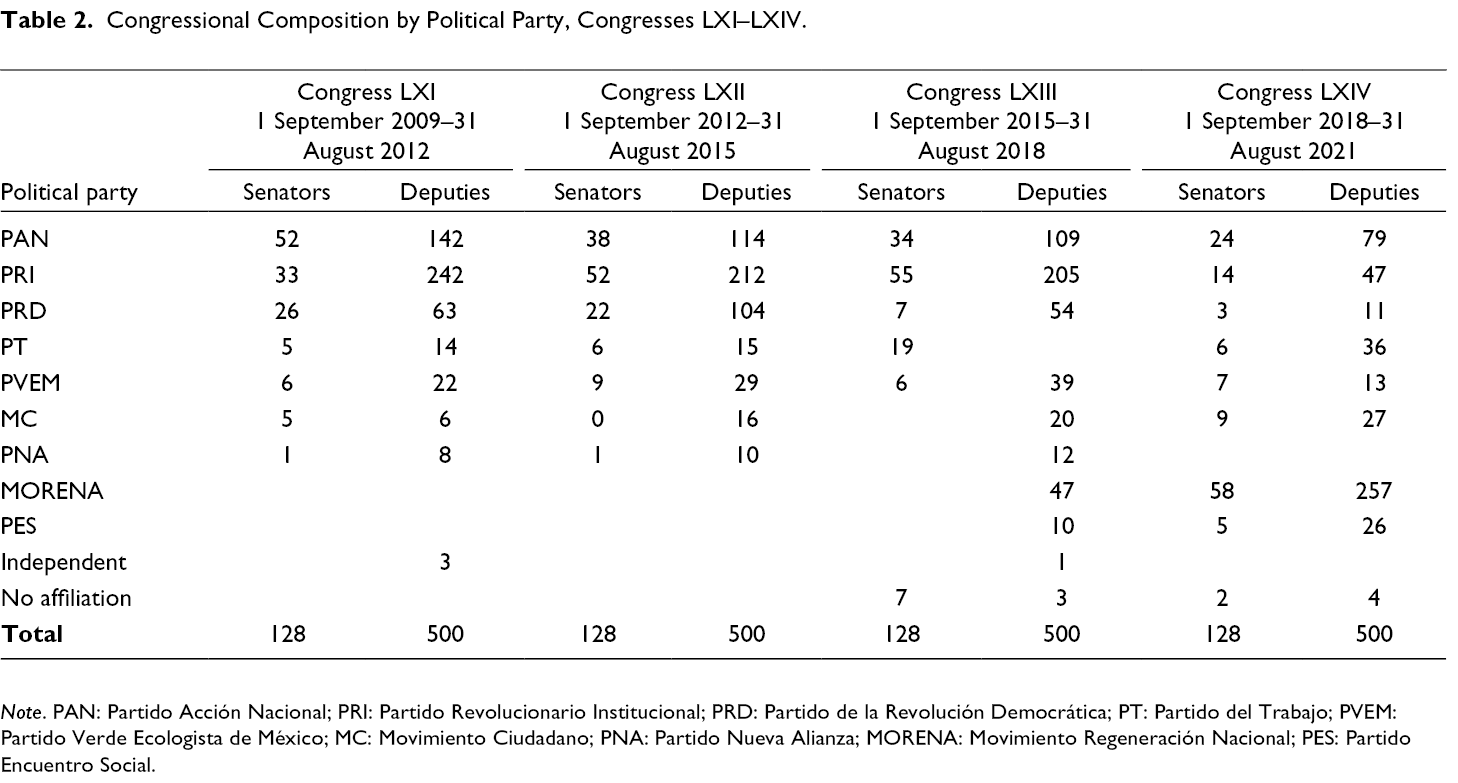
From 2011 to 2014, several parties in Mexico’s Congress debated the adoption of legislation to make room for national popular consultations. 2 During the LXI Congress (1 September 2009 to 31 August 2012), the Partido Revolucionario Institucional (PRI, a centrist party), the Partido Acción Nacional (PAN, a centre right party), and the Partido de la Revolución Democrática (PRD, a centre left party) added Article 35, section VIII to the national constitution, which created the right for Mexican citizens to vote in popular consultations. During the LXII Congress (1 September 2012 to 31 August 2015), these same parties adopted the Federal Law of Popular Consultation, which outlined specific procedures to undertake popular consultations. Finally, during the LXIV Congress, several modifications were undertaken to DD in Mexico. These legislative sessions and the composition of Congress by parties are summarised in Table 2. The following subsections provide a detailed investigation of legislation – including discussions, qualms, and disagreements among political parties – to explain the endogenous nature of DD. The main cleavages and disagreements among parties are crucial to understand the final design and functioning of DD in Mexico.
Congressional Composition by Political Party, Congresses LXI–LXIV.
Note. PAN: Partido Acción Nacional; PRI: Partido Revolucionario Institucional; PRD: Partido de la Revolución Democrática; PT: Partido del Trabajo; PVEM: Partido Verde Ecologista de México; MC: Movimiento Ciudadano; PNA: Partido Nueva Alianza; MORENA: Movimiento Regeneración Nacional; PES: Partido Encuentro Social.
Adopting Direct Democracy
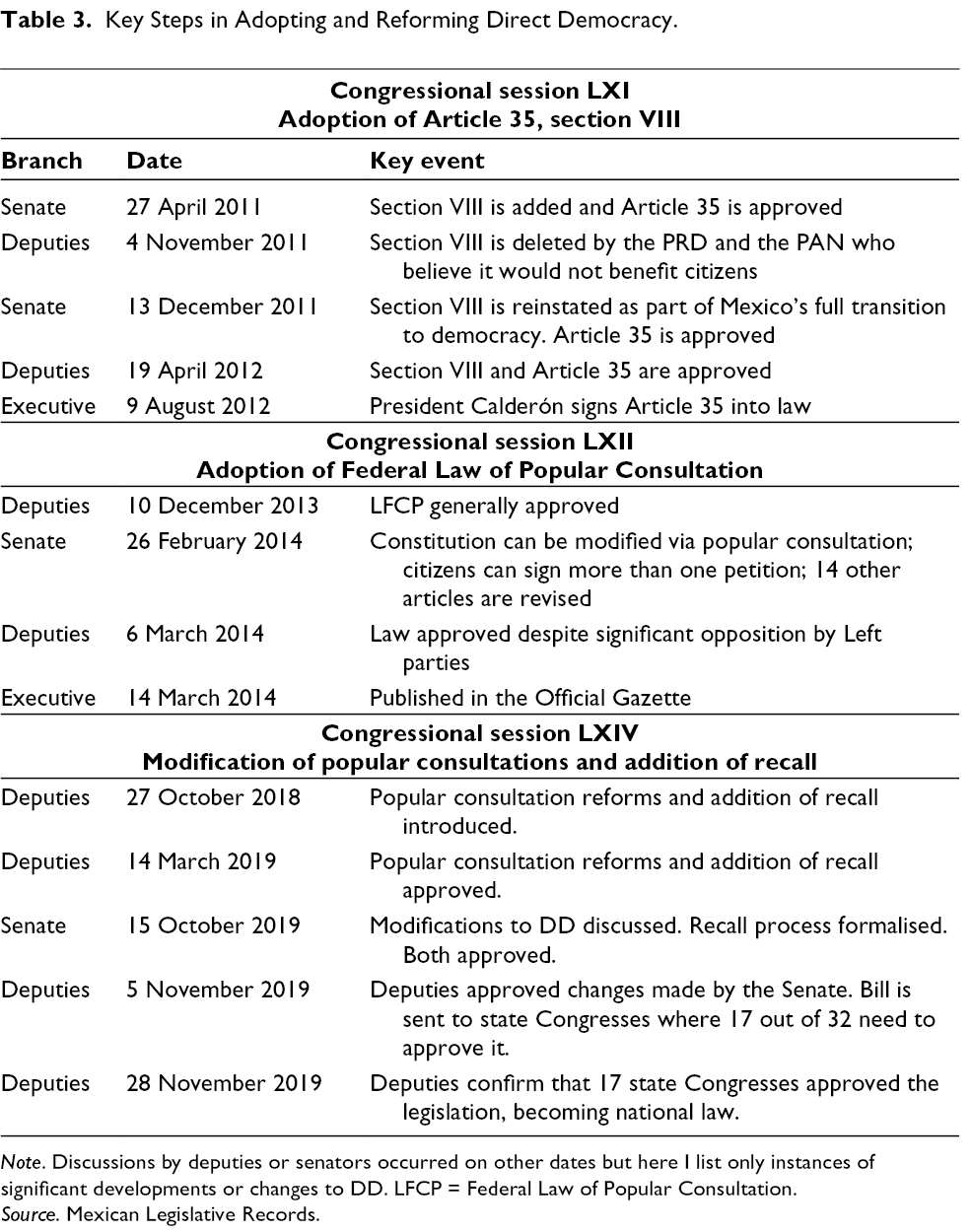
The first step in adopting DD involved adding section VIII to Article 35 of Mexico’s constitution, which permits citizens, Congress, and the executive to use national popular consultations where citizens’ vote renders the final decision. The first half of Table 3 summarises the key steps taken in the adoption of section VIII. Members of the PRI in the Senate originally proposed DD as a way to increase the strength of democracy in Mexico. After an initial draft, the bill was sent to the Chamber of Deputies where disagreements about the particulars erupted on 4 November 2011. This led deputies to completely delete DD. Deletion was directed largely by the PRD and the PAN. Legislative proceedings recorded that these two parties considered the current framework of DD as incapable of benefiting citizens and as an imposition by the PRI which the PRD and the PAN believed would use DD to accomplish party goals. When the bill was returned to the Senate, senators reinstated section VIII by restating that DD was fundamental to Mexico’s full transition to democracy, and unanimously approved it. The bill was then returned to the Chamber of Deputies, where Article 35 with section VIII was widely approved on 19 April 2012. Those parties previously against it (the PRD and the PAN) approved the legislation after clauses for national re-election of Congress members were scrapped in other legislation.
Key Steps in Adopting and Reforming Direct Democracy.
Note. Discussions by deputies or senators occurred on other dates but here I list only instances of significant developments or changes to DD. LFCP = Federal Law of Popular Consultation.
Source. Mexican Legislative Records.
Once the possibility of using DD was incorporated into the national constitution, secondary legislation, the Federal Law of Popular Consultation (LFCP), was debated to specify rules by which popular consultations were to be undertaken – that is, who, when, and how DD can be used. The middle section of Table 3 demonstrates its progression among senators and deputies. The final outcome, however, does not capture the intensity of disagreement and concessions that resulted in those votes. A critical moment occurred on 25 February 2014, when DD had extensive support among senators until members of the PAN broke an arrangement with the PRI to support the law. The delay was due to opposition by the PAN, the PRD, and the PT (Worker’s Party) to several restrictions in the draft of the law at that point in time. Discussion continued into the following morning when senators agreed to revise Articles 5, 6, 12, 14, 15, 20, 21, 25, 28, 30, 32, 33, 41, 64 and the transitory text. The law was subsequently approved (103 Yes, 10 No), but several revisions are important to consider, each a reflection of the respective objectives of the different political parties and which determined the scope of DD.
First, the legislation originally prevented the content of the constitution from appearing as a topic of popular consultation. This restriction was included by the PRI and supported by the PAN in order to guard against a popular consultation on the privatisation of the national petroleum company (Petróleos Mexicanos [PEMEX]), which had been partially privatised in 2012. However, during the debate on 26 February 2014, members of the PAN, together with parties on the left, voted to scrap the prohibition and allowed DD to amend the constitution. Second, the proposed legislation originally did not permit citizens to sign more than one petition to qualify a consultation to the national ballot. Under pressure from the PAN and the PRD, the PRI supported an adjustment on the condition that 80 per cent of signatures would need to be unique to each petition. Third, at the insistence of the left parties, modifications transferred power to decide the constitutionality of popular consultations from Congress (as originally proposed by the PRI and the PAN) to the Supreme Court. Finally, senators defined the issues that could not be put to popular vote: human rights, the representative form of government, election law, taxes and government spending, the armed forces, and national security.
In Table 3, the 6 March 2014 vote demonstrates the passage of the law but also shows that several members of left parties opposed it. Before the final vote, the PRD, the PT, and members of other small parties fought to modify twenty-five additional articles which they believed would not benefit citizens. None of the suggestions garnered enough support to pass. At the end, several members of the PRD opposed it and all members of the PT and the Movimiento Ciudadano (MC, of left political ideology) voted against the legislation. The law was thus approved despite the significant disagreement that remained.
The process of adopting section VIII to Article 35 and the LFCP demonstrates that DD – despite seen as a tool of citizens against government – is in fact endogenous to the political system. Its adoption and rules depend on the political forces present during the time of adoption. While it is certainly true that all laws depend on the current configuration of legislatures, adopting DD is unlike adopting other laws. DD, at its core, seeks to expand the role of citizens in politics, making them a direct player in creating public policy. In effect, DD creates an additional veto player in politics capable of challenging existing laws. The Mexican case further demonstrates that some members in Congress sought to create DD to benefit parties and not just citizens. This is demonstrated by the final regulative design of DD, which provided not only citizens the right to use popular consultations but also Congress and the president. 3
For citizens to undertake popular consultations, they must first consult with a Congressional chamber and then collect signatures from 2 per cent of eligible voters. The petition and signatures must be submitted to Congress in a two-week window. If no violations are found by the National Electoral Institute, the Supreme Court of Justice of the Nation (SCJN) decides on the constitutionality of the proposed measure before appearing on the ballot for a national election. Outcomes of popular consultations are binding when at least 40 per cent of citizens turn out to vote, and would only be held during national elections – every three years.
In Congress, either chamber can draft a consultation with 33 per cent support from its members. After drafting, a majority of both chambers needs to approve it and the SCJN needs to decide its constitutionality before the consultation appears on the ballot. As for the executive, 4 they can propose one consultation every three years (twice during their six-year tenure in office) after first conferring with Congress. The latter then forwards the petition to the SCJN. If constitutional, the proposal returns to Congress for a majority vote in both chambers and then appears on the next national ballot.
At the end of the adoption process, two critical details were omitted from the popular consultation law. First, there was no clause to prevent political parties from using the signature-gathering method created for citizens. Second, there was no language on the specifics details and rules for recalls. Both issues are discussed in the following subsection.
Use and Reform of Popular Consultations
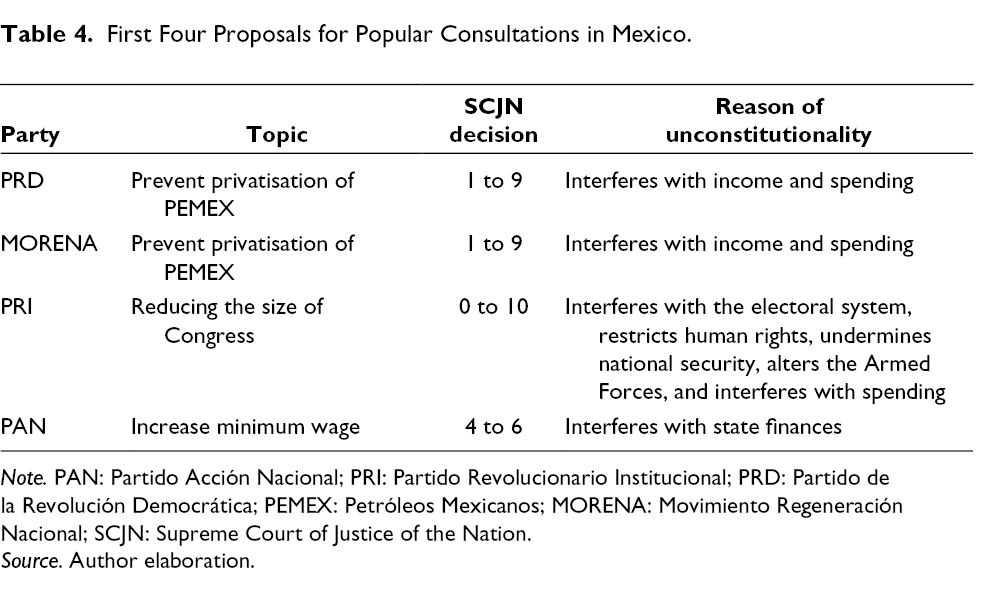
Upon the adoption of DD, millions of signatures began to be arduously collected to qualify four different consultations to the June 2015 ballot. 5 But the signatures, counterintuitively, were not collected by everyday citizens but by individuals representing the four major parties. Two proposals – each undertaken by the main left parties, the PRD and the new Movimiento Regeneración Nacional (MORENA, a party of left political ideology created in 2014) – sought to prevent the privatisation of PEMEX. Another – organised by the ruling centrist PRI – hoped to reduce the number of federal deputies and senators, and a final proposal by the PAN sought to increase the national minimum wage. While a detailed history as to why these specific topics were selected is beyond the scope of this article, the critical thing to recognise is that each proposal was under the direction of a political party despite using the signature-gathering path reserved for citizens. When the proposals were submitted to the SCJN to ensure their constitutionality, all four were ruled unconstitutional. Table 4 lists the supporting party, the topic of the consultation, the SCJN decision, and the justification for unconstitutionality.
First Four Proposals for Popular Consultations in Mexico.
Note. PAN: Partido Acción Nacional; PRI: Partido Revolucionario Institucional; PRD: Partido de la Revolución Democrática; PEMEX: Petróleos Mexicanos; MORENA: Movimiento Regeneración Nacional; SCJN: Supreme Court of Justice of the Nation.
Source. Author elaboration.
In response to their unconstitutionality, members of major parties articulated concern about the role of the SCJN in DD. Andrés Manuel López Obrador (AMLO), founder of MORENA and now President of Mexico, asserted that the SCJN’s decision was illegal, and Martí Batres, then leader of MORENA, called the decision irresponsible. Cuauhtémoc Cárdenas, who directed the PRD proposal, called the SCJN a biased and partisan institution (LatinNews, 2014), and Carlos Navarrete, leader of the PRD, expressed intent to refer the case to the Inter-American Commission of Human Rights and the Inter-American Court of Human Rights for redress. Lastly, and critical for the future of DD, the PAN and the PRI expressed a need to reform the rules of DD to make it easier for citizens to participate in the process (Gutiérrez Ávila, 2014; Nieto, 2014).
These reactions towards the SCJN’s decision and the widespread calls for DD reform are important because they demonstrate how the use of DD can lead to its regulative changes, as shown by the curved arrow in Table 1. Modifications to the regulative design of popular consultations continue to the present, as shown in the lower part of Table 3. Given MORENA’s numerical majority in Congress (Table 2), they led the discussion during the LXIV Congress. This began on 27 October 2018, when MORENA deputies introduced a bill to modify the rules of popular consultations and the addition of a recall process for presidents, both promises made by AMLO during his presidential campaign. On 14 March 2019, deputies approved the bill. Senators discussed the changes on October 2019 and modified popular consultations and the recall process.
In terms of the recall, 3 per cent of all registered voters can initiate the process against the president, state governors, or the mayor of Mexico City (when doing so, at least 3 per cent of voters in at least seventeen states need to sign the petition to qualify the recall). Neither Congress nor the president can initiate recalls, as first proposed by MORENA, recalls can take place one time, three months before the end of the third year of the president’s or governor’s six-year term. The result is binding with a 40 per cent turnout and a simple majority is required to pass. Like the adoption process which began in 2011, there was significant opposition to these changes. In particular, the PAN voted against it consistently citing possible instability of the nation if presidents did not finish their six-year term.
As for the modification of popular consultations, revisions outlined that their subject cannot only be issues of national importance but also those of regional importance. When the issues are regional, 2 per cent of eligible voters must support the proposal in the respective states. The issues subject to consultation were also modified. In addition to existing prohibitions outlined in the original law, consultations cannot be held on infrastructure projects already underway. Both of these changes occurred in response to the unofficial multi-day referendum on October 2018, which asked citizens if they desired to halt the development of Mexico City’s new airport. While already under construction, voters chose to stop its completion. Finally, while the SCJN retains its previous power of deciding constitutionality, popular consultations can no longer take place on the same day as elections for representatives. Instead they can be held (if needed) every year on the first Sunday of August.
Once these modifications were approved by senators, they were sent to the Chamber of Deputies, where they were approved on 5 November 2019. Deputies clarified that in the case of a successful recall, the president of Congress will act as resident of the nation and within thirty days, Congress would select a new federal president to conclude the sexenio. Once approved, deputies sent the law to state legislatures, where seventeen out of thirty-two would need to adopt it in order for it to be incorporated into the national constitution, which was confirmed on 28 November 2019.
The adoption process discussed above, the experience with the use of popular consultations so far, and the modifications to DD validate my argument. Mexico demonstrates how the design of DD was influenced by divisions among parties and how popular consultations are being used. More importantly – and as a new contribution to DD literature – the Mexican case illustrates the endogenous nature of DD. DD, its form, and any modifications to it are intrinsic to the political forces that created it. While DD is considered to be a tool for citizens against governments, it is bound by rules determined by legislatures. As such, DD is only a tool for citizens to shape public policy to the extent that their legislators have determined.
Evolution of Direct Democracy in Uruguay
As a secondary case, it is important to consider the case of Uruguay because it is the most prominent user of national-level DD in Latin America and the developing world. While I rely on existing research, the history of DD in Uruguay exemplifies my argument in three ways. First, DD in Uruguay was adopted in order to craft a particular government structure, a collegiate executive. Second, the availability and rules of DD have been modified significantly over the past century, transforming the way popular consultations are utilised. Third, as in the case of Mexico, party influence is important because votes in citizen-initiated DD are primarily a result of party loyalty. Each of these is briefly discussed in turn.
Regarding the first, the adoption of DD in Uruguay dates back to the first two decades of the 1900s, when several members of the Uruguayan political elite, including José Batlle y Ordóñez (president, 1903–1907 and 1911–1915), were influenced by political ideas emanating from continental Europe, particularly France and Switzerland (Altman, 2008; Hudson, 1992; Lissidini et al., 2008). Uruguay pursued the Swiss DD model, Altman maintains, due to Batlle’s deep normative convictions but also due to “notorious short-term partisan and political interests toward advancing with direct democracy” (Altman, 2011: 143).
While the influence of DD occurred during a period of expansion of Uruguayan democracy and political institutionalisation (Hudson, 1992), it did not necessarily expand the political participation of citizens, which would take decades to develop. Rather, DD involved a means for political elites to achieve certain political goals. Given the high fractionalisation of political parties (even though Batlle’s Colorado Party occupied the presidency), it was difficult to reach decisions in the Parliament. In particular, the legislature was averse to adopting a collegiate executive. DD would transfer the resolution of this political stalemate to citizens and help Batlle and his followers beat the National Party and fraction of the Colorados that opposed him. DD, in short, was an attempt to govern more effectively in the face of opposition in the Parliament (Lissidini, 1998: 181–182). 6
Second, Uruguay also demonstrates how the rules of DD have changed since it was first used. Uruguayan citizens indeed voted on a popular consultation shortly after Batlle’s second presidency to approve the 1917 Constitution, creating an executive branch with two bodies: a president and a National Council of Administration (Hudson, 1992). While the 1917 Constitution did not provide any strong powers to citizens through DD (despite its approval by popular vote), the institutions of DD would be expanded and altered all the way up to the present (Caetano and Rilla, 1994; Lissidini, 1998). Briefly, formal power to citizens was expanded in the 1934 Constitution, which allowed citizens to hold popular consultations on constitutional revisions when 20 per cent of voters supported it, and a new constitution in 1942 lowered the signatures required to 10 per cent and incorporated a quorum for approving popular consultations (the “yes” needed to represent 35 per cent of voters).
A new Constitution in 1967 allowed citizens to not only revise the constitution but also challenge most laws passed by Congress whenever 25 per cent of citizens supported it. Given the government’s inability to verify such a large number of signatures, in 1989 Law 16,017 allowed 0.5 per cent of eligible voters to propose a popular consultation. The 25 per cent support threshold would be verified by asking citizens to vote twice in order to show their support to hold the consultation. This meant that Uruguayans voted twice to decide whether to vote. Such a tedious and resource intensive practice resulted in a further modification in 2000, when the legislature changed the required signatures to propose a consultation to 2 per cent (instead of 0.5 per cent) and required only one prevote to decide whether to vote on the matter (Altman, 2008, 2011: 144–146). 7 Today, Uruguayan citizens have participated in several popular consultations from their beginning (collecting citizen signatures) to their conclusion (participating in the vote). Recent issues decided via citizen-initiated DD include the prohibition against the privatisation of water in 2004, the abolition of the waiver for crimes committed by the armed forces during Uruguay’s dictatorship in 2009, and on lowering the age of criminal responsibility in 2014. Voters agreed to the first but rejected the other two.
Third, and reflecting the experience in Mexico, it is instructive to consider the role of political parties in Uruguayan DD. Looking at Uruguay broadly, three distinct DD stages regarding the role of parties have been identified (Lissidini, 2012). The first stage was characterised by political parties and fractions attempting to reform the constitution. In this stage, and critical to my argument, DD involved bipartisan competition used to displace one or another political fraction from achieving its desired policy. All popular consultations originated among political parties and none were begun or sponsored by citizens or social organisations outside of the parties. The incorporation of DD into the constitution and its use in the first period, Lissidini argues, “did not stem from a crisis of representation” (2012: 153) but a path for parties to pursue their agenda. This was followed by a second stage where, under authoritarian rule (1973–1985), popular consultations were used to institutionalise the regime’s power. In the third stage, beginning with Uruguay’s recent democratisation, DD was solidified as a tool for citizens to curb or reject decisions of the Parliament. 8 The three stages demonstrate a shift in power from parties to citizens in the DD process. For example, Altman (2011) finds that recent citizen-initiated DD in Uruguay often succeeds 9 and that DD reinforces democracy by promoting public discussion and citizen participation (Lissidini, 2012).
Although the role of citizens has been expanded in Uruguayan DD, we must recognise that political parties have incentives to take positions on the issues at stake. While Uruguayans today are active in DD, how citizens vote on popular consultations is primarily the result of party affiliation (Altman, 2002, 2011). The finding is partly a product of party loyalty – where political identities are deeply rooted in Uruguay’s two main parties – but also a result of active positions taken by the political parties in citizen-initiated DD. Moreover, and complementing the Mexican case, parties in Uruguay often help organise citizens due to the vast amount of resources needed to undertake national popular consultations. Like Mexico, citizens in Uruguay have “very little chance to successfully advance their interests through DD” (Altman, 2008: 512) given the barriers to successfully qualify a popular consultation to the national ballot.
Theoretical Contributions
The primary contribution of this article is that DD is an endogenous institution, adopted by legislative bodies on their own terms. Once this is understood, the misnomer that DD cedes political power to the people must be qualified given the often-dominant role played by political parties. Endogeneity suggests that DD is not an institution of citizens independent of other government branches. The case of Mexico – and the experience of Uruguay – demonstrate this dynamic and its implications in practice. Both cases offer valuable insights for the literature on DD.
The first is a theoretical contribution. Established literature suggests that the incorporation of DD in Latin American constitutions stemmed from a belief that representative democracy had failed to properly serve citizens (Barczak, 2001: 38). As such, DD was demanded from “below” under two conditions (Schilling-Vacaflor, 2011). First, it was adopted when constitutions were written by formerly excluded protagonists that rose to dominate political institutions (as occurred in Argentina, Brazil, Ecuador, Peru, and Venezuela). Second, DD was placed on the political agenda during times of institutional stress and when traditionally excluded groups mobilised to capture a significant, but not controlling, share of the authority over the reform-writing process (as in the cases of Colombia and Paraguay [Barczak, 2001: 40–41]). In the case of Bolivia, Breuer (2008b) finds that DD emerged as a result of executive-legislative conflict. Deviating from these theoretical expectations, Mexican (and Uruguayan) DD was introduced from above. In Mexico, DD emerged under the direction of the centrist PRI party, which ruled singularly for seventy years until 2000 while parties on the left expressed significant concerns about the process. In Uruguay, DD was introduced to achieve a particular government structure. Research on the Uruguayan experience suggests that mechanisms of DD became bargaining chips among political elites to counter a greater concentration of executive power, not as demands from disenfranchised groups in society to gain broader political inclusion (Altman, 2002, 2008, 2011).
A second contribution involves the need to rethink why governments resort to DD. In a study of established democracies, the motivations for utilising top-down DD were organised into four reasons: to consolidate government power, to resolve divisions within the government, to pass otherwise unpopular legislation, or to pass legislation that would otherwise be seen as illegitimate unless delegated to citizens (Morel, 2001; Topaloff, 2017). From the vantage point of the Mexican case, we can expand on these reasons for DD and move beyond top-down mechanisms when studying the power of government in DD. This influence of government also extends into citizen-initiated DD, as the case study of Mexico demonstrates and statistical models suggest (Serdült and Welp, 2012). The case of Uruguay similarly demonstrates the entrenched role of parties in the DD process.
A third contribution involves a deeper reflection of the direct effects (laws approved by the voters) and indirect effects (changes in legislative behaviour) of DD (Gerber and Hug, 2001). Missing from this discussion is a conceptually different effect: the possibility that the experience with DD may cause legislatures to modify the rules that underpin its use. The experience of Mexico demonstrates that parties modified the rules of DD after it did not work as they originally intended. In Uruguay, significant alterations of the rules of DD have been made over time that changed substantially who and how DD is used. Such rule revisions may expand the role of citizens, as appears to be the case in Uruguay, while simultaneously increasing the ability of parties to manipulate the process, as it seems to be occurring in Mexico. It is thus important to recognise that DD works both ways. The rules of DD affect legislatures and parties and in turn these institutions can push back to reform DD. Both causal arrows (how legislatures affect DD and how DD affects legislatures) are critical in the DD game.
A fourth contribution involves the need to more critically pose the question of why legislative bodies voluntarily erode their power by providing citizens with DD? The answer is that the utilisation of DD does not constitute a complete erosion of their power to establish the law of the land. This is precisely why the close consideration of the origins and legislative adoption of DD is essential. In what has now become a common narrative, DD’s theoretical promise – to increase the power of citizens and expand the space for democratic participation – does not tell the full tale. We can expect groups with resources to focus their efforts and attention on the most important institutions for decision-making, whether in legislatures or through DD (Mendelsohn and Parkin, 2001). In the United States, for example, political parties and non-partisan lobbies have embraced DD to challenge restrictions placed on them in realising specific policy goals. By the end of the twentieth century, argue Bowler and Donovan (2001), American political parties had become significant actors in DD.
A final contribution of this article is the reconsideration of the neat typological divisions into which DD institutions have been placed. The discussion here suggests that organising DD strictly by its regulative characteristics (the rules which underpin the use of DD) only clouds our understanding of this phenomenon. The fact is that DD paths reserved for citizens may be partly controlled by parties and political elites, a trend that eludes classification. If we treat top-down and bottom-up DD as tools of government and citizens, respectively, we can miss the influence of parties in both types of mechanisms. For top-down DD, research has found that governments use DD to achieve the goals of political elites, that political leaders count on the masses to support popular consultations directed by parties, and that presidents often attempt to use the tools in their favour (Durán-Martínez, 2012). This article argues that bottom-up DD may be used in similar ways, as demonstrated by the Mexico case.
That DD may become an additional tool of governments does not suggest it be received with pessimism in all instances. While DD can be co-opted by governments, this outcome is not inevitable. There are myriad ways in which DD can benefit citizens and deepen democracy in many contexts (Cameron et al., 2012) while creating laws closer to citizens preferences (Matsusaka, 2004). Research suggests that DD can fill a gap between citizens and representative democracy (Selee and Peruzzotti, 2009) and pave new avenues for citizens to express their political opinions (Qvortrup, 2017).
Discussion: AMLO’s Popular Consultations and Avenues for Future Research
Considering the lessons of DD in Mexico and the narrative in the existing literature, I echo Altman’s suggestion that DD is Janus-faced: some instances of DD are “forward looking, democratising politics, whereas others are backward facing, enhancing the power of politicians who deliberately use them” (Altman, 2011: 8). But to grasp the roots of this proposition, we need to understand the origins of DD. Past research has suggested that to understand how DD is used, one must examine its regulative design. However, it is my contention that scholars must dig deeper in order to fully comprehend how DD came about in the first place. Doing so reveals that DD was often adopted for specific reasons. The use of DD can be biased in practice, both because the government’s intentions may be instrumental, and also because the regulative design may be biased in favour of the government (Morel, 2001).
Endogeneity here does not suggest that DD must be born within the country adopting it; political ideas continue to circumvent the world, leaving their mark along the way. Foreign institutions and ideas certainly shape the way that institutions at home evolve, but it is the legislative process of adoption that determines the use of these institutions in practice. The critical lesson about endogeneity is that legislatures provide the masses with DD but they do so on their own terms. As such, DD is not a tool of citizens against government independent of government; rather, it derives its power precisely from government.
There are a host of directions for work on DD to move forward in the case of Mexico. In particular, apart from tracking further developments and changes to the rules of national-level DD, research can begin examining its use at the state or regional level and how it is shaping the sexenio of the current administration of President López Obrador. When elected in 2018, AMLO’s party, MORENA, vowed to transform Mexico’s politics and society with greater inclusion and direct participation in politics by everyday citizens, particularly through popular consultations.
This promise began even before assuming his presidency, when AMLO held an unofficial referendum where citizens were asked to decide whether to continue the construction of Mexico City’s new airport. Once president, AMLO used the referendum outcome to indeed suspend the partially completed airport. Furthermore, in November 2018, AMLO asked citizens to decide ten issues, including the construction of a transcontinental railroad, doubling pensions for the retired, and increasing the number of scholarships for grade-school students. Other consultations have been held, including the construction of a thermoelectric project in the states of Morelos, Tlaxcala, and Puebla and on construction of a brewery in Mexicali in Baja California. The consultations, however, have been plagued by dismally low turnout, voter fraud, and vandalism, among other irregularities. Critics have also pointed to the loaded terminology of the consultations, the lack of background information, and the fact that polling stations have been largely set up in areas that showed strong support from AMLO during the 2018 presidential election.
As AMLO continues to make policy via these popular consultations, scholarship should be attentive to their public policy effects and how these are shaping the behaviours of political parties and citizens. Scholars and citizens should also be wary of whether the holding of referendums at this magnitude is an effective decision-making process and one that actually empowers citizens. Indeed, a broad range of evidence warns against the chronic use of executive consultations given their potential for presidential aggrandisement (Bermeo, 2016). This is a possibility because consecutive presidential referendums can create a feeling that presidents derive their power directly from the masses. The institutional hazard is that instead of referendums being understood as a consequence of executive legitimacy, they may begin to be interpreted as the basis of democratic legitimacy, as was understood long ago by Weber (1968: 266).
This possibility increases when referendums ask not to decide public policy but to decide the election terms of political elites, a strong possibility in Mexico. Even before AMLO began his presidency, he announced a referendum on his performance and vowed to curtail his six-year term if voters so decided. This is, however, precisely the danger. A referendum on AMLO’s rule does not constitute an ordinary competitive election, but a profession of faith, a recognition of one individual as a personally qualified leader (Weber, 1968). When adopting provisions for the recall in 2019, the PAN recognised this and argued that recalls could actually empower elected officials if they worked in their favour.
By reflecting on the DD experience in Mexico so far, and given the potential dangers of misusing popular consultations, we should question whether DD at the national and/or subnational level can be rightly interpreted as the voice of the people. Examining how DD in Mexico develops and by considering it in other countries, future research can continue to investigate whether DD constitutes a meaningful democratic representation of the citizenry. To do so, future work on DD will require a strong understanding of its adoption, regulative design, and the role of governments in countries examined.
Supplemental Material
Supplementary Material 1 - Supplemental material for Endogenous Direct Democracy: The Case of Mexico
Supplemental material, Supplementary Material 1, for Endogenous Direct Democracy: The Case of Mexico by and Juve J. Cortés in Journal of Politics in Latin America
Footnotes
Declaration of Conflicting Interests
The author(s) declared no potential conflicts of interest with respect to the research, authorship, and/or publication of this article.
Funding
The author(s) received no financial support for the research, authorship, and/or publication of this article.
Notes
Author Biography
E-mail:
References
Supplementary Material
Please find the following supplemental material available below.
For Open Access articles published under a Creative Commons License, all supplemental material carries the same license as the article it is associated with.
For non-Open Access articles published, all supplemental material carries a non-exclusive license, and permission requests for re-use of supplemental material or any part of supplemental material shall be sent directly to the copyright owner as specified in the copyright notice associated with the article.
