




Abstract
Government and organized criminal groups co-exist in uneasy equilibrium. Criminal groups adjust their behavior as a function of their own goals and resources in relation to inter-group cooperation and conflict, dynamic markets, and public policies; governments adjust their behavior according to shifting perceptions of the benefits offered, threats posed, and strategies adopted by criminal groups. When governments attempt to control or repress their activities, criminal groups employ various tools and instruments that might be grouped into three categories: evasion, corruption, and confrontation. The paper draws on recent cases from Brazil and Mexico with respect to tactical and strategic choices by governments and criminal groups, seeking to address three broad questions. What factors disrupt the state-criminal group equilibrium? Under what circumstances do disruptions produce significant levels of violence (as opposed to evasion or corruption)? What are the implications for the quality of democracy as criminal groups violently confront the state?
Introduction
Shortly before Mother's Day weekend, on May 12, 2006, Brazil's largest city and economic powerhouse, São Paulo, was paralyzed by outright warfare between police and members of the Primeiro Comando da Capital (PCC), a gang with origins in the prison system. 1 The targeted murders of police officials and a wave of attacks against police stations and other symbols of state power shut down much of the city and forced the police into improvised bunkers in their stations. In the first of three waves of attacks, at least one hundred and forty people were killed, traffic stopped citywide, bus service was cut off, and many businesses closed entirely. While this event shocked São Paulo, which had considered itself largely immune to the sort of state-criminal confrontation that has long plagued its northern neighbor, Rio de Janeiro, it was in many ways only a natural extension of violence between criminal organizations and the Brazilian state.
The authors would like to thank Diane Davis, participants in LASA 2007, and the anonymous reviewers for helpful suggestions on earlier versions of this paper.
A little before 9 p.m. on September 5, 2006, the head of Nuevo León's state investigative police, Marcelo Garza y Garza, was shot and killed by an unknown assailant in a park in an upscale suburb of Monterrey, Mexico. He had been called there to keep an appointment and was talking on his cell phone when the assassin struck. His death was one of 55 linked to organized crime in the state in 2006, and one of about 2,000 tallied in Mexico at large that year (Milenio 2007b). Besides gang members (and occasional innocent by-standers), victims included hundreds of police and justice officers, scores of elected or appointed officials from all levels of government, and dozens of army personnel. By the metric employed by the Mexico City daily El Universal, the pace of the violence increased. Some 2,673 gang-related killings were recorded in 2007, including 238 police officers and 33 army personnel (El Universal 2009; 2008a). The nature of the violence intensified as well, with – for example – a number of grisly beheadings carried out in ways to magnify publicity.
These events suggest that direct and public confrontation between organized criminal groups and the state is no longer a minor concern in Latin America's two largest democracies. Organized crime is capable of challenging the state with the aim not of assuming state powers, but of attaining certain political objectives. The events also call into question commonly held views of the role of the modern state, suggesting that even while claiming the monopoly of the legitimate use of violence, many states may be in constant negotiations with criminal groups to preserve an appearance of order. In sum, direct conflict between criminal groups and the state poses largely unexplored questions about the state-crime relationship, as well as about its repercussions for democratic governance in Latin America.
The specific puzzle addressed in this paper is why organized crime would overtly challenge the state, and disturb an otherwise largely stable equilibrium. Simple logic suggests that criminal organizations seek mainly to avoid confrontation, which is costly and disruptive of business as usual. Our central argument, illustrated by the Mexican and Brazilian cases, is that confrontation signals a calculation by criminal groups, and is likely in conditions under which segments of organized crime believe the costs of tolerating government actions are greater than the risks of drawing attention to themselves. The immediate triggers may vary widely: government cooperation with rival groups, more intense government repression of crime, adoption of specific policies related to jailhouse segregation of gangs, and so forth. The challenges to the equilibrium also reflect the calculation that the state can be forced into concessions, and signal organized crime's willingness to reveal or publicize the complicity between state and criminal actors. As a result, instances of confrontation may offer a threatening reflection of the depth of criminal-political ties, as well as of the strength of criminal groups relative to the state.
In the first section of this paper, we describe in stylized terms the unusual nature of organized criminal groups’ use of confrontation, in the choice among the tactical options of evasion, corruption, and confrontation. The second section moves beyond the stylized model to the more complex real-world cases of confrontation between organized crime and the state in Brazil and Mexico. We conclude by considering how organized crime's use of confrontational tactics impacts basic conceptions of democratic governance.
“Organized Crime” and Crime-State Relations
“Organized crime” is qualitatively different from other forms of criminal activity on two crucial dimensions: time and numbers. 2 Organized crime involves repeat actions over time by multiple colluding actors whose objectives are illegal. This broad definition, however, allows for many different types of criminal organizations, ranging from tight vertical hierarchies of members with lifelong commitments, to looser, more ephemeral and non-hierarchical networks, and various mixtures in between (Figure 1). 3
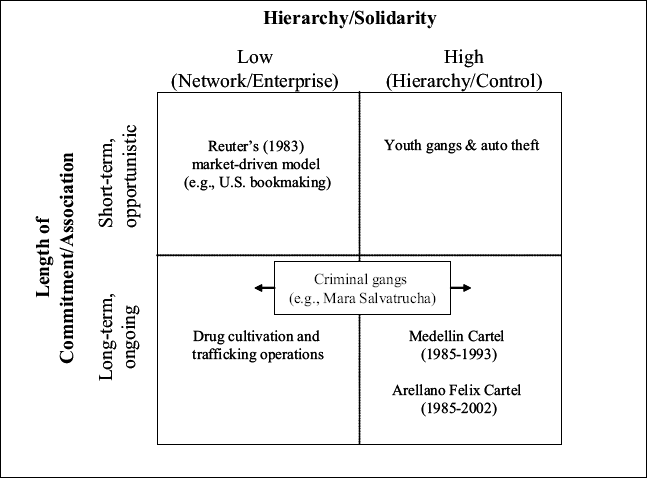
The Organization of Criminal Networks
See, for example, Lampe (2002) and Finckenauer (2005), for a discussion of the many different definitions and conceptions of organized crime. UNODC (2002) provides an especially useful analysis of the links between organizational variations of transnational organized crime and patterns of violence and corruption.
Although the ideal types shown here offer conceptual clarity, criminal organizations may not settle neatly into a single category, and may vary considerably on both axes over time and across distinct fields of business.
At the least organized end of the spectrum are criminal associations that are primarily organized around fluid market transactions. As Reuter (1983) notes in his study of the American bookmaking, numbers, and loan-sharking markets, the stylized view of a centrally-controlled Mafia-like organization is almost certainly false in these markets, which are instead guided by an “invisible hand,” which brings together un-connected individuals in a variety of illicit but market-driven interactions (Reuter 1983: 187; see also Paoli 2002).
At the other end are criminal organizations with longer-term associations and a degree of hierarchy. What Paoli (1998) has termed “criminal fraternities,” these bring together individuals with similar minimal goals as well as shared rules. Almost by definition, an individual affiliated with such an organization does not report on a daily basis to a given place of work, at a given time to complete a given criminal task. In fact, most members of criminal organizations may well work at such “regular” jobs in the legal/licit world and participate only sporadically in criminal activities, brought together with others only as their specific skill-sets are required. 4
Criminal organizations of this sort coalesce in a fashion broadly analogous to the law enforcement community, in which networks of distinct professional categories with disparate objectives and clear hierarchical differences – such as police, lawyers, prosecutors and judges – come together in repeat (and not always smooth) interactions to achieve a common goal of public order. Organized crime may be no more cohesive than the law enforcement community in terms of the homogeneity of its members’ objectives, but the common goal of criminal profit does lead to ongoing relations and even, on occasion, to a clear organizational structure. In both the law enforcement community and in organized criminal groups, interactions between any two individuals in the system may well only occur once: e.g., any given prosecutor may only meet any given judge once in their careers, and prosecutors are unlikely to ever meet all the judges in the system. But the interaction is a repeat interaction in the sense that the patterns of interplay between professionals are repeated: it is likely that all prosecutors will interact with at least one judge in the course of their careers, just as any given drug trafficker is likely to interact with a drug supplier or supplier of protection at some point in their careers.
Groups in the lower half of Figure 1 are complex organizations engaged in ongoing interactions and multiple forms of both legal and illegal activities, differentiated solely by the degree of internal hierarchy. 5 We have depicted a fifth possibility here that spans both lower cells, relating to large-scale criminal gangs. These organizations generally develop long-term ongoing loyalties, be it through initiation rituals, or under more coercive circumstances as when banding together for protection within prisons. Despite these ties, the degree of hierarchy may vary, with some organizations adopting a much more hierarchical structure than others; alternately, some such gangs may be quite amorphous most of the time, working in cells or subunits that, despite the common bonds of membership with a larger group, come together only occasionally to achieve centrally determined objectives.
Following Gambetta (1993: 227), it is clear that there are two dimensions to these organizations: criminal activities per se (e.g., kidnapping, cargo hijacking, illicit drug production and trafficking), and private protection and dispute resolution for groups engaged in these activities. Gambetta terms the latter a “mafia,” which may engage in criminal activities but whose distinctive function is dispute resolution.
The benefits that accrue to the individual from affiliating with a criminal organization – however it is structured – include a mix of both economic and personal security considerations: greater business credibility, increased protection, the physical or economic elimination of rivals, and an expanded network of contacts (in a world in which such contacts are by nature shadowy). Not all the motivations for the association with criminal organizations are solely economic; over time, “fraternity”-type allegiances to a given band of brothers or to informal codes may become as important to explaining affiliation as economic or personal security considerations.
But given members’ conditional and frequently opportunistic affiliation, staging a coordinated act of “political violence” – like the examples cited in the introduction – is likely to be a challenging and risky endeavor for any of the organizational types in Figure 1. Even within the most hierarchical and long-lived organizations in the chart, individual members will have many plausible reasons to defect either to the government or to rival criminal groups, not least as a result of the threat to two key incentives for membership in the organization: economic and personal security. The puzzle this poses, then, is why criminal groups would risk a confrontation with the state, which threatens group unity and survival. To understand this, we turn now to a stylized model of criminal and state objectives.
There is considerable interplay between states and criminal actors, even when the state is not corrupted by, or allied with, criminal groups. Governments and criminal organizations employ evasion and corruption to co-exist in equilibrium relationships in which each continually adjusts to the other's perceived evolution. Criminal groups adjust their behavior as a function of their own goals and resources in relation to the dynamics of markets, public policies, and other criminal groups. 6 Governments adjust their behavior as a function of electoral dynamics, the expectations of other governments, and the perceived behavior of criminal organizations.
This is not always evasive adjustment. For example, organized criminal groups benefit from a state that bans the goods or practices in which they deal (e.g., prostitution, drugs, contraband), since this generates a premium (a monopoly rent, in many cases) that is best captured by illicit organizations. Organized crime is especially likely to benefit if the state bans the goods it trades in, but is unable or unwilling to control traffic in these goods.
Interactions between criminal organizations and governments can occur on a number of levels. At the neighborhood level, for example, fluid organizations involved in extortion, drug distribution, gambling, or prostitution work out stable relationships with individual officers, groups of police, or with whole precincts (Hinton 2006). Evasion and corruption are typical practices. Evasion can be adopted by both criminal groups (operating clandestinely) and by police (avoiding the superior force of criminal gangs); criminals can voluntarily negotiate bribes with police or submit to unilateral extortion by them.
More significant are criminal organizations that operate across several neighborhoods or even citywide. In equilibrium settings, these groups may forge corrupt arrangements with police organizations that frequently reach upward into elected offices (e.g., Gamarra 1999 on Bolivia; Macaulay 2008 on Brazil; Schulte-Bockholt 2006 on Colombia). Most significant to the state-criminal organization equilibrium are several key attributes of these broad-based gangs: command and control of trained personnel, high-power weaponry, tactical intelligence, and mobility. Above some minimum threshold, numbers are not the crucial factor, since criminal groups can operate rather like terrorists, choosing their own targets and timing for maximum effect. More important are the flows of income to finance these key attributes. The wealth, organization, communications, and weaponry of these groups can create qualitatively different bargaining relationships with regional or even national governments.
It is worth noting, finally, that the state's primary objective with respect to public security is often not to maintain public order, but rather, to maintain the public impression of the proper provision of public order. 7 Some bargaining with criminal groups is thus not unusual, although this bargaining may be informal and often telegraphed, rather than settled in face-to-face meetings. A criminal organization that is able to achieve its goals without disturbing the public order may be valuable to the state, especially in contrast to more fragmented criminal enterprises that compete for dominance and thus may generate politically inconvenient levels of violence. Furthermore, if the state is truly unable to provide certain public goods associated with public security (such as low rates of violence or the punishment of petty criminals), organized crime, in the process of protecting its market from competitors, may exercise informal controls over the criminal world that are a useful mechanism for ameliorating public perceptions of state weakness. 8
As Bayley (1994) notes, a common misconception is that the police (the central institution of the state in regard to the discussion above) prevent crime. Rather, according to Bayley, the police have two key functions: intervening authoritatively to restore order, and imposing symbolic justice by demonstrating to offenders and the public that the law exists. Foucault (1977) emphasizes this symbolic deterrence in his analysis of the historical evolution of state punishment. In the Latin American case, the symbols used to maintain public perceptions of the state's power of enforcement and punishment are often illicit in their own right, as in extralegal police killings of suspects (e.g., the essays in Huggins 1991 and Chevigny 1995), yet these illicit actions are seldom punished in the formal judicial system (Brinks 2008).
In Sicily, “[t]he mafia at times polices its territory as if it were responsible for public safety” (Gambetta 1993: 166). Similar arrangements are common, for example, in the favelas of many of Brazil's largest cities.
Simplifying them as unified actors, the state and criminal groups each thus use several tactics as they seek to achieve these somewhat stylized strategic objectives – (1) maintaining public perceptions of the proper provision of public order, and (2) preserving unfettered criminal operations, respectively. For the state, the tactics used to achieve this objective generally fall into three rather simple categories: coexistence, disruption, or elimination. Even when corruption is not a factor, the state may choose explicitly or implicitly to permit certain types of crimes because the other tactical alternatives are too costly either in terms of policy effectiveness or in terms of public support. Examples of tactics of coexistence include tolerance for informal markets that sell smuggled or counterfeit goods, the frequent blind eye to illegal immigrants in the US or Europe, the nonexistent or relatively light penalties for marijuana use or underage drinking in much of the Western world, and the longtime permissiveness of Brazilian authorities in regard to jogo do bicho gambling rackets. At the other extreme lies the tactical object of complete elimination of particularly noxious criminal enterprises. Pedophilic pornography rings, for example, brook little tolerance from authorities anywhere in the world. The state is willing to employ significant resources to eliminate any vestige of these activities, wherever they may be found, oftentimes going beyond what might be considered strictly rational in terms of the tradeoffs in lost law enforcement capability that might be productively employed elsewhere.
In stable equilibrium, most state tactical operations against crime, however, fall into the camp of disruption: the goal is not necessarily to eliminate the criminal activity and its participants entirely, but to disrupt it, move it into other fields of endeavor or into other locales. The implicit recognition is that it is impossible to eliminate some criminal activity entirely, and efforts to eliminate it may in fact be too costly in terms of spent resources, constrained liberties, or lost lives, so best to simply disrupt such activities and make it more difficult for them to function normally. There is also often a “better the devil you know” logic at work here: it may be best to weaken a criminal organization than eliminate it entirely, especially because elimination may trigger a period of considerable upheaval, uncertainty, and violence in the criminal underworld, with high costs in terms of public impressions of state effectiveness.
Our primary interest here, though, is the mix of tactics employed by organized criminal groups, which include variants on three possibilities: evasion, corruption, and confrontation. It is commonplace to imagine evasion as the overarching tactical objective for organized crime: in order to achieve the strategic objectives of unfettered illicit business, evasion is clearly the least costly strategy, provided it is successful. But at many points in most criminal enterprises, evasion is impossible: advertisement of illicit products, routine government inspections, ostensive policing, or even a dissatisfied member of a criminal organization may alert the state to potential malfeasance. At this stage, or in anticipation of detection, organized crime may attempt to co-opt state actors. Throughout the world, but especially where police-justice-regulatory agents are poorly paid or lack strong professional esprit, corruption is a readily feasible option.
The remaining option, confrontation, is the least employed. At the individual level, confrontation is not that rare: the intimidation of individual members of the law enforcement establishment (such as police, prosecutors, or judges), for example. But far rarer are efforts such as those mentioned in the introduction, of wide-scale confrontation directly targeting multiple symbols of state power. The rarity of wide-scale confrontation is a result of its difficulty and its potential costs. It requires significant organizational capabilities such as intelligence gathering, secrecy, coordinated action, and effective weaponry, which are usually key attributes only for broad-based criminal organizations. Meanwhile, the potential costs are extremely high, and may include (1) external costs such as greater public awareness of the organized criminal groups’ existence and activities, higher levels of government repression, and public repudiation; and (2) internal costs, such as members’ defection, declining business, and risks to members’ personal security. If we think of criminal organizations as hierarchically organized and long-term collective actors – such as those in the lower right hand cell in Figure 1 – wide-scale confrontation thus suggests that the criminal group is willing to overcome the considerable costs of organizing collective action and confronting the state because the costs of putting up with government actions (whether formal and licit or informal and illicit) are greater than the potential costs of confrontation.
This stylized model has three significant shortcomings. It assumes that both the state and organized crime are unified and monopolizing actors, rather than opportunistic aggregations of smaller groups and individual members who may themselves be in conflict; it suggests that the state and criminal groups are fully separable, when in fact, organized crime frequently relies heavily on members within the state apparatus, and may even operate from within the state 9 ; and it implies that only one tactic is in use at any given moment in time, when in fact both sides may employ a combination of tactics. When we add in these complexities, however, the same basic logic remains, and in fact may become even more compelling: wide-scale confrontation is only likely once government actions cross a threshold in which the costs of putting up with government policies are greater than the potential costs of confrontation. Confrontation offers useful leverage, allowing criminal actors to point to state cooptation or corruption by crime, intimidate the most malleable members of the state apparatus, and even remove or eliminate specific state officials. Further, individual actors within criminal organizations may see confrontation as the best possible means of establishing a new equilibrium in which they are dominant, either as a group over rival criminal organizations, or as individuals over their own organization.
Migdal (2001) depicts the state as a collection of competing agencies which both penetrates society and is penetrated by it. At an even greater theoretical remove, it has been argued that “[the] state should not be taken as a freestanding entity… located apart from and opposed to another entity called society” (Mitchell 1991: 95). The crime-state relation perhaps places the state at unusually great distance from the societal actors that belong to criminal groups, but it is worthwhile to heed the overall lesson that the dividing line between state and crime is less clear-cut than it is frequently portrayed, including here.
These scenarios also point to the likelihood that widespread confrontation will be less frequent, more easily resolved, and more likely to lead to a lasting and stable equilibrium in situations in which a criminal organization has near monopoly control of a given situation, as compared to situations where competition between criminal groups is intense. In both scenarios, however, the model has two important implications: (1) it highlights the unusual conditions under which a given criminal group would opt to confront the state, and (2) it suggests that such actions should send us alarming signals about (a) the perceived role of the state's performance as a provider of security; (b) the relative strength of criminal organizations in comparison to the state; or, more likely, (c) both.
These signals have significant implications for democratic governance. Politics, defined as the authoritative allocation of values for a society (Easton 1953; 1965), is not a realm we often think of when contemplating organized crime. And yet, in choosing to confront the state, organized criminal groups operate more intensely and visibly, seeking to influence the manner by which the law (a central manifestation of societal values) is applied. In so doing, these groups move – however temporarily or sporadically – into a sphere that is typically inhabited by groups with a much more overt political stance, such as terrorists, guerrillas or paramilitaries (for a conceptual discussion, see Chernick and Bailey 2005; Bailey 2007). While organized criminal activity is always and everywhere corrosive of state power and legitimacy, the tactical choice to directly confront the state generates heightened uncertainty about whose interests – the government's or criminal group's – will prevail, not only in the immediately visible conflict but also under the new equilibrium reached between the state and criminal groups.
There may be important variations, however, both in terms of the degree of organization of criminal groups and in terms of their potential politicization. We now turn to case studies of recent events in Brazil and Mexico to consider some of these distinctions that shape both confrontational tactics and their effects on newly democratic states.
State-criminal confrontation: São Paulo and Monterrey
São Paulo
Brazil suffers from high rates of urban crime: five Brazilian cities – including São Paulo and Rio de Janeiro – are among the 15 most violent in Latin America. Although crime rates have fallen in the past decade, the decline has been accompanied by a rapid increase in the prison population: the country currently has the fourth-largest prison population in the world, with 360,000 inmates, the prison population has quadrupled since 1994 (Hanson 2006).
Roughly two out of every five of these prisoners (143,000) are housed in São Paulo state, where the PCC originated and remains centered today. The PCC dates its origins back to a notorious 1992 massacre at the Carandiru prison complex, during which police violently stormed the rioting prison facility and killed 111 prisoners. Although the PCC therefore claims to be historically organized on behalf of prisoners’ rights, its evolving strength since the Carandiru incident has been directly related to its participation in protection and trafficking rackets within the jails as well as criminal activities outside them, such as kidnapping, drug and gun trafficking, prostitution, and bank robbery.
It is impossible to accurately estimate the number of PCC members, but it is estimated that at least 15,000 members (both inside and outside the prisons) pay regular dues, while the gang is believed to control more than 80 percent of the state prison population (O Estado de São Paulo 2006a; Portela 2007). The PCC dominates the 144 prisons in the state both politically (through its elimination of significant rivals and its monopoly on most effective forms of representation with state officials) and economically (primarily through its monopoly on the prison drug trade and most forms of protection) (O Estado de São Paulo 2006b). 10
In tracking bank accounts associated with senior gang members, the government found financial movements of nearly 2 million USD per month (O Estado de São Paulo 2006b).
The PCC is a diffuse organization with largely autonomous cells in each prison as well as outside them. The group's leadership has changed violently over time, and the current leader, Marcos Willians Herbas Camacho, known as “Marcola,” only took over the organization after a clash in 2001. Despite the potential for fragmentation, a sophisticated communications network – autonomous cells communicate through corrupt lawyers and by cellular phones smuggled into prison (often by these same lawyers) – has enabled the PCC to orchestrate well-organized uprisings across the enormous state, whose population is larger than that of all Latin American nations, except for Brazil itself, Mexico, and Colombia.
The triggering events for the 2006 PCC attacks were both broad and small-gauge. Among the broad causes, one might highlight a resurgence of police killings, which began to rise again after years of decline, even as the overall murder rate fell by half since 2000 (Amnesty International 2007). 11 Perhaps more important was the 45 percent increase in the São Paulo prison population between 2003 and 2006. Directly associated with these issues are serious problems of corruption within the police and prison guard forces, as well as a significant degree of impunity for corrupt or abusive actions by state agents. 12
Amnesty International (2007), however, notes that death squad activities linked to police have also risen in important urban areas, such as Guarulhos and Ribeirão Preto.
For a good overview of the problems within the prison system see Macaulay (2002). Macaulay (2007: 637) notes that “[t]he PCC episode demonstrates vividly that prisons can be an Achilles heel of the criminal justice system, more capable of re-exporting violence to the community than containing it.”
Tension has grown rapidly between the state and the PCC. The first major PCC uprising took place in 2001, when 28,000 prisoners at 29 prisons across the state simultaneously erupted in riots. The coordinated uprising, and the horrific beheadings of prisoners that went with it, were widely seen as a bid for dominance of the prison system, out of which the PCC emerged as the leading prison gang.
Unfortunately, the state miscalculated the new threat, failing to address the gang problem as a serious issue, and even exacerbating it with misguided policies and violence of its own. Despite important prison reforms, the sizeable expansion of the prison system had important consequences:
The state lost control over significant parts of the system and has been forced to resort to increasingly harsh punishments to prevent its total collapse or, in the case of the PCC, negotiate directly with criminals in order to maintain order (Amnesty International 2007).
The chaotic prison system lumped together both hardened and new prisoners, divided prisoners by gang membership, and in an attempt to isolate gang bosses, ended up spreading those leaders to new prisons. 13 Further, a new disciplinary regime for misbehaving prisoners, the Regime Disciplinar Diferenciado (RDD), was introduced in 2003, and its promise of solitary confinement under severe conditions for up to 360 days was especially loathed by prisoners. As though that were insufficient, police are alleged to have set up a parallel squad to infiltrate and execute PCC members: in the 2002 “Castelinho” case, 12 alleged PCC members traveling together by bus were killed by the police, execution style (Amnesty International 2007).
This is an interesting case of policy “amnesia,” as the Brazilian government made similar mistakes with political prisoners in the 1970s (Leeds 1996).
Perhaps in response, in March 2003, two judges responsible for prison security were killed, one in São Paulo and the other in Espirito Santo. This was a major escalation in criminal-state violence. Seldom before had judges been specifically targeted; as one paper noted, “the murder of two within ten days looks to Brazilians like a declaration of war against the state by organized crime” (The Economist 2003). Later in 2003, what may have been the prototype of the 2006 attacks took place, with simultaneous attacks on 50 police stations, in which three policemen were killed. 14
It is worth noting that while this was an important change in the scale of criminal violence in São Paulo, it was not the first instance of such confrontation in Brazil. Penglase (2005), for example, details how the Comando Vermelho gang shut down Rio de Janeiro at the behest of a jailed trafficker, Fernandinho Beira Mar, in September 2002.
In sum, relations between the state government and the PCC were already tense several years before the 2006 attacks. Although things then appeared to achieve a tenuous equilibrium, isolated attacks against prison directors and other public officials continued. But why the large-scale attacks that began in May 2006? The motivation appears to have been both internal and external to the PCC. Externally, extortion by corrupt state agents was a major problem for the PCC: several relatives of jailed PCC members were allegedly kidnapped by civil police between 2005 and 2006. At the level of state policy, the RDD was being used widely, the state government continued to harden its policies, and prison conditions continued to deteriorate. 15 The state had responded to the threat posed by the PCC by gradually ratcheting up its disruptive efforts against the group, suggesting that small-bore, individually targeted attacks by members would likely result in further state pressure on the gang as a whole. Hence the bold bid to confront the government more aggressively, replacing the existing equilibrium. Internally, furthermore, the PCC leadership sought to strengthen its control over the prisons, and past experience showed that a bold strike could enhance their dominance.
The PCC also potentially stood to gain leverage from the political environment: 2006 was an election year, and the riots were a considerable threat to São Paulo Governor Geraldo Alckmin's presidential campaign.
The immediate trigger for confrontation, though, was the result of an elaborate counter-intelligence coup by the PCC. Two days before the May attacks began, the PCC bribed an employee of a transcription company hired by the national Congress, and thereby obtained the secret closed-door testimony of two senior security officials. In this testimony, the officials discussed their plans to transfer 765 top gang members to maximum-security prisons in an effort to prevent riots they had learned were scheduled to begin May 14. With this information in hand, the PCC brought forward the planned uprising by two days, catching public security officials by surprise on May 12.
In contrast to previous conflicts between the PCC and the state government, the 2006 attacks were much more extensive, spreading terror both inside and outside the prison system, in three waves of attacks during May, July, and August (with 373, 658, and 294 incidents of violence outside the jails in each wave, respectively; O Estado de São Paulo 2007). On the first day of the conflict, at least 23 police officers outside the prisons were gunned down. But alongside these coordinated murders came a series of acephalous, opportunistic attacks by sympathizers and so-called “Bin Ladins” who owed the PCC tribute: over 100 busses were firebombed and banks, police stations, a metro station, and key bureaucratic offices were bombed or hit with grenades. According to the official coroner, in the week of the May attacks, 492 people died of gunshot wounds in the state. This was a multiple of the usual incidence of homicides (which averaged 157 weekly in the state during 2006), although only 140 of these deaths were directly linked to the attacks. 16 São Paulo, which prides itself on its work ethic, ground to a complete halt. 17
Annual homicide data from Núcleo de Estudos da Violência, University of São Paulo, online: http://nevusp.org, (accessed January 14, 2009).
During the August attacks, the PCC also adopted a new tactic, kidnapping a reporter for the dominant Globo news network and trading his release for the national broadcast of a four-minute video by the PCC.
As for the political logic of the attacks, they were a form of terrorism, in the sense of utilizing symbolic attacks as a means of asymmetric coercion against the state. Further episodes of unpredictable violence were implicitly threatened, despite the overwhelming superiority of state police forces, if the PCC's concerns were not placed on the public agenda. Penglase has described the logic of this implicit threat in the case of Rio de Janeiro, arguing that by publicly confronting the state, gang leaders are “claiming that they hold the power to dictate alternations between normality and states of emergency” (2005: 6).
But the attacks do not seem entirely rational if we look at them solely in terms of a negotiation between crime and the state; indeed, Marcola and other leaders could probably guess that the attacks would lead to a rapid crackdown on the PCC and on themselves as leaders particularly. The tactical purpose of the attacks is perhaps better understood when we recognize them as “symbolic acts” or “marketing tools” that helped PCC leaders to strengthen and consolidate their control within the organization, as well as to achieve more complete dominance of criminal activities within the state of São Paulo. 18 Ironically, the attacks may even have increased some PCC leaders’ life expectancies, by making them public figures which the state must now protect from its own rogue agents.
Jacqueline Muniz, cited in The Economist (2007).
Blatantly PCC-related violence subsided dramatically in São Paulo in 2007. Although politicians and public officials have denied any negotiations, there are some signs of tacit agreements between public officials and the gang leaders. Violence halted almost immediately after a May meeting between police officials, Marcola, and Marcola's lawyer (flown to the meeting at state expense). Marcola later told Radio Record that the state authorities negotiated with him to end the May attacks, and other meetings may have taken place later in the year to enforce this truce.
That said, there are those who believe that the PCC is unable to do more than undertake symbolic efforts, and certainly, the broad confrontational tactics of 2006 could not be a permanent tactic for an organization that must perforce operate in the shadows. The most important reason is the high cost to the PCC. After the attacks, the PCC's top leaders were all isolated in the Presidente Bernardes high security penitentiary, where their subsequent hunger strikes and complaints have garnered comparatively little press. Revenge killings by the police in the wake of the May attacks, when police admitted having killed 107 “suspects” (Amnesty International 2007), were also replicated on a slightly smaller scale after the second and third wave of attacks. These reprisals met with some public support (although many of those killed probably had little to do with the PCC), and public opinion rapidly shifted against the PCC, generating pressure to further restrict prisoners’ rights. Proposals floated in the public sphere included the de-activation of cellular phone towers near prisons (so as to disrupt PCC communications), restrictions on lawyers’ visits, limits on parole and holiday leaves, the construction of more high-security prisons, and other efforts that threaten to make prisoners’ lives increasingly uncomfortable.
On the other hand, the PCC has shown that it has the ability to credibly threaten public infrastructure and state actors almost at will. In the process, the PCC has ratcheted up its political leverage, both by consolidating its control of prison organizations, and by pointing to the soft underside of government authority. In this sense, the interaction between crime and the state has reached a new equilibrium, in which corruption and evasion will likely remain the most important tactics for criminal groups, but confrontation and – perhaps more importantly – the threat of confrontation can be wielded as a useful lever whenever the state squeezes too hard.
The PCC is not the only criminal organization in São Paulo, of course, but it is the largest, and had no significant contenders within the prison system as of 2006 or in terms of its potential for widespread statewide action. This quasi-monopoly has important consequences in terms of the patterns of conflict visible in São Paulo, which have followed a binary logic of action and reaction between the state and the PCC. This is not to say that either the state or the PCC acts as a single body: groups of crooked police and bureaucrats within the state were clearly one of the causes (and targets) of the PCC's attacks, for example, and it is hard to know how many of the participants in the PCC attacks were acting solely on central directives from the PCC leadership or, for that matter, how unified that leadership remains.
Nonetheless, the relative simplicity of the logic for adopting confrontation as a tactic in São Paulo contrasts greatly with the much more complicated playing field of multiple, competing criminal organizations in Monterrey. The picture in São Paulo is thus much closer to the simple model described above, with organized crime using the opportunity to concentrate power and pick off troublesome police opponents, as well as to embarrass the state government (just as the state governor was running for President), and extract concessions from the state. In sum, while it is far from a perfect fit, the strategic logics of both the government and organized crime were largely coherent, given the limited number of players. Thus confrontation followed a seemingly clearer tactical logic than it did in Monterrey, to which we now turn.
Monterrey
The murder of Marcelo Garza y Garza in September 2006 shocked the Monterrey community. The chief of the state's investigative police was a trusted and articulate figure in law enforcement, one highly regarded in the state government, business, media, university, and diplomatic communities. The murder of police chiefs in San Pedro Garza García and Hidalgo, Nuevo Leon, in February 2006, and the kidnappings and/or murder of several police officers had increased the general sense of insecurity in the state. But Garza y Garza's death was a threshold event. Press accounts linked his murder to raids he had ordered against residences allegedly belonging to the Sinaloa Cartel, which resulted in the arrests of two gang leaders and the seizure of arms, ammunition, and – more importantly – of lists of compromised police officers in Monterrey and adjoining communities.
The case of Monterrey should be viewed in the broader context of disequilibrium between state and organized crime in Mexico. With respect to drug trafficking, the overall pattern of state-organized crime relations in the period roughly 1980-2001 was one in which corruption predominated (Bailey and Godson 2000; Bailey and Chabat 2002). Criminal groups also used evasion both to avoid prosecution and to avoid making payments to police and justice officials. Confrontation – mostly within and among the gangs – operated as an adjustment mechanism, for example, in disputes to control a particular territory. Some gradual changes, along with particular events and policy decisions by the Mexican government, created conditions that led to disequilibrium and violent state-crime confrontation.
With respect to drug markets, a significant change through the late 1990s was the stabilizing of demand in the United States for cocaine, heroin, and marijuana, along with a growth in demand for methamphetamines. This market adjustment contributed to increased availability of illicit drugs within Mexico, stimulating internal consumption. The market change also increased competition among trafficking groups, both to retain their routes into the United States and to service the expanding internal markets in Mexico. Increased competition exacerbated inter-gang violence. 19
This is a conventional interpretation. See, for example, El Universal (2006d) and La Jornada (2007a).
Two other contributors to disequilibrium were an increasing supply of specialists in violence and the growth of weaponry in volume and firepower. Besides common criminals, deserters from the army and from the country's many police forces hire out as trained specialists in violence. With respect to the army, 347,055 soldiers deserted between 1985 and 2006. For the most part, these were enlisted personnel with only basic training in weapons and tactics; but the numbers include 2,754 officers as well (Milenio 2007a). The latter group is better trained in weapons, organization, and tactics. 20 We do not have comparable data on deserters from the ranks of the roughly 300,000 federal, state, and municipal police, although 4,873 of the 4,981 military police assigned to the ranks of the Federal Preventive Police deserted between 2001 and 2006, and more than 2,600 police officers were fired (El Universal 2006b; Público 2007). Deserters from police forces carry not only knowledge about weapons, operations, and communications; in many cases they maintain friendships with active-duty officers. We do not have the exact number of army and police deserters that subsequently joined trafficking organizations. The secretary of defense reportedly estimated that one-third of the traffickers have served in the military (El Universal 2008c). The result is a complex web of formal and informal organizations that can operate effectively as criminal networks. While weapons and ammunition are highly regulated in Mexico, there is easy access to stocks smuggled from the United States, especially from California and Texas. About 90,000 firearms were seized by Mexican authorities between 1995 and 2006 (El Universal 2007c), which most likely represents a relatively small fraction of the total flow of weapons that entered the country.
The army also reported that 1,560 of its best trained special forces deserted between 1994 and 2007 (El Universal 2008b).
Beyond market dynamics and the growing supply of specialists in violence, institutional dynamics, particular events, and policy decisions led to disequilibrium. In brief, Mexico's law enforcement-justice administration systems have lagged behind most other policy-administrative systems in terms of resources and overall effectiveness. The creation of effective police and justice agencies requires decades, if not generations, to accomplish. This reality explains in part the decision by President Vicente Fox (2000-2006) early in his term to employ the army against the larger drug-trafficking organizations. The army succeeded in “decapitating” some of the larger organizations, which had the unintended consequence of fragmenting them into smaller groups, which in turn heightened uncertainty and promoted more widespread violence. The “escape” from prison by Joaquin Guzman Loera, head of the Sinaloa organization, in January 2001, combined with the detention of Osiel Cardenas, head of the Gulf Cartel, in March 2003, gave the Sinaloa group an advantage and further exacerbated tension and violence as fragmented organizations competed to gain advantage (or protect turf).
By the end of the Fox administration, gang violence had escalated and criminal groups were more openly defying the government. 21 During his 2006 presidential campaign, National Action Party (PAN) candidate Felipe Calderón took a harder line on public security, placing it at the top of his policy agenda. Shortly after assuming office in December 2006, Calderón dispatched large contingents of federal police and military personnel to various locales, including Tijuana, Ciudad Juarez, rural areas in Michoacan, and Monterrey.
For example, an armed group executed seven persons in Acapulco and left a note: “We don't give a damn about the federal government and here's the proof” (El Universal 2006a).
This highly simplified summary provides a context for interpreting the disequilibrium that afflicted Monterrey beginning about 2004 and continuing into 2008. In simplest terms, Monterrey became contested turf between the Sinaloa Cartel's project to extend its control toward the East and the Gulf Cartel's efforts to resist that project and to expand its own reach. In the struggle, the leadership of the Gulf group appeared to lose control over its armed enforcers, the so-called Zetas, who adopted increasingly violent tactics (Dallas Morning News 2008).
Institutional factors also contributed to the spike in violence. A divided government complicates police-justice coordination and offers opportunities to criminal groups to utilize corruption. Monterrey is an urban conglomerate of seven municipios divided roughly equally between two major parties (Institutional Revolutionary Party – PRI and PAN), while the state government is divided between a PRI governor and a PAN majority in the state legislature.
The 2006 violence occurred primarily among criminal groups, and to lesser extent between these and the state. The state became involved in complex ways. Municipal and state police – along with federal police and the military – acted to repress criminal organizations. But actors within the state apparatus – especially municipal and state police officers – also protected, aided, or even promoted criminal organizations. It is not inconsistent for criminal elements of police to repress criminal organizations to support rival organizations. Also, it is not unusual for members of the same police agency to support different criminal gangs, or for police officers to shift loyalties from one gang to another. Federal police, the Agencia Federal de Investigacion and the Policia Federal Preventiva, have a lesser presence at the state and local levels, but their activity can complicate alliances among state and municipal police and criminal groups. The shifting networks of loyalties and hostilities create enormous tension and uncertainty within police agencies and between these and the public. While there are strategic goals behind the violence, much of it at the tactical level appears related to vendettas and to “settling accounts” for one or another act.
Overall, most of the violence is contained within these police-criminal networks and reflects the ongoing conflicts within them. The murder of Garza y Garza and other police chiefs shows that the violence on occasion may reach the tops of those agencies. Less clear, however, are the connections that might extend upward to reach higher appointed or elected officials of state or federal government. Some forms of violent “signaling” between criminal groups and the state point to such linkages. An example illustrates the point.
A written note attached with an ice pick was found on a body in Monterrey on March 20, 2007. The text read: “Prosecutor: don't be an ass [‘no seas pendejo’], this will continue until you stop protecting Hector Huerta's people, ‘Shorty’ Guzman, and that queer ‘La Barby.’ Especially you, Rogelio Cerda [secretary of government], until all your children are dead… P.S. This is only the beginning.” The following day another note appeared, delivered the same gruesome way: “Look, ass, even with bodyguards and everything, Rogelio Cerda and your entire family and the functionaries that are with you and with the Sinaloa Cartel are going to die. P.S. This will keep up until you understand” ( Proceso.com 2007).
Taken at face value, the message warned the government's interior secretary to end his support for the Sinaloa group. Another reading suggests the note was intended to undermine the secretary's political standing. Regardless, the messages (along with damaging reports about official corruption) led to the secretary's resignation less than four months later.
Other contemporaneous events indicated a similar willingness to directly confront the state, rather than specific law enforcement agents: a sign painted on a police building in the Monterrey suburb of Santa Catarina shortly before an officer was gunned down read: “You're going to die” (El Universal 2007a); by early May 2007 such “narco-messages” had appeared in 15 cases nationwide, some directed at state institutions, including the army (El Universal 2007d).
The choice of confrontation with the government in these cases appears to be an outcome of the calculations of criminal organizations working at cross-purposes; as a result, the targets are much more specific. Rather than the overall political aims of the PCC in São Paulo – to change prison policy, shame the police, and extract concessions – the Mexican gangs’ choice of confrontation is aimed primarily at eliminating specific obstacles to their growth or threats to their survival, whether these come from government, rival criminal gangs, or both. As a result, the chances of reaching a new equilibrium in which a mix of corruption and evasion replaces confrontation are much more remote in the case of Monterrey.
What is the likelihood that a new equilibrium can be achieved between the state and criminal organizations in the case of Nuevo Leon, one in which a mix of corruption and evasion might replace confrontation? The main possibilities are: (1) an alliance initiated by the state with one set of criminal groups in order to repress other criminal organizations; (2) successful repression by the state of criminal organizations; (3) successful repression by a criminal alliance of both the state and other criminal actors; or (4) continuing uncertainty but with a declining capacity of criminal groups to apply violence.
The truce option is complicated by the fragmentation among criminal organizations and various units and levels of government. Even if state and municipal governments could somehow overcome their partisan differences and forge a coalition with one of the cartels to exclude the other from the region, the federal government – with its national perspective and facing different constraints – would likely continue to push for general repression. 22 With respect to the second option, an alliance of governments, with support from US law enforcement, could conceivably repress sufficiently to force the criminal groups toward greater reliance on evasion. Repression would likely displace the violent competition among trafficking organizations from Nuevo Leon to other regions of the country. As to the third possibility, could criminal organizations, separately or in alliance, force the state to retreat? Since “the state” consists of multiple overlapping and interacting jurisdictions, the option may be feasible over short time periods but is unlikely as a stable equilibrium. Media exposure and rounds of elections at the various levels of government, for example, expose corrupt arrangements to potential disruption. The final option seems perhaps most likely: at some point criminal organizations calculate their resources and capacity to sustain violent confrontation with other criminal and government groups. Perceiving a deteriorating situation, a rational organization retreats and seeks other arrangements. The difficulty for Mexico, illustrated in the case of Monterrey, is that crime is too fragmented to retreat in its entirety: as one criminal organization stands down, others may rise to take advantage of the space left open.
State Governor Natividad Gonzalez Paras denied any such pact, as did federal attorney general, Eduardo Medina Mora (La Jornada 2007b).
Implications of the Mexican and Brazilian cases
Forty years ago, few worried about the effects of criminal groups on Latin American development. Admittedly, Huntington's (1968) chief concern was order, but it was order of a different sort, aimed at channeling the political power of the rising working class within coherent institutions. Less than a half century later, one of the most significant threats to political order in the largest countries in the region comes not from such overt and traditional political forces, but instead from less-identifiable and far less-studied criminal forces which challenge and contest state power, generate potentially dangerous reactions from both state and societal actors, and strain public trust in government. In new democracies, in particular, evidence suggests that perceptions of violent crime are correlated with reduced support for democracy (Bailey and Flores-Macías 2007).
Organized crime always and everywhere threatens the state's monopoly of the legitimate use of violence, by illustrating the tenuousness of this monopoly, even if does not challenge its dominance outright or aspire to replace it. Organized crime also has indirect effects on the health of the state, both in terms of the “real” world (by threatening individual safety, the performance of economic and financial systems, and the integrity of the political system, among other effects; see Lampe 2004: 19) and in terms of public perceptions of the effectiveness of the state, which can be equally important in maintaining public support for legal rules and the legal process. The reach of the law depends in large part on the legitimacy of its origins, broad perceptions of the legitimacy of the state, and the credibility as well as effectiveness of the state's police and regulatory and judicial apparatus. The presence of organized crime threatens all of these.
Usually, however, organized criminal groups do not attempt to directly confront the regime or the state, preferring instead to subvert it, or to convert it to their ends by buying or intimidating individual members of the state bureaucracy. This can be highly corrosive of state power, but such acts are neither a direct test nor necessarily a manifestation of state weakness. When organized crime directly confronts the state in public ways, by contrast, the effect can be damaging to real institutions, but it is especially corrosive of perceptions of state effectiveness. In fact, this is precisely where the tactic of confronting the state provides organized crime with leverage over state officials. But as we have shown here, such confrontation is rare and largely irrational in equilibrium situations. When it does occur, then, it should be viewed as a dangerous signal of a potentially significant tipping point in the prevailing state-crime equilibrium.
The key difference in the use of the tactic of confrontation in the Mexican and Brazilian cases discussed here emerges from the degree to which criminal organizations have been able to achieve monopoly or near-monopoly power in their given field of endeavor or given geographical area. Confrontation will seemingly be less likely, more easily resolved, and more likely to lead to a lasting and stable equilibrium in situations in which a criminal organization has near monopoly control of a given situation, such as the PCC's control of the São Paulo prison system.
This is particularly the case because confrontation is a risky and costly tactic that only makes sense when criminal groups or their leaders are convinced that they stand to reap benefits. For groups with a near-monopoly, in other words, a little confrontation goes a long way. The opposite is true when no single criminal group has a monopoly within a given region or business as, for example, in the Mexican case given here. Partly as a result, confrontation in the case of Monterrey is both more diffuse and more confused than in the São Paulo case, as rival crime groups compete to achieve dominance in both the criminal sphere and in criminal-state relations. Until such dominance is achieved, violent confrontation with the state – and especially with state actors working with other criminal groups – may even be more probable. Almost by definition, though, this confrontation is likely to be the result of small-scale, uncoordinated actions by competing players.
This is not to suggest that one pattern of confrontation is necessarily to be preferred over the other; indeed, the new equilibrium achieved by the PCC's use of confrontation in the São Paulo case was arguably less preferable than the previous equilibrium and, on balance, the dominance of a single large crime organization may be more threatening to the state in the long haul than the rather noisy but less coordinated prospect of smaller and more atomized criminal groups competing for power. But the two experiences suggest that the patterns of competition between criminal groups in a given region may play an important role in the resulting patterns of confrontation between crime and state.
A second, and related, implication of organized crime's use of confrontation as a tactic arises from the reactions it generates in society and the state. A number of authors have suggested that violent crime leads to changes in societal attitudes and behaviors, including greater distrust of other individuals or the state, and support for restricting rights and increasing the repressive powers of law enforcement (e.g., Bailey and Paras 2006; Caldeira 2000; 2002). Organized crime's use of confrontation is particularly effective in forcing the state to respond to criminal demands because it highlights the weaknesses of the state, may well point to the corruption of state actors or their protection of some criminal activities or figures, and illustrates the ineffectiveness of legal institutions. While recognizing that confrontation with the state is a rare tactic, one disturbing lesson of the cases described here is that it is not particularly difficult. The state and its security organizations, by their very nature, must have an ostensive public presence. This provides criminal groups with a tactical advantage, especially because by confronting the state in pinprick ways that target its weaknesses, they may be able to temporarily drive it off the streets and perhaps even provoke the state to react disproportionately and in ways that belie its claims to an organized, legitimate, and effective monopoly of violence.
Under such conditions, the reaction from members of society may be as dangerous as the direct effects of criminal groups’ attacks. Society may increasingly tolerate state violence and restrictions on the rights of perceived criminals, while there may be declining confidence in the law's legitimacy and, possibly, declining legal obedience. 23 State officials, and especially those on the front lines, such as the police, may well react in similar fashion, with their perceptions of their roles and responsibilities shifting in response to what may well be perceived as direct aggression against them. A defensive stance, and possibly tit-for-tat reprisals, can turn the police into a questionably legitimate state institution, and in the process, may also weaken other law enforcement institutions, such as prosecutorial and judicial bodies.
As Tyler (1990) notes, the key component in public obedience of the law is not fear of punishment, but instead, belief in the law's legitimacy.