



Abstract
There is a growing interest to evaluate the political aftermath of the pandemic. We study how parties attract voters under the redistributive pressure created by COVID-19, looking into the 2021 Ecuadorian elections. We classify the messages that candidates sent, evaluate if and how candidates used COVID-19 to mobilize voters, and assess how voters reacted to them. We followed 858 virtual events and gathered more than 1’575.000 tweets from candidates and their communities. We find that candidates did not place COVID-19 at the center of their strategies but used it to connect with symbolic messages about the capabilities of parties and candidates. Twitter users had a limited engagement with COVID-19-related content. These findings nuance our expectations of the pandemic. COVID-19 was only an element rather than the core of electoral strategies. Our empirical approach can be easily extended to other cases where in-person events are still limited.
Introduction
Elections are the essence of democracy, and electoral campaigns are par excellence political parties’ preferred field to promote their ideas, position their agenda and mobilize the electorate. Political organizations employ multiple strategies to achieve these ends, ranging from promoting public policy to establishing emotional ties with voters using symbolic content. The pandemic has affected all aspects of democratic life, including elections. Yet, studies focused on how the pandemic affected the nature of political competition remain scarce. 1 Research on elections during this period has focused on electoral processes and outcomes (Gatto and Thome, 2020; Sircar, 2021), rather than the campaign and parties’ electoral strategies. Thus, we have yet to understand political parties’ treatment of this issue within electoral contests.
Questions about how the pandemic might affect electoral processes are multiple: will parties focus on advancing programmatic offers, like strengthening public health systems geared to address the entrenched inequalities highlighted by the pandemic? Will parties opt for clientelist offers? Or, by contrast, will parties and candidates focus on presenting themselves as the best possible managers of the crisis? Did the COVID-19 pandemic feature in the parties and candidate campaigns? We aim to empirically answer some of these queries by exploring the campaign strategies put forth by political parties in the 2021 Ecuadorian general election, held in a highly competitive field in one of the Latin-American countries hardest hit by COVID-19. This combination of factors makes the Ecuadorian elections the perfect case to study the new phenomenon of elections in times of Covid. Our research contributes to the knowledge about parties and candidates’ behavior (henceforth parties) in times as critical as the pandemic. Thus, our first, and more general research question, is Q1. How prominent is COVID-19 in campaign strategies?
To answer this question, we focus on the appeals parties employed to mobilize the voters. We conceptualize appeals as the “reasons [given] for citizens to offer their support to a party or politician” (Barr, 2009: 31), i.e., what the candidates and parties say. These appeals fall into four categories: programmatic, clientelist, symbolic, and vote-buying (Mustillo, 2016). Candidates and parties may use appeals within a single category or employ a mix of them. As such, a party using a single appeal will have, for example, a programmatic mobilization strategy; on the contrary, a party using various appeals will have multiple mobilization strategies, e.g., programmatic and symbolic strategies. How parties mobilize voters determines their linkages, specifically the accountability between politicians and voters (Kitschelt, 2000). For example, using programmatic appeals is expected to increase accountability and responsiveness; voters are likely to know what they were promised and can thus hold parties accountable. Our work adds to this research agenda by exploring the types of appeals used amid the pandemic. Of particular interest is to examine whether parties campaigned on pandemic-related issues – e.g., vaccination campaigns – and, if they did, whether these were all the same. Hence our following research questions are Q2a. Did parties campaign on pandemic-related programmatic offers? Q2b. Did parties make similar offers?
Researchers have highlighted that, in Latin America, parties employ multiple strategies to mobilize voters (Anria, 2013; Calvo and Murillo, 2019; Luna, 2014). Using multiple strategies means combining different appeals while communicating with voters, e.g., candidates may talk about policy offers (programmatic appeals) while highlighting how good a candidate is or how the party is well known for delivering promises (symbolic appeals). It is common for parties to make use of symbolic appeals to differentiate themselves from the pack. Hence our following research questions are Q3a. Did parties combine programmatic offers with symbolic content? Q3b. How prevalent was the symbolic content as a campaign strategy? Q3c. What type of symbolic content did parties use (if any)? Q3d. How did voters react to different electoral frames?
Overall, we find that parties use multiple mobilization strategies, yet COVID-19-related issues were not salient. Electoral messages were mainly a combination of symbolic and programmatic appeals that aimed to convey candidates’ potential to manage the problems created by the pandemic. In what follows, we present the empirical strategy we used, including our data sources. We then present and analyze our results. In the last section, we come back to our original questions considering our findings, acknowledge some limitations and propose areas for further study.
Ecuador, Electoral Strategies, and Twitter
To study parties’ strategies during the Ecuadorian campaign, we looked at the presence of programmatic and symbolic appeals and whether they were used independently or combined. The Ecuadorian case provides an ideal scenario to explore how the context of the pandemic shaped parties’ mobilization strategies. Ecuador comes across as a case where the COVID-19 should have featured strongly in the electoral campaign. The elections occurred almost a year after the first measures taken by the government (Castellanos Santamaría, et al., 2021). The spread of the virus caused the collapse of the public health and funeral systems, forcing the government to extend confinement measures until September 2020 with considerable social and economic effects. By December 2020, the country registered an excess death rate of 46%, and the state continued to impose limitations on social gatherings (Cevallos-Valdiviezo, et al., 2021).
The electoral campaign took place from December 31, 2020 until February 4, 2021, for the first round, and between March 6 and April 8, 2021, for the runoff. The legislative and presidential first round took place on February 7, while the presidential runoff was on April 11. Political parties faced each other in a highly competitive field. There were 16 presidential candidates and 87 parties competing for one of the 137 seats in the National Assembly. Though it was the first time in the country's history to observe such high levels of fragmentation, the Ecuadorian party system has consistently been described as inchoate (Mainwaring, 2018), littered with weakly institutionalized organizations that ambitious politicians borrow and use as electoral vehicles and others more institutionalized that often struggle with party discipline (Vallejo Vera, 2021).
The measures adopted to safeguard public health forced parties to combine traditional canvassing and other indirect electoral activities with digital media use. Thus, in a competitive, short, and pandemic-constrained campaign, Twitter, Facebook, and WhatsApp were used to replicate messages and inform wider audiences of parties’ different activities. We leveraged the use of these multiple platforms to set up our data collection project. In the following subsection, we motivate and describe our data sources, including how we followed candidates’ public interventions during their campaigns and coded their messages. Finally, we explain why and how we collected Twitter data to study parties’ messages, the extent of engagement it produced, and provide a snapshot of what we found.
Mobilization Strategies Data
The atypical circumstances of the 2021 national elections shaped our data collection strategies. Since the national government and electoral authorities prohibited large gatherings, we focused on online broadcasted public interventions by parties (excluding interviews) on Facebook, Instagram, and YouTube and the candidates and parties’ activities on Twitter. The only social media platform that we did not gather data on was Whatsapp.
We monitored the broadcasted events of 88 candidates to the legislature (the first and the second candidate of the list) from four parties in the four provinces (eleven electoral districts) with the largest populations (Azuay, Guayas, Manabí, and Pichincha). The parties were the electoral vehicle UNES (Unión por la Esperanza), the indigenous party Movimiento de Unidad Plurinacional Pachakutik (MUPP-18), the party Creando Oportunidades (CREO) and the party Izquierda Democrática (ID). As for the presidential campaign, we focused on the three most optioned candidates: Andres Arauz (UNES), Guillermo Lasso (CREO), and Yaku Pérez (MUPP-18). The incumbent president, Lenín Moreno, did not participate in the elections, and his party had little electoral presence.
By the end of the campaign, there were 2,415 records of campaign activities and 858 registered observations of candidates’ public interventions. This information was collected with the support of 17 research assistants who worked under the project “Political Parties in Ecuador: The Use of Multiple Strategies to Mobilize Voters.” Research assistants registered parties’ appeals present in transmitted events, organizing them into four categories: programmatic, clientelistic, vote-buying, and symbolic. We used Mustillo’s (2016) definition of mobilization strategies focusing on the payoffs of different appeals. Programmatic appeals relate to non-excludable payoffs, for example, appeals referring to “education for all” or “a new tax law,” which entail benefits for the general population. Clientelistic and vote-buying appeals relate to payoffs with specific beneficiaries with the difference in the timing of delivery. Vote-buying appeals need to be accompanied by an in situ transaction wherein the party delivers a specific good to voters, e.g., personal protective equipment (PPE) delivered in campaign rallies, free bags of rice, and free COVID-19 tests. Clientelistic appeals relate to payoffs that depend on the election result, e.g., constructing a bridge to benefit a particular community. Lastly, symbolic appeals relate to non-material payoffs that aim to mobilize expressive voting, i.e., the act of attaching oneself to a particular outcome, party, or candidate without a material payoff as a reason (Schuessler, 2000). Symbolic appeals can relate to (1) the “charisma” of candidates and their competence; (2) the party's brand and competence; and (3) ethnic identities or ethnic symbols.
Regarding parties’ Twitter activity, we collected various waves of Twitter data between January 1 and April 15. Twitter is one of the two social media outlets with the largest user base in Ecuador (Latinobarómetro, 2018). We used two politically neutral terms -elecciones and ecuador- to capture much of the online conversation around the presidential and legislative campaigns during the first round. Additionally, we downloaded a second collection of tweets from legislative and presidential candidates and party Twitter accounts that covered the runoff between Guillermo Lasso and Andrés Arauz. 2 We connected rtweet (Kearney, 2018) to Twitter's backward search application programming interface (API) to collect both sets. The data from the first collection includes 1,559,461 posts by 50,788 unique Twitter users. 3 For the analysis, we selected only those accounts that participated multiple times and were in the primary connected network. 4 From the second collection, we gathered 78,755 tweets from 471 unique legislative candidates, 15,961 tweets from 23 unique presidential candidates, and 8191 tweets from 26 unique party accounts. The first collection of tweets allows us to study the reaction of Twitter users to political frames advanced by candidates; with the second collection, we can identify the frames advanced by candidates.
The #EleccionesEcuador Network Data
The availability and fine-grained nature of Twitter data allow us to estimate links between politicians and voters (users) and analyze the content of the message produced. In social media, users tend to cluster around like-minded peers, which Himelboim et al. (2013) describe as selective exposure. Selective exposure leads to homogenous communities. During the Ecuadorian elections, we expect political communities to form around the leading presidential candidates. In Twitter, this roughly translates into pro-Arauz users to mostly interact (retweet) with other pro-Arauz users or pro-Lasso users to interact primarily with other pro-Lasso users. 5 Each user is a node in our Twitter network, and an edge is created when a user H (hub) retweets user A (authority). Figure 1 shows a diagram of how a network forms in Twitter.
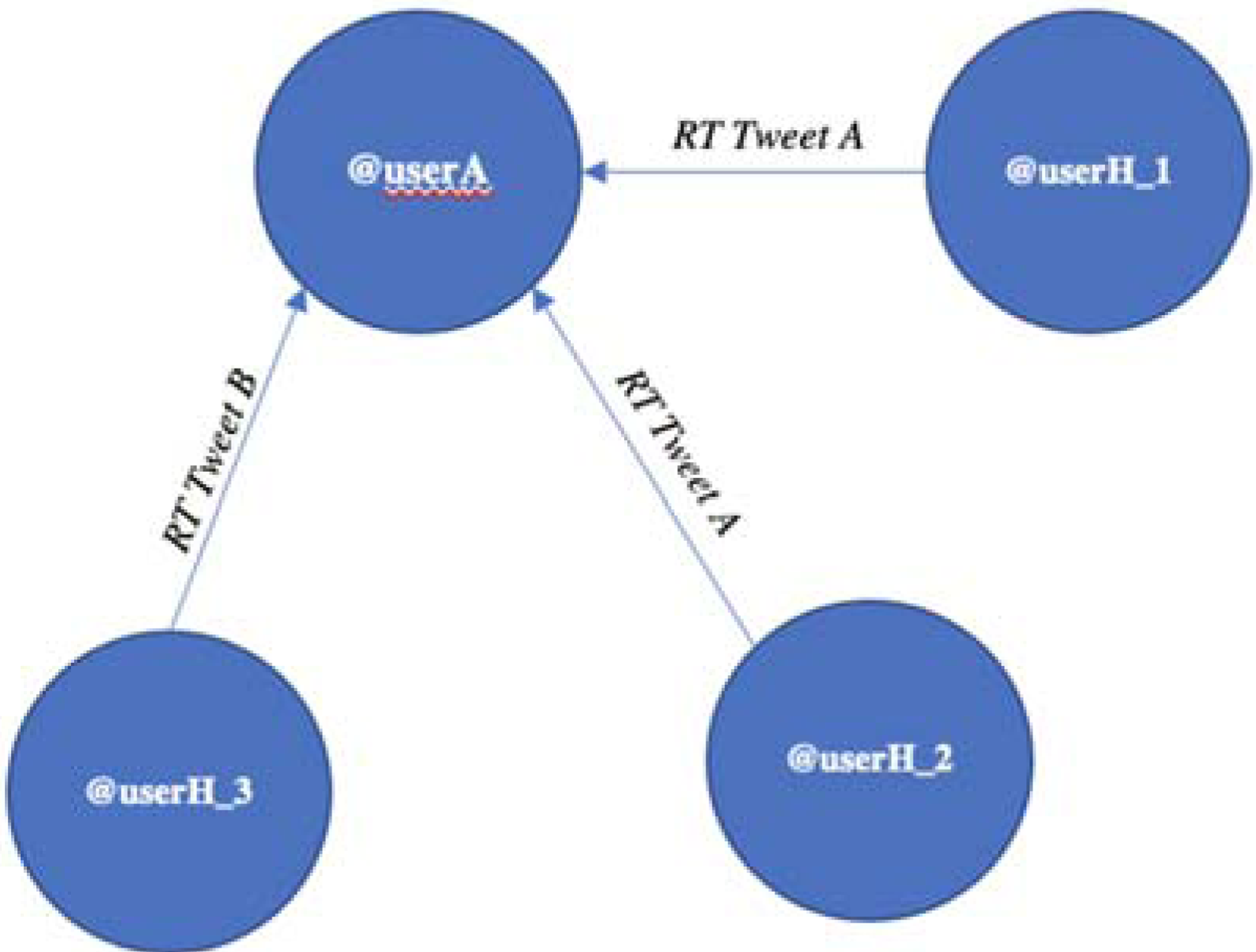
The formation of a network in twitter. Caption: In Figure 1, @userA tweeted two tweets: “Tweet A” and “Tweet B.” @userH_1 and @userH_2 retweeted “Tweet A,” while @userH_3 retweeted “Tweet B.” Each user is a node in our network. When a user (node) retweets another user (node), a link (edge) is created between them. In the diagram, each arrow is an edge. Since @userH_1 retweeted a tweet from @userA, @userH_1 is called a hub, and @userA is the authority. Users (nodes) can be both hubs (when they retweet other users) and authorities (when other users retweet them).
A starting point for analyzing this information is to identify communities--clusters of nodes where the same information (tweets) is shared. We implemented the following procedure to create the layout and identify the communities in the Ecuadorian Twitter network. First, we loaded all the edges from the first collection of tweets with the author of the original tweet set as the authority (A) and the author of the retweet set as the hub (H), such that
The random-walk community detection algorithm identified two primary communities in the Ecuadorian network. The first one is a pro-Correa/pro-Arauz (UNES) network, 8 including 16,344 nodes for the first electoral round and 13,861 nodes for the second electoral round. The second community is an anti-Correa/pro-Lasso (CREO) network, 9 with 25,545 and 12,319 nodes for the first and second electoral rounds. Figure 2 presents the basic FR layout for both instances of the Ecuadorian elections network (pro-Arauz community represented with orange triangles and pro-Lasso's with blue circles). The size of the nodes is proportional to the nodes’ in-degree, with larger ones indicating users who were retweeted by a greater number of followers.
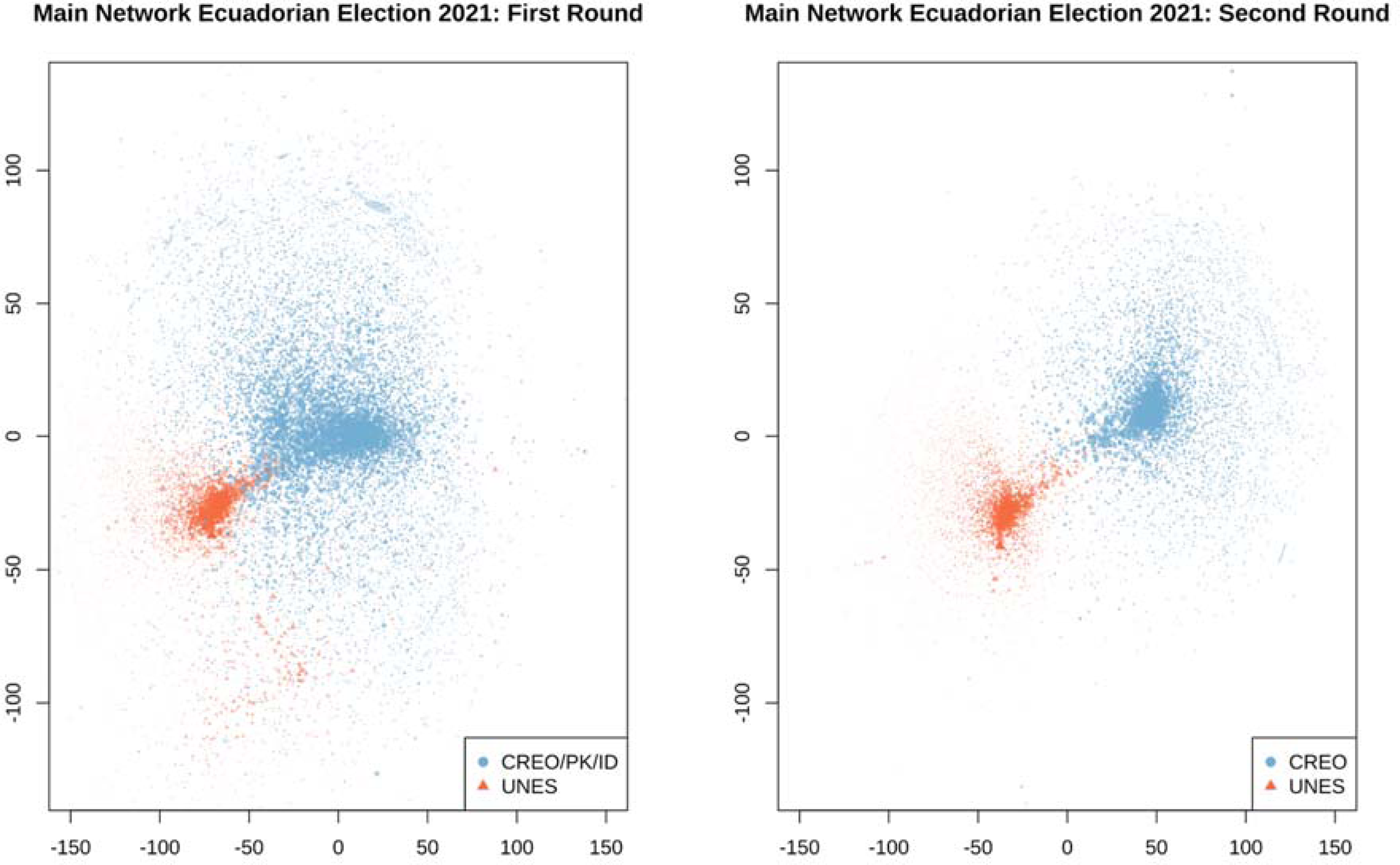
The main communities during the first and second rounds. Caption: Twitter communities formed around political events often have at their center political leaders. In the Ecuadorian network for the first and second electoral rounds the pro-Arauz community had at its center the presidential candidate @ecuarauz (Andrés Arauz) and the de-facto party leader @mashirafael (Rafael Correa). In contrast, the pro-Lasso community had at its center, in addition to @LassoGuillermo, @yakuperezg (Yaku Pérez, Pachakutik presidential candidate), and @xhervas (Xavier Hervas, ID presidential candidate).
As Figure 2 shows, there were two distinct user communities organized around the leading presidential candidates (UNES and CREO) during the campaign. The horizontal dimension captured by the algorithm, rather than solely ideological, is a reflection of the political divide. It is also worth noting that the anti-Correa community from the first round is more dispersed than the anti-Correa community from the second round. This suggests that the numerous candidates positioning different frames during the first round did not lead to a unified anti-Correa message (something that happens for the second round).
Candidate Frames and User Reactions
We are interested in how parties framed their electoral campaigns around COVID-19. We are also interested in how users reacted to these frames. For the former, we use the tweets collected from the party, legislative and presidential candidates’ accounts and explore their focus on different topics. To identify the issues mentioned in each tweet, we constructed a dictionary (list) of topics with words associated with each topic, then searched for the presence of those words in our Twitter data. We searched for the major themes covered across the elections and analyzed COVID-19's prominence 10 and its variation across parties.
For user reactions, we use the collection of tweets from broader online conversations. We analyzed how prominently COVID-19 appeared among users. We also wanted to know which topics propagated in the network. In social media, “acceptance equals propagation” (Aruguete and Calvo, 2018). 11 Twitter users are exposed to frames from like-minded peers. However, not all content will resonate with users equally. Users consuming messages on Twitter will propagate content from their community peers more quickly when these are cognitively congruent. Aruguete and Calvo (2018) show that time-to-retweet, the number of seconds elapsed from the time a user (authority) posts a tweet to the time a second user (hub) retweets the same post, is a proxy for cognitive congruence. Thus, to operationalize acceptance, we test whether latency increases or decreases for frames related to COVID-19 (and other frames).
Finally, we are also interested in what each political party (and community) focused on when addressing COVID-19. Also, and perhaps more importantly, how they differed one from the other. We estimate the relative frequency (i.e. Keyness) of terms in each group (e.g. party or community) to test this. Keyness is used to define the levels of differentiation across two corpora, expressed by words that are most different across corpora.
Results
This section presents how parties tried to attract voters during the campaign. We provide an overview of the topics that candidates mentioned the most, including the salience of COVID-19 relative to other topics. We also examine how candidates framed the pandemic by looking into the content that accompanied COVID-19 mentions. Lastly, to study the pandemic's relative importance for Twitter users, we describe how they engaged with COVID-19-related messages. Overall, we find that COVID-19 was not the more salient issue of the campaign, but its salience increased in the second round. Also, parties and candidates developed their programmatic agendas, bringing an unexpected diversity to policy offers. Nonetheless, programmatic offers were not at the center of the campaign; symbolic offers took the spotlight of parties and appeals. Lastly, while Twitter users’ engagement with COVID-19-related messages changed over time, gaining importance towards the end of the presidential campaign, these did not become the main topic of focus over the course of the elections.
Issues and Programmatic Appeals
To answer our first and second research questions (Q1. How prominent is COVID-19 in campaign strategies? Q2a. ¿Did parties campaign on pandemic-related programmatic offers? Q2b. Did parties make similar offers?) we look at the content produced by parties and the frames they advanced more eagerly. Figure 3 shows the topics mentioned by legislative candidates covered during the first electoral round. After their party's presidential candidate name, all candidates prioritized the economy, which was the most mentioned policy topic. While COVID-19 appears as one of the most popular issues, it is not paramount in legislative messages. In all parties, COVID-19 falls behind health or education (for Pachakutik and CREO) or their former leader Rafael Correa (for UNES).
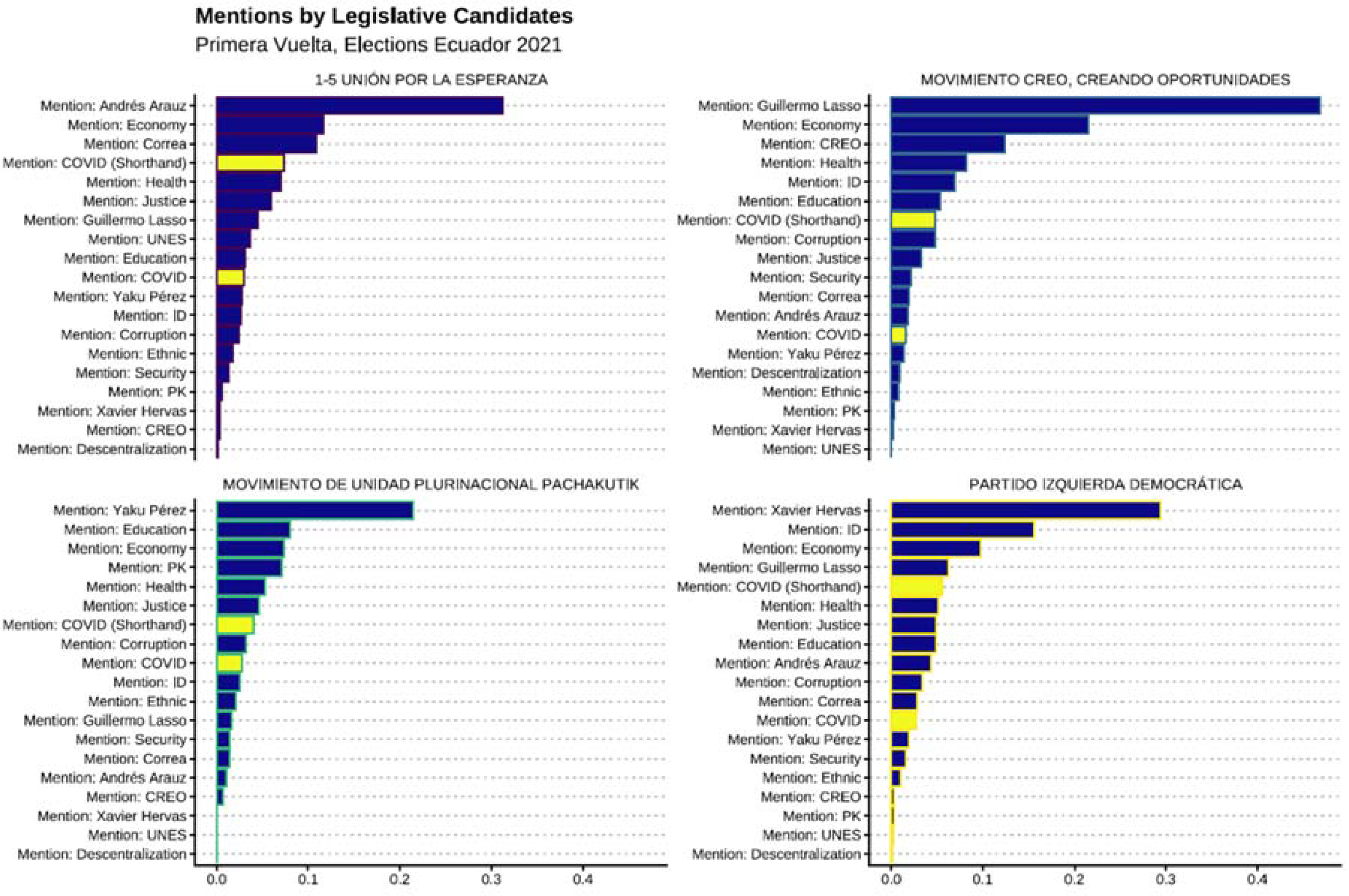
Main contents of the legislative campaign by party during the first round.
The descriptive content analysis aligns with Twitter data. Out of the 858 observed campaign events: 31 per cent addressed economic issues such as unemployment and loan conditions, 17 per cent mentioned matters related to education and university access, 14 per cent talked about the public health and pension systems. Only nine per cent referred directly to the pandemic. Half of these messages were related to the vaccination process, while the other half was related to the delivery of “help” to ameliorate the pandemic's effects.
A similar trend can be observed when looking at parties and presidential accounts (Figures 4 and 5). All party accounts, for example, focused on the economy, health, or justice, before mentioning COVID-19. Interestingly, presidential candidates strayed farther away from COVID-19, suggesting that, despite its potential salience, candidates were not crowding the topic. Instead, it seems that COVID-19 was a given, and candidates addressed other issues with potential longer horizons.
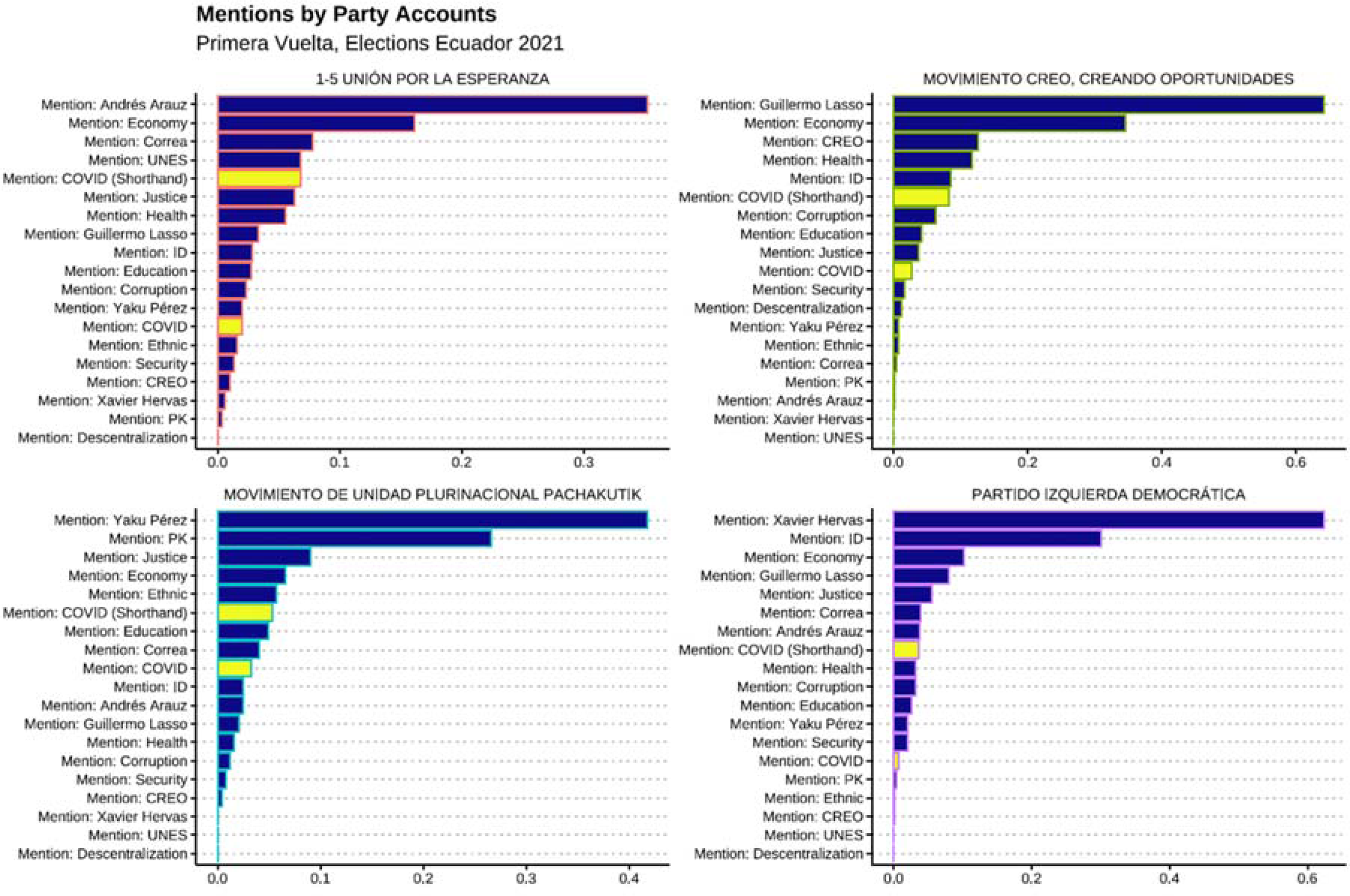
Main contents during the first round (by party accounts).
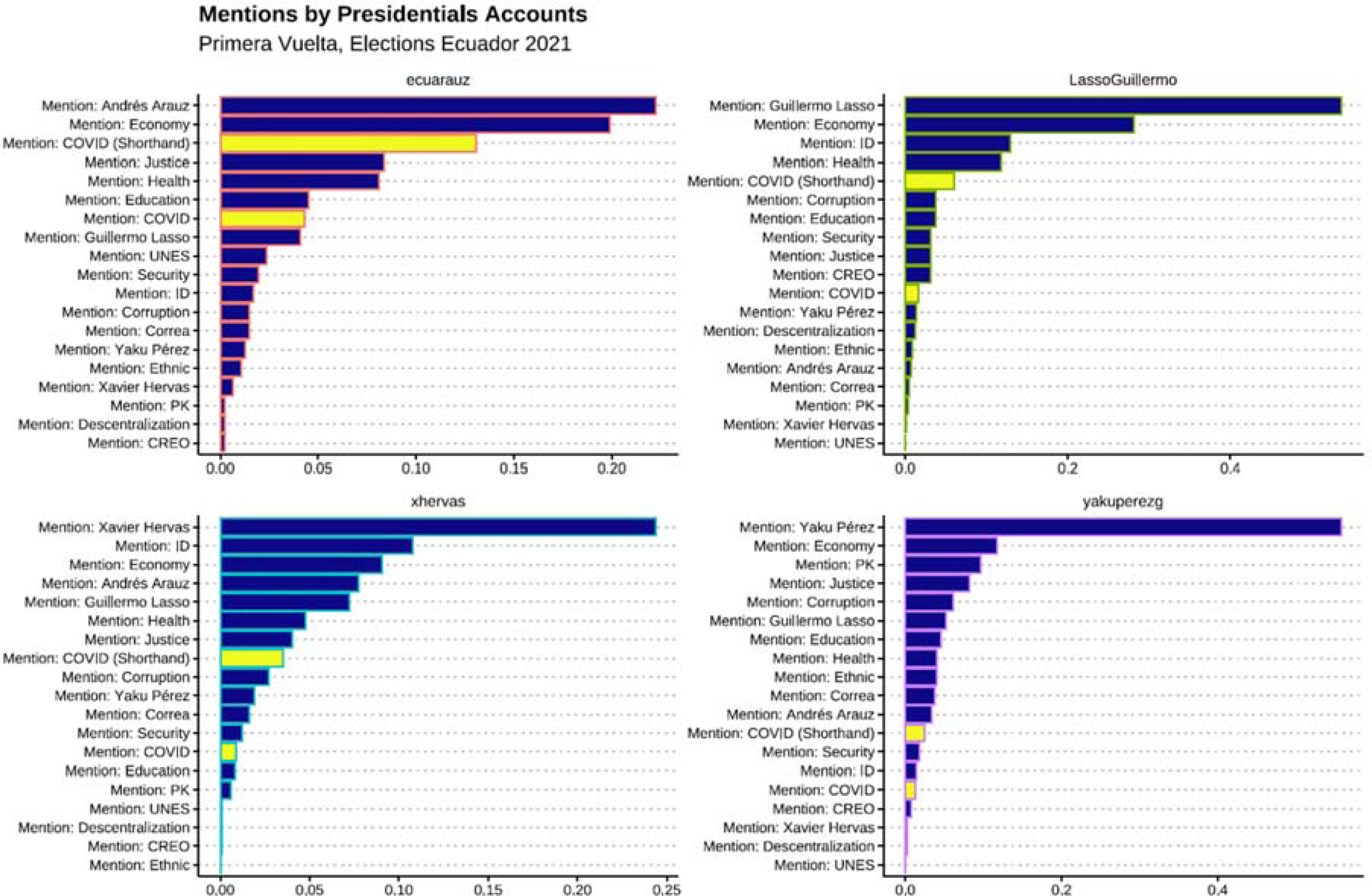
Main contents during the first round (by presidential accounts).
Again, content analysis is consistent with Twitter data. Presidential and legislative campaigns emphasized socio-economic problems rather than COVID-19. When parties addressed COVID-19, they did so with ambiguous electoral offers. For example, UNES promised “to give an alleviating hand” by creating 8,000 jobs, promising to reduce interest rates, and restructuring debt for all senior debtors. CREO invited voters to take on Guillermo Lasso's “flag of change” while offering two million jobs, public health, and education systems total reengineering. MUPP-18 and ID made similar offers. Thus, the answer to our questions about the pandemic's prominence and the strategic use (in the formation of different appeals) is that parties did develop positions and proposals related to the pandemic. Still, these were not at the center of the campaign.
There were also different levels of coordination across legislative, presidential, and party accounts. Figure 6 shows that the density distribution of COVID-19 mentions across all Twitter accounts varies between parties and within party lines. The ID party, for example, had a highly coordinated message. Not only is the variation in the distribution of mentions smaller, but the median of the percentage of distributions coincides with the percentage of mentions by the presidential candidate and the party account. Similar yet different levels of coordination were observed for CREO and Pachakutik. UNES has, by contrast, a less coordinated message. The distribution has a higher variation, and the presidential candidate mentions twice as much COVID-19 than the party account and the median legislative candidate.
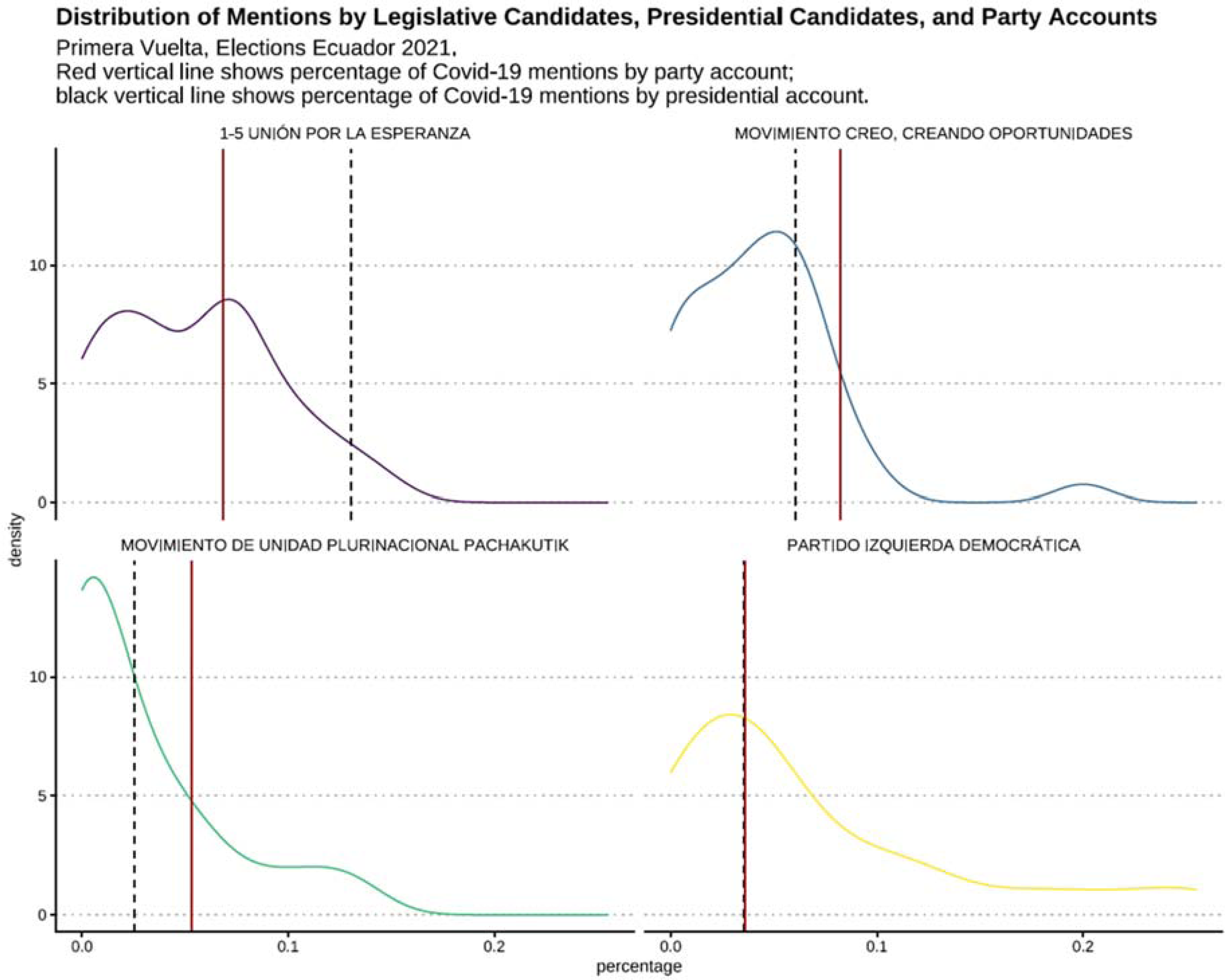
Distribution of mentions during the first round (by presidential candidates and party accounts).
There was a change in the focus from the first to the second round (Figures 7 and 8). Both parties and presidential candidates’ accounts increased their COVID-19 mentions. This increment coincides with a spike in COVID-19 cases in March 2021 and a disastrous roll-out of the vaccines. The presidential candidates’ strategy shifted towards a more pragmatic and policy-oriented message, including mentions of COVID-19 and solutions to address its spread. While UNES candidates frequently mentioned vacunas (vaccines) and dosis (doses), they also focused on pointing out members of the Moreno administration to link the government's shortcomings to CREO's candidate, Lasso. By contrast, CREO candidates emphasized words linked to policy proposals, mostly economy-related: #propuestasdelasso (Lasso's proposal) and empleo (jobs).
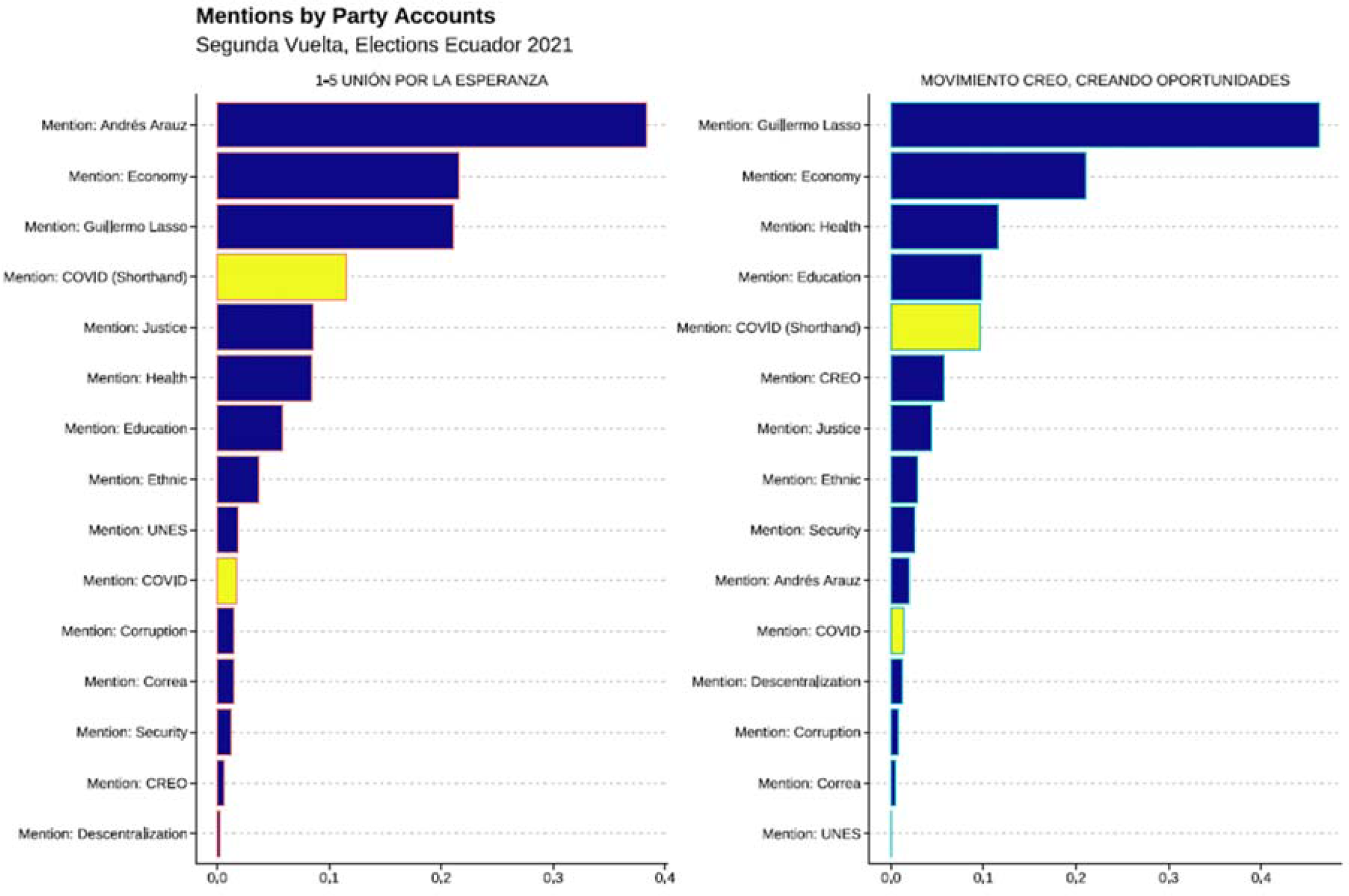
Main contents of the campaign during the second round (by party).
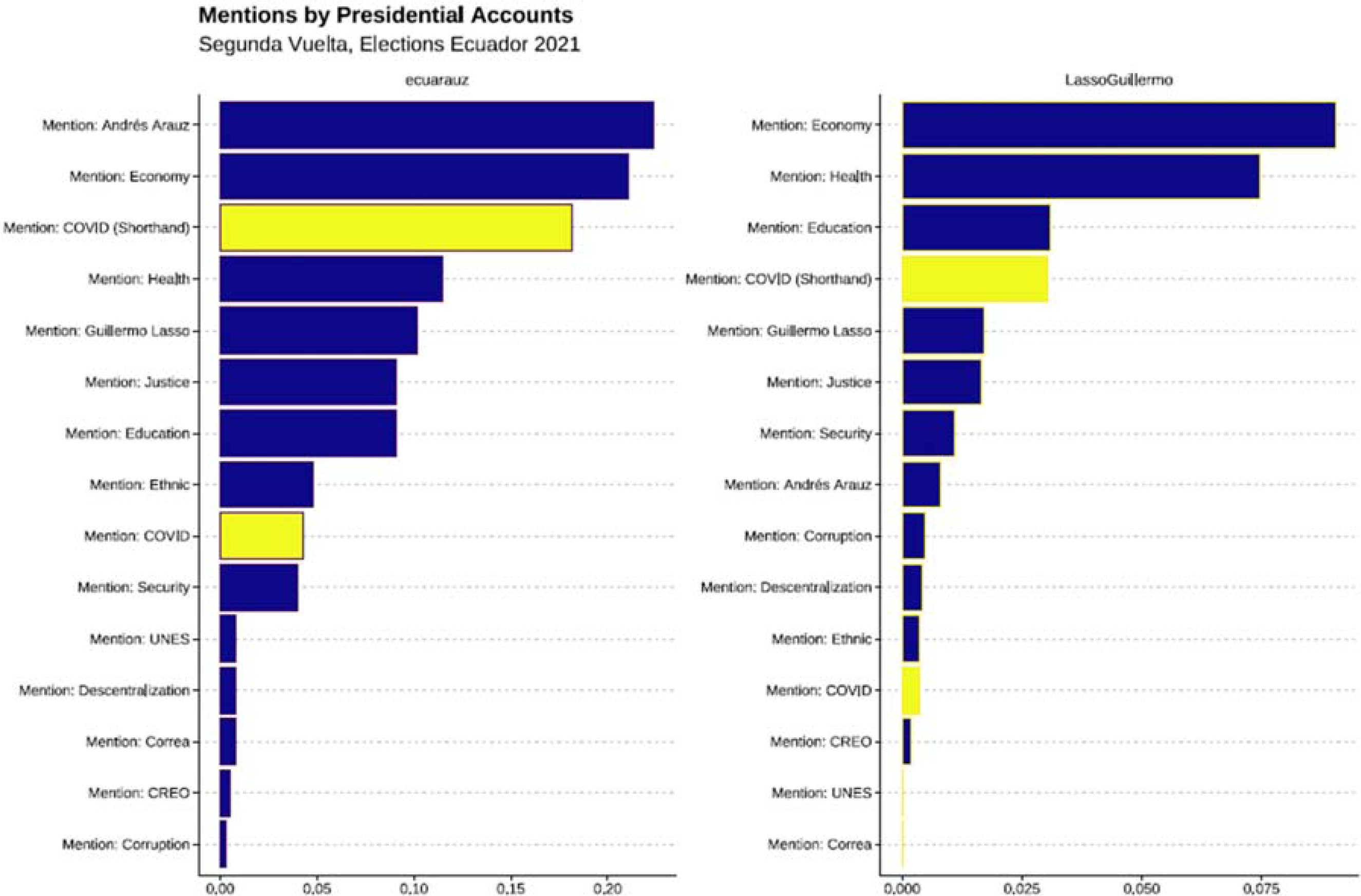
Main contents of the presidential campaign during the second round.
Symbolic Appeals: Keyness and Symbolic Content
While there are certain similarities in the topics that parties addressed and their frequency, we are also interested in how parties frame them. As discussed, parties often accompany policy offers with symbolic appeals. These appeals can have more than one purpose: to assure voters that policy offers can effectively be accomplished (competence) or broaden the pool of possible voters, especially when using ethnic symbolic content.
To answer our third group of research questions (Q3a. Did parties combine programmatic offers with symbolic content? Q3b. How prevalent was the symbolic content as a campaign strategy? Q3c. What type of symbolic content did parties use (if any)?) we estimated the Keyness of twitter's communities most used terms. Keyness is a measurement that determines the probability of differentiating one corpus from another by looking at the terms that make it up. In Figure 9, we compare the corpus of all the tweets published by legislative candidates from two parties, CREO and UNES. Every term maximizes the probability of identifying each party. The differences across parties are revealing: when talking about the COVID-19, CREO frequently mentions symbolic managerial and service-related content: capacidad (capability), calidad (quality), and carisma (charisma). In turn, UNES focuses more on highlighting the party and the candidates: @ecuarauz (Arauz), @mashirafael (R. Correa), @rabascallcarlos (C. Rabascall, vice-presidential candidate).
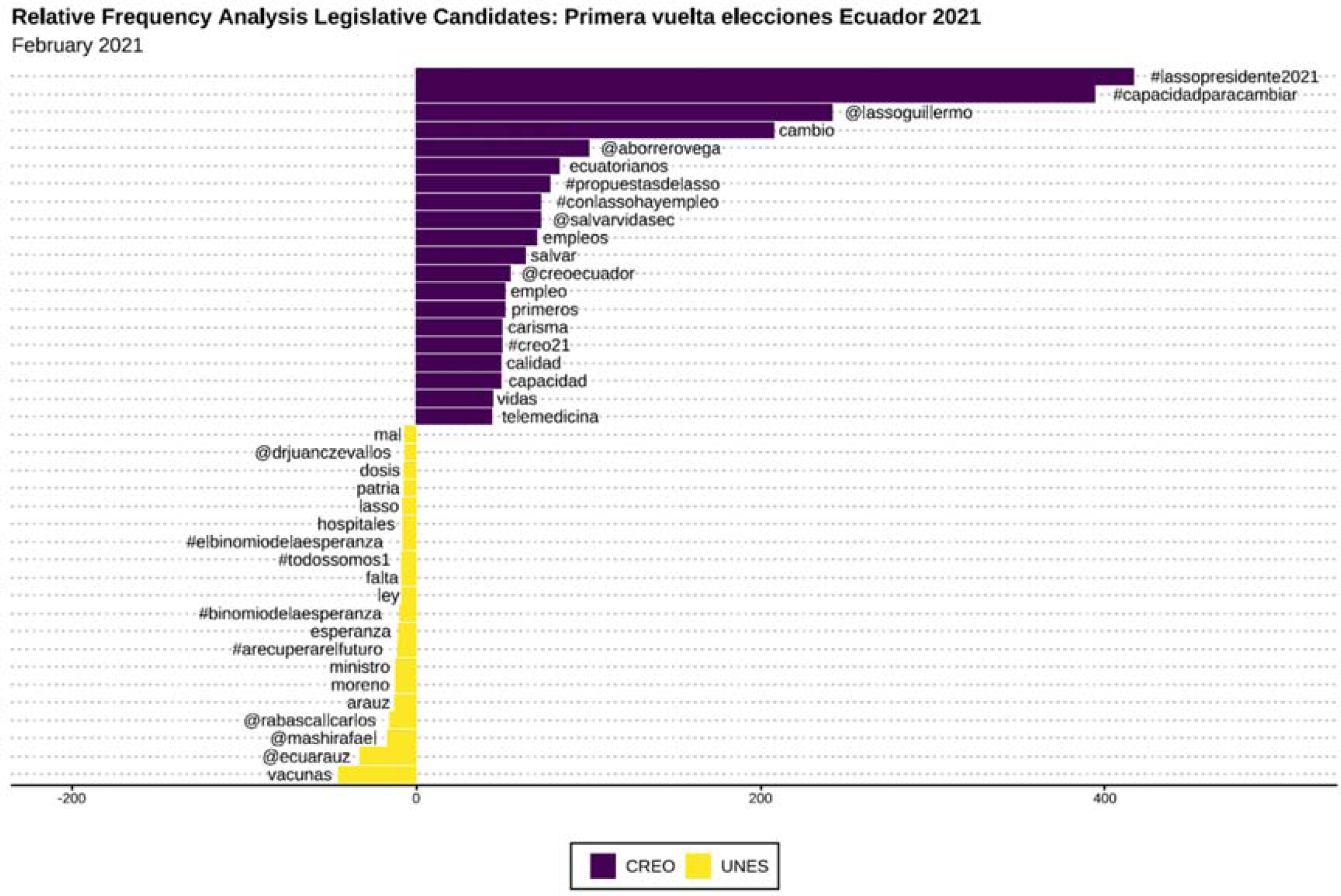
Relative frequency analysis for the legislative campaign during the first round.
Content analysis again is consistent with findings obtained from Twitter data. More than 60 per cent of all the observations registered the presence of symbolic content. The analysis shows that UNES tried to position their candidates as members of a party with prior and successful governmental experience, a reliable alternative to improve the current sanitary and socio-economic crisis and assure a better future. This party's campaign constantly reminded their audiences about Correa's former administration (2007–2017), signaling it as a period of prosperity and an example of know-how. In fact, 49 per cent of UNES content was related to the party's suitability to lead the government, and 20 per cent highlighted the organization's previous political experiences (as representatives or in public service).
CREO, in turn, emphasized the experience of its presidential candidate. The party highlighted Lasso's experience in becoming a successful entrepreneur and used it as an example of the party's strength and capacity to generate positive outcomes amidst adverse contexts. During the first round, CREO's campaign promoted their candidates’ alleged “capacity to change”; 36 per cent of coded contents related to the party's suitability to rule. At the same time, legislative candidates carried out an intense clientelist (vote buying) agenda to position the idea of also being a party that “delivers.” Content analysis shows that candidates and activists went to popular sectors to deliver food baskets and other goods, along with CREO's medical brigades that administered free covid tests. All these activities were public and promoted through social media.
MUPP-18 and ID also used symbolic appeals. MUPP-18 was the only party that openly promoted previous legislative and other representative experience of its candidates (19 per cent of the party's coded contents). The party also highlighted candidates’ capacities (66 per cent) and indigenous content (86 per cent). The organization built its electoral platform claiming to represent the original, hardworking, honest, and solidary people: “we do not have money, but we do have big hearts, thought of fighting for a better world” (Perez, December 31, 2020). In contrast, ID remembered the party's successful experience with Rodrigo Borja's government (1988–1992) in combination with the idea of a generational renovation: “we know how to do it” was promoted along with “We are ID, we are new people.” From all its coded content, 20 per cent of the ID's messages related to the party's prior political experiences, 31 per cent with the party's suitability, and 34 per cent with the promotion of the candidates’ capabilities and experiences.
These findings answer questions 3a, 3b, and 3c: Parties used programmatic appeals, but not as the keystone of their campaign; instead, the campaign's primary appeal was symbolic. That is, parties consistently focused on presenting themselves as the best prepared, more likely to deliver, while remaining unclear (i.e. not mentioning) what exactly they would deliver.
The Effects of Mobilization Strategy: User Activation on Twitter
Thus far, we have focused on candidates and parties, but social media also allows citizen interaction. Regardless of the effort a party or a candidate makes to position and frame a topic, in social media, users decide the frames that will propagate and those that will not as they are the ones who decide whether to spread content or not and its speed (Bennett and Iyengar, 2008; Chaffee and Metzger, 2001). To answer our final research question (Q3c. How did voters react to different electoral frames?) We now turn our attention to the broader Twitter network and the two communities identified before, the pro-Correa/pro-Arauz and the anti-Correa/pro-Lasso communities.
We analyze the determinants of time-to-retweet to understand the response of users to different frames. Higher values of time-to-retweet mean longer times between the authority's original tweet post and the retweet by the hub. We estimate the proportional Hazard Cox model, with unstandardized coefficients describing changes in the hazard rate of time-to-retweet. Positive coefficients indicate increased hazard rates (faster time-to-retweet) and cognitive congruence with the frames, while negative coefficients indicate slower times and cognitive dissonance (Aruguete and Calvo, 2018).
Twitter users did not appear engaged with COVID-19. Table 1 shows the results from the proportional Hazard Cox model. 12 For an intuitive interpretation of the magnitude of the effects, consider the coefficient of our variable of interest, “Mentions: COVID,” which takes a negative and statistically significant value (p < .01) for both communities during the first electoral round, and a positive and statistically significant value for both communities during the second electoral round. The exponentiated values of the first round coefficients for UNES and CREO (0.95 and 0.89, respectively) are the incidence rates and can be interpreted as the (instantaneous) change in time-to-retweet when a tweet mentions COVID-19. One minus the incidence rates is 0.05 and 0.11, showing that the time-to-retweet for posts mentioning COVID-19 during the first electoral round is about 5 per cent and 11 per cent slower than other posts. Thus, users were not engaging with Covid-related tweets, suggesting that COVID-19 content did not produce cognitive congruence among users. To better illustrate the effect, we plot the survival probability curves for our variable of interest in the left-hand panels of Figure 10.
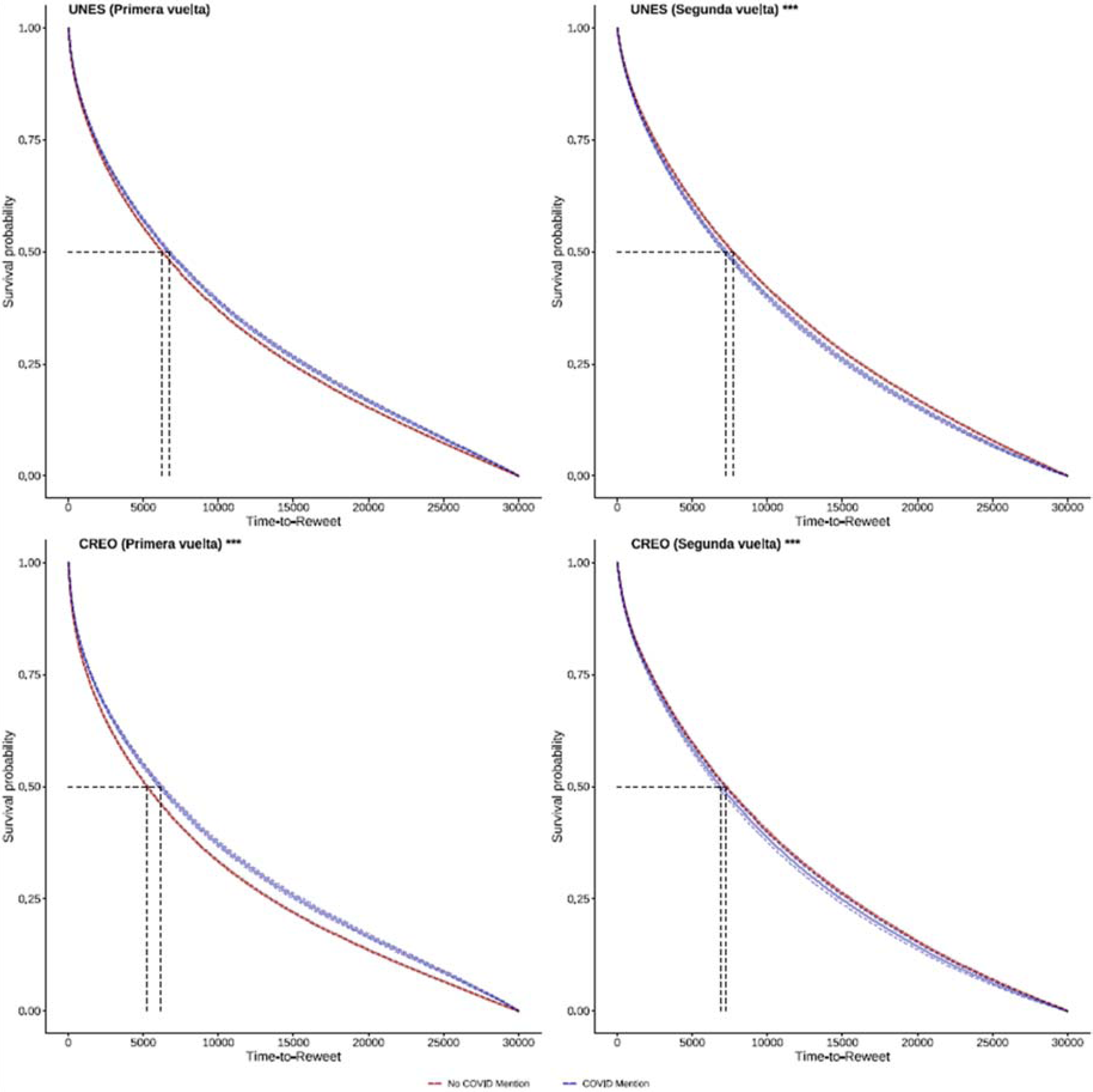
Survival probability curves for COVID-19 in first and second election rounds.
COVID Mentions and Time-to-retweet in Ecuadorian Network.
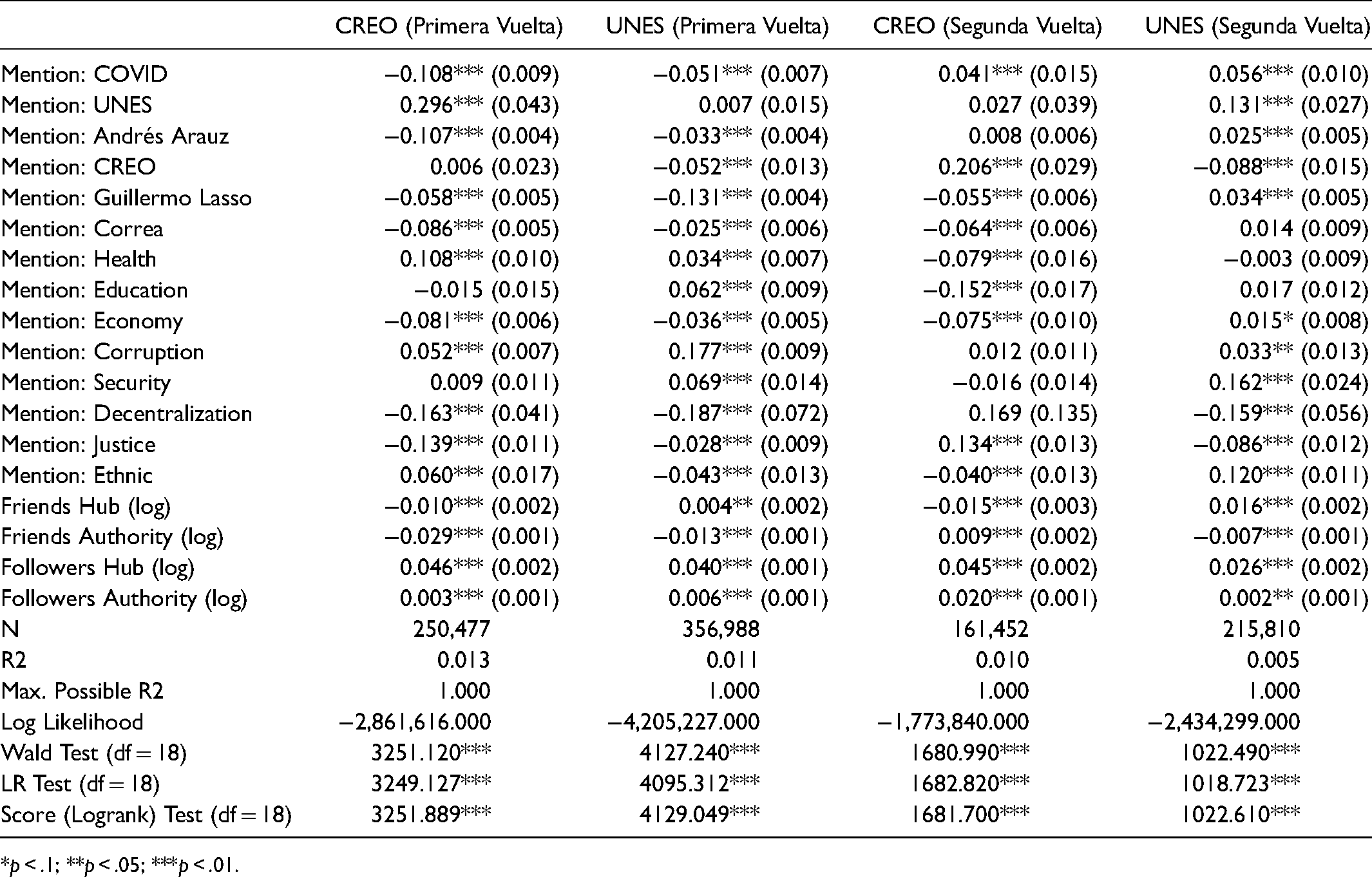
*p < .1; **p < .05; ***p < .01.
This trend flips during the second electoral round. In the right-hand panels of Figure 9, we can observe how time-to-retweet for Covid-related posts decreases, suggesting this kind of content became cognitively congruent among users of both communities in the second round. Again, this might be a reflection of the broader political and social context. During the first electoral round, the pandemic had partially subdued, and there was no vaccination plan yet. For the second round, the government could not coordinate a vaccination plan while coronavirus cases increased again. Thus, COVID-19 became more relevant, and the reaction of Twitter users reflects this reality.
The reaction of Twitter users might also explain why parties refrained from engaging directly and prominently with topics related to the pandemic. 13 While the two leading candidates (Arauz and Lasso) proposed different policies to the same issues, Their management capabilities related to the pandemic and the society's reaction to them were more homogenous. On the one hand, candidates could not differentiate themselves by suggesting solutions to the spread of the virus. On the other hand, users’ engagement (and probably voters' engagement) with topics related to the pandemic was linked to events outside the control of the candidates.
As previously suggested, neither CREO nor UNES placed COVID-19 as the primary policy topic of their campaign strategy, even when voters were increasingly worried about the pandemic. Rather, parties framed issues related to the topic differently, either pragmatically or symbolically. Mentions to COVID-19 revolved around opponents’ perceived weaknesses. Figures 11 and 12 show the relative frequency analysis for the Ecuadorian network during the first and second electoral round, respectively. In both cases, the communities focused on pointing out the limitations of the other side when managing other issues as a signal to the limitations they will have when managing the pandemic. For example, when mentioning COVID-19, the UNES community frequently mentioned Lasso and Moreno, advancing the connection between both and linking Lasso to the mismanagement of Moreno. In the second round, the CREO community framed their COVID-19 mentions around Arauz's controversial amount of severance pay received after leaving the Central Bank. Thus, frequently mentioned words include Arauz, dólares (dollars), and cobró (got paid). For their part, the UNES community framed their COVID-19 mentions around a controversy surrounding members close to Lasso who were able to get vaccinated ahead of the official schedule. Frequently used terms were vacunados (vaccinated), listas (lists), and vip (VIP).
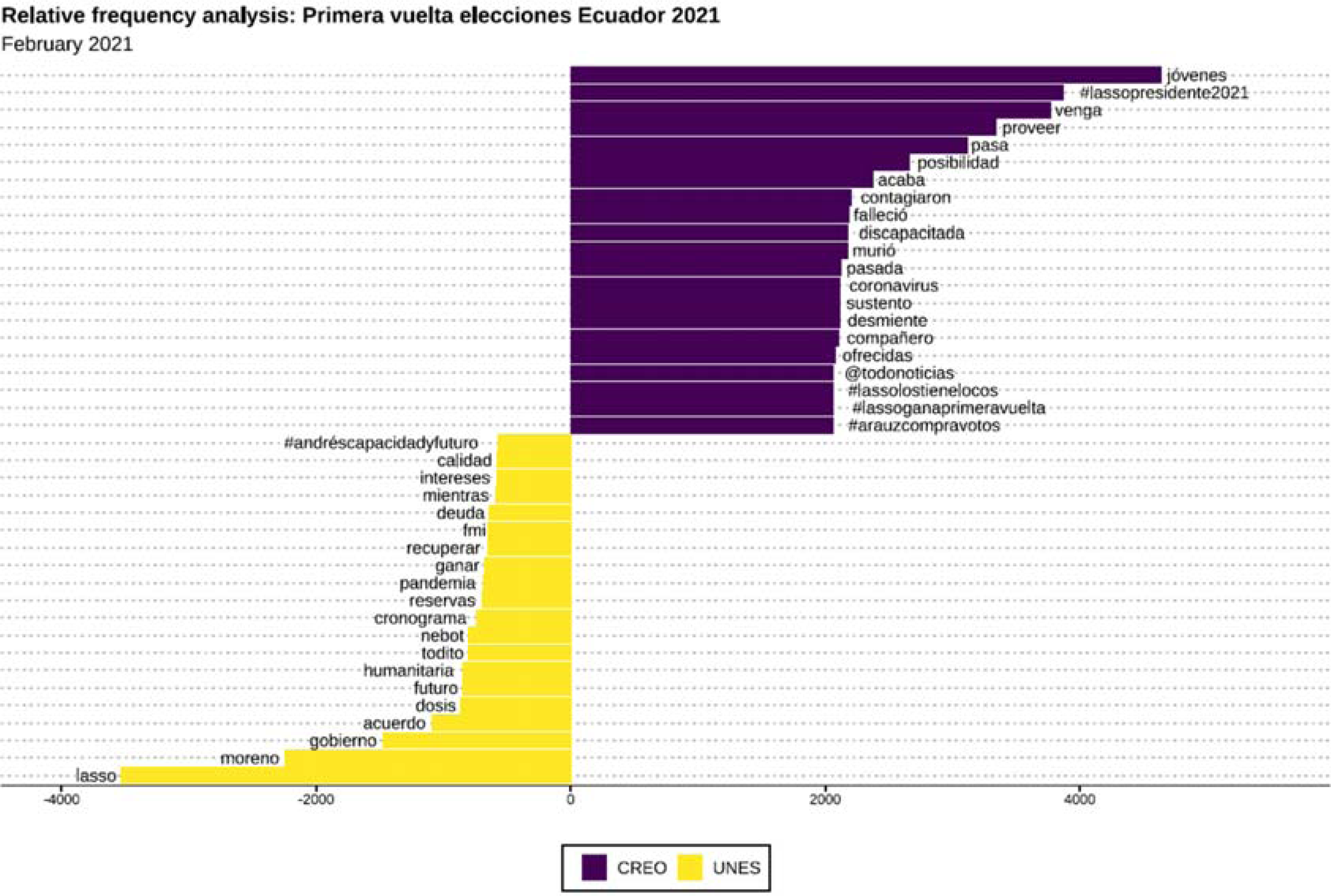
Relative frequency analysis for the Ecuadorian network during the first round.
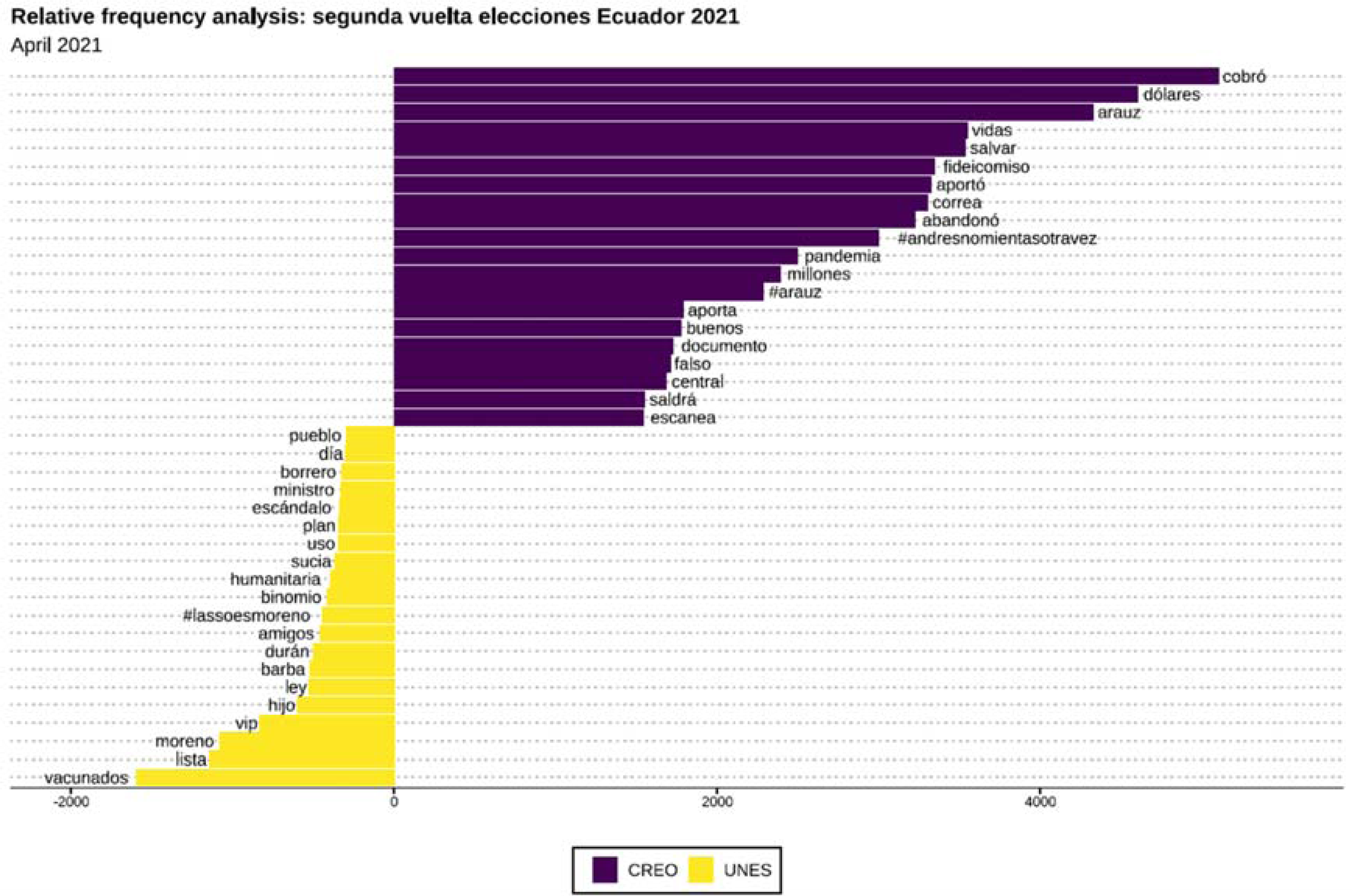
Relative frequency analysis for the Ecuadorian network during the second round.
Discussion and Concluding Remarks
The emerging literature on the politics of COVID-19 has paid limited attention to how the pandemic shapes elections. This research note contributes to filling this gap by analyzing candidates’ mobilization strategies in the context of a pandemic. To do so, we use two sets of data, a recollection of tweets produced during the electoral process and the content of campaign events streamed online. We also explored if the observed mobilization strategies had any effect on the activation of voters. To this end, we looked at Twitter communities’ reactions to different types of content. Ecuador's 2021 general elections provided an ideal setting to study how parties and voters reacted and dealt with the pandemic.
Our results reveal that parties conveyed messages to generate trust. Symbolic messages highlighted parties’ competence, experience, and trustworthiness. Even though COVID-19 related content was present as one of the four most cited topics of the campaign, candidates and parties did not focus on it. While this topic became more salient during the second round, it was not as salient as the economy, education, or health. These results show that the COVID-19 was not at the center of the political debate even in critical times.
Another key result is that parties combine mobilization strategies. That is, they combined symbolic messages along with programmatic content. As parties offered to increase jobs, improve public education or ensure universal access to a high-quality public health system, they also focused on positioning themselves and their organizations as the best alternatives. Furthermore, even though COVID-19 was a peripheral issue in the electoral agenda, there were differences in how parties combined the pandemic issues with policy and non-policy content. For example, when talking about it, UNES used symbolic messages while CREO opted for policy-oriented ones.
Twitter users’ reactions to mobilization strategies confirm that COVID-19 was not the most salient topic. Despite this, the analysis also shows that users’ interest in the pandemic increased during the ballotage campaign, suggesting that broader socio-political and economic contexts are key in attracting people's attention. Hence, the pandemic might not have been at the center of the voter mobilization strategies because it did not attract people's attention disproportionately. Another finding is that COVID-19 mentions appear to be related more to symbolic than programmatic content.
Studying elections and electoral campaigns under COVID-19 is paramount to grasp if and how the pandemic has affected the nature of political competition within Latin American democracies. This research note contributes to understanding how political parties use mobilization strategies. Results support the argument that parties resort to a mixture of political strategies to mobilize voters. In the Ecuadorian case, these strategies involved both symbolic and programmatic content. As the latter was similar amongst parties, symbolic messages were essential to help voters differentiate between candidates.
Finally, we foresee at least two directions for further research. The first would be an extension of this work that could address why parties used COVID-19 as an element instead of the core of their strategies; this path would require more extensive fieldwork. The second would be a comparative design that could help us understand to a better degree how parties used COVID-19 in their electoral strategies and why.
Supplemental Material
sj-docx-1-pla-10.1177_1866802X211058742 - Supplemental material for Believe in me: Parties’ Strategies During a Pandemic, Evidence from Ecuador
Supplemental material, sj-docx-1-pla-10.1177_1866802X211058742 for Believe in me: Parties’ Strategies During a Pandemic, Evidence from Ecuador by Angélica Abad Cisneros, Raúl Aldaz Peña, Diana Dávila Gordillo and Sebastián Vallejo Vera in Journal of Politics in Latin America
Footnotes
Declaration of Conflicting Interests
The author(s) declared no potential conflicts of interest with respect to the research, authorship, and/or publication of this article.
Funding
The authors wish to thank the Universidad de Las Américas Quito, Ecuador, for its support in collecting data for this project.

Supplemental Material
Supplemental material for this article is available online.
Notes
Author Biographies
References
Supplementary Material
Please find the following supplemental material available below.
For Open Access articles published under a Creative Commons License, all supplemental material carries the same license as the article it is associated with.
For non-Open Access articles published, all supplemental material carries a non-exclusive license, and permission requests for re-use of supplemental material or any part of supplemental material shall be sent directly to the copyright owner as specified in the copyright notice associated with the article.
