



Abstract
This research note explores variation in how political parties and presidents in Latin America responded to the COVID-19 pandemic. Relying on the Chapel Hill Expert Survey-Latin America (CHES-LA), we argue that preferences regarding the trade-off between virus containment and maintaining an open economy were shaped by the ideological positions of presidents and parties, particularly for more programmatic ones. This is largely consistent with findings in other world regions. Yet, beyond ideological orientation, populism, also had an important – though heterogeneous – effect on response preferences, with non-populists, particularly highly programmatic ones, more consistently supporting virus containment. In addition, both incumbents and more populist presidents and parties favoured further concentration of executive power to address the pandemic. These findings provide evidence of the importance of understanding how ideology, populism and programmatic linkages interact in Latin America’s party systems.
Starting in the first quarter of 2020, the spread of the COVID-19 virus caused havoc around the world. As experts learned more about the virus, political leaders everywhere scrambled to implement measures that would limit citizens’ exposure and help affected populations. However, the extent to which governments heeded experts’ recommendations varied enormously across countries, as did their success in arresting the spread of the disease or mitigating its negative economic impact. In Latin America, where health systems were already under stress, the effects of the pandemic were especially dramatic. By the end of 2022, estimated COVID-19-related deaths per capita in the region were among the highest in the world. The economic and social effects of the crisis were also devastating, as steep recessions came with sharp increases in poverty, food insecurity, and losses in educational attainment (ECLAC, 2022).
Variation in the policies implemented by regional governments to face the crisis was also remarkable (see Hale et al., 2021 for the Oxford University Government Response Tracker). For example, while leaders like President Alberto Fernández in Argentina imposed strict public health guidelines early on, with initially broad public support (Jones and Galmarini, 2020; Lodola and Perelmiter, 2022), others such as Brazil's Jair Bolsonaro or Mexico's Andrés Manuel López Obrador, refused to implement national policies or impose major air travel restrictions (de la Cerda and Martinez-Gallardo, 2022; Dunn and Laterzo, 2021). Politically, the crisis also led incumbents and their political allies to favour greater concentration of power in the hands of the executive as a (necessary or fabricated) way to face the emergency.
In this research note, we explore variation in policy responses to the COVID-19 crisis in Latin America through the lens of party competition. Faced with a common external shock, regional experts reached relatively high levels of consensus regarding the actions needed to protect the population. However, crises are often interpreted through pre-conceived ideological lenses, leading parties and presidents to support reactions to the crisis that suit their preferences under the guise of necessity or urgency. As the examples above illustrate, governments and parties in Latin America responded to the initial challenges of the pandemic in widely different ways. To what degree does the nature of political competition help explain different approaches to the pandemic? Were reactions to the crisis motivated by ideology or by non-programmatic considerations such as populism? Do factors other than incumbency explain support for further concentration of executive power in response to the crisis?
To explore these questions we rely on data from the Chapel Hill Expert Survey–Latin America (CHES-LA). We focus on two important dimensions of government action during the pandemic. The first is the question of whether to favour containment of the virus, as public health experts recommended, or to favour economic normalisation instead, prioritising keeping the economy open. We find that despite a relatively high degree of expert consensus, political parties and presidents in Latin America reacted to the COVID-19 pandemic in ways consistent with their pre-existing ideological positions – as did leaders in other parts of the world (Rovny et al., 2022). We leverage wide variation in the extent to which parties in Latin America attract voters using policy appeals (what we term programmatism), to confirm that the relationship between policy preferences and ideology is particularly important for more programmatic parties. We also provide evidence that populism impacted preferences over pandemic policy, though here our results are more qualified. Overall, we find that populists are less responsive to expert opinion than non-populists and tend to favour keeping the economy open, but we also show considerable heterogeneity, particularly in the responses of populist leaders.
Second, we also look at parties’ positions regarding the need to concentrate power in the hands of the executive to face the emergency. In moments of crisis, citizens look to their governments for guidance, and COVID-19 was a crisis of unparalleled proportion. Although centralising power may have seemed justified by the scale of the emergency, it can also serve other purposes. Here, we show the importance of populism, especially for incumbents and their parties. Populist leaders tend to exercise power in an unmediated fashion (Weyland, 2001), and crises give them a window of opportunity to increase concentration of power in their office. Ideology, by contrast, has a weak effect on parties’ support for concentration of power.
This article contributes to our understanding of political parties in several ways. First, we show that political parties’ pre-existing ideological positions inform the way they approach policy even in times of crisis. We also demonstrate this is particularly true for more programmatic parties, despite understandable concern regarding the robustness of political party systems in the region (Luna et al., 2021; Weyland, 2021). Second, we show that although populism is linked to more diverse approaches to the pandemic, when it is associated with high programmatism it can shape preferences regarding crisis policies. Finally, we also confirm that incumbents and coalition partners, especially populist leaders and their parties, see crises as an opportunity to further concentrate executive power.
Partisan and Presidential Responses to Crises
Crises are moments of tremendous risk but also great opportunity. For governments, crises present enormous challenges, but they also provide leaders possibilities to change the political landscape in ways that suit their broader ideology or agenda (Bermeo and Pontusson, 2012). On one hand, extraordinary events can generate a high degree of expert policy consensus, relegating disagreements mostly to issues of government competence or execution (Atkeson and Maestas, 2012). On the other hand, however, even when agreement is relatively strong regarding the nature of the crisis and the steps required to ameliorate its effects, leaders with varying ideological perspectives, electoral prospects, or leadership styles are likely to make divergent policy choices. Necessary policy action might be postponed to avoid high electoral costs or to satisfy important organised interests. Some leaders might delay reporting on health outbreaks to avoid costly restrictions (Worsnop, 2019), for example, or they might take advantage of a crisis to escalate repression against opponents (Wood and Wright, 2016).
In the case of the COVID-19 pandemic, a high degree of expert consensus emerged regarding the need for containment measures that would limit the death toll from the virus. Nevertheless, government action in Latin America varied considerably across countries and even across subnational units (Dunn and Laterzo, 2021; Edgell et al., 2021). To explain this variation, some scholars have focused on political factors including the degree of democracy, the strength of parties, executive-legislature relations, and policy legacies, more than programmatic or ideological differences (Blofield et al., 2023; Giraudy et al., 2020). Others have emphasised the capacity of health care systems before the pandemic and the strength of social welfare systems, as well as economic factors like the size of the formal sector and the fiscal environment (Blofield et al., 2020).
We focus on how two different features of party competition help explain variation in COVID-19 policy. The first is the role of the ideological and programmatic orientation of parties; that is, the extent to which parties in Latin American countries are structured along ideological lines, specifically with regard to socioeconomic and sociocultural issues. This type of structuration has been confirmed in several studies (e.g. Martinez-Gallardo et al., 2022; Power and Zucco, 2009; Saiegh, 2009; Wiesehomeier and Doyle, 2012) even if parties vary widely regarding how strong their programmatic linkages are to voters.
The second feature of party competition we examine is the extent to which parties are also oriented around linkages that allow them to gain support beyond programmatic or ideological appeals, through populism or clientelist exchanges, both of which can be considered orthogonal to the left-right distinction (Mudde and Rovira-Kaltwasser, 2013). We focus particularly on populism, drawing on two dominant existing approaches. The first, ideational, approach considers populism to be a “thin ideology” characterised by a Manichean political discourse that separates society into two groups, pitting “the people” against a conspiratorial, evil elite (Casullo, 2019: esp. 47–53; Hawkins and Rovira Kaltwasser, 2017; Mudde, 2017). The second, political-strategic, conceptualisation, sees populism as a personalistic leadership strategy resting on unmediated and direct support from unorganised masses (Andrews-Lee, 2021; Weyland, 2001). 1 Although these two approaches are conceptually distinct, empirically there can be broad overlap in how specific political leaders or parties are scored.
In advancing our arguments regarding responses to the pandemic in Latin America, we build on research on democracies in the Global North which shows that the ideological predispositions of leaders and parties, and the context in which they compete for power, shaped responses to the COVID19 crisis, despite incentives to converge on policies advocated by health experts. In Europe, for example, Rovny et al. (2022) confirm the central importance of party ideology in predicting parties’ choices regarding virus containment and enforcement of lockdown measures, as well as their reliance on science in pandemic policymaking. In the United States, pandemic policies also varied across localities according to the ideology of voters (Holman et al., 2020; Prieto-Rodríguez et al., 2023).
We argue that ideology also helps explain responses to COVID-19 in Latin America and that the impact of ideology on pandemic preferences should be greater for highly programmatic parties, which emphasise their policy positions in seeking electoral support. Although some studies have stressed the relative organisational weakness of parties and considerable variation in the importance of policy in seeking electoral support (Levitsky et al., 2016; Mainwaring, 2018), recent work provides evidence that parties continue to be structured around meaningful policy programs focused primarily on the economy and, secondarily, on sociocultural issues. This evidence comes from studies based on surveys of political elites (Alcántara Sáez, 2018; Power and Zucco, 2009), party manifestos (Ares and Volkens, 2017; Mantilla, 2020; Morgan and Hinojosa, 2018); and expert surveys (Martinez-Gallardo et al., 2022; Wiesehomeier and Benoit, 2009).
To test the links between ideological and populist orientations, programmatism, and preferences over responses to COVID-19 in Latin America, we first look at positions regarding whether governments should prioritise virus containment or keep the economy open. Initially, as the scope of the pandemic became clearer, there was broad expert consensus regarding the need for dramatic action to reduce the spreading rates of infection. However, while containment measures partially protected citizens, including the large high-risk population tied to the informal urban economy, they were also highly disruptive of market economies and came with heavy economic costs. Given the distributional consequences of containment, our first expectation regarding ideological orientations is that parties and presidents on the right would prefer to maintain the market economy open, in line with their policy priorities. By contrast, we expect leftist parties and presidents, concerned with protecting vulnerable sectors of society, to be more supportive of containment measures. This relationship should be especially pronounced among programmatic parties that emphasise their policy priorities in seeking electoral support.
Parties in Latin America, however, tend to employ a mix of programmatic and non-programmatic electoral strategies (Luna, 2014) and exercise power in a variety of ways. Beyond their ideological preferences, another important source of variation is the extent to which parties rely on – or condemn the use of – populist appeals (Abente Brun and Diamond, 2014; Levitsky and Loxton, 2018).
2
In the context of the pandemic, we argue that populist orientations also help explain variation in policy responses. First, compared to non-populists, populist parties and leaders were “among the most vocal deniers of the pandemic” (Ringe and Rennó, 2022: 10) and were less likely to follow scientific advice on containment measures, often portraying experts as elitist. Our expectation is that:
But populism itself is typically characterised as a weak (or “thin”) ideology and interpretations of the severity of the threat and of the importance of expert advice varied widely among populist parties, especially populist presidents, in ways that did not always match their general ideological orientation. Some – President López Obrador in Mexico, for example – defended “experiential wisdom and common sense,” portraying experts as elitist and dragging their feet on containment (Giorgi and Eslen-Ziya, 2022: 3). Others – like President Maduro in Venezuela – characterised the virus as a threat to the people and led a strong COVID-19 response. This leads us to expect that:
The incentives to use a crisis of this magnitude to concentrate power were not limited to populist incumbents and, considering expert advice urging dramatic action, other incumbents also expanded their authority. Naturally, opposition forces reacted by expressing concerns that the crisis would provide governments incentives to abuse their power. In general, then, we expect presidents and their coalition partners to strongly favour greater concentration of power to address the pandemic, while opposition parties should be against it.
Data, Methods, and Results
Our main goal is to use variation in ideological and populist orientations to explain COVID-19 pandemic responses, considering also whether observed relationships are stronger for more programmatic parties. Empirically, this means first that we need to estimate parties’ ideological positions. To do this, we rely on the CHES-LA dataset, which places parties and presidents in twelve Latin American countries on a range of issues relevant to ideological orientations. 3 In particular, we employ positions on three issues to estimate the left-right economic dimension (spending vs. taxes, deregulation, and redistribution) and positions on six issues to estimate the left-right sociocultural dimension (including immigration, social lifestyle, religion, and the environment). 4 We employ confirmatory factor analyses (CFA) to estimate each dimension (Bakker et al., 2012, 2015), replicating the analyses in Martinez-Gallardo et al. (2023). In line with their findings, we use a CFA one-factor model to predict parties’ and presidents’ positions along a single underlying ideological left-right dimension, which combines parties’ highly overlapping positions on socioeconomic and sociocultural issues. 5
To measure populism, we again employ CFA, relying on five questions in CHES-LA, three that operationalise key aspects of the ideational concept of populism, and two that address central elements of the political-strategic concept. 6 Replicating de la Cerda et al. (2023), we run exploratory analyses to compare two models, one that assumes populism has two distinct dimensions – related to these different concepts of populism – and a second model that combines both understandings of populism in a one-dimensional latent construct. In our analyses below we employ the one-dimensional construct as measures of fit indicate that the two main ways of understanding populism are strongly related and belong to a single underlying dimension. 7 This is an empirical choice; we leave for future consideration whether this overlap is because expert respondents conflate the two underlying concepts, or some other reason. 8 We also estimate a CFA measure of particularism, employing three question items from CHES-LA, which we employ as a control variable in our models below. Based on these results, we estimate party and president positions on populism and particularism. 9
To measure the importance parties place on programmatic linkages to voters, we employ a question that asks the extent to which parties seek to mobilise electoral support by emphasising their policy issue positions. As we expect, parties on the ideological extremes (both left and right) on average score higher on programmatism. 10
Moving to our dependent variables, pandemic responses by parties and presidents, we use two questions from the CHES-LA. The first one addresses positions on responding to the COVID-19 crisis by prioritising keeping an open economy or containing the spread of the virus. The second evaluates the degree to which parties and presidents favoured additional concentration of power in response to the crisis. Both variables range from 0 to 10, with higher values representing a preference for virus containment and for higher concentration of power, respectively. 11
To model the relationship between COVID-19 responses and ideological and populist dimensions of party competition, we use hierarchical linear models (HLMs). HLMs allow us to include party- and country-level predictors and to evaluate how much variation occurs at each of these levels. At the party level, we include controls for particularism, vote share, and type of party (opposition, coalition member, president's party, or president), and programmatism. At the country level, we evaluate if weighted averages of left-right, populism, and particularism explain cross-national variation in pandemic response. We estimate four models for each of our two dependent variables – containment versus economy and concentration of power. Models 1 and 5 are null models that include only country random effects, Models 2 and 6 include party- and country-level predictors, Models 3 and 7 incorporate an interaction term between left-right and programmatism, and Models 4 and 8 include an interaction term between populism and programmatism. The eight models are summarised in Table 1.
Explaining COVID-19 Responses.
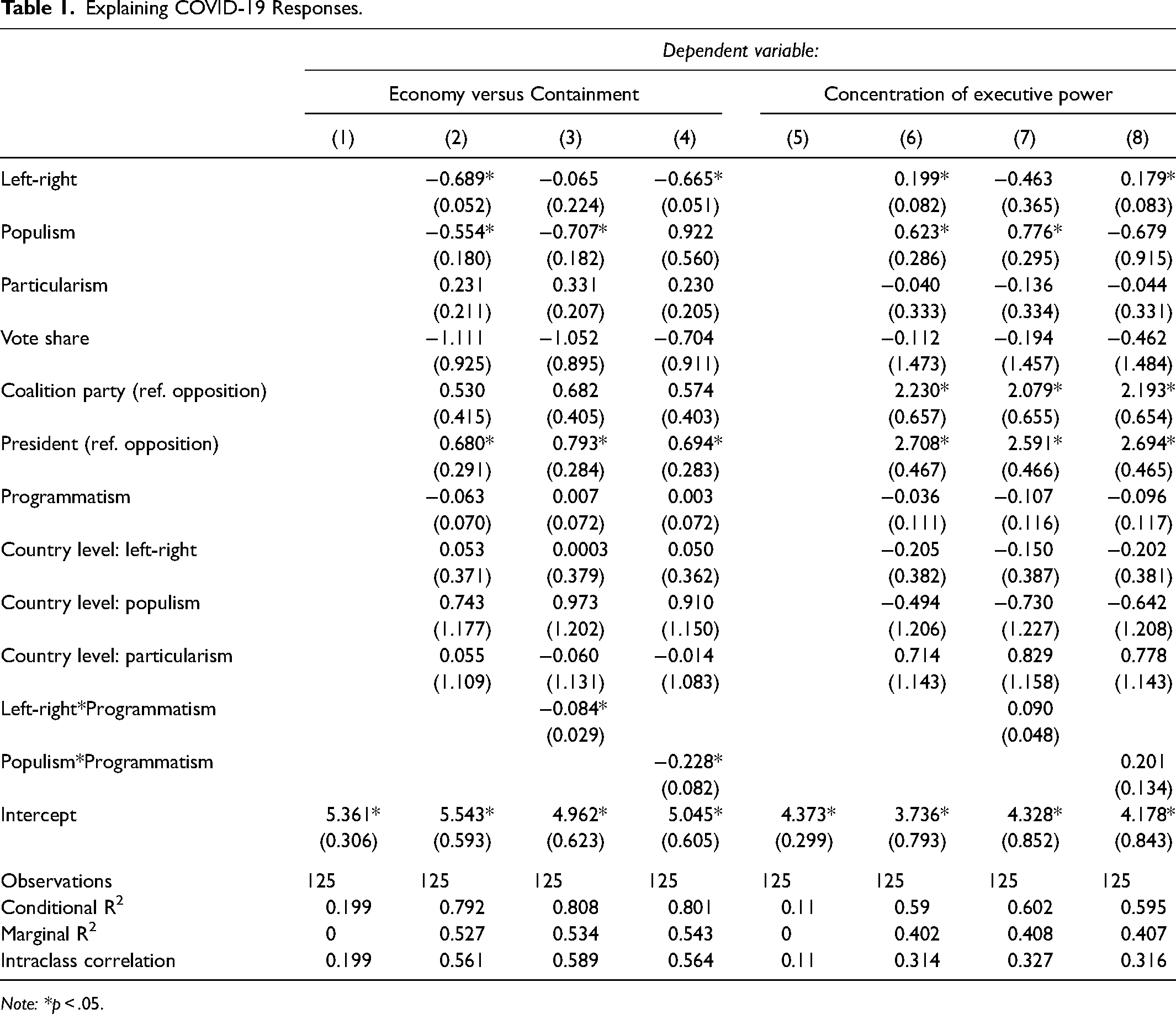
Note: *p < .05.
Open Economy Versus Virus Containment
Models 1 to 4 in Table 1 predict the decision by parties and presidents to prioritise keeping an open economy over containing the spread of the COVID-19 virus. Higher values indicate a preference for containment. Model 1, which only includes country random intercepts, evaluates the extent to which variation in the dependent variable is caused by within- or between-country variation. The intraclass correlation of this model can be interpreted as the variation explained by differences at the country level; a correlation of .199 indicates that only 20 per cent of the variance of the dependent variable is due to differences across countries and a full 80 per cent to differences across parties (and presidents).
We summarise the relationship between containment and the ideological and populist dimensions of party competition in Figure 1, based on Model 2. Consistent with H1a, ideology is strongly related to positions on COVID-19 containment. While left-wing parties are more likely to prioritise the containment of the virus, right-wing parties are more likely to favour maintaining an open economy. Substantively, the predicted difference between an extreme left-wing party and an extreme right-wing party is 5.9 points on an 11-point scale that goes from prioritising an open economy (0) to prioritising containment (10). These differences are consistent with general patterns observed in Latin America during the period. In Brazil, for example, variation in ideological orientations led to substantial subnational variation in policy responses. While left-wing governors who opposed Bolsonaro (e.g. Piauí, Ceará, and Maranhão) implemented the strictest COVID-19 contention policies, right-wing pro-Bolsonaro states (like Santa Catarina, Rio de Janeiro, and Amazonas) had the weakest response (Bertholini, 2022). The pattern for presidents, however, is more varied than for political parties. For example, several moderate to conservative presidents like Presidents Abdo Benítez in Paraguay or Martín Vizcarra in Peru were more cautious in response to the pandemic than rightist parties overall. On the left, president López Obrador in Mexico also differed from leftists overall and prioritised an open economy. This is perhaps not surprising given specific country circumstances, small numbers, and individual personalities.
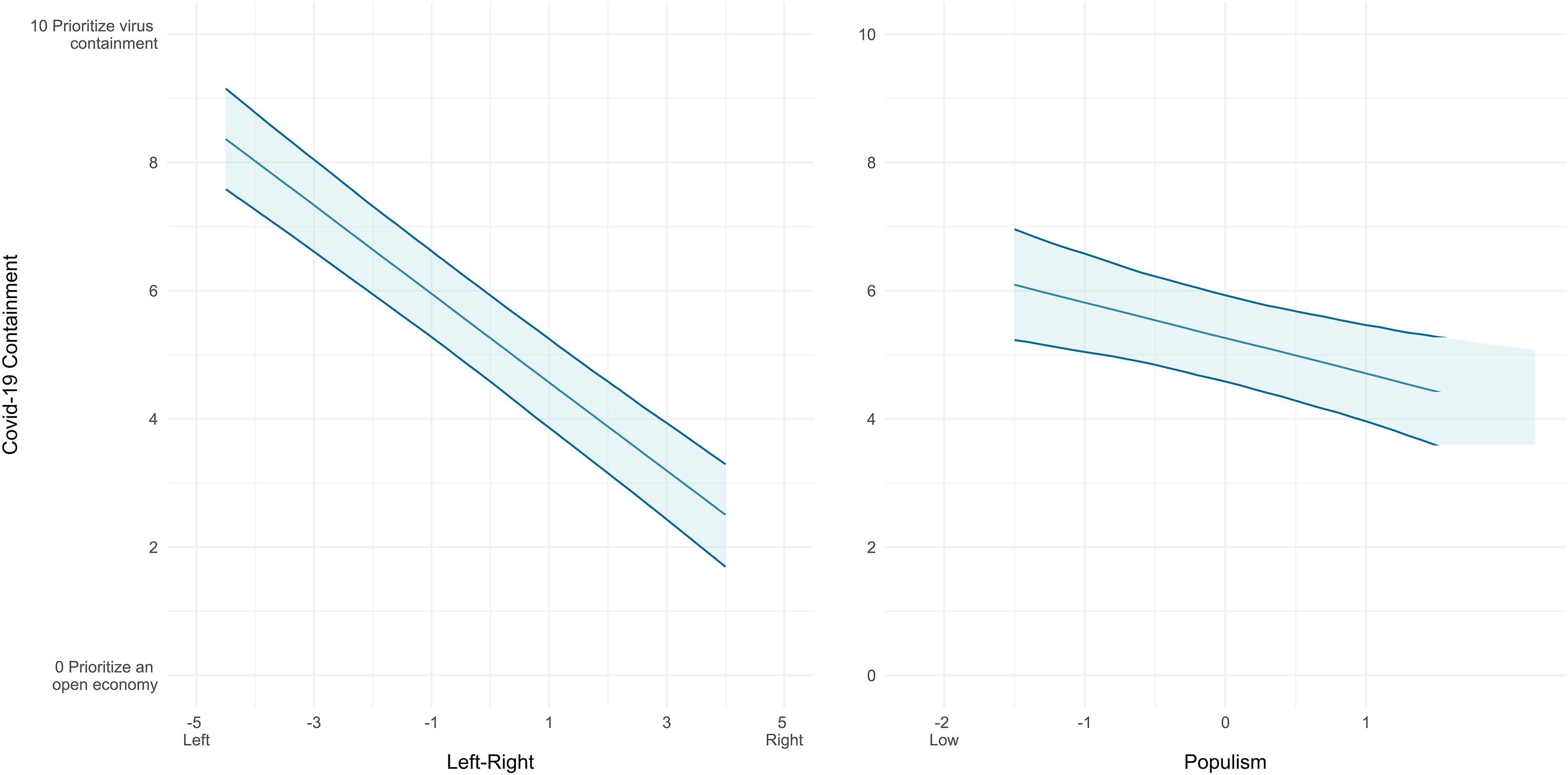
Ideological and Populist Correlates of COVID-19 Containment
The effect of populism on policy reactions is also consistent with our expectations (H2a). Parties and presidents with higher scores on populism tended to prioritise an open economy over virus containment. As Figure 1 shows, the effect is substantively important, if more modest; the predicted difference between a highly pluralist party and a populist party is 2.4 points on an 11-point scale. Again, the Brazilian case illustrates this point well. While right-wing governors aligned with President Bolsonaro implemented laxer policies, right-wing governors opposed to Bolsonaro in São Paulo, Rio Grande do Sul, and Pará implemented stricter policies (Bertholini, 2022).
In Figure 2, we examine whether the relationships shown in Figure 1 are more pronounced for more programmatic parties. We consider a party as highly programmatic if its programmatism score is 1.5 standard deviations above the mean. Conversely, parties are considered low on programmatism if their score is 1.5 standard deviations below the mean. The left panel shows that the effect of ideology on pandemic responses is much more pronounced for parties that rely on policy as a mobilisation strategy. While the predicted differences in containment between left- and right-wing parties is 3.1 for low programmatic parties, the difference for highly programmatic parties is 6.8. This provides strong evidence in support of H1b.
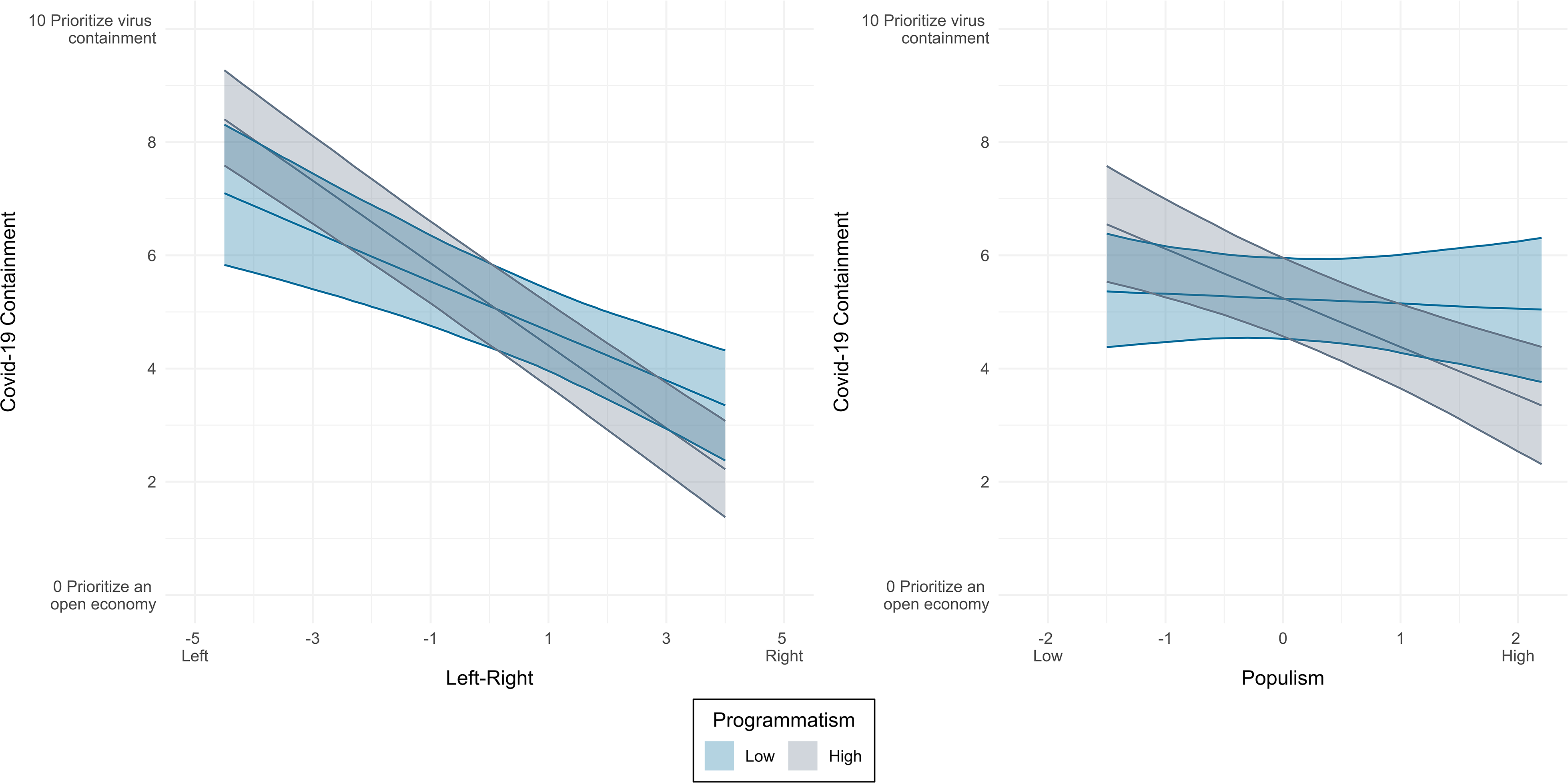
Interaction Effects of Programmatism on Left-Right and Populist Correlates of COVID-19 Containment.
We also find that the effect of populism on COVID-19 containment is moderated by programmatism, though the substantive effect is smaller. For parties that rank low on programmatism, the effect of populism on containment is close to 0 and not statistically significant. Conversely, orientation to populism has a strong effect on COVID-19 containment strategies for highly programmatic parties. Moving along the complete range of populism scores leads to a predicted change of 3.92 on containment. As levels of populism increase, highly programmatic parties tend to favour an open economy. However, further analysis suggests this relationship is strongly driven by highly programmatic non-populist parties which systematically prioritised containing the spread of the virus. This is suggestive of greater heterogeneity among responses by more populist actors.
Figure 3 provides further evidence in support of our expectation that preferences regarding containment were more heterogeneous among populists (H2b). The top panel shows a scatterplot of the data, with populism on the x-axis and containment on the y-axis, and presidents identified by name. Pluralist parties and presidents are concentrated in the top-left of the scatterplot, indicating that parties and presidents low on populism tended to abide by the containment measures recommended by experts, or to moderately favour an open economy As populism increases, however, the overall trend is toward favouring an open economy, but responses are decidedly more heterogeneous. Presidents López Obrador (Mexico), Bolsonaro (Brazil), and Maduro (Venezuela), provide a good illustration; all three presidents score high on populism but their response to the COVID-19 pandemic was very different. While Bolsonaro has the lowest score in terms of COVID-19 containment, Maduro has one of the highest. These findings are in line with previous country-level analyses (Andrews-Lee, 2022; Bertholini, 2022; de la Cerda and Martinez-Gallardo, 2022).
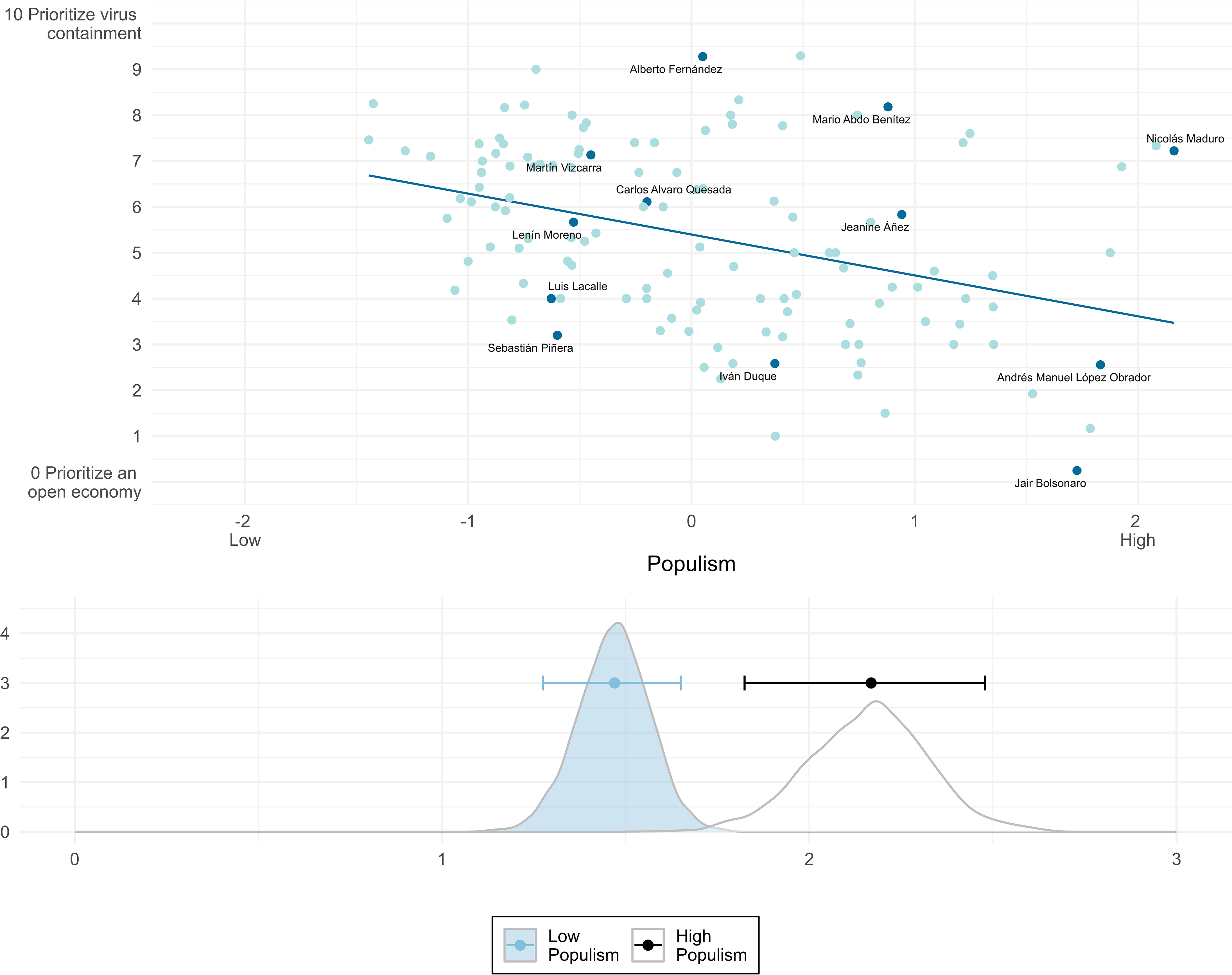
COVID-19 Containment and Populism.
To look more closely at the variation in containment responses, in the bottom panel of Figure 3 we divide the sample into two groups, one with low populism scores and the other with high scores (below and above 0, respectively). We then estimate the standard deviation for each group, using non-parametric bootstrapping to recover uncertainty estimates around these measures. The results show considerably more agreement on how the pandemic should be handled among non-populist parties and presidents in the region than among parties and presidents that scored high on populism, which faced the COVID-19 threat in more disparate ways. 12 In sum, the two panels of Figure 3 provide evidence in support of our hypotheses regarding the relationship between populism and approaches to the pandemic (H2a and H2b).
Executive Concentration of Power
We examine our hypotheses about executive concentration of power as a response to the pandemic in Table 1, Models 5 through 8. Model 5 includes only country random effects, Model 6 includes party- and country-level variables, and Models 7 and 8 include interaction terms between ideology, populism, and programmatism. The intraclass correlation of the null model is 0.11, indicating that variation in concentration of executive power is also due mostly to differences across parties and presidents and not across countries.
Regarding populism, Models 6 and 7 show results that are consistent with H3. Populism significantly affects party positions regarding additional concentration of power in the executive. To examine the size of these effects, the right panel of Figure 4 presents predicted values based on Model 6. The effect of populism on concentration of power is substantial, with movement from the lowest to the highest populism score associated with a predicted change of 2.1 points on an 11-point scale. Although all presidents in our sample support greater executive concentration of power, this is particularly true for more populist presidents, in particular Presidents López Obrador in Mexico and Maduro in Venezuela (see Appendix, Figure A4).
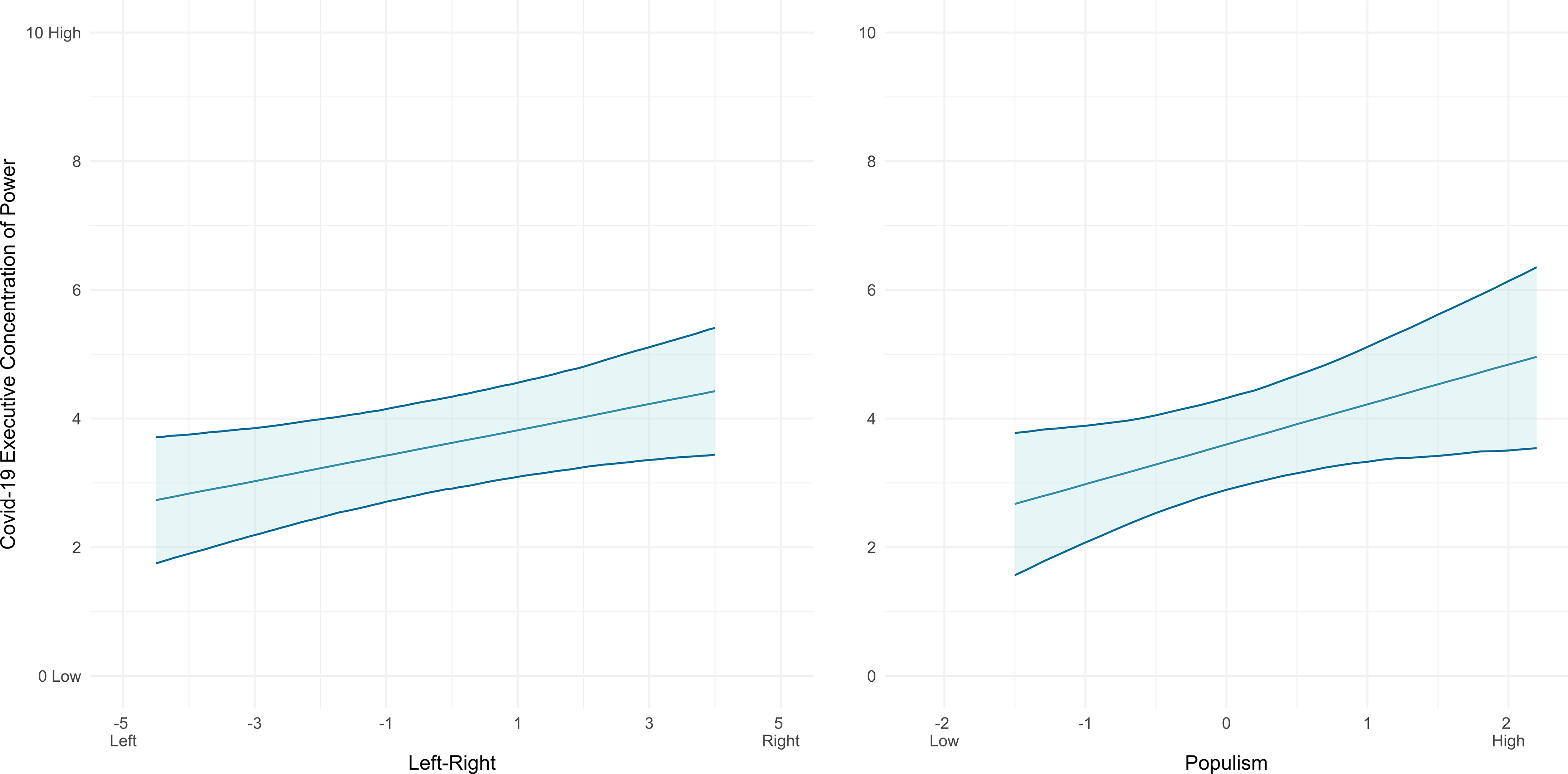
Ideological and Populist Correlates of Concentration of Power in the Executive.
Although we have no clear expectation regarding the impact of ideology on the extent to which parties and presidents support additional concentration of power, Table 1 and Figure 4 (left panel) point to an effect, albeit much smaller than the effect on containment. There are reasons, however, to be cautious about this result. Figure 5 presents a scatterplot of the data with ideology on the x-axis and executive concentration of power on the y-axis. Dark blue dots are observations with higher hat values, which is a measure of the influence of a value on the predicted values of the bivariate relationship. Rather than being spread across the full range of ideological positions, the most influential observations in the model are all clustered at the bottom left side of the figure, including the PT in Brazil and several Chilean leftist parties all of which were out of power at the time. This means that these results are largely driven by a set of left-leaning parties that strongly opposed further executive concentration of power. 13
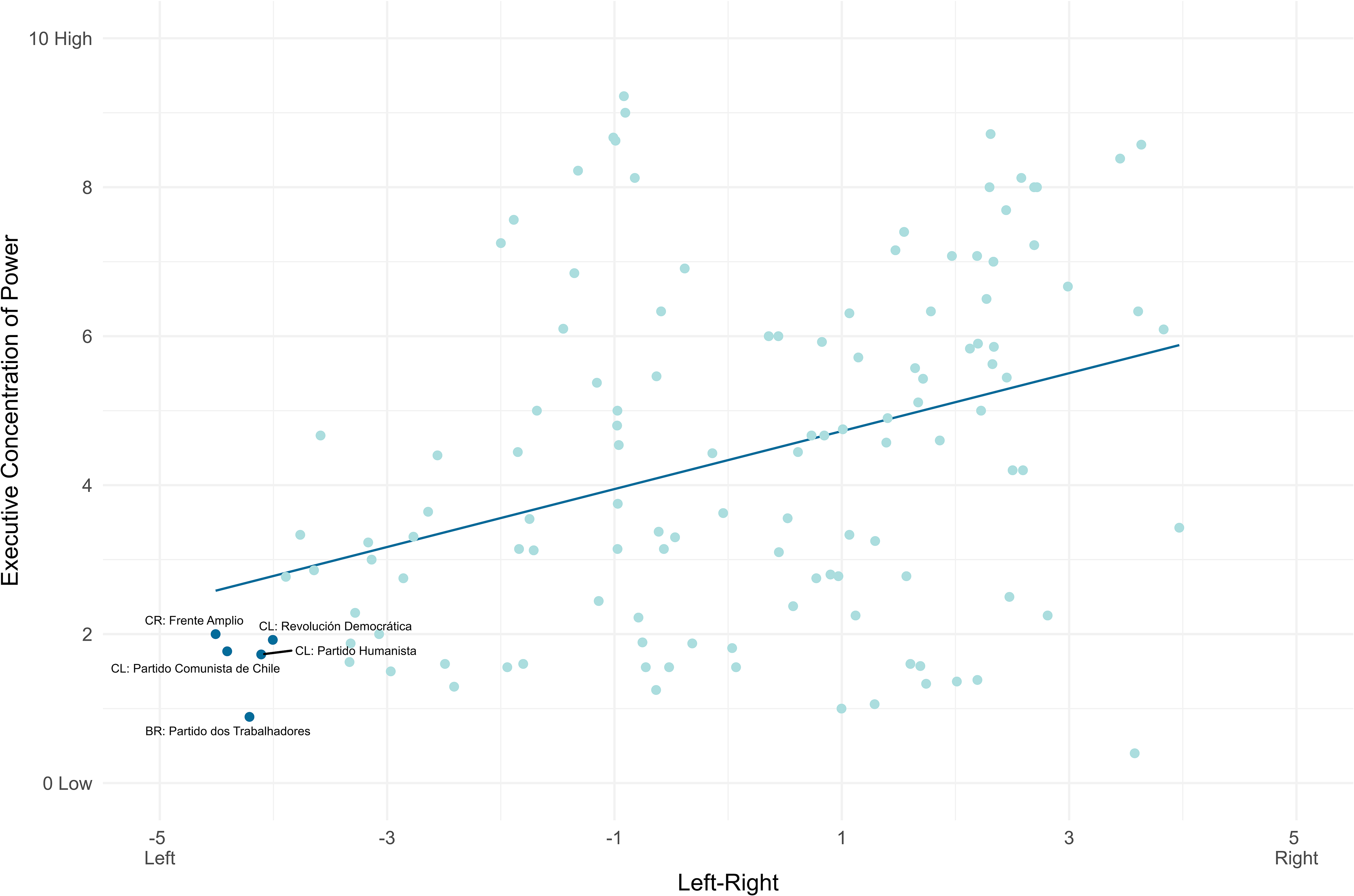
Executive Concentration of Power and Ideological Left-Right Position.
Finally, we find strong evidence in support of the argument that presidents and their coalition partners support greater executive concentration of power in response to the crisis, in comparison to opposition parties (H4). Indeed, in Models 5 to 8, status as part of the opposition or the incumbent coalition is the most important predictor of a partys position on concentration of power. The predicted difference between opposition parties and incumbent coalition members is 2.2, while the predicted difference between opposition parties and presidents is 2.7 on an 11-point scale (model 8).
Conclusion
The COVID-19 pandemic offers a unique opportunity to study the drivers of variation in policy responses by political parties and presidents faced with a common external threat. Despite a broad public health consensus regarding crisis response, actions by incumbents and parties in Latin America varied widely. We find evidence that this variation is associated to positions on both the ideological and populist dimensions of party competition in Latin America.
Consistent both with our expectations and with findings in other world regions, ideology is central to how parties addressed COVID-19, especially regarding its significant distributional consequences. When it came to deciding between limiting the spread of the virus and keeping the economy open, left-wing parties supported greater containment measures while right-wing parties prioritised maintaining economic activity. At the same time, in a region marked by weak party systems and varying linkage strategies with voters, it is important to highlight that we find the effect of ideology on responses to the pandemic to be especially strong for political actors that rely on programmatism for electoral mobilisation.
Beyond ideology, we find that populism also impacted policy approaches to the pandemic, though with heterogeneous effects. Abiding by the recommendations of the scientific community, parties and presidents in the region who were not populist generally favoured greater containment measures or, influenced by their ideology, more modestly favoured an open economy. In contrast, populists were on average more supportive of keeping the economy open, but this effect was limited to programmatic parties. Furthermore, there was wider variation in the positions populists endorsed to confront the pandemic. This heterogeneity is consistent with research that describes populism as a “thin ideology” (Hawkins and Rovira Kaltwasser, 2017; Mudde, 2004) that allows populist parties and leaders flexibility to interpret the pandemic in multiple ways. Indeed, some of them strongly denied its importance and others characterised the virus as extremely threatening (Ringe and Rennó, 2022).
Consistent with past research, we find that populist leaders and parties saw the COVID-19 pandemic as an opportunity to further concentrate executive power. This was especially true of populists in power at the time, though we also find that presidents and their coalition partners generally favoured greater power concentration than parties in the opposition. In turn, although our overall results find a modest link between right-wing ideology and concentration of power in the executive, we believe this result should be taken with caution, as it may be driven by a cluster of left-wing parties that were out of power at the time.
These findings have several implications for our understanding of party competition in Latin America. They provide further evidence that the ideological diversity of parties in the region has political consequences, in this case in the context of an exogenous shock. This finding is in line with work that shows ideological structuration for political parties in the region (Martinez-Gallardo et al., 2022), and with work that argues it has important consequences for policy (Huber and Stephens, 2012; Pribble, 2013). Our findings also confirm the reinforcing role of programmatism in a region in which reliance on policy appeals varies widely (Mainwaring, 2018), and highlight the heterogeneous effects of populism for how countries in the region responded to the crisis.
Finally, our findings have normative consequences. Some might argue it is promising for democratic accountability and responsiveness that parties employ their prior ideological positions when engaging with new issue like COVID-19, whereas others might insist that in an unparalleled health crisis such as this one, scientific knowledge must play a dominant role. At the same time, given party instability, electoral volatility and a widespread sense of crisis in the region, it is hardly surprising that citizens also turn to political leaders that seek support using populist strategies. Yet, the widely varying responses by populists to the pandemic and their focus on concentrating executive power provides further evidence that their approach to governance risks exacerbating polarisation and challenging democratic accountability and responsiveness.
Supplemental Material
sj-docx-1-pla-10.1177_1866802X241262326 - Supplemental material for Ideological and Populist Bases of Partisan Responses to the COVID-19 Pandemic in Latin America
Supplemental material, sj-docx-1-pla-10.1177_1866802X241262326 for Ideological and Populist Bases of Partisan Responses to the COVID-19 Pandemic in Latin America by Nicolás de la Cerda, Jonathan Hartlyn and Cecilia Martinez-Gallardo in Journal of Politics in Latin America
Footnotes
Declaration of Conflicting Interests
The authors declared no potential conflicts of interest with respect to the research, authorship, and/or publication of this article.
Funding
The authors disclosed receipt of the following financial support for the research, authorship, and/or publication of this article: This work was supported by the Reckford Professorship at UNC-Chapel-Hill.

Supplemental Material
Supplemental material for this article is available online.
Notes
Author Biographies
References
Supplementary Material
Please find the following supplemental material available below.
For Open Access articles published under a Creative Commons License, all supplemental material carries the same license as the article it is associated with.
For non-Open Access articles published, all supplemental material carries a non-exclusive license, and permission requests for re-use of supplemental material or any part of supplemental material shall be sent directly to the copyright owner as specified in the copyright notice associated with the article.
