



Abstract
This paper delves into the Philippines’ response to the COVID-19 pandemic, focusing on the enforcement of a rigorous lockdown and the paradoxical rise in President Rodrigo Duterte's approval despite the virus's unmitigated spread. While conventional analyses lean on securitisation to explain military involvement in pandemic control, this paper argues that COVID-19 was not securitised in the Philippines. Instead, the government targeted the “pasaway” (undisciplined) as a supposed threat to national security, employing identity politics. By presenting the undisciplined as adversaries, the government garnered support from perceived “good citizens.” Despite human rights concerns and a lack of evidence linking the undisciplined to virus transmission, the narrative of cracking down on them garnered widespread approval. This challenges traditional securitisation explanations, suggesting that the emphasis on a “scapegoated enemy” and identity politics played a pivotal role in shaping public perception and elevating presidential approval ratings.
Introduction
The novel coronavirus, known as COVID-19, emerged in 2019 and claimed over six million lives worldwide by 2023. This unprecedented threat prompted nations globally to enact measures to curb its spread. In the Philippines, the government implemented an exceptionally strict quarantine and restrictions on movement. From March to May 2020, the Philippine government imposed what was called “the longest lockdown in the world.” This entailed mobilising the police and military to enforce restrictions on residents, with President Rodrigo Duterte even issuing directives to “shoot them dead” for non-compliance (Billing, 2020). In fact, within the first month of the lockdown, authorities arrested more than 30,000 people for violating the lockdown measures in Metro Manila alone (Arguelles, 2021: 263). Human rights violations due to excessive policing were also reported (Talabong, 2020), and some citizens were shot dead for refusing to wear masks (Billing, 2020).
However, despite these stringent measures, the Philippines faced a surge in COVID-19 cases. The number of infections in the country skyrocketed in June 2020, with the highest number of infections per population in Southeast Asia (Thompson, 2022: 409). Meanwhile, the economy cooled significantly in the wake of the lockdown, and unemployment soared (Magno and Teehanke, 2022: 111–113). In a Bloomberg report that assessed countries’ resilience under COVID-19, the Philippines ranked last out of 53 countries, and in a similar ranking by Nikkei Asia of COVID-19 resilience, the Philippines ranked last out of 121 countries (Aguilar, 2021; Sarao and Zacarian, 2021). Intriguingly, amidst these challenges, President Duterte's approval rating did not decline but rather rose to an unprecedented 91 per cent in September 2020 (Reuters, 2020). The purpose of this paper is to solve this puzzle.
In the existing literature on the Philippine's policies to tackle COVID-19, many use the concept of securitisation to explain the implementation of a severe lockdown that mobilised the military (Hapal, 2021; Thompson, 2022). This paper will present details later, but in brief, securitisation is the process of positioning an issue as an existential threat to a nation and making it a security issue to be addressed (Buzan et al., 1998). Indeed, Duterte often spoke of COVID-19 in war-related terms and actively used the military in the fight against COVID-19. However, the concept of securitisation cannot explain why the president's approval rating rose despite his failure to control the spread of COVID-19. If COVID-19 is positioned as a security issue, one would expect that the approval rating of a president who fails to properly deal with a national security crisis would decline significantly.
It seems that previous studies have somewhat easily adopted the concept of securitisation by focusing too much attention on the mobilisation of military forces to fight COVID-19. This article examines the concept of securitisation first. It then goes on to show that COVID-19 was not securitised in the Philippines. Meanwhile, the Philippine government excessively attacked its “scapegoated enemy” as a threat to national security. This article argues that such excessive attacks against a “scapegoated enemy” were the reason why Duterte's approval ratings rose even when he failed to control the spread of COVID-19.
Securitisation and Over-Securitisation
In response to the spread of COVID-19, political leaders in many countries sought to prioritise the threat of COVID-19 by positioning it as a matter of national security. For example, French President Emmanuel Macron frequently stated that “we are at war in our country” and asked people to understand restrictions on going out (Politico EU, 2020). President Donald Trump of the United States called himself a “wartime president” and asked people to “make sacrifices for their country” (Politico, 2020). In response to this situation, a number of studies have attempted to analyse the response to COVID-19 in various countries using the concept of securitisation. 1
The theoretical framework of securitisation in international relations was developed by the so-called Copenhagen school, led by such scholars as Barry Buzan and Ole Wæver, and it has become a major field in security studies (Salter, 2018). 2 The process of securitisation starts when an actor attempts to securitise a certain object/ideal by framing it as a threat to a referent object. If the audience accepts such an attempt, the object is transformed into a matter of security to enable the use of extraordinary means in the name of security (Buzan et al., 1998: 25).
In fact, it is common for the military to be mobilised to solve securitised problems. In dealing with COVID-19, French government mobilised troops to provide medical assistance (France24, 2020), and the American government sent troops to set up field hospitals (Megerian and Cloud, 2020). Furthermore, the military was used in many countries for policing things, such as curfew restrictions and lockdowns. The use of the military to deal with urgent national security issues is not in itself problematic. However, the use of military forces to deal with problems that lie outside their primary mission often causes problems. In fact, when the military engaged in policing activities such as curfew restrictions to prevent the spread of COVID-19, excessive policing and human rights violations occurred frequently in many countries (Acacio et al., 2022; Levy, 2022; The Gurdian, 2020). Such excessive actions to solve securitised problems are often denounced as over-securitisation.
While over-securitisation is often seen as a problem, it has not been adequately theorised. Certainly, mobilising the military to respond to those who do not comply with COVID-19 lockdowns leads to a deviation from the proper role of the military. On the other hand, public support for such a role was strong in some countries such as the Philippines, as we will see later. Those who support these policies do not feel that they are excessive in the least. Who, then, determines when over-securitisation takes place? For purposes of this paper, I will define over-securitisation as a case where the measures taken by a securitising actor to eliminate a securitised threat are excessive compared to the measures the majority of the audience considers appropriate (Adachi, 2024). In other words, I will focus on the perception gap between the securitising actors and the audience.
Once a problem is securitised, its solution becomes the top priority, and therefore, all possible measures can be taken to eliminate the threat, which is why over-securitisation is likely to occur. However, even if the majority of the public agrees to a certain issue being securitised, it does not necessarily mean that they will delegate full authority regarding the extent of measures to be taken for the securitised issue. If a government responds in an excessive manner beyond what is acceptable to its constituents, it will naturally face criticism from them. If there is a debate over whether an issue is a security issue in the first place, the government needs to gain the public's support for how to deal with the issue, even after the issue has been securitised. The interaction between securitising actors and their audience is not only over the framing of the issue, but also over what steps to take. And when measures are taken that exceed what the majority of the audience considers appropriate, a backlash may occur (Adachi, 2024).
Has COVID-19 Been Securitised in the Philippines?
The first confirmed case of COVID-19 in the Philippines appeared on January 30, 2020. Since the infected person was a traveller from Wuhan, China, to the Philippines, the Philippines government immediately suspended travels of non-Filipinos from China's Hubei Province, of which Wuhan is the capital, to the Philippines. However, as Hubei Province had already implemented a lockdown measure at the time, this measure had little meaning. 3 In addition, as many countries were experiencing cases of COVID-19, there were strong calls for broader restrictions on entry in the Philippines. In response to these requests, President Duterte denied the threat of COVID-19, saying, “one or two [cases] in any country is not really that fearsome” (Aguilar, 2020). When criticism arose about the government's delay in responding to the COVID-19 pandemic, he defended the government's response, citing the preventive measures taken by health authorities. At the same time, Duterte downplayed the spread of COVID-19 saying, “the public will rely on the strength of Filipinos’ antibodies” and that “Filipinos don’t get sick easily.” He also stated that he wanted the military and police to instil public order should the spread of COVID-19 worsen, indicating his intent to respond to COVID-19 not with medical and epidemiological findings, but with the military and the police (Tomacurz, 2020).
In March, the disease began to spread throughout the Philippines. When the Philippines’ first domestic case of infection was confirmed, Duterte immediately declared a public health emergency ( Proclamation No. 922 ). However, it seemed the president's own awareness of COVID-19 had not changed at all. In fact, in a speech on March 11, after the declaration of a public health emergency, he stated, “They are discouraging long meetings and large congregation. Naniwala pala kayo. Sus. [fools. Don’t believe it!]” (Duterte, 2020). On that occasion, the president himself repeatedly shook hands with military and police personnel in defiance of the “no-touch policy” set by the Presidential Security Group to protect him from COVID-19 (Lopez, 2020). In response to a sharp increase in the number of cases in the week that followed, the Philippine government imposed strict quarantine and movement control measures in Metro Manila and some municipalities from mid-March to May. 4 This was dubbed the “longest lockdown in the world.” However, even at the time of this announcement, Duterte repeatedly appealed to the public not to fear COVID-19 (Hutchcroft and Holmes, 2020).
In implementing the quarantine and movement control measures, the Philippine government actively used the military and the police to crack down harshly, acting without warrants to arrest citizens who criticised the government's infectious disease control measures on the Internet (Vitug, 2020) and arresting one after another who violated the curfew restrictions. Several previous studies have pointed out that these policies were the result of the securitisation of COVID-19. They also tend to critically discuss human rights violations caused by the active use of the military and police as a result of COVID-19's over-securitisation (Atienza et al., 2020; Baysa-Barredo, 2020; Hapal, 2021; Quijano et al., 2020; Thompson, 2020; Thompson, 2022; Utama, 2021). However, the mere use of the military in the measures to control COVID-19 does not necessarily mean that COVID-19 is securitised. In fact, many countries used the military in their response to COVID-19 because military personnel possess the capabilities necessary to implement various emergency measures (Kalkman, 2021).
It has also been argued that as a result of the securitisation of COVID-19, Duterte gained sweeping emergency powers with the March 23 passage of the so-called Bayanihan to Heal as One Act, or Republic Act No. 11469 (Bayanihan Baysa-Barredo, 2020; Thompson, 2022: 410). This law allowed the government, among others, to provide financial assistance to mitigate the impact of the pandemic. Its contents were in accordance with the constitution. In fact, it did not contain any extreme contents that would have been impossible without securitising COVID-19 (Atienza et al., 2020: 11–12). Rather, the content of the law as finally enacted was more in line with congressional control over the president than the original proposal (Buan and Rey, 2020; Hutchcroft and Holmes, 2020). Although some argued that the law violated the Constitution and appealed to the court, the Supreme Court dismissed such appeals (CNN Philippines, 2020).
With COVID-19's spread worldwide and in the Philippines, Filipinos were becoming increasingly aware of the threat that it posed (Hutchcroft and Holmes, 2020). In contrast, as mentioned above, Duterte himself repeatedly denied or downplayed that threat. According to Karl Hapal (2021), at the start of the lockdown of major cities, Duterte did use the expression, “We are at war against a vicious and invisible enemy.” However, even during this press conference, he “spoke disjointedly about the dangers of the virus, repeatedly asking the people not to be afraid (Hutchcroft and Holmes, 2020).”
In order to securitise a subject, it is not enough to assert just once that the subject is an enemy that poses an existential threat to the state or its people. One must repeatedly make the case that the subject is an existential threat and needs to be treated as a security issue in order to gain the support of the audience for securitising the subject. However, while Duterte did make a statement referring to COVID-19 as an enemy, there was no consistent attempt to make it a security issue. Rather, he frequently made statements downplaying the threat of the new virus. As a result, in a Gallup International survey conducted in the Philippines in March during the lockdown, 59 per cent of respondents said that the threat of COVID-19 was exaggerated, and in April, the percentage was still 50 per cent (Gallup International, 2020). It is thus difficult to say that Duterte attempted to securitise COVID-19, nor that his audience accepted its securitisation. Most previous studies argue that Duterte had securitised COVID-19, but such claims seem to lack sufficient evidence.
“Pasaway” as a Scapegoat
It is true that President Duterte himself often used war-related words when he talked about COVID-19. The top 100 most frequently used words in his speeches, press conferences, and video messages on COVID-19 from 3 February to 4 May of 2020 included the words “death,” “army,” “power,” and “soldier” (Randa, 2020). However, the use of these words alone does not imply that he was attempting to securitise COVID-19. As noted above, Duterte did not consistently attempt to convince his audience that COVID-19 was a national security threat. The frequent use of these words may have been, in part, an attempt to make the government's response appear dramatic (Lasco, 2020a: 1421–1422). At the same time, it is also true that he did actually mobilise the military and repeatedly said, “If there is a problem, shoot to kill.” Thus, it is obvious that he was using the military to defeat an “enemy.” Who (or what) did Duterte consider to be a security threat or enemy to the country?
This study concludes that what Duterte saw as the enemy to the country was the pasaway [undisciplined]. In the Philippines, as the economy continued to grow at a remarkable pace from the mid-2000s, neoliberalism prevailed. “While promoting the state's withdrawal from welfare and flexibilisation of employment, neoliberal governmentality shifts the blame for life's misfortunes from the state to individuals” (Kusaka, 2020: 425). While the idea that one could succeed if one “disciplined” oneself and worked hard was gaining ground, there was a growing tendency for struggling “good citizens” to denounce the pasaway as “evil others” (Kusaka, 2017). Against this backdrop, Duterte increasingly sought to build public support by targeting the pasaway and cracking down hard on them.
The “war on drugs” he promoted is a prime example. Duterte framed widespread drug use as a threat to national security (Quimpo, 2017; Thompson, 2020; Utama, 2021). In doing so, he mobilised the military and conducted a harsh crackdown, even willing to shoot drug traffickers and drug addicts. Despite the arrest of numerous drug traffickers and drug addicts, drug distribution in the Philippines has not decreased (Allard and Lema, 2020). However, the relentless crackdown on drug traffickers and drug addicts, who are considered as pasaway and the “evil other,” drew support from most of the Filipinos, not only the rich and middle class, but also the poor who want to be “good citizens” to be rescued by the government (Kusaka, 2017; Thompson, 2018).
Of course, the “war on drugs” promoted by Duterte was not without criticism. International NGOs such as Amnesty International and Human Rights Watch actively criticised the rampant extrajudicial killings from an early stage (Amnesty International, 2017; Human Rights Watch, 2017). The International Criminal Court launched a preliminary investigation into the extrajudicial killing of a drug crime suspect in 2018, following accusations by a Filipino lawyer of “crimes against humanity,” and approved a formal investigation in September 2021. 5 The United Nations Office for the Coordination of Humanitarian Affairs (OCHR) was critical of Duterte's “war on drugs” since its initiation. The OCHR repeatedly asked the Philippine government to allow independent UN rapporteurs to investigate the “war on drugs” (Lozada, 2021). Although not widely noticed, there were also large-scale demonstrations against the “war on drugs” domestically (Lozada, 2021) and lawsuits alleging that the “war on drugs” violated the Constitution (Buan, 2017). However, Duterte's approval rating and public support for the “war on drugs” remained stable at high levels, and these criticisms had little impact (Lozada, 2021).
The Filipino public's stable support for the “war on drugs” was linked to steadily high approval ratings for Duterte himself. In a Social Weather Survey conducted in December 2019, just before the spread of COVID-19, Duterte's net satisfaction rating was 72 per cent (82% satisfied, 10% dissatisfied). The approval ratings of many Philippine presidents have tended to be high when they took office but declined significantly by the halfway point of their terms. Nevertheless, halfway through his presidency, Duterte's approval rating was significantly higher than that of previous presidents (Social Weather Station, 2019). Duterte had been able to maintain his high approval rating because the Filipinos perceived him as someone who actually improved their security and who tried hard to change the situation (Czech, 2022). The existence of a culture in the Philippines that tolerates violence may also have contributed to the president's continued high approval rating despite the many casualties in his “war on drugs” (Scarpello, 2016).
Although Duterte initially downplayed COVID-19, he was forced to take further action when the infection spread throughout the Philippines. Instead of expanding testing and contact tracing systems, he targeted pasaway. In other words, just like in the “war on drugs,” the president tried to give the public the impression that he was improving security and making some changes by targeting and cracking down on pasaway and showing that he was fighting a specific, tangible enemy. The same discipline-oriented policy that had been successful in maintaining high approval ratings since the president's inauguration was applied to deal with the COVID-19 issue. In April 2020, when the Philippines had the highest number of COVID-19 cases in Southeast Asia, the presidential spokesperson said, “So many of us are pasaway. Because of that, we’re number one in ASEAN in terms of COVID-19 cases. That's shameful. Stop being pasaway and stay at home” (Philippine Daily Inquirer, 2020). On the same day, Duterte also stated that “this quarantine […] is really intended to protect the other guy” (Hapal, 2021: 234), stressing that the lockdown is to protect “good citizens” from the other guy, pasaway. He then suggested that the government may have to resort to measures such as martial law in order to enforce discipline (Hapal, 2021: 234). He positioned the pasaway, who he claimed were responsible for the spread of COVID-19, as a threat to the state and subjected them to a strict crackdown that would mobilise the military.
There was no evidence that pasaway were responsible for the spread of COVID-19. With inadequate testing and contact tracing systems in place, the Philippine government had little data on how the infection was spreading. To avoid being criticised for spreading COVID-19 due to inadequate government policies, the Philippine government constructed and disseminated the narrative that the pasaway were responsible for the spread of COVID-19 (Lasco, 2020b). In fact, the attempt to securitise pasaway was an extension of Duterte's discipline-oriented policies. As noted earlier, even before the spread of COVID-19, Duterte repeatedly stressed the importance of cracking down on the pasaway, and had he gained public support. In responding to the problem of COVID-19, the Philippine government attempted to dodge criticism by turning the pasaway into a scapegoat in the absence of sufficient capacity to address the problems through medicine and epidemiology.
As the public had supported the policy of cracking down on the pasaway thus far, government officials expected them to support the strict crackdown on the pasaway in the case of COVID-19 as well. In fact, cracking down on the pasaway in a COVID-19 context could have a greater effect than on other issues. The attempt to securitise the pasaway is in some respects easier for the public to understand and accept than an attempt to securitise the invisible disease COVID-19. This is because the enemy was made visible. And by policing its “enemies,” the Philippine government could claim to be making concrete “war results.” Therefore, the Philippine government focused on cracking down on the lockdown by mobilising the military rather than strengthening its inspection system and contact tracing.
According to a poll conducted by Gallup International, 70 per cent of respondents in March and 80 per cent in April said the government's response was working in the Philippines, even though the spread of COVID-19 was not under control (Gallup International, 2020). A survey by Imperial College London found that 72 per cent said they would refrain from going out for shopping and 81 per cent said they would refrain from working outside the home, both higher than in any other Asian country surveyed. In fact, Filipinos were less likely to go out than those in countries with similar or stricter regulations as you can see in Table 1. For example, the Philippines’ score in the Oxford Index of Strict Government Regulations was 86, the same as Thailand and Hong Kong and lower than Vietnam's score of 100. And yet, Filipinos were far more willing to stay in than people in any of these other countries (Imperial College London, 2020). The percentage of respondents who reported wearing a mask when going outside was also extremely high, at 92 per cent. The tendency to refrain from going out was also confirmed by other data, such as location data from mobile devices (Punongbayan, 2020). Social distancing and mask wearing were not controversial among Filipinos (Hapal, 2021: 11). Many Filipinos followed the “discipline” demanded by the government of their own accord (Kusaka, 2020).
Identity Politics Between “Pasaway” and “Good Citizens”
The political approach of positioning the pasaway against the “good citizens” was a key factor in President Duterte's war on drugs. The Filipino people, frustrated with the growing neoliberal trend as well as the exploitation of the laws and regulations by corrupt officials (Kusaka, 2017: 56), were very much appeased by the “penal populism” that severely punishes the pasaway. 6 This is because many “good Filipino citizens” with various grievances felt increasingly victimised by the pasaway (Kusaka, 2019). Despite or because of the many arrests, shootings, and reported human rights violations in the war on drugs, many Filipinos supported Duterte (Kenny and Holmes, 2020, 2023). The same logic was behind his tough stance against criminals and corruption. And this “penal populism” was able to win support across social strata and religious, racial, and regional cleavages (Kusaka, 2017: 64, 2019).
If COVID-19 had been securitised as prior studies have suggested, it would have been difficult for Duterte to maintain his high approval ratings as the outbreak defied containment and continued to spread. However, it was not COVID-19 but the pasaway that Duterte attempted to securitise. Therefore, by showing that Duterte was cracking down hard on the pasaway, he could earn the reputation of being responsive to the “enemy.”
In addition, the method of dividing the people into pasaway and “good citizens” led to the construction of an identity of a “moral we” and “immoral others.” Duterte then used this to deploy identity politics to increase support for his presidency (Kusaka, 2017). Duterte intensified the division between the pasaway and the “good citizens” and tried to position himself as the one who would protect the “good citizens” from the pasaway, who were the “immoral others.” As a result, the “good citizens” did not often see human rights violations, if any, as a problem when crackdowns against “immoral others” were carried out. In fact, most of them even perceived it as desirable.
Therefore, even though the spread of COVID-19 was completely uncontrolled despite the severe lockdown, the mobilisation of the military to crack down on the lockdown, and the order to shoot violators, a public opinion poll conducted in April 2020 during the lockdown showed that as many as 80 per cent of the public said that the government was handling the COVID-19 pandemic well. And 86 per cent said they would “gladly sacrifice human rights to prevent the spread of COVID-19” (Gallup International, 2020). This could be considered evidence of an attempt to emphasise being a “good citizen” over human rights. In any case, few people perceived government lockdowns and crackdowns on severe lockdown violations as excessive, and the overwhelming majority viewed them as appropriate. In other words, Filipinos did not view Philippines government policies regarding COVID-19 as being a result of over-securitisation. They considered these policies and measures as appropriate to fight against the threat posed by pasaway, rather than seeing them as measures to fight against the threat posed by COVID-19 itself.
This is not to say, however, that there were no problems with Duterte's policies to tackle the COVID-19 pandemic. Identity politics that bifurcate the Filipino people into “us, the good citizens,” and “pasaway, the immoral others,” and attract the support of the “good citizens” by thoroughly punishing the pasaway could easily lead to excessive exclusion against the pasaway (Kusaka, 2017: 64). As has often been noted, identity politics can intensify civil wars (Kaldor, 1998) and increase social divisions (Fukuyama, 2018). There is a danger of overlooking this point in a misguided analysis that assumes the Philippine government securitised or over-securitised COVID-19.
This article has thus far argued that the securitisation of the pasaway was the reason for Duterte's high approval rating, despite the failure of his measures to combat COVID-19. In fact, Duterte's approval rating remained high and generally exceeded 75 per cent until he left office. 7 However, this alone does not fully explain why the approval rating reached an all-time high in September 2020. There were several other factors that contributed to the record-high approval rating in the fall of 2020. One of the reasons was timing: The first wave of the outbreak peaked around August 2020, after which the number of cases began to gradually decline. In 2021, the number of infections increased significantly again, so overall, the fall of 2020 was a period of relative calm. 8 The declining number of infections was probably one of the reasons for the president's higher approval rating during this period compared to other periods.
Although the government's distribution of benefits to needy families was behind schedule, 72 per cent of respondents had received some form of financial assistance as of July 2020. On August 24, 2020, the Bayanihan to Recover as One Act, also known as Bayanihan 2 (Republic Act No. 11494), was passed, allowing for a total budget of 165.5 billion pesos for assistance to low-income and unemployed people, support for returning overseas migrant workers, loans to micro, small, and medium enterprises, and distance education. The September 2020 survey was conducted at a time when people were expecting to get further financial support from the government. This may have had the effect of slightly boosting support for the government. In fact, compared to the previous survey, the September 2020 poll showed the largest increase in support among the poorest segment of the population (Elemia, 2020). These factors may have had some positive effect on the approval rating. However, it is difficult for these factors to explain the continuation of high approval ratings despite the failure to control the spread of COVID-19.
Concluding Remarks
As we have seen in this paper, the Philippine government neither securitised nor over-securitised COVID-19. What President Duterte securitised was not COVID-19 but the pasaway that he claimed spread COVID-19. The deployment of identity politics between “us, the good citizens” and “pasaway, the immoral others” created a situation in which the more harshly the government attacked the pasaway, the more support the government gained from the “good citizens.” This is the reason why Duterte achieved record high approval ratings despite the failure of the Philippine government's policies to control the spread of COVID-19. The paper also acknowledges additional factors contributing to Duterte's approval ratings, such as the timing of the first wave's decline and government financial assistance initiatives. However, it emphasises that these factors alone cannot fully explain the persistently high approval ratings.
Despite the high number of human rights violations and killings without trial, there was a growing tendency not to see them as a problem as long as they were directed against the “pasaway, the immoral others.” This situation is not a phenomenon that emerged only after the COVID-19 pandemic. It was common to the various policies, including the war on drugs, that Duterte pursued after assuming the presidency. Moreover, these policies appear to have been carried over to President Ferdinand Marcos (Jr.), who replaced Duterte as president. It has been pointed out that the son of ousted dictator President Marcos (Sr.) was able to win the presidential election in part because he was perceived as carrying on the policies of the Duterte administration (Dulay et al., 2023), especially his vision of progress through discipline (Kuhonta, 2022). And indeed, with regard to the “war on drugs,” which was the symbol of Duterte's discipline-oriented policy, it has been pointed out that despite President Marcos (Jr.)'s pledge to take a more compassionate approach, he has so far continued Duterte's “war on drugs,” with numerous human rights violations and the killing of violators (Chi, 2023; Gavilan, 2023; Simons, 2023).
It is therefore essential to take a look at the dangers of identity politics that pit these pasaway against “good citizens.” For this reason, we must refrain from assuming that the concept of securitisation applies based solely on the fact that the military is being used to tackle a problem, and instead examine what is actually being securitised as the “enemy” or the existential threat to the nation, as well as what policies to deal with this “enemy” are perceived as appropriate by the audience.
Government Regulation Strictness and Citizen Behaviour.
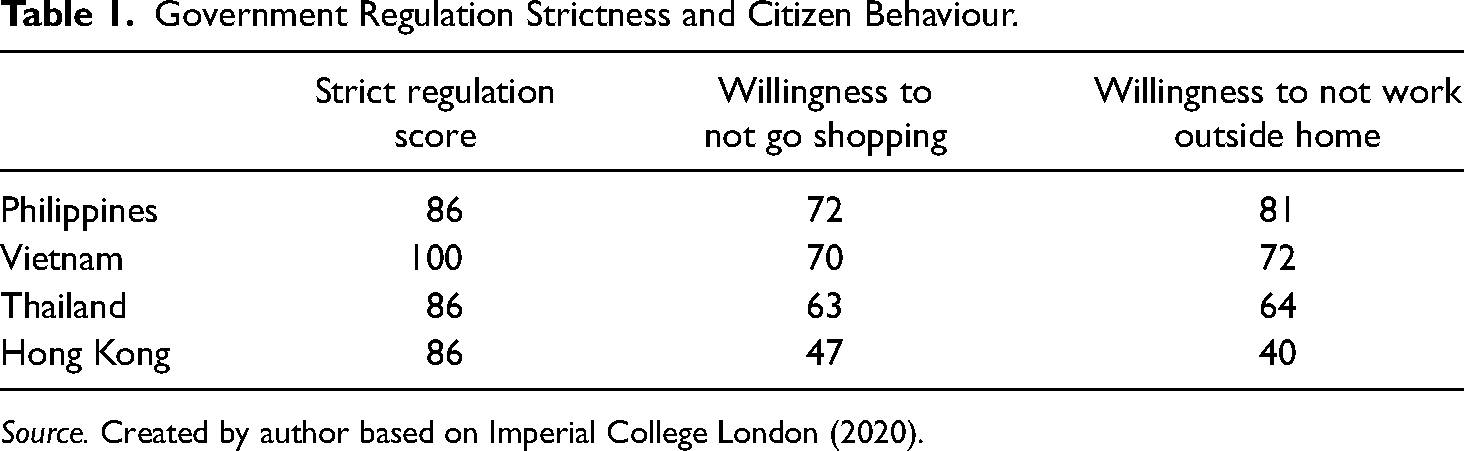
Source. Created by author based on Imperial College London (2020).
Footnotes
Declaration of Conflicting Interests
The author declared no potential conflicts of interest with respect to the research, authorship, and/or publication of this article.
Funding
The author disclosed receipt of the following financial support for the research, authorship, and/or publication of this article: This work was supported by the Japan Society for the Promotion of Science (JSPS) (Grant Nos. 22K01367, 23H00792, and 20H04407) and AY2023 Programme for Asia-Japan Research Development, Ritsumeikan University.
