



Abstract
This article presents the case for steering clear of electoral outcome-based regime classifications. It advocates focusing instead on the systemic character of the formal and informal institutions that govern access to power as a more appropriate way to draw electoral regime boundaries. The case study of Ecuador under the presidency of Rafael Correa is offered as an example of this approach. Both electoral outcomes under Correísmo (2006–2017) as well as the procedural context in which elections occurred are examined. But the regime is here analyzed and categorized on a procedural-centered basis. The analysis of the slope of the playing field in the electoral arena reveals that political competition was fundamentally unfair, placing the regime in the competitive authoritarian category. This conclusion is reached on grounds of the incumbent's capture of the electoral management body, as well as highly discriminatory electoral laws drawn by the incumbent, among many other factors that rendered Ecuadorean electoral contests unfair.
Escúcheme bien, eh! El Presidente de la República no es sólo jefe del Poder Ejecutivo, es jefe de todo el estado ecuatoriano. Y el estado ecuatoriano es Poder Ejecutivo, Poder Legislativo, Poder Electoral, Poder de Transparencia y Control Social, Superintendencias, Contraloría, Procuraduría […] Todo eso es el Estado ecuatoriano.
President Rafael Correa
Introduction: On the Inadequacy of Outcome-Based Regime Taxonomies
It is widely acknowledged among scholars of comparative politics that the definitional boundaries delimiting regime categories are somewhat ambiguous. In the quest to reduce such ambiguity, comparativists should avoid the temptation to craft or rely on regime taxonomies centered on electoral outcomes (percentage of votes or seats won, number of elections won, one-party dominance, alternation of power, etc.). Adam Przeworski (1991) famously proposed an outcome-based definition of democracy as a regime in which “parties lose elections.” As an easily observable indicator, this is an enticing shortcut to delineate the boundary between democratic and non-democratic polities, and is therefore a frequently used definition. However, results-oriented approaches prove inadequate from both a conceptual and an empirical standpoint. In conceptual terms, a venerable tradition of scholarship, dating back to Joseph Schumpeter and Robert Dahl, defines democracy as a rule-based system of governance that derives legitimacy precisely from acceptance of its rules (rational-legal legitimacy). For the purpose of classifying electoral regimes, faithfulness to a process-centered definition (minimalist or mid-range) that revolves around access to power dictates a strict focus on the procedural conditions surrounding political competition.
From an empirical point of view, a results-centered approach is inadequate because electoral outcomes are, by definition, contingent, and because many election outcomes are the product of a mixture of genuine voter preferences and governmental manipulation (often practiced on a continuous basis between elections). Electoral results can be a certifiably misleading or imperfect proxy to judge the fairness, freedom, or ex ante competitiveness potential of elections. An undemocratic regime that allows competition can lose a notoriously unfree and unfair (pro-incumbent tilted) election when it becomes highly unpopular. Conversely, electoral outcomes can be competitive but deviate from real (unobserved) popular preferences because minimum conditions of freedom and fairness do not apply. In short, electoral outcomes are a poor basis for inferring the quality of competition. Over-time electoral results that are repeatedly one-sided can provide important supplemental information about the nature of a regime, but should not be the basis upon which categorizations are drawn.
To underscore their inappropriateness for classificatory purposes, it is important to note that electoral-outcome approaches are vulnerable to both type-I errors (excluding from democracies regimes that are in fact democratic) and type-II errors (including as democracies regimes are that are not in fact democratic). Defining democracy as the “institutionalization of uncertainty” (Pzreworski 1991) is evocative, but analytically imprecise and outdated in a post-Cold War era in which many regimes concurrently display frequent violations of civil liberties, very uneven playing fields, and uncertainty with respect to electoral outcomes (including instances of incumbent turnover). Empirically, significant electoral uncertainty and authoritarianism do coexist. Therefore, while the alternation rule may be a point of reference, it is an inadequate basis for coding regimes.
A broader problem with extant classificatory schemes is the violation of a basic norm of taxonomies: consistent rules. Some political regimes are currently defined by ex-ante attributes and others are not. Boundaries separating electoral regimes (electoral democracy versus competitive authoritarianism; competitive versus hegemonic electoral authoritarianism) are best delineated by examining the broad procedural context in which elections (and competition writ large) are embedded; this, in turn, certainly poses difficult measurement quandaries. Empirically speaking, when is an election meaningfully free and fair? When is there meaningful competition? Answers to such queries cannot be reliably inferred from electoral outcomes, and therefore neither can regime categorizations. However, paths forward are being charted.
For example, Hyde and Marinov (2012) have usefully devised data that measures electoral competition (that is, which elections can be lost) without relying on electoral outcomes or inferring the possibility of competition from aggregate measures of regime type. This research agenda provides clear criteria to separate competitive regimes from those that are not (hegemonic authoritarian). On the conceptual front, a great deal of energy has been devoted to devising diminished subtypes of both authoritarianism and democracy, but not to the relationship between the subtypes of both root concepts. Bogaards (2009) proposes a double-root strategy that maps the full range of contemporary regimes from both sides of the regime continuum spectrum. Only then can hybrid regime categories be mutually exclusive. It is clear that significant conceptual and methodological work remains to be done in order to reduce the ambiguities that currently bedevil hybrid categories, but such work is underway (for a configurative approach, see Gilbert and Mohseni 2011).
Despite their inadequacies, outcome-based assessments of regimes are common. In the context of Latin America, many analysts and scholars have proclaimed the democratic nature of regimes of highly questionable democratic credentials by reference to competitive electoral results or to outright electoral victories by an opposition (for example, Venezuela's 2008 referendum and 2015 parliamentary election, or Bolivia's 2016 national referendum). Scrutinizing the processes, rules, and informal institutions that condition elections and political contestation is surely a much more information-laden, analytically demanding exercise. That is why a frequent source of regime misclassification emanates from either neglect or unsystematic consideration of the fairness of political competition. The concept of competitive authoritarianism, notwithstanding the criticisms it has attracted, has the virtue of defining an authoritarian subtype on the basis of procedural conditions (formal and informal) that affect access to power.
The accurate classification of regimes is of evident significance for the enterprise of comparative politics, where analytical precision is of the essence, not least to avoid conceptual stretching. Secondly, causal arguments and conclusions emanating from academic works that are premised on misclassified regimes will inevitably be biased. Thirdly, pervasive misclassification of regimes precludes new, important research agendas from emerging. If the Latinamericanist community develops a near-consensus around classifying pink-tide Venezuela, Nicaragua, Ecuador, and Bolivia as competitive authoritarian, then it will be necessary to rethink and reassess basic queries about the general state of democratic governance in the hemisphere, the legacies of the contestatory left in power, or the ability of regional organizations to defend democracy in the region – to name just three substantive areas. Also, new questions, such as mechanisms of cross-country authoritarian diffusion in a democratic era, or the effects of party system collapse on the sustainability (not merely quality) of democracy, will come to the fore.
Defining and Characterizing Competitive Authoritarianism
Competitive authoritarian regimes have been defined as those in which violations of open, free and fair elections to the executive and the legislature, as well as violations of civil liberties and political rights, are “broad and systematic enough to seriously impede democratic challenges to incumbent governments” (Levitsky and Way 2002: 53), such that they create “an uneven playing field between the government and the opposition” (Levitsky and Way 2002: 53). Delegative democracies are characterized by powerful, plebiscitarian executives who are not held to account by horizontal institutions, but are still held in check via reasonably free and fair elections (O'Donnell 1996). Competitive authoritarian regimes dilute vertical accountability (in addition to eviscerating horizontal accountability) because elections are not free and fair. Unequal access to financial resources, mass media, the law, and the state apparatus writ large, confer the ruling party with a decisive advantage at election time. A weapon that is commonly deployed in these regimes is that of discriminatory legalism: the use of formal legal authority to promote government cronies and punish critics and opponents (Weyland 2013: 23–25). Competitive authoritarian regimes display incumbent “hyper-advantage” (rather than mere incumbent advantage typical of democracies) as a result of the government's unmatched access to these resources, rendering politico-electoral competition fundamentally unfair.
However, these hybrid regimes also differ from full-fledged authoritarianism in that they evince a legal political opposition, and incumbents submit to elections that are competitive, and thus not preordained in their final results, even if their unfair nature means that incumbents usually win. Such contradictory features account for the inherent tensions at the heart of competitive authoritarian regimes, for incumbents routinely manipulate formal rules of the game to enhance their power, but face strong incentives not to eliminate the competitive elements of the regime. As a result, incumbents make great efforts to draw voter support during elections and often spearhead permanent forms of campaigning.
The exposition of evidence employed here follows the framework and the conceptual basis laid out by Levitsky and Way (2002, 2010), which is premised on the notion that democracy requires a reasonably level playing field between the incumbent and the opposition. While some deviations from democratic rules and practices are found even in established democracies, and illiberal practices are found throughout Latin America, it is the systemic character of political competition that needs to be considered.
Why Did Ecuador Transit towards Competitive Authoritarianism?
Scholars have advanced a number of competing explanations for why certain chief executives in Latin America are able to concentrate an inordinate amount of power – enough to impede democratic governance. Mazzuca (2013) defends the explanatory power of natural resource rents, which grant incumbents the ability to co-opt important political actors as well as civil society. Rents have also been theorized to stimulate radicalism and voluntarist attacks on the established political order. Levitsky and Loxton (2013) posit that populism constitutes the chief trigger spearheading competitive authoritarian regimes, based on the premise that populists enjoy electoral mandates for radical change as well as the predisposition and incentives (as outsiders or mavericks) to confront the traditional political class and demolish inherited institutions. More generally, comparativists often adduce institutional factors to explain power-accretion outcomes. Party system collapse can facilitate the rise of personalistic outsiders (Madrid 2012) as well as concentration of power in the Executive branch, because it removes once-important veto (party) players from the political battlefield, rendering a plethora of democratic institutions easier to co-opt and capture (Sanchez-Sibony 2013).
The aforementioned explanatory candidates are not individually at odds with one another. They can be collectively summoned to provide a rather comprehensive explanation of some recent transitions away from democracy in Latin America. Although Rafael Correa's populist approach operated as a triggering factor, populism is insufficient to explicate the advent of competitive authoritarianism. Ecuador has seen a number of populist chief executives during its post-1978 democratic era (De la Torre 2010), yet only Correa was able to successfully construct political hegemony. A more complete explanation must incorporate permissive conditions. Correa took office in an economic and institutional context that was optimal for authoritarian state-building, a permissive political opportunity structure. On the institutional front, while Ecuador's party system severely dealigned in the 2002 general elections that brought outsider Lucio Gutierrez to power, traditional parties became even more marginal and powerless in the 2006 elections that catapulted Rafael Correa to office. The collapse of the traditional party quartet, the flimsy party-voter links of PRIAN and PSP, and the disrepute of democratic institutions writ large, paved the road for a concerted Executive assault on institutions inherited from the ancient regime. Weakened and discredited political parties were no longer able to act as veto players against the power-centered ambitions of an astute and very popular incumbent, and nor were Ecuadorean state institutions, which have been historically very feeble.
On the economic front, President Correa presided over a petrostate blessed by a resource bonanza. The price of oil increased by a whopping 81 percent from the time he came to office to the year 2013 – touching a record of USD 145 a barrel in July 2008 and standing at a high USD 95 a barrel as late as February 2013 (Bloomberg News 2013). These high oil prices – as well as tax revenue increases and large loans from China – enabled a massive explosion of public expenditure over the years, from 26.3 percent of GDP in 2006 to 40.8 percent by 2012 (Lucio-Paredes 2013), fuelling a formidable clientelistic machine that previous presidents could not have bankrolled. Almost two million Ecuadoreans came to benefit from the Bono de Desarrollo Humano (monthly stipends of USD 35–50) by 2012, up from only one million in 2006. The size of the public bureaucracy was expanded from around 100,000 public employees in 2007 to roughly 500,000 in 2012 (Lucio-Paredes 2013). The new recipients of public jobs and the army of new beneficiaries of the bonos had powerful economic incentives to become Correista supporters. The massive public investments in health care, education, and infrastructure (particularly roads and highways), undergirded by the oil bonanza, also curried favor with voters.
Finally, political agency played a role in the erosion of democracy. The comparison between Lucio Gutierrez and Correa is useful for elucidating the role of agency (leadership) as an independent explanatory factor, because Gutierrez enjoyed almost as favorable an economic and institutional environment to concentrate power as did Correa. Despite favorable conditions, the army colonel lacked a strategy (and the personal craftiness) for power-accretion, as exposed by his meandering decision-making, or “intermittent populism”: first he collaborated with the political establishment, then confronted it after his political capital had dissipated (Montúfar 2008). By contrast, Correa's well-crafted populist strategy matched words with deeds, both during the campaign and immediately thereafter. His strategy followed through on a promise of wholesale transformation as well as a commitment not to field party candidates for parliamentary elections before a Constituent Assembly was summoned. Despite facing a similar political opportunity structure, the fate of the two populist figures was starkly different. While Gutierrez created a short-lived, self-defeating “authoritarian situation,” to use Linz's term, Correa crafted a self-sustaining authoritarian regime.
Electoral Outcomes under Correísmo
Rafael Correa sustained high levels of popularity that defied those of previous Ecuadorean presidents. His favorable public approval ratings were consistently among the very highest in Latin America, reaching a superlative 84 percent in in July 2013 and 74 percent in 2014, compared with an average of 47 percent for the region, according to Mexico's Mitofsky polling agency (Consulta Mitofsky 2014). The support for Correa was also – unlike that documented for other leftist leaders such as Morales or Chavez – remarkably similar across socioeconomic sectors (Moncagatta 2013). While analyses of Correa's public support have understandably focused on legitimacy of performance to explain his inter-temporal electoral success, this emphasis sidesteps considerations about the fairness of electoral contests. Official electoral results after 2006 (that is, not including his initial victory) inflate what his support would have been under fair conditions for political competition.
Ecuador has not had an electoral asymmetry of the magnitude seen during the Correa era at any time in the post-1979 era. While international observers declared all elections during the Correa's reign to be fair and free of fraud, conditions for fair elections had been purposely manipulated long before each contest. The account provided below is meant to provide an important background to the electoral performance of Correísmo, not to serve as evidence to categorize the regime. Only if the key playing fields of competition are demonstrated to be fundamentally tilted can electoral outcomes be used as supplementary supporting evidence for the categorization of a regime as non-democratic, as such outcomes will inevitably reflect (to a good extent) incumbent manipulation, regardless of the baseline political capital and performance legitimacy enjoyed by the incumbent.
Enormous and Unprecedented Margins of Victory
Electoral outcomes in pre-Correa Ecuador stand in stark contrast to those that have taken place thereafter. During the 1979–2006 period, the margin of victory between the first- and second-placed candidates in the first round of a presidential election ranged from 0.89 percent (in 1996) to 8.33 percent (in 1998). Ecuador showcased “a high level of competitiveness in presidential contests” (Freidenberg 2013: 10), not least fostered by perpetual high party system fragmentation, undergirded by a playing field that did not confer clear advantages to any given political party. Elections were characterized by a high level of uncertainty, a property of political competitiveness. Indeed, party turnover in power became the hallmark of Ecuadorean politics, with all major four parties of the dominant “party quartet” having at least one turn in power (Sánchez 2008: 35–66; Pachano 2011: ch. 3). Even though the key 2002 and 2006 general elections marked the death knell of the traditional party system, thereby enhancing the “domain of competition” (due to a higher number of floating voters), the margins of victory in the first and second rounds of both elections were within the observed range of outcomes in the post-1979 era.
The 2006 presidential contest, which catapulted Correa to the presidency, broadly followed the script of previous elections in terms of competitiveness. Correa's Alianza PAIS (AP) lost the first round by four percentage points and won the second round by 13 points (higher than average, but only the third-highest margin of victory in the post-1979 period). The results of the presidential elections of 2009 and 2013 mark an obvious departure from previous electoral contests. AP was re-elected in both, breaking a historical trend whereby no political party had attained re-election since the return of democracy. Moreover, in both elections the ruling party attained over 50 percent of the vote in the first round, obviating the need for a second round; this outcome was also unprecedented. What was even more exceptional was the margin of victory between AP and the second-placed party. In 2009, that margin of victory was an enormous 23.7 percentage points; in 2013, Correa's margin of victory over businessman Guillermo Lasso was a colossal 35 percentage points (see Table 1).
Presidential Election Results, 1979–2017 (Figures in Percentages)
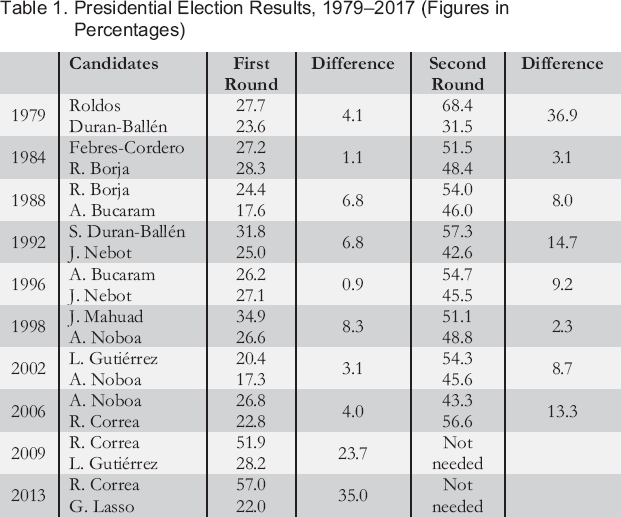
Presidential Election Results, 1979–2017 (Figures in Percentages)
The contrast between electoral outcomes in 2009 and 2013 versus those of previous presidential elections (see Table 1) does not provide, per se, any proof of a slanted political playing field. However, the disparity is jarring enough to warrant investigation of political competition in the electoral arena, as well as all other arenas that have a bearing on the fairness of electoral processes. After all, electoral outcomes displaying such margins of victory are rare in bona fide democracies.
Ecuadoreans were summoned to the polls seven times in nationwide elections since Correa assumed the presidency in 2006. The ruling party won all seven contests. It also won the first post-Correa presidential election in 2017, in spite of general societal disaffection towards the government on multiple fronts (ruling party corruption, economic malperformance, unpopular policy initiatives, botched governmental response to a natural disaster, and so on).
It is a record of invincibility not dissimilar to that seen in Venezuela under the competitive authoritarian regime crafted by Hugo Chavez, who won 13 out of 14 electoral contests during his 14 years in power. Referenda to convoke a Constituent Assembly and ratify the new Magna Carta were essentially plebiscites on Correa's rule, which he won with large absolute majorities (see Table 2). Correa's only narrow victory was the surprising outcome of the 2011 referendum proposing changes to the judicial branch and mass media.
Under competitive authoritarian conditions, elections and plebiscites can generate regime-subverting effects; in probabilistic terms, however, electoral contests usually deliver regime-sustaining outcomes (Schedler 2010). Ecuador's electoral record under Correa fits these trends. With the partial exceptions of the 2011 referendum and the 2014 municipal elections, each time Ecuadoreans were summoned to the polling station, Correísmo won decisively; on each occasion, the presidential project of enhancing Executive control over state institutions and broadening political power was furthered.
Referenda During Correa's Era (Figures in Percentages)
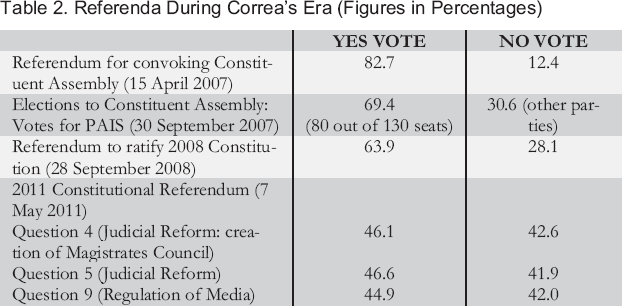
Like other democratically elected leaders in the region who have erected authoritarian edifices, Correa astutely used his popularity to conquer more and more institutional spaces – including those that help promote and keep up his high public approval numbers. When Correa took the presidential oath in early 2007, his public approval rating stood at a remarkable 73 percent (Conaghan 2008). It is not surprising, therefore, that whilst democratic institutional power-centers were controlled by opposition parties, President Correa shifted the political battle against his opponents to the arena where he enjoyed a decided advantage: referenda and elections.
Pro-Incumbent Electoral Reforms
The Ecuadorean political class has experimented with a multitude of electoral reforms that “sought to enhance the efficacy of political representation” (Sánchez 2008: 110), an objective they signally failed to accomplish. By contrast, the reforms to electoral law undertaken during Correa's reign were purely self-aggrandizing in intent.
The so-called Código de la Democracia (Democracy Code), approved in April 2009 (after President Correa vetoed the version enacted by his own AP caucus) slanted the electoral playing field. The new legislation allowed serving government officials to run for office without stepping down from their posts, granting them extensive media exposure and public resources, a decided advantage not afforded to opposition candidates. The president also vetoed Article 203, which prohibited the use of state resources to engage in propaganda and publicity during electoral campaigns. Consequently, state resources could now be used legally, while the existing prohibition on private media was maintained (Freidenberg 2012). Finally, the Código limited private media coverage of candidates and political parties during the run-up to elections, banning journalists from reporting anything favorable or unfavorable about contenders in the 45 days before a vote. State-owned media (effectively tools of ruling party propaganda) were not subject to such restrictions. The combination of these features undermined the freedom and fairness of future elections.
Alianza PAIS had obtained 59 seats in the 2009 elections under the Hare electoral formula enshrined in the Código de la Democracia for the assignment of provincial legislators. In 2012, the Executive branch piloted a change in electoral law from Hare to the majoritarian D'Hondt electoral formula, with no aim other than to augment the ruling party's parliamentary dominance, decimating Ecuador's pluralist political tradition of favoring the existence of political minorities. 1 (The self-serving nature of the reform was unmistakable: the D'Hondt method would have yielded 75 legislators for AP in the 2009 parliamentary election, rather than 59.) In addition, the AP performed extensive gerrymandering in the districts of Guayas, Pichincha and Manabi (accounting for over 32 percent of seats in Congress); this, coupled with the D'Hondt majoritarian electoral formula, amounted to an “explosive combination” (Basabe-Serrano 2013), because it greatly amplified the majoritarian bias of the formula, brazenly favoring the ruling party. 2 Thus, the government ushered in a de facto super-majoritarian electoral law. With 51.8 percent of the vote in the 2013 parliamentary election, AP obtained a vast 73 percent of seats (100 out of 137), well over the two-thirds super-majority that permitted the government to enact constitutional changes without the support of other parliamentary forces. 3 It also allowed the AP to control the presidency and two vice-presidencies of Congress, as well as control all 13 parliamentary Commissions. This hegemonic ruling party presence in the legislature – unthinkable in bona fide democratic regimes – also paved the way for the continued absence of accountability on the part of government officials. 4
NRW 2012. In 2004, the Constitutional Tribunal declared the D'Hondt electoral method unconstitutional because it discriminated against political minorities.
For illustration, under the new electoral scheme, one ruling AP lawmaker from rural Pichincha represents just 80,000 inhabitants – half the population of a district in opposition-friendly Northern Quito.
In addition, the pro-government party Avanza gained five seats. The new electoral law also exploited the fragmentation of opposition party lists, thus augmenting the ruling party's surplus of seat representation. The 29 seats held by the opposition were divided among Movimiento Creando Oportunidades (CREO) (11), Partido Social Cristiano (6), Sociedad Patriótica (5), Movimiento Popular Democratico (MPD)-Pachakutik (5), Partido Rodolsista Ecuatoriano (PRE) (1), and Movimiento Sociedad Unida Mas Accion (SUMA) (1).
In the 2009–2013 legislative term, out of the 19 political trials put forth by the National Assembly against state officials, only the two promoted by the Executive prospered, whereas none of the 17 put forth by the opposition did.
Both the 2009 and 2012 electoral rule changes entailed a number of violations of the 2008 Montecristi Magna Carta, not least the constitutional prohibition (stipulated in Article 117) against changing electoral rules within the 12 months previous to an election – which led to the convenient postponement of the 2013 general election. Moreover, the legislation enshrined in the Código brazenly contravened Articles 115, 166, and 138 of the Montecristi Constitution, all of which sought to safeguard the equity and impartiality of electoral processes (CNE 2008).
All of the aforementioned Constitutional transgressions were enacted with impunity because the government obtained de facto control of the judiciary as well as the National Electoral Council (Consejo Nacional Electoral – CNE). In 2011, the naming of five members with links to Alianza PAIS to integrate the CNE gave the electoral body a decidedly partisan affiliation. All five had worked for the ruling party either in government or as parliamentarians. This included CNE President Domingo Paredes, a former treasurer of AP, and Vice-president Paul Salazar, a former advisor to Foreign Minister Ricardo Patiño (Expreso 2011). The selection process, nominally entrusted to the Consejo de Participación Ciudadana (a body the 2008 Constitution created), was plagued with irregularities and denounced by the opposition as well as by well-qualified candidates to these posts who were unduly discarded (El Universo 2012).
Predictably, from the time these new members were installed, the CNE systematically made rulings favoring the government, which damaged the electoral prospects of the opposition. CNE reforms to prevailing electoral legislation established rural districts of much smaller magnitude than urban ones, a rule tailor-made to capitalize on AP's popularity in rural Ecuador. Another such regulation obliged presidential candidates to personally register their candidacies, a move that targeted Abdalá Bucaram and Alvaro Noboa, both exiled from the country and burdened with legal troubles that made their return difficult. The CNE was newly entrusted with supervising the selection of internal party candidates of all contending political formations, a prerogative that was wrested away from political parties themselves. Another change in electoral norms made any campaign spending undertaken before the official convocation to elections count toward the campaign spending limits stipulated in the law – a law that was crafted to hamper rich banker and opposition candidate Guillermo Lasso, and one from which the President was exempt. Opposition parties made numerous complaints to the CNE about the abuse of public resources during electoral campaigns on the part of President Correa, but these were systematically ignored by the electoral body (CRE Satelital 2013). The CNE also failed to supervise and place constraints on the incumbent's campaign spending. For instance, during the 2011 Referendum, the CNE accepted Correa's request that he be exempted from submitting his campaign's expenditures, as legally required of other candidates, on the grounds that that he would not be accepting private contributions; this special treatment attracted strong protestations from the opposition (El Comercio 2011).
Correísmo without Correa?
At the height of Correa's power, political scientist Luis Verdesoto stated that his challenge was to “create the Ecuadorean version of the Mexican PRI, technocratic, despotic and corrupt […] as well as a standardized, homogenous society that yields electoral majorities” (El País 2013). That party-centered vision never materialized. Correa's failure to invest in the institutionalization of Alianza País (AP) boded ill for the future hegemony of Correísmo or the building of a long-lived “perfect dictatorship.” New parties are most likely to consolidate when they develop a clear brand, build territorial organization, and avoid early schisms (Levitsky, Loxton, and Van Dyck 2017). Alianza País failed on all three counts. The development of a programmatic brand was hindered by the contradictory elements that make up the official “doctrine,” policy switches on a number of issue areas, and worsening economic performance from 2014 onwards. The ruling party never developed internal mechanisms of dispute resolution to manage the irreconcilable differences among its multiple factions, whose main glue has been their loyalty to the leader. Finally, Correa largely utilized control over the mass media and growing state control over the economy as substitutes for party organization.
In April 2015, the National Assembly approved a constitutional change that allowed for indefinite presidential re-election, with a provisional amendment such that the clause only applied from 2021 onwards. The rationale behind this manoeuver was open to interpretation; Correa possibly aimed to wrong-foot the opposition, evade ownership of the looming economic crisis, and play for another day (that is, post-2021). In any case, it was hardly irreversible. The Constitutional Court, dominated by incumbent party acolytes, had the prerogative to rule the amendment unconstitutional, leaving the door open for Correa had he wanted to run in 2017 (ABC Internacional 2015). The acute personalization of power undergirding the Citizens’ Revolution constituted its greatest vulnerability: after a decade in office, the absence of a societally-rooted, institutionalized ruling party meant that Correísmo as a political project was in jeopardy without Correa. None of the president's potential successors (Lenin Moreno, Gabriela Rivadeneira or Jorge Glass) enjoyed his level of legitimacy or popularity. Once in office Moreno has attained enormous popularity due to his anti-corruption efforts, his conciliatory demeanor, and other factors. His government represents a departure from Correismo in many respects, a testament to the limits and personalization inherent to Correa's political project.
Much like the economic crises of 1980s and 1990s made it difficult to govern on the left (Kaufman 2011), so it has proven in the post-resource bonanza era (2013 onwards), as manifested in recent adverse electoral results for Kirchnerismo, the MAS, and Chavismo – all lost nationwide elections or referenda in 2015–2016. Oil-funded state spending constitutes the cornerstone of Correísmo. In August of 2014, Oriente's crude oil blend sold for USD 90 a barrel; by August 2015 it was selling at USD 37 (Ecuador Review 2015). After 10 years in office, the Correa regime had “not been able to lay the foundations to build a different economy better able to withstand unfavorable external conditions” (Ecuador Review 2015). With the end of the commodity boom, the regime's performance legitimacy suffered visibly. The large-scale protests witnessed throughout 2015 and 2016 – led by teachers, indigenous groups, environmentalists, labor unions and other groups – amid a much-deteriorated economic environment, exposed the over-dependence of Correa's popularity and political project upon the vast system of patronage that (temporary) windfall gains permitted. Correa's public approval had dropped from 60 percent in 2014 to 35 percent by May 2016 (La Hora 2016). In the absence of institutional avenues to channel demands and grievances, civil society protests repeatedly spilled onto the streets, disparate in its (sectoral) demands, but united against the government's authoritarianism. Correísmo as a hegemonic political project was fraying in parallel with lower international oil prices. However, a post-hegemonic scenario is not tantamount to an imminent transition to democracy. The likelihood of a liberalizing electoral outcome in competitive authoritarian regimes, defined as alternation in power or significant liberalization, is greatly enhanced by the ability of the opposition to forge a unified coalition (Howard and Roessler 2006). In Ecuador, the fragmented political opposition did not coalesce around that strategic choice. This lack of coordination contributed to the victory of the incumbent AP in the 2017 presidential election, a contest also beset by an uneven playing field – not least, inequality in access to the state and to the law. Lenin Moreno profited from the advantages bequeathed to the ruling party during the course of a decade of institutional engineering and informal forms of power-accretion.
Conclusion
I have argued that, in judging the dividing line between democracies and competitive authoritarianism, it is the systemic character of the formal and informal procedures that govern and affect access to power that merit scrutiny, not electoral outcomes. This essay 5 offers evidence of incumbent maneuvering that aims to tilt the playing field in the electoral arena. Elections in Ecuador have been rendered unfair because of the incumbent's capture of the electoral management body, as well as a number of electoral law changes that aim to benefit the incumbent party and hamper the opposition. The incumbent party incurred in many other forms of calculated maneuvering in the mass media, judiciary, legislature and other arenas, all of which inexorably shaped elections. The result of this multifaceted self-dealing was the systemically slanted nature of electoral processes. Correa's charisma and genuine popularity aside, opinion polls and official electoral results inescapably reflected the consequences of incumbent hyper-advantage in access to mass media and state institutions writ large. For instance, the verifiably more slanted political playing field in the 2013 presidential election in comparison to the 2009 contest contributed to a less competitive election.
I would like to thank Francisco Sanchez, Santiago Basabe-Serrano, John Polga, William Barndt and James Bowen for their comments on a previous version of this article.
There are powerful theoretical reasons for scholars to focus on procedural considerations when drawing the boundary between democratic and nondemocratic regimes. A convergence on process-centered definitions would allow comparativists to hone in on adequate operationalizations of what a level playing field entails, markedly reducing the room for disagreements about the classification of real-world regimes. Discrepancies over definitions of what a democratic regime comprises and where its boundaries are have come at a high cost for comparative politics because they slow knowledge accumulation, bias findings, foment conflicting scholarly results, and prevent new interesting inquiries in the field of regime transitions from emerging.