



Abstract
What happens when a traditional source of political capital becomes a health hazard? Stigmatized electoral practices, such as vote buying, are a double-edged sword: While these strategies may signal candidates’ electoral strength, they may also entail reputational costs. In normal times, street campaigns are a non-stigmatized electoral practice. During the Covid-19 pandemic, however, they imposed health risks. Employing data from a national survey experiment conducted in Brazil prior to the 2020 municipal elections (N = 2025), we extend research on the employment of stigmatized campaigns and the gendered dynamics of electoral viability. We find that voters evaluate candidates who engage in face-to-face activities as less electorally viable and report lower intent to support them. These dynamics do not impact all candidates equally: Voters more harshly punish women candidates who conduct street campaigns than men, leading women to lose the advantage they have over men when both employ non-stigmatized campaign practices.
Introduction
Brazil is one of the countries that held elections during the Covid-19 pandemic. On 15 November 2020, voters across 5568 Brazilian municipalities went to the polls to elect mayors and city councilors. To ensure that the election did not impose additional health risks, the Brazilian electoral court stipulated special guidelines to prevent candidates from conducting activities that violated social distancing (Tribunal Superior Eleitoral, 2020a). Despite formal guidelines and public calls for caution—and, in some areas and entire states, court orders explicitly prohibiting street campaigns (Meira and Borba, 2021)—across the country many candidates continued to rely on traditional campaign tactics, including canvassing and large informal rallies (Tomazela, 2020).
Candidates’ engagement in contentious campaign strategies is not new. In fact, to stay competitive, around the world, candidates running for office often employ stigmatized campaign practices that are morally and/or socially questionable. The use of intimidation (Frye et al., 2018; Gonzalez-Ocantos et al., 2020; Mares et al., 2018), violence (Gutiérrez-Romero and LeBas, 2020; Rauschenbach and Paula, 2019; Rosenzweig, 2021), and vote buying (Borges Martins da Silva, 2019; Bratton, 2008; Mares and Young, 2019; Muñoz, 2019) are some examples of practices deemed by some—if not most—voters as socially unacceptable.
Critically, stigmatized practices are often a double-edged sword: While these activities may signal candidates’ electoral viability, they may also entail large legitimacy costs, as candidates who engage in such strategies risk damaging their reputations (Mares and Young, 2019; Muñoz, 2019)—something that may ultimately render them less desirable to voters.
The employment of stigmatized campaign practices may not impact all candidates equally, however. General expectations about women having more integrity and ethical standards (Barnes and Beaulieu, 2014, 2019) and being more socially responsible than men during the pandemic (Johnson and Williams, 2020) may mean that voters more harshly punish women candidates who diverged from gendered expectations (Barnes et al., 2020; Reyes-Housholder, 2020) and conducted health-hazardous street campaigns.
Street campaigns—which encompass any activity that puts candidates or their representatives in direct contact with voters, such as canvassing and rallies—are key to electoral campaigns around the world. Face-to-face campaigns are particularly important in clientelist contexts (such as that of Brazil), where candidates use rallies, large events with supporters, and home visits to signal their access to resources and electoral strength (Björkman, 2014; Gadjanova, 2017; Kramon, 2016; Szwarcberg, 2014; Zarazaga, 2014). In normal times, street campaigns are a commonplace and socially acceptable practice.
But what happens when elections take place during a global pandemic and a traditional source of political capital becomes a health hazard? Does this otherwise common practice become stigmatized? Are candidates who engage in this traditional form of campaign strategy punished? If so, are men and women candidates who employ this practice punished equally?
Taking place during a health crisis, the Brazilian municipal election provides an opportunity to extend research on stigmatized campaign strategies and the gendered dynamics of electability and punishment. In the context of the pandemic, we expect that voters will deem candidates’ engagement in street campaign activities as socially unacceptable and will transfer this assessment to their evaluations of viability and intention to support candidates in gendered ways.
To test our hypotheses, we employ data from a national survey experiment conducted in Brazil in the week prior to the 2020 municipal elections (N = 2025). As part of the survey, we randomly assigned respondents to one of four combinations of candidate profiles that varied candidates’ type of campaign activities (face-to-face tactics or remote internet-based strategies) and gender. This design allows us to estimate the effects of campaign strategy and candidates’ gender on voters’ evaluations of candidates’ electability and voting intention.
Our findings indicate that, as expected, in the context of the health crisis, voters deem face-to-face campaigns unacceptable. Contrary to our expectations about the relationship between the employment of this (now) stigmatized practice and candidate electability, voters perceive candidates who engage in face-to-face campaigns as less electorally viable than those who employ internet-based campaigns. Aligned with their perceptions of candidates’ electability, respondents also report lower intention to vote for candidates who engage in face-to-face activities—results that are aligned with recent studies, which report that even when morally-questionable practices promote mobilization, they can still impose large legitimacy costs to candidates (Borges Martins da Silva, 2021b; Mares and Young, 2019; Muñoz, 2019)
The employment of a stigmatized campaign practice does not impact all candidates equally, however: Voters more harshly punish women candidates who engage in face-to-face campaigns than men, leading women candidates to lose the comparative advantage that they have over men when they employ non-stigmatized campaign practices. This suggests that the pro-woman voter bias encountered in many studies (Schwarz and Coppock, 2021) may only emerge when women candidates’ behavior and activities are perceived as congruent with gendered expectations.
In additional exploratory analyses, we find that voters’ characteristics also shape their attitudes towards candidates’ employment of stigmatized campaign strategies. While income levels do not meaningfully differentiate voters’ attitudes, politically disengaged voters evaluate candidates who employ face-to-face campaigns more negatively than voters who are politically engaged. Similarly to previous research that find that pro-government and opposition partisans in Brazil have different perceptions of risk during the pandemic (Calvo and Ventura, 2021), we also find that loyal supporters of Bolsonaro display higher voting intention towards candidates who engage in street campaigns than his eventual supporters and oppositional voters.
Stigmatized Campaign Practices
Scholars have long identified that politicians often assume that they need to engage in non-programmatic, stigmatized campaign practices to be considered serious contenders and remain electorally competitive (Borges Martins da Silva, 2021a; Chauchard, 2018; Gadjanova, 2017).
Stigmatized campaign practices are characterized for being morally and/or socially questionable tactics. These practices can be classified as negative inducements—demobilization strategies of intimidation and violence such as threats, intimidation, and coercion towards voters (Bratton, 2008; Collier and Vicente, 2012; Rauschenbach and Paula, 2019; Robinson and Torvik, 2009)—or positive inducements—practices such as vote buying, turnout buying, campaign clientelism, patronage, and policy favors used to increase electoral participation and mobilize support.
In the literature on negative and positive inducements, social stigma is a product of mechanisms of inducement employed to increase or repress mobilization. For example, when threatening opposition voters, candidates seek to prevent certain groups from participating in elections; in this example, threatening voters is thus both, the mechanism through which a candidate seeks to shape mobilization and the source of the stigma associated with this campaign activity.
Dissimilar to other campaign strategies previously identified in the scholarship on negative and positive inducements, the mechanism through which street campaigns seek to shape electoral participation is not generally stigmatized. That is, in elections taking place under regular circumstances, street campaign activities used to increase candidate visibility and signal electoral strength (such as rallies, home visits, and motorcades) do not tend to raise social or moral concerns. In the context of the pandemic, however, face-to-face campaigns imposed a threat to individual voters and collective public health. This exogenous factor transformed the risks imposed by street campaigns, potentially creating a source of stigma for otherwise acceptable practices.
Stigmatized Practices, Candidate Viability and Punishment
Stigmatized campaign strategies are employed with the objective of increasing a politician’s electoral advantage over their contenders. Even if candidates’ employment of these practices leads voters to evaluate them as electorally stronger, stigmatized campaign tactics can still impose reputational costs to the candidates who employ them. Existing studies provide mixed evidence regarding the effectiveness of stigmatized campaign practices in signaling electoral viability or increasing voters’ support for candidates.
Indeed, some studies establish a positive connection between candidates’ employment of stigmatized positive inducements and voters’ assessments of their electoral strength (Borges Martins da Silva, 2021b; Kramon, 2016). For example, Kramon (2016) finds that after receiving information about a candidate’s distribution of electoral handouts, voters in Kenya perceive candidates as more electorally viable. Likewise, in her ethnographic work with low income voters in rural Brazil, Borges Martins da Silva (2021b) describes that despite stigmatizing candidates who engage in vote buying, voters hold the widespread assumption that only heavily vote-buying candidates are competitive. Other studies suggest the opposite: That the employment of stigmatized campaign practices could hinder a candidate’s perceived electability. For instance, exposing voters to information about candidates’ engaging in vote buying may reduce voters’ evaluations of their electability (Mares and Young, 2019; Muñoz, 2019, p. 199).
The literature is also divided when it comes to the effectiveness of stigmatized campaign practices in increasing candidates’ competitiveness. While some studies find that voters who are more vulnerable to be the targets of these strategies are less likely to stigmatize these practices than upper- and middle-class voters (González-Ocantos et al., 2014; Weitz-Shapiro, 2012), other studies argue that vote buying is equally stigmatized by all voters (Mares and Young, 2019; Muñoz, 2019, pp. 107–9), even those who partake in such practices (Borges Martins da Silva, 2021b; Bratton, 2008). That is, even if candidates’ employment of stigmatized practices grants them enhanced viability, they may also impose reputational costs. For example, in the context of Nigeria, Bratton finds that electoral violence is ineffective since voters tend to turnout less when threatened. Equally, other studies have found that exposing voters to information about a candidate engaging in a stigmatized practice, such as vote buying, reduces a candidate’s voting intention (Mares and Young, 2019; Muñoz, 2019, p. 199).
Gendering Stigmatized Practices, Candidate Viability, and Punishment
It is not only voters’ characteristics that may shape attitudes towards the use of stigmatized campaign strategies: Candidates’ traits may also heterogeneously influence how voters evaluate the employment of a stigmatized campaign practice. As many scholars have shown, the historical exclusion of women from politics has important implications for voters’ evaluations of women’s electability, willingness to support women candidates, and expectations about women’s behaviors. The impact of the employment of stigmatized campaign practices on candidates’ electability and electoral support is, thus, likely gendered.
Gender-based stereotypes shaped by women’s exclusion from the political domain can distance women from what is expected of (male) politicians (Schneider and Bos, 2014) and, in some cases, render them to be perceived as less electorally viable than men (Kao and Benstead, 2021). Although gender biases may depress voters’ evaluations of women’s fitness for office and levels of electability, gender-based stereotypes do not necessarily lower voters’ willingness to support women (Sanbonmatsu, 2002).
In fact, in a meta-analysis of 67 studies on candidate choice, Schwarz and Coppock (2021) find that survey respondents tend to display higher intention to vote for hypothetical women candidates than for men candidates. Aligned with this analysis, previous research on Brazil has uncovered a large pro-women voter bias (Aguilar et al., 2015), suggesting that women’s status as outsiders in a system where politicians face high levels of distrust may be electorally advantageous (Gatto et al., 2021).
Positive stereotypes seem to, at least in part, explain voters’ pro-women bias and desire for more women in politics (Batista Pereira and Porto, 2020). As previous work has shown, women politicians are often characterized as being more honest and ethical (Brooks, 2013; Dolan, 2014; Schneider and Bos, 2014) and less likely to engage in moral transgressions than men (Barnes and Beaulieu, 2014; Żemojtel-Piotrowska et al., 2017). Gender stereotypes that hold women as more caring can also lead voters to believe women are particularly well-suited to tackle certain policy areas, including social security and healthcare (Fridkin and Kenney, 2009; Sanbonmatsu, 2002).
But voters’ support for women may wane when women’s behaviors are incongruent with voters’ gendered expectations. As Barnes et al. (2020) show, for example, voters more harshly punish women politicians involved in sex scandals than men who engage in the same practices. Involvement in corruption also seems to more saliently depress women presidents’ approval ratings than men’s (Reyes-Housholder, 2020)—although some studies indicate that gendered patterns of punishment for engaging with corruption may be context-specific (Le Foulon and Reyes-Housholder, 2021; Schwindt-Bayer et al., 2018) or more dependent on voters’ characteristics (Eggers et al., 2018).
Our focus on candidates’ use of street campaigns in the 2020 Brazilian municipal elections allows us to explore whether this practice was stigmatized, and, if so, what this meant for (the gendered dynamics of) candidates’ electoral viability and punishment.
The Brazilian Case
In Brazil, municipal elections encompass races for local councilors and mayors. Races for mayor take place under plurality rule, whereby candidates who secure a majority of votes have a straight win in municipalities with less than 200,000 inhabitants, or the two top contenders move into a second round of elections if no candidate attains more than 50 per cent (plus 1) of the votes in larger municipalities. Meanwhile, races for local councils operate under an open-list proportional representation system in which candidates compete for nominal votes against non-partisans as well as co-partisans, in attempts to secure a high placement on their respective parties’ lists.
Albeit guided by different electoral rules, executive and legislative elections in Brazil are person-centric (Avelino and Biderman, 2019)—a characteristic that is reinforced by Brazil’s highly fragmented party system. In a context of weak party brands, electoral campaigns have the goal of distinguishing individual candidates from their contenders (Avelino and Biderman, 2019). According to the most recent survey of Brazilian federal legislators conducted by Zucco and Power (2019) 82 per cent of legislators believe that their personal effort (rather than their party) was the most important factor for their elections.
To become known to voters, candidates running for executive and legislative office at every level conduct street campaigns. In Brazil, face-to-face campaigns encompass different types of activities, including rallies, motorcades, walks, car parades, and even cavalcades (Speck and Mancuso, 2015). Differently from vote buying—which is also a widely used, albeit a morally questionable practice (Borges Martins da Silva, 2019, 2021b; Nichter, 2018)—these activities are not generally stigmatized by voters. Quite the contrary, rallies and motorcades are festive opportunities, especially in rural and smaller municipalities where the electoral period is one of the most expected events of the town. Walks and rallies organized by politicians in rural Brazil are festivities similar to Carnival parades, in which large crowds of supporters follow one or several trucks equipped with giant speakers (“trios elétricos”) with the candidates and his most prestigious allies standing on the truck’s platform. Politicians often hire professional entertainers to lead the parades and the trios elétricos play candidates’ jingles several times (see Appendix A).
Street campaigns not only provide candidates the opportunity to directly engage with voters, but they can also signal candidates’ electoral strength: Outside major city centers, polls are rare, unreliable, and politicized, so voters’ often use the size of rallies and parades to estimate which candidates are leading a race (Borges Martins da Silva, 2019). As shown in Appendix B, the 2020 elections were no exception, with candidates using photos of the crowds in their campaign events to build their images as strong contenders.
The centrality of street campaigns in Brazilian elections is not only observable to the eye during election season, but it is also measurable: According to Speck and Mancuso (2015) expenditures with street campaign activities represented three-fourths of total campaign budgets of candidates for national congressional races and half of the budgets of candidates running for state governor in 2014.
Most recently, “modern” campaign practices have been added to the repertoire of widely employed campaign activities (Speck and Mancuso, 2015). Besides jingles and intelligence research, such strategies include promotional material for social media diffusion. While these modern campaign strategies did not replace street campaigns in previous years, restrictions to face-to-face campaigns encouraged the increased employment of online campaign practices in the 2020 elections.
Scheduled to take place in October 2020, municipal elections would fall amidst a critical moment of the Covid-19 pandemic, when Brazil continued to struggle to contain contagion and death rates. In an attempt to diminish additional health risks that the campaign season and in-person voting could impose, the election date was postponed, and electoral authorities issued caution on campaign practices of physical contact between candidates and voters (Tribunal Superior Eleitoral, 2020b). In some states, authorities went well-beyond suggesting caution, issuing court orders to prohibit face-to-face activities all-together. For example, after receiving over 1200 complaints of campaign violations in a period of 10 days, electoral authorities in the state of Bahia prohibited candidates to hold any street campaign activity in the final five days of the campaign period (Calila Noticias, 2020). Similar prohibitions took place in other states throughout the country, including Pará and Pernambuco.
While informal pleads, formal rulings, and broader health guidance on social distancing may have diminished the widespread prevalence of face-to-face activities (particularly of large rallies) and changed the dynamics of campaigns, candidates throughout the country continued to conduct face-to-face campaigns, including activities with large crowds (Tomazela, 2020).
Hypotheses
Given the importance that street campaigns have in Brazil, it is unsurprising that many candidates disrespected sanitary regulations and continued to engage in physical contact with voters in the 2020 elections. However, if in normal times, activities such as rallies and canvassing were not stigmatized by voters, in the context the Covid-19 pandemic, candidates’ choice to hold face-to-face events could potentially entail (gendered) legitimacy costs.
Stigmatized Campaign Practices
There are several factors that indicate that Brazilian voters would negatively evaluate street campaigns during the pandemic. First, Brazilians were highly fearful of contracting Covid-19. In our survey, conducted during a period in which infections rates in Brazil were declining, 88 per cent of respondents stated that they had some or a lot of fear of getting infected. For comparison, during the worst moments of the pandemic in the United Kingdom and India, 61 per cent of British and 70 per cent of Indian respondents were fearful of contracting the virus (YouGov, 2020).
In addition to Brazilians’ heightened fear of Covid-19, candidates’ disrespect for social distancing gained extensive media attention and was widely criticized by different sectors of society. While Bolsonaro supporters viewed street campaigns as a sign of the hypocrisy of candidates who otherwise claimed to be taking the pandemic seriously (see Appendix C), medical doctors and scientists highlighted the health risks associated with the practice and pointed to crowded events promoted in November 2020 as one of the reasons behind the spike in infections rates in March of 2021 (Tatsch, 2021).
Given the heightened fear of getting infected with Covid-19 and the increased and widely advertised health risks imposed by face-to-face activities, we expect Brazilian voters to stigmatize in-person campaign strategies carried out during the pandemic. Specifically, we hypothesize that:
H1: Voters will evaluate the campaigns of candidates who engage in face-to-face activities as less acceptable than the campaigns of candidates who engage in internet-based activities.
Stigmatized practices, candidate viability and punishment
Since voters in Brazil use face-to-face activities (such as the size of candidates’ rallies) as proxies to gauge a candidate’s chances of winning the election, we predict that candidates who conduct face-to-face campaigns should be perceived as more electorally viable. Formally, we hypothesize that:
H2: Voters will evaluate candidates who engage in face-to-face campaigns as more electorally viable than those who engage in internet-based campaign activities.
We also expect that the stigmatization of face-to-face campaign will lead voters to display lower voting intention for candidates who engage in street campaigns. Electability is a key criterion shaping voter support in real elections in Brazil (Araújo and Gatto, 2021); accordingly, much of the literature on electoral violence and vote buying conveys that, by increasing perceptions of candidates’ electoral strength, candidates’ employment of stigmatized campaign practices also increases voters’ support for said candidates. Unlike real elections in which voting is a private activity, surveys and interviews involve voters’ public admittance of their attitudes and behaviors. Similarly to the findings of previous studies using survey methods (Mares and Young, 2019; Muñoz, 2019), we expect that when asked about their own behavior regarding a stigmatized electoral practice, respondents might dissociate themselves from the candidates who employ these practices, even if in the secrecy of the ballot box they might still support them (Jerolmack and Khan, 2014). Formally, we anticipate that:
H3: Voters will display lower intent to vote for candidates who engage in face-to-face campaigns than in candidates who engage in internet-based campaigns.
Gendering stigmatized practices, candidate viability and punishment
Similarly to studies on other countries, research on Brazil indicates that voters positively stereotype women politicians in traditionally gendered ways, thinking of them as more pure and morally superior than men (Batista Pereira and Porto, 2020; Gatto et al., 2021). The health crisis also likely increased the value of traits traditionally associated with women (Johnson and Williams, 2020): Not only is healthcare a “feminine” policy area (Bauer et al., 2020), but women politicians are also expected to be more caring towards the vulnerable and sick (Johnson and Williams, 2020) and more risk-averse (Palmer and Peterson, 2020)—and, thus, more compliant towards mask-wearing and social distancing rules. In the context of the pandemic, women candidates employing face-to-face campaigns would be going against traditional expectations that hold them as more socially responsible. We thus expect that:
H1a: Voters will evaluate the campaigns of women candidates who engage in face-to-face activities as less acceptable than the campaigns of men who engage in face-to-face activities.
Context-specific factors may shape gendered perceptions of electability (Kao and Benstead, 2021). Even if formal and informal institutions are the major factors shaping women’s electoral competitiveness (Gatto and Wylie, 2021; Sacchet and Speck, 2012), women’s underrepresentation and recent events may have conveyed to Brazilian voters that women are less fit for occupying office and less electorally competitive than men. Women occupy few offices in Brazil: In the 2018 elections, women were elected to only 15% of seats in the National Congress and one governorship (of 27). In recent years, Brazil’s first and only woman president was impeached (dos Santos and Jalalzai, 2021) and elections were marked by scandals involving women “phantom candidates”—candidates on paper only, nominated for the purposes of quota compliance (Wylie et al., 2019). As political outsiders, however, women may require more efforts to improve their name recognition, so face-to-face campaigns may be more important for strengthening women’s electoral competitiveness than men’s (Gatto and Thome, 2020). As such, we expect that:
H2a: Voters will evaluate women candidates who engage in internet-based campaigns as less electorally viable than men who engage in internet-based campaigns.
H2b: Employing face-to-face campaigns will be more beneficial to voter’s assessments of women candidate’s viability than of men’s.
Even if voters perceive men as more electorally viable than women, they may still be willing to display higher support for women candidates. As previous survey experiments with Brazilian respondents have shown, women candidates in Brazil benefit from positive gendered stereotypes (Batista Pereira and Porto, 2020), which translate into a pro-woman voter bias (Aguilar et al., 2015; Gatto et al., 2021). Still, and similarly to other contexts, Brazilian voters are likely to punish women who engage in moral transgressions that go against gendered expectations more harshly than men who engage in the same activities (dos Santos and Jalalzai, 2021). In line with this, we anticipate that:
H3a: Voters will display higher intent to vote for women candidates who engage in internet-based campaigns than men candidates who engage in internet-based campaigns.
H3b: Employing face-to-face campaigns will be more detrimental to voter’s intent to vote for women candidates than for men candidates.
Voter Characteristics, Stigmatized Practices, and Candidate Viability and Punishment
It is also likely that voters’ characteristics shape the ways in which they evaluate face-to-face campaign activities; we derive exploratory expectations about voters’ heterogeneous attitudes towards candidates’ employment of stigmatized campaign practices. Following Borges Martins da Silva (2021a) who argues that even poor voters consider vote buying as unacceptable, we predict that income levels do not differently shape voters’ tendencies to stigmatize face-to-face campaigns.
Instead, we expect that voters’ levels of political engagement and ideological alignments will shape their evaluations of face-to-face campaigns. Specifically, we grant that the stigmatization of face-to-face campaigns during the health crisis will further deepen distrust in politicians among voters who are generally disengaged with politics, leading them to evaluate candidates who employ street campaigns significantly more negatively than voters who are more politically engaged.
Finally, we expect that loyal supporters of Bolsonaro will evaluate candidates who engage in face-to-face campaign less harshly than his moderate supporters and oppositional voters. Throughout the pandemic, Brazil’s president has consistently undermined the health crisis, refused to take national action to control the spread of the virus, and criticized mayors and governors who adopted local measures (Calvo and Ventura, 2021). Given the denialist approach of President Jair Bolsonaro towards the Covid-19 pandemic, it is plausible to expect that his supporters are also more likely to undermine the health risks that street campaign activities imposed.
Research Design
We test our formal and exploratory hypotheses with original data from an online survey experiment with Brazilian respondents conducted by Opinion Box between 06 and 13 November 2020. 1 The sample of 2025 is representative of the Brazilian adult population in respect to gender, age, household income, and region within a margin of error of 2.2 percentage points (p.p.). 2 Appendix D provides an overview of the sample’s characteristics, Appendix E offers descriptive statistics for all variables employed in our analyses, and Appendix F summarizes the distribution of our dependent variables.
To test whether candidates’ employment of a stigmatized campaign practice impacts voters’ assessments of them, and whether this varies based on whether candidates are men or women, we randomized survey respondents to one of four different vignettes describing a candidate and their campaign activities. 3 To prevent potential issues associated with survey fatigue, vignettes were short; nevertheless, respondents participated in the survey while elections were taking place and the information provided was characteristic of practices ongoing during the period—and thus realistically plausible and likely known to voters.
Table 1 The four randomized candidate profiles varied information about campaign type and candidates’ gender. Candidates’ gender was indicated by masculine and feminine pronouns (as indicated within brackets). To strengthen the priming of candidates’ gender, post-treatment questions used to measure our outcome variables also signaled the gender of the candidate primed. For example, respondents who received primes using feminine pronouns would then be presented with questions which clearly outlined that the candidate to be evaluated was a woman. 4
Randomized candidate profiles.
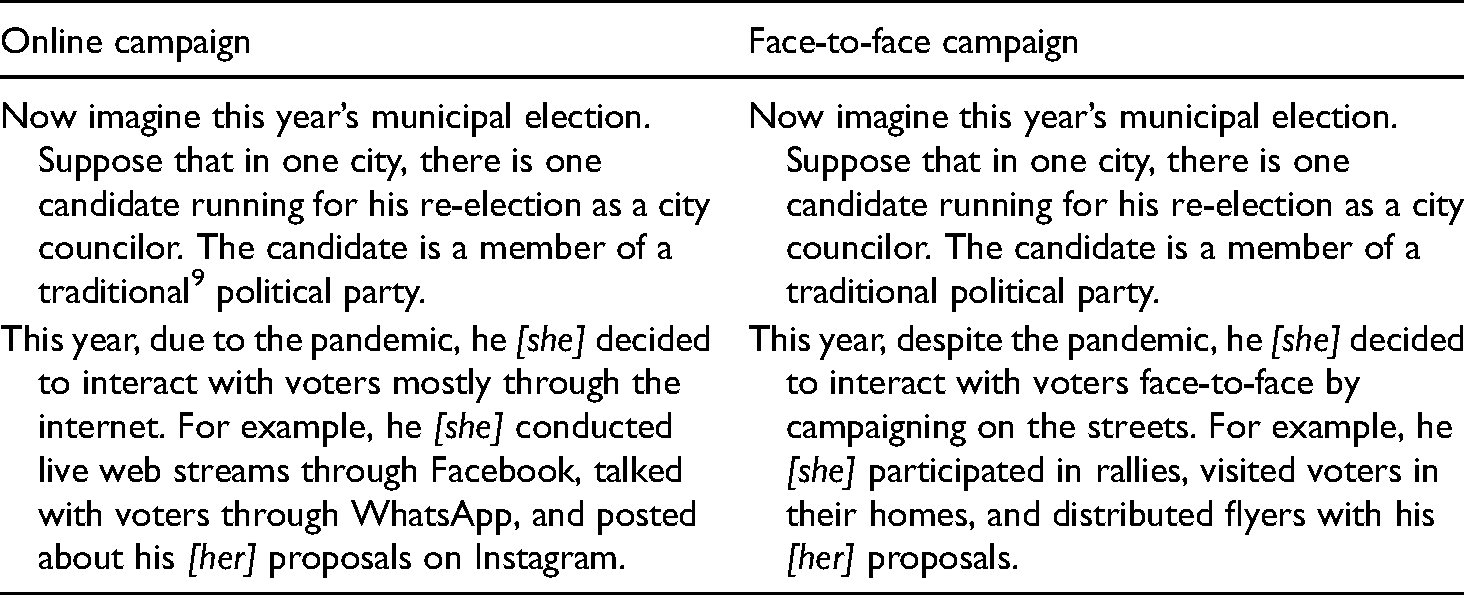
We employ post-treatment questions to derive three dependent variables. First, to assess whether face-to-face campaigning during the pandemic was indeed a stigmatized practice, we employ the variable acceptability, which is measured on a Likert-scale in which −2 corresponds to assessments of the exposed campaign type as “completely unacceptable,” a value of 0 corresponds to “comprehensible, but unacceptable,” and a value of 2 to “completely acceptable.” Social desirability may prompt respondents to avoid self-placement in the extreme ends of the scale (Krumpal, 2013). To capture respondents with stronger views on the issue, we alternatively code this as a binary variable, in which a value of 1 corresponds to “completely acceptable” and all other responses take a value of 0. We use this alternative measure in robustness checks.
To measure perceptions about candidates’ electoral viability, we employ the variable electability, for which a value of 0 corresponds to “no chance [of winning],” a value of 1 corresponds to “some chance [of winning],” and a value of 2 corresponds to “high chance [of winning].” We run robustness checks with an alternative binary operationalization in which a value of 1 corresponds to “high chance [of winning].”
Finally, to examine whether candidates’ engagement with a stigmatized campaign practice impact voters’ likelihood to support them we code the variable vote intention, in which a value of 1 corresponds to “yes, I would vote [for this candidate]” and a value of 0 corresponds to “no, I would not vote [for this candidate]”). For robustness purposes, we run additional analyses in which missing values (i.e. respondents who replied they “did not know”) take on a value on 0.
In addition, to explore heterogeneous treatment effects and examine how voter characteristics may impact their evaluations of candidates who carry out stigmatized campaign activities, we conduct sub-group analyses by respondents’ income levels, disengagement in elections, and ideological tendencies.
Among socio-demographic characteristics, income stands as a key factor shaping attitudes towards candidates’ use of stigmatized practices. To account for this, we conduct analyses that account for household income, a measure that ranges from 0 to 4 in which 0 corresponds to “up to 2 minimum wages” and 4 to “more than 10 minimum wages”).
Attitudes towards the employment of stigmatized campaign practices may also be shaped by voters’ trust in politics and politicians, more generally. In Brazil, distrust in politics is widespread. For example, 87.8 per cent of respondents in our sample believe that politicians are not responsive to voters’ needs. To capture greater variability in attitudes towards politics more generally we employ a behavioral measure of voters’ distrust, which captures voters’ political participation and engagement during electoral campaigns. Unlike the direct measure of reported distrust, this measure varies more widely, and seeks to better capture the process through which voters’ distrust for politicians in abstract is translated into their lower engagement with elections. For the variable disengagement, a value of 0 corresponds to voters who tend to have a favorite candidate and a value of 1 corresponds to respondents who do not normally have a preferred candidate.
Lastly, an underlying assumption of characterizing face-to-face campaigns during the pandemic as a stigmatized practice is that voters perceive personal contact and agglomeration as health hazards. However, attitudes towards Covid-19 vary widely and are also shaped by partisan and political ideologies (Calvo and Ventura, 2021). To account for this, we employ the variable Bolsonaro support, which captures whether respondents would vote for a candidate who have the support of Jair Bolsonaro. For this variable, a value of 0 corresponds to “never,” 1 corresponds to “maybe,” and 2 corresponds to “yes.” Respondents who are irrespectively willing to vote for candidates who have the support of Bolsonaro can be thought of as more loyal Bolsonaristas, those who respond “maybe” are considered eventual Bolsonaristas, and those who convey that they would never vote for a candidate backed by the president are considered as anti-Bolsonaristas.
Analyses
We begin our analyses by exploring whether voters indeed negatively evaluated candidates’ use of face-to-face campaigns in 2020. That is, before assessing whether the employment of this practice shapes voters’ evaluations of candidates’ viability and their propensity to support candidates in gendered ways, we examine whether street campaigns were stigmatized in 2020.
Following standard practices in experimental studies in which key pre-treatment observable characteristics are balanced (see Appendix H), we test our hypotheses with bivariate analyses across the two groups of respondents exposed to vignettes that detailed profiles of candidates carrying out online and face-to-face campaign activities, and then further disaggregate our analyses into the four groups randomly exposed to different combinations of candidates’ campaign types and gender.
Stigmatized Campaign Practices
As reported in Figure 1, in the atypical context of the 2020 elections held during a pandemic, voters considered face-to-face activities—an otherwise commonplace campaign strategy—as non-acceptable, a finding that stands in stark contrast to the positive evaluations of candidate campaigns conducted online.
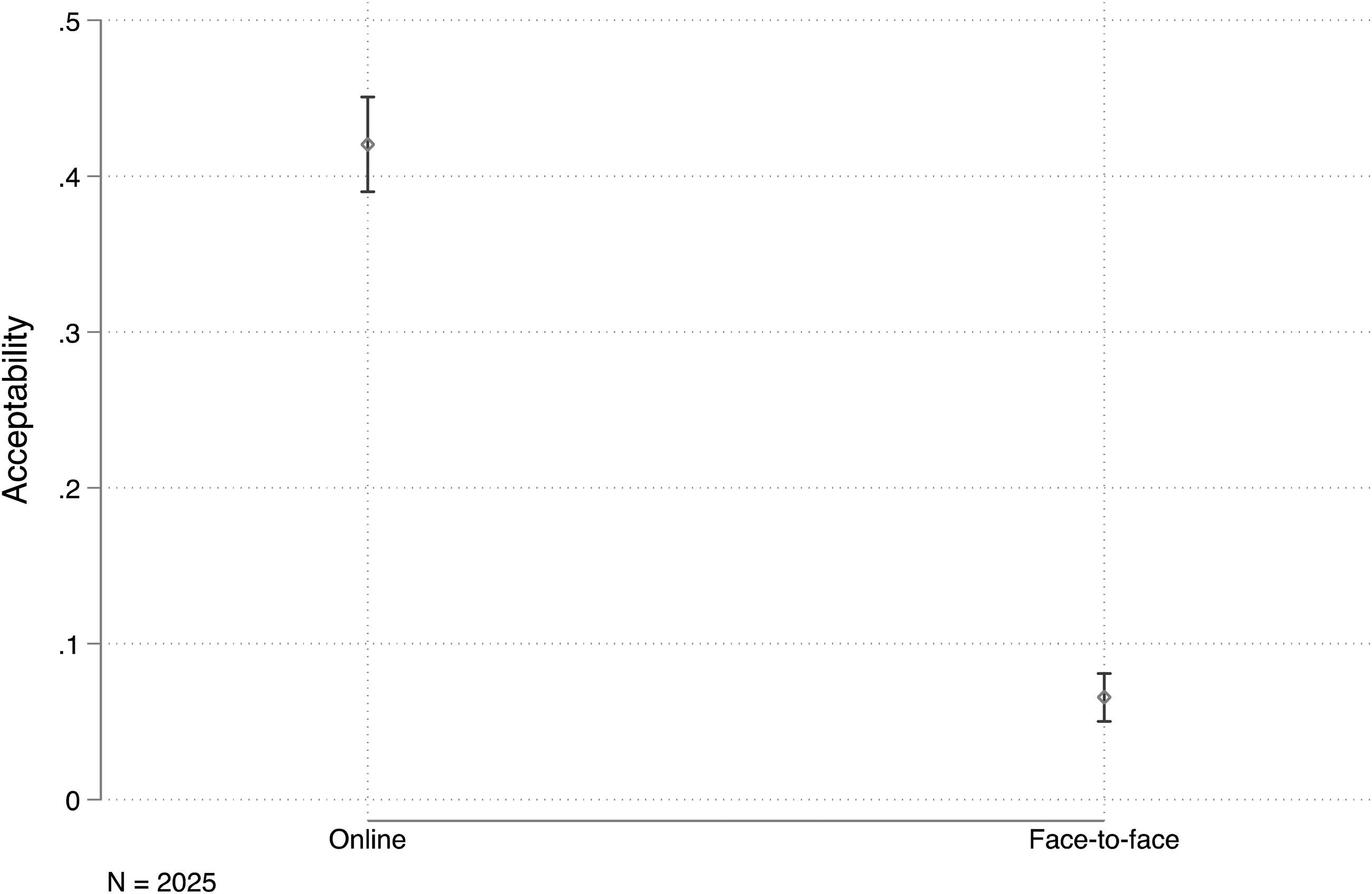
Specifically, while voters evaluated online campaigns as 1.15 on the scale of acceptability, they ranked face-to-face campaigns as − 0.12 on the same scale, a difference of 1.27 that is statistically significant at the 1 per cent-level. Consistent with expectations outlined in H1, these results—which are robust to the alternative binary operationalization of acceptability, as shown in Appendix I—indicate that street campaigns constituted a contentious and socially questionable practice in 2020.
Stigmatized Practices, Candidate Viability and Punishment
Having established that face-to-face campaigns were stigmatized in 2020, we now turn to analyzing whether engaging in this form of campaign shapes voters’ evaluations of candidates’ electoral viability and their likelihood of supporting them. Figure 2 summarizes our results. As shown in panel A, against our expectations that, in spite of its stigma, face-to-face campaigns would signal candidates’ electoral strength (H2), we find that voters evaluate the viability of candidates’ who conduct online campaigns as 0.18 points higher on the scale of electability as those who engage in face-to-face activities. These results stand in robustness checks (Appendix J). Possibly, these findings indicate that respondents’ attitudes towards electoral viability may be intertwined with qualities they find acceptable and/or desirable, such as electoral strength.
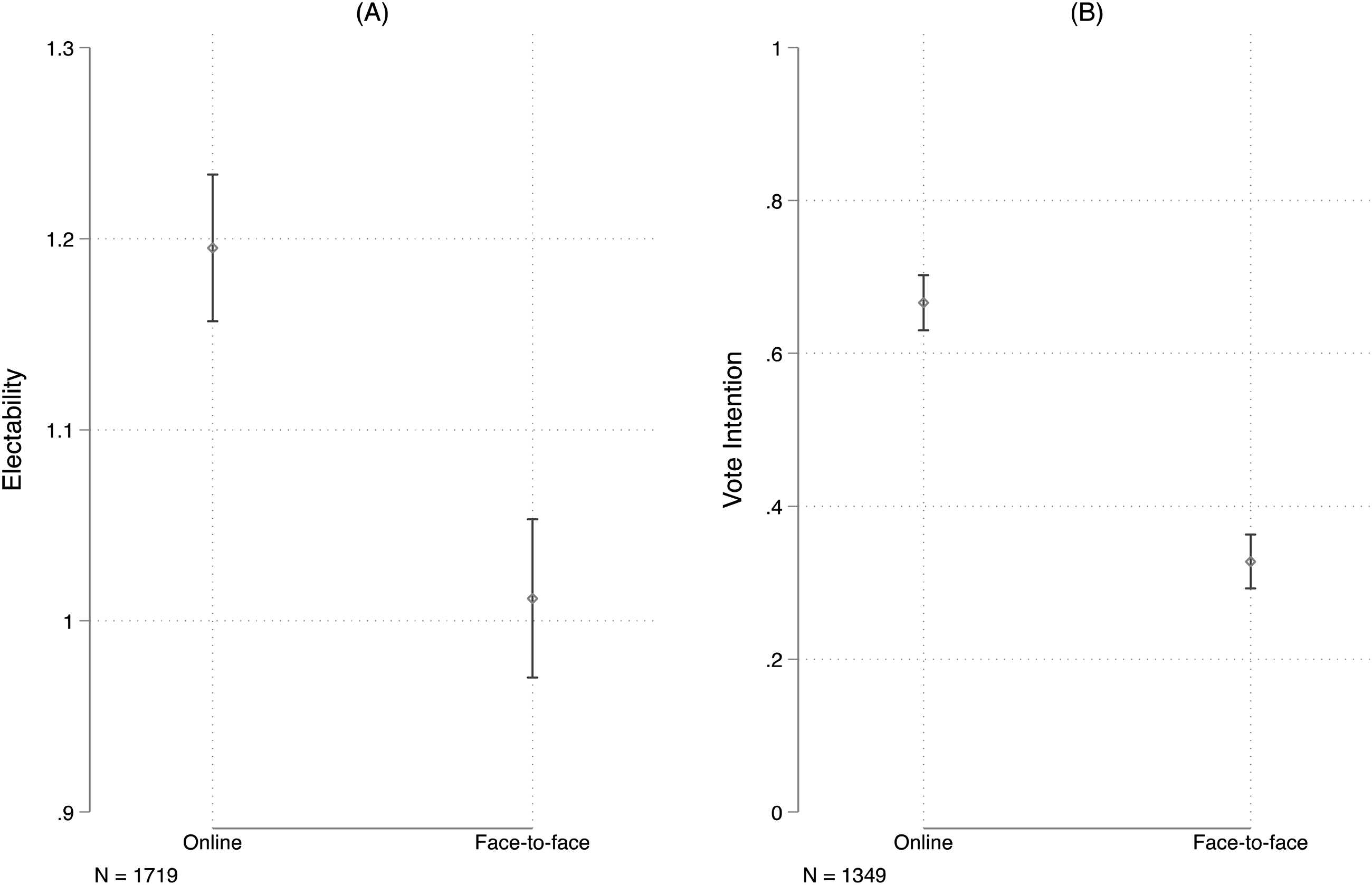
Coherent with their stigmatization of face-to-face campaigns, and in alignment with our expectations that reported voting intention would be more strongly shaped by moral concerns (H3), respondents indicate that they would punish candidates who conducted street campaigns on the ballot-box (see panel B). This impact is substantively sizable: While 66.6 per cent of respondents indicate they would support candidates who ran online campaigns, only 32.7 per cent affirm they would back candidates who conducted face-to-face activities, a difference of 33.9 pp. This finding is robust to alternative operationalizations (Appendix J) and suggests that voters signal intention to punish at the ballot-box candidates they perceive to have engaged in non-acceptable practices.
Gendering Stigmatized Practices, Candidate Viability and Punishment
Given our interest in assessing whether the employment of a stigmatized campaign practice impacts voters’ evaluations of candidates in gendered ways, we also examine whether acceptability towards face-to-face campaigns varies depending on whether the candidate carrying out such activities is a man or a woman. As reported in Appendix K and against our expectations outlined in H1a, candidates’ gender does not significantly shape voters’ levels of acceptability towards street campaigns; that is, voters find face-to-face activities to have been similarly unacceptable regardless of whether the candidate conducting them was a man or a woman. These findings remain consistent in robustness checks (see Appendix I).
As illustrated in Figure 3 (panel A), although aligned with the direction of our expectation that voters deem men to be more electorally viable than women, we find that the man and woman who conducted online campaigns are deemed statistically indistinguishably viable (thus rejecting H2a). 5
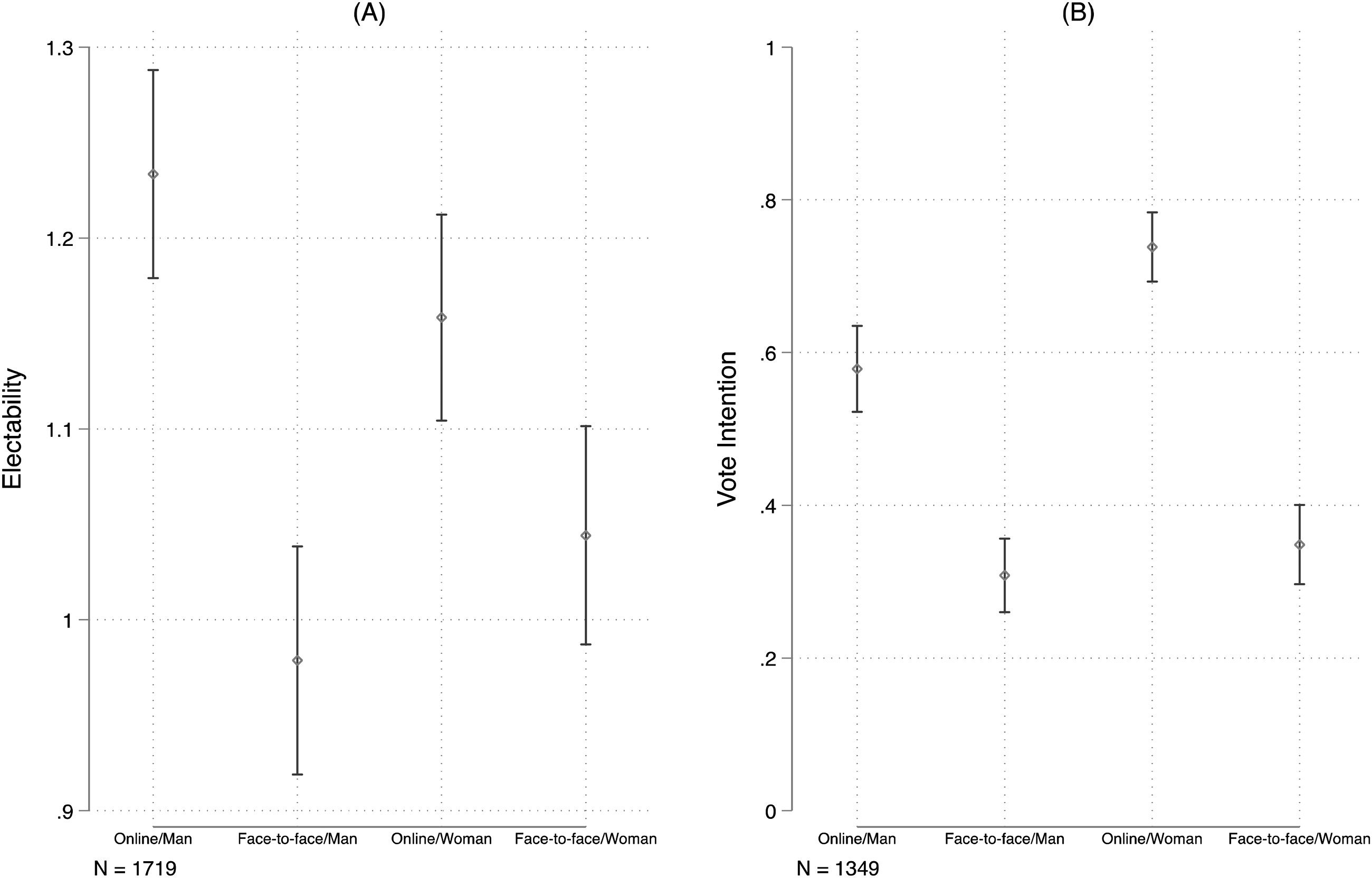
As previously discussed, contrary to what we anticipated in H2, engagement in face-to-face campaigns depresses assessments of candidates’ competitiveness, so it is not surprising that we also reject H2b—which anticipated that employing this type of campaign would be more beneficial to women candidates.
Interestingly, however, and aligned with the theoretical rationale underlying H2b, women’s status as outsiders seems to contain the negative effect that street campaigns have on perceptions of electoral strength: While voters’ assessment of a candidate’s viability drops by 0.25 on the scale of electability when the candidate conducting face-to-face campaigns is a man, the impact of employing stigmatized campaign activities for a woman candidate is a reduction of 0.11 points on the same scale. Still, as indicated by the overlapping confidence intervals (Figure 3, panel A), the man and woman candidates described as engaging in street campaigns are perceived as comparably viable.
These results reinforce the notion that respondents’ attitudes towards electoral viability may be intertwined with qualities voters find acceptable and/or desirable in politicians and that respondents may have used candidates’ employment of a stigmatized practice as a stronger shortcut than gender to extrapolate about candidates’ other traits (including electoral strength). 6
As anticipated by H3a, when women’s campaign behavior is congruent with gendered expectations, voters’ intention to support a woman candidate is higher than their support for a man candidate who also engaged in internet-based campaign activities: When described as conducting an online campaign, the woman candidate enjoys high rates of voting intention, with 73.8 per cent of respondents randomly allocated into this group stating they would support the described candidate, compared to 57.9 per cent of respondents who state they would support than man candidate, a difference of 15.9 pp that is statistically significant at the 1 per cent-level.
Consistent with H3b, however, we find that women who engage in a stigmatized campaign practice are more harshly punished by voters than men who do the same. Specifically, voters’ stated intent to vote for a man drops from 57.9 per cent when the candidate is described as conducting an online campaign to 30.8 per cent when he is profiled as carrying out face-to-face activities, a difference of 27.1 p.p. that is statistically significant at the 1 per cent-level (see Figure 3, panel B). While complying to socially acceptable campaign norms gives women a wide advantage over men, employing stigmatized campaign activities makes them lose this advantage, with only 34.8 per cent of voters stating they would support a woman candidate who employed face-to-face campaigns—a drop in voting intention of 39 p.p. As summarized in Appendix J, these results are robust to the alternative operationalization of vote intention.
Voter Characteristics, Stigmatized Practices, and Candidate Viability and Punishment
So far, our analyses assumed that voters respond equally to candidates’ employment of a stigmatized campaign practice. As the existing literature poses, however, some groups of voters may be more likely to negatively evaluate candidates for employing non-acceptable strategies than others. Analyses of treatment effects by sub-groups allow us to provide exploratory insights into how specific voter characteristics shape perceptions of viability and intent to vote for candidates who conducted street campaigns. 7 Figure 4 summarizes our results.
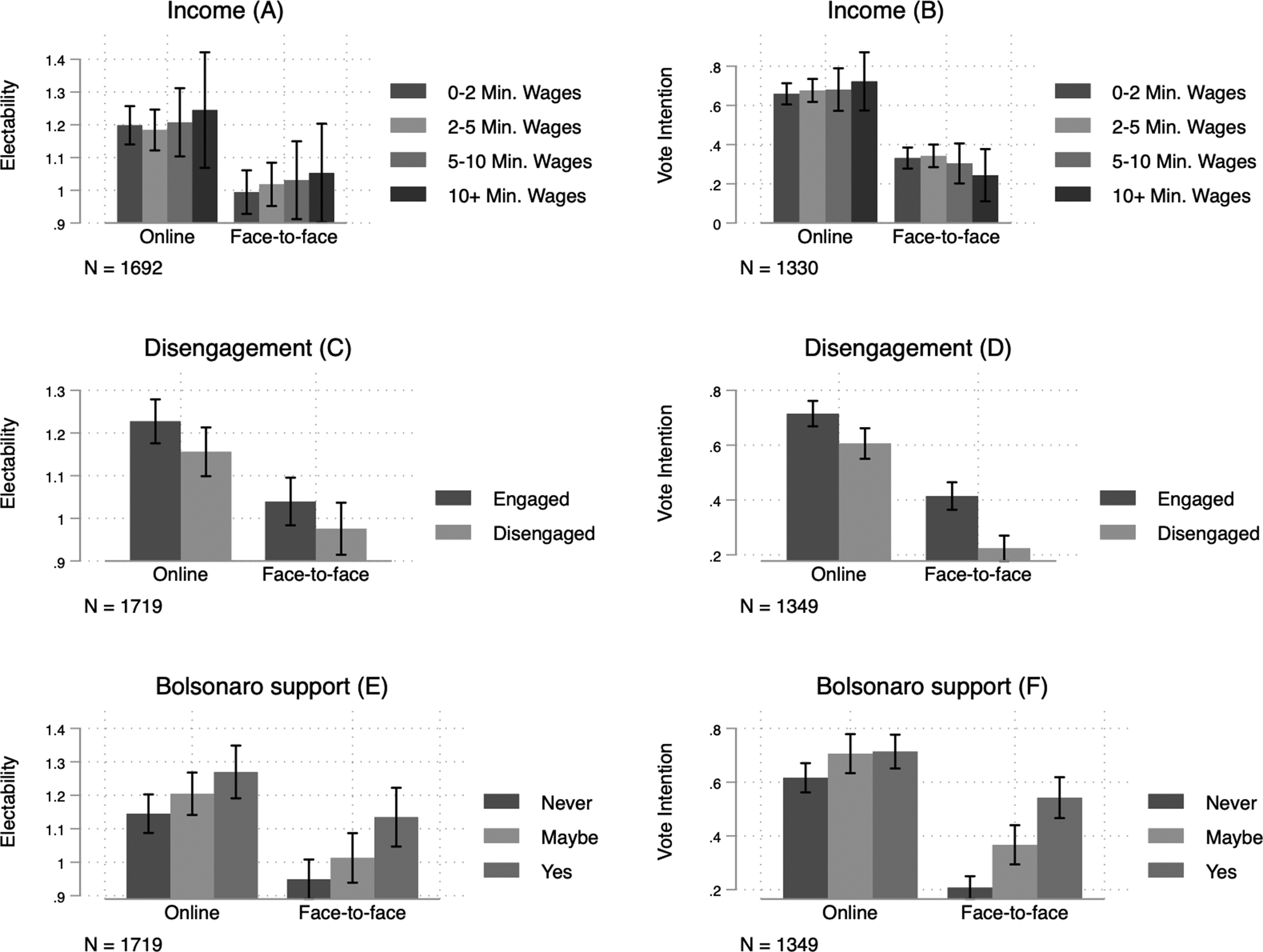
Existing scholarship often argues that income levels shape voters’ acceptability of stigmatized practices and their evaluations and support for these candidates. As our analyses reported in Appendix M show, this is not what we find: Voters from all income brackets stigmatize face-to-face campaign practices during the pandemic.
Income also seems unrelated to voters’ evaluations of candidates who employ these practices. As illustrated in Figure 4 (panel A), voters from different income groups are indistinguishable in their assessments of the electability of candidates conducting online campaigns, as well as in their evaluations of the viability of candidates who conduct street campaigns. 8 Voters from different income levels also similarly punish candidates who employ a stigmatized practice at the ballot-box and display statistically equivalent levels of intent to vote for candidates who conduct street campaigns, as well as for those who engage in street campaigns (Figure 4, panel B).
Generalized distrust and engagement with politics may also shape voters’ attitudes towards candidates’ employment of stigmatized campaign practices. Although engaged and disengaged voters are not statistically different in their assessment of the electability of candidates who employ online campaigns and of those who conduct face-to-face activities (see Figure 4, panel C), candidates’ employment of a stigmatized practice more strongly depresses voting intention among disengaged voters (who already have a predisposition to be distrustful of politics). Engaged voters display high levels of support towards candidates who conducted online campaigns, with 71.5 per cent of them claiming they would vote for such a candidate; meanwhile, 41.4 per cent of engaged voters display intent to vote for candidates who employed street campaigns—a difference of 30.1 pp that is statistically significant at the 1 per cent-level.
Disengaged voters, meanwhile, display statistically and substantively lower intention of supporting candidates in general, regardless of campaign type. In addition, candidates’ employment of a stigmatized practice more strongly depresses voting intention among this group: While candidates who conducted online campaigns enjoy support from 60.6 per cent of disengaged voters, this group’s support for candidates who employed street campaigns starkly drop to 22.4 per cent—a difference of 38.2 p.p. that is statistically significant at the 1 per cent-level (as shown in Figure 4, panel D).
Finally, ideological leanings and attitudes towards far-right Bolsonaro may also be associated with voters’ evaluations of candidates’ who employ campaign practices that could impose further health hazards. Indeed, as shown in Appendix M, albeit to a lesser degree than online campaigns, loyal Bolsonaristas still evaluate street campaigns as acceptable—in stark contrast with anti-Bolsonaristas, who strongly reject the practice. In addition, while ideologically diverse voters are indifferent in their evaluations of the electoral viability of candidates running online campaigns, loyal Bolsonaristas—i.e., those who admit they would certainly vote for a candidate who had the backing of Bolsonaro—evaluate the viability of candidates who ran face-to-face campaigns as 1.35 on the scale of electability, a statistically and substantively higher evaluation than that made by anti-Bolsonaro voters (0.95, as per Figure 4, panel E).
In fact, Bolsonaro support is particularly critical in shaping voting intention for candidates who carry out ill-advised face-to-face campaign activities amidst the pandemic (Figure 4, panel F): When exposed to candidates described as carrying out street campaigns, voting intention drops 40.8 pp among anti-Bolsonaro respondents; 33.9 pp among eventual Bolsonaristas; and, 17.1 pp among loyal Bolsonaro supporters (more than half of whom still admit they would vote for a candidate who conducted face-to-face campaign activities during the Covid-19 pandemic).
Conclusion
Around the world, candidates often employ morally questionable practices to signal their electoral strength. These practices may be a double-edged sword: While they may showcase candidates’ access to resources and viability, candidates who employ such practices also risk incurring reputational costs. These costs may not disadvantage all candidates equally. Gendered expectations of women as more socially responsible and better suited for tackling health crises means that voters may more harshly punish women who deviate from expectations and employ stigmatized campaign strategies. Heterogeneity does not apply only to candidates: Voters may also differ in their attitudes towards candidates’ use of questionable campaign strategies.
Often, studies of stigmatized campaign practices focus on activities that have been largely established—at least by the scholarly literature—as morally unacceptable and detrimental to democracy. These include, for example, vote buying, clientelism, and the use of violence to suppress or encourage turnout.
Taking place during the Covid-19 global pandemic, the Brazilian elections of 2020 allows us to expand the study of stigmatized campaigns, electoral viability and punishment—and their gendered dynamics—to a strategy that is not commonly considered detrimental to democracy. Specifically, we ask: What happens when a traditional source of political capital becomes a health hazard? In the context of the pandemic, face-to-face campaign activities, a non-stigmatized practice during normal times, posed risks to voters and society at large.
Using data from a survey experiment conducted in the week prior to the election with a national sample of Brazilian respondents, we explored whether, in the context of the pandemic, street campaigns became a stigmatized practice and, if so, how candidates’ employment of face-to-face campaigns shaped voters’ (gendered) perceptions of candidates’ electability and their intent to support them.
We find that, as expected, face-to-face campaigns, an otherwise commonplace tactic employed by candidates around the world, were stigmatized in the 2020 elections. These results suggest that the stigma assigned to some forms of campaign activities is circumstantial and potentially mutable: A practice that is not considered socially questionable in one context may be stigmatized in another.
Changes in the perceived status of a campaign practice, in turn, may have detrimental consequences to candidates who employ them. Specifically, we find that employing face-to-face campaigns depresses candidates’ electability and voting intention. These findings reinforce existing scholarship on vote buying that emphasize that even positive inducements may entail large reputational costs for candidates (Mares and Young, 2019; Muñoz, 2019), but challenge studies that argue that when candidates engage with stigmatized tactics of positive inducement, voters’ evaluations of them improve (Kramon, 2016). Further research should investigate the mechanisms underlying such contrasting findings.
As our analyses show, the uncovered dynamics are gendered: Although carrying out street campaigns more strongly depresses voters’ evaluations of men’s electoral prospects, voters punish women who carry out such activities more harshly—thus erasing the voting intention advantage that women candidates have over men when they comply with expectations of responsible campaign practices. This result indicates that women candidates face a dilemma when it comes to engaging in practices that may improve their electoral strength, and that they may have to more seriously consider the reputational trade-offs of the campaign strategies they employ. Importantly, our findings provide additional evidence on how engaging in morally transgressive but commonplace political activities may be more costly to women candidates than to men.
Finally, against the much of the literature on clientelistic candidate-voter relations, we do not find income to differently shape respondents’ characterization of street campaigns as unacceptable, or their attitudes towards candidates who employ this practice. Meanwhile, political disengagement and support for Brazil’s far-right president Jair Bolsonaro do shape voters’ assessments of candidates’ use of street campaigns. Specifically, voters already disengaged with politics become even less supportive of candidates who employ a socially questionable practice. Aligned with emerging scholarship on Brazil, we find that attitudes towards stigmatized campaign practices is yet another dimension of the ideological divide distancing Bolsonaro supporters and opponents.
In sum, our results point to how stigmatized campaign practices are embedded into mutable contexts and to how the employment of stigmatized campaign practices is heterogeneous and shaped by candidate and voter characteristics. We encourage future work to further explore other forms of campaigns with shifting stigma status, as well as to consider how candidate (i.e. race and socio-economic background) and voter characteristics (i.e. political distrust and engagement) shape whether and how campaign strategies impact candidates’ electoral strength.
Supplemental Material
sj-docx-1-pla-10.1177_1866802X211058739 - Supplemental material for Stigmatized Campaign Practices and the Gendered Dynamics of Electoral Viability
Supplemental material, sj-docx-1-pla-10.1177_1866802X211058739 for Stigmatized Campaign Practices and the Gendered Dynamics of Electoral Viability by Mariana Borges Martins da Silva and Malu A. C. Gatto in Journal of Politics in Latin America
Footnotes
Acknowledgement
We thank Débora Thomé for helpful comments and suggestions in a quick turnaround. We also thank Christina Pao for invaluable research assistance.
Declaration of Conflicting Interests
The author(s) declared no potential conflicts of interest with respect to the research, authorship, and/or publication of this article.
Funding
The author(s) disclosed receipt of the following financial support for the research, authorship, and/or publication of this article: This work was supported by a British Academy/Leverhulme Small Research Grant (SRG1920\100629).
Supplemental Material
Supplemental material for this article is available online.

Notes
Author Biographies
References
Supplementary Material
Please find the following supplemental material available below.
For Open Access articles published under a Creative Commons License, all supplemental material carries the same license as the article it is associated with.
For non-Open Access articles published, all supplemental material carries a non-exclusive license, and permission requests for re-use of supplemental material or any part of supplemental material shall be sent directly to the copyright owner as specified in the copyright notice associated with the article.
