




Abstract
In contrast to accounts that explain increases in women’s political representation by reference to structural and institutional factors, this article draws attention to the agency of women candidates. The number of women elected in the Eastern Indonesian province of East Nusa Tenggara (Nusa Tenggara Timur, NTT) increased markedly in 2019. To explain this increase, this article highlights the remarkable persistence of women candidates, many of whom succeeded in 2019 only after competing in multiple prior elections, slowly building their personal political skills and reputations. The article also draws attention to the effects of positive female role models – showing how a female candidate in a gubernatorial race inspired other women politicians – and the positive effects that can arise from co-operation among women candidates. It shows that, despite the emphasis on male dominance and dynastic power in much of the literature on Indonesian politics, there are still pathways to power for women with origins in the grassroots.
Introduction
This article discusses advances made in women’s representation at the provincial level in East Nusa Tenggara (Nusa Tenggara Timur, NTT) in the 2019 legislative elections. Studies that seek to explain a rise in women’s political representation often focus on factors at the national level. These factors include institutional design, such as the adoption of gender quotas (Dahlerup, 2006; Krook, 2009), socio-economic factors such as economic development (Inglehart and Norris, 2003), the connection between rates of female workforce participation and the electoral system (Iversen and Rosenbluth, 2008), political party recruitment practices (Fox and Lawless, 2010; Kenny, 2013; Lovenduski and Norris, 1993), and family connections and dynastic ties (Folke et al., 2021; Jalalzai, 2004, 2008; Jalalzai and Rincker, 2018; Labonne et al., 2015). Studies examining the rise of women’s representation at the subnational level tend to use similar explanations. For example, Rai et al. (2006) examine the quota provisions, Dewi (2018) identifies party nomination processes that favour family ties, and Sundström and Stockemer (2015) focus on socio-economic factors. Some such studies also focus on specifically local factors, including the role of local non-governmental organisations (NGOs) in assisting women (Drage, 2001), changes in social norms (Pini and McDonald, 2011), a trickle-down effect from the increase in women’s national representation (Sundström and Stockemer, 2015), and the influence of female political role models (Baskaran and Hessami, 2018; Karp and Banducci, 2008; Wolbrecht and Campbell, 2007).
Frequently – and somewhat ironically – such studies often do not much focus on the attributes, capacities, and skills of female candidates themselves. In this article, I look at the experiences of women candidates in the Indonesian province of NTT in 2019 to argue that one hitherto neglected attribute of female candidates – their persistence, by which I mean their willingness to contest in repeat rounds of elections, to learn from those experiences, and to thereby build up their capacities and skills – can improve women candidates’ electoral chances by eroding one of the main causes of women’s underrepresentation: the knowledge and informational barrier (Maguire, 2018). There is little discussion in the literature on women in politics on persistence. Instead, the focus in terms of the motivation of candidates has been primarily on women’s reluctance to compete in electoral politics, despite being qualified to do so (Fox and Lawless, 2004, 2011; Lawless and Fox, 2010). What we see in NTT is that women politicians who engage in multiple elections can transform their experiences into new knowledge and political capital they can use in future campaigns. Their persistence leads to electoral success.
The focus of this study, the province of NTT, saw a significant rise in the number of women elected to both provincial and national legislatures in 2019. This rise represents progress for women’s politics in the context of a local society that is generally seen as highly patriarchal (Kemitraan, 2014); there are now more women from NTT in both the provincial and national legislature than at any other time in the province’s history. In the national People’s Representative Council (Dewan Perwakilan Rakyat, DPR), 23 per cent of the members elected from NTT, or three of thirteen, were women. In the provincial People’s Regional Representative Council (Dewan Perwakilan Rakyat Daerah, DPRD), women took twelve of the sixty-five seats (18.5 per cent), up from 9.2 per cent in 2014.
This study builds on the theory of women’s political pathways developed by Choi (2018). As I discuss in the following section, Choi identifies three main pathways for women politicians in Southeast Asia: elite, middle, and grassroots. While Choi’s pathways are separate and distinct, what we see in NTT is that the persistence of women in testing themselves in the political arena over time means that women who have backgrounds in grassroots activism can become part of a non-dynastic elite; they can do so by gradually building their capacity and authority and occupying party leadership positions. In the early stages of women’s move into the electoral arena, female representation often rises as a result of women with dynastic connections (i.e. elite women) being elected, as research by Folke et al. (2021) shows. However, over time, other factors, including the persistence and growing knowledge of non-dynastic women candidates, can come into play. As women candidates repeatedly contest office, they accumulate knowledge about the techniques of electoral competition; voters, meanwhile, become more informed about women candidates. The result is that non-elite women may well have greater rates of electoral success as time passes.
Data for this study were collected by means of field observation, shadowing of candidates and public events, collation of publicly available biographical information, and in-depth interviews. Interviews were conducted with eight women candidates as well as members of their tim sukses (“success teams”, the Indonesian term for campaign teams), several male candidates, academics, and members of civil society groups, especially women’s groups. Fieldwork was conducted from March to July 2019.
The article is divided into four parts. First, I elucidate the theoretical framework I am using for this study to explain the rise in women’s representation at the local level. Second, I map the local context of NTT to help explain this rise in representation. Third, I examine the backgrounds and social origins of the women elected in 2019, showing how many of them were extremely persistent candidates, succeeding in 2019 after having participated in numerous previous elections. Fourth, I draw attention to other ways in which women’s political agency contributed to their success in 2019, focusing on the demonstration effect produced by having an influential woman run for office in the province’s gubernatorial election a year prior to the legislative election, and noting the effects of networking and co-operation among women candidates.
Women’s Political Advancement: Persistence, Experience, and Local Pathways
Studies on women’s political advancement in varied countries show, or sometimes assume, that the majority of women who succeed at entering parliament come from an elite background (Agustino, 2010; Hawkesworth, 2012; Jalalzai, 2004, 2008; Jalalzai and Krook, 2010; Jalalzai and Rincker, 2018; Kenawas, 2015; Labonne et al., 2015; McDonagh, 2009; Rai, 2012; Sutisna, 2017). Borrowing from Choi’s trichotomy, there is an “elite pathway” through which women can gain political office. This pathway typically involves women assuming political power in ways that are mediated by male relatives who belong to the upper social strata, are already entrenched in local or national power structures, and thus have access to abundant political resources. The elite pathway thus equates to women using kinship networks and coming to power by virtue of their membership of political families.
Experience around the world shows that family networks are indeed often a pathway to political power for women. Kinship ties are seen to be crucial when we look at which women win office in many different countries. McDonagh (2009), for example, in her research on women in executive office in the USA argues that the family dynasty is the surest route for women to political power. In the Philippines, a study by Labonne et al. (2015) shows that a majority of women mayors elected since 1988 had dynastic connections with established politicians. A study by Folke et al. (2021) of thirteen democratic nations also shows a dynastic bias in gender representation, with family relationships with a prior male politician being much more important for recruitment of women politicians than for men. Research by Jalalzai and Rincker (2018) in sub-Saharan Africa, Latin America, Asia, Europe, and North America confirms the relevance of family ties for the recruitment of chief executives (presidents and prime ministers) in both democratic and non-democratic countries.
A similar phenomenon has been observed in Indonesia. Elite politicians frequently try to entrench family members in power, giving rise to a form of dynastic politics that elevates some women to political office. A large proportion of women elected to the DPR in Indonesia have dynastic ties (see Dewi, 2018; Puskapol, 2014; Wardani and Singka, 2021). At the local level, research conducted by Sutisna (2017) in Banten provides one example of how women can be promoted as political leaders to extend a dynasty’s influence in the executive, legislature, business and even community organisations. Another study by Dewi (2018) demonstrates that female candidates can use their elite family backgrounds as an important form of political capital, enabling them to secure nomination for political office from parties.
A second body of literature examining the networks that women use to achieve political success shows that there are also non-elite pathways to power for women (Choi, 2018). In particular, the study by Choi (2018) identifies two other pathways for women in Southeast Asia: the grassroots pathway, in which women seek political office from below, with the support of social movements; and a middle pathway, taken by many upwardly mobile middle-class women. Many of this latter group see politics as a profession and seek to enter politics for personal gain, either through access to material rewards or social prestige (Choi, 2018: 19). There have been relatively few studies of women politicians taking these two pathways. Exceptions are studies by Rai (2012) and Hawkesworth (2012). These studies examine the importance of political parties and social movements as a means for women to develop their capacities and resources.
As we shall see, the grassroots pathway is particularly applicable to the present study of women in NTT province. I will argue that in NTT, several successful women candidates had backgrounds as activists in grassroots movements, and were able to exploit the institutional support of parties to develop their personal political resources. The experience of NTT women at the provincial level is thus different from that conceptualised by Choi (2018: 2), who states that women from the grassroots tend to lack institutional support and so “have faced much tougher odds” than women politicians using the other two pathways. This study shows that NTT women often enter politics as cadres of political parties and rise through the ranks at the same time that they are gaining political experience by contesting elections and participating in social movements. As a result, they often build an institutional base that is quite independent of their family ties, and are able themselves to enter in the ranks of a local political elite, albeit a party elite not a dynastic elite. The point, however, is that they enter this elite as a result of their own efforts, and do so as from a starting-point in grassroots activism.
While I accept Choi’s (2018) argument regarding the emergence of a new type of female leader in Southeast Asia who is neither beholden to family nor someone whose political career began in a grassroots advocacy movement, I find little evidence of women in NTT using the middle pathway to electoral success. For the purposes of my study of women candidates, I therefore simplify the analysis and divide the routes taken by women into two pathways: the elite and non-elite pathways. All women’s political pathways not mediated by male relatives will be categorised as non-elite pathways.
Another factor comes into focus in this study of women politicians in NTT: demonstration effects and learning from example, two factors enhancing pathways to power largely unexplored by Choi (2018) and others with regard to non-elite women. Studies by Baskaran and Hessami (2018), Gilardi (2015), Shair-Rosenfield (2012), Karp and Banducci (2008), and Wolbrecht and Campbell (2007) show that women’s representation sometimes rises as a result of the accumulating effect of the presence of women politicians as role models. Baskaran and Hessami (2018) looked at over 100,000 candidates in local council elections between 2001 and 2016 in Germany. They found that women were more likely to run as candidates if the municipal head (mayor) was a woman. Likewise, the study by Shair-Rosenfield (2012) in Indonesia outlines that one of the significant factors increasing the number of female candidates elected to the national parliament over the decade between 1999 and 2009 was female incumbency: even new women candidates benefited from female incumbents in their own and bordering electoral districts, enhancing female candidate placement and electability (Shair-Rosenfield, 2012: 576).
In this research, I found that the accumulation of demonstration effects and learning is facilitated by women’s persistence. As a result, I contend that research into women’s representation has tended to underestimate another factor: the persistence of women candidates themselves in running for office. Research conducted for this article shows one key to the success of individual women candidates, and therefore to increases in women’s representation overall, is their sheer determination to compete over multiple electoral cycles, despite initial setbacks. In this way, they can slowly accumulate political experience and capital. Previous research has tended to focus on limits to women’s willingness to compete in elections (Lawless and Fox, 2010), either because women often doubt their own capacity despite being equally qualified with men to run as candidates (Fox and Lawless, 2004: 2011; Lawless and Fox, 2010), or because they are “election averse.” According to Kanthak and Woon (2014), based on a study using an experimental design that applied to 350 subjects (173 men and 177 women), women are less interested in participating in elections, even when they have similar qualifications as male candidates. Potential women candidates fear that they will not get enough support and so are reluctant to run.
In political science, several studies bring together the notion of women’s persistence with analysis of electoral politics. However, such studies often focus on the weakness of women’s persistence. Wasserman (2018), for example, examined 11,000 candidates in local elections (municipal, county, and school board elections) in California, showing that when they experienced electoral defeat, women experienced 50 per cent more attrition than men, with a decrease in women’s desire to run in the following election of around 25 per cent, far higher than the 16 per cent among defeated male candidates. However, this gender gap did not arise when representation of women in an institution was quite high or among candidates who were relatively experienced. Therefore, Wasserman concluded that the gender gap in persistence depends on the setting. There are, however, other studies that point to persistence among female incumbents. Lippmann (2019) found that women incumbents in France demonstrated tenacity in defending their seats: it was more difficult for female candidates to replace incumbent women than to replace incumbent men. Similarly, Bhalotra et al. (2018) found that women incumbents in India were more likely to compete in subsequent elections than male incumbents. The evidence for persistence among women candidates is thus mixed.
In this present article, I argue that non-incumbent women candidates can also demonstrate remarkable persistence, that this persistence can yield eventual electoral victories, and that persistence thus represents not only a psychological strength, but also a significant political resource. The tenacity of women candidates to compete again and again increases their competitiveness. We will also see, however, that this tenacity had important sources beyond the realm of party politics: in NTT province, the emergence of repeat female candidates was nurtured by the work of NGOs and international donors who engage in capacity building for women candidates as part of political empowerment programmes. Such a finding is in accord with Drage (2001), whose research in a number of Asian countries underlines the important role played by NGOs in the implementation of strategies to lift women’s political representation.
The NTT Context: Poverty, Patriarchy, and International Donors
NTT is an archipelagic province in the east of Indonesia consisting of twenty-two rural districts (kabupaten) and cities (kota) and with a population of around 5.25 million. Three important factors influence women’s representation in the region: NTT’s status as a marginal region economically, the strength of its culture of patriarchy, and its targeting by international donors. Poverty and patriarchal culture in NTT greatly affect the low representation of women in politics because women’s access to political resources is limited. On the other hand, international donor factors provide opportunities for women to become involved in politics.
Regarding the first factor, NTT is the Indonesian province with the third-highest rate of poverty after Papua and West Papua; around 21.35 per cent of the population are officially classified as poor (BPS Provinsi NTT, 2018). Poverty is much higher in rural areas (24.91 per cent) than in urban areas (8.84 per cent). NTT also has the third-lowest Human Development Index score in Indonesia (BPS Provinsi NTT, 2018), and the workforce is dominated by people who have graduated only from primary school, with 58 per cent of workers in this category.
Meanwhile, there is a strong culture of patriarchy present in the province, where men hold most strategic positions and are decision-makers in both public and private institutions, and employment outside the home is dominated by men (Arif et al., 2010). This in turn contributes to the marginalisation of women in many aspects of life. Neglect of women’s rights has implications for the health of not just women themselves, but also their children: NTT has the highest prevalence of childhood stunting in Indonesia, at 42.6 per cent, well above the national rate of 30.8 per cent (Lewanmeru, 2019).
The acute nature of poverty in NTT means that numerous international organisations and NGOs co-operate with local government in the province to run various development, welfare, and empowerment projects. There are many international donor agencies that all have programmes in the province. 1 These programmes often target women and children, and many of them have included training and other capacity-building projects that aim to promote women’s political, economic, social, and cultural participation. These interventions on gender issues have led to positive transformation in the capacity of many women in NTT to proactively express their own needs and aspirations (Tamyis et al., 2019). The International Republican Institute (IRI) has even run, in partnership with local NGOs such as Bengkel Appek, a programme that aims to raise political capacity among women candidates. Several of the women candidates have participated actively in these projects, even leading programmes for women’s empowerment. Many of the women candidates who succeeded electorally in 2019 have either been participants in, or helped to run, several of these programmes, which thus can be seen as having at least partially countered some of the structural disadvantages women experience in NTT.
2019 Election Results for Women
As already indicated, in the field of politics, the 2019 legislative elections indicate what may be the beginnings of positive change in the descriptive representation of women in NTT, with significant rises at both the national (DPR) and provincial (DPRD) level. The number of women elected was the highest in the province’s history.
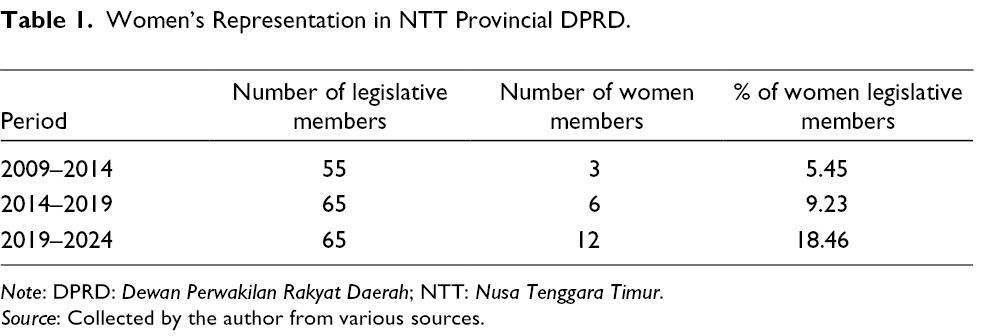
At the national level, women’s representation from NTT rose dramatically from zero members elected to the DPR in 2014 (after falling from 7.7 per cent in 2009, that is, one out of thirteen) to 23.07 per cent in 2019. Table 1 shows that at the provincial level, there was a gradual rise from 5.45 per cent (three out of fifty-five) in 2009, to 9.23 per cent in 2014 (six out of sixty-five), and 18.46 per cent in 2019 (twelve out of sixty-five). The three women who won seats in the DPR in 2019 all came from the first electoral district of NTT I, encompassing Timor, the islands of Sabu and Rote, and Sumba. No women were elected from the second electoral district of NTT II, located in Flores, Lembata, and Alor.
Women’s Representation in NTT Provincial DPRD.
Note: DPRD: Dewan Perwakilan Rakyat Daerah; NTT: Nusa Tenggara Timur.
Source: Collected by the author from various sources.
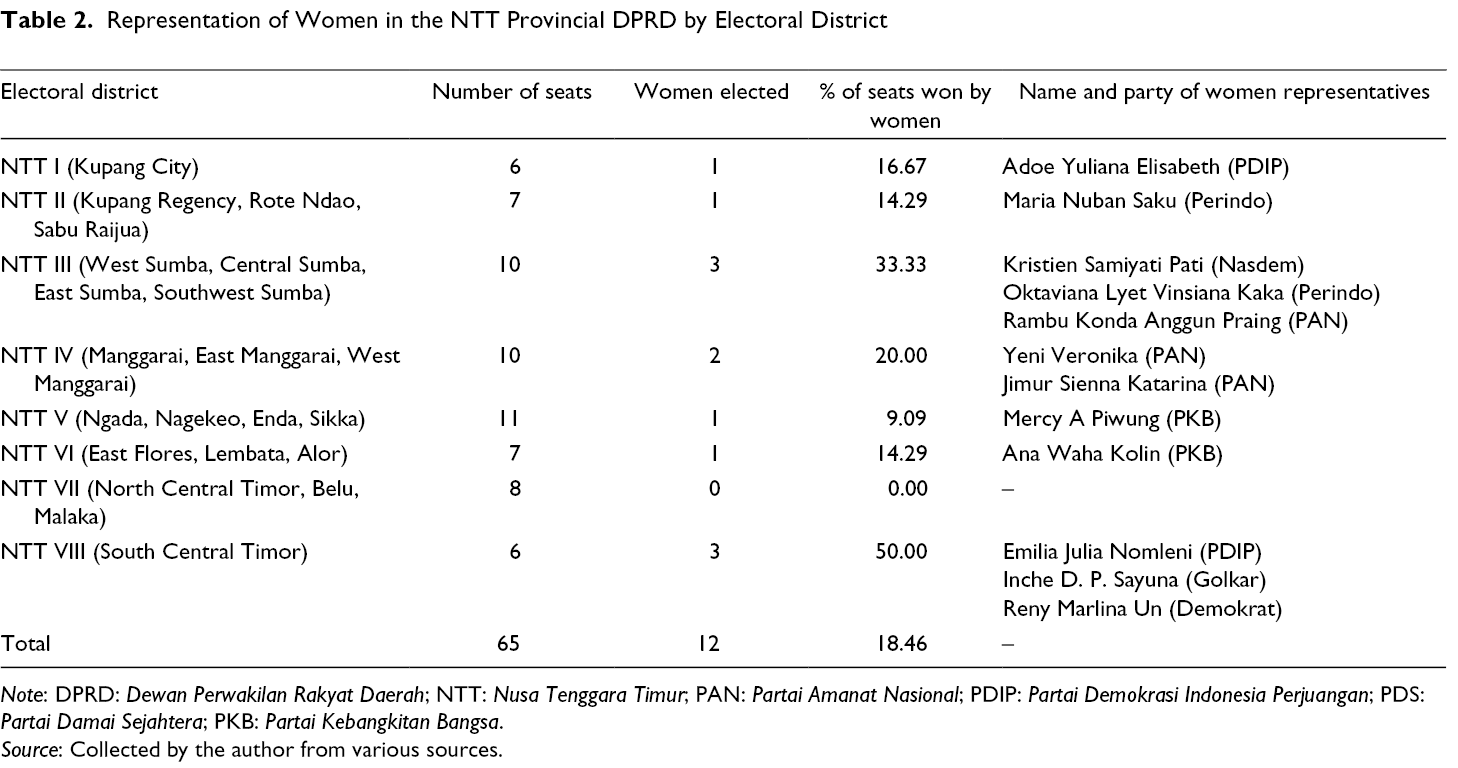
Table 2 shows the results of the 2019 legislative elections for the provincial level by electoral district. Women fared best in NTT VIII, encompassing South Central Timor, where women made up half of those elected, and NTT III, encompassing Sumba, where a third of seats were won by women. The worst performing electoral districts for women were NTT VII, consisting of North Central Timor, Belu, and Malaka, where no women were elected, and NTT V, in central Flores. Thus, women were most successful in the regions of Timor, especially South Central Timor where there are a number of prominent women advocates and politicians.
Representation of Women in the NTT Provincial DPRD by Electoral District
Note: DPRD: Dewan Perwakilan Rakyat Daerah; NTT: Nusa Tenggara Timur; PAN: Partai Amanat Nasional; PDIP: Partai Demokrasi Indonesia Perjuangan; PDS: Partai Damai Sejahtera; PKB: Partai Kebangkitan Bangsa.
Source: Collected by the author from various sources.
Backgrounds of Women Candidates in NTT
In this section, I discuss the emergence and background of the fifteen women candidates elected in 2019 both to the national parliament (Dewan Perwakilan Rakyat, DPR) and NTT provincial DPRD. I divide these candidates into two basic categories: those with an elite background (i.e. those with family connections to established political dynasties and elected politicians) and non-elite candidates.
Elite Privilege: Family Connections for Electoral Success
Six candidates had an elite background. Five of them were newcomers to electoral politics, only one was an incumbent. The emergence of all six of these candidates was mediated by their male relatives, whether husbands, fathers, or brothers. Among these elite candidates, four were the wives of officials and district heads; two belonged to the millennial generation. Two of the three women elected to the DPR were wives of officials: Kristina Muki is the wife of the district head (bupati) of North Central Timor; Ratu Nggadu Bonu Wullu is wife of the former district head of Southwest Sumba. At the province level, Yeni Veronika is the wife of the bupati of Manggarai, and Jimur Siena Katarina is the wife of a former member of the DPR representing NTT. The husbands of all four women managed their entry into politics.
The two successful women candidates I classify as millennials, Rambu Konda Anggung Praing and Oktaviana Lyet Vinsiana Kaka, both come from upper middle class families and have close ties to male relatives who are leading members of political parties. Both women, originally from Sumba, have university degrees, and both were taking part in electoral politics for the first time. Rambu Konda Praing, twenty-three years old at the time of the election, is the youngest member of the NTT provincial parliament in its history. Her social status as a member of the upper caste (a very important factor in Sumba, as in many parts of NTT), her father’s position in the upper echelons of the local bureaucracy, and the fact that her uncle is the head of the district branch of the National Mandate Party (Partai Amanat Nasional, PAN) in East Sumba meant that once she joined PAN in 2016, she immediately became deputy head of the same branch. Her older brother is also a politician. Oktaviana Lyet Vinsiana Kaka chose to run for the Indonesia Unity Party (Partai Persatuan Indonesia, Perindo); her father was the head of the party in West Sumba district.
The six female candidates with an elite background, most of whom were newcomers, clearly enjoyed privileges that were influential in their election through membership in a family network facilitating name recognition and acceptance by society. This is in line with the findings of Choi (2018) and Jalalzai and Krook (2010) that, apart from having political experience, women from elite pathways are more accepted by the public (Choi, 2018; Jalalzai and Krook, 2010: 13).
The Non-Elite Pathway: Repeat Contestation and Perseverance over Time
The nine women candidates from non-elite backgrounds who won seats can be further grouped into three categories (though with considerable overlap): women’s movement activists, party activists, and professionals. What binds these women together, apart from their non-elite status, is that none of them was a newcomer to politics. All nine women – whether or not they were incumbents – had a relatively long period of experience in the world of politics before being elected in 2019.
Women’s Movement Activists
As noted above, NTT has long been a target of donor programmes aiming to promote women’s empowerment, giving rise to a large body of experienced women’s activists in the province. Three candidates elected in 2019 fit this category: Angela Mercy Piwung, Ana Waha Kolin, and Emilia Nomleni. The first two have deep roots in the NTT women’s movement, with both of them members of the Women’s Caucus (Kaukus Prempuan), a civil society initiative set up with support from donor institutions. Mercy, an incumbent, was active as the chair of the Women’s Parliamentary Caucus (Kaukas Perempuan Parlemen, KPP) of NTT Province from 2016. Much of her political work had involved co-operation with various women’s empowerment initiatives, such as helping set up the KPP in the district (kabupaten) of Belu and in South Central Timor and North Central Timor. Ana Kolin, a newcomer to the provincial DPRD, was elected in 2006 as secretary of the Caucus for Indonesian Women Politicians (Kaukus Politisi Perempuan Indonesia, KPPI) of NTT province, a civil society organisation that aimed to promote advancement of women in politics outside of parliament; she was later elected head of that organisation in NTT three times. She also had considerable experience in Yayasan BaKTI (Bursa Pengetahuan Kawasan Timur Indonesia, Eastern Indonesia Knowledge Exchange Foundation), a partner in the MAMPU women’s empowerment programme.
Emilia Nomleni, an incumbent, is well known as a senior politician in the Indonesia Democracy Party-Struggle (Partai Demokrasi Indonesia Perjuangan, PDIP) who had been involved in the party since its formation early in the democratic era. She was one of the founders and administrators of the volunteer association known as CIS (Centre for IDP Services) Timor, which was founded on 9 September 1999 to help refugees from Timor-Leste, who were then moving into West Timor. This movement was initiated by a number of youths and Christian students who were members of the Indonesian Christian Youth Movement (Gerakan Angkatan Muda Kristen Indonesia, GAMKI) and the Indonesian Christian Student Movement (Gerakan Mahasiswa Kristen Indonesia, GMKI). Emilia Nomleni was a well-known activist in both organisations. Her previous background in NGOs made it easy for her to move into party politics.
Political Party Activists
In addition to Emilia Nomleni, three successful candidates had long personal histories of involvement in parties as activists. All three have been loyal supporters of the party they initially joined, in a political environment in NTT in which many politicians change parties at least once, if not multiple times. Anita Jacob Gah, who was elected to the DPR, grew up in Jakarta among members of the diaspora from Sabu, an island well known for the progressive nature of its education system. Before becoming involved in politics, she was active in the arts and music scene and also the youth movement of Jakarta churches because of her background as a music teacher for the Protestant Churches of Western Indonesia (Gereja Protestan di Indonesia Bagian Barat, GPIB) and for the church youth wing, first in Jakarta and then in the NTT capital, Kupang. She joined the Democrat Party (Partai Demokrat) when it was first founded by Indonesia’s former president, Susilo Bambang Yudhoyono, in 2001.
In the NTT provincial parliament, Lilie Adoe (as she is known), and Maria Nuban Saku, are both loyal members of PDIP. Lili Adoe was involved in the party from its founding in 1998. Together with Frans Labu Raya, head of the party in NTT between 2000 and 2020, she was a pivotal figure in the development of the party in the province. Similarly, Maria Nuban Saku had played an important role in promoting the party in the district (kabupaten) of Kupang, serving as head of the PDIP branch in that district between 2003 and 2010. At that time, she was the only woman in NTT in a leadership position in a political party.
Professionals
A further three candidates have backgrounds as professionals: Inche Sayuna, Reni Marlina Un, and Kristien Samiyati Pati. The first of these women, Inche Sayuna, is a lawyer and entrepreneur with a long affiliation with the world of politics. During her student years, she was an activist with GMKI, and she is the only woman elected to the provincial parliament who has a PhD. Ethnically Chinese, she was nominated by Golkar, a party often associated with professional groups such as lawyers, businesspeople, and those in the hotel sector, and which attracts support from many ethnic Chinese Indonesians in South Central Timor. Reni Marlina Un is also an ethnic Chinese woman from South Central Timor. The Democrat Party appointed her to the provincial legislature in 2018 to replace another representative in the lead-up to the 2019 election; before that, she was a lecturer at the Oemathonis College of Economics in Kupang. Although she herself grew up in a family of entrepreneurs, she chose the academic route after studying in Surabaya. The third woman professional elected, Kristien Samiyati Pati, was an incumbent from the Nasdem Party (National Democrat Party); prior to her political career, she had worked as a teacher in a vocational high school in Flores.
Increasing Women’s Representation in NTT: The Persistence of Women Candidates
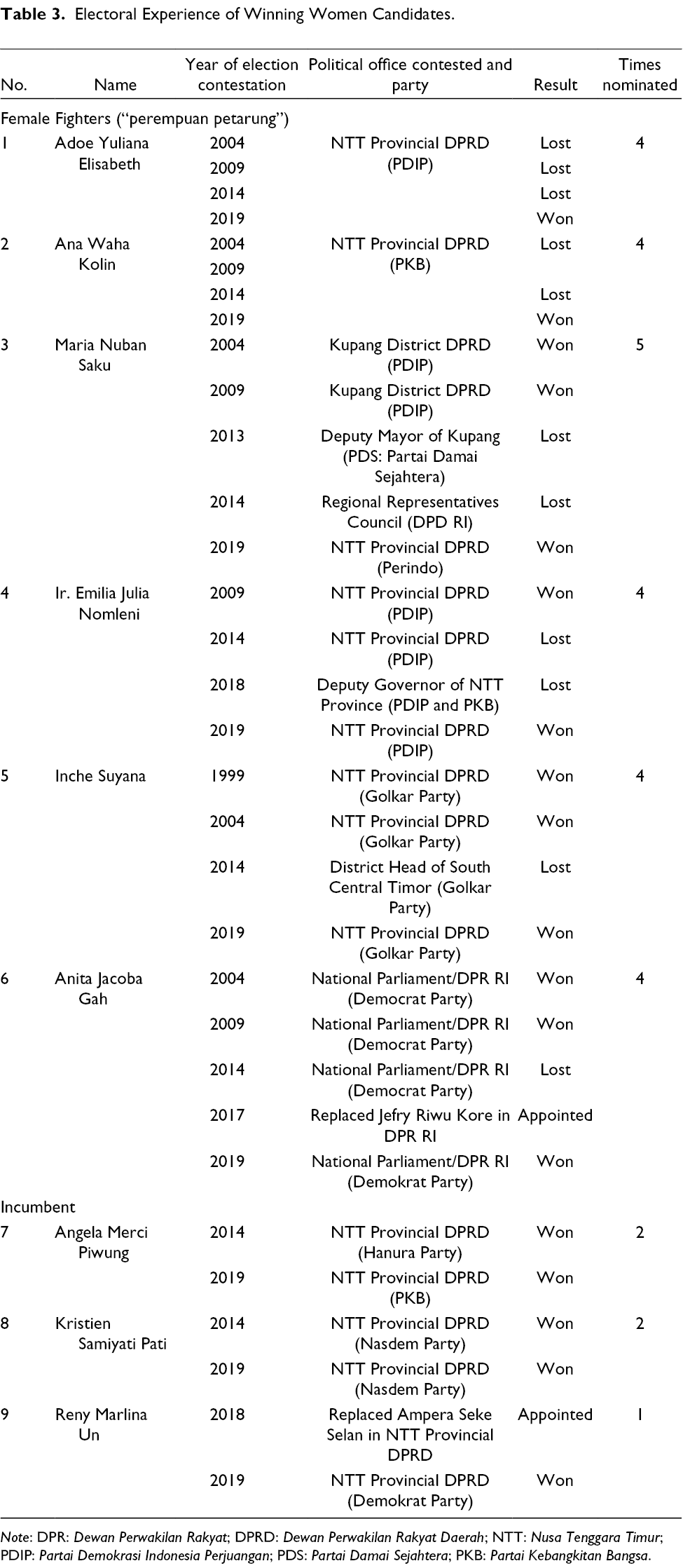
A striking finding of my research, in contrast to much other research on women’s representation in Indonesia, is that most women candidates who won seats in 2019 were from a non-elite background. Of the nine women, eight had competed in elections previously; the one exception was Reni Marlina who was an incumbent who had been appointed to parliament in 2018 (Table 3). Adoe Yuliana Elisabeth and Ana Waha Kolin are the two most extreme examples of women’s persistence. They have both participated in the election four times. They were candidates for the first time in the NTT Provincial DPRD in 2004, and continued to run every five years. However, it was only in the 2019 election that they were finally elected as members of the NTT Provincial DPRD. Even though they had to wait for fifteen years and participate in four consecutive elections, this did not dampen their political ambition.
Electoral Experience of Winning Women Candidates.
Note: DPR: Dewan Perwakilan Rakyat; DPRD: Dewan Perwakilan Rakyat Daerah; NTT: Nusa Tenggara Timur; PDIP: Partai Demokrasi Indonesia Perjuangan; PDS: Partai Damai Sejahtera; PKB: Partai Kebangkitan Bangsa.
Using the information collated in Table 3, I classify six candidates as “fighters,” women who have stood in repeated elections over time: five have competed for provincial DPRD seats multiple times, and one has repeatedly competed for her DPR seat. These women have high levels of persistence and so are political activists who, by the time of their election in 2019, already had a great deal of experience of political competition. Each has participated in elections at least three or four times and experienced defeats during that period. Their tenacity, persistence, and competitiveness justify the label of women “fighters.” 2 The other three successful non-elite women candidates are either incumbents or have taken part in elections only twice. Although Anita J. Gah can also be categorised as an incumbent, her experience is slightly different from the other three incumbents because Anita lost in the 2014 election before being appointed in 2017 to replace another member of parliament. The other three women whom I categorised as incumbent have never experienced electoral defeat.
As I explain below, the persistence of the six female candidates who were categorised as “female fighters” was formed through two important processes, namely (1) participating in repeated elections and (2) participating in the political leadership in their respective political parties.
From Grassroots to Political Office: Elections and the Accumulation of Political Experience
Women’s persistence is characterised by participation in multiple campaigns, but for persistence to lead to success, women need to develop political capital by building their political knowledge and taking strategic roles in political parties. The case of Ana Waha Kolin is a good example of how competing in successive elections can help women politicians accumulate political knowledge. Ana has run for a seat in the provincial parliament four times.
She explained that what pushed her to participate in successive elections was her involvement as a committee member in the KPPI. As stated in the previous section, Ana is an activist of the women’s movement activist in NTT and is involved in political empowerment projects undertaken by NGOs in NTT supported by international donor agencies. Her activism in the women’s social movement led to her becoming the Secretary of the NTT chapter of the KPPI in 2006, and she became Chair of the KPPI for NTT in 2009. When she was elected as a member of the NTT Provincial DPRD in 2019, Ana had thus already led this institution for two periods, and following her election, was appointed to a third leadership term.
In the 2004 elections, Ana admits that she was not seriously hoping to be elected and had simply put her name on the list as a vote getter. In 2009, an internal party conflict in her party, PKB, led to her failure. Having been defeated twice in the same electoral district, in 2014 Ana moved to a new electoral district but was unsuccessful. In 2019, Ana Kolin returned to her original electoral district and was finally successful. She ascribed her success to her long experience of activism in the women’s movement, which helped her identify strategic issues affecting women in NTT. Her political experience on the hustings and her long involvement with KPPI meant she had the advocacy skills to develop policies that she could use as the basis for her campaign and appeal directly to women voters. One of the public issues that she consistently campaigned on in 2019 was the welfare of women and children, including education and health issues. Her consistency in women and children’s issues made her choose to be a member of Commission V (People’s Welfare Sector), which focuses on women and children’s affairs, social, health, labour, and education, after she was elected as legislative member of DPRD NTT. Ana Kolin’s story shows how women learn politics both by being part of the electoral process and through social movement experience.
Women’s Leadership in Political Parties
Another characteristic that stands out with the female fighters is their long journey in their respective parties, starting from becoming party cadres and then being able to move up to occupy leadership positions in the party. When women take on formal party leadership roles, they also increase their chances of electoral success. By accumulating experience within a party, they are more likely to be nominated in successive elections, even after failed campaigns. Examples are Emi Nomleni, Lili Adoe, and Maria Nuban Saku, all of whom have been members of PDIP since it first competed in 1999. As noted previously, Lili Adoe has played an important role in developing PDIP in NTT. Under the leadership of Frans Lebu Raya (a prominent national party figure, and NTT governor between 2008 and 2018), she was twice appointed as NTT party treasurer. In 2019, after he failed to win a DPR seat, Frans Lebu Raya handed over the reins of leadership to Emi Nomleni, and Lili Adoe relinquished her role in the leadership of the party.
Emi Nomleni herself is a senior PDIP politician who has been with the party since the beginning of the modern democratic era. She served as deputy head of the party in South Central Timor between 2005 and 2015 and then was elected party branch head in South Central Timor for 2015–2020. In 2019, with the electoral defeat of Frans Lebu Raya, Emi became the first woman to serve as head of the PDIP provincial branch in NTT. This position led, in turn, to her election as speaker of the provincial parliament. According to Emi, her success is the result of long involvement in the world of politics (Interview, Kupang, 12 April 2019). Political experience, she says, builds women’s capacity to engage in campaigning and removes their naivety. Elections are increasingly competitive, so women need to build their skills to compete, and she believes the best way for women to do this is to join political parties. Only once someone has been a member for some time should they put themselves forward as a candidate. She criticises those who nominate to run without undergoing party cadreisation (kaderisasi). Becoming a quality politician does not happen overnight, but is a process, as her own career demonstrates.
Maria Nuban Saku also was long involved in PDIP and, as noted previously, was in 2003 the first woman to head PDIP at the district level in the province. However, her long history of involvement with PDIP came to an end in 2013 when she ran unsuccessfully for deputy mayor of Kupang on a PDS ticket. Nominated by another party, she left PDIP. Influenced by her political profile and experience, the head of the Gerindra party in NTT invited her to join the party, but she refused. In the lead-up to the 2019 election, she chose instead to join Perindo, and was immediately appointed deputy chair of the party in NTT, responsible for law and human rights issues.
The other three women “fighters” also hold, or have held, leadership positions in their respective parties. Ana Waha Kolin is deputy head of PKB in NTT, the party she has belonged to since the beginning of her political career. Ince Sayuna has been with Golkar since it first re-formed as a political party in the chaotic transition to democracy. After successful campaigns for the provincial parliament in 1999 and 2004, Ince Sayuna then took some time out of legislative politics, then running unsuccessfully as district head in South Central Timor in 2014. Her long experience with Golkar brought her into the leadership of the party and in 2017, she became party secretary for NTT. After being elected in 2019, she was appointed as deputy speaker of the NTT legislature. Anita Gah has also been a cadre for the Democrat Party since it was founded and continues to be active in that party.
In Indonesia, researchers often view parties as a major barrier to women’s political participation, pointing to their failure to provide training and leadership support for women. NTT provides evidence that when women join parties, move up the ranks, and eventually capture strategic positions in party leadership bodies, they have a good chance of succeeding electorally. Women can use their party experience and influence to achieve nomination, higher positions on candidate lists, and party support for their campaigns. Even when a long-time woman party leader’s relationship with a party sours, as happened with Maria Nuban Saku, she can use her political experience as a bargaining tool to attain a leadership position in a new party.
The success of these women candidates in NTT after multiple failed campaigns demonstrates how resilience and a passion to compete can eventually yield positive political results. These women are not election averse (Kanthak and Woon, 2014; Lawless and Fox, 2010); they did not leave the political arena after experiencing electoral defeat. Instead, they used their campaign experience, combining it with their experience as activists and advocates in social movements and their experience in political parties, to run for office again. The persistence of the women candidates I categorise as fighters comes from their commitment to represent women’s interests and their personal values. As one candidate explained, she was willing to run again and again because she wanted to be a role model for other women in NTT to show that women can also be elected and be equal to men in the political sphere (confidential interview). She also explained that having a candidate quota made it easier for her to stand multiple times. The high commitment and loyalty to advocacy displayed by many women is an example of what is often referred to as “moral capital” (Choi, 2018; Derichs et al., 2006), endowing them with qualities such as “prestige, respect, loyalty and authority” that can be used then as “a resource to mobilise for political goals, activities, or support” (Kane in Derichs et al., 2006: 245). Persistence thus helps to build moral capital, and is a key factor in the ability of women to build their political careers.
Role Models and Networks
If the persistence of women candidates’ electoral efforts was the key to their electoral success, other factors also helped them accumulate political experience and confidence, and thus underpinned the positive results in 2019. In particular, one development in 2018 had a significant demonstration effect on would-be women candidates: the 2018 gubernatorial election for the province saw a woman run as deputy gubernatorial candidate for the first time. Emilia Julia Nomleni (Emi Nomleni) ran on a joint PDIP and PKB ticket with Marianus Sae. However, prior to the campaign launch, Marianus Sae was arrested by the Corruption Eradication Commission (Komisi Pemberantasan Korupsi, KPK) on bribery charges. As a result, Emi campaigned on her own. According to General Election Commission (Komisi Pemilihan Umum, KPU) Regulation No. 3/2017, as long as there is no guilty verdict from the court (still a suspect), Marianus Sae remains as candidate for governor. This situation gave rise to a great deal of sympathy for Emi among women politicians, many of whom decided to support her campaign. While she was defeated in the end by a pair consisting of Viktor Bungtilu Lasikodat and Joseph Nae Soi, who attained 36 per cent of the vote, she received the second highest vote total (26 per cent).
Emi’s success provided impetus to women with leadership aspirations in what has been dubbed the “Emi effect.” 3 The women who joined Emi on the campaign trail and supported her candidacy included Adoe Yuliana Elisabeth from PDIP, Ana Waha Kolin from PKB, and Enny Anggrek from PDIP, all of whom were elected to either provincial or district DPRD seats in 2019. Not only did these women campaign alongside Emi during the 2019 election (see below), but their faces were already known to voters as they had accompanied Emi when she campaigned from village to village in 2018.
Through her efforts in 2018, Emi Nomleni has become a role model for women politicians in the province. According to a number of informants I interviewed, Emi inspired many women and men to vote for women politicians and encouraged women candidates to work hard and believe in themselves and their ability to complete. The gubernatorial campaign became, in fact, a space to consolidate the strength and solidarity of women politicians in NTT, and it provided opportunities for them to learn campaign skills and introduce themselves to the public. Emi’s status as a new symbol of women’s political leadership helped other women candidates to overcome the psychological, cultural, and institutional barriers (Gilardi, 2015; Wolbrecht and Campbell, 2007) that women politicians face in NTT.
Another impact of the Emi effect that contributed to electoral success in 2019 was the adoption by several women candidates of co-operative, so-called tandem strategy in the campaign. Tandem arrangements, which occur when candidates who are competing in the same districts for seats in legislatures at different levels team up to share resources and campaign infrastructure, are not unusual in Indonesian elections; what was distinctive about the 2019 election in NTT is that several women candidates decided to support each other and create what were effectively all-women tandems. Emi Nomleni, for example, campaigned with two other PDIP women candidates, Lili Adoe and Enny Anggrek (a candidate for district DPRD of Alor). The idea for this strategy came from Emi Nomleni herself. This tandem strategy was very beneficial for female candidates because of the figure of Emilia Nomleni. According to Lili Adoe, tandem campaigning attracted voter sympathy because Emilia Nomleni was also present in the campaign, and the women candidates could interact directly with the voters. Further, she was able to learn about political strategy directly from Emi. She credits this effort as contributing to her win, and also to the election of Enny Anggrek. 4 As well as campaigning with her fellow PDIP women candidates, Emi also initiated training sessions for them all. Together they studied how to campaign, and how to speak in public. 5
Apart from working together with her fellow PDIP women candidates, Emi Nomleni also sought to develop bonds with two other candidates for the provincial parliament in her own electoral district, despite the fact that they represented different parties and were thus competing against her. She regularly met with Marlina Un (Democrat Party) and Ince Sayuna (Golkar) during the campaign period to share insights they had each gained from their campaigning. These three women were all elected, taking 50 per cent of the NTT VIII electoral district’s six seats, making it the electoral district with the highest level of female representation in NTT.
The strategy of tandem campaigning was particularly effective for women candidates with limited resources, such as Lili Adoe. She acknowledges that because she had little financial support, she was reliant on cheap campaign strategies, such as going door to door – the strategy she had employed in all her previous unsuccessful campaigns. Normally, she would not organise her own public campaign events because they were too expensive; this time, she was able to participate in tandem events with other PDIP candidates from the three levels of legislature. By joining other candidates, she was able to raise her public profile and gain a wider audience.
Conclusion
Research explaining increases in women’s political representation often focuses on broad structural and institutional factors. In this study, I have zeroed in on the women politicians’ agency, and how they can shape their own political futures – even in adverse circumstances. As I have shown, despite the patriarchal context of NTT, and with crucial help provided by training programmes designed to boost women’s confidence and increase their skills, women candidates in the province recorded significant advances in 2019.
Above all, my study highlights how persistence by women candidates can pay off. Elections represent opportunities where women can learn about politics and strengthen their political skills – even when they have to compete over multiple cycles in order to achieve success. It might be that persistence is a normal characteristic of many women in NTT who have to struggle against poverty and discrimination their entire lives. The idea of persistence is something of a basic ethos for the women’s movement in the province, and women who have come from a grassroots advocacy background demonstrate strong commitment to representing women’s interests in parliament. However, it needs to be emphasised that long-term persistence and repeated political campaigns are not enough on their own to move women into positions of power. To succeed, women’s willingness to compete needs to be accompanied by the capacity to learn from previous experiences and to experiment with new strategies.
The political experience gained by women candidates over successive election campaigns produces an accumulation of knowledge on the part of candidates, but also voters. Women’s faces become known and they are able to build their profiles over the years. If, as Maguire (2018) argues, a lack of information about women candidates is a barrier to increased representation, then women’s persistence helps to overcome that barrier. Women acquire political capital through participation in the political process, and voters come to know them as political actors. Women’s persistence makes women candidates rich in political experience, and this in turn erodes the knowledge and informational barrier that often disadvantages them.
Another lesson that this focus on women’s agency brings to the fore is that – at least in NTT – the elite pathway to power for women, which relies on family or dynastic relationships with male power holders (Choi, 2018), is being disrupted by the emergence and success of women candidates who have emerged from grassroots movements. Long-term engagement in political parties – another aspect of persistence – and women’s ability to take up party leadership positions, and so become part of an emerging party-based elite, is also a key to success. A close study of developments at the local level thus shows that the picture of male dominance and powerful dynasties is being challenged at the local level in Indonesia, that pathways to political power for women are not necessarily separate or distinct, and that parties can provide conduits that enable women to move from the grassroots to an elite pathway.
Does this pattern of persistence leading to political success apply in other parts of Indonesia or is it unique to NTT? While we cannot generalise on the basis of a case study in one province, I propose that we need to give greater attention to this factor when discussing women’s political representation in Indonesia. Persistence is likely to be a pathway in other areas that have been the focus of efforts by international agencies to raise the profile of gender and development issues as we find in NTT and where strong collaborations exist between these donor agencies and women’s empowerment organisations. In areas where women’s access to social space is limited due to the patriarchal structures and values, civil society organisations become a new site for women to access social space. In these regions, it is necessary to study the linkages between women’s empowerment agencies and increased women’s representation.
Footnotes
Declaration of Conflicting Interests
The author(s) declared no potential conflicts of interest with respect to the research, authorship, and/or publication of this article.
Funding
The author(s) disclosed receipt of the following financial support for the research, authorship, and/or publication of this article: The research for this special issue was funded by the “Supporting the Rules-Based Order in Southeast Asia” (SEARBO) project, administered by the Department of Political and Social Change at the Australian National University and funded by the Australian Department of Foreign Affairs and Trade. The opinions expressed here are the authors' own and are not meant to represent those of the ANU or DFAT.
Notes
Author Biography
Email: