




Abstract
What is the source of the Partido dos Trabalhadores’ (PT) success? And is the PT likely to thrive into the future as a key player in Brazil's party system? In this paper we weigh in on an emerging debate about Lula's role in the PT's rise to power. Without Lula's ability to win more votes than his party, we might not be discussing lulismo at all, much less its difference from petismo. Yet despite Lula's fame, fortune, and extraordinary political capabilities, lulismo is a comparatively weak psychological phenomenon relative to and independently of petismo. Lulismo mainly reflects positive retrospective evaluations of Lula's performance in office. To the extent that it indicates anything more, it constitutes an embryonic form of petismo. The ideas that constitute lulismo are similar to the ideas that constitute petismo in voters’ minds, and they have been so since the party's founding – a nonrevolutionary quest to make Brazilian democracy more equitable and more participatory. Both lulismo and petismo are key sources of the PT's strength, but petismo is likely to endure long after Lula has departed the political scene.
Introduction
What is the source of the Partido dos Trabalhadores’ (PT) success – namely, its electoral growth, presidential election victories, and expansion throughout Brazil? And is the PT likely to thrive into the future as a key player in Brazil's party system? Although it was born as a radical opposition party under Brazil's 1964–1985 military dictatorship, the PT has moderated its programmatic commitments since the mid-1990s. This move to the center has drawn the charge that the PT has become – just like all other Brazilian parties – power-hungry, corrupt, and distant from and even disdainful of voters and their concerns. Indeed, widespread popular disenchantment with all of Brazil's parties sparked massive protests across Brazil in 2013, raising the question of whether any of them can retain popular support over the long term.
In this paper 1 we engage the debate about Lula's role in the PT's rise to power. Some suggest that the PT owes its success largely to Lula's charismatic leadership. Lula certainly played a leading role in the PT's foundation and increased his voter base faster than his party did when Brazil began holding direct presidential elections in 1989. Moreover, as Lula gained votes, he and the PT came to derive electoral support from different socioeconomic and geographic bases. Lula's supporters tend to be poorer, less educated, darker skinned, and less involved in politics than petistas, who remain more likely to come from the organized and activist middle classes and work in the formal sector, particularly the public sector. Thus when Lula was reelected in 2006, although nearly all petistas voted for Lula, not all lulistas were also petistas. In fact, there were about twice as many lulistas as petistas.
Prepared for the conference “Le Bresil de Lula: Héritage et Défis,” Université de Montréal, 11–12 October 2012. We thank Octavio Amorim Neto, Graciela Ducatenzeiler, and Françoise Montambeault for their comments.
Some viewed the 2006 election as Lula's apotheosis: lulismo had pushed petismo into the background, transforming the PT's story from one in which Lula was an important yet ultimately replaceable leader into one in which Lula was uniquely responsible for the PT's success. According to this interpretation, lulismo – defined as the basis of Lula's popularity, which is built upon voters’ personalistic attachments to his charisma, personal history, rhetorical style, and/or government policies – is the true source of the PT's rise to power. To the extent that the PT owes its success to Lula, then it is an open question as to whether the PT will fade after Lula passes from the scene.
It is true that without Lula's ability to win more votes than his party, we might not be discussing lulismo at all, much less petismo. Yet most observers do not credit the PT's success simply to Lula. Lula contrasts with historical Brazilian populist leaders such as Leonel Brizola, Getúlio Vargas (Brizola's political godfather), and João Goulart (Brizola's actual brother-in-law). Those three figures are remembered more as charismatic individual leaders than as leaders of powerful party organizations. Although Lula certainly has acquired historical prominence due to his charisma and personal leadership qualities, no one labels the PT a ‘personalist’ party. By implication, perhaps lulismo is not the key source of the PT's success. Instead, the sources of the PT's rise are its deep roots in civil society, its organizational strength, and its articulation of a relatively coherent and consistent programmatic profile. The growth of petismo – defined as voters’ affective attachment to or identification with the party's political project – is perhaps more responsible than lulismo for the party's growth and long-term prospects.
Our assessment of the evolution of lulismo and petismo as well as the likely role of the PT in Brazil's future is based upon the following argument: despite Lula's fame, fortune, and extraordinary political capabilities, lulismo is a comparatively weak psychological phenomenon relative to and independently of petismo. In the 2006 election lulismo reflected positive retrospective evaluations of Lula's performance in office, particularly among poorer Brazilians. Yet Lula's vote total always exceeded the PT's, implying that lulismo cannot be reduced to retrospective voting. To the extent that it reflects something more than that, we suggest that lulismo constitutes an embryonic form of petismo: the ideas that constitute lulismo are similar to the ideas that constitute petismo in voters’ minds and have been so since the party's founding – a nonrevolutionary quest to make Brazilian democracy more equitable and more participatory. Although not all lulistas inevitably become petistas (engagement in civil society typically distinguishes those who do from those who do not), we side with those who perceive similarities, rather than differences, between these two phenomena.
To support the arguments that lulismo is a relatively weak phenomenon and that lulismo and petismo are conceptually similar psychological constructs, we first consider Lula in a comparative perspective with other Latin American leaders. This reveals that Lula is at best a mild populist who has rhetorically downplayed his own personal significance. Next, we scrutinize the sources and strength of petismo as a form of political identity, discussing and empirically evaluating its power relative to lulismo. We then assess the conceptual meaning of lulismo, demonstrating its fundamental similarity to the meaning of petismo. Finally, we conclude that the PT's future is not a function of Lula's presence or of the strength of adoration for Lula among Brazilian voters, but rather is dependent on the party's ability and willingness to continue to invest in what it has long claimed to stand for. Nonetheless, PT leaders know full well that many Brazilians who adore Lula have no feelings about the PT at all. The PT's key challenge remains to convert positive sentiments about Lula into petismo – a deeper, longer-lasting form of political identity.
To begin building support for our argument, we must first put Lula and the PT in comparative perspective. When observers of Latin American politics attempt to place the PT in context, the result inevitably sounds something like this: the PT is an institutionalized party with deep roots in civil society, a relatively coherent programmatic profile, and internal democracy. This profile has seen the PT – in contrast to every other Brazilian party and many others in the region – generate a growing base of partisan supporters. This means that the PT is not a flash-in-the-pan personalistic vehicle or a populist machine with no programmatic profile beyond the distribution of clientelistic goods (see e.g. Levitsky and Roberts 2011: 13). However, the PT also abandoned the programmatic and ideological radicalism of its early years (Samuels 2004; Hunter 2010; Ribeiro 2010; Amaral 2010) and is now part of the ‘moderate’ Latin American Left.
As for Lula, some observers insist on pejoratively calling him a populist. Yet in terms of personal style, rhetorical appeal, and the policies he advocates, the contrast between Lula and other Latin American leftist leaders is stark. For example, President Lula was among the least populist in terms of economic policies, unlike others who recklessly promoted consumption and increased wages at the expense of fiscal and monetary stability, and he took comparatively few actions that undermined democratic institutions (Castañeda 2006; Weyland and Hunter 2010; Cameron and Hershberg 2010; Edwards 2010). Dissimilar to Hugo Chávez, for example, he never sought to create a political system that would revolve around his political will and whim. And in terms of political influence, Lula is no Perón or Vargas: he had far less of a vision to (re)make the state and never had the influence over the party system that either of the other two cultivated, albeit in different ways.
Let us consider Lula's rhetorical style. Hawkins (2009) coded Latin American presidents’ speeches as more or less populist based on the understanding that populism is more about process and style than outcomes (Weyland 2001; Laclau 2005; Roberts 2006). Hawkins defined populism as a “Manichaean discourse that identifies Good with a unified will of the people and Evil with a conspiratorial minority.” Populist discourse is moralistic and sees political competition as a “cosmic struggle” between good and evil. This suggests that populist discourse evinces a powerful antiliberal strain that emphasizes unity over diversity, the evil of opposition to the leader's cause, and the denigration of constitutional liberties and other institutional safeguards of minority rights.
Given this definition, Lula barely qualifies as a populist compared to Perón, Chávez, Vargas, Evo Morales, or others. Hawkins examined 42 of Lula's speeches, discovering a comparative lack of inflammatory rhetoric and messianic fervor. Lula does not (a) frame political issues in Manichaean terms, (b) ascribe “cosmic proportions” to conflict over issues, (c) tend to justify the moral significance of his ideas by invoking historical or religious figures, (d) assign a romanticized notion of moral goodness to the majority or characterize his political opponents as evil, (e) call for revolutionary systemic change, or (f) validate nondemocratic means to achieve his goals. In the end, on a 0–2 scale, Lula received a 0.3 – the same score as Mexico's Vicente Fox (!) and substantially less than Chavez (1.9), Peron (1.5), and Vargas (1.0). Lula's rhetoric has also mellowed over time. Research reveals marked differences between the Lula who almost won the election in 1989 and the Lula who did win in 2002: the early Lula more consistently employed a confrontational (friend/enemy) depiction of politics, while the later Lula stressed finding common ground and national unity (Campello 2012). According to Hawkins’ coding, Lula today resembles what he calls a “pluralist,” which is essentially a left-liberal – that is, someone whose rhetoric emphasizes the importance of both using the state machinery to bring about greater political and socioeconomic equality and opening up the state to greater participation from civil society.
Of course, Lula's moderation raises the question of the extent to which Lula's two victories are based on his adoption of left-liberal ideals and rhetoric. Perhaps Lula's decisions to abandon the radical elements of his platform and shift toward the center are what allowed lulismo to finally resonate among a majority of Brazilian voters. Lula's moderation also raises the question of the extent to which his appeal has differed and continues to differ from the PT's. If Lula is fundamentally a moderate left-liberal leader and the PT is fundamentally a party of the moderate Left, then Lula may simply embody petismo.
The Extent and Strength of Petismo
To begin to evaluate whether petismo is a psychologically more coherent form of political identity than lulismo, in this section we describe the extent and strength of the former. We start by first describing how many Brazilians actually declare a preference for any particular party. Using data from a series of publicly available surveys that have been carried out by the polling firm Datafolha since 1989, we provide the proportion of voters who identify with a party as well as the share of Brazilians who identify with the three largest parties (the PT, the Partido da Social Democracia Brasileira (PSDB), and the Partido do Movimento Democrático Brasileiro (PMDB)) in existence continuously since the mid-1980s (see Figure 1). This reveals that since redemocratization, only the PT has successfully cultivated a sizable base of mass partisan support. Circa 1980 virtually no Brazilians declared themselves petistas, simply because the party had only recently formed. Yet just one generation later, one in four does – a sociological transformation that echoes the growth of mass partisan allegiances in Western Europe a century ago. Meanwhile, Brazil's other parties have largely failed in their efforts to cultivate mass partisanship. 2
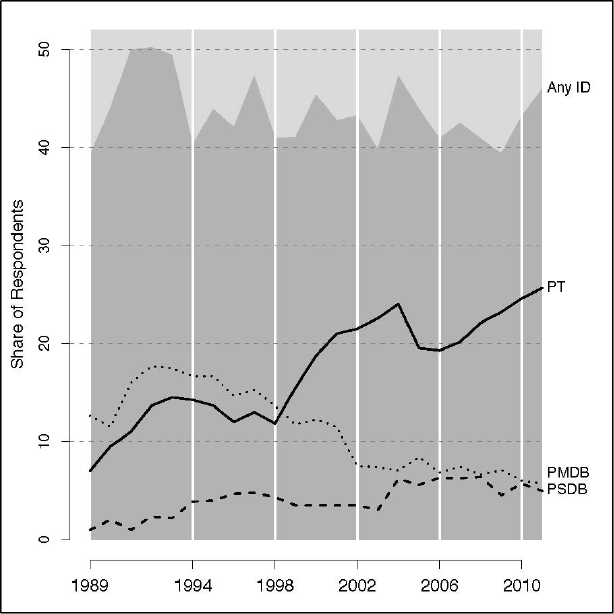
Party Identification in Brazil (1989–2010)
The Datafolha question was open-ended and always phrased the same: “What is your preferred party?” (“Qual é o seu partido político de preferência?”).
Is this self-professed psychological affinity with the PT ‘real’ in the way that scholars conventionally understand partisan identification? Does the PT label serve as an informational cue or shortcut, shaping Brazilians’ perceptions of politics and their vote choices? It is possible that mass partisanship in Brazil is weaker than Figure 1 implies. Perhaps petismo is not a coherent form of party ID and does not shape voters’ perceptions and choices. Or perhaps it is a function of clientelism or of support for Lula. After all, until the 1990s, the PT was largely a party of São Paulo and other urban areas in Brazil's southern and southeastern states. Today, it is a national party; indeed, since at least 2010 – according to Datafolha surveys – petistas have been slightly more prevalent in Brazil's northern, northeastern, and west-central regions than in its historical ‘core’ regions. This means that most petistas today did not grow up in an environment in which petismo was a common form of political identity. Can partisanship emerge in a relatively young democracy, especially one in which the socioeconomic environment appears to be hostile to its emergence among voters (Kitschelt et al. 2010)? In what follows we probe the strength of party labels in Brazil, confirming that petismo is a strong form of partisanship in voters’ minds.
One way to assess the coherence of partisanship at the individual level is to explore the degree to which it is bounded. Partisanship is bounded when individuals identify over time with a particular party or with no particular party and do not switch allegiances between parties. Even in the most highly developed and long-established democracies, self-declared partisans frequently vary between supporting a party and not supporting that party – but they rarely switch between parties.
The only way to assess partisan boundedness is with panel data from surveys. For example, Zuckerman, Dasovic, and Fitzgerald (2007: 43) showed that only about 1 percent of German partisan identifiers picked the same party for the entire length of a 16-year panel study. However, nearly all “picked a side by not picking the other side.” More precisely, on average, 78 percent of those who identified with the SPD in one wave of the panel study picked the SPD in the subsequent wave, 2 percent switched to the CDU/CSU, and 18 percent claimed no partisan identity (Zuckerman, Dasovic, and Fitzgerald 2007: 41). Thus on average, 96 percent of those who identified with the SPD in one wave either repeated that identification or claimed no party ID in the next. The results were similar for the CDU/CSU, indicating that partisanship is highly bounded for those who identify with one of the two main German parties.
Partisanship is not an absolute yes/no phenomenon. Instead, partisans stay on one side of a national political divide and (almost) never cross it. To what extent is partisanship bounded in this way in Brazil? Existing research offers good reasons to believe that partisanship should be only weakly bounded: Most Brazilian voters have comparatively low degrees of education (regarded as key for motivating individuals to develop partisan attachments). Clientelism rather than clear programmatic commitments remains central to political campaigns. Brazil has relatively less experience with competitive elections compared to Germany or other older democracies. The party system is highly fragmented (which might confuse voters and impede the formation of strong psychological attachments to political parties). And, finally, most parties are younger than the current democratic period, meaning that party allegiances cannot have been transmitted to a significant portion of the electorate by parental socialization. To the extent that these arguments matter, mass partisanship should be weakly bounded for all parties.
To assess this question, we draw on data from the 2010 Brazilian Election Panel Study (BEPS), a nationally representative household survey composed of three waves conducted in March/April, August, and November of 2010 (Ames et al. 2010). All waves of the BEPS asked respondents, “Nowadays, do you sympathize with any political party?” (Question VB10). Respondents who answered this question positively were then asked which party they sympathized with (Question VB11). Party names were not read to respondents. The responses to this question were consistent with levels of partisanship in other recent surveys, with about two-thirds of respondents expressing no partisan preference. On average across all three waves, about 21 percent identified with the PT; 5 percent, with the PMDB; and 3 percent, with the PSDB.
To what extent are these forms of partisanship bounded? Table 1 presents respondents’ choices over two consecutive waves of the BEPS. Reading down any column, you can see the proportion of respondents who gave the same or a different response in the subsequent wave of the panel. For example, 58 percent of petista respondents answered ‘PT’ in successive waves; the respective proportions for the other parties were significantly smaller. In addition, although the proportion of petistas who reaffirmed their party affiliation from one wave to the next was lower than for parties in Germany, nearly all petistas “picked a side by not picking a side.” Only 6 percent of those who identified themselves as petistas in one wave of the survey picked a different party in the following wave – a level similar to that for parties in other countries for which panel data exist. Meanwhile, the probability that a PSDB or PMDB identifier in one wave picked that party again in the subsequent wave was lower than a coin flip, and only 76 percent and 78 percent, respectively, “picked a side by not picking a side.” About 1 in 10 PMDB and PSDB identifiers even switched to the PT from one wave to the next! Overall, party ID is fairly well bounded for the PT, but less so for the PMDB and PSDB.
Bounded Partisanship, Brazil 2010
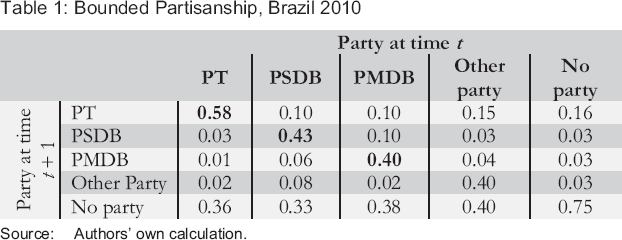
Bounded Partisanship, Brazil 2010
Source: Authors’ own calculation.
The evidence from the BEPS supports the view that partisanship is bounded for the PT in a way relatively similar to that in older democracies; at the very least, it shows that petismo is significantly more bounded than partisanship for other Brazilian parties. Only the PT has managed to develop a brand name that both has broad appeal and is “sticky” – that is, those who choose the PT only rarely cross over to another party. In contrast, neither the PMDB nor the PSDB had substantial numbers of partisans to begin with, and partisan attachments to those two parties are less consistently bounded. Boundedness is not the only element of partisan identity, but it is a crucial measure of the relative psychological coherence and depth of affective partisan attachments.
At this point we know that many Brazilians claim to be petistas and that petistas express their affinity for the PT about as consistently as do supporters of parties in other countries. Another way scholars evaluate the relative coherence of party ID is to assess whether identifying with a particular party shapes voters’ opinions and choices. On this count, the evidence also supports the notion that partisan affiliation in Brazil is ‘real.’ For example, Figure 2 shows that since 1989, those who identify with the president's party have evaluated the president's job performance substantially higher than have those who profess to identify with the main opposition party, while those who identify with other parties and those who identify with no party have rated Lula's performance roughly in between.
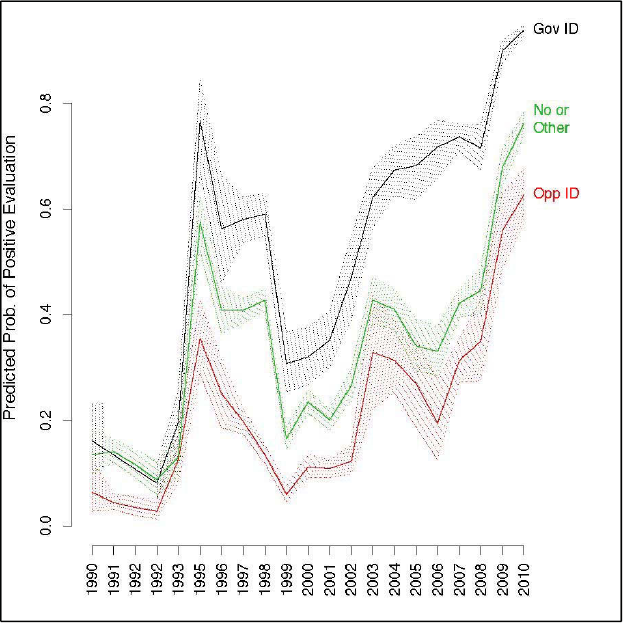
Government Evaluation given Party ID
Likewise, Figure 3 shows that in the first round of all presidential elections between 1989 and 2010, PT identifiers were considerably more likely to vote for PT candidates (Figure 3a) and considerably less likely to vote for PSDB candidates. The same applies in reverse to PSDB identifiers (Figure 3b). (Those who identify with other parties are not shown but behave almost exactly like those with no party ID.) These differences are nontrivial and consistent over time, suggesting that partisanship has shaped and continues to shape voters’ actions and perceptions of the political world just as its conventional definition suggests it should. We note that these two figures are a bit misleading in that they state the probability of approving the government and voting for one's party's candidate given identification with either the PT or the PSDB. It is important to remember that the PT has at least four times as many identifiers as the PSDB, meaning petismo has about four times the impact on swing vote totals as does partisan support for the PSDB.
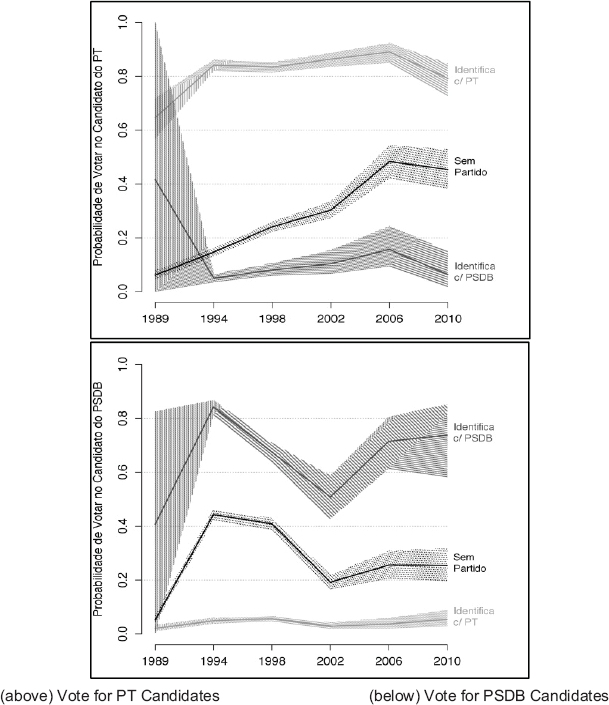
Probability of Voting for PT and PSDB Presidential Candidates given Party ID
Even if we cannot assess the direction of causality between partisanship and voter behavior, the mere existence of the associations shown in Figure 3 suggests that petismo is a relatively strong form of partisan identity. Yet how well does it hold up when tested against potential confounders? There are two commonly offered alternatives to the hypothesis that petismo is a real form of political identity. The first is that petismo is merely a form of proincumbent bias, driven by receipt of clientelistic government benefits – in particular those from the Bolsa Família (BF) (“Family Grant”) program. The second is that petismo is merely a “Lula effect,” a personal affinity with Brazil's beloved former president. In the remainder of this section we analyze the first of these alternatives. Then, in the next section, we consider Lula's role in shaping petismo.
Is petismo nothing more than a superficial reaction to the receipt of government social welfare benefits? Do millions of Brazil's poorest citizens identify the PT as the creator and provider of this often life-transforming source of income and become more likely to declare themselves petistas as a result? To assess this possibility, we again relied on BEPS data. The BEPS, however, was not perfectly designed to answer this question for two reasons: First, respondents were presumably bombarded with information about Lula, the BF, and the PT during the campaign season. Second, BF is not randomly distributed; in fact, it correlates with other attributes that might, in theory, be associated with petismo.
We dealt with the first issue (potential “campaign effects”) by using only the first wave of the BEPS, implemented in March/April 2010. To mitigate the nonrandom assignment to treatment, we balanced the sample by matching BF recipients to similar nonrecipients. We required exact matches on region and income bracket as well as nearest-neighbor matches at the municipal level on development, gender, age, schooling, and respondents’ evaluation of Lula. 3 Our balanced data set had 1,331 observations, roughly equally divided between beneficiaries and nonbeneficiaries.
To improve balance, we allowed for matching with replacement and a two-to-one ratio of control to “treatment” observations, where treated observations are those who received BF.
We then estimated the effects of receiving BF on the probability of identifying with the PT through a simple difference-of-proportions test (between the group that receives BF and the group that does not) and multiple regression logit analysis (controlling for gender, income, age, region, and political activism 4 ). In the test with no controls, identification with the PT is slightly higher among those who received BF benefits than among those who did not (21.5 percent versus 19 percent); however, the effect of BF actually becomes negative once controls are added.
This is an index produced by constructing one-dimensional factor analytic scores from six questions pertaining to political activism that were rescaled to take on values between 0 and 1. The BEPS questions we included were cp5, cp7, cp8, cp9, cp13, and bracp21.
In any case, the results reported graphically in Figure 4 indicate that neither difference is statistically significant. In short, there is no support for the hypothesis that petismo grew during Lula's terms because distribution of BF benefits also grew.
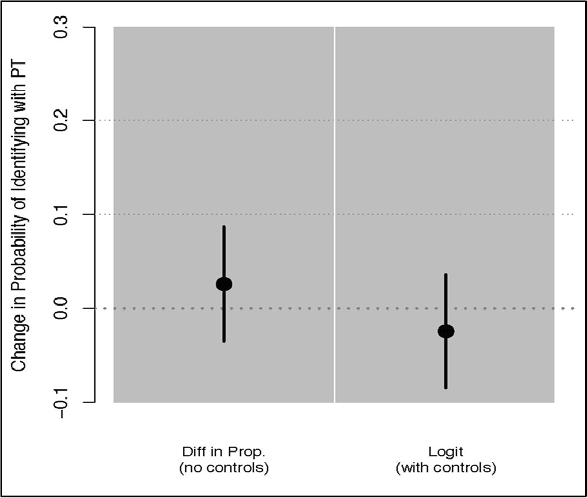
“Effect” of BF on Identification with the PT
Now let us consider whether support for Lula underlies partisanship toward the PT. Samuels (2006) noted that it would come as no surprise if petismo and lulismo were highly correlated. However, he found that support for Lula was a weak predictor of petismo relative to other factors such as political engagement and belief in the efficacy of democracy. Here we reconsider this question with more recent data. The gist of our analysis consists of identifying the extent to which positive attitudes toward Lula increase the probability of voters declaring support for the PT. Our main independent variable comes from the 2010 BEPS question that asked respondents to evaluate the performance of Lula's government.
We recognize that this variable is not a perfect proxy for lulismo, because some voters might have had very positive feelings about Lula but only lukewarm feelings about how well his government performed. Moreover, the observational nature of the data forces us to use instrumental variable (IV) models to deal with the potential endogeneity problem, which is suboptimal relative to an experimental research design. Still, despite these limitations, this is – to our knowledge – the first attempt to begin addressing this question through the systematic analysis of quantitative data.
At first glance, identification with the PT is unsurprisingly higher among those with good evaluations of the Lula government. Identification with the PT was at 27 percent among those who rated Lula's performance as “excellent” and dropped to 3 percent among those who rated it as “very bad.” The differences between those who rated the former president as “fair” and those who rated him as “good” (the two categories that contain the largest share of respondents) was 6 percentage points.
However, these raw results do not take into account the potentially important problem of endogeneity – that is, although support for Lula might increase the probability of identifying with the PT, sympathy for the PT might also increase support for Lula. In fact, approval of Lula in the BEPS was higher among PT identifiers: on a 0–4 scale, the average approval scores were 3.12 among PT identifiers and 2.74 among non-identifiers.
The possibility that lulismo increases petismo and that petismo also increases lulismo means that it is difficult to identify the independent effect of lulismo on petismo. One potential way to address this problem would be to employ IVs – variables that only increase the likelihood of identifying with the PT through their effect on approval for Lula. We considered several potential instruments for approval of Lula, including respondents’ perceptions of the economy and whether they had recently become unemployed.
Perceptions of the state of the economy are a strong predictor of approval of Lula. It is plausible or even likely, however, that people who are petistas would be more inclined to make positive judgments about the economy or even about their own economic well-being under a Lula government than non-petistas. This means that we cannot be confident that those two variables are exogenous to petismo or that they meet the “exclusion restriction.”
On the other hand, it is much easier to defend the idea that, at least in the short run, having lost a job (and remained unemployed) over the last year is not a direct predictor of identification with the PT, except through its effect in lowering one's evaluation of Lula. It turns out, however, that having lost a job and remained unemployed is only a weak instrument for approval of Lula. 5
In the first-stage regression in the presence of controls for gender, education, income, age, region, and activism level, the instrument has a significant negative effect on a five-level variable capturing evaluation of Lula's job performance. The p-value on the instrument is 0.059 and an F-test yields a test statistic of 3.563, which is lower than the rule-of-thumb of 10 for the case of a single endogenous regressor, thus revealing a weak instrument (Stock, Wright, and Yogo 2002).
Figure 5 thus reports changes in the probability of identifying with the PT as evaluations of the Lula government change from “fair” to “good” – the two categories that contain the most respondents in the data set. The first point presents the raw difference found in the data, while the second presents results from a probit regression including controls for gender, education, income, age, region, and activism level. These suggest a small but significant impact of evaluations of Lula on the likelihood of identifying oneself as a petista. This finding is unsurprising – after all, we are not suggesting that pro-Lula sentiment should be unrelated to pro-PT sentiment.
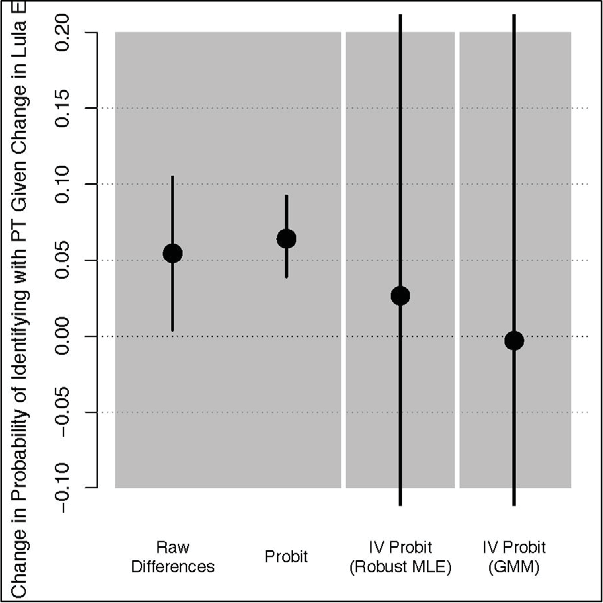
“Effect” of Approval of Lula on Identification with the PT
However, these results do not account for the potentially serious endogeneity problem. The last two point estimates come from IV models that attempt to address this issue. The first IV model uses maximum likelihood estimation (MLE), while the second uses a generalized method of moments (GMM) estimator (Wilde 2008). Both were instrumented for Lula's job evaluation using the “recently unemployed” variable mentioned above.
One should keep in mind that the instrument is relatively weak; therefore the deck is stacked against finding a significant effect. In this sense, it is not surprising that the standard errors are also considerably larger in the IV estimates than in the (noninstrumented) probit analysis. At any rate, and for what it is worth, the estimate of the impact of positive evaluations of Lula on identification with the PT shrinks considerably in the IV models relative to the naive model. In these models shifting from “fair” to “good” provokes increases of 0.02 and just about zero in the probability of identifying with the PT in the MLE and GMM variants of the model, respectively. A linear probability version of the IV models (not reported) yields essentially the same estimate (roughly 1 percentage point change). Weak-instrument problems aside, these point estimates are compatible with the notion that lulismo is not the primary source of petismo (Samuels 2006).
In any event, it is important to remember that there are, and always have been, far more lulistas than petistas. Why do so many lulistas not identify with the PT? The answer, as we suggest in the following section, is that lulismo is an embryonic form of petismo. But creating partisans is harder than generating support for a charismatic politician – thus far, the PT has only been able to convince some Lula supporters to become petistas. Many lulistas remain uninterested in partisan politics and untouched by the PT's recruitment efforts. As we suggest elsewhere (Samuels and Zucco Jr. 2014b), only those Brazilians who both like Lula and who are engaged in civil society activism are likely to become petistas.
So far, we have learned that comparatively speaking Lula is a relative moderate and that petismo is a fairly widespread and very real form of political identity in Brazil. This knowledge allows us to further probe the potential similarities and differences between petismo and lulismo.
Some believe that Lula's support derives from paternalistic clientelism and a charismatic cult of personality based on the connection poor Brazilians draw between their own experiences and Lula's personal trajectory (e.g. Souza 2011: 76). This notion implies that, in Weberian terms, lulismo is distinct from petismo in that the former is akin to charismatic authority bestowed on individual leaders, while the latter is similar to rational-legal authority conferred on organizations. The hypothesis also indirectly suggests that lulistas should have no necessary affinity for the PT.
Another prominent effort to explain lulismo as distinct from petismo comes from Andre Singer (2012), who argues that Lula's reelection in 2006 brought about an ideological awakening among the “subproletariat,” a term he takes from Paul Singer's analysis of Brazilian social structure circa 1980. Andre Singer attempts to explain why Lula's constituency differed so dramatically from the PT's in 2006. His argument is provocative in that he refuses to shave with Ockham's razor – that is, he is opts for a more complicated explanation over the simpler one.
Singer starts by suggesting that the sources of lulismo are economic growth, the expansion of BF provision, increases in the minimum wage, and other policies that improved the welfare of millions of Brazilians (Singer 2009: 94). Like other observers, he acknowledges that millions of Brazilians connected these gains to Lula's efforts in office. This, so far, is the simple explanation: lulismo is a form of retrospective voting. Yet Singer goes several steps further. Although he disagrees with the notions that lulismo is simply about charisma or clientelism, he also argues that lulismo is not simply about retrospective economic evaluations. For Singer, voters’ attribution of improvements in their lives to Lula represents an ideological awakening: “It seems,” he writes (Singer 2009: 96), “that lulismo, upon executing a program of combating inequality within the existing political order, cooked up a new ideological path” that Singer describes as having
incorporated conservative points of view, principally that the conquest of equality does not require a self-organized, class-based movement that breaks with the capitalist order [… and] that a strong state has the duty to protect the poorest, independently of the desire of capital (Singer 2009: 101).
This argument is replete with ambiguity. It is unclear, for example, what sort of ideology (defined traditionally as an integrated system of ideas about how the world works) combines support for progressive attitudes toward government intervention in the economy to reduce inequalities with conservative attitudes toward organized societal interests and capitalism. And in any case, Singer offers no empirical evidence that this ideology actually exists in voters’ minds.
We disagree with the notion that lulismo amounts to a deep and fundamentally conservative ideological awakening of a large portion of Brazil's electorate. What then are the sources and meaning of lulismo? It is true that substantial evidence suggests that retrospective evaluations drove the 2006 presidential election results (Hunter and Power 2007; Soares and Terron 2008; Fenwick 2009; Licio, Castro, and Rennó 2009). Yet how can we explain the disjuncture between Lula's and the PT's vote? There is a simple explanation for both the sources of lulismo and the difference in voter bases between Lula and the PT: poor Brazilian voters, regardless of who is in office, tend to attribute responsibility for improvements in their lives (or to everyone's lives) to the president, but not to the president's party (Zucco 2008). This retrospective voting dynamic is common to multiparty presidential systems around the world (Samuels and Hellwig 2008).
The year 2006 represented an important inflection point in Lula's and the PT's electoral history. Since the party's founding Lula has argued that to win elections and truly transform Brazil, the PT must “reach the segment of society that earns one salário mínimo (minimum wage) or less” (see da Silva 1991: 8). Prior to 2006 neither Lula nor the PT had figured out how to accomplish this goal. Unlike Fernando Collor, and despite his personal backstory, Lula historically lacked appeal among Brazil's “shirtless” class (the descamisados). Instead, his and the PT's base largely consisted of the organized and aspirational middle classes.
In 2006 Lula finally broke through to Brazil's poor. In our view, the explanation is straightforward: the poor rewarded Lula for policies that combined growth with equity, but they did not attribute responsibility for the policies that fostered such gains to the PT. We do not believe that such attributions amount to an ideological awakening. Even if they did – and here we contrast sharply with Singer – to the extent that lulismo is mainly about rewarding Lula for fostering “growth with equity,” then lulismo is not an ideology or psychological phenomenon distinct from petismo, and 2006 does not represent an electoral realignment as Singer suggests. 6
It merits pointing out that the concepts of “realignment” and “critical election” have never been applied to executive elections separately from partisan support (i.e., from legislative elections). It is thus not at all clear that a “presidential-election realignment” can be said to exist as Singer proposes, particularly since when scholars speak of electoral and party-system alignments and realignments, they are referring to the results of legislative elections and/or to levels of partisan identification, not to the results of presidential elections.
We acknowledge that there is relatively less direct evidence that voters rewarded Lula because of his focus on reducing social and economic inequalities than there is for the simple economic voting argument, but the evidence that exists is strongly suggestive. Moreover, this evidence backs our claim that lulismo is a relatively weak psychological phenomenon and did not bring about an electoral realignment as Singer suggests.
For example, analyzing responses to the 2006 Estudo Eleitoral Brasileiro, Rennó and Cabello (2010) reveal (as have others) that many lulistas are nonpartisans and have low socioeconomic status. More importantly, they also show that self-declared petistas have much stronger positive feelings toward Lula than do nonpartisans – a result that should hardly come as a surprise given the PT's history. Nonpartisans may like Lula, but petistas love him and hold his leadership close to their hearts. Rennó and Cabello's findings undercut the notion that lulismo exists as a strong and independent form of political identity or ideology that shapes voter opinions and behavior like partisanship. Instead, they imply that by 2006, lulismo was a relatively weak sentiment among nonpartisans and was largely derived from retrospective evaluations of government performance.
The findings of Nunes et al. (2010) add an important nuance to this interpretation of the sources of lulismo. Based on results from a series of surveys and focus groups in early 2010, the authors found that lulismo was correlated with (1) a positive assessment of the combination of the growth and equity that Lula's policies fostered, especially in comparison to similar results under former president Cardoso, and (2) a more efficacious and participatory understanding of democracy. Unfortunately, unlike Rennó and Cabello, Nunes et al. do not control for partisanship in their empirical analysis, so we cannot distinguish between the relative strength of nonpartisan lulistas’ support for a participatory understanding of democracy and the way that petistas think about participation. It is safe to assume that both partisan and nonpartisan lulistas positively assess Lula's performance in office. It is possible, however, that nonpartisan lulistas care little or not at all about a participatory notion of democracy. And if this is true, then we know that the source and meaning of nonpartisans’ support for Lula in 2006 can be boiled down to positive retrospective evaluations of government performance.
Let us assume for the moment that the findings of Nunes et al. hold for both petista and non-petista lulistas. To the extent that we accept this proposition, two things about their findings merit note: First, greater equality and expanded participatory opportunities correspond precisely to two of the three pillars of the so-called modo petista de governar (“PT way of governing”), with the third being ethical governance. These are the PT's core longstanding principles and were adopted at its origin. Second, valuing equality and participation correlate highly with whether or not a Brazilian declares a partisan affinity for the PT (Samuels 2006) – a point that Nunes et al. did not consider. Samuels (2013) argues that Lula lived up fairly well to the first two pillars of the modo petista de governar, even if his government fell short on the third pillar – and even though, as the 2013 protests indicate, the party never managed to appeal to important segments of Brazil's population, especially the urban middle classes. Still, the important point is that despite political scandals marring Lula's two terms, petismo continued to grow, particularly among Brazilians engaged in social and political activism.
This growth in party ID for the PT reflects the party's historical trajectory. Since its founding the PT has always been relatively more open to grassroots participation than its competitors. The PT hardly embodies a utopian ideal of “participatory democracy,” but it remains far less of an elite electoralist vehicle than Brazil's other main parties. In recent years, the PT has deliberately sought to cultivate partisanship in the electorate by reaching out to Brazilians involved in social and political activism, by expanding its municipal-level organizational reach, by engaging in massive recruitment drives, and by creating channels for members to participate in party politics (Samuels and Zucco 2014b; Montero 2012). Petismo has grown, at least partly, because the party has reached out to Brazilians looking for opportunities to participate in politics on a broader scale, not just voting for this or that politician every couple of years. Petistas, in turn, are activists who are also political pragmatists. They are not much motivated by leftist ideology, but rather by a belief in the efficacy of political participation and social activism – one that they hold relatively more strongly than the average Brazilian.
Certainly Lula's administration made deals with political and economic elites, but Lula deliberately sought to reduce poverty and expand and institutionalize mechanisms of participatory governance to a far greater extent than his predecessors. In our view, it is thus no surprise that voters who benefited from these policies equated Lula's administration with these outcomes. To poor Brazilians with a negative opinion of politicians and extremely low expectations regarding government efficacy, Lula's two terms constitute evidence that government action can improve their lives – that if a politician or a party prioritizes change, it is not impossible to bring about.
The findings of Nunes et al. suggest that lulismo and petismo share similar conceptual roots. Given that the former has broader appeal yet is a psychologically thinner concept, we conceive of lulismo as a form of proto-petismo – quite the opposite from the hypothesis that lulismo is distinct from petismo. And here we note that although Lula's appeal plays strongly among the poor, who tend to classify themselves as conservative (when they respond to such a question on a survey), Singer's argument mistakenly associates lulismo with conservative ideas. If, as Nunes et al. suggest, voters associate Lula's words and deeds with equality of outcomes, a strong state, and greater efficacy of participation in politics, then lulismo in fact embodies social democratic ideals.
Singer's argument requires that lulismo be distinct from petismo, but this overlooks Lula's and the PT's parallel shifts to the political center. For example, it is true that before 2002, Brazilians who identified themselves as petistas also tended to classify themselves as ideologically left of center (Samuels 2006). However, the correlation between leftist self-placement and partisanship toward the PT disappeared that year (Samuels 2013). Even in terms of campaign platforms, the PT and Lula differed little by 2006. Troolin (2012: 30), using the Comparative Manifestos Project coding scheme, discovered that any differences in policy and ideological emphasis between Lula's and the PT's election manifestos had virtually disappeared by 2006 and that their platforms were, on the left-right scale, entirely indistinguishable in 2010.
Overall, at both the elite and mass levels, any dissimilarity in the nature of petismo and lulismo had narrowed, not widened, by 2006. If lulismo is merely about retrospective evaluations of the president, then it is no different from the support that any president receives for a job well done. Barack Obama received about 51 percent of the popular vote in his 2012 reelection – a far greater percentage than there are self-professed Democrats among US voters. In the United States, however, no one speaks of “Obamacrats.” Obama's votes came from his partisan base and from independents who nonetheless chose him over Mitt Romney.
Even if we put his personal appeal back into the equation and highlight how Lula has long sought to “develop motifs and arguments that aim to promote the self-esteem of the dominated while affirming their capacity for individual social mobility,” as French and Fortes (2012: 24) put it, this fundamentally equates lulismo and petismo. In an important sense, Lula personifies petismo – the ideals that the PT has long claimed to stand for. Lula understood that he would have to overcome the self-discrimination manifested in the phrase “pobre não vota em pobre” (“poor people don't vote for poor people”). It was not until 2006, after having proven to the masses that a man without a high school education could successfully govern Brazil, that he was really able to do so. Lula's personal trajectory serves as a role model for tens of millions of Brazilians, encouraging them to assert their interests and engage in the political process, which has generated a slow but notable change in poor Brazilians’ notions of democratic citizenship (Holston 2008). This is exactly what the PT has been attempting to do since the day it was formed.
Our argument is not limited to what Lula says on the campaign trail. When in government, the distance between Lula and the PT was minimal. Unsurprisingly, the PT was Lula's most loyal supporter in Congress. More to the point, Lula's governing strategy was not simply a personal project. It is true that in presidential systems the chief executive and his or her administration tend to overwhelm the influence of the chief executive's party (Samuels and Shugart 2010), yet Lula's political and governing strategies were part of a longstanding partisan project, which the PT had articulated and developed for many years in an attempt to grow and consolidate its power over the long term. Efforts to increase economic, political, and social equality are as much “PT projects” as they are “Lula projects” – perhaps even more so.
Despite falling short on many of those goals, in office Lula and the PT sought to put the modo petista de governar into practice, at least in part. And perhaps for this reason – despite all the party's moderation and accommodation to coalition presidentialism – in terms of mass political identity, petismo today remains associated with an understanding of politics that believes participation is efficacious. Of course, the PT leadership understands the challenge of converting lulismo into petismo – or, more specifically, of converting support for a person into a long-lasting affective attachment to the party. For this reason, it has invested in organizational expansion (Ribeiro 2010) and in cultivating a wider and deeper mass base of support (Samuels and Zucco 2014b). Even if lulismo and petismo are fundamentally similar, it does not necessarily follow that lulistas will become petistas. Unless the PT succeeds in its goals, Lula voters may forget – or may never realize – that the gains they experienced under Lula were part of a partisan project, not just a gift from one man. The 2013 protests also indicate that some voters’ memories may be quite short!
Lula's victory represented not only the election of a charismatic leader and legitimate representative of Brazil's humbler social classes, but also the rise to power of a political party with a powerful organization and a strategic vision for remaking Brazilian society. Ignoring Lula's conscious effort to put PT ideals into practice is willful ignorance. The PT of today is not the PT of 1980, and petismo today is not the petismo of the 1980s. Yet despite having grown and matured, both the PT and Lula retain the DNA they were born with – and both were born of the same DNA.
At the level of individual voters, the Brazilian party system has evolved into a situation that combines solidity and fluidity (“the PT versus the rest”) for the simple reason that while approximately 20–25 percent of Brazilians identify with the PT, no other party consistently obtains more than 5 percent of voters as partisan adherents. But does this matter? Some Brazilian parties have shown they can survive without partisans. The PMDB, for example, receives votes without a deep base of partisan support. Nevertheless, partisanship is a valuable resource that helps solidify a party's electoral support over the long term. Parties like the PFL/DEM, for instance, have withered away partly because their labels mean nothing – neither to politicians nor voters.
Petismo is not a product of clientelistic largesse or the fruit of personalistic identification with Lula. Brazilians who affirm an affinity with the PT not only “pick a side” and rarely stray from that side, their partisanship has the effects that scholars predict it should have: it shapes their opinions on public policies, evaluations of incumbent government performance, and candidate choices (Samuels and Zucco Jr. 2014a). The PT's success in building a partisan following stems from organizational efforts that have linked it to active civil society. In fact, petistas are “activist pragmatists” – that is, people who are not much motivated by ideology and not associated with any particular sociological class, but who value a more participatory approach to politics than is traditional among Brazilians. This suggests that the reason that petismo is far more widespread and more consistent as a form of social identity has to do with what continues to set the PT apart from other Brazilian parties: its organizational structure and its roots in civil society. These roots allowed the PT to water down its ideology but continue to expand its base of support while it was in opposition and in government.
Looking into the future, we are willing to bet that lulismo as a concept will fade from use. After Lula left office, partisanship toward the PT did not dissipate; indeed, it continued to grow for several years. In 2013 Brazil was wracked by nationwide protests against corruption and poor public services. This damaged President Roussef's approval rating and changed the dynamic of the 2014 presidential election. Yet still, the PT remained the most powerful player in the party system and is likely to remain so. Petismo is a solid, lasting phenomenon and is likely to endure long after Lula finally departs the political scene. The PT is not a personalistic vehicle for its leader like the parties associated with other leftist leaders in Latin America, such as Perón or Chávez. For example, lulismo is not peronismo, because Lula has never sought to shape the PT to perpetuate his personal legacy. Peronismo has continued sin Perón, but it might not have continued had Perón not built the informal clientelistic network that sustains the Partido Justicialista to this day. Lula helped build the PT, but the PT is not like the Partido Justicialista. The PT's distinctiveness rests on its formal organization, its ties to organized civil society, and its core goals. Lula remains a powerful player in the PT, but the structure and the goals will remain after he has gone. Peering into our crystal ball, we see the PT as the fulcrum of Brazil's party system. Without it, governance will be difficult. This will occur whether or not Lula is around to guide the party. Petismo will continue, while lulismo will fade – largely because when one scrapes away the ebb and flow of support for Lula (and such fluctuations are normal in any democracy), lulismo and petismo are fundamentally the same. The PT will continue to try to convince Lula supporters – as well as other Brazilians – that the PT is acting in their interests and seeking to make Brazilian democracy more open to and equitable for all. To ensure that it succeeds, the PT is putting both Lula's and the party's ideals into practice.
Footnotes
Appendix
We obtained Datafolha surveys from CESOP, a survey repository at UNICAMP, and directly from Datafolha. The surveys used, and the identifying information, are listed in Table 2.