




Abstract
In the 2019 election, the proportion of women elected to Indonesia’s People’s Representative Assembly (Dewan Perwakilan Rakyat, DPR) increased significantly to almost 21 per cent. In this article, we ask whether an institutional innovation – the introduction of simultaneous presidential and legislative elections – contributed to this change. We examine the election results, demonstrating that, overall, women candidates did particularly well in provinces where the presidential candidate nominated by their party won a majority of the vote. Having established quantitatively a connection between results of the presidential elections and outcomes for women legislative candidates, we turn to our qualitative findings to seek a mechanism explaining this outcome. We argue that the simultaneous elections helped women candidates by easing their access to voters who supported one of the presidential candidates, but who were undecided on the legislative election. Rather than imposing additional burdens on female candidates, simultaneous elections assisted them.
Introduction
Every time there is an election in Indonesia, women’s representation is a topic of public and academic discussion. The focus generally is on whether the number of women elected to the legislature will rise or fall, and the factors driving change. Academics writing on women’s political representation in Indonesia and beyond have identified several sets of factors that affect the rate at which women are elected. Among them, two sets of factors are particularly important. First are factors related to electoral system design, and how the electoral system affects the opportunities available to women candidates, the strategies they adopt and, ultimately, their political success (Amalia, 2009: 94; Budiatri, 2009: 202–209; Lijphart and Aitkin, 1994: 20; Matland, 2013: 4; McAllister and Studlar, 2002: 3; Norris, 2004: 2, 2006: 201; Puskapol, 2009: 35; Roberts et al., 2013). Second are factors related to individual female candidates themselves: for instance, their family relationships with established political elites (Baturo and Gray, 2018; Feinstein, 2010: 575; Fitriyah and Supratiwi, 2018: 44), their financial and political resources (Benoit and Marsh, 2003: 18; Gerber, 2004: 558; Jacobson, 1990: 344; Levitt, 1994: 789; Sweinstani, 2019: 1167), and possible incumbency advantages (Shair-Rosenfield, 2012: 581; Shair-Rosenfield and Hinojosa, 2014: 843).
Many past studies have focused on women’s parliamentary representation in Indonesia by looking at some combination of these two sets of factors, with numerous studies looking at electoral-system design, including the influence of affirmative action policies such as the zipper system and quotas for female candidates (Budiatri, 2011: 1, 25; Hillman, 2017: 39, 2018: 3), and women candidates’ positions on candidate lists (Amalia, 2009: 98, Amalia, 2012: 235, 2017: 206; Puskapol, 2015: 23), but also focusing on candidates, such as in patterns of dynastic politics (Amalia, 2009: 94; Fitriyah and Supratiwi, 2018: 44; Puskapol, 2015: 2). This article focuses on the recent 2019 election, by drawing attention to a factor that has not yet been the subject of much scholarly scrutiny in Indonesia and worldwide, but that also has an important bearing on women’s representation, namely the effect of the introduction of simultaneous legislative and presidential elections. The 2019 election was the first occasion in which Indonesia held its legislative and presidential elections on the same day – in all previous elections since the introduction of presidential elections in 2005, presidential elections have followed legislative elections by a gap of several months; legislative elections typically occurred before parties had even decided which presidential candidate they would support.
Most observers and academics assumed that the simultaneous election would have a negative impact on women’s representation in the legislature. Research in other settings has indicated that simultaneous elections can disadvantage women candidates in legislative races by focusing voters’ and parties’ attention on the presidential campaign, thus making it harder for women to break through with the public and achieve the attention they need (Height, 2019; Sukmajati and Disyacitta, 2019: 88). Even in some of the interviews conducted for this research, female candidates themselves shared similar fears (Interviews with Ela Siti Nuryamah, 13 January 2020; and with Netty Prasetiyani, 17 January 2020).
Contrary to such expectations, in fact, the outcome in 2019 was a significant increase in women’s representation in the People’s Representative Assembly (Dewan Perwakilan Rakyat, DPR). A total of 120 women were elected to the national body, taking 20.9 per cent of the seats (Komisi Pemilihan Umum, Indonesia's General Elections Commission [KPU], 2019). Though this was still a low figure compared to that of men, this was the highest result for women’s representation, not only during the reformasi period (i.e. the period of political reform which began with the downfall of Indonesia’s authoritarian ruler, President Suharto, in 1998), but in Indonesian history. This result represented an increase of about 3.5 per cent from the result in 2014, when women obtained 17.3 per cent of seats (Komisi Pemilihan Umum, Indonesia's General Elections Commission [KPU], 2014).
To examine this outcome, in this article, we present our analysis of nationwide election outcomes for female candidates in the DPR, and draw upon interviews with numerous such candidates (we cite interviews with eleven candidates from six parties and six provinces: Jakarta, West, East, and Central Java, Lampung, and West Nusa Tenggara). We find that one explanation for increased women’s representation is that the introduction of simultaneous elections unexpectedly advantaged female candidates – or at least worked to offset somewhat the disadvantages they mostly face. As has been well established in the literature, female candidates typically face various disadvantages in Indonesian elections, including those related to patriarchal attitudes in society and the generally weaker financial and network resources they have compared to their male counterparts. These disadvantages are particularly severe due to the candidate-centred nature of Indonesia’s open-list proportional representation (PR) system. In 2019, at least some women candidates were able to offset some of these weaknesses by presenting themselves as supporters of one or other of the presidential candidates. Doing so made it easier for women candidates to be accepted by voters, especially voters who already supported a presidential candidate. This dynamic had a direct impact on the number of women elected, with women candidates affiliated enjoying a sort of coattail effect in provinces in which the presidential candidate backed by their party performed well. As stated by Samuels (2000a: 3, 2000b: 241), and Borges and Turgeon (2019: 5), in concurrent elections people’s votes for a presidential candidate can influence their preferences in voting for legislative candidates. Patterns of electoral victories by female legislative candidates, in other words, were affected by the distribution of votes in the presidential election.
We argue that our findings help explain why there was an increase in women’s parliamentary representation in Indonesia in 2019 although of course we recognise that other factors may also have played a part. By presenting our analysis, we hope to contribute to the debate on institutional factors that affect the election of women politicians in Indonesia, and to respond to wider debates concerning female representation worldwide by drawing attention to the role that concurrent elections and coattail effects can play in boosting female parliamentary representation.
We present our argument through five sections. After this introduction, a second section briefly reviews the literature on factors affecting the election of women parliamentary candidates, and surveys why simultaneous presidential and legislative elections might be expected to disadvantage women. The third section presents a general description of the representation of women in the DPR as a result of the 2019 election and links this analysis to voting patterns in the presidential election. In this section, we demonstrate that there was a connection between the rate at which women were elected from parties supporting the two different pairs of presidential–vice presidential candidates, and the results for those candidates across Indonesia’s regions. We show that women candidates did particularly well in areas in which the presidential candidate for their party supported also performed well. In the fourth section, we explain this result by turning to our qualitative findings drawn from interviews with female candidates, who said that they found it easier to campaign by associating themselves with the presidential and vice-presidential candidates supported by their parties. In the last section, we conclude that concurrent elections and coattail effects can play a role in boosting female parliamentary representation by allowing women candidates to identify themselves with the presidential candidates supported by their party.
Simultaneous Elections and the Increase of Women’s Representation
The choice of electoral system and rules implemented in a country will influence the level of women’s representation in parliamentary institutions (Lijphart and Aitkin, 1994: 20; Matland, 2013: 4; McAllister and Studlar, 2002: 3; Norris, 2004: 2, 2006: 201; Roberts et al., 2013: 1558). In the Indonesian case, there has been much focus on Indonesia’s use (since 2009) of open-list PR. On the one hand, compared to majoritarian systems, it is generally agreed that PR provides greater opportunities for a diversity of groups in society to be represented in the legislature (Shugart and Wattenberg, 2003: 9), with this same rule applying to women. However, while closed-list PR (in which voters choose a party and candidates from that party are allocated seats in accordance with their position on the party list) is generally seen as advantaging women (Matland, 2013: 104), the same is not the case with open-list PR systems such as that adopted in Indonesia. In open-list PR, citizens cast their votes for individual candidates, and it is the number of votes each individual candidate attains that determines whether they are allocated a seat. In such systems, the various sources of individual candidate strength – name recognition, incumbency, personal networks, financial resources, and the like – can thus have a significant impact on determining which candidates are elected. Yet, as has been extensively shown in the literature on Indonesia, women candidates – as a result of structural gender inequality in Indonesian society – tend to be weaker in terms of sources of political, social, and financial capital (Shvedova, 2005: 22–32). It is thus not surprising that, despite the introduction of a 30 per cent gender quota on candidate nomination in 2003, the proportion of women elected to the DPR has grown only gradually, from 9.6 per cent in 1999, to 11.7 per cent in 2004, 18 per cent in 2009 before dropping slightly to 17.3 per cent in 2014 (KPU, 2014).
The implementation, for the first time, of a simultaneous legislative and presidential election in 2019 was a significant innovation in Indonesia’s electoral system. It could be assumed this change would also have an impact on female representation. Several candidates said that simultaneous elections placed a double burden on candidates, requiring them to promote not only their own individual candidacy and party but also the presidential candidate supported by their party (Interviews with Ela Siti Nuryamah, 13 January 2020; Netty Prasetiyani, 17 January 2020; Pratiwi Awilda, 15 May 2019; and Rahayu Saraswati, 12 May 2019). Such a burden is likely to be especially heavy for female candidates who, dealing with social attitudes that view politics as a male pursuit, experiencing limits on their financial capacity that are generally greater than their male counterparts, and having less access to sources of political authority in parties and elsewhere, generally face burdens not experienced by their male competitors (Ashe and Stewart, 2012: 688; Beckwith, 2007: 31; Del Prado Lu, 2013: 144; Fattore et al., 2010: 263; Franceschet and Piscopo, 2008: 395; Inglehart and Norris, 2003; Kerevel and Atkeson, 2013: 980; Office for Democratic Institutions and Human Rights (OSCE/ODIHR), 2014: 29; Partini, 2014: 41; Sweinstani, 2018: 308; White and Aspinall, 2019: 10; Interviews with Netty Prasetiyani, 17 January 2020; Dwi Septiawati, 4 July 2019; Endang Sulistyorini, 15 May 2019; Eva Yuliana, 15 January 2020; Sri Wuryani, 8 June 2019; Ela Siti Nuryamah, 13 January 2020; and Pratiwi Awilda, 15 May 2019). As a result, it was predicted prior to the 2019 election that the outcome was likely to be even lower female representation in parliament. According to the result of the nationally representative survey of 2,200 voters conducted by White and Aspinall (2019) in collaboration with Lembaga Survei Indonesia (LSI) after the 2019 elections, 62 per cent of respondents agreed that men are more capable of being political leaders while 78.2 per cent also agreed that men not women must be the heads or leaders of the community, and women must support them. In addition, 49.6 per cent of respondents agreed that women do not have the experience needed for politics and 40.7 per cent respondents said that women were not tough enough for politics (White and Aspinall, 2019: 10).
There are at least two reasons why it was assumed that simultaneous elections would disadvantage female candidates. First, simultaneous elections have the potential to significantly increase the campaign burden experienced by candidates. Indeed, our own qualitative findings confirmed that campaigning for the presidential and vice-presidential candidates nominated by their parties placed a triple burden on legislative candidates. They not only had to prioritise their own personal campaigns, but were also generally expected to support their parties, and now had to support a presidential ticket as well. It might be expected that this additional burden would fall particularly heavily on women candidates, given that women already face unique challenges when standing for elective office, having to battle against stereotypes that see politics as a masculine domain where women do not naturally belong (Ashcroft et al., 2007: 95; Partini, 2014: 41; Sweinstani, 2018: 308).
A second reason concerns the voters, suggesting that in simultaneous elections, stereotypes about female candidates will be more influential when voters determine their choices. Experiences in the USA indicate that simultaneous elections can overwhelm voters with information about national races, reducing the information they are exposed to about candidates and issues at the local level, including female candidates (Anzia and Bernhard, 2019: 12; Oliver and SE, 2007: 3). According to Anzia and Bernhard (2019), lack of information about candidates is the root cause of why voters rely on gender stereotypes when evaluating female candidates, rather than judging them on their merits. Such observations are relevant to the Indonesian case where, as Surbakti (2019) has argued, the complexity of Indonesia’s electoral system presents challenges to voters, overwhelming them with choice among hundreds of individual candidates. In 2019, citizens voted for candidates on five different (and often massive) ballot papers for elections for the presidency, the House of Regional Representatives, and national, provincial and district People’s Representative Councils. Most of these ballot papers contained a large number of parties and candidates.
In this context, it is to be expected that many voters will rely on stereotypes as informational shortcuts to help them make their decisions. This is especially so given that voters were far more interested in the presidential contest than in the legislative races in which female candidates were running: a survey conducted by LIPI found that a majority of voters (50.4 per cent) had decided on their choice of presidential candidate at the time when the Komisi Pemilihan Umum (KPU, the Indonesia’s General Elections Commission) announced the candidates (about six months prior to voting day), whereas only a third of respondents had chosen their legislative candidates or parties three months prior to the poll, and about 29 per cent said they made this decision either within a day of voting or on voting day itself (Figure 1).
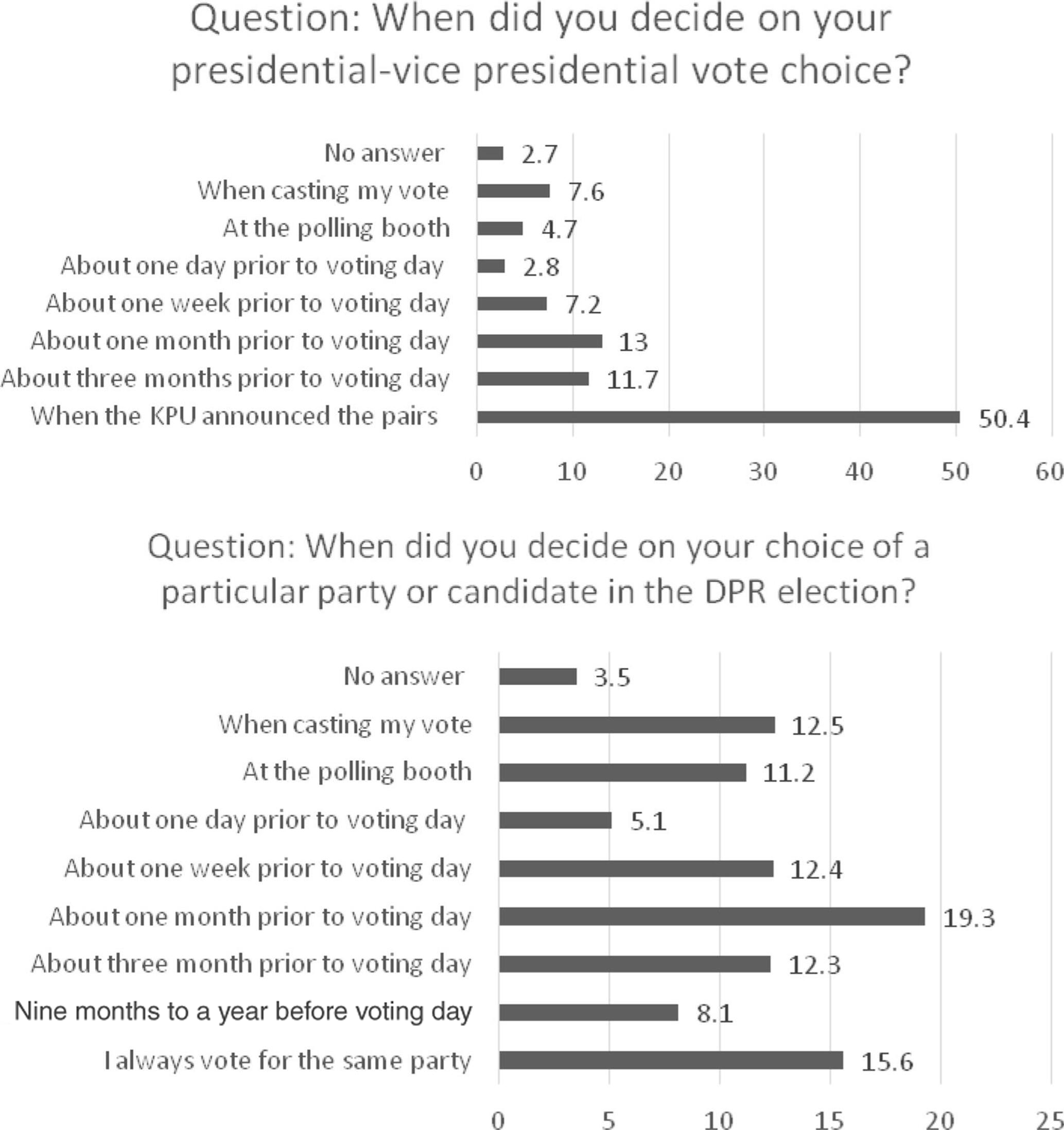
Timing of Voting Choices.
Mapping the Results for Women
Despite these expectations, as already noted, the first simultaneous election in Indonesia produced an increase in female representation in the DPR. According to KPU data, 120 women were elected to the national body, taking 20.9 per cent of the seats, the highest number in Indonesian history, and a significant increase on the 2014 result when women’s representation in the DPR stood at 17.9 per cent. The parties that managed to win seats in the DPR had varying levels of female representation, ranging from 15 per cent to 32 per cent, with the Nasdem Party (Partai Nasdem, National Democrat) party achieving the highest percentage at 32.2 per cent (Figure 2).
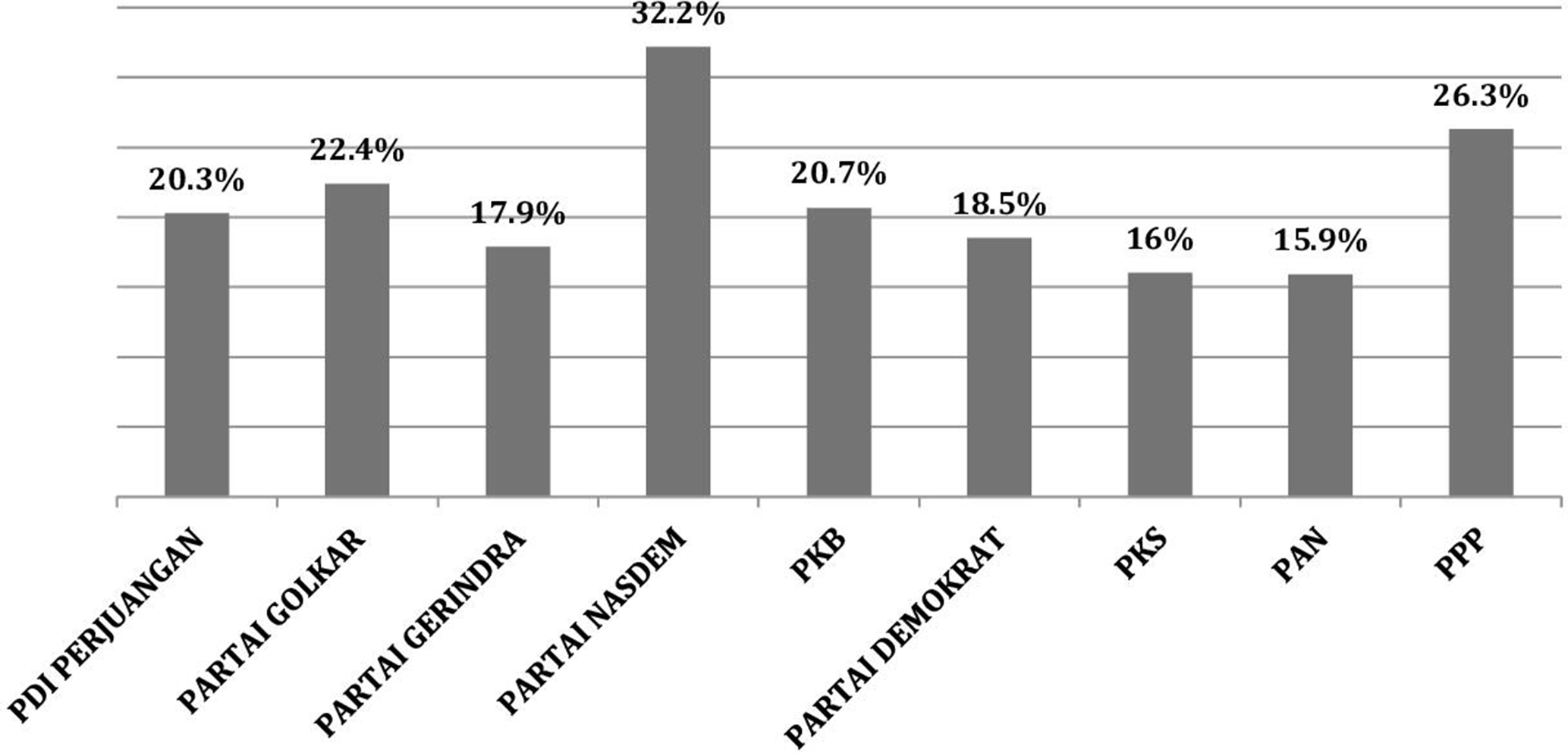
Percentage of Women DPR Members by Party (2019).
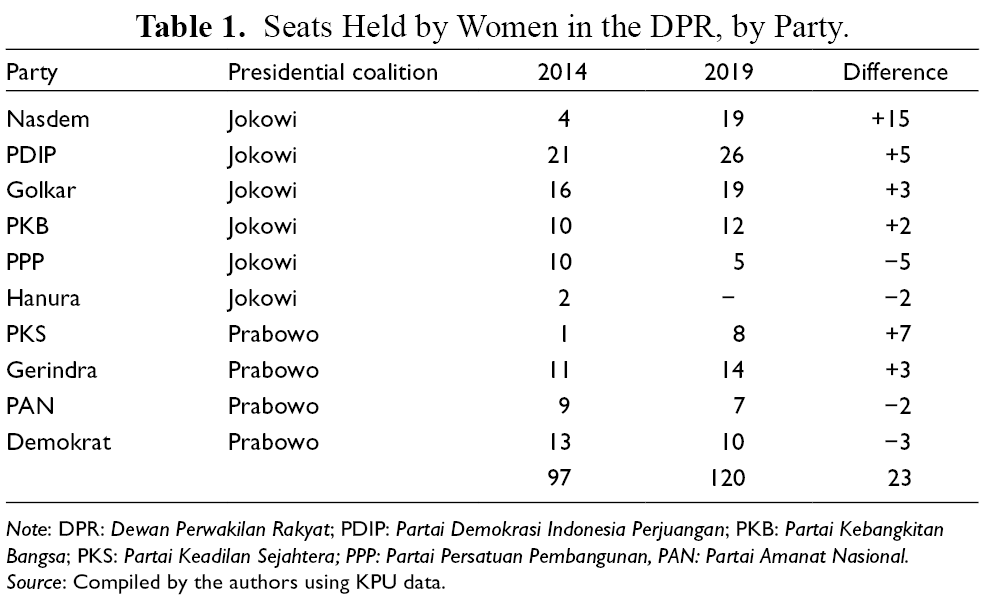
This result translated into an increase of twenty-three seats held by women in the DPR. As indicated in Table 1, the increase was widely distributed across six parties, with four parties experiencing declines in the number of women DPR members. Each of these four parties lost seats overall in 2019, with Hanura Party (Partai Hati Nurani Rakyat, People’s Conscience Party) failing to reach the parliamentary threshold and thus losing all of its DPR seats. The Nasdem Party, part of President Joko Widodo’s (known as Jokowi) coalition, experienced the greatest increase in its number of female DPR members, at fifteen seats, with the Prosperous Justice Party (Partai Keadilan Sejahtera, PKS) – an Islamist party that backed Prabowo Subianto – experiencing the second highest increase at seven seats.
Seats Held by Women in the DPR, by Party.
Note: DPR: Dewan Perwakilan Rakyat; PDIP: Partai Demokrasi Indonesia Perjuangan; PKB: Partai Kebangkitan Bangsa; PKS: Partai Keadilan Sejahtera; PPP: Partai Persatuan Pembangunan, PAN: Partai Amanat Nasional.
Source: Compiled by the authors using KPU data.
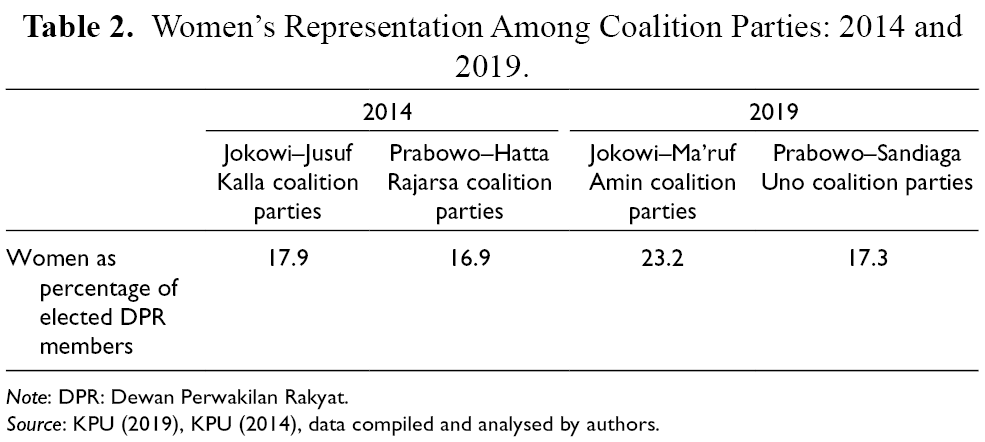
In order to analyse the relationship between these results and the simultaneous nature of the elections in 2019, it is necessary to examine the connection between the presidential and parliamentary results in greater details. The first step is to tease out the figures for women’s representation among the two coalitions of parties that supported each presidential candidate pair. In the 2019 election, the General Election Law required all parties already represented in the DPR (as a result of the 2014 election) to support a presidential–vice presidential pair. In the end, two such pairs were nominated: incumbent Joko Widodo, with Ma’ruf Amin as his running mate, and Prabowo Subianto alongside Sandiaga Uno, supported respectively by coalitions of nine and four parties (Table 1). At first glance, Table 1 indicates that gains and losses in female representation were distributed across parties that supported both presidential candidates. Viewed more closely, it becomes clear that the number of women parliamentarians elected from the coalition of parties supporting incumbent Jokowi, at eighty-one seats, was more than double the thirty-nine seats obtained by the parties backing Prabowo. Almost 70 per cent of the women representatives coming into the new DPR were thus from the Jokowi coalition. It is not surprising that the Jokowi coalition would contribute a higher number of female DPR members given that its parliamentary numbers themselves were greater (it won 60.7 per cent of parliamentary seats), but in percentage terms there was also a difference, with women being 23.2 per cent of the incoming DPR members in the Jokowi coalition, against 17.3 per cent of those from the Prabowo coalition. In fact, both coalitions of parties elected a higher proportion of women DPR members than in 2014. Again the coalition of parties supporting Jokowi performed better, rising from 17.9 per cent in 2014 to 23.2 per cent in 2019. The increase for parties supporting Prabowo was much less: from 16.9 per cent in 2014 to 17.3 per cent (Table 2).
Women’s Representation Among Coalition Parties: 2014 and 2019.
Note: DPR: Dewan Perwakilan Rakyat.
Source: KPU (2019), KPU (2014), data compiled and analysed by authors.
A next step is to look at the geographic distribution of elected women candidates and analyse how that distribution relates to the electoral map in the presidential poll. The 2019 presidential election (even more than previous elections in Indonesia) was marked by uneven geographic distribution of the two candidates’ votes, with Jokowi performing strongly in ethnically Javanese regions and in areas dominated by religious minorities (such as largely Christian Papua and predominantly Hindu Bali), and Prabowo performing well in areas known as having strongly conservative local Islamic traditions (see Aspinall and Mietzner, 2019 for a discussion of this pattern). Taking advantage of this pattern, to pursue our analysis, we divide provinces into groups on the basis of how well each presidential candidate fared in them – whether they lost the popular vote, won it, or won it convincingly (over 59 per cent). We then look at legislative results in these groups of provinces, assessing how women candidates nominated by parties supporting each presidential candidate fared in these groups of provinces, and identifying provinces in which these parties from these coalitions had at least one woman candidate elected. The general pattern we find is that the likelihood of at least one woman from a particular party being elected increased in 2019 in provinces won by the presidential candidate backed by that party. The geographic relationship between the rate of election of women representatives from parties supporting a presidential candidate’s coalition, and a presidential candidate’s own election results was much weaker in the 2014 election when the presidential and parliamentary elections were held on separate timetables.
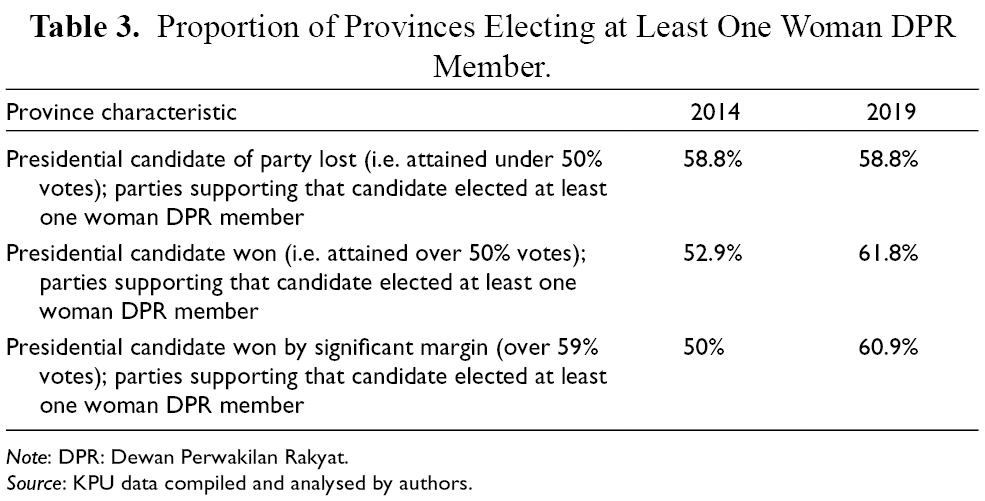
In 2014, in only 50 per cent of provinces in which a presidential candidate won a commanding victory (with over 59 per cent of the vote) did the parties supporting that candidate manage to send at least one female candidate to the DPR (Table 3). In contrast, in 2019 this proportion increased by over 10 per cent to 60.9 per cent. If we broaden the scope to include all regions simply won by a presidential candidate (i.e. with more than 50 per cent of the vote), in 2014 in only 52.9 per cent of such provinces did the parties supporting that candidate manage to have at least one female candidate elected. This figure increased to 61.8 per cent in 2019. By contrast, no such increase in women’s representation among parties supporting a particular presidential candidate occurred in provinces in which that candidate lost: in 2014, parties supporting a particular presidential candidates had victorious female candidates in 58.8 per cent of provinces where that presidential candidate lost (with under 50 per cent of the vote); that figure remained stable at 58.8 per cent in 2019 (Table 3). In short, the introduction of simultaneous elections seemed to generate a connection between female parliamentary representation and the presidential election, with much of the increase in female representation occurring among parties that supported a particular presidential candidate in provinces where that candidate did particularly well.
Proportion of Provinces Electing at Least One Woman DPR Member.
Note: DPR: Dewan Perwakilan Rakyat.
Source: KPU data compiled and analysed by authors.
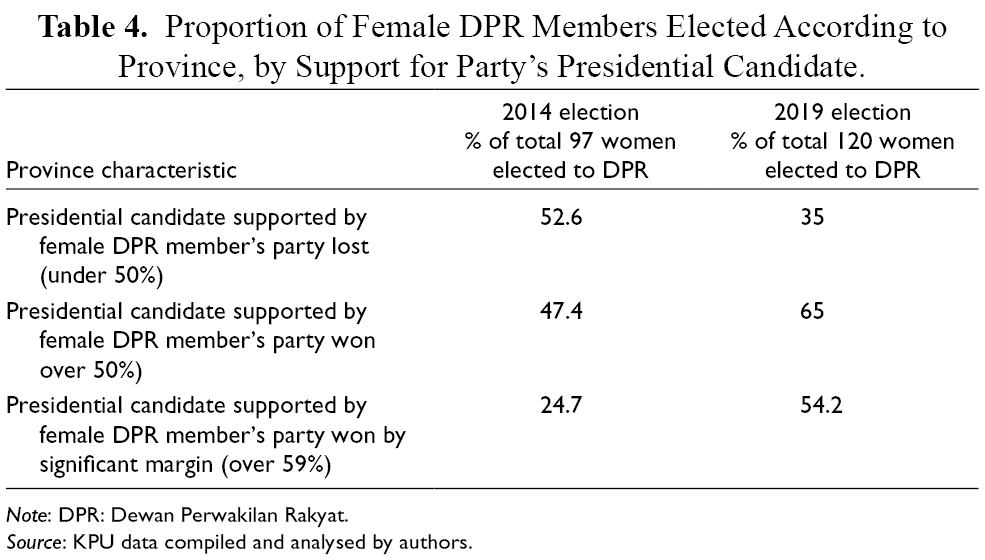
This connection between women’s representation in the DPR and the presidential result is further confirmed when we look at the general pattern in Table 4, which breaks down female DPR representation according to the province of origin of victorious female candidates. It shows that 78 of the 120 female DPR members elected in 2019 (65 per cent) came from provinces where the presidential candidate supported by their party won a majority of the vote. Only 35 per cent (i.e. 42 individuals) were elected in provinces where their party’s nominee lost the popular vote. Again, there is a stark contrast to 2014, when fifty-one of the ninety-seven female DPR members (52.6 per cent) were elected from provinces where the presidential candidate supported by their party later won a majority of the votes, only slightly more than the forty-six (47.4 per cent) elected from areas where their party’s presidential candidate lost. Interestingly, 54.2 per cent of the 120 women candidates elected in 2019, or sixty-five individuals, were elected in provinces where their party’s presidential candidate was dominant, with over 59 per cent of the vote; this was a stark contrast to 2014 when the figure was only 24.7 per cent (twenty-four individuals). Overall, these findings show a trend: female DPR members tended to be elected from provinces where their presidential candidate won. More than half of the women representatives come from provinces where their presidential candidate was dominant. Again, the introduction of simultaneous presidential and parliamentary elections in 2019 seems to have been one factor driving increased women’s representation.
Proportion of Female DPR Members Elected According to Province, by Support for Party’s Presidential Candidate.
Note: DPR: Dewan Perwakilan Rakyat.
Source: KPU data compiled and analysed by authors.
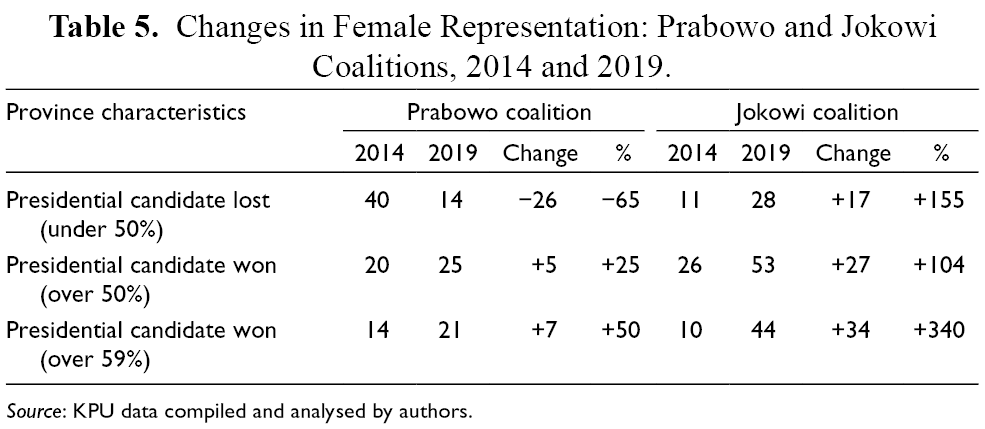
The trend becomes even clearer if we compare the number of women elected from the two coalitions. Table 5 shows that more women were elected from both the Jokowi and Prabowo coalitions in provinces where their presidential candidates performed strongly. The number of women elected from Prabowo’s coalition in provinces where Prabowo did well increased from twenty in 2014 to twenty-five in 2019. The increase in women elected from Jokowi’s coalition parties in regions where Jokowi performed well was even greater: from twenty-six women elected in 2014 to fifty-three in 2019 – more than double. The increases were greatest in provinces where a presidential candidate was dominant (i.e. winning with at least 59 per cent of the vote). The Prabowo coalition recorded an increase in seven women elected – over a 50 per cent increase – in such regions, whereas the increase for Jokowi’s coalition was 340 per cent – from ten women elected in 2014 to forty-four in 2019.
Changes in Female Representation: Prabowo and Jokowi Coalitions, 2014 and 2019.
Source: KPU data compiled and analysed by authors.
In regions where a presidential candidate loses, the pattern is only partly consistent. Certainly, in provinces where Prabowo lost, Table 5 shows that twenty-six fewer women were elected from parties supporting Prabowo than in 2014, a decrease of 65 per cent. In contrast, there was actually an increase in female representation among parties supporting Jokowi where the incumbent president lost (Table 5). However, it should be noted that this increase was highly concentrated in provinces where the president lost the popular vote only narrowly – 79 per cent (twenty-two in total) of the women from Jokowi’s coalition who won seats in such provinces did so in provinces where Jokowi lost narrowly, with 40 per cent–50 per cent of the popular vote.
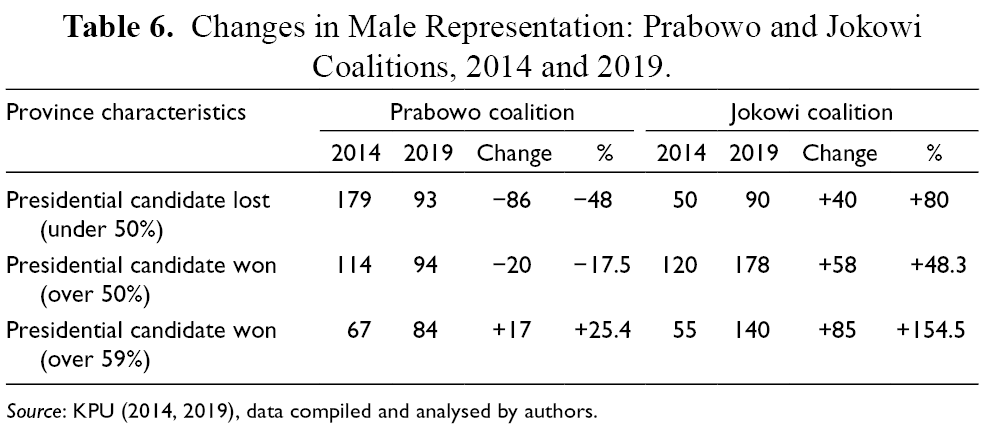
Comparing these results with those for men (Table 6) suggests that women candidates (from both coalitions) enjoyed a much greater advantage than male candidates in provinces won by their coalition’s presidential candidate. Of male candidates, only those from Jokowi’s coalition experienced a boost in provinces won by their candidate, but even here the percentage increase was much lower than that experienced by female candidates (48 per cent versus over 100 per cent in provinces for women where Jokowi won with over 50 per cent of the vote, and 155 per cent versus over 300 per cent in provinces where he won with over 59 per cent). In the Prabowo coalition, meanwhile, male candidates only improved their performance in provinces where Prabowo won with over 59 per cent, and even here their increase (at 25 per cent) was only half that experienced by female candidates; overall, the number of male candidates from the coalition elected actually fell in provinces where Prabowo won over 50 per cent – where the number of women candidates from the coalition increased (Table 5). Overall, if we look at changes in the number of both male and female candidates elected, we can see that their numbers increased most sharply in provinces where their presidential candidates performed strongly (with over 59 per cent), pointing to a general coattail effect, but that even here the increase for women was greater. Overall, the introduction of simultaneous elections involved a significant boost for female candidates when compared to male candidates. 1
Changes in Male Representation: Prabowo and Jokowi Coalitions, 2014 and 2019.
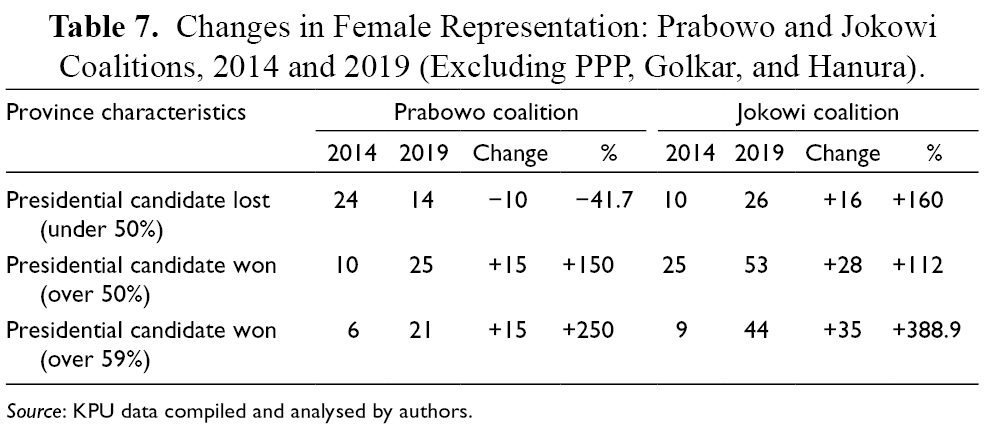
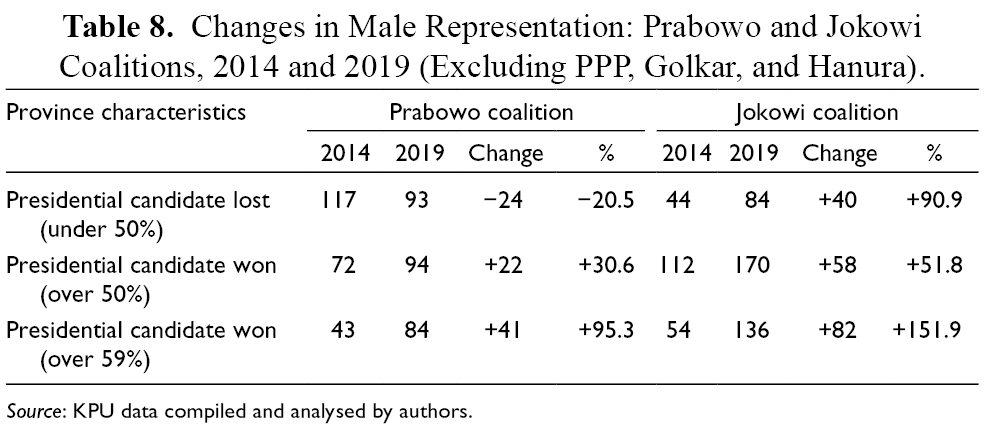
There is one possible complication in this analysis: the coalitions supporting each presidential campaign changed significantly between 2014 and 2019. In particular, two parties – Golkar and PPP (Partai Persatuan Pembangunan, United Development Party) – defected from the Prabowo coalition, which they supported in 2014, and joined the Jokowi coalition in 2019, while another party, Hanura, which supported Jokowi in both elections, failed to meet the 4 per cent parliamentary threshold and thus did not win any seats in 2019. Are the figures presented in Tables 5 and 6 distorted by these changes? To check, we excluded these three parties from the analysis (for both 2014 and 2019) and present the results in Tables 7 and 8. The results strengthen the findings so far: both male and female candidates for the remaining parties experienced a coattail effect, experiencing an increase in representation in provinces where their presidential candidates did well, but the increase for women was more pronounced than for men. In particular, where the relevant presidential candidate won more than 59 per cent of the vote, the increase of men from Jokowi’s coalition winning seats was 152 per cent, while for women it was 389 per cent; for candidates from Prabowo’s coalition the increases were 95 per cent and 250 per cent, respectively.
Changes in Female Representation: Prabowo and Jokowi Coalitions, 2014 and 2019 (Excluding PPP, Golkar, and Hanura).
Source: KPU data compiled and analysed by authors.
Changes in Male Representation: Prabowo and Jokowi Coalitions, 2014 and 2019 (Excluding PPP, Golkar, and Hanura).
Source: KPU data compiled and analysed by authors.
However, it is appropriate that we also examine some regions that were exceptions to the general pattern of an association between a high result for a presidential candidate and the election of women candidates from parties backing that candidate. Of the five provinces recording the highest percentages for Jokowi and Ma’ruf Amin – Bali, Papua, East Nusa Tenggara (NTT), West Papua, and Central Java – parties supporting these candidates sent no women to the DPR in two provinces: Bali and West Papua (in fact, no women at all were elected in these two provinces). The five strongest provinces for Prabowo and Sandiaga Uno were Aceh, West Sumatra, West Nusa Tenggara (NTB), South Kalimantan, and Banten. Parties backing these candidates failed to have women candidates elected in three of these provinces: Aceh, NTB, and South Kalimantan. The failure of the general pattern in these exceptional provinces can likely be explained by gender relations in these provinces. According to data prepared by the research institute Cakra Wikara Indonesia, since the 2009 election Bali has not elected a woman to the DPR (Cakra Wikara Indonesia (CWI) (2018)). West Papua has the lowest Gender Development Index score of any Indonesian province, indicating very low rates of female participation in social and political life (Kementrian Pemberdayaan Perempuan dan Perlindungan Anak dan Badan Pusat Statistik, 2018). In NTB and Aceh, conservative interpretations of Islam are an obstacle to women’s political representation. (Amalia, 2017; Fakih, 2013).
The Impact of Simultaneous Elections on Women’s Campaigns
How might we explain the effects of the introduction of simultaneous elections we have described so far? Why might women candidates have been advantaged in regions where the presidential candidate supported by their parties performed well? In this section, we turn to our fieldwork findings to argue that the fact that presidential and legislative elections were held concurrently provided a boost to campaigns by women candidates, helping to offset at least some of the disadvantages they have previously faced. Those disadvantages are both considerable and well known, and include institutional barriers within the parties, problems of patriarchal culture (Amalia, 2017: 207; Parawansa, 2002: 43), motivation of women themselves to become candidates (Ekawati, 2017: 74), and limited financial resources to fund their campaigns or purchase high list positions from their nominating parties (Prihatini, 2019: 15–16).
The chief mechanism linking the simultaneous election to greater success of female legislative candidates, we argue, is that the presidential campaign provided female candidates with opportunities to reach out to otherwise resistant voters. Numerous female candidates we encountered in the field during our research mentioned that campaigning for a presidential candidate provided them with opportunities to build links with voters who might otherwise not have been interested in their approaches or might have doubted their capacity as a candidate as a result of having patriarchal attitudes. This opportunity, we argue, partly offset the other obstacles women candidates face, and helps explain why it would have benefited female candidates generally: while both male and female candidates had the opportunity to reach out to voters by packaging their personal campaign strategy in the context of the presidential campaign, this approach disproportionately helped weaker candidates, who lacked the networks and resources to make such approaches on their own. Thus, the concurrent election disproportionately helped women. It did not directly overcome any of the obstacles traditionally confronting female candidates – it did not, for example, suddenly mean that female candidates’ financial disadvantages were lessened – but by easing their connections with voters, it somewhat lessened the impact of this financial gap. Moreover, this mechanism only really applied in regions where the relevant presidential candidate pair enjoyed strong support: as we would expect from the figures presented in the tables.
Women candidates themselves often spoke in these terms, explaining that the simultaneous elections made it easier for them to be accepted by voters when they campaigned amongst them. For example, Ledia Hanifah, a PKS candidate in district West Java I (Bandung and Cimahi) explained that, as an individual candidate, she made use of her party’s support for Prabowo when promoting her own campaign. As she explained, many voters she encountered were already firm on their decision to support Prabowo, but were uncertain about their choice of legislative candidate. Ledia used this opportunity to promote her own candidacy, and to promote the PKS, believing that voters who supported Prabowo would be likely to support a legislative candidate they saw seriously supporting Prabowo. Accordingly, she always tried to promote her own candidacy as a “single package” with the presidential campaign, emphasising that Prabowo would need strong supporters in parliament if elected (Interviews with Ledia Hanifah on 13 May 2019, and Rahayu Saraswati, 12 May 2019). In this case, such a dynamic was perhaps not surprising given that West Java is one of the strongest bases of the PKS, and of Prabowo.
But it was not only female incumbents like Ledia and Rahayu who benefited from the coattail effect, newcomers – that is, female candidates who won a DPR seat for the first time – also benefited. 2 Such candidates faced heavier challenges than incumbents in introducing themselves to constituents (Interview with Farah Putri Nahlia on 15 January 2020). Not only were they mostly unable to point to a national-level record of achievement in their electoral district, but most of them had spent much less time than incumbents in visiting all corners of those districts.
All the newcomer female candidates we interviewed – especially those competing in electoral districts where their party’s presidential nominee enjoyed strong support – stated that the simultaneous nature of the 2019 election benefited them. Take, for example, the experiences of Ela Siti Nuryamah, a National Awakening Party (Partai Kebangkitan Bangsa, PKB) candidate – the party closely associated with the traditionalist Islamic organisation, Nahdlatul Ulama (NU) – from the Lampung II electoral district, a strong support base of Jokowi-Maruf Amin. In some regions of her constituency, notably in Central and East Lampung districts, Ela had difficulty gaining access to areas around some of the region’s large and influential pesantren (Islamic boarding schools). This was because Ela did not have a strong local pesantren background, nor was she from the family of any of Lampung’s influential kiai (religious scholars) – factors which can be very influential in NU circles. She faced particular challenges in persuading her constituents – and influential kiai in particular – to accept that a woman candidate like her would be capable of representing the views and the interests of the community. Responding to these challenges, Ela used a strategy of silaturahmi – making respectful visits to various pesantren and community leaders, and she did so by making use of the name of Kiai Ma’ruf Amin – who was not only Jokowi’s vice-presidential pick but the national leader of NU and one of the most respected kiai in the country. She recounted that this strategy was very effective: “It was easy for me to gain entry to the NU big family, because of Kiai Ma’ruf Amin. That helped me quite a bit” (Interview with Ela Siti Nuryamah on 13 January 2020). Not only did she always mention his name, but she always made sure that she began each of her “socialisation” events by promoting the election of Kiai Ma’ruf Amin as vice-president: “Because we were promoting Kiai Ma’ruf, those kiai would come to the socialisations. At the beginning, if I didn’t focus on the presidential election, those kiai wouldn’t want to attend” (Interview with Ela Siti Nuryamah on 13 January 2020).
Farah Puteri Nahlia, a PAN (Partai Amanat Nasional, National Mandate Party) candidate in the West Java IX constituency, had a similar experience. Farah faced particular challenges here, because not only did she not reside in the constituency, but she was also not Sundanese, the majority ethnic group. She said that she could get around these obstacles – and those posed by her gender – by emphasising her support for Prabowo and Sandiaga, who were enthusiastically supported at the grassroots. According to Suherlan (a member of Farah’s campaign team), the enthusiasm of voters for attending and participating in events at which Prabowo and Sandiaga’s campaign was emphasised, was very obvious (Interview, Farah Putri Nahlia, 15 January 2020). Farah also felt that her own supporters were far more militant in areas which were loyal to Prabowo and Sandiaga:
for example, even when we didn’t tell them to do anything, they would be much more creative and take more initiatives. They worked like crazy. Let’s say, we’d ask them to put up just one banner [provided by Farah’s campaign team], but then they’d say – without asking for anything in return – “Miss, I’ll print up my own banners as well, ya”. So it was like a domino effect. I was amazed. There were villages which had an allocation [from the team] of only five or ten banners, and when I came there were twenty banners put up around the village. They’d made them themselves. It was the same with stickers, they’d say “I’ll make some more”. They’d get them printed themselves. (Interview with Farah Puteri Nahlia on 15 January 2020)
Farah felt the results on election day, when it turned out that her personal vote was far greater in areas where Prabowo and Sandiaga also did particularly well, such as South Subang (Interview with Farah Puteri Nahlia on 15 January 2020).
Netty Prasetiyani, a PKS candidate in West Java VIII, likewise realised from the start that, because the province was one of the strongest bases of the Prabowo-Sandiaga campaign, she should boost her own campaign by trying to attract supporters of the presidential ticket. As she explained:
Because Prabowo and Sandiaga were better known than the PKS, this greatly reduced our burden. We’d look at the preference of the community […] if they [were for Prabowo] well then we’d promote them, and I’d look for a way to introduce myself to his supporters but without denigrating other legislative candidates [from the coalition]. I would do it by talking about my own issues and capacity, my commitment […] That could make them notice me, it helped me thicken my support. The point was to get people to think, “Oh, that Ibu Netty, she also supports Prabowo and Sandy.” So that increased their support for me. (Interview with Netty Prasetiyani on 17 January 2020)
In fact, Netty was in a particularly fortunate position. Not only did she promote the presidential and vice-presidential candidates in her own campaign, but she was a member of their official national campaign team called Badan Pemenangan Nasional (BPN, National Winning Agency). In this capacity, the candidates themselves on occasion directly endorsed her. Netty recalled, in particular, that Sandiaga Uno was happy to campaign on her behalf during his visits to small and medium enterprises in her constituency. The results were excellent, with Netty confirming that her personal vote in parts of her constituency that favoured Prabowo and Sandiaga (such as Cirebon) was far higher than in regions that did not (such as Indramayu). As she explained: “I’m convinced the community’s [presidential] preference has a big influence. If they vote for Prabowo, yeah, that means they’ll vote for a legislative candidate from his coalition. Then it’s up to us [the candidates] about how clever we are when it comes to our own strategy” (Interview with Netty Prasetiyani on 17 January 2020).
Eva Yuliana, a candidate for the Nasdem Party in Central Java V also thought there was a strong coattail effect. She viewed the strong support for Jokowi in her constituency – which included the president’s home town of Surakarta – as a major advantage in her own campaigning. She said her position as a member of the coalition supporting Jokowi was an “entry door” (pintu masuk) for constituents, though she also attributed her success to her own hard work in reaching out to voters and convincing them to vote for her, as well as for Jokowi. So convinced is she that she was advantaged by the 2019 arrangements that she hopes that the 2024 elections will also be held simultaneously, and that she will have the opportunity to stand in the same electoral district (Interview with Eva Yuliana, 15 January 2020).
If the simultaneous elections advantaged female candidates who were able to link themselves to their party’s presidential candidate in that candidate’s base areas, it obviously did not have the same effect on women who were running in areas where their presidential candidate was weak. These candidates needed to more actively strategise and improvise when campaigning, falling back on the standard techniques of Indonesian political campaigning. In such cases, these candidates tended to steer clear of the presidential race and instead emphasise their personal achievements and programme of work. One example was Ribka Tjiptaning (Interview, 12 May 2019), a successful candidate (and incumbent) from Partai Demokrasi Indonesia Perjuangan (PDIP, Indonesian Democratic Party for Struggle) who was running in West Java IV electoral district, where Prabowo and Sandiaga Uno enjoyed strong support. She chose to build her campaign around a personal programme of providing free medical treatment to constituents, rather than trying to promote Joko Widodo and Ma’ruf Amin. Likewise, Farah Puteri Nahlia, the PAN candidate discussed above, who relied heavily on her links to the Prabowo campaign in areas where his support was strong, emphasised that she de-emphasised these links and instead relied on her personal characteristics and programme in areas where she knew that Prabowo was weak (Interview, Farah Puteri Nahlia, 15 January 2020).
This exploration of how candidates and parties adjusted to the simultaneous elections helps explain the rise of female parliamentary representation. It has long been recognised that one of the problems with the open-list PR system used by Indonesia is that it places great primacy on the role of individual candidates and their personal networks and financial resources (Shin, 2017: 9). The simultaneous election, by injecting the politics of the presidential race directly into voter and candidate calculations, helped to at least partially offset the primacy of these factors, and thus disproportionately assisted candidates who were weak in these areas. Candidates could overcome personal weaknesses by emphasising their support for a locally popular presidential candidate. This mechanism, we argue, helped to boost women’s representation in 2019. Of course, the offset was far from complete – in the context of open-list competition in which candidates were competing for seats against competitors from the same party, most candidates still rode to power on the basis of their personal resources and name recognition. Moreover, in some regions of the country, candidates who identified with a presidential candidate who was locally weak had to downplay their associations with that candidate and emphasise even more their individual qualities and resources, a factor which might help the geographic patterns explained above. Taken as a whole, the picture helps explain why the simultaneous elections generated an increase, but a relatively modest one, in women’s representation in 2019.
Conclusion
Our findings confirm the well-established analysis that female political representation is affected by two main sets of factors: those related to electoral system design, and those related to the resources that female candidates are able to mobilise. These factors do not stand alone, but interact, especially in how they shape how women candidates design the strategies by which they appeal to voters. The shift in Indonesia’s electoral system that occurred with the introduction of simultaneous presidential and legislative elections in 2019, it turns out, represented an opportunity for women candidates to offset some of their weaknesses in terms of resources, opening opportunities – especially for candidates in areas in which their party’s presidential candidate was performing strongly – to gain access to ordinary voters and to, however indirectly, promote their own campaigns. Many female candidates chose to strongly identify themselves with the presidential candidate promoted by their party, and those who did so often reported being able to gain greater acceptance among voters. This dynamic helps to explain the increase in women’s parliamentary representation that occurred in 2019.
Our findings provide a new perspective on how institutional factors can help increase women’s political representation. Previous studies looking at electoral institutions and women’s representation, both in Indonesia and in other democracies, often focus on affirmative action measures, ranging from reserved seats, the zipper system, and quotas. This study has taken a wider focus and suggests that electoral engineers aiming to boost female representation need to consider a range of solutions, in addition to traditional affirmative action measures. The introduction of simultaneous presidential and parliamentary elections in Indonesia produced an indirect coattail effect that helped increase the number of female representatives in the national legislature. It is to be hoped that additional studies can examine similar electoral arrangements elsewhere, to investigate whether similar dynamics can be found beyond Indonesia.
Footnotes
Acknowledgements
First of all, we would like to express our sincere gratitude to Professor Valina Singka Subekti and Dr Sri Budi Eko Wardani from University of Indonesia for their thoughtful comments and recommendations on this article. Further, we would like to thank women council members and women legislative candidates for taking the time to be interviewed in the midst of their busy schedules. We are also thankful to all the workshop participants and contributors to this special edition for the unforgettable discussion experience. To conclude, we cannot forget to thank Dr Kurniawati Hastuti Dewi and Dian Ratnasari, our colleagues in the Centre for Political Studies, Indonesian Institute of Sciences. This article and the research behind it would not have been possible without their exceptional support since the beginning of this project.
Declaration of Conflicting Interests
The author(s) declared no potential conflicts of interest with respect to the research, authorship, and/or publication of this article.
Funding
The author(s) disclosed receipt of the following financial support for the research, authorship, and/or publication of this article: The research for this special issue was funded by the “Supporting the Rules-Based Order in Southeast Asia” (SEARBO) project, administered by the Department of Political and Social Change at the Australian National University and funded by the Australian Department of Foreign Affairs and Trade. The opinions expressed here are the authors' own and are not meant to represent those of the ANU or DFAT.
Notes
Author Biographies
Email:
Email:
Email:
Email:
Email: