




Abstract
Coalitional presidentialism is a power-sharing strategy deployed in multiparty presidentialist democracies that entails the distribution of cabinet positions to coalition partners to facilitate governability. This model of governance is increasingly common worldwide, gaining growing scholarly interest. The consequences of coalitional presidentialism for women’s cabinet representation, however, have received scant attention. In this article, we provide a gendered analysis of the Brazilian experience with coalitional presidentialism. Through the quantitative analysis of an original dataset of all ministerial appointments (N = 597) under eight Brazilian presidents (1985–2019) and a descriptive assessment of the coalitional dynamics during that period, we evaluate the Brazilian experience with coalitional presidentialism through the lens of Feminist Institutionalism. We show that coalitional presidentialism restricts women's access to cabinet seats, with the demands of multiparty coalition formation and management often overriding presidential considerations about descriptive representation, and coalition parties rarely advancing women to fill portfolios allocated to them by the president.
Introduction
Gender parity cabinets are on the rise, yielding acclaim in popular and academic accounts alike. As of January 2021, thirteen countries have 50 per cent or more women in cabinet positions. Yet the trend is far from universal; only 21.9 per cent of ministers around the world are women (Inter-Parliamentary Union, 2021). Brazil fares far below the global average with women representing just 7.7 per cent of ministerial appointments between 1985 and 2019.
Many constraints condition cabinet composition in highly fragmented multiparty presidential systems such as Brazil's, with governability concerns being prescient. In the interest of managing executive–legislative relations and facilitating governance, chief executives employ power-sharing strategies that include selectively distributing cabinet posts as an enticing carrot to coalition partners (Batista, 2016). Scholarship on coalitional presidentialism derived from and has been particularly insightful for the Brazilian case, where no president has had more than 19.3 per cent co-partisans in the country's lower legislative chamber since 1990. While Brazil is perhaps an extreme case of coalitional presidentialism, this strategy of governance is becoming increasingly common worldwide and has been employed to mediate executive–legislative relations in presidentialist systems in Latin America, Africa, post-Soviet states, and beyond (Chaisty et al., 2014, 2018).
As the coalitional presidentialism literature progresses into its third decade, with coalitional governments now the norm in democracies around the world, concerns over its quid-pro-quo character abound. Largely missing from that conversation, however, are considerations about how strategies deployed affect descriptive representation. What are the implications of coalitional presidentialism for women's cabinet representation? And what factors condition women's opportunities for cabinet appointment under governments employing this governance strategy?
The existing literature offers incomplete answers to these questions. Coalitional presidentialism scholars emphasise ministerial appointments as a tool to facilitate governance deployed by presidents in multiparty systems to attain a congressional majority (Abranches, 1988). Central to this argument is the notion that chief executives’ appointments primarily reflect partisan affiliation requirements rather than demographic characteristics. On the other hand, comparative research on gender and cabinet representation demonstrates the increasing salience of descriptive diversity (such as gender, race, ethnicity, and religiosity) in cabinet formation (Krook and O’Brien, 2012), with the inclusion of women in cabinet positions now normalised and expected, in what Annesley et al. (2019) theorise as a concrete floor. In parliamentary systems, achieving descriptive representation is more challenging in coalition governments (Annesley et al., 2019). How well do these insights travel to ministerial appointments under coalitional presidentialism?
Whereas prime ministers are party leaders and representatives of their parties, presidents enjoy a source of legitimacy independent from their party due to the separate origin of the executive in presidentialist systems. This has two core implications. First, while presidents often enjoy extensive powers to change cabinet size and distribute seats to coalition partners, coalitional instability may impose a recurrent threat to governance (Chaisty et al., 2014), restricting presidents’ ability to prioritise other forms of representation (i.e. descriptive diversity). Second, presidents’ greater discretion comes with a cost: while prime ministers share responsibilities with their party and coalition colleagues, under presidentialism, there is a “heightened attribution of responsibility to a unipersonal executive” (Batista et al., 2022: 1; Samuels and Shugart, 2010: 252).
In gendering coalitional presidentialism, we argue that cabinet formation and management under coalitional presidentialism can have profound consequences for women's representation. Through the quantitative analysis of an original dataset on the gender, political affiliation, and timing of all ministerial appointments (N = 597) during the mandates of eight Brazilian presidents (1985–2019), and a descriptive assessment of the coalitional dynamics under different presidential terms during that period, we evaluate the Brazilian experience with coalitional presidentialism through the lens of Feminist Institutionalism (FI). Our analyses reveal how selectorate capacity – or the ability of the president (and coalition parties) to appoint ministers – and selectorate will to improve diversity drive women's cabinet representation.
Specifically, we find that coalitional presidentialism encourages coalition partners to ignore calls for gender representation, since responsibility for cabinet diversity tends to be ascribed to the president. In the context of unstable coalitions, however, presidents often prioritise partisan representation over descriptive representation. Presidents willing to prioritise women's representation have to bear the costs of their nomination by incorporating them into their own party's portfolios. Ultimately, governance concerns still take precedence, with the number of cabinet posts available to presidents conditioning their capacity to nominate women.
In centring the representational consequences of coalitional presidentialism, this article stands in contrast to most existing accounts, which have tended to emphasise governability while neglecting other dimensions of the quality of democracy. In employing a key case within the coalitional presidentialism literature (Chaisty et al., 2018), this article also contributes to the literature on gender and cabinets by examining cabinet dynamics in a country that provides an interesting representational puzzle: the limited presence of women in legislative office and subnational executives, but the election of a woman to the presidency – a position that grants its occupant the institutional power to affect descriptive representation through the appointment of women to cabinet positions.
Coalitional Presidentialism and Women's Political Representation: An Incongruous Match?
Presidential systems and parties have proliferated worldwide. By 2010, most democracies had directly elected presidents, and the effective number of parties had increased from 2.94 in 1974 to 3.83 by 2005 (Chaisty et al., 2018). In most presidential and parliamentary systems, the parties of heads of government do not attain a majority of parliamentary seat shares, so they form coalitions by distributing cabinet positions (Chaisty et al., 2014, 2018). In both systems, coalition formation procedures are bound not by set rules, but by strongly institutionalised informal norms guiding the decisions of chief executives and coalition partners (Annesley et al., 2019: 69).
While the role of political institutions in procedural dynamics such as cabinet formation and management has been widely studied, the role of gender as an institution has received less attention. Gender, defined as the social construction of identities that signify power and hierarchy between men and women (Mackay et al., 2010), must be understood as part of the institutional dynamics that shape and constrain behaviour. As more women enter the political arena, navigating a space that was largely created by men for men (Acker, 1992), scholars must consider how gender as a signifier and as an institution influences the political process.
Coalitional Presidentialism
Multiparty presidentialist systems pose challenges to governability (Ames, 2002; Mainwaring, 1999; Neumann and Morgenstern, 1944; Shugart and Carey, 1992). As articulated in the coalitional presidentialism literature, presidents in such systems often overcome those challenges by building and maintaining multiparty coalitions that can cultivate a legislative majority, thus compensating for their own party's minority status, and facilitating their realisation of policy goals (Abranches, 1988; Cheibub et al., 2004). Although presidents rely on other tools to synchronise the executive and legislative agendas, the allocation of cabinet seats to coalition members is one of the main strategies employed by presidents in exchange for parties’ electoral and legislative support (Chaisty et al., 2018).
The president, like other actors engaging in coalition negotiation and formation, is “severely constrained by institutional arrangements and prior commitments” (Strom et al., 1994: 303). While the president is the central player in cabinet allocations, coalition parties use cabinet negotiations to further their political objectives, often wielding considerable power in selecting appointees for the portfolios allocated to them (Lopez, 2015). Once presidents choose which party will lead each ministry, they may not have a significant say in who occupies positions allocated to parties other than their own (Chaisty et al., 2018). The power of coalition parties thus constitutes a heavy constraint on the president's appointment powers (Annesley et al., 2019). In addition, while inaugural cabinets tend to give formateurs a seat “bonus,” over time presidents often lose personal capital, increasing the need to redistribute those seats to coalition partners (Chaisty et al., 2018). The need to improve coalescence between parties’ legislative and executive representation is likely to increase during political crises, when presidents’ popularity decreases and cabinet changes become a strategic defence tool (Martínez-Gallardo, 2014; Pereira et al., 2005). Including women's representation in the calculation of cabinet formation and management adds a layer of complexity to those negotiations.
Gender and Cabinet Representation
Research on the gendered dynamics of ministerial appointments has expanded the domain of the women's representation literature from legislatures to cabinets (Adams et al., 2016; Annesley, 2015; Annesley et al., 2019; Beckwith, 2015; Claveria, 2014; Escobar-Lemmon and Taylor-Robinson, 2016; Field, 2020; Franceschet and Thomas, 2015; Krook and O’Brien, 2012; Scherpereel et al., 2020; Siaroff, 2000; Taylor-Robinson and Gleitz, 2018). Those studies demonstrate gendered inequities in the overall process and distribution of cabinet posts, the types of positions allocated to women, and the qualifications of appointees.
Particularly in systems that require executives to select their cabinet appointees from the parliament, limited women's legislative presence can constrain the appointment of women (Adams et al., 2016, 2019; Scherpereel et al., 2020; Taylor-Robinson and Gleitz, 2018). Yet women's legislative representation is neither a necessary nor sufficient condition for increasing women's cabinet representation (Adams et al., 2016; Jacob et al., 2014; Reyes-Housholder, 2016). This should be particularly true in systems like Brazil's, where ministers do not have to be legislators and can be recruited from positions beyond political bodies – including industry and civil society.
Domestic and international norms are also salient, with attention to gender equity in cabinet nominations by previous presidents or neighbouring leaders inducing path dependence in women's cabinet representation (Adams et al., 2016; Annesley et al., 2019; Claveria, 2014; Reyes-Housholder, 2016). Over a decade ago, Escobar-Lemmon and Taylor-Robinson (2005: 840) declared, “It is now unusual for a cabinet not to have at least one woman of full ministerial rank.” As articulated by Annesley et al. (2019), the institutionalisation of the international norm of gender equity in decision making means that, in established democracies, ministerial appointments are now subject to a concrete floor – the minimum number of women for the ministerial team to be perceived as legitimate.
Gendering Coalitional Presidentialism
The Brazilian case presents an opportunity to investigate the implications of coalitional presidentialism for women's cabinet appointments. First, unlike many countries in the world where the adoption of quotas has transformed the gendered composition of legislatures and party leadership (Hughes et al., 2019; Schwindt-Bayer, 2009), women's legislative representation has remained largely constant over time even after the national implementation of the quota law in 1998 and subsequent efforts to strengthen the quota (Gatto and Wylie, 2021; Santos, 2021; Wylie et al., 2019). This provides a stable context to isolate the effects of coalitional presidentialism – and not other changes in the wider dynamics of women's political representation – on women's ministerial presence.
Importantly, the case of Brazil also yields variation in selectorates’ capacity and willingness to nominate women. This allows us to evaluate how coalitional presidentialism dynamics influence presidents’ and coalition partners’ pursuit of women cabinet members. We leverage descriptive insights from the Brazilian case to exemplify our findings. The election of Dilma Rousseff as the first woman president in 2010 and her re-election in 2014 allow us to examine the relationship between the gender of the chief executive, commitments to increased women's descriptive representation, and coalitional presidentialism constraints on cabinet formation and management. Rousseff's impeachment process in 2016 and the ascension of vice-president Michel Temer show how a change in leadership can influence the appointment of women cabinet members in times of crises. Finally, the election of right-wing president Jair Bolsonaro in 2018 allows us to consider whether a refusal to employ coalitional presidentialism opens opportunities for women's ministerial representation. The focus on gendered institutional constraints under coalitional presidentialism makes a Feminist Institutionalist analysis the ideal theoretical approach to connecting gender, coalitional presidentialism, and cabinet appointments.
Drawing from the New Institutionalist literature (March and Olsen, 1996; North, 1990; Steinmo et al., 1992), FI centres on the role of gender in institutional development and change, and how such gendered processes empower and constrain political actors (Adams and Smrek, 2018; Mackay and Krook, 2011; Mackay et al., 2010; Waylen, 2014). While Annesley et al. (2019) apply FI to better understand the dynamics behind cabinet appointments in seven countries (including two presidential systems), to our knowledge there has been no work employing the framework to address the gendered idiosyncrasies of coalitional presidentialism.
The key to understanding coalitional presidentialism in the context of FI is to place gender at the centre of an analysis of cabinet allocation and coalitional dynamics, paying close attention to the processes that influence the structural and agentic factors underlying cabinet appointments. More specifically, we must understand how formal and informal rules driving cabinet appointments may influence women and men in distinct ways, leading to gendered opportunities and constraints on selectors and eligible nominees.
We argue that coalitional presidentialism dynamics – in particular, the necessity of forming and managing multiparty coalitions – influence the capacity and will of selectors to nominate women. Capacity speaks to presidential and coalition parties’ ability to appoint cabinet members and its consequences for the nomination of women to cabinet positions. Will relates to selectors’ own commitments (and the pressures they face) to enhance women's cabinet representation. Coalitional presidentialism dynamics may independently shape capacity and will, and often influence both simultaneously. Capacity and will may also be interdependent: changes in capacity may influence selectors’ will to nominate women; in turn, selectors’ own will (or will imposed by political pressures) may motivate selectors to increase capacity. Finally, because responsibility allocation is centred around presidents, the same factors may impact the capacity and will of different selectors – namely, presidents and coalition partners – in distinct ways. Understanding these complex dynamics is an important step towards better understanding the formal and informal constraints coalitional presidentialism poses to attempts to increase cabinet diversity.
Drawing on the literature on the consequences of the district and party magnitude for women's representation (Matland and Studlar, 1996), we expect the relative scarcity of appointments extended to each individual party in the coalition to come at the cost of women's appointment. Parties with one or few seats will likely nominate top party leaders, who are typically men (Gatto and Thomé, 2020; Morgan and Hinojosa, 2018; Wylie, 2018). Parties with more positions to distribute will have a greater capacity to nominate ministers, and thus be better positioned to appoint women. Presidents are likely to retain discretion over the largest share of cabinet seats and divvy up the remaining seats among coalition partners. Compared to the president's party, coalition partners thus tend to be allocated fewer cabinet portfolios, so we expect coalition partners to have lower capacity and be less likely to nominate women ministers. Moreover, under coalitional presidentialism, presidents often do not have control over the selection of ministers for portfolios allocated to coalition partners. Yet presidents are still publicly viewed as responsible for the overall representativeness of their cabinets, which should, in turn, shape their will to nominate women. As such, we expect that nominations made for the purposes of achieving higher descriptive representation will largely be absorbed by seats over which the president has discretion – namely, those that are allocated to presidents’ co-partisans or to non-partisans. We hypothesise that:
H1: Women are more likely to be appointed when their party's portfolio allocation is high.
Previous research indicates that larger cabinets tend to have more women (Claveria, 2014). Presidents have the ability to create and terminate ministries, and as such, cabinet size has varied greatly since the return to democracy in Brazil. This means that when they have the will to nominate women, presidents are in a position to increase capacity through the creation of a new ministry. 1 But while larger cabinets entail more positions to distribute, more seats overall do not necessarily result in more positions for each party in the coalition and may instead reflect a president's need to build a larger (but more fragmented) coalition to maintain governance. The gendered implications of cabinet size are thus not straightforward: on the one hand, cabinet size may reflect a president's attempt to increase their capacity to nominate women; on the other hand, it may reflect their need to accommodate demands from a greater number of coalition parties, thus reducing their capacity to appoint women. We outline alternative hypotheses:
H2a: Women are more likely to be appointed when the cabinet size is high.
H2b: Women are less likely to be appointed when cabinet size is high.
We also expect that concerns of descriptive representation will be heightened in presidents’ widely publicised and photographed inaugural cabinets, which tend to be subject to greater societal scrutiny than reshuffled cabinets. Earlier in their terms, presidents’ recent electoral success tends to yield greater legitimacy and popularity, which typically grants the formateur a seat “bonus,” in turn improving their capacity to nominate women. This timing consideration should be particularly important for seats under presidential discretion.
H3: Women are less likely to be appointed later in presidential terms.
Annesley et al. (2019) delineate experiential criteria as influential for women's cabinet appointments. An important manifestation of experiential criteria is women's political experience; if women are not represented in the legislature, their likelihood of cabinet representation will be diminished. Under coalitional presidentialism, women's legislative representation may increase the capacity (supply of experienced women to occupy cabinet posts) and will (pressures from women co-partisans) of formateurs to nominate women. Although women have held no more than 15 per cent of seats in the lower house during the years under observation (1985–2019) that aggregate figure obscures substantial interparty variation that may offer explanatory power for understanding ministerial representation. As such, we expect that:
H4: Women are more likely to be appointed by parties with higher shares of women legislators.
Women's appointments are likely shaped not only by presidents’ and coalition partners’ varied capacity to nominate women, but also by formateurs’ will to increase descriptive representation. In Brazil and elsewhere, leftist parties have historically been more supportive (at least rhetorically) of gender equity than non-leftist parties (Kittilson, 2006; Wylie, 2018; but see Funk et al., 2017). Because of their party's commitment to gender equity and/or their own identities or personal networks, some presidents may be more willing than others to make intentional efforts to nominate women to cabinets. Since Brazil's return to democracy, only two presidents hailed from a party with an institutionalised commitment to women's representation: Luiz Inácio da Silva (popularly known as Lula) and Dilma Rousseff, both from the Workers’ Party (PT). We also expect women presidents to have a larger network of trusted women political actors and a greater will to nominate women (Annesley et al., 2019; Barnes and O’Brien, 2018; Krook and O’Brien, 2012; Reyes-Housholder, 2016), particularly for cabinet posts under presidential discretion. Finally, building on the concrete floor discussion (Annesley et al., 2019), we expect women's cabinet representation to be path dependent, with prior levels of women ministers increasing societal expectations for cabinet diversity, in turn increasing pressures for presidents to appoint women. We expect that:
H5: Women are more likely to be appointed to portfolios held by leftist parties. H6: Women are more likely to be appointed by a woman president. H7: Women are more likely to be appointed after other women ministers have been appointed.
Data and Method
Previous coalitional presidentialism studies have been mostly concerned with legislative and executive partisan coalescence (Amorim Neto, 1998; Chaisty et al., 2018). As a result, existing datasets normally track the allocation of ministries, but do not contain information on ministers. 2 Our focus on women's descriptive representation thus led us to compile an original dataset that includes all 597 ministers appointed between 1985 and 2019, encompassing the full ministerial compositions of ten administrations (seven presidents), as well as the inaugural cabinet of Jair Bolsonaro (elected in 2018). We include all titular ministers listed by the Office of the Presidency, excluding individuals who served as interims. 3 Descriptive statistics for all variables are available in Appendix A.
Our study seeks to understand how selectors’ capacity and will under coalitional presidentialism influence the individual-level appointments of women. Our main dependent variable indicates ministers’ gender. This variable takes a value of one when the minister is a woman and a value of zero otherwise. Women account for forty-six (7.71 per cent) of our observations.
To test H1, we employ the measure party portfolio allocation, which captures the total number of cabinet positions a minister's party has at the time of their appointment. For ministers in portfolios under presidential discretion (i.e. who belong to the president's party or are non-partisan), party portfolio allocation is equal to the sum of cabinet posts allocated to the president's party and to non-partisans in the inaugural cabinet. As previously detailed, we expect this measure to affect women's nominations through formateurs’ capacity.
Another set of variables shapes the capacity and will to appoint women. We test H2a and H2b with the variable cabinet size, which corresponds to the number of ministries during each presidential term. To account for the timing of appointments (H3), we employ the variable days since inauguration, counting the number of days between the president's inauguration and the minister's appointment. We test H4 with the number of women deputies in ministers’ respective parties. 4 Given that ministers without partisan affiliation are chosen by the president, we assign the number of women in the president's party to ministers without official partisan affiliation.
We assess the will to appoint women by controlling for three variables. Party left-right ideology is from Power and Zucco Jr. (2009) and Power and Rodrigues-Silveira (2019), which use national legislators’ survey responses on political parties’ reputation in legislative behaviour to calculate an ideological score for each political party operating in Brazil in the period between 1991 and 2019. We assign the ideology score of the president's party to non-partisan ministers (H5). Second, to examine whether the president's gender shapes their will to nominate women (H6), we employ a binary variable that takes a value of one for those appointed under Rousseff and zero otherwise. Third, to account for whether women's appointments are influenced by a previously established “concrete floor” (H7) and changing normative demands for women's representation, we control for gendered cabinets, which measure the share of cabinet seats occupied by women in the previous administration.
Because presidents and coalition partners have different roles in building and managing coalitions, we expect the above factors to shape the capacity and will of each type of selector to appoint women distinctly. To account for whether a cabinet seat is under the president's discretion, we code a binary variable which equals one for ministers who are members of the president's party or those who have no publicly available partisan affiliation 5 and zero for ministers affiliated to a party that is a coalition partner. This variable is highly correlated with other coalitional dynamics (e.g. number of portfolios and cabinet size), so, instead of including it as an independent variable in our model, we use it to estimate models restricted to appointments made under presidents’ discretion. These models allow us to examine whether the above-detailed factors operate differently when only considering appointments made by presidents.
Analysis
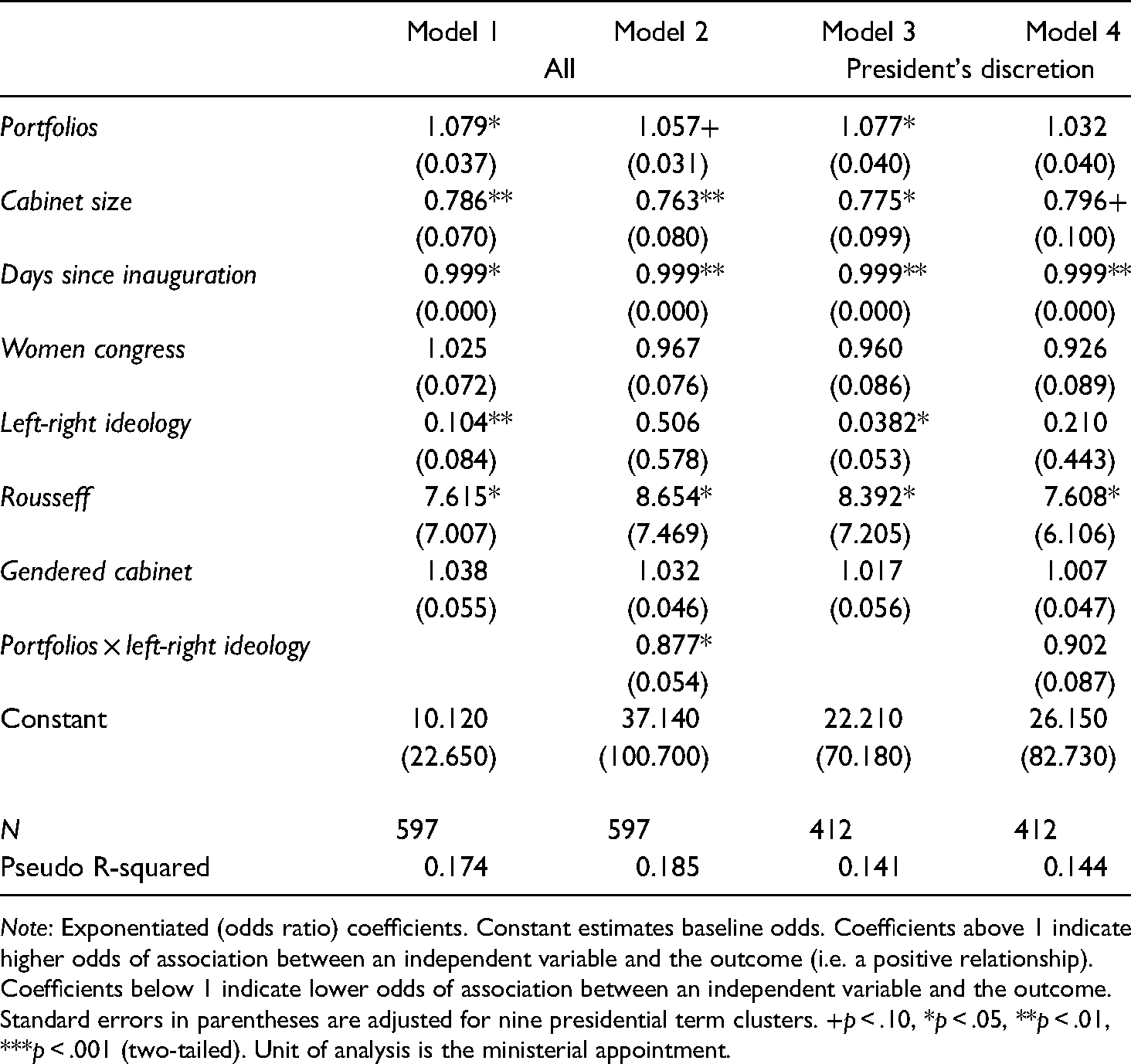
We test our hypotheses with logistic regressions with standard errors clustered by presidential term. Table 1 summarises our results from two full models of all cases and two models restricted to ministers appointed to seats under a president's discretion.
Coalitional Presidentialism Dynamics and Women's Cabinet Appointments, Logistic Models.
Note: Exponentiated (odds ratio) coefficients. Constant estimates baseline odds. Coefficients above 1 indicate higher odds of association between an independent variable and the outcome (i.e. a positive relationship). Coefficients below 1 indicate lower odds of association between an independent variable and the outcome. Standard errors in parentheses are adjusted for nine presidential term clusters. +p < .10, *p < .05, **p < .01, ***p < .001 (two-tailed). Unit of analysis is the ministerial appointment.
As shown in Table 1, variables associated with both capacity and will influence women's cabinet representation. H1 anticipated that the number of portfolios allocated to a given party would increase the prospects of women's nomination. Indeed, as portfolio allocation increases from one to twenty-four (the maximum number of portfolios under a president's discretion or allocated to a single party) and other variables are held at their means (for model 1), the predicted probability that a woman is a nominee increases from 1.2 per cent to 6.9 per cent. The variable produces statistically significant coefficients of similar magnitude for the unrestricted and restricted models (models 1 and 3).
But portfolio allocations vary widely, with coalition partners having an average allocation of 2.5 cabinet seats, while presidents hold an average of 19.4 seats under their discretion. As such, although the influence of portfolio allocation on women's appointment seems substantively small, the large discrepancy between the number of portfolios held by presidents and coalition partners means that different selectors have distinct levels of capacity to appoint women – and that variation in portfolio allocation is most consequential for appointments under presidential discretion, where the vast majority of women's ministerial appointments occur.
Because of its potential to affect capacity and will and, in turn, shape women's likelihood of appointment in different directions, we outlined alternative hypotheses for cabinet size. Our results indicate support for H2b and show that, as cabinet size increases, the likelihood of women's appointment decreases – suggesting that cabinet size increases tend to accommodate demands of coalitional (i.e. partisan) representation, not descriptive diversity. Indeed, and aligned with the literature on coalitional presidentialism, bivariate analyses suggest that cabinet size is positively correlated with cabinet fragmentation 6 (the number of parties in a coalition) (Pearson's r = 0.424***) but is not correlated with portfolio allocation – an indication that presidents likely inflate their cabinets to bring more parties to the table without compromising the number of portfolios they can allocate to their own party or key coalition partners.
The timing of appointments also affects selectorate capacity and will to appoint women (H3), with days since inauguration exercising a negative effect on the probability that a minister is a woman. Pressures to appoint women are typically greatest in widely publicised inaugural cabinets, precisely when formateurs generally enjoy their greatest latitude. Once the honeymoon period expires, cabinet shuffles tend to be motivated by partisan concerns rather than descriptive representation.
Our expectation that women's appointment prospects would be greater in parties with more women deputies (H4) was not supported. This null finding points to correlations between this variable and two of our covariates that shape will: Left-right ideology and Rousseff, both of which are statistically significant.
We stipulated three hypotheses about selectorate will, with mixed findings. As anticipated in H5, leftist ideology is associated with an increase in the likelihood of women's appointment: holding other variables at their means (for model 1), the likelihood of women's appointment for a party in the far-left (with an ideology score of−1) is 23.5 per cent; this falls to 3.1 per cent for parties at the centre (with an ideology score of 0) and to 0.03 per cent for parties at the far-right (with an ideology score of 1). 7 The predicted effect of ideology is more pronounced in our restricted model, with the likelihood of the minister appointed being a woman falling from 48.7 per cent for left-wing presidents with an ideology score of −1 to 0.14 per cent for far-right presidents with a score of 1.
Rousseff's presidential terms are also associated with a higher likelihood of women's appointment, as outlined in H6. With other variables at their means (for model 1), the predicted probability of women's appointment in other presidential terms was 2.2 per cent; under Rousseff, the likelihood that a minister was a woman was 14.4 per cent. Unsurprisingly, the variable's effect is more substantively pronounced in our restricted model, which only accounts for seats under presidential discretion. For model 3, the predicted likelihood of the appointee being a woman increases from 3.8 per cent to 24.9 per cent under Rousseff; this indicates that Brazil's first woman president had a greater level of capacity to nominate women to posts to which she had full control.
Contrary to expectations implied by the “concrete floor” concept (H7), the precedent of more gender-egalitarian cabinets does not increase the likelihood that a minister is a woman. Women's cabinet representation in Brazil has instead followed the “see-saw” pattern articulated in Scherpereel et al. (2020), corresponding to selectors’ fluctuating capacity and will. As we discuss, however, pressures to diversify the all-white male cabinet put in place after Rousseff's impeachment anecdotally suggest that a “concrete floor” may be brewing in Brazil.
Finally, we assess how the positive effects of a greater will to appoint women ministers interact with selectorate capacity with the interaction term, portfolios-left-right ideology. Results are illustrative of our theoretical expectations about the interactions between capacity and will: as summarised by model 2, the interaction is statistically significant, the main effect of portfolios becomes more tenuous than in model 1, and the main effect of left-right ideology loses statistical significance, suggesting that the positive influence of selectors’ capacity on women's appointment prospects hinges on selectors’ will to appoint women. Figure 1 displays the predicted probabilities of this interaction, revealing that the boost portfolio allocation offers to women's ministerial prospects holds only for leftist parties.
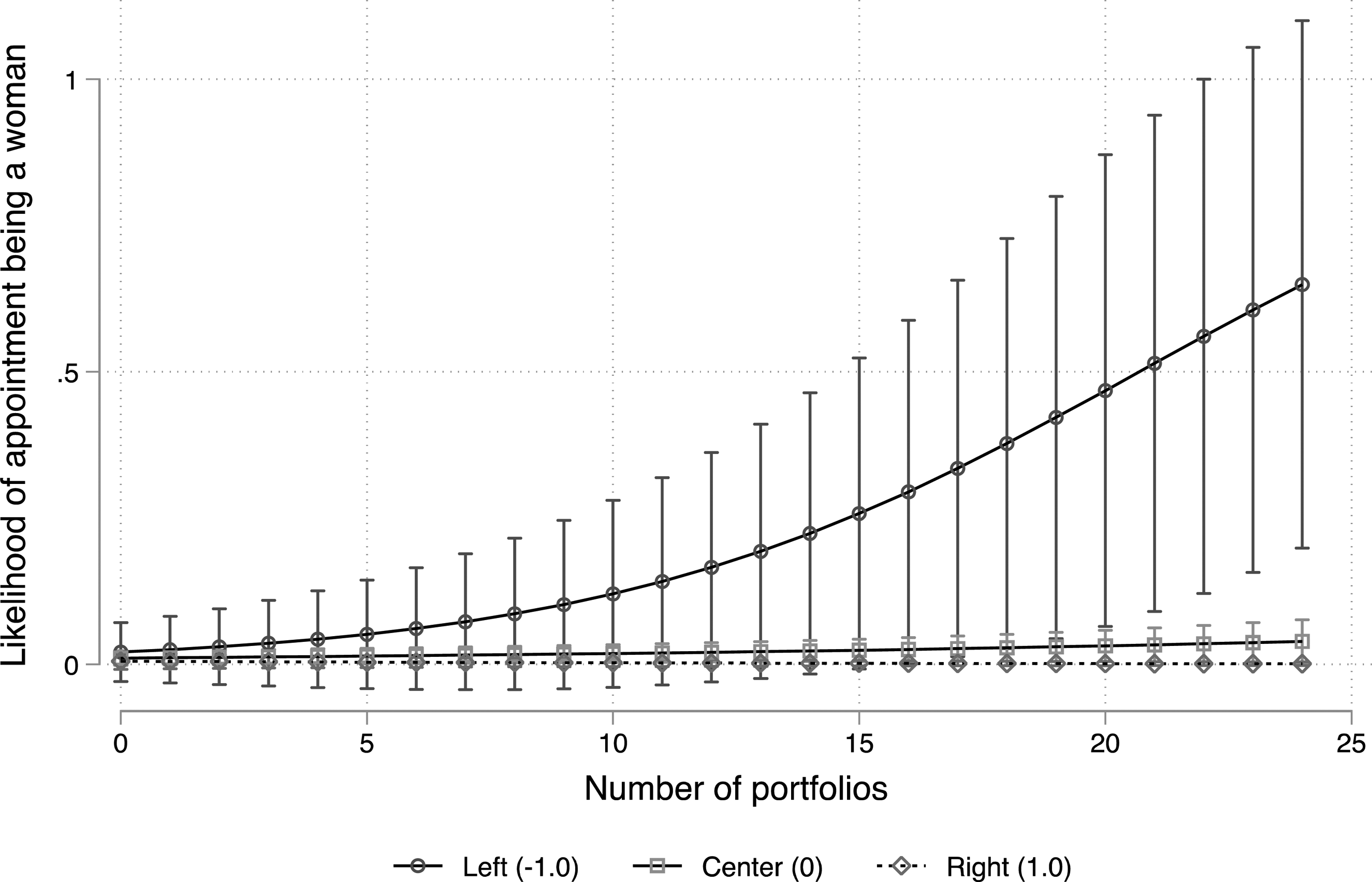
Likelihood of Appointment Being a Woman When Capacity (Portfolios) Interacts With Will (Left-Right Ideology).
Discussion
A descriptive assessment of women's appointments in different presidential terms provides deeper insight into the mechanisms through which the factors uncovered in our models as statistically significant shape women's likelihood of appointment, and illuminates how capacity and will interact on the ground.
As shown in Figure 2, presidents have discretion over a much higher number of portfolios than coalition partners. This gives presidents greater capacity to accommodate women. In addition, since parties tend to use ministerial positions as a reward for their most senior leaders, the underrepresentation of women in most parties’ leadership structures (Araújo et al., 2018; Wylie, 2018; Wylie and dos Santos, 2016) decreases their chances of being the chosen representatives of their parties’ interests in a cabinet coalition – with presidents claiming to have no power over who occupies seats allocated to parties other than their own. As such, while women ministers have also come from non-partisan, technocratic backgrounds, women have always represented a paltry share of nominations from coalition partners.
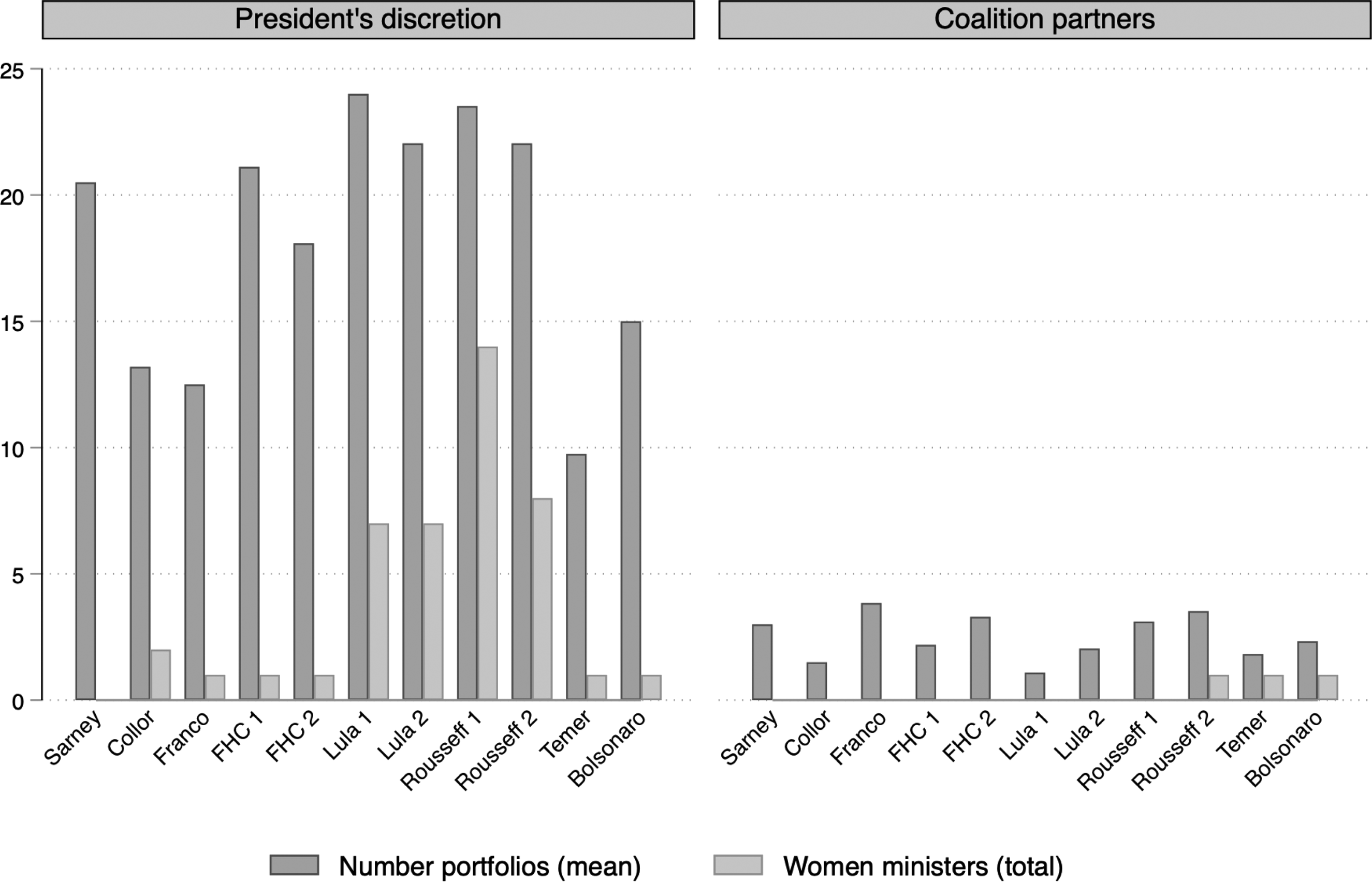
Ministerial Distribution by Ministers’ Gender, President's Discretion Status, and Presidency.
In fact, just three out of the total forty-six women ministers 8 are from coalition parties (Kátia Abreu, Luislinda Valois, and Teresa Cristina), with all three hailing from the coalition party allocated the highest number of cabinet positions. In line with H1 and reinforcing our finding on the statistical significance of portfolio allocation, coalition parties with scarce portfolio allocations are unlikely to give them to women. Having access to a relatively large number of portfolios approximates a necessary condition for women's cabinet appointments. But capacity is insufficient for women's cabinet appointments; will is also necessary.
The near exclusion of women from cabinet positions during the first five presidencies of Brazil's present democratic era indicates that the space has historically been a masculinist one and that formateur will has been critical for women's cabinet representation. Between 1985 and 2002, women occupied no more than 5 per cent of cabinet positions. Tellingly, in his 1998 speech to celebrate International Women's Day, Fernando Henrique Cardoso, who as president at the time had power over cabinet appointments, stated that “perhaps one day women will be ministers” and will be able to share political power (Folha de São Paulo, 1998).
Upon taking office in 2003, Lula more than doubled the previous maximum share of women's cabinet representation by appointing seven women and reaching 10.6 per cent of women in his first-term cabinet and maintaining this commitment during his second term, again nominating seven women (10.1 per cent of all nominations). Lula was likely encouraged by party leadership and his advisors to include more women in his cabinet appointments (dos Santos and Jalalzai, 2021): the left-wing PT pioneered a party gender quota in 1991 and has remained at the forefront of initiatives to promote women's representation (Godinho, 1996; Wylie, 2018). This is also consistent with our findings that left-wing ideology increases women's likelihood of appointment – even when controlling for Rousseff, Brazil's only woman president and also a PT member. Aligned with our statistical findings about portfolio allocation, the higher number of women ministers under Lula (compared to previous administrations) came not from coalition parties but through presidential discretion. Of the nine (unique) women appointed to a cabinet position during his two administrations, eight were from the PT, and one had no party affiliation.
Rousseff's election as Brazil's first woman president placed her in a position to promote women's leadership, an agenda she publicly accepted and actively supported (dos Santos and Jalalzai, 2021; Jalalzai and dos Santos, 2015). During her first term as president, Rousseff tried to appoint as many women as possible (Diniz Alves, 2010; dos Santos and Jalalzai, 2021; Jens Glüsing, 2012). As Gilberto Carvalho, one of Rousseff's top aides explained: “Given a choice between a man and a woman with the same qualifications, she prefers to hire the woman” (Jens Glüsing, 2012). Her ministers reaffirmed this idea: Ideli Salvatti, who was appointed to various cabinet positions under Rousseff, stated that the president “was firm on nominating about ten women ministers to compose her cabinet of trust” (dos Santos and Jalalzai, 2021: 73).
Rousseff's actions reinforce the importance of will for women's appointments. Indeed, Rousseff was responsible for nominating the most women-inclusive cabinet in Brazilian history: nine women were nominated to her inaugural cabinet, 25 per cent of all cabinet posts. The inaugural cabinet presented Rousseff with the most opportune moment for appointing women ministers, given the mandate conferred by her recent election. As the country's first woman president, the visual of her inaugural cabinet represented a poignant manifestation of her deviation from the white, male norm of embodied political power in Brazil. This is picked up by our statistical models: the controls for Rousseff and days since inauguration produce positive and statistically significant coefficients. Still, Rousseff fell short of feminist expectations. In total, Rousseff nominated fourteen women during her first term, 18.7 per cent of all nominations. As was the case with Lula, all women Rousseff nominated in her first term were either from the PT or had no party affiliation, meaning their appointment did not appease coalitional demands.
Despite her strong will, Rousseff's capacity to nominate women was curtailed in her (short) second term in office (see Figure 2), which ended abruptly with her impeachment in August 2016. After a contested electoral win in 2014, Rousseff began her second term with less bargaining power, with her party losing sixteen seats in the lower house of Congress. The political crisis not only increased Rousseff's reliance on her coalition partners, but also constrained internal party dynamics (Sousa Braga, 2018). Rousseff's cabinet appointments had to satisfy both coalitional demands and different PT factions.
In responding to pressures from coalitional partners and her own party, Rousseff started her second term by keeping discretion over 35 per cent of the cabinet seats and distributing the remaining seats to coalitional partners. The need to galvanise PT support across an increasingly divided party meant that Rousseff had to distribute ministerial appointments to key PT factions. Since women's cabinet representation under coalitional presidentialism is so reliant on the availability of seats under presidential discretion, the need to appease PT factions hindered Rousseff's capacity to nominate women (Fagundez and Mendonça, 2016).
This led to a considerable decrease in women's cabinet representation: Rousseff appointed only six women (15 per cent) to her second-term inaugural cabinet. Of those women, five occupied seats under Rousseff's discretion – four were from the PT, and one had no party affiliation. The sixth, Kátia Abreu (Ministry of Agriculture, Livestock, and Supply), was from a key coalition partner (Brazilian Democratic Movement Party, PMDB), and the only woman from a coalition party to be nominated during Rousseff's two terms. Yet according to multiple sources, Abreu's name was not proposed by the PMDB leadership, but rather, was a decision made by Rousseff (Azedo, 2017; dos Santos and Jalalzai, 2021). Abreu's nomination to a prestigious ministry thus neither satisfied PT supporters’ demands (who strongly opposed Abreu's connections to agroindustry), nor did it comply with the demands of her largest coalition partner. Instead, this appointment represents an example of Rousseff's will to subvert coalitional presidentialism's constraints and nominate a woman she trusted (despite ideological differences).
As Rousseff's second term in office progressed, the crisis deepened, and her government's survival rested on continued support from coalition partners (Sousa Braga, 2018). Rousseff reduced the number of cabinet posts – a reform that, among other changes, merged the Ministry of Women's Rights, Secretariat for Women, and Secretariat for Racial Equality – all led by women ministers – into a single ministry. Rousseff's reforms removed three of six women from her inaugural cabinet.
Upon taking office following Rousseff's impeachment, Temer intensified efforts to signal his willingness to respond to legislators’ demands and promote executive–legislative cohesiveness. To do this, he immediately reduced the number of cabinet seats from thirty-two to twenty-three – notably extinguishing the ministerial-status Secretariat for Women – and then distributed portfolios to eleven of the twenty-six parties with seats in the National Congress, still maintaining twelve seats (46 per cent) under his discretion: six posts for members of his party (PMDB), and another six for non-partisans. For comparison, in Rousseff's first inaugural cabinet, there were thirty-six portfolios, with twelve (33 per cent) under Rousseff's discretion.
Despite having the capacity to do, none of the twelve portfolios under Temer's presidential discretion went to women. The exclusion of women from Temer's cabinet corresponds to our findings above, which suggest that leftist parties and women presidents are more likely to appoint women ministers. Attempting to justify the nomination of an all-white male inaugural cabinet, Temer's Chief of Staff blamed coalition partners, claiming that the government initially received no women nominees from coalition parties and was unable to find women willing to serve as ministers with such short notice (Amorim et al., 2016). Transferring responsibility to coalition partners did not work, suggesting that accountability for poor gender and racial descriptive representation may fall on the president.
Under continued public pressure to diversify his cabinet, Temer then re-established the previously extinguished Ministry of Human Rights and appointed Luislinda Valois, an Afro-Brazilian woman from the Brazilian Social Democracy Party (PSDB), a major coalition partner (Paraguassu and Goy, 2017). Responding to criticism for the lack of representation of women and Afro-Brazilians in his cabinet, Temer made a single nomination that neither required the replacement of a white man nor otherwise threatened to disrupt the established coalitional agreements – a “complementarity bonus” tactic often used by elites in efforts to diversify representation while minimising costs (Celis et al., 2014).
Elected as an anti-system, far-right president, Bolsonaro's initial approach to the presidency included a vocal rejection of coalitional presidentialism. Aligned with his call for a new way of doing politics, Bolsonaro received the formal support of only one political party, with seven other parties pledging informal support for the president (Martins, 2018). In 2019, Bolsonaro's governing coalition in Congress was thus neither large nor stable enough to facilitate governability (Cerioni and Caleiro, 2019). In his inaugural cabinet of twenty-two portfolios, fifteen remained under Bolsonaro's discretion. The high share of portfolios under the president's discretion, combined with Bolsonaro's public disregard for nominating a cabinet that could ensure governability meant that he had the capacity to nominate women.
But Bolsonaro lacked the will, nominating a single woman to portfolios under his discretion: Damares Alves, a conservative evangelical pastor, who he appointed to lead the rebranded Ministry of Women, Family, and Human Rights. The only other woman in his cabinet was Teresa Cristina, 9 nominated to lead the Agriculture, Livestock, and Supply Ministry and the third woman from a coalition partner to ever occupy a ministry in Brazil. Despite the low number of women in his cabinet, Bolsonaro rejected criticisms of women's underrepresentation. In fact, in a speech on International Women's Day, he claimed: “For the first time, the number of women and women ministers is balanced in the government. […] Each of these women that are here is equivalent to 10 men” (Mazui and Netto, 2019).
In sum, the appointment of women requires both capacity and will from selectors. As a result of capacity constraints under coalitional presidentialism in Brazil's highly fragmented party system, women are most often absorbed into seats under the president's discretion, with such appointments highly dependent on political will. Having the plurality of portfolios under their discretion, presidents often have the capacity to appoint women; in these cases, it is the president's willingness to nominate women that matters. Conversely, having few portfolios to distribute to their top elites, coalition partners rarely have the capacity to nominate women. When the portfolio allocation of willing selectors increases, so does the likelihood of women's nomination.
Conclusion
Multiparty presidential systems have become more common worldwide. With independent elections to the executive and legislative branches, presidents whose parties lack a majority rely on coalitional presidentialism to improve governance. While women's ministerial representation has been widely studied across other systems, existing scholarship had not yet examined the gendered implications of coalitional presidentialism governance strategies. Our analyses show that while coalitional presidentialism and the nature of electoral politics in Brazil – the driving forces in the political calculations behind cabinet allocation – are not institutions that explicitly bar women from these positions of power, the gendered dynamics that dictate coalition formation and management work to create formal and informal barriers to entry in this historically male-dominated environment.
As indicated in our statistical analyses, capacity and will shape selectors’ likelihood of nominating women. The number of cabinet seats allocated to any given coalition member is scarce, so seats are generally allocated to the most influential political leaders in coalition parties; women's absence from party leadership positions thus also has implications for their cabinet nominations. As a result, women's appointments are largely restricted to seats over which presidents have discretion – and, as such, hinge upon the number of seats over which presidents have discretion, as well as the presidents’ will to nominate women, which is conditioned by timing, left-wing ideology, and access to women's networks.
As we reveal in our assessments of coalitional dynamics under different presidencies, the PT's rise to power was accompanied by a noticeable increase in women's cabinet nominations. The presence of a woman in Brazil's most powerful position also had a transformative impact on the nomination of women to cabinet: Rousseff's presidency saw nearly as many women nominated to the cabinet as all previous presidencies combined. Nevertheless, as the PT's congressional seat share diminished in her second term, and as the institutional crisis widened, Rousseff's ability to nominate her preferred cabinet members was severely curtailed.
Contrasting Rousseff's and Temer's cabinet formation experiences result in an institutional paradox: while Rousseff's willingness to promote women was tempered by coalitional presidentialism demands, Temer's strategy of partisan coalescence was checked by representational pressures related to the blatant gender imbalance in his initial cabinet. This provides a silver lining and suggests that Lula's and Rousseff's efforts to nominate women meant that Temer had to halt his decision to nominate an all-male cabinet – even as he publicly lamented the coalitional constraints that complicated his effort. This possibly indicates a “concrete floor” for women's representation. Bolsonaro's initial cabinet was arguably less restricted by coalitional presidentialism than Temer's. Although Bolsonaro “only” included five parties in his inaugural cabinet, most seats went to non-partisans (including several military leaders), and he nominated just two women. Thus, as analyses of different presidencies show, while the size of portfolio allocations – particularly those under presidential discretion – drives selectors’ capacity for nominating women ministers, such opportunities are often foregone by leaders who lack the will to prioritise descriptive representation. Selectors must therefore have both the will and capacity for constructing descriptively representative cabinets. 10
More broadly, in multiparty presidential systems, institutional and partisan concerns constrain presidents in the cabinet formation and management processes, and those constraints have negative implications for women's ministerial prospects. Although coalitional presidentialism can improve governability amidst multiparty coalitions, it may come at the cost of representativeness. Brazil's highly fragmented party system and unstable coalitions potentially make it an extreme case, but the gendered dynamics we uncover are likely to apply to presidential systems beyond Brazil.
For example, in Colombia, nearly half (46 per cent) of Álvaro Uribe's inaugural cabinet in 2002 were women (United Nations Development Programme, 2012: 17); similarly, in Chile, Michelle Bachelet was celebrated for nominating a parity inaugural cabinet (where women occupied 48 per cent of the seats) in 2006 (Nyrup and Bramwell, 2020). At face value, these cases may seem to challenge our findings. Yet, as Uribe's and Bachelet's respective popularities decreased with time in office and governability was at stake, both presidents shuffled out women ministers, replacing them with men party leaders. When Uribe left office in 2010, only 15 per cent of cabinet seats were occupied by women; when Bachelet left office in 2010, only six of her twenty-six-seat cabinet were women (23 per cent) (Franceschet, 2016).
By contrast, under Daniel Ortega, Nicaragua has managed to not only maintain the ninth position in the world ranking of women's parliamentary representation, but also to maintain high levels of women's cabinet representation. When inaugurated in 2007, six of Ortega's seventeen ministers (35 per cent) were women (Nyrup and Bramwell, 2020). As of April 2021, Nicaragua has a gender-balanced cabinet, in which ten of the twenty ministers are women (World Economic Forum, 2021). Critically, unlike Colombia, Chile, or Brazil, Ortega's cabinet is not a multiparty cabinet: all cabinet members are either independents with no partisan affiliation or members of the president's party, the Sandinista National Liberation Front, reinforcing our finding that women's cabinet representation is more likely under the president's portfolios. 11 These examples supplement the above analyses to illustrate the insights gained by gendering the study of coalitional presidentialism for our understanding of cabinet formation and management in Latin America. However, there is regional variation in the use of cabinet allocation as a tool of governance in presidential systems (Chaisty et al., 2014). Understanding how this variation may impact women's descriptive representation in presidential systems beyond Latin America also offers a fruitful area of research.
Footnotes
Declaration of Conflicting Interests
The author(s) declared no potential conflicts of interest with respect to the research, authorship, and/or publication of this article.
Funding
The author(s) received no financial support for the research, authorship, and/or publication of this article.
