



Abstract
Since the return to democracy, Uruguayan presidents have built cabinets of varying natures (majority and minority coalitions, majority and minority parties). Most studies on presidential government assume that the partisan composition of a cabinet is a good predictor of the performance of a government's legislative program. In this paper I test this hypothesis using Cox and McCubbins’ (1993, 2005) party cartel theory. The results confirm that six of the eight presidential cabinets’ legislative performances were consistent with theoretical expectations, while two were deviant cases. This article also provides a theoretical explanation for these two outliers, highlighting the importance of legislative parties, the presidential style of government, and preferences as regards legislative initiative.
Introduction
Studies have shown that presidents select their cabinets in order to build legislative support in Congress (Altman 2000; Amorim Neto 2006; Chasquetti 2001; Cheibub and Limongi 2002; Martínez-Gallardo 2011; Negretto 2003), primarily by offering cabinet portfolios. Therefore, this structure could serve as a good proxy with which to better understand the dynamics of the relationship between the president and Congress as well as the opportunities and possibilities that government have to pass the president's legislative agenda. 1
This paper is an output of the research Project “Carreras legislativas en Uruguay: Reglas, partidos y legisladores en la Cámara,” funded by the Fondo Clemente Estable de la Agencia Nacional de Investigación e Innovación. I would like to specially thank Juan Pablo Micozzi, Mariana Llanos, Silvana Harriett and Colin Hannigan.
Party cartel theory (Cox and McCubbins 1993, 2005) states that all majority governments seek to create a legislative cartel in order to control the political agenda – this control is referred to as “agenda power.” By contrast, minority governments are unable to control the agenda and are, therefore, more likely to be rolled in the chamber. According to this approach, whether a government actually has a majority does not depend on the characteristics of the cabinet, but rather on the kind of organization adopted by the largest party or coalition in Congress. This seems logical given that the appointment of a cabinet takes place at a specific point in time (e.g., at the beginning of a mandate or after a government crisis) after which a new game begins wherein arrangements are put in place for governing. If parties in the cabinet gather a majority of legislators and comply with their demands, they should be in a position to build a cartel with sufficient agenda power. However, if for any reason the parties in the cabinet turn away from the government agreements, the president will have squandered his key institutional resources (i.e., cabinet portfolios) without obtaining the necessary guarantees to pass his policies. In such an instance, the legislative process will evolve in a way that will be determined by the preferences of the median chamber member.
With this time sequence (where cabinet formation is t, and legislative process is t + 1), it is very difficult to characterize a government based solely on the type of cabinet. Amorim Neto, Cox and McCubbins (2003) analyzed the case of Brazil and arrived at a similar conclusion. Out of six cabinets examined, three had been previously characterized by Amorim Neto (1998) as a majority coalition; 2 however, the application of party cartel theory showed that only one of these was a case wherein a majority controlled the agenda. Thus, despite the partisan composition of a cabinet providing valuable information, it alone cannot predict the future behavior of the legislative contingent of the president.
Amorim Neto (1998) classifies the last Sarney's cabinet (1990) as “tight coalition” and Franco's cabinet (1992–1994) and the first Cardoso's cabinet (1995–1998) as “loose coalition.” Amorim Neto, Cox and McCubbins (2003) found that only the latter was actually supported by a majority cartel in Congress.
Since its return to democracy in 1985, Uruguay has been ruled by presidents with different types of cabinets: Lacalle (1990–1991), Sanguinetti (1995–1999), and Batlle (2000–2002) had majority coalition cabinets; Vázquez (2005–2010) and Mujica (2010–2011) had majority party cabinets; Lacalle (1992 and 1993–1995) had a minority coalition cabinet; and Sanguinetti (1985–1990) and Batlle (2002–2005) had minority party cabinets (Altman 2000; Amorim Neto 1998; Chasquetti 1999). Such diversity of strategies makes the Uruguayan case an interesting example with a stable set of variables such as the party system, the electoral system and intraparliamentary rules. However, the characterizations of presidential governments tend to focus on the partisan composition of a cabinet rather than what actually happens in Congress.
This paper evaluates the Uruguayan case through the application of party cartel theory and refrains from using other theoretical approaches to explain various Uruguayan governments’ respective legislative performances. Specifically, this study seeks to confirm Amorim Neto, Cox and McCubbins’ (2003) argument that majority cabinets with legislative cartels will have significant agenda power and low roll rates, while minority cabinets will have no agenda power and high roll rates. The paper also seeks to formulate convincing theoretical explanations for the two outlying cases where a particular type of cabinet did not result in the aforementioned types of legislative behaviors. The Uruguayan case also reveals the importance of the presidential style of government and the ideological program the president intends to pass in Congress. A president with a minority cabinet who is willing to move his initiatives toward the median legislator will be more likely to have a successful relationship with Congress than a president in a similar situation who is unwilling to compromise.
This paper is organized as follows: The first section reviews the key features of the party cartel theory, focusing on the problem of empirical identification of legislative cartels. With this aim, we analyze the votes of important bills in the Senate and the nominal control of standing committees in both chambers. The result shows that six out of the eight cabinets appointed in the period 1985–2010 generated the expected consequences and two are deviant cases. In the second and third sections we discuss these two outliers and attempt to explain why the majority coalition cabinet of President Lacalle (1990–1991) failed to build a legislative cartel, and why the minority party cabinet of President Batlle (2002–2005) – which did not control the agenda – built a plurality cartel that avoided being rolled in the plenary. The fourth section presents the conclusion, including two substantive findings regarding the procedure of presidential government.
Parties and Legislators in Congress
Party cartel theory claims that if a majority government is formed, it will also constitute an agenda cartel (Amorim Neto, Cox, and McCubbins 2003). Majority parties “are a species of legislative cartel,” which seize the required power to make the rules that govern the structure and processing of legislation (Cox and McCubbins 1993: 2). Control of the agenda is the key that a majority party uses to wield influence over the legislative process. This means that a majority party will look to secure the majority of committee chairpersonships, the role of speaker of the Chambers and any other legislative position that could increase its authority.
The main goals members pursue consist of seeking reelection for their office and gaining positions within Congress's structure. They must cooperate with their respective party's collective action in order to accomplish these goals. In order to fulfill the party's purpose of achieving an important legislative record and improving its public reputation, legislators delegate their own individual power to a central authority which assumes the costs of managing and monitoring the cartel; this is typically done by establishing policy priorities, monitoring the legislative process, and distributing benefits and punishments according to performance. In order to solve the problems of collective action, party leadership delegates agenda power to its most reliable legislators, who take control of the main positions on committees and in the plenary. Thus, these key legislators are responsible for determining which bills should be analyzed by the plenary or committees and those which should not.
Under these circumstances, the legislation process is dominated by the party cartel and the success of any bill is dependent on the preferences of the median member of the majority. This means that any bills that deviate from that ideal point will inevitably be rolled on the floor or in standing committees. Without a majority party cartel, the probability of success de- pends on how far the bill strays from the preferences of the median chamber member. 3
The pivotal-player theory states that the likelihood of a bill's approval in Congress depends on the ideological preferences of legislators (Krehbiel 1998). In this approach, neither the parties themselves nor the commitments that party leaders assume during the process of legislation are important. The basic problem of the chamber consists of how the members organize the work with the purpose to make transactions based on information. The world without parties described by Krehbiel's theory seems far different from the Uruguayan legislative arena, which is dominated by parties and factions and powerful leaders who control the careers of members.
Because of the nature of institutional designs in Latin America, presidents with significant legislative agenda power recognize the crucial importance of nominating cabinet members when building a legislative cartel. In the interests of having a stable majority in Congress, a president may choose to solicit legislative support in exchange for cabinet positions. In this case, the legislative coalition faces the challenge of resolving problems of collective action given that members of coalition parties might have incentive to compete rather than to cooperate with the government. Amorim Neto, Cox and McCubbins (2003) noted this problem when they analyzed the Brazilian case, finding that not all coalition cabinets had managed to build a legislative cartel. In the Uruguayan system, however, coalition cabinets were frequent between 1990 and 2005 and would have likely faced similar dilemmas.
The Uruguayan Political System
Despite significant differences between the American and Uruguayan political systems, there are two key institutional features which they share: the direct election of the president and the separation of powers. In Uruguay, there is also the election of a moderate number of representatives who are involved in the decision-making process. Additional mechanisms of direct democracy include referenda on certain laws that have been approved by Congress (but where the president does not have exclusive initiative) or when the constitution is amended.
The Uruguayan president must be elected by an absolute majority over two rounds of voting. The president's constitutional powers facilitate control of the legislative agenda: total and partial veto rights, exclusive legislative initiative in strategic areas (budget, taxation, and pensions), urgent bills, and the power to appoint and dismiss cabinet members. This latter prerogative allows a president to negotiate a coalition with parties that share a similar political orientation with the aim of controlling a majority of supporters in Congress (Buquet, Chasquetti, and Moraes 1998).
The Uruguayan Congressional elections take place at the same time as the first round of presidential voting. The legislature is bicameral with each of the chambers – the Chamber of Senators (i.e., the Senate) and the Chamber of Representatives – sharing similar prerogatives to one another. The Senate is composed of 30 members, plus the vice president, who are elected by a single national district through proportional representation. The Chamber of Representatives is composed of 99 deputies who are elected in 19 multimember districts. Members of the Senate are party faction leaders who effectively control the careers of most of the legislators by virtue of their power to select candidates and assign legislators to standing committees (Moraes 2008). Following Cox and Morgenstern (2001), it could be argued that the Uruguayan Congress is a reactive legislature whose principal function is to analyze, modify, reject, or approve the executive's initiatives. Still, nearly a third of Uruguayan legislation is initiated by legislators, who exercise significant influence over executive activity (Chasquetti 2011). 4
There are at least three institutional mechanisms used to control the executive's activity. Legislators can (i) call ministers to the plenary of the chamber to ask them questions about their policies (with the support of 1/3 of members); (ii) call ministers to the committees with the same purpose (with the support of a simple majority); (iii) request reports on different issues regarding the ministries (by individual initiative).
Until the 1970s, the Uruguayan political scene was dominated by two powerful actors: the Partido Colorado (Colorado Party) and the Partido Nacional (National Party). After the emergence of the Frente Amplio (Broad Front), the two-party system evolved into a moderate multiparty system with three-and-a-half parties (Buquet and Chasquetti 2008). The main organizational feature of these parties is their factionalized structure. The factions are not simple currents of opinion; they are well institutionalized organizations with powerful leaders, executive committees, and ideological programs (Buquet, Chasquetti, and Moraes 1998). The party factions are subjected to a prisoner's dilemma insofar as they must compete with each other but they must also cooperate with the party to achieve its goals (Morgenstern 2001). As leaders control the discipline faction, party decisions are the result of internal negotiations between the chiefs of factions.
Identifying Legislative Cartels
In general, empirical studies on legislative cartels focus on the way in which majority members vote in the chamber. On the one hand, Cox and McCubbins (1993) claim that if a majority holds agenda power, the ruling party will have minimal roll rates in the plenary; on the other hand, if the ruling party lacks agenda power, the roll rate will be high. Cox, Masuyama and McCubbins (2000) found that majority parties have positive but small (less than 5 percent) roll rates – as can be seen with majority parties in the US House of Representatives since the late nineteenth century.
A second way to identify a legislative cartel is through examining who, in fact, makes use of agenda power in Congress. The nominal control of the speaker and the chairpersons of standing committees represent an alternative source of information for determining whether or not the majority has developed a collective action in order to reach certain goals. 5 Empirical studies of the House of Commons of Great Britain (Cox and McCubbins 2005), the Danish Folketing (Cox, McCubbins, and Skjæveland 2005), the German Bundestag (Chandler, Cox, and McCubbins 2006) and the Italian Parliament (Cox, Heller, and McCubbins 2008) take into account both perspectives of analysis (votes on the floor and nominal control of positions), but have emphasized the former as preferable for confirming the presence of legislative cartels.
The seminal study of Cox and McCubbins (1993) shows how the US Congress has been dominated by a major cartelized party throughout the twentieth century. The proof is based on two factors: first, the majority party holds the agenda power through the Speaker and the chair of the standing committees; and second, the majority party never is rolled because its member vote joined the main bills.
In the Brazilian case, Amorim Neto, Cox and McCubbins (2003) identified cartels by considering four factors: (1) the president's nominal support coalition, (2) the roll rate of each party in the nominal support coalition, (3) how the president distributed portfolios, and (4) the presidential use of statutes and decrees. They determined that a cartel indeed exists in a chamber when a majority coalition has low roll rates, the president secures an equitable representation between parties in the cabinet, and the president seeks statutes rather than decrees. In the Argentinean case, Jones and Hwang (2005) applied party cartel theory to analyze Congress by using party votes in the chamber as evidence of a cartel's existence. More recently, Chasquetti (2011) studied the legislative cartelization process in Uruguay during the period 1995–2010 using evidence related to agenda control and the degree of partisan affiliation of legislators in the Chamber of Representatives.
In this paper, the legislative cartels will be identified following the analysis of party votes in the plenary and the nominal control of standing committees. These two variables will allow us to determine which presidents build a legislative cartel and which do not. We will use systematic data of party votes on the floor as well as the membership and chairs of standing committees.
Votes in the Senate
To find out whether or not different presidents were able to build a majority cartel, we analyzed the voting behavior of legislators from the three main parties (Partido Colorado, Partido Nacional, and Frente Amplio) for 209 votes in the Senate. The Senate was selected for three reasons: (1) it is a small chamber and, thus, it is relatively easy to know the position of each member; 6 (2) the party and faction leaders are located there, so it provides an ideal setting for monitoring compliance with the agreements between the president and those parties that hold positions within the cabinet; and (3) legislator behavior in the Uruguayan chambers does not typically vary, given the remarkable symmetry that exists as well as the method of election (proportional representation) and their constitutional prerogatives. 7
The Uruguayan Congress hasn't got the electronic vote and roll-call votes are fairly uncommon. To enable a roll-call vote, a legislator must submit a proposal that should be voted by a majority of members. I have analyzed 209 votes on the Senate floor; 34 of them were roll call votes (16.2 percent) and the rest were studied with the procedures used by Buquet, Chasquetti and Moraes (1998); Lanzaro et al. (2000); and Koolhas (2005). By taking into account (i) the party and factional membership of each senator, (ii) the number of senators who take part in each vote, and (iii) the debate and foundation of vote of each senator, we can deduce legislator behavior in votes. This third factor requires a simple reading of some crucial aspects of the debate (if the bill has a majority or minority report, or the foundation vote of the members for instance). The selection of bills was performed considering the cutoff-point (0.24) of criticalness of the vote, an indicator suggested by Amorim Neto, Cox, and McCubbins (2002: 63–64).
During the last three terms (1995–2010), the Uruguayan Congress approved 1966 laws. Only 9 percent of the total (175) showed a disagreement between the chamber in which the bill was proposed and the other chamber. This evidence reveals the importance of alignment between the chambers.
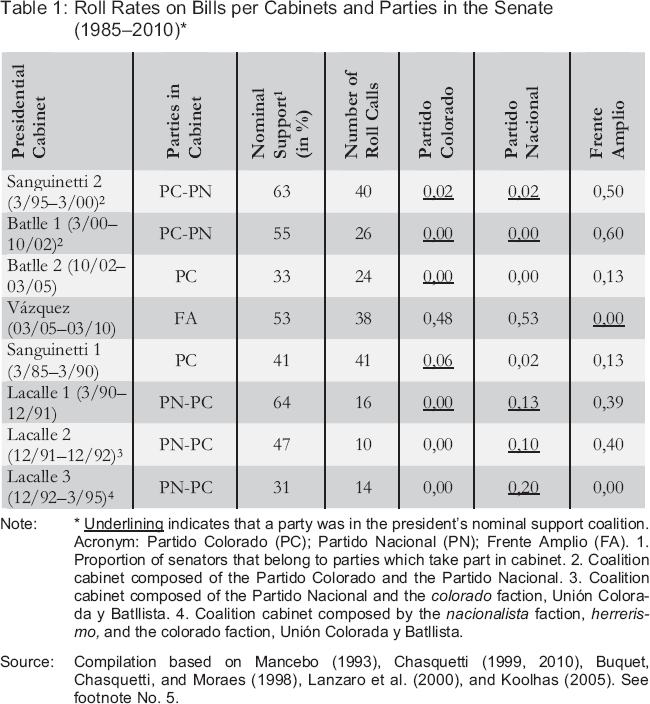
Table 1 illustrates party voting behavior in the Senate against the eight presidential cabinets formed during the period 1985–2010. The number of cabinets during this period can be calculated by applying the criteria presented by Amorim Neto (1998) to identify new cabinets; there will be a new cabinet when the new president assumes duties, there is a change in the partisan composition of the cabinet, or there is a change of more than 50 percent of the cabinet members. The results of the application of these criteria match the conclusions drawn by Mancebo (1993), Amorim Neto (1998), Chasquetti (1999 and 2008) and Altman (2000). Information was ordered in agreement with the strategy followed by Amorim Neto, Cox and McCubbins (2003). The roll rates of the three main legislative parties can be seen in Table 1; the underlined rates refer to the parties which share positions in the presidential cabinet. Following Cox, Masuyama and McCubbins (2000), we consider a 0.05 (5 percent) roll rate as the cut-off point for the existence of legislative cartel.
Roll Rates on Bills per Cabinets and Parties in the Senate (1985–2010) *
Note:
Proportion of senators that belong to parties which take part in cabinet.
Coalition cabinet composed of the Partido Colorado and the Partido Nacional.
Coalition cabinet composed of the Partido Nacional and the colorado faction, Unión Colorada y Batllista.
Coalition cabinet composed by the nacionalista faction, herrerismo, and the colorado faction, Unión Colorada y Batllista.
Source: Compilation based on Mancebo (1993), Chasquetti (1999, 2010), Buquet, Chasquetti, and Moraes (1998), Lanzaro et al. (2000), and Koolhas (2005). See footnote No. 5.
Cabinets with low levels of roll rates, particularly before 1995, appear in the upper part of Table 1. This confirms that the Uruguayan Congress, since that year, has been controlled by majorities which have given the president stable legislative support (Chasquetti 2011). That which stands out, however, is President Batlle's second cabinet, which performed well despite a composition that would have predicted scarce legislative support.
The lower part of the table shows the cabinets with roll rates over 5 percent. These results were expected because almost all these cabinets lacked the potential support necessary to avoid suffering losses in the plenary. Party cartel theory argues that when there is no majority cartel, the roll rates of parties closest to the median member of the chamber will be lower. If the president's party is far from that point, its failures will be significant or simply more significant than those of the other parties.
The first administration of President Sanguinetti (1985–1990) – whose cabinet was composed mostly of individuals from his party and lacked a majority in the chamber – clearly demonstrates this problem. As can be seen in Table 1, Sanguinetti's party had more losses than the Partido Nacional, which – although situated in the opposition – was closer to the ideal preference point of the median chamber member. 8 Throughout President Lacalle's tenure a similar phenomenon occurred: the party with the lowest roll rate was not the ruling party, but rather the Partido Colorado – in opposition since 1992.
This interpretation is consistent with González’ findings (1991: 89). After applying a survey to the 42nd Legislature members (1985–1990) he found that the Partido Nacional was the most centrist party on the spectrum (5.9 in the ideological-scale, very close to the median ideal point of the chamber, 5.53). Unfortunately, there are no similar surveys for the 43rd Legislature (1990–1995).
Again, the Partido Colorado was closest to the median chamber legislator and, therefore, experienced roll rates significantly lower than the rest of the parties. It is worth noting that the first cabinet of President Lacalle had the potential for majority support, but suffered very poor voting outcomes.
The Control of Agenda Power in Standing Committees
This section analyzes the nominal control of the agenda-power positions on the standing committees of each chamber per legislative year. For this analysis we take into account a sample of 733 observations.
In the Uruguayan Congress the assignment of positions on committees and the nomination of chairpersons are determined by a multiparty agreement made at the beginning of each legislative term. This arrangement dictates how many seats each party will have on each committee, which parties will occupy the chairs, and the size of each committee. The nomination process for each party's committee positions begins with the distribution of the positions among party factions. Once a faction knows how many seats it has been allocated, it will proceed to nominate legislators. Because all authority positions alternate – including the composition of the committees – legislators are unable to build legislative careers from a particular position. Instead, their careers are subject to the opinions and preferences of party leaders – the self-selection process is minimal. The most important positions (i.e., those with agenda power) are given to more loyal and experienced members of a faction (Chasquetti 2011). For this reason, party leaders often use the assignment process as a mechanism of reward and punishment according to an individual's performance in the chamber. Under these conditions, it would be fair to assume that if there is a majority willing to control the agenda, this should be seen in the composition and distribution of the positions in the committee system.
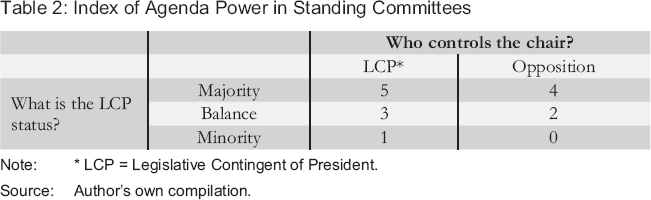
To empirically evaluate agenda power in committees, we considered two key factors: (1) the status of the legislative contingent of the president (LCP), and (2) the control of the chair of the committee. The LCP may have a majority within the committee, a minority within the committee, or be balanced with the opposition. At the same time, the LCP may have the presidency of the standing committee or not. The combinations of both variables yield six possible configurations of agenda power in committees. Table 2 illustrates the different configurations by assigning arbitrary values ranging from a maximum of five points, where the LCP has a majority (absolute control), to a minimum of zero points, where the chair has a minority (no control).
Index of Agenda Power in Standing Committees
Note:
LCP = Legislative Contingent of President.
Source: Author's own compilation.
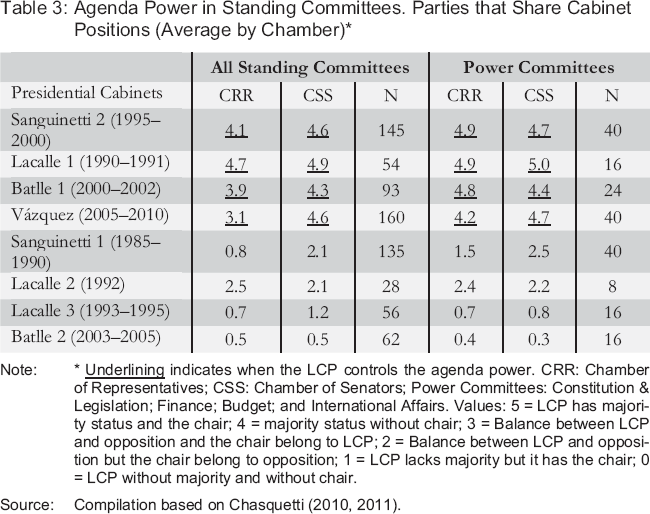
This procedure can be applied to each of the standing committees in both the Chamber of Representatives (14 between 1985 and 1992, 15 between 1992 and 2000, and 16 since 2000) and the Senate (14 between 1985 and 1999, 15 between 2000 and 2004, and 16 from 2005). Given that committee chairs are positions that alternate, with each committee offering five possible observations per term, this allowed us to build a database with 733 observations. Table 3 shows the annual averages for each period according to the eight presidential cabinets. On the one hand we take into account “all standing committees” of each chamber, and on the other, only the four “power committees” (Constitution and Legislation; Finance; Budget; and International Affairs).
Agenda Power in Standing Committees. Parties that Share Cabinet Positions (Average by Chamber) *
Note:
Source: Compilation based on Chasquetti (2010, 2011).
The distribution of agenda power in committees showed some features already observed in the previous section. Agenda power tended to be higher in Senate committees and the power committees of both chambers. Both findings were expected because the Senate majority has fewer restrictions than does that of the Chamber of Representative to impose its preferences regarding the appointment of members to committees. In the Senate, members can participate in more than one committee, while in the Chamber of Representatives each deputy can join only one. This institutional feature allows the leadership of the majority party to negotiate with minimal restrictions. Moreover, evidence has shown that in a case involving a majority in the chambers, such a majority tends to control the most important committees, thereby allowing the opposition to have more influence on the less important committees.
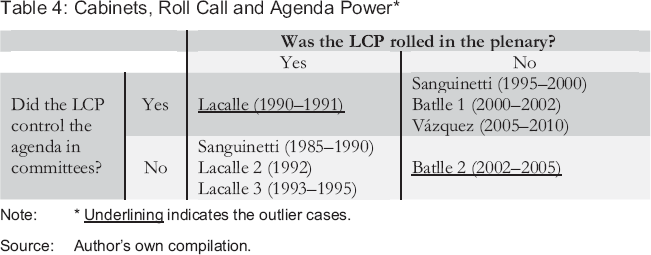
Table 4 shows that the legislative contingent supporting the cabinets of Sanguinetti 2, Batlle 1 and Vázquez effectively controlled the agenda. However, when comparing these results with those of the previous section, there are two major inconsistencies. First, the cabinet of Lacalle 1 controlled the agenda but, as seen above, experienced high roll rates. Second, the cabinet of Batlle 2 did not have agenda power but its voting performance was efficient, showing low roll rates.
Cabinets, Roll Call and Agenda Power *
Note:
Source: Author's own compilation.
These findings raise two questions: If the first coalition cabinet of President Lacalle (1990–1991) controlled the agenda in the committees, why did it fail to avoid being rolled in the plenary? Also, if the second cabinet of President Batlle did not control the agenda in the committees, how did it avoid being beaten in the plenary voting? We will try to explain these occurrences in the next two sections.
Coalition Cabinets and Legislative Cartels
As mentioned above, presidents in various Latin American countries have used cabinet designation as a strategic tool to build legislative support in Congress. Politicians who have accepted cabinet portfolios are expected to guarantee the loyalty of their respective party members in Congress. This practice also explains why presidents with limited agenda power, but who want to create a legislative majority, tend to yield portfolios to the party members of their coalition partners. The more consistent the distribution of portfolios is (regarding the legislative support each party provides), the more satisfied the partners of a coalition are; this creates better conditions for the smooth functioning of the majority in the chamber. An additional factor geared toward achieving the government's goals is the fact that the president proposes policies appropriate to the political orientation of the majority that has been built. In other words, the presidential cabinet should not be designed to simply ensure a legislative majority, but should also be constructed with the aim of accomplishing clear legislative objectives, both in terms of policies and control of the agenda.
Cox and McCubbins (1993) argue that all legislative cartels must have a central authority that is responsible for the costs of management. Unlike in the US Congress, this authority is collective and at times diffuse in the Uruguayan system (Chasquetti 2011). The decision center of the legislative majority is composed of the heads of party factions that support the government. The decision circuit of the cartel involves the faction bosses, ministers, advisers, executive officers, and the president. While the president and the cabinet cannot strictly be considered part of the head of the cartel, they play a substantive role in its strategic direction due to four substantive reasons. First, the executive has important agenda power given the prerogatives that the Constitution reserves. Second, the executive sets legislative priorities that Congress must take into account due to the fact that the President's mandate has been legitimated by the electorate. Third, the executive has resources desired by its partners, such as portfolios and other state positions. Fourth, the success of the executive is a collective good for all members of the cartel – individual legislators running for reelection can take credit for their contributions to successful, government-driven legislative outcomes.
However, cartel authority is not limited to the relationship between the heads of the factions and members of the executive. Congressional authorities have significant agenda power and also play a key role. So does the vice president, who – as president of both the General Assembly and the Senate – aims to coordinate the relationship between the two branches of government. These positions give the vice president a key role in organizing and developing the legislative cartel. Given that the vice presidential candidate is selected in part for his loyalty to the interests of the presidential candidate, the vice president will typically be a key player for the executive within the Senate, strengthening the agenda power of the executive by boosting its legislative platform.
Therefore, the legislative authority of the Uruguayan cartels involves a complex net of relationships between party bosses, institutional authorities, and executive members – all of whom are interested in accelerating the president's agenda. Negotiation and persuasion are common tactics for achieving legislative success. For these reasons, the construction of the political institutional grid of authority is a task as important as the designation of the ministers according to the legislative weight of each of the parties that compose the cabinet.
There are many reasons to believe that the first cabinet of President Lacalle could have ensured the establishment of a legislative cartel. However, empirical evidence shows that the president and his supporters failed to build a cartel authority, which can be attributed to President Lacalle's modus operandi and the set of policies he prioritized.
Lacalle and His Majority Coalition Cabinet (1990–1991)
When Lacalle was elected president in November 1989, his party controlled only 39 percent of the seats in each chamber and was divided into four factions. His strategy for selecting his cabinet consisted of reserving eight portfolios for his party (two for his faction), while he negotiated the remaining four with the three main factions of the Partido Colorado. In theory, the political sectors represented in the cabinet should have ensured 64 percent of the seats in each chamber. Lacalle distributed cabinet portfolios by taking into account the legislative weight of each party and faction. The cabinet coalescence index was 0.91 when calculated in relation to the parties, and 0.82 when calculated according to the weight of factions (Chasquetti 2004). Therefore, from a structural point of view, it seemed reasonable to assert that Lacalle had laid the groundwork to develop a successful government: the governmental coalition had a majority in both chambers, the composition of the cabinet had covered the aspirations of the partners, and the legislative positions with agenda power were controlled by members of his legislative contingent (see Table 3). Then why were successsive presidential initiatives rolled in the plenary? The evidence shows that as a cartel, Lacalle's coalition ran into three serious difficulties. 9
The roll rate of the presidential party during the first Lacalle cabinet was 0.06, only 0.01 above the cut-point suggested by Cox, Masuyama and McCubbins (2000). However, the Partido Colorado, his partner in the cabinet, suffered no defeats during this period. So we might think that legislative preferences of the colorados were much closer to the preferences of the median member of the chamber.
First, Lacalle had trouble constituting a collective central authority based on a set of common goals. Mancebo (1993: 37) states that “Lacalle favored an asymmetric competition between the economic government team (trusted by the president) and the nationalist dome, favoring always the first group.” Many of the aspirations of the leaders of the Partido Nacional factions were displaced or not taken into account under the technocratic logic imposed by the economic leadership. In this context, the leaders of the colorado factions had less opportunity to review presidential proposals and negotiate with the leaders of the nacionalistas. Consequently, their votes in the chamber were always uncertain.
Second, Lacalle chose inappropriate procedures to promote and accelerate the work of the legislative cartel. Mancebo points out that
in the parliamentary level, the president often went to the bottom of the structure to communicate directly with legislators of his own party, giving overlapping tasks and generating sometimes ambiguous and conflicting jurisdictions in policy areas (Mancebo 1993: 37).
The president's tendency to micromanage caused confusion regarding the legislative objectives, creating communication problems, misunderstandings, and unnecessary conflicts between coalition parties. 10
Mancebo says: “Lacalle initially achieved some success in defining the points of negotiation and the procedure rules; however, he failed to control the game-time decision. Hence, many of the bills that he wanted to pass, in the first hundred days in office, were inevitably delayed” (1993: 36).
Third, Lacalle's coalition had an important problem of ideological dispersion. The neoliberal reform program under which he was elected was not shared by the rest of the coalition members. He proposed many bills with political aims that fell to the right of several partners (particularly the nacionalista faction Movimiento Nacional de Rocha and the colorado faction Foro Batllista) and far from the ideal point of the median legislator of the cartel; this, of course, dramatically reduced the likelihood of such bills being passed.
Cox and McCubbins’ (2005) theory on agenda power is key to understanding one of the most common problems Lacalle would have faced during the first two years of his mandate. Figure 1 illustrates a hypothetical situation where there has been a change in the status quo (SQ) to the right of a specific public policy that is being introduced. F represents the position preferred by the median legislator in the Chamber of Representatives, and M represents the position of the median legislator of the majority.
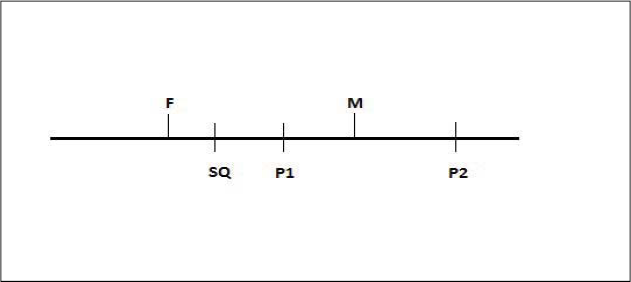
Presidential Bills and Legislative Cartel
If the president presents a bill (P1) which approximates the status quo to the ideal point of the median cartel member (M), his supporters will back the amendment and use their agenda power to ensure it passes; this is because the proposal is closer to their position than it is to the status quo. However, if the president puts forward a bill (P2) that radically moves the status quo to the right, away from the ideal point of the median cartel legislator, the chance of success decreases dramatically; this is because the median cartel legislator will prefer the status quo (closer to M) rather than the president's proposal (P2). In this circumstance, the legislative cartel stops functioning and the median chamber legislator becomes irrelevant (F). Therefore, the president's bill (P2) will never be approved, unless he agrees to amendments made in the chamber (i.e., moves toward M).
This kind of situation was very common during Lacalle's government. Its main pieces of legislation – the privatization of public enterprises and the revocation of monopolies – were profoundly modified in Congress (Chasquetti and Lanzaro 2003) or were dramatically buried – social security reform (Giménez 2011). The political consequences of the mistakes made in managing the legislative cartel became clear when analyzing the overall results of the policy-making process. During Lacalle's first cabinet, the executive submitted 265 bills of which only 34 percent became laws. That success rate is significantly lower than the one achieved by the following three presidents in their first two years in office: Sanguinetti (1995–1996) achieved a success rate of 39 percent; Batlle (2000–2001), 54 percent; and Vázquez (2005–2006), 55 percent (see Chasquetti 2010).
The types of legislation passed also reveal the difficulties faced by the government: of the 96 laws approved, 54 percent were administrative rules (naming schools, troop deployment, individuals’ special pensions), 20 percent were ratifications of international treaties, and only 26 percent consisted of substantive legislation related to the presidential platform (Lanzaro et al. 2000).
In sum, Lacalle's inability to build a central authority capable of guiding the cartel as a legislative contingent was the result of procedural mistakes and a policy agenda that was not reconciled with the ideal-point of the median coalition member. Consequently, Lacalle's carefully selected multiparty cabinet was unable to achieve legislative successes. Even having agenda power in standing committees made no difference, since there was, in many cases, no harmonious coalition majority pursuing collective action. Lacalle's failure to recognize the consequences created by the ideological dispersion of his supporters ensured that he would suffer new failures in the following years (Chasquetti and Lanzaro 2003). His persistence with neoliberal reforms – which he saw as being justified given his election on this mandate – eventually led to the breakdown of his coalition cabinet. President Lacalle attributed this, however, to a lack of loyalty on the part of his partners rather than his radical government program. 11
In January, 1992, Lacalle stated: “we cannot accept that behind the ministers in cabinet, the votes in Congress are not clearly guaranteed […] we will accomplish with the citizen mandate, with one cabinet or another, alone or in company, because we have the clear duty of fulfilling the goals the people voted for in November, 1989”(quoted by Mancebo 1993: 38).
The Advantage of a Plurality Cartel
The other outlying case is the second cabinet of President Batlle. In the first section we saw that while his legislative contingent was small and did not hold agenda power in the committees (between 0.3 and 0.5 out of a possible 5, see Table 3), his supporters in the plenary did not roll in the votes for important bills (0 percent, see Table 1). The evidence shows that cabinets with low roll rates in the plenary and agenda power typically have majority status, while those with high roll rates and no agenda power typically have minority status. However, Batlle's second cabinet does not correspond with either of these types.
In their recent study, Calvo and Sagarzazu (2011) used the term “plurality cartel” to define the situations wherein a party controls the agenda, but lacks enough votes to pass legislation. This model has two distinctive features: on the one hand, cartel members exert negative agenda power by acting cohesively and using all available institutional resources; on the other, they have difficulties in exercising positive agenda power in the plenary because they need allies to pass legislation. This is well illustrated in the Argentinean case, where plurality cartels delegated more authority in prefloor institutions in order to block unwanted bills or gain support for the passage of their own bills.
President Batlle's second cabinet does not exactly fit this model because the Uruguayan Congress lacks prefloor institutions. However, his plurality cartel did exercise negative agenda power by appealing to different strategies, which will be described in the next paragraphs. Despite the empirical differences, Batlle's second cabinet may be considered a subtype of plurality cartels. To understand the nature of the government's experience it is essential to review the special conditions in which this cabinet was selected and the type of behavior President Batlle adopted.
The Second Cabinet of President Batlle and the 2002 Crisis
The severity of the 2002 economic crisis in Uruguay 12 led to the breakdown of the majority coalition composed at the beginning of the presidency. In October of that year, the Partido Nacional withdrew its five cabinet ministers and announced its transition to the opposition. The president's popularity had fallen dramatically in the past six months, from 36 percent in March to 12 percent in September. After the loss of the minority partner in the coalition, a new cabinet was composed, consisting solely of members from the president's party – which accounted for only 32 percent of the seats in each chamber.
The economic crisis during 2002 was one of the most complicated episodes in Uruguay's history. The finance minister, Alejandro Atchugarry, who instructed the government to the end of the crisis, described the juncture as a perfect storm: “since January 1999, when Brazil devaluated its currency, the Uruguayan economy not only did not grow, but went into recession with a systematic falling of the GDP, the employment rate and the investment rates. With the Argentinean crisis in 2001 and its declaration of default, Uruguay suffered the largest and longest bankrun in history. Since January 2002, 45 percent of deposits in the financial system were withdrawn. We had a government with the wear and tear of two tax adjustments (February and May), with plans promoted by the IMF that did not work and with a dramatic loss of all Central Bank reserves. Besides the government lost its legislative support, […] the country doubled its debt (from 50 percent of its GDP to 100 percent), the economy fell by 20 percent only in this year, and unemployment climbed to 20 percent” (quoted by Pérez Antón 2011: 45).
With the country in crisis and the government overwhelmed, the president was required to employ three innovative strategies. First, He made the important decision to appoint Senator Alejandro Atchugarry as the finance minister. Atchugarry was the principal voice of the government in Congress, had a long tenure as a legislator, and possessed strong bargaining and negotiating skills. Once in office, the new minister developed a parliamentary managing style. In his own words:
the end of the crisis was reached by walking down a new path […] with a minority government, the procedure was to share information with the opposition, collectivize the reasoning underpinning decisions with flexibility to incorporate the views of legislators from other parties. Thus, the country controlled inflation and the exchange rate, fulfilled its duties, and maintained and improved production incentives, in the conviction that only with growth would we overcome the crisis (quoted by Pérez Antón 2011: 46).
While the president avoided public exposure – instead focusing on chief-of-state issues, such as foreign policy and making efforts with multilateral agencies – the finance minister became, during the following months, the face of the government; he appeared daily in Congress, participating in finance-committee meetings in both chambers as well as sessions that were called by both chambers to discuss legislation related to overcoming the crisis (Pérez Antón 2011).
The risk that the crisis posed to the democratic regime, combined with the bargaining procedure used by the government, strengthened opposition parties’ confidence in the new measures, which enabled the plurality cartel to secure allies and, thus, successfully pass bills. It can be argued that placing the finance minister in Congress enabled the plurality cartel to write bills closer to the ideal point of the median chamber member, which partially explains the absence of high roll rates in those months. During the year after the crisis, Congress passed 157 laws (40 above the annual average) – only 19 cases in the Senate resulted in split votes, while all financial laws targeted at ending the crisis were passed.
This strategy was very useful during the crisis. However, as the economy began to recover the government had to find other strategies. Atchugarry left office in August 2003, which saw the president return as the central figure in the political scene. During the last 18 months of Batlle's mandate, the government repeatedly threatened to veto certain bills proposed by opposition parties – actually vetoing 11 bills (7 partial vetoes and 4 total vetoes). This contrasted starkly with the previous three years, during which Batlle had only vetoed on 7 occasions. 13
While the third Lacalle cabinet (minority coalition, 1993–1994) applied 19 vetoes, the Sanguinetti cabinet during his first term (minority party, 1988–1989) applied 13 vetoes.
Second, the government developed a careful strategy to prevent any modifications to its budgetary policy. As mentioned above, the Uruguayan Constitution grants the executive branch sole legislative initiative on budget policy, meaning that legislators do not have the power to propose budget amendments, they are only permitted to vote on those put forward by the executive. The constitution also requires that a budget bill for five years (presupuesto quinquenal) be submitted in the first year of the president's mandate as well as successive annual bills (rendición de cuentas). There is a maximum period of 120 days for the approval of the annual bill. If this deadline is not met, the Constitution stipulates the approval of the allocations established in the original five-year bill (Moraes, Chasquetti, and Bergara 2009). In this context, the plurality cartel preferred to maintain the status quo rather than to propose changes and risk being rolled by the opposition – a strategy that proved, as we will see, extremely efficient. In 2003 and 2004, the government proposed annual budget bills containing a single article that simply communicated the state of finances and established the freezing of resource allocation. Faced with such types of proposals, the opposition had no option but to maintain the status quo: if they voted in favor, the status quo was maintained; if they rejected the bill, the status quo was also maintained; and even if they let the constitutional deadline expire, the status quo was maintained. In short, any outcome favored the government. Given this situation, the opposition parties chose to vote against the government so that it might pay some form of political cost. Despite this tactic, the government was able to realize its goals on both occasions. 14
The Rendición de Cuentas 2002 was introduced on 1st July, 2003 and sent to the joint committees of Budget and Finance in the House of Representatives. After 16 sessions, the committee rejected the bill by 12 votes to 6. The handling of the bill in the plenary featured the presentation of four minority reports, one per party, and the bill's rejection on the floor received 50 negative votes of the 76 present members. The Rendición de Cuentas 2003 was sent to Congress on 7 July, 2004. The same committees studied the bill and after 5 sessions, it was rejected by 10 members of the opposition while the government legislators decided not to participate. Four days later, the bill was discussed in the plenary with three minority reports of opposition parties. In this instance, the government legislators left the session and the bill received 42 negative votes out of the 45 present members.
Third, the plurality cartel adopted a strategy of not forming quorums, counting on the complicity of some legislators in the Partido Nacional to follow suit. This phenomenon was more frequent in the last year of the period in question, when parties’ primary elections and national elections were scheduled to take place. 15 As most nacionalista members were elected in small districts away from the capital (77 percent, 17 out of 22 deputies), the plurality cartel strategy of not forming quorums became functional to the interests of nacionalistas, who wanted to cultivate their local constituencies.
Primary elections are held in June of the fifth year of the term. They are designed to select the presidential candidates of each party and the national and departmental conventions. Additionally, they serve to set the places on the legislative list and order the candidates from various fractions of the parties (Chasquetti 2011). The legislative elections take place in October in concurrence with the first-round of the presidential election. The second-round is held in November, thereby generating a long time frame ideal for an extensive electoral campaign of at least nine months.
Although plenary sessions usually took place, they lacked the necessary quorum to make decisions (50 deputies). Once this practice had become a chronic problem, a debate took place during the 28th session of the Chamber of Representatives (see Diario de Sesiones), prompted by the reflection of colorado deputy, Washington Abdala, that
for several sessions we have had difficulties establishing a quorum, and this problem worries me, I do not know how the chamber will deal with it, but this situation is becoming untenable.
After several interventions, Ernesto Agazzi, deputy of the Frente Amplio, said that
when discussions began, I counted legislators on the floor and there were 49. Rarely this year has there been a quorum of this size. Of the 49 legislators, 67 percent were frentistas, 18 percent colorados and 14 percent nacionalistas. I do not say this as a merit, but as a simple statement.
Later, the colorado deputy Ruben Diaz, frankly acknowledged that
there is no attendance problem in the Chamber of Representatives, but a problem with the attendance of colorado and nacionalista deputies. That is the truth. And if not, look at who is right now on the floor. Moreover, my party mates speak here and then leave.
According to the frentista deputy, Guillermo Chifflet,
in the Human Rights Committee, for quite some time we have just had a quorum to deliberate because of the presence of another member of the Frente Amplio and me, but we are four members in the committee! […] legislators of the Partido Colorado and Partido Nacional exceptionally attend.
The statements continued in that tone until the last of the speakers. Almost the totality of participants acknowledged the difficulties in establishing quorums in both committees and plenary sessions, motivated primarily by the absence of the colorados and nacionalistas.
To sum up, the second cabinet of President Batlle held a plurality cartel in Congress that used different strategies to avoid high roll rates in the plenary. In the midst of the economic crisis, Senator Atchugarry was appointed as finance minister, though he took on a role akin to that of a parliamentary prime minister. His bargaining style and willingness to dialogue allowed the cartel to develop bills that were acceptable to the median chamber legislator. Once the economy improved, the plurality cartel started to employ institutional resources (Calvo and Sagarzazu 2011) such as the threat of vetoes, the application of vetoes, effective use of the budget rules process, and, finally, a strategy of not running quorums in committees and the plenary. Thus, the outcomes obtained by this weak minority party cabinet, which lacked the control of agenda power, were excellent: it was not rolled in the plenary as regards important bills and reduced the influence of the opposition parties over approved legislation.
Conclusions
This study confirms the fecundity of party cartel theory to analyze the performance of the presidential government in Latin America. Accepting that there are institutional differences compared to the US system, this study showed how party cartel theory is able to provide consistent explanations for different situations. Empirical evidence reveals that parties matter and that the performance of parliament cannot be interpreted with theoretical approaches that dispense with these actors.
This paper confirms the idea that the cabinet structure in Uruguay is a good proxy with which to better understand the legislative dynamics in this country. Although our study was based on a small number of cases, we found that the partisan composition of the cabinet ensures legislative support for the president. In six of the eight analyzed cabinets, the nominal composition allowed the estimation of the legislative performance of the government. When a cabinet guarantees a majority in the chamber, it establishes a basis upon which it is possible to build a cartel with agenda power. In contrast, cabinets that do not secure a legislative majority face serious difficulties in successfully carrying out the presidential agenda in Congress. In this latter situation, the preferences of the median member of the chamber will determine the outcomes of the legislative process. However, as shown by the analysis of the two deviant cases, the ideal preference point of the median member is also a product of the parties’ positions in relation to the presidential initiatives.
The analysis of the outlying cases provides two important lessons. First, a president's leadership style is an important factor in determining a government's success. The manner in which President Lacalle developed a link with party leaders within the coalition threatened to undermine the authority of the legislative cartel. His impatience often saw him break the chain of command to reach decisions that conflicted with previous decisions, thus causing confusion and unnecessary conflicts between coalition parties. President Batlle, however, operated differently when faced with crisis. Having seen his government lose its legislative majority and his public opinion drop, Batlle decided to step back from the spotlight and appoint his key senator, Alejandro Atchurraga, to take the lead on economic policy. Atchurraga quickly assumed the role of government chief and began a productive dialogue with the opposition parties. It is fair to assume that had President Batlle adopted any other attitude, not only would his government's results have been different, but the costs of the economic crisis may have been more severe for Uruguay.
Second, both outlying cases show the importance of a president's policy agenda. In the case of President Lacalle, his obstinate pursuit of neoliberal policies – which sat at odds with most of his coalition legislators’ political orientations – was, in his mind, legitimized by the fact that he had been elected by the public on that mandate. But given that many of his initiatives were far from the ideal preference point of the legislative median of the majority, he eventually eroded the legislative support he believed he had. The policy agenda during the second cabinet of President Batlle can be seen as the opposite of President Lacalle's. Batlle's greater willingness to compromise is reflected by his decision to appoint Atchurraga – a minister with strong negotiating and bargaining skills – as finance minister. Subsequently, bills negotiated during Batlle's regime took into account the preferences of the median member of the chamber and, thus, allowed the government to experience some legislative success and spread the costs of ending the crisis among all parties.