



Abstract
Uruguay stands out as an exceptional case for having a vibrant party system, stable democracy, and frequent use of direct democracy mechanisms (MDDs). Previous research has explained the use of MDDs as a means of opposing centre-right governments, but it has failed to explain the subsequent use of these mechanisms during the period of alternation between the major ideological blocs in government after 2005. We make an empirical contribution by describing the practice of direct democracy actions and explaining their fate through a qualitative comparative analysis that assesses how well the theoretical expectations proposed by Altman are borne out in the Uruguayan case in the latest period. We conclude that the politics of direct democracy change when ideological blocs alternate in government and that direct democracy initiatives fail due to the lack of lobbying power, high government approval rates, or non-concurrency of the vote with the presidential election in the context of a positive economic environment.
Introduction
The crisis of democratic representation in Latin America is characterised by a combination of widespread democratic disaffection and poorly institutionalised party systems. In this context, Uruguay stands out as an exceptional case for having a stable democratic regime, comparatively high levels of support for democracy, and an institutionalised party system (Joignant et al., 2017; Mainwaring et al., 2018). Also, Uruguay is regarded as the most prodigious user of citizen-initiated direct democracy mechanisms (MDDs) in the region (Altman, 2011; Breuer, 2011; Welp, 2020).
Previous studies have analysed the intense use of MDDs in Uruguay as a means of opposing centre-right governments during the country's first two decades of post-transition democracy (1985–2005). In this period, unions, retirees, and the leftist opposition initiated several direct democracy actions and effectively promoted changes to the pension system and to the regulation of public companies’ ownership. The literature suggests that this use of direct democracy supplemented representative democratic politics by increasing vertical accountability between elections (Altman, 2019; Breuer, 2007), opening new avenues for institutionally channelling voters’ discontent, representing the interests of groups, and providing the political opposition an electoral accumulation tool (Altman, 2011; Monestier, 2007).
We know less about the subsequent use of these mechanisms during the period of alternation between the two major ideological blocs in government that began in 2005 when the centre-left coalition was elected to govern and continued in 2020 when a new centre-right coalition began to rule (see Antía and Vairo 2023). Did the use of MDDs – for example, the issues and actors involved – change when the political context changed? What accounts for the fate of MDDs in this new context?
This article aims to fill this gap in our understanding by analysing the changing uses and the fate of MDDs in post-transition Uruguayan democracy. We first describe the frequency of use and the types of actors and issues involved in direct democracy actions in the context of political alternation. The use of MDDs was recurrent and partially successful during centre-right governments, and infrequent and unsuccessful during the “left turn.” Also, we observed that most initiatives on economic issues occurred during centre-right governments, and most initiatives seeking a more punitive security policy or greater restrictions on sexual freedoms and the rights of marginalised groups prevailed during centre-left governments. We also observed a predominance of social movements operating as promoters during centre-right governments, while political parties predominated during centre-left governments.
Although it can be challenging to draw definitive conclusions from the comparison of left-wing and right-wing government cycles with different time periods, these features suggest a changing pattern of CI-MDD use in response to the alternating ideological orientations of the governments.
Then, we explain the failure of citizen-initiated MDDs (CI-MDD) once they reach the ballot box. We use qualitative comparative analysis (QCA) to assess how well the new empirical cases of direct democracy actions that have occurred in Uruguay in recent decades align with the theoretical expectations proposed by Altman (2011). In particular, we use crisp-set QCA, originally developed by Ragin (1987), to analyse 18 direct democracy actions initiated between 1985 and 2022, adding new cases to Altman's original study. We conclude that the failure of direct democracy actions is attributable to the absence of lobbying capacity on the part of the promoters, high approval rates of the government, or the non-concurrency of the MDD vote with the presidential election, in the context of a positive economic environment.
This article contributes to the literature on direct democracy by describing the use and explaining the fate of MDDs when different ideological coalitions alternate rule, in a case that is particularly well-suited to explore the politics of direct democracy. The study also aims to discuss whether the politics of direct democracy enhances government responsiveness by supplementing and revitalising representative democratic politics.
In the next section, we present the institutional design of MDDs and describe the practices of direct democracy use in Uruguay. Next, we discuss the prevailing explanations regarding the fate of direct democracy initiatives. We then present the research design, with a focus on the QCA method and the operationalisation of the conditions. In the subsequent section, we present the results and a depiction of the process of direct democracy actions. Finally, we discuss the key findings, potential implications and identify opportunities for future research.
MDD Use in Uruguay During Centre-Right and Centre-Left Governments
Institutional Design
The literature classifies the MDDs into bottom-up and top-down mechanisms, depending on who initiates them (citizens or government) (Altman, 2011; Breuer, 2011). Citizens can exercise vertical control over their governments through a citizen-initiated process that can be sparked by signature-gathering campaigns. This process allows citizens to influence the political agenda by adding issues that elected officials may prefer to see left out, or by blocking and reversing undesirable policies (Breuer, 2011: 101).
The institutional setting for MDD activation has remained mostly unchanged during Uruguayan post-transition democracy, including three types of direct democratic instruments:
1
Popular initiatives to reform the Constitution are citizen-initiated instruments that aim to introduce constitutional amendments. Support of at least 10 per cent of the registered citizens is needed to place an amendment on the ballot concurrent with the upcoming national election. Congress may formulate substitute projects to be submitted to the plebiscite decision, together with the popular initiative. There are no restrictions on what topics can be included in the projects. For a proposal to be approved, it requires the affirmative vote of an absolute majority of the ballots cast in the election, which must represent at least 35 per cent of the registered voters. Hence, this instrument is a proactive tool to change the status quo, although it can also be used to guarantee the maintenance of the status quo by incorporating issues into the Constitution. Derogative referendums are citizen-initiated instruments that aim to repeal a law approved by the parliament, except for laws concerning taxes or those that come under the “exclusive initiative” of the executive, including spending provisions. Derogative referendums can be initiated through a “long pathway,” which requires the submission of the signatures of 25 per cent of the registered voters within a year of the law in question being enacted. Alternatively, a “short pathway” can be used to propose a pre-referendum vote to determine support for the consultation. This method requires the signatures of 2 per cent of registered voters. An actual referendum is held if the pre-referendum poll receives at least 25 per cent of the vote.
2
The activation of a referendum against a law entails considerable mobilisation to gather support from the requisite 25 per cent of registered voters and force a ballot vote, which is a demanding requirement when compared to referendums in other countries such as Switzerland (Altman, 2011; Papadopoulos, 2001). It is also rigorous when compared to the popular initiative requirements. Mandatory referendums (or Legislative Initiative to reform the Constitution) are the only top-down MDD in Uruguayan institutional design. This device is automatically activated to endorse (or not) constitutional reforms initiated by Congress or by the Executive in cooperation with the Legislature.
Changing Uses of MDDs: Types, Actors, and Issues
Uruguay's stable democracy and frequent use of direct democracy set it apart from other Latin American countries (Altman, 2011; Welp, 2020). Additionally, Uruguay has an institutionalised party system that has undergone significant transformations (Buquet & Piñeiro, 2014; Buquet & Yaffé, 2021). Before the 1970s, the political arena was dominated by the traditional rivals, Partido Colorado (PC) and Partido Nacional (PN), which formed a fractionalised bipartisan system (Buquet et al., 1998) 3 . The emergence of the centre-left party, Frente Amplio (FA), in 1971 led to the formation of a three-party system by 1994 4 .
From the return of democracy until 2004, the PC and PN alternated in government with various formats of bipartisan cooperation (Chasquetti, 2006). In this process, the traditional parties moved towards the centre-right, and the FA shifted to the centre-left of the political spectrum (Buquet & Piñeiro, 2014; Garcé & Yaffé, 2005). Consequently, political competition became organised around two blocs of similar electoral weight: one centre-left bloc including the FA, and the other centre-right bloc including the two traditional parties (Buquet & Piñeiro, 2014). Since 2005, these blocs have alternated in office. In that year, the FA came to power with a majority in Congress and was reelected twice until a new centre-right government coalition, led by the PN and integrated by the PC, the new right-wing party Cabildo Abierto, and two other small parties, took office in 2020.
The analysis of the use of MDDs reveals that, in line with the periods of alternation between ideological blocs, there have been three delineated phases, in terms of the frequency of their use and success, the issues at stake, and the actors involved in these initiatives. In this regard, we identify a changing pattern of MDD use, with intensive use and varying success during centre-right governments and marginal and unsuccessful use during centre-left governments.
In this section, we aim to provide a brief overview of the MDDs types (Figure 1), the actors promoting the initiatives (Figure 2), and the main issues included in the proposals (Figure 3) for each phase. Since the duration of the three phases varies, we present the information by government periods to facilitate comparability. The actors promoting the initiatives were classified into two categories, namely social movements and political parties. Social movements include various actors, such as trade unions, organised interest groups, and associations of retirees and pensioners. Concerning the issues at stake, we developed a classification based on Leemann (2015) and Martínez-Gallardo et al. (2022). We distinguish between the economic-distributive dimension (state-market divide, pensions, and labour rights); the socio-cultural dimension (gender, sexual rights, environment, and public security), and the institutional dimension (modifications to the electoral regime and interbranch relations). We also incorporated an issue of human rights violations during the military dictatorship of 1973–1985.
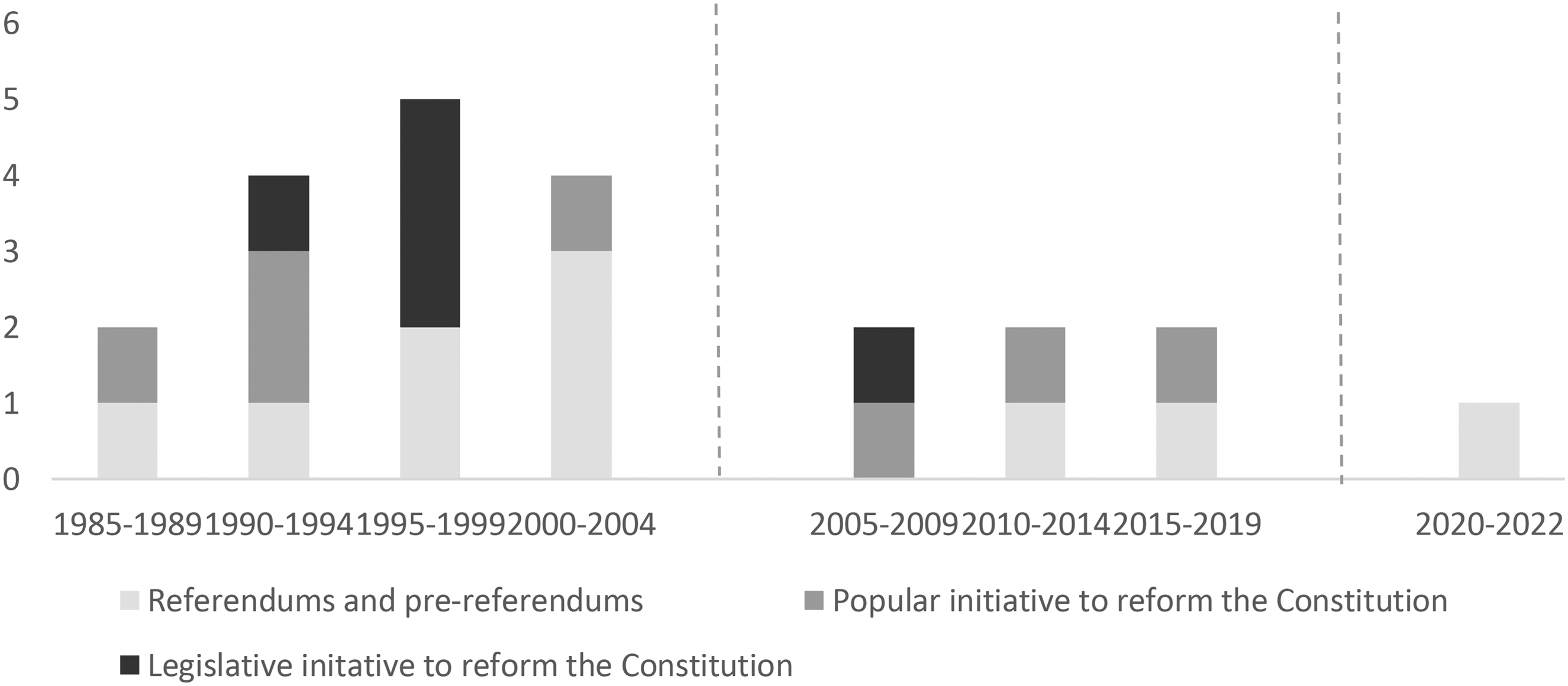
Activation of Direct Democracy Mechanisms in Uruguay, by Government Terms (1985–2022). Source: The Authors, Based on Altman (2011); Monestier (2007); Lissidini (2021), and press accounts. Note: The dotted lines delimit government cycles based on ideological blocs.
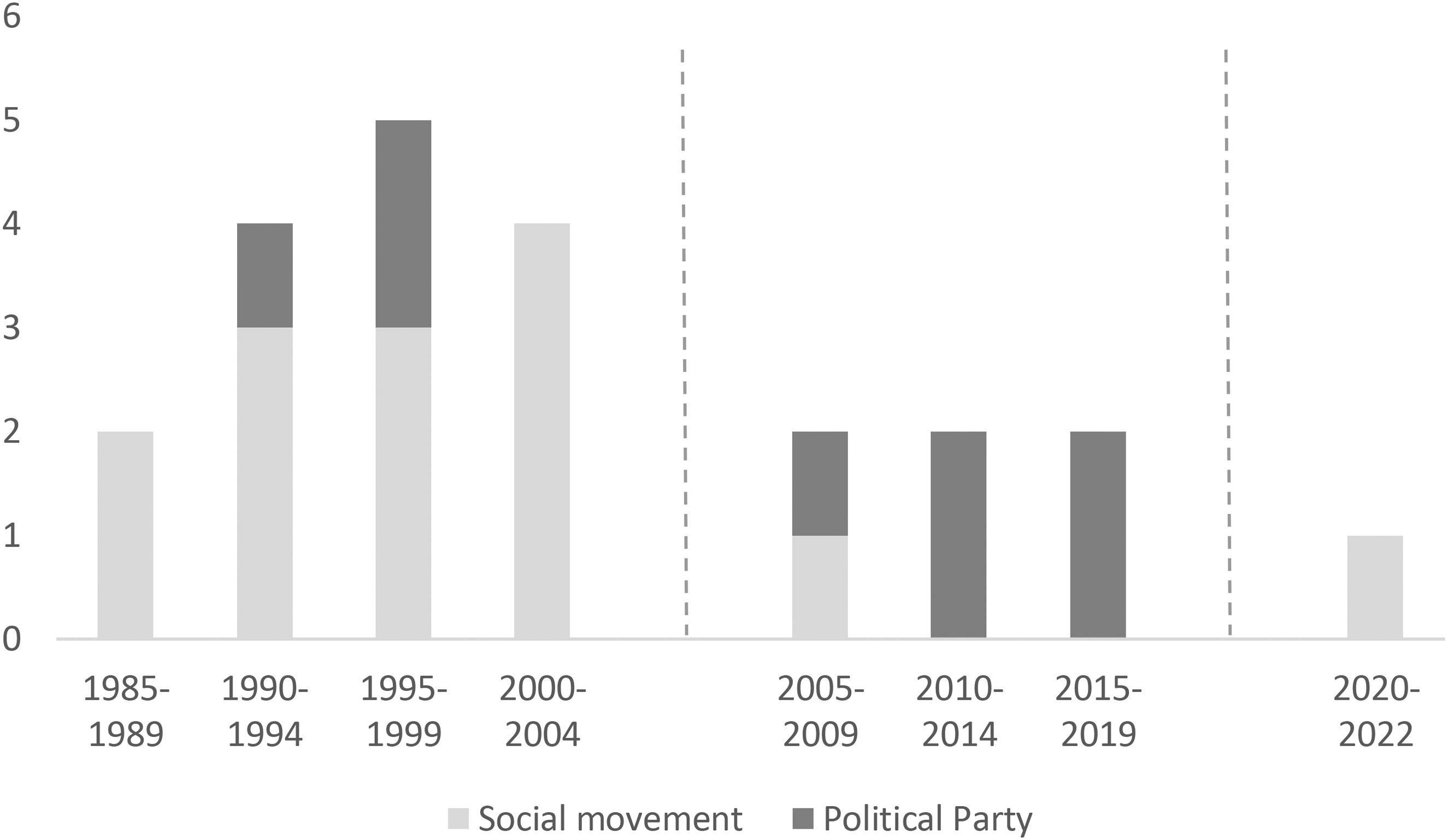
Initial Promoters of Mechanisms of Direct Democracy in Uruguay, by Government Terms (1985–2022). Source: The Authors, Based on Altman (2011); Monestier (2007); Lissidini (2021), and press accounts. Note: The dotted lines delimit government cycles based on ideological blocs.
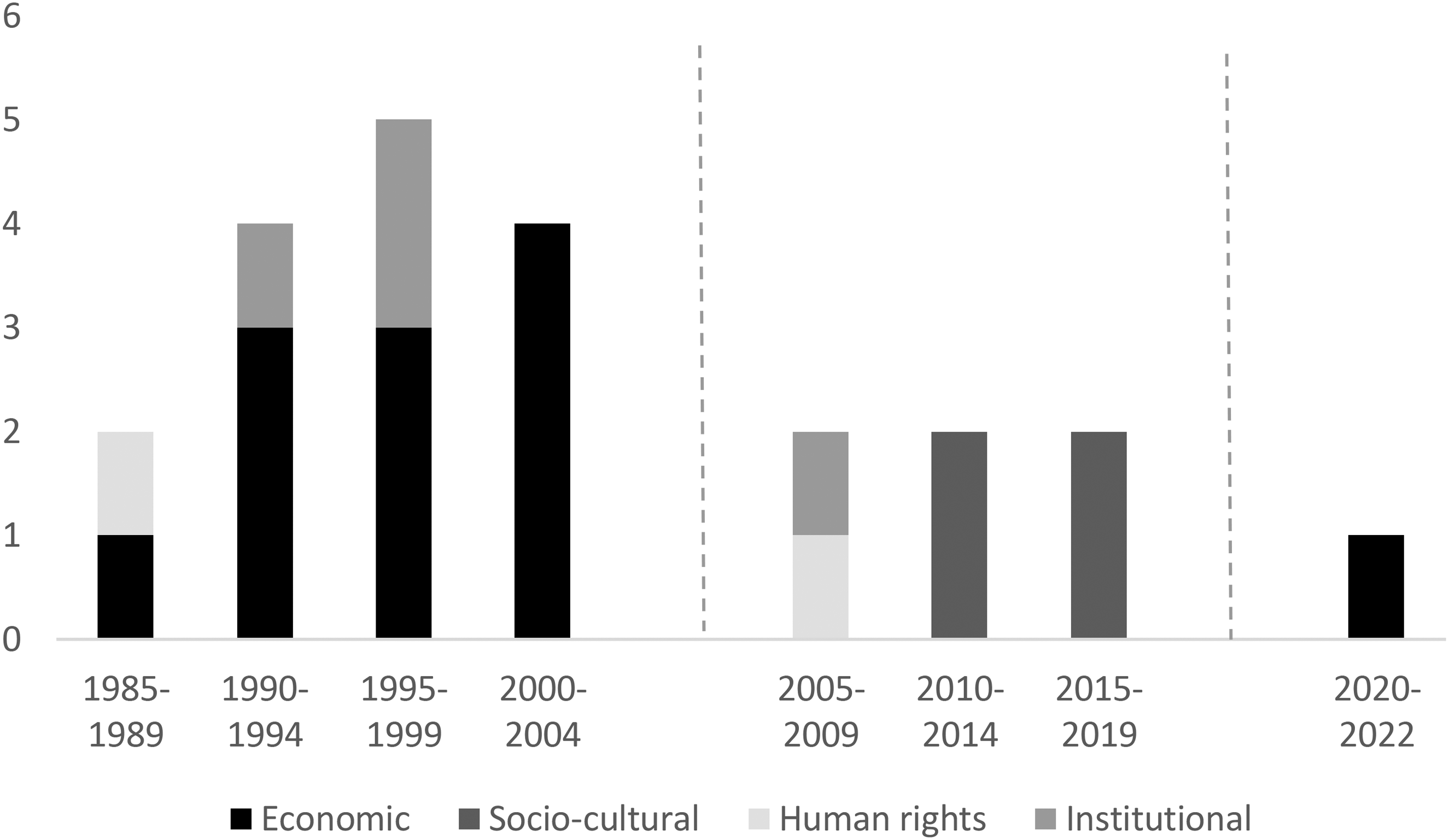
Issues at Stake in Mechanisms of Direct Democracy in Uruguay, by Government Terms (1985–2022). Source: The Authors, Based on Altman (2011); Monestier (2007); Lissidini (2021), and press accounts. Note: The dotted lines delimit government cycles based on ideological blocs.
In the first phase, there were eleven CI-MDDs, comprising four popular initiatives to reform the Constitution and seven referendums to derogate laws 5 , along with four constitutional plebiscites on legislative initiatives to reform the Constitution (Figure 1).
This amounts to an average of 0.8 MDDs per year across the four government periods within the centre-right government cycle from 1985 to 2004.
The CI-MDDs that opposed laws adopted by the centre-right governments were mainly driven by social movements, such as public enterprise unions, in alliance with the political left in opposition, FA, and with the occasional support of fractions of centre-right parties (Altman, 2011; Bergara et al., 2006; Lissidini, 2012; Monestier, 2007) (Figure 2). The issues put to a direct vote in this phase were mostly economic, although there were also some that concerned institutional and human rights issues (Figure 3).
Every successful experience of direct democracy occurred during this stage: Of the fifteen cases in which direct voting by the citizenry was enabled, the modification was approved six times. Additionally, on one occasion, the approval of a pre-referendum led the government to repeal the law in question to deactivate the popular consultation (Altman 2011).
In this article, we aim to provide an analysis of the years that have been less explored in the literature. Once the left came to power, the frequency and nature of MDD use changed. Between 2005 and 2019, six initiatives were proposed, including two pre-referendums to derogate laws 6 , three popular initiatives to reform the Constitution, and one legislative initiative to reform the Constitution (Figure 1). 7 This represents an average of 0.4 MDDs per year, which is notably lower than the averages observed during the centre-right government cycle (0.8 per year) and the overall period (0.6 per year). In addition, none of the initiatives were successful in the ballot box.
Moreover, the initial promoters of the initiatives have also changed, with fractions of political parties and/or politicians leading them instead of the unions and social movements that orchestrated initiatives in the previous phase. Furthermore, the MDDs of this second stage focused on different issues than those of the previous period. The economic issues that predominated during centre-right governments were replaced by four initiatives concerning socio-cultural issues (Figure 3).
In effect, right-wing individual politicians initiated two referendums in 2013 and 2019, expressing opposition to the expansion of sexual and minority rights by FA governments. In addition, political parties initiated two constitutional reform initiatives related to public security in 2014 and 2019, which had a strong punitive orientation aimed at increasing criminal penalties and promoting new institutional mechanisms to fight crime.
Furthermore, two constitutional reform initiatives unrelated to economic or socio-cultural issues were presented and voted on in 2009, originating from the left. The first initiative was a popular initiative project promoted by a broad coalition of social movements, unions, and the FA, aiming to reform the Constitution on a human rights issue. This was a second attempt to annul a law that established amnesty for military and police officers who had committed crimes during the civil-military dictatorship 8 . The second initiative, related to an institutional issue, was promoted by FA legislators, and aimed to enable mail-in voting for Uruguayans living abroad.
Finally, in 2020 a centre-right coalition took office, marking the beginning of the third and current phase. A derogatory referendum was proposed and ultimately put to a popular vote in March 2022, resulting in an average of 0.5 MDDs per year for the two years 9 . However, it narrowly failed in the ballot box. The referendum challenged 135 of the 476 articles of an omnibus bill enacted in 2020, which introduced various reforms in fiscal regulations, labour rights, environmental protection, education, healthcare, and housing. Similar to the first cycle of centre-right governments, unions, and social movements, followed by the centre-left opposition, were the driving forces behind the referendum. Economic issues played a prominent role in this initiative.
Prevailing Explanations for the Fate of CI-MDD
What do we know about the conditions under which MDDs succeed or failed? What accounts for the fate of MDDs in a context of political alternation? In this section, we focus exclusively on CI-MDDs, which are the object of our subsequent explanatory analysis.
The bulk of the literature has focused on three approaches to account for CI-MDD fate: institutional, political, and economic factors. The first perspective refers to the institutional requirements that hinder or facilitate the success of a CI-MDD, such as the number of signatures required or the existence of quorums (Altman, 2019). For instance, the higher the number of signatures or the quorums required, the harder it is for the MDD proposal to succeed.
Political explanations emphasise how different factors influence citizens’ voting decisions. Scholars have offered three accounts of how citizens decide their vote (see Font & Rodríguez, 2009). Some accounts posit that citizens vote on a direct democracy proposal according to their attitude toward the issue at stake, without considering other events. Other arguments hold that MDDs usually are “second-order” elections, where citizens cast their vote based on their assessment of the national government and political parties competing in a “first-order” election (Franklin et al., 1995). When voting in a MDD, they will vote according to the national government's suggestion if they approve of the government, but if they do not, they will take the opportunity to punish the government. This account highlights the importance of government popularity at the time of voting, which may influence a CI-MDD vote. Finally, some scholars argue that voters often follow partisan cues when deciding their vote on a CI-MDD proposal (Hobolt, 2006; Silagadze & Gherghina, 2018) and that, in some contexts, they follow fractional partisan suggestions (Altman, 2002, 2011). As crucial information providers in CI-MDD campaigns, political parties can alter how the ballot proposition is framed and can affect voting behaviour (Hobolt, 2006). The more cohesive and clear the message given by political parties, the more influential they are likely to be. Furthermore, political parties, social movements, and interest associations may form coalitions for an issue-specific MDD proposal, recommending the vote for or against it (Kriesi, 2006). Additionally, the success of a direct democracy proposal may depend on the government's political composition. Coalition governments, composed of multiple parties, can lead to more fragmented political loyalties among citizens compared to a majority-party government (see Altman, 2002).
The economic perspective suggests that deteriorating economic conditions could enhance the prospects of a popular initiative or referendum that opposes the government's interests (Altman, 2011; Bowler & Donovan, 1998; Altman, 2019). Although economic conditions affect government popularity (Lewis-Beck & Stegmaier, 2013; Singer & Carlin, 2013), they are not the only basis for evaluating an incumbent's competence (Singer, 2011). The evolution of economic conditions and incumbent popularity may differ, and thus, may independently influence citizens’ voting decisions in a MDD.
Combining these different strands of the literature, Altman (2019) analyses the probability that a CI-MDD will succeed, considering those that occurred in the period 1980–2016 around the world. He concludes that “CI-MDDs’ likelihood of success increases when they need lower quorums, the executive recommends them, the government is beyond its honeymoon period, there is a strong economic contraction, and electoral participation is high” (p. 102).
Regarding the fate of Uruguayan CI-MDDs, Altman (2011) offers an explanation of the success or failure of direct democracy actions during the 1985–2004 period. The analysis is based on five causal conditions, all closely linked to the main dimensions identified in the literature. The first condition is the state of the economy. He hypothesises that: “the better the economic atmosphere, the higher the support for the government's position on any given CI-MDD” (Altman, 2011: 164). The second condition concerns the issue at stake in the CI-MDD, which can be economic or political-institutional. The influence of this factor is presented as an exploratory, rather than a confirmatory hypothesis, since it does not start from clear theoretical expectations regarding its influence. The third condition concerns the degree to which the content of a CI-MDD proposal is conservative and seeks to maintain the status quo. The expectation is that conservative CI-MDD proposals are more likely to succeed under the assumption that voters are, in general, conservatives. The fourth condition is whether the CI-MDD takes place concurrently with presidential elections, which may produce a contamination effect, increasing support for the direct democracy proposal. The final condition concerns whether a strong group is promoting the CI-MDD. Strong groups are better able to mobilise the population and so the expectation is that CI-MDDs promoted by a strong group are more likely to succeed (Altman, 2011, pp. 163–167).
The author concludes that, on the one hand, the success of a CI-MDD is closely linked to a strong lobby or union promoting the action and the economic issue at stake (necessary conditions), accompanied by two different combinations of sufficient conditions: (1) the CI-MDD attempts to maintain the status quo in a context of deteriorating economic conditions; or (2) the CI-MDD is concurrent with elections and there is a positive evolution of the economic situation. He further concludes that, on the other hand, CI-MDDs tend to fail at the ballot box when (1) the organised group that promotes the action is weak; (2) the issue at stake is political; (3) the CI-MDD proposal attempts to alter the status quo and is not concurrent with the national elections; or (4) the CI-MDD proposal attempts to alter the status quo and the economic conditions are deteriorating.
Methods
In the following section, we attempt to explain the success or failure of citizen-initiated direct democracy actions once they reach the ballot box. We use QCA to assess the theoretical expectations proposed by Altman (2011) in light of the new empirical cases of direct democracy actions that have occurred in Uruguay in recent decades.
QCA is particularly well suited to account for causal complexity, based on the assumption that social phenomena can rarely be understood by focusing on the role of a single causal condition (Ragin, 1987; Schneider & Wagemann, 2012). Instead, most phenomena are characterised by causal complexity involving: (1) equifinality, that is, the possibility of multiple paths leading to the same outcome; (2) conjunctural causation, when causal conditions operate in concert with others; and (3) asymmetry, meaning that the causes of success are not the same as those that explain failure (Oana et al., 2021: 8).
The explanatory part of the article presents an analysis of 18 citizen-initiated MDDs that occurred during 1985–2022, in which the executive opposed the goal sought by the MDD's supporters. Our work adds five new cases to Altman's original study. 10 Due to the nature of the data, where most conditions are dichotomous, we use crisp-set QCA, originally developed by Ragin (1987), and the R package “QCA” developed by Oana et al. (2021) to analyse the data.
The Standard Analysis of the QCA yields three types of solutions – complex, parsimonious, and intermediate – depending on the handling of logical remainders, that is, rows containing combinations of causal conditions that do not present any empirical cases (Ragin, 2010). We opt for the parsimonious solution, in which all the logical remainders are considered true and incorporated into logical minimisation, as did Altman (2011).
We developed the analysis in two steps. First, we replicated Altman's analysis, using the same five causal conditions (issue, concurrency, CI-MDD attempts to maintain the status quo, wage, and lobby, see below), and adding the new cases not considered in that paper. The truth table used for the QCA is included in the Appendix (Table A1). The analysis showed that one of the rows of the truth table (row 22) reveals contradictions, in the sense that one of the new cases added to the analysis is ascribed to a row that displays a different outcome. This contradictory truth table row implies that the same combinations of conditions result in both the occurrence and the non-occurrence of the outcome in different cases.
To resolve this contradiction, we follow the suggestion of Schneider and Wagemann (2012: 120), by adding a condition to the QCA analysis. Therefore, the contradicting row is divided into two rows, splitting the cases with various outcomes into these new rows. The new condition that we included is the popularity of the government at the time of the CI-MDD 11 .
Accordingly, the second step of our analysis was to conduct a new crisp-set QCA analysis, including the six causal conditions. These results are reported in the “Result” section.
Operationalisation
We follow Altman (2011) for the operationalisation of most of our conditions. Our outcome is the result of the CI-MDD at the ballot box. It is operationalised as a dichotomy: 1 if it is successful, 0 if unsuccessful.
Data on our six causal conditions were collected from various sources, including previous studies and press accounts. The first causal condition is the issue of the CI-MDD, which can be economic (E) or political-institutional (∼E) 12 . We code the issue based on a close reading of the content of each CI-MDD proposal. In the few cases where the CI-MDD content combines economic and political issues, we evaluate which issue predominates. In particular, in the case of the referendum on Urgency Law 2 held in 2022, we define the issue as economic, given that most of the challenged rules were economic.
The second condition is concurrency (C) of a CI-MDD with presidential elections, which is operationalised as 1 if they are concurrent and 0 if they are not. The third condition is whether the CI-MDD attempts to maintain the status quo (Q). We assign a value of 1 when the proposal aims to maintain the status quo and 0 if the CI-MDD seeks to change the status quo. For the fourth condition, which measures the presence of a strong lobby (L) in support of the CI-MDD, we assign a value of 1 if a strong lobby is present and 0 otherwise. The evolution of the real wage (W) takes on the value of 1 if the average real salary change over the past 12 months is positive and 0 otherwise. The final condition is the president's approval rating (A), which is measured by the average popularity of the president for the year in which the CI-MDD was held. We set the dichotomisation threshold for presidential popularity at 35.07 per cent, which is the average value of the historical presidential approval ratings for the period 1989–2022, assigning a value of 1 when popularity is greater than 35.07 per cent and 0 otherwise 13 .
Table 1 summarises the cases and our coding. As can be seen, none of the new cases we have incorporated into the analysis were successful. For this reason, in the following discussion, we focus on explaining the failure of the CI-MDDs.
Data Matrix.
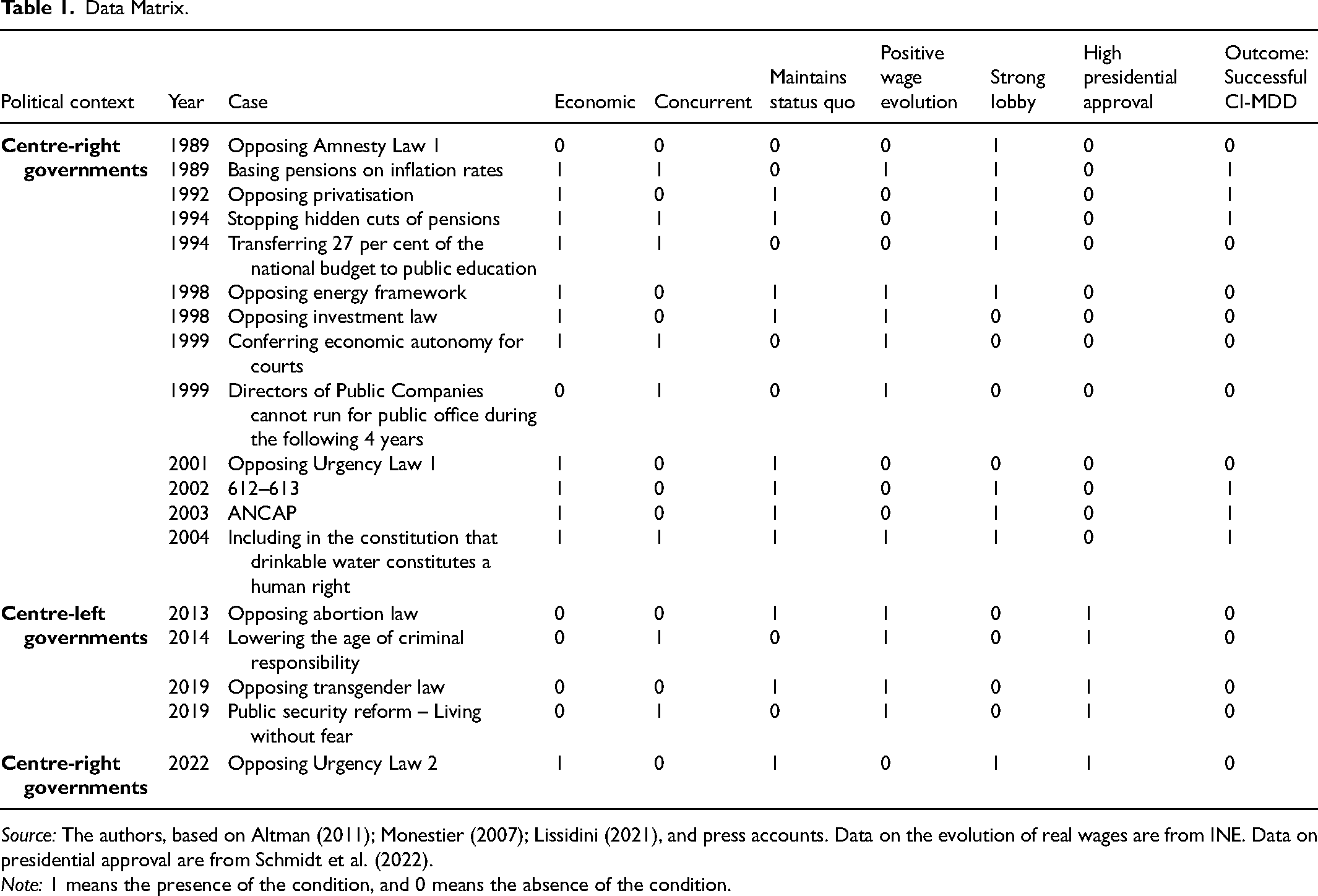
Source: The authors, based on Altman (2011); Monestier (2007); Lissidini (2021), and press accounts. Data on the evolution of real wages are from INE. Data on presidential approval are from Schmidt et al. (2022).
Note: 1 means the presence of the condition, and 0 means the absence of the condition.
Results
We turn now to the results for the analysis of the failure of CI-MDDs. We first analyse the conditions that are necessary for the failure to occur. Condition X is necessary when it is always present when the outcome is present. The analysis shows that none of the conditions is necessary for the failure of a CI-MDD (Table A2 in the Appendix).
The second phase entails performing an analysis of the sufficiency of conditions through a truth table analysis, which summarises the data and makes it possible to identify potential patterns (Table 2). Sufficiency analysis involves identifying the condition or set of conditions that always lead to the outcome of interest.
Truth Table for Outcome = CI-MDD Failure.
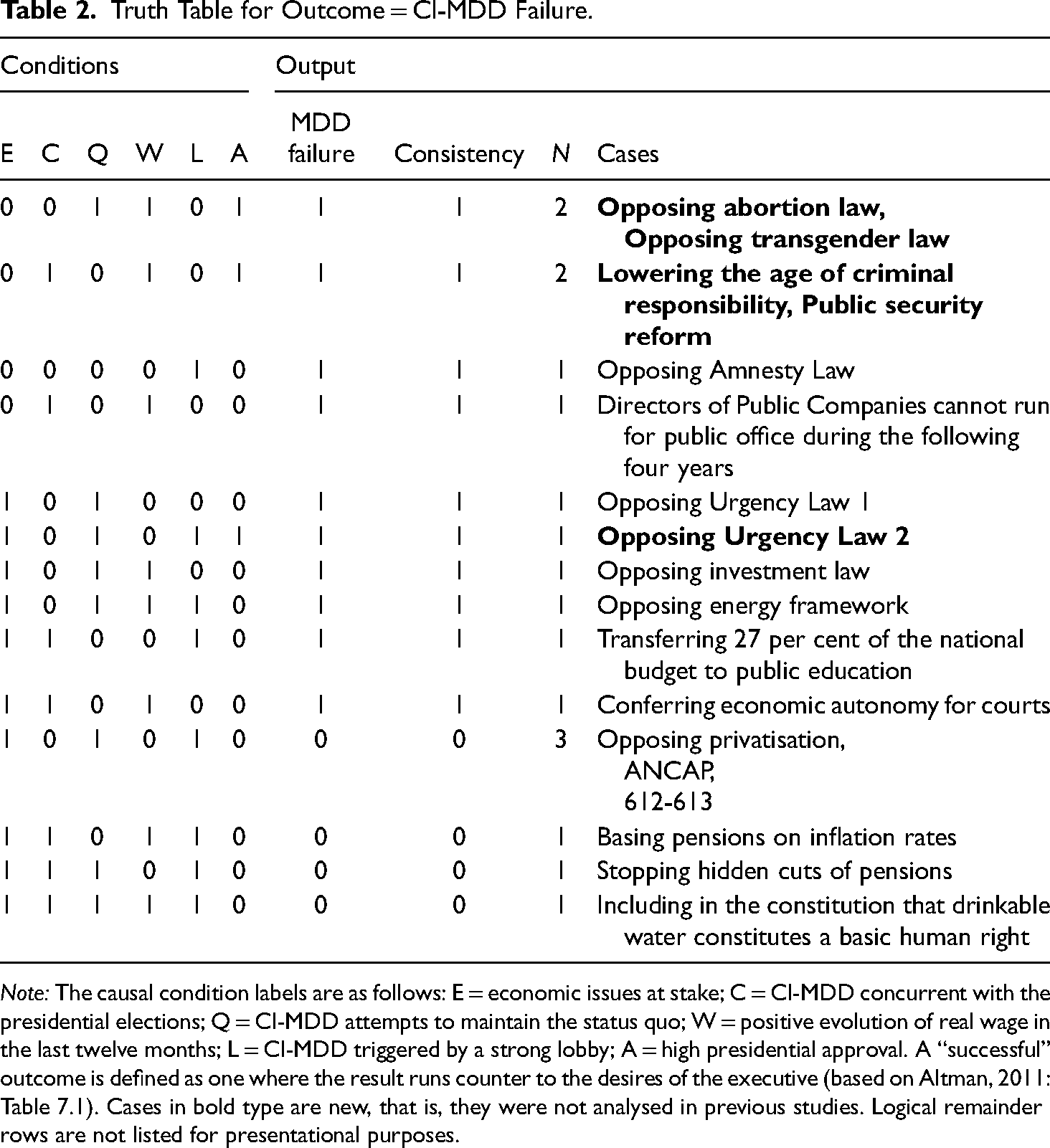
Note: The causal condition labels are as follows: E = economic issues at stake; C = CI-MDD concurrent with the presidential elections; Q = CI-MDD attempts to maintain the status quo; W = positive evolution of real wage in the last twelve months; L = CI-MDD triggered by a strong lobby; A = high presidential approval. A “successful” outcome is defined as one where the result runs counter to the desires of the executive (based on Altman, 2011: Table 7.1). Cases in bold type are new, that is, they were not analysed in previous studies. Logical remainder rows are not listed for presentational purposes.
The rows of the table show configurations of our six conditions, with a total of 64 rows (26). Here we present 14 rows into which at least one empirical case could be placed 14 . The table shows that 10 rows are assigned a value of 1 in the Output column, which means that they are sufficient for the failure outcome. It can also be seen that there are no contradictory truth table rows, that is, cases where the same configuration of conditions leads to opposite outcomes. In particular, the parameter of fit “consistency” takes on the value 1 when all instances with a given configuration show the same outcome (Oana et al., 2021).
The QCA process continues with the logical minimisation of truth tables, to identify sufficient conditions. This resulted in a parsimonious four-path solution leading to the failure of a CI-MDD. Table 3 displays those paths along with the associated scores for consistency, coverage, and the identification of the cases.
Parsimonious Solution (Sufficient Conditions) for CI-MDD Failure (∼O).
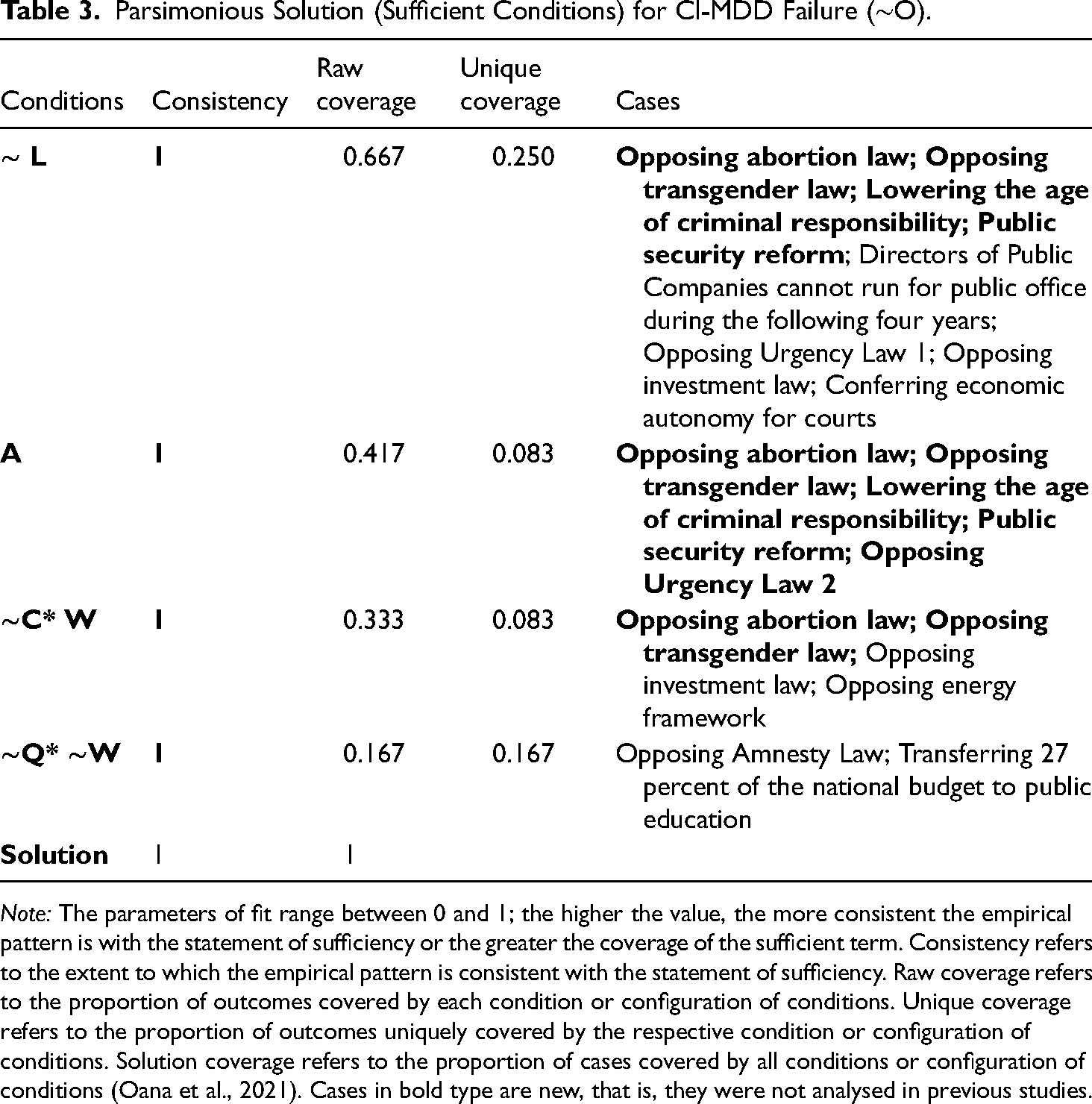
Note: The parameters of fit range between 0 and 1; the higher the value, the more consistent the empirical pattern is with the statement of sufficiency or the greater the coverage of the sufficient term. Consistency refers to the extent to which the empirical pattern is consistent with the statement of sufficiency. Raw coverage refers to the proportion of outcomes covered by each condition or configuration of conditions. Unique coverage refers to the proportion of outcomes uniquely covered by the respective condition or configuration of conditions. Solution coverage refers to the proportion of cases covered by all conditions or configuration of conditions (Oana et al., 2021). Cases in bold type are new, that is, they were not analysed in previous studies.
When taken as a whole, the parsimonious solution term exhibits a consistency (solution consistency) and coverage (solution coverage) of 1. This means that the empirical pattern is consistent with the statement of sufficiency.
Four paths have typically resulted in the failure of a CI-MDD: a weak lobby pushing the CI-MDD (∼L), high levels of presidential approval (A), the CI-MDD vote is not concurrent with the presidential election and there is a positive evolution of the economy (∼C* W), or the CI-MDD attempted to change the status quo in a context of deteriorating economic conditions (∼Q ∼W).
Cases of CI-MDD Failure During the Second (2005–2019) and Third Phases (2020–2022)
In this section, we examine the CI-MDDs submitted to a vote in the second cycle (centre-left governments) and the third cycle (centre-right government), considering the causal configurations accounting for the failure of these initiatives 15 .
CI-MDDs Against Reproductive and Transgender Rights
Frente Amplio governments promoted the expansion of the “new rights agenda,” which included reforms to laws governing abortion and the rights of transgender individuals and other minority groups. As a result, religious groups and pro-life movements reacted against the so-called “gender ideology,” in defence of certain traditional values (Bidegain et al., 2021; Pérez Bentancur and Rocha-Carpiuc, 2020). This opposition was expressed in several ways, particularly through two referendum attempts against the abortion law and the transgender law.
Opposition to Abortion Law (2013). During the post-transition democracy, several attempts were made to pass a law decriminalising abortion in Uruguay. In the centre-left government headed by Tabaré Vázquez, in 2008, the Parliament passed a bill decriminalising abortion, but the president vetoed it. In 2012, during the government of the next centre-left leader, José Mujica, Congress passed a new abortion law, but in this case, the Executive promulgated it. The law allows the interruption of pregnancy up to 12 weeks of gestation.
Immediately, some congressmen and politicians from opposition parties, with the support of pro-life religious groups, launched a campaign to collect signatures to repeal the law. The “National Commission for the Repeal of the Abortion Law” gathered the required signatures (2 per cent of the electorate, about 12,000 persons) to enable the “short pathway” referendum (Rómboli, 2013). Every presidential pre-candidate and some former presidents supported the idea of calling for a referendum, even within the ruling party, as in the case of the former president, Tabaré Vázquez. However, party support was lukewarm (Lissidini, 2021). In response to the initiative, in June 2013 a group of social organisations and unions launched a counter-campaign called “I do not vote and you?” which sought to persuade citizens not to participate in the pre-referendum. The pre-referendum was held in June 2013 and obtained support from 8.92 per cent of the registered voters, falling far short of the 25 per cent required to call the final referendum (La Diaria, 2021).
The failure was due to three sufficient conditions. On the one hand, the lobby campaigning for the referendum was weak because, in practice, it was not supported by parties, unions, or social movements with mobilisation capacity. On the other hand, President Mujica enjoyed high popularity, exceeding 40 per cent approval (Schmidt et al., 2022). Finally, the pre-referendum was not held concurrently with the presidential election, and the positive evolution of the economic situation made it less likely that people would vote against the government. In brief, a CI-MDD against a popular government and lacking the means to mobilise around its goal, in a good economic context and far away from the elections doomed the initiative.
Opposition to transgender law (2019). In 2019, as the period of centre-left governments was ending, some individual politicians of minority sectors and with the support of some religious groups activated the mechanism of a referendum to repeal the “Integral Law for Transgender People.” This law recognises the rights of transgender persons, provides reparations to victims of discrimination, and promotes inclusion policies for this group. The most controversial part of the law provides trans adolescents access to hormone treatment through the courts and without the consent of their parents or other legally-responsible adults (Ferreira, 2019).
A group that called itself “We are all equal” followed the “short pathway” to call a referendum. However, the initiative had limited political support. Even within the Catholic Church, there were differing opinions (Ferreira, 2019). The majority of the presidential candidates encouraged people to vote in the pre-referendum (González Keusseian, 2019), which received support from only 9.9 per cent of registered voters, and so the issue failed to advance to a final referendum.
The failure of the pre-referendum, in this case, can be attributed to the same three sufficient configurations as the action against the abortion law. The lack of lobbying power of the promoters was a sufficient condition for the initiative to fail. It did not have strong support from political parties, unions, or social organisations, nor significant access to the media. In addition, the timing of the vote in August 2019, which coincided with the last months of the Vázquez administration, saw an improvement in presidential approval ratings. Public opinion polls showed that citizens did not consider the issue of the law important enough to hold a referendum on (Ferreira, 2019). Moreover, the pre-referendum vote was not held concurrently with the national election, and the economic situation at the time was favourable.
CI-MDDs on Public Security Issues
During the second cycle of centre-left governments, opposition parties also put forth two public security-related constitutional reform proposals in 2014 and 2019. These events occurred in a context marked by a discourse on the need to increase penalties to reduce crimes against persons and private property, which had become prominent in the media and political debates (Lissidini, 2021: 7).
Initiative to lower the age of criminal responsibility (2014). In 2014, concurrent with the national elections that gave Tabaré Vázquez a second presidential term, a plebiscite on constitutional reform was submitted to a popular vote. The initiative proposed to lower the age of criminal responsibility from 18 to 16, to preserve the criminal record of minors, to create a National Institute of Rehabilitation, and to strongly penalise adults who use minors in criminal acts.
A group calling itself “The National Commission to Live in Peace” initiated an “I sign” campaign in 2011 to gather the 10 per cent of signatures required by the popular initiative mechanism to reform the constitution. The main promoter was a conservative fraction of the Partido Colorado, which was later supported by its entire party. Some fractions of the Partido Nacional also supported the initiative, but an important fraction strongly opposed it. The signatures were delivered to the Electoral Court in 2012, exceeding by more than 10,000 the required number of signatures (El Espectador, 2012).
In response to the collection of signatures, a group calling itself “The Commission Against Lowering the Age of Imputability” was formed in mid-2011, comprising a wide range of political and social organisations such as the national central union (PIT-CNT) and the Federation of University Students (FEUU) (Lissidini, 2021). The Frente Amplio and some politicians from centre-right parties also actively campaigned against this proposal (Lissidini, 2021).
The initiative ultimately obtained support from 46.8 per cent of registered voters, so it almost succeeded but fell short of its goal. The failure of this initiative is associated with two sufficient conditions. First, the government of José Mujica was very popular at the time of the plebiscite vote. He had a government approval rating of more than 50 per cent in public opinion polls (Schmidt et al., 2022), making it difficult for an initiative against the government to succeed. Second, this initiative lacked a strong lobbying effort from organised interest groups and was not unanimously supported by the opposition parties.
This CI-MDD case highlights an interesting point that was not previously taken into account in our explanatory model, that is, the strength of the lobby against the popular initiative. In our analysis, we coded the lobby that supported the initiative as an explanatory condition. However, this case has shown us that the group that opposed the lowering of the age of imputability had a strong media and street campaign, with the support of interest organisations and the government party. The strong mobilisation capacity of this group likely played a decisive role in the failure of the initiative.
Public security reform initiative (2019). This initiative was a new effort of some centre-right political fractions to fight crime and insecurity through increased punitiveness. On this occasion, a fraction of the Partido Nacional, with the support of some other politicians, promoted a new constitutional reform initiative that succeeded in collecting more than 10 per cent of the registered voter signatures required for this mechanism (La Diaria, 2019). Under the slogan “Living without Fear,” the initiative proposed the creation of a militarised national guard and reviewable life imprisonment in cases of very serious crimes, elimination of early release for some crimes, and authorisation of nighttime raids (Lissidini, 2021; Nocetto et al., 2020).
Despite gaining initial traction, the public security reform initiative faced significant opposition from a range of social and political groups. The “No to Reform” movement carried out an important mobilisation campaign to construct a new framework for understanding the problem of citizen security and to avoid the adoption of repressive and punitive strategies (En perspectiva, 2019).
The plebiscite was also unsuccessful, although as in the 2014 event, it obtained the support of 46.3 per cent of voters. Its failure can be attributed to the sufficient condition of lacking a powerful lobby. The initiative was closely associated with a National Party leader who promoted it, with little support from other fractions, political parties, or organised interest groups. Additionally, the presidential candidate of the Partido Nacional, Lacalle Pou, who in the election that took place concurrently with the CI-MDD, won the presidency, did not endorse the initiative. The failure of the plebiscite can also be attributed to the high presidential approval of the outgoing president, which was improving during the final phase of his term.
CI-MDD on Economic and Political Issues
Opposition to the Urgency Law (2022). A coalition of centre-right and right-wing parties led by Lacalle Pou of the PN started the third cycle in 2020. During this current stage, a referendum was held in an attempt to repeal some provisions of the Urgent Consideration Law (UCL), which was an omnibus bill that addressed a broad range of economic and political issues. The UCL contained 476 articles covering topics such as fiscal regulations, economic activity, public security, housing, labour rights, health, and education.
In the economic area, the UCL establishes a fiscal rule that limits public spending. It also includes rules regarding financial inclusion, the oil market, and state-owned corporations, with a general deregulatory orientation. In addition, some articles have a direct impact on unions’ primary interests. In particular, the UCL limits striking workers’ right to occupy workplaces. The law also changed how representatives of teachers were included in the organisations in charge of running the various levels of education. In the security area, penalties were increased and a new category of crimes was created.
After the law was passed, the national central union, PIT-CNT, launched a campaign to support a referendum against the UCL. The union initiated the referendum through the “long path,” which involved obtaining the support of 25 per cent of registered voters within a year. The initiative was promoted by The Intersocial, a forum that includes numerous social organisations in addition to the PIT-CNT. The Frente Amplio also joined the campaign. The signature-gathering campaign required the deployment of a large number of activists, in a difficult context marked by the pandemic that severely limited people's mobility (Antía & Vairo, 2023).
In July 2021, the National Pro-Referendum Commission delivered 797,261 signatures to the Electoral Court, which made it possible to hold the referendum to repeal 135 articles of the UCL on March 27, 2022. The initiative had significant support (48.67 per cent) at the ballot box but fell short of the amount needed to repeal the law (Corte Electoral, 2022).
The sufficient condition to account for the referendum's failure was the high public approval of President Lacalle Pou. Presidential approval rates have stayed at high levels from the beginning of the administration, suggesting an extended honeymoon phenomenon (Schmidt & Repetto, 2022: 442). Also, the public's approval of security policies (a crucial component of the UCL) has remained at high levels. Although the mobilisation capacity of the initiative's promoters (PIT-CNT, social organisations, and FA) was significant, with a popular and strong president, it was difficult to persuade a majority of voters to oppose the main law adopted by the new government.
Conclusion
In this article, we made an empirical contribution to the literature on direct democracy by describing the use and explaining the fate of MDDs in Uruguay when different ideological coalitions alternate rule.
First, we find that there is a changing pattern of CI-MDD use in response to the alternating ideological orientations of the governments, in terms of the issues, promoters, frequency, and results of such initiatives. We find that initiatives concerning economic issues tend to occur to oppose the policies of centre-right governments, while initiatives concerning socio-cultural issues tend to arise during centre-left governments. This suggests that the content of CI-MDDs has been successively left- or right-wing in response to the political leanings of the ruling administration. However, it is worth noting that the current cycle (2020–2022) is exceptional in many regards and requires further research to draw more definitive conclusions. Overall, our findings suggest that the use of CI-MDDs is not a static phenomenon but a dynamic one that responds to the political context of the time.
Another interesting result concerns the changing profile of CI-MDD promoters. When the right governs, direct democracy actions are promoted by social organisations, which are later joined by political parties. However, when the left governs, the opposing parties or individual politicians take the lead. It is widely known that political parties make strategic use of direct democratic actions, as part of intra- and inter-party competition dynamics (Hollander, 2019; Leemann, 2015). When in opposition, the left frequently campaigned for direct democratic actions that had been initiated by social movements, a process that has been acknowledged as a crucial element in the left's electoral success. What is new is that when the right-wing parties were in the opposition, they also began to make strategic use of the instances of direct democracy, even becoming its initial promoters. Particularly, in the cases of popular initiatives related to public safety issues – which received broad support at the ballot box, even though they failed –, ambitious politicians took advantage of the importance that this issue had gained in public opinion and, by calling for constitutional plebiscites, positioned themselves in the public arena.
Second, we reconsider earlier work by replicating and extending previous research on the determinants of CI-MDD results, during a period in which there were no successful cases. We conclude that the weakness of the lobby promoting the action, high presidential approval, or the fact that the MDD is non-concurrent with the elections and there is a positive evolution of the economic situation explain the failure of direct democracy actions in the last period.
We agree with Altman (2011) regarding the role of the weakness of the lobby or of the actor promoting the CI-MDD in explaining the initiative's failure. While lack of adequate mobilisation capacity was a sufficient condition in only some cases to account for CI-MDD failure during the first cycle of centre-right governments, it was present in all the CI-MDD attempts when the centre-left governed, pointing to a relevant difference between the left-right camps in terms of mobilisation capacity.
The comparison of the findings from the two studies also revealed that our explanation includes an additional sufficient condition, namely, presidential approval. This is an important condition that could be included in other studies of direct democracy results, particularly in contexts where government popularity and the evolution of economic conditions do not always go together.
After reviewing the different uses and conditions that account for the fate of CI-MDDs, it is worth examining the role of direct democracy in recent times. Even though since 2005, during the last two cycles, there have been no successful instances of direct democracy, the direct democracy arena has not become irrelevant. Several direct democracy actions that received substantial electoral support were politically consequential as they contributed to shifting the political agenda's emphasis, encouraged the political agenda of the initiator, or showcased the ability of the promoters to mobilise voters (Altman, 2019; Hollander, 2019). Actually, by including direct democracy experiences from the last 20 years in the analysis, it seems that CI-MDDs continue to play an important role by institutionally channelling discontent and giving voice to those who disagree with the government's orientation, both among social movements and political elites.
Our conclusions accord with those of authors who have emphasised the importance of political parties in guiding citizens’ voting decisions in direct democracy actions (Altman, 2002, 2011; Hobolt, 2006; Silagadze & Gherghina, 2018). We add to this literature by pointing out that, when the left governs, opposition parties play a new role as promoters of instances of direct democracy. Our analysis reveals new facets of how direct democracy interacts with political parties in a complex interplay between direct and representative democracy (see Setälä and Schiller, 2009).
Finally, we suggest that future research should expand the scope of this line of inquiry to explore the role of countermobilisation campaigns that seem to have played a significant role in countering direct democracy actions. Additionally, future studies should conduct a more in-depth analysis of the motivations of political elites and political parties in initiating direct democracy actions. Such research could enhance understanding of the role of political parties, which make up an important component of direct democracy's political processes.
Supplemental Material
sj-docx-1-pla-10.1177_1866802X231183454 - Supplemental material for Direct Democracy in the Hands of the Opposition Under Alternating Ideological Coalitions in Uruguay (1985–2022)
Supplemental material, sj-docx-1-pla-10.1177_1866802X231183454 for Direct Democracy in the Hands of the Opposition Under Alternating Ideological Coalitions in Uruguay (1985–2022) by Florencia Antía and Daniela Vairo in Journal of Politics in Latin America
Footnotes
Declaration of Conflicting Interests
The authors declared no potential conflicts of interest with respect to the research, authorship, and/or publication of this article.
Funding
The authors received no financial support for the research, authorship, and/or publication of this article.
Supplemental Material
Supplemental material for this article is available online.
Notes
Author Biographies
References
Supplementary Material
Please find the following supplemental material available below.
For Open Access articles published under a Creative Commons License, all supplemental material carries the same license as the article it is associated with.
For non-Open Access articles published, all supplemental material carries a non-exclusive license, and permission requests for re-use of supplemental material or any part of supplemental material shall be sent directly to the copyright owner as specified in the copyright notice associated with the article.
