




Abstract
Scholars of the world's most recent democratization processes have tended to focus on how national-level institutions have developed and how citizens have interpreted and responded to those developments. In this paper, we argue that the distinct subnational political environments that emerge from uneven national regime transitions are important determinants of how people view their political world. Specifically, we argue that citizens’ experiences with and attitudes towards corruption are particularly influenced by the subnational political context in which those citizens live. We use survey data from across Mexico to test our theoretical expectations that a multi-party electoral context will heighten citizens’ awareness of corruption as a governance issue, even as their chances of being victimized by corrupt behavior is reduced. Conversely, we posit that one-party electoral environments should facilitate a “business as usual” attitude toward corruption among government officials and citizens. As efforts to deepen democracy and improve governance continue across the developing world, our findings highlight the need to incorporate subnational political processes into efforts to understand and address such critical issues as corruption and its consequences.
Introduction
Perceptions of corruption, and even experiences with it, can be highly subjective and shaped by a variety of individual and contextual factors (see, for example, Bailey and Paras 2006; Morris 2008). What one person sees as corruption, another might see as “getting things done.” However, less is known about the source of these variations in citizens’ understandings of corruption. The two general factors that are most commonly invoked in this regard are culture and institutions. Countries with particularly acute corruption problems often are seen as having a culture and/or a set of institutions that lend themselves to widespread incidents of corruption. One theme of recent work on corruption concerns the impact that the introduction of national-level democratic institutions has had on levels of corruption and on the culture of corruption that is believed to exist in many developing countries (e.g., Bohn 2012; Gerring and Thacker 2004; Rock 2009; Seligson 2001). However, a critical problem this research confronts, which serves as our point of departure, is the highly uneven nature of democratic change across the subnational political landscapes of emerging democracies. As such, it is only by examining institutional change, or the lack thereof, at the subnational level that we can begin to more fully understand the relationship between political institutions, a culture of corruption, and citizens’ attitudes and experiences with corrupt behavior in an era of democracy.
In an attempt to better understand the extent to which citizens’ experiences with and views of corruption are a product of their state-level political systems, we leverage uneven institutional change across Mexico's thirty-one states in the midst of that country's national-level democratization process. We suggest that institutional change at the national level, which in Mexico's case takes the form of the demise of the Institutional Revolutionary Party's (PRI) seventy-year hegemonic party regime, is not sufficient to change subnational patterns of corruption. Instead, we argue that the outgoing regime's legacy regarding citizens’ interactions with the state will remain strong until an individual's subnational political system exhibits signs of concrete institutional change that is consistent with a national-level democratization process.
For Mexico, then, we should expect to see evidence of the PRI's notoriously corrupt one-party regime emerge much more clearly in those states where the PRI kept its control of state government intact throughout the country's democratization process than in states in which citizens voted the PRI out of power at the state level. In sum, we offer evidence that subnational political systems play a powerful role in shaping the degree to which corruption continues to characterize interactions between individuals and their state. As such, in an era of highly uneven emerging democracies, efforts to understand the impact of institutions and culture on levels of corruption must move beneath the national level in order to account for this high level of intra-national variation.
Cross-National Understandings of Corruption
The subjective nature of corruption across countries makes comparative analyses inherently difficult. Citizens in some countries are may be inclined to perceive corruption in any type of interaction they have with government officials, while those other countries rarely find fault with even the most overt acts of government officials’ malfeasance. This situation makes comparative research on perceptions of, and even experiences with, corruption across these countries problematic. Without the ability to control for such inherently fuzzy concepts like “cultural understandings of corruption,” it is difficult to understand how pervasive corruption actually is across countries in which citizens have distinct conceptions of what constitutes corrupt behavior.
Extant cross-national research on corruption, as well as international anti-corruption efforts among the development community, is founded on the idea that citizens around the world now have a common understanding of what corruption is and a vested interest in fighting it. However, most people who are involved in these efforts recognize the tenuous nature of such an idea, where perceptions of what corruption is and is not vary significantly across time and space. There appears to be an implicit hope that such differences in conceptual understandings of corruption around the world will diminish as globalization continues apace. As Weyland pointed out in his description of changes in corruption levels across Latin America:
In earlier decades […] people may not have had a clear sense of the separation between the public and private spheres and may not have condemned certain private uses of public office. Due to modernization and the diffusion of universalist standards, ever more people may have begun to brand as bribery and corruption practices that in earlier years were deemed acceptable (Weyland 1998: 110).
Despite the clear trends of “modernization and the diffusion of universalist standards” that Weyland described, we contend that citizens’ understandings of and reactions to corruption continue to vary across and within countries. Wrong's description of the underlying logic of corruption in Kenya highlights this point:
Western analysts have remarked on Africans’ ‘astonishing ambivalence’ towards corruption, but it is not so surprising. Under the colonial occupiers and the breed of ‘black wazungas‘ who replaced them, the citizen had learnt to expect little from his government but harassment and extortion. ‘Anyone who followed the straight path died a poor man,’ a community worker in Kisumu once told me. ‘So Kenyans had no option but to glorify corruption’ (Wrong 2009: 55).
A similar widespread recognition, if not acceptance, of corruption has historically manifested itself in Mexico in such sayings as, “Un político pobre es un pobre político” (A politician who is poor is a poor politician). 1 These examples suggest different levels of tolerance for corruption across nations that seem, at least partly, to be a function of the countries’ political systems and the degree to which the countries rely on corruption to “get things done.”
For more extensive discussions of Mexico's culture of corruption during the PRI's seventy-year rule, see Bailey and Paras (2006), Camp (2003), and Morris (2003).
Are Kenya and Mexico two countries in which corruption has become so embedded in the cultural fabric that changes in citizens’ views of corruption under a new system are unlikely, or have the two countries’ recent democratic transitions resulted in a widespread rejection of the authoritarian legacy of corruption? The answer may be “a little bit of both” if we are correct that subnational political systems in many countries, particularly those pursuing the decentralization of government responsibilities, will have a far greater impact on citizens’ experiences with and attitudes toward corruption than the national political regime. In either case, it is unlikely that national-level democratization processes have had any uniform impact on corruption attitudes and behaviors across these countries. Rather, any effects will be a function of the particular subnational democratization dynamics that have occurred in the two countries.
It is rare that a country with a long authoritarian past will become democratic overnight. Although elections for national office may become relatively free and fair within a short amount of time, subnational electoral processes may be resistant to such change. As O'Donnell pointed out more than a decade ago, national-level democratization processes are often characterized by
[p]rovinces peripheral to the national center [that] create (or reinforce) systems of local power which tend to reach extremes of violent, personalistic rule open to all sorts of violent and arbitrary practices (O'Donnell 1999: 138). 2
However, as Wrong masterfully highlights in her book on Kenya's democratic transition in 2002, entitled It's Our Turn To Eat, newly elected democratic leaders at the national level are not immune from participating in corrupt activities just as actively as officials in the outgoing authoritarian regime.
In such contexts, one cannot expect changes in national-level institutions to have a great effect on the more common forms of street-level corruption that many encounter in their daily lives, such as police officers demanding “donations” to help with neighborhood security or hospital officials asking for an extra payment to ensure a much-needed appointment. We view this behavior as being influenced more by local and provincial-level political norms and institutions than by the national political system.
A widely publicized corruption scandal involving prominent national-level politicians would certainly have an impact on citizens’ perceptions of corruption, as would a prominent, national anti-corruption public information campaign. However, just as all politics is local, so too are the most common forms of corruption. We argue that it is these daily acts of corruption that are most likely to survive in subnational political systems that have withstood national-level democratic change. In the case of Mexico, the PRI's seventy-year legacy of corruption will most likely prevail in states where the PRI remains in charge, despite any national-level move toward a more accountable and less corrupt form of government. We suspect that the same could be said for the Southern United States of fifty years ago or the authoritarian enclaves of Argentina today (Gibson 2012). Regardless of what goes on at the national level, corruption should be expected to continue until provincial-level political machines founded on corruption can be dislodged. Therefore, from both a theoretical and methodological perspective, a subnational analysis of corruption across states that have removed the PRI, even for one electoral cycle, and those states that have yet to do so can help explain how the legacy of corruption, and a change in institutions that should theoretically erode that legacy, may or may not influence citizens’ views of and experiences with corruption.
Corruption and Subnational Electoral Contexts
The uneven nature of many countries’ political transitions means that the possible impact that a continuation of state-level political machines could have on attitudes toward, and experiences with, corruption is particularly relevant among new democracies. An increasing number of scholars (Fox 1994; Gibson 2012; 2005; Giraudy 2013; Lawson 2000; O'Donnell 1993) have highlighted and sought to explain the persistence of authoritarian enclaves at the provincial level amidst recent national-level democratization processes. Indeed, there is good reason to believe that such enclaves can become even more repressive and authoritarian as a national-level system becomes more democratic, with provincial political bosses more aggressively defending the status quo as democracy appears to be on the rise all around them. As Gibson (2012) noted, such subnational political machines can also be implicitly condoned by national-level government officials seeking the solid, reliable bases of electoral support that these machines can provide.
In such cases, where elements of the old regime survive, and often thrive, during an era of democratization, why do we expect corruption to also continue as a mode of governance? Our theory revolves around the idea that those with vested interests in the status quo will not change their behavior until confronted with sufficient evidence that a change in that status quo has occurred. Despite multiple economic crises and governance disasters, the PRI has yet to be dislodged from the most powerful branches of state government; in this context, it is rational for citizens and public officials to continue operating under the old rules of the game. In many ways, this argument is consistent with the argument that Olson presented in his seminal Rise and Decline of Nations that the longer a political system remains intact, the more likely it will fall prey to “distributional coalitions” intent on rent seeking (1982). Such entrenched interests can only be dislodged with some type of exogenous shock to the system. In the case of Mexico, the PRI's uninterrupted control of state government for seventy years appears to be a classic case of entrenched interests bent on rent-seeking behavior. The watershed electoral ouster of the PRI from a state's legislative and executive branch can greatly increase (but not guarantee) the chances of such entrenched interests being dislodged. Only when this occurs will corrupt behavior and corruption-tolerant attitudes associated with the old way of doing business have much opportunity to change.
Of course, Mexico is not the only Latin American country to have endured extended periods of one-party rule in the twentieth and twenty-first centuries. In Paraguay, the Colorado Party controlled national-level politics for six decades before being defeated by the populist-minded former bishop of San Pedro Fernando Lugo in 2008. While Diego Abente-Brun attributed the end of the sixty-one-year reign of the Colorado party at least partly to “the capacity of the Liberal Party to develop a political apparatus of its own through the control of a number of important municipalities and departmental governments” (Abente-Brun 2009: 145), others foresaw the Colorado Party's grip on subnational politics as a potential hindrance to the new administration. In a postelection report, Peter Lambert wrote:
Lugo must overcome more than a half-century of Colorado control of government, state agencies and to a great extent, society, along with the accompanying legacies of clientelism, corruption, and authoritarian enclaves. Moreover, Lugo's victory did not imply the collapse of the Colorado Party, which remains the largest party in terms of departmental governorships […] (Lambert 2008).
The Colorado Party reclaimed the presidency in Paraguay during the 2013 elections, similar to Mexico's PRI in 2012. 3
The authors are grateful to an anonymous reviewer for encouraging us to examine the similarities between the democratization processes of Mexico and Paraguay.
Beyond Latin America, the southern region of the United States represents another notable example of how such interests persist in distinct subnational political systems that contrast significantly with the country's larger democratization process. The one-party South developed its own set of political norms and institutions that in many respects ran counter to the democratic ideals, if not institutions, of the country as a whole. Key (1949) offers compelling support for the notion that this distinct political environment produced a wide array of subtle and not-so-subtle consequences in terms of the quality of governance in the region, the quality of life for citizens living in the region, and the relationship those citizens held with their elected public officials. Olson (1992: 927) also noted the overwhelming tendency among the ruling elites of the South to preserve the status quo: “Nor was there much enthusiasm in the ruling coalitions for changing local customs,” even in order to bring about a more productive economy. For these states of the U.S. South, as was the case in the states of Mexico still controlled by the PRI, the decades-long rule of a single organization or group of elites allowed for the creation of an informal, and sometimes formal, institutional framework founded on rent seeking by a privileged class of people. We argue that it is the strength of these vested interests in maintaining corruption as business as usual that is so critical for understanding systematic differences in corruption attitudes and behavior across Mexican states.
Just as the U.S. South lagged far behind the rest of that country's democratization process, we argue that certain states in Mexico's political transition face the same challenge. Specifically, as of 2008, 4 the PRI continued its seventy-year grip on both the executive and legislative branches of government in eight states, having never lost control of either branch since the party's inception in 1929. 5 Though some of these sub-national political systems could, and almost certainly did, qualify as democratic in many respects by 2008, they had yet to experience life under non-PRI rule. We argue that this single condition makes more likely (though not a certainty) the continuation of the PRI's culture of corruption that emerged over seventy years of one-party rule founded on the idea of the private exploitation of public office. As De Palma noted in the mid-1990s, “Corruption is not a characteristic of the system in Mexico […] it is the system” (As quoted in Morris 2009: 1). Thus, no matter how democratic the political systems of these eight PRI states may have become in the 2000s, the persistence of this corruption-driven system of government is far more likely in these states where architects of this style of governance has never left power. Consequently, we expect citizens within these PRI states to report higher levels of experiences with corruption, but also perhaps have a more jaded view of the extent to which this sort of behavior is a problem.
Two thousand eight is the final year of our subsequent analysis of citizens’ corruption attitudes and experiences.
The eight PRI-dominant states as of 2008 were Coahuila, Colima, Durango, Hidalgo, Oaxaca, Puebla, Sinaloa, and Tamaulipas. In 2010, three of these states, Oaxaca, Puebla, and Sinaloa, elected non-PRI governors, moving them out of the PRI-dominant category.
Suggestive evidence in support of this proposition comes from two complementary perspectives. First, the proposition implies that the PRI's legacy of corruption will begin to erode with the ouster of the PRI and an increased level of uncertainty surrounding the outcome of elections. This is precisely what Sharafutdinova (2010) found in an analysis of Russia's regions, where greater electoral competition led to heightened citizen perceptions of corruption (see also Grzymala-Busse 2007). Second, in situations where citizens lack concrete evidence that the old regime is dead, they will continue to interact with their political system in ways that have worked for them in the past. Hiskey and Bowler's (2005) work on local political environments and citizens’ views of the electoral process supports this expectation. Those authors found that “local context, perceptions of the system, and political behavior are intimately connected” (Hiskey and Bowler, 2005: 57). Citizens living in PRI-dominant states were more likely than their counterparts in multi-party states to view the electoral process as unfair and consequently disengage from formal political life (Hiskey and Bowler 2005: 66–68). In other words, in areas where people were not convinced of a regime change, the legacy of unfair and fraudulent elections remained strong and they continued to behave in ways consistent with that legacy.
Accordingly, our underlying assumption for this analysis is that prior to the initiation of the country's democratization process in the 1980s, state-level electoral environments were largely similar across the country, as was the view among citizens that corruption was simply a cost involved in making it through one's life. 6 Until 1989, elections for state-level offices were largely seen as “rituals” (Alonso 1993). Though some states did have vibrant opposition movements active during this period, this opposition never threatened the PRI's grip on state government. Across these state governments, corruption in its myriad forms was indeed business as usual. As Shelly noted, “the unique role of the PRI in Mexican society, rather than particular features of its organization, contributed to the [country's] high level of corruption” (Shelly 2001: 215). Thus, although certain states were closer to becoming democratic than others prior to 1989, it can be said that there was an overriding culture of corruption across all of Mexico's states.
Clearly recognizing that, during this period, some states were further along than others in terms of developing a viable opposition to the PRI's one-party rule.
Since 1989, with the PRI's ouster from the governor's office in Baja California, the state-level electoral framework upon which this climate of corruption and unchallenged one-party rule rested has started to change in some states. The election of an opposition party, even one represented by a candidate who only months before had seemed to be a loyal PRIista, 7 erodes the PRI's ability to maintain its partisan control over the machinery of government. With this loss of control, we posit that the long-standing culture of corruption is more likely to erode as well. Further, with a new political party taking over state government, we should expect anti-corruption rhetoric, if not actual policy, to become more prevalent than in states still controlled by the PRI. Individuals living through these initial opposition governments should therefore exhibit more sensitivity to corruption and be more willing to hold their government officials accountable in attempts to reduce corruption. In turn, all of these dynamics should help reduce levels of actual corruption in these states when compared to states that still operate under the PRI's old rules of a game in which corruption played such a central role.
This was the case in the state of Zacatecas in 1998, when Ricardo Monreal was passed over by the PRI as its candidate for the governor's race, and so switched parties and became the victorious candidate of the PRI's arch-rival, the Democratic Revolutionary Party (PRD).
Where the PRI's one-party rule did remain intact throughout the country's democratization process, we expect to find a citizenry that is more exposed to corruption, but less likely to see it as a problem. Even in those PRI states with a democratic sheen to them, acceptance of corruption as simply the cost of getting things done is likely to prevail among public officials and the mass public, thereby facilitating the continuation of the corruption legacy of the old regime. Furthermore, it seems unlikely that an incumbent PRI administration would rely greatly on anti-corruption rhetoric or policies, as such positions would hardly be credible, given the party's seventy years of close association with corruption. Nor should we expect a PRI candidate for a state legislative seat or governor's office to base a lot of his or her campaign on fighting corruption, as such a platform would stand as a fairly explicit indictment of the very party the candidate claimed as his own. Only after the PRI has been ousted from power could it credibly put forth an anti-corruption platform, aimed at an incumbent non-PRI government. For all these reasons, until the PRI loses power, we should expect the party's legacy of corruption to continue to be evident in all facets of public life.
Explaining PRI States
We begin our exploration of these ideas by examining our two groups of states: those in which the PRI remained in absolute control of state government, and those in which it did not. Our goal here is to uncover any systematic differences between the two groups that could also explain differences in corruption levels and attitudes. In defining our category of PRI states as those in which the party has continued its uninterrupted control of both the legislative and executive branches of state government, we include only those states that are truly “PRI-dominant states.” In saying this, we do not discount the fact that, during the 1990s and early 2000s, electoral contests in these states were becoming more competitive and that opposition parties were managing to win control of some municipal governments. From our perspective, however, the fact that the PRI was able to maintain majority control of the legislature and continue its uninterrupted control of the governor's office while such advances by opposition parties were taking place is further evidence that the PRI's undemocratic political machines were still functioning in these states.
Using these strict parameters to categorize a state as PRI-dominant involves a risk – not of mistakenly including a state that is actually not PRI-dominant, but rather of excluding a state in which an old-style PRI political machine is still in place. For example, our category of PRI states excludes the state of Veracruz. From one perspective, this state seems to fit the bill of a PRI-dominant state, with that party retaining control of the state executive branch throughout the 2000s, despite what seems to be a horrendous record in terms of economic and human development progress. However, the 2004 elections reflect the true level of support for the state's PRI machine, and explain why we have not classified it as a PRI state. In those elections, the PRI lost over 60 percent of municipal electoral contests and its majority control of the state legislature. Therefore, no matter how much the levers of state political power may remain in the hands of the PRI vis-à-vis its continued control of the executive branch, it arguably is less of a PRI state than those eight in which the party controls not only the executive branch, but also the legislative branch. Therefore, our strategy rests on identifying only those states in which the PRI's legacy of one-party rule and corruption has the strongest chance of surviving into the era of multi-party politics.
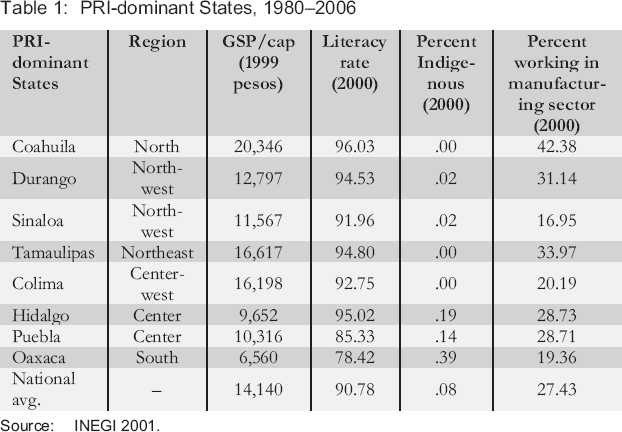
In trying to discern why only eight of thirty-one states have remained so much under the rule of the PRI, we look at them first as a group and examine any common features they might share. Instead of finding uniformity, however, we have found what appears to be a highly disparate group of states. Table 1 shows that the gross state product per capita of the states run from one of the lowest in Mexico (Oaxaca) to one of the highest (Coahuila). The group also contains states with some of the highest percentages of indigenous populations (Oaxaca and Puebla) and some of the lowest (Coahuila, Tamaulipas, and Colima). In short, there does not seem to be any obvious geographic or socioeconomic thread tying these eight states together.
PRI-dominant States, 1980–2006
Source: INEGI 2001.
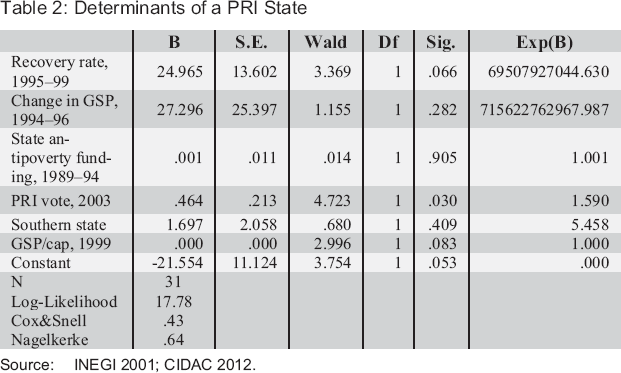
To help explain the continued dominance of the PRI in some states, Table 2 offers the results of a logistic regression analysis that models the probability of being a PRI state in 2004. 8
Determinants of a PRI State
Source: INEGI 2001; CIDAC 2012.
The first year of our survey data analysis in the following section.
We have included as independent variables the following indicators, which are designed to tap the socioeconomic development level of the state (the gross state product per capita in 1999): its economic performance during the 1990s, including the impact of the 1995 economic crisis (change in gross state product per capita between 1994 and 1996 and change in GSP/cap, 1995–1999); the state's fiscal relationship with the national government during the 1990s (total National Solidarity Program 9 spending/cap, 1989–1994); and the general level of support for the PRI in national elections (average vote share received by the PRI in the 2003 federal deputy elections).
This was Mexico's primary social development program during the early 1990s and, after controlling for the economic development level of the state, offers a rough proxy of the state government's ability to tap into federal coffers.
The results from the analysis largely confirm the absence of any (observable) systematic linkage among the eight PRI states. While the model's overall performance is respectable based on pseudo-R 2 measures (e.g., Nagelkerke R-square=.64), the only variables that approach statistical significance are the economic development level of the state (p<.08), the economic recovery variable (p<.07), and the PRI vote share in the 2003 federal deputy elections (p<.03). This latter coefficient suggests a modest correlation between the PRI's strength at the federal level and its ability to retain control of state government.
Of course, it is equally plausible that the causal arrow between these two runs the other way, with strong PRI machines at the state level able to deliver votes in the federal electoral arena as well. The coefficients for the economic variables may indicate that the PRI was better able to fend off opposition advances in states where the party was able to provide at least minimal protections for its citizens during the crisis years of the 1990s. Although we have not conducted an exhaustive analysis of this question, the results indicate that there are no clear and obvious variables that neatly explain why these eight states remained under the control of the PRI as late as 2008. For our purposes, these relative non-findings reduce the likelihood of a factor that is unique to the PRI states and corruption attitudes and experiences, other than the factor that is of most interest to us; namely, the continuation of the PRI's rule, and with it, the party's legacy of corruption.
Corruption Attitudes and Behavior across Distinct Political Environments
For decades, political scientists have concerned themselves with how contextual or ecological conditions might affect citizens’ attitudes, perceptions, and behaviors. To account for differences between contexts among a target population, scholars have most often relied on dummy variables to assign a contextual condition to each observation in a dataset. Most notably, following the publication of Key's foundational work on the U.S. South (1949), students of American politics began including a regional dummy in quantitative analyses to control for systematic differences between Americans residing in the eleven states that comprise the “Old Confederacy” and those residing in the other thirty-nine. 10 In recent years, arguments have been raised that a ‘new south’ has emerged and lost many of its distinctive qualities. However, Hillygus and Shields’ recent analysis suggests that, at least in regards to voting behavior, “[…] the calculus of Southern voters remains distinct from the rest of the electorate, with ideological cross-pressures in particular a more prominent condition in their vote decision” (Hillygus and Shields 2008b: 518). Our approach to capturing the impact of Mexican subnational political environments follows this same logic.
The states that have traditionally been defined as being in the south are Alabama, Arkansas, Florida, Georgia, Louisiana, Mississippi, North Carolina, South Carolina, Texas, Tennessee, and Virginia.
Comparative political scientists have also recognized that categorical variables can be used to capture cultural and regional variations at both the cross-national and subnational levels. For instance, Pop-Eleches and Tucker's (2011) study of the lingering legacy of communism on democratic values and behaviors effectively used a dichotomous variable to account for those countries they define as post-communist and those that do not fall into that category. Similarly, at the subnational level, Hiskey and Bowler (2005) used this analytical approach at the municipal level in Mexico to distinguish between citizens living in opposition towns and states and those living in areas where the PRI has never lost.
In the present study, we have utilized the same methodological approach to account for differences in subnational electoral contexts in contemporary Mexico. More specifically, we have analyzed data from nationally representative surveys of Mexicans and assigned a value of “1” to those respondents living in states that remain under the control of the PRI, and a value of “0” to respondents living in areas that have experienced life under non-PRI rule. We are not claiming that the ouster of the PRI necessarily means the full arrival of democracy to a state's political system, nor that the continuation of PRI rule at the state level necessarily means the complete absence of democracy. Rather, we have simply viewed the watershed event of the PRI losing control of the executive and/or legislative branch of a state government for the first time in over six decades for what it is: concrete evidence for citizens of a change in the state-level electoral context from one in which the PRI never loses to one where it has lost at least once. We have viewed the uninterrupted rule of the PRI at the state level as being linked to an increased probability for the persistence of a culture of corruption that characterized the PRI's hegemonic one-party regime. Because such a culture of corruption is more likely to survive in PRI states, we expected to find evidence of this culture when asking residents about their experiences with and perceptions of corruption.
The following analysis relies on two distinct sources of data. We start by taking a descriptive look at aggregate, state-level corruption data gathered by Transparencia Mexicana 11 in order to identify differences in average levels of corruption across the PRI and non-PRI state categories. We then turn to a more extensive individual-level analysis of survey data from the 2004, 2006, and 2008 rounds of the AmericasBarometer Survey, conducted in Mexico by the Latin American Public Opinion Project (LAPOP) at Vanderbilt University. We combined these three rounds of surveys into a single pool of data with approximately 4,500 observations (each round included around 1,500 respondents) in order to maximize the number of respondents from PRI and non-PRI states. All three rounds of surveys were conducted with similar sampling frames and survey items. 12 From these data, we found that eighty-seven percent of respondents lived in states in which the PRI had lost control of the state executive and/or legislative branch for at least one electoral cycle prior to the administration of the survey, while the remaining thirteen percent lived in areas where the PRI remained in control of both branches. We expected that, after controlling for an assortment of relevant individual-level factors, those respondents living in PRI states would report corruption attitudes and experiences that are distinct from their neighbors living in non-PRI states in ways that are consistent with the continuation of a legacy of corruption.
Available at <www.transparenciamexicana.org.mx/ENCBG/>.
All of the analyses of these data include “year of survey” dichotomous variables.
In our individual-level analysis, we examined three dimensions of corruption tapped by AmericasBarometer survey items – experiences with corruption, attitudes about the extent of corruption in society, and views of the government's effectiveness in fighting corruption. We measured these dimensions as follows:
Individual-level measure of “street-level” corruption involvement in the previous twelve months, measured through AmericasBarometer items that ask respondents whether in the past twelve months they have been asked for a bribe or illegal payment by any of a variety of public employees (for example, teachers and school administrators, health officials, police officers).
Individual-level measure of perceived extent of corruption in the Mexican system, measured through the AmericasBarometer survey item that asks respondents:
“Taking into account your experience or what you have heard, is corruption by public officials very common, somewhat common, a little common or not common?”
Individual-level measure of evaluations of effectiveness of government anti-corruption campaign, measured through an AmericasBarometer item that asks respondents the following question:
“Using a seven-point scale that goes from 1, which means none, to 7, which means a lot, [could you please tell me] … to what point would you say the current Government is combating corruption within the government?”
Aggregate Analysis: A View from Transparencia Mexicana
We begin with a cursory look at the aggregate levels of corruption across our two categories of states as measured by Transparencia Mexicana (TM). The TM corruption index offers one of the most comprehensive survey-based metrics of state corruption levels across Mexico and over time and is based on an aggregation of survey responses to questions regarding an individual's exposure to corrupt behavior on the part of a wide range of public employees (such as police officers). In a more extensive analysis of these data, Morris (2006) found that, in the early 2000s, states with a strong PRI electoral presence experienced lower rates of improvement in TM corruption scores than those states with a viable electoral opposition. Figure 1 shows that our two categories of states are statistically indistinguishable from one another, 13 with the average corruption score for PRI states considerably higher than other states in 2003 and 2005, while non-PRI states recorded a higher average in 2001 and 2007. At the aggregate level, then, there appears to be at least as much, if not more, corruption in PRI states as in states where the PRI's monopoly over state political power has ended.
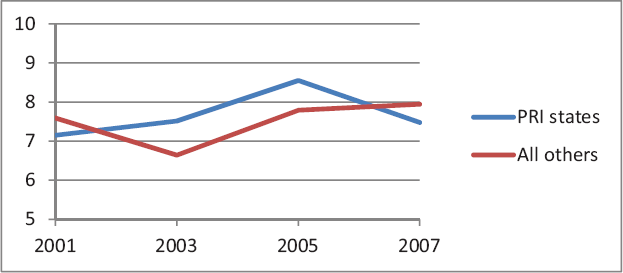
Average Corruption Index Scores, 2001–2007
Based on standard analysis of variance tests.
Individual-Level Analysis
We now turn to our exploration of AmericasBarometer data in an effort to better understand the impact that subnational political environments have on individuals’ experiences with and attitudes toward corruption. We use citizens’ reported involvement with corruption to examine the effect that residency in a PRI state has on a person's chances of having been involved in a corrupt act during the preceding twelve months. As explained above, we expect street-level forms of corruption to be significantly more likely in states where the PRI has never lost power, allowing its seventy-year old culture of corruption to remain intact. 14
See Seligson (2006) for a full description of the corruption items included in the LAPOP instrument.
The second and third models explore our proposition that the “business as usual” view of corruption in PRI states will make citizens less likely to see corruption as a problem and less critical of their government's fight against corruption than individuals living in multi-party states. Here again, this expectation rests on the idea that citizens living in states where the PRI has never left power will view corruption in the 2000s in much the same way as they did during the heyday of the PRI's one-party regime – that is, as a necessary evil, and perhaps even in a positive light in terms of getting things done – and will therefore be less inclined to see it as a problem or blame their government for its persistence.
All three models employ a standard set of variables that offer appropriate controls that we can use to explore the independent contextual effect of a state's electoral environment on corruption attitudes and behaviors. Our controls seek to account for possible alternative determinants of citizens’ experiences with corruption and their views regarding its prevalence. Fortunately, there is a well-established body of research from which we can identify theoretically important control variables (e.g., Seligson 2006; Morris 2009). The first such control is a respondent's level of wealth, a factor that has long been viewed as positively associated with the probability that an individual will be exposed to corruption. Given that the LAPOP data are constructed to offer comparable socioeconomic measures across multiple country settings, the level-of-wealth index consists of responses to a series of questions asking individuals if they possess certain household items, such as indoor bathrooms, televisions, vehicles, and washing machines. 15 As the number of items a person owns increases, so too does their score on the wealth index.
For a complete list of those items included in the wealth index, see Appendix 1.
We also include other standard socioeconomic and demographic controls, such as years of education and age, and a categorical measure of the respondent's place of residence, in order to capture the potential impact that the population of a town may have on exposure to corruption. Previous research suggests clear expectations with respect to the impact that these controls have on an individual's potential to be involved in corruption, which, in turn, should influence attitudes towards corruption. We generally expect that more educated, wealthy, urban respondents are more likely to report involvement in corrupt behavior than their counterparts at the other end of those scales. With age, the typical relationship to corruption involvement is non-linear, with people who lie in the middle age range most likely to be exposed to corruption. Finally, we also include a control for gender (as males have been shown to be more likely victims of corruption), as well as two dummy variables to control for the year of the survey (Seligson 2006).
Moving to our attitudinal and behavioral controls, we start by including measures of political and civic participation. These variables were coded dichotomously, with a value of 1 being assigned to respondents who reported having participated in at least one political or civic activity during the past year. Our expectation here is that respondents who are more involved in the civic and political life of their communities will be more likely to come into contact with a corrupt public official and, consequently, more likely to have distinct views regarding the pervasiveness of corruption. We also include a person's self-reported ideology score to control for the likely relationship between a person's political views and his or her views of and experiences with corruption under the current government. 16 The measure for this item consists of a scale from 1–10, on which respondents were asked to place themselves on a left/right political ideology scale, with the left-most responses assigned a score of one, while those furthest right received a score of 10.
Ideally, we would also include a party-ID control here in order to capture partisan influences that are at work on our dependent variables. Unfortunately, because this item was not included in all of the survey years included in our analysis, it would significantly reduce the number of cases in the analysis and, consequently, our ability to assess the state-level contextual impact on individual respondents.
Finally, for Models 2 and 3 we include what we expect to be one of the more powerful control variables: corruption involvement (our dependent variable in Model 1). Involvement in a corrupt act seems almost certain to have a negative influence on an individual's perceptions of the magnitude of the presence of corruption and the effectiveness of government anti-corruption efforts. 17 For our purposes, however, it is simply important to control for this effect in order to assess the independent impact that the state political context has on citizens’ evaluations of corruption and their government's efforts to fight it.
However, we recognize that there will also be cases where individuals involved in corruption may be less inclined to report it as a problem in order to somehow justify their own involvement.
Results
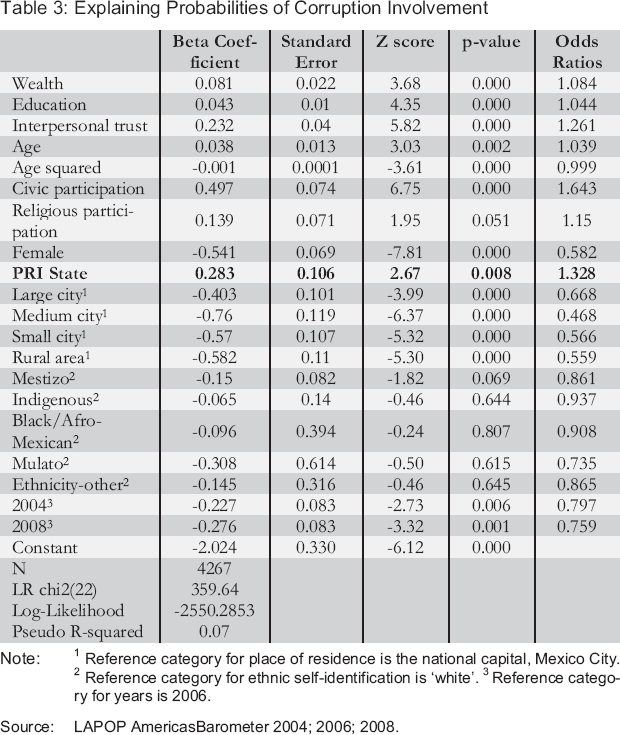
Table 3 presents the results of our logistic regression estimation of the probability of an individual being involved with corruption. Most control variables are significant and work in the expected directions. Men are more likely to be involved in corruption than women, and those respondents in the prime of their earning potential are more likely to be participants in a corrupt act (whether by choice or not) than those on either side of this age range. Similarly, higher levels of wealth, education, and civic participation all increase the likelihood that an individual will be involved in corruption. All of these findings are strikingly consistent with recent research on this question (Seligson 2006).
Explaining Probabilities of Corruption Involvement
Note:
Reference category for place of residence is the national capital, Mexico City.
Reference category for ethnic self-identification is ‘white’.
Reference category for years is 2006.
Source: LAPOP AmericasBarometer 2004; 2006; 2008.
Having controlled for all of these individual-level factors, we found that simply by living in a PRI-dominant political environment, an individual is approximately thirty-three percent more likely to have reported being involved in a corrupt act during the preceding twelve months than citizens living in multi-party contexts. This finding offers clear support for the idea that corruption is more prevalent in those states where the PRI political machine has remained intact throughout the country's democratic transition. The removal of the PRI from power for at least one electoral cycle seems to have helped diminish the rate of corrupt behavior among public officials. We see this stark difference in corruption victimization rates as a product of the strength and persistence of the PRI legacy of corruption, even in the face of a national-level democratization process. It remains to be seen how this same political environment affects citizens’ assessments of the prevalence of corruption and their government's efforts to fight corruption.
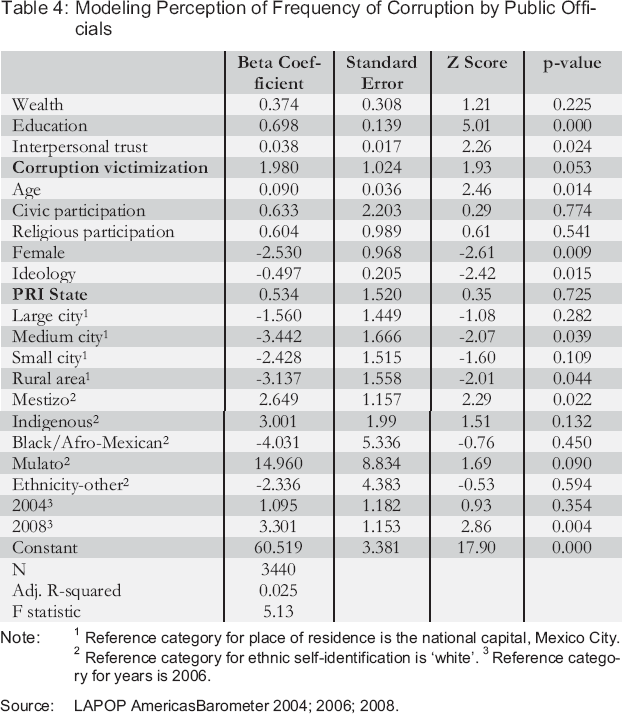
The second model seeks to explain variations in respondents’ views on the extent of corruption as a problem in Mexico. As Table 4 shows, there is no support for our expectation that citizens in PRI states would be less likely to view corruption as a problem than their counterparts in a multi-party context. In fact, there does not appear to be any significant difference between these two groups of respondents regarding their assessment of corruption as a problem. This finding is somewhat surprising given what we now know about the higher levels of street-level corruption in PRI states. However, we should also note here that the relatively poor overall model performance suggests that part of the problem may be the underspecification of the model. Although we attempted to correct this through analysis of a wide range of independent variables, in no case did we find much improvement in the model's performance.
Modeling Perception of Frequency of Corruption by Public Officials
Note:
Reference category for place of residence is the national capital, Mexico City.
Reference category for ethnic self-identification is ‘white’.
Reference category for years is 2006.
Source: LAPOP AmericasBarometer 2004; 2006; 2008.
The item of most interest from Model 2 is the powerful impact that corruption victimization has on views of corruption as a problem. This result is similar to that of Seligson (2006), who found (not unexpectedly) that victims of corruption are more likely to see it as a problem. The fact that citizens in PRI states are more likely to be victimized suggests that this experience with corruption may trump our posited “business as usual” attitude, making the PRI state variable inconsequential here.
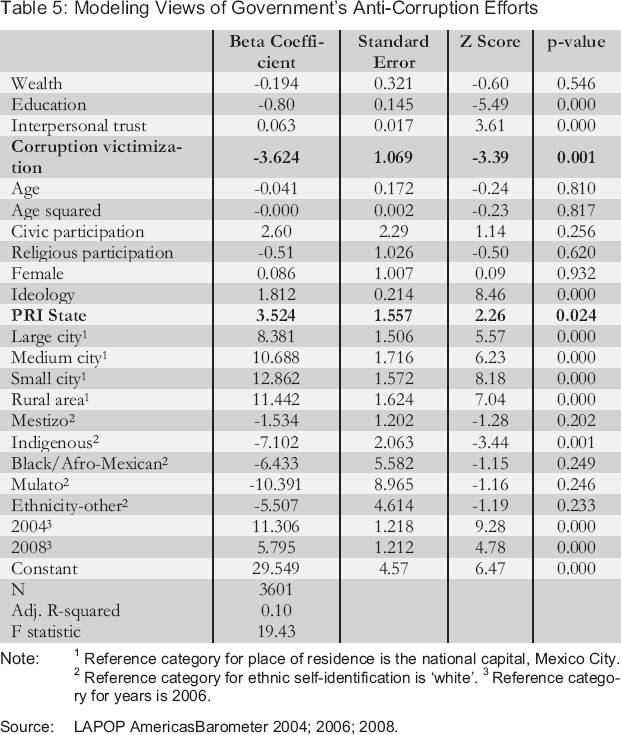
Looking at our third model of citizen assessments of their government's fight against corruption, our controls performed for the most part as we expected. A respondent's education, interpersonal trust, corruption victimization, and age all have significant and largely intuitive effects on that person's views of government effectiveness in combating corruption. For example, education has a negative effect, which suggests that the more educated a person is, the more critical he or she is of the government's anti-corruption efforts. A person's ideology also has a significant impact on his or her perception of the government's fight against corruption – those Mexicans with conservative-leaning ideologies tend to perceive the government as being more effective fighting corruption than those who self-identify as liberal. Given the control of the executive office by the right-of-center PAN during the period under study, this finding highlights the partisan dimension to individual assessments of government anti-corruption efforts. Knowing that we have adequately controlled for this bias, it is notable that we still found significant contextual effects from our PRI state variable, particularly given the direction of this contextual effect, where respondents in PRI states view their government's anti-corruption efforts in a more positive light than those living in multi-party states.
Modeling Views of Government's Anti-Corruption Efforts
Note:
Reference category for place of residence is the national capital, Mexico City.
Reference category for ethnic self-identification is ‘white’.
Reference category for years is 2006.
Source: LAPOP AmericasBarometer 2004; 2006; 2008.
As expected, a person victimized by corrupt behavior is far more likely to view his or her government's anti-corruption efforts as ineffective. In fact, there was a difference of almost four points between those who had been victimized by corruption and those who had not in terms of their views of the government's fight against corruption. Putting aside for a moment our focus on the role a PRI-state political context plays in shaping attitudes toward corruption, the fact that corruption victims are more likely than non-victims to blame their government is an important, albeit largely intuitive, finding. The implication here is clear: all other things being equal, citizens based their evaluations of their government and its effectiveness more on what they experience in their daily lives than what happens in the capital city or elsewhere. Therefore, bolstering confidence in government, whether in the area of its anti-corruption efforts or more general levels of system support, requires a better performing government at the local level. Although it may seem somewhat obvious, this message seems to all too often get lost in the midst of national anti-corruption efforts that tend to lose sight of the deleterious effects that daily, “minor” forms of corruption have on citizen assessments of their larger political system.
The strong and intuitive relationship between corruption victimization and views of government anti-corruption efforts is also important for our central question concerning the impact that state-level political environments have on citizens’ political attitudes. In the previous section, we found that respondents living in PRI states were far more likely to be involved in a corrupt act than their counterparts in other states. This finding offers some support for the idea that corruption remains a prominent feature of everyday public life in PRI states. Knowing that respondents in PRI states are more likely to be involved in a corrupt act, and that such involvement has a strong effect on one's views of government efforts to fight corruption, we might expect respondents in PRI states to view their government's fight against corruption in a more negative light than their counterparts in non-PRI states.
In fact, we found the exact opposite. Specifically, respondents living in non-PRI states are, on average, 3.5 points more critical of their government's anti-corruption efforts than those individuals living in PRI states. So why do respondents in PRI states seem reluctant to criticize their government for its anti-corruption efforts? First, although many people within the international community and media believe that Mexico transitioned to democracy in 2000, the PRI's powerful legacy of corruption seems to have survived the onset of democracy as an accepted way of doing business in states where the PRI has yet to relinquish control of state government. Second, with this legacy of corruption still exerting a powerful influence, we expect public conversations on the problematic nature of corruption, whether in the media or political campaigns, to be minimal, thereby diminishing citizen sensitivity to the corruption issue. If corrupt behavior is viewed as simply a part of one's daily life rather than a pressing issue up for public debate, we should expect citizens to be less critical of government's efforts to fight against it.
Conclusion
This examination of the role that subnational political contexts play in shaping citizens’ views of and experiences with corruption has offered strong support for the basic idea that variations in such contexts matter. When considering the bulk of research on corruption, which relies on cross-national analyses of these questions, our findings suggest that important intra-national differences in political environments may be muddying our understanding of how democratization affects corruption across the developing world. Without recognizing the role that subnational political systems play in either condoning or attacking a longstanding culture of corruption, we will overlook an important part of the story behind democratic institutional change and corruption. As we have argued above, the problem is that national level institutional change can be, and often is, trumped by subnational institutional stasis.
We now know, in the case of Mexico, that states in which the one-party rule of the PRI has continued amidst a national-level democratization process have significantly higher levels of corruption. Although it is difficult to establish empirically without long-term panel data, there is considerable theoretical support for the proposition that these higher levels of corruption are largely a product of the lingering strength of the PRI's legacy of corruption. Conversely, we suggest that a principal reason why corruption levels are lower in states that have broken the PRI's decades-long grip on power is that the ouster of the PRI brought a heightened sense among public officials and private citizens that the old rules of the game – rules that treated the use of public office for private gain as acceptable behavior – have changed. More accountable, democratic institutions, then, do seem to matter.
However, our concern in this paper has had more to do with those states that have not experienced such change. In the eight PRI states, we are most confident that elements of the old-style, one-party machine remain. We are not nearly as confident in claiming that the remaining twenty-three states are all equally and fully democratic; in fact, we know they are not. However, they do share a common feature of having removed the PRI from power in the executive and/or legislative branches. We see the culmination of forces and factors necessary to achieve this single feat of defeating the PRI as also being capable of disrupting a culture that views corruption as business as usual. While such a watershed election will certainly not end all forms of corruption within a state, in many cases it will help further demarcate the line between what was acceptable under the past regime and what is permissible in a democracy founded on the principle of accountability. In states where the PRI continues its uninterrupted rule, such a line does not appear to be drawn.
Although this study has focused on the impact of subnational democratization in one country, we believe the results and implications are also highly applicable to cases beyond Mexico. We argue that subnational realities will affect how citizens perceive of and are influenced by corrupt acts in countries such as Paraguay and Argentina, where authoritarian enclaves still exist and subnational electoral contexts vary in ways similar to those of Mexico. While more work is clearly necessary to fully understand the role played by subnational political contexts – particularly the authoritarian legacies that persist within many emerging democracies – in shaping citizens’ views of what constitutes corruption and the degree to which it is a problem, this work represents a step forward. If nothing else, we have highlighted the fact that national-level processes of regime change, and their subsequent impact on such phenomena as corruption, do not occur evenly, nor can we infer from those national-level changes similar outcomes across all subnational political units within a single country.
Footnotes
Appendix
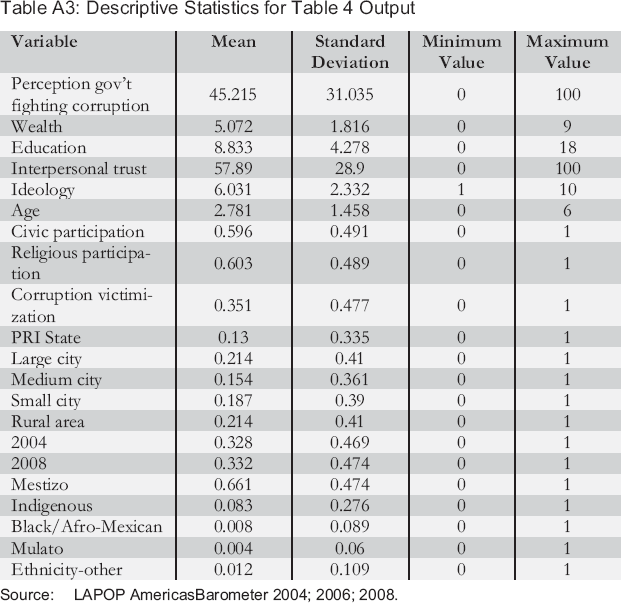
Descriptive Statistics for Table 4 Output
| Variable | Mean | Standard Deviation | Minimum Value | Maximum Value |
|---|---|---|---|---|
| Perception gov't fighting corruption | 45.215 | 31.035 | 0 | 100 |
| Wealth | 5.072 | 1.816 | 0 | 9 |
| Education | 8.833 | 4.278 | 0 | 18 |
| Interpersonal trust | 57.89 | 28.9 | 0 | 100 |
| Ideology | 6.031 | 2.332 | 1 | 10 |
| Age | 2.781 | 1.458 | 0 | 6 |
| Civic participation | 0.596 | 0.491 | 0 | 1 |
| Religious participation | 0.603 | 0.489 | 0 | 1 |
| Corruption victimization | 0.351 | 0.477 | 0 | 1 |
| PRI State | 0.13 | 0.335 | 0 | 1 |
| Large city | 0.214 | 0.41 | 0 | 1 |
| Medium city | 0.154 | 0.361 | 0 | 1 |
| Small city | 0.187 | 0.39 | 0 | 1 |
| Rural area | 0.214 | 0.41 | 0 | 1 |
| 2004 | 0.328 | 0.469 | 0 | 1 |
| 2008 | 0.332 | 0.474 | 0 | 1 |
| Mestizo | 0.661 | 0.474 | 0 | 1 |
| Indigenous | 0.083 | 0.276 | 0 | 1 |
| Black/Afro-Mexican | 0.008 | 0.089 | 0 | 1 |
| Mulato | 0.004 | 0.06 | 0 | 1 |
| Ethnicity-other | 0.012 | 0.109 | 0 | 1 |
Source: LAPOP AmericasBarometer 2004; 2006; 2008.