



Abstract
This study makes the following contributions to the study of the politics of patronage appointments in Latin America: Conceptually it adopts Kopecký, Scherlis, and Spirova's (2008) distinction between clientelistic and nonclientelistic types of patronage politics and widens these authors classification of patrons’ motivations for making appointments, specifically as a lens for the study of patronage practices within Latin America's presidentialist regimes. Analytically, it sets up a new taxonomy of patronage appointments based on the roles that appointees’ play vis-à- vis the executive, the ruling party, and the public administration – one that can be used for the comparative study of the politics of patronage. Empirically, it applies this taxonomy to a pilot study of the politics of patronage in Argentina and Uruguay under two left-of-center administrations. Theoretically, it contributes to theory-building by relating the findings of our research to the differences in party systems and presidential powers within the two countries under study, and to agency factors associated with the respective governments’ own political projects. The article concludes that differences in patronage practices are a manifestation of two variant forms of exercising governmental power: a hyper-presidentialist, populist one in Argentina and a party-centered, social-democratic one in Uruguay.
Introduction
One of the more important political factors affecting the quality of public institutions in Latin America is the colonization of the state apparatus by politically appointed public sector employees. In a classical study of the Latin American state, one published more than 40 years ago, Douglas Chalmers (1977) argued that the enduring quality of Latin American politics in the twentieth century was not a particular form of regime but the politicized quality of the state. He further posited that being “in power” was particularly important, because it gave leaders extensive patronage opportunities and the authority to establish government programs to benefit existing supporters as well as to attract new ones. Much has changed in Latin America since Chalmers first published his work, but the argument about the politicized nature of the state has nevertheless stood the test of time (Philip 2003; Spiller et al. 2008).
Scholars have used the terms “patronage” and “clientelism” interchangeably (Piattoni 2001: 4), to signify the exchange of public sector jobs for political support (Chubb 1982; Geddes 1994). This assimilation has, however, been challenged by analytical distinctions between clientelistic and nonclientelistic modalities of patronage (Kopecký, Scherlis, and Spirova 2008; Piattoni 2001), and by awareness of the alternate roles that appointees play in different political environments – and, indeed, even within the same public administration (Grindle 2012). And yet, there has to date been surprisingly little comparative empirical research done about the politics of patronage appointments in Latin America's presidentialist central public administrations - as well as about what explains the tangible differences that exist both within and between countries.
This article 1 contributes to the study of patronage appointments in Latin America's presidentialist regimes, then, by adopting and adapting the definition thereof formulated by Kopecký, Scherlis, and Spirova (2008). This is done in order to set up a taxonomy of patronage appointments. It subsequently applies this taxonomy to the study of the politics of patronage appointments in Argentina's and Uruguay's central public administrations under two left-of-center governments, and relates the findings uncovered to institutional and agency factors in the two countries.
We wish to acknowledge the contribution of our research assistants Mauro Casa González and Tamara Samudio to this research project, and thank them for their valuable work. We would like to thank our colleagues at the Instituto de Ciencia Política of the Universidad de la República (Uruguay) for their comments on earlier versions of this article.
We assume that the scope of patronage appointments, the power to make them, the motives for them, and the roles played by appointees themselves are the defining elements of the politics of patronage. We argue that the differences in patronage practices in the two countries were shaped by institutional variation in their respective presidential powers and party systems, as well as by agency factors related specifically to the political forces that controlled each government in the period under study. We found that the scope of patronage largely confirms the impression of two politicized central administrations that were not, however, characterized by traditional forms of mass clientelism. With this common baseline, politicization not only runs deeper in Argentina but also worked differently between the two countries generally. In Argentina, patronage was centrally controlled by the presidency in strategic areas and by ministers in other ones. In Uruguay, in contrast, patronage was largely devolved to the ruling party's factions with little central interference from the presidency. These findings, together with the observable differences in the roles played by appointees, present a clear picture of two different political systems, two different political projects, and, ultimately, two different modalities of exercising governmental power: a hyper-presidentialist, populist, politico-institutional regime in Argentina and a party-centered, social-democratic one in Uruguay.
The rest of the article proceeds as follows: The next section reviews the literature on patronage appointments. Section three then defines the main concepts, and sets up a taxonomy of patronage practices. The fourth section presents and justifies the choice of cases and theoretical assumptions. Section five outlines the research design and methodology. The sixth section presents the research's main empirical findings. The concluding section discusses institutional and agency explanations for the differences in patronage practices between the two countries studied here, Argentina and Uruguay.
While there have been a wealth of studies of clientelism in Latin America (see, among others, Hilgers 2012; Lazar 2004; Levitsky 2003; Stokes et al. 2013; Taylor 2004), as a general rule these are mainly interested in explaining variations in the scope of it (Ames 1977; Geddes 1994; Gordin 2001; Hagopian, Gervasoni, and Moraes 2009) and/or in investigating mechanisms of clientelistic exchange at the subnational level (Oliveros 2016; Stokes 2005; Auyero 2000) – with little attention paid to the mapping of different patronage practices in central administrations. 2 Closer to our own research interests here are: Kopecký, Scherlis, and Spirova's (2008) work on conceptualizing and measuring patronage appointments; Kopecký, Mair, and Spirova's (2012) studies of the politics of patronage in European democracies; investigations of political appointments and coalition management at the upper levels of the federal government in Brazil (Bersch, Praça, and Taylor 2017; Garcia Lopez 2015); Schedis's (2012) analysis of patronage practices in Argentina as a party-building strategy; and, finally, Grindle's (2012) comparative study of patronage and the politics of administrative reform. These studies argue, in common, that: patronage appointments are controlled and contested by different actors; patrons have different motivations for making appointments; and, appointees perform a variety of roles within the public administration while having different levels of competence.
The study of the different roles that patronage appointments play in central administrations has received more attention in Europe (Connaughton 2015; LSE Group 2012; Askim, Karlsen, and Kolltveit 2017; Kristinsson 2016) than in Latin America hitherto. European studies tend, however, to concentrate on the narrow category of advisers, while the range of political appointees is in fact much broader in Latin America's politicized central pubic administrations
In line with Kopecký, Scherlis, and Spirova (2008), we define patronage appointments as the power of political actors to discretionally install individuals in (nonelective) positions within the public sector, irrespective of the motives for the actual appointment, the capabilities of the appointee, and the legality of the decision. As Kopecký et al. (2016) note, this definition includes patronage appointments that are clientelistic in nature as well as others in which appointments are used for purposes besides clientelistic exchange. In consequence, we distinguish between different types of patronage role and define clientelistic appointments – the exchanging of public sector jobs for votes – (Lémarchand 1981; Roniger 1994) as only one among a number of different varieties of patronage appointment.
Two clarifications are necessary here to better understand the relations between clientelism and patronage:
Recruitment to patronage positions defines obligations but not necessarily motives and roles, as those who are politically appointed to positions in the public sector may be installed there for a variety of reasons other than furthering the patron's electoral chances (Grindle 2012; Johnston 1979; Key 1964; Kopecký, Mair, and Spirova 2012; Müller 2006). While the politicized and discretional nature of the appointment is a shared characteristic with clientelism, patronage ones include appointments where professional qualifications – rather than just partisan criteria - may have been taken into account (Grindle 2012).
Trust is the essence of patronage. It cuts across the other selection criteria, and combines with them in a number of different measures. It can be personal to the politician or political to the party. Even in cases where patronage appointments are made in accordance with the law, there is always an asymmetry of power between the patron and the appointee – as the latter serves at the discretion of the former. This makes the position dependent on relations of personal trust, or partisan loyalty, between the politician and the appointee (Grindle 2012).
In order to map practices in Argentina and Uruguay, we look at three elements regarded by the comparative literature as crucial for the study of the politics of patronage: the scope of appointments; who has the power to appoint; and, the patron's motives for the appointments. We use the last of these three as a lens with which to identify the roles played by appointees, and from this to construct a taxonomy of patronage appointments.
By “scope” we mean the range of state agencies that include patronage appointments (breadth) and the levels (depth) that the latter reach within the administrative hierarchy of a given state agency. By measuring scope we aim to determine levels of politicization within and between the two countries (Kopecký et al. 2016). By “power of appointment” we denote the political actor or actors that have the real power here, regardless of the legal one. By studying the power of appointment we aim to determine the partisan or personalistic nature of patronage networks, as well as the ability of executive officeholders to make patronage appointments with autonomy from the ruling party or parties (Scherlis 2012).
By motivates we understand the reason or reasons (they may have more than one) that patrons have when making a given appointment. Motives largely determine the roles played by appointees (Connaughton 2015; 2012), and define the latter's relations vis-à-vis the executive, the political system, and the public administration. Studies of patronage in Europe show that parties have sought to compensate for their lack of active militancy by becoming increasingly embedded in the state apparatus (Katz and Mair 1995). Following this logic, appointments are used to reward and maintain a network of political activists. While this may be the case, there is still the need to find out what roles – political and technical – are played by appointees once installed. In line with this objective, and in order to better capture the roles that appointees play vis-à-vis the executive, political parties, and the public administration, we analytically distinguish between the following four motivations for these appointments:
Taxonomy of Patronage Practices
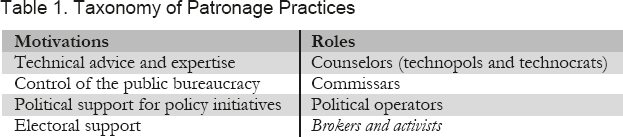
We conceive our taxonomy as a tool that can be used to better understand differences in patronage practices. The prevalence of certain types of appointment and the nature of patronage networks within a given administration are set to impact differently on respective governance and governability; they also yield key insights about the relations between party systems, executive officeholders, and the public administration.
In the case studies that follow, we apply our taxonomy to the study of the politics of patronage practices in the central public administrations under the left-of-center governments of Néstor Kirchner (2003–2007) and Cristina Fernández de Kirchner (2007–2015) in Argentina and Tabaré Vazquez (2005–2010) and José Mujica (2010–2015) in Uruguay respectively.
The cases of Argentina and Uruguay are particularly well suited for a pilot study of the politics of patronage appointments in Latin America under John Stuart Mill's method of difference (Lijphart 1977; Mill 1961). The cases combine strong contextual similarities regarding socioeconomic and historical variables, and have important differences in the institutional and agency factors that are assumed to explain variation in the politics of patronage. This combination of similarities and differences is bound to minimize variance in certain variables while simultaneously making it more evident in others.
Argentina and Uruguay have similar and relatively high levels of economic and human development (United Nations Development Program 2016; World Bank 2016), which have been regarded as important variables in explaining the decline in the use of mass clientelism as an electoral resource in the two countries (Kopecký and Mair 2006; Stokes et al. 2013). Both share strong historical, economic, and cultural links, and have experienced similar cycles of authoritarianism and democratization since the 1970s. The two countries were the earliest full democracies in Latin America (González 2012). Concerning the history of the public sector, in both countries democratization preceded the setting up of a professional bureaucracy – a sequence that has been associated with the politicization of the civil service (Shefter 1977). The two countries shared the same score (52 on a 1 to a 100 scale) in Zuvanic, Iacoviello, and Rodriguez Gustá's (2010) index of the use of merit in bureaucratic bodies. The score places them equal fourth in the region behind Brazil, Chile, and Costa Rica, and well above the Latin American average of 33 in the ranking of public sector professionalization. These conditions make the central public administrations of these two relatively highly- developed countries ideal loci for our research, because we expect to find here politicized but not mass clientelistic central administration bureaucracies. 4
In Argentina, however, mass clientelism is still common at the provincial level (Scherlis 2013).
By way of contrast the two countries exhibit significant variation in key institutional and agency factors, ones that have been related to the politics of patronage. Institutionally, Argentina has been characterized as a “delegative” and as a “hyper-presentialist” democracy (Castells 2012; Casullo 2015; Nino 1992; O'Donnell 1994; Rose-Ackerman and Desierto 2011). These delineations refers to the combination of majoritarian politics, weak horizontal accountability, and the political centrality of the presidency. The Argentinean head of state enjoys strong legislative powers that allow them to rule by decree, have the budgetary initiative, and to use the legislative line-item veto (Cox and Morgenstern 2001; Payne 2006; Negretto 2004). Concerning the party system, from the second half of the twentieth century until the November 2015 presidential election it was dominated by the Peronist party. The 2001–2002 financial crises hit particularly hard the non-Peronist parties in office at the time, reinforcing the historical hegemony of the Peronist party that won three consecutive presidential elections between 2003 and 2011 (Casullo 2015; Torre 2003).
Institutionally, Uruguay is a liberal democracy (Freedom House 2017) characterized by the strong rule of law and an effective system of checks and balances (World Bank 2016). The political matrix is characterized by a highly institutionalized party system with strong programmatic elements (Kitschelt et al. 2010; Mainwaring and Scully 1995). Parties are internally organized into political factions, ones that are also highly institutionalized. Presidential powers in Uruguay are relatively weaker than in Argentina (Payne 2006). 5 Politically, the power of the president is constrained by the need to negotiate with the ruling party and party factions as well as by a more powerful parliament. This makes Uruguay one of the few countries in the Latin American region that can be typified as a system of party government (Katz 1986; Rose 1969; Wildenmann 1986).
Payne (2006) assigns Uruguayan presidents an index of 0.39 and Argentinean ones an index of 0.47, in his 0 to 1 scale of presidential powers – in which 0 is minimum power and 1 maximum.
Politically, Argentina has a long tradition of populism – to the extent that it has been labeled a populist democracy (Casullo 2015). The Peronist party has been historically regarded as one of the electorally most successful populist machines in the region (Levitsky and Roberts 2011). Presidents belonging to the Peronist party have traditionally enjoyed a high degree of discretionary freedom to allocate state resources, which they have used to consolidate their power over the ruling party and, via the state governors, over the clientelistic provincial political machines that provide crucial electoral support too (Scherlis 2013).
The Peronist party administrations of Néstor Kirchner (2003–2007) and Cristina Fernández de Kirchner (2007–2011, 2011–2015) were regarded as examples of the left-wing populist governments in Latin America's populist–social-democratic left divide (González 2012; Horowitz 2012; Philip and Panizza 2011). The Kirchners’ own political grouping, the Frente para la Victoria (FPV, the Front for Victory – also known as Kirchnerismo), was formally part of the Peronist party. But relations between the two organizations were often strained, as the grouping became effectively an autonomous political machine controlled by the Kirchners from within the executive.
The Frente Amplio administrations that ruled Uruguay between 2005 and 2015 were regarded as part of twenty-first-century Latin America's “late social democracies” (Lanzaro 2014). The Frente Amplio is an alliance of left and left-of-center political groupings that, in line with the institutional features of Uruguay's political parties, are formally constituted as autonomous political factions. The Frente Amplio's access to government in 2005 represented an important change in Uruguay's historical domination by the traditional Colorado and Blanco parties without, however, representing a rupture with the country's liberal-democratic institutions, strong welfare state, mixed economy, policy gradualism, and highly institutionalized party system (Lanzaro 2014; Panizza 2015).
The large number of institutional and agency variables that are considered to influence patronage appointments make it difficult to account for differences in practices at high levels of generality, and moreover independently of the political context. Aware of the danger of generalizing from a paired comparison, this study assumes that differences in the politics of patronage in the two countries are the result of a number of politico-institutional and agency factors that find expression in two different forms of exercising governmental power. We expect that, in the period under study, in Argentina stronger presidential powers, a dominant party, a weaker party system, and high levels of political polarization will result in greater levels of politicization of the public administration; that presidents and ministers will exercise their power of appointment with relatively strong degrees of autonomy from the ruling party; and, that control of the public administration and the electorally driven intermediation between the government and the recipients of public goods and services will be a significant motivation for the appointments.
In Uruguay, we expect that a competitive party system, the consociational nature (Lijphart 1977) of the decision-making process, and lower levels of political polarization will result in a reduced scope of patronage, parties having significant influence in the process of appointments, securing political support for the government being a significant motivation for the appointment, and, finally, the programmatic nature of the party system being reflected in the importance of technical advice and expertise. In terms of our taxonomy, we hence expect to find relatively more commissars, brokers, and activists in Argentina and more counselors and political operators in Uruguay meanwhile.
Measuring patronage is no straightforward task, as the exercising of it comprises a combination of both formal and informal practices (Helmke and Levitsky 2006). An analysis of the formal rules – such as laws, decrees, and constitutional dispositions – that regulate public sector appointments can give a broad idea of the official number of discretional such ones. Such a study, however, risks overlooking a significant number of appointments that are regulated by the informal rules that sidestep, bypass, distort, or simply outright violate established legal dispositions. As is often the case, and as Grindle puts it, “de facto practice trumps de jure theory” (2012: 145–146). In an effort to obtain a more comprehensive picture hereof, scholars have attempted to estimate the numbers of discretional appointments by using such proxies as increases in the number of public employees or in personnel-related spending. These indicators, however, are influenced by factors lying beyond the power to appoint discretionarily, and may thus not truly reflect patronage practices (Kopecký, Mair, and Spirova 2012; Scherlis 2013).
Informal practices are notoriously difficult to measure with accuracy, and borderline cases often require judgment calls being made. One accepted qualitative method for measuring the impact of informal institutions on public life is to survey the perceptions of experts (Peabody et al. 1990; Transparency International 2017). This method was used, for example, by Peter Evans and James Rauch (1999) to identify the features of Weberian bureaucracies in newly industrialized countries.
Our research adopts and adapts the surveying of experts method used by Kopecký, Scherlis, and Spirova (2008) in their study of patronage appointments and more recently employed by Meyer-Sahling and Veem (2012) as well as by Kopecký et al. (2016) for the comparative study of patronage in 22 countries from five world regions. In order to elicit a more rounded picture of the two countries’ patronage practices, and in an effort to minimize cognitive and political bias, we drew our interviewees from a wide range of political and professional fields – ones comprising experts with a broad knowledge of the public administration and party systems of the two countries in question as well as key informants chosen for their inside knowledge of four selected areas of the central public administration of each. Experts included scholars, specialized journalists, trade union leaders, parliamentarians, and public sector consultants. Key informants included both active and retired career civil servants, trade unionists, current and former executive officeholders, and politically appointed public sector workers.
We chose, as noted, four policy areas representative of the central public administration in both countries: the economy, social development, foreign relations, and agriculture. These were chosen on the expectation, based on the literature on public bureaucracies, that they are representative of different patterns of bureaucratic professionalization (Peters 1988): more professional vis-à-vis the economy and foreign affairs, more technical regarding agriculture, and more politicized when it comes to social development. The administrative hierarchy in each area was divided into “high” (top managerial level), “middle” (lower managerial and high administrative levels), and “low” (low administrative level; technical and service personnel) tiers, in accordance with each country's administrative scale of public sector positions.
The questionnaire was administered through semi-structured, face- to-face interviews with 16 experts (9 in Argentina and 7 in Uruguay) and 64 key informants (29 in Argentina and 35 in Uruguay), conducted between April 2014 and November 2016. The questionnaire, and a list of interviewees with their work profiles are attached as an Appendix. Interviewees were asked to provide both quantitative estimates and qualitative accounts of patronage. As a way of appraising the scope of patronage appointments, while taking into account both formal and informal rules, we used the so-called index of party patronage (IPP) (Kopecký, Scherlis, and Spirova 2008; Kopecký, Mair, and Spirova 2012; Kopecký et al. 2016). This index uses survey results to measure the extent and depth of patronage appointments across institutions and levels of hierarchy. The IPP varies from 0 (no patronage appointments) to 1 (all appointments are patronage ones).
We complemented the questionnaire and checked against the interviewees’ views with a number of both primary and secondary sources. These included government documents, background interviews, freedom of information requests, press reports, international surveys, and academic studies. For changes in the total number of public employees, we relied on officially published figures. We surveyed legislation and other publically available sources to estimate the number of discretional appointments authorized by law. The following section now presents a summary of our main findings.
Findings
Scope and Politicization
According to our survey the IPP of Argentina, at 0.77, was significantly higher than that of Uruguay, at 0.61. To place these figures into context, the IPPs of both Argentina and Uruguay were noticeably above those of Eastern Europe (0.42) and Southern Europe (0.45) but well below those of Guatemala (0.98) and Paraguay (0.97) – two Latin American countries notoriously characterized by mass patronage (Kopecký et al. 2016). To complement the IPP, we looked additionally at the ratio of nontenured
(mainly public sector workers on fixed-term contracts) to tenured positions. While this indicator must be used with caution because nontenured employees can be appointed for a variety of reasons and many contracts tend to be converted into tenured positions eventually (Scherlis 2013), the presence of a large number of nontenured public workers on fixed-term contracts may be a mechanism for setting up a parallel administration – and thus a proxy for politicization. In Argentina under the Kirchners, there was a sharp increase in the percentage of nontenured appointments – which went up from 20.3 percent to 57.3 percent in the years of their rule (Llano and Iacoviello 2015). In Uruguay, in contrast, there was a small decline from 8.8 percent to 6.2 percent herein during the administrations of the Frente Amplio (Oficina Nacional de Servicio Civil 2016).
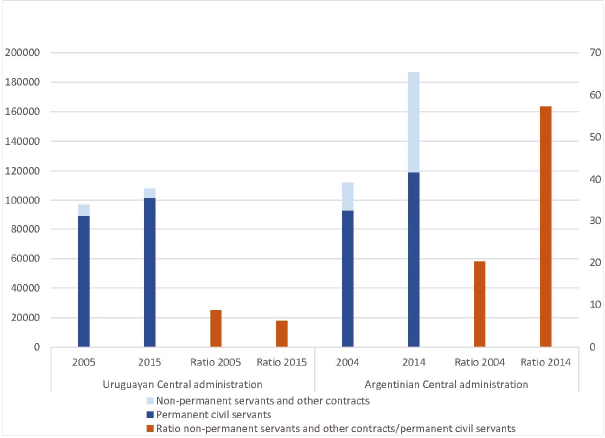
Evolution of Permanent and Nonpermanent Civil Servants in the Central Administration in Argentina (2004–2014) and Uruguay (2005–2015)
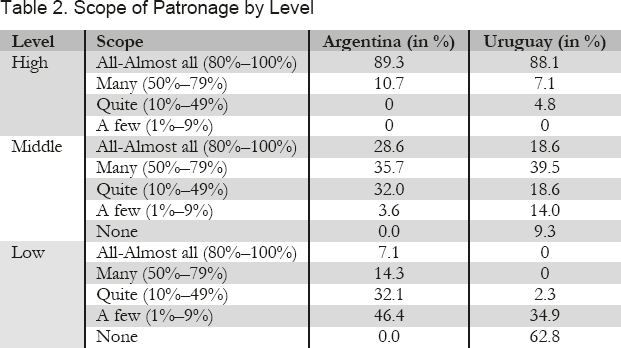
Patronage appointments reached considerable depths within the administrative structure, particularly in Argentina. 6 For this country, 89 percent of interviewees considered most appointments (ranging between 80 percent and 100 percent) at the top level of the administrative structure (the one immediately below political positions, such as ministers) to be based on patronage, while in Uruguay 88 percent of interviewees also chose this particular range too. This finding was not especially surprising in the case of Uruguay, given that the law establishes the discretionary nature of appointments at this level. In Argentina, however, positions at this level are mandated by law to be filled through “competitive processes” (concursos de oposition y méritos) among high civil servants; the winners should be appointed for a period of between five to seven years.
The questionnaire provided a nominal list of the positions considered to be at the high and middle levels of the administrative structure in each country.
According to our survey results, a significant proportion of middle- level appointments in both of these countries were also based on patronage. Range estimates, however, varied significantly both within and between countries. In Argentina, 35.7 percent of respondents estimated that between 50 percent and 79 percent of appointments at this level were patronage ones – while a further 32 percent estimated the appointments at the lower range of between 10 percent to 49 percent hereof. In Uruguay, 39.5 percent and 18.6 percent of interviewees opted for the higher and lower ratios respectively. Altogether, 67.7 percent of interviewees in Argentina and 58.1 percent of those in Uruguay considered that there were at least some patronage appointments at the middle level of the administrative hierarchy. This finding goes against legal dispositions in both countries prescribing that most, if not all, positions at this level must be filled by career civil servants in accordance with rules for promotions. A difference between the two countries was that while in Uruguay appointees at this level were usually coopted from within their ministry or agency and appointed to a higher managerial position on a temporary basis, in Argentina they tended to be prior outsiders – thus further disrupting the administrative structure. 7
In Uruguay, to get round the legal disposition ministers promote functionaries benefiting from their personal or political trust within their ministries in an acting capacity – a widely used mechanism known as encargaturas. The use of this tool was mentioned by several experts in the semi-structured interviews. In Argentina, in contrast, ministries tend to bring “their own people” from outside. For corroborating evidence on Uruguay, see Filgueira et al. (2002); for Argentina, see Scherlis (2009) and Ferraro (2006).
The survey also revealed differences between Argentina and Uruguay regarding the scope of patronage appointments at the lowest levels of the public administration. The central public administration in Uruguay was perceived as nearly free of patronage appointments by a large majority of interviewees (97.8 percent). In contrast, all interviewees in Argentina claimed that there were at least some patronage appointments at this level – although they differed on estimates of the phenomenon's magnitude. Differences within countries in the estimates of patronage at both the middle and lower levels are at least partly explainable by variations in scope between the four areas of the public administration covered in the survey. For example, both in Argentina and Uruguay key informants within the Ministry of Social Development coincided in their view that most appointments at the middle level were patronage ones while informants from each's Ministry of Foreign Relations perceived lower degrees of patronage at the same level.
Scope of Patronage by Level
All interviewees in Uruguay agreed that political and policy differences between the Frente Amplio administrations and previous governments did not lead to a significant overall increase in patronage appointments or to alternate patterns of politicization either. It must be noted, however, that the number of legally authorized discretional appointments (cargos de confianza) at both the national and departmental (provincial) level went up from 324 in 2005 (Ramos 2009: 354; Correa Freitas and Vázquez 1998: 159) to 671 in 2015 (Oficina Nacional de Servicio Civil 2016: 29, Table 11). 8 While this increase is seemingly significant, only 159 of these positions were in the central administration – with the majority (440) of the cargos de confianza being appointments at the departmental (provincial) level. Moreover, these individuals amount to just about 0.2 percent of the total number of public employees. Regarding nondiscretional appointments, the administration of President Mujica centralized civil service recruitment within the National Civil Service Bureau (Oficina Nacional de Servicio Civil, ONSC) so as to increase compliance with meritocratic processes. 9
In Table 11, the cargos de confianza are codified as escalafón “Q.”
“Uruguay Concursa.” Article 127, Law 18,7191 of 27 December 2010 and Executive Decree dated 27 February 2011, online: <www.uruguayconcursa.gub.uy/uruguayconcursa/uruguay_concuisa_normativa.htm> (22 August 2016).
The degree of consultation between the president, ministers, and parties when making patronage appointments is an important indicator of the powers of the head of state, as well as of the relations between the ruling party or parties and executive officeholders. Our research shows drat while in some cases officeholders (presidents and ministers) exercised their powers of appointment autonomously, in others they did it in consultation with other relevant actors. Figure 2 summarizes the aggregate results of respondents’ perceptions on the powers of appointment in Argentina and Uruguay respectively.
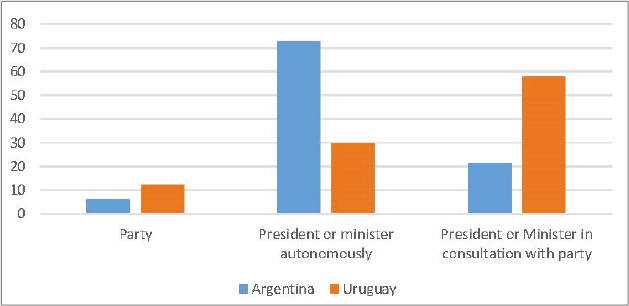
Experts’ Perception of Power of Appointment (in %)
Two main findings stand out from this part of the research:
Presidents and ministers played a key role in the appointment process in both countries. The majority of our informants (48.5 percent in Argentina and 74 percent in Uruguay) agreed that ministers were the most relevant patrons within the ministries under their control. A significantiy larger number of informants in Argentina (45 percent) than in Uruguay (12 percent), Though, considered it to be the president who held the main power of appointment. 10 The claim that ministers had power of appointment did not mean, however, that they personally made discretional ones in all areas and at all levels within their domains. Ministers often also delegated powers of appointment down the administrative ladder to under secretaries, agency directors, and program coordinators – who in many cases were political appointees themselves.
The fact that the Kirchners exercised their power of appointment over the head of ministers was noted by several respondents, particularly in Interviews No. 5 and No. 12 (Appendix). For corroborating evidence for this, see also Scherlis (2012: 59).
In Argentina, over 70 percent of respondents claimed that presidents and ministers made appointments with autonomy from the ruling party. Presidents Nestor Kirchner and Cristina Fernández de Kirchner largely ignored the ruling Peronist party when making appointments, relying instead mostly on trusted former members of Nestor Kirchner's state administration (1991–2002) in the province of Santa Cruz (Scherlis 2012) while using patronage appointments to build up their own political grouping, the aforementioned FPV, from within the state.
During the administrations of Presidents Néstor Kirchner and Cristina Fernández de Kirchner, there was an intensive process of top-down politicization (Van der Meer, Steen, and Wille 2007) intended to secure the presidency's political control of the public administration – and particularly over strategic agencies. As noted by several key informants, this process was especially noticeable during the last two years of President Fernández de Kirchner's second administration. For This purpose, the executive colonized key public sector agencies by making patronage appointments at levels traditionally staffed by professional bureaucrats. 11 For instance, in 2006, in a highly publicized and well-documented case (Jueguen and Bullrich 2009; Noriega 2012), the government of President
According to key informants, this was particularly evident in the Ministry of the Economy as well as in the international trade and economic areas of the Ministry of Foreign Relations too, in which outsiders were appointed to positions that had traditionally been held by professional staff (Interviews No. 9 and No. 14).
Néstor Kirchner removed over 20 professional staff from the National Statistics Institute (Instituto Nacional de Estadísticas y Censo, INDEC) and replaced them with political appointees – that in order to manipulate the official figures for inflation.
The distinction between the personal and the partisan, and between public sector duties and political activism, was, however, not always clear cut in Argentina. For example, the appointment of militants from La Cámpora (a political grouping directly controlled by the Kirchners) was based on personal links that often went back to a common university background; in many cases, though, appointer and appointee also shared politico-ideological sympathies. Moreover, La Cámpora itself evolved away from being a loose network of militants into a more institutionalized political grouping, further blurring the distinction between personal and partisan loyalty. This grouping was originally set up in 2003 by Néstor Kirchner and Cristina Fernández de Kirchner's son, Máximo, as an organization of young political cadres at the service of his parents’ political project (Rocca Rivarola 2013). Particularly in the last two years of her second administration President Fernández de Kirchner used her powers of appointment to build up La Cámpora as a personal political machine (Novaro, Bonvecchi, and Cherny (2015). Close political allies of the president followed the same logic. For example, Alicia Kirchner, sister of the late Néstor Kirchner and minister for social development during both his and Cristina Fernández de Kirchner's administrations, set up the so-called Kolina organization of activists within her ministry as a personal political apparatus that came to be known as La Agrupación de Alicia (“Alicia's Grouping”) (Vázquez 2014).
In contrast to the FPV's state-centered construction of its political organization, in Uruguay party factions were structured outside and independently of the public administration. However these factions were still key actors in the politics of patronage there. As a general rule, presidents from all parties took into account the political weight of the ruling party's highly institutionalized factions when making ministerial appointments or, in the case of coalition governments, of the parties and factions of the governmental coalition (Buquet, Chasquetti, and Cardarello 2013). According to our survey, ministers enjoyed a high degree of autonomy from the president when making appointments within their ministries but in most cases they consulted their own party or party faction and appointed members from the latter. A study of discretional appointments below cabinet level during the 2005–2015 Frente Amplio administrations by Ramos, Casa, and Samudio (2017) demonstrates a high positive correlation between the relative electoral weight of the party's factions and the number of these made by each, suggesting that such appointments were part of the government's coalition management toolkit.
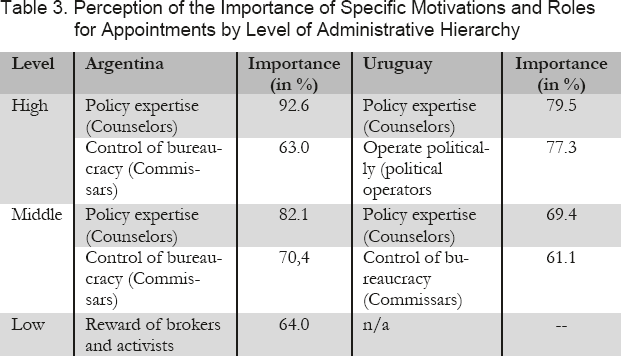
Addressing the patrons’ motivations for making appointments is crucial for understanding the specific roles played by political appointees. Table 3 summarizes the interviewees’ perceptions about the patrons’ main motives – and also of the subsequent roles performed by the appointees. In analyzing these results, it must be taken into account that patrons could have more than one motivation when making a particular appointment.
Perception of the Importance of Specific Motivations and Roles for Appointments by Level of Administrative Hierarchy
Perception of the Importance of Specific Motivations and Roles for Appointments by Level of Administrative Hierarchy
According to 87 percent of interviewees in Argentina and 75 percent thereof in Uruguay the main motivation for appointments at the high and middle tiers of the public administration was the provision of technical advice and expertise for policy design and implementation, leading to the appointment of counselors. Technical expertise, however, was not the sole criterion for these appointments, as it was always combined with either personal or partisan trust. While in Uruguay there was a strong emphasis on the latter form, in Argentina there were no significant differences between personal and partisan trust – which is in line with the observation from interviewees that technical, personal, and partisan links were often superimposed in groupings such as La Cámpora. 12
Interviews Nos. 2, 3, 5, 12, and 15. See also, Scherlis (2012).
A further significant difference in motivations is apparent from comparing the relative importance assigned to control over the bureaucracy as well as to the ability to operate politically. According to the survey figures, across all levels of the two countries’ central public administration there was more than a 10 percentage point difference in favor of Argentina in the importance assigned to control over the bureaucracy – reflected in the appointment of a higher number of commissars there. Some interviewees noted that the Kirchners’ administrations were particularly mistrustful of the loyalty and neutrality of the civil service. The response of one key informant, a politically appointed high civil servant in the Ministry of Finance, who belongs to the Cuerpo de Administradores Gubernamentales (a senior public sector management category), encapsulated the government's skepticism about the principle of a politically neutral civil service – namely, by arguing that it would be impossible to implement government policies by trusting civil servants from previous administrations, because of their differing views about the ideal working of the economy. 13 The informant's remarks must be interpreted within the context of a government that sought to break with the neoliberal consensus that had dominated Argentinean politics during the preceding two decades (Wylde 2016). Rightly or wrongly, office-holding politicians saw career civil servants as part of the old consensus – which could only be broken by the appointment of trusted commissars to control the public bureaucracy.
Interview No. 9 (a politically appointed high civil servant in the Ministry of the Economy).
Informants’ Perceptions of Motivations for Appointments: Control and Operate Politically Only (All Levels) (in %)

Moreover, technical expertise and political activism were not regarded as separate qualities; rather, they complemented each other in the pursuit of an alternative model of development and the consolidation of the electoral hegemony of the FPV. As one of our interviewees, an agronomist working in the Ministry of Agroindustry, put it:
People think that because we are militants of La Cámpora we are here to bang the drums [a practice associated with the Peronist party's and trade unions’ political rallies] and eat choripans [barbecue pork sausages, a popular street food] but in fact many of us belong to the intellectual middle class. 14
Interview No. 36 (an appointee in charge of parliamentary affairs in the Ministry of Agroindustry).
In an example of the blurring of the distinction between technical expertise and political militancy, in 2011 a group of economists within the Ministry of the Economy created an organization called La GraN MaKro – with the core purpose thereof being to publicly defend the government's economic policies as a technically sound alternative to neoliberal orthodoxy (Vázquez 2014: 73).
In Uruguay, in contrast, the more gradualist nature of political and economic change and the consociational characteristics of its political system resulted in the highest priority being assigned to the appointment of political operators. This was in order to articulate political support for the government's policies within the ruling party and party factions: some 69 percent of our interviewees in Uruguay considered the ability to operate politically as a relevant selection criterion at the top level of the public administration, while a further 43 percent regarded it as relevant at the middle level. The corresponding figures for Argentina were 42.9 percent and 10.7 percent respectively meanwhile.
Furthermore it is important to note that in Uruguay counselors often doubled up as political operators too, as many of the former were also party members with considerable political experience who used their political know-how to generate support for government policies. One of our key informants, a high-ranking policymaker in the Ministry of the Economy during the first Vázquez administration, highlighted his role as a political operator. He noted that he used to spend about half of his time negotiating political support for the ministry's policies with leaders of his own party within the executive, parliament, and within the Frente Amplio's own executive too. 15
Interview No. 40 (Appendix) (a high political appointee in the Ministry of the Economy).
At the lower tier of the public administration, the appointment of brokers to mediate between the government and the recipients of public goods and services was perceived by 64 percent of those interviewees detecting patronage at this level in Argentina as being the primary motivation for the appointments. Other studies have shown that the wider category of “political activists” was also relevant here (Zarazaga 2014;
Faur 2011). 16 The importance of such activism at this level is reflected in comments from one of our key informants, an employee in the Ministry of Agroindustry:
See: <www.lanacion.com.ar/1869917-echaron-del-ministerio-de-agroindustria-a-330-contratados> (14 November 2018).
I recently joined the ministry together with a large group of Peronist militants to work in the administration while simultaneously campaigning for the government. Recently, my comrades called me to attention because lately I have become too involved with my work within the ministry to the neglect of political militancy. 17
Interview No. 34 (see Appendix) (a low-rank civil servant in the Ministry of Agroindustry).
In Uruguay, the occurrence of only low numbers of discretional appointments at this level unfortunately thus does not allow us to draw any firm conclusions about motivations herein.
Our comparative study bridges the literature on public administration and on politics, two strands of scholarly research that do not always converse with each other. It makes four specific contributions to the study of the politics of patronage in Latin America: Conceptually, it adopts Kopecký et al.'s (2006) distinction between clientelistic and other modalities of patronage appointment and widens these authors’ classification of patrons’ motivations for making appointments – that in order to better reflect the variety of roles played by appointees vis-à-vis the executive, the ruling party, and the public administration. Analytically, it sets up a new taxonomy of patronage appointments that can be used for the comparative study of the politics of patronage. Empirically, it applies the taxonomy to a pilot study of the politics of patronage in Argentina and Uruguay under two left-of-center administrations. Theoretically, with the customary caveats about generalizing from a paired comparison, it contributes to theory-building on the politics of patronage in Latin America by relating differences in such practices to institutional and political factors within the two respective countries under study here.
Five main findings emerge from our research:
1) The scope of patronage largely confirms the picture of two politicized central administrations that were not, however, characterized by traditional forms of mass clientelism. With this common baseline, differences in the respective IPPs as well as in the ratios of nontenured to tenured public sector workers are evidence that the central public administration was more politicized in Argentina than in Uruguay.
2) Politicization not only run deeper in Argentina but it also worked different in the two countries more broadly. In Argentina, patronage was centrally controlled by the presidency in strategic areas and by ministers in other ones. As a general rule, there was little consultation with the ruling Peronist party when making appointments.
Particularly during the administration of President Fernández de Kirchner, patronage appointments were used to build up La Cámpora as a personal political machine at her own service, autonomous from the Peronist party and even the FPV. Through the appointment of La Cámpora cadres to different areas of the public administration, President Fernandez de Kirchner reinforced her control over a public sector bureaucracy that was deeply mistrusted so as to satisfactorily implement the foundational project of her government. Last but not least, there was also a significant blurring of the divide between public sector service and political activism in these years.
In Uruguay, in contrast, patronage was largely devolved to the Frente Amplio's factions with little central interference from the presidency. As a general rule, ministers appointed persons that enjoyed their personal trust but ultimately these decisions were taken in consultation with their own faction. The more horizontal nature of patronage appointments in Uruguay suggests that these were used as tools of coalition management by the presidency, and as mechanisms to consolidate the influence of their factions by ministers meanwhile.
3) An analysis of motivations in terms of our taxonomy shows that, contrary to our expectations, there were no significant differences between the two countries in the importance assigned to the appointment of counselors. This was an unexpected finding concerning Argentina, given the emphasis in the literature on the Peronist party's lack of firm ideological foundations and the importance assigned by the latter to corporatism and clientelism as electoral mechanisms. The finding is, however, in line with the argument that programmatic and clientelistic electoral appeals can certainly coexist in a political system, often operating at different geographical sites and political levels (Luna 2014). The importance of counselors in Argentina can also be explained by the Kirchners’ determination to make a clean break with the neoliberal policies of the previous administrations (Wylde 2016), as well as their lack of trust in the neutrality of a public administration that they suspected to be too close politically and ideologically to previous governments.
In contrast, and in line with our expectations, we found that relatively more commissars were appointed in Argentina, while more political operators were in Uruguay. If we take these findings together with the ones about variations in scope as well as in the real power of appointment, a clear picture emerges about two different political systems, two different political projects, and, ultimately, two different modes of exercising governmental power.
Institutionally, differences in patronage practices can be attributed to Argentina being a political matrix with a strong presidency and a weakly institutionalized party system. In this the Peronists were the dominant political force during the period under study, while the FPV emerged as a semiautonomous, personalistic faction within the Peronist party – one, moreover, directly controlled by the president. In contrast, Uruguay is a typical case of party government (Rose 1969) – a system in which political parties have a strong institutional presence and deep social roots. Ruling parties never offer a blank check to the president, who is obliged to permanently negotiate policy support with his own ministers (usually factions’ leaders) and with the party's parliamentary factions too.
4) Within this context, agents developed their own strategies regarding the politics of patronage. In the case of Argentina, Kirchnerismo exacerbated the top-down politicization of the public administration and the in-built personalistic bias of patronage – particularly during President Fernández de Kirchner's second administration. Meyer-Saliling and Veen (2012) claim that problems of political control over the bureaucracy are more severe in political contexts characterized by regular wholesale alternations between ideological blocks of parties in government. Drawing on this claim, it could be argued that the hyperpoliticized, rupturist nature of the Kirchnerismo (Laclau 2006; Panizza 2015) brand of left-wing populism made the political control of the bureaucracy a high priority for the Argentine government – as expressed in the importance that it assigned to the appointment of political commissars. In contrast, in the Uruguayan case, the Frente Amplio – as a moderate left-of-center political force – largely maintained the traditional patterns of bargaining and negotiating that have long been characteristic of the politics of appointment in Uruguay. Hence, the relatively larger number of political operators there.
5) Last but not least, our findings are relevant for understanding the relations between politics and the public administration. The relatively large number of counselors in both countries shows that the two governments have important programmatic components – and that securing policy responsiveness was a high priority. 18 We must stress, however, that the fact that appointees had technical expertise does not mean that they were the best-qualified persons for their respective jobs, particularly given that such know-how was combined also with personal or partisan trust. The abundance of commissars and political operators at the middle level is also consistent with the respective administrations’ prioritization of such policy responsiveness. Taken together, counselors, commissars, and political operators almost completely monopolized policy design and implementation. While this did secure policy responsiveness, it nevertheless still raises the question of whether this institutional design is ultimately the best one to ensure the quality of public policies. This, however, is a baton for further research to now take up.
In the case of Argentina this may be surprising for those who equate populism with clientelism and a lack of ideological principles. However, scholars of populism have shown that it is different from clientelism – and that populist parties can indeed have strong politico-ideological components to them.
Footnotes
Appendix
Within the public administration exist positions occupied by careerist civil servants, while others are pilled by the Government authorities with a higher degree of discretion. For the purposes of this research, the latter will be called political appointments’. I will ask you several questions about the way these political appointments are made within the public institution you know the most about.’
1) Which is the proportion of political appointments at the Ministry X, regarding the following tiers?
Higher level: ministerial advisors, Ambassadors, National Directors and their advisors, as other similar positions.
Middle level: Managers, Directors of Divisions, Departments and territory offices, leaders of projects and programs, Coordinators of teams, Consultants and similar positions.
Lower level: technicians, street-level bureaucrats, territory operators and similar positions.
2) Despite the legal dispositions and the formal authority entailed by the public positions, who proposes the individuals to be politically appointed?
3) Which objectives are prioritized by politicians when discretionally appointing people in the different administrative tiers of the Ministry X? (Important/Not important)
4) Which capacities are prioritized among those being politically appointed in the different administrative tiers of the Ministry X? (Important/Not important)
5) Do you think social and economic actors (e.g. companies, unions, civil society organisations) wield any power to influence the political appointment process? (Important/Not important)
6) Which variations do you find between the presidential terms of Tabaré Vázquez and José Mujica regarding the political appointment practices?