



Abstract
This paper studies the territorial scope of the bills presented by members of the Chamber of Deputies (the lower chamber of the Argentine National Congress) during Juan Domingo Perón's first two terms in office (1946–1955). Its main objective is to observe the effect that modifying the electoral system (switching from incomplete party ballots in multimember districts to relative majorities in single-member districts) had on that scope. Experimental techniques (an interrupted time-series and a within-subjects design) are used to analyze a novel database including every bill presented in the Chamber of Deputies during the period in question. Contrary to theoretical expectations, an increase is observed in the share of bills with a territorial scope that goes beyond deputies’ districts – especially for those presented by legislators from the opposition and from larger provinces. In addition, by separately analyzing the effect on the ruling party and the opposition, the paper uncovers a plausible explanation for previous nonconclusive findings.
Introduction
During Juan Domingo Peron's first two terms in office (1946–1955), the Argentine electoral system was more dramatically transformed than in any other period (De Privitellio 2011: 213). 1 Nonetheless, previous analyses of this time frame barely focus on the reforms introduced during that period, and even fewer aim to assess their actual effects. In fact, the studies that do analyze the constitutional amendment of 1949 (e.g., del Barco 1983; Prol 2007; Ajmechet 2009; Negretto 2012) tend to concentrate on its objectives and the way in which it was passed rather than the effects its profound electoral reforms had. In the handful of works where the electoral reforms are the topic of interest, the focus is on the extension of the franchise to women and inhabitants of the national territories. 2 The only exceptions appear to be the works of Sabrina Ajmechet (2012) and Luciano De Privitellio (2011), which examine the electoral reforms as a whole. However, they examine the political conceptions underpinning the reforms, paying little attention to their actual effects. Furthermore, the few papers that analyze the electoral reforms’ effects, including the pioneering study by Walter Little (1973), limit their attention to electoral results. For instance, they emphasize how the Peronist Party improved its electoral returns vis-à-vis the opposition and the role the reforms played in these gains, but they ignore other ways in which these electoral changes may have affected representation.
I would like to thank Sabrina Ajmechet, Alejandro Bonvecchi, Daniel Hidalgo, Martin Liby Alonso, Alejandra Mastino, Ana María Mustapic, Gisela Sin, Javier Zelaznik, and the two anonymous reviewers for their useful comments and suggestions. Any errors or omissions left remain my sole responsibility.
The national territories were political territorial delimitations established in those parts of the Argentine national territory where the provinces created during colonial times did not have historical control. They were under federal control and their populations had limited political rights.
In the theoretical and comparative literature on electoral reform we find that much has been written about the effects changes in the electoral rules can have on (i) politicians who are more likely to become candidates and, in turn, be elected and (ii) the behavior of politicians once in office (Carey and Shugart 1995; Norris 2002, 2004; Lundell 2004; Cox and McCubbins 2007; Carey 2008; Hazan and Rahat 2010). To date, however, the empirical evidence has been inconclusive (see section 3).
Moreover, even though a lot has been written about Peron's presidencies, few studies focus on the dynamics of governmental institutions during his first two terms – especially in the case of the Argentine National Congress (Engelhardt 2012). Some scattered references can be found in research with a more general scope, such as the founding years of Peronism (Luna 1972; Ciria 1983; García Sebastiani 2001) or the exercise of opposition by the Unión Cívica Radical (UCR) (Persello 2007). But in those references Congress is broadly seen as an arena for interesting, albeit useless, debate or as an opposition tool for political building. In any case, it is dismissed as being ultimately controlled by the president (Molinelli 1991). Thus, it is still necessary to develop a systematic analysis of the legislative branch for the period 1946–1955 that can “rule out the impressionism of naïve opinions” (Marysa Navarro cited in Ciria 1983: 88; author's own translation). Bárbara Engelhardt (2012) took a first step toward this with her descriptive study of Congress during the first years of Peron's presidency (1946–1949), which highlights the role the legislature played as the origin of relevant laws and the arena in which substantive discussions were held, particularly in the Chamber of Deputies (lower chamber).
Taking this into account, this paper aims at further developing these areas of study. Its starting point is the territorial scope of the bills initiated in the Chamber of Deputies during Peron's first two terms in office – that is, whether the bills were of national, provincial, local, or individual relevance. It particularly focuses on how the 1951 electoral reform (which replaced the use of incomplete party ballots in multimember districts with relative majorities in single-member districts for the election of national legislators) may have affected that scope. In order to fulfil this goal, I analyze a database containing all bills initiated in the Chamber of Deputies from 1946 to 1955. I also make use of, first, the literature on the effect of electoral systems on political incentives and, second, two experimental designs, which also serve as a useful empirical contribution to the former. Using experimental designs to analyze a novel dataset of legislative initiatives from the period under study contributes to the literature in at least two ways. First, it permits us to glean new information from primary sources that have not yet been systematically studied. Second, it allows us to carry out controlled analyses – which enables us to better evaluate causal relations, thus reducing the risk of omitted variable bias – and make analyses simpler and clearer (Morton and Williams 2010; Dunning 2012).
The rest of the paper proceeds as follows: Section 2 introduces the period under study, focusing on the role of Congress and the electoral reforms. Section 3 then reviews the literature on electoral rules and their effect on legislative behavior. Section 4 presents the data and methodology used in the empirical analysis, which is presented in section 5. Section 6 provides some concluding remarks.
Congress
The national general election was held on 24 February 1946. The country's (at that time) 14 provinces and the Federal District of Buenos Aires voted for members of the electoral college, who were tasked with selecting the president, local executive authorities, and both national and local legislators. As had been the case in all democratic elections since the enactment of the so-called Saenz Peña Law of 1912, national legislators for the Chamber of Deputies were elected by means of incomplete lists in multimember districts, which guaranteed that the plurality and the first minority in each district was represented.
The Perón–Quijano ticket won 52.84 percent of the 1946 popular vote and 80 percent of the electoral college. 3 In Congress only Peronist members formed the Senate (upper chamber) as the only two non-Peronist senators were never incorporated. 4 The Peronists also controlled almost 70 percent of the Chamber of Deputies’ 158 seats, while the Radicals had 28 percent. This distribution remained virtually unchanged after the midterm elections in 1948 (Engelhardt 2012). Though the Peronist bench had more than two-thirds of the seats, its legislators came from different political parties (mainly from the Partido Laborista and the Unión Cívica Radical Junta Renovadora) and had little or no legislative experience. In contrast, the legislators from the Unión Cívica Radical (UCR) had more political and legislative experience (Cantón 1966); in fact, they frequently criticized the Peronists on account of that (MacKinnon 2002).
See online: <http://andytow.com/> (15 June 2017).
Luis Bobbio and Mariano Gómez elected by the Corrientes’ local legislature.
During Peron's first term in office, the opposition was led by the so-called Bloque de los 44 – a group of 44 members and chaired by Ricardo Balbín and Arturo Frondizi. In spite of its scant membership within the 158-seat chamber, the faction was considerably active during debates, in the chamber's committees, and in introducing law proposals. The motivation for such activity seems to have been the desire (i) to distinguish themselves from other parties by showing “conceptual unity” and determination to carry out a previously established program, and (ii), for the intransigent faction, to which most of the legislators from the UCR belonged, to increase its preponderance within the UCR (Luna 1972; Persello 2007). Faced with this behavior, the Peronist Party strengthened its internal discipline in order to cope with an opposition that, despite its own divisions, acted in a unified way within the Chamber of Deputies (Engelhardt 2012).
Analyzing Congress in general, Engelhardt (2012) highlights the role it played during Peron's first term in office – at a time when it showed vitality and freedom of action – as an arena where many substantive bills were presented and discussed and important debates were held. Although it consisted only of Peronist members, the Senate did not always display unanimity. In fact, Engelhardt shows that (i) the executive only introduced 50 percent of the bills considered by Congress during the 1946–1947 period, (ii) many of those executive initiatives were approved only after being amended by legislators, (iii) their consideration was not a priority, and (iv) some of those bills were even ignored altogether. Furthermore, as Ana Virginia Persello (2007) states, the debates played an important role in enabling the opposition to openly challenge the government and publicize its own ideas. As García Sebastiani (2001) highlights, it was the UCR legislators’ activities in Congress that ensured a place for the opposition at the national level.
However, the majority party's frequent use of parliamentary resources to achieve its goals restricted the ability of the opposition to play a substantive role in the legislature. For instance, during Perón's first term, the Peronist Party made use of its majority position to gain control over the committees, monopolize the interpretation of the chamber's rules, unilaterally put an end to debates, and declare the opposition deputies “out of the topic” (Engelhardt 2012). Other forms of control, enumerated by Ciria (1983), consisted of declaring the Chamber of Deputies a committee; modifying the previously set times to end sessions; eliminating the messages accompanying bills so as to prevent them from becoming part of session diaries; and warning, suspending, and even expelling some UCR legislators. 5
The last was the case of Ernesto Sammartino, Atilio Cattáneo, Agustín Rodríguez Araya, and Ricardo Balbín.
During Peron's second term, there was a clear and gradual reduction in the number of noncopartisan legislators: the number of UCR legislators was reduced from 44 to 30 in 1950 and down to 12 by 1955 (Ciria 1983). Nonetheless, it is worth pointing out that this reduction did not reflect in the opposition's activity levels. In fact, more than 30 percent of the bills presented in the Chamber of Deputies during the periods 1946–1947 and 1948–1949 were initiated by UCR legislators. Moreover, even though that figure decreased to 20 percent during the 1950–1951 period, it reached 30 percent again in the following Congress and 55 percent in the 1954–1955 period. 6
In any case, the legislative activity in terms of proposals did in fact decrease during those years: 2,300 proposals were presented in the lower chamber during the 1946–1947 period; 678, during the 1950–1951 period; and less than 290 during the 1952–1952 and 1954–1955 periods.
The direct precedent of the 1951 electoral reform was the 1948 constitutional reform. As plenty has been written about the constitutional reform (e.g., del Barco 1983; Prol 2007; Ajmechet 2009; Negretto 2012), for the purposes of this paper, it suffices to review a few issues concerning the reasons for it. In a speech on 3 September 1948 Perón argued for such a reform, stating the necessity to combine the stability provided by a constitution with the potential for evolution and perfectibility (Sampay 1975). Other members of the Peronist Party cited the convenience of being able to incorporate Peronist philosophy and advancements in social rights into the constitution and guarantee them for future generations. In contrast, the opposition argued that the real purpose of the reform was to ensure the reelection of the president (Ajmechet 2009).
The reform was approved on 27 August 1948 by the Chamber of Deputies and five days later by the Senate (Reform Law 13233). Once enacted, Decree 29198 set 5 December 1948 as the date for the Constituent Assembly election, in which Peronist candidates won a majority in each province and in the Federal District of Buenos Aires. The result saw the Constituent Assembly made up of 110 Peronists and 48 members of the UCR. After some days of debate, however, the members of the UCR decided to retire from the assembly in order to avoid approving a reformed constitution they were not in agreement with. Consequently, the Peronist Party was the only party that approved the reformed constitution.
The reformed national constitution made some important changes to the electoral system. First, it incorporated the direct election of the president, vice president, and senators and permitted reelection for those offices (articles 47 and 82). In the case of lower-chamber legislators (who were already directly elected), it established the plurality rule, a minimum of two legislators per province (article 42), equivalence between the Senate and the Chamber of Deputies with regard to office terms (six years with partial renewal of the both chambers every three years), and the possibility of reelection (article 44). The decision to change the election rules for lower-chamber legislators was, as we will see in more detail, quite controversial.
Last but not least, as a consequence of the sixth transitory disposition, the terms of all the national legislators in office were extended until 13 April 1952 in order to synchronize the terms of members of the Senate and the Chamber of Deputies and thus reduce the frequency of national elections. In protest at the extension, a significant number of UCR legislators resigned when their original terms came to an end (Luna 1972).
As a corollary to the changes introduced to the electoral system by the reformed constitution, Law 14032 7 was approved on 1 July 1951. It established the new national electoral system, condensing all the rules concerning the election of national offices and those used in the national territories. The most important innovation of this law pertained to the election of members of the Chamber of Deputies and required that each “small” province (i.e., those with the fewest number of legislators) be divided into as many districts as it has seats in the Chamber of Deputies. Each “big” province, 8 on the other hand, was to be divided into as many districts as it had seats minus two. The remaining seats were to be assigned to the two runners-up with the highest number of votes. 9
Complete text available at <www.boletinoficial.gov.ar/> (15 June 2017).
Buenos Aires, Ciudad de Buenos Aires, Córdoba, Entre Ríos, and Santa Fe.
The original law stipulated that beginning in the first partial renovation, only half of the districts would elect a legislator in every election. However, this was modified shortly after by Law 14292, which stated that every province should be divided into districts according to the number of seats to be appointed on that occasion and not according to the total number of seats appointed by the province (complete text available at <www.boletinoficial.gov.ar> (15 June 2017).
Some of the arguments introduced during the debate of this law 10 are relevant for the topic under discussion here. Ángel José Miel Asquía opened the debate in the Chamber of Deputies by defending the proposal on the basis that (i) extant laws and decrees had been updated, organized, and made compatible with the new national constitution and (ii) it gave democratic representation to the national territories. He also pointed out that simultaneous national and provincial elections offered a way to avoid “constant electoral agitation” (author's own translation). Óscar E. Albrieu made a case for the expansion of single-member districts, arguing it was the best way to guarantee equality among voters as it balanced the amount of votes needed to elect a single legislator throughout the national territory. Furthermore, such a system would ensure the selection of the most capable candidates in every region of the country, facilitate the election of legislators with different social interests, and strengthen the relationship between legislators and citizens, thus enhancing vertical accountability. Vicente Bagnasco added that the new system was better because it resulted in the representation of minorities closely approximating their electoral strength and was not limited to just one minority.
I would like to thank María Teresa Tonski from the Departamento de Coordinación de Estudios de la Dirección de Información Parlamentaria de la Honorable Cámara de Diputados de la Nación for providing me with the full transcription of the debate
The opposition, in the voice of Óscar López Serrot, claimed that the law was a stimulus to the politics of local strong men. Likewise, Alfredo R. Vitolo cast doubt on the constitutionality of a law that did not observe the provinces as the only districts and added that such a system favored sectoral interests to the detriment of “broad political parties capable of channeling the national opinion through general concepts with national scope” (author's own translation). Reynaldo A. Pastor highlighted the law's tendency toward unanimity. In response to this last point the Peronist Party decided to incorporate a sort of “insurance” for minority representation by allocating two seats from the big provinces to the two runners-up with the largest number of votes.
Lastly, although the Peronist Party–dominated debate in the Senate did not add many novel arguments, it did highlight the fact that the new system could encourage local development and facilitate the representation of many separate minorities in the same province.
Legislatures always exhibit some balance between collective and individual representation. Even though the legislative branch aims at representing diversity, the electoral rules used for choosing its members impact on the dimension through which social diversity can be translated into actual representation (Carey 2008). This leaves room for a trade-off whereby reputation-seeking candidates threaten the maintenance of party reputation (Cox and McCubbins 2007: 113). Given this trade-off, legislative elections are likely to generate collective action problems. Those problems are illustrated by a potential conflict between party members who remain loyal to their districts and the party leadership (Carey and Shugart 1995). Though they are not the only element at stake, electoral rules play a central role in defining which side of the trade-off will be prioritized.
Formal electoral rules also influence what type of politician is more likely to become a candidate and, in turn, be elected. For instance, single-member districts have been proven to increase the descriptive representation of underrepresented groups, on the one hand, but have been shown to be detrimental to the presence of women in legislatures, on the other (King 2002; Trounstine and Valdini 2008). Likewise, the more inclusive the “selectorate” (Bueno de Mesquita et al. 2003), the more difficult it seems to be for women and other nonterritorially concentrated groups to access competitive positions in the candidate lists (Hazan and Rahat 2006) – this is beacuse the power to balance the ticket is greater in systems where the nomination process is closer (Matland 1993). District size also seems to affect the ideological-extremism level among legislators (Richardson, Russell, and Cooper 2004), while selection processes within political parties affect the territorial representativeness of legislators and their turnover rates (Hazan and Rahat 2006).
Moreover, electoral rules generate incentives that shape and limit political behavior (Norris 2004). Using that idea as a starting point, Pippa Norris (2002, 2004) analyzes (i) how the structure of the ballot, and specially whether it is based on the individual candidate or the party, shapes the incentives for the candidates and the electorate and (ii) how this modifies the accountability and responsiveness chains that connect legislators with local communities and the party leadership. The underlying idea is that the ballot structure influences the behavior of rational politicians by making some activities more relevant than others, both during the electoral campaign and once in office. Candidate-orientated ballots would encourage a focus on personal rather than partisan aims and are more likely to lead to a proliferation of legislators with strong accountability ties to local communities and who are more responsive to public demands than to those of the party leadership. In terms of policy this would translate into a preference for the allocation of private benefits and local goods. On the contrary, party-oriented ballots would increase the incentive to allocate programmatic benefits. John Curtice and Phillips Shively (2000) reached similar conclusions, stating that in single-member districts the support from a clearly defined group of citizens is needed, thus impelling candidates to stand as efficient intermediaries capable of dealing with individual and local problems.
However, the empirical evidence is not yet conclusive. For instance, many empirical studies, such as the one by Krister Lundell (2004), do not find any evidence or conclusive indications of candidates developing stronger local reputations in single-member districts in established democracies; though single-member districts do seem to correlate with more services to the districts (Norris 2004). Those works that do find some evidence of more fluent contact between legislators and citizens in single-member districts (see Curtice and Shively 2000) also find strong differences between countries. Moreover, even studies that use experimental designs are unable to generate conclusive results. While Jonathan Boston et al. (1998) and Amihai Glazer and Marc Robbins (1985) find evidence of a change in politicians’ incentives when the district borders and/or magnitude change, Bernard Grofman, Robert Griffin, and Gregory Berry (1995) and Scott Desposato (2006) find no evidence of the existence of such changes. Likewise, the only study of this kind performed for the Argentine case (Dal Bó and Rossi 2011) finds evidence of the impact of institutional changes in Congress but for a different case: the lottery-based modification of office terms in 1983 and 2001 and the effect thereof on the effort exhibited by legislators.
One must also keep in mind that regardless of the system used to elect legislators, in presidential systems they are more likely to concern themselves with local rather than national issues. This is because the responsibility to advance a national agenda is set in the executive. In the case of Argentina, for example, Alejandro Bonvecchi and Ana María Mustapic (2011) reveal that two distinct political agendas existed during the country's democratic period (which began in 1983): a national agenda, promoted mainly by the president, and a local agenda, promoted by legislators. Another point worth mentioning is that in presidential systems the executive–legislative dynamic is intertwined with the government–opposition cleavage (Mustapic 2000; Jones, Hwang, and Micozzi 2009).
Data and Methodology
Database
The data used in this paper was compiled from the Chamber of Deputies Clerk's Office journal entries (diarios de Mesa de Entrada) for the period between 1946 and the coup of 1955. For the 1946–1950 period, I used data collected by Engelhardt (2012). 11 For the 1951–1955 period, I collected data specifically for this research. 12
I thank Bárbara Engelhardt for providing me with her complete database.
For that task, the assistance of the staff from the Subdirección de Archivo Parlamentario of the Dirección de Archivo, Publicaciones y Museo (Honorable Cámara de Diputados de la Nación) was invaluable. In particular, I want to thank Eduardo Fasanella for authorizing access to the documentation and Roberto Sergio Macerati (chief of the department), Andrés Mejías Fernández, Néstor Falcon, Roxana Bonanno, Ariel Precedo, Nancy Rosa, Raul Lazcoz, Sandra Pintos, Cristian Meinhard, Cesar Sánchez, and Maria Rosales for their kindness and assistance.
I only selected bills from all the initiatives presented by legislators from the Chamber of Deputies during the period in question. The result was a database including 5,712 bills submitted to the Chamber of Deputies between 1946 and 1955. The database was complemented with information about the legislators who presented those proposals. 13
Both the database and the R scripts used are available on request.
The dependent variable is the territorial scope of the bills presented in the Chamber of Deputies between 1946 and 1955. I followed the classification proposed by Ernesto Calvo (2007) with only one minor change: I replaced the “municipal” category with “local.” As a consequence, the categories in this variable were “national,” “provincial,” “local,” and “individual.” The “national” category was used when the bill dealt with a topic of national scope. This was the case of bill 18-D-1951 – which proposed amnesty for political, union, or opinion offenders – and bill 379-D-1952, which related to the monthly minimum allowance for retirees and pensioners under national programs. The “provincial” category was applied to those bills that affected only one particular province or a small group of provinces, such as bill 60-D-1951 – which allocated a subsidy to the government of Córdoba province so that it could exterminate insects that spread infectious diseases – and bill 379-D-1954, which set up a toxicological laboratory in Buenos Aires city. The proposals classified as “local” were those whose anticipated impact was limited to a territory smaller than a whole province, such as bill 77-D-1951 – which pursued the expansion and improvement of the Ipizca Dam in Catamarca – and bill 169-D-1951, which concerned the building of a meat-packing plant in the Rio Negro valley. Bills classified as “individual” were those that only affected the individuals or narrow groups involved, such as noncontributory-pension recipients and subsidy-receiving private entities. 14
Classifying subsidies can be involved because, on some occasions, a subsidy given to a narrow group can bring benefits to a broader community. The criterion used meant that bills in which subsidies were allocated for building or repair works whose anticipated impact exceeded the narrow group or allocated to municipalities, schools, or public hospitals, were classified as “local” because they provided services to the local community.
The database also includes the main sponsor, the sponsor's province, and the sponsor's political party for each bill. The decision to include only the main sponsor was based on a practical motive and a theoretical one. The practical reason was that in most of the bills presented after 1950 only the main sponsor was registered (followed by the expression “and others”). The theoretical reason was that, given the purpose of the paper, it was deemed more relevant to identify the political party than the rest of the personal traits of the legislator. Moreover, virtually no proposal was presented by legislators belonging to different political parties. The few cases (less than 0.1 percent) for which it was impossible to determine the main sponsor of a bill were excluded from the analysis.
In order to identify the political party of legislators, I used the historical official payroll from the Chamber of Deputies to classify legislators into three broad groups: the Peronist Party, the UCR, or other minor parties. In those cases where the party had not been recorded in the official payroll, the field was left empty. In addition, a dummy variable was used to identify whether legislators came from a big province according to Law 14032 (taking the value 1) or otherwise (value 0). Five provinces were classified as big provinces: Buenos Aires, Capital Federal, Córdoba, Entre Ríos, and Santa Fe.
Lastly, bills were classified according to the legislative period in which they were presented (1946–1947, 1948–1949, 1950–1951, 1952–1953, and 1954–1955), 15 and a dummy variable identified whether a bill's sponsor had been elected for that period by using incomplete party ballots in multimember districts or relative majority in single-member districts.
After the electoral reform, the legislative periods lasted three years; however, the division of every two years was kept to allow for the comparison between periods.
Jasjeet S. Sekhon (2009: 487) states that “without an experiment, natural experiment, a discontinuity, or some other strong design, no amount of econometric or statistical modeling can make the move from correlation to causation persuasive.” Moreover, as Rebecca B. Morton and Kenneth C. Williams (2010) highlight, experimental techniques are the best methods not only for evaluating causal relations but also for assessing the impact of an institutional change, as they make it possible to control all other variables that could impact that institution's effects. What is more, this control emanates from the same design and not from later adjustments (Dunning 2012), which reduces the probability of omitted variable bias and makes the analysis simpler and clearer.
The available information and the way in which the electoral reform was implemented (i.e., by the complete renewal of the Chamber of Deputies) makes it possible to use two types of experimental design in order to achieve the paper's goals: an interrupted time-series analysis (ITS) and a within-subjects analysis.
The first design is based on the observation of a unit in multiple points in time and has the objective of assessing “the degree to which a treatment shifts the underlying trajectory of an individual's values for an outcome” (Morgan and Winship 2007: 243–244). This required first using the observed trajectory of the dependent variable prior to the treatment to forecast its future trajectory in the absence of a treatment and then comparing it with the actual course followed by the variable after the treatment. The underlying idea is a counterfactual definition of causality (Dunning 2012), which can be illustrated by the Neyman-Rubin model. According to this model, a treatment's causal effect is defined as the difference between the potential decisions of a subject in two different states of the world.
Therefore, in the ITS analysis the Chamber of Deputies is the unit of analysis, and its expected and actual trajectories are compared. In order to do that, I used the individual trajectories of the different scopes and the average scope of the bills. The use of averages was preferred because an individual analysis could have resulted in overestimated significance levels due to the large number of bills.
This type of analysis is well suited to this case study because it is possible to assert that the treatment (i.e., the system under which legislators were elected) was assigned in an “as if random” way. In fact, that a candidate faced one system or the other was just a temporal issue, most likely statistically independent of the rest of the variables likely to affect electoral behavior. Furthermore, following the criteria proposed by Dunning (2008, 2012), it can be stated that the treatment only affected the result by itself as it was the only legal or institutional variable modified 16 and only had an impact on the legislators who were subjected to it; it did not have any effect on those who were elected with the previous system. This is because both electoral systems were not in force at the same time, and legislators elected by different systems did not share time in the Chamber of Deputies. Furthermore, in contrast to many other experimental analyses on legislative behavior (e.g., Grofman, Griffin, and Berry 1995, Desposato 2006), there is no possibility of self-selection bias because all potential candidates should face the same electoral system at some point in time given that the change was introduced to the national electoral system. For the same reason, there was no room for those assigned to the treatment group to avoid treatment, or for those assigned to the control group to take the treatment in anyway (Hidalgo 2014).
In fact, even though it has not been possible to gather all the ballots used in the elections, those which were available have barely changed their style and aspect between elections.
Nevertheless, there are two design issues that could affect the analysis results and should thus be considered. The first is the brief period of validity of the law, which was a consequence of the 1955 coup d'etat. This could be a limitation because, as Norris (2004) states, sometimes the effects of legal changes are not visible in the short term. The second issue is the aforementioned reduction in the percentage of non-Peronist legislators. With this in mind, I decided to additionally perform the analysis for the Peronist Party and the UCR separately. This methodological decision was also grounded in the expectation of finding different behavior between the opposition and the ruling party.
Another limitation – one that is common to all ITS analyses – is that the evolution of the dependent variable prior to the treatment may not be a sufficiently good predictor of how it might evolve in the absence of treatment (Morgan and Winship 2007: 244). Taking this limitation into account, I followed Morgan and Winship's recommendation (who drew on Braga et al. 2001) and thus considered meaningful subgroups within the subject. Specifically, I compared the trajectory followed by legislators from the big provinces with that followed by legislators from the small provinces, as the effect of the electoral-law change is more likely to be spotted in the former case.
The second experimental design used is a within-subjects design, in which the same individual subjects make choices in multiple states of the world (Morton and Williams 2010). In this particular case it is also a crossover procedure as those states of the world followed one another sequentially (Morton and Williams 2010). The main advantage of this design is that it makes it possible to control for both observable and nonobservable variables given the fact that the same subjects act before and after the treatment (Morgan and Winship 2007; Morton and Williams 2010). This distinguishes this type of design from techniques such as matching, which have a similar aim but assume that the researcher is aware of all the factors that may affect the dependent variable and, moreover, is able to measure them (Dunning 2012).
To make use of the advantage of this type of design, it was necessary to focus on those legislators that were elected through both electoral systems and compares the territorial scope of the bills they presented in the two separate states of the world. Given the fact that only three legislators from the UCR fulfilled this requirement, the analysis only includes the 24 Peronist legislators who were sequentially elected under the two electoral systems. Although this analysis inevitably refers to a much smaller number of bills (554), the number of legislators included is not so small if we keep in mind that during the period 1932–1976, only 21 percent of the seats in the Chamber of Deputies were occupied more than once by the same legislator (Molinelli, Palanza, and Sin 1999). Therefore, the findings from this analysis can be a useful complement to the ITS analysis.
Interrupted Time-Series Analysis
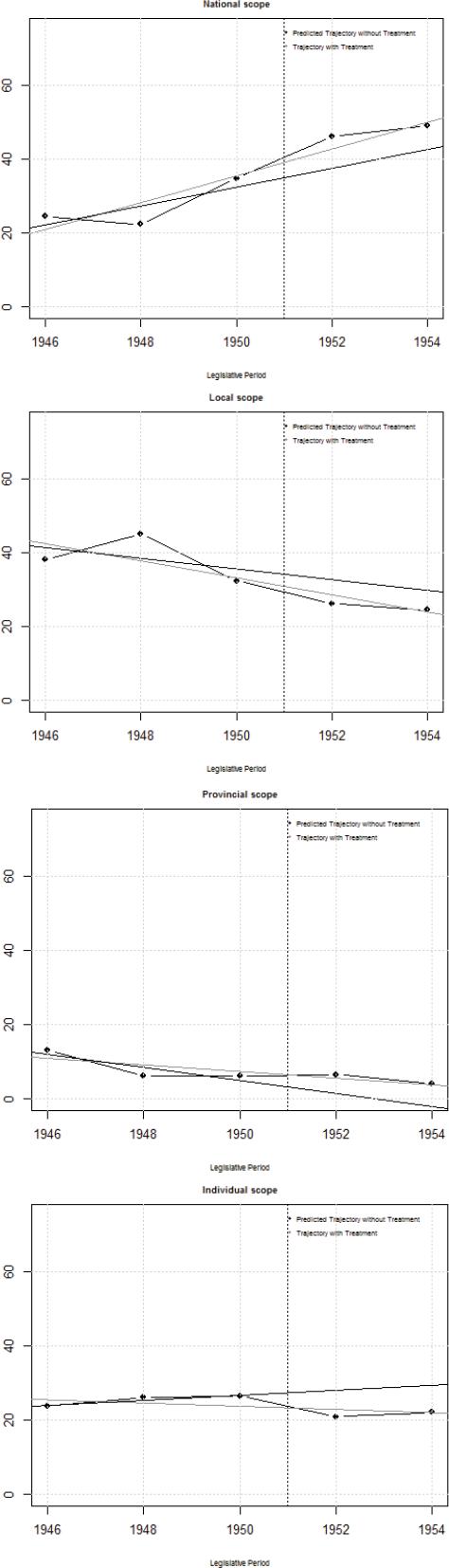
Figure 1 shows the trajectory followed by the different scopes along the five legislative periods under analysis. For each period, the percentage of the total bills classified as having each of the scopes was calculated and different plots were made in which the trajectory followed by each of the scopes is shown. In addition, two linear adjustments were added, depicting the actual trajectory followed by the scope (gray) and the predicted trajectory if no change in the electoral system had occurred (black) (i.e., if no treatment was applied).
The first thing to notice in Figure 1 is that the effect of the electoral-system change runs contrary to what was theoretically expected. In fact, without such a change, the percentage of bills with a national scope would have been almost 10 points less than it actually was. Even though the difference is less evident, this also seems to be the case with bills with a provincial scope. In contrast, the percentage of bills with both a local and an individual scope was reduced as an effect of the change in the electoral system. This is particularly clear for those bills with an individual scope, where an otherwise upward tendency was reverted after the change in the electoral system.
Scope Trajectories
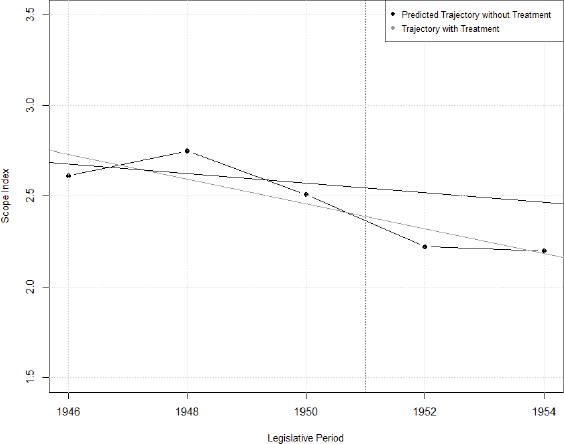
Figure 2 shows a similar trend. This plots the trajectory followed by the average scope of all the bills introduced in the Chamber of Deputies in each period. An average of one means that all the bills were national in scope, while an average of four would imply that all the bills were individual in scope. As can be readily appreciated, although the average changed from year to year during the three legislative periods under the former electoral system, the variation was always in the range 2.5–3, thus indicating a moderate tendency towards legislation with a narrower scope. Using those averages, the expected trajectory also continues within that range of values. In contrast, the average decreased after the electoral reform, indicating that more weight was given to bills with provincial or national scope.
Average Scope Trajectories
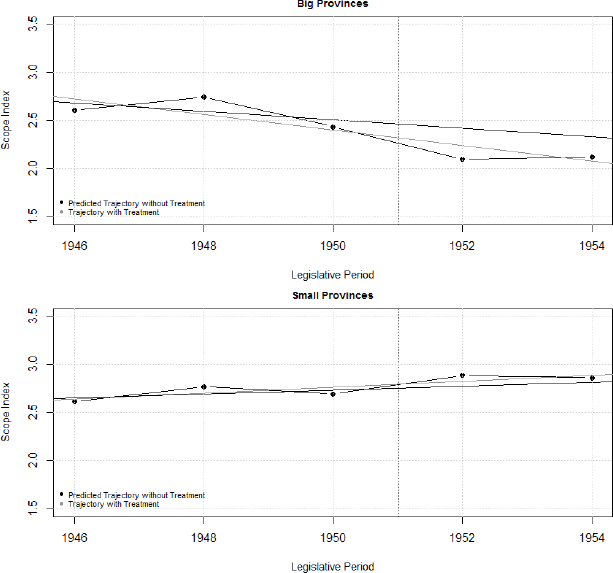
As already stated, in order to further check these results, the analysis was performed with a meaningful subgroup. The theoretical expectation is that if the change in the electoral system had any effect, it would have been stronger in the big provinces. The reason for this is that citizens in big provinces, who were used to electing a high number of legislators, were asked to elect only one. Such a change may have affected the prior knowledge they had of the candidates they were voting for. As theoretically expected and illustrated in Figure 3, the effect of the electoral reform (represented by a decrease in the scope's average) is evident in the bills introduced by legislators from big provinces and not in those introduced by legislators from small provinces.
Average Scope Trajectories for Big and Small Provinces
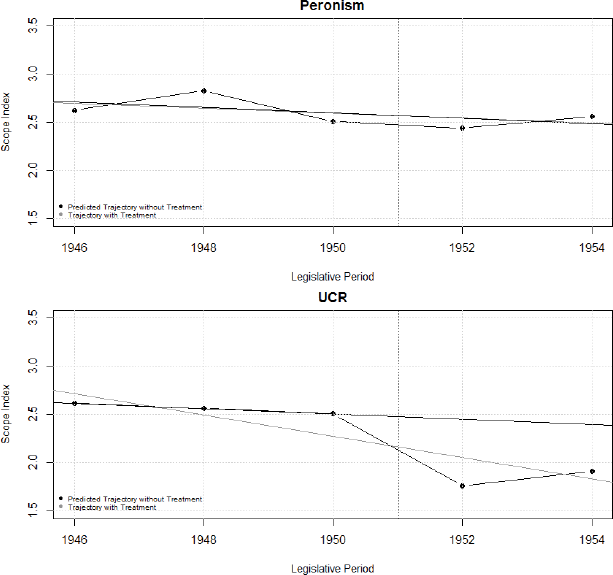
As it was likely that the behavior of those legislators from the Peronist Party and the UCR differed, separate trajectories were estimated for both groups (see Figure 4). As shown, the effect of the electoral reform seems to have been concentrated on UCR legislators. Although there is a slight decrease in the average for Peronist legislators, the expected trajectory without the change in the electoral system hardly differs from the actual trajectory. However, the electoral reform seems to have had a strong impact on the scope of the bills introduced by UCR legislators. In fact, before the reform, the average scope of the bills they presented was around 2.5; after the reform, less than 2. A possible explanation is that as a smaller minority, it was virtually impossible that their bills would actually become law and that, in such a context, introducing legislation with a broader scope was deemed a better credit-claiming strategy. Besides, since the Peronist Party was in charge of defining district borders, actual district boundaries and their stability over time were likely a matter of uncertainty for the UCR. So instead of legislating for the constituency they were elected by – expecting it to stay unchanged – it was a much safer option to invest in a broader population.
Average Scope Trajectories for Peronist and UCR Legislators
The second experimental technique used was a within-subjects analysis. It only considered those bills introduced by the Peronist legislators elected under both electoral systems. As is visible in Figure 5, this subgroup seemingly behaved differently from the Chamber of Deputies as a whole. In fact, the actual trajectories of the different scopes show fewer national and provincial bills than expected and an increase in the percentage of those with a local or individual scope.
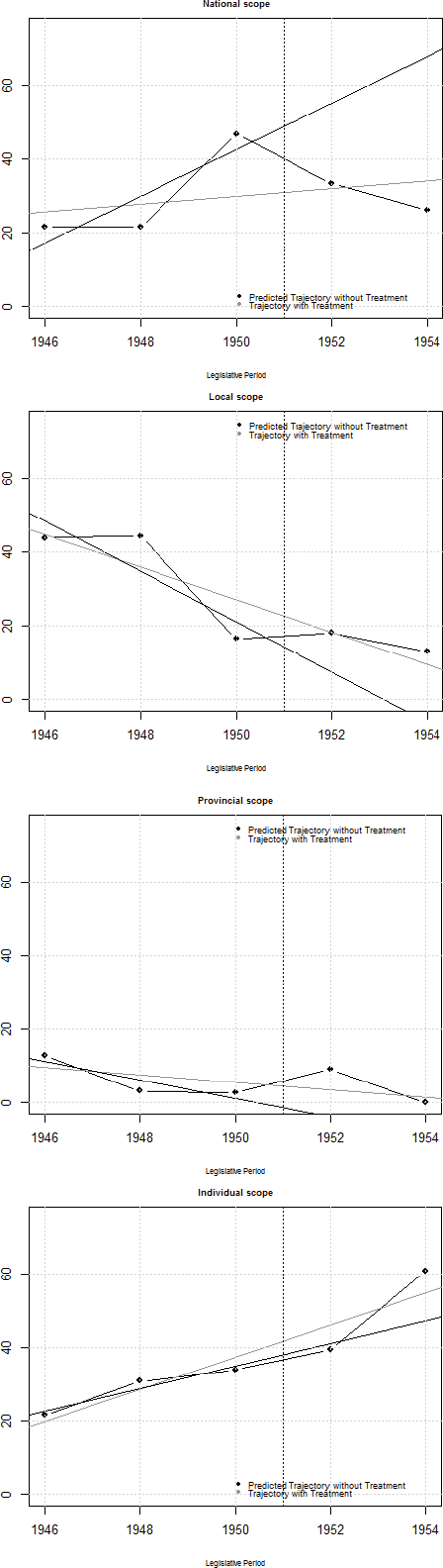
Scope Trajectories (Legislators in Both Systems Only)
This tendency is also evident in Figure 6, as the average scope increases significantly after the electoral reform. This is consistent with the finding from the ITS analysis, which shows that the decrease in the average scope was mainly driven by UCR legislators. Another interesting feature about this subgroup is the trajectory followed by the percentage of bills with an individual scope. This percentage not only increased constantly across periods but was also significantly higher in this subgroup. This finding – although not the main goal of this paper – might indicate that the allocation of particularistic goods makes the reelection of legislators more likely.
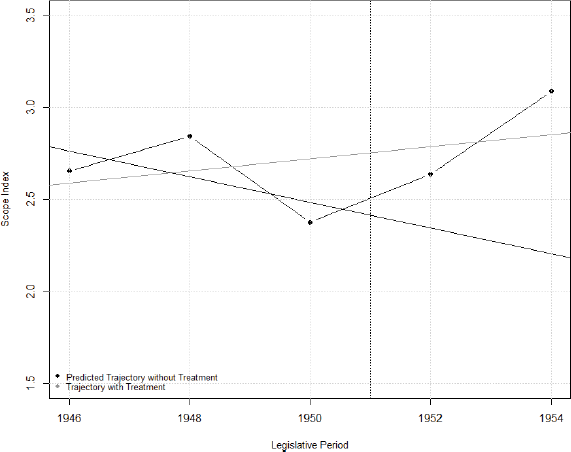
Average Scope Trajectories (Legislators in Both Systems Only)
The goal of the paper was to analyze the territorial scope of the bills introduced by legislators in the Chamber of Deputies during Peron's first two terms in office. In particular, it focused on the effect the reform of the electoral system may have had on that scope. Therefore, it contributes to the study of two scarcely analyzed aspects of Peronism – namely, the dynamics inside Congress and the effect of electoral reforms on policy – as well as to the broader literature on electoral systems. In order to achieve this aim, I reviewed the literature on the subject and used two experimental techniques (an ITS analysis and a within-subjects analysis).
Contrary to what was theoretically expected, the findings show that after the introduction of single-member districts, there was an increase in the proportion of bills that had broader scopes. As expected, this effect was relevant in big provinces but not in small districts, thus reinforcing the causal claim of the analysis of the bills as a whole.
A potential explanation for these counterintuitive findings is the difference in behavior between Peronist and UCR legislators. In fact, when the analysis is performed separately for both groups, the increase in the share of national and provincial laws is observed only for legislators from the opposition. Further analysis would be needed in order to make any conclusive arguments, but this may indicate that the change in the electoral system had an effect contrary to that theoretically expected because the observed effect is not a consequence of the reform per se but of its effect on the proportion of legislators from the opposition and the way it was implemented. As for the first point, given that the reform implemented a harsh reduction in the share of opposition legislators in Congress – which was controlled by the government party – UCR legislators could not depend on the allocation of individual or local goods to their constituencies for credit claiming. In such a context, it is possible that the best strategy for those legislators was to introduce broad-scope bills that could be used for credit claiming in a partisan or symbolic fashion, even if they had virtually no chance of being enacted. As for the way in which the reform was implemented, it is likely that district borders remained a source of uncertainty for UCR legislators, thus making it a safer strategy to invest in broader populations. Such uncertainty derived not only from the fact that the Peronist Party had the power to define those borders but also from the fact that the law was modified shortly after its enactment, thus contradicting the law's semblance of stability.
Furthermore, the fact that the within-subjects analysis found no increase in the share of national bills reinforces the hypothesis proposed to explain the theoretically unexpected findings. Furthermore, the high and steadily increasing proportion of bills with an individual scope introduced by Peronist legislators elected under both electoral systems may indicate the importance of this kind of legislation with regard to the probability of reelection. The underlying logic here is that the behavior or the characteristics of reelected candidates differ from those of other Congress members, especially in countries with low reelection rates.
Finally, the use of experimental techniques to analyze a novel dataset on legislative initiatives contributes to our understanding of the effect changes in electoral systems have on policy, above all on its territorial scope. In particular, they highlight differences in behavior between the governing party and the opposition as well as the presence of intervening effects as the likely sources of previously nonconclusive findings.