




Abstract
This article proposes a set of arguments about the strategic use of cabinet appointments by executives in presidential systems. Although recent work has greatly improved our understanding of government formation in presidential countries, most changes to presidential cabinets happen throughout the lifetime of a government and remain poorly understood. I argue that presidents use cabinet changes in response to unexpected shocks and to adjust their governments to changing political and policy circumstances. Weak presidents are more likely to use this strategic resource, which means that ministerial turnover should be higher when a president's formal authority is weak and he or she has low political support and popularity. To test these claims, I have assembled an original dataset that records individual cabinet changes in 12 Latin American countries between 1982 and 2012. The data provides strong support for the theory.
Introduction
The power to appoint and fire government ministers is one of the most important, if under-appreciated, assets available to executives in presidential systems. At the outset of a term, cabinet appointments allow presidents to form a government that reflects their policy goals. The importance of government formation in presidential countries has been the subject of a growing recent literature that shows that the majority status, partisan composition and portfolio allocation of cabinets reflects the policy-making strategies of presidents (Amorim Neto 2006; Raile, Pereira, and Power 2011; Alemán and Tsebelis 2011; Negretto 2006, among others). However, the importance of appointments as strategic resources goes well beyond government formation. In fact, although we have quite a good understanding of what drives presidents’ initial cabinet picks, an average of 60 percent of all cabinet appointments that Latin American presidents make happen throughout the president's term and existing theories of government formation can only poorly explain these cabinet changes. 1
This number is based on the data for this paper. See below for details.
In this paper, I argue that these ministerial replacements reflect a second crucial way in which presidents use appointments: as a way to adapt to unforeseen shocks throughout their term in office. This strategic use of appointments is especially important in the context of fixed terms, which limit presidents’ options for dealing with impending crises. Presidential institutions do not allow the removal of presidents that have lost legislative or popular support and cabinet changes can provide embattled executives a “safety valve” with which to adjust to changing political and economic circumstances (Mainwaring and Shugart 1997: 38). For instance, reshuffles followed precipitous drops in the polls for Chilean President Piñera in 2011 and Peruvian President Toledo in 2004. Similarly, cabinet changes often follow economic crises, such as the 2009 energy crisis in Ecuador that ended the tenure of Energy Minister Albornoz; they come after scandals like the infamous mensalão bribery scandal in Brazil that led to the exit of President Lula's cabinet chief in 2005; or follow changes in the partisan balance of powers brought on by an electoral triumph or defeat – like the defeat suffered by the party of Argentine President Fernandez in the 2009 legislative elections.
Yet, despite the frequency with which presidents use this strategic resource, cabinet replacements in presidential systems have received little attention until recently. This contrasts sharply with work on parliamentary politics, which has long recognized the importance of appointments in shaping prime ministers’ popularity (Dewan and Dowding 2005), in helping executives manage problems of adverse selection and moral hazard in policy-making (Huber and Martínez-Gallardo 2008), and in helping them avoid ministerial drift (Indridason and Kam 2008). However, research into presidential systems has primarily focused on the partisan and nominal composition of cabinets and paid much less attention to the ways in which presidents use appointments strategically throughout their term (Praça, Freitas, and Hoepers 2011; Polga-Hecimovich, Basabe-Serrano, and Mejia Acosta 2012; Camerlo and Pérez-Liñan 2012 are exceptions to this trend).
In this paper, I claim that cabinet appointments help presidents solve a dynamic problem. The existing literature has shown that presidents form governments that reflect their policy-making strategy and that this choice depends on the strength of presidents relative to the legislature (Amorim Neto 2006). However, although the initial conditions under which presidents form a cabinet are important, they are not set in stone. Instead, unexpected events over the course of a government's life will change these conditions and make bargains that were previously “stable” no longer viable. Appointments are an explicit political strategy that presidents will use to face these unexpected challenges. Cabinet changes allow presidents to change policy by changing the individuals in charge of making policy, and can also help presidents adjust their support coalition by giving them a resource they can use in their negotiations with other actors.
However, appointments are not the only tool that presidents use to adjust to a changing political and policy environment (Raile, Pereira, and Power 2011; Chaisty, Cheeseman, and Power 2012). The second claim I make in this article is that presidents use appointments more when other means of policy change are expensive. This happens when presidents’ legislative support is weak and their constitutional authority is limited. In other words, although a president can change his or her cabinet, the use of appointments as a political strategy is more attractive to presidents who are otherwise weak.
To examine the strategic use of cabinet replacements by presidents, I have used original data that tracks every change to the cabinets of 74 presidents in 12 Latin American countries over a period of 20 years. This unique dataset allows close analysis of appointments on a number of key dimensions. In particular, the data has enabled me to track changes made to the cabinet throughout the president's term in office and not only at the outset, during periods of government formation. I can also take into account systematic differences among countries and look at what drives variation at different times within a country or even within an administration. In addition, the data has made it possible to analyze differences across portfolios, rather than just looking at cabinets as a whole or at annual averages. I have used duration models to evaluate the circumstances under which presidents replace members of their cabinet. The findings support the main claims of the article; specifically: cabinet replacements are more likely to happen in the context of shocks and they are used more frequently by vulnerable presidents that lack majority support in the legislature, have weak institutional authority or have weak support among voters.
Although a central criticism of presidentialism has been that institutional incentives might lead to inter-branch conflict and potential deadlock (Stepan and Skach 1993; Linz 1990), the main implication of my findings is that cabinet replacements might give presidents some flexibility in managing the types of challenges that have long been identified as sources of presidential instability. Consider the example of Peruvian President Alejandro Toledo. Elected in 2001 without a legislative majority, Toledo used frequent cabinet changes to mitigate public outrage over a series of corruption scandals and to recover credibility in the face of plummeting public approval rates and calls from the opposition for his resignation ( thefreelibrary.com 2014). Indeed, Toledo was the first Peruvian president without a congressional majority to complete a term in office (Morón and Sanborn 2006). The evidence in the present article suggests that, like Toledo, other executives in presidential systems use appointments to adapt their government to unexpected changes in the political environment throughout their term.
In the next section I develop a set of arguments regarding why and when presidents favor the use of appointments as part of their political strategy. In the third section, I describe the dataset, which includes information on over 1,400 cabinet replacements. In the last two sections, I describe the empirical strategy and present the findings. I close with a discussion of the broader implications of the paper.
A Theory of Ministerial Turnover
Unexpected Shocks and the Dynamics of Cabinet Changes
The presidential literature has traditionally described government formation as a unilateral process dominated by the president. However, more recent work has suggested that – far from being unilateral – government formation in presidentialism can actually be seen as a bargaining process; that is, a (sometimes explicit) negotiation between the president and parties in the legislature (or factions within the president's own party) in which the president trades control over policy-making for future political support (Amorim Neto 2006; Martínez-Gallardo 2012). In this view, patterns of government formation reflect not only presidents’ preferences over future policy outcomes, but also the alliances they expect will be necessary in order to get their agenda through the legislature (Geddes 1994). Whether (and which) political alliances will be necessary will depend on whether the president has majority support in the legislature and on the extent of the president's law-making authority (Amorim Neto 2006).
I add a dynamic element to this account of government formation by suggesting that cabinet changes provide presidents with a tool for responding to changing political environments between elections. This view is consistent with work in the parliamentary literature that relates government terminations to exogenous shocks that might precipitate bargaining failures and compel presidents to reshuffle their cabinets (e.g., Browne, Frendeis, and Gleiber 1984; Diermeier and Merlo 2000). 2 I argue that in presidential regimes, as is the case in parliamentary democracies, events that change the parameters of the bargain struck in the immediate aftermath of presidential elections will encourage action by the president. Such shocks may change the distribution of power within the governing coalition, or between the president and the opposition, compelling presidents to search for new sources of political support. Or they might change the policy environment in ways that prompt the president to strengthen the cabinet's policy expertise or to change the government's policy position altogether.
These shocks are destabilizing because they can bring about changes in the parameters of the model; for example, policy preferences or expected seat distributions (Laver and Shepsle 1998). They are exogenous because they are determined outside of the model, they appear “on a schedule that is not fully controlled by actors” (Browne, Frendeis, and Gleiber 1984: 180).
Presidents can face a wide range of unexpected events during their term in office, including any event that changes the parameters that were bargained at the outset of the term (Lupia and Strom 1995). As varied as they are, though, most of these events can be seen as having political and/or policy effects. In terms of politics, shocks can change the political calculus of players – including the president, governing parties, and the opposition – in the competition for electoral support. Shocks such as midterm or subnational elections, a scandal, or a sharp change in the president's popularity can alter the distribution of power among political parties, change their perception regarding their electoral prospects going forward, and lead to changes in their political strategy. In these cases, presidents can use cabinet changes to re-allocate posts in ways that reflect the new political environment.
A good example of how presidents deal with the political repercussions of a shock comes from Peru. In 2008, recordings revealed an illicit deal between the head of the state oil company, PeruPetro, and a prominent member of President Alan García's party. In an effort to contain the fallout from the scandal and shore-up support in disaffected quarters, the president fired the energy minister and the president of the Council of Ministers, replacing him with someone who was “popular in the regions and with the left; [had] good relations with union leaders and regional presidents” ( theamericasreport.com 2008).
Other shocks are more likely to change the policy status quo. In terms of policy, shocks such as an international or economic crisis or a natural disaster might create “a need for government and opposition parties […] to assess their present policy position or, in some instances to take altogether new policy positions” (Laver and Shepsle 1998: 36). When shocks have clear policy effects, presidents will sometimes appoint individuals with the requisite “technical” skills or expertise to change the direction of policy and/or to signal competence to stakeholders. However, presidents might also deal with the policy effects of a shock by making changes to the cabinet as a concession to other parties, or factions within their own party, in exchange for their support in changing the policy status quo (see Raile, Pereira, and Power 2011 on Brazil).
A good example of a shock with clear policy effects, and the president's reaction to it, comes from Argentina. In the first months of 2001 the Argentine economy, which had been sunk in a recession for two years, dropped further into crisis. The stock market plunged and President Fernando de la Rúa reacted by replacing Economy Minister José Luis Machinea with Ricardo López Murphy, who was seen as “the most orthodox of the economists close to Mr. De la Rúa” ( nytimes.com 2001). Despite his credentials, the new minister failed to get political backing for his reform plan and was himself soon replaced by Domingo Cavallo, who had served five years as Economy Minister under President Carlos Menem. Crucially, the new minister not only had the required expertise, but also had powerful backers in the opposition PJ (Partido Justicialista), whose votes in congress were essential in granting him extraordinary powers to reform the economy (Lupu 2014).
In sum, unexpected shocks might upset the equilibrium achieved at the outset of a president's term, prompting the president to adjust his or her cabinet. Although the nature of a given shock can vary widely, most shocks can be thought of as having a policy and/or a political component. In terms of policy, shocks will most often compel presidents to replace the ministers who are deemed responsible for policy failures with ministers who are more qualified or that signal a change in policy direction to important stakeholders. Politically, shocks will change the balance of power in the competition for electoral support, creating opportunities for both parties and presidents to use cabinet politics to shape voters’ perceptions.
Presidential Strength and Cabinet Replacements
As conditions change during a government's lifetime and the bargains struck at the start of the term are no longer sustainable, presidents must take action to strike new political deals. Whether a president uses cabinet changes to adjust to the changing environment will depend on the range of political tools available to him or her (Raile, Pereira, and Power 2011). These tools might include legislative action, if barriers to agreement with the legislature are sufficiently low, or executive action, if presidents’ institutional authority allows them to change policy unilaterally. I argue that, all other things being equal, appointments will be used more often by politically and institutionally weak presidents.
To achieve their political goals, most presidents need to pass legislation, which means that their success depends to a significant degree on the approval of congressional majorities (Saiegh 2009). As a result, the extent to which presidents are able to influence policy largely depends on the size of the barriers to agreement with the legislature. In general, governments that do not have a secure majority in the legislature are more politically vulnerable. Weak political support makes a president more susceptible to demands from the opposition or from legislators from his or her own party for concessions; this political weakness translates into higher turnover as presidents use appointments for political leverage. Legislative action is also more costly for presidents with weak public support (Raile, Pereira, and Power 2011). There is evidence from different countries that low approval rates increase the barriers to agreement with the legislature by making it easier for legislators to oppose the president's bill proposals (e.g., Calvo 2007; Canes-Wrone and de Marchi 2002). Popular presidents, by contrast, have considerably more political leverage and should be less likely to change their cabinet as conditions change.
Another factor shaping presidential strength is the extent of their institutional authority. Although all presidents have some formal authority over the policy process, the extent to which they can shape policy outcomes varies widely across presidential systems (e.g., Shugart and Carey 1992; Pereira, Power, and Rennó 2005; Tsebelis and Alemán 2005). In some countries, presidents have strong institutional authority that allows them to enact policy changes through the use of executive decrees. The reach of these decrees varies; in each country, constitutional rules determine whether decree authority is limited to certain areas and whether decrees expire if congress does not ratify them (Negretto 2004). In countries with extensive decree powers, presidents tend to rely on executive prerogative rather than legislative action to further their agendas (Amorim Neto 2006). This suggests that presidents who have the option of using unilateral executive action to change policy will be less likely to use cabinet replacements as strategic bargaining tools.
In most countries, however, presidents only have reactive powers that allow them to block policy, but not change it. In these cases, policy change is likely to require agreement with the legislature and constitutional rules determine how difficult or easy this is likely to be to achieve. Most commonly, presidents have veto powers that can vary according to the majority needed to override the president's veto, whether they can veto the budget, or whether they can veto all or part of a bill. In these cases, presidents are more likely to rely on negotiations with allies in the legislature in order to get policy approved and are more likely to face pressure to use cabinet changes as tools in bargaining with the legislature.
In sum, appointments are a source of leverage for presidents who have little political or public support or who have weak constitutional authority; they can be used as particularized benefits, as patronage for other politicians whose support the president needs, or as benefits for loyal supporters (Geddes 1994; Raile, Pereira, and Power 2011). Thus, as circumstances change throughout their term, weak presidents will be more likely than strong presidents to use cabinet changes to adapt.
Constraints on the Use of Appointments
Although appointment powers can be extremely useful for presidents, there are some constraints on their ability to use this resource effectively. The first stems from the opportunities for policy influence that different portfolios offer ministers (and, potentially, their parties). Some portfolios are more politically sensitive or central to the government's agenda than others, which means they should be at least partly protected from the dynamics discussed here. Ministers in these areas are likely to be vetted more carefully, or they might have to meet technical or professional requirements that are harder to substitute. Which portfolios fit this description is likely to vary from one country to another depending on the policy priorities of the administration; however, certain areas, such as finance, are sensitive everywhere and so should see lower cabinet turnover.
Second, coalition agreements might constrain how presidents use appointments. This is the case in parliamentary democracies, where coalitions tend to be more stable than single-party governments. Two main mechanisms explain this. First, moral hazard concerns might lead to more careful scrutiny of potential ministers during coalition negotiations, and hence to ministers who are less likely to be removed later on (Huber and Martínez-Gallardo 2008). Second, parties in parliamentary systems usually negotiate in detail the distribution of portfolios, which limits the prime minister's freedom to change the distribution of party representation in the cabinet without having to engage in a “costly, more general renegotiation of the entire coalition bargain” (Huber and Martínez-Gallardo 2008: 172; Martin and Vanberg 2004). Less is known about the nature of coalition agreements in presidential systems. However, despite few formal restrictions on presidents’ appointment powers, the proportionality with which presidents distribute portfolios among coalition partners (Amorim Neto 2006) is a sign that agreements between coalition partners – even if informal – might impose some limits on the freedom of presidents to change ministers. If coalition arrangements do constrain president's appointment powers, coalitions should be more stable than single-party governments.
Measuring Ministerial Turnover
In the next sections I describe the empirical strategy I have used to evaluate whether exogenous shocks shape the use of cabinet reallocation by presidents throughout their term and the degree to which president's political and institutional strength conditions the use of appointments. I start by describing the data and discuss issues of measurement, and then discuss the empirical tests and findings.
Dependent Variable: Ministerial Turnover
While most work on government formation in presidential systems has focused on the factors that determine the composition of presidents’ initial cabinets, the arguments I have presented regard the dynamic and institutional factors that lead presidents to replace ministers throughout their term. Therefore, I have used an original dataset that records every change presidents make to the cabinet from the moment they are sworn into office until the moment they step down. The dataset covers 74 different presidential terms in 12 Latin American countries between 1982 and 2012. 3 Each of the 2439 ministers in the dataset is observed monthly from the time he or she enters a specific portfolio to the time he or she leaves it (their failure or termination). I use the continuous number of days that a minister occupies a specific portfolio to measure ministerial turnover. This measure improves on existing work, which is based mostly on aggregate measures of cabinet stability, including indicators for a reshuffle when a certain number of ministers changes (Geddes 1994; Almeida 2003), or indicators of the number of changes in a cabinet in a year (Amorim Neto and Borsani 2004) or an administration (Santos 1986). Measuring cabinet stability using the duration in office of individual ministers enabled me to associate cabinet turnover with aspects of the political process that change at different points during a government, including the incidence of shocks, changes in the electoral calendar, and changes in the president's popular support. 4
There are 64 individual presidents in the dataset, but 10 of them were reelected (Arias, Cardoso, Chavez, Menem, Garcia, Lula, Menem, Sanguinetti, Uribe and De Lozada). The years included are: Argentina (1983–2011), Bolivia (1982–2009), Brazil (1990–2010), Chile (1990–2010), Colombia (1982–2010), Costa Rica (1982–2010), Ecuador (1985–2006), Mexico (1997–2012), Paraguay (1992–2008), Peru (1985–1991, 2001–2011), Uruguay (1986–2010), Venezuela (1984–2005). Only country-years with a Polity score of 6 or more are included.
Despite the advantages of this measure, a potential concern is that, to the extent that ministers are reshuffled within the cabinet, changes during the lifespan of a government are not independent. In Table A.1 of the Supporting Appendix I run a model excluding ministers who were moved to a different position within the cabinet and obtain practically identical results.
Three important features of the data are worth highlighting. First, there are more ‘ministers’ than individuals in the dataset; this happens because individuals can enter the dataset more than once if they occupied more than one position in the cabinet and/or if they left the cabinet and joined it at some other point in time. 5 For instance, Colombian ex-President Cesar Gaviria appears twice in the dataset, once as Minister of Finance and once as Minister of Government (presidents, of course, are excluded from the analysis).
Only ministers who were in office for longer than a month are included. The number of individuals in the dataset is 2061 and the number of ministers (minister-portfolio) is 2439; 345 individuals (or 1.7 percent) occupied more than one position in the cabinet.
Second, the empirical analysis excludes terminations at the end of a president's term. Observations for ministers who leave their posts when the president leaves are considered to be censored; in other words, it is unclear how long these ministers would have stayed in office had they not had to leave their positions at the end of the president's constitutionally mandated term. Figure 1 compares the number of ministers that left their posts at some point during the presidential term with the number who left at the end of a president's term. Overall, 1,437 ministers (59 percent) left their post during the president's term; it is these terminations that I have analyzed. Figure 1 shows that, in most countries, half or more of the total changes to the government occurred at some point between the president's inauguration and the end of the term. The most notable exception is Costa Rica, where ministerial stability has been remarkably high and a full 60 percent of exits from the cabinet happened when the presidential term ended.
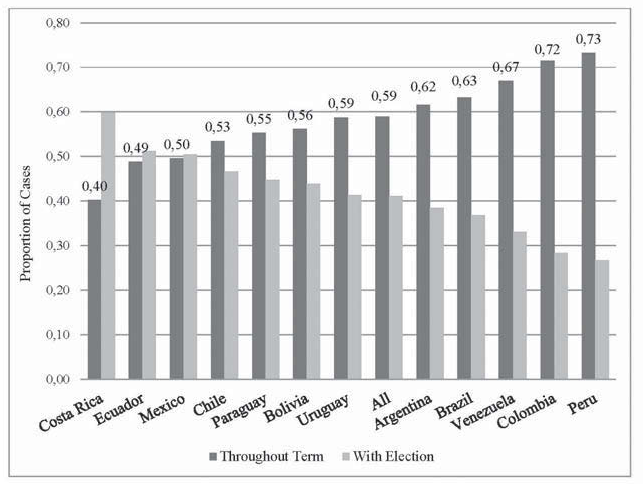
Terminations throughout and at End of Presidential Term
Third, in order to enhance comparability across countries and portfolios, the dataset includes only a subset of core portfolios. Portfolios differ widely in terms of saliency, visibility, the opportunities they offer for patronage and, consequently, their value to ministers and their parties. Escobar-Lemmon and Taylor-Robinson (2005), for example, found substantially different patterns in the recruitment of female ministers when they looked at “high-prestige” portfolios as opposed to “medium-prestige” and “low-prestige” positions. Including only core portfolios minimizes these differences and the possibility that the findings might be driven by a small group of highly salient (and potentially more stable) portfolios.
I decided which portfolios to include based on the consistency with which they existed in each country over time. The assumption behind this decision is that core portfolios tend to exist more consistently than those created for more idiosyncratic reasons, such as opportunity or ideology. Some portfolios were excluded because they existed only during a certain period of time; an example is the Ministry of Executive-Legislative Coordination in Chile, which existed under President Eduardo Frei. Other portfolios were excluded because at the time data was gathered they had existed only for a few years. Examples of these recently created positions include Legal Defense of the State in Bolivia and Ground Transport in Venezuela. 6 All the results shown below hold using all available portfolios (see Table A.1 in the Supporting Appendix).
Portfolios that constituted less than 1 percent of the country's observations were excluded. If this rule did not reduce the number of portfolios in a country to 25 or fewer, portfolios were eliminated using their relative frequency until 25 portfolios were left.
Table 1 shows summary statistics for the dependent variable. The first column includes the mean tenures in months for all ministerportfolios. Overall, the average ministerial tenure is relatively short, at 19.6 months (the average presidential term is 57 months); this figure is in sharp contrast with US secretaries, who averaged 34.7 months in office between 1789 and 2001 (Chang, Lewis, and McCarty 2001). 7 The tenure of ministers is evidently shorter if we consider only terminations that happen during the president's term and exclude ministers who left office at the end of the president's term (see column 3). The average tenure for ministers who left the government at some point during the president's term is only 16.4 months, although variation across countries is very large, with ministers in Ecuador remaining in office for approximately one-sixth of the presidential term and ministers in Uruguay staying, on average, for more than half of a term (see last column of Table 1 for average tenures as a proportion of a presidential term).
Ministerial Duration in Months, by Country, 1982–2010 †
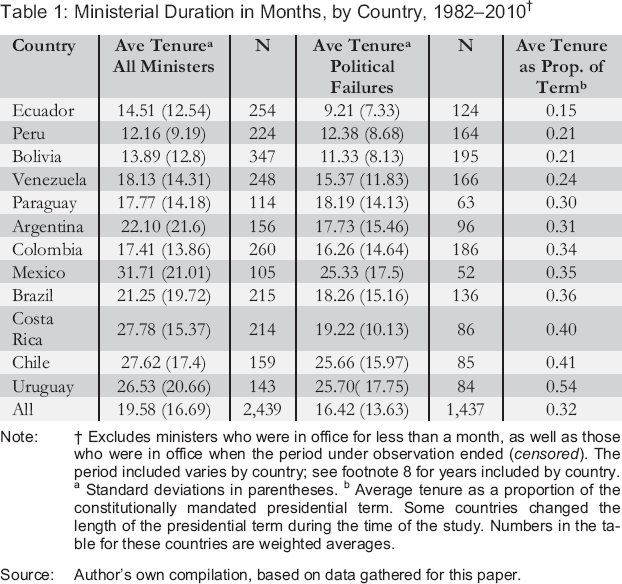
Excludes ministers who were in office for less than a month, as well as those who were in office when the period under observation ended (censored). The period included varies by country; see footnote 8 for years included by country.
Standard deviations in parentheses.
Average tenure as a proportion of the constitutionally mandated presidential term. Some countries changed the length of the presidential term during the time of the study. Numbers in the table for these countries are weighted averages.
Source: Author's own compilation, based on data gathered for this paper.
Average ministerial duration in parliamentary systems varies widely, from 26 months in the same portfolio in Italy to 85 months in Luxembourg (Huber and Martínez-Gallardo 2004).
In the following paragraphs I describe the independent variables used in the analysis (see Tables A.2 and A.3 in the Supporting Appendix for descriptive statistics and sources).
Independent Variables: Shocks and Presidential Strength
During their lifetime, governments are subjected to “a continuous stream of critical events” that can change bargaining conditions and prompt action by the president (Laver 2003: 28). While directly measuring the effect of the full range of shocks that president's face is unfeasible, I have used two different approaches that have been common in empirical studies of parliamentary cabinets. The first and most common approach has been to include a set of variables that measure the extent to which the economic and political environment make it more likely that any given shock might be destabilizing (e.g., King et al. 1990; Laver and Schofield 1998). This approach assumes that shocks can happen at any time, but the degree to which they will threaten the stability of the government varies with the complexity of the environment in which political actors bargain. In the models below, I have included a measure of country risk as a proxy for a country's propensity for destabilizing shocks. The index combines data on economic and financial indicators with measures of a country's political stability, such as corruption and the influence of the military. If my argument is correct, we should observe more cabinet changes in places where political and economic conditions are more unstable and, thus, shocks are more likely to be destabilizing.
A second approach to examining the effect of shocks has been to connect one or two individual types of exogenous events, such as political scandals (Dewan and Myatt 2007), protests (Camerlo and Pérez-Liñan 2013), or economic crises (Warwick 1992), to cabinet stability. Following this approach, in the models below I use an indicator for quarters in which the executive's approval drops by more than the average quarterly drop for the country (Drop in Approval). Like other shocks, sharp drops in popularity should prompt action by presidents seeking to rebuild their credibility or reconstruct their political coalition. Approval data comes from the executive approval dataset gathered by Carlin, Hartlyn, and Martínez-Gallardo (2009). They computed country-specific measurement models using time-series principal components analysis and the dyad ratios algorithm to bridge differences in survey data across countries and generate a comparable measure of presidential approval. 8 Unfortunately, although the data covers all the countries in this paper, the number of years available varies from country to country; therefore, in the models that include measures of approval, I have omitted governments with missing data on approval.
This approach is well known in studies of macro-opinion in the United States (Erickson, MacKuen, and Stimson 2002). For a detailed explanation, see Stimson (1999).
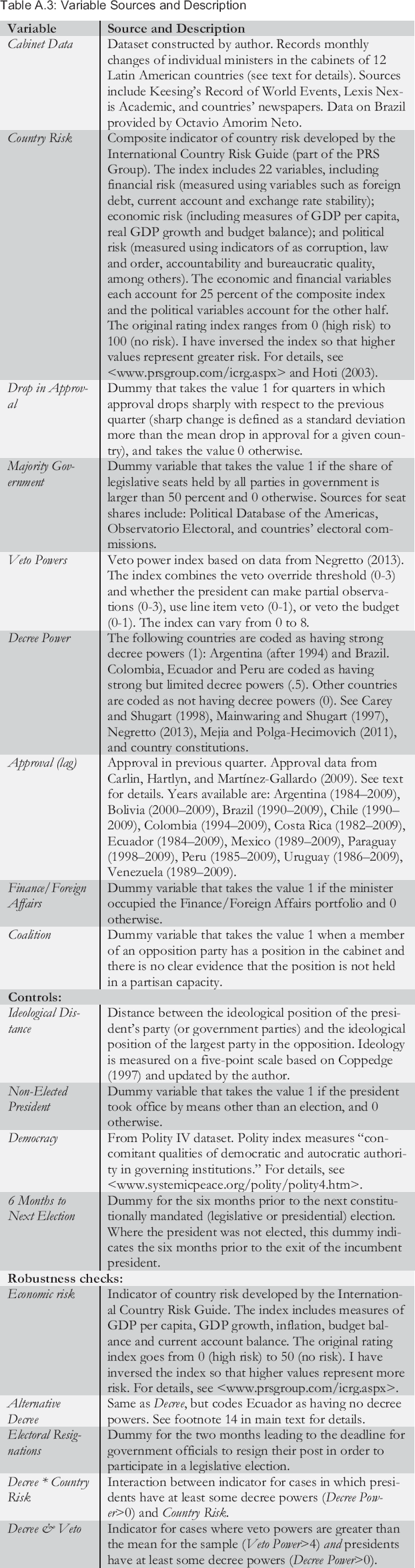
The second claim of the theory is that cabinet changes will be cheaper to use than the legislative process for weak presidents. I have argued that three sources of strength should be particularly important: legislative strength, institutional authority and popular support. To measure legislative support, I have used an indicator of whether the governing party (or parties, if the government is a coalition) has (have) a majority of seats in the legislature (Majority Government). To capture the president's institutional authority, I have used an indicator for presidential decree powers (Decree Power). To reflect the variation in executive decree authority, the indicator takes a value of 1 where decree authority is strong; a value of .5 where this power is limited in scope or where laws expire after a certain period; and 0 where presidents have no decree powers. 9 To account for presidents’ veto powers, I have used an index based on Negretto (2013), which scores the veto override threshold, whether presidents can veto parts of a bill and make observations, and whether presidents can veto the budget (Veto). Approval is measured quarterly and lagged to ensure that I am capturing the effect of approval on stability and not the potential effect of reshuffles on the president's approval.
There is disagreement in the literature on the extent of decree authority accorded to presidents in different countries (see, for example, differences between Amorim Neto 2006; Carey and Shugart 1998; and Negretto 2013). I use the following scores: Brazil and Argentina after 1994 receive a 1; Colombia, Ecuador and Peru are coded as .5; the rest of the country-years are coded as 0. In Table A.1 of the Supporting Appendix, I have re-run the results coding Ecuador as having no decree powers (see Mejia and Polga-Hecimovich 2011; Mainwaring and Shugart 1997). Results are unchanged.
I have included two measures of constraints on presidents’ ability to use appointments. The first one is a proxy for the opportunity for influence that different portfolios offer. Although the relevance of each portfolio varies across countries, here I have used dummies for finance and foreign affairs portfolios, which tend to be two of the most prominent areas of policy across the region. The second is an indicator of whether the government is a coalition or not. A government is considered to be a coalition when a member of an opposition party has a position in the cabinet and there is no clear evidence that the position is not held in a partisan capacity.
Finally, I have included a series of control variables. Based on existing literature, I have included three variables to account for potential alternative sources of instability in the cabinet: the ideological distance between the president and the opposition in the legislature; an indicator of whether the president took office by means other than an election (Nonelected); and the Polity measure of democracy to account for differences in the quality of democracy among countries in the dataset (Democracy). 10 The electoral cycle should also shape parties’ incentives, so I have included an indicator for the six months prior to the next legislative or presidential election.
Only democracies with a Polity score 6 or more are included because the inter-branch dynamics that I describe here require minimal conditions of electoral competitiveness and openness.
Modeling Cabinet Stability
To test the claims outlined above, I have estimated a series of survival models (Prentice and Kalbfleisch 1979). These models are prominent in the study of parliamentary government where they have been widely used to test theories of government duration (Box-Steffensmeier and Jones 1997). Survival analysis is of particular interest when the main variable of interest is a duration – in this case, the amount of time elapsed between the minister's appointment to the cabinet and his or her exit. The key concept in survival analysis is the hazard function, which gives the probability that an individual will fail at a certain time, given that he or she has survived up to that point. Here, the hazard rate represents the likelihood that a minister will leave his or her current position in the cabinet, given that he or she has not done so up to that point. 11
A minister fails if (a) he or she leaves the cabinet, or (b) he or she is changed to another portfolio. However, in Table A.1 in the Supporting Appendix I show that the results are robust to the exclusion of ministers who were moved to a different portfolio.
Two key issues arise in model specification: duration dependence and unobserved heterogeneity. The first challenge is to characterize the relationship between the hazard rate and time (or duration dependence). This relationship is given by the baseline hazard, which describes the hazard rate when all covariates are set to zero. Depending on whether we think that the risk of failure increases, decreases, or remains constant over time, we could assume different shapes for the baseline hazard or the underlying risk of failure. In the context of ministerial turnover, however, it is not clear what the relationship is between cabinet terminations and time. On one hand, if parties have incentives to distance themselves from the incumbent president as an election approaches (e.g., Altman 2000), we would expect the hazard or risk of exiting the government to increase as the next election gets nearer. On the other hand, I have argued that presidents will use appointments as responses to exogenous shocks, and there is no a priori reason to expect that these shocks will be distributed in any particular way with respect to time (Browne, Frendeis, and Gleiber 1984). In sum, there are insufficient grounds to form an unambiguous expectation about the relationship between time and the probability of failure by an individual minister. Consequently, I have used semi-parametric Cox proportional hazards models that allow the analysis of ministerial tenures without assuming a specific shape for the hazard function (Cox 1972).
A second issue with model specification is the possibility of factors that affect the likelihood of cabinet terminations but are unobservable or difficult to measure. Failing to control for this unobserved heterogeneity may lead to biased coefficients and durations (Henderson and Oman 1999). To control for this possibility, the models include a random variable, or frailty term, that allows for unobserved variation across clusters that might affect the underlying vulnerability of observations from a particular cluster to fail more often. Observations are assumed to be clustered in countries and the frailty is assumed to be shared by all ministers in a given country. The models estimated below are of the following form:

where h o (t ij ) is the baseline hazard, j= 1, …, J is the cluster (country) index, i= 1, …, N is the subject (minister) index, and the frailty term, υ j , follows a gamma distribution (mean= 1 and variance = θ).
Table A.1 of the Supporting Appendix shows that the results presented below are unchanged if I use portfolios as clusters.
Findings
The results provide strong support for the argument that presidents use appointments to handle the political and policy effects of shocks and show that appointments are used more when presidents’ formal authority is weaker and when their political support and popularity are lower. The results are presented in Table 2 and Figure 2. The coefficients in Table 2 represent the ratio of the hazards for a one-unit increase in the relevant covariate; a hazard ratio greater than 1 implies that an increase in the covariate will increase the odds that a minister will exit the cabinet, while a hazard ratio lower than 1 implies that an increase in the covariate will reduce the odds of a minister leaving the cabinet. To make the results for continuous variables more intuitive, I have shown in the following paragraphs and in Figure 2 the results in terms of the hazard ratio associated with an increase of one standard deviation in the corresponding covariate (or a change from 0 to 1 for dichotomous variables). 12 Unless otherwise indicated, all estimated effects are based on column 1 of Table 2. Measures of approval are included separately in column 2 because they exclude more than 400 ministers for whom data is not available.
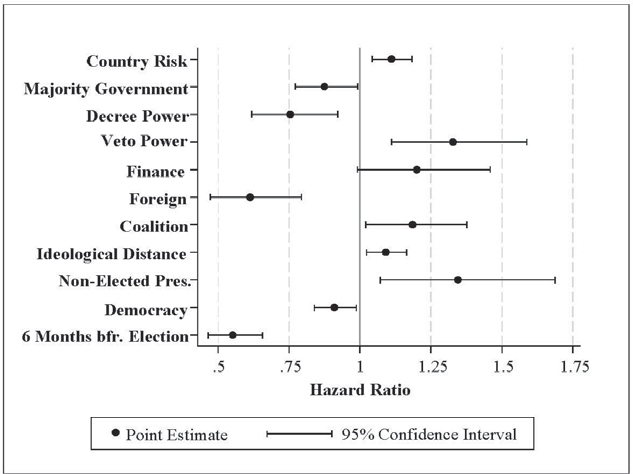
Determinants of Ministerial Stability
Determinants of Ministerial Stability †
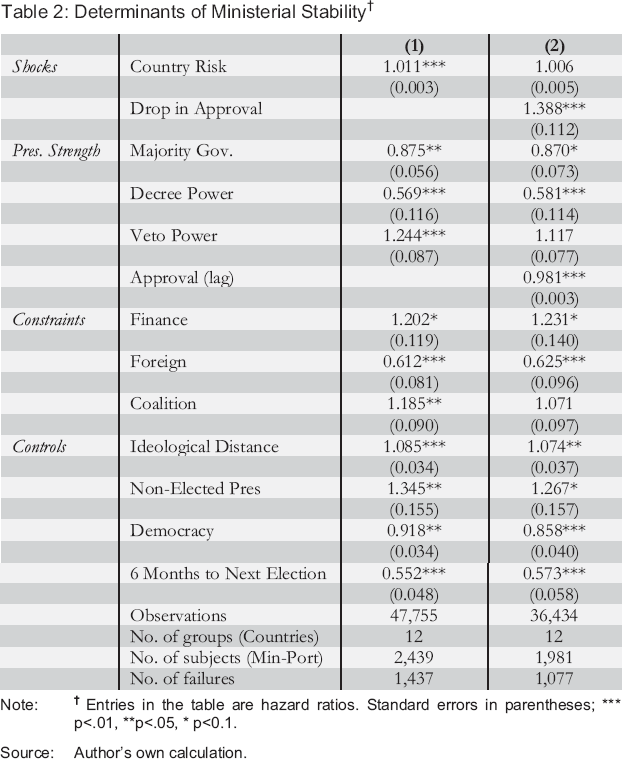
Entries in the table are hazard ratios. Standard errors in parentheses;
p<.01,
p<.05,
p<0.1.
Source: Author's own calculation.
I estimate the hazard ratio for a one-standard deviation change in a covariate by raising the hazard ratio in Table 2 to the power of the standard deviation. For instance, if the hazard ratio associated with a one-unit increase in a covariate is 1.085, the hazard associated with a one-SD change of 3 points is (1.085) 3 = 1.277.
Looking at column 1 first, it is clear that cabinet changes increase in contexts of more shocks. The measure of propensity for shocks, the index of country stability, has a significant effect on the likelihood of cabinet changes. The likelihood of a termination increases by approximately 12 percent with a one-standard deviation (10-point) increase in a country's risk rating (see Figure 2). 13
One of the 22 variables that compose the index of country risk is government stability and thus there is potential concern with endogeneity. The correlation between yearly country risk and yearly number of political failures is indeed positive, but not high (.16). Table A.1 in the Supporting Appendix shows that results are unchanged using a narrower measure of economic risk.
During the tenure of Argentina's President Menem, for instance, the country's risk rating decreased from 65.5 in 1989 to 39.5 in 1995. Holding all other variables constant, we would expect this drop to translate into a decrease in the risk of failure of approximately 25 percent. 14 In column 2 I have added a measure for one particular kind of shock: an indicator for quarters in which a president suffers a drop in approval that is one standard deviation larger than the mean negative change in approval for that country. Although over 400 ministers are excluded due to missing data, the results suggest that cabinet changes are significantly more likely in quarters that follow a sharp drop in the president's popularity. This is consistent with work by Dewan and Dowding (2005), who found that cabinet changes in the United Kingdom are often used as a way to stop the fall in the government's approval that follows policy shocks. Whether this “corrective device” actually works in presidential systems is a question for further research.
Based on Model 1, a drop of 26 points in country risk is associated with a hazard ratio of .75 (1.011-26=.752).
Findings on presidential strength also support the main expectations of the theory. First, as expected, presidents that head a government with majority support in the legislature are consistently less likely to use appointments in policy-making than presidents whose government is in a minority. Presidents in majority governments are around 13 percent less likely than their minority government counterparts to change their cabinet. Second, a president's institutional authority is also a significant determinant of their use of cabinet changes throughout the term. Figure 2 shows that, as expected, controlling for president's veto powers, strong decree powers reduce substantially the likelihood that presidents will make changes to their cabinet. Ministers are approximately 44 percent less likely to fail under presidents with strong decree powers than under presidents with no decree powers. The likelihood of being replaced is reduced by about 25 percent for ministers serving under a president with strong decree authority compared to those serving under a president with limited decree authority. Interestingly, turnover is significantly higher under presidents with stronger reactive powers: a one-SD (1.3 points) increase in the seven-point veto powers index increases the likelihood of a cabinet change by roughly 33 percent. 15 This effect is consistent with the idea that inter-branch conflict around policy-making will lead to more cabinet instability. 16
Research has suggested that proactive institutional powers are more effective when presidents also have reactive authority (Negretto 2004). Indeed, when presidents have some decree powers (Decree Power is greater than 0) and higher-than-average veto powers, the likelihood of a termination is reduced by 33 percent. See Table A.1 in the Supporting Appendix.
While the evidence clearly shows that politically and institutionally weak presidents are more likely to react to a changing environment by replacing cabinet ministers, it is harder to establish whether weak presidents are more likely than strong presidents to use cabinet replacements in the aftermath of a particular shock. Table A.1 in the appendix shows that as the indicator for propensity for shocks rises, presidents with some decree powers (those whose score on Decree Power is greater than 0) are less likely to use cabinet reshuffles than presidents with no decree power. Whether this holds for any type of shock remains a question for future research.
In Figure 3, the survival function (or the probability that a minister will exit the government at any point during the president's term, given that he or she has survived until that point) for ministers in majority governments where the president has some decree powers is compared with those in minority governments where the president has no decree powers. The Figure shows that ministers are more stable where presidents are stronger; this is especially true for ministers who have been in office for more than nine months and fewer than five years (the mean duration for all ministers is 19 months).
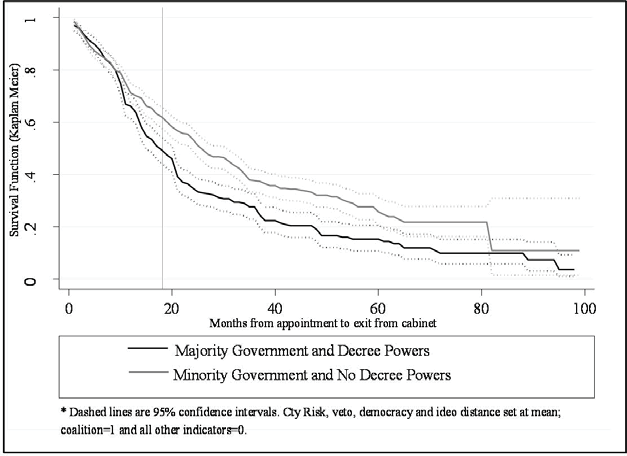
Survival Function by Presidential Strength*
The third finding in terms of presidential strength is that presidents with high approval rates tend to use appointments less often. Given the extent of missing data, the findings on approval need to be taken as provisional, but the results in column 2 suggest that higher approval rates are associated with more stability in the cabinet and that this effect is substantively large. The likelihood that a cabinet member will be changed decreases by approximately 25 percent when the president's popularity increases by one SD (or 15.4 points). For example, Argentine President Raúl Alfonsín came to power in 1983 with a very high approval rating of 84.4 percent, but left power six years later with a disappointing 47.1 percent approval. Holding all other variables constant, we would expect a drop in approval of 37 points to increase the likelihood of cabinet replacements two-fold. 17
Based on Model 2, a drop of 37 points in lagged approval is associated with a hazard ratio of 2.03. Table A.1 in the Supporting Appendix shows that results on approval hold if we include Drop in Approval and Approval (lag) separately.
The last set of findings in Table 2 relate to the effect of constraints on appointment powers on cabinet stability. First, coalitions clearly do not impose constraints on the ability of presidents to use their appointment powers freely. Among the presidential systems of Latin America, ministers in coalition governments are approximately 18 percent more likely to be changed than ministers in single-party governments. This stands in contrasts to parliamentary governments, where the high costs of re-negotiating a coalition agreement make coalitions substantially more stable than single-party governments (Huber and Martínez-Gallardo 2008). Second, the indicators for portfolio area show that finance ministers are more unstable than ministers in other policy areas. One possible explanation is that finance ministers in Latin America face more shocks than other ministers, which means they tend to be replaced more often. This is not true for foreign affairs ministers; the likelihood that ministers in this area will be changed is significantly lower than the likelihood for other ministers.
Finally, the controls are all significant and in the expected direction. Non-elected presidents and a greater ideological distance between the president and the largest opposition in the legislature are both associated with greater instability. Better-quality democracies are less likely to see high levels of ministerial instability: a one-point increase in the Polity score is associated with a 9 percent decrease in the likelihood of termination. Finally, regarding the electoral calendar, the dummy for the six months before an election is consistently significant, indicating that changes to the cabinet become less likely as elections approach. 18
In most countries, cabinet ministers must resign their post a certain number of months before the legislative election if they wish to participate in it; this requirement ranges from 70 days in Bolivia to a year in Chile and Colombia. Table A.1 in the Supporting Appendix shows results of a model that includes a dummy for the two months prior to this deadline. The indicator is not significant (it is not significant if we exclude the indicator for six months before the election either) and all other results are unchanged.
Conclusions
Comparative research in the last decade has done much to dispel some of the long-standing misconceptions about government formation in presidential systems. The notion that “[e]xecutive power is not formed through postelection agreements among parties” (Mainwaring 1990: 165) has given way to research on the conditions under which governing coalitions are formed (e.g., Aleman and Tsebelis 2011), their partisan composition (e.g., Amorim Neto 2006), and the prospects for their survival (e.g., Martínez-Gallardo 2012). The present paper makes several contributions to this new wave of work on government formation and stability in presidentialism.
First, I show that appointments are crucial to presidents’ policymaking strategy beyond government formation, as presidents face unexpected challenges throughout their term. Exogenous shocks inevitably change the terms of the prevailing political bargain, and presidents are forced to take action through a set of strategies that include legislation, unilateral action, the use of partisan resources, and appointments. I have shown here that appointment strategies will typically follow when weak presidents find other potential strategies – legislative strategies in particular – too costly, given their level of political support.
The theory of the use of appointment strategies also suggests ways in which the process of cabinet formation and cabinet change are connected in presidential politics. There is evidence that presidents will attempt to form a cabinet that will allow them to pass policy. Amorim Neto (2006) found that presidents who anticipate that they will pursue a legislative strategy tend to form more partisan cabinets, in which portfolios are allocated in proportion to party strength. I have argued and shown here that cabinet politics also matter between elections. Presidents use their appointment powers throughout their term to deal with shocks that change the relative cost of one or another policy-making strategy. In a context of decreasing popular support, for example, presidents will tend to rely more on appointments in bargaining with the legislature. This might also be the case when their legislative support decreases.
An important pending question relates to the impact of cabinet stability on policy-making. It is typically assumed that a certain degree of continuity will improve the stability and quality of policies, as well as the ability of politicians to make the bureaucracy accountable. However, there is very little research on this subject (especially outside the economic arena) and it remains very much an open question. This paper suggests that the use of cabinet changes is not always negative. Weak presidents who would otherwise find themselves severely limited in their ability to cope with political and policy crises resort to reshuffles precisely as a way to overcome their political and institutional limitations. This might point to the use of cabinet changes as a way to renew the talent pool or to innovate. In such cases, constraints on the ability of presidents to change their cabinet might prevent both the type of instability that impedes good policy-making and the type of changes that allow them to change course when they need to do so.
More generally, this paper sheds light on the debate over the relative merits of presidential and parliamentary government. The traditional perspective on regime stability is that electoral incentives in presidentialism translate into minority presidencies that, in the context of multipartyism, are more likely to face high levels of executive–legislative conflict (Valenzuela 2004; Mainwaring 1993). This perspective has come under attack by scholars who have questioned the idea that broad constitutional differences are behind the failure of presidential countries to avoid conflict and instability, pointing instead to the importance of lower-level factors like the relative strength and ideology of political parties and the president's agenda-setting powers (Negretto 2004; Cheibub 2002).
The findings presented here suggest that the use of appointment strategies by presidents is another central factor in understanding the stability of the wider political system. The connection is both implicit and explicit. On one hand, appointments are often cited explicitly as a means by which presidents attempt to build working majorities that guarantee governance or seek to avert situations of crisis. On the other hand, arguments about regime instability often implicitly assume either rapid changes in the cabinet or the inability of the administration to make political compromises through cabinet positions as the mechanisms linking regime type and political instability. The evidence in this paper suggests that appointments provide presidents with a way to manage the types of institutional and political challenges that have long been identified as sources of presidential instability. However, fleshing out the links between cabinet instability and regime crises in more detail remains a promising research agenda in the comparative politics of institutions.
Footnotes
Appendix
Variable Sources and Description
| Variable | Source and Description |
|---|---|
| Cabinet Data | Dataset constructed by author. Records monthly changes of individual ministers in the cabinets of 12 Latin American countries (see text for details). Sources include Keesing's Record of World Events, Lexis Nexis Academic, and countries’ newspapers. Data on Brazil provided by Octavio Amorim Neto. |
| Country Risk | Composite indicator of country risk developed by the International Country Risk Guide (part of the PRS Group). The index includes 22 variables, including financial risk (measured using variables such as foreign debt, current account and exchange rate stability); economic risk (including measures of GDP per capita, real GDP growth and budget balance); and political risk (measured using indicators of as corruption, law and order, accountability and bureaucratic quality, among others). The economic and financial variables each account for 25 percent of the composite index and the political variables account for the other half. The original rating index ranges from 0 (high risk) to 100 (no risk). I have inversed the index so that higher values represent greater risk. For details, see <www.prsgroup.com/icrg.aspx> and Hoti (2003). |
| Drop in Approval | Dummy that takes the value 1 for quarters in which approval drops sharply with respect to the previous quarter (sharp change is defined as a standard deviation more than the mean drop in approval for a given country), and takes the value 0 otherwise. |
| Majority Government | Dummy variable that takes the value 1 if the share of legislative seats held by all parties in government is larger than 50 percent and 0 otherwise. Sources for seat shares include: Political Database of the Americas, Observatorio Electoral, and countries’ electoral commissions. |
| Veto Powers | Veto power index based on data from Negretto (2013). The index combines the veto override threshold (0-3) and whether the president can make partial observations (0-3), use line item veto (0-1), or veto the budget (0-1). The index can vary from 0 to 8. |
| Decree Power | The following countries are coded as having strong decree powers (1): Argentina (after 1994) and Brazil. Colombia, Ecuador and Peru are coded as having strong but limited decree powers (.5). Other countries are coded as not having decree powers (0). See Carey and Shugart (1998), Mainwaring and Shugart (1997), Negretto (2013), Mejia and Polga-Hecimovich (2011), and country constitutions. |
| Approval (lag) | Approval in previous quarter. Approval data from Carlin, Hartlyn, and Martínez-Gallardo (2009). See text for details. Years available are: Argentina (1984–2009), Bolivia (2000–2009), Brazil (1990–2009), Chile (1990–2009), Colombia (1994–2009), Costa Rica (1982–2009), Ecuador (1984–2009), Mexico (1989–2009), Paraguay (1998–2009), Peru (1985–2009), Uruguay (1986–2009), Venezuela (1989–2009). |
| Finance/Foreign Affairs | Dummy variable that takes the value 1 if the minister occupied the Finance/Foreign Affairs portfolio and 0 otherwise. |
| Coalition | Dummy variable that takes the value 1 when a member of an opposition party has a position in the cabinet and there is no clear evidence that the position is not held in a partisan capacity. |
|
|
|
| Ideological Distance | Distance between the ideological position of the president's party (or government parties) and the ideological position of the largest party in the opposition. Ideology is measured on a five-point scale based on Coppedge (1997) and updated by the author. |
| Non-Elected President | Dummy variable that takes the value 1 if the president took office by means other than an election, and 0 otherwise. |
| Democracy | From Polity IV dataset. Polity index measures “concomitant qualities of democratic and autocratic authority in governing institutions.” For details, see <www.systemicpeace.org/polity/polity4.htm>. |
| 6 Months to Next Election | Dummy for the six months prior to the next constitutionally mandated (legislative or presidential) election. Where the president was not elected, this dummy indicates the six months prior to the exit of the incumbent president. |
|
|
|
| Economic risk | Indicator of country risk developed by the International Country Risk Guide. The index includes measures of GDP per capita, GDP growth, inflation, budget balance and current account balance. The original rating index goes from 0 (high risk) to 50 (no risk). I have inversed the index so that higher values represent more risk. For details, see <www.prsgroup.com/icrg.aspx>. |
| Alternative Decree | Same as Decree, but codes Ecuador as having no decree powers. See footnote 14 in main text for details. |
| Electoral Resignations | Dummy for the two months leading to the deadline for government officials to resign their post in order to participate in a legislative election. |
| Decree * Country Risk | Interaction between indicator for cases in which presidents have at least some decree powers (Decree Power>0) and Country Risk. |
| Decree & Veto | Indicator for cases where veto powers are greater than the mean for the sample (Veto Power>4) and presidents have at least some decree powers (Decree Power>0). |