




Abstract
Violent conflicts between indigenous groups, multinational companies, and governments over the control of lands potentially containing valuable minerals and hydrocarbons are proliferating in Latin America, as well as elsewhere around the world too. In 1989 the International Labor Organization (ILO) approved ILO Convention 169, which mandates the implementation of prior consultation (PC) with indigenous peoples about any project that could potentially affect their territory. Many interpretations regarding the aims and scopes of PC exist. Some environmental sectors see PC as a mechanism to prevent the implementation of ecologically unsustainable projects in indigenous territories. Part of the indigenous rights sector, however, sees PC as a platform via which to negotiate financial resources for indigenous communities. On the side of governments and multinational companies, PC represents a means to diminish violence and advance projects under more stable political conditions. By examining mining and hydrocarbon projects in Bolivia, Peru, and Mexico, the authors compare cases in which PC takes place and ones where it is not applied. A typology of the outcomes in relation to 1) the prevention of industrialized resource extraction on indigenous lands, 2) redistribution of economic benefits produced by extractive projects, and 3) diminishment of the state repression associated with extractive projects is offered. Findings show that in many cases all three of these results are not simultaneously achieved; the authors explain why some outcomes might be obtained in certain instances and not in others. Finally, the article offers an overall assessment of PC results in light of participation theories.
Keywords
Introduction
During the first decade of the twenty-first century, some governments in Latin America initiated the implementation of the right to prior consultation (PC), as contained in the stipulations of International Labor Organization (ILO) Convention 169. Since then, these governments have faced strong criticism from civil society groups and international agencies claiming that PC procedures, as implemented today, fail to meet international standards. Scholars researching PC outcomes have paid special attention to the conditions preventing this mechanism from incorporating indigenous participation in a meaningful way (Flemmer and Schilling-Vacaflor 2016; Bascopé 2010; Rodrí;guez-Garavito et al. 2010). Yet, no systematic studies exist at present regarding the outcomes of these consultation procedures.
This article seeks to fill this void by offering a typology created on the basis of PC implementation in three Latin America countries. By examining mining and hydrocarbon projects attempted in indigenous territories across Bolivia, Peru, and Mexico, the authors compare cases in which PC procedures take place and ones where they are not applied. Then, the authors explain why results are obtained in some cases but not in others.
The Right to Prior Consultation
In 1989, ILO Convention 169 recognized the special importance that indigenous peoples’ ancestral relations with their lands and natural resources have for their culture and spiritual values. For this, the norm mandates that governments – in cooperation with indigenous people – ought to preserve and protect the environment of the territories inhabited by indigenous groups (Articles 7 and 13 of ILO Convention 169). Along these lines, the convention stipulates that government should undertake PC with indigenous peoples before permitting any potential impacts on their territories and traditions to occur. Further, the norm also states that when extractive activities are carried out on indigenous lands then such groups should share in the economic benefits of these activities, and should also receive fair compensation for any damages resulting from them (Article 15 ILO Convention 169).
In light of the increase in conflict and violent death within indigenous territories (Global Witness 2018), diverse interpretations over the aims and scopes of PC coexist. Among a sector of indigenous rights activists who claim that the extractive industries are ecologically unsustainable, PC should protect indigenous territories by enabling their peoples to ban industrialized resource extraction (United Nations 2018). For others, PC represents a way to achieve a fairer distribution of the economic resources derived from projects executed on indigenous lands (Schilling-Vacaflor and Flemmer 2013). From the perspective of state actors and extractive companies, on the other hand, PC should serve as a means to diminish violence in indigenous areas while also enabling extractive projects to move forward (La República 2018).
Disagreements also exist regarding whether indigenous consent is required for projects to go ahead. While state agencies defend the government's entitlement to advance projects even if indigenous groups do not agree to them, civil society groups advocate for the incorporation of the free, prior, and informed consent of indigenous peoples as a fundamental requisite of PC procedures (Santamaría Ortiz 2016). Considering the diverse interpretations held by some of the main actors in resource- based conflicts, this article hence examines three potential outcomes of indigenous participation in PC: 1) the outright prevention of mining and hydrocarbon projects in indigenous territories; 2) the redistribution of the economic benefits generated by mining and hydrocarbon projects; and, 3) the reduction in the use of force against indigenous protestors.
The most remarkable finding of this article is that PC procedures are generally capable of deterring the use of state repression against indigenous protestors. However, as previous research carried out by one of the authors demonstrates, PC does not in any case serve to impede mining and hydrocarbon projects. All of the PC procedures conducted in Bolivia, Peru, and Mexico ultimately concluded in indigenous approval for the projects. In addition, only in some cases are indigenous peoples able to obtain pecuniary benefits from PC; however this depends on their mobilization capacities and negotiation skills. Furthermore, findings also suggest that indigenous mobilization capacities in the absence of PC enables these groups to prevent the implementation of extractive projects anyway (Torres Wong 2018).
The first part of this article explains the case selections of Bolivia, Peru, and Mexico. In the next section, a typology of PC outcomes combining the three possible scenarios described above is offered. These outcomes are then discussed in light of participation theories. Finally, the article makes an overall reflection on both the achievements and the limitations of PC procedures in Latin America to date.
Case Selection
Most of the debate on the shortcomings of PC in Latin America focuses on whether indigenous free, prior, and informed consent (FPIC) is required for projects to move forward (Santamarí;a Ortiz 2016). Accordingly, more progressive legislation granting the power of veto to indigenous communities should deliver different outcomes compared to those countries where legislation is contrariwise more conservative (Jaskoski 2013). Bolivia, Peru, and Mexico were selected as case studies because they exhibit significant variation in that way that the right to PC was incorporated into their national legislation (Torres Wong 2018). Bolivia granted veto power to indigenous communities over hydrocarbon projects in 2005, with the approval in that year of a hydrocarbon law. Peru passed a PC law in 2011, recognizing the right of indigenous peoples to be consulted before any affectation on their lands is attempted – yet the government nonetheless did not establish indigenous consent as a requirement for project implementation. Although Mexico was the first country to ratify ILO Convention 169, it only recently legalized PC, in 2013, within the hydrocarbon sector – although it still remains unclear whether indigenous consent is mandatory for such projects to move forward.
In addition, the three countries all have sizable indigenous populations within their territories and share a history of land disputes involving governments, corporations, and indigenous groups – thus making them further suitable for comparison. Finally, the mining and hydrocarbon sectors were selected for examination here due to the high degree of conflict within these two industries. Mineral and hydrocarbon extractions are often undertaken within indigenous territories; therefore they offer a unique opportunity to assess PC outcomes.
Prior Consultation: A Typology
The absence of systematic studies is due in part to the fact that not all governments have databases where PC outcomes can be consulted. Of the three countries examined for the purposes of this study, Peru is the only one with complete information on PC procedures (Ministry of Culture n.d.). Bolivia, in spite of being one of the first countries to conduct PC, lacks official databases regarding these procedures. For this country, data on PC results for hydrocarbon projects were collected from Falleti and Riofrancos’ recently published database (2018). PC results for mining projects, on the other hand, were collected from newspapers, nongovernmental organization websites, and government press releases (CEDIB 2015; Fuente Directa 2016). For Mexico, the Secretariat of Energy recently published PC results (Sener n.d.). In this case information regarding the agreements reached between indigenous groups and the government does exist, yet there is none regarding whether any pecuniary benefits were negotiated. For this, data was collected from interviews with state officials, indigenous actors, and NGO employees instead.
Up until the end of 2017, 177 PC procedures were found in Bolivia (154), Mexico (2), and Peru (21) collectively. All of them led to indigenous approval of consulted-on mining and hydrocarbon projects (Falleti and Riofrancos 2018; CEDIB 2015; Flemmer and Schilling-Vacaflor 2015; Ministry of Culture of Peru n.d.; Sener n.d.). From this universe of PC procedures, we examined those cases where pecuniary benefits were indeed negotiated between consulted indigenous groups and the state. Through newspapers, NGO documents, and semi-structured interviews with state officials as well as NGO employees, we identified several such cases in each of the three countries. The Guaraní in Bolivia, the Achuar, Quechua, and Kiwchua in Peru, and the Yaqui in Mexico were all indigenous groups who were able to derive economic benefits in exchange for approving extraction. Conversely, other groups participating in PC were unable to obtain any economic compensation. Ten cases of PC held over hydrocarbons in Peru and one in Bolivia – also in the hydrocarbon industry – illustrate this outcome.
In order to compare PC outcomes with those instances where the procedure does not take place, emblematic cases were examined where either indigenous communities refused to participate in PC or conversely the state failed to enforce it. First, we examined extant databases regarding conflicts over mining and hydrocarbon projects in Latin America (Observatory of Mining Conflicts in Latin America n.d.; Environmental Justice Atlas n.d.). Second, we analyzed the availability of information about conflicts from newspapers and through interviews with experts in Bolivia, Peru, and Mexico. The indigenous municipalities of Challapata (Bolivia), Chetilla (Peru), and Capulalpam de Méndez (Mexico) were selected as cases where indigenous peoples were able to prevent extraction yet PC was not used. Corocoro (Bolivia) and Cerro San Pedro (Mexico) were selected cases where extraction moved forward and the government did conduct PC. In neither of these cases was state repression significant. Two additional ones were selected, Mallku Khota (Bolivia) and Chucuito (Peru), in which PC did not take place; however here state repression did occur and also extraction was cancelled. In addition, the case of San josé del Progreso (Mexico) where PC did not take place, state repression occurred, and extraction moved forward was also examined.
Based on the three possible PC outcomes detailed earlier, as well as the evidence collected via databases, interviews, and case studies, six possible PC scenarios were identified (see Table 1 below).
Typology of Prior Consultation Outcomes
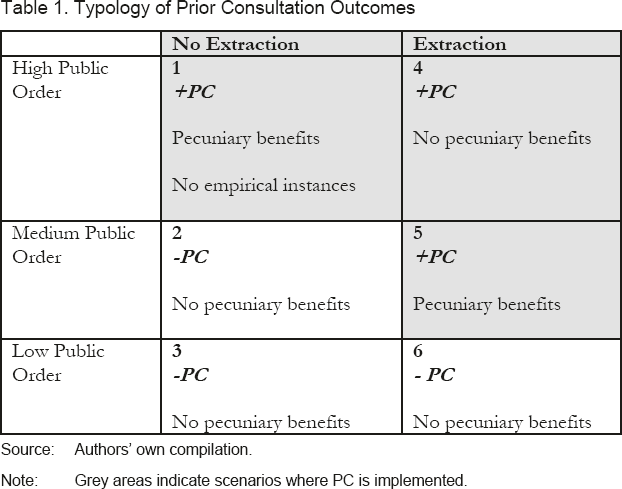
Typology of Prior Consultation Outcomes
Source: Authors’ own compilation.
Note: Grey areas indicate scenarios where PC is implemented.
This outcome is only possible if an indigenous group participating in PC decides not to approve extraction and this decision is accepted by the government. In addition, indigenous communities would have to receive economic funding from the state. No empirical instances of this were found given the contradictory nature of these three outcomes. As shown in the following sections, governments redistribute pecuniary benefits only if indigenous groups agree to mining or hydrocarbon projects. Further, indigenous opposition to extractive projects is usually punished with some form of state repression.
Medium Public Order, No Extraction, and No Pecuniary Benefits for Indigenous Peoples
This outcome takes place when highly mobilized indigenous groups oppose extractive projects. In these cases, indigenous groups do not use PC to fulfill their objectives. The fact that indigenous participation in PC is not the mechanism chosen for preventing extraction is consistent with evidence showing that PC generally ends up with the approval of it. High degrees of violence are not observed, yet sporadic disruption of the social order generally does take place. The government ends up stepping back, and extraction does not proceed.
Challapata (Bolivia), Chetilla (Peru), and Capulalápam de Méndez (Mexico) illustrate this outcome. In these three cases, the government attempted to implement mining projects on indigenous lands; they faced, however, local opposition therein. In all cases, the indigenous leadership saw in mining operations a threat to their water sources and chose protection of the environment over the potential economic benefits of mining projects. They did not seek PC to make their voices heard by the government. Arguably, the absence of negotiation spaces with the government enabled local leaders to remain united in their desire to not allow mining activities to occur on their lands. Indigenous communities adhered to their native mechanisms of decision-making and somewhat peaceful means of protest. In all three cases, the mining projects were cancelled and violence did not flare up.
Low Public Order, No Extraction, and No Pecuniary Benefits for Indigenous Peoples
This type of outcome is produced by the combination of high indigenous mobilization capacities and the state denial of PC. Unlike the cases examined in the previous section, in these ones indigenous groups are in favor of extraction and want a share of the benefits. Yet neither the government nor extractive companies are willing to negotiate with them. As the government refuses to apply PC and instead chooses repression over negotiation, conflicts grow to regional proportions. Several waves of protest are followed by state repression. Extraction is finally banned, however, but only after a number of deaths and injuries have occurred.
The cases illustrating this particular outcome are the indigenous communities of Mallku Khota in Bolivia and Chucuito in Peru mobilizing over mining projects in 2011 and 2012. In neither of these instances were indigenous peoples against mining; still, they wanted to negotiate the terms of extraction nevertheless. In the case of Mallku Khota, indigenous protestors argued that the use of open-pit exploitation techniques would contaminate existing lagoons needed for their livelihood. The real motive behind the opposition, however, was that these leaders opposed mineral exploitation by a foreign company. In turn, they intended to create a mining cooperative to benefit directly from mineral extraction (Lipa Challapa 2012). Likewise in Chucuito the indigenous population were willing to negotiate the economic benefits of mining through PC; the government refused to consult with them however.
In both cases violence raged for several weeks. Forceful measures adopted by protestors included seizing mining company offices, kidnapping their employees, blockading highways, and destroying public property. Violent confrontations between police officers and indigenous communities took place, leaving a number of dead and injured among both. Because governments in both of these countries denied indigenous leaders the right to participate in PC, violence ensued. Intensification of state repression in both cases led to the noted fatal outcomes, followed by the cancellation of mining projects too.
High Public Order, Extraction, and No Pecuniary Benefits for Indigenous Peoples
This outcome takes place when indigenous groups who participate in PC are demobilized. Consulted indigenous peoples generally approve extraction; however these groups are unable to obtain significant compensation from the state, given their lack of mobilization capacities and negotiating skills. Indigenous leaders end up accepting predetermined formulas used by state agencies to address the impacts of extraction. As these groups are incapable of posing a threat to the public order, resorting to state repression is not necessary.
Examples of this type of PC outcome are the 10 such procedures completed by the Peruvian government in the hydrocarbon sector from 2012 to 2017 (Ministry of Culture of Peru n.d.). These consultations were applied in relation to several indigenous groups located in the Amazon basin, and had the objective of obtaining their consent for hydrocarbon operations in oil blocks 164, 169, 175, 195, 189, 165, 197, 169, 190, and 191 respectively. In the areas where PC took place, consulted indigenous peoples are defined by their geographic isolation. These groups are also very small, and live in conditions of extreme material poverty. Their lack of connection with broader political organizations prevent them from developing negotiation skills and mobilization capacities.
(Torres Wong 2018). As a result of this, during PC procedures the government only made superficial commitments. In the end, a transfer of money was not pledged – yet indigenous authorization for hydrocarbon projects was still granted in all cases.
Likewise in Bolivia there was at least one prior consultation that did not result in pecuniary benefits for the consulted population. 1 This was the case of the Mosetén people located in the province of Sud Yungas, within Bolivia's Amazonia (Bascopé 2010). While this group is only small in size, it was among the first Amazonian tribes to organize politically through the Organization of the Mosetén People (OPIM) in 1994. However, over the last decade, OPIM control over the Mosetén territories has been severely diminished by the arrival of timber companies. By the time the hydrocarbon project dubbed the “Lliquimuni” was launched, OPIM was already politically weakened (Ribera 2013). OPIM had no experience in negotiating profits produced by hydrocarbon extraction, and used preliminary PC meetings to demand land – not money – as compensation for extractive activities (Bascopé 2010). In the end, however, OPIM failed to obtain any form of compensation from the state.
No official data exists for the results of PC in Bolivia. Through interviews with NGO employees and via secondary data, we discovered that the Mosetén participated in PC yet did not obtain any pecuniary benefits from extraction. However there may be other cases of PC where this outcome also occurred.
After preliminary meetings concluded, the government excluded OPIM and engaged in PC directly with the indigenous communities. 2 Division among indigenous members deepened, as some demanded that the state consult with OPIM while others supported the rapid implementation of the project (Bascopé 2010). 3 Still, most of Mosetén communities acquiesced to hydrocarbon activities upon state promises of health-care, education, and infrastructure provision, among other things (Bascopé 2010). The government announced that PC was successfully completed, and the exploration of the Lliquimuni block began – albeit amid criticism from some NGOs (Cedla 2011).
According to ILO Convention 169, states must respect indigenous political organizations during PC.
The Morales government launched a campaign to discredit indigenous organizations opposing state projects by accusing them of using fake ecological justifications (Enciso 2016).
A fourth possible scenario results from indigenous communities possessing high levels of mobilization capacity agreeing to participate in PC with the state. In these cases indigenous leaders use mobilization tactics to threaten the public order and to pressure the state to share the economic benefits of extraction with indigenous groups. Some of the most common disruption tactics used are blockades of extraction sites, protests, and in some cases the kidnapping of extractive companies’ employees. Still, such protest does not tend to grow to national proportions nor does it result in death or injury. Redistribution of resources usually follow in these cases too.
Several cases uncovered across Bolivia, Peru, and Mexico exemplify this outcome. Generally, the Guaraní communities living in the El Chaco region of Bolivia, where most of the 58 PCs over hydrocarbon projects have occurred, have been able to negotiate significant economic compensation with the government and with oil companies. The Guaraní are famous for their high levels of political organization, their sophisticated methods of decision-making, and their negotiation skills vis-à-vis the oil companies that have been operating on their land for decades now. Mobilization and protest have been used to make the government comply with indigenous economic demands, yet high levels of violence during PC procedures have been rare.
Likewise in Peru, the Achuar, Quechua, and Kiwchua indigenous groups living near to oil block 192 were able to negotiate benefits with the state as a result of their participation in PC. These groups had both experience negotiating with oil companies dating from the 1990s, alongside well-established partnerships with international NGOs. In PC meetings held in July 2015 over hydrocarbon extraction on their lands, indigenous representatives requested the creation of an endowment fund to be directly administered by themselves and financed by oil production. After several months of negotiation, the state accepted some key indigenous demands.
Similarly in Mexico, in 2016, the government implemented PC with the Yaqui people over the construction of a gas pipeline that would cross the states of Sonora, Sinaloa, and Chihuahua. The Yaqui are the largest indigenous group in Sonora, and have a longstanding reputation for political mobilization. Through negotiations, the Yaqui were able to attain the amount of MXN 76 million (USD 4 million) to be paid as compensation for their consenting to the gas pipeline.
Low Public Order, Extraction, and No Pecuniary Benefits for Indigenous Peoples
This represents perhaps the worst-case scenario for indigenous peoples. In this case, the state does not implement PC and even though there is a medium-level mobilization capacity on the part of indigenous actors they are still not strong enough to overcome internal divisions – and thus to prevent extraction. Furthermore, violence occurs and casualties ensue.
One emblematic case hereof is the municipality of San José del Progreso in Oaxaca, Mexico. In 2006 the government authorized the mining company Fortuna Silver to operate in this indigenous municipality. As exploration activities moved forward, some community members began to an develop anti-mining stance. They claimed that the government had not consulted with the community about whether they approved of the entry of Fortuna Silver onto their lands. In 2007 anti-mining groups created the local political organization Coordinadora de Pueblos Unidos del Valle Ocotlán (CPUVO) to defend San José del Progreso from the negative impacts of such activities. However municipal authorities, supported by those community members who had found jobs with the mining company, were in favor of these mining operations. CPUVO denounced the unconsented to mining operations, arguing that they lacked proper information about extractive activities. CPUVO also argued that community members were divided because of the presence of Fortuna Silver, and tensions within San José del Progreso had deepened (Civil Observation Mission 2012). In 2011 the Mexican state sent police to clear an area occupied by anti-mining protestors. In 2012, meanwhile, armed groups associated with the pro-mining faction engaged in repression against anti-mining leaders. As a result of violence from the state and between factions, two people were killed and several injured. Fortuna Silver is still operating in this municipality today. At the time of writing, the Mexican government has still failed to conduct PC – and tensions between the two factions hence continue to define local politics in San José del Progreso.
The Promises and Facts of PC in Light of Participation Theories
On paper, PC procedures are participatory mechanisms aimed at including indigenous voices in policymaking regarding extractive projects potentially affecting their territories and traditions. In the aftermath of the fall of the Berlin Wall, participation was reconceptualized by democracy theories; many authors predicted that new participatory institutions would contribute to the triumph over the shortcomings of by now profoundly discredited representative democracies (Manin 1997; Urbinati 2006; Warren 2001). Specifically in the field of Environmental Politics, some scholars saw the “deliberative turn” as an opportunity for citizens to produce more environmentally sound policy decisions (Baber and Bartlett 2005).
New theories on participatory democracy were accompanied by unprecedented institution-building on a global scale (Fung and Olin Wright 2003; Wampler and Avritzer 2005). In this context, in the first decade of this century leftist governments in the Andes incorporated PC as part of “new participatory democracies.” New presidents in Bolivia and Ecuador came to power in the aftermath of the widespread anti-neoliberal outpourings, and received significant support from indigenous movements. Campaign promises to address the inequality and ecological damage associated with the extractivist model included consulting with indigenous peoples about any projects to be attempted in their territories. Once in power, the new governments in these two countries created new constitutions – including therein the right to PC (Falleti and Ríofrancos 2018). A few years later, Peru (2011) and Mexico (2013) followed suit – and legislation is now in place mandating the implementation of PC procedures in such cases.
Strong criticism prevails, however, over how governments actually conduct PC. Many civil society organizations, both national and international in scope, have written dozens of texts by now denouncing the most salient irregularities committed by state agencies when applying PC procedures with regard to indigenous populations (Gonzales and del Pozo 2016; Due Process of Law Foundation and Oxfam 2015; Hurtado 2014). Even when ad hoc legislation was passed in several countries to regulate when to consult, what mechanisms to use, and which groups have the right to be consulted, high levels of non-enforcement of PC are still observable.
In Peru and Bolivia, for instance, the governments delayed the implementation of PC procedures over ecologically controversial mining projects for several years. It is only very recently that mining projects have begun to be consulted on in both of these countries (see Appendix). The Peruvian government used the argument that communities living within mineralized areas were not indigenous, but peasants. In Bolivia, indigenous communities were in many cases the extractors of minerals – which allowed the government to skip over PC for several years in this industry (Torres Wong 2018). In Mexico, on the other hand, the government has not implemented any PC procedures over mining projects, using the argument that domestic legislation in this regard does not yet exist.
In addition, when PC does take place indigenous participation in any case does not result in the prevention of ecologically controversial mining and hydrocarbon operations. This is because when PC is implemented, the main surrounding conditions of projects have by then already been settled; hence the available space to decide over key aspects of such projects is significantly reduced. In the best-case scenario, indigenous groups are able to use PC to negotiate pecuniary benefits; only those groups with high mobilization capacities are capable of deriving economic benefits however. One risk associated with this outcome, though, is that PC could serve to validate the expansion of the extractive frontier toward regions such as Amazonia, one of the most important ecological sources of resistance to climate change – but one also with extremely fragile ecosystems (Outcome 5 in the Typology, see Table 1 above).
On the other hand, one important outcome of PC is that even when ecologically controversial projects do generally move forward, and indigenous communities do not in all cases obtain pecuniary benefits, confrontation between state public forces and protestors is nevertheless less likely to occur. The absence of PC seems to be significant, then, in those cases where highly mobilized indigenous communities do not oppose extraction yet they look for spaces to negotiate economic compensation. In the absence of PC, these cases can turn violent and state repression occur (Outcomes 3 and 6 in the Typology, see Table 1 above). If PC does take place, however, indigenous activists and state agencies are likely to reach agreements under peaceful conditions (Outcomes 4 and 5 in the Typology, see Table 1 above). This accord, although in danger of being only temporary, demonstrates that negotiations through PC can be genuinely useful means to diminish state repression.
Furthermore, by examining Bolivia, Peru, and Mexico, the results suggest that the way in which governments choose to regulate PC – that is, whether indigenous consent is required before projects go ahead – is not as influential on the outcomes that are addressed in this article. PC has been more radically embraced in Bolivia, where indigenous veto power has been recognized for the hydrocarbon industry, as compared to in Peru and in Mexico meanwhile. Still, in none of the 177 PC procedures uncovered in the three countries did indigenous participation in PC result in the prevention of mining and hydrocarbon projects. Moreover, some indigenous groups were able to negotiate pecuniary benefits in the three countries via this mechanism.
As pointed out by a number of Latin American scholars, these results should be interpreted in the context of these countries remaining strongly dependent on extractive industries. It should come as no surprise that PC implementation evidences a strong bias in favor of mining and hydrocarbon projects’ approval (Gudynas 2009). However this article's findings also evidence the complexity of participatory institutions in cases where they are created to include a collective subject. Generally, indigenous peoples organize into communities with shared holdings of land; these communities elect their local leaders through native mechanisms of deliberation and decision-making in the form of community assemblies. However, as the cases described above illustrate, indigenous communities may or may not have a connection to broader indigenous organizations at the national and international level (Outcome 4 in the Typology, see Table 1 above). Because governments generally conduct PC at the community level, thus often excluding national and international organizations, PC outcomes differ from the hegemonic discourses linking indigenous rights and the protection of “Mother Earth.”
Having indigenous peoples negotiating economic benefits in exchange for approving controversial projects might contrast somewhat with the impressions of radical indigenous ecologists. Yet, the gap between the discourse of national and international indigenous organizations and the goals held by indigenous communities themselves at the local level help explain this dichotomy. Assuming that there is a close relationship between what representatives of civil society organizations say and what the broader citizenry actually wants is a frequent mistake within the literature on participatory institutions (for critical approaches, see: Gurza Lavalle and Szwako 2015; Zaremberg, Guameros-Meza, and Gurza Lavalle 2017). The relationship between representatives and those represented is complex and indeed paradoxical (Pitkin 1967; Gurza Lavalle 2015). Moreover, the degrees of representativeness by national and international organizations vis-à-vis indigenous communities is conjectural. PC results evidence that many consulted indigenous communities seem to be more concerned with the short-term benefits of extractive projects than with the long-term goals associated with the implementation of ecologically sustainable development.
In sum, the PC outcomes examined in this article show the limits of expanding participation in a context of significant economic dependence and where the subject of the right to participate in policymaking is collective. Achieving the unbiased implementation of PC as well as consensus between indigenous individuals, their community leaders, and national and international organizations remain difficult endeavors. The less idealistic scenarios regarding PC outcomes presented in this article could contribute to shedding light on what to actually expect from this institution. Understanding why some outcomes obtain benefits and others do not is perhaps one first step in proposing alternative ways to protect indigenous territories, improve indigenous peoples’ situation of economic deprivation, and to diminish state violence.
Conclusion
Although the systematic approval of extractive projects is not an outcome expected by some of the fiercest environmental activists, state repression – usually a defining feature of resource-based conflicts in the Latin American region – occurring at lower levels is an important consequential outcome that should be appreciated when examining PC. At the same time, wholesale consent to extractive projects remains a flaw of this participatory institution – to the extent that PC has not served to put on the policy agenda the viability of an economic model that is based on unsustainable industries. None of the 177 PCs implemented in Peru, Bolivia, and Mexico up until the end of 2017 prevented the expansion of extractive activities into indigenous territories. These results are significant for debates about whether deliberative institutions such as PC can be effective instruments for green democracy.
The typology that was introduced seeks to offer a non-naive analytical assessment of PC, and a non-deterministic overview of this new institutional mechanism. In other words, our analysis shows that while PC is not an effective mechanism to stop extraction it is nevertheless not completely without use in resource-based conflicts. Evidence on PC outcomes collected through database examination and also fieldwork in Bolivia, Peru, and Mexico accounts for six possible types of outcome regarding the three main expectations – prevention of mining and hydrocarbon projects on indigenous territories, redistribution of pecuniary benefits for indigenous peoples, and the diminishment of state repression associated with extractive projects – held over the right to PC.
The game being played out between communities and extractive stakeholders should not be viewed in idealistic terms. As discussed previously, part of the literature on participation assumed that the demands made by social and political organizations on behalf of their members were inherently similar to those of these individuals themselves. The cases analyzed here disprove this assumption. Indigenous actors are not always opposed to unsustainable projects, and furthermore – as the cases scrutinized in this article have shown – they usually occupy a less favorable and an unequal socioeconomic position from which to even confront companies and state officials in the first place.
The expectation that new participatory institutions such as PC would enhance democracy faces serious challenges in countries with high levels of such inequality. Indigenous people usually have to choose on the edge, between “bad and worse.” PC generally occurs in situations where complex tradeoffs between the environment, state repression, and pecuniary benefits are at play. In such cases, the common good and citizens’ rights are very often at risk – and, indeed, in tense contradiction to each other.
Footnotes
Appendix
Each of the rows represents one PC process; however, while the Bolivian government published details of the number of PCs held in 2016 it gave no information about the indigenous groups that were consulted or the locations where these PCs took place.
The information only stated that these PCs were over mining projects.
Source: Fuente Directa (2016), En un año, el OEP acompañó 165 procesos de consultas previas en minería, online: <http://fuentedirecta.oep.org.bo/noticia/en-un-ano-el-oep-acompano-165-procesos-de-consultas-previas-en-mineria/>.