



Abstract
Over the past decade, there has been a surge of “new Left” governments in Latin America, yet polling data shows no comparable shift to the left among the general Latin American population. If electorates have not followed their political leaders to the left, then it is likely that new right-wing political actors will emerge to compensate for the leftward shift in Latin American politics. I propose a research agenda for studying right-wing politics in light of the current wave of left-leaning governments in the region. I argue that we should focus on four main areas of right-wing politics: the political agenda of right-wing groups; their political organization; their power capability; and the institutional environment in which they operate. This agenda requires that we move beyond the traditional focus on right-wing political parties and focus on right-wing organizations at all levels of formal politics, as well as groups that operate outside the formal political arena.
Left and Right in Contemporary Latin American Politics
In this paper, I attempt to establish a preliminary research agenda for studying the (re-)emerging phenomenon of the Right in Latin America. This exercise is necessarily conceptual and theoretical in nature since the “new Right” has yet to leave many empirical footprints for scholars to analyze. However, putting forward a coherent conceptual framework for analyzing right-wing politics in 21st-century Latin American should help us avoid many of the conceptual pitfalls that plagued the literature on the re-emergence of the Left in the last decade (Cameron 2009). In the process, I propose a series of hypotheses that can serve as a guide for future empirical research on right-wing politics in Latin America.
Much of the debate on the resurgent Left in Latin America has revolved around dichotomies that tend to exaggerate differences while downplaying similarities and points of contact between a more radical, contentious, or populist Left, on one hand, and a more moderate, market-friendly, or social democratic Left, on the other (Cameron 2009). A framework for interpreting right-wing politics in Latin America that avoids this pitfall can usefully build from Arditi's (2008) discussion of the “conceptual grid” and “political praxis” that have shaped leftist politics in the region. Such a framework pushes us to ask two crucial and inter-related questions: What are the ideological underpinnings of right-wing groups? And how do these groups organize and mobilize to achieve their goals? These are the questions that should drive studies of the Right in Latin America, since they open multiple avenues of empirical research without foreclosing potential inquiries into political activity that falls outside the bounds of conventional politics. By expanding beyond a narrow institutional focus, we can also begin to analyze the interactions between the Right as formal political organizations (e.g. political parties, legislative coalitions, and presidential candidates) and the more informal ways right-wing actors attempt to influence political and economic outcomes.
In order to explore both the ideological basis and the political praxis of the Latin American Right, this paper addresses four variables that (parsimoniously, yet fairly thoroughly) allow us to understand the role of right-wing groups in contemporary Latin American politics: their political agenda, their organizational structure, their power capabilities, and the existing institutional environment in which such groups emerge and operate. Again returning to recent studies of left-wing politics as my guide, Hunter's (2010) work on the transformation of the Worker's Party (PT) in Brazil provides useful theoretical architecture for integrating these four variables into an explanation of where, how, and with what consequences particular types of right-wing organizations are likely to emerge and evolve. Hunter (2010) combines rational choice analysis and historical institutionalism (HI) to explain how the PT (originally a radical leftist opposition party tied to equally – or more – radical grassroots social movements) became a moderate governing party and the winner of the last three presidential elections. She argues that organizations (including political parties) are shaped by defining events (critical junctures), and that their future development is strongly conditioned by the institutional incentives that exist within the broader political environment and conflicts within any political tendency or organization. Rather than responding mechanically to contextual changes, behavior tends follow patterns inherited from previous conflicts. Organizational identity, form, and behavior is thus likely to be path dependent or “sticky” to the extent that the political and economic environment generally does not shift radically over short periods of time. As Thelen (2003) describes it, change is likely to occur in a layering fashion, whereby new rules and behaviors are introduced on top of or alongside existing rules and behaviors. This approach would seem to have much to tell us about the evolution of right-wing politics across time in Latin America.
Actors within any particular institutional setting do, however, have choices that HI does a rather poor job of explaining. Within the context described by HI scholars, actors make strategic choices in adapting their political agenda and using various organizing strategies to maximize the effectiveness of the power resources at their disposal. A rational choice framework is most adequate for describing this strategic environment. Hunter (2010) applies this approach explicitly to the adaptation of political parties, but I argue that the approach can be applied more broadly to the adaptation and evolution of broad political tendencies over time. Particularly in Latin American states with relatively weak political institutions (e.g. most of Central America and the Andean region, as well as other countries in South America and the Caribbean), the institutional environment that many rational choice theorists posit to be the source of actors’ strategic preferences (Cox 1997) may be far broader than the formal institutional environment embodied in democratic political institutions. Correspondingly, we must broaden our strategic framework to take into account informal as well formal rules and norms when analyzing the behavior of the Right in contemporary Latin America.
This theoretical blending provides an umbrella under which to ask questions about (and evaluate answers to) how particular actors within (right-wing) groups and organizations make strategic calculations given historical and institutional legacies that make some outcomes prima facie more or less likely. Following logically from this framework, the variables I propose address both the external environment that right-wing groups confront as well as the identities and preferences of actors and the resources they can bring to bear to see these preferences fulfilled. Together they provide a useful guide for analyzing not just right-wing political parties, but right-wing politics more broadly.
Although this analysis is principally concerned with developing concepts that can guide the study of the new Latin American Right(s), polling data gives us interesting hints about Latin American polities that force us to question the traditional Left-Right dichotomy. According to the Latinobarómetro public opinion poll, in 2008, 42 per cent of Latin Americans identified themselves as centrist, up from 29 per cent in 2002 (Shifter 2011). The shift towards the center was particularly strong among younger Latin Americans, suggesting that this tendency is likely to continue to grow. This suggests that the emergence of successful right-wing leaders, parties, and movements will require that they appeal to a more moderate society than they have in the past, rely on force to rule over a less ideologically polarized society, or attempt to exercise influence in the name of a sharply-reduced constituency.
History of the Right in Latin America
A full analysis of the history of the Right in Latin America is beyond the scope of this paper, but a few background comments will help locate the contemporary Latin American Right within a broader historical context. Historically, the Right has been the dominant political force within most Latin American countries (if only because of suffrage restrictions that have been common throughout Latin America's democratic history). The liberals and conservatives of the 19th century who waged frequent battle (both ideological and armed) against one another have merged over the course of the 20th century to represent two different tendencies within the broader right-wing movement. Liberals, who argued for maximum individual freedom, minimal state intervention in the marketplace, a reduced role for the Church (particularly in the economy), and a small, efficient state; and conservatives, who used the state apparatus to defend the interests of landed and business elites and supported an active role for the Church in both social and economic life, would both qualify as right-wing actors in 21st-century Latin America. What has changed during the intervening decades is the diversification of Latin American societies and the growing role that subaltern actors and their political representatives (usually, though not always, on the Left) have played in the political life of their respective countries (see, for example, Collier and Collier 1991). In earlier times, demands by marginalized groups were generally ignored, repressed, or negotiated at the local level. At the national level, politics was a distinctly right-wing affair.
More recently, transitions to democratic politics throughout the region generally privileged the Right. As Karl noted in her study of modes of transition to democracy, only Nicaragua (in 1979) represents a revolutionary transformation; she further notes that by her definition, the Sandinista revolution did not mark a transition to democracy but rather a transition away from a specific type of authoritarian rule (Karl 1990). Most transitions, therefore, were conservative in nature or, at the very least, did not radically threaten the interests of right-wing constituencies. Concomitantly, these transitions also did not significantly alter underlying social structures across the region (Kohli 2002). Thus, although there was a substantial shift in the style of political rule (from authoritarianism to democracy), it is debatable whether there was a meaningful shift in overall patterns of social and political domination (Conaghan and Espinal 1990; Hagopian 1996).
As a corollary to the point just made, the conservative nature of most Latin American transitions coincided with a dramatic and global shift in dominant economic ideology that increasingly vilified the state as an economic actor and sought to limit the role of the state in most facets of economic life. This neoliberal project advanced further in some countries than in others, but even where reforms were relatively weak (e.g. Venezuela, Ecuador), the door pre-emptively slammed shut on any attempt to use democratic control of the state toward redistributive ends, even in countries governed by ostensibly left-of-center parties and presidents. Anti-statism was thus a relatively effective check on leftist movements and political parties seeking to gain political influence and economic advancement in the post-authoritarian era.
As one after another Latin American country moved towards more democratic regimes beginning in the late 1970s, scholars focused great attention on right-wing actors who had supported previous authoritarian regimes (O'Donnell and Schmitter 1986; Levine 1988). As most of these new regimes endured (although far fewer could be said to be truly consolidated), attention shifted to the many deficiencies inherent in laying an egalitarian political model (which is, at its core, what democracy is) over a highly unequal social structure and an economic model (capitalism) that concentrated economic power in the hands of the owners (both national and foreign) of large amounts of capital (Oxhorn and Ducatenzeiler 1998). Throughout the following two decades, citizens’ evaluations of the performance of their democratic governments slid. Many important variables have been analyzed as the source of the relatively poor performance of several Latin American democracies. Weak political institutions (particularly political parties), mediocre economic performance, the enduring political appeal of clientelism and populism, and a weak rule of law, among other factors, are clearly important in understanding the limitations of democratic rule in Latin America as well as in other regions of the world. The poor economic performance of right-of-center governments during the “lost decade” of the 1980s is at least partially responsible for the resurgence of left-wing alternatives in the 1990s and 2000s.
The first decade (or more) of post-authoritarian politics was generally dominated by right-wing actors in both the political and economic realms. Following the demise of the Soviet Union, the related economic and social debacle in Cuba, and the demise of guerrilla (or revolutionary) movements in Peru, El Salvador, Nicaragua, and Guatemala, the Latin American Left was sputtering (Castañeda 1993). Right-wing politics came in a variety of shapes and sizes during this period, from the conservative populism of Carlos Menem in Argentina, Alberto Fujimori in Peru, and Fernando Collor de Mello in Brazil (Roberts 1995; Weyland 2003) to the ascendance of neoliberal technocrats within the PRI (Partido Revolucionario Institucional, Institutional Revolutionary Party) in Mexico (Centeno 1994). Beyond the realm of formal political institutions, the armed Right remained a political force in various Central and South American countries (Payne 2000; Tate 2009).
The relative strength of right-wing forces and the endurance of political democracy lent credence to the arguments of scholars such as O'Donnell and Schmitter who argued that, for democracy to survive, the interests of right-wing actors must be systematically protected lest they abandon the democratic process in favor of authoritarian options (O'Donnell and Schmitter 1986: 62). Other analysts later showed how the conservative nature of most political transitions had tremendous consequences for the future political evolution of Latin American countries (Karl 1990; Conaghan and Espinal 1990). The nature of transitions to democracy, specifically the early successes of the Right throughout Latin America, conditioned the future development of Latin America's democratic regimes.
Despite the early dominance of the Right in post-authoritarian Latin America, the Left has regrouped and is now a powerful challenger to right-wing actors throughout the region. For much of the past decade, the Right has been on the defensive as left-wing parties and movements have taken advantage of the perceived failures of previous governments to organize protest movements and elect political leaders who diverge, often quite significantly, from the political and economic agenda of the “Washington Consensus” (Hershberg and Rosen 2006). After a decade of wandering in the ideological and political wilderness, the Left has re-emerged as a powerful political force in Latin America. According to Nef, as of 2009, 16 Latin American countries were ruled by Left or center-left executives, while only three (Colombia, Mexico, Panama) had right-wing presidents (Nef 2010). Since Nef wrote, Sebastián Piñera has been elected president in Chile, thus ending nearly two decades of center-left rule in that country, and Porfirio Lobo has been elected president in controversial elections in Honduras. Just as the Left was almost certain to re-emerge after their politico-ideological crisis of the 1990s, the Right is by no means a spent force in Latin America. And just as the “new Left” is internally diverse and is vastly different from its pre-crisis ancestors, a resurgent Right is likely to be multifaceted and not identical to the conservative groups that ruled much of the hemisphere during the 1980s and 1990s.
As left-wing movements and parties have surged in Latin America, scholarship on the Right has virtually disappeared. This is not a new phenomenon, but rather an extension of a long-standing bias within the social sciences toward the study of progressive causes. While such causes merit discussion and analysis, the crucial role that the Right plays in limiting the effects of left-wing groups continues to be a sorely neglected topic. Moreover, with relatively few exceptions, studies of the Right in Latin America have tended to concentrate on political parties and the formal political sphere more generally (Gibson 1996a; Koivumaeki 2010; Middlebrook 2000; Power 2000). Less attention has been given to other manifestations of the Right such as business federations (but see Schneider 2004), the armed far Right (but see Payne 2000), or right-wing social movements.
Conceptualizing the Right
Conceptualizing “the Right” is a tricky undertaking given the wide variation in ideology, organization, and tactics. In his study of conservative political parties, Middlebrook eschews ideological definitions (since ideology can and does change over time) in favor of a definition that relies on the “core constituencies” that right-wing parties represent (Middlebrook 2000). He defines these core constituencies as the upper social and economic strata of society. Electorally, however, these parties rely on the support of a multi-class coalition in order to win access to public office. This argument is consistent with the emergence of right-wing neopopulist leaders such as Menem in Argentina and Abdalá Bucaram in Ecuador during the 1990s. Both of these leaders governed from the Right (i.e. in favor of upper socioeconomic groups), but used populist strategies to win electoral support from lower-class voters (Weyland 2003). This is similar to many of the current regional autonomy movements in countries like Bolivia and Ecuador where right-wing leaders have organized middle- and lower-class supporters in defense of local elite interests (Eaton 2011 forthcoming; Fabricant 2009). Timothy Power also defines right-wing parties in terms of their core constituency, but provides both a broader and more precise definition of who this core constituency consists of. For Power, the Right often includes actors such as the armed forces, large- and medium-sized landowners, the industrial bourgeoisie, smaller segments of the Catholic hierarchy, the middle class, and the media (Power 2000: 36).
While Power's broader approach is attractive in that it identifies diverse and specific actors who fit within the category of “the Right,” I build from Middlebrook's (2000) simpler definition that associates the Right with the upper social and economic strata of society, who I will refer to as “elites”. Defining the Right in this manner allows us to ask questions about the way that elites interact with other social actors. Are elites well represented (and do they consider themselves to be well represented) within formal political institutions? How do they interact with other important political actors such as the military, popular social movements, and other political forces? This definition also allows us to blend class analysis with concepts developed from the study of political culture, without falling back on crude conceptualizations of the role of dominant or capitalist classes in political life or relying primarily on discourse and symbolic politics to understand right-wing political action. While elites certainly have a class identity (and identifiable relationships to the means of production), this is not the only identity that informs their political behavior. Similarly, although there are common discourses and political symbols that characterize the Right throughout much of the world, analyzing political action solely through the lens of identity, language, and symbols misses the material components and redistributive issues that are at the core of politics on both the Right and the Left. Defining the Right in terms of its relationship to political and economic elites rather than by its ideology or specific form of organization also allows the possibility of studying various manifestations of right-wing politics. Part of what makes the Right a potent political force (despite the relatively small number of elites in any society) is the ability of right-wing actors to pursue their interests in multiple arenas simultaneously. We should not, therefore, pre-emptively close off potentially fruitful avenues of research by definitional fiat. By the same token (and as the subsequent section of this paper will discuss in greater depth), there is a limited ideological range for organizations on the Right. Right-wing ideology is flexible, but not infinitely so.
In the remainder of this paper, I analyze four key conceptual arenas that should frame the study of the Right in Latin American politics. First, the political agenda of the Right must be central to any study of right-wing resurgence. As Bermeo and Seligson have noted, “the Right” is a category that has often housed many competing ideological orientations (Bermeo 2003; Seligson 2003). In analyzing a new Right, it is important that the point of departure be the ideological diversity that characterizes any broad political tendency. Second, I draw attention to the internal organization of the Right. Just as the re-emergence of the partisan Left was foreshadowed by grassroots mobilization within civil society (and is often still driven by social mobilization as much as institutional politics), the organizational structure of the Right should remain an open question rather than one that can be settled by definition. The fact that right-of-center political parties control the executive branch in only five Latin American countries is not a priori evidence for the weakness of the Right in other countries, but rather may indicate differences in organizational strength across countries. Third, and related to the Right's internal organization, I inquire into the power capability of the Right. Ideas and organization contribute to the creation of political power, but we must also observe the ability of right-wing forces to form viable leaders and political candidates, mobilize voters, organize social protest or investment strikes, procure arms (in the case of the armed Right), and negotiate with other social forces. Finally, we must understand the institutional environment within which right-wing actors operate. Does it matter whether party systems are well institutionalized, whether business is organized in a relatively small number of cooperating or competing federations, and whether the existing political and economic “rules of the game” are relatively stable or unstable? Although a complete understanding of the emergent Right would also have to take into account additional factors (e.g. foreign policy orientation), I contend that these four arenas provide the building blocks for comprehending this important emergent political phenomenon.
Political Agendas on the Right
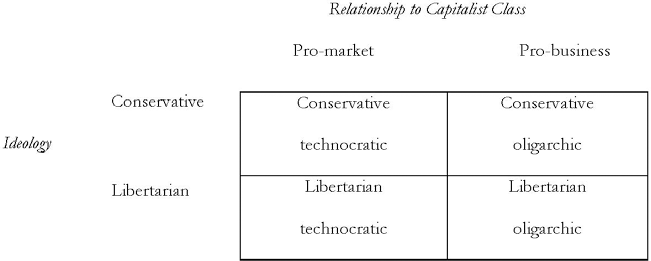
Conspiracy theories notwithstanding, there is no singular political agenda or ideological script for right-wing politics. If we define the Right as a political tendency that defends the interests of the upper social and economic strata of society, there are multiple ways in which any specific organization, group, or movement could pursue that goal. Therefore, in conceptualizing the Right in 21st-century Latin America, I stress the relationship of right-wing groups to ideology and the capitalist class. Ideologically, I array right-wing actors on a spectrum ranging from conservative to libertarian. Conservatives tend to maintain tight relations with religious institutions (usually, though not necessarily, the Catholic Church), tend to take a “law and order” approach to social conflict and, accordingly, see the military and police forces as the last line of defense against a raucous civil society and unruly popular classes. On social issues, they typically assume conservative positions against birth control and family planning, legalization and/ or official recognition of homosexuality, and are generally in favor of an active role for religious institutions in the public square. Libertarians tend to be ideological descendents of classical liberalism not just in the economic realm, but also in the social and political realm. They stress the limited role of the state in individuals’ decisions about how to conduct their personal lives and question the influence of the military, security agencies, and religious institutions in politics. As such, they often take opposing positions to social conservatives on the social issues discussed above. In practice, however, in the electoral arena they may downplay social issues (rather than actively defend libertarian principles) in order to attract support from social conservatives and build broader coalitions of political support.
The Right's relationship to the capitalist class is equally complex. The core conceptual distinction I use to define the continuum along which rightist actors locate themselves is the distinction between “the market” and “business.” Technocrats, like libertarians, tend to prefer minimal state involvement in individual decision-making. Economically, technocrats favor the undisturbed functioning of markets over efforts by the state to pursue specific developmental goals or to redistribute resources from one sector to another. In terms of economic policy and their relationship to business, technocrats generally seek to resist the influence of specific business groups seeking particular advantages or rents. Oligarchs, by contrast, generally defend the interests of business (either individually, sectorally, or as a whole). They may seek preferential access to credit or foreign exchange for existing businesses, protection from foreign or domestic competition, or subsidies to enhance profitability, among many other potential goals. Their overriding goal is the health and profitability of existing businesses, which may be in conflict with technocrats’ preferences for a freely functioning market economy that does not privilege existing businesses and sectors over emerging ones, and does not privilege domestic firms over foreign ones.
These two continuums can be simplified and used to create a two-by-two table demonstrating the potential relationships between rightist ideology and the Right's relationship to business (see Figure 1). These four categories represent ideal types, and no government, party, or movement is likely to fall perfectly within a single quadrant. Nonetheless, each category represents a distinct ideological formation, and the distinctions provide a useful way to theorize about the ideologies and agendas that different right-wing groups bring to the political arena. To the extent that we can identify the political agenda of relevant right-wing organizations, we can begin to formulate hypotheses regarding how ideologies and political agendas affect other important political phenomena such as party system stability, accountability of parties to voters, and various measures of the performance of democratic institutions. Outside the realm of formal political institutions, we can begin to understand how the political agenda of right-wing actors enables them to interact with other political actors (i.e. the military, social movements, multinational corporations, and foreign governments).
Political Agenda of the Right
If we broaden our conceptualization of the Right to include organizations other than political parties, we may begin to notice affinities between particular right-wing political agendas and specific types of organizations. For example, while there has been a surge in “think tank” organizing in various Latin American countries that could be labeled libertarian technocratic, political parties and other mass-based right-wing organizations tend to be located on the top half of the chart. One could therefore hypothesize that conservative ideology is a more effective mobilizing strategy for the Right than is libertarianism. On the other hand, the lower-right (libertarian oligarchic) quadrant is likely to be underpopulated relative to the other three quadrants. This makes sense given that oligarchic business-state relations run directly counter to libertarian ideology, which emphasizes a laissez-faire political economy. These, however, are preliminary hypotheses in need of further empirical investigation.
Few right-wing organizations will fit perfectly within a single quadrant. For example, right-wing political parties like Mexico's PAN (Partido Acción Nacional, National Action Party) or El Salvador's ARENA (Alianza Republicana Nacionalista, Nationalist Republican Alliance) are clearly in the upper half of the chart, although there is room for disagreement with regards to their relationship to capitalists. Arguably the PAN is closer to the technocratic end of the spectrum, while ARENA is more oligarchic. Nonetheless, this model serves as a useful heuristic for thinking about the different political agendas right-wing organizations might pursue.
Organization and Political Praxis: Civil Society, Political Parties, and Right-wing Social Movements
As the Right re-asserts itself across the region with differing political agendas, it is likely to do so in an organizationally uneven fashion. The impact of right-wing forces is likely to be conditioned by the dominant organizational form the Right takes. To oversimplify, we might begin by separating cases where the dominant right-wing organizations are political parties from those cases where non-party organizations (e.g. social movements, business federations, militant groups) are the dominant expressions of right-wing political activism. Numerous scholars have studied the role of political parties and party systems in influencing the direction of politics under “new Left” governments (Weyland 2010). We may develop similar hypotheses for the political behavior of the Right. In contexts where political life (and particularly political party systems) are stable and institutionalized, the Right will likely play a moderating role. Such would be the case in countries like Chile and Uruguay (were a right-wing party to come to power in the latter country), as well as Costa Rica and perhaps Brazil. In countries where parties are weak or where party systems collapse entirely, the Right is likely to be far more radical in both its demands and its tactics. Venezuela would be a particularly strong case of this phenomenon, as the right-wing opposition (keeping in mind that not all opposition to Chávez comes from the Right) has demanded no less than the renunciation of Hugo Chávez, has shown itself willing to use illegal and violent strategies to achieve power, and has attempted to use state power to crush opposition and reward allies (Ellner 2008: 115). Bolivia is another case where the virtual collapse of the country's traditional political parties created an institutional vacuum. On the Left, this vacuum has been filled largely by Evo Morales and his political party (MAS, Movimiento al Socialismo, Movement for Socialism) but the creation of new forms of formal political representation on the Right has been slower, leaving the door open for more disruptive and potentially violent forms of right-wing activism. The key distinction here is not the radicalism of any particular government or party per se, but rather the effectiveness of existing institutions. Where institutions are effective, they will generally restrain radical political impulses. Weak or faltering institutions, however, create incentives for radicalization across the political spectrum.
Right-wing groups have a variety of organizational strategies available to them. The political influence they are able to muster will depend, in large part, on the organizational strategies actors choose and the way that different fragments of the Right interact with each other. Moreover, the dominant faction(s) within the right-wing coalition will likely be apparent by the dominant organizational form the Right takes. The most logical area for political scientists to look for right-wing political activism is within the party system. A reasonable hypothesis would be that a small number (relative to the total number of parties in a party system) of programmatically coherent and (relatively) non-clientelist, right-wing political parties represents the best recipe for elite representation within the context of political democracy. The number of parties would need to be small, given the limited electoral base for non-clientelist, right-wing parties. A large number of center-right parties is likely an indicator that these parties are political vehicles for powerful regional oligarchs or populist leaders, and the likelihood that such parties can consistently represent elite actors without undermining the core institutions of political democracy is limited.
Another important institutional expression of the Right in Latin America is the business federation. These federations are usually organized along sectoral lines (banking, industry, commerce, agriculture, tourism, etc.). In some countries (such as Colombia), there are hierarchical, overarching federations that attempt to represent the broader community of capitalists. In others (such as Argentina), competing federations offer a hodge-podge of economic policy advice and primarily lobby for concessions and advantages for their particular sector (Schneider 2004). The latter type of business representation system is most conducive to conservative oligarchic forms of right-wing representation, while the former tend to be more technocratic in nature.
Historically, business federations have interacted directly with state institutions, often under formal corporatist arrangements. However, as stateled developmentalism has yielded to more market-driven development models, we can hypothesize that traditional business-state relations should give way to mediation by political parties (Gibson 1996b: 39). Given the current preponderance of center-left governments in the region, however, it is important to analyze the relationship between different types of federations and different governments. My own research in Ecuador suggests that under a president (Rafael Correa) belonging to the more radical of the current crop of leftist executives, relations between the business community (particularly the leading cámaras) and the government have not been as conflictual as the heated rhetoric on both sides would suggest (Bowen 2010). The relationship between political forces and the business community, therefore, must be a matter of empirical investigation rather than theoretical speculation. In relatively few countries, however, have the interests of capitalists been represented primarily through the political party system. The model of direct negotiation between business and the state is still the dominant pattern in the region.
Given that the Right's core constituency is relatively small in any society, its capacity to use social movement strategies to gain influence and/or state power may seem less intuitive. As Payne (2000) has argued, however, even the extreme Right has been moderately effective in using some of the same strategies employed by social movements in order to achieve quite different goals. More recent studies by Eaton (2011 forthcoming) and Fabricant (2009) have documented right-wing groups use of social movement strategies in Bolivia and Ecuador and the utility of using social movement theories to study the Right. These examples focus our attention on the ways that right-wing actors can mobilize support amongst popular sectors. In the Bolivian and Ecuadorian cases, right-wing leaders in Santa Cruz and Guayaquil have appealed to regional identities (and thinly veiled racial prejudices) to draw support from popular sectors for right-wing political movements and leaders.
These studies also direct us to focus on politics at levels other than the nation-state. The “conservative autonomy movements” that both Eaton (2011 forthcoming) and Fabricant (2009) analyze are distinctly regional phenomena whose leaders’ stated goals are greater political and economic power for local (rather than national) leaders. The use of social movement strategies by right-wing actors is consistent with the tendency of neopopulist leaders and movements to use mass mobilization to achieve conservative goals. As such, these strategies are likely to undermine and destabilize democratic governments over the long run.
When right-wing groups opt for mass social mobilization as a political strategy, political instability is increasingly probable since the Left will likely respond in kind. This sets the stage for radicalization and potentially military intervention to avert political collapse and bloodshed (although bloodshed is often the result of any military intervention). Much of the emerging literature on mass mobilization (mostly on the Left) and political instability (in the form of presidential removal) suggests that military intervention may be the unintended byproduct of mass mobilization strategies (Pion-Berlin and Trinkunas 2010). Mass mobilization may also be a deliberate strategy to sow chaos and to force the military to intervene in the hopes that such intervention will favor right-wing organizations. In analyzing cases of mass mobilization on the Right (and counter-mobilization on the Left), it is important to keep in mind Bermeo's (2003) crucial distinction between mass polarization and elite polarization. 1 As Bermeo shows quite convincingly, democratic collapse (and political disorder more generally) owes mostly to polarization at the elite level rather than to ideological polarization at the mass level. Where polarization has led to instability, violence, and/ or regime change, it is primarily because leaders (on both Left and Right) conflated the public expression of discontent and polarization by political activists for the private polarization of the masses. This perceived mass polarization can drive leaders to behave irresponsibly, on the assumption that they are either leading or following a large group of dissatisfied and polarized citizens. Even as Latin American citizens today apparently are becoming more moderate (Shifter 2011), elite polarization can quite easily create political crises, which have in the past often been precursors to military intervention and the breakdown of democratic regimes.
Bermeo's use of the term “elite” is somewhat different from my own. For Bermeo, elites are the leaders of any political tendency (not just the Right), and elite polarization refers to the growing ideological distance (and increasingly radical tactics) adopted by competing groups of elites.
Power Capability and Resources
While the organizational forms that right-wing politics takes will define the shape of a resurgent Right, the outcome of social and political struggle will be significantly determined by the power resources that these organizations can bring to bear. Power resources include (but may not be limited to) organizational resources, money and other economic assets, links to important international actors, and the ability to mobilize violence (either directly or via links with military or paramilitary organizations).
While left-wing groups have developed power capabilities in the areas of partisan politics and social mobilization, the Right has advantages in other areas. The extent to which the Right can exploit these advantages will shape the next generation of political conflicts. First, the Right generally has a clear advantage in economic assets. This is an obvious advantage in terms of fundraising for political campaigns (especially in countries where campaign finance laws are permissive or are weakly enforced). It also provides the Right with a structural “second vote” in the democratic process via the constraining influence that investment decisions have on government policy (Lindblom 1977). The economic basis of right-wing power is also important in defining which sectors (if any) of the economic elite will take the lead in defining the economic agenda of the Right. Where domestically oriented industry is powerful, we should expect the Right to take on oligarchic agendas, whereas in economies where exporters and foreign investors are dominant, we should expect a more technocratic approach to governance.
Beyond the economic advantages that right-wing actors generally possess, they may also enjoy closer ties to other powerful actors like the military, multinational corporations (MNCs), and foreign powers (particularly the United States). The ability of the Right to instigate military intervention has been demonstrated in Venezuela (in 2002) and Honduras (in 2009), but in many countries the military is increasingly autonomous from narrow societal interests. In Ecuador, for example, the military has repeatedly intervened to remove unpopular presidents, yet there is no clear evidence that they have consistently done so at the behest of right-wing groups.
The ability of the Right to harness international support via either MNCs operating in Latin America or via direct or covert intervention by outside powers remains an open question. Although MNCs have a clear and immediate interest in supporting right-wing actors that espouse a technocratic ideology, they also have an interest in getting along with whoever is in power. This latter point is evidenced by the behavior of many large MNCs operating in countries currently governed by some of the more radical “new Left” governments. Despite the nationalist and anti-imperialist rhetoric of these governments, relatively few MNCs have abandoned their operations in these countries. Even as contracts for exploitation of natural resources were forcefully renegotiated by governments in Bolivia, Ecuador, and Venezuela, many MNCs continued to find it profitable to operate in these countries.
A similar argument could be made for the potential allies of the Right in foreign governments, particularly the United States. With some glaring exceptions (e.g. tacit U.S. support for the ouster of elected presidents in Venezuela and Honduras in 2002 and 2009, respectively), the United States has not played an obvious role in re-empowering the Right throughout the region. With the possible exception (again) of Honduras, the ascendance of right-of-center leaders to the presidency has not depended on significant foreign involvement. Given the current preoccupation of the U.S. government with other regions of the world (particularly the Middle East and East Asia) and the relative resilience of Latin American economies in the face of the global financial crisis of 2008-2009, I contend that the factors of greatest relevance to the resurgence, behavior, and results of a “new Right” will be mainly domestic rather than international.
This discussion of MNCs and foreign governments draws our attention to the relationship between representatives of the Right, particularly within the formal political system, and de facto powers (poderes fácticos) that lack the political legitimacy to openly defend their own interests within the formal institutions of politics but possess significant power resources nonetheless. These poderes fácticos may include drug-trafficking networks (and related money-laundering operations) in Mexico, Central America, the Caribbean, and the Andean region; right-wing paramilitary groups that wield broad influences in many rural areas of Colombia; and other clandestine (yet powerful) actors that may see their own interests best represented by right-wing political organizations. These are often difficult organizations to study for obvious reasons, but their apparent influence within political institutions, judicial systems, and the security apparatus of numerous countries in the region suggests that understanding their role in political life is crucial to a more complete understanding of politics in Latin America.
Historical and Institutional Environment
Scholars of the Left have noted the importance of the existing institutional environment in influencing what shape emerging political forces will take (Flores-Macías 2010; Hunter 2010; Weyland 2010). For example, the virtual collapse of the Venezuelan party system made possible (or at least made more likely) the ascent of a political outsider like Chávez, while the relative stability of Brazilian institutions and party systems created strong moderating incentives for Lula's PT government (Hunter 2010). No right-wing political parties have the long experience of opposition, repression, and solidarity of parties like the PT or, to a lesser extent, Chile's Concertación alliance. In contrast to the leftist movements and parties that have featured prominently in recent analyses of Latin American politics, the formative political experiences of the contemporary Right are generally less dramatic. Right-wing actors, by and large, have emerged from backgrounds of authority and privilege rather than marginalization and struggle. Although right-wing actors may have lost direct control over the institutions of the state (as in the case of post-Pinochet Chile), the global political and economic zeitgeist was generally far more conducive to the Right than to the Left. If the contemporary Left has as its foundational experiences the repression and exclusion they experienced under authoritarian rule and/ or the costly political and economic defeats of the neoliberal wave from the 1980s through (at least) the early 2000s, the Right lacks a common set of foundational experiences. This would suggest that the possibilities for different types of political participation on the Right are at least as great as they are on the Left.
Is there, however, an analogous historical-institutional pattern that might serve to constrain emerging right-wing leaders? The most simple and intuitive argument would be that stability and moderation beget stability and moderation. Hence we might argue that the political and economic stabilization that occurred in Brazil during the Cardoso presidency (1995-2003), as well as the constraints imposed by the global capitalist order, moderated Lula's political and economic goals, while the political and economic chaos that ensued in Argentina from 2001 to 2002 gave rise to the Kirchner political dynasty that has been significantly to the left of the supposedly more radical Workers’ Party in Brazil.
As political democracy (along with global norms of human rights) has taken hold across the region, the strategies available to many previous right-wing leaders are less immediately useable (although this could potentially change). As most studies of the “new Left” acknowledge, even more radical leftist leaders, such as Hugo Chávez in Venezuela, have not attempted the type of extreme social transformation attempted by previous incarnations of the Left (e.g. revolutionary Cuba and Nicaragua). Moderation on the Left, we might hypothesize, should lead to moderation on the Right. If this is the case, we should expect the strategies of right-wing groups to differ from those of their predecessors.
According to this logic, we should expect to see a right-wing president like Chile's Piñera be significantly more moderate than a future right-wing government in Bolivia, Venezuela, or Argentina. Similarly, a future presidential win by right-wing parties in Brazil is unlikely to significantly upset a set of social and economic policies that have brought Brazilians unprecedented political and economic stability (and increasing prosperity) over the past decade. Of course, we should not be overly deterministic. Historical institutionalism teaches us that sudden shocks (such as economic crisis or war) could disrupt the stability of formal and informal institutions, even in places like Chile and Brazil. Speaking probabilistically, it is reasonable to hypothesize that where left-of-center governments have significantly broken with the formal and informal institutions they inherited, right-wing leaders will be less constrained by the rules and institutions they might inherit in the future.
Within the formal political sphere, a strong, representative right-wing party is an unquestionable asset to building democracy in the region. Viable right-wing parties have not necessarily made democracy “better” or more responsive in any objective sense, but they do make democracy more stable (Gibson 1996b: 28). The lack of stable right-wing parties with deep roots in the region, therefore, does not provide grounds for great confidence. However, as Duverger argued decades ago, a strong threat from a (democratically) organized Left could provide just the push that right-wing forces need to bury their own internal differences and form a single (or a small number of) policy-driven, democratic political parties (Duverger 1954). If this fails to happen, the Right may be continually drawn to call for military intervention, the historic norm when the institutionalized Right is too weak to confront perceived threats from the Left, or deliberately work to undermine state institutions that impinge on elites’ political and economic prerogatives.
Remaining Questions and an Agenda
A basic premise of this paper is that, despite the resurgence of leftist movements and parties in Latin America, the Right is far from a spent force. The conceptual umbrellas of rational choice and historical institutionalism provide a useful point of departure for analyzing why, when, where, how, and with what consequences particular forms of right-wing political activism emerge in Latin America (Hunter 2010). Historical institutionalism forces us to systematically account for institutional legacies that impact right-wing politics in the region. Relative to the experience of the Left, the recent history of the Right has been far less dramatic. Hence, change on the Right has been layered and evolutionary (Thelen 2003) rather than rapid and dramatic, as described by scholars of critical junctures and path dependence. Nonetheless, the institutions and norms of political democracy (even where weak) create constraints and incentives that are not easily overcome.
An appreciation of these constraints and incentives can still leave room for right-wing actors to behave strategically in defining their goals and agendas, and creating organizations that maximize the resources they either have at their disposal or can reasonably hope to accumulate. Agendas, organizations, and power capabilities are not causally independent of one another (and all three are shaped by the institutional context in which they take shape); future research can help untangle the relationships between these three factors that I have described separately in this paper. One example of this is Kitschelt and his collaborators’ work on electoral linkages, where they attempt to unravel the relationships between party organizations and the resources (both material and ideological) parties deploy to link voters and financial contributors to a particular party (see Kitschelt et al. 2010). This line of research can be extended to analyze not just partisan electoral politics, but also how political actors link organizations and resources more generally.
Moving forward, it is important to understand
the role that right-wing actors play in democratic politics (from both empirical and normative perspectives);
what forces make particular manifestations of right-wing politics more or less likely; and
what the impact of a resurgent Right in Latin America is likely to be.
It is too early to offer any but the most speculative conclusions regarding the final question, so in this conclusion I will confine myself primarily to the first two issues.
Right-wing actors play a crucial role within any political system, including democratic ones. Most importantly, the Right can be a stabilizing or destabilizing force for democracy depending on how well its interests are represented within the formal political sphere. Ideally this would happen through the mediating mechanism of viable, programmatic, right-wing political parties. However, the experience of the 1980s and 1990s throughout the region shows that elite groups may feel their interests adequately represented by other political parties, or by the weakening of the entire institutional apparatus of the state such that the state is not able to control and regulate the most powerful groups in society.
While the relatively few studies of right-wing actors in Latin America have generally focused at the national level, the phenomenon of political decentralization that has taken hold over the past decade has made it increasingly imperative to analyze the role of the Right at the sub-national level (and at the national level we should look beyond the executive branch) (Grindle 2009). Just as some of the most innovative political strategies and policies of the Left were pioneered at the local level, the Right can also reinvent itself first locally before mounting a national challenge. Given the historic antipathy of right-wing actors to intervention by a strong, national state, local and regional politics would seem to be a logical place for the Right to attempt to achieve many of its goals. Political activism at the sub-national level may also allow the Right to exploit many of its natural advantages (e.g. wealth and control over important local industries) while minimizing one of the Right's perennial weaknesses vis-à-vis leftist groups: their weak capacity for mass mobilization at the national level.
Devoting greater attention to the Right in local politics and institutions other than the presidency presents other advantages, as well. A focus on the presidency may lead us to overestimate the importance of purely conjunctural factors in specific elections and to overlook more durable factors that have broad explanatory power across numerous political settings. At worst, a focus on presidential politics draws our attention to specific cases that may have little to teach us about beyond the personalities of specific political leaders. Such may be the case, for example, in Chile. Concertación president Michelle Bachelet left office with impressive approval ratings (she was constitutionally prohibited from seeking a second consecutive term), yet her coalition's choice to succeed her (Eduardo Frei) was, by all accounts, a particularly uninspiring candidate and a symbol of the career politician from a traditional political family. In this context, the election of the younger, more energetic Piñera may reflect the specific details of a particular presidential election rather than any broad trend toward a new type of right-wing politics in Chile.
In addition to looking “down” from the commanding heights of the national political arena, we must also look “back” and take seriously the historical roots and trajectory of the contemporary Right. Because of the dearth of attention paid to right-wing groups, students of the Latin American Right are in a comparatively weak analytical position relative to students of progressive or leftist causes. Outside of the largest countries (particularly Argentina, Brazil, Chile, and Mexico), historical studies of the Right tend to be based on conventional wisdom rather than empirical research and/ or focus on right-wing parties and right-wing violence at the expense of other potential manifestations of right-wing politics. 2 Over the past few decades, right-wing groups have attempted to mobilize citizens in mass protest (particularly in countries governed by leftist governments), set up think tanks to inject their voices in policy discussions (Mendizabal and Sample 2009), and used business federations to lobby governments of all stripes (with both the positive and negative connotations that the term “lobbying” carries). These varied manifestations of right-wing politics should be studied alongside right-wing parties and the (thankfully now rare) military organizations sponsored by right-wing actors. The way various segments of the Right interact will have significant consequences for the political and economic future of Latin America.
An important exception to this characterization, and a model of empirical research on the Right that moves beyond thinking of the Right in its purely partisan or violent manifestations, is found in Power 2002.
A thorough understanding of the “new Right” in Latin America will also require looking ethnographically at political and economic elites, their political culture, and their internal organization (or lack thereof). This is another area where scholars have devoted shockingly scant attention during recent decades (Shore and Nugent 2002). Just as it is important to develop fine-grained understandings of organizations and movements that represent indigenous communities, women, racial and religious minorities, domestic workers, and sexual minorities (to name only a few marginalized groups), understanding the many manifestations of right-wing politics requires that we delve into the inner workings of dominant classes throughout the region (Camp 2002).
Democracy and economic globalization have forced the Right to modernize, but have not changed its essential composition the way they have for the Left. Whereas the decline of the Soviet Union and the decreasing viability of revolutionary socialism forced the Left into a fundamental rethinking of its goals and strategies, the experience of the Right has not been nearly so jarring. Perhaps the rebirth of the Left will force the Right to come up with new ideas to compete in a democratic setting where its core constituency (political and economic elites) does not control the votes to elect governments. We should not be overly sanguine, however, about the capacity and/or willingness of all right-wing actors to play by the rules of formal democracy (Borón 1995). Where elites feel their interests to be under severe attack, authoritarian options cannot be ruled out. During the past two decades, elites have supported successful and unsuccessful military coups in at least four Latin American countries (Ecuador, Honduras, Peru, and Venezuela) and have appeared to contemplate anti-democratic options in others.
In general, it is a good idea to disaggregate the concept of “the Right” at least into its electoral and non-electoral branches. When discussing the electoral Right, we can and should ask many of the same questions that we ask of the Left. However, in the realm of civil society the Right, almost by necessity, is organized very differently. The non-institutional Right consists, by definition, of many of the most privileged actors in society. Although upper classes always produce a few political renegades, the upper echelons of Latin American societies generally fall on the right side of the political spectrum. How they organize, and with what effect, should be arenas for empirical investigation.
As right-wing actors reformulate political agendas and strategies for achieving them, new questions will surely emerge. While the new Right(s) will likely bear a family resemblance to past manifestations of the Right, it will also have to take into account the changed political environment that has privileged center-left forces over the past decade. This paper attempts to lay the groundwork for analyzing the most important issues that scholars and policymakers will confront as right-wing forces rethink their priorities and strategies, reorganize themselves to compete both internally and with forces on the Left, and re-emerge as potent political actors.