



Abstract
This work examines whether the size, as well as the composition, of legislative coalitions is an additional factor that affects the incidence of protests against national governments in Latin America. Based on aggregate data for 18 democracies from 1980 to 2014, the analysis reveals that the relationship between the size of legislative coalitions in the lower house of national assemblies and the odds of antigovernment protests is U-shaped. Specifically, the odds of antigovernment protests occurring decrease until the president has a coalition comprising 50–55 percent of the national assembly; once this threshold is passed, the odds of protests taking place increase as the coalition grows. This result holds after controlling for the party composition of the governing coalition and other factors previously linked to the occurrence of antigovernment protests. The evidence thus indicates that both minority and supermajority scenarios can be socially destabilizing for Latin American democracies.
Introduction
Due to the “dual mandate” problem between the executive and the legislature, presidential systems are more prone to suffer from breakdowns than are parliamentary systems (Stepan and Skach 1993; Cheibub 2002; Cheibub and Limongi 2002; Cheibub, Przeworski, and Saiegh 2004). Despite this, democratic politics has proved enduring in third-wave Latin America, where majority governments are now the norm rather than the exception (Chasquetti 2001; Deheza 1997; Foweraker 1998; Cheibub, Przeworski, and Saiegh 2004; Cheibub 2002). In fact, no third-wave democracy in the region (except for Ecuador) has had an average legislative coalition size of less than 45 percent (the minimum for a working majority) in the lower house of its national legislature (Table 1). Nevertheless, despite increasing cooperation between executives and legislatures in the region, Latin American democracies continue to be beset by waves of antigovernment protests (Figure 1).
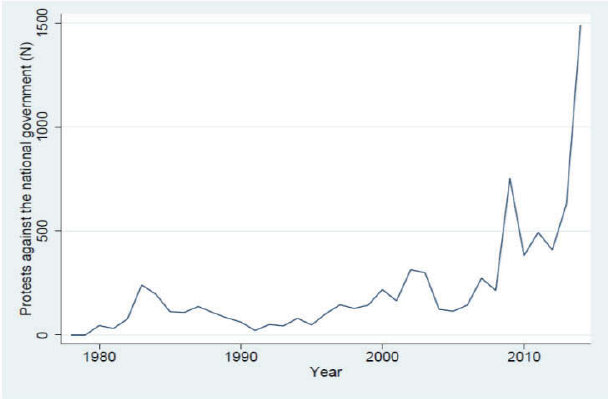
Antigovernment Protests in Latin American Democracies, 1980–2014
Legislative Coalitions in the Lower Houses of the National Legislatures of Latin American Democracies (Mean Values), 1982–2012
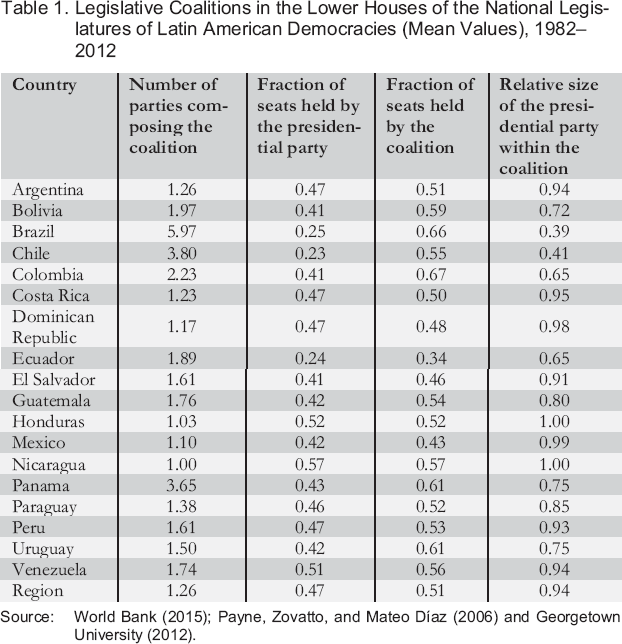
Source: World Bank (2015); Payne, Zovatto, and Mateo Díaz (2006) and Georgetown University (2012).
Of course, the incidence of antigovernment protests in the region can be attributed to a myriad of factors, including the rise of social media (Salzman 2015), the influence of external actors (Trejo 2013), the region's mode of insertion into the global economy and the effects of neoliberal reforms (Arce and Bellinger 2007; Arce 2008; Arce and Rice 2009; Stahler-Sholk, Vanden, and Kuecker 2008; Almeida 2010), the persistence of structural inequalities (including the unequal distribution of land) (Foweraker 1995; Davis 1999; Foweraker and Krznaric 2002; Landman and Larizza 2009), and the continued marginalization of ethnic and racial groups (Yashar 2005; Lucero 2008).
In effect, the identity and the demands of social movement actors vary greatly across time and space in third-wave Latin America. What characterizes all these disparate movements is their demand for changes to the way political power is structured and exercised in their countries (Foweraker and Landman 1997; Tilly 1978).
In presidential systems, like those in Latin America, the executive is the focal point of politics and policymaking and therefore of contentious action. 1 Yet, save for a few classic presidentialism works relating minority governments to episodes of social instability (Linz and Valenzuela 1994; Mainwaring 1993), the relationship between presidentialism and the political attitudes and behavior of citizens has received little scholarly attention (Saiegh 2011; 2015; Carreras forthcoming; Singh and Carlin 2015). This work aims to contribute to a growing body of literature that connects the institutional and behavioral aspects of democracies. It does so by examining whether, and in what ways, the size and composition of legislative coalitions in assemblies influence the incidence of antigovernment protests in Latin America. Within the region, there is considerable variation in both the trajectory of antigovernment protests and the character of executive–legislative relations across time and space, making it possible to examine this relationship from a comparative perspective (Figures 2 and 3).
According to data from the Global Data on Events, Location and Tone (GDELT) dataset, 26 percent of all protest events in Latin America between 1980 and 2012 targeted national state institutions. Of these, 60 percent targeted the national executive.
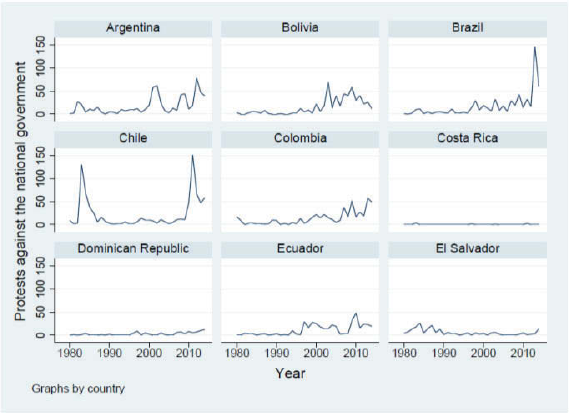
Antigovernment Protests in Latin America by Country (1980–2014)
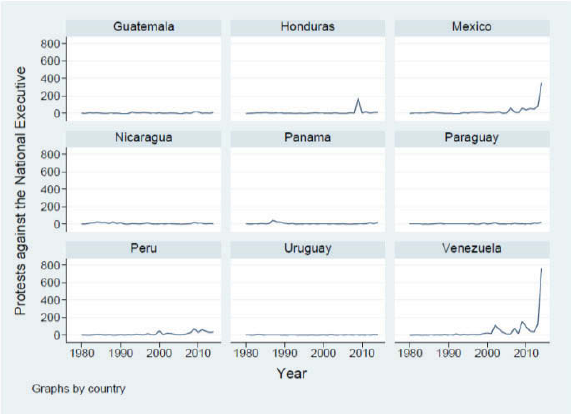
Antigovernment Protests in Latin America by Country (1980–2014)
To be clear, the objective of this paper is not to provide a full explanation of the occurrence of antigovernment protests across the region but rather to identify an additional factor behind this phenomenon.
The basic proposition advanced here is that the relationship between the occurrence of antigovernment protests and the size of a legislative coalition in a national assembly is U-shaped. In other words, I expect protests against the national government to be more likely to occur if presidents are supported in their respective assemblies by either a minority or an oversized majority. This claim is tested using aggregate data for 18 Latin America democracies for the period 1980–2014. As hypothesized, the statistical results indicate that the relationship between presidential coalition size and the rate of antigovernment protests is U-shaped. Specifically, the probability of antigovernment protests decreases up to the point that the legislative coalition comprises 50–55 percent of the assembly; after this threshold is passed, the likelihood of protests increases as the coalition grows. This result holds after controlling for the governing coalition's party composition and other factors previously linked to the incidence of antigovernment protests. The evidence thus suggests that both minority and supermajority scenarios can socially destabilize governments in presidential systems.
The study proceeds as follows: It begins by discussing the existing literature on presidentialism because it relates to the occurrence of antigovernment protests. Next, it advances a series of hypotheses on the effect of the size and status of legislative coalitions on the incidence of antigovernment protests in presidential democracies. It then describes the data and methods that are used for testing these claims. It presents the results through a series of statistical models before concluding with a discussion on the empirical findings and some recommendations for future research.
According to relative deprivation theories, contentious action is more likely to occur when individuals feel aggrieved – that is, whenever their current situation does not match the conditions of life to which they feel rightfully entitled (Gurr 1970: 13; Muller and Weede 1994: 41). In every democracy all citizens should have equal rights, at least with regard to political contestation and participation (Dahl 1971: 6–7). When the rights that people have in theory do not match the rights they enjoy in practice (Foweraker and Landman 1997) – as is the case in most of Latin America – citizens have strong incentives to protest against their governments (Foweraker 1995). In other words, the incidence of antigovernment protests is related to the extent to which the process and outcomes of policymaking are in line with citizens’ rights. It follows that the occurrence of antigovernment protests is influenced by the decision-making process and, therefore, the high politics of legislative coalition-building.
Citizenship rights are the political mainstay of a democratic system; the extent to which they are effectively enforced throughout the demos constitutes the core of democratic governability. Although governability issues in Latin America have long been related to the character of executive–legislative relations (Linz 1994; Mainwaring 1993), most scholarship on Latin American presidentialism treats antigovernment protests as an exogenous variable that affects (rather than reflects) the ways in which presidents relate to parties in their respective national assemblies. According to some accounts, presidential interruptions in the region are shaped by the occurrence of street protests in conjunction with other factors, such as splits in the ruling coalition, minority presidencies, or economic downturns (Marsteintredet and Berntzen 2008; Llanos and Mainstentredet 2010; Hochstetler 2006; Pérez Liñán 2008). Other studies relate the incidence of minister turnovers to unexpected shocks, such as street protests, media scandals, economic crises, or natural disasters (Camerlo and Pérez-Liñán 2013; Martínez-Gallardo 2014).
Although the above arguments are valid, I argue that the occurrence of antigovernment protests can also be shaped by the character of executive–legislative relations. The connection between the occurrence of antigovernment protests and the character of executive–legislative relations is the policymaking process, which is conditioned by the relative powers of the presidency and the legislature and, therefore, the distribution of presidential support in the national assembly. In a presidential democracy both the president and legislators are elected with the mandate to represent the interests of their constituents in the policymaking process. Thus, I expect the likelihood of antigovernment protests to be higher if a president (1) lacks a working majority or (2) is supported by an oversized coalition in the national assembly. In other words, I expect the incidence of antigovernment protests to be nonlinearly related to legislative coalition size.
If a president lacks a working majority in their assembly, levels of antigovernment protests can escalate due to policy paralysis and, in turn, the inability of the government to deliver outputs that benefit citizens’ rights at large. Certainly, minority presidents can advance their agendas through executive orders, regulatory ordinances, and decree powers, provided that they have this constitutional prerogative. However, the legitimacy of such enacted laws may be questioned by other parties in the assemblies, which may feel they have been left out of the policymaking process and, if able, may overturn those presidential actions. 2 Opposition parties can exercise their right to participate in the policymaking process by organizing themselves to remove the president or by joining or organizing demonstrations against the national executive. Policy paralysis and attempts to unilaterally resolve it can fuel anger and frustration among citizens and ultimately increase their incentives to protest against the authorities.
Presidential decrees can also be subjected to judicial review.
Gridlock is avoided when presidents count on the support of large majorities in their national assemblies. Majority coalitions can be composed of either a single party or various parties. The problem with single-party supermajorities is that they allow presidents to govern as they see fit (O'Donnell 1994). In such scenarios legislatures merely serve to rubber stamp the presidential actions of presidents who are free to abuse their positions, change the rules of the democratic game for their own benefit, co-opt autonomous institutions like the judiciary, and censure and persecute dissidents, and so on and so forth (Corrales and Penfold 2011: 156–157; Negretto 2013; Levitsky and Loxton 2013). There is the risk that the process and outcomes of policymaking seek not to include but to exclude opposition elements. Therefore, the lack of oversight of the executive can have a deleterious impact on the allocation and composition of public spending, the delivery of public services and goods, and, consequently, the enforcement of citizenship rights. Those citizens and political actors left out of the decision-making process and/or directly harmed by the actions of delegative presidents may resort to protest to defend their entitlements. To put it differently, executives that are not subject to adequate restraints may adopt biased policy, which could spark intense public indignation and push citizens to protest against the government.
For instance, following the collapse of traditional parties in Venezuela, the legislature came under the absolute control of the governing party: the United Socialist Party of Venezuela (Partido Socialista Unido de Venezuela, PSUV). Consequently, President Hugo Chávez was virtually free to push through legislation on a wide range of issues according to his personal preferences. 3 Under Chávez, policies were formulated (sometimes from one day to the next) and implemented without any scrutiny or deliberation of any kind from the opposition. Also, cabinet positions were reserved for the president's cronies. Although Chávez endorsed a redistributive agenda, his policy outcomes were neither redistributive nor sustainable in the economic arena (Corrales 2011: 85). Moreover, once Chávez took control of the courts, the electoral institutions, and the security apparatus, the civil and political freedoms of ordinary Venezuelan citizens became more restricted. In 2007 the private media and students began to mobilize against human rights violations, growing crime, and increasingly evident government corruption (Corrales 2011: 85; Levitsky and Loxton 2013: 124–125). Over time, an important number of former Chávez supporters (among the country's middle class and urban poor) joined the ranks of protesters to object to the deterioration of protection afforded to political, civil, and social rights (Canache 2004: 46–48; Corrales and Penfold 2011: 146–148; Corrales 2003). 4 In Chávez's Venezuela protest levels experienced an upward trajectory (Corrales 2011: 82–83) (see Figure 3). This case illustrates that protests can arise even when the government's legislative passage rates are high. This is because executives with increased powers and greater legislative capacity can actually lead to political polarization, social instability, a loss of system legitimacy.
Most legislation during Chávez's government, however, was enacted by delegated decree authority (DDA). DDA laws were approved by the legislature in favor of the president in 1999, 2000, and 2007. In 2007 DDA was granted to the president for a period of 18 months.
Defections also occurred within the cabinet, allied parties, and the military (Corrales 2011: 72–74).
Certainly, oversized coalitions reduce the likelihood of interbranch conflict and, more importantly, prevent the executive from bypassing the legislature or transgressing the constitutional order. This is because coalition partners act as veto players in both the cabinet and the coalition. At the same time, plural coalitions can provide nonincumbent parties with greater opportunities to influence the formulation and implementation of policies. Thus, one might assume that the probability of protest is lower when presidents are supported by plural coalitions than by single-party coalitions. This would be in keeping with the idea that antigovernment protests are less likely to occur in consociational democracies, which are characterized by the accommodation of a number of interests in government (Lijphart 1977: 25–47; 1969: 216). However, the idea of consociationalism is based on the experience of established democracies of the West.
Nonetheless, various studies on Latin America indicate that large plural coalition governments have pernicious effects on the equal application of the rule of law and the equal enforcement of citizenship rights (Foweraker and Krznaric 2002; Foweraker 1998; Hagopian 1990). Due to the unequal structure of societies in the region, large coalitions commonly involve pacts with traditional oligarchies and therefore policy choices are narrow. By virtue of these alliances, questions of wealth redistribution (e.g., agrarian reform and progressive taxation policies) – which impair the delivery of public goods and the protection of citizenship rights – are left off the political agenda. Similarly, rights abuses committed by oligarchies (e.g., modern forms of slavery and coercive labor, clientelism, corruption, and unequal access to law) are tolerated in exchange for legislative votes. For example, Alfred Montero (2014: ch. 4) notes that while large coalition governments served to advance the passage of legislation in third-wave Brazil, in the long run such pacts also played a key role in weakening relevant accountability institutions, particularly congressional investigative committees. Hence, although large plural coalition pacts might enable presidents to advance their agendas and prevent the rise of “delegative presidencies,” they can also increase the incentive to protest against the government among those most affected by the abuse of traditional elites.
An additional reason has to do with the way oversized legislative pacts are sustained over time. Presidents negotiate coalitions with other parties on the basis of cabinet representation, policy concessions, agenda-setting powers, and so on and so forth. However, due to the separation of the executive and the legislative, there is no guarantee that presidents can count on the support of individual legislators from parties represented in their cabinets, not even of those from their own party. But congress members can switch to the opposition at any moment without being held responsible for the failures of the government. Cabinet allocations are thus insufficient for crafting and preserving large coalitions in multiparty presidential democracies (Raile, Pereira, and Power 2010). Presidents have strong incentives to offer (mainly through budgetary decisions) covert payments or benefits on an ongoing basis to legislators in return for their support; whereas legislators have strong incentives to continuously threaten not to support any government initiatives in order to extort additional favors or resources from the president (Raile, Pereira, and Power 2010). 5
Not all the currencies that are available to a president to forge broad coalitions in the national assembly necessarily involve corruption (Helmke and Levitsky 2006). Nonetheless, coalitions sustained by tools other than pork tend to be the exception rather than the rule. In fact, existing research demonstrates that malfeasance is more likely to occur in presidential democracies than in other systems (Lederman, Loayza, and Soares 2005).
Obviously, the larger the coalition, the more pork that is required. Of course, one could argue that the pay-offs that coalition partners get from the president could be used to provide material benefits to local constituencies and consequently improve political representation. 6 However, the resources used to finance these side payments are commonly disbursed in covert or hidden ways and are therefore used for private (not public) purposes, to the detriment of citizenship rights (Mejía Acosta 2006; Mejía Acosta and Polga-Hecimovich 2011). Hence, although oversized coalitions can effectively reduce hyperpresidential tendencies, they do not minimize the risk of state abuse by coalition partners or, therefore, the likelihood of antigovernment protests. But, they can lead to the destabilization and delegitimization of the political system overall.
That said, these benefits are often delivered in exchange for electoral support. Clientelism is exclusionary by nature and consequently inimical to democratic representation and the equal enforcement of citizenship rights.
For instance, since 1994, Brazilian presidents have managed to include over eight parties in the cabinet and have commanded large majorities. Coalitions during that time have comprised more than 12 parties and have accounted for 70 percent of the seats in the lower house of the National Congress. These majorities have enabled presidents to pass legislation and implement successful redistributive programs like Bolsa Familia. For years, improvements in governability in Brazil had been attributed to this type of coalitional presidentialism (See Montero 2004, Ch. 1). However, as coalitional politics progressed, protests against the national government (e.g., denouncing the low quality of social service provisions, the high cost of living, police brutality, the homicide rate, and even political corruption) began to mount (Winters and Weitz-Shapiro 2015). Over time, the country has witnessed a series of scandals, which have exposed the bribery, money laundering, and misuse of public funds that underpins plural coalitions in Congress. The most infamous was the Mensalão scandal in 2005, which exposed how the governing Workers’ Party (Partido dos Trabalhadores, PT) misused public resources to make monthly side payments to legislators in return for their support for the president's agenda. 7 What is interesting about the case of Brazil is that antigovernment protests were on an upward trajectory long before the end of the commodity boom and the country entered its worst recession ever (Figure 2). Thus, I argue that the incidence of antigovernment protests is not so much influenced by legislative coalitions’ party composition as it is by their size. But, greater cooperation and trust within political elites can lead to a marked deterioration of citizens’ trust in the government and political institutions and in their ability to protect their rights.
It should be noticed that the disclosure of these scandals was made possible by the resilience of control institutions like the Federal Police (Polícia Federal), the Public Prosecutor's Office (Ministério Público), and other independent comptroller agencies in the country.
When presidents have the support of a working (nonoversized) majority in the national assembly, the risk of legislative paralysis is lower than under minority governments since the president has enough support to advance the government's basic agenda. However, presidents cannot minimize the claims and interests of opposition parties, particularly if major reforms are on the agenda. At the same time, the opposition still has enough capacity to block the proposals, to check on the actions of the executive, and to consequently prevent abuses and rent extraction by the president (and the president's allies in government). Of course, legislative passage rates are higher for presidents with oversized majorities. But, it is more likely that laws enacted under governments not backed by oversized coalitions will be more inclusive and more in line with citizens’ rights. Additionally, highly charged policy conflicts will be resolved through compromise and accommodation. Obviously, this does not mean that state abuse is nonexistent under such governments; rather its consequences might not be as dire as they would be under a government supported by an oversized coalition. Hence, I expect the relationship between legislative coalition size and the incidence of antigovernment protests to be U-shaped.
These ideas are consistent with previous findings. For instance, Singh and Carlin (2015), who use survey data from 18 Latin American countries, show that there is a nonlinear relationship between citizens’ levels of support for and satisfaction with democracy and the lawmaking powers of presidents. Accordingly, citizens are unhappiest about democracy when their presidents are the strongest or weakest in terms of law-making powers (measured as formal powers, partisan powers, and rate of statutory success). Using aggregate data from all countries, Sebastian Saeigh (2011: ch. 9; 2015) likewise demonstrates that the odds of social unrest and governments’ legislative passage rates are nonlinearly related. Accordingly, the risk of social protest should be highest when passage rates are (1) extremely low due to a stalemate or (2) extremely high because there is little room for the opposition to check executive actions or block executive proposals. Following Saiegh (2011; 2015), governments with legislative rates above 85 percent are more prone to experience social upheaval than are those with lower legislative rates (below 15 percent). Saeigh (2015) also indicates that governments’ legislative passage rates are lower under coalition governments than under single-party governments.
If governments’ legislative passage rates are nonlinearly influenced by the size of legislative coalitions, the occurrence of antigovernment protests might reasonably be expected to be nonlinearly affected as well. Thus, I expect antigovernment protests to be more likely to occur when presidents command either a minority or an oversized majority in their respective assemblies. Based on these considerations, I advance the following hypotheses:
H1: The size of the legislative coalition affects the incidence of antigovernment protests.
H2: There is a U-shaped relationship between legislative coalition size and the likelihood of antigovernment protests.
To address the above claims, this paper uses a cross-national quantitative analysis based on aggregate data for 18 Latin American democracies for the period 1982–2012. 8
The sample includes the following countries: Argentina (1983), Bolivia (1982), Brazil (1985), Chile (1989), Colombia (1980), Costa Rica (1980), Ecuador (1982), Dominican Republic (1980), El Salvador (1984), Guatemala (1996), Honduras (1982), Mexico (1994), Nicaragua (1990), Panama (1989), Paraguay (1992), Peru (1982), Uruguay (1985), and Venezuela (1980).
The dependent variable is the incidence of antigovernment protests. It is measured by the number of protest events (including demonstrations and rallies, hunger strikes, blockades, strikes and boycotts, and riots) against the national executive occurring in a country in a given year. Data for this variable were obtained from the GDELT. 9 This dataset allows us to distinguish events according to the occurrence and targets of contentious action. It is based on reports from various international news sources, including Agence France Presse, the Associated Press Online, Associated Press Worldstream, BBC Monitoring, the Christian Science Monitor, Facts on File, the Foreign Broadcast Information Service, United Press International, the Washington Post, the New York Times, and all national and international news from Google News. It should be noted that Google News records information from historical archives dating back over 200 years. Thus, this data source is likely to produce a more reliable measure of protest events than the Cross-National Time-Series Data Archive, which despite being the most commonly used source of protest events among scholars, presents various biases as it is based on only one news source from one country: the New York Times.
The GDELT data source covers all events worldwide since 1979. As the name of this data source suggests, events are distinguished according to the character of actors involved, the claims made, the forms of action, and the location of events.
The key explanatory variables (see below) were collected from the Database of Political Institutions (World Bank 2015) and Georgetown University's Political Database of the Americas (2012). Additional or complementary information was gathered from news reports and government websites.
Control Variables
The following were also employed as independent variables:
Specifically, it captures presidents’ veto powers, decree authority, budgetary powers, and referendum powers. It is included since presidents with broad constitutional powers have fewer incentives to build coalitions in national assemblies, appoint partisan members to their cabinets, or distribute portfolios in a proportional manner (Amorim Neto 2006). This index variable was developed by Gabriel Negretto (2014) and ranges from 1 to 100, with 100 being the maximum possible level of power.
These may be due to variations in the system used to select upper-house members. For instance, senators in Argentina, Brazil, Mexico (prior to 1997), Bolivia (until 2009), and Chile have the mandate to represent the interests of specific territorial units and are elected in uninominal districts. However, senators in Colombia, Paraguay, and Uruguay have the mandate to represent the interests of the electorate at large and are elected via proportional representation rules.
Other controls include socioeconomic and demographic factors that have previously been related to the incidence of protests against national governments in Latin America. These include population size, economic development levels, economic growth, inflation rate, income inequality, foreign investment, ethnic polarization, and Internet usage. I describe the measurement of these variables and discuss the theoretical bases of their inclusion in the Appendix.
Since the number of observations varies with the availability of these control indicators over time, linear interpolation was computed for each country-series to increase the number of observations for the present enquiry. Complete data is available for 478 country-year observations.
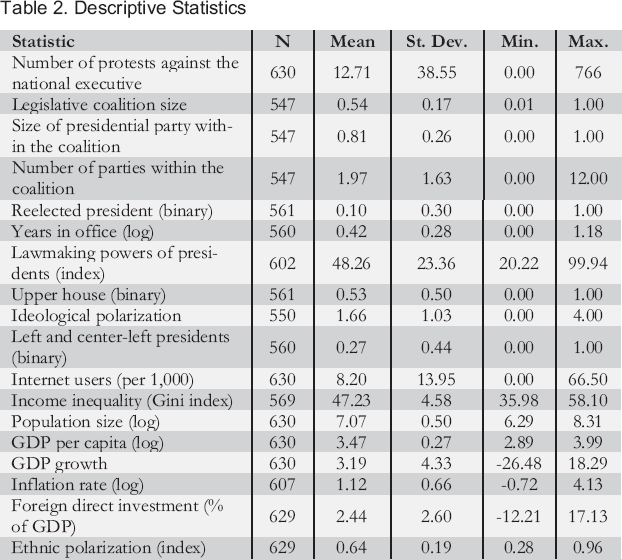
Table 2 presents the summary statistics of all these variables.
Descriptive Statistics
Because the number of protest events could only take integer and nonnegative values, the dependent variable could only be estimated using nonlinear models for count data. To correct for unit heterogeneity, an alternative is to employ a fixed-effects Poisson model or a negative binomial model. Nonetheless, these models are based on the assumption that the impact of the regressors on the dependent variable is static and therefore does not have any effect in future periods. Protest events, however, unfold in trends or cycles over time according to the accumulation of unaddressed grievances and are consequently likely to be correlated over time within a country. Therefore, using fixed-effects Poisson or negative binomial models is not an adequate strategy. Moreover, the addition of a lagged dependent variable (LDV) to the set of regressors could introduce a series of biases and discontinuities, because the LDV would be estimating a linear (not a nonlinear) exponential growth rate (Sutradhar 2011: 189–190).
A more adequate strategy for estimating count data in a pooled cross-sectional time-series context is the so-called linear feedback model (LFM) (Blundell, Griffith, and Windmeijer 2002).
11
In the LFM the LDV is linearly related to the dependent variable, but the other covariates influence the outcome variable by an exponential function (Blundell, Griffith, and Windmeijer 2002; Trivedi and Munkin 2010). In formal terms let y
it
be the number of protest events that occurred in the ith i = 1,…, K country in the year = 1, …, T. y
it
is influenced by a p-dimensional vector of factors x
it
= (xit1,…, x
itp
)’, with a magnitude of β
it
= (β1, …, β
j
, …, β
p
)’, and by ith-country's specific characteristics α
i
. This dynamic relationship can be expressed as follows:

In the LFM, LDV is linearly related to the dependent variable, whereas the other covariates influence the outcome variable by an exponential function (Blundell, Griffith, and Windmeijer 2002; Trivedi and Munkin 2010).
The estimation of this classic dynamic model requires “weak exogeneity” to be assumed. Therefore, this is not a true fixed-effects model. However, it is possibly the most appropriate statistical dynamic specification for pooled cross-sectional time-series for count data available at the time of writing. The model parameters are estimated using the generalized method of moments (GMM) estimator (Wooldridge 2010: 764–766; Trivedi and Munkin 2010), 12 while further overdispersion is controlled for using robust clustered estimators.
Because the functional form of the model does not belong to the exponential family, estimation via maximum likelihood estimates (MLE) is not feasible.
All estimations were conducted using Stata 14.
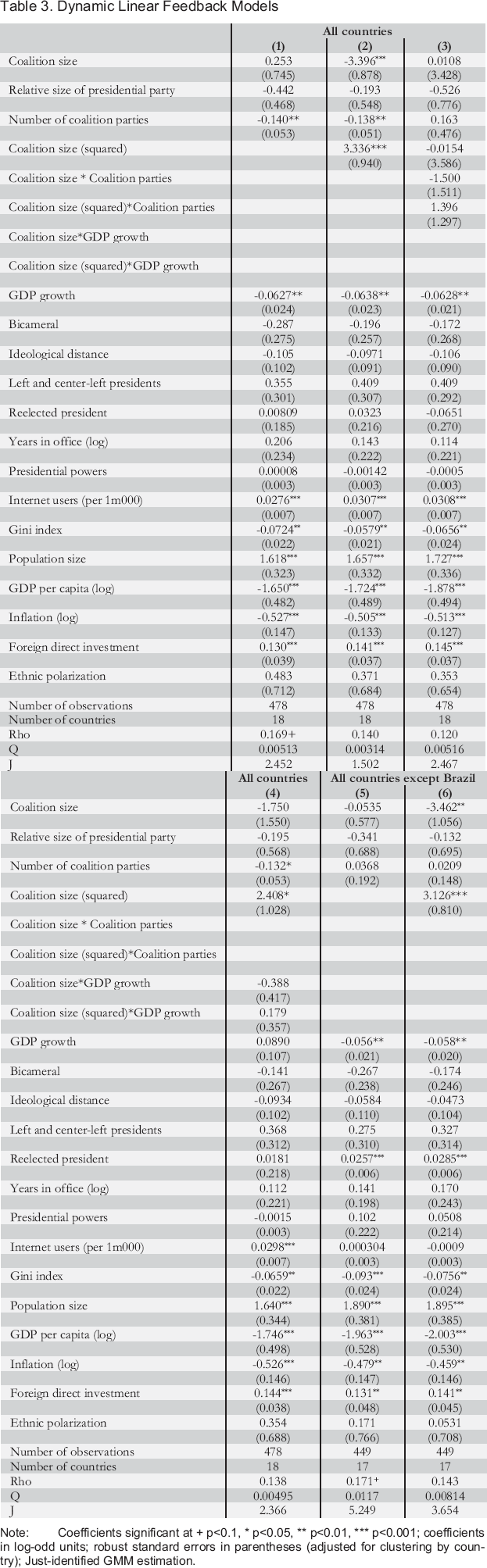
Table 3 presents the results of the statistical exercise. Unstandardized coefficients with robust standard errors are reported in parentheses. Parameter estimates are in log-odds units. As seen in model 2, there is a U-shaped relationship between the size of the legislative coalition and the odds of antigovernment protests. I set the regression equation to zero and solved it and found that the likelihood of antigovernment protests is lowest when the president has a coalition consisting of 51 percent of members in the national assembly. Once this threshold is surpassed, the odds of antigovernment protests rise as legislative coalition size increases.
Dynamic Linear Feedback Models
Dynamic Linear Feedback Models
Note: Coefficients significant at + p<0.1,
p<0.05,
p<0.01,
p<0.001; coefficients in log-odd units; robust standard errors in parentheses (adjusted for clustering by country); Just-identified GMM estimation.
These findings are in line with our expectations. As for the composition of the legislative coalition, the models tell us that the odds of antigovernment protests are not meaningfully influenced by the size of the presidential party within the governing coalition. However, the number of coalition parties is negatively related to the number of antigovernment protests – that is, all else being equal, the risk of antigovernment protests decreases as the number of political parties included in the coalition increases.
To see whether the relationship between the size of the legislative coalition and the number of protest events varies with the number of parties included in the coalition, I include interaction terms in model 3. However, none of these interaction terms achieves statistical significance. One obvious question is whether the relationship between legislative coalition size and the likelihood of antigovernment protests is conditional on the performance of the economy. To assess this, I include interaction terms between the economic growth rate and coalition size in model 4. However, none of these interaction terms is statistically significant.
It might be possible that the above regression results are influenced by high-leverage cases like Brazil, where oversized coalitions have been the most frequent (see Table 1). Therefore, models 5 and 6 exclude observations from Brazil. As can be seen, none of the variables related to the composition of the legislative coalition has a statistically significant influence on the odds of antigovernment protests. Hence, this finding is not robust. However, model 6 once again confirms that there is a U-shaped relationship between the size of the legislative coalition and the likelihood of antigovernment protests. The minimum threshold is 55 percent of the seats in the assembly. The models 5 and 6 also indicate that the relationship between the size of the coalition and the occurrence of antigovernment protests does not vary with the party composition of the legislative coalition or the economic growth rate.
As for control variables, all models tell us that the odds of antigovernment protests are not statistically related to presidents’ formal powers, the reelection of presidents, the number of years presidents have been in office, the presence of left-wing and center-left presidents, or the ideological distance between presidents’ parties and the largest opposition parties in national assemblies. However, the models do indicate that there is a positive relationship between the likelihood of antigovernment protests and the size of the population, the number of Internet users, and the ratio of foreign direct investment to GDP. These findings are consistent with previous findings linking the incidence of antigovernment protests in Latin America to the effects of globalization and neoliberalism (Arce and Bellinger 2007; Arce 2008; Arce and Rice 2009; Stahler-Sholk, Vanden, and Kuecker 2008; Almeida 2010) and the spread of social media (Salzman 2015). It can also be seen that the odds of antigovernment protests are negatively associated with the economic growth rate, the inflation rate, 13 economic development levels, and income inequality.
This result should not be surprising considering that during the first decade of the twenty-first century, economic growth was paralleled by rising inflation rates in South American countries.
Overall, statistical results confirm that presidential coalition size in the national assembly affects the odds of antigovernment protests in Latin America. As hypothesized, the relationship between the size of the coalition and the odds of protest events are nonlinearly related. More specifically, the likelihood of antigovernment protests decreases until the president has a coalition comprising 50–55 percent of members of the national assembly; after this point, the odds of antigovernment protests increase as the size of the legislative coalition increases. Interestingly, after excluding the case of Brazil, this curvilinear relationship is not conditional on the party composition of the legislative coalition. The evidence thus confirms that there is a U-shaped relationship between legislative coalition size and the odds of antigovernment protests. Accordingly, antigovernment protests are more likely to occur when presidents command minorities or oversized majorities in their national assemblies. To put it differently, protests against national governments are less likely to occur in countries where there is a balanced distribution of power between the president and the parties in the legislature and where there is give and take between both branches of government in the formulation and adoption of policy. This relationship holds independent of the number of parties that make up the coalition.
Most studies on Latin American presidentialism treat the incidence of antigovernment protests as an exogenous variable that influences the character of executive–legislative relations. In effect, social protests can be successful in influencing policymaking, changing the composition of government, and even shaping political institutions themselves. However, this study tests whether the relationship can be influenced in the other direction – namely, whether the ways in which Latin American presidents relate to parties in their national assemblies affect the incidence of antigovernment protests in their democracies. The statistical results here confirm that the incidence of antigovernment protest is affected by legislative coalition size in the national assembly. Moreover, the findings indicate that there is a U-shaped association between antigovernment protest rates and legislative coalition size. More specifically, the odds of antigovernment protests decrease until the president's coalition comprises 50–55 percent of the legislature; after which, the odds of antigovernment protests increase as the legislative coalition grows.
This finding holds after controlling for the number of parties composing the legislative coalition. These results are robust to (1) the exclusion of Brazil, where oversized majorities have been the most predominant, and (2) the inclusion of a series of socioeconomic and demographic controls. Interestingly, the curvilinear relationship between coalition size and the risk of antigovernment protests is not conditional on party composition of legislative coalitions or economic performance. These results are in line with previous findings on nonlinear relationships between governments’ legislative passage rates and social unrest (Saeigh 2011; 2015) and between presidential powers and citizens’ support for and satisfaction with democracy (Singh and Carlin 2014). Overall, the findings of this study highlight the role of checks and balances in counteracting the incidence of antigovernment protests in Latin American presidential systems. More research is needed on the links between political institutions and political participation in these democracies.
Of course, there may be many counterarguments to the claims advanced here. Further studies may wish to test the findings of this study by developing alternative hypotheses, employing formal models, or using additional or alternative data. Future research should also corroborate whether the findings obtained here can be generalized to presidential systems in other parts of the world. The analysis can also be extended to the subnational level in federal democracies, such as Mexico, Brazil, and Argentina. An interesting line of inquiry would be to analyze the role of the judiciary and comptroller and ombudsman agencies. Qualitative data can help to shed further light on the relationship between antigovernment protests and the character of executive–legislative relations. Scholars could also explore how executive–legislative relations affect other forms of political participation, such as voting. The results of these future undertakings will certainly provide a clearer theoretical and empirical understanding of the mechanisms through which executive–legislative relations influence political participation in presidential democracies in Latin America and beyond.