



Abstract
This paper examines the persistent gender gap in electoral politics at the local level in Buenos Aires, Argentina. I argue that the combination of the division of political work and existing social norms regarding the separation of domestic chores contributes to women's political underrepresentation at the local level. Studying everyday politics in Buenos Aires, a clear division of political work between men and women was found. Only women were in charge of finding solutions to issues of domestic abuse and violence, and of taking care of children, the pregnant, and senior citizens. Using information from Buenos Aires municipalities, I document the gender gap in elected legislative and executive offices at the local level – as well as in non-elected offices within municipal cabinets. It was also found that the types of political work assigned to female activists and candidates reinforce existing stereotypes of women as mothers of the poor.
Introduction
This paper 1 examines the persistent gender gap in electoral politics at the local level in Buenos Aires, Argentina. Using information from Buenos Aires municipalities, I document the persistent gender gap in elected legislative and executive offices at the local level – as well as in non-elected offices within municipal cabinets. It is argued that the gender gap is the result of social norms and also of the gendered division of political work. This division of political work was observed when studying the everyday activities of local activists in Buenos Ares. Women performed the vast majority of social work, including caring for children, the pregnant, and senior citizens, alongside finding solutions to issues of domestic abuse and violence.
Acknowledgements: I thank Ernesto Calvo, Eduardo Alemán, Elin Bjarnegard, Mariana Caminotti, Christina Ewig, Mala Htun, Jennifer Piscopo, Rodrigo Zarazaga, and two anonymous reviewers for their insightful comments and suggestions.
Soup kitchens illustrate this gendered division of political work at the local level. Over the course of two decades of visiting soup kitchens in poor neighborhoods in Buenos Ares, I consistently found less than a handful of men helping to cook and serve food there. Indeed, in the few cases where men did help run the soup kitchens, they took political credit from the daily work put in by numerous women. These women were buying groceries, deciding what to cook, preparing and serving the meals, and cleaning pots, plates, cups, and silverware so that the soup kitchen could even serve food the following day.
When mostly women are responsible for social work, a gender gap in political work emerges. This constitutes one cause of the existing gender gap in political representation. In Argentina, like in other places, social work is systematically devalued in comparison to other types of labor; and, when women are systematically involved in social work, they are deprived of opportunities to engage in other types of political work too. Since women are expected to fit into stereotypes of maternal behavior, regardless of whether they have children or not, they have a duty to take care of the most vulnerable. This paper shows how female activists tend to specialize in social work, and how their political work is mean-while less rewarded with promotion. It is observed that both women and men solve problems, but only those that men tackle are recognized as important and rewarded with political promotions – leading to uneven levels of political representation.
To study the continued gender gap in local politics, one outcome of the gendered division of political social work, this article examines both elected and non-elected municipal offices in Buenos Aires. Local-level politics is an ideal setting for the study of this gender gap, for a number of reasons. First, it allows us to test the implications of existing theories about the causes of the gender gap at the municipal level. This then enables us to either challenge or provide further support for existing findings about the gender gap at the provincial and national levels too. Second, since many women began their political careers at the municipal level, studying this level of political representation thus provides a more encompassing and bottom-up approach to understanding their political careers. Third, by studying the invisible and continuous labor that poor women perform daily, this paper seeks to highlight the key role of unpaid and unrecognized social work within local communities.
Theory
This article argues that the combination of the division of political work and existing social norms prevent women from pursuing a career in politics and, furthermore, anchor them to only engaging in social work. Women's specialization in social work has significant implications for their political representation. First, by engaging mostly in such work, women do not gain experience in solving problems outside those that are seen as traditionally female and maternal ones. Second, problems that women traditionally tackle – such as feeding children and taking care of the old and disabled – do not carry the same recognition as those that men solve. Women's engagement in politics as mothers of the poor therefore reinforces sexism, and sustains a system in which they are systematically underrepresented. Even when they are elected to local office or do hold cabinet positions, women are still more likely to be in charge of offices and legislative commissions that concern motherhood and social work.
Beyond the unequal division of political work, women also face higher costs than men in running for office. As mothers and wives, women are still expected to take care of the children and the house even while working full-time jobs. In practice, this implies that women bear a double labor burden. 2 Certainly, we have seen changes since Elsa
‘Women who take on work outside of their homes in addition to carrying out the demands of domestic life often have a double – and sometimes triple – work day, the product of a lack of redistribution of domestic tasks within their homes” (Equipo Latinoamericano de Justicia y Género 2002: 2). This and all subsequent translations from Spanish are by the author herself.
Chaney's seminal work on supermadres in Latin America documented how “women overwhelmingly agreed to a division of labor in the polity that parallels the traditional, unequal roles of men and women in the family” (1979: 21). Yet a very recent study nevertheless finds that the gendered division of labor still constrains women's political careers (Franceschet, Piscopo, and Thomas 2016). Revisiting the maternal legacies in women's political participation in the Latin American region, these three authors argue that:
While today's female politicians have developed diverse responses to maternalism, their access to public office remains profoundly shaped by structural constraints and cultural narratives that privilege traditional feminine ideals of caretaking. (Franceschet, Piscopo, and Thomas 2016: 1)
This article studies local politics and uses information about the election of municipal candidates in Buenos Aires to examine this gender gap more closely. The majority of existing studies about gender differences in political participation and representation in Latin America have focused on presidents, governors, and national as well as provincial senators and deputies (see e.g. Barnes 2016; Franceschet, Piscopo, and Thomas 2016; Htun 2016; Caminotti 2013; Hinojosa 2012; Schwindt-Bayer 2011; Htun and Piscopo 2010; Franceschet and Piscopo 2008). 3 Yet, the role of female politicians at the municipal level remains uninvestigated. This absence is unfortunate, because municipal-level politics is where poor women first begin their political careers. As such focusing on the local level allows us to expand our understanding of the potential causes of the gender gap at the national and provincial levels, as well as our awareness of the political experiences of women who have historically been underrepresented.
Exceptions include the work of Caminotti, Rotman, and Varetto (2011), which traces, mostly numerically, the political careers of all elected politicians in Buenos Aires between 1983 and 2007, and thus includes the number of women and men elected as mayors and councilors. Hinojosa and Franceschef's (2012) study, meanwhile, focuses on the effects of municipal electoral reform on female representation in Chile.
Research Design
Argentina is an archetypical case to study the gender gap in political representation; it is emblematic of middle-income countries and has been selected by an extensive body of scholarly works focused on explaining the political representation of women in democracies (see e.g. Barnes 2016; Htun 2016; Franceschet, Piscopo, and Thomas 2016; Franceschet and Piscopo 2014, 2008; Caminotti, Rotman, and Varetto 2011). Argentina is also an interesting case given the ineludible figure of Eva Perón, “a necessary point of reference for understanding women's experience with political power [in the country]” (Bonder and Nari 1995: 184). 4 Studying the political work of female party activists in Buenos Aires, ethnographer Javier Auyero argues that female politicians who solve poor voters’ problems are “performing Evita.” When female political activists
“The figure of Eva Perón and the experiences of the Peronist Party and, later on, its women's branch are still important influences on the political style of many Argentinean women”; “Eva Perón's power and style have helped to strengthen and legitimize women's presence in politics” (Bonder and Nari 1995: 183–184). See also, Feijoó (1998).
position themselves as the mothers of the poor, [it] almost always has the effect of personalizing the favor performed, the good bestowed. But it also has another consequence: the construction of a gendered view of politics and the reproduction of gendered relations within the political arena. The division of political work is thus gendered. (Auyero 2000: 127)
Building on Auyero's argument, I posit here that women's participation in politics as mothers of the poor reinforces their overrepresentation in social work. If women solve only certain types of problem and demand only select positions from the very beginning of their political careers then they only gain political experience in providing solutions to issues deemed appropriate for their gender. As a result, we can assume that demanding equal treatment and promotion becomes a significant challenge for female politicians and activists.
Eva Perón also symbolizes the figure of a woman whose political work was to take care of the most vulnerable: children, the sick, and the elderly. She created an idealized model of the “woman politician,” which, even today, influences the social and personal expectations of women politicians in Argentina. (Bonder and Nari 1995: 184)
Looking beyond the figure of Evita, it is notable that Argentina has already had two women serving as presidents: Isabel Perón and Cristina Fernandez de Kirchner, both wives of former presidents. In addition the office of governor of the province of Buenos Aires is currently, for the first time, held by a woman, Governor María Eugenia Vidal. Argentina was also the first country in Latin America to implement a quota for women's participation in Congress, in 1991. Yet, beyond this progressive outlook, women's political representation at the local level still does not surpass the 30 percent mark established by the quota, and the most important municipalities in the country have either none or only few women in their cabinets.
To test this paper's hypotheses, information was gathered about local politics in several neighborhoods across the 33 municipalities that border the City of Buenos Aires – collectively referred to as the Conurbano Bonaerense. 5 The province of Buenos Aires is the financial, industrial, and political center of Argentina. Given the size of the province's electorate, voters living in these 33 municipalities have the power to determine the outcome of national elections. For instance, La Matanza is a municipality that has the same population as six other Argentine provinces combined; similarly, the municipality of José C. Paz contains the same number of voters as some Argentine provinces do in their entirety. In fact, while the 33 municipalities make up only 0.1 percent of Argentina's national territory their residents constitute 60 percent of Buenos Aires's registered voters and 27 percent of the national electorate.
See Zarazaga and Ronconi (2017) for a contemporary description of the Conurbano, and its importance for Argentine politics. The 33 municipalities are: Almirante Brown, Avellaneda, Berazategui, Berisso, Ensenada, Escobar, Esteban Echeverria, Ezeiza, Florencio Varela, General Rodriguez, Hurlingham, Ituizango, José C. Paz, La Matanza, La Plata, Lanus, Lomas de Zamora, Malvinas Argentinas, Marcos Paz, Merlo, Moreno, Moron, Pilar, Presidente Perón, Quilines, San Fernando, San Isidro, San Martin, San Miguel, San Vicente, Tigre, Tres de Febrero, and Vicente Lopez.
I conducted extensive fieldwork for seven months in 2005 across three municipalities of Buenos Aires: San Miguel, José C. Paz, and Malvinas Argentinas. Focusing the study on these three cases enabled me to gather data on individual candidates’ political careers in each; I selected these particular municipalities also because they are representative of the universe of cases. First, all three of these municipalities, located in the northwest of the Conurbano, constituted up until 1994 the municipality of General Sarmiento. Before being divided into three separate municipalities, General Sarmiento was second in terms of electoral importance in Buenos Aires. As a result, studying these three municipalities allows us to examine the same key political district over time.
Second, these three municipalities are representative of the partisanship variation experienced in the majority of the municipalities of the Conurbano. Peronist mayors, although from different factions of the party, have consistently governed these municipalities from the return of democracy to the present day. Yet in the last election, in 2017, Cambiemos and not the Peronist party were elected in San Miguel. Nevertheless the current mayor of San Miguel, Jaime Mendez, was a cabinet member and is still a close friend of the previous Peronist mayor, Joaquín De La Torre, who is currently a minister in the provincial government of Cambiemos. This pattern is observable in many other municipalities of the Conurbano, and representative of current electoral alliances between former Peronists and Cambiemos. Third, these cases are to different degrees representative of the territorial variation in infrastructure, services, and income existing within each district, where private neighborhoods and country clubs coexist in close proximity to shantytowns and poor working-class neighborhoods. Fourth, these three municipalities have only ever elected male incumbents, as indeed have the majority of municipalities in the Conurbano.
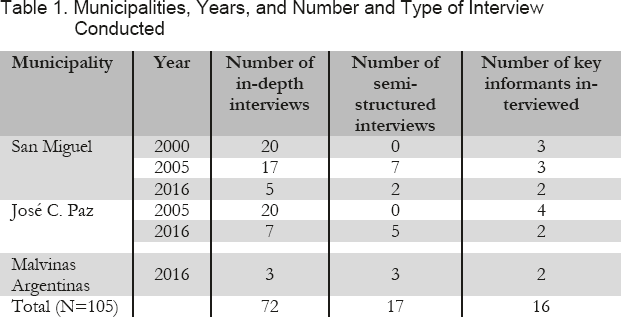
Data includes field research observations, in-depth interviews, semi-structured interviews, and archival research. I conducted 72 in-depth interviews, and 17 semi-structured ones with elected candidates in José C. Paz, San Miguel, and Malvinas Argentinas so as to learn more about their political careers. The length of the interviews ranged from two to several hours long, sometimes extending over several weeks. As the qualitative section of this paper shows, candidates talked very openly about their political careers and the division of political work within their respective parties. I relied on information provided by key informants in the 16 cases where it was not possible to interview candidates directly. These intermediaries were generally advisors who had known and worked for the candidates for several years, even decades, and were thus able to provide detailed and reliable information about the candidates’ biographies.
Each year from 2007 to 2011, and from 2013 to the present, I conducted follow-up fieldtrips to these three municipalities. More importantly, however, I undertook a survey as well as 15 in-depth interviews for one month from mid-March to mid-April 2016, focusing on questions about gender and local politics with both elected and non- elected female candidates and activists in José C. Paz, San Miguel, and Malvinas Argentinas. This paper combines information gathered in 105
interviews (72 of them in-depth ones) conducted with locally elected council members between 2000 and 2016. The first two columns of Table 1 describe the municipality (column 1) and year (column 2) of the interviews. The following three columns provide information about the number of in-depth interviews (column 3), semi-structured interviews (column 4), and key informants (column 5).
Municipalities, Years, and Number and Type of Interview Conducted
In-depth interviews, semi-structured interviews, and survey data enable us to better understand women's political participation at the local level, as well as their decision to even pursue a political career. Six quantitative data sources are also used to measure the gender gap in political representation and within types of political work. First, I gathered data about the percentage of female mayors elected between the return of democracy in 1983 up until the last election in 2015. 6 Second, I collected information about every elected councilor in 2017 to measure the percentage of female legislators. Third, I gathered data on ballot composition to examine whether female candidates run for lower positions than male ones do beyond the quota law – which requires parties to put forward one female candidate for every two male ones on the ballot. Argentina uses a system of proportional representation with closed-list ballots, in which a candidate's position on the party ticket determines his or her chance of being elected. Political parties in Argentina print these ballots themselves, with each listing only their own party's candidates. If women are consistently placed in lower positions on the ballot, they will face a structural disadvantage in being subsequently elected.
In Buenos Aires, local executives and legislators are elected and reelected every four years. The local legislature is renewed by halves every two years, and thus the last election was in 2017. The last local executive election was in 2015.
Fourth, I gathered information about legislative authorities to compare the number of women who held positions as presidents, vice presidents, and secretaries in each municipal legislature in 2017. Fifth, I collected data on legislative committees to observe whether the division of political work translates to legislative work. Sixth and finally, I recorded the number and office of cabinet members in each municipality in 2017, to measure whether there is a gender gap in the number of cabinet offices that women held and to observe if the division of political work translates to the type of office (social work-related) that they held at city hall. Table 2 below describes the sources of quantitative data (column 1), year of collection (column 2), and number of observations (column 3).
Quantitative Data: Source, Year, and Number of Observations
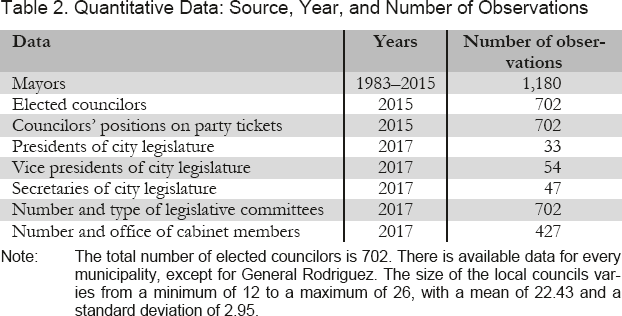
Note: The total number of elected councilors is 702. There is available data for every municipality, except for General Rodriguez. The size of the local councils varies from a minimum of 12 to a maximum of 26, with a mean of 22.43 and a standard deviation of 2.95.
Causal arguments about the connections between local politics and political representation in legislative and executive offices are prone to endogeneity problems. This paper seeks to overcome these challenges by relying on findings from the extensive fieldwork and interviews conducted, thereby providing concrete and falsifiable evidence of the mechanisms at play from the micro-level of the neighborhood to the macro-level of the municipality.
Results
The political underrepresentation of women is particularly stark in the case of the most powerful politicians at the local level: mayors. Since the return of democracy in 1983, out of 1,180 mayors elected in Buenos Aires only 29 have been women. The sheer fact that fewer than 3 percent of women have succeeded in getting elected to executive positions in Buenos Aires suggests “the persistence of an institutionalized inequality [as] executive positions are sources of resources and political capital more valuable than that from the legislative branches” (Caminotti, Rotman, and Varetto 2011: 214). Studying the political representation of female candidates in local elected positions, it is found that greater numbers have been voted into legislative offices under the quota system. In 1991,
Argentina became the first country in the world to pass a law that would require all political parties running candidates for the Chamber of Deputies to include women in at least 30 percent of the list positions on party ballots. (Schwindt-Bayer 2011: 2)
However there are still significant and meaningful differences between the number of elected women and men. In the municipalities of Buenos Aires, for instance, only 31.5 percent of legislators are women. 7 In practice, the number of them elected to local legislatures is almost always less than or equal to the ballot quota of 30 percent. The law requires that parties fill one out of three closed-list ballot positions with female candidates; it was observed that female candidates tend to occupy third, sixth, and ninth places, etc. herein. Comparing the ballot placement of women versus men in the last municipal election, we find that the former tend to run for lower positions across all political parties. Figure 1 depicts the percentage of women elected as local representatives in every municipality, showing the distance of each municipality from gender parity. Indeed, Figure 1 shows that not a single one reaches gender parity – and also that the percentage of female city legislators is even below 30 percent in 12 of them.
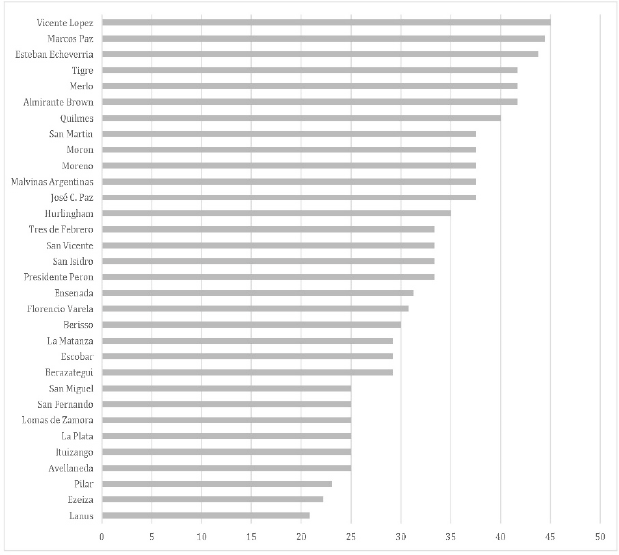
Percentage of Women Elected as Councilors in Buenos Aires
Interestingly, the percentages do not look different for the province of Buenos Aires as a whole – with only 19 female mayors (2.35 percent) compared to 788 male ones.
Beyond elected positions, I examine also the presence of women within municipal cabinets. While there are good reasons to focus on elected representatives, analyzing (the proportion of women in positions not impacted by the quota allows us to better understand what difference the quota is actually making elsewhere.
Figure 2 shows the number of cabinet members in each municipality. It also illustrates the range of variation among municipalities – from Berisso, which does not have a single woman in the cabinet, to Marcos Paz and La Matanza, where the majority of cabinet offices are held by women. 8 It is nevertheless worth mentioning that women make up less than 30 percent of the cabinets in 22 of the municipalities, and less than 10 percent in 7 others. Again, partisanship has no effect on the number of women present in the municipal cabinets.
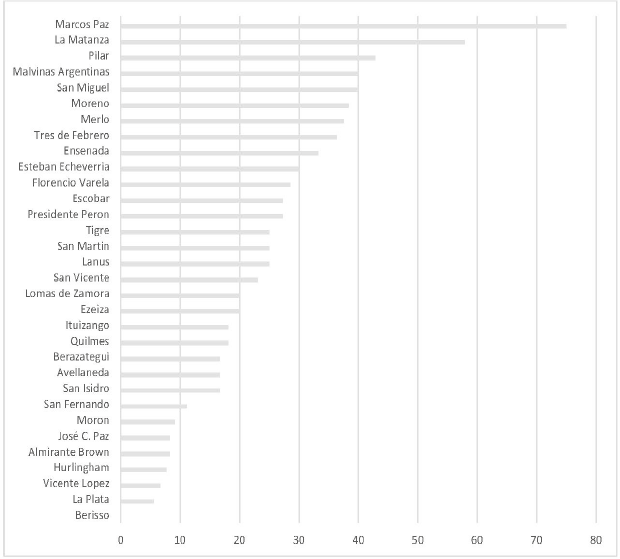
Percentage of Women in the Cabinet
It is worth noting that the number of cabinet members varies among municipalities. While most municipalities have 10 members, Malvinas Argentinas has a minimum of 6 offices and La Matanza a maximum of 20.
The findings from these three measures are consistent with the expectation that women are underrepresented in both elected and appointed political positions. These discoveries are also in line with the results of Desposato and Norrander's study of the gender gap in 17 Latin American countries:
Historically, women have deliberately been excluded from political power and participation in democracies, and differentials in participation have often persisted in spite of the removal of formal barriers to voting and holding office. (2009: 141)
As in the rest of the world, women have long been seriously underrepresented in elected office in Latin America. Their presence in political decision making has never equaled men's. (Htun 2005: 112)
Most studies of gender quotas demonstrate that they have certainly contributed to an increase in women's representation in politics (see e.g. Franceschet and Piscopo 2008, 2014; Htun 2005, 2016; Htun and Piscopo 2010). In addition, 11 Latin American countries have established minimum quotas of female candidates on national tickets in recent years. These developments have followed an increase in recognition among both male and female leaders of the importance of greater gender equality in politics, and of changing attitudes to women being in power. Nevertheless Franceschet and Piscopo's research demonstrates that
quotas have significantly improved women's access to elected office without altering either the gendered hierarchies or gendered power networks that govern political advancement. (2014: 85)
Studying the Division of Political Work
To examine the division of political work, I first compare the number of women vis-à-vis men within each legislative committee. The nature and type of legislative committee varies in each municipality, given that the latter are autonomous when it comes to deciding how many and what type of legislative committees are needed. In addition the number of councilors within each committee is decided by political parries based on the number of votes obtained in the election, so as to secure the incumbent's representation and healthy numbers within key committees. Still, using the available information, it was possible to code the existing committees into 10 categories that appeared consistently across all municipalities – albeit with different nomenclatures (see for example the Committee on Human Rights and Gender described below). These committees are: Economy, Education, Employment, Environment, Health, Human Rights and Gender, Infrastructure, Press, Security, and Transportation. The total number of members in each committee in 2017 was 1,123 (411 women and 712 men).
Figure 3 illustrates that men outnumber women in all legislative committees, except in those classified as Human Rights and Gender ones, where 52 percent of members are female. Examples of such committees include Human Rights and Gender Politics, Permanent Committee of Women, and Committee about Gender Violence. Males are particularly overrepresented in Press, Security, and Infrastructure ones; this imbalance is less acute in such committees as Health and Education meanwhile.
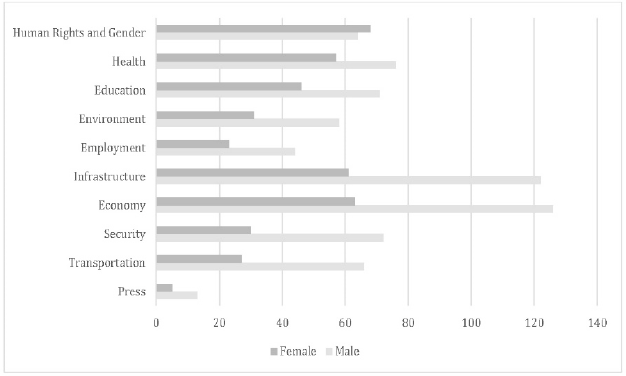
Legislative Committees and Gender Representation
Furthermore I examine the gender distribution of hierarchical positions within local legislatures, including presidents, vice presidents, and secretaries of legislative bodies. The distribution of authority within the legislature provides us with a sense of the power distribution and division of political work at the local level. Figure 4 indicates that women are a minority in all hierarchical positions within the legislature. I also scrutinize the distribution of hierarchical positions within each legislative committee, and find that women hold a majority of presidential positions only in Human Rights and Gender ones. Women hold a minority of vice presidential offices in all but one committee type: Health. I find gender parity or majority female office holders most often when limiting attention to the position of secretary.
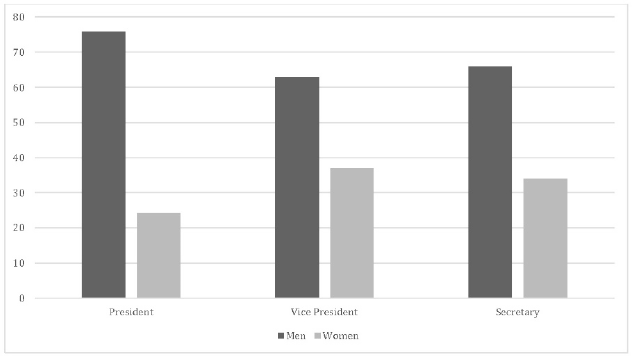
Gender Distribution within Legislative Authorities
Studying women's positions within cabinets, scholars confirm that these individuals are disproportionately clustered in soft or low-prestige portfolios such as education and social services (Reynolds 1999; Rodriguez 2003; Escobar-Lemmon and Taylor-Robinson 2005). “In a trend that has changed little over time, women tend to control portfolios such as social services, education, tourism, culture, and housing” (Htun and Piscopo 2010: 3). Apart from the differences between the women who hold executive and legislative positions at the national level, similar patterns in terms of soft political work are observed at the local level – where the adjective “soft” is used to describe the intensive and demanding daily work assigned to women. In my sample, women tended to be in charge of the offices of: Social Welfare; Family, Children, and Youth; and, Culture and Tourism. Men, meanwhile, held offices related to: Finance and Economics; Construction; Infrastructure; and, Security.
Comparing the number of positions in the executive vis-à-vis legislative branches, it can be observed that women are still highly underrepresented in executive municipal positions; some of them did not even have a single female in their cabinets in 2017. Overall women made up 24 percent of cabinet members at the municipal level, falling far short of the legislative quota of 30 percent. Indeed, comparing the number of women in municipal cabinets vis-à-vis municipal legislatures, it is revealed that quotas have indeed contributed to a reduction in the existing gender gap in political representation.
The findings here provide further support to this idea of a concrete gender gap in political representation. I show that there are fewer female candidates in local legislatures, and within those women are significantly outnumbered in all hierarchical positions – as well as in almost all key legislative committees. These results concur with those of feminist scholars in the country, who have discovered that
the expansion of women in Buenos Aires to access to legislative positions, spurred on by quota laws, was accompanied by two phenomena: 1) in terms of seats, such access did not exceed the minimum number required by the quotas, and 2) in terms of opportunities, it did not translate into significant access for women in positions without quota mechanisms (such as mayoral or ministries). (Caminotti, Rotman, and Varetto 2011: 214)
Understanding the Gender Gap
To explain the persistence of the gender gap in local politics, we also need to address existing social expectations and the differences in opportunity costs that women experience vis-à-vis men in pursuing a political career. While social expectations of men's contributions to childcare and household chores have certainly changed over time, they are still not expected to perform as much unpaid household labor as women are. 9 And while there is variation within each household's decisions about how to delegate domestic chores and childcare, information collected for this paper suggests that working class and poor women living in Buenos Aires still believe that it is their duty to take care of the house and of the children. Indeed, several women reported that they had abandoned their political career because it was impossible to be a good (and present) mother and wife while simultaneously working a full-time job in politics. Reflecting on balancing political work and time at home, two council-women in José C. Paz, one in 2005 and the other in 2016, recognized that such work requires a time investment that leads candidates to putting one's family aside.
For instance, Budlender found that in the province of Buenos Aires, “women, on average, spend more time working than men each day, although more of their time is spent on unpaid work while men's time is spent on paid work. Moreover, women in Buenos Aires spend around 3 times as much time on unpaid work per day as men do” (2008: 15). Esquivel (2010), meanwhile, found that around 30 percent of Argentinian women are care workers of some kind, compared to only 3 percent of Argentinian men.
Politics is a very demanding job in terms of time and energy, making it very hard to be a present mother and a wife. 10
Author's interview, August 2005.
There is also another issue: the family. You have to dedicate a lot of time to politics and leave your family aside. 11
Author's interview, March 2016.
Interestingly, these testimonies are about the relationship between working in politics and having a family – and therefore are not necessarily gendered. Working in politics takes time away from the family for women and men alike. The difference is that it is still more socially acceptable for men than for women to take this time away. Testimonies collected in 2016 from activists and candidates echoed claims heard over ten years before. For instance, a councilwoman recounted in 2005 that she “couldn't do political work” because her “marriage was suffering” as she was “neglecting her home.” 12 In 2016 the testimony of Mónica, a municipal activist in the Mutual Primavera in José C. Paz, provided further support for the double load that working women continue to face vis-à-vis men.
Author's interview, September 2005.
The issue is of having to work and to come home and to be in charge of the cooking, the children, the school, the cleaning. For me it was normal, and it was my body that was telling me that I couldn't do it anymore. 13
Author's interview, March 2016.
Social expectations not only cause women to carry such a double burden, but also induce them to not pursue a career in a field where the most important decisions are made during the hours in which they are expected to be at home making dinner and getting the children to bed.
Today, it isn't easy; politics take a lot of time. You have to be away from your home a lot of the time, there are no fixed schedules, you have a lot of meetings, it is very difficult to take care of a house and a family. 14
Author's interview, March 2016.
If you have children, the feeling of guilt you experience could be overwhelming. It's as if you have abandoned your kids. Political life has no schedule, you have no life. The women who already have children, if they do not decide it before they form a marriage, or find a partner who understands that they will have such a career, it becomes more difficult for them. They must think twice about it, because the meetings are at night. By day, you have the meetings in the barrios [neighborhoods], travel, and the paperwork. During the nights, on Saturdays, and on Sundays, you have the meetings to negotiate [la rosca], and if you want to sit at the table [mesa chica] where men make decisions, you must be the sultan, and not say ‘no, because today I have to wash my husband's clothes.’ No, you have to go, you have to be there. 15
Author's interview, March 2016.
These testimonies are important because they convey the difficulty of balancing working in politics and maintaining a home. And, whereas a work-life balance is already challenging for most people, women – and especially those of them interested in a political career at the local level – seem to face unsurmountable challenges. Scheduling the most important political meetings at night reduces women's participation in them, as well as their chances of advancing their political careers. It also introduces an unspoken differentiation between women with and women without children. 16
Studying the political careers of female legislators in the region, Franceschet, Piscopo, and Thomas also found that “nearly all interviewees mentioned the difficulties posed by political schedules: parliamentary sessions and plenary debates often last all night, and evenings and weekends fill with meetings and events” (2016: 19). In addition, Argentinian “female legislators are less likely to be married and have fewer children when compared to male legislators” (Franceschet, Piscopo, and Thomas 2016: 16).
The second testimony quoted above illustrates the hardship involved in pursuing a career that implies working during the day and attending meetings at night. Interestingly, this testimony points out how difficult it is for partners and children to understand the time demands of political work. It also shows how women – beyond working day and night – are still expected to be in charge of domestic chores.
During the interviews with local activists and politicians, it was only women who repeatedly mentioned the inconvenience of having such meetings at night. Building on this paper's findings, we should expect this to be the case given that men can rely on their female partners to take care of the housework while they themselves attend these meetings. Aware of this difference and actively seeking greater female participation in local politics, a female councilor in José C. Paz thus deliberately schedules meetings during the day.
I try to make the meeting earlier in the day so that it doesn't take away from their family time. We meet early. If we need to do an activity, we do it early, so then at night everyone is in their respective homes. Men always plan meetings late. 17
Author's interview, March 2016.
Of course, we do it in the afternoon, late afternoon. Then they come, they finish their errands, they pick up the kids from school, they come, we talk, and then at night they are at home preparing supper; men's political meetings are always late, because the man finishes work and goes to a meeting afterwards. 18
Author's interview, March 2016.
Differences in the costs that women and men face in deciding to pursue a career in politics certainly play a central role in explaining the gender gap therein. As the evidence presented here suggests, social expectations make it easier for men to attend key political meetings and to engage in solving voters’ problems without any restrictions on their time schedule. Women, in contrast, need to constantly negotiate with their partners to attend meetings and solve problems during dinner or bedtime hours. And, as important, they are expected to continue managing the household chores even while engaging in full-time work.
This paper argues that the combination of the division of political work and existing social norms about the delegation of domestic chores helps, then, to explain women's political underrepresentation at the local level. Testimonies consistently highlighted how, even though women were doing most of the work in the neighborhoods visited, it was men who took the credit for their work.
I have seen that there are different activities, as if it is divided […]. The woman does more of a social role, with children […]. The jefe (boss) is a man, the boss is always a man. 19
Author's interview, April 2016.
The women would always work, yet the leader (head) would be a man. Priority is always given to a man, since he is seen as much more political than a woman – who is always seen as more sensible, as the one who organizes the barrio, the one who does social work. But this social work is also political, so why not give these women a place as they do social work in the barrio, to become representatives of their barrio, of their municipality, of their province? 20
Author's interview, March 2016.
Studying the mechanisms through which activists access political promotions, it is discovered that women are less likely to ask for them than men are. This pattern is observable even though the political work of women often implies frequent and intense interactions with voters, and thus more time and energy being spent solving problems. For instance, soup kitchens tend to be open daily, assistance to pregnant women tends to imply at least monthly checkups, and providing solutions to issues of domestic violence implies long and intimate collaboration with those directly and indirectly involved in the family dynamics.
I believe that men go and ask, they sit and negotiate. We are not businesswomen; we don't go in front of the party leader [conductor] and tell him, ‘I will negotiate with you […].’ No, at least not in my case. […] The position or the office [cargo], I believe, must come alone; it must be offered so that you can continue solving the problems of the people. Because if without anything you can do so much, with a position you can continue growing within the neighborhood, helping out a neighbor, setting up a sports center, as I told you how it was set up here [we did the interview in the sports center]. Men, yes, men go, I think, I don't know, […] I think that they go and they negotiate – ‘Okay, done, I have this group, we did this work, we want this much, we have this number of people’ – and keep selling people to get somewhere. I believe that it shouldn't have to be like that anymore, people don't have a price tag, people are not for sale. 21
Author's interview, March 2016.
Women's failure to ask for promotion and recognition is not exclusive to tins particular candidate, or indeed to Argentinian ones in general. Women almost always talked about other people when explaining their decision to pursue a political career: their need to help the vulnerable, to do something good for society. In their study of women's political participation in Argentina, Bonder and Nari find that female politicians have difficulty realizing their aspiration to pursue a political career:
The majority of my colleagues feel that they have to look for excuses for doing political work. Women tend to rationalize their feelings by using legitimate excuses for their public activities: “I do it to help children, the poor, to help others”; women are still far from frankly admitting that they like power, that they deserve it, and that they must fight for it together with their colleagues. (1995: 191–192)
Tracing the political career of female party activists in Villa Paraíso, a shantytown in Buenos Aires, Auyero shows how “the love for children is the basis – the founding feeling” of their political careers (2000: 129). In mothering the poor, female activists are also able to state that their political work has nothing to do with politics. This division of political work – in which women do politics while simultaneously depoliticizing their actions – has important implications for women's political recognition.
Although men also do not immediately admit that political ambitions are their reason for pursuing a career in politics, they do indicate at some point in their testimonies that political promotions are the fruit of their work in this field being recognized. Women do not seek such recognition; or, if they do, they do it to a lesser degree than men do. In the interviews, party bosses agreed that men are quicker and more straightforward when asking for promotions, whereas women generally have to be offered these because they would not ask for them.
The combination of women's distaste for asking for recognition and the decision process via which closed-list ballots in Argentina are compiled favors the political exclusion of females. Tracing the political careers of municipal councilwomen, it is found that most of them took longer than men – even within the same constituency – to be nominated for an elected position, and that women (all of them) run for the lowest possible position (given the restrictions stipulated by quota laws) on the ballot.
Conclusions
To explain the gender gap in political participation and representation in Argentina, this paper has focused specifically on the division of political work at the local level. It has been found that the types of political work assigned to female activists and candidates reinforce existing stereotypes of women as mothers of the poor. Indeed it has been discovered that most welfare activities are delegated to women, even when they serve as elected officials. If women solve only certain problems and demand only select positions from the very beginning of their political careers, meanwhile, it becomes difficult for them to subsequently demand equal treatment and standing. Because they only solve social problems, women solely gain experience of addressing the ones deemed appropriate for their gender.
Recognition in politics translates into rewards, and, for the career- ambitious, rewards translate into political promotions. In this paper, it has been shown that women's political work is less rewarded than that of men. Beyond differences in recognition and rewards for their political work, women who opt to pursue a political career additionally face different costs and social expectations in comparison to men. Given that women still take on most of the childcare and housework, engaging in politics inevitably entails a double burden of labor. The challenges presented by juggling work and family life were constantly mentioned during the interviews with women who decided to pursue political careers. Indeed, many elected representatives reported that they decided not to accept promotions or to pursue reelection because they were already barely able to keep up with the challenges of running a house and holding political office.
It is through this interaction of gendered social norms and the distribution of political social work that the gender gap in political representation at the local level is reproduced, even under the conditions of Argentina's gender quota. The findings presented in this paper are also supported by evidence that was gathered in other cases elsewhere too. Beyond Buenos Aires, extensive fieldwork was also conducted in eight municipalities in the province of Córdoba in 2006, as well as in several municipalities in the province of San Luis in 2009. Outside Argentina, significant fieldwork was also undertaken for several months in Lima, Peru, in 2006 too. Further research is now needed, however, to establish the conditions under which these findings hold true; it is very likely that both the conditions and research results are neither unique to Buenos Aires nor to Argentina, applying in fact to a larger universe of cases.
Finally, this paper has sought to open up the broadest possible discussion of the effects of the division of political work when it comes to explaining the gender gap in political participation and representation. This area of research would benefit from more studies being done on it, to discover whether they provide further support for the findings advanced here or whether they refute these and advance alternative explanations instead. It is only by fully understanding the existence and persistence of this gender gap in politics that we will eventually reach equality between the sexes in democracies.