



Abstract
In scores of countries, the adoption of gender quotas has boosted the numbers of women elected to national legislatures. How does the growing presence of women affect legislative behavior regarding women's rights? Using an original dataset of all the bills submitted to the Argentine Congress between 1983 and 2007, we analyze the relationship between women's presence in Congress and the introduction and approval of bills related to women's rights. Our dataset allows us to compare three periods with varying levels of women's presence in both legislative chambers (the first without quotas, the second with a quota in one chamber, and the third with full quota implementation in both chambers). Our results confirm the necessity of distinguishing between the process of legislative behavior and its outcome. We show that many more women's rights bills were introduced when women held a greater share of seats in both chambers. However, the approval rates of these bills actually declined. Despite their greater presence, women continue to be marginalized in the legislature and to suffer reduced political efficacy.
Introduction
Does the presence of women in positions of power change legislative behavior? Do their increased numbers lead to greater advocacy of women's rights issues? Institutional interventions to promote women's inclusion – such as gender quotas – are frequently justified by referring to their alleged policy consequences. Greater numbers of female elected officials – so the argument goes – lead to more deliberation over gender equality and increase the chances of legal and policy changes that expand women's rights. As Mansbridge puts it: “[The] descriptive representation by gender improves substantive outcomes for women in every polity for which we have a measure” (2005: 622). This “story of the critical mass theory” has helped women activists around the world convince policy makers to fix targets, usually 30 percent or higher, for women's presence in politics (Dahlerup 2006: 514– 517).
Yet careful analysis of existing research demonstrates that women's political presence is “neither absolutely necessary nor entirely sufficient” for legislative action on women's rights (Reingold 2008: 128). Some women advocate gender equality more forcefully than others, some men are more supportive than some women, and different institutional contexts foster dissimilar amounts of feminist activity (Reingold 2008: 128). What's more, studies differ in how they conceptualize and measure representative behavior to advance women's rights (which many scholars call “women's substantive representation”). Whereas some conceive it as a process of articulating, advocating, and discussing women's concerns, others view it as an outcome that is reflected in changes of laws and policies (Franceschet and Piscopo 2008). These differences signal a lack of consensus among both scholars and advocates about what it means for women to “make a difference” in political life (Dahlerup 2006: 517).
Scholars who analyze the process of representation tend to focus on activities such as bill initiation, legislator priorities, committee behavior, speeches, and the like. These studies show that women are more likely than men to sponsor feminist legislation, prioritize gender equality issues, and seek to convince other legislators to support gender equality initiatives (see, e.g., Thomas 1994; Reingold 2000; Swers 2002; Schwindt-Bayer 2006, 2010). However, there is less evidence that women's presence leads to positive outcomes on women's rights (see discussion in Reingold 2008: 131–132; Childs and Krook 2006: 523–524). To take the most dramatic example: the United States, where women made up 18 percent of the lower of Congress (ranking 77th worldwide in early 2013) has more feminist legislation than Rwanda, where women comprised 56 percent of parliamentarians (the world's largest share). In fact, in 2009, the highly feminized Rwandan Parliament adopted labor legislation that cut in half the length of publicly paid maternity leave.
Do the changes that women bring to politics stop at process, that is, at the level of political discourse and legislative agendas? Or does women's greater presence also help transform policy outcomes? This paper addresses these questions in the context of Argentina, the first country in Latin America (and one of the first in the world) to adopt a national gender-quota law requiring that women make up at least 30 percent of the candidates in legislative elections. We 1 use an original dataset that tracks the fate of some 170,000 bills between 1983 and 2007 to analyze the relationship between women's presence in power and the introduction and adoption of gender-related legislation. The dataset encompasses three distinct stages in the evolution of women's presence, collinear with the phased implementation of gender quotas: 1) low (pre-quota), 2) uneven (with a quota for just one legislative chamber), and 3) high (quotas for both legislative chambers).
We are grateful for the comments and suggestions from Nelida Archenti, Tiffany Barnes, Ernesto Calvo, Mona Lena Krook, Debora Lopreite, Jennifer Piscopo, Leslie Schwindt-Bayer, Maria Ines Tula, two anonymous reviewers, and participants at the American Political Science Association Annual Meeting, the 1st International Meeting of the Legislative Studies Section of ALACIP, and the Political Science Workshop at the Universidad Católica de Chile.
We assess different theories about the relationship between women's presence and legislative behavior on women's rights. Is the relationship linear, that is, does putting more women in Congress lead to a proportional increase in legislative activity? Or do significant changes first occur after women have achieved a ‘critical mass’ of 30 percent of all legislators? Is the notable presence of women in one legislative chamber enough to affect behavior, or do women need to reach a “critical mass” in both chambers? Finally, we analyze whether women's growing presence triggers a “backlash” that jeopardizes successful advocacy for women's rights. Do growing numbers of women bring about greater efforts by male party leaders and legislators to marginalize and isolate them?
Our analysis confirms expectations that greater numbers of women legislators generate growth in the introduction of bills related to women's rights. We found evidence of a continuous increase in bill introduction as a function of women's presence – including after women have crossed the threshold of 30 percent presence in the chamber. On the other hand, the data also shows that women's growing presence makes approval of gender-related legislation less likely, especially when a woman sponsors the bill. As women's numbers increase, the approval rates of women's rights bills decrease. This pattern, though arithmetically logical since approval rates – even if they stay steady – will appear to decline as the number of bills introduced grows, suggests that women politicians may be marginalized by male party leaders and legislators. Although women's presence has changed some aspects of legislative behavior, other features of politics – including the power of party leaders over agenda setting, committee structure, and the partisan discipline imposed at voting time – remain unaltered. The structure of gender quotas – which add women to the legislature but divide them across parties – may not boost the collective political influence we would expect from women's greater numbers.
Women's Presence and Legislative Behavior: Theory and Hypotheses
Gender institutions in politics, society, and the economy tend to put women at a disadvantage in relation to men. Institutionalized patterns of cultural values uphold a status hierarchy that privileges masculinity and denigrates femininity. The gendered division of labor delegates unpaid care and reproductive work to women and public, remunerative work to men. The asymmetric valuation of these two types of work reduces women's opportunities and compromises their economic independence (Fraser 2007; Htun and Weldon 2010; Young 2002). By virtue of their common disadvantaged position, women share some perspectives. Yet the intersection of gender with class, race, ethnicity, sexual orientation, and other axes of difference creates hierarchies and marginalization within the category of ‘women’ (see, e.g., Garcia Bedolla 2007; Hancock 2007; Nash 2008; Weldon 2008). The heterogeneity of women's experience and the power hierarchies among women make it difficult to treat them as one social group with stable, identifiable interests.
We concur with much of contemporary feminist theory by deemphasizing women's shared “identity” or “interests” (see Fraser 2007; Htun 2005; Weldon 2011; Young 1994). Though particular groups of women in specific contexts may mobilize around special interests and call on elected officials to defend them, the category ‘women’ is not generally or universally associated with a set of identifiable ‘interests’. Women's varied experiences of sexist oppression – not to mention their individual beliefs, such as on the question of abortion – engender distinct interests and preferences. Fortunately, it is not necessary to rely on notions of women's identities or women's interests in order to study women's rights and both women's and men's representative behavior to advance such rights. When women act to promote women's rights, it is because they are reacting to disadvantages, not because all women share the same interests.
A considerable amount of research from different countries reveals that women are more likely than men to take action on policy issues regarding women's rights. In Latin America, male and female legislators tend to have substantially different views and levels of enthusiasm for policy concerning gender issues, although they express similar views on the economy, agriculture, foreign policy, and other topics. Schwindt-Bayer's research confirms that more women than men have tended to do constituency service on behalf of women, participate in meetings sponsored by women's groups, give floor speeches on women's rights issues, and sponsor and cosponsor bills on gender issues (2006, 2010). Franceschet and Piscopo (2008) reported that quota laws in Argentina resulted in an increase in the introduction of women's rights bills, while Micozzi and Lacalle (2010) found that, after the quota law, legislative co-sponsorship among women in Argentina's lower house increased.
The notion that, in spite of their differences, women are more likely than men to take action on behalf of women's rights generates our first two hypotheses:
H1: Women legislators are more likely to introduce bills related to women's rights than their male counterparts.
H2: As the presence of women grows in the House and the Senate, the number of women's rights bills submitted will also grow.
However, conventional wisdom holds that women's advocacy for women's rights is not equally likely in all conditions. Many scholars have suggested that women must reach a ‘critical mass’ – usually about 30 percent of a legislative body – to have an impact on politics (see, e.g., Grey 2006; Tremblay 2006; Dahlerup 2006; Childs and Krook 2006). One early formulation held that a specific number of women had to be present to foster the formation of coalitions and advocacy on behalf of women (Thomas 1994). The value of numbers is partly psychological: being with other women makes each woman feel more comfortable and empowered. 2 Moreover, their combined weight facilitates successful alliances and prompts changes in the organizational culture (Moss Kanter 1977). Critical mass theory prompts our next hypothesis:
In an interview, then-Mexican Senator and president of the PRI party María de los Angeles Moreno was asked how many women would need to be present in a room of ten people for her to feel comfortable raising an issue such as domestic violence. She replied, “Three.” Mexico City 1998.
H3: When women occupy 30 percent of seats, the number of women's rights bills introduced will sharply increase.
Yet the idea that women will bring changes to political life only when they reach a critical mass has spawned considerable debate. Critics have claimed that there is no precise threshold that triggers the effects of critical mass since legislative processes are contingent on other variables. Although 30 percent is widely touted, scholars have pointed out that small numbers of women can produce big policy changes while parliaments with many women can end up doing nothing. Whether women take action on women's rights depends on their personal preferences, political parties, time in office and committee positions – as well as men's reactions, and other variables including public opinion, the presence of feminist movements, and international norms (Childs and Krook 2006; Dahlerup 2006; Grey 2006; Tremblay 2006). As Dahlerup (1988, 2006) puts it, “critical acts” and not “critical mass” further women's rights.
Other scholars suggest that greater numbers of women might produce the opposite effect of that posited by critical mass theories: Men who feel threatened by women's presence will work to marginalize and isolate women legislators. Thus an increase in women may produce a backlash that thwarts legislative activity on gender issues. Indeed, some research shows that male party leaders have segregated women in less important and less prestigious committees (Heath, Schwindt-Bayer and Taylor-Robinson 2005), excluded them from deliberations, and demeaned their words and contributions (Kathlene 1994; Hawkesworth 2003). The gap between women's priorities and their behavior further supports the backlash thesis. Schwindt-Bayer (2010) shows that although women share similar policy priorities and preferences with men, they are less likely to sponsor legislation in areas that are traditional male ‘domains’ (economics, foreign affairs, and budget). She argues that the “gendered legislative environment” marginalizes women. This problem may be particularly acute in a country such as Argentina where party leaders have greater control over individual legislators (Schwindt-Bayer 2010).
A larger number of women may also raise awareness of women's diversity. As they cease to be a marginalized minority and approach parity with men, fissures and subgroups among women will become more evident. Some scholars hold that as overall numbers increase, individual women will be less likely to advocate for women on the assumption that their colleagues will take care of those matters (Reingold 2000; Carroll 2001). These views suggest a fourth hypothesis:
H4: The growth in women's presence in the House and the Senate initially increases the number of women's rights bills but as women reach a critical mass, submissions will decline.
These hypotheses imply that the relationship between women's presence and legislative behavior assumes different shapes. The relationship may be linear: adding more women to the legislature produces a steady increase in bills introduced. If the theory of critical mass is correct, a flurry of representative activity will occur once a certain presence threshold is reached. The backlash theory implies that activity on behalf of women's rights will rise with numbers of women then decline after their presence reaches a certain point.
Our analysis has thus far focused on one dimension of legislative behavior: bill introduction. A frequently studied measure of behavior, bill introduction is an important indicator of representation. It calls attention to women's rights and helps to raise awareness among legislators and the general public. Yet bill introduction does not imply passage into law. Bills must first be put on the agenda, then survive committees and finally get a floor vote to be translated into legislation. The expectation that women's greater numbers will facilitate this process leads to our fifth hypothesis:
H5: The higher the share of seats held by women in the House and Senate, the greater the chances of approval of gender-related bills.
However, the backlash hypothesis previously discussed implies that the relationship is not so straightforward. The increased presence of women may trigger a backlash as men seek to defend their historically privileged position. A legislature has many gender hierarchies – like other organizational environments where women suffer discrimination and marginalization (Duerst-Lahti 2005; Hawkesworth 2003; Franceschet and Piscopo 2008; Franceschet and Thomas 2012; Schwindt-Bayer 2010). Male party leaders and legislators can simply ignore women's rights bills, preventing them from appearing on the committee's agenda. The bills may languish and be archived before any action is taken. Or men may unite to defeat a bill. Such conditions may cause a decline in the approval rates of gender-related bills.
Other Hypotheses: The Institutional Context
A great deal of legislative scholarship casts doubt on the idea that the sex of legislators and numbers of women in the assembly should shape legislative behavior. According to these perspectives, other factors – such as party membership – are far more important determinants. Political parties are the central actors in legislative politics: they get representatives elected, organize majorities (and oppositions), and structure the agenda (Cox and McCubbins 2003; Cox 2006). Indeed, many scholars agree that party trumps gender as a determinant of legislative behavior (Reingold 2000). 3 Htun and Power's study (2006) of the Brazilian Congress found party to be a more important determinant of legislator views on gender issues than sex. In her study of the U.S. Congress, Swers compared bill initiation and committee amendment behavior between men and women from the same party, not across parties (2002). Volden, Weisman and Wittmer (2010) similarly analyzed how the majority or minority status of men and women affected their ability to keep their sponsored bills alive through later stages of the legislative process.
In fact, no single known contribution has shown gender to be the principal divisive dimension of legislative activity. Instead, most congressional studies indicate that government-opposition dynamics are the main determinants of legislative behavior.
The importance of party membership varies throughout the legislative process, however. It clearly matters most for voting and agenda setting (Cox and McCubbins 1993, 2005). But global evidence of partisan effects on bill drafting, patterns of cosponsorship, and speeches is less conclusive. Factors such as race and ethnicity, popularity in home districts, career ambitions, territorial origins and even the proximity of offices are influential (Alemán 2010; Calvo and Leiras 2012; Crisp et al. 2004; Highton and Rocca 2005; Micozzi 2009; Rocca and Sanchez 2008; Rogowski, Sinclair and Fowler 2010). This suggests a sixth hypothesis:
H6: Party membership is more important in determining the approval of a women's rights bill than the actual introduction of a women's rights bill.
Committee structure and membership are other important determinants of legislative behavior. The existence of a women's issues committee and a legislator's membership on it affect the number of women's rights bills introduced and how they are treated. Schwindt-Bayer (2006) found that a woman's tendency to introduce more bills on gender equality was significantly influenced by her membership on a women's issues committee. Yet men have tended to marginalize women on these committees in order to reserve the work on more powerful committees for themselves (Heath, Schwindt-Bayer, and Taylor-Robinson 2005). The association between women legislators and gender-related legislation may reflect sex segregation by committee rather than the autonomous expression of preferences. This implies that:
H7: Legislators on women's issues committees are more likely to introduce bills related to women's rights.
A final aspect of the institutional context is bicameralism. Starting with Montesquieu and the Federalists, literature on institutions has shown that the existence of a second chamber is highly relevant to the legislative process. It may promote consensus (Lijphart 1999), delay or accelerate collective decisions (Riker 1992), favor the maintenance of the status quo by adding a veto player (Diermeier and Myerson 1999; Tsebelis and Money 1997), or even improve the position of overrepresented territorial units (Samuels and Snyder 2001). Most work on gender-related legislative behavior seems to apply to single chambers. However, Kittilson and Schwindt-Bayer (2010) are an exception in showing that bicameralism, as a device that tends to safeguard minority rights, can also promote women's involvement in politics. Other studies, though they included Upper Houses in their samples (Schwindt-Bayer 2006; Jones 2009), have failed to theorize the implications of the bicameral format and the relevance of interactions between deputies and senators.
One might expect bicameralism to mediate the relationship between women's presence and legislative behavior. For example, convinced that the other chamber will be unresponsive, women who would otherwise sponsor legislation and advocate for women's rights might deem such actions futile. Even if one chamber adopted a lot of legislation on women's rights, the upper house – with its different composition – could block it. There are numerous examples of important gender-related bills that were approved by one chamber but languished or died in the other. The Uruguayan Chamber of Deputies, for example, approved the legalization of elective abortion in 2002 but the Senate rejected the bill in 2004. In Chile, the Chamber of Deputies voted to legalize divorce in 1998, but the Senate stalled for six years – until 2004 (Htun 2009). The possibility that inter-chamber dynamics shape advocacy on gender issues – at bill introduction and in later stages of the legislative process – suggests that we need to take into account women's presence in both chambers when analyzing bicameral systems.
Research Setting: The Argentine Congress
This paper analyzes how the sequential addition of women to bicameral national legislatures shapes legislative behavior on women's rights. The Argentine experience after 1983 is an ideal scenario to explore these relationships. Focusing on trends in Argentina over time facilitates the empirical verification of competing theoretical approaches. The country pioneered the use of gender quotas. First applied in the Lower House (30 percent) in 1993, quotas were later extended to the Senate (50 percent) after the introduction of direct popular elections to that chamber in 2001. Since electoral rules did not dramatically change in this period, 4 there is no reason to expect behavioral change due to varying incentives by the electoral system. 5 What is more, the bicameral structure of the Argentine Congress has not changed since the nation state was formed in 1853. Finally, the almost automatic impact of gender quotas on women's presence in the House and the Senate allows us to use quotas as a latent variable and to focus on women's share of seats as the main covariate.
Shifting from the state legislators’ indirect appointment of senators to popular direct elections in 2001 drastically changed the rules. Notwithstanding, there was no change from a few delegates per district to many (as in Colombia), and no dramatic change in the number of parties represented took place.
It is accepted that electoral rules influence intra-party dynamics and other aspects of the representational relationship. One view holds that single-member-district systems motivate elected officials to focus on the needs of a single geographic constituency and the shared interests of the multiple social groups it encompasses. In contrast, PR systems with larger multi-member districts make it possible for elected officials to aggregate votes from a smaller number of groups in a larger geographical area (Crisp et al. 2004). As a result, they may specialize in more thematic and social issues, such as gender equality (Grey 2006). Variation in representative behavior is expected across PR systems – depending on the degree to which electoral rules compel the cultivation of individual votes or induce candidates to focus on broad issues of national concern (Carey and Shugart 1995).
The phased implementation of the gender quota law provides the opportunity to evaluate legislative behavior in three dissimilar environments: one without quotas (ten years), one with partial application (seven years in one chamber), and one with implementation in both chambers (six-and-a-half years). The numbers of women in each chamber differed significantly in these three periods. As shown in Figure 1, women's share of seats in the House increased from six to 37 percent between the first and second periods. Between the second and third periods, their numbers jumped dramatically in the Senate and continued to climb in the House. After quotas were applied to the lists for the Senate in 2001, women's presence in both chambers exceeded the 30 percent threshold posited by critical mass theory.
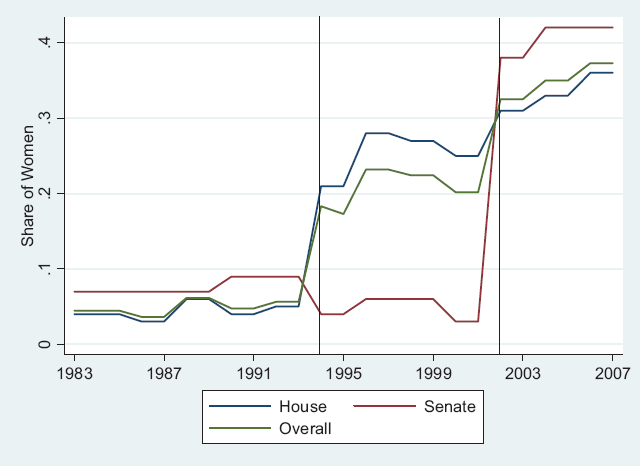
Women in the Argentine Congress, 1983–2007
In spite of the growth in women's presence shown in Figure 1, most of the literature on the Argentine Congress identifies factors other than gender as the principal influences on legislative behavior. For example, studies utilizing roll-call voting have recognized coalition membership – specifically the split between government and opposition – as the main predictor of legislative alignments (Jones 1995, 2002; Jones and Hwang 2004; Jones, Hwang and Micozzi 2009). Given agenda controls enacted by the majority party, bills that are likely to provoke disagreement tend not to advance to the plenary. Furthermore, individuals who do not support a party decision usually strategically leave the floor rather than vote against the party line (Jones 1995). As a result, social cleavages – by region, religion, or sex – are rarely brought to bear on voting behavior.
What is more, the Argentine Congress is not a professionalized legislature (Jones et al. 2002). Due to the structure of incentives generated by the electoral system, the internal organization of the legislature (Alemán 2006), and federal institutions, legislators have progressive ambition and limited incentives to specialize and develop their legislative expertise (Micozzi 2009). This reduces the number of legislators who invest time, resources, and energy to become policy specialists on gender-related and other issues. Finally, the power of governors, local leaders, and party bosses over candidate selection (De Luca, Jones, and Tula 2002; Spiller and Tommasi 2009) leaves little opportunity for a legislator's individualistic behavior, including leadership on gender issues. These features make Argentina a “critical case” for assessing the relationship between women's presence and legislative behavior on women's rights (Eckstein 1975). If women manage to be effective in this unlikely setting, where many factors conspire to reduce the influence of gender, they are likely to be able to produce change elsewhere.
Analysis and Results
In this paper, we analyze the entire set of bills submitted to the Argentine Congress in the first 24 years of the current democratic period. This sample enables us to examine change over a long period of time, work with an enormously large-N, and compare the fate of legislation on women's rights with that of other kinds of bills. We collected information on 172,130 bills b submitted by a legislator i in a year t between 1983 and 2007. The data are disaggregated at the bill level with information on its content; the sponsor's district, party, and gender; the final status; the committees that considered the bill; and committee chairmanship. Additional information at other levels has also been gathered, such as the total number of bills submitted by a legislator in a given year, their tenure in Congress, and the share of women in each chamber. 6
Official information from the congressional website (www.hcdn.gov.ar).
Next we identified “women's rights bills” – a difficult endeavor in such a huge sample. In order to minimize bias and make homogeneous choices, we developed an automated coding scheme that identified women-related keywords in the title and the description of each bill. 7 This enabled us to identify 3,272 bills, or 1.8 percent of the whole sample, as “women's rights bills.” Around 18 percent of these bills were approved, in contrast with the 28 percent approval rate for other bills. 8
We determined our sample keywords by using the literature and consulting with gender studies specialists. After the first wave of codes, we adjusted the reliability of our criteria, resulting in greater than 95 percent accuracy. We also incorporated options for multiple words to minimize spelling-based omissions. Our coding scheme is in Appendix A.
A miniscule portion of the bills identified this way did not seek to advance but rather to restrict women's rights, mostly regarding abortion. Excluding these bills from the sample, we were left with a total of 3,230 observations.
Descriptive statistics illustrate trends over time in the submission of women's rights legislation. As Figure 2 shows, trends in bill submission were positive for both the whole (logged) set of legislation submitted and the logged number of women's rights bills. It could be argued that this growth simply reflects increases in the number of seats in both chambers. 9 However, the figure shows that the number of women's rights bills grew at a (slighter) higher rate than the overall number of bills.
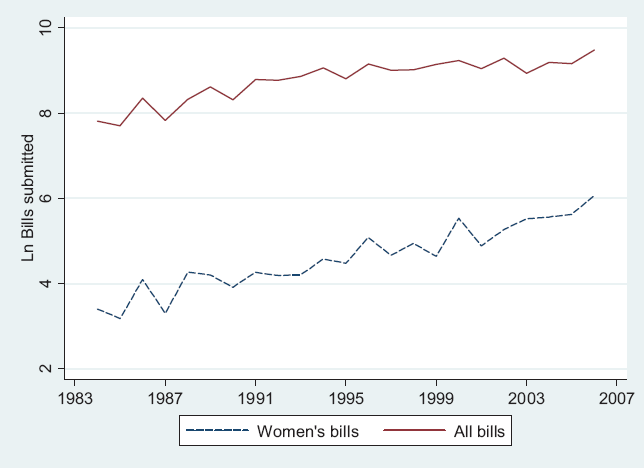
Bill Submission across Time
The House added three deputies in 1991, and in 1995 the Senate incorporated a third member per province that brought the size to 72.
Estimations
To test our hypotheses, we worked at different levels of aggregation. First, to assess the process of legislative activity, we focused on patterns of bill submission. These estimations took each legislator i at time t as the unit of analysis. This means that we used the year, not the particular congress, as the temporal cluster, which makes sense since legislators do not behave the same way year in and year out. With this legislator-level approach, our estimations used the number of gender-related bills submitted by year as the dependent variable. Given its non-negative condition, we utilized an event count model. After testing for overdispersion in regular Poisson models, we realized that a negative binomial model performed better. However, the abundance of zeros in the dependent variable (79 percent of observations) suggests that the complete distribution of the outcome needed to be approximated by mixing two component distributions, one for the zero-outcome portion of the equation and thee other for the positive values. Thus, the zero-inflated negative binomial model (Atkins and Gallop 2007) appeared better suited to our data structure.
To assess the relationship between the introduction of women's rights bills and other types of bills, we computed our estimations utilizing the total number of bills submitted annually per legislator as the predictor of zero values. We then estimated the expected number of gender-related bills as a function of the sponsor's sex, the weighted shares of women in the House and the Senate, 10 partisanship, chamber of origin, membership in a committee for women's issues, and indicators of institutional power such as committee chairmanship and congressional tenure. To avoid bias, errors were clustered at the legislator level.
Percentage of seats held by women in each chamber, weighted by the relative size of the chamber.
Linear, critical mass, and backlash approaches have different implications for the relationship between women's presence and legislative behavior. We estimated different models to discover the approach that best characterizes the nature of increases in bill submission. We specified our main independent variable – the share of seats held by women in both chambers – in three different ways: as a simple linear variable; as a dummy variable that equals 1 if the weighted share of seats held by women is greater than .3, as suggested by critical mass theory, and 0 otherwise 11 ; and as a quadratic variable added to the continuous main covariate to test the curvilinear effects implied by the backlash hypothesis.
We did not test the critical mass hypothesis at other threshold levels.
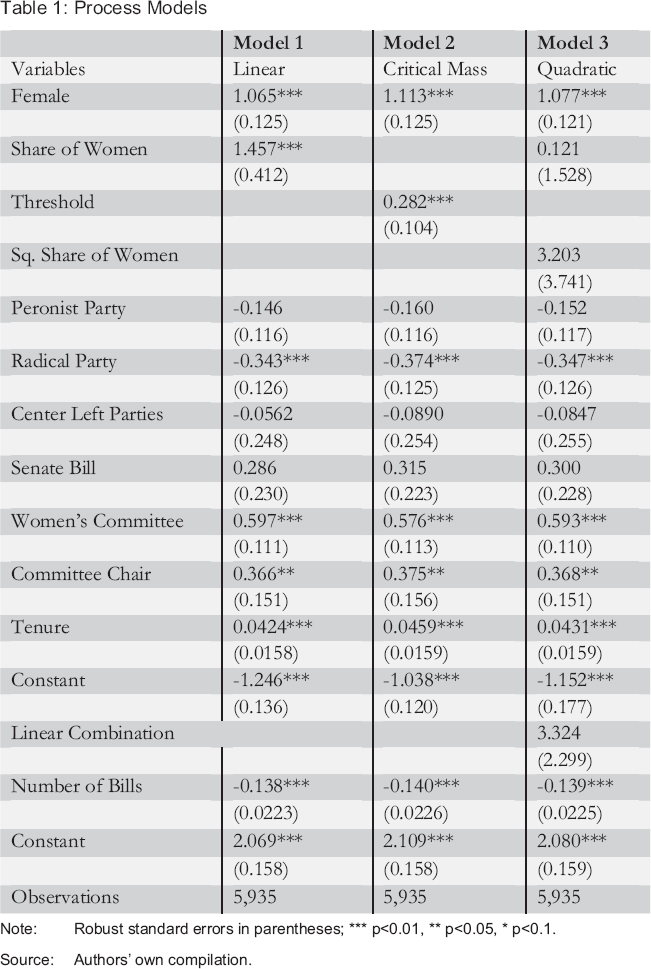
The analysis in Table 1 confirms many of our theoretical predictions. All three estimated models demonstrate that being a woman makes a legislator more likely to submit women's rights bills, as anticipated by hypothesis 1 (see the positive and highly significant coefficients to Female in models 1–3). Greater numbers of women in Congress also increases the expected number of women's rights bills. Our results confirm the linear hypothesis (H2) that growth in the presence of women increases the number of women's rights bills introduced: Share of Women is positive and highly significant (model 1). Our results also support the critical mass hypothesis (H3). As model 2 shows, the coefficient for Threshold is positive and highly significant. These coefficients support the intuition that boosting women's presence is likely to improve processes of legislative behavior regarding women's rights.
Process Models
Note: Robust standard errors in parentheses;
p≤0.01
p≤0.05
p≤0.1.
Source: Authors’ own compilation.
On the other hand, our results do not confirm the backlash hypothesis (H4): the coefficients for the linear and quadratic Share of Women (along with their linear combinations) in model 3 do not achieve significance or go in the direction expected. With all else equal, there is no upper limit to the effect of having more women in Congress with regard to the introduction of women's rights bills.
We needed to take an additional step in order to disentangle the question of which theory best explains the relationship between women's presence and legislative behavior – linear or critical mass. We evaluated the goodness of fit of models 1 and 2, and after seeing how the AIC and BIC tests performed, concluded that the linear model better explains our data's performance.
Another interesting finding about the prediction of outcomes with the value of zero is that, as the total number of bills submitted increases, the likelihood that a women's rights bill will not be submitted decreases. In other words, the more bills a legislator submits, the less likely she or he will be to not submit a women's rights-related bill. Very productive legislators – both men and women – tend to devote time and effort to deliver gender-related legislation (see the negative and significant coefficients of Number of Bills in models 1–3). This implies that regardless of gender, highly productive individual legislators tend to promote women's rights in Congress.
Our results reveal that, as expected, membership in a women's issues committee is positively and significantly associated with bill submissions on women's rights issues (H7). We found partisanship to be mostly insignificant, although Radical Party membership is associated with a lower likelihood of submitting a women's rights related bill (models 1–3). On the other hand, variables measuring institutional power – including possible committee chairmanship and legislative tenure – had positive and significant effects on their likelihood of introducing women's rights bills.
Figure 3 presents the predicted probabilities anticipated by hypotheses 1 and 2. As the share of women in both chambers increases, the expected number of women's rights bills introduced by both male and female legislators grows. However, both the slope and the intercept of these subgroups are distinct, supporting the view that women tend to be more active than men on women's rights issues. On average, keeping continuous variables at the mean and specifying a male Peronist, Senator, committee chair and member of the Women's Rights Committee, this subject will submit around one-half of a women's-rights-related bill in a Congress where women are totally absent. Growth in numbers of women in Congress to 27 percent of the total results in a doubling of his chances of drafting a women's rights bill. When 40 percent of all legislators are female, his predicted number of women's rights bills is 1.3.
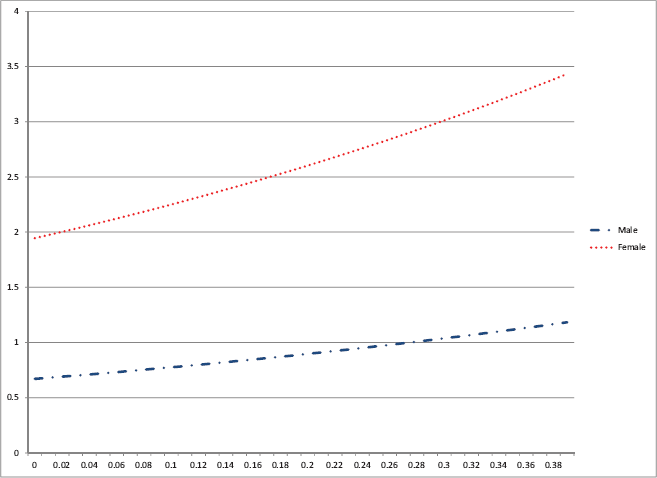
Predicted Number of Women's Rights Bills submitted per Year (y axis), according to the Share of Seats Held by Women in Congress (x axis), and Sex of Legislator
The picture would be different if we specified a woman with the same attributes. The woman legislator would never be likely to write fewer than two gender-related bills per year, even if she were the only female member of Congress. With women occupying one-third of all congressional seats, this female legislator is likely to submit around three targeted bills per year, and when women's share reaches 40 percent, she will introduce 3.5 women's rights bills annually.
At first glance, these predicted figures do not seem large. An average of three bills per capita submitted by 40 percent of 329 legislators, however, adds up to 395 gender-related bills per year. Though these numbers are hypothetical, they reveal the degree to which women's greater presence in positions of power is likely to affect legislative behavior on behalf of women. 12 To summarize: We find compelling evidence to support the idea that higher numbers of women in both chambers positively impact the submission of women's rights bills, especially by women legislators.
It should be noted that the model was also computed using the interaction between the share of seats held by women and being a woman. Although the coefficients didn't change much, the linear combination of each constitutive term and the interaction was statistically insignificant, and was therefore removed from the equation.
Outcomes
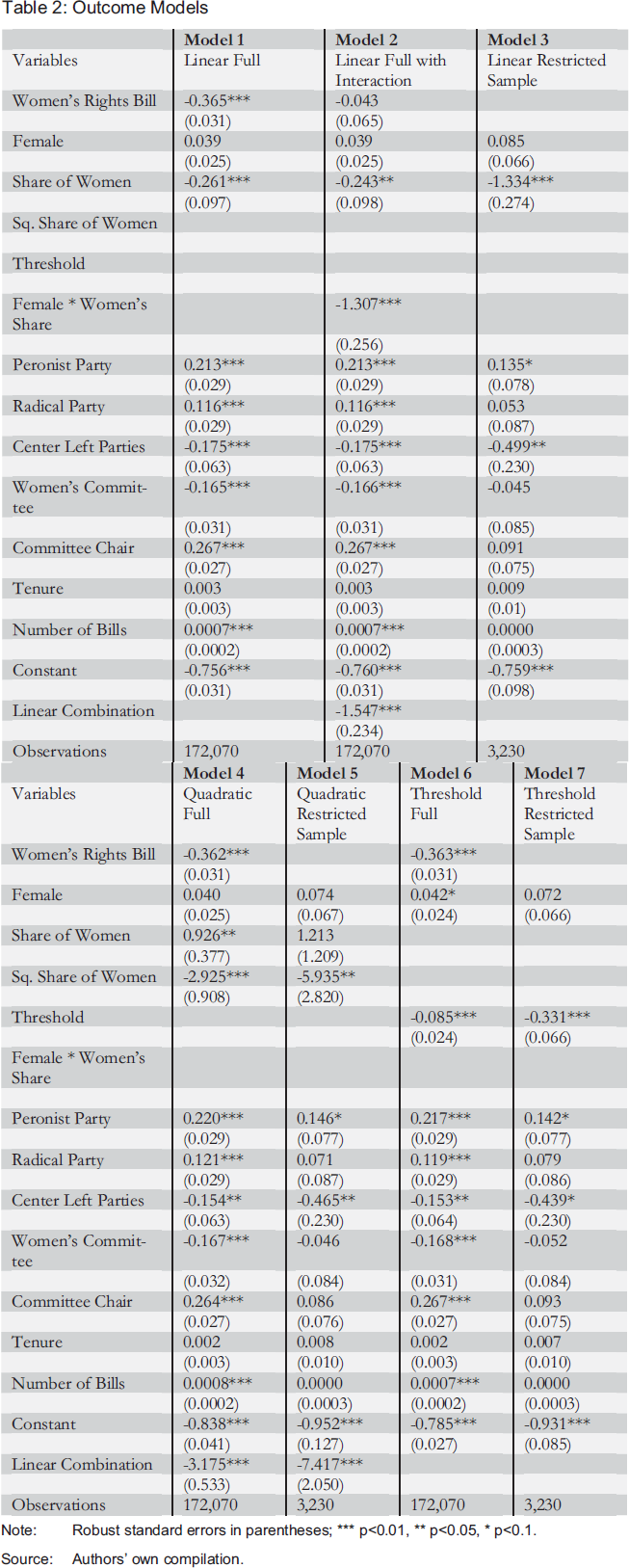
Our models confirm that women's increased presence improves the process of representation on behalf of women's rights. But what about changes in policy outcomes? To test the relationship between presence and outcomes, we calculated the chances of bill approval as a main function of having a female sponsor, the share of seats held by women, partisanship, institutional power (committee chairmanship and legislative tenure), and total bill submissions. To analyze the fit of each theoretical model, we ran different pooled probit models with clustered standard errors at the legislator-year level. For each hypothesis, we first computed the estimations by utilizing the full sample of bills (specifying the women-related content on the right hand side of the equation) and then by restricting the sample to the 3,230 women-related bills. The results of our seven models are presented in Table 2.
Outcome Models
Note: Robust standard errors in parentheses;
p≤0.01
p≤0.05
p≤0.1.
Source: Authors’ own compilation.
With similar negative results across models, the analyses robustly disprove our hypotheses. A bill with women-related content along with women's increased presence in Congress caused the probabilities of approval to drop – in every single model. The first three models test the linear argument over the full sample, then use an interaction, 13 and finally restrict the analysis to the set of women-related bills. As women's share in Congress increases, overall approval rates decrease, especially if the bill has women-related content (model 1) – and even more if it was sponsored by a woman (model 2). In the sample of women's rights bills (model 3), as women's presence rose, approval rates declined, regardless of the sponsor's sex.
The linear combination of the interaction is strongly negative and significant.
Models 4 and 5 tested the backlash argument and returned similar results. The linear combination of the continuous and squared share of women in Congress, along with the women-related content of a bill, negatively affects the chances of approval. 14 Models 6 and 7 show similar dynamics for the critical mass hypothesis. Goodness of fit across estimations does not reveal substantive differences. As a result, it is difficult to specify the precise shape of the relationship between women's presence and the probability of bill approval. Although taking a more nuanced approach could affect the results, it is clear that women's increased presence in the House and in the Senate is negatively associated with the probability of approval of women-related bills.
We have no good explanation for why the overall chances of bill approval decline as women's presence increases. This relationship requires further research.
The models strongly support the notion that party membership counts more for the approval of a bill than for its introduction. Conventional wisdom holds that membership in a large national party (such as the Peronists or the Radicals, the only parties that have had majorities over time) is associated with greater chances of getting a bill approved. This means that the less popular center-left delegation has lower chances of getting bills passed. These results also show that the sex of a legislator does not affect the chances of a bill being passed and that when it comes to a vote, party-level factors do not discriminate between men and women. To sum up: The data do not support hypotheses predicting that women's presence boosts the chances for approval of women-related legislation. Our findings show that with the rise in the share of women legislators, the productivity of Congress as a whole declines, even more sharply for women-related bills.
Conclusion
Women's presence has changed legislative behavior on women's rights in some respects but not in others. As women's presence in the Argentine Congress has grown, both women and men have introduced more women-related bills. This implies that there is more discussion of gender-related concerns and more consciousness-raising, as well as more space in the legislative agenda for issues related to women's rights. The most dramatic gains came after 2002, when gender quotas were applied to elections for the Senate and women's presence exceeded a critical mass in both chambers. Bicameralism matters: for women's presence to be associated with significant change, numbers of women cannot be dramatically different in the two chambers.
On the other hand, the chances that a women's rights-related bill would actually get approved by Congress were greater when women were fewer in number. As women's presence has grown and the process of representation has improved, the chances of successful outcomes have shrunk. The huge increase in women's presence secured as a result of gender quotas has made the passage of any individual piece of women-related legislation less likely. To a certain extent, this is the arithmetical result of the inflation in bill submission. Yet it may also be more evidence of the marginalization of women within the legislature (cf. Schwindt-Bayer 2010). As women's presence has grown, male politicians have worked harder to reduce their influence by pushing them into less important committees and preventing their bills from reaching the floor.
Our research has revealed that partisan and institutional factors continue to shape patterns of bill approval. Though gender quotas bring more women into Congress, they do not change party dominance of the legislative agenda, committee structures, or the incentives for legislators to specialize in public good policy issues. In fact, gender quotas are designed to maintain these institutional mechanisms and the power of party leaders. Candidate quota laws that require parties to add individual women to party lists and legislative delegations serve to divide women through the party system (Htun and Ossa 2013). (In contrast, a policy of reserved seats for a women's party would not.) Women do not enter power as a group but as individual members of different parties who owe their position to party leaders. Though party dominance has little impact on the process of bill introduction, our research confirms its enduring influence on the patterns of bill approval.
Footnotes
Appendix

| Keyword | Translation |
|---|---|
| ABORTIVA | Abortion inducing |
| ABORTO | Abortion |
| ABUSO SEXUAL | Sexual abuse |
| ACCESO IGUALITARIO | Equal access |
| ACIDO FOLICO | Folic Acid |
| ACOSO SEXUAL | Sexual harassment |
| ALIMENTARIOS MOROSOS | Maintenance debtors |
| AMA DE CASA | Housewife |
| ANENCEFALIA | Anencephaly |
| ANTIABORTO | Anti-abortion |
| ANTICONCEPCION | Contraception |
| ANTICONCEPCION DE EMERGENCIA | Emergency contraception |
| ANTICONCEPCION QUIRURGICA | Surgical contraception |
| ANTICONCEPTIVO | Contraceptive |
| APELLIDO DE SOLTERA | Maiden name |
| ATAQUE SEXUAL | Sexual abuse |
| BENEFICIO DE PENSION | Pension benefit |
| CANCER DE MAMA | Breast cancer |
| CANCER DE UTERO | Uterus cancer |
| COLPOSCOPIA | Vaginal examination |
| COMISARIA DE LA MUJER | Women police station |
| COMISION INTERAMERICANA DE MUJERES | Inter-American Commission of Women |
| CONCUBINA | Concubine |
| CONSEJO NACIONAL DE LA MUJER | National Woman Council |
| CONTRA LA MUJER | Against woman |
| CONTRACEPCION QUIRURGICA | Surgical contraception |
| CONTRACONCEPTIVOS | Contraceptive |
| CONTRALOR DE NACIMIENTOS | Birth control |
| CONYUGE SUPERSTITE | Conjoint successible |
| CUELLO UTERINO | Cervix |
| CUIDADO DE LOS NINOS | Childcare |
| CUOTA ALIMENTARIA | Maintenance |
| CUPO FEMENINO | Gender quota |
| CUPO SINDICAL FEMENINO | Gender quota in labor unions |
| D.I.U. | UID |
| DERECHOS DE LAS MUJERES | Women's rights |
| DERECHOS REPRODUCTIVOS | Reproductive rights |
| DERECHOS SEXUALES | Sexual rights |
| DESIGUALDADES DE GENERO | Gender disparities |
| DEUDORES ALIMENTARIOS | Maintenance debtors |
| DIA DESPUES | Day-after |
| DIA INTERNACIONAL DE LA MUJER | Women's International Day |
| DISCRIMINACION CONTRA LA MUJER | Discrimination against women |
| DISCRIMINACION SALARIAL | Pay discrimination |
| DIVISION SEXUAL DEL TRABAJO | Sexual division of labor |
| DIVORCIADA | Divorced |
| DIVORCIO VINCULAR | Absolute divorce |
| ECOGRAFIA | Sonogram |
| EDUCACION SEXUAL | Sexual education |
| EMBARAZADA | Pregnant |
| EMBARAZO | Pregnancy |
| EMPLEADA DOMESTICA | Slavy (maid) |
| EMPLEO DE MUJERES | Women's employment |
| EQUIDAD DE GENERO | Gender equality |
| FALOPIO | Oviduct |
| FECUNDIDAD NO DESEADA | Unexpected fertility |
| FEMINICIDIO | Femicide |
| FEMINISMO | Feminism |
| FEMINISTA | Feminist |
| FETAL | Fetal |
| FETO | Fetus |
| FILIACION | Filiation |
| FORO DE MUJERES | Women forum |
| GESTACION | Gestation |
| GRAVIDEZ | Pregnancy |
| GUARDERIA | Nursery |
| GUARDERIA INFANTIL | Children's nursery |
| HOSTIGAMIENTO SEXUAL | Sexual harassment |
| IDENTIDAD DE GENERO | Gender identity |
| IGUAL PAGO POR TRABAJO DE IGUAL VALOR | Equal pay for equal work |
| IGUALDAD DE GENERO | Gender equality |
| IGUALDAD DE TRATO | Equal treatment |
| IGUALDAD REAL DE OPORTUNIDADES | Equal opportunities |
| INEQUIDAD DE GENERO | No gender equality |
| INTEGRIDAD SEXUAL | Sexual integrity |
| INTERSEXUALIDAD | Intersexuality |
| JARDINES MATERNALES | Nursery school |
| JUBILACION DE LA MUJER | Women retirement |
| LACTANCIA | Breastfeeding |
| LACTANTES | Unweaned baby |
| LECHE MATERNA | Breast milk |
| LEY DE CUPO | Gender quota |
| LICENCIA POR MATERNIDAD | Maternity leave |
| LICENCIA POR PATERNIDAD | Paternity leave |
| MACHISMO | Male chauvinism |
| MACHISTA | Male chauvinist |
| MADRE NINA | Young mother |
| MADRE TRABAJADORA | Working mother |
| MAMOGRAFÍA | Mammography |
| MATERNIDAD | Maternity |
| MATERNIDAD SUBROGADA | Subrogate maternity |
| MATERNO INFANTIL | Mother and Child |
| MENOPAUSIA | Menopause |
| METODOS ANTICONCEPTIVOS | Methods of contraception |
| MISOPROSTOL | Misoprostol |
| MORTALIDAD MATERNA | Maternal mortality |
| MUJER | Woman |
| MUJER ARGENTINA | Argentine woman |
| MUJER TRABAJADORA | Worker woman |
| MUJER VIOLADA | Raped woman |
| MUJERES ARGENTINAS | Argentine women |
| MUJERES EN LA CIENCIA | Women in science |
| MUJERES EN LAS LISTAS | Women in electoral lists |
| MUJERES TRABAJADORAS | Working women |
| ORIENTACION SEXUAL | Sexual orientation |
| PAPANICOLAU | Smear test |
| PAPILOMA | Papilloma |
| PARIDAD DE GENERO | Gender parity |
| PARTICIPACION IGUALITARIA | Equal participation |
| PARTO | Childbirth |
| PARTO HUMANIZADO | Humanized childbirth |
| PATRIA POTESTAD | Parental custody |
| PERSPECTIVA DE GENERO | Gender perspective |
| PLANIFICACION FAMILIAR | Family planning |
| POTESTAD COMPARTIDA | Shared legal authority |
| PROCREACION RESPONSABLE | Responsible parenthood |
| PROSTITUCION | Prostitution |
| RAZON DE RAZA | Race issue |
| RAZON DE SEXO | Gender issue |
| REASIGNACION SEXUAL | Sexual reallocation |
| REPRESENTACION FEMENINA | Female representation |
| RESPONSABILIDADES FAMILIARES COMPARTIDAS | Shared family responsibilities |
| SALUD REPRODUCTIVA | Reproductive health |
| SALUD SEXUAL | Sexual Health |
| SEGREGACION LABORAL | Labor segregation |
| SERVICIO DOMESTICO | Housework |
| SEXISTA | Sexist |
| SEXO BIOLOGICO | Biological gender |
| SEXO FEMENINO | Female |
| SEXO SUBREPRESENTADO | Underrepresented gender |
| TECNOLOGIAS REPRODUCTIVAS | Reproductive technologies |
| TRABAJADOR DOMESTICO | Household worker |
| TRABAJO DOMESTICO | Housework |
| TRANSEXUALIDAD | Transexuality |
| TRANSGENERIDAD | Gender reassignment |
| TRANSMISION SEXUAL | Sexual transmission |
| UTERO | Uterus |
| UTERINO | Uterine |
| VIOLADA | Raped |
| VIOLENCIA CONTRA LAS MUJERES | Violence against women |
| VIOLENCIA DE GENERO | Gender violence |
| VIOLENCIA DOMESTICA | Domestic violence |
| VIOLENCIA FAMILIAR | Family violence |
| VIOLENCIA HACIA LA MUJER | Violence against woman |
| VITRO | In vitro |
Source: Authors’ own compilation.