



Abstract
Provincial supreme courts are important players in local politics because justices can affect the interest of the ruling governors; however, no research has addressed the factors that affect judicial turnover in provincial high courts in new democracies. This research attempts to fill this gap by using original data on the 525 departures of all provincial high court justices in Argentina from 1983 to 2009. My guiding hypothesis is that the stability of a justice on the bench depends on the political proximity of the justice to the ruling governor rather than on the executive's institutional capacity to impeach. This study reveals that being aligned with the faction of the ruling governor is a major factor in accounting for judicial turnover not only in single-party provinces, as expected, but also in multi-party provinces. Because provincial politics have proven to be a major source of power for national politicians, governors would prefer to have a friendly court during their administration.
Introduction
Provincial supreme courts are important players in local politics because justices’ decisions can affect the interests of the ruling governors. For example, in 2006 Carlos Rovira, governor of the northeastern Argentinian province Misiones, launched a massive campaign to reshuffle the high court a couple of months before he presented a constitutional referendum to allow indefinite re-election of governors. His appointment of five out of the nine justices to the high court resulted in the court delivering no unfavorable rulings regarding his (un)constitutional referendum. In new democracies, the manipulation of high courts can help governors leverage their power, as courts are relevant political actors, and friendly courts tend to support rather than frustrate the presidential political agenda. The existing literature reveals that local high courts have been the target of political manipulation (Leiras, Giraudy, and Tuñón 2009; Chávez 2004), but it is still not clear under which circumstances it is likely that governors would manipulate their high courts. Therefore, the objective of this research is to address this gap by examining 1) the conditions under which the executive could manipulate the composition of high courts and 2) the political factors that explain this judicial instability in new democracies. This research uses original data from provincial high court justices in Argentina in order to address these issues by analyzing the departures of all high court justices between 1983 and 2009. 1
This project was funded by the Pre-doctoral Andrew Mellon Fellowship. The author would like to thank Chris Bonneau, Dan Brinks, Steve Finkel, Aníbal Pérez-Liñán, Catalina Smulovitz and the anonymous reviewers of this journal for helpful comments and advice. The author is indebted to Diego Castelfranco, Luis Cecchi, Igancio Puente and Anakaren Sileiro for their invaluable research assistance and to many people from the provincial judicial branches that assisted me in the data-gathering process.
The research begins by questioning the consensus held within comparative judicial politics that executives have proven to be relevant actors in explaining judicial independence (Chávez 2004; Scribner 2004; Helmke 2005; Magaloni and Sanchez 2006; Herrero 2007; Ríos-Figueroa 2007; Iaryczower, Spiller, and Tommasi 2002; Pérez Liñán and Castagnola 2009; Trochev 2008; Widner and Scher 2008; Ginsburg 2003; Ramseyer and Rasmusen 2003). 2 This research argues that executives do not trust justices appointed by other executives with different political preferences and therefore prefer to craft a friendly court in order to leverage their power (Pérez Liñán and Castagnola 2009; Castagnola 2010b). For this reason, the guiding hypothesis claims that the stability of a justice on the bench depends on the political proximity of the justice to the ruling governor rather than on the executive's institutional capacity to carry out an impeachment.
A recent study on the Constitutional Court of Ecuador represents an exception to this consensus (Basabe-Serrano and Polga-Hecimovich 2012).
This research contributes to both comparative judicial politics and subnational literature. The first objective of this paper is to elucidate the political factors that trigger the political manipulation of high courts in developing democracies under different institutional designs and levels of democratic consolidation. Second, this paper aims to contribute to the subnational research that claims that in Argentina, provincial politics are a major source of power for national politicians (Benton 2003; Gibson and Suarez-Cao 2010; Jones and Hwang 2005; De Luca, Jones, and Tula 2002). The existing research suggests that politicians who control local politics are likely to become influential players within their national party and thus compete for the presidency. The literature has traditionally acknowledged that electoral institutions and control over government expenditures have allowed governors to remain in power, first by making the incumbent more favorable for re-election and second by using funds to engage in clientelistic activities (Auyero 2005; Levitsky 2003). This research suggests that the manipulation of high courts is another important way for governors to consolidate their power since friendly justices would not obstruct a governor's political interests and aspirations.
The remainder of the paper proceeds as follows: The next two sections trace the main theories of judicial turnover both within and beyond the American literature, and the subsequent section develops a theory of vacancy creation that builds on the main contributions of the existing literature. Section four presents a historical examination of the manipulation of high courts in Argentine provinces. Section five discusses the data and the methodology for testing the model, while the sixth section presents the results of the survival model that analyzes the 525 departures of high courts justices in Argentina from 1983 to 2009. The last section concludes by outlining the implications of this study for the literature on executive–court relations in developing democracies and on subnational politics in Argentina.
Strategic Retirements in American State Supreme Courts
The puzzle surrounding justices’ instability in office in subnational courts in new democracies challenges several assumptions about the relations between the executive and the courts and about judicial behavior in the American literature. The existing research that addresses this topic, for both the national and subnational courts, is mainly of two types: qualitative or quantitative (for earlier works on the topic, please refer to Schmidhauser 1962, Wallis 1936, Callen and Leidecker 1971, Ulmer 1982, and King 1987). Qualitative studies, mostly biographical and chronological accounts of the justices who have served on the U.S. Supreme Court, provide detailed and valuable information about the justices themselves, as well as about how the political and social context of the time influenced the court and its justices (Atkinson 1999; Ward 2003; Schwartz 1993; Rehnquist 2002). Quantitative studies have developed a provocative theoretical framework that aims to understand what factors influence the rate of judicial retirement not only from the U.S. Supreme Court but also from the lower federal courts. Scholars argue that judicial retirements are not random events but rather reflect strategic decisions by the justices. Furthermore, some authors argue that it is politics that motivate justices to strategically retire from the bench (Barrow and Zuk 1990; Hagle 1993; Hall 2001; King 1987; Nixon and Haskin 2000; Spriggs and Wahlbeck 1995; Zorn and Van Winkle 2000; Epstein and Segal 2005), while others insist that personal and economic reasons dominate (Squire 1988; Yoon 2006, 2003). Even though some of these works account for vacancies in the U.S. Supreme Court and others only for those in the lower federal courts, all of them use similar hypotheses to explain judicial retirements. The only exception is the literature on state supreme courts, since in this case scholars pay special attention to the role of judicial elections and institutional variables in understanding the retirement decisions of state supreme court justices (Hall 2001; Bonneau 2005; Bonneau and Hall 2003, 2009).
The rationale of the strategic retirement theory is based on the idea that justices are willing to give their seats to another like-minded justice but not to a justice with opposing political preferences. It is because of this that a justice's decision to depart from the bench is influenced by whether or not the justice shares the same political preferences as the executive and the senate, since in that case the executive would appoint a justice with similar preferences (Hagle 1993; Spriggs and Wahlbeck 1995; Zorn and Van Winkle 2000; Ward 2003). Therefore, the probability of an American justice departing from the bench increases when that justice has the same political preferences as the ruling executive. It is for this reason that new appointments will likely preserve the ideological balance in the court, as justices with similar preferences will be replacing each other (Franklin 2002).
Even though the strategic retirement theory may be a compelling argument to account for judicial turnover in the American judiciary, 3 the same may not be true for judiciaries in new democracies. While American scholars agree that it is the justice's own decision to depart from the bench, what we find in new democracies is that it is the decision of the executive that determines when a justice departs from the bench (Pérez-Liñán and Castagnola 2009; Castagnola 2010b). This is because executives want to craft a supportive court to leverage their political power. Therefore, in new democracies there is an inverse effect of the justice's stability on the bench on the partisanship alignment because justices with preferences different from those of the ruling executives are more likely to depart involuntarily from the bench. New appointments modify the ideological balance in the court (rather than preserve it) because justices with different preferences from the ruling executive will depart from the bench, while justices with similar preferences will enter the court.
Maitra and Smyth (2005) found similar results as in the American literature when studying the determinants of judicial turnover on the Supreme Court of Australia.
Strategic Actors Determined by the Political Context in the Comparative Literature
When is it likely for a governor to manipulate the composition of his or her high court and what factors would trigger those changes? The comparative judicial politics literature has been aware of judicial instability on the bench, but rather than treating it as an empirical problem it has been taken as a way to explain judicial instability (Magaloni and Sanchez 2006; Helmke 2005; Ríos-Figueroa 2007; Chávez 2004; Iaryczower, Spiller, and Tommasi 2002). However, over the last couple of years, a group of scholars has begun to fill this gap by examining the political factors that address judicial turnover in developing democracies (Basabe-Serrano and Polga-Hecimovich 2012; Pérez Liñán and Castagnola 2009; Lara Borges, Castagnola, and Pérez Liñán 2012; Leiras, Giraudy, and Tuñón 2009).
Since justices in new democracies do not have the necessary institutional protection to ensure the independence of their decisions, scholars argue that justices have become strategic actors (Helmke 2005; Magaloni and Sanchez 2006; Scribner 2004; Herrero 2007; Chávez 2004; Ríos-Figueroa 2007; Iaryczower, Spiller, and Tommasi 2002). The main argument is that depending on the political context in which justices are immersed, they rule either in favor of the executive – as a way to circumvent reprisals – or against the executive. The idea is that if an executive has a supermajority in Congress, then justices will vote as the executive would prefer, since the president has the political power to formally remove the justice from office (Chávez 2004; Iaryczower, Spiller, and Tommasi 2002). Conversely, if the president's party does not have a supermajority in Congress to formally impeach a justice, then justices can vote honestly, challenging the president's preferences because the latter is not able to punish them for voting against his or her agenda (Iaryczower, Spiller, and Tommasi 2002: 701). Therefore, according to those authors, justices will vote honestly or strategically depending on the political power of the current executive so as to circumvent their own impeachment.
The underlying assumptions in this argument are threefold: first, that justices depart from the bench as a result of an impeachment process; second, that justices can regulate their stability on the bench by ruling either against or in favor of the interests of the president; and third, that judicial turnover would decline with “weak” presidents since they would lack the partisan power in Congress to impeach an unfriendly justice. However, empirically the departure of a justice is not necessarily associated with impeachment and, moreover, it is not clear whether the way the justice votes and the partisan power of the executive affect the stability of a justice on the bench. If justices are strategic actors who can prevent their own impeachment through their voting behavior, then reshuffles on high courts should not take place. Assuming perfect information: justices should foresee whether executives have the capacity to impeach them and thus rule as necessary so as to remain on the bench. However, reshuffles in high courts are not rare events in new democracies in Latin America, where courts have historically been politically manipulated (Pérez Liñán and Castagnola 2009). This suggests that an empirical explanation is needed in order to understand judicial instability in these developing democracies.
Explaining Judicial Turnover in New Democracies
Why is judicial turnover important? Because changes in policy are associated with changes in the membership of the court (Baum 1992). The jumping-off point of this research is that executives, while in power, desire a supportive court as a way to increase their political leverage while also ensuring that their policymaking will not be frustrated. For these reasons, incoming executives will not necessarily trust justices appointed by executives with different political preferences (Pérez Liñán and Castagnola 2009). Under normal circumstances, vacancies should be isolated events resulting from retirement or death; however, if vacancies appear frequently and they are correlated, then this pattern may indicate that there are other factors affecting the stability of a justice in office.
Based on this idea, this research presents a novel framework based on the existing literature for the study of the factors affecting supreme court vacancies in new democracies by examining the preferences and incentives of the executive to craft a supportive court. The starting point is that there is a reversed directionality of the relationship between executives and justices in proposing that executives, rather than justices, can determine the timing of the departure.
The political alignment of a justice with the ruling executive can be used as a proxy variable to know when executives, or governors, would activate an induced retirement strategy. The idea is that a justice with political preferences that differ from those of the ruling executive will be more likely to be removed from office than a justice who shares the same political preferences as the executive (Pérez Liñán and Castagnola 2009). This is the case because executives do not trust justices that have a different political preference. But in entities with intra-party fragmentation, as is the case in Argentine provinces, it is more likely that executives will be considered friends when they and the justice in question belong to the same political faction of their party since loyalties may be more personalistic than the literature acknowledges. Taking into account the fact that at the subnational level many provinces have a single-party system, it is expected that the political alignment of the justice with the governor's faction would matter greatly in those provinces. The American literature claims that the political proximity of the justice to the executive can be determined by the political party of the appointing executive; however, this study challenges that hypothesis by claiming that the political proximity can more realistically be determined by the political faction of the appointing executive.
Other scholars have also recognized that the executive's capacity to manipulate the composition of the high court is also related to the electoral calendar – that is, a new administration. In the American literature and in some comparative judicial research, such as Helmke's (2005), it was the timing of the executive's election that set the degree of justices’ instability in office (Hagle 1993; Spriggs and Wahlbeck 1995; Zorn and Van Winkle 2000). In this literature, it is argued that when executives confront an unfriendly court, they are likely to manipulate the composition of the court during their first years in government rather than during their last years. This is because having a loyal court at the beginning of the term (rather than at the end) is more likely to guarantee executives the fulfillment of their policy goals. Therefore, having a new administration increases the probability of a justice leaving the bench.
Finally, as previously discussed, the literature also acknowledges that the congressional support of the executive is an important factor in judicial turnover, since executives with a supermajority in Congress (allowing them to formally impeach a justice) can craft a supportive court as opposed to executives with no congressional support (Chávez 2004; Iaryczower, Spiller, and Tommasi 2002; Ríos-Figueroa 2007). Therefore, justices are more unstable when a strong executive, rather than a weak one, is in power. Because this study addresses judicial turnover in subnational high courts, it is important to include a control variable for the years in which the governments of particular provinces experienced an intervention from the national level. Federal interventions can affect the autonomy of local judiciaries since presidents can decide to remove not only local governors and congressmen but also high court justices. Extreme cases of government corruption and wrongdoing have given way to six interventions of local judiciaries (twice in Corrientes, 1992 and 1999, twice in Santiago del Estero, 1993 and 2004, once in Catamarca, 1991, and once in Tucumán, 1991). In those cases, the president of the country, backed by Congress, took control of the province and removed the local justices. A total of 66 justices (37 percent) were removed as a consequence of national interventions in those four provinces, some of them at the beginning of the intervention (32 justices), others at the end when the situation was normalized (25 justices), and still others at some point in the middle of the intervention as a result of a change in the ruling authority (nine justices).
The Political Manipulation of Subnational High Courts in Argentina
Argentina is a federal country with separate judicial entities. Each province is autonomous vis-à-vis the national government in the design of its institutions, thereby producing a high degree of heterogeneity in the provinces’ respective constitutional designs with regards to the tenure system, the number of sitting justices, the appointment and removal process, and judicial review. Along with these institutional differences, the provinces have varying levels of both democratization and economic development.
Even though each province is autonomous in the design of its institutions, most of the provinces have followed the appointment and impeachment systems of the Supreme Court of Argentina, similar to those adopted by the U.S. Supreme Court. The provinces of Chaco, Río Negro (since 1988), San Juan (since 1986) and Tierra del Fuego do not share this appointment system – either the executive or the legislative branch is absent from the processes in each of those provinces, while the provinces of San Luis and Tierra del Fuego have implemented a hybrid model known as the “impeachment jury.” 4 The tenure system is similar, as all provinces, except Salta, guarantee life-long tenure for their national supreme court justices. 5
The main difference between the congressional model of impeachment and the “impeachment jury” is the type of actors involved in the process: in the congressional model, the legislative branch is the main actor, while in the other models other actors participate as well.
Although Salta is the only province that still has a fixed-term tenure for its justices (six years with the possibility of re-election), in 1983 there were five other provinces with fixed terms: Catamarca (until 1988), Jujuy and San Juan (until 1986), La Rioja (until 1998), and Tucumán (until 1991). The terms of the justices did not run concurrently with those of the governor.
However, the greatest variation in the institutional designs of the provincial high courts is the executive's ability to “pack” the court. The provinces of Córdoba, La Rioja and Neuquén are the only provinces whose constitutions clearly establish a fixed number of sitting justices, while the rest of the provinces (87 percent) have adopted imprecise regulations (some have no specification at all, some specify only a minimum number, others name a range in the number of sitting justices) (Castagnola 2010a). This vagueness in the rule can account for the fact that since 1983 more than half of the provinces (61 percent) have at least once changed the total number of sitting justices (either increasing or reducing it). The most unstable courts were those in Misiones, where the total number of sitting justices changed four times, and in each Formosa and La Rioja, where it changed three times (Castagnola 2010a). This suggests that many governors have indeed manipulated the composition of their courts.
There is a growing literature in comparative politics that analyzes the determinants of the different democratization levels among subnational entities. Studies on Argentina have concluded that there is great variation in the level of democratization between its provinces. For example, in Giraudy's (2010) democratization index level, only 5 out of 24 provinces between 1983 and 2006 reached high, sustained levels of democracy, while the rest have made little to no progress. But the uneven distribution of democracy in the subnational entities in Argentina is not a characteristic unique to this country but rather a common pattern within the region (Fox 1994; Snyder 1999; Benton 2012).
Along with this trend, Argentine provinces have another common characteristic: the unstable checks-and-balances mechanism characterized by weak institutional constraints (of the judiciary and other horizontal institutions) on the power of the governors (Gervasoni 2010). Scholars have shown how these powerful governors were able to remain in power by affecting the distribution of local power in the electoral arena in favor of incumbents (Calvo and Micozzi 2005; De Luca 2004). But what the literature has not yet systematically analyzed is the relationship between the executive and the court in the subnational entities – more precisely, how these powerful governors interact with the justices of their provincial high courts.
One indicator that can capture the executive–court relations is the number of times that the high courts were reshuffled – meaning, when more than half of the justices depart in a given year – since the reshuffling represents a powerful mechanism by which governors are able to craft supportive courts. Prior to the democratization process in 1983, there was a legacy of reshuffling the provincial high courts. For example, in Córdoba there were twelve reshuffles, in Buenos Aires eight, in Chaco six, La Pampa, Río Negro and Santa Cruz each five, Neuquén and Entre Ríos four, and Chubut and Formosa each three (Pelaez 2007; Poder Judicial de la Provincia de La Pampa 2007; Poder Judicial de la Provincia de Mendoza 2009; Poder Judicial de la Provincia de Río Negro 2009; Poder Judicial de la Provincia del Chaco 2009; Poder Judicial de la Provincia del Chubut 2007; Biblioteca Tribunal Superior de Justicia de Córdoba 2007; Departamento Histórico-Judicial 2006; Ghiggi 2007; Córdova 1994; Lamote 2007). 6 Provincial high courts during this period were more vulnerable than the Supreme Court of Argentina itself: during those years, the national court experienced a total of six reshuffles (1947, 1955, 1958, 1966, 1973, 1976), which suggests that executives at subnational entities launched a more aggressive strategy to control their judiciaries.
However, in contrast to what the democratization literature says, the legacy of reshuffling provincial high courts did not end when democracy was re-established in 1983, as happened with the national court, which was at that time reshuffled for the last time. Figure 1 displays the number of times that provincial high courts were reshuffled from 1983 through 2009. The Supreme Courts of Santiago del Estero, Corrientes and Neuquén were reshuffled between five and six times each during this span of time, which amounts to one reshuffle every five-and-a-half years. While Santiago del Estero and Corrientes have twice experienced interventions by the national government, Neuquén is the province with the greatest number of reshuffles without federal intervention. The province of La Rioja ranks next, with four reshuffles. The courts of La Rioja and Neuquén were reshuffled from 1983 to 2009 without federal intervention more than the courts of any other single province, and each of the two provinces has been ruled by the same political party since 1983 (the Movimiento Popular Neuquino in Neuquén and the Peronist Party in La Rioja). This evidence demonstrates that intra-party fragmentation in Neuquén and La Rioja offers a strong explanation for the instability of their judiciaries.
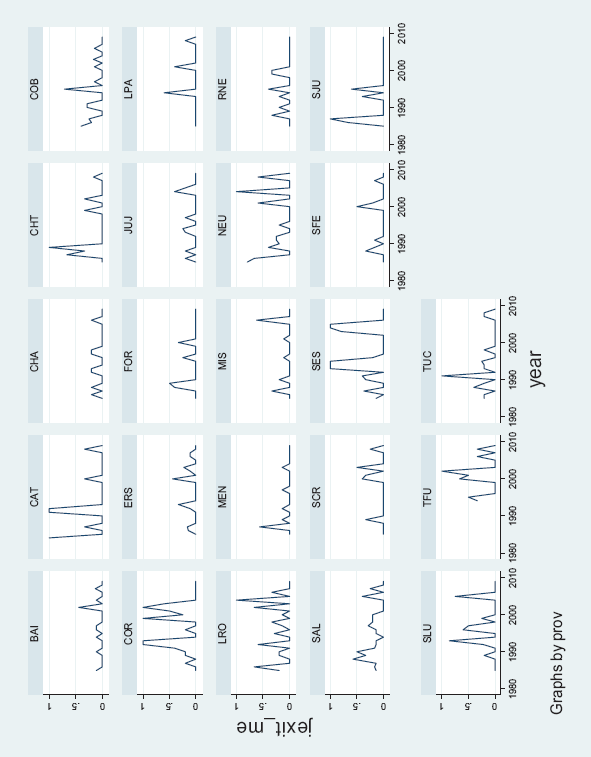
Reshuffles in the Provincial Supreme Courts, 1983–2009
The Supreme Courts of Córdoba and Buenos Aires were created at the beginning of the twentieth century, while those of the other provinces mentioned above were created during the 1950s and early 1960s as a result of the national provincialization laws (the court of Entre Ríos was created in 1950, that of Chaco in 1954, La Pampa in 1955, Chubut, Formosa, and Santa Cruz all in 1959, Río Negro 1960, and Neuquén in 1961).
The evidence provided above reveals that provincial high courts have historically been the target of political manipulation, during both dictatorships and democratic regimes. But, considering that justices have either life-term or fixed-term appointments, how have governors been able to craft supportive courts? The systematic analysis of the departures of provincial justices between 1983 and 2009 reveals that governors have triggered different strategies for creating vacancies. 7 One powerful strategy was to offer attractive retirement benefits to the sitting justices, which did occur in several provinces. For example, in 1999 the incoming Peronist governor in Tierra del Fuego, Carlos Manfredotti, issued Law No. 460, which mandated retirement for all justices and judges in the provinces who were at least 50 years old and who had paid five years of benefit contributions (Ramonet 2007). As a result of this permissive law, three out of the five sitting justices in the Supreme Court of Tierra del Fuego, as well as 83 percent of its federal judges, were forced to retire from the bench (Página 12 3/10/2007). Governors have also created other mechanisms of vacancy creation such as allowing for the re-appointment of justices to the federal court, terminating the terms of the justices, and even cutting their salaries. For example, in La Rioja a controversial constitutional reform in 2002 that reduced the number of sitting justices abruptly ended the term of the four justices that had opposed the reform due to violations of constitutional procedures (Diario Judicial 25/8/2003).
Original data regarding the departures of the provincial justices between 1983 and 2009 were collected from over 27 provincial and national newspapers. More than 700 newspaper articles were examined in the course of a five-month-long data-gathering process.
Impeachment was also used as an institutional mechanism to induce the retirement of provincial justices, but, as in the Supreme Court of Argentina, only a small number of justices were actually removed using this procedure. Since 1983 a total of nine justices have been impeached, and 40 have been threatened with an impeachment trial (Castagnola 2010b). Aside from these institutional strategies, governors have also successfully obtained vacancies in the court by discrediting justices in the media or by providing information to the public about the alleged involvement in scandals of family members of justices. For example, in San Luis, Justices Oscar Alberto Bianchi, Elias Taurant, and Alberto Estrada Dubor resigned in 1996 as the result of an insulting newspaper campaign calling for a reshuffling of the court. The local newspaper, owned by the governor's family, published a photomontage of the faces of the justices superimposed on the bodies of strippers, thereby leading to the departure of the justices (El Diario de la República 26/11/1996). This brief outline of the different strategies used by governors in order to remove unfriendly justices comes from the qualitative analysis of 180 (33 percent) departures and suggests that governors are not willing to tolerate a court that rules against their interests. Due to difficulties in gathering data, it was possible to identify the reason for departure for only a third of the total justices. Figure 2 displays this information.
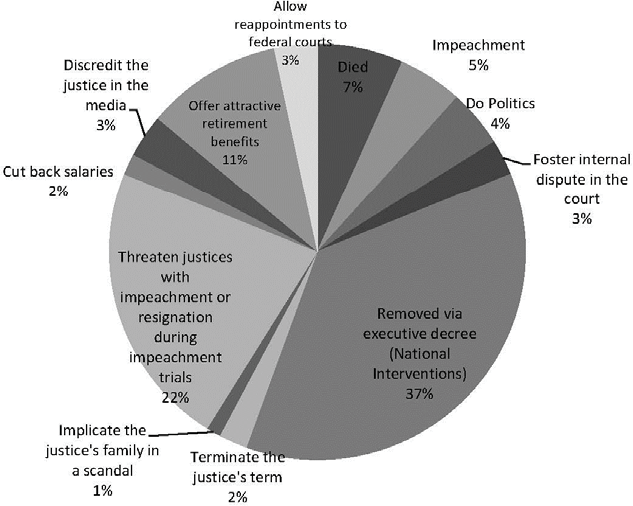
Reasons Justices’ Departures from the Provincial Supreme Courts, 1983–2009
Estimation and Model Specification
To test the Supreme Court vacancies hypotheses, following the literature, a survival model for discrete data was used (Box-Steffensmeier and Jones 2004; Nixon and Haskin 2000; Squire 1988; Zorn and Van Winkle 2000). 8 This section uses original data to systematically assess the 525 departures of justices from the 23 Argentine provinces that have occurred since the return of democracy in 1983. The dataset contains all the justices who served on the court as well as all the justices still in office. The statistical analysis shows how the governor's incentives and preferences have influenced these retirements.
Since justices may depart from the bench only during the judicial calendar year, the underlying process is assumed to be discrete; thus the intervals for the duration are measured in terms of years.
A temporal dependence variable was included, not only because each individual case has multiple data points and thus can exhibit temporal dependence, but also for the purpose of examining whether or not the stability of a justice in office changes over time. 9 Each justice has a separate observation for each year that he or she was on the court, yielding a total of 3,416 observations. The dependent variable is the year in which a justice departs from the bench, indicating with a “1” the year of exit and a “0” otherwise (if a justice did not exit the court in that year).
The Carter and Signorino (2007) time polynomial method (t, t 2 , and t 3 ) was used to model temporal dependence; those authors provide evidence that the use of time dummies lacks efficiency.
American scholars and the recent cross-country research on Latin American courts consider the justice to be politically aligned with the executive when the justice belongs to the political party of the nominating governor (Hagle 1993; Spriggs and Wahlbeck 1995; Zorn and Van Winkle 2000; Pérez Liñán and Castagnola 2009; Sánchez, Magaloni, and Magar 2011; Ríos-Figueroa 2007). However, in countries with party factionalism, like Argentina, the proximity of the justice to the executive is not necessarily determined by the political party, as acknowledged by the literature, but rather by the political faction 10 of the governor who nominates the justice. This caveat becomes even more important in provinces that have a single-party system since the political alignment of the justice with the governor is determined by the ruling faction rather than the ruling party. Consequently, two measures of political alignment are employed. The first dummy variable captures whether or not a justice belongs to the same faction as the governor who nominates that justice, while the second dummy variable captures whether or not the justice belongs to another faction of the same political party as that of the governor who nominates that justice. The baseline category is no alignment with the party of the governor. Another dummy variable captures whether or not a province has a single-party system. Different sources of information were used to measure political factions at the subnational level. Governors were considered to be from the same political faction when the outgoing governor or the interna faction of the governor supported the candidacy of the incoming governor. This information was collected from different sources depending on the electoral laws of the provinces. 11 Cases in which incoming governors betrayed the political faction that had supported them during the elections were also taken into consideration; this occurred, for example, in Santiago del Estero with Governor Iturre. In those instances, even though the incoming governor was from the same interna as the outgoing one, it was coded as a different interna since once in office the incoming governor no longer belonged to the same faction as the outgoing one.
“Political faction” demarcates ideological differences within the same political party. The main coding rule for this variable is whether or not the outgoing executive supported the incoming executive during the nomination process or primaries. Another consideration is whether an incoming executive supported by the outgoing executive remained loyal to the faction during his administration.
In some cases, the information was taken from the primary elections within the parties or the sublemas in the elections (double simultaneous voting), and in other cases from the local newspapers during the electoral campaigns; subsequently, interviews with local experts were conducted to corroborate the information gleaned from the newspapers.
The model also includes three dummies to measure the other political factors affecting induced retirements: the supermajority (captures with a “1” strong, unified governments – meaning, those in which the executive's party controlled at least two-thirds of the seats in both chambers); the new administration (coded as “1”, the first two years of a new administration); 12 and a control variable for national interventions.
The first two years of the administration were coded because changes in the administration often come at the end of the calendar year, when the judiciary is closed; thus, justices resign the following year.
Judicial Turnover in Provincial High Courts
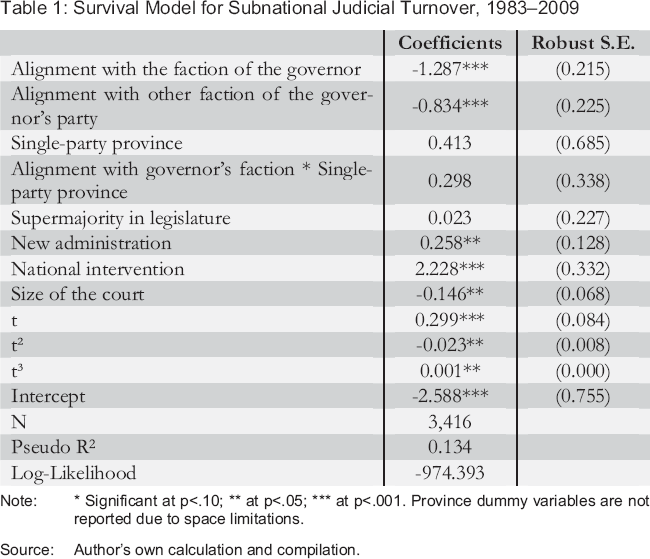
What factors account for the high instability rate of provincial high court justices? Table 1 shows the discrete-time survival model, using logit with robust standard errors with fixed effects. Politics are an important aspect of judicial turnover in Argentinian high courts. The interpretation of the coefficients for alignment deserves special attention because being aligned with the governor's faction is a subset of being aligned with the ruling party. The probability of a justice leaving the bench is reduced if the justice is aligned with the ruling party. 13 But what happens in provinces with a single-party system? Does faction matter when accounting for judicial turnover in those provinces? A justice aligned with the faction of the governor in a single-party province would reduce the probability of that justice leaving the bench. 14 Since the coefficients are non-linear, it is not possible to compare the effect of party alignment vis-à-vis faction alignment.
Survival Model for Subnational Judicial Turnover, 1983–2009
Note:
Significant at p<.10
at p<.05;
at p<.001. Province dummy variables are not reported due to space limitations.
Source: Author's own calculation and compilation.
The lincom command in STATA was used to test for the combined effect of party alignment and the result was statistically significant (-2.122***).
The lincom command in STATA was used to test for this effect: −1.287 + 0.298. The combined effect of faction alignment in single-party provinces was statistically significant (-0.989**).
To overcome this problem, predicted probabilities were computed using different scenarios: In single-party provinces, with a change in administration, the probability of a justice aligned with the governor's faction leaving the bench is 0.05 but increases to 0.14 if the justice is aligned with another faction of the party. In multi-party provinces, with a change in administration, the probability of a justice aligned with the faction of the governor leaving the bench is 0.07, but increases to 0.12 when the justice is aligned to a different faction from that of the governor, and to 0.16 if not aligned with the governor's party. Therefore, not being aligned with the governor's faction in a single-party province is as risky as not being aligned with the governor's faction in a multi-party province. Consequently, faction matters in both single-party and multi-party provinces.
The dummy variables for changes in administration and national interventions also proved statistically significant, meaning that justices are more unstable during the first years of a new administration and during national interventions. Governors want to craft a supportive court earlier in their term so as to increase their political leverage.
The variable for supermajority in legislatures is not statistically significant, suggesting that justices are not necessarily more unstable on the bench in provinces that have powerful governors. If in a context of high judicial turnover – as in the Argentine case – the governor's partisan power does not affect judicial turnover, most justices do not depart via impeachment but rather through other mechanisms that do not necessarily require a supermajority in Congress. Figure 2 captures some of these alternative mechanisms of vacancy creation. This lack of finding is consistent with a recent study on provincial courts in Argentina that shows that political competition does not protect judicial stability (Leiras, Giraudy, and Tuñón 2009).
But how are governors who lack the partisan power in the legislature they need in order to impeach a justice able to induce the departure of an unfriendly justice? As previously mentioned, the qualitative analysis of the departures of the provincial justices revealed that impeachments are not the only strategy for governors to craft a friendly court. In fact, governors have used other strategies to remove justices from the bench, but without the same public visibility and political cost as an impeachment. These other strategies proved to be powerful, since many justices do not survive political persecution, moral attrition and coercion, and thus end up resigning from the bench. The importance of these mechanisms of vacancy creation is that they can have the same effect as a full-fledged impeachment but they require a less rigorous process. Precisely because some of these practices are informal, less legal argumentation and evidence are required to endorse the accusations aimed at the unfriendly justice. These types of unverified denouncements against justices undermine the justices’ own credibility within society.
Conclusion
Courts are powerful actors in politics because justices have the capacity to control the executive and Congress while at the same time influencing the policymaking process. It is precisely for this reason that in unstable political contexts where institutional protections cannot guarantee the justice's stability on the bench, justices become the target of political manipulation. This research makes several contributions to both the comparative and the subnational judicial literature.
The analysis of high courts in Argentine provinces reveals that governors have systematically controlled the conformation of their courts by manipulating the departure of their justices. In fact, it is during the first few years of a new administration that justices are more likely to depart from the bench, suggesting that governors do not trust justices appointed by other governors with different political preferences. Incoming governors trust only justices that have been appointed by previous governors belonging to the same ruling faction, which suggests a different pattern of political loyalties than the one mentioned in the American literature. In other words, the study shows that the political loyalties of justices and executives turn out to be more sophisticated and personal than had been anticipated in the literature. It is for this reason that in new democracies the study of executive– court relations should concentrate more on the one-to-one relationships between the justices and the governor.
The existing literature on subnational politics in Argentina has not devoted sufficient attention to how party factions can affect the provincial party dynamic in the political arena, and no research has been done on how party factions can affect the stability of justices on the bench. This research reveals that party factions are of great importance when accounting for judicial turnover not only in single-party provinces, as expected, but also in multi-party provinces. The fact that loyalty is associated with the faction of the party and not necessarily with the political party per se reveals that high court justices are relevant political players and therefore should be politically very proximate to the ruling governor. Being appointed by the ruling party is not sufficient evidence for the governor that the sitting justices will not frustrate the policies of the administration. This research argues that the governor's interest in crafting friendly courts stems from the fact that courts can become another source of power for local governors to consolidate their power locally and allow them to become relevant political players in the national arena.
The null finding with regards to the executive's partisan power in Congress brings up the unsolved puzzle of how political competition shapes judicial independence. So far, the literature argues that political competition produces a more independent judiciary because the power is not concentrated in one branch of government (Chávez 2004; Iaryczower, Spiller, and Tommasi 2002). In other words, when executives do not have the partisan power in Congress to control the stability of the justices on the court (the power to impeach a justice), justices are more likely to vote sincerely on the cases that come before them, because presidents cannot arbitrarily remove those justices. But what we learn from this research is that in Argentine provinces party competition has not necessarily produced a more independent judiciary. Governors, irrespective of their partisan power in legislature, have been able to manipulate the composition of the courts by triggering both formal and informal mechanisms of vacancy creation, thereby under-mining the independence of the judiciary and the stability of the justices. Judiciaries in new democracies have not proven themselves to be independent from the executive branch; rather, they are targets of manipulation.