



Abstract
Presidential agenda success is usually accounted for through measures of interbranch cooperation, such as bill approval rates, participation rates, and roll-call data of support from presidential initiatives. These measures do not provide an accurate picture of presidential agenda success because they cannot capture the ability of presidents or Congress to shape the substance of legislation. To overcome this limitation, this paper proposes a combination of two measures of influence on legislative outcomes: the Legislative Input Score for partisan involvement in lawmaking, and the Barrett and Eshbaugh-Soha Scale for legislative substance. To illustrate the potential of these measures, it puts them to work in analyzing the ability of presidents to control the substance of their proposed legislation in Argentina between 1999 and 2007. Preliminary results show that when agenda success is measured with these scores, presidents can consistently shape legislative substance regardless of popularity, coalition size, and honeymoon periods.
Introduction
The aim of this article 1 is to develop measures of presidential agenda success in Congress that can provide information on the extent to which Presidents were actually able to obtain what they wanted from legislators. To achieve this aim, we propose to combine a measure of legislative input on presidential agendas with a measure of presidential success on the substance of legislation. Measuring legislative input on presidential agendas enables analysts to assess the relative influence of each branch of government on the outcomes of the legislative process; and measuring presidential success on the substance of legislation makes it possible to establish the degree to which Executives obtain legislative outcomes consistent with their aims.
The authors are grateful to German Feierherd, Ricardo Gamboa, Mariana Llanos, Andres Malamud, Scott Morgenstern, Ana Maria Mustapic, Juan Negri, Luis Tonelli, and two anonymous reviewers for their helpful comments.
The typical way of measuring presidential agenda success has been to provide indications of legislative support for presidential initiatives. Thus, measures of interbranch cooperation in presidential systems have usually been interpreted as measures of presidential agenda success. This has been particularly the case with legislative approval rates of presidential initiatives. The number of bills sponsored by the President and approved by Congress has been used as an indicator both of the level of Executive-Legislative cooperation and of the success of Presidents in pushing through their agenda. The more presidential initiatives approved by Congress, the greater the cooperation between Congress and the President and the greater the presidential success in passing their agenda.
However, the legislative approval rate of presidential initiatives is not an accurate measure of presidential agenda success because it does not account for the ability of presidents to shape the substance of legislation (Barrett and Eshbaugh-Soha 2007). Approval rates only indicate whether presidential initiatives have been accepted or rejected by Congress; they do not convey any information about the content of those initiatives. Consequently, approval rates are unable to show whether the bills passed by Congress were consistent or inconsistent with the President's preferences or wishes. Approval rates may be taken as indications of a compromise between the Executive and Legislative branches, but they tell nothing about the substance of such compromise.
Legislative approval rates cannot account for presidential agenda success because they provide no information about the ways in which legislators may alter presidential initiatives. Learning that any given presidential initiative was made into law does not inform whether the bill was modified during passage, and tells nothing about the nature of modifications. A bill sponsored by the President may have passed with amendments that catered to the particularistic interest of legislators, or in a policy position closer to the preferred point of Congress than to that of the Executive. This information is crucial for assessing a President's success in pushing through their agenda: without it, a high approval rate of bills inconsistent with the President's policy preferences may be credited as evidence of high presidential agenda success.
Only a handful of attempts have been made to measure presidential agenda success in terms of the substance of legislation. Some scholars have focused on the degree of participation of the President in the legislative process (Jones 1994) and tried to measure its impact on legislative content (Krutz 2001). Others, notably Rudalevige (2002) and particularly Barrett and Eshbaugh-Soha (2007), have concentrated on measuring the substantive distance between legislative outcomes and presidential initiatives. Both approaches point to significant dimensions in the legislative process. A low participation of the President in the process would be equivalent to a high participation of legislators, and a high participation of legislators would be tantamount to the introduction of amendments to presidential initiatives. On the other hand, congressional amendments to presidential initiatives may bring outcomes closer to legislators’ preferred points, or may not amount to significant distance from the President's preferences. Hence both dimensions should be taken into account for the measurement of presidential agenda success.
Combining measures of each branch's participation in the legislative process with measures of the distance between legislative outcomes and presidential initiatives is crucial to avoid the pitfalls of measures based on congressional support for the President. Such indicators as the voting unity of the government party on all or merely key issues are focused on a different matter: They capture the degree to which legislators align themselves with Presidents at the time of voting for Executive-sponsored initiatives, not the level of consistency between what is being voted on and the President's objectives. To grasp such level of consistency, analysis must focus not only on the act of voting but also on the nature of what is being voted on.
This article intends to combine these two approaches to the measurement of presidential agenda success by using and comparing two different procedures. On the one hand, we develop a measure of legislative input on presidential initiatives that consists of determining the party identity of the legislators who introduced amendments in either stage – committee or floor – of the legislative process. On the other hand, we follow the approach proposed by Barrett and Eshbaugh-Soha (2007: 105) to assess the President's success in preserving the substance of the legislation proposed to Congress.
We put these measures into use by analyzing the legislative process of presidential initiatives enacted into law in Argentina between 1999 and 2007. This period of Argentine history is particularly useful to assess the effect on presidential agenda success of the variables typically used to account for legislative approval rates. The period includes a minority president who resigned his office, an interim president who called for early elections, and a majority president who managed to get his preferred successor elected into office; plus there were significant variations in the economic cycle. So it is possible to assess for the effect of the electoral cycle, the popularity cycle, and institutional variables such as the size of the President's legislative coalition.
The article is organized as follows. The first section reviews the background for this research by pointing out the methodological issues involved in measuring presidential agenda success. The second section describes the database on the Argentine legislative process used throughout the paper. The third section defines how the dependent and independent variables are operationalized, and proposes the hypotheses to be tested. The fourth section presents the results of our analysis. The conclusion recaps on the argument and findings and proposes questions for further research.
Previous attempts to evaluate presidential agenda success have pointed to three issues that need to be methodologically addressed in order to produce adequate measures: the level of support for the President among legislators; the degree of participation of presidents and legislators in the legislative process; and the distance between the substance of the President's intent and that of legislative outcomes. Most studies have dealt with either the first or the second issue, and have more or less implicitly assumed that the substance of legislative contents would be contingent on the level of support for or the degree of participation of the President in lawmaking.
The majority of the literature on presidential agenda success has measured this variable using some indicator of the level of support for either presidents or their initiatives among legislators: voting unity indexes, presidential box scores, roll rates, or simple percentages of positive votes for presidential initiatives (for the US case, Edwards 1985, 1991; Covington 1986; Bond and Fleisher 1990; for Latin America, Morgenstern 2004; Carey 2009; Saiegh 2009; for Argentina, Jones 2002; Jones and Hwang 2005). The smaller number of studies dealing with the degree of presidential and legislative participation in the legislative process typically use measures such as legislative approval rates, participation rates, or dominance/ preponderance rates in order to show which branch makes the most significant input to the legislative process (for the US, Jones 1994; Krutz 2001; Rudalevige 2002; for Latin America, Saiegh 2005; Alcántara Sáez and García Montero 2005; García Montero 2009; for Argentina, Calvo 2007; Alemán and Calvo 2008).
All these measures, though useful for conveying an aggregate view of lawmaking and its determinants, share two important problems. First, they are typically based on sources that provide limited depictions of the complexity of legislative processes. Second, they are unable to account for the President's success in shaping the contents of legislation.
Measures of presidential support in Congress are generally based on roll-call data. This data provides an incomplete picture of lawmaking insofar as it only captures decisions made on Chamber floors while excluding choices made in committees or non-roll-call votes (Edwards 1985). This is particularly problematic when legislative procedure contemplates the possibility of both open and closed rules for the discussion of bills in the committee and floor stages. If bills can be amended in either stage or only in the committee stage, then roll-call data misses the bulk of legislative activity – or assumes it away when voting unity indexes rank high. In addition, roll-call data pose an insurmountable problem of interpretation: how to deal with nonvoting. As Edwards points out, while “most absences are due to illnesses or official business”, some may be due to legislators’ desire to support or oppose the President without publicly stating their position – so “there is simply no way to know how to interpret absences” (Edwards 1985: 675). Thus, another crucial strategic feature of legislative behavior is lost by using measures of presidential support.
Measures of branch participation in the legislative process are focused on the final outcome of that process. Approval rates indicate the share of initiatives passed per branch of the total each proposed; participation rates show which branch approved the largest share of the total proposed by both branches; dominance/ preponderance rates depict which branch controlled the legislative process. But by focusing on final outcomes these measures do not provide a window into how the legislative process may transform the bills it considers. This makes it extremely hard to ascertain that outcomes effectively capture the President's success in pushing their agenda.
Neither measures of presidential support in Congress nor indicators of branch participation in the legislative process are typically able to account for presidential success on the substance of legislation because they focus on aggregate expressions of interbranch (mis)alignment. While this focus may be justified on grounds of the readiness of data availability, and possibly even the representative character of aggregate measures, it does not convey whether legislative outcomes are closer or further from presidential or (median) legislators’ preferences or ideal points. Measures of presidential support in Congress assume that closeness depends on interbranch unity: If legislators vote for presidential initiatives, then they must agree with them to some significant degree, so high voting unity for the President's bills means high presidential agenda success. In contrast, measures of branch participation in the legislative process assume that branch dominance equals branch success: If presidents have higher approval, participation or dominance rates than Congress, then they are more successful than the legislators in pushing their agenda through, so they must be obtaining what they want from Congress. In the former case, the substance of legislation is assumed to be consistent with presidential preferences; in the latter, it is upheld to be so.
Aggregate measures of interbranch (mis)alignment are thus only partially effective to account for presidential agenda success. They provide information on the general standing of each branch in the overall pattern of legislative activity, but they fail to show how this activity moves legislative outcomes closer or further from presidential preferences. Bills sent by the President may be approved by Congress, but if they are modified to such extent that they do no longer contain the provisions originally proposed by the President, then they should not be counted as cases of presidential agenda success. To illuminate this aspect of legislative activity and interbranch relations it is necessary to complement measures of branch participation in the legislative process with measures of the substantive distance between presidential initiatives and final legislative outcomes.
Barrett and Eshbaugh-Soha (2007) have proposed one such measure based on a scale of presidential success for the substance of legislation. This scale treats success as a continuous variable, with each value amounting to a higher level of presidential ability to protect the substance of proposed legislation from congressional amendment. In order to assign a value to each presidentially-sponsored bill, the authors review the details of their legislative history: original proposal, committee reports, floor discussions and votes, presidential signing statements or vetoes. On the basis of such information, they separately code each bill and control each other's coding to test for reliability.
This methodological treatment of the distance between the substance of the President's intent and that of legislative outcomes has at least three advantages over previous measures of presidential agenda success. First, it looks into each stage of the legislative process, thus avoiding biases emerging from missing data. Second, it makes no assumptions on the preferences of government branches on the contents of legislation. Finally, it poses no obstacle for combination with any of the previous measures. Moreover, it specifically begs for complementation with any measure that captures branch participation at each stage of the legislative process – such as committee voting patterns or partisan alignment of amendment proposals. Such combination of indicators would make it possible to control a measure based on subjective coding judgments with measures based on more objective data.
Legislative substance scales do not substitute for but may complement aggregate measures of interbranch (mis)alignment in providing a more complete depiction of each branch's influence on agenda and outcomes. The former indicate how branches shape legislative content; the latter show the overall effect of such influence and the partisan resources on which it rests.
This article combines objective and subjective measures of legislative substance to analyze presidential agenda success in Argentina between 1999 and 2007. This period of Argentine history offers significant variations on the main independent variables used in the literature to account for presidential agenda success: presidential popularity, presidential coalition size, honeymoon effects, and electoral cycles. Between 10 December 1999 and 9 December 2007, Argentina had three different administrations, headed respectively by Fernando De la Rua, Eduardo Duhalde and Nestor Kirchner. 2 Largely because of the political crisis of 2001–2002, these presidential terms had different durations. Even though Argentine Presidents are elected for a four-year term, De la Rua was in office little more than two years (10.12.1999–21.12.2001), Duhalde for barely a year and a half (01.01.2002–25.05.2003), and Kirchner for four and a half years (25.05.2003–10.12.2007).
Three interim presidents were also in office between 21 December and 2 January 2001, but had no time to steer Congress into approving any legislative initiative.
These presidencies were also different in origin and partisanship. Both De la Rua and Kirchner had been popularly elected (with 47 percent and 22 percent of the positive votes, respectively), while Duhalde was appointed by Congress after De la Rua's resignation in order to complete the latter's term. Kirchner and Duhalde were members of the working-class based Partido Justicialista (PJ), while De la Rua was member of the Unión Cívica Radical (UCR), a party traditionally supported by middle-class voters. Kirchner headed a one-party administration; De la Rua a coalition government between the UCR and FREPASO (Frente País Solidario) – an offspring of the PJ; Duhalde presided over an administration supported by the main faction of the PJ, with the co-operation of the main faction of the UCR.
The next section describes the database of presidentially-sponsored legislation used to analyze presidential agenda success in these restless years of Argentine history.
The focus of this study is on presidential success on the substance of legislation. Researching this issue requires the construction of a suitable database. 3 Over the period analyzed (10 December 1999 and 9 December 2007), there were 384 bills initiated by the Executive and passed by Congress. 4 This set encompasses 115 bills initiated by De la Rua, 73 by Duhalde, and 196 by Kirchner. These figures include the legislative initiatives of De la Rua and Duhalde that were enacted after they left office. Given that the initiators would have plausibly had little capacity to ensure the substance of their proposals once they were out of office, 5 the database was trimmed down in order to include only bills that were passed while the respective initiator was still in office. This left us with 295 laws: 68, 31 and 196 bills for De la Rua, Duhalde and Kirchner, respectively. This set of laws encompasses a great deal of pieces usually considered to be minor legislation, such as 136 ratifications of international agreements, 10 bills authorizing the participation of Argentine armed forces in combined military exercises with foreign military forces, 8 bills passed on a yearly basis granting the President authorization to leave the country and 1 bill proclaiming the Day of Remembrance for Truth and Justice as a national public holiday. Most of these minor bills were anyway approved under closed rule, so no amendment can be introduced by Congress. This leaves 140 laws: 26, 22 and 92 bills for De la Rua, Duhalde and Kirchner, respectively.
All the information used to construct the database was collected from official sources, namely the on-line databases of the Argentine Senate and Chamber of Deputies, by Gabriela Almaraz, research assistant to the project.
The Congress passed 1,105 bills over the period. These include 469 bills initiated by the executive, 385 by deputies, and 250 by senators. The 384 presidential bills counted in the text exclude 85 bills initiated by President Carlos Menem (1989–1999), that were passed under De la Rua, Duhalde or Kirchner. Most of these bills were international agreements (77, or 90.6 percent) while other two were submitted on behalf of the then elected President De la Rua (the 2000 Budget, and the reform of the Cabinet Law).
The assumption holds even though all three presidents had different ability to exert influence over the subsequent administrations. While De la Rua had to resign two years in advance in the midst of the deepest political, social and economic crisis of, at least, the 20th century, Kirchner managed to get his wife elected as his successor to the Presidency, and Duhalde got Kirchner elected in order to block former President Menem's attempt to gain office one more time.
Since our main interest is not the passage of legislation but rather the extent of the President's influence on the content of the bills, we built a smaller database consisting only of those presidential initiatives that had been amended by any of the two chambers of Congress, whether in committee or in floor meetings. This led us to eliminate a further 57 more or less relevant bills passed by Congress without amendments. 6 Thus, the definitive database includes 93 bills: 19 initiated by De la Rua, 18 by Duhalde, and 56 by Kirchner. The legislative process of all these 93 bills was subject to a close scrutiny in order to trace the identity of the legislators who proposed the amendments, the stage of the legislative process at which amendments were introduced, and the extent of the modifications. The latter implied a careful analysis of the text of each law, comparing them to a) the text of the original bill proposed by the President, b) the committee reports, and c) the transcripts of floor debates in both houses of Congress. To complement this information we resorted to data about the political and economic context of each decision.
The majority of these bills, 48, were initiated by Kirchner, while De la Rua and Duhalde initiated 6 and 3, respectively.
Two further aspects of the database are worth mentioning. First, the database excludes bills that, despite having being initiated by legislators, were actually part of the presidential agenda, or the content of which the President showed interest in shaping. Even though it is sometimes easy to identify such cases, there are no objective criteria to count them in on the basis of the information provided by the official legislative databases of the Argentine Chamber of Deputies and Senate.
Second, following standard practice in the study of the US Congress (Mayhew 1991; Krutz 2001; Barrett and Eshbaugh-Soha 2007), our database distinguishes between important bills and non-important bills, but we use this distinction differently. While Mayhew (1991) and his colleagues classify as important those bills which journalists and policy analysts labeled as important, we label as non-important those bills that Congress passes on a regular basis and/or under closed rule. In the case of Argentina, these bills are typically international agreements, travel authorizations for the President, transfers of national estates to provinces or municipalities, plus special tributes and decorations. In contrast, we term all other bills major legislation – which typically includes economic, institutional, penal, social, tax, civil rights, and regulatory bills, plus other pieces debated under open rule.
This section describes the dependent and independent variables, and presents and justifies the hypotheses tested in order to assess differences in presidential success on the content of legislation.
The dependent variable of our analysis is the distance between the contents of legislative outcomes and the contents of presidential initiatives. We measure this distance in two ways. The first, which we call Legislative Input Score (LIS), intends to measure the legislative input on presidential initiatives by focusing on the partisan affiliation of those who proposed amendments to presidential initiatives: whether opposition legislators only, government and opposition legislators, or government party legislators exclusively. We assume that amendments by opposition legislators are farthest from the President's preferences, amendments by government and opposition legislators are even compromises between the President and Congress, and amendments by government party legislators are closest to the President's preferred outcome. 7 We code them 1, 2, and 3 respectively. The more amendments of the first kind, the greater the legislative input on presidential initiatives and the lesser the President's influence on the substance of legislation; the more amendments of the latter types, the lesser the legislative input and the greater the President's influence on the substance of legislation.
This assumption is consistent with that supporting the use of voting unity indexes and roll rates as indicators of presidential support in Congress: That government party legislators generally vote the government's position.
Two aspects of LIS merit further consideration. First, the assumption about consistency between the preferences of the President and those of government party legislators contains another assumption: that of high levels of discipline in the government party. This assumption may, of course, be untenable in many countries, or hold better for bills dealing with some issues rather than others. Still, since we are not advocating the sole use of LIS but its combination with a measure of presidential success on the substance of legislation, we contend that this combination may serve to correct the deficiencies of LIS for cases in which its assumptions hold less well.
Second, LIS may be collected differently in committee sessions and in floor meetings according to data availability. In some countries, committee reports typically contain detailed information on amendments to the bills reported to the parent chamber: the contents of each amendment, the identity of its proposer(s), the acceptance or rejection by the committee, the level of support received by each proposed amendment, etc. When this is the case, LIS may be measured the same way both in committees and in the floor – i.e. by noting who proposed each approved amendment to a presidentially-sponsored bill. But if committees merely provide information on amendments but not on their proposers, LIS must be measured differently at the committee stage. In these cases, we assume that all legislators signing a report with amendments were the proposers of those amendments. So if all amendments to a given bill were introduced at the committee stage by opposition legislators, LIS for that bill would be 1; if opposition and government party legislators signed the report approved without modifications by the chambers, LIS for that bill would be 2; and if government party legislators were the sole signatories of the report subsequently passed without changes by Congress, then LIS for that bill would be 3.
To assess in detail the President's likely impact on the content of legislation, we use the scale proposed by Barrett and Eshbaugh-Soha (2007: 105). These authors code a bill with 5 if the President received from Congress “virtually everything he wanted” except “a few minor provisions”, which would be the closest to presidential preferences. Code 4 corresponds when the President gets “most of what he wanted, yet he accepted a number of significant provisions he either opposed or did not want included”. Code 3 is for bills whose substance was “a relatively equal compromise” between the President and Congressional leaders. Code 2 designates bills the majority of whose content was not wanted by the President but still contained “a few significant provisions that the President wanted”. And code 1 is reserved for those bills farthest from the President's preferences, which were “nothing like what he wanted” (Barrett and Eshbaugh-Soha 2007: 105).
This scale rests on the assumption that bills reflect the President's original intent. This intent may be sincere – i.e. correspond to presidents’ policy preferences – or strategic – i.e. consistent with presidents’ calculations of congressional preferences or feasible outcomes. This difference, however, is inconsequential for the coding: Both sincere and strategic bills will likely be vetoed if amended beyond acceptability.
The codes in the Barrett and Eshbaugh-Soha Scale (BESS) require some further specification. A code 5 bill may include either of the following typical amendments: a clarification (e.g. defining the meaning of a particular word or the duration of a specific provision), an improvement in legal technique (e.g. securing the bill's consistency with constitutional clauses), the correction of grammatical or factual errors, or an enhancement of the President's request (e.g. an extension of the duration of a particular delegation of powers). A code 4 bill is typically one in which the core of what the President proposed is maintained but some limitations on Executive power or compensations for specific actors are introduced (e.g. checks on bureaus’ administrative powers or benefits for subnational districts or economic sectors). A code 3 bill is generally one in which the core of the presidential initiative is modified but not discarded (e.g. if the President asks for unlimited power to manage tax exemptions and Congress only grants such power for a given time period and on a specific set of taxes). A code 2 bill is one whose proposed core has been discarded by Congress but which still contains some provisions requested by the President (e.g. an administrative reform for which the President requested power to reshape the structure of bureaucratic agencies and to fire or relocate public employees, but only obtained power to recommend structural changes to a joint Executive-Legislative committee on administrative reform and to relocate employees). Finally, a code 1 bill would be one in which legislators have taken on the issue proposed by the President but entirely discarded the Executive's proposals (e.g. when the President proposed a free-trade agreement and Congress approved the agreement but maintained protection for all significant local economic sectors).
Both LIS and BESS measure the influence each branch wields on legislative outcomes. LIS measures it from the Legislative's viewpoint by highlighting the origin of amendments. BESS measures it from the Executive's standpoint by underscoring differences between its intent and the end-result. They are comparable insofar as both measure influence on outcomes: one focusing on authorship; the other, on content. Together with aggregate measures of lawmaking, they would provide a more complete depiction of legislative processes and enable a more precise analysis of its determinants.
Our independent variables tap the President's political strength under the assumption that stronger presidents will be more able to protect the content of bills submitted to Congress than weaker presidents. All these variables have been found to have a strong impact on presidents’ success on passing their initiatives through Congress; we offer an overview of their impact on presidents’ success on getting their initiatives approved with the content they want. These variables are the President's popularity, the size of the President's legislative coalition, and honeymoon effects.
Presidential popularity is a classical variable in studies assessing Presidents political influence, and it could be traced back to, at least, Neustadt's (1990: 73) assertion that public standing is a source of influence, a factor bearing on their willingness of others, including legislators, to give the president what he wants. For the Argentine case, Calvo (2007: 277) has found that “the most significant variable affecting the Congressional rate of approval of presidential initiatives is the positive image of the president among voters”, and here we expect to find the same effect on amendments (see also Alemán and Calvo 2008: 23).
The higher the President's popularity, the closer legislative outcomes would be to the President's preferences.
We measure presidential popularity using the approval ratings in opinion polls at the moment of the final passage of the bill. 8 These approval ratings range from a low 7 percent on June and September 2002 (Duhalde government) to a high 84 percent on March 2004 (Kirchner government). 9
The data on presidential approval used in this article was kindly provided by IP-SOS-Mora y Araujo. Even though the data covers the whole period under study, it has not been produced on a monthly basis, so when there was no data available for the month corresponding to the enactment of the bill we imputed the score of the month closest to the enactment, or the average score of the previous and subsequent measures when the missing data was equidistant from the available data.
Yet, there is little variation within administrations regarding presidential popularity: while Duhalde consistently obtained rates below 25 percent (minimum: 8 percent, maximum: 24 percent) Kirchner never had rates below 50 percent (minimum: 58 percent, maximum: 84 percent). Only De la Rua displayed a wide span of values, from a low 9 percent to a high 72 percent.
The size of the presidential legislative coalition is also a classical variable in the studies on presidential influence. The size of the presidential legislative coalition has been regarded as a crucial source of presidential support in studies on presidential governance in Latin America (Jones 1995). Yet, the results are more disputed for the literature revolving around the impact of divided government on presidential legislative success (Mayhew 1991; Fiorina 1996), and even a study on presidential legislative success in Argentina has found that “the level of partisan support presidents have in the legislature does not affect approval probabilities” (Alemán and Calvo 2008: 29). Still, here we take the classical view according to which the bigger the size of presidential legislative contingents, the stronger the president.
The bigger the size of the President's legislative coalition in the Chamber of Deputies, the closer legislative outcomes would be to the President's preferences.
The size of the presidential legislative coalition is measured as the number of legislators from the government's party or coalition. It ranges from a low 37 percent for Duhalde between March 2002 and May 2003, to a high 53 percent for Kirchner between February 2006 and December 2007. 10
In the case of De la Rua it includes the President's party (Unión Cívica Radical) and the Frepaso (Frente por un País Solidario, the junior partner in the government coalition). After March 2001 it also includes Acción por la República (the party of the then appointed Minister of Economy, Domingo Cavallo), and the figures were adjusted in order to account for defections from both UCR and Frepaso. In the case of Duhalde it includes the PJ (Partido Justicialista), adjusted in order to account for substantive defections after March 2002. In the case of Kirchner the legislative coalition includes the FpV-PJ (Frente para la Victoria-Partido Justicialista), also adjusted to account for important defections between May 2005 and January 2006. After February 2006, Kirchner's coalition also includes Peronismo Federal.
The third variable is the “honeymoon effect”. Going back to Roosevelt in 1933 it has been argued that presidents have a higher influence on legislative outcomes in the 100 days following presidential inauguration than at other moments in their term (see also Radwin 2003; Beckmann and Godfrey 2007; Fleisher and Bond 1983; Edwards 1985). Alemán and Calvo have also found that in Argentina “presidential bills introduced during the first year in office are more likely to become law that those introduced in later years” (2008: 23). Here we will assess whether the honeymoon effect also influences the shaping of the content of legislation.
The closer to the inauguration of the presidential term, the closer legislative outcomes would be to the President's preferences.
Presidential honeymoon is a nominal variable scoring 1 when a bill is passed during the first year of his term, and 0 otherwise. 11
We also operationalized this variable considering only the first three and the first six months of each administration, but the overall results of the analysis were not significantly different. We measured this variable for all three presidents included in this study, although President Duhalde was not popularly elected, so the honeymoon effect should be less tenable for him.
Our analysis shows that Argentine presidents are highly capable of protecting the substance of the legislation they initiate from amendments by legislators. This capability holds regardless of presidential popularity, legislative coalition size, and honeymoon effects. This section reports and gives account of these results.
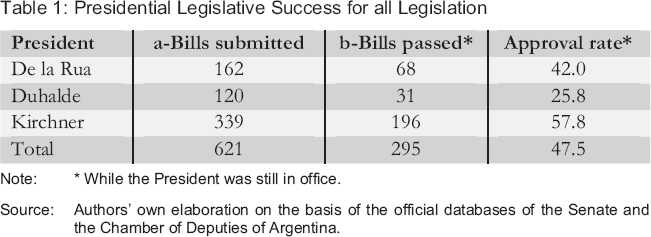
Since the database focuses only on a small universe of presidential bills approved with amendments, it is convenient to provide additional information in order to contextualize the legislative success of the presidents under study. Table 1 provides information about the legislative success of each of the presidencies analyzed here. 12
Presidential Legislative Success for all Legislation
Presidential Legislative Success for all Legislation
Note:
While the President was still in office.
Source: Authors’ own elaboration on the basis of the official databases of the Senate and the Chamber of Deputies of Argentina.
See Calvo (2007) and Alemán and Calvo (2008) for articles focusing on this aspect of legislative success.
The table shows that President Kirchner was the most successful in having his initiatives passed by Congress. This should not be outstanding given that Kirchner was the only of these presidents to serve a full four-year presidential term, and could count on a legislative majority over most of his administration. Likewise, the poor performance of Duhalde should not be surprising given the fact that he lacked a popular mandate, since he was elected by Congress.
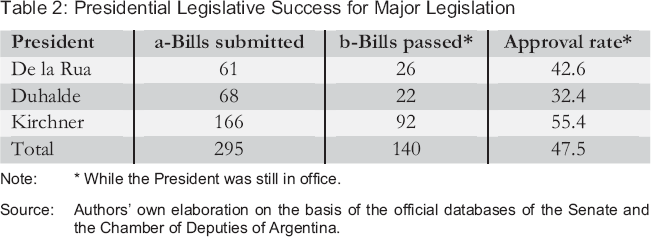
It must be noted, however, that Table 1 includes bills usually regarded as minor pieces of legislation, such as international agreements and the yearly authorizations for the President to leave the country. The whole picture, though, is barely different if we exclude these bills, which usually amount to nearly half of all bills submitted by the President, and consider only major legislative pieces. 13
These minor pieces represented 62 percent, 43 percent and 51 percent of all the presidential bills enacted for De la Rua, Duhalde and Kirchner, respectively.
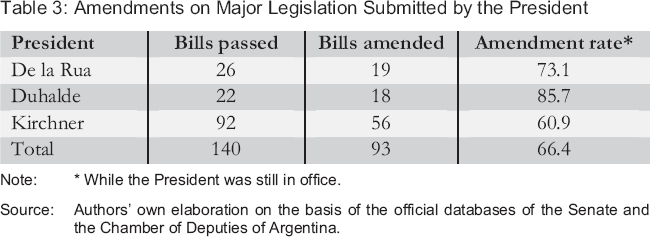
Table 2 shows again that the Kirchner presidency was the most successful in having its initiatives passed by Congress, followed again by De la Rua's. In both cases, the rate of success is about the same as that concerning all legislative pieces, while Duhalde improves his rate of passage when only major bills are analyzed. Although approval rates are not the focus of this analysis, these figures could be used to assess whether the patterns of approval and amendment rates are similar. Table 3 provides preliminary information on amendment rates.
Presidential Legislative Success for Major Legislation
Note:
While the President was still in office.
Source: Authors’ own elaboration on the basis of the official databases of the Senate and the Chamber of Deputies of Argentina.
Amendments on Major Legislation Submitted by the President
Note:
While the President was still in office.
Source: Authors’ own elaboration on the basis of the official databases of the Senate and the Chamber of Deputies of Argentina.
The table shows that none of these presidents were able to get even half of their bills enacted without amendments. Yet, again Kirchner has been more successful in having his proposals passed without any amendments than the other two presidents. The rank order of the cases is the same for both approval and amendment rates, as is the distance between cases measured in percentage points. 14 Still, we are more interested here in the extent of the amendments that in their frequency. In other words, while frequency only shows that an amendment has been made, the aim of this analysis is to assess the extent to which these amendments changed the intent of the President. For doing so the paper focuses on the 93 amended bills reported in Table 3. 15
It must be recalled that amendments coded 5 in the Barrett and Eshbaugh-Soha Scale include minor modifications such as corrections of grammatical or factual errors. If we exclude bills with code 5 amendments, the amendment rates would be 38 percent, 62 percent, and 23 percent for De la Rua, Duhalde and Kirchner, respectively. Thus, popularly elected presidents would be successful in getting the majority of their bills passed without (significant) amendments while Duhalde's amendment rate would remain high.
In this article we focus exclusively on bills that were approved with modifications, excluding both bills approved without modifications (i.e. the cases where presidents got exactly what they asked for) and non-approved bills, many of which were also modified on the way before dying at some point of the legislative process. Note however that a large majority of bills that died before final vote (98 out of 129, or 75 percent) received no amendment at any stage of the legislative process.
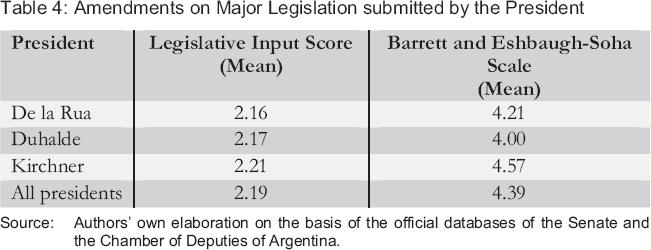
As described above, we use two different scores to measure the quality of amendments. The Legislative Input Score (LIS) ranges from 1 when amendments are proposed solely by opposition parties, to 3 when they are promoted by the President's party, and takes the value of 2 when both government and opposition parties amend a presidential bill. On the other hand, the Barrett and Eshbaugh-Soha Scale (BESS) ranges from 5 when presidents get everything they wanted even after amendments are introduced to 1 when they get nothing.
Table 4 shows little difference on LIS, but some differences appear on BESS. In this measure Kirchner is close to the ideal score, Duhalde emerges as a President able to protect the core of his proposals with some concessions, while De la Rua stands in the middle, closer to Duhalde than to Kirchner. The rank order replicates the patterns for overall success rates, major legislation success rates and amendment rates; but the scale suggests that even President Duhalde, with unusually low success rates for the Argentine standards was able to control the amendment process in order to keep the content of approved bills close to his preferences.
Amendments on Major Legislation submitted by the President
Source: Authors’ own elaboration on the basis of the official databases of the Senate and the Chamber of Deputies of Argentina.
The literature on presidential legislative success would expect that differences in legislative support, public standing, and honeymoon effects would make a difference on these scores. Presidential popularity appears to have a small effect on the level of legislative input on presidential initiatives.
Table 5 shows that the mean scores for LIS are exactly the same for both high and low approval ratings; however, the statistical correlation is not significant. BESS changes in the expected way, with a small correlation of .260 that is significant at the 0.01 level for a one-tailed t-test, increasing the value of the score as the presidential popularity rates gets higher. Still, differences are not as marked as expected according to studies focusing on success rates in Argentina (Calvo 2007; Alemán and Calvo 2008), especially considering that presidential approval ratings cluster around the high and low ends, with no cases for intermediate levels of support – i.e. between 25 percent and 50 percent. This implies that amended presidential initiatives in the De la Rua, Duhalde, and Kirchner administrations were introduced by both government and opposition legislators regardless of the presidential level of popularity, and these deals made presidents similarly able to get what they wanted. The size of the legislative contingent has a similar impact.
Presidential Popularity and Legislative Input on Presidential Initiatives
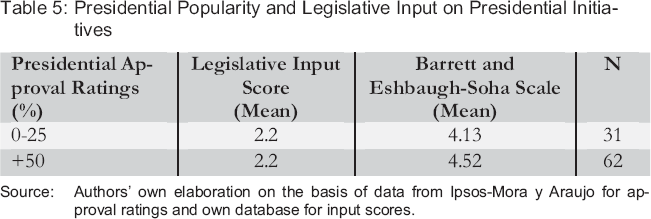
Source: Authors’ own elaboration on the basis of data from Ipsos-Mora y Araujo for approval ratings and own database for input scores.
As Table 6 shows, the mean LIS has almost no variation regardless of whether the President's legislative coalition held the majority in the Chamber of Deputies (the correlation is not significant), while BESS varied in the expected direction but with no striking differences, with a correlation of .249 that is significant at the 0.01 level for a one-tailed t-test. This implies that in the De la Rua, Duhalde, and Kirchner administrations the loss of the legislative majority by the government party had little impact on the President's ability to shape the content of the initiatives they sent to Congress. A somewhat different pattern obtains for the honeymoon effect hypothesis.
Presidential Legislative Coalition Size and Legislative Input on Presidential Initiatives
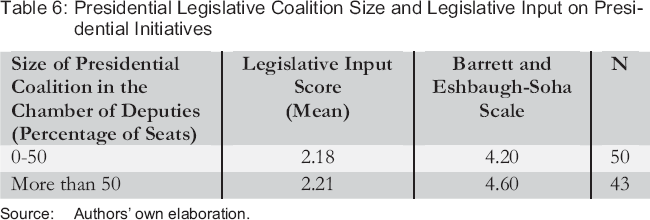
Source: Authors’ own elaboration.
As Table 7 depicts, mean LIS are consistently low and exhibit only slight variations across time: Opposition legislators appear to have had slightly more influence on the content of legislation in the first year of each presidential term though their input score is only 0.13 lower than that registered for subsequent years; yet, the correlation is not statistically significant. Figures for BESS also suggest that presidents were more successful in getting what they want on non-honeymoon years, with a correlation of -.349 that is significant at the 0.01 level for a one-tailed t-test. Although differences in both scales are small, this finding counters the traditional contention about the effects of honeymoon periods hypothesized also in this article, and fits closer to Barrett and Eshbaugh-Soha's (2007: 102) assertion that lack of experience in dealing with Congress makes incoming presidents more vulnerable to congressional pressures during the early moments of their administration.
Honeymoon Effect and Legislative Input on Presidential Initiatives
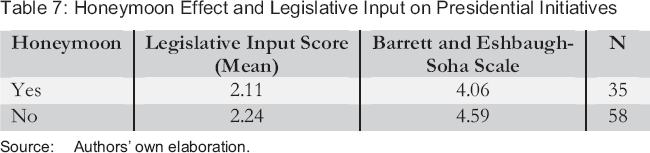
Source: Authors’ own elaboration.
Thus far, these findings give limited support to the above stated hypotheses: Both approval rates and legislative contingents have small, albeit significant effects on the value of BESS, with signs in the expected direction, while honeymoon has a small and significant effect but with signs in the opposite direction. LIS correlations have even smaller values, not significantly correlated to any of the variables, not even BESS. The latter is somewhat problematic since it suggests that LIS and BESS may not be measuring the same thing. 16 Furthermore, the fact that values for LIS are close to 2 means that most amendments are passed on a cross-partisan basis, which raises two questions. First, what are the conditions leading these cross-partisan agreements to produce amendments closer or further to the presidential intent? Second, and foremost, why are these amendments usually close to the presidential intent – i.e. scoring 5 or 4 in BESS? Here we propose two possible explanations for the latter, in which anticipation and institutions are the usual suspects.
This would also rule out the usefulness of LIS as an independent variable for BESS, as suggested by one of the anonymous reviewers.
Anticipation means that presidents would foresee the preferences of legislators in Congress and only send bills they know are approvable beforehand. According to this reasoning, to avoid a defeat in Congress, presidents would gather information on the preferences of legislators, and would only send bills they are sure would be passed without major amendments. For sure, this kind of strategic thinking is present in every presidential decision in relation to Congress. Yet, it seems inaccurate as an explanation of the reported facts. Firstly, because while anticipation could account for the mildness of the amendments introduced by Congress, it would not account for the reason why bills are amended at all in the first place. Secondly, it would not explain why most of the bills presidents send to Congress never reach a final vote on the floor. Finally, because the anticipation argument assumes that the bills the presidents initiate reveal their true preferences, and that lack of treatment of a presidential bill is equal to its explicit defeat. In fact it could be argued that, precisely to anticipate congressional reaction, presidents send bills farthest from legislators’ preferences in order to minimize losses during inter-branch negotiations.
The second explanation concerns agenda control rules and the reactive powers of the president. According to this argument, presidents would not care much about gathering accurate information on legislators’ preferences in order to anticipate their reactions since there are procedural powers at hand for the president's party to block unwanted amendments – which would allow presidents to shelve in committee bills that would only be approved in such amended versions that the status quo would be preferable. Furthermore, presidents in Argentina have a strong veto, so they can delete from bills any addition they deem unacceptable, or the whole bill altogether if approved in such a distorted version that makes the status quo preferable. In this case, anticipation would occur on the side of legislators, who would have to decide whether to invest their scant time in bills that would most likely be vetoed by the president. In those cases, the Congress would have to choose between passing no law, or passing a version acceptable to the president. In short, then, Argentine presidents would be similarly successful in the substance of legislation because they have institutional tools to counter or discourage amendments inconsistent with their position. This institutional explanation is akin to what the cartel theory of legislative organization contends: that the (majority) party cartel's success in Congress is due to its agenda control. However, the theory's application to Argentina (Jones and Hwang 2005) uses all legislative activity, instead of just lawmaking, as its dependent variable, and makes no inquiry or distinction into the substantive content of legislation. Further research on roll calls and committee alignments would be required to test this explanation over LIS and BESS.
This paper has shown that the variables usually employed to account for presidential agenda success do not hold when the focus of analysis is the substance of legislation. By probing into the legislative process and assessing the level of legislative input on presidential initiatives, we have shown that – at least in the case of Argentina – presidents can consistently shape the substance of the bills they present to Congress regardless of their popularity, the size of their legislative coalition, and the honeymoon period.
Our findings suggest that the literature on Executive-Legislative relations should incorporate the issue of legislative substance and reassess its claims on the basis of new analyses that explicitly account for this dimension of legislative activity. If unpopular presidents get as much legislation approved close to their preferences as popular presidents do; if presidents in their honeymoon, and congressionally-dominant presidents also get their way as much as their exact opposite types, then different independent variables should be proposed and analyzed in order to understand how these patterns obtain.
Consequently, research on presidential agenda success should develop along at least two different lines. On the one hand, it should strive to construct new measures of the substance of legislation and/or refine the ones proposed in this paper. We acknowledge that our legislative input scores require the strong assumption of identity of preferences between the President and the presidential party in Congress. This assumption may of course not obtain if parties are not cohesive. To correct for the classification mistakes this assumption may lead to, measures that take more detailed account of how the legislative process enables individual legislators to express their dissidence and/or propose constructive amendments need to be developed. This is crucial to test the cartel theory explanation in Congresses with few roll calls. We also recognize that more sophisticated statistical analyses should be carried out in order to increase the confidence in our findings.
On the other hand, research on presidential agenda success should probably bring the issue of presidential leadership into the forefront. If presidents may obtain what they want from Congress both when they are strong and when they are weak, then their ability to lead might have something to do with such remarkable feat. Developing more tractable measures of presidential leadership and its likely impact on the substance of legislation is thus a pending task for the comparative politics of Executive-Legislative relations.