



Abstract
How do political parties guarantee enforcement of a clientelistic exchange? This research note empirically supports a catalog of clientelism compliance enforcement tactics. It also suggests that by focusing on the personalization of tactics and the constraints they place on individual voters, we can evaluate how intrusive these tactics are and further help to bridge existing instrumentalist and reciprocity theories of client compliance. The supporting evidence comes from interviews carried out with 73 elected Argentine local and provincial officials. How persuasive or coercive the tactics need to be to make clients comply with their part of the bargain has implications for our understanding of the legitimacy of the clientelistic bondage and our assessment of the roles of patrons and brokers in such exchanges.
Introduction
Clientelism is pervasive in many new democracies. It is based on patrons (usually politicians) giving clients (usually voters) particularistic benefits (e.g., money, food, and favors) in exchange for electoral support (e.g., votes). This practice requires that political parties use different forms of communication with voters, various amounts of resources, and different types of organization according to the setting. At least two distinct party activities can be identified in clientelism, irrespective of the context of the clientelistic exchange: giving (or promising) benefits to voters (this may require prior knowledge of the district and voters via local brokers) and enforcing the exchange with a range of, what I term, compliance enforcement tactics (CETs), which include monitoring, 1 vote-buying, or turnout-buying, inter alia. This research note focuses on the mechanisms of this latter party activity.
A variety of definitions of “monitoring voters” are provided by Medina and Stokes (2007: 82), Kitschelt and Wilkinson (2007: 8, 19), Larreguy Arbesu (2012), and Lawson and Greene (2014).
The comparative literature explores different aspects of the clientelistic relationship. Susan Stokes (2005) and Brusco, Nazareno, and Stokes (2004) examine “vote-buying” in Argentina, arguing that party operatives can observe and make inferences from voters’ attitudes and behavior (also see Auyero 2001). Nichter (2008) argues that “turnout-buying” is a better explanation of Stokes’ evidence. In fact, both are aspects of a clientelistic exchange (see Stokes et al. 2013; also, on enforcement see Stokes 2005; Calvo and Murillo 2004). 2
Works like Szwarcberg's (2013) focus instead on client mobilization to political rallies.
CETs can vary in the degree to which they intrude on an individual client's voting process. Intrusiveness refers to the party's interference with the voter's autonomy to vote freely (e.g., Dahl 1996: 645). From a political party perspective, costly CETs – such as monitoring tactics – would ideally not be needed, because clients would fulfill their part of the bargain and support the patron as a matter of reciprocity. Political parties’ limited capacity to monitor voters may also be a reason for the absence of more intrusive tactics (Lawson and Greene 2014: 69). Indeed, some authors argue that there is a “norm of reciprocity,” “reciprocal obligation” (Lawson and Greene 2014: 61), and loyalty (Lomnitz 1988: 7, on “subordination,” 47; Auyero 2000: 73; also see Neufeld and Campanini 1996; Roniger 1997; Trotta 2003: 146). I see client reciprocity as the consequence of multiple and/or significant positive interactions between the patron and client. For example, a voter may feel compelled to vote for a patron-politician who paid for his daughter's surgery. 3 Political parties invest time and resources to benefit particular voters in order to generate reciprocal obligation among clients. Recognizing this role of political parties complements instrumentalist theories that focus on the monitoring and threatening tactics employed to make clients respect the clientelistic contract (e.g., Szwarcberg 2013). Client compliance may be achieved through a variety of tactics, ranging from deeds and gestures (which generate feelings of reciprocity) to coercion and intimidation. I argue that a CET's degree of intrusiveness toward a client depends on how personalized (as opposed to how anonymous) and how intimidating the tactic is. Hence, political parties achieve client compliance with both persuasion and coercion.
Survey data gathered by Lawson and Greene (2014: 65) supports this argument.
Qualitative case-study research provides the best accounts and descriptions of the tactics (the processes and meaning involved) used by political parties to enforce clientelistic exchanges (e.g., see Auyero 1997, 2001; Álvarez-Rivadulla 2012; Lazar 2004; Urquiza 2005 and Zarazaga 2014) Yet, there is no systematic study of CETs; most studies are based on, and thus biased toward, large and/or relatively wealthier cities and districts.
Case Selection, Method, and Data
This study uses qualitative data obtained from 73 semistructured interviews containing open-ended questions posed to local and provincial elected officials. I make descriptive inferences based on four provincial cases with sample sizes of 15–20 interviews each and then suggest indicators to measure how personalized and how coercive those practices were to voters.
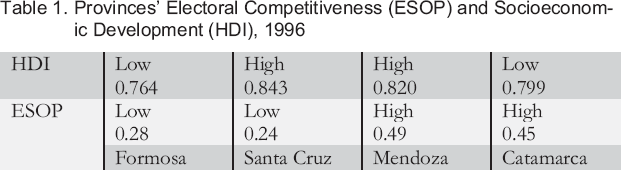
I conducted field research in 23 localities with as little as 1,067 inhabitants in four Argentine provinces (Catamarca, Formosa, Mendoza, and Santa Cruz) between March and November 2006. The four districts are diverse in terms of electoral competitiveness (Effective Strength of Opposition Parties, ESOP) 4 and socioeconomic development (Human Development Index, HDI) (see tables 1, 2, and 3). 5 Next I examine what type of CETs are employed in the four selected districts; I identify and illustrate seven types of tactics.
Provinces’ Electoral Competitiveness (ESOP) and Socioeconomic Development (HDI), 1996
Populations of Localities of Local-Level Interviewees (Index 2001)
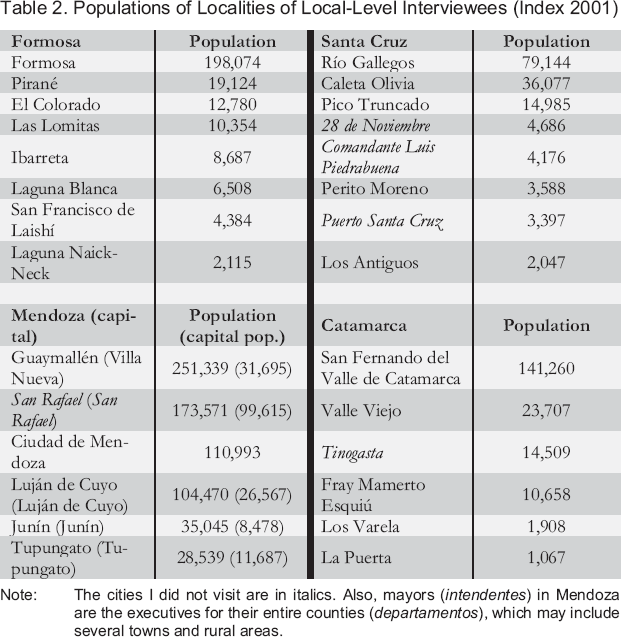
Note: The cities I did not visit are in italics. Also, mayors (intendentes) in Mendoza are the executives for their entire counties (departamentos), which may include several towns and rural areas.
Interviews Conducted with Elected Officials
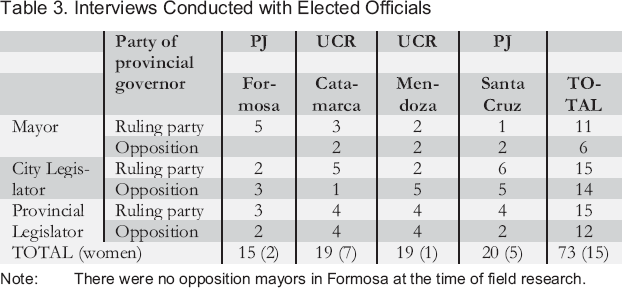
Note: There were no opposition mayors in Formosa at the time of field research.
I show elsewhere how Laakso and Taagepera's (1979) Effective Number of Competing Parties (ENCP) is an inappropriate proxy for competitiveness and how the Effective Strength of Opposition Parties (ESOP) index is more appropriate (Lisoni 2012). My measure averages competitiveness for all gubernatorial elections in the period 1987–2003. On the relevance of focusing on gubernatorial elections instead of local elections, see (Lisoni 2017: 146).
To further verify the “capacity” of citizens in the four cases, see the GADIS (2004) study on the development of civil society in Argentina, which generally supports my classification of cases. It found that Formosa has “Little relevance of an associative tradition” and a “very low level of citizenship participation,” that Catamarca has “low institutional articulation and participation in networks” and “Low citizen participation,” that Mendoza has “High coverage and citizenship participation,” and that Santa Cruz has a “Very high level of institutional articulation and participation in networks” but only “Moderate citizenship participation.”
Catamarca: Persuasion and Coercion to Enforce Compliance
Here, I illustrate the pervasiveness of clientelism in Catamarca and provide accounts of specific CETs. Clientelism is characterized by the large quantity and the last-minute distribution of particularistic benefits, such as money, food, and job promises, among other things. Deputy Victor Brandán, a Peronist in the UCR-led Frente Cívico y Social (FCyS), had this to say:
I am not saying it happens all over the province. I mean, people from downtown [the provincial capital] and the middle class or richer are very difficult to buy with a bag [of food], a bed, and a pair of shoes. But I do not think that is actually buying the vote. For people sleeping on the floor, all of a sudden, somebody shows up. It might be a politician or not, because it could be someone from an NGO giving them a bed, a mattress, shoes. It is likely that people will be eternally grateful […]. And if later that person asks them to support his candidacy with a vote, they will do it because they are grateful for the solution he brought. […] Oh well, it is part of the idiosyncrasy, part of the tradition related to the way of doing politics in these regions […] we believe are not proper. But it should be agreed among all political parties. If someone decides not to use the methodology of handing out things, then all parties should decide not to do so. Because otherwise, if handing out things allows you to win, undoubtedly it would not be fair play.
Deputy Salcedo (Unión Cívica Radical, UCR) characterized giving benefits as part of their job as politicians, while acknowledging the quid pro quo that:
Even if it is an exchange, a vote for a gift […] If we say we are politicians and want to improve people's lives, giving things to people is not a whim. […] People know they can request things during a campaign. During a campaign things are often handed out without organization, which could produce better results if it were officially organized during a term of office. […] But people do not get this idea of “process.” The positive effect is achieved in the last five days of the campaign.
Senator Figueroa (Peronist) argued that “One can campaign without money, but if one wants to campaign to win, then you need money. People need solutions right then, not later.” Councilwoman Stella Ramos (Valle Viejo, UCR) pointed out that:
When you go to a home to ask for a vote, I think that 70 percent ask for some material benefit for themselves: a job, funds for their kid who is a student, construction materials for the house, or medicines.
Mayor Humberto Valdez (Fray Mamerto Esquiú, UCR) made a similar point, contending that:
There are groups that make the most of it. “If you come, don't come empty-handed.” What do they ask for? Beds, mattresses, shoes, some bags of food. It is the most common thing […] to all parties though, “If you don't bring anything, don't show up!”
Mayor Marcelo Saavedra (Los Varela, PJ) seemingly defended this practice, arguing that:
The issue of gifts [dádiva] will always exist […] but we think that [giving a person] a contract making 150–200 pesos [a month], at least to survive, [is better than nothing]. [Helping] is what politics is for; it is not just to fill your pockets [llenarse el bolsillo].
In fact, Mayor Javier Morra (La Puerta, PJ) claimed that he “send[s] people house to house, see[s] the needs, and […] solve[s] the problems from the municipality.” Meanwhile, Senator Jesús Albarracín (PJ) said he:
visited every 15 days. We went up [the mountain], brought medicines and we distributed them monthly. That's what people see […] Those from the Frente Cívico [incumbent coalition] do not go to the mountains [los cerros], only when they need the vote. And they bring quicklime, cement, corrugated iron.
These accounts show that machine clientelism is practiced openly and is admittedly effective.
Cash on Site
According to Senator Figueroa:
You cannot buy 7,000 votes, it is impossible. But you can buy 50 to 100 votes, which in the end decide the election. In 2005 we were comfortably winning until 4 or 5 p.m., and the mayor got a phone call saying, “You are losing the election. Why don't you go and take your place?” And he did with a briefcase. […] We lost in a constituency of 7,000 by only 200 in the last stretch. The mayor beat us because he spent ARS 50,000 in the last half hour. He stood up at the school and simply paid for votes.
Figueroa's anecdote shows how close elections can be and also that political machines have the capacity to monitor how people vote. It also reveals that a mayor avoided prosecution despite his questionable and intimidating actions. This behavior would only need to affect the votes of a small number of clients to be effective. As Councilwoman Lia Quiroga (Tinogasta, UCR) points out:
the last day there are people who pay for votes, with money. […] And yes, that can turn an election – even more so in a town where the difference between parties is small, 60 or 100 votes.
Making cash payments at polling stations or using “chain votes” 6 reflects a very personalized and immediate attempt to control the client. These tactics are not necessarily widespread, but I found several instances thereof.
Precinct authorities hand out an envelope with their signatures to each voter. In the “chain vote” a voter introduces a counterfeit envelope in the ballot box and hands out the original, legitimate envelope with the official signatures to a broker outside the precinct. The broker then gives the envelope with the “correct” paper ballot to the next client, who in turn gets money from the broker in exchange for a new empty legitimate envelope from the precinct. When counting the votes, only one envelope will be invalid.
Rides to the Polls
Salcedo describes the logistics and tactics used to achieve compliance, thus revealing the party organization and capacity required to mobilize voters:
I saw people with little education […] they take their ID cards and escort them [to vote]. […] Another strategy we've used […] was to have an acquaintance go all the way to the school, to the ballot box, talking to him. […] It is illegal. You bring me three voters, and I wait for them in a predetermined place on the sidewalk [across from the school] (because of the police), and I talk to them, and perhaps those last words convince them. […] We have a provisory voters’ roster [padrón], in which you take the time to find out who is dead or unable to vote. […] And you give a roster to each of your party delegates [fiscal de mesa]. […] We use a spreadsheet, 1 to 300 and begin crossing them out, so we know who we need to get. We do it all day. Since someone has a roster in the car: “Number 31 is missing!” We go to get him and talk to him in the car about our childhood […]. Until two minutes to 6 p.m., whatever else we can inside [the school].
With the help of (incompetent or corrupt) polling officials, people can vote with someone else's identification papers – a practice that party workers try to avoid being affected by. It is important that party activists know the roster when making a final attempt to sway voters. The tactics they employ require a significant amount of party resources, staff, and organization and, ultimately, put at least a few poor (and perhaps also uneducated) voters in intimidating situations.
Infrastructure providing access to polling places is often lacking. The transportation logistics for election day are thus expensive, but the votes of people in the mountains (as few as 70–200 in some counties) are indeed important to many officials. Figueroa explains that “Out of 7,000, 400 are given rides. […] But those 400 can decide the election.” Deputy Burgos recalls:
we rent three 4×4 trucks. We have to bring them [people] things […] all the food. We gather them in just one locality. There are no roads. [We rode] On horseback, ARS 200 for each horse. It is expensive because of the campaign. […] We have to go one week prior [to the election]. […] we use our own resources. ARS 7,000 each bus from Tucumán to Santa María [Burgos's county].
Burgos points out that elections are close, and that they once lost by a mere 100 votes.
Describing the details of election day mobilization in a more urban setting, Mayor Jalile (Valle Viejo, UCR) explains that “Each broker has a personal roster of 30 people, and the mayor provides gasoline and/or cars for those going to vote.” Well-organized parties, such as the PJ and UCR in Catamarca, have a clear idea of the number of votes they get this way.
In Argentina it is very common for parties to help voters’ reach polling stations by giving them rides. These rides may be arranged one-on-one with the client or collectively by a local broker. Clients experience different degrees of intimidation when accepting (or refusing) rides from brokers. It is not just a feeling of gratitude that makes clients fulfill the exchange; the physical proximity between brokers and clients also plays a role.
Body Searches (Clients as Property)
[Elections] are fought, to the last vote. […] Two years ago, we won the [Provincial] Senate race by one vote. […] I may not be a fair player […] it is difficult […] but people [rival activists] come from out of town, stand at the [school] door, and take people's ballots and replace them with theirs. […] They scuffle. […] Our militants ensure that does not happen to us. You have to protect them [voters] so it does not happen to you […] the people that we bring […]. It happened here that they gave ARS 20 per vote, up to ARS 50; however, they didn't do well. […] It's all about the trust and security they [voters] have. […] Nobody is left unattended; we get the last person [to give her or him a ride]. […] We even find the 70-year-olds, get them, and wait until they come out [from voting]. (Mayor Saavedra, PJ, Los Varela)
In order to enforce clientelistic exchanges in rural areas, the logistics have to be considered – such as having local brokers pick up voters from distant homes. Saavedra refers to the people his party brought to vote as if they were his property.
Burgos said, “Our brokers inspect them to make sure they do not have other parties’ ballots.” Party activists are careful to lead people as close to the voting booth as possible. For example, they make sure that men do not carry their ballots in see-through shirt pockets so that their votes remain secret and are not declared invalid. Moreover, due to the competitiveness of rural elections and the lower education levels of rural voters (who can be influenced with less resources), party activists are vigilant and even intrusive of voters’ privacy. This is not an uncommon CET.
Formosa: Ensuring Loyalty through Persuasion
Formosa had high levels of poverty and noncompetitive elections (see appendix). The seeds of personalized clientelism are planted and tended by patrons and bear fruit in elections. Campaigns in Formosa only practice machine clientelism as a tradition; in most cases it does not influence election outcomes. Elected officials tend to keep benefits flowing to the electorate in order to reinforce loyalty. Officials are directly accountable to their community and must keep their support base happy if they do not wish to see their legitimacy and leadership challenged. In small towns people know mayors personally and do not want to talk to anyone who does not have the power to help them. An important feature of this relationship is the personal bond that is created. Besides supporting the cult of personality in such towns, it also nurtures clientelism between constituents and mayoral electoral machines.
Cultivating Loyalty
Today there were three urgent cases that had to travel to Formosa [city's hospital 300 kilometers away]. I had to give them a solution, a subsidy that they pay back later. When they return [from the hospital], we will buy them their medications. […] On giving out food and supplies […] If it is during the campaign, I don't go out to do it; I have my people for that. […] They say they come in the name of the mayor. You can match the quantity of things; the difference is if they believe in you. (Mayor Meza, PJ, Las Lomitas)
The indigenous people […] visit the party offices […] to get things, but you don't know whom they vote for afterward. Inside their community there are people that answer to and identify with us. But you can't obligate them; you have to persuade them. And you aren't going to do that on the day of the election; you have to do it over time. (Mayor Brígnole, PJ, El Colorado)
In short, people go where they can get the most benefits, but there is a pre-existing trust between an incumbent mayor and the electorate that is difficult for rival candidates to counter. The loyalty and reciprocity clients give in return for the benefits received or promised are the consequence of multiple satisfactory interactions. Loyalty, specifically, requires a long-term investment on the part of party operatives (usually brokers or local patrons). The resultant reciprocity reflects the client's recognition of the legitimacy of the broker and/or patron. Therefore, a mayor needs a network of brokers in situ to report back on and manage the mayor's standing in the community.
Giving Rides and Hosting Clients
Some voters live up to 70 kilometers away from the polling stations, and thus rides have to be organized by the political parties several days prior. Rain can be an insuperable hazard to voters because dirt roads become impassable. Parties arrange to bring people days ahead of time, house and feed them at school gyms, and – of course – provide them with their paper ballots. Even if the election in question is not a mayoral contest, it is still the mayor who coordinates this campaign effort. Mayor Oviedo (San Francisco de Laishí, PJ) stressed that the “forty small cars and fifteen pickup trucks” used by the PJ were “all private vehicles” and that no municipality vehicles were used for the party's benefit. For many people, simply going to town for the day means a chance to get a free ride and food; it is a sort of festive event.
In 2003 an investigative reporter alleged to have “uncovered” evidence of illegal campaign practices during the electoral processes in several of the poorer provinces in Argentina (Clarín 2003). One claim in the report was that candidates contesting the 19 October 2003 election in Lugones, Formosa, collected more than 150 poor natives from the rural areas and kept them in warehouses for up to two days before the election. They were purportedly given ballots that were individually folded in a certain way so that their compliance could be determined by campaigners during the vote count. According to the report, people were promised money, food, or cheap roofing materials for their houses. Referring to this topic, Mayor Meza said that “The municipality brings them water, the plans [government subsidies], 7 etc. They want to vote, but you have to go get them.” Interestingly, PJ officials see this as something of a noble act, as these poor people – many of whom do not speak Spanish – would probably not vote otherwise. Neither the market nor political parties (besides the Peronist PJ) reach these people. The personal contact the mayor has with voters, their familiarity with him, their general awareness of his virtual monopoly on resources, and, again, the mayor's display of assets and coordination during the election process probably intimidate voters and signal an inevitability about the electoral outcome.
The plan Jefes y Jefas de Hogar was a nationally funded program that gave ARS 150 (USD 50) per month to underprivileged adult applicants with children. Recipients were required to work four to six hours daily. However, the initiative was called into question due to officials’ discretional use of it. In August 2006 there were 45,473 beneficiaries in Formosa (1 in 10 of any age). In the town of Las Lomitas, which has a population of 10,354, there were 1,505 recipients (1 in 7 of any age). There, there were 24 beneficiaries with the last name “Palomo” (Source: Ministerio de Trabajo). This shows how mayors give subsidies to underprivileged indigenous families in their areas. Mayor Meza of Las Lomitas said that he preferred to give some people subsidies and not have them work for the municipality (because they would simply be “in the way of things”) or in their communities (because they are “impossible to control” or “it is in their culture not to work”). For more on the clientelistic use of a national program at the municipal level, see Weitz-Shapiro (2012).
In many rural areas of Argentina political parties arrange to host people who live far away from polling stations. A feeling of gratitude for this service (benefit) may be present, but the intimidation created by the situation is evident: party operatives pick people up from their homes and feed and house them in an unfamiliar place. In such a context, brokers and patrons project a sense of control; and clients, of dependence. Thus, it stands to reason that clients might feel they are being watched.
Santa Cruz: The Incidence of Patronage
Deputy Omar Hallar (UCR): What happened with [former governor] Kirchner is that he used political clientelism very well. Look, this province – which has 200,000 people – pays 45,000 salaries: public employees, be they provincial, national, municipal; retirees of those three branches […] If you multiply by 4, it means there is a public employee in each family. […] The only, quote, unquote “industry” is public administration. They did not want to change that. […] Why? Because it is easier to hold people who are tied to a [government] salary, a [government] subsidy, to a house built by the state, public employment. Those people are above the poverty line, they don't need handouts to survive, but they need it to live because they don't want to work. They want to continue receiving, and Kirchner understood that very well and got three terms in office. […] And then what happens? They [public employees] know that during elections if they don't vote for the one who appointed them, who hired them…
Interviewer: Are those people threatened?
Hallar: No, the system leads you to that.
Interviewer: Do they fear losing their job?
Hallar: Of course. […] Kirchner carried out public works projects […] the port […] but nothing that actually changes people's lives: industry, economic development.
In Santa Cruz relatively low-paid public employees who are seemingly tied to the administration are susceptible to pressure to support the incumbent administration. However, these employees have not necessarily been explicitly threatened by “patrons,” most likely because a state/ government job or subsidy is “the most secure option they have” (Deputy Aguiar, PJ). According to “Quique” Campaña, the UCR's senior provincial legislative advisor, “most people buy, sell, or work for the state and speaking against it can mean isolation.” Paraphrasing different interviewees, basically all the jobs in Santa Cruz's towns are tied to the government one way or another. And commerce is tied to the salaries of public employees, while the media is tied to government sponsorship. The towns themselves are tied to the money coming from the provincial government.
Demanding Clients
Most accounts reveal that it is the voters who ask for government jobs and expect and demand solutions to their problems. 8 Interviewees implied that there is a local culture that is also being fueled by people moving from other provinces. For example, Councilman Saa (UCR, Río Gallegos), complained that Santa Cruz:
For example, in 2009 a group of unemployed protestors climbed a public water tower and threatened to jump if they did not receive jobs – which is not an uncommon tactic. The local government agreed to find the men jobs with oil companies and provide the women with paid training of some sort, among other benefits (El Patagónico 2009 and Tiempo Sur 2009).
is a province with too much public employment and has little private business. […] There are people without problems who ask for things […] there are many foreigners who make the most of this situation – not foreigners, but people not from this province, from the north [i.e., the rest of Argentina], looking for jobs, looking for subsidies and government help. It's not their fault. I believe that somehow we have accustomed them to those ways.
Mayor Roquel (UCR, Río Gallegos) appeared to agree, saying that Santa Cruz is:
A state that generally has acted with a focus on welfare and, I don't want to generalize, but there are people who are accustomed to that.
Appalled by the clientelism in place, Deputy Hallar (UCR) said that:
People come here […] [and expect] that the state must give them a house […] a job […] a bag of food. […] Anyone who comes here to the province; they also want to leave their job because of the retirement. It is far better to have a retirement from the province than from the national state or from a private employer.
Councilwoman Reynoso (PJ, Caleta Olivia) expressed a similar sentiment, claiming that:
People want to be municipal workers. […] work 6 hours sitting in a place […] And they want a job for life. They want to sit in one spot and retire.
These and other officials not quoted here seem to agree that having a wealthy provincial state and a weakly diversified economy becomes an incentive for people to flock to a “sugar daddy state.” Patronage has been used for years to keep social peace and standards of living, which eventually bears fruit in elections. 9
The percentage of the Santa Cruz population (of any age) with a provincial or local government job is 11.8 percent. In Mendoza it is 4.8 percent; in Formosa, 7.9 percent; and in Catamarca, 9.4 percent. These figures do not include jobs with public companies or official banks. Source: ASAP, based on data from Secretarías de Hacienda y de Asuntos Universitarios, Dirección Nacional de Coordinación Fiscal con las Provincias and INDEC.
CETs in Patronage
Most people end up being employees of municipalities or of local branches of [the Departments of] Public Services or Provincial Roads. Everything relates to the state, especially in small towns where commerce depends on the state. (Councilman Naim, PJ, Río Gallegos)
Clientelism mostly takes the form of patronage and generally affects low-paid public employees, such as police officers, teachers, municipal workers, and any other employee whose position depends on political appointment. The tactics used in the patronage strategy are very subtle at times and do not necessarily occur with greater frequency during electoral campaigns. For example, keeping employees as “hires” (contratados) rather than full-time workers (de planta) ensures there are no unions involved, no binding contracts, and no major benefits paid and leads employees to hope that they will eventually secure full-time status if the right party wins the election. Another example concerns schoolteachers, where raises are given as “bonuses” instead of as part of the formal salary and thus are not used to calculate retirement benefits. Another tactic used to control the labor force is to reward good monthly work attendance (presentismo) – for example, 50 percent more pay for that month. This tactic is used to discipline the labor force and weakens unions by making strikes significantly financially costly for employees.
The big oil companies in the district financially contribute to many of the government programs that aid the unemployed because doing so helps prevent protests and road closures, which would interrupt the running of their very profitable businesses. Patronage is thus needed to keep the “social peace” in a relatively more organized and mobilized civil society than Formosa or Catamarca. 10
Nevertheless, large-scale protests occur, with significant consequences to the provincial state. For example, the lack of production caused by day 13 of a 19-day strike by oil workers was costing the province, on average, “USD 580,000 a day in oil royalties, and some USD 150,000 from gas,” which represented “20 percent of the monthly salaries paid by the provincial state” (La Opinión Austral 2009).
CETs are public policy measures or widespread threats applied by incumbent parties to strengthen a sense of asymmetry between them and their clients and to often induce compliance from public employees. CETs can be applied to large groups of employees (e.g., teachers or municipal workers) or smaller groups (e.g., municipal bus drivers). Usually, jobs, salaries, or other benefits are on the line for the clients. In Santa Cruz the state apparatus is used to threaten and/or punish public employees.
Mendoza: Coercion and Patronage
Mendoza is a district with a high level of socioeconomic development and competitive elections. Officials from the three major parties seem to agree that patronage is carried out at the municipal level. But on the question of how relevant it is to electoral outcomes, Peronist deputy Guillermo Carmona (PJ) said:
it is pretty determinant of the [party internal] election results. […] In the general election, it has a smaller impact […] [because] people are required to vote, and hence it is less feasible to control who people vote for.
Clientelism's relevance is limited in general elections in Mendoza given the small proportion of people who are poor or dependent on government employment or benefits. Clientelistic tactics can also be adopted by opposition candidates backed by resource-rich districts/cities in a competitive province. Mayors, in particular, count on patronage tactics affecting public employees and financially dependent local NGOs. In larger cities this job is delegated to other actors, such as city councilpeople, but also loses relevance and reach given the prevalence of other campaign tactics (e.g., the use of the media). Decentralized decision-making and the minimal importance of clientelism in general election campaigns translate into limited party logistics and resources dedicated to clientelism (see Lisoni 2012).
CETs in Mendoza
The pressure put on public employees can vary from a public endorsement of a candidate by their bosses to explicit intimidation. According to Carmona, there was a:
case of public employees who were visited in their homes to warn them […] on behalf of municipal authorities […] that they had to quit our party faction or they risked being moved, having their positions changed, etc. Those cases exist.
These clientelistic practices are used by the UCR, PJ, and Partido Demócrata (PD).
Carmona explains that party delegates (fiscales de mesa) coerce public employees and monitor their votes by marking their voter envelopes with a different signature:
In this way they [party leaders] can verify how many municipal employees voted for the incumbent list and whether someone voted otherwise. They can then use the roster to try to figure out who voted for opposition candidates. 11
There are about 300 electors registered to each precinct. The precinct authority (presidente de mesa) and party delegates later open each envelop and register each vote.
Councilman Ramírez (PJ) gives another example of the tactics of intimidation used against public employees and subsidy recipients:
The last week, […] when it seemed that the Peronists were going to win, they held meetings with all the public employees and told them “You either help us win or we have from October [election] to December [inauguration] […] to fire all of you.”
Ramírez explains that when a beneficiary of a subsidy “goes to sign the daily attendance sheet, they remind him that if they do not win, he will not keep the subsidy.”
Through meetings, telephone calls, and other types of explicit messages, individuals and groups of clients receive various threats (e.g., losing their jobs or being relocated to a different place or job) if the patron loses the election. Needless to say, intimidation and being watched are factors in this case. Accusations of patronage in the local administration of national subsidies cross party lines.
NGO Patronage
In Mendoza's larger cities mayors would meet with civil society organizations instead of doing the door-to-door work during campaigns (a task for city council candidates). Deputy Morales (PJ) explained that during the election, pressure or control is exerted:
not only over public employees. You must realize that a municipality is a network of services, assistance, relationships with agricultural producers, businesspeople, and in a given time all that sets in motion. The mayor can request the vote from a union, an NGO, whatever. And all those little structures mobilize in favor of him.
A mayor can reach out to cash-strapped civil society organizations to pressure them to commit to her or him prior to elections. Deputy Carmona points out that:
Local NGOs, […] neighborhood associations, clubs are given conditions and control is tightened on them. Civil society organizations that have some [financial] relationship with a municipal program can be brought to one political side by putting conditions on them. In some cases – particularly the neighborhood associations, the sporting clubs – they are told “Well boys, if you do not support us, you lose such and such a benefit, such and such a subsidy.”
Measuring CET Intrusiveness
In this section I focus on the degree to which CETs intrude upon a client's autonomy. The intrusiveness of such tactics is made up of two parameters: degree of personalization and degree of coercion (i.e., physical constraint and/or intimidation). First, anonymous clients have more autonomy, ceteris paribus, than those singled out by the clientelistic machine. I rated the degree of CET personalization on a scale of 0 to 2 with 0 being anonymous and 2 being personalized. A value of 1 represents partial personalization, such as being identified as part of a group. I ask whether the political party's tactic is directed to all recipients of a particular “benefit.” Can the political party machine identify or individualize the particular client?
The second parameter has to do with how coercive or persuasive the tactics are. I see persuasion as being a nonphysical constraint (e.g., implicit threats of negative consequences for noncompliant clients) and, perhaps more importantly, also including positive appeals to the patron for reciprocity. I then rate the persuasion–coercion parameter on the same scale, with 0 being no threat, no physical constraint, and/or no intimidation; 1 being mild threat or physical constraint; and 2 being physical threat, constraint, and/or intimidation. To determine this, I examine whether the patron/broker appeals for the client's reciprocity or to the client's loyalty to or familiarity with the patron/broker in order to achieve compliance. I also look at whether the patron/broker explicitly points out the negative consequences for the patron losing the election or for clients not supporting the patron.
Thus, the intrusiveness of a given CET becomes a two-digit rating, one for each parameter. When combined, intrusiveness is measured from 0 to 4 (table 4). The list of actual CETs in table 4 is certainly not exhaustive, and the tactics’ intrusiveness rankings are informed calculations based on my personal observations and interviews. Future research will require that the two parameters are operationalized according to data availability. Still, I am able to make a number of observations here.
Operationalization of CETs’ Intrusiveness to Achieve Compliance
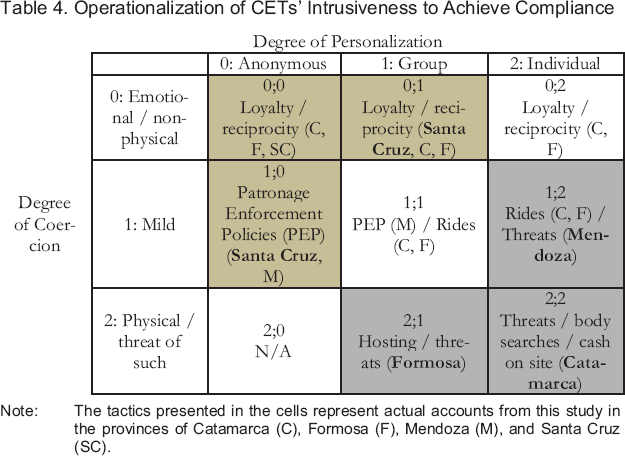
Note: The tactics presented in the cells represent actual accounts from this study in the provinces of Catamarca (C), Formosa (F), Mendoza (M), and Santa Cruz (SC).
Discussion
Clientelistic relationships between political parties and voters are contracts in which clients are expected to reward patrons with their votes. This article revealed differences in clientelistic practices and on this basis has made some tentative conclusions. For example, political parties in competitive districts (e.g., Catamarca and Mendoza) are less confident that their clients will fulfill their part of the bargain due to the challenges presented by rival parties. Therefore, parties that invest in clients in competitive districts will resort to more coercive measures to enforce compliance, ceteris paribus, than will those in less competitive districts. Thus clientelistic bonds in competitive districts may consequently be more ephemeral than in noncompetitive districts, where patrons are unchallenged.
In Formosa the presence of personalistic leaders and reciprocity account for clients’ compliance. Yet, the specific mechanisms used by dominant parties to enforce clientelistic exchanges still require substantial resources and organizational capacity in instances where obtaining high vote shares becomes necessary to revalidate patrons’ legitimacy (i.e., a modern patrimonial relationship concomitant with democratic institutions). 12
Durazo Herrmann (2012) discusses clientelism's adaptation in democratizing regimes; see also Trotta (2003).
This article provides evidence that political parties engaged in clientelism may in fact resort to tactics designed to enforce clients’ compliance with the clientelistic contract. These CETs range from acts that generate a willingness to reciprocate to acts that are fairly coercive and sometimes violent. The differences between CETs and, hence, the differences between party–client relationships revealed here call for greater discernment of the role of patrons and brokers, on the one hand, and the legitimacy of clientelism in many communities, on the other.
Footnotes
Appendix
Population Traits (%) and Formosa Governor's Election, 19 October 2003
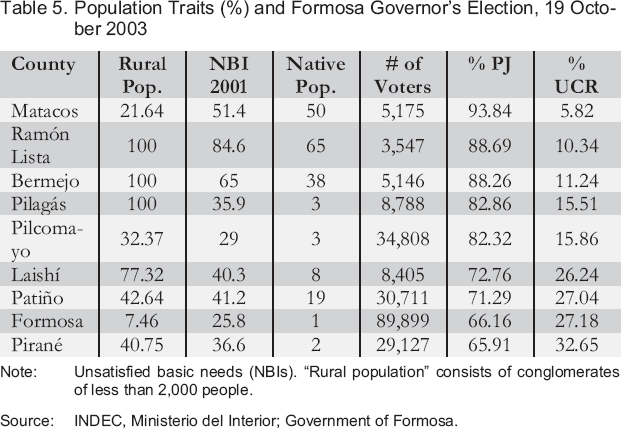
| County | Rural Pop. | NBI 2001 | Native Pop. | # of Voters | % PJ | % UCR |
|---|---|---|---|---|---|---|
| Matacos | 21.64 | 51.4 | 50 | 5,175 | 93.84 | 5.82 |
| Ramón Lista | 100 | 84.6 | 65 | 3,547 | 88.69 | 10.34 |
| Bermejo | 100 | 65 | 38 | 5,146 | 88.26 | 11.24 |
| Pilagás | 100 | 35.9 | 3 | 8,788 | 82.86 | 15.51 |
| Pilcomayo | 32.37 | 29 | 3 | 34,808 | 82.32 | 15.86 |
| Laishí | 77.32 | 40.3 | 8 | 8,405 | 72.76 | 26.24 |
| Patiño | 42.64 | 41.2 | 19 | 30,711 | 71.29 | 27.04 |
| Formosa | 7.46 | 25.8 | 1 | 89,899 | 66.16 | 27.18 |
| Pirané | 40.75 | 36.6 | 2 | 29,127 | 65.91 | 32.65 |
Note: Unsatisfied basic needs (NBIs). “Rural population” consists of conglomerates of less than 2,000 people.
Source: INDEC, Ministerio del Interior; Government of Formosa.