



Abstract
Can federal-state relations affect popular protests? Using an extensive dataset measuring local protests in the Argentine provinces (2002–2006), I assess the effects of the president's and governors’ tactical allocations on the persistence of contentious events. I analyze how the delivery of federal resources, to both provincial governments and local social organizations, affects the chances of protests occurrence and the nature of its demands. Results show that federal spending increases the frequency of protests in the Argentine provinces, particularly when provincial governments are not involved in its delivery. In addition, protest demands are sensitive to president's discretional expenditure, suggesting a different dynamics in which protests became a legitimate channel to obtain federal monies.
Introduction
In December 2001, as Argentines faced major political and economic turmoil, citizens took to the streets. 1 While middle class voters protested the government's decision to freeze bank accounts, food riots multiplied in the less well-off districts of the greater Buenos Aires area, Rosario, and Córdoba. As unemployment soared and poverty rates doubled, political elites readied a battery of social programs to manage some of the social and economic effects of the crisis. Workfare programs, unemployment insurance, and the delivery of goods provided local governments with a mechanism to deal with some of the most destabilizing consequences of the economic crisis. These federally provided resources gave local elites the instruments to manage social discontent and to fend off popular agitation.
This work is framed in the UBACYT (S027) and CONICET (PIP 1810) research projects. An earlier version of this article was presented at the meeting of the Mid-west Political Science Association, Chicago, April 2010. I thank the Group of Studies on Social Protest and Collective Action (GEPSAC) of the University of Buenos Aires for making the data on protest available. I am very grateful to Ernesto Calvo for his support and comments in the process of writing this paper and to Eduardo Alemán, Melchor Armesto, Jacqui Behrend, Marcelo Leiras, German Lodola, Julia Moretto, Alex Navarro, Mariano Tommasi and Pablo Spiller for their ideas and suggestions. The anonymous reviewers, Valeria Brusco, Jennifer Holmes, Guillermo Jajamovich, Pedro Pirez, Ivana Socoloff and Julieta Suarez-Cao made insightful comments on earlier versions. Grace J. de Haro was responsible for the edition. Omissions and mistakes are entirely my responsibility.
Five years later, however, protests were at an all time high, even though the political and economic context could not have been more different. 2 From 2003 to 2006, the economy grew a robust 8.5 percent per year, poverty declined from 57.5 percent to 26.9 percent (INDEC – Instituto Nacional de Estadística y Censos, National Statistics and Censuses Institute), and social spending increased significantly (Di Natale 2010). The question is then if the socioeconomic situation shows signs of improvement, why are people still protesting? In this article, I suggest that the federal government's coalition-building strategies help to explain the observed trends in social mobilization. When the president diversifies the portfolio of public goods to be delivered, expands the number and kinds of intermediaries in sub-national territories and allies contentious actors, provincial protests increase and governors face new challenges. 3
An action of protest takes place when one organizational effort is mobilized: regardless its duration or whether it takes place in one or many territories (GEPSAC 2006). While in 2001 and 2002, there were 294 and 319 protests; in 2005 this number rose to 702, falling to 464 in 2006 – still 59 percent higher than during the year of the crisis (GEPSAC 2009).
Federal coalitions are temporary agreements forged in formal or informal arenas to secure votes for elections, legislative support and collaboration in the implementation of policies (Schneider and Wolfson 2005). I will focus just on those agreed between the president and sub-national political and social actors. By “intermediaries” I mean those who receive federal transfers and are responsible for their reallocation in their provinces.
The persistence of the contentious events is understood, in part, as an outcome of relationships and competition between government levels for the influence over sub-national politics. In this article, I show that protests and politics in Argentina are built around informal practices of coalition building of the federal executive and the mechanisms of polity control of governors. I analyze two different problems seldom brought together: social protests and federal politics. In Argentine federal politics, both the president and governors allocate a portion of federal resources with high discretion in order to fuel their political structures. The president's discretionary allocations allow him to find new allies and build new basis of power bypassing governors. For governors it is the mechanism of reward and punishment that guarantees them the subordination of local allies in order to get the president what he needs from the provincial polity (i.e. votes, legislative support) and to remain at the top of provincial politics. However, while the president chooses contentious actors as intermediaries to counterbalance the dependence on governors, these actors become stronger by fostering protests, affecting governors’ control over their territories (despite the fact that this control is also crucial for the federal government electoral success). 4
Here I suggest that protests are the channel that social organizations use to make demands from the president but not from the governors.
The president's strategies legitimize social mobilization as a way of demanding political outcomes not necessarily related to the worsening of social conditions. In the context of a relative improvement in the economic situation, patterns of tactical distribution of resources followed by the central government result in the increase of “offensive” protests (Navarro Yañez and Herrera Gutierrez 2009). Offensive protests seek to influence decisions of resource reallocation, whereas defensive protests are characterized by making demands to prevent the worsening of living conditions in times of economic and social distress. Social organizations are chosen to manage federal social programs and the president answers protests by delivering more resources, thus the provincial protest is encouraged by these coalitions because it appears to be a good way to obtain funds directly from the federal government. 5 This could weaken the power of provincial administrations because governors lose their monopoly on the control of federal transfers in their provinces and also because they have to deal with challengers strengthened by the president.
By social organizations I refer to groups related to the poor and unemployed people at the neighborhood level. They have the ability to reach people in order to deliver social handouts and to mobilize citizens in rallies and protests.
Students of protest have shed light on the mutual influence between contentious groups and political institutions and processes such as, constitutions, the territorial and horizontal organization of power, regimes, elections, public policies or decentralization (Kitschelt 1986; Amenta and Young 1999; Stearns and Almeida 2004; McAdam, Tarrow, and Tilly 2008; McAdam and Tarrow 2010). Others have focused on government responses to protest and its influence on the persistence of contention (Franklin 2009; Inclan 2009). Political responses appear to be direct reactions to the protests features, such as the scope of claims, the forms of actions, the influence of national or international public opinion, etc. (Franklin 2009). The approach to protest in connection with federal coalition building strategies proposed here differs from other studies on politics and protest (though this article is consistent with those contributions). Unlike most analyses, I argue that protests are more affected by informal practices of governments than by the decentralized nature of the federal territorial regimes. Also that protests, far from being exceptional, disruptive, and built around issues unattended by governments: emerge due to a policy of concessions that result in the “de facto” transformation of contentious actions as a permanent channel for obtaining resources from the federal state.
Federal coalition-building strategies in sub-national territories have been widely canvassed in terms of how federal resources are allocated to the provinces and the specific consequences of each pattern of tactical distribution (Gibson and Calvo 2000; Schady 2000; Lee 2003; Lowry and Potoski 2004; Gordin 2006; Larcinese, Rizzo, and Testa 2006). In this field, protests are mainly considered to be one of the independent variables explaining the territorial patterns of federal funds allocation (Lodola 2005; Weitz-Shapiro 2006; Giraudy 2007). However, this rich literature has not addressed the consequences of different federal coalition-building strategies on the provincial polities. Specifically, how do decisions on federal expenditure impact on the behavior of provincial protests and, as a consequence, the strategies by which governors control their regimes? I offer an alternative approach to contentious events by exploring their sensitivity to proxy measures of federal and state government coalition building strategies. I show that these events can also be explained as a result of the struggles, between federal and state governments, for the control over political machineries in provinces. I also classified protests by their demands to assess the weight of the interaction of claims with monies (one delivered by the president in provinces, the other reallocated by governors), in order to capture the specific sensitivity of each demand to the patterns of the allocation of funds. To do this, I estimate fourteen negative binomial regression models to explore the impact of the different kinds of federal transfers and demands on protests.
One of the main approaches to protest explains it as one of the possible expressions of contentious politics. Defined by McAdam, Tarrow, and Tilly, contentious politics are understood as
episodic rather than continuous, occurs in public, involves interactions between makers of claims and others, is recognized by those others as bearing on their interests, and brings in government as mediator target, or claimant (McAdam, Tarrow, and Tilly 2008: 5).
Though some scholars consider that the stress given to the role of government as mediator leaves behind crucial expressions of collective actions that do not refer to the state (Abers and von Bülow 2011), others assume that sooner or later all claimants intersect the state in some way to achieve their objectives, even when they challenge other social groups or focus on the development of their own identity (Amenta and Young 1999). State-movements coalitions are expected to arise when both parts share interests round a certain policy or issue (Stearns and Almeida 2004). While contact with the state is almost taken for granted, challengers are usually seen to be outside the polity, without routine access to governments and public resources (Amenta and Young 1999: 155; McAdam, Tarrow, and Tilly 2008: 12). Abers and von Bülow identify two patterns of intersection between state and social movements: the integration of their members to the public administration, and the emergence of new organizations and collective actions as a result of the dialogue and coordination with the state (2011: 65). Also certain policies can impact on the organization of new contentious actors (Amenta and Young 1999; Garay 2007) such as was the case of the PRONASOL in México (McAdam, Tarrow, and Tilly 2008: 302). Both patterns of state-movements interactions can be found in Argentine contemporary politics. 6
On protests and politics in Argentina see Farinetti 2000, Svampa and Pereyra 2003, Delamata 2004, Schuster et al. 2005. Other examples from Latin America regarding the relationship between protest, politics and democratization are addressed in Favela Gavia 2005, Somuano Ventura 2007, Bruhn 2008 and Inclan 2009.
Regarding political institutions and protests, their mutual influence has been elicited considering the features of the polity (Kitschelt 1986; Amenta and Young 1999; Tilly 2004) and political processes, such as democratization (McAdam, Tarrow, and Tilly 2008; Inclan 2009) or elections (Blee and Currier 2006; McAdam and Tarrow 2010). For Amenta and Young (1999) the decentralized nature of federalism results in broader forms of collective actions and also in a greater number of local organizations. However, I suggest that the very decentralization can result in an uneven distribution of some resources, practices and policies. That means that in federal countries situations which foster protest, sometimes cohabit with others that hamper it and that no one-way influence between federalism and protests can be assumed ex-ante. 7
Examples of heterogeneity in trends of mobilizations across government levels can be seen in India (Palshikar and Yadav 2003), Switzerland (Tilly 2004), México (Favela Gavia 2005, McAdam, Tarrow, and Tilly 2008), or the US (McAdam 1999, McAdam, Tarrow, and Tilly 2008).
Scholars have also approached main determinants of government responses to protests. These responses were classified in toleration, repression or concessions to the challengers (and all their possible combinations, Goldstone and Tilly 2001; Franklin 2009; Inclan 2009). Each path of government responses seems to have a different impact on the persistence of protests (Franklin 2009). Particularly, concessions “are likely to encourage future challenges, by increasing potential challengers’ estimate of the likelihood of success” (Franklin 2009: 702). While the results of this research support the positive relationship between concessions and the persistence of protests (Franklin 2009), political institutions appeared to be less influential than the informal practices of the regime.
Though empirical analyses show the key role of informal politics in explaining the behavior of protests, little theoretical attention was paid to this dimension. Actually, research tends to refer to informal practices of contentious actors and their relation to formal politics (McAdam, Tarrow, and Tilly 2008: 7). Some examples of these informal practices are: the discretional distribution of public resources and positions to gain political leverage, the influence of party leaders in the selection of candidates to run for office and in the patterns of political carriers, the virtual overlapping among different powers of government and among political parties structures and state agencies, the uneven enforcement of the rule of law across territories, among others, all of them practices that shape the features of the regime thus affecting protests.
These informal features of the regime are also related to the performance of political institutions. Protests are expected to arise when institutions responsible for translating citizens’ demands into political outcomes fail (Anderson and Mendes 2005; Scartascini and Tommasi 2009; Machado, Scartascini, and Tommasi 2009). Contentious actions then become a way to force governments to hear unattended issues. This mechanism is also consistent with the positive relationship between concessions and protests mentioned above. If protests are the usual channel by which people's demands are being heard by politicians, the number and chances of having mobilizations at the provincial level could depend less on the worsening of social conditions (Navarro Yañez and Heredia Gutierrez 2010) or other variables, such as ideology, usually related to contentious events (Machado, Scartascini, and Tommasi 2009). 8
This does not mean that inequality is unrelated to the emergence of protest, but that the relationship between social conditions, protests, and institutions is complex and should be assessed on a case-by-case basis.
The President's strategies encourage the persistence of protests as a way of demanding political outcomes; these events are not necessarily related to higher levels of discontent with the government or to the worsening in social conditions. Federal government tolerates protests and spurs them through concessions thanks to the discretional allocation of resources. One of the more important human rights organizations in Argentina acknowledged that since 2003 the federal government had undertaken the peaceful management of contentious events and had taken several actions to avoid repression (Fernández and Borda 2007). 9 However when accounting for state repressive responses, though they were not widespread, all appear related to provincial police forces. 10 It is my opinion that the variation in government responses across government levels and coalitions with contentious actors are less related to the issue demanded by the makers of claims and other variables, such as public opinion (Franklin 2009), than with tension emerging from federal-provincial relations.
Whereas during 1996–2001 main responses from both levels of government were repression and criminalization of protests.
Some events took place in Buenos Aires province 2002, Buenos Aires City 2004, Chaco 2006, and Santa Cruz 2004 and 2006. At that time federal police in Buenos Aires City acted under the orders of the Mayor.
One of the crucial features of federal politics is the relationship between the president and governors, in particular the tensions that emerge when they compete to influence different territories, resources and political structures. In Brazil president Lula was able to bypass governors succeeding in the delivery of universal social policies (Fenwick 2009) and in constraining governors ability to reallocate them for their own electoral gain (Borges 2007: 128). In México, most of the twentieth century federalism was weak and
served as a transmission belt for central governmental policies, the allocation of patronage and control of the ruling party's electorate, and gave some scope for local power structures to develop autonomously (McAdam, Tarrow, and Tilly 2008: 293). 11
For the impact of democratization on protests in México see Favela Gavia 2005 and Inclan 2009.
Gibson (2008) has shown governors’ skills to avoid the intervention of the president in their polities, that not only helped them to remain in power but also to prevent the diffusion in their polities of the growing electoral competition and democratization experienced at the federal level. Regarding Argentina, federal politics are characterized by the control that the president has over federal policy making, budget allocation, and legislative initiatives. 12 Presidents have a deficit of horizontal accountability (O'Donnell 1998) and governors have become the de facto counterbalance to presidential authority (De Luca 2008). 13 Governors play a central role in the selection of candidates for federal positions (De Luca, Jones, and Tula 2002) and, more generally, they also influence the chances of provincial politicians to run in elections and to assume cabinet positions (Jones et al. 2002). The low turnover rate of governors makes them even more influential (Calvo and Micozzi 2005; Behrend 2011). Moreover, all the presidents from 1989 to 2007 were governors first (De Luca, Jones, and Tula 2002). 14 However in 2003, the federal government started to seek out other allies in provinces, due to changes in the balance of power between the president and governors (Benton 2009) that seem to favor the latter in a context of high political uncertainty over the control of the party structure (and the president's subsequent lack of trust in the loyalty of his own party leaders and governors).
Ardanaz, Leiras, and Tommasi (2010) offer an accurate summary of Argentine federal dynamics.
Previous research has shown that presidents give particular incentives to the provinces, such as establishing bilateral agreements with different benefits for each province by means of fiscal pacts in order to negotiate with them (Gibson and Calvo 2000; Gordin 2006).
President Fernando De La Rua was Mayor of the City of Buenos Aires (1996–1999).
In recent years, governors from the PJ (Partido Justicialista – Peronists) have been more influential in federal politics than their peers from other parties, thanks to better performance as candidates and their ability to remain office. The PJ has won four of the six presidential elections held since 1983; whereas the other elections were won by the UCR (Union Cívica Radical). 15 Two UCR presidents had to leave office before the end of their terms because of crises that were worsened when the Peronists refused to support the government. 16 In fact, governors, particularly Peronist governors, have been important intermediaries in federal politics.
From 1983 until the early 2000s, Argentine political parties followed a two-party system dynamics between the PJ and the UCR. Nowadays, the PJ has been improving its electoral performance and consolidating the transformation of the party system, which is now closer to becoming a predominant one (Sartori 1980).
In some cases, Peronist governors are suspected of openly promoting social riots in order to undermine presidential legitimacy and speed up presidential resignations (Auyero 2007; Novaro 2003).
President Kirchner knew the federal-provincial politics game very well. He was the governor of a small province and was nominated by the interim president and former Buenos Aires governor, Eduardo Duhalde. When Kirchner ran for president in 2003, the Peronist party leadership was divided and he did not control the party apparatus. 17 He took office after the 2001–2002 crisis with a small percentage of the vote, lacking both electoral legitimacy and strong political allies. 18 Even though Kirchner allied with governors, he also built new alliances that allowed him to lean on actors outside the Peronist party. 19
The Peronist party does not have a strong national structure; instead it resembles a federation of provincial branches (Calvo and Escolar 2005; Gibson and Suarez Cao 2010).
Kirchner did not achieve an absolute majority (22 percent of the vote) because former president Carlos Menem, who won with 24 percent of the vote in the first round, quit the race in the second round.
For the 2005 midterm and 2007 general elections, Kirchner changed this strategy and allied with all Peronist caudillos (governors and local party bosses), though still supported more than one candidate in some districts.
The president's main strategy was to create a new organization, the Frente para la Victoria (FPV), whose goal was to include politicians from different parties and backgrounds. Although the main member of the FPV is the PJ, it has also included politicians and governors from the opposition, since 2006. Another strategy of the FPV since 2003 was to integrate social organizations related to the poor and unemployed people in their neighborhoods into the federal government. 20 During Kirchner's administration, social organizations not only administered social assistance programs – even when municipal and provincial governments were allies – they also became political partners at the sub-national level in all provinces. Many of them explicitly supported the federal government, and some of their leaders became legislators and members of the government. There are several reasons that explain this strategy, first president Kirchner valued positively the commitment of the organizations of the poor, he also needed to build support against the opposition of powerful actors most affected by economic policies and the productive model of his government and last, and more importantly, he sought to build support with social organizations to consolidate his presence in the provinces, because he could not count on the support from the Peronist party machine during the first part of his administration. 21 Though, in the past, the Peronist party had included both social organizations and opposition politicians in some coalitions (Macor and Tach 2003; Mackinnon 2002), the patterns analyzed here show three important differences: first, now the social organizations chosen are not related to the labor market, such as unions or chambers of commerce. Second, opposition politicians have not left their original parties to integrate the PJ. Last, in some cases the president seeks alliances with social organizations and opposition leaders in provinces and municipalities where he/she already has partners from his/her own political force.
The relationship with social organizations was different from that established by both Menem's (1989–1999) and De La Rua's (1999–2001) administrations. Menem started to appeal to social organizations once targeted social assistance programs made evident the inefficacy of local bureaucracies for their distribution. De La Rua used social organizations to avoid delivering benefits through Peronist territorial networks.
Distrust and a radial structure of linkage give the tone to the new patterns of alliances. The president (and his ministers) had direct contact with several provincial actors (relations in the past mediated by provincial governors and state level officers). Kirchner established bilateral relations keeping for himself the center of the political spectrum.
Since the provincial protests are understood as offensive, resulting from a cycle of “protest/ concessions/ more protests”, all kinds of federal transfers are likely to have a positive impact on them. Among the pool of resources considered, social assistance handouts are expected to have a higher incidence on the rise of protests than federal revenue sharing funds that can only be allocated to governors. When social organizations get and deliver social assistance programs to citizens, they attract more members and have more resources available to continue working. As a result, social organizations consolidate their power, and their method of making demands (protests) achieves a legitimate status.
There is a mechanism that helps to understand the trends in provincial protests in relation to the federal coalition-building strategy. This mechanism known as “certification” means that the protest is recognized by governments, politicians, and territorial brokers as a valid tool for making demands (McAdam, Tarrow, and Tilly 2008; Auyero, Lapegna, and Poma 2009). Although protests can potentially challenge clientelism (Svampa and Pereyra 2003); I find a strong connection, between protests and the mechanism that fuels territorial political machines. In fact, in some cases, protests are fostered by politicians and local brokers. Also, the federal government encourages protests when it does not repress them and when it openly supports leaders of social organizations involved in uprisings. 22 President Kirchner recognized them publicly as political allies: they took part in government, administered social assistance policies within their territories (Garay 2007), and rallied support to back government initiatives. 23 Moreover, citizens are entitled to make direct demands of the government. 24 In sum, the federal executive not only gave concessions to challengers, but also sometimes fueled patronage networks and promoted all kinds of non-institutional channels for demanding public resources. 25
For instance, when the social leader and Sub-secretary of Land and Social Habitat Luis D'Elia took over a police station in the City of Buenos Aires in 2004, he was prosecuted (later the sentence was lifted) yet not forced to leave office.
Svampa (2008) suggests that the national government managed to integrate organizations in a way that moderated their challenges. However, Schipani (2008) finds that even though social leaders who are government insiders tend to mobilize fewer people, they still protest against the government using the governments’ resources.
The federal bureaucracy has an office in charge of replying to the requests sent by the people. All these letters are supposed to be answered, even if the request is not satisfied (author interviews officials at the Ministry of Social Development, July 2007 and August 2008, Buenos Aires City).
This behavior is consistent with the reinforcement of the mechanism in which low institutionalization levels encourage people to use protests and discourage the incumbents to invest in building more effective institutional channels (Scartascini and Tommasi 2009).
The diversification of intermediaries at sub-national levels allows the federal government to seek for the support of different kinds of actors increasing the number and strength of challengers for governors and creating alternative sources of fund reallocation in provinces. In order to measure the impact of federal alliances with social organizations on provincial protests, I organized resources according to the discretion that the president has to allocate them to different intermediaries: “Federally earmarked funds” are those which can be either administered by governors and other actors (such as social organizations or municipalities), or given directly to beneficiaries – discretional resources for the president. “Federal revenue sharing funds” are non-discretional for the president and can be only transferred to the governors, but they can reallocate them for their own gain. From this distinction, a series of hypotheses are drawn:
H1, because of the offensive nature of protests, both federal expenditures are expected to increase them.
H2, Social handouts that can be discretionarily transferred by federal government to contentious actors will increase protests more than the resources managed (and reallocated) by governors.
Federal social assistance programs can be allocated by the president with high discretion and as a result they are easier to exchange for support (Lee 2003; Larcinese, Rizzo, and Testa 2006; Remmer 2007; Bonvecchi and Lodola 2011). More discretion implies that the mechanism through which recipients get the transfers is less formal, objective, and reliable. Thus, discretion encourages protests and reinforces an equilibrium in which outcomes are reached through non-formal channels (Scartascini and Tommasi 2009). Besides, there are some features of social programs that can bring new tensions to the sub-national regimes. Since social organizations must make sure that people work a certain number of hours per week in order for them to receive their benefits, recipients are encouraged to join an organization. More members in an organization mean an increase in the human capital that can be mobilized for street protests. Also federally earmarked funds allow groups to reallocate some resources for organizational purposes and to establish different kinds of linkages with each government level. In fact, protests increase because with the delivery of funds to contentious actors, the president legitimizes them as valid spokespersons in sub-national territories.
Governors’ responses to protests are likely to differ from the president's. Governors also distribute public resources and positions in the state with high discretion, but they prefer not to deal with protests. Beyond tactic allocation of monies, the control of provincial polity is the main and distinctive capital of governors. Governors are the pivotal figures round which all sub-national politics orbit. In these polities elections are contested, fair and periodic, all adults have the right to vote and run for office, however from vote seeking to the rotation of local politicians in state positions (Souza 2009), governors deploy a menu of informal practices to lead politics in their territory, with the support of the usually small provincial elite (Behrend 2011), and they proved to be very successful in remaining in power and in keeping their polities isolated from some processes at the federal level (Gibson 2008).
A complex tax-sharing revenue regime establishes that certain resources must be delivered from the president to governors, but the latter have more discretion to reallocate them with political objectives (Bonvecchi and Lodola 2011). Governors distribute funds to keep themselves in power and to buttress federal elections and legislative initiatives. The dynamics then follow a predictable pattern from top to bottom and then back to the top again: the president transfers funds to governors who use the resources with the highest possible discretion to control their provinces, and, in turn, deliver votes and legislative support to the president in the federal arena. As long as governors, who monopolize the reallocation of funds, favor polity control instead of responding to challengers, social organizations benefit by negotiating with them, rather than challenging them through protests. Negotiation becomes the best way to secure some of the federal funds administered by governors and discourages protests as a means to relate with them.
H3: federal revenue sharing funds are expected to have less impact on protests because they are monopolized by governors who reallocate them to tighten the control over their polities.
Protests and the Informal Access to Public Resources and Political Outcomes
An additional secondary hypothesis is advanced in order to assess the offensive characteristic of protests:
H4, the increase in protests is better explained by the tactical allocation of federal resources, rather than by the worsening of social conditions (measured as poverty and unemployment).
I have identified two groups of protests: those that take place in a scarcity context (for instance, protests framed in economic liberalization settings, Auyero 2005; Roberts and Portes 2006; Arce and Rice 2009), and others which take place in a distributive situation. 26 I argue that in 2002–2006, protests were offensive. In fact, they were the response to a practice of resource allocation where several actors competed for the acquisition of funds. 27 Moreover, most of them did not challenge the authority of the federal government. In fact, I expect to find that the rise in expectations regarding the share of the profits from economic growth encourages protests because these are a valid method of making demands in a context of a redistributive struggle (Navarro Yañez and Herrera Gutierrez 2009).
A distributive context does not necessarily mean a situation of abundance. Poverty did not decrease to the level expected by the government. However the budget of the Ministry of Social Development (responsible for most of the delivery of assistance policies that are strongly related to the rise in protests) increased 700 percent from 2003 to 2010 (Di Natale 2010).
As Remmer (2007) shows, when the distribution criteria is not clear and depends on the discretion of the federal executive, it is difficult to assess the impact of social conditions on protests.
Dependent, Independent, and Control Variables
I estimated fourteen negative binomial regression models. 28 In models 1–2, the dependent variable is the total number of protests clustered by province per year. 29 In models 3–14, the dependent variable is total protests by province and demand per year. Protest issues: (i) jobs, working conditions, and social assistance; (ii) social security; (iii) wage adjustments; (iv) economic policy changes; and (v) political demands (GEPSAC 2006).
The list of variables, definitions, and sources, as well as summary statistics can be found in the appendix.
Argentina is a federal presidential republic made up of 23 provinces and the autonomous federal district of the City of Buenos Aires. Regarding the province of Buenos Aires, I consider protests in the Conurbano area (the 24 municipalities of the province of Buenos Aires that surround the City of Buenos Aires) separately from those that occurred in the rest of the province. These municipalities share some economic and demographic traits with the city, and together they compose the Buenos Aires metropolitan area which holds almost a third of the country's population (INDEC 2003). Population, poverty and unemployment variables were also measured distinguishing the Conurbano area from the rest of Buenos Aires province.
The protest database was reshaped from the original dataset collected by the Group of Studies on Social Protest and Collective Action (GEPSAC – Grupo de Estudios Sobre Protesta Social y Acción Colectiva) at the University of Buenos Aires. The data were gathered by the GEPSAC from national newspapers, which tend to underestimate provincial protests and to treat the Buenos Aires metropolitan area events as if they were “local”. Even though this is a considerable bias, it is a constant over time and for almost all provinces. Also the coefficients of models estimated to test its effects, excluding the metropolitan area, did not evidence significant changes. Contentious events are counted in actions of protests; this means that regardless the number or duration of the events, they are considered one protest when one organizational effort and a set of resources are mobilized by one or more actors (GEPSAC 2006). The reshaping work sought to capture the territorial dimension of protests and mainly consist in reorganizing the data dividing multiple response variables – such as the province where the protest took place and type of demands made.
Federal expenditure is measured by the amount of federal transfers (logged) handed out to each province (23 plus Buenos Aires City and Conurbano area) per year (2002–2006). This variable is conflated in two groups according to whom it can be delivered. Federal revenue sharing funds can only be allocated to state governments. When governors get these revenues they can reallocate them with higher discretion for their own gain. The president has higher discretion to deliver federally earmarked revenues to different intermediaries or hand them out directly to citizens in provinces. This second group of transfers is composed of two social assistance programs, the Jefes y Jefas de Hogar (PJJH – Household Heads Program) and the Emergencia Habitacional (EH – Housing Emergency Program). Created in 2002, the PJJH is an unemployment workfare program that contributed to the soothing of social discontent after the 2001–2002 crisis. 30
Each beneficiary gets around USD 50 monthly. People must work a certain number of hours per week to keep the benefit. A social organization or the municipality is responsible for monitoring this. In 2003, there were 1,953,887 beneficiaries. In 2008, 694,555 persons received PJJH (Data from the Ministry of Labor and Social Security – MTSS 2009). The number of beneficiaries decreased over time, as people changed workfare programs or got jobs.
EH is considered a social assistance policy because it focuses on housing and infrastructure for the poor. EH has deployed resources for house building and has provided sanitary sewers through cooperatives since 2003. Cooperatives must be composed of 16 unemployed people; eight of which receive the PJJH. Their members get a salary for their work, resources for basic supplies, and must coordinate with the municipalities the administration of the funds for building materials. The EH program has direct and indirect beneficiaries. Direct beneficiaries are the members of the cooperatives (86,400 members were employed). The indirect beneficiaries (4,338,000 people) are the estimated number of those who benefit from construction work (data from the Ministry of Federal Planning, Public Investment and Services).
Several other variables are used as control. The lag of protests is introduced to assess whether past conflicts encourage new ones. Past protests may be indicating a spiral of conflict in which several actors take to the streets to voice their demands. The persistence of protests was related to government concessions and I indicated that some of these concessions are embedded in a broader coalition strategy. Thus it will be crucial to understand the persistence of mobilization to estimate the particular influence of both past events and rewards that can be delivered to protesters.
Among the socio-demographic indicators, I control for the percentage of poor people and the unemployment rate by province per year. 31 The effects of socioeconomic indicators in protest will show its nature. If the events under research are found to be defensive reactions due to the worsening of living conditions, poverty and unemployment are expected to spur protests. Unlike the former, a negative relationship between social indicators and protests would support the hypothesis proposed regarding the offensive nature of the contentious events here canvassed, understood as tools to acquire federal resources in a distributive context.
I introduced two economic variables (GDP and Inflation) to consider the evolution of protests under economic expansion. However, the data were only available at the national level and, when tested, both variables were not significant.
Protest demands are included as independent variables and also interacted with expenditure clustered by who can deliver it discretionally in provinces (the president or governors). The interaction terms between funds and demands aim to assess their particular weight vis-à-vis the total number of protests, and to discover the specific sensitivity of each demand to the patterns of monies allocation. That is the reason why the consideration of all these variables will show both the nature of protests (defensive or offensive), as well as the institutional target of the demands (federal or provincial spheres).
In the models, I also control for the logarithm of the total population. Gibson and Calvo (2000) show that presidents forge different types of coalitions according to the size of districts. Metropolitan districts, which are more populated and autonomous, are more costly to persuade to join an alliance. Additionally, in urban areas, all kinds of citizen mobilizations are more likely. The other coalition strategy targets peripheral provinces, which are less populated, and overrepresented in the federal Congress. Therefore, they are more dependent on federal revenues and less costly. Population also matters because of the national media bias of the dataset. This bias is reinforced when the national media echoes urban events in Buenos Aires City (headquarters of the federal government) because protests there achieve greater visibility.
A dummy variable is used for non-Peronist governors. The president seeks for the support of opposition leaders at sub-national levels and since 2006 some governors belonging to the opposition explicitly supported the federal government (the so called “radicals-K”). However, in the period here considered all non-Peronists opposed President Kirchner while all Peronist governors were core allies (with the exception of the governor of San Luis province). This variable partially captures the relationship between federal resources allocation and provincial politics. Governors who belong to the president's party tend to receive more transfers than those in the opposition (Larcinese, Rizzo, and Testa 2006). However, the president looks for other actors to build territorial power. If the president allocates more resources to the governors than to other actors, my hypotheses will predict a weaker effect of these funds on the increase of protests.
The provincial protest data set was collapsed at its mean values in order to make groups which show the number of protests by province per year, models 1–2, and included protests demands in models 3–14. I conducted a cross-section time-series analysis for panel data of 23 provinces, Buenos Aires City, and the Conurbano area for the 2002–2006 period. The random effects models allow me to control for effects across and within provinces.
The number of protests varies across provinces and over time. Protests are events and therefore do not have a continuous distribution. The probability of an event occurrence can only be estimated over time once the series of events has happened; otherwise, the chance of the expected occurrence is unknown (King 1990). Events also have some particular features: they never assume negative values, and they reach small or null values – zero – (as hap-pens for most combinations of protests by province, year and demand). The variance in the number of protests, in relation to any independent variable, does not follow a pattern that can be captured by a straight line that crosses from left to right. A line describing protests would be higher in the probability of having zero to a few protests, suddenly falling over and becoming flatter for most of its trajectory. Then, protest distribution does not have the linearity assumed by the OLS regression which is also not appropriate for count data (King 1990).
Therefore, protests will be treated with a negative binomial regression model. 32 This approach to count events includes a parameter of dispersion that represents the unobserved heterogeneity, which may cause the additional variability in the distribution of events (Cameron and Trivedi 2009: 555). The parameter of dispersion captures a random error not correlated with the independent variables. This error factor might have a different origin, such as the effect of unobserved variables and other factors of randomness (Long 1997).
Arce and Rice (2009) and Inclan (2009) also use this model for addressing protest as the dependent variable.
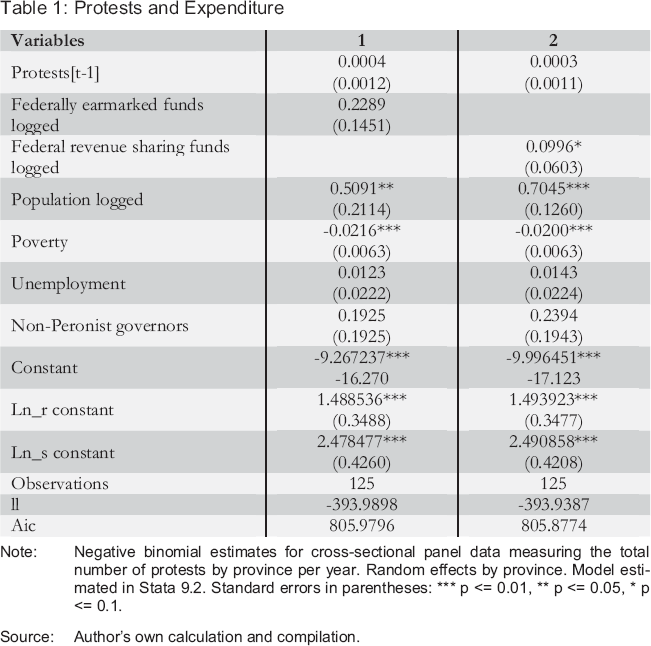
The results of the negative binomial regression models show that the pattern of distribution of federal funds encourages protests as a way to get them. Both clusters of expenditure foster these events. In the aggregated models (1–2), expenditure has a positive and significant relation to protests and poverty reduces it. Past protests, unemployment and the dummy variable for non-Peronist governors have positive but not reliable effects. Where protests were collapsed by year and province, funds managed by governors only increase protests by 10 percent while the federally earmarked revenues which can be delivered to contentious actors double this influence. 33 If governors redistribute funds then protesting does not appear to be the best way to get them. As indicated, funds managed by governors are delivered through local territorial networks and the monopoly of their distribution is crucial to keep control over voters’ preferences. Governors’ party and provincial state virtually overlap. Governors reward core allies with public resources and public employment. Also, thanks to their tight control, exerted not only over the polity but also over several dimensions of provincial public life, governors are not easily challenged and challengers are likely to be punished or marginalized. As long as the main source of public funds is the federal government and not local taxpayers, governors seem to be less responsive to citizens and their claims (Gervasoni 2010) and can choose recipients of resources discouraging protests. They deeply influence the careers of local politicians, they manage the access to important business with the provincial state, and sometimes they own local media and/or have close nexus with the judicial system (Behrend 2011). As a result governors are less keen on answering to protests with concessions and more able to resist changes occurring at the federal level, such as the renewed role of social organizations. Although, in model 1, the coefficient of federally earmarked funds is not significant, the differences in the impact of each expenditure are constant and with highly significant results across most models (2–14).
In order to give a more intuitive and friendly interpretation of the results, I have transformed the coefficients into counts of protests.
Protests and Expenditure
Note: Negative binomial estimates for cross-sectional panel data measuring the total number of protests by province per year. Random effects by province. Model estimated in Stata 9.2. Standard errors in parentheses:
p <= 0.01
p <= 0.05
p <= 0.1.
Source: Author's own calculation and compilation.
In the aggregated models, I introduced a number of control variables to capture different mechanisms behind provincial protests. Population has the expected positive sign in all models. More populated areas are likely to experience more protests. As explained above, the effect of population can be understood as a result of two factors: the particular dynamics of most populated metropolitan areas, where citizens tend to engage more in mobilizations, and the city-oriented bias in the data set. What is interesting is that while population (logged) doubles protests in the model of federal revenue sharing funds, (model 2), it loses 40 percent of its influence when assessed with federally earmarked revenues (model 1). The hypotheses concerning the influence of social conditions on protests can be tested via the estimation of the effects of poverty and unemployment (models 1 and 2). While the first coefficient is significant and shows a negative influence, i.e. poverty decreases the likelihood of protests and the rise of unemployment would increase them. The influence of both poverty and unemployment seems to be weak. However, it is my opinion that this is not conclusive evidence to rule out protests as offensive. On one hand, standard errors were too high and the coefficients of unemployment were not significant. On the other, protests seem to have a different sensitivity to expenditure when considering the demands. Therefore, further research is needed to depict more accurately the dynamics underlying protests.
In relation to sub-national politics and protests, when governors manage federal resources, non-Peronists seem to have 27 percent more chances of experiencing protests than Peronists, but when the president can choose his/her intermediary to allocate federal revenues, being in the opposition seems to have no impact on the persistence of the number of conflicts. Allied governors get more federal funds, but if they are not allied, the president tries to allocate funds directly to social organizations or to other political actors and transfers of social programs allow the president to bypass governors. However, the standard errors of the dummy variable “non-Peronist governors” are too high to give conclusive evidence supporting this analysis.
Allied governors have no tools to stop the president from bypassing them because they depend on federal funds. However their tool for negotiation is their influence over their polities which show them as the most able to obtain all that federal governments need from the provincial regime (i.e. votes, legislative support). What governors can do and actually do is remain in power, exert influence over provincial leaders and politicians, and try to cope with the consequences of the presidential coalition building strategy, in particular with the rise of challengers and the cohabitation of several sources for federal funds reallocation. 34 Unlike Brazil, in Argentina the practice of bypassing governors in the delivery of resources does not necessarily mean that provincial leaders are less powerful (Borges 2007; Fenwick 2009). The consequence of this practice seems to be the cohabitation of more than one source of federal revenues in sub-national territories, one belonging to the president, his allies and federal bureaucrats and the other channeled through the governors’ structure of power in the provinces. Also governors face new leaders and social organizations strengthened by the presidential coalition building strategy but, so far, they emerged successful in coping with both challengers and protests.
In the Jujuy province the provincial government (core ally of the federal executive) could not prevent the president from delivering resources to an organization which became the third employer in the province thanks to its access to federal resources, however, the provincial elite managed to deal with protests and challengers, and kept control over the sub-national polity in a virtual cohabitation with a parallel state (Moscovich 2009).
When types of demands are included (models 3–14), past protest coefficients are positive and highly significant. The effects of past events on present events are quite weak in all models and less influential than the effects of expenditures. Furthermore, past protests coefficients are strikingly similar across all models. This led me to conclude that mobilizations are not necessarily related to a cycle of protests where contentious events are emulated by different actors in their demands. These results seem to be counterintuitive with the trend of protests in contemporary Argentina where anybody with any demand can block a street as a way to be heard. But results reveal that expenditure and patterns of federal funds distribution are the explanatory variable underlying the persistence of protests. In sum, expenditure has a higher influence than the cycle of contention.
Protest Demands
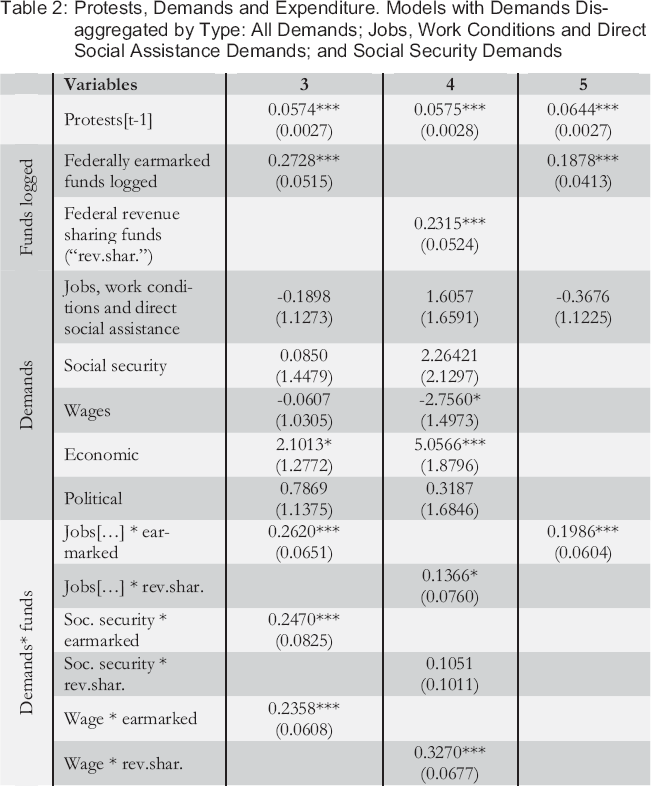
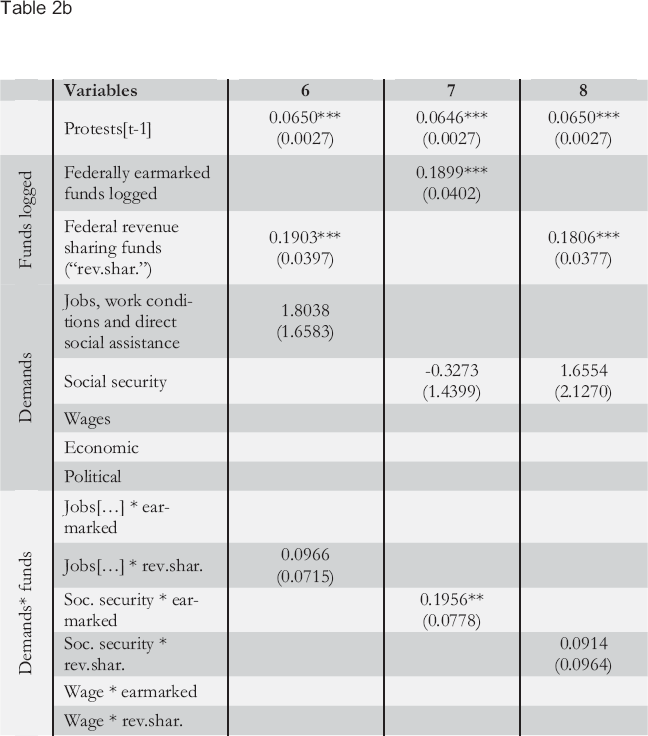
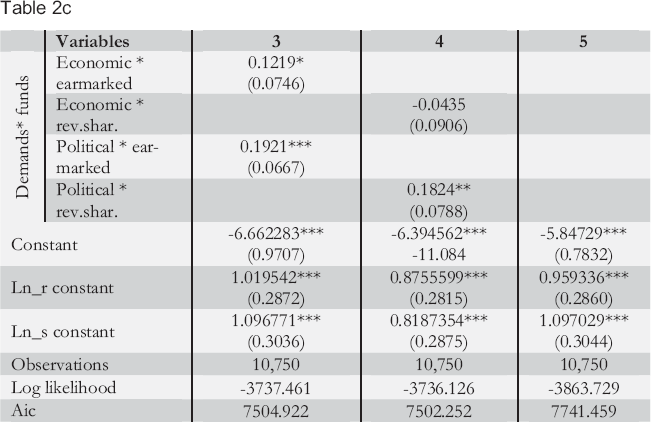
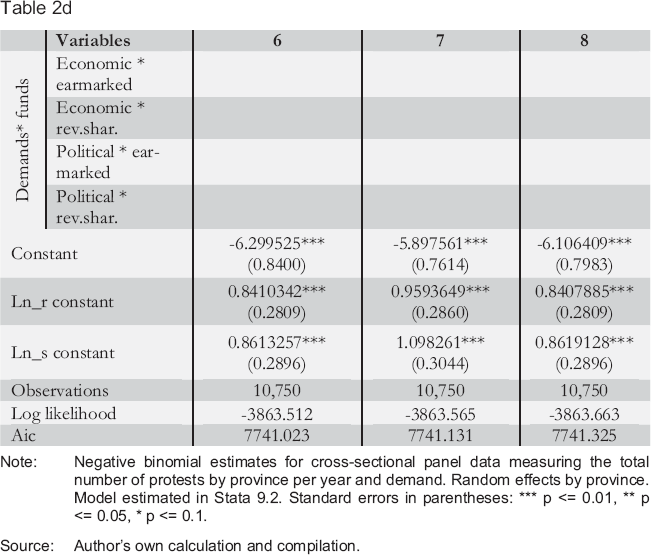
The dependent variable in models 3–14 is protests by province and demand per year. These models also include different protest demands and their interactions with funds as independent variables. The results of Models 3 and 4 conflate all demands and relate them to funds allocated by the president to different intermediaries and others that can only be delivered to governors. Models 5–14 include each demand separately, and also in relation to both kinds of funds. Models 3–14 show a positive and significant effect of past protests and expenditures in the persistence of contentious events. Demands differ in their results and reliability, following I explain all models in detail.
Allies, Demands, and Protests
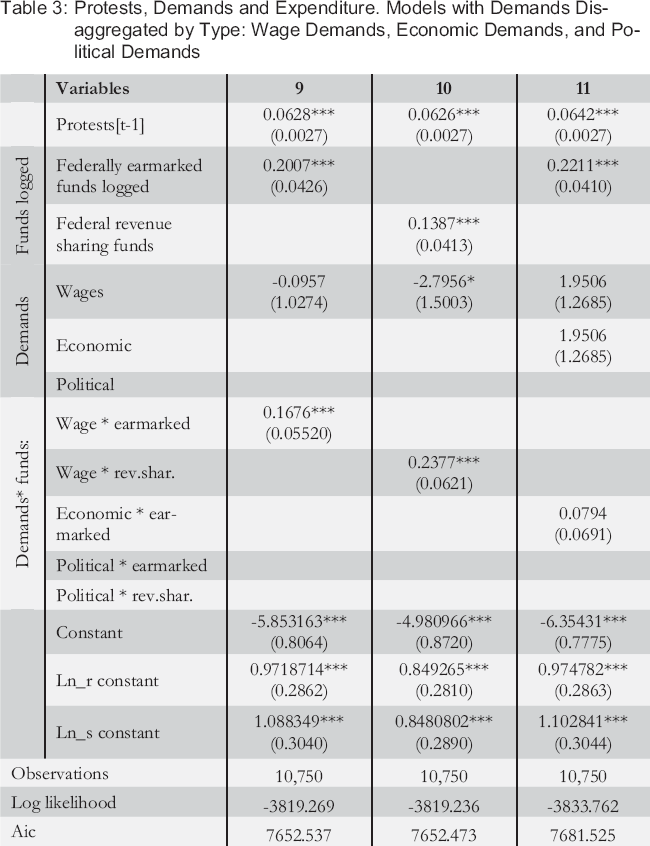
Both groups of expenditure, clustered by possible intermediaries in provinces, show a positive and highly significant association with protests, considering all demands together (models 3–4) and separately (models 5–14). Here, too, the president's discretionary funds have more influence on protests than revenues that can only be delivered to governors. Each additional unit in the log of expenditure of social programs increases protests from 20 percent to 30 percent, while funds managed by governors show a 14 percent to 26 percent increase in the number of protests.
The Effects of Expenditure on Protest Demands, Assessing the Interaction Terms
When assessing the joint significance of demands and the interaction terms (expenditure*demand), the particular influence of the expenditure in each demand can be singled out. For instance, if compared with the effect on the total protests, the positive influence of federally earmarked transfers is higher for protests demanding social assistance and social security (models 5 and 7), but reduces the chances of having protests with political and economic claims (models 9, 11 and 13). The influence of transfers only allocated to governors drops with each particular demand taken singularly (models 6, 8, 12 and 14), except for wage demands. Funds delivered to governors have less influence on each demand because protesting is more effective to appeal to the federal government; while negotiating is better to obtain the resources delivered by governors.
In relation to claims, the variations in the impact of expenditures on each demand stress the singularity of protests. Economic, political and wage demands seem to follow a different pattern, if compared with demands of social programs and social security. Claims of changes in economic policies are by far the most frequent and significant in model (12), considering federal revenue sharing funds. It is also very interesting to see that the demands of social handouts are negatively related to the expenditure of social programs (model 5). However, as long as this coefficient is not significant, this relationship is not conclusive.
Protests, Demands and Expenditure. Models with Demands Disaggregated by Type: All Demands; Jobs, Work Conditions and Direct Social Assistance Demands; and Social Security Demands
Protests, Demands and Expenditure. Models with Demands Disaggregated by Type: All Demands; Jobs, Work Conditions and Direct Social Assistance Demands; and Social Security Demands
Note: Negative binomial estimates for cross-sectional panel data measuring the total number of protests by province per year and demand. Random effects by province. Model estimated in Stata 9.2. Standard errors in parentheses:
p <= 0.01
p <= 0.05
p <= 0.1.
Source: Author's own calculation and compilation.
Protests, Demands and Expenditure. Models with Demands Disaggregated by Type: Wage Demands, Economic Demands, and Political Demands
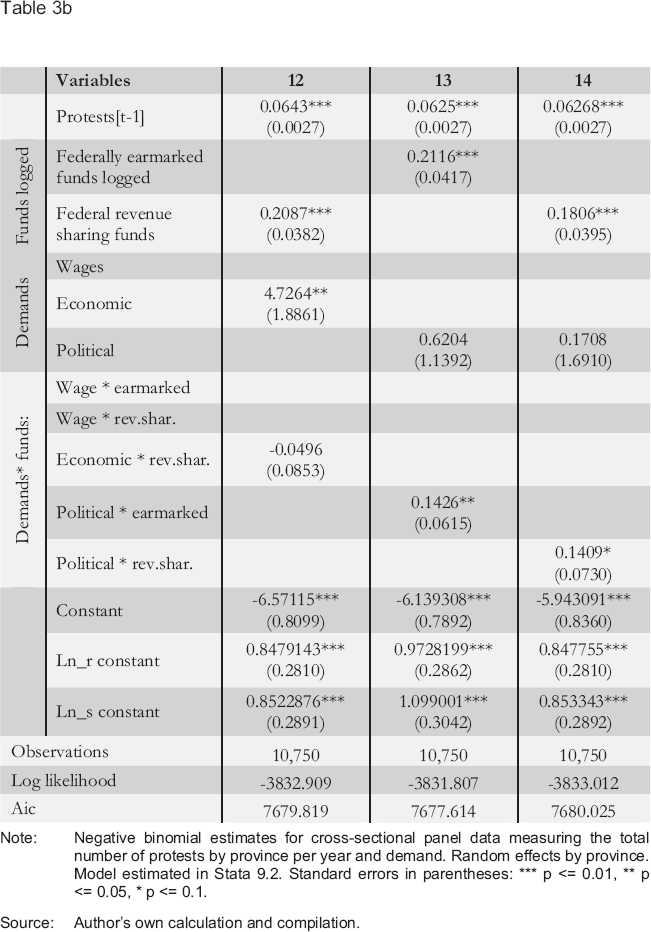
Note: Negative binomial estimates for cross-sectional panel data measuring the total number of protests by province per year and demand. Random effects by province. Model estimated in Stata 9.2. Standard errors in parentheses:
p <= 0.01
p <= 0.05
p <= 0.1.
Source: Author's own calculation and compilation.
Regarding models of wage demands (9 and 10), they are the only ones less influenced by federally earmarked transfers, than by the monies allocated to governors. Wage demands are less likely by −90 percent, but each log of expenditure given to governors increases the chances of having these protests (model 10). The protests I analyze here are different from those that have helped formal workers maintain a basic income in the highly unstable Argentine economy. The responses to concerns about wages are dealt within the marketplace through the mediation of unions and governments, and not by asking for public revenues. Therefore, the negative coefficient of protests with wage demands underpin the hypotheses stating that, during the years analyzed, a different dynamics was behind provincial protests in Argentina and that these events were offensive claims in reaction to certain patterns of federal expenditure for coalition building, and less affected by other political, economic or social variables.
In this article I propose an approach to protests which originally focuses on political coalitions across government levels. I understand that the nature, persistence and targets of protests can be understood as an outcome of the tension emerging from the federal-provincial governments competition over the influence on sub-national politics. I argue that when the president supports and legitimates contentious actors, protest is encouraged and becomes a permanent channel for accessing federal resources. I also suggest that this strategy creates new challenges for governors, despite the fact that they are essential for the president. To test my model I explore the impact of governors’ and presidents’ patterns of discretionary allocations in provinces and results offered clear evidence of the variation in their influence over protests. Protests show the contradictory interests related to the strategic allocation of resources of governors and presidents, while the president uses these resources as a way to link with different actors and build new structures of power, governors use them to fuel their territorial machines and to avoid challengers.
The contribution of this article is twofold. First I single out tensions emerging from different coalition building strategies and I show that protests react differently to them, varying across government levels. My results show evidence of robust links between an increase in federal expenditure and in provincial protests, particularly when transfers can be allocated through social organizations, that is when the president bypasses governors to diversify his alliances. When different types of demands are considered, protests that appeal to discretionary transfers from the president have a different sensitivity to expenditure than others less affected by them. Unlike the latter, I find that the governors’ monopoly over the reallocation of federal funds has a weaker effect. This monopoly secures the mechanism of reward and punishment for local allies to guarantee their subordination in order to get the president all he needs from the provincial polity and, therefore, to be able to remain at the top of provincial politics. In fact, when protests are disaggregated by demands and governors’ control over resources, results show that the chances of protests occurring tend to decrease thus providing a stabilizing factor.
The second contribution of this article is having distinguished the particular features of protests. The logic of discretional transfers and the biases in the distribution of funds bolster the mechanisms through which non-formal politics are preferred over institutional channels. The federal executive not only gives concessions to challengers, but also promotes all kinds of non-institutional channels for demanding public resources. Various actors with very different demands end up participating in demonstrations, rallies, and roadblocks. However, these actions do not seem to result in a cycle of protests instead they appear to be a channel for demanding political outcomes that arise when expectations among allocation of public revenues encounter doubts regarding the criteria used for their distribution.
In contrast to prior research, I show that informal politics have greater influence on the government's response to protests than the issue at hand or the cycle of protests. I also give evidence suggesting that federalism and decentralization do not necessarily imply a broader menu of contentious actors and state targets, instead both result in a variety of situations in which the scope of protests and the state-challengers relationship greatly differ. This work complements the extant literature of federal coalition building and strategic resources allocation and takes a step forward by showing that both the president's and governors’ strategies have a specific and sometimes contradictory influence over sub-national polities.
To conclude, in this article I showed that tensions emerging from these different federal alliances did not result in a higher dispersion of power, neither in the opening of the sub-national polities. Governors were able to resist the challengers and reached new equilibriums in which they still controlled the polity, even experiencing higher levels of mobilizations. Another crucial implication for democracy and citizens is the cohabitation of several intermediaries for the reallocation of federal resources in provinces reinforcing the informal and discretional features of their patterns of distribution. I believe that future work on coalition building and protests should focus with greater detail on the mechanisms through which governors deal with the increasing instability at the sub-national level. Also is needed comparable information on the relation between organizations and governors within provinces and regarding main trends of protest and politics after 2006. Many questions are now opened and information is still scarce. I expect this article to contribute to a more diverse research agenda on the sub-national consequences of federal coalition building strategies.
Footnotes
Appendix
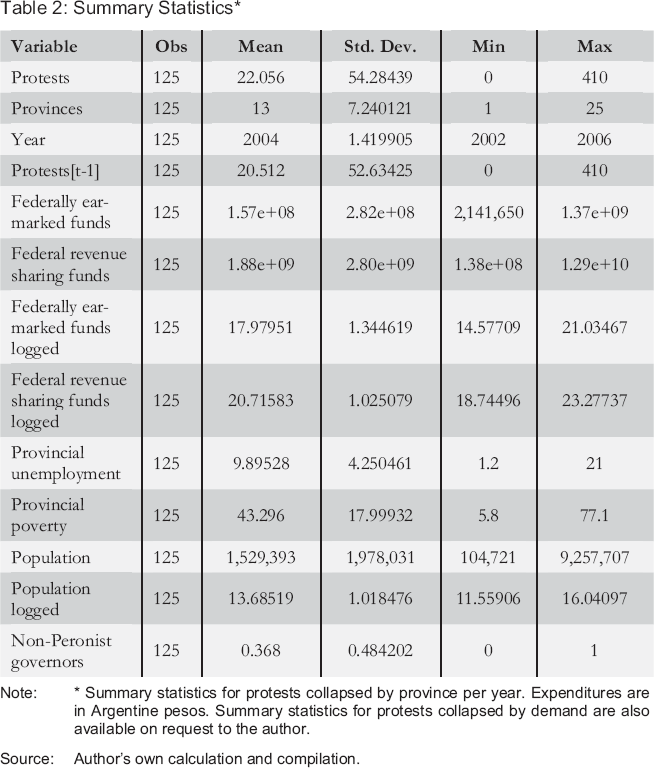
Summary Statistics *
| Variable | Obs | Mean | Std. Dev. | Min | Max |
|---|---|---|---|---|---|
| Protests | 125 | 22.056 | 54.28439 | 0 | 410 |
| Provinces | 125 | 13 | 7.240121 | 1 | 25 |
| Year | 125 | 2004 | 1.419905 | 2002 | 2006 |
| Protests[t-1] | 125 | 20.512 | 52.63425 | 0 | 410 |
| Federally earmarked funds | 125 | 1.57e+08 | 2.82e+08 | 2,141,650 | 1.37e+09 |
| Federal revenue sharing funds | 125 | 1.88e+09 | 2.80e+09 | 1.38e+08 | 1.29e+10 |
| Federally earmarked funds logged | 125 | 17.97951 | 1.344619 | 14.57709 | 21.03467 |
| Federal revenue sharing funds logged | 125 | 20.71583 | 1.025079 | 18.74496 | 23.27737 |
| Provincial unemployment | 125 | 9.89528 | 4.250461 | 1.2 | 21 |
| Provincial poverty | 125 | 43.296 | 17.99932 | 5.8 | 77.1 |
| Population | 125 | 1,529,393 | 1,978,031 | 104,721 | 9,257,707 |
| Population logged | 125 | 13.68519 | 1.018476 | 11.55906 | 16.04097 |
| Non-Peronist governors | 125 | 0.368 | 0.484202 | 0 | 1 |
Note:
Summary statistics for protests collapsed by province per year. Expenditures are in Argentine pesos. Summary statistics for protests collapsed by demand are also available on request to the author.
Source: Author's own calculation and compilation.