



Abstract
This paper presents an expert-based operationalization strategy to measure the degree of democracy in the Argentine provinces. Starting with a mainstream and “thick” definition of regime type, I assess each of its aspects using a subjective or perception-based approach that taps the knowledge of experts on the politics of each province. I present and justify the methodological design of the resulting Survey of Experts on Provincial Politics (SEPP) and conduct a preliminary analysis of its results. Some aspects of the provincial regimes appear to be clearly democratic, while others are mixed or even leaning towards authoritarianism. Moreover, some show little inter-provincial variance, while others vary considerably from province to province. An analysis of the central tendency and dispersion of the survey items allows for a general description of the Argentine provincial regimes. Inclusion is the most democratic dimension, while the effectiveness of institutional constraints on the power of the Executive is the most deficient. Electoral contestation is generally free of traditional forms of fraud, but incumbents often command far more campaign resources and media attention than do their challengers. Physical repression is rare, but opponents in some provinces face subtler forms of punishment. While the survey does not uncover any clear cases of subnational authoritarianism, stricto sensu, provincial regimes do vary significantly from basically democratic to clearly hybrid.
Introduction
Issues of conceptualization and measurement have been only lightly addressed by the recent literature on subnational regimes. Several works have highlighted the existence and analyzed the nature of “subnational authoritarianisms” in the context of national democracies, but it is often unclear what conceptual definition is used to describe these regimes as authoritarian and what operational rules are applied to determine whether a given province or region is authoritarian or democratic.
National indices of regime type covering most countries in the world have been available for decades (e.g., Bollen 1980; Coppedge and Reinecke 1991; Alvarez et al. 1996; Vanhanen 2000; Marshall and Jaggers 2009; Freedom House 2010). Scholars of Latin America have more recently developed region-specific indices (Mainwaring, Brinks, and Pérez-Liñán 2001, 2007; Bowman, Lehoucq, and Mahoney 2005). The measurement of national regimes has given rise to a sophisticated methodological debate (Bollen 1993; Collier and Adcock 1999; Bollen and Paxton 2000; Munck and Verkuilen 2002; Hadenius and Teorell 2005; Goertz 2006; Treier and Jackman 2008) that has led to a better understanding of the advantages and disadvantages of the extant indices, and has provided advice on how to design measures that maximize validity and reliability. In recent years several works have proposed new cross-national indices that – using new conceptualizations, new data and/or new statistical methods – improve on imperfections of the previous ones (Paxton 2000; Moon et al. 2006; Coppedge, Alvarez, and Maldonado 2008; Treier and Jackman 2008). The young subfield of subnational regimes, by comparison, is light-years behind in conceptual clarity, measurement rigorousness, and data richness.
As Latinamericanists we would like to know how democratic (or not) our provinces, states, and municipalities are. As comparativists we would like to explain why some subnational units are less democratic than others. This paper makes a methodological contribution – a new, expert-based operationalization strategy to measure the level of subnational democracy – and a substantive contribution – a preliminary description of subnational democracy in the 24 provinces of Argentina for the period 2003-2007. 1 In a previous paper I discussed conceptualization issues, identified the dimensions and subdimensions of the concept of “subnational democracy,” and made the case for a subjective or perception-based measurement strategy on the grounds that it is better suited to capture the subtle ways in which democracy is restricted in subnational polities that are embedded in national democracies (Gervasoni 2008). In this paper I focus on the actual measurement tool I used to gauge democracy in the Argentine provinces and on its results. The perceptions that are used as the basis of measurement are those of 155 experts on the politics of each of the provinces, as revealed by the responses they provided to the Survey of Experts on Provincial Politics (SEPP). 2 The methodological design of the survey and the results of some of its most important items are described below.
I thank Michael Coppedge, Edward Gibson, Ana María Mustapic, Sybil Rhodes, and Catalina Smulovitz for helpful comments on earlier versions of this paper. Andrea Cavalli, Adrián Lucardi, María Marta Maroto, and María Eugenia Wolcoff provided invaluable research assistance.
The SEPP was funded by a National Science Foundation Doctoral Dissertation Improvement Grant (award number 0719658). Additional financial assistance for the project was provided by The Helen Kellogg Institute for International Studies and The Graduate School, University of Notre Dame.
The proposed operationalization strategy has the following advantages: 1) it starts with an explicit and clear understanding of the concept to be measured, and of its dimensions, subdimensions, components, and subcomponent, 2) it includes specific (and sometimes multiple) indicators for each subcomponent, 3) it measures each indicator several times (by consulting more than one expert per province), 4) it permits assessing the uncertainty of the resulting descriptive inferences, 3 and 5) it makes the procedures public by clearly describing each of the methodological decisions made. These are all characteristics recommended by the methodological literature (Bollen 1993; King, Keohane, and Verba 1994; Munck and Verkuilen 2002; Treier and Jackman 2008) which, however, are often disregarded by popular national-level indices (Munck and Verkuilen 2002). The methodological design is explained in detail so that any researcher can replicate the study in Argentina or, with some adaptation to local political contexts, in any other nation with elected and reasonably autonomous subnational governments. Hopefully, in a not-so-distant future, scholars will periodically produce estimates of subnational regime type around Latin America and the world that can be used to assess the causes and consequences of subnational democracy.
Most national indices of regime type, including the most widely used in political science, ignore issues of measurement error. For exceptions see Bollen (1993); Bollen and Paxton (2000); Treier and Jackman (2008).
The Study of Subnational Regimes
More than three decades into Huntington's “third wave,” it is clear that the extent to which citizens of many federal democracies enjoy the benefits of political freedom varies widely, not only across socioeconomic levels and ethnic lines, but also across subnational borders. From Argentina to Brazil and from India to Russia, national electoral democracies include very imperfectly democratic subnational regimes along with more democratic ones.
In his classic Polyarchy, Robert Dahl stressed that “even within a country, subnational units often vary in the opportunities they provide for contestation and participation” (1971: 14). He recognized that not dealing with this issue was a “grave omission” of his book. Thirty-five years later, the matter remains very much understudied. Some recent attempts to measure democracy at the national level explicitly indicate that they fail to incorporate information about subnational regimes (cf. Foweraker and Krznaric 2001: 18). For the particular case of Latin America, Guillermo O'Donnell has called attention to the matter, wondering “how one conceptualizes a polyarchical regime that may contain regional regimes that are not at all polyarchical” and pointing to “abundant journalistic information and reports of human rights organizations, that some of these regions function in a less than polyarchical way” (O'Donnell 1999b: 315). Although there are a few recent academic case studies of “subnational authoritarianisms” (Cornelius 1999; Snyder 1999; Gibson 2005), they often do not provide explicit definitions or operationalizations of the degree of subnational democracy. The earliest studies I am aware of which define and measure democracy systematically in all (or most of) the subnational units of a country are those conducted by Hill (1994) for the USA, Hernández Valdez (2000), and McMann and Petrov (2000) for a large subset of the subnational units of Russia. More recently scholars have resorted to institutional or electoral indicators to construct indices that measure subnational democracy or subnational electoral contestation, an important dimension of democracy, in countries such as Argentina, Brazil, India, Mexico, and the USA (Beer and Mitchell 2006; Borges 2007; Goldberg, Wibbels, and Mvukiyehe 2008; Gervasoni 2010; Giraudy 2010 in this issue).
Although the concepts of democracy and authoritarianism are relatively well-established in political science (Dahl 1971; Linz 1975), potential for disagreement and “stretching” does exist, especially when they are applied to new empirical domains. Thus, conceptualizations of subnational regime types in Latin America sometimes incorporate idiosyncratic elements. Authoritarianism, for example, is sometimes associated with “conservative rule,” “traditional elites,” or “machine politics,” and democratization is associated with the electoral progress of the (often leftist) opposition. Likewise, sometimes a conceptual connection is established between low levels of subnational democracy and neopatrimonial politics (Trocello 2008; Durazo Herrmann 2010 in this issue). In this paper democracy is defined at a high level of abstraction, that is, avoiding region-specific attributes that may not “travel” well. As detailed in the next section, the concept of “liberal, representative democracy” refers to a regime type that institutionalizes both electoral access to power and limited exercise of state power.
It should be noted that, in the context of national-level democracies, subnational regimes are almost always democratic in one sense: they have multiparty elections in which votes are counted fairly, real opposition parties represented in the legislature, at least some alternative sources of information, nontrivial levels of freedom of speech and the like. Subnational authorities are constrained in the extent to which they can restrict political rights. Blatantly authoritarian leaders are unlikely to succeed in keeping “boundary control” (Gibson 2005): open and visible violations of political rights attract much negative national attention, which both hurts the provincial leaders’ (often national) career ambitions, and increases the likelihood that the federal government will use its formal or informal powers to remove them. 4 As a result, even the less democratic provincial regimes contain significant doses of both authoritarianism and democracy. The point may be blurred by the literature's tendency to use adjectives such as “authoritarian” and “undemocratic” to describe certain subnational regimes in Latin America (Fox 1994; Cornelius 1999; Snyder 1999; Gibson 2005; Durazo Herrmann 2010 in this issue; Giraudy 2010 in this issue). As argued by McMann (2006), however, subnational regimes in formally democratic contexts are generally better described as “hybrid regimes” (Karl 1995; Zakaria 1997; Diamond 2002; Levitsky and Way 2002; Schedler 2006) than by the traditional concept of “authoritarianism.” 5 A methodological consequence of the hybrid nature of some subnational regimes is that measurement is especially challenging: the regime differences between a hybrid Argentine province such as San Luis and a democratic one such as Mendoza, are smaller and less visible (and therefore harder to measure reliably) than those between blatantly authoritarian North Korea and prototypically democratic Finland.
The Argentine constitution, for example, assigns Congress and the President the right to remove provincial authorities to “guarantee the republican form of government.” These “federal interventions” have taken place six times since 1983: Catamarca (1990), Tucumán (1991), Corrientes (1991 and 2000), and Santiago del Estero (1993 and 2004).
Durazo Herrmann (2010 in this issue) uses the concept of “hybrid regime” to describe the Mexican state of Oaxaca. In his conceptualization, however, the combination of “formally democratic political institutions … with authoritarian practices” does not call “its authoritarian character into question.” That is, hybrid regimes are seen as a type of authoritarianism, not as an intermediate category between democracy and authoritarianism.
Subnational Democracy: Dimensions, Subdimensions, Components, and Subcomponents
Regime type is conceived as a set of
procedural rules, whether formal or informal, that determine the number and type of actors who are allowed to gain access to the principal governmental positions, the methods of access to such positions, and the rules that are followed in the making of publicly binding decisions … (Munck 1996: 8).
This definition can be reduced to two sets of rules, 1) those about how government positions are filled, and 2) those about what government officials can and cannot do. These “access to power” and “exercise of power” dimensions (Mazzuca 1998) correspond to the strictly “democratic” and the “liberal” dimensions of modern representative liberal democracies. A regime is democratic to the extent that top government positions are filled through competitive, free and fair elections (= democratic access to power), and to the extent that the power of elected officials is limited and respectful of certain rights and freedoms (= liberal exercise of power). These two dimensions are in turn, decomposed into three subdimensions each, as shown in Figure 1.
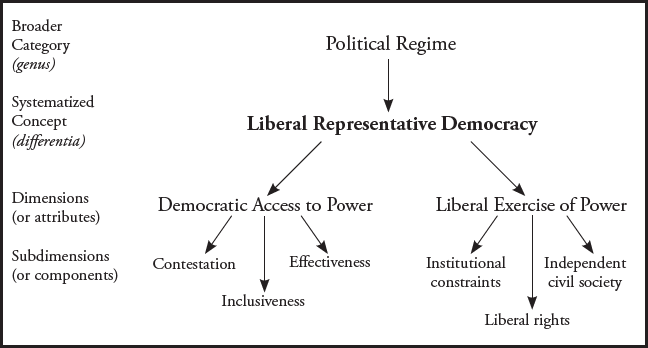
Genus, Differentia, Dimensions, and Subdimensions of Democracy
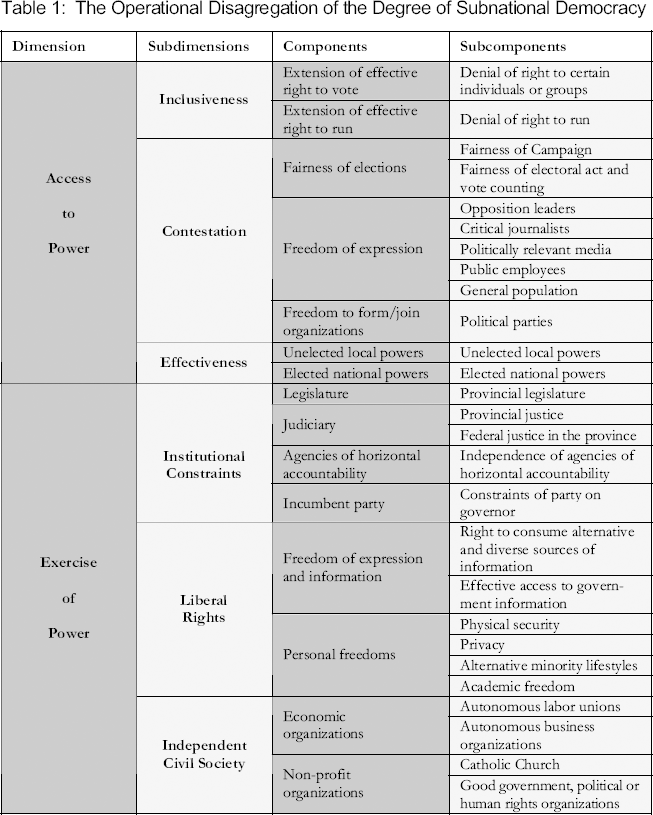
Table 1 presents the components and subcomponents into which each subdimension of democracy is decomposed. Each subcomponent represents the end of the operationalization of a concept and is measured by one or more indicators, which in the context of my perception-based operationalization strategy, are questions (items) in the survey of experts. The final data, then, are the answers to those questions (aggregated by province). The table presents the dimensions (column 1) and subdimensions (column 2) defined so far, plus a list of the components (column 3) and subcomponents (column 4) of each subdimension. Columns 1 through 4, then, are thought as general categories applicable to the elective subnational regimes of any country. The questions (=indicators), of course, have to be adapted to the context – in this case to the Argentine provinces – and to each particular province. Some of these indicators may be directly applicable to other countries, but some will need substantial redesigning to adapt them to different national realities. (For details about the overall conceptualization and decomposition into dimensions, subdimensions, components, and subcomponents, see Gervasoni 2008).
The Operational Disagregation of the Degree of Subnational Democracy
Indicators: Subjective (or Perception-based) Measures of Democracy
Following Adcock and Collier (2001), in this section I go one level below the “systematized concept” to address the indicators that will be used to operationalize the concept of subnational liberal representative democracy, as defined above. Given the complexities of a “thick” concept (Coppedge 1999) such as degree of subnational democracy, and the additional difficulties posed by the fact that hybrid regimes restrict democracy in subtle ways, I propose to follow the subjective tradition of measurement of democracy (Bollen and Paxton 2000: 60). As opposed to the objective tradition that uses measures which do not depend on the judgment or opinion of the researcher, experts, or secondary sources (e.g., Vanhanen 2000), the subjective tradition uses “perceptions-based” (Kaufmann, Kraay, and Mastruzzi 2005) indicators. 6 In this strategy a researcher makes an informed judgment about a certain aspect of democracy in a given country using secondary sources and/or consulting country experts. This strategy is clearly illustrated by mainstream democracy measures, such as Polity IV (Jaggers and Gurr 1995; Marshall and Jaggers 2009), Freedom House's (2010) ratings of political rights and civil liberties, and Coppedge and Reinecke's Polyarchy Index (1991), all of which use subjective measures. Bowman, Lehoucq, and Mahoney (2005: 940) make a strong case in favor of an index of democracy based on the judgments of experts with deep knowledge of the polities to be coded.
The word “subjective” is often loaded with negative connotations. It is sometimes associated with normative biases or interested opinions. Here it is used in a straightforward neutral way to describe a measurement process based on informed and educated judgments of certain “subjects.” It is important to realize that some well respected and widely used databases in political science come from subjective operationalizations. This is the case not only with measures of democracy, but also with measures of corruption, for example Transparency International's Corruption Perception Index, and with measures of governance, such as the World Bank's Governance Indicators. For a defense of the strengths of “perceptions-based” indicators over objective ones, see the methodological paper for the World Bank indicators (Kaufmann, Kraay, and Mastruzzi 2005: 27-31).
The subjective operationalization I designed consists of a survey of experts on the politics of each subnational unit. To my knowledge expert surveys have only been used to assess subnational regimes twice in the past, in Russia and Kyrgyzstan (McMann and Petrov 2000; McMann 2006). The main methodological difference between these surveys and my own is that the former interviewed a group of experts who resided in the capital cities and asked them to rank and rate all the regions (Kyrgyzstan) or the top ten and bottom ten regions (Russia) in terms of a single given definition of democracy, while mine selected a specific set of experts for each province (most of them residents of the province) and asked them to rate it in terms of many different aspects of democracy. 7
The index of democracy for the Russian regions carried out by Nikolai Petrov and Alexey Titkov at the Moscow Carnegie Center is also based on expert ratings, although it is not clear whether a formal survey of experts was carried out, and if so how many and what kind of experts (Moscow-based or region-based) were consulted. For the index see http://atlas.socpol.ru/indexes/index_democr.shtml.
Experts are most likely more reliable than secondary sources, in part because the latter lack the necessary level of detail and quality for several provinces, and in part because the subtle manner in which democracy is restricted in hybrid regimes calls for very specific pieces of information. The questionnaire of the SEPP included many items aimed at tapping experts’ assessment of the situation of each subdimension in their respective units of specialization. Ideal interviewees were local, politically independent scholars and professionals (such as journalists and consultants) with deep knowledge of their provinces’ politics. One significant disadvantage of this approach is that, due to well-known memory limitations, interviewees can only supply reliable data for recent times.
Because experts are by definition knowledgeable of many characteristics of the political regime in place, multiple aspects of democracy beyond electoral competition and inclusion can be assessed, including, for example the effectiveness of legislative and judicial checks on the Executive, the level of press freedom, the civil rights situation, the prevalence of human rights violations, and so forth.
Methodological Design of the SEPP
The SEPP is a face-to-face survey conducted in each of Argentina's 24 subnational units using a questionnaire that includes approximately 140 items about the 2003-2007 period (except for two provinces off the regular electoral schedule). Fieldwork started in late April and ended in mid November 2008. Below I outline the survey methodology:
Questionnaire design and administration
Given the length and complexity of the questionnaire, the survey was administered face to face by political scientists with backgrounds in Argentine provincial politics. The survey was carried out with a structured questionnaire including both closed-ended items (in which experts rated an aspect of democracy in a given province) and open-ended items (in which they had the chance to explain the reasons for their ratings, qualify their answers, or provide an answer different from those offered by the questionnaire). Given a well-documented tendency of intellectually sophisticated publics to resist the “straightjacket” of closed-ended questions (Putnam 1973; Aberbach et al. 1975), the open-ended questions also served the purpose of allowing interviewees to elaborate their answers, which is useful both for the substantive goals of the research project and for the smooth progress of the interviews. The average length was one hour and nineteen minutes. The questions were designed and tested so that they were clear, concrete, and unbiased. They were written following the standard advice of the literature on questionnaire design (Converse and Presser 1986; Oppenheim 1992; Foddy 1993) and on elite interviewing (Dexter 1970).
Questionnaire Pretests
The questionnaire was pretested in several stages. First I circulated it among advisors and colleagues. 8 The resulting version was first read and commented upon by the members of the fieldwork team, 9 which resulted in additional improvements. After this the interviewers and I conducted a pretest that included 14 experts on the politics of 11 provinces. These pretests helped us identify problems such as ambiguous wording, value-loaded terms, missing categories, and questions that were too demanding.
I am grateful to Michael Coppedge, Frances Hagopian, Scott Mainwaring, Ernesto Calvo, Agustina Giraudy, Debra Javeline, Frauke Kreuter, Marcelo Leiras, Aníbal Pérez-Liñán, and Fernando Ruiz for their helpful comments on early versions of the questionnaire.
Andrea Cavalli, Adrián Lucardi, María Marta Maroto and María Eugenia Wolcoff, all excellent research assistants.
Sampling
Interviewees were intentionally selected using two broad criteria: 1) deep and extensive knowledge of the politics of the province, and 2) reasonable level of independence from the provincial government and opposition. The ideal expert is a scholar in the social sciences, although my exploratory fieldwork in four provinces during 2006 indicated that political journalists and attorneys in the field of constitutional law are often as knowledgeable about the provincial regime as academic political scientists. As expected, finding such experts was difficult and time consuming, especially in provinces that are small, less developed, and/or have no political science departments (such as Chaco, Formosa, La Pampa and Tierra del Fuego). I constructed a sample framework drawing on 1) personal academic contacts, 2) social scientists from the interior I met during the exploratory stage of fieldwork (July-August 2006), 3) colleagues from the provinces I contacted personally at the 2007 Argentine Political Association conference in Buenos Aires, 4) experts cited or interviewed in Buenos Aires newspapers when covering provincial politics, and 5) information provided by the political science schools and institutes of many provinces. From all of these original contacts I “snowballed” to create a larger sampling framework. Experts with more distinguished academic, professional or journalistic credentials and experts mentioned by more sources were given priority. In the case of the most “difficult” provinces (those with smaller populations and few or no university social science departments), it was necessary to relax the criteria at times, and interview prestigious political scientists who did have some kind of political position or, less frequently, knowledgeable people without formal positions in academia or journalism. 10 The goal was to achieve a minimum of three experts per province so that inter-expert agreement could be calculated on a relatively solid basis. The effective sample includes a minimum of four and a maximum of twelve interviewees per province (for a total of 155 experts, or an average of 6.46 per province). Note that there is no “small sample” problem here: this survey is different from public opinion or elite surveys, in that the goal is not to infer the characteristics of a larger population, but (as in the case of historical interviews) to systematically obtain factual information from knowledgeable sources. The measurement strategy, then, is comparable to that of the widely-used Polity IV dataset, which typically uses one coder per country, and a few coders for some countries, to assess inter-coder reliability (Marshall and Jaggers 2009: 5-7). In my measure the experts function as coders, and, improving on Polity IV, every province is coded by at least four experts. In provinces in which average inter-expert agreement was high, the final number of cases was not changed. In provinces where it was middling or low additional interviews were conducted. The second stage of fieldwork added 32 cases (taking N from 123 to 155) in ten provinces.
Although practically all the respondents were – as planned – either local social scientists or political journalists, the second requirement (political independence) was more difficult to meet. The few political scientists living in the smaller, less developed provinces tend to work for the state or be active members of political parties. So in these provinces there was a clear trade-off between criteria 1 and 2. When I had no choice but to interview somebody with a government position or party affiliation, we felt they almost always responded to the questions as scholars and not as politicians or government officials. The inter-expert agreement analysis will help determine whether or not these provinces were particularly problematic in terms of measurement reliability.
Fieldwork
Conducting 155 interviews with busy experts in 24 locations in the eighth largest country in the world posed significant challenges. To facilitate the logistics, the country was divided in six regions. Each region had a “hub” city where interviewers were based. The six regions were: 1) Pampas (hub in the city of Buenos Aires), 2) Northeast (Corrientes), 3) Northwest (Salta), 4) Cuyo (Mendoza), 5) North Patagonia (Bahia Blanca), and 6) South Patagonia (Río Gallegos). The author and four research assistants completed the first stage of the fieldwork in a little over three months (it started on April 22 and the last interview was conducted on July 30, 2008). Each region was in charge of one of the interviewers. I personally trained them in four meetings, for a total of about 14 hours. In these sessions they became familiar with the general goals of the research project and the survey, the questionnaire, the techniques appropriate for conducting interviews with experts, the human subject treatment standards, and the logistic and economic issues related to the fieldwork. Interviewers acquired additional expertise during the pretesting of the questionnaire. We contacted experts by e-mail (and sometimes also by phone) a few days before visiting a given province. Most of those we were able to find cooperated enthusiastically. There were very few outright rejections (the response rate was of 81 percent of all experts contacted).
Questionnaire Administration
All interviewees received an e-mail requesting an interview and explaining the nature of the project, the reasons for their selection, the importance of their participation, and the anonymity of their answers. To encourage positive responses experts were offered a small gift (one of several political science books we bought) and early access to a report with the survey's main results. Gifts (but not money) and access to results are commonly used in elite-level interviews in Argentina, and, given certain conditions, endorsed by much of the literature on interviews (Adler and Adler 2002). The experts I surveyed during the exploratory fieldwork were for the most part willing to meet and share information with me. Nonetheless, the incentives make personal interviews easier and faster to arrange, and interviewees more willing to spend an hour and 20 minutes answering a demanding and at times tedious questionnaire. Interviews were arranged at the places and times that were convenient for the experts. Their answers were recorded on the paper questionnaire, circling the pre-coded categories for the close-ended questions and writing down the answers for the open-ended ones (thus avoiding the often unwelcome tape recorder).
Questionnaire Quality-control and Coding
Immediately after completion of each interview (while answers were still fresh in their memories) the interviewers checked the open-ended answers for completeness and readability. Coding was necessary for only a few questions, as the experts’ answers to the closed-ended questions were considered final codes. However, in cases in which an expert refused to choose one of the categories of the closed-ended items, I used the information in the open-ended follow-up question to assign a code. If this question was also unanswered (or uninformative), the item is coded as a missing value. A small number of missing values is inevitable and not particularly harmful. However, interviews with more than 20 percent of missing values were considered invalid and replaced by an interview with a different expert.
Preliminary Results
After the end of the second stage of fieldwork, the questionnaires were revised, coded, and entered into an electronic database. The experts’ answers to the close-ended questions have been averaged to form an aggregate score for each item in each province. Following classical reliability theory (Traub 1994), I assume that errors of measurement are random noise with an expected value equal to zero. Therefore, the mean of all expert scores for a given item and province is an unbiased estimator of the true score. 11 The variance of this estimator depends both on the level of agreement among experts (that is, the standard deviation of the scores they assign to a given item) and on the number of experts consulted. The main point to consider in analyzing the information provided below is that all estimates contain measurement error, and that therefore small differences among provinces may not reflect true differences. Details about the estimated magnitudes of measurement error are provided in Appendix 1. As rule of thumb, inter-provincial differences smaller than 0.5 should be seen as not significant.
Using the mean implies assuming that the (ordinal) survey items are measured on an interval scale. This assumption seems reasonable for practically all items. The median, an appropriate central tendency statistic for ordinal variables, has its own disadvantages (e.g., it disregards the information contained in answers significantly different from the rest).
The wording of the questions and the answer options is presented under each graph in English (the original Spanish wording can be consulted in Appendix 2). Below I present the preliminary results of several key survey questions (for space reasons, and because some of them measure variables other than subnational democracy, not all the items are presented) for all the 24 provinces.
Contestation
Contestation is the only element of democracy about which all definitions, including the most minimal ones, agree. Free and fair elections for the main executive and legislative offices are the central element of this subdimension of democracy. How free and fair are provincial elections in Argentina? Figure 2 displays the results of two questions measuring the fairness of the last gubernatorial elections, that is, the extent to which some people were arbitrarily excluded from the ballot and the extent to which votes were miscounted to favor a given party. (In this and the following figures the more democratic scores correspond to the upper-right corner and the least democratic ones to the lower-left corner; this sometimes means that categories in the graphs are reversed with respect to their order in the questionnaire).
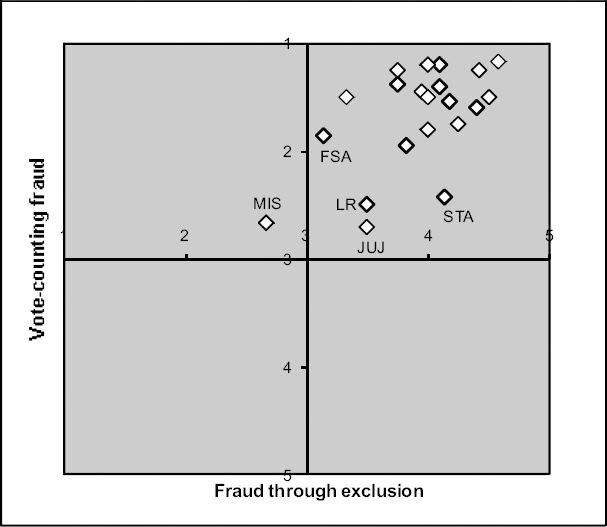
Fairness of Elections
According to Figure 2, there are almost no important instances of electoral fraud (Misiones appears to be an exception). Most provinces cluster close to the democratic (upper-right) corner, while the lower-left quadrant is empty. These variables, then, seem to reflect a situation of relatively high and homogenous levels of electoral fairness in the provinces. However, the situation changes when we take a broader view of the electoral process. Figure 3 shows indicators of the pro-incumbent bias of the provincial media (TV in the X-axis and provincial newspapers in the Y-axis) in the most recent gubernatorial elections. The Federal Capital of Buenos Aires, Córdoba and Mendoza appear at the upper-right corner. 12 However, all the quadrants are populated, and at least three provinces do very poorly in both TV and newspaper coverage. That is, there is considerable variance in these measures, implying that in some provinces incumbent and opposition candidates have similar access to the media, while in others incumbents get much more and better coverage than opponents. Elections in the latter cannot be considered fair even if votes are counted fairly. Another important conclusion of the figure is that, although the variables are positively associated, the correlation is only moderately strong (r=0.58) because of off-diagonal provinces like La Pampa in which the TV is biased but the newspapers are not.
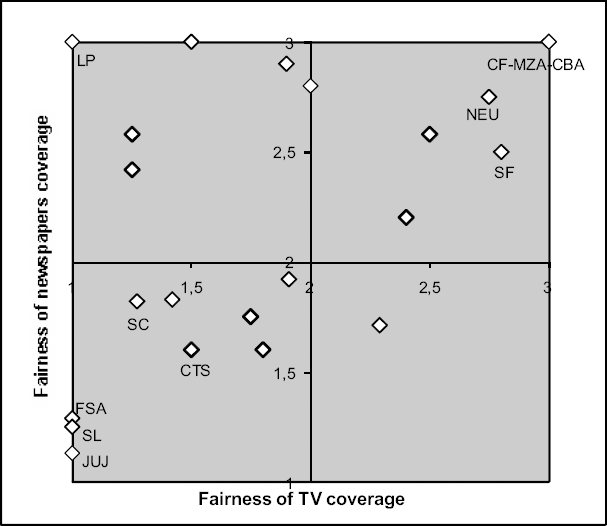
Fairness of Campaign Media Coverage
The acronyms identifying provinces in the figures can be consulted in Table A (Appendix 2).
In sum, it seems that the electoral act in itself is generally not subject to important political manipulations, but the pro-incumbency bias of the provincial media ranges from null to extremely high. Contestation, then, is in some provinces restricted in one of the most critical arenas of modern politics. As both classic liberal thinkers posited and contemporary public opinion research shows, a reasonably-informed democratic public cannot exist in the absence of media pluralism.
Inclusion
Figure 2 showed that there were few differences among provinces in terms of electoral inclusiveness. Figure 4 presents this variable again but crossed against another indicator of inclusion, the proscription of gubernatorial candidates. With only one exception, all the provinces are well within the upper-right quadrant. It appears that both at the level of voters and of candidates these subnational units can be characterized, as McMann concluded about Russia and Kyrgyzstan, as “strong on participation, weak on contestation.” Just as in those post-soviet states, in Argentina “the leaders of hybrid regimes … seem to allow participation but stealthily undermine contestation” (2006: 179-181).
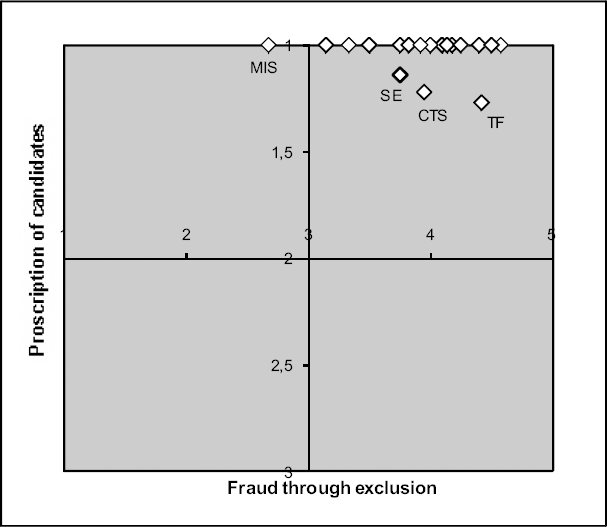
Inclusion of Voters and Candidates
Freedom of Expression
Democracy can only function properly when citizens can voice their political views without fear of punishment. The SEPP included a number of questions about freedom of expression. Two of them, one about the population in general and another about public employees, are presented in Figure 5. Only two provinces appear on the left sector of the graph, indicating that the citizens of most provinces enjoy significant levels of freedom of expression. When this attribute is evaluated only for provincial public employees, who are often thought to run larger risks if they express critical views of the government, inter-provincial differences become larger: several provinces are located in the lower half of the chart. Public employees, then, are not so free to speak about politics publicly. This is a major limitation of democracy in many provinces where most jobs (and the overwhelming majority of the best jobs) are controlled directly or indirectly by the provincial administration. The finding is consistent with interpretations of differences in subnational regimes as emerging from differences in levels of economic autonomy (McMann 2006; Gervasoni 2010). Overall, only a few provinces are well into the upper-right quadrant. These results and the findings above on campaign coverage by the media suggest that one of the main ways in which provincial incumbents limit contestation is by restricting political communications.
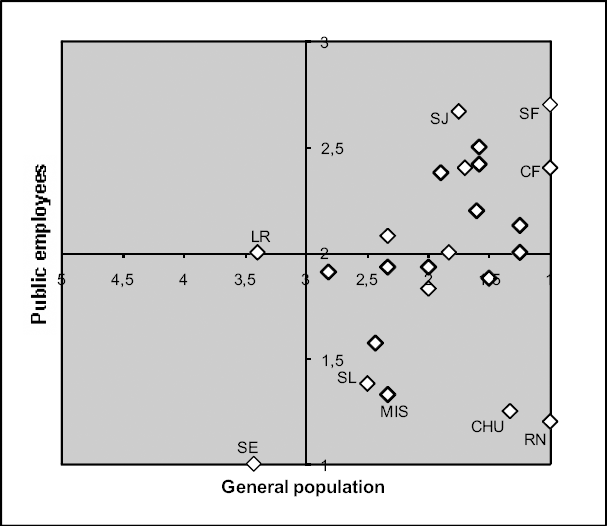
Freedom of Expression
Checks and Balances
The SEPP assesses institutional constraints through questions about the role of the provincial Legislature and the provincial Supreme Court of Justice in functioning as limitations on the power of the Executive (all of Argentina's provinces are “presidential” and have, constitutionally, three clearly separated branches). Figure 6 shows that only the Federal Capital has effective legislative and judicial controls on the power of the Executive. The provinces of Buenos Aires and Mendoza appear in relatively democratic positions too. Most notably, there is a large group of provinces clustered towards the lower-left corner. The Governors of Santiago del Estero, San Luis, Santa Cruz, La Pampa, Jujuy, and other provinces enjoy almost total freedom from the other branches, a finding consistent with journalistic accounts and academic case studies of some of these provinces (Bill Chavez 2003; Gibson 2005). Contrary to the findings above about vote-counting fraud and inclusion, the “checks and balances” subdimension appears as a deficit of democracy in many (but not all) provinces. An interesting additional finding is that provinces with decent levels of judicial independence outnumber those with effective legislative control.
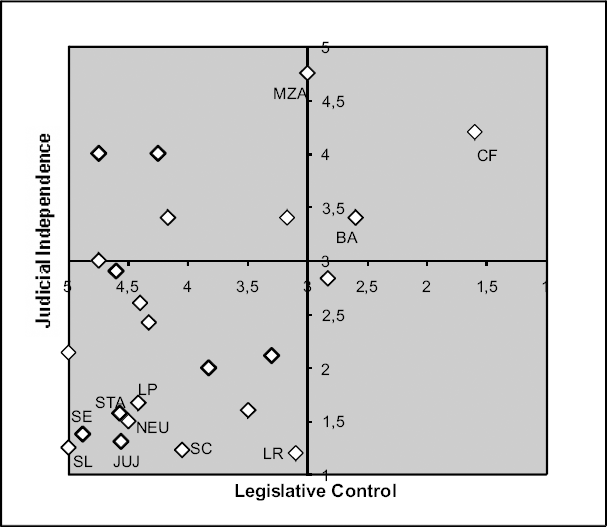
Checks and Balances
State Repression and Discrimination
Some of the indicators presented above contain little inter-provincial heterogeneity (like those tapping inclusion and outright electoral fraud), while others did vary considerably from province to province (e.g., freedom of expression and institutional constraints). The last aspect of democracy I analyze, state repression and discrimination, combines one variable of each type. As Figure 7 shows, all provinces boast very high ratings in terms of discrimination against religious minorities (similar results obtain with other types of discrimination). However, they do differ when repression of public demonstrations is assessed: although no province is located at the lowest level in this variable, four of them are at or below the mid-value. One possible interpretation of these differences is that discrimination against minorities is hardly ever needed to keep an incumbent in power, while repression of demonstrations against the government might be.
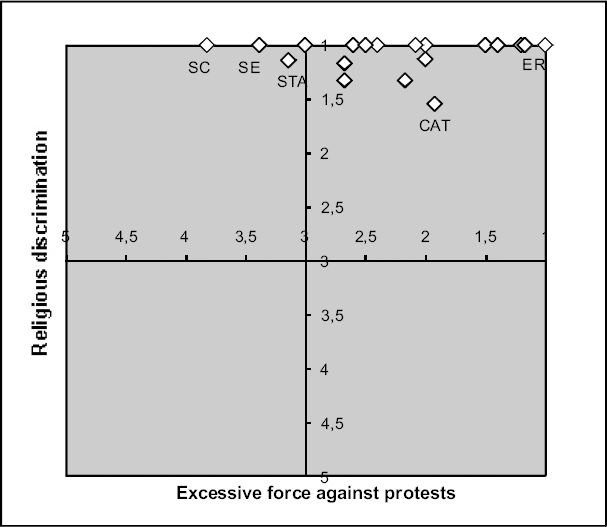
State Repression and Discrimination
Overall Assessments of Democracy
As an alternative (and last) way of measuring the level of democracy in each province, an item towards the end of the questionnaire gave the experts a definition of democracy and asked them to rate the 2003-2007 period in their provinces (and several national-level administrations). The question read as follows:
For the next questions I need to define democracy as ‘a political regime in which: 1) the executive and legislative branches are elected in free and fair elections with universal adult franchise, 2) there are effective checks and balances among the executive, legislative and judicial branches, and 3) basic constitutional rights such as freedom of speech are respected.
I am going to mention several provincial and national governments, and I would like you to tell me, using this definition, whether each of them was very democratic, quite democratic, somewhat democratic, not very democratic or not democratic at all. 13
“Para las siguientes preguntas necesito definir la democracia como ‘un régimen político en el que: 1) los poderes ejecutivo y legislativo son elegidos en elecciones libres, justas y con voto universal, 2) hay pesos y contrapesos efectivos entre los poderes ejecutivo, legislativo y judicial, y 3) se respetan los derechos constitucionales básicos, tales como la libertad de expresión’.” “Le voy a mencionar varios gobiernos provinciales y nacionales y quisiera que me diga, tomando en cuenta esta definición, si cada uno de ellos fue muy democrático, bastante democrático, algo democrático, poco democrático o nada democrático.”
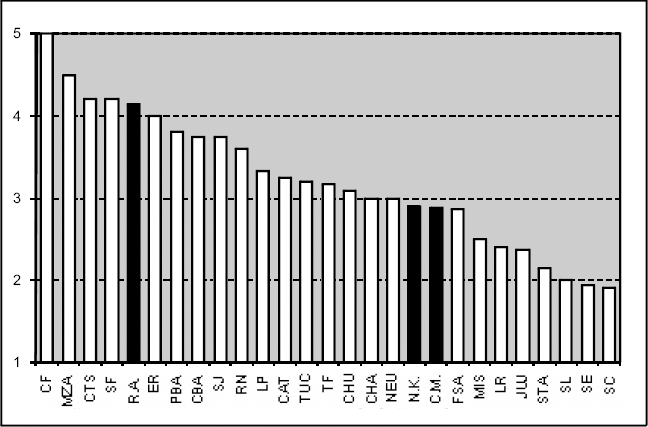
Each expert was asked to assess the current (2008), the 2003-2007, and two previous provincial administrations, plus the Néstor Kirchner, Carlos Menem and Raúl Alfonsín administrations at the national level. Figure 8 presents the results for the 2003-2007 provincial average scores (plus those for the national administrations, which are based on the opinions of all experts and are highlighted in black).
Overall Evaluations of Democracy
The national-level ratings provide a useful (and interesting in itself) point of reference for comparison. As the figure shows, the Federal Capital, Mendoza, Corrientes, Santa Fe and Entre Ríos, along with the 1983-1989 Alfonsín administration, were considered basically democratic. The Néstor Kirchner (2003-2007) and Carlos Menem (1989-1999) administrations were evaluated as considerably less democratic. The subnational regimes in San Luis, Santiago del Estero, and Santa Cruz were seen as the least democratic, well below most other provinces. These figures (and some of the previous ones) show a wide variance in terms of degree of democracy. They also show that provinces can be more or less democratic than the national-level regime.
Subnational Democracy over Time
A limitation of the subjective measurement strategy is that memory-constraints make it unadvisable to use expert judgments to code specific characteristics of regimes far in the past. Moreover the need to keep interviews reasonably short makes it in practice impossible to repeat all questions for several past periods. Taking into account these restrictions, the SEPP attempted to obtain some information about the past by asking only the “overall democracy” question (described in the previous section) for two previous provincial administrations, that is, the 1995-1999 gubernatorial term, and the 1983-1987 term (the first after the 1983 redemocratization). Moreover, since the survey was administered after the end of the 2003-2007 period (on which practically all items focus), the “overall” question was also asked about the current (2007-2011) term.
Expert judgments about the distant past surely contain more measurement error than those about the present or the recent past. Moreover, these overall evaluations of democracy are less accurate than other items in the SEPP for two additional reasons unrelated to the temporal frame: 1) they conflate in a single question all aspects of democracy and therefore leave to the discretion of the expert the relative weight of each of them, and 2) they are less factual and therefore more prone to subjective biases than most other items. In sum, at the price of accepting a higher level of measurement error I was able to collect data to assess over-time variation in subnational democracy. Given the measurement limitations of these “overall” items, small differences from one period to the next should not be overinterpreted. Sharp temporal trends, however, in all likelihood reflect real regime changes since 1983.
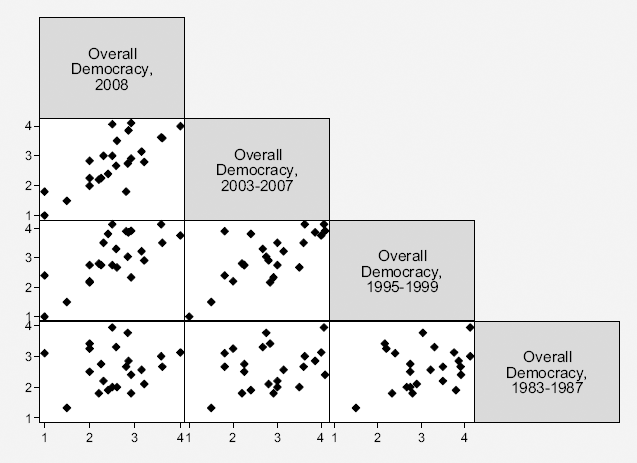
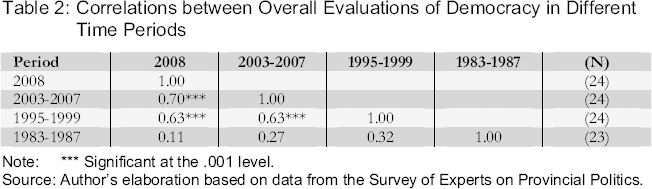
Although the average level of subnational democracy does not show a clear ascending or descending trend, Figure 9 and Table 2 below display a pattern of association that reveals important information about the persistence of provincial regimes over time.
Scatterplots of Overall Evaluations of Democracy in different time periods
Correlations between Overall Evaluations of Democracy in Different Time Periods
Note:
Significant at the .001 level.
Source: Author's elaboration based on data from the Survey of Experts on Provincial Politics.
The overall assessments of democracy at different periods are always positively associated. That is, provinces that are more (or less) democratic today tended to be also more (or less) democratic in previous gubernatorial terms. As it is the case at the national level, provincial regimes tend to persist over time. Such persistence, however, weakens as measurement points are temporally farther apart. The pattern of correlations in Table 2 indicates that the longer the period between two terms, the lower the (positive) correlation. The especially low coefficients associated with the 1983-1987 term (none of which is statistically significant, an unsurprising finding given the small sample) are likely to reflect its larger distance in years to the other periods, but they might also be a function of larger measurement error. In effect, one would expect expert judgments to be less reliable for older periods (other things being equal). If so, the higher (hopefully random) error would result in downwardly-biased (or attenuated) correlations. In all likelihood both factors – regime change over time and time-dependent measurement error – are at work. If so, then all the correlations above are to some extent attenuated, which means that regimes are more persistent than these graphs and figures suggest. It is illustrative to note that, even containing significant levels of measurement error, the scatterplots in Figure 9 show practically no cases clearly located in the upper-left or lower-right corners, that is, in the positions that would indicate radical changes from democracy to authoritarianism and vice versa.
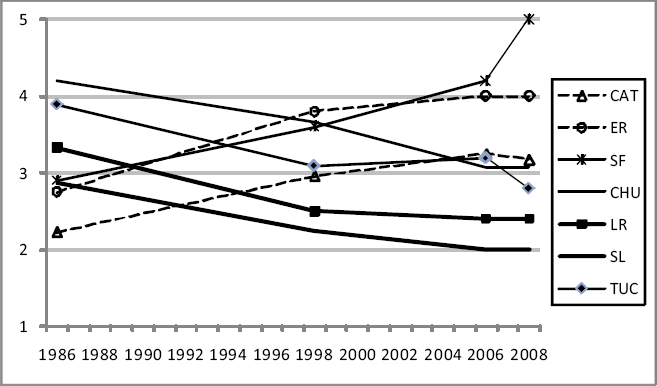
That persistence over time is the overall pattern does not preclude the possibility of cases that did undergo significant change since the inauguration of democracy in 1983. Figure 10 presents provinces with statistically and substantively significant temporal trends. Taking 1986, 1998, 2006, and 2008 as the mid-points of each gubernatorial term, I regressed the average overall assessment of democracy in each province on time. Four provinces show a clear and substantive downward trend: Chubut (slope=-0.05), La Rioja (-0.04), San Luis (-0.04), and Tucumán (-0.04). Despite their similar slopes, these provinces differ in their constants (or starting points): Chubut, for example, started quite democratic, and declined to middling, while San Luis started off at rather low levels of democracy and sank even deeper. Three provinces boast clear upward trends: Santa Fe (slope=0.08), Entre Ríos (0.06), and Catamarca (0.05). The fact that most of the lines displayed in the graph are monotonic provides additional support for the idea that they reflect gradual but persistent regime change over time.
Overall Democracy over Time in Seven Provinces
However imprecise these trend estimates may be (due to the measurement issues discussed earlier), collectively they seem to indicate that within the general context of persistence, subnational regimes can, given enough time, move both toward higher and lower levels of democracy.
A Systematic Analysis of the Central Tendency and Dispersion of the SEPP Items
A first characterization of democracy in the Argentine provinces can be carried out by just looking comparatively at the overall means of the items. To make this analysis easier, I normalized all items so that their lowest category equals 0 and their highest category equals 1, and recoded them so that 1 is always “high level of democracy” and 0 is “low level of democracy.” The normalized means range approximately from 0.17 (two items related to the campaign resources available to incumbents and challengers) to 1 (an item on government killing of critical journalists). This means that the SEPP covers a wide range of issues that go from those in which the provinces rank consistently high (in none of them does the government kill journalists) to those in which they tend to do poorly (in general incumbents’ campaign funds are much larger than those of their challengers).
The central tendency of the items, as measured by their means, provides information about the average provincial situation on a given aspect of democracy. However, item means are not the only characteristic of interest. Equally important is inter-provincial dispersion. Only items with significant levels of heterogeneity provide information about differences among provincial regimes. To assess dispersion I use the standard deviation of each item, a measure that in the context of variables that range at most from 0 to 1 has a minimum of 0 and a maximum of 0.5 (the latter implies a situation in which half of the provinces are coded 1 and the other half are coded 0). Low standard deviations indicate that provinces are similar, while high standard deviations imply that inter-provincial differences are significant.
The combination of information on the mean and the standard deviation provides a useful basis for an initial analysis of the general situation of democracy in the Argentine provinces. If, for the sake of simplicity, we assume that both statistics can be either “low,” “medium,” or “high,” then seven situations are possible, as shown in Table 3.
Classification of Items by Mean and Standard Deviation
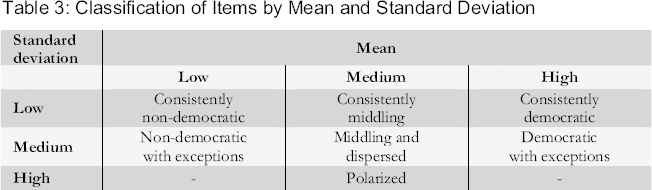
Left-to-right movement in Table 3 implies going from less to more democratic situations. Movement from top to the bottom, on the other hand, is associated with low to high inter-provincial differences. The lower left and right cells are empty because it is logically impossible that a low or high mean is accompanied by high standard deviation: the former require a clustering of the provinces in one end, while the latter implies that provinces are widely scattered. The actual distribution of the survey items is displayed in Figure 11. Notice, first, the empty area on the left of the graph: no item has a very low mean, that is, there is no aspect of democracy that performs consistently poorly in all provinces. At the right end of the graph, however, there are many items with high means: some features of democracy appear to be prevalent across the national territory. The declining level of dispersion as the item means approach 1 is inevitable: a very high mean can only be obtained if all cases rank high, a situation that implies inter-provincial homogeneity.
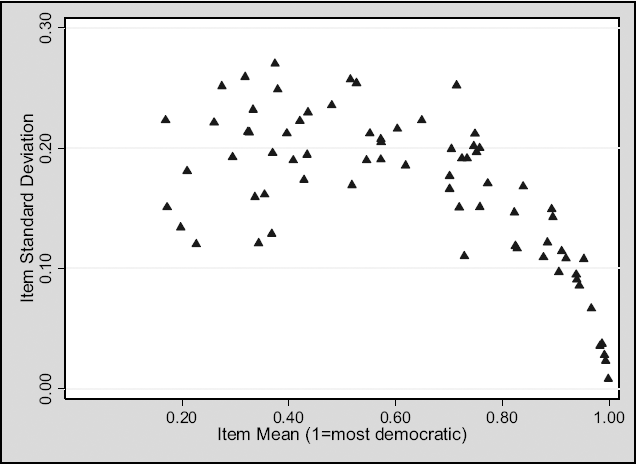
Scatterplot of SEPP Item Means by Item Standard Deviations
Standard deviations do differ considerably toward the center of the figure, ranging from a low of approximately 0.10 to a high of 0.27. It should not be surprising that no item approaches a standard deviation of 0.5 (the “polarized” situation of Table 3), as this would mean that about half of the provinces are at the democratic extreme and half at the authoritarian extreme, and none in between, a highly unlikely distribution for any social science variable. However, the fact that all items in the central area of the figure are above 0.10, and many above 0.20, suggests that non-trivial inter-provincial differences are always present, and that sometimes they are rather large.
Is there a pattern in the type of items that appear in each sector of the graph? Figure A (available as this article's supplementary material at www.jpla.org) is a rough reproduction of Figure 11 where the small triangles are replaced by short descriptions of the substantive content of most questions. All items are colored according to the subdimension of democracy they belong to. 14 Two sets of items tend to cluster in a specific sector of the figure. First, the two purple items (inclusion dimension) are on the lower-right corner, indicating that they are consistently democratic: all provincial regimes tend to be highly inclusive both in terms of the right to run and the right to vote. Second, the red items (institutional constraints) are mostly located on the left half of the figure, and generally on the upper half. 15 This pattern implies that institutional limits on the incumbents’ power are the weakest aspect of subnational democracy in Argentina. Both the provincial Legislatures and the provincial Supreme Tribunals (and lower courts) are judged to be generally ineffective in checking the Governor. The same is true for the provincial agencies of horizontal accountability (O'Donnell 1999a) and incumbent parties. Notice, however, that the relatively high standard deviation of these red items indicates that at least in some provinces checks and balances do work. The items associated with institutional constraints, then, approach the “non-democratic with exceptions” pattern in Table 3.
As measures of the dimension “Independence of Civil Society” are “effect indicators” more than constitutive aspects of democracy, I decided not to include them in Figure A. The point is that it is logically possible for a democratic political system to exist in the midst of a weak civil society, even if such situation is unlikely.
The only partial exception is the federal justice, a non-surprising finding given that federal courts are part of the national, not the provincial government.
The “liberal rights” (green) items are somewhat more common on the right half of the figure, and especially so when the substantive content includes overt repression. Thus, executions of detainees are extremely rare and arbitrary detentions or excessive use of force by the police not too common. The only liberal rights that perform poorly are access to government information, and the availability of alternative sources of information for the poor. 16 That is, core liberal rights such as physical security and liberty are for the most part respected, while violations occur in the realm of less critical rights or for the less privileged citizens.
The question about ease of access to alternative sources of information was asked for three hypothetical citizens, a poor peasant, a lower middle class teacher, and an upper middle class professional.
The items associated with contestation, the most central feature of democracy, do not follow a clear distributional pattern. They appear in all populated sectors of the figure, but seem to move from left to right as the substantive content becomes more associated with traditional forms of electoral fraud. For example, electoral irregularities, the arrest of opposition leaders, or the harassment of opposition campaigns are relatively uncommon. Items tapping the fairness of electoral campaigns in terms of financial resources or media coverage, on the other hand, show a generally lopsided picture: incumbents often (but with important inter-provincial differences) prevail over their opponents because of privileged access to campaign funds, state resources, and favorable media coverage.
Not surprisingly, the overall indicator of democracy (in black and bold in the picture) is located approximately at the center of all items: experts surely took into consideration many aspects of democracy in their provinces and concluded that the overall situation is some type of weighted average of all of them. Overall, the figure shows that the state of provincial regimes in Argentina is mixed in two senses: 1) some aspects of democracy do better than others, and 2) with respect to most items, some provinces do better than others.
It was already argued that there are strong theoretical reasons to expect that subnational incumbents in national democracies will tend to curtail democratic rights in subtle and relatively civil ways. The items highlighted in bold in Figure A are those associated with highly visible violations of democratic principles. Those items, which ask about acts such as vote stealing, threats, physical attacks, arrests, and executions, are always located on the right side of the figure. It appears that, following the logic of hybrid regimes and “boundary control” (Gibson 2005), provincial executives try to avoid blatant (and therefore visible) instances of undemocratic practices.
Conclusion
Different aspects of democracy in the Argentine provinces, as measured by the SEPP questions, range from (on average) very good to rather poor. Most also have a significant level of inter-provincial variance. These findings mean that subnational regimes are heterogeneous in two ways. First, they perform differently in terms of different components of democracy. For example, provinces tend to be democratic in terms of inclusion but rather authoritarian in terms of checks and balances. Second, provincial regimes vary with respect to their overall average: for a large majority of items some provinces are significantly more and some are significantly less democratic. There is, then, plenty of inter-provincial variance to be explained.
The descriptive results presented above suggest that the less democratic subnational regimes in Argentina are characterized by weak checks and balances and by sophisticated ways of undermining contestation. Inclusion requirements, and to a lesser extent liberal rights, are generally respected by Argentine provincial incumbents.
The weakness of institutional constraints on the power of the Governor could be interpreted as the legitimate result of democratic politics, especially with respect to the Legislature. It could be argued that if a party wins both the governorship and a comfortable majority in the assembly, the preferences of both branches are likely to be aligned. This argument is reasonable but not conclusive: even where a party controls both branches, it is unlikely that in a clearly democratic regime the Legislators and the Governor would always agree. Or, in other words, a submissive or institutionally weak legislature is arguably a sign of a weak democracy. 17 More generally, the fact that judicial and other horizontal accountability institutions also often fail to set any limits on the power of the Executive suggests that the problem is not so much “unified government” as “excessive dominance of the Executive.” To the extent that liberal democracy is about limiting the power of rulers (Riker 1982), the Argentine provinces tend to be only imperfectly democratic.
Steven Fish (2006) makes a persuasive “stronger legislatures, stronger democracies” argument.
Standard errors should be compared taking into account the different scales of the items, which sometimes range from 1 to 3, sometimes from 1 to 4, and sometimes from 1 to 5.
Additional analyses of the SEPP data might allow the elaboration of a more general and sophisticated typology of subnational regimes using information both about the items’ substantive content and about their central tendency and dispersion. Such a typology would not only reveal (quantitative) levels of democracy, but also the (qualitative) nature of provincial regimes.
Footnotes
Measurement Error Estimates
As is the case with any measurement instrument, expert judgments are affected by measurement error. An important advantage of the SEPP, however, is that by scoring each item in each province several times (by consulting several experts), it permits the estimation of the (usually unknown) magnitude of the error of measurement.
To illustrate the approximate uncertainty associated with the SEPP figures presented in this article, Table A displays the estimated provincial standard errors for the overall indicator of democracy depicted in Figure 8. The estimates of measurement error are based on classical reliability theory (Traub 1994): it is assumed, first, that observed scores equal true scores plus measurement error and, second, that errors are random noise around the true score, and more specifically that they are distributed normally with a mean of zero. These assumptions, plus the availability of several measurements per item and province, make it possible to estimate provincial-specific standard errors. This means that different provinces might have, as happens in practice, quite different levels of measurement error for a given item, depending both on the level of agreement among experts and on the number of experts consulted. Making use of the normality assumption, the central limit theorem was applied to estimate the standard errors of measurement shown in the last column of Table A (confidence intervals at any significance level can be constructed from the means and standard errors provided in the table).
Standard error estimates vary from as low as zero (the city of Buenos Aires) to as high as 0.51 (Formosa). The median standard error equals 0.25. The substantive importance of these magnitudes can more easily be assessed in relationship with the range of this item's scale: it varies theoretically from 1 to 5 (range=4), and empirically from 1.91 to 5 (range=3.09). The practical implication of these figures is that small differences between provincial scores (such as that between Buenos Aires and Córdoba) should not be overinterpreted as necessarily reflecting true differences. Conversely, large differences (say that between Santiago del Estero and Mendoza) cannot be plausibly attributed to measurement error, and therefore reflect in all likelihood real differences.
The rest of the SEPP items used in this article contain comparable levels of measurement error. Table B presents the summary statistics for each of these items, plus their median standard errors. The figures indicate that measurement error is sometimes higher and sometimes lower than (but usually close to) that associated with the overall evaluation of democracy presented in detail in Table A (and here displayed in the last row).18