




Abstract
Over the past two decades, the armed forces have increasingly been asked to take an active role in the fight against the rampant crime in Latin America. Since the militaries in this region are not always trained to conduct themselves with restraint, the possibility of excesses and human rights violations is always latent. Despite that prospect, there is a high level of public support for military counter-crime interventions throughout the region. The key argument in this article is that when the Latin American public supports military interventions to combat crime, it makes a comparative judgment call about the relative efficacy of military vs. police conduct in domestic security roles. Latin American citizens have very low confidence in the capacity of the police to fight crime effectively and to respect human rights. They place more trust in the armed forces as an institution capable of performing effectively and in accordance with human rights standards and the rule of law. This study develops these arguments in greater detail and then turns to recent Americas Barometer surveys that clearly show that Latin American citizens place more trust in the armed forces than the police as an institution capable of effectively and humanely fighting criminal violence.
Introduction
Since the turn of the century, the armed forces have been increasingly asked to assist in the fight against crime in Latin America. Calls for military intervention have escalated in tandem with the rise of larger, more lethal, and more sophisticated national and transnational criminal organizations. It is evident that when governments enlist the help of the military to fight these criminal elements, they do so with the firm backing of the public. In fact, constituents are often ahead of the politicians in demanding that tougher measures be taken, and that those measures specifically include the deployment of soldiers.
There are certainly reasons to be skeptical about the benefits of turning soldiers loose on city streets to hunt down members of criminal organizations. Militaries are normally trained to use uninhibited, explosive force to subdue an enemy; they are not commonly prepared to conduct themselves with restraint or circumspection. There is an ever-present theoretical possibility that soldiers could resort to excesses and violate human rights while chasing suspects. Despite that prospect, public support for military counter-crime intervention seems undiminished. Why would this be so?
A central contention of this study is that when the Latin American public supports military crime fighting, it makes a comparative judgment call about the relative efficacy of military versus police conduct in domestic security roles. As our evidence will show, citizens of Latin America have a rather dismal view of the police and are convinced these law enforcement officers can neither fight crime effectively nor respect the rights of those they are sworn to protect and serve. The citizens lack a fundamental trust in law enforcement to do its job in a successful, transparent, and humane manner. By contrast, Latin American citizens place more trust in the armed forces as an institution capable of performing effectively, and in accordance with human rights standards and the rule of law. In other words, public support for military crime intervention is not an endorsement of repression or authoritarian solutions, so much as a belief – accurate or not – that the military can, compared to the police, better combat criminal elements without placing innocent civilians in harm's way to the same degree.
To defend these claims, we start by detailing the extent of crime and violence in the region and the public's reaction to it. We then use statistical modeling to examine the reasons for widespread support for military crime-fighting operations, focusing on the impact of fear, victimization, dissatisfaction with police performance, and police corruption. We look at surveys indicating that, in contrast to negative perceptions about the police, the armed forces are viewed more favorably; that is, as better trained and more respectful of human rights. These same models will demonstrate that there is an association between the public's trust in the military and its belief that they respect human rights on the one hand, and their support for military crime fighting on the other.
The Problem and Reactions to it
Crime and violence are two of the most compelling and seemingly intractable problems confronting Latin America today. Latin America is often described as the most violent region in the world (Parkinson 2014). Global homicide statistics corroborate this assertion, as can be observed in Figure 1.
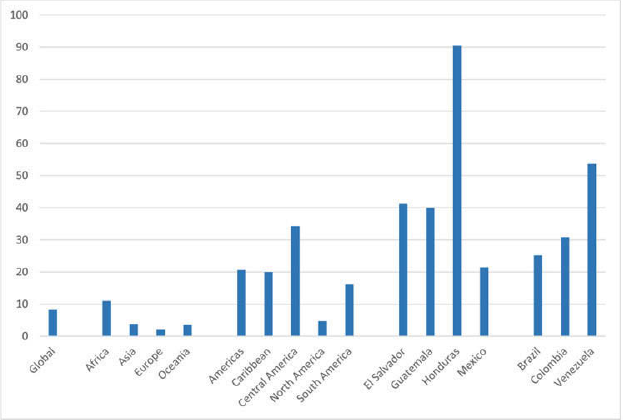
Homicide Rates (Per 100,000 Population), by Region
This figure shows the scale of the crime-related violence in Latin America. The global homicide rate in 2012 was 8.3 per 100,000, and it was lower than 4 per 100,000 in three world regions (Asia, Europe, and Oceania). By contrast, the homicide rate was 20.6 per 100,000 in the Americas. Criminal violence is concentrated in South America, in the Caribbean, and especially in Central America, where the homicide rate reaches 34.3 per 100,000. Although criminal violence is on the rise throughout the region, Figure 1 also shows that homicide rates are particularly high in certain Central American (El Salvador, Guatemala, Honduras, Mexico) and South American (Brazil, Colombia, Venezuela) countries.
These high crime rates also affect the attitudes and perceptions of Latin American citizens, as several polls and surveys have shown in the past decade. For instance, the 2014 wave of the Americas Barometer asked respondents what is the most important problem facing their countries; almost one-third of respondents (32.6 percent) considered criminal violence as the most serious problem. 1 Unsurprisingly, the percentage of people who considered crime as the most serious problem was even higher in the most violent countries (for example, 47.9 percent in El Salvador and 65.2 percent in Honduras).
The exact question wording is “In your opinion, what is the most serious problem faced by the country?” We recoded the responses into a dummy variable. People who responded “crime”, “gangs”, “kidnappings”, “security (lack of)”, and “violence” were coded as 1 (that is, criminal violence is the most serious problem), and all other responses were coded as 0 (that is, criminal violence is not the most serious problem).
Normally, it is the police that are sent to fight crime; they are, in theory, the first responders. However, the conundrum facing many Latin American states plagued by pervasive drug-related crime and violence (Bruneau 2011; Dammert 2012; Desmond Arias 2006) is that they are unable to rely on their police forces to provide citizens with the protection they demand. While police are normally at the front lines in the battles to defeat crime, they are also part of the problem: inept, corrupt, outnumbered, and outgunned by lethal criminal syndicates with sufficient resources to purchase police docility or connivance. Even if they could hold their own against criminal organizations – which they cannot – police often lack the motivation to try. Instead, police throughout the region regularly skirt the law, and even cross the line into criminality, corruption, and rampant violence (Brinks 2008). Running drug operations and prostitution rings, committing extrajudicial killings and kidnappings, providing intelligence to drug traffickers, and abusing detainees have become familiar police practices in a number of Latin American countries. Opportunities for these activities abound, as do motives, such as poor pay, poor training, and the knowledge that such transgressions will likely go unpunished. These police practices have also led to an erosion in trust in the police and to low levels of satisfaction with the performance of the police (Lagos and Dammert 2012).
The obvious solution is to reform the police, but this is much easier said than done (Fuentes 2005; Uildriks 2009; Ungar 2012; Sabet 2012). Police themselves do not want to be held to close scrutiny, fearing revelations of incompetence, corruption, excessive violence, and criminality within their ranks. The police can call on a hardline coalition of political office holders, party leaders, and the public (Fuentes 2005), arguing that reform efforts could actually drive up crime by hampering the police's resolve, hurting morale, and inviting hesitancy. They boil the problem down to a choice of either harsher measures or human rights observance, but not both (Ungar 2012). Politicians commonly accept this unfortunate tradeoff when they are confronted with constituents who are panicking about crime and calling for urgent responses to it. Politically expedient governments then opt for the easier, faster remedy that simply places more heavily armed police officers on the streets with a license to kill (Ungar 2012).
Inevitably, however, those superficial responses fail to stem the tide of criminal violence. The excessive use of force backfires, as police – wittingly or unwittingly – threaten the very citizens they depend on to provide intelligence on suspected criminals. Residents shy away from sharing with law enforcement their localized knowledge of criminal elements, let alone their own harrowing personal experiences of victimization, which is precisely the kind of information police need to uncover wrongdoing and make arrests. Consequently, police performance suffers and the public grows increasingly disenchanted.
It is for these reasons that citizens commonly support and indeed request the introduction of the armed forces to help fight crime, complementing and in some cases supplementing police units. When crime escalates, as it has in recent years throughout Latin America, voters pressurize their political leaders to deploy soldiers onto city streets when police have not been up to the task. In El Salvador, this took the form of mano dura in 2003 and, after that failed, super mano dura policies in 2007, which also failed. Interestingly, even in the face of failure, citizens will insist on hardline programs that use military force. By 2009, 93 percent of respondents in a poll conducted by El Salvador's El Diario de Hoy still favored the use of soldiers to fight crime (IPS 2009; see also Pérez 2010).
A similar pattern has been observed in Mexico. President Felipe Calderón (2006–2012) launched a war on drugs that was widely seen as ineffective. In 2009, Calderón resorted to a surge strategy, sending thousands of soldiers to ‘take back’ northern cities under drug cartel domination, but victory proved elusive. Not only did homicides attributable to the war increase, but allegations of human rights abuses at the hands of army personnel grew as well. In 2012, when pollsters asked Mexicans who they thought had won the war, 54 percent said the criminals and only 18 percent said the government. Yet, by October 2012, with the Calderón Sexenio coming to a close, and with no end in sight to the murder and mayhem, 69 percent of those polled still maintained it was correct to use the army to combat organized crime (CESOP 2013: 39).
In Latin America, the introduction of the military for internal security purposes invokes historically based fears based in haunting memories of the past. During the years of de facto rule, the armed forces granted themselves authority to engage in widespread intervention. Guided by nefarious doctrines and ideological precepts constructed within the context of the Cold War, they repeatedly sacrificed individual rights and freedoms on behalf of the national security state. However, even within the context of a democratic state, with constitutional protections in place, the common wisdom has been to avoid reintroducing the military into internal security at all costs; that to do so would be to invite harm to citizens, whether intentional or unintentional (Loveman 1999; Stepan 1986). The military's sin is no longer political or ideological hatred for the target population, although on certain occasions that may be so. Rather, it is most commonly over-reaction, a result of ingrained behavior. Militaries are socialized into the use of maximum force. Conditioned by years of rigorous training and indoctrination, they are hard-wired to react in ways that are widely considered inappropriate and at odds with police functioning. 2 Deploying army units in anticrime or antidrug operations in densely populated zones – often alongside police units – often invites trouble because militaries resist being compelled to abide by the principles of minimal use of force and due process, which are thought to interfere with combat effectiveness. The critics say that the result is inescapable: citizens will suffer repeated human rights abuses at the hands of soldiers.
This training is called Continually Reinforced Functional Discipline (CRFD); see McDavid (2007). David Bayley (2001) argued that the military will contaminate community policing because it is trained to take orders from above rather than responding to citizen appeals; because it does not know how to use restrained force; it lacks mediation skills; and does not give soldiers powers of discretion.
Whether the armed forces that conduct anti-crime operations are in fact guilty of repeated human rights transgressions is an empirical question that is addressed below. Separate from that is the question of whether the public believes this is the case. Is the public convinced that military intervention opens the door to the use of unbridled force, resulting in human rights transgressions? If so, then are citizens who demand a military response to crime explicitly condoning a turn toward repressive measures? If they are not, then what is the basis upon which they support military crime-fighting intervention?
Review of the Evidence
Many nations have passed laws restricting the use of military force within national borders, and yet all nations of the region continue to allow for some form of military utilization under certain conditions. 3 Even Argentina, the country thought to have erected the highest hurdles, does allow for the internal deployment of armed forces in exceptional circumstances, when normal internal security forces are overwhelmed, and when ordered in by the president under constitutional state of siege provisions.
Of those countries, 54 percent do so only with minimal restrictions, namely that it occur only with presidential authorization. Forty-six percent impose more formidable conditions, stating either that the military be used only under exceptional circumstances, or that it be confined to supportive roles. See Pion-Berlin (2009).
Does the public favor military intervention to fight crime? In order to explore this question, we used a survey item present in the 2012 wave of the Americas Barometer, which asked respondents whether they agreed or disagreed with the following statement: “The Armed Forces ought to participate in combatting crime and violence in [country].” The responses ranged from 1 (strongly disagree) to 7 (strongly agree). Figure 2 presents the percentage of respondents who agree or strongly agree with this statement (responses ranging from 5 to 7).
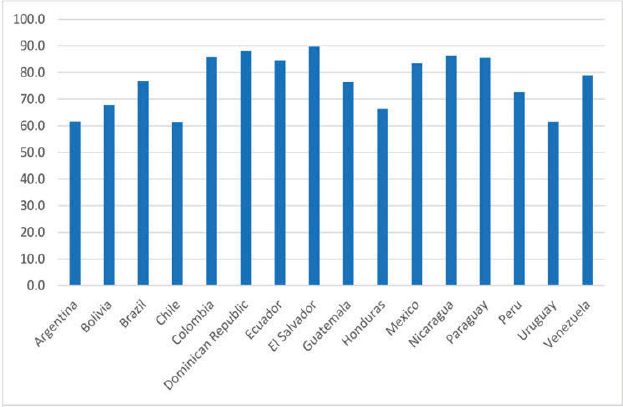
Support for Military Anti-Crime Intervention, 2012
The figure shows that there is widespread support for a military intervention in anti-crime operations. In fact, 78 percent of respondents from 19 countries either agree or strongly agree with the statement that the army should help fight crime. This was true throughout the region, regardless of crime levels. While support was strong in high crime countries such as El Salvador, Guatemala, Honduras, and Venezuela (on average 77.8), as expected, support for military intervention to fight crime was also considerable in countries with lower rates of crime such as Peru, Bolivia, Chile, and Ecuador (71.6). This was also the case in Argentina, where past human rights abuses during the Dirty War had made that military an institutional pariah. In the years immediately following the transition to democracy, citizens there rejected any internal security role for their military, which is actually legally prohibited from engaging in law enforcement measures, except in rare circumstances, and as authorized under states of siege. Even there, over 61 percent of those recently polled now favor military intervention to fight crime.
Why are citizens calling for military intervention? In the countries with the highest rates of crime in Central America, violence has reached unprecedented levels, and political leaders there have referred to organized, gang-related activities as threats to national security. Crossing the threshold from a public security peril to one of national dimensions justifies the introduction of the armed forces, since no other agency of state could effectively grapple with such an existential crisis. If the public agrees with that assessment, this would explain its support for introducing troops (Bailey, Parás, and Vargas 2011).
A second and more likely explanation for region-wide trends is that the police have been unable to effectively respond to escalating crime and violence, leaving citizens frightened, frustrated, and searching for alternatives, including the assistance of the armed forces (Corbacho, Philipp, and Ruiz-Vega 2012; Lagos and Dammert 2012). As more police are brought into counter-crime activities, homicide rates actually trend upward; this is just one indication of police ineffectiveness. This was true in El Salvador, when the mano dura policy was introduced in 2003. Thousands of additional police were deployed, but the homicide rate soared from 37 per 100,000 people in 2002 to 62.2 per 100,000 by 2005. Mano dura‘s successor, super mano dura, introduced in 2007, fared no better, as homicide rates escalated to 70.9 by 2009 (UNODC 2013: 126). In Mexico, thousands of additional federal police were deployed to northern border cities in 2007 as part of President Felipe Calderón's Drug War. However, homicide rates rose steadily from 7.8 per 100,000 people in that year to 21.5 per 100,000 by the end of his term in 2012.
The public has taken a measure of police performance, as indicated by the polling results displayed in the table below. For 2015, across the region, 65 percent of respondents were dissatisfied with the police and only 35 percent were satisfied. When broken down by high- and low-crime countries, the differences are slight.
Latin American Public's Police Ratings, 2015
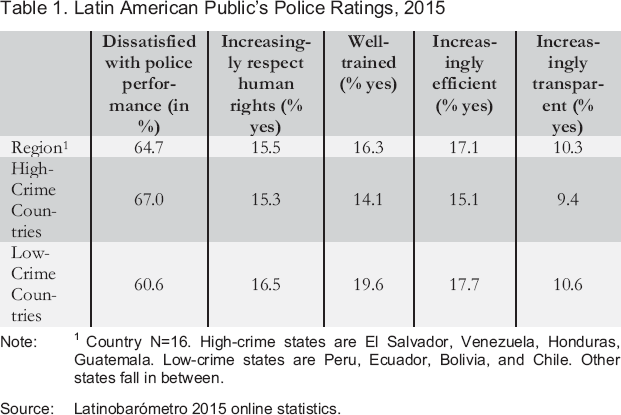
Note: 1 Country N=16. High-crime states are El Salvador, Venezuela, Honduras, Guatemala. Low-crime states are Peru, Ecuador, Bolivia, and Chile. Other states fall in between.
Source: Latinobarómetro 2015 online statistics.
Exploring the dimensions to that dissatisfaction reveals that only small minorities believe the police respect human rights, are well-trained, and are efficient and transparent. Again, the differences between high- and low-crime countries are negligible. If the public perceives that the police have little regard for human rights, this is an indication it does not trust the police to protect them. Citizens will not report crimes to policemen who are known to be habitually abusive and violent, convinced that doing so would only personally expose them to greater danger (Brinks 2008). Police agencies that lack transparency, concealing malfeasance while protecting corrupt officers, will not elicit much faith among the citizenry. These arguments are buttressed by a review of 27 recent studies, which indicates that the strongest predictor of citizen dissatisfaction with the police is having had a negative encounter with law enforcement (Johnson 2015). Negative encounters could include violent run-ins with policemen or requests for bribes.
Police corruption in particular might lead to low satisfaction with the police. Previous studies have shown, in various contexts, that public experiences of police corruption reduce public confidence in the police (Gerber and Mendelson 2008; Tankebe 2010; Weitzer and Tuch 2005), and also negatively affect the legitimacy of the political system (Cruz 2015). There is widespread evidence of police corruption in Latin America (Cawley 2013), but do the armed forces fare better? In order to address this question, we used two survey items present in the 2014 wave of the Americas Barometer, which asked respondents whether a police/military officer had asked them to pay a bribe in the last 12 months. Figure 3 presents the percentage of respondents in various Latin American countries who reported having been asked to pay a bribe by the police and the percentage of respondents who reported having been asked to pay a bribe by the military in the last 12 months.
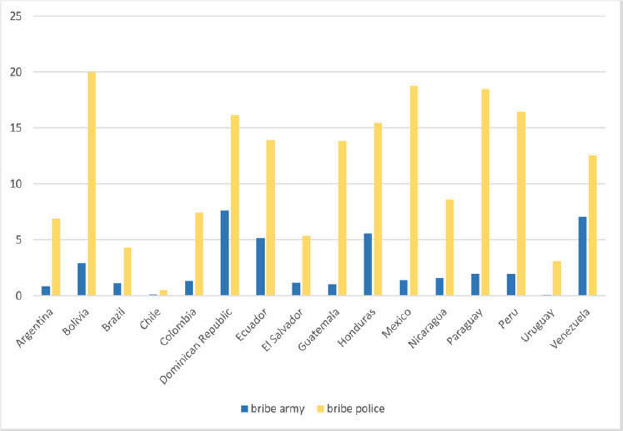
Percentage of Citizens Who Were Asked to Pay Bribes (Police vs. Army), 2014
The figure makes it clear that the police are much more likely than the armed forces to request bribes from Latin American citizens. While only 2.5 percent of Latin Americans report having been requested to pay a bribe by a military officer, 11.5 percent report that a police officer asked them to pay a bribe. In several countries (Bolivia, Mexico, Paraguay, and Peru), almost one in five respondents were asked to pay a bribe by the police. The comparison between corruption in the police and corruption in the armed forces is particularly relevant in countries where the military takes an active role in the fight against criminal violence. In countries such as Brazil, El Salvador, and Mexico, these survey data clearly show that the military operates in a much less corrupt way than the police.
According to the study mentioned earlier by Johnson (2015), the second-most important factor driving dissatisfaction with police is a fear of crime and disorder in one's neighborhood. If a victimized and fearful public has lost faith in law enforcement, it can respond in several ways. The middle and upper classes will often retreat to gated communities where they pay for the services of private security squads. Poorer communities have sometimes resorted to vigilantism, taking law enforcement into their own hands. However, another, more widespread response has been to demand that governments deploy the armed forces to either supplement or supplant the police in the fight against organized crime.
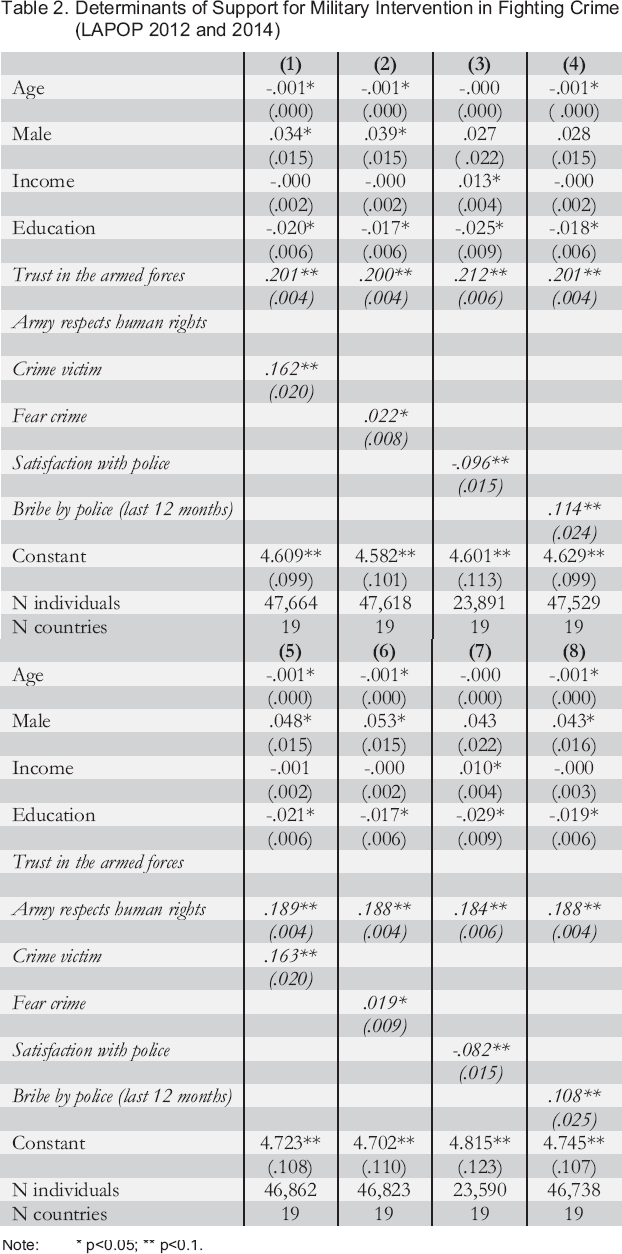
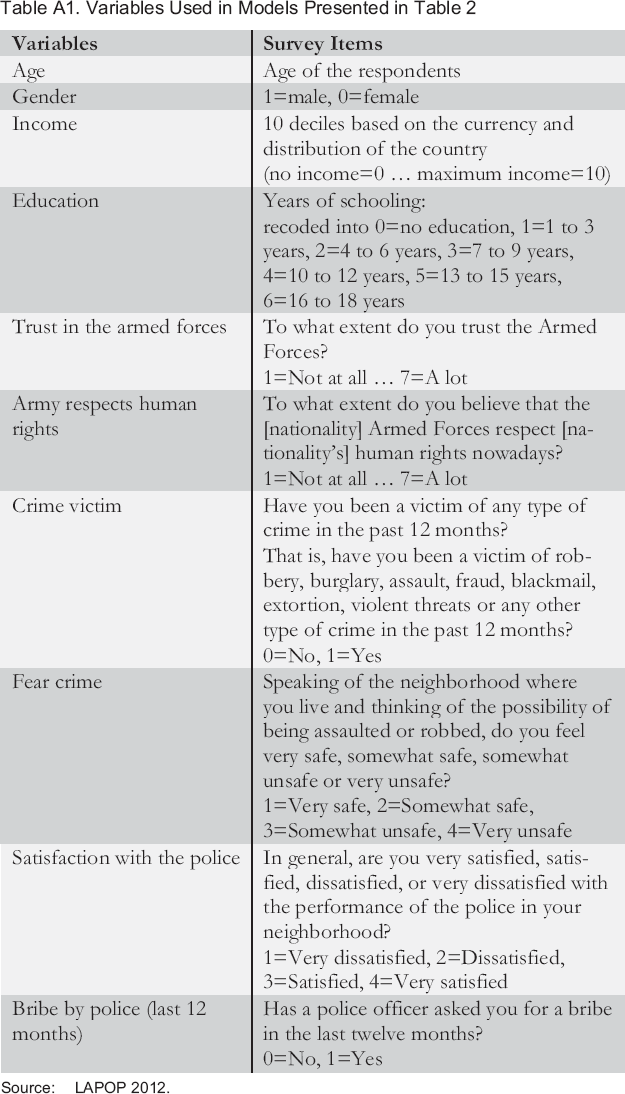
Is there evidence for stronger support for military intervention to fight crime among Latin American people who have negative interactions with the police, are dissatisfied with the performance with the police, or have been victimized? Again, we can take advantage of several survey questions included in the 2012 and 2014 waves of the Americas Barometer to answer this question. Through a series of statistical models, we estimate the impact of crime victimization, fear of crime, satisfaction with the police, and receiving a bribe by the police in the last 12 months on respondents’ likelihood of supporting a military intervention to fight crime. We also include two variables to evaluate the effect of trust in the armed forces (models 1–4), and citizens’ views about the army's human rights record (models 5–8) on support for military intervention in the fight against crime. We control for the basic socio-demographic characteristics of the respondents (age, gender, income, and level of education). The variables used in the analysis are described in Tables A1 in the Appendix. All the empirical models in this paper apply multilevel techniques that distinguish between two levels; that is, the individual level and the country level. 4
Hierarchical models allow for a more precise estimation of individual-level factors because they control for important contextual factors that may bias the estimates of variances and their associated standard errors (Gelman and Hill 2006; Steenbergen and Jones 2002).
As expected, the results reported in Table 2 show that crime victims and people who fear crime are more likely to support an active role of the military in fighting crime. So too are people who are not satisfied with the performance of the police and people who have been asked for a bribe by law enforcement in the last 12 months. The coefficients for all these variables are in the expected direction and statistically significant in the eight models in Table 2. In sum, Latin American people who have been victimized or who have negative interactions with the police are more supportive of an active military role in the fight against crime.
Determinants of Support for Military Intervention in Fighting Crime (LAPOP 2012 and 2014)
Note:
p<0.05;
p<0.1.
If people want the military to fight crime, does that also translate into support for repression? Carreras (2013: 101) asked whether public disenchantment with how state institutions have responded to crime could soften opposition to “quasi-authoritarian means to reestablish order?” In other words, citizens who desire military intervention may presume that human rights violations will occur, but do not seem troubled by that fact. Indeed, there is evidence that citizens exposed to crime and institutional ineffectiveness in Latin America favor “get tough” policies (Buchanan et al. 2012) and even vigilantism (Nivette 2016) in response. The issue is whether they expect the armed forces in particular to resort to excessive force, resulting in human rights violations?
Survey results indicate that, in contrast to perceptions about the police, the armed forces are considered well trained and respectful of human rights, as can be observed in Figure 4. 5 The figure shows that, on average, only 25 percent of respondents believe that the armed forces do not respect human rights. By contrast, 60.5 percent of respondents believe that the army is well trained and organized. With very few exceptions, the public in Latin American countries appears to trust the professionalism of the armed forces and to believe that the army respects human rights.
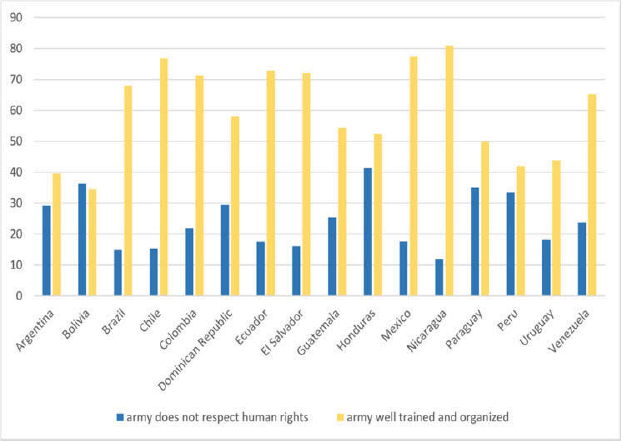
Perceptions of the Professionalism of the Armed Forces (2012)
This figure reports the percentage of respondents who believe that the army 1) does not respect human rights (answers 1–3 in a 1–7 scale) and 2) is well trained and organized (answers 5–7 in a 1–7 scale).
There may be an association between increased belief in military respecting human rights and public desire for it to intervene to fight crime. Data from Mexico shows that as belief that the military respects human rights increases, so too does support for military policing activities, both to complement police and to patrol city streets on its own. At the same time, as the perception that police respect human rights decreases, support for the army's counter-crime role increases. Moreover, the public associates the effectiveness of the military counter-crime effort with greater respect for human rights, not less (Bailey, Parás, and Vargas 2011).
The results presented in Table 2 extend the Mexican findings to 19 countries in the Latin American region. In fact, trust in the army and the perception that the army respects human rights are key predictors of support for military intervention in the fight against crime. In other words, Latin American citizens do not appear to be willing to give a blank check to the armed forces to intervene unilaterally in policy implementation or in the fight against criminal violence, which could lead to authoritarian excesses, including human rights abuses. On the contrary, the evidence suggests that they support targeted military operations when they are not satisfied with the performance of the police and when they have confidence that the army will do a better job at respecting citizens’ rights and liberties. In other words, the public support for military crime intervention is not an endorsement of repression so much as it is a belief – accurate or not – that the military can, compared to the police, more capably combat criminal elements without harming innocent civilians to the same degree. 6
One study of Mexico showed that awareness of crime nationally leads people to have less tolerance for extra-legal (violent) action to deter crime (Malone 2013: 37).
Public perceptions seem to square with the actual conduct of the armed forces, when engaged in domestic security operations. Empirical evidence based on an investigation conducted by David Pion-Berlin and Andrew Ivey indicates that very few civilian casualties result as a consequence of military domestic operations. They conducted research in eight countries between 2013 and 2015 into civilian injuries and fatalities resulting from military internal security operations of one kind or another. 7 Five of these countries were among those with the highest crime rates in Latin America, while three were lower-crime states. The armed forces were used to fight crime, suppress protests (including land and oilfield occupations), eradicate illicit coca production, and counter gang and cartel activity. They found data for 60 such operations in all, involving army units, joint task forces, and a few naval forces. They recorded 81 injuries and 52 deaths, with 39 of those deaths (75 percent) occurring in Mexico. In other words, there was less than one fatality per operation, on average. Leaving Mexico out of the equation, 33 operations resulted in just 13 fatalities across seven countries in three years; in other words one fatality for every 2.5 operations.
This is an unpublished paper. Countries studied were Brazil, Ecuador, Peru, Bolivia, El Salvador, Guatemala, Honduras, and Mexico, between 2013 and 2015. Data on those countries was retrieved from Human Rights Watch, Amnesty International, Latin American Weekly Reports, Latin American Security and Strategic Reviews, and newspaper articles from Access World News and Lexis-Nexis.
Naturally, unreliable reporting and attempts to conceal wrongdoing may have suppressed coverage, resulting in an underestimation of civilian casualties. Moreover, this is just one study that must be balanced with investigations conducted by respected NGOs detailing disturbing patterns of abuse at the hands of army units in Mexico, Colombia, Peru, and elsewhere. 8 The military record is by no means unblemished. That having been said, the key revelation of our study is that the public's yearning for military counter-crime intervention is not a belief that the military is ideally suited for these missions nor an endorsement of repression so much as an expression of frustration over police failures and a belief that the military is, comparatively speaking, more capable of meeting the challenge of widespread crime. The public's support for the military to conduct crime-fighting more efficaciously and humanely is a relative – not absolute – affirmation.
Examples of these reports include: Human Rights Watch, “Ni seguridad ni derechos: Ejecuciones, desapariciones y tortura en la ‘guerra contra el narcotráfico’ de México,” New York, November 2011, online: <www.hrw.org/sites/default/files/reports/mexico1111spwebwcover.pdf>; Mexican Commission for the Defense and Promotion of Human Rights, “Jurisdicción militar: Impunidad y violaciones a los derechos humanos,” January 2013, online: <www.cmdpdh.org/publicaciones-pdf/cmcpdh-briefing-enero-2013-justicia-militar-sk.pdf>; Report of the United Nations High Commissioner for Human Rights on the situation of human rights in Colombia, 7 January 2013, online: <www.ohchr.org/Documents/HRBodies/HRCouncil/RegularSession/Session22/A-HRC-22-17-Add3_English.pdf>; Amnesty International, “Colombia” Report, online: <www.amnestyusa.org/reports/annual-report-colombia-2013/> (all 30 October 2017).
Conclusion
The public is justifiably unnerved by the unprecedented escalation of violence and criminality throughout much of the Latin American region. In light of the apparent inability or unwillingness of the police to adequately confront the problem, it is also understandable that the public would favor the introduction of troops to chase down drug traffickers and patrol city streets. However, such support cannot be interpreted as an endorsement of uninhibited repression on the part of soldiers. Findings from Mexico, and more generalized statistical results, strongly suggest that the public evaluates military performance in light of police inadequacies. Disenchanted with corrupt, poorly trained police who trample upon citizens’ rights, the public views the military as a comparatively more professional force capable of responding to crime more efficaciously and humanely. Support for military crime fighting rises as satisfaction with the police declines.
These findings are encouraging in so far as they do not indicate a public preference for unfettered military operations that resort to excessive violence and any and all extra-legal measures to stem crime. While citizens want to live a more secure life, they are not willing to pay just any price for it. They want the military to intervene and to use lethal force if they must, but to do so judiciously, with protections for human rights in mind. The evidence is consistent with the notion that the military ought to be trained to operate within the rule of law and under clear rules of engagement. Soldiers should be given guidelines for operating in densely populated urban settings, where their violent encounters with cartels or gangs often occur just a hair's breath away from civilian dwellings. In those encounters, it is incumbent upon the military to show some restraint, carefully discriminating between criminal targets and law-abiding residents who live nearby (Pion-Berlin 2017). All of this assumes that the military of a given country is capable of change, of being re-socialized to be much more circumspect and restrained than it is long accustomed to. Some Latin American militaries are fundamentally resistant to change of this sort, fending off all efforts to revamp their modus operandi.
This point raises a question that suggests the need for further research. What if citizen views are wrong? What if they have falsely attributed to the military, admirable qualities that are lacking, and thus put their faith in an institution that cannot really deliver on its promises? As mentioned, there is evidence suggesting that the armed forces of some Latin American countries do commit human rights abuses during internal security operations. Moreover, in the case of Mexico there is scholarly research showing that the introduction of that country's armed forces into counter-crime operations has not reduced homicide rates, and in some instances may have increased them (Calderón et al. 2015); and yet, public confidence in the armed forces remained unshaken. A recent public opinion survey found that 82 percent of Mexicans want the army and marines to continue patrolling city streets in pursuit of criminals (CESOP 2016) – consequences notwithstanding. What then prompts citizens to retain faith in their military, even in the face of facts that do not reflect well upon that institution's performance? Citizens may conclude that there are no better alternatives, or they could be misinformed, convinced that the armed forces are up to the task when they are not. Additional research is needed to determine what drives these perceptions.
Footnotes
Appendix
Variables Used in Models Presented in Table 2
| Variables | Survey Items |
|---|---|
| Age | Age of the respondents |
| Gender | 1=male, 0=female |
| Income | 10 deciles based on the currency and distribution of the country (no income=0 … maximum income=10) |
| Education | Years of schooling: recoded into 0=no education, 1=1 to 3 years, 2=4 to 6 years, 3=7 to 9 years, 4=10 to 12 years, 5=13 to 15 years, 6=16 to 18 years |
| Trust in the armed forces | To what extent do you trust the Armed Forces? |
| 1=Not at all … 7=A lot | |
| Army respects human rights | To what extent do you believe that the [nationality] Armed Forces respect [nationality's] human rights nowadays? 1=Not at all … 7=A lot |
| Crime victim | Have you been a victim of any type of crime in the past 12 months? That is, have you been a victim of robbery, burglary, assault, fraud, blackmail, extortion, violent threats or any other type of crime in the past 12 months? 0=No, 1=Yes |
| Fear crime | Speaking of the neighborhood where you live and thinking of the possibility of being assaulted or robbed, do you feel very safe, somewhat safe, somewhat unsafe or very unsafe? 1=Very safe, 2=Somewhat safe, 3=Somewhat unsafe, 4=Very unsafe |
|
|
|
| Satisfaction with the police | In general, are you very satisfied, satisfied, dissatisfied, or very dissatisfied with the performance of the police in your neighborhood? |
| 1=Very dissatisfied, 2=Dissatisfied, 3=Satisfied, 4=Very satisfied | |
| Bribe by police (last 12 months) | Has a police officer asked you for a bribe in the last twelve months? 0=No, 1=Yes |
Source: LAPOP 2012.