



Abstract
This study discusses basic trends in articles on legislative politics in Latin America published in twelve journals between 2000 and 2010. It examines the distribution of the articles over time and by journal, the authors’ institutional affiliations and patterns of collaboration, the frequency with which various countries are studied, and common approaches and topics. The articles in this set are all peer-reviewed and published in English.
Introduction
The study of Latin American politics has changed significantly over the last three decades – partly due to new regional trends. 1 Topics that for decades had captivated the attention of political scientists, such as military interventions, corporatism, the cultural legacy of Iberian colonialism, and the political implications of deepening industrialization, began to lose prominence after most countries in Latin America had transitioned from authoritarianism to democracy. The study of democratic politics, including legislative institutions, became energized after the fall of most authoritarian regimes. Academic debates over the merits and drawbacks of presidentialism, federalism, party fragmentation, and open-list electoral rules reflected renewed interest in the institutions of democracies. General changes within the discipline have also contributed to reorienting researchers’ attention. The growing importance of institutionalist approaches in political science, evident since the late 1970s, influenced the research of a new generation of graduate students interested in Latin American politics. It is no longer uncommon for PhD students in political science to write dissertations about the choice of democratic political institutions or their impact on political outcomes. As a result of these changes, more research is being conducted on Latin American legislatures.
An earlier version of this paper was presented at the conference Legislativos en América Latina: mirada crítica y agendas pendientes, organized by GEL–ALACIP, at the Centro de Estudios Legislativos – Universidad Federal de Minas Gerais, Belo Horizonte, Brazil, 19–21 October 2011.
Shugart and Carey's (1992) seminal book Presidents and Assemblies signaled that the new institutionalism had arrived in the study of Latin American legislative politics. The book presented an in-depth comparison of presidential legislative and partisan powers and their implications for executive–legislative relations and democratic stability. Since the early 1990s, the number of such studies has dramatically increased – encompassing not only work on the consequences of various institutions in the region, but also work that examines constitutional choices. This new scholarship has illuminated several aspects of Latin American politics that were seldom addressed by earlier scholars, and has helped test and develop theories that were originally advanced to explain legislative politics in the established democracies of North America and Western Europe.
This review surveys some of the literature on Latin American legislative politics, specifically the basic trends in peer-reviewed articles in English in twelve well-established academic journals. I discuss the distribution of these articles over time and by journal, the authors’ institutional affiliations and patterns of collaboration, the frequency with which various countries are studied, and common approaches and topics.
Books and articles published in other peer-reviewed journals have also boosted the importance of this literature – books like Term Limits and Legislative Representation (Carey 1996); Legislative Institutions and Ideology in Chile (Londregan 2000); The President and Congress in Postauthoritarian Chile (Siavelis 2000); Presidents, Parliaments, and Policy (Haggard and McCubbins, eds. 2001); Legislative Politics in Latin America (Morgenstern and Nacif, eds. 2002); Patterns of Legislative Politics: Roll-Call Voting in Latin America and the United States (Morgenstern 2003); Ambition, Federalism, and Legislative Politics in Brazil (Samuels 2003); Politicians and Politics in Latin America (Alcántara Sáez, ed. 2007); Pathways to Power: Political Recruitment and Candidate Selection in Latin America (Siavelis and Morgenstern, eds. 2008); Legislative Voting and Accountability (Carey 2009); Who Decides the Budget? A Political Economy Analysis of the Budget Process in Latin America (Hallerberg, Scartascini, and Stein, eds. 2009); Political Power and Women's Representation in Latin America (Schwindt-Bayer 2010); and Ruling by Statute: How Uncertainty and Vote Buying Shape Lawmaking (Saiegh 2011).
This study evaluates articles on legislative politics published in twelve journals between 2000 and 2010. The set includes the four top-ranking political science journals: The American Political Science Review (APSR), the American Journal of Political Science (AJPS), the Journal of Politics (JOP), and the British Journal of Political Science (BJPS). It also includes the three leading journals on comparative politics: World Politics (WP), Comparative Politics (CP), and Comparative Political Studies (CPS). The two most well-known journals on legislative politics – the Legislative Studies Quarterly (LSQ), and the Journal of Legislative Studies (JLS) – and the three best-known journals on Latin America – Latin American Politics and Society (LAPS), the Latin American Research Review (LARR), and the Journal of Latin American Studies (JLAS) – are also included. This list includes generalist, sub-disciplinary, and region-specific journals. While several other academic journals also publish articles on legislative politics, these twelve represent the trends.
Between 2000 and 2010, these twelve journals published 88 articles on legislative politics in Latin American countries (2.1 percent of the total), not counting book reviews or articles whose primary focus was on elections. 2 There were fewer publications during the early part of the decade (15 between 2000 and 2002) than in the mid- or late-2000s (27 between 2008 and 2010). Although there is no comparative evidence from the last decades of the 20th century, the number of articles on this topic published since 2000 is likely higher. Using different criteria to count articles and surveying fewer English-language journals, Morgenstern and Negri (2009) found very few publications on Latin American legislative politics prior to the year 2000.
I did not include in my count articles that emphasize the effects of certain variables on e.g., the fragmentation of the party system following electoral contests.
The total number of articles per journal is given in figure 1. The figure indicates that the two journals specialized in legislative studies published the most articles on the subject: the U.S.-based LSQ and the U.K.-based JLS. AJPS, a generalist journal that is considered to be among the best in the field, ranks third in terms of the number of articles. CPS shares the fourth position with LAPS, the top-ranked journal focused on Latin American politics. The two multidisciplinary Latin American area-studies journals, LARR and JLAS, have published comparatively few articles about legislative politics. APSR, the discipline's flagship journal in the United States, and WP have published the fewest articles.
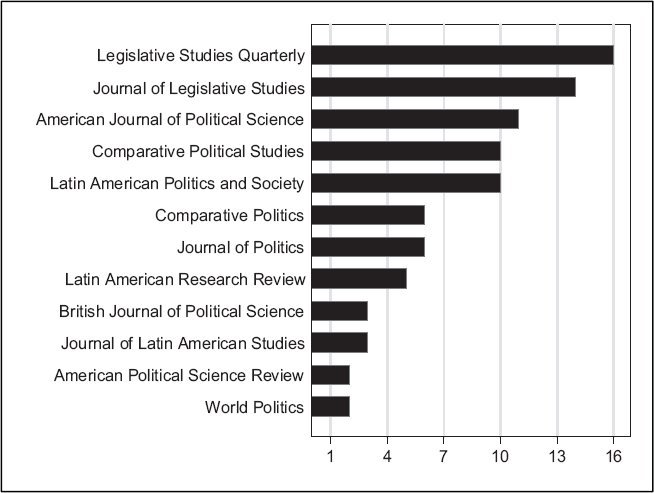
Articles on Latin American Legislative Politics, 2000–2010 (Total by Journal)
Articles about legislative politics in Latin America represent only a small portion of the scholarly work published in these twelve journals. The journals with an above-average share of articles on the topic are LSQ, with just over 6 percent, and JLS and LAPS, both with nearly 5. Given the growing importance of legislative studies in the field of Latin American politics, as well as the expansion of comparative studies in legislative politics research, some of these percentages will probably soon increase.
Among the articles in this study we find both single-country studies and cross-national analyses (small-N and large-N). Two-thirds of these articles focus on the legislative politics of a single country, as is often the case in literature on legislative and comparative politics. The remaining articles are divided into those analyzing two to five countries (17 percent), and those covering six or more countries (also 17 percent). In this set, about 10 percent of the articles also examine countries outside of Latin America.
Figure 2 presents the countries ranked according to the frequency with which they were studied. This is measured in two different ways. The black bars reflect a simple count, meaning that a country receives one point for each article that includes it. The gray bars reflect a weighted count: the weight varies with the number of countries included in the article. 3 Both measures provide similar rankings.
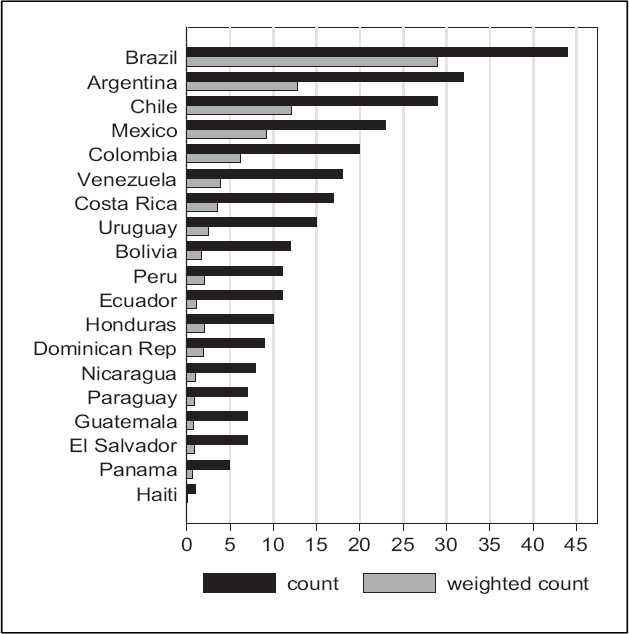
Countries Studied, 2000–2010 (12 English-language Journals)
A country in a single-country study equals “1”, each country in a two-country study “0.5”, each country in a three-country study “0.33”, and so on.
Brazil, the most-studied Latin American country, tops both rankings. Half of the 88 articles included in this study address legislative politics in Brazil. The country is very often included in cross-national studies and also ranks first among single-country studies. Next comes Argentina, which is included in more than one-third of the articles, followed by Chile, Mexico, and Colombia. These five countries are the only ones that are the focus of more than one single-country study. Most studies of legislative politics in Latin America that are published in English tend to examine these five countries.
Venezuela, Costa Rica, and Uruguay rank above the median in terms of the frequency with which they are examined. However, these three countries are mostly studied in comparison with other Latin American countries (each is the focus of only one single-country study). There are few works on the legislative politics of Central American and Caribbean countries (except for Costa Rica). Paraguay and Ecuador are the least-studied countries in South America.
There are probably several reasons for this regional focus. One is demographics: Brazil and Mexico are the most populous countries in Latin America. Compared with other countries in the region, they have the most students at universities in the United States and the greatest number of members of the American Political Science Association. Authors’ institutional affiliations (addressed in the next section) has probably also influenced the choice of countries studied. Most interestingly, this distribution of cases mirrors Altman's (2006) classification of the levels of political science institutionalization in the region. Altman noted clear asymmetries in political science departments across Latin American universities. Only in Argentina, Brazil, and Mexico is the discipline sufficiently developed in terms of degrees, professionalization, and recognized research centers so that it can be classified as ‘institutionalized’. According to the Altman, a second tier including Chile, Colombia, Costa Rica, Uruguay, and Venezuela is being developed, while the remaining countries still have much to do to institutionalize the discipline.
Unlike the humanities, where single authorship is the norm, in political science it is customary to co-author articles. In a recent review of academic collaboration in political science, McDermott and Hatemi (2010) note that the proportion of co-authored articles has grown significantly since the 1970s and 1980s. About half of the articles (n=45) in the set I review here are single-authored. The rest have two (n=26) or more authors (n=17). This level of collaboration is common in political science, at least for articles published in English-language journals. The average number of authors is 1.75, which is about the same as the average number of authors in all articles published in top-tier U.S. journals of political science.
Figure 3 shows the region of the authors’ academic institutions, most of which are affiliated with universities in the United States. Given the journals surveyed, it is perhaps more surprising that 25 percent of the articles have at least one author affiliated with a Latin American university. A smaller share of works (9 percent) has at least one author from a university in Western Europe. 4 Of the co-authored articles, 21 percent are collaborations of authors from Latin American universities with authors from universities in the United States and/or Europe. Most of the authors affiliated with Latin American institutions work in Brazil. Twelve articles were written by authors at Brazilian universities and four by authors at Mexican universities. Authors at universities in the Southern Cone wrote the remaining articles: Chile (four articles), Argentina (two), and Uruguay (one). 5
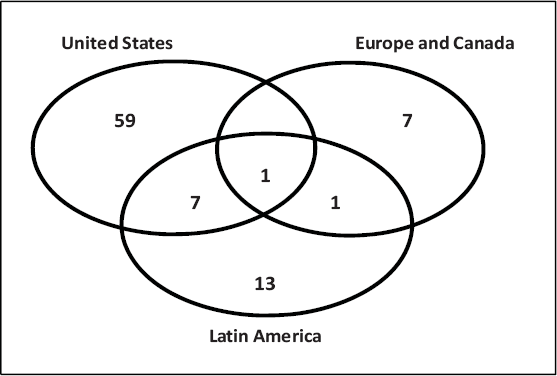
Institutional Affiliation of Authors (12 English-language Journals)
One article was by an author from a Canadian university.
One article was by authors affiliated with Chilean and Uruguayan universities.
There are several possible explanations for the productivity of political scientists at Brazilian universities. Top-notch universities and the institutionalization of the discipline (Altman 2006) have created a favorable context. In addition, a very large proportion of Brazilian political scientists return home after obtaining doctorates in the United States and Europe (Freidenberg and Malamud 2013). This may give them an edge in publishing in the type of journals surveyed for this article. Political scientists working in Mexico and the Southern Cone make up the rest of the Latin American authors.
The articles address a variety of topics related to legislative politics and take various approaches to social science research. They also illustrate some general trends, for instance most articles have a quantitative component; usually they empirically evaluate a theoretical proposition. Methodological individualism is more common than studies where the unit of analysis is an institutional actor, such as a chamber, a committee, an executive, or political parties. The approach is overwhelmingly nomothetic – geared towards generalizations – rather than idiographic.
About three-fourths of the articles include some form of quantitative data analysis – statistical analyses, including survey and social-network analyses, scaling techniques, and the development of indices. These approaches are standard in the literature on legislative politics, but less common in the field of area studies. Many articles in this survey analyze datasets collected over the last decade, including data on legislators’ choices and attitudes, bills introduced and passed, party behavior, and career information.
The other studies in this set mainly use a qualitative approach. Following a long tradition in legislative literature, these works provide in-depth views of policy-making and the inner workings of legislatures. They include several bill narratives (privatization, tax reform, pension reform, economic reform, a quota for women candidates, and the budget bill), as well as studies of congressional influence (oversight and bureaucracy). A couple of articles mix qualitative and formal approaches.
It is not easy to classify these studies in a few research areas. I have used four categories. Legislative behavior and executive–legislative relations are the two main areas. Just over 28 percent of articles fit the first category, and about 27 percent fit the second category. Another 16 percent of the articles overlap these two categories. The fourth area of research is political careers, with over 19 percent of the articles. Studies on legislators’ attitudes, bicameralism, and institutionalization make up the rest of the articles (about 9 percent). 6
When we focus on the top four journals in the field, we find a greater share of cross-national analyses and no article that is purely qualitative.
The largest category contains studies that examine legislative behavior, including voting behavior, bill initiation, constituency work, and floor speeches. These articles frequently address how institutional rules and career incentives affect behavior.
Several studies analyze roll-call votes. For example, six studies examine votes in Brazil's Congress to reveal the influence of governors (Carey and Reinhardt 2004; Desposato 2004; Cheibub et al. 2009), electoral rules (Desposato 2006), party leadership (Lyne 2008), and ideology (Zucco 2009). Lyne (2008), Pereira and Muller (2004a), and Hagopian et al. (2009) examine the association between appropriated budget amendments and the voting unity of Brazilian legislators. 7 Congressional votes have also been used to evaluate party unity in Peru (Carey 2003) and coalition unity in Chile (Alemán and Saiegh 2007). Carey (2007) studies the determinants of party unity with cross-national data on roll-call votes.
In my coding the articles by Pereira and Muller (2004a), and Hagopian et al. (2009) belong in the hybrid category.
Rosas and Shomer (2008) focus on votes in the Argentine Congress as a way of assessing the impact of abstentions on the estimation of legislators’ ideal points. Jones and Hwang (2005) examine roll-call votes to evaluate the applicability of ‘cartel theory’ to the Argentine case. The analysis of presidential cartels in Brazil by Amorim Neto et al. (2003) and the study of gatekeeping in Argentina, Chile, and Mexico by Alemán (2006) use congressional votes to estimate party-roll rates. Some articles focus on specific congressional votes, such as Mardones’ (2007) study of support for decentralizing legislation in Chile, and Langston's (2010) study of fiscal reform in Mexico.
Several studies investigate the process of representation by examining the behavior of legislators. For example, four studies by Crisp and his coauthors (Crisp and Ingall 2002; Crisp et al. 2004a; Crisp et al. 2004b; Crisp 2007) examine the effects of electoral incentives on bill initiation patterns in several Latin American countries. Other articles that examine the initiation of legislation include Schwindt-Bayer's (2006) study of gender in Argentina, Colombia, and Costa Rica; Escobar-Lemmon's (2003) study of decentralization policies in Colombia and Venezuela; Amorim Neto and Santos’ (2003) study of electoral incentives in Brazil; and Alemán's (2009) study of congressional decay and democratic stability in Chile. Another article advances a new method to derive legislators’ ideal points by using data on bill cosponsoring with evidence from the U.S. and Argentine Congresses (Alemán et al. 2009).
Within this group we also find two studies of constituency work that use data on legislators’ travel to evaluate their representational styles (Crisp and Ingall 2001; Crisp and Desposato 2004) and one study of inequalities in debate participation in the Honduran Congress (Taylor-Robinson and David 2002).
The second-largest category in terms of the number of articles is inter-branch relations, which includes studies of executive–legislative conflict and cooperation, control over the legislative agenda, oversight, and policymaking. Some publications discuss broad patterns of executive–legislative relations in Latin America, such as Cox and Morgenstern's (2001) typology of presidents and legislatures; Calvert's (2004) discussion of congressional influence; Morgenstern et al.'s (2008) cross-national study of legislative opposition; and Negretto's (2006, 2008) analyses of executive–legislative conflict and constitutional reforms. Others focus on one or two countries, such as Figueiredo and Limongi's (2000) seminal article on presidential power and legislative behavior in Brazil; Marsteintredet's (2008) study of executive–legislative conflict and coalition-making in the Dominican Republic; and Hunneus et al.'s (2004) comparison of institutional functions in Chile and Argentina.
Various authors examine the implications of presidential powers: Three studies examine the use of decree authority in Brazil (Reich 2002; Pereira et al. 2005 and 2008), and one compares decree powers in Argentina and Brazil (Negretto 2004). Another article discusses the prerogatives of presidential urgency and committee autonomy in the Brazilian Congress (Pereira and Muller 2004b). Two analyses (Alemán and Tsebelis 2005; Tsebelis and Alemán 2005) compare presidential veto powers and agenda setting.
Studies of legislative oversight and the bureaucracy also fall in this category. Among the former we find Siavelis’ (2000) work on Chile, and Eaton's (2003) work on Argentina; among the latter we find Gaylord's (2010) study of legislation regulating the Brazilian bureaucracy's authority to make policy, and Ferraro's (2008) examination of congressional influence on the bureaucracy in Chile. Some studies center on the passage of landmark legislation, such as tax reform (Eaton 2001) and privatization (Llanos 2001) in Argentina, and pension reform in Brazil (Hiroi 2008a). There is also a comparative study of impeachment in Brazil and Colombia (Kada 2003).
Studies that examine congressional approval of executive bills are at the intersection of inter-branch relations and legislative behavior. This group includes Cheibub et al.'s (2004) cross-national study of government coalitions and legislative success in presidential and parliamentary countries; Calvo's (2007) study of congressional responsiveness to popular opinion regarding the Argentine President; Hiroi's (2008) study of bicameralism and the timing of bill approval in Brazil; Alemán and Navia's (2009) study of the impact of executive prerogatives on bill approval in Chile; and Finocchiaro and Johnson's (2010) study of legislative success in committees in Colombia, Costa Rica, and Venezuela.
The third category includes articles examining legislators’ political careers. Here we find articles on candidate selection in Argentina (De Luca et al. 2002), Chile (Siavelis 2002), and Mexico (Diaz 2004; Bruhn 2010). There is also an article on candidate recruitment and selection by Siavelis and Morgenstern (2008). Other authors have looked at professionalization in the Argentine Congress (Jones et al. 2002), and the career paths of Brazilian (Samuels 2000; Leoni et al. 2004) and Uruguayan (Altman and Chasquetti 2005) legislators. Llanos and Sánchez (2006) focus on the social backgrounds and political careers of senators.
A couple of articles have paid special attention to the distribution of powerful positions within a legislature. For example, Santos and Renno (2004) studied the selection of leadership positions in Brazil's lower congressional chamber, and Crisp et al. (2009) studied the impact of electoral incentives on committee assignments in Argentina, Costa Rica, and Venezuela. Women legislators’ unique career challenges are addressed in three articles: Franceschet's (2010) examination of norms inside the Chilean Congress; Jones’ (2004) assessment of how the gender-quota law impacted the election of women in Costa Rica; and Roseanna et al.'s (2005) cross-national investigation about the possible marginalization of women through committee assignments.
The remaining articles are studies of bicameralism, institutionalization, and legislators’ attitudes. Llanos and Nolte (2003) analyze bicameral symmetry and incongruence in eleven Latin American countries and the United States. Diaz-Cayeros (2005) focuses on institutional changes in the Mexican Senate, while Beer (2001) and Solt (2004) concentrate on legislative institutionalization across Mexican state legislatures. We also find three studies of legislators’ attitudes that use survey data to estimate ideological positions (Rosas 2005; Power and Zucco 2009; Saiegh 2009). Htun and Power (2006) use surveys to examine legislators’ support for gender-related policy issues.
The 88 articles in this survey exemplify the research on legislative politics of Latin American countries published in English-language journals. These works have substantially contributed to the sub-discipline of legislative studies as well to the study of democratic politics and political institutions in Latin America. I consider that four general aspects of this literature deserve emphasis.
First, many of these articles have enriched the study of legislative politics by testing, revising, and challenging theories about legislative politics elsewhere. These works have helped scholars evaluate the generalizability of influential arguments about legislative politics often found in literature on the United States or Western Europe. For example, the notion of an ‘electoral connection’ that underpins legislators’ behavior informs several studies on representation and voting behavior reviewed here. Some studies have shown how various electoral incentives and career paths influence legislators’ actions, legislative outputs, and the likelihood of legislators’ professionalization in Latin America. Others evaluate the applicability of partisan theories of legislative organization developed with the United States in mind (e.g., cartel theory), as well as theories on government coalitions developed with parliamentary governments in mind (e.g., size theory). There are studies on the usefulness of rational choice theories about U.S. congressional committees to explain the internal organization of Latin American congresses. Various studies on bill initiation and approval have also applied insights from the U.S. context to presidential countries in Latin America with different rules and partisan settings – examining, for example, how the electoral cycle impacts legislative output. In short, research on Latin American legislatures has contributed to validating and improving more general legislative theories.
Second, these articles have enriched our understanding of legislative politics in presidential governments. Traditionally, depictions of institutional influences on legislative behavior and outcomes have been heavily influenced by the well-studied case of the United States. Latin America exhibits significant variations in the prerogatives of presidents and congresses, distributions of congressional agenda-setting power, electoral incentives and career paths, and party systems. This variance is beneficial to the general study of institutional incentives and legislative outcomes. Literature on executive–legislative relations in Latin America, including behavioral studies, analyses of inter-branch bargaining, and detailed narratives, seeks to explain how the distribution of lawmaking power and the inner workings of presidentialism vary from country to country.
Third, the research examined here reflects common weaknesses cited by scholars reviewing the state of comparative legislative research. For example, more than 25 years ago, Eulau (1985) criticized the individualistic and parochial nature of legislative studies, and advocated for more cross-national studies and collaborative efforts – yet single-country studies still predominate. Eulau viewed studies of single legislatures, the most common type, as “unlikely to lead to either cumulation or comparison in a truly scientific manner” (Eulau 1985: 11). While I disagree with this characterization of single-country studies, I believe it would be wise to conduct more cross-national research. However, single-legislature studies can still be very important to the field of legislative studies and contribute to the accumulation of knowledge particularly when they engage with other research on the topic focused elsewhere. Literature about the U.S. Congress shows that single-legislature studies can also help generate theories, even if some of these legislative theories might need to be tested elsewhere to be confirmed. Several of the reviewed works have also helped illuminate aspects of legislative politics that are not always generalizable.
Fourth, the field of Latin American legislative studies is still young. Currently, no topic is receiving enough attention. The legislative politics of most Latin American countries continue to be largely unexplored and there is comparatively little research on sub-national legislatures, congressional norms, and interest-group representation. While congressional committees in the U.S. Congress have been studied thousands of times, very few works have focused on congressional committees in Latin American legislatures. Even with regard to legislative behavior, a common topic in the set of articles reviewed here, many theoretical propositions remain tentative. For researchers this is both challenging and encouraging. Students of Latin American legislative politics need not eschew certain topics because they are over-studied, with only the narrowest questions remaining unexplored: all subjects could still benefit from original research and intellectual experimentation.
Theories that were developed to explain legislative politics in the United States and Western Europe remain foundational for much comparative legislative research. Yet it is important to test the implications of more general theories of legislative behavior on new cases. Several studies included in the set of articles reviewed here have shown why some of these theories should be modified. More significantly, scholars have used the theoretical arsenal to tackle questions that are central to Latin American domestic politics.
New theorizing – on problems common to Latin America – is also significant. Various research areas are already making great progress explaining Latin American legislative politics. One example is the new literature that examines how different electoral rules, selection mechanisms, and career incentives affect legislative behavior. Another example is literature that links legislative outputs to variations in institutions (e.g., presidential and congressional powers or rules of procedures) and the strategies of key legislative actors (e.g., parties or individuals). Detailed analyses of the passage of major legislation that examine specific cases also greatly contribute to our understanding of lawmaking processes in Latin America. Finally, the studies reviewed here introduce a variety of new and important datasets that should prove helpful to future research about legislatures in the region.
Conclusion
The study of legislative politics in Latin America has noticeably expanded since the early 1990s. Here I have briefly reviewed articles in twelve important journals over the eleven-year period starting in 2000. I have described the distribution of articles by journal, the number of authors, and the regions of the authors’ institutional affiliations. I also have shown which countries were most studied, commented on the most frequent topics, and noted the prevalence of data analysis and research geared towards generalizations. These articles show the great value of early research on Latin American legislative politics. While many articles have added to knowledge about legislative politics, much work remains to be done. Further research on Latin American legislative politics is needed to improve theories that often were narrowly targeted to fit specific cases, as well as to stimulate the development of new theories to address other, less studied questions that are relevant to the region.