




Abstract
We explore how the reception of remittances affects perceptions of the bilateral relationship between Mexico and the United States. Scholars have claimed that the economic benefits of the relationship with the US prevail over imperialistic concerns as a result of the asymmetry of power between the two countries. Empirical research shows that Latin American public opinion is indeed more supportive of the US than theory indicates. However, we identify two gaps in this literature. First, scholars have explored the determinants of generic expressions of sentiment toward the US, overlooking more concrete instances of cooperation between the two countries. Second, scholars have focused on trade and investment and have ignored how the material gains of emigration shape attitudes toward the US. The present paper fills these two gaps by using novel survey data on the bilateral relationship between Mexico and the US. On one hand, we find that while the reception of remittances correlates positively with good sentiments toward the US, the recipients of remittances are consistently more opposed to cooperation with the US in the fight against drug trafficking. We argue that this finding can be explained by the different nature of the migratory phenomenon, and the connection between anti-drug trafficking policies and the close scrutiny of illegal flows of money and people.
Introduction
In this paper, we explore how the reception of remittances shapes the views of Mexicans regarding the bilateral relationship between Mexico and the United States. 1 Recent research on the determinants of attitudes toward the US in Latin America has emphasized the relevance of material interests in shaping those attitudes. Indeed, against the extended view that Latin Americans’ attitudes toward the “colossus of the North” are primarily negative due to decades of intervention in the internal matters of these countries (Rubinstein and Smith 1988; Smith 2000; Morris 2005; Sweig 2006), some authors have shown that material exchanges, increased contact, and greater economic integration can counter those feelings of resentment and translate into more positive views of the United States (Radu 2004; Morris 2005; Baker and Cupery 2013). In particular, empirical research has shown that contact with the US in the form of travel or relatives living abroad has a strong leverage in terms of leading Latin Americans to hold more positive views of the US (Morris 2005; Martínez and Lago 2008; Azpuru and Boniface 2015). By the same token, economic exchanges, particularly access to more consumption goods through international trade, are strong predictors of positive attitudes toward the US (Baker and Cupery 2013).
We appreciate comments by Maria Koinova, Sandra Ley, Gerardo Maldonado, Gerasimos Tsouparas, participants in the Workshop “Unpacking the Sending State”, Atlanta, 15 March 2016, and two anonymous reviewers. We acknowledge the support of a Newton/British Academy Mobility Fund in this research.
We contribute to this literature in two ways. First, we provide a closer look at migration as a form of economic exchange, especially to worker remittances – money transfers from migrants to their families left behind – as one of the factors that potentially shapes the attitudes of Mexicans toward the US. Second, we claim that the empirical literature on anti-Americanism should move beyond the exploration of generic perceptions and opinions of the US to address whether those sentiments, either positive or negative, translate into distinctive attitudes concerning concrete instances of cooperation. After all, while it is interesting to know whether economic exchanges make respondents south of the border more sympathetic to the US, a much more interesting question is whether migrants and migrants’ families support greater bilateral cooperation.
In this context, how the reception of remittances may shape attitudes toward the US remains largely unexplored. In line with the literature that suggests that consumerism in the south drives these positive attitudes (Baker 2010; Baker and Cupery 2013), and taking into account the fact that remittances are overwhelmingly devoted to consumption (Durand, Parrado, and Massey 1996), the reception of remittances is a variable that should strongly predict positive attitudes toward the US. This is indeed the case.
However, we show that generic sentiments and attitudes regarding support for cooperation do not necessarily go hand in hand. Concretely, we study whether the reception of remittances makes recipients more supportive of greater collaboration with the US on the so-called “War on Drugs.” Using two waves (2010/2012) of the “Mexico and the World” survey, we compare generic attitudes toward the US (trust in, admiration for) versus attitudes toward US involvement in the combat of drug-related violence. In particular, respondents were asked three specific questions: whether they would support financial support by the US to curb drug trafficking; whether they would support that assistance if it entailed supervision of the financial support by the US; and whether they would support that assistance if it entailed the presence of US troops in the country.
Our results show that there are clear limits to the material gains hypothesis. Remittance recipients are more likely than non-remittance recipients to hold positive views of the US and also to support US financial involvement in the fight against drug-related crime; however, recipients are not more likely than non-remittance recipients to support US supervision of those resources. They are less likely to support US financial involvement if it is conditional on the presence of US troops. Thus, support for greater cooperation with the US on this thorny but crucial foreign policy issue is partial and conditional on the level of intrusiveness of US presence. We argue that this greater opposition on the part of remittance recipients is related to specific aspects of anti-drug policies focused on fighting illegal flows of people and money, aspects that do not show in other types of economic exchanges, such as international trade or foreign direct investment.
This paper contributes to an expanding research agenda that looks at changing incentives on the part of out-migration governments to reach out to the diasporas to secure the inflow of remittances (Aparicio and Meseguer 2012; Gamlen 2006; Iskander 2010; Leblang 2015), as well as a dynamic agenda exploring the consequences of remittances on electoral and non-electoral political behavior, changing political attitudes, corruption, political accountability, and clientelism in out-migration countries or communities (Pfutze 2012, 2014; Pérez-Armendáriz and Crow 2010; Pérez-Armendáriz 2014; Córdova and Hiskey 2015). To date, there has been virtually no research into whether and how out-migration connects with foreign policy preferences from a bottom-up rather than a top-down perspective (see Careja and Emmenegger 2012 for an exception). Consequently, we have only anecdotal knowledge of what kind of foreign policies emigrants and their families back home support. We seek to disentangle those preferences here.
The remainder of the paper is structured as follows. In Section 1 we review the literature on the determinants of attitudes toward the US, with an emphasis on how economic and informational exchanges shape them. In Section 2, we look into the “War on Drugs” policies deployed by the US and their implications for migrants and remittance recipients. From these two sections, we derive two hypotheses that we test statistically in Sections 3 and 4. Section 5 concludes with a discussion and reassessment of the main policy implications of this study.
Anti-Americanism is defined as “any hostile action or expression that becomes part and parcel of an undifferentiated attack on the foreign policy, society, culture, and values of the United States” (Rubinstein and Smith 1988: 36). 2 A prominent attempt to scrutinize the sources of anti-Americanism is Katzenstein and Keohane's (2007a, 2007b) study, which identified six different origins of anti-American sentiment: liberal, social, sovereign-nationalist, radical, elitist, and legacy anti-Americanism. Of these variations, sovereign-nationalist, legacy, and elitist sources of anti-Americanism are frequently referred to as the main determinants of hostility towards the United States in Latin America. By sovereign-nationalist anti-Americanism, Katzenstein and Keohane mean the widespread perception that the US has often abused its power, meddling with internal affairs from domestic politics to domestic economic development. Indeed, over the past two centuries, the United States has:
See Chiozza (2009: 34–35) for a more detailed discussion of this definition.
annexed territory, colonized and occupied independent states, embargoed trade, invaded to collect debts, staged coups, removed democratic leaders, backed brutal despots, expropriated land, dominated trade and investment relations, and sponsored violent insurgencies in Latin America. (Baker and Cupery 2013: 108)
Legacy anti-Americanism stems from a perception of past wrongdoings committed against a society. Finally, elitist sources of anti-Americanism refer to the embracing of this type of position among elites, quite often with instrumental purposes (Rubinstein and Smith 1988: 41). In recent years, a new wave of radical leftist leaders in Nicaragua, Venezuela, Ecuador, and Bolivia have adopted an anti-imperialist discourse that some analysts interpret as a convenient tool to exonerate themselves from blame over domestic economic and political failures (Azpuru and Boniface 2015: 121–122).
All too often, scholars of anti-Americanism assume that the adversarial position adopted by some Latin American elites is shared by the ordinary citizen. As Rubinstein and Smith (1988: 36) put it, in Latin America anti-Americanism is a “venerable intellectual tradition.” Consequently, most of what we know about attitudes toward the US in the region is taken from the discourse of political elites and intellectuals and based on what scholars often perceive to be the sentiment of the average Latin American citizen (Radu 2004; Sweig 2006). However, our knowledge of what mass public opinion toward the US is remains rather anecdotal. In the present article, we follow Giacomo Chiozza in defining “the study of anti-Americanism as the analysis of popular sentiment towards the United States,” where “popular” indicates the feelings reported by ordinary citizens rather than those of cultural elites. We use “sentiment” the same way as Chiozza does, namely as “a mood that ordinary people entertain about the United States” (Chiozza 2009: 36). We also differentiate between these sentiments and specific attitudes toward American foreign policy, using bilateral collaboration on the war on drugs as a concrete example.
Instead of engaging in an in-depth review of the concept and causes of anti-Americanism, we concentrate on discussing two oft-cited determinants of this sentiment that directly connect with our goal of exploring the relationship between migration, anti-Americanism, and foreign policy: (a) the economic exchange mechanism, and (b) the personal contact and information channel. The former refers to the role of economic relationships in worsening or improving opinions about the US. Here, we have two opposing camps. On one hand, some authors consider that the economic activities of the US in the region are an attempt to impose its free-market views on Latin American governments by supporting the activities of foreign firms, and through its promotion of so-called Washington Consensus neoliberal policies. For these authors, the economic relationship between the US and Latin America generates conflict and underdevelopment, and is a source of sovereign-nationalist anti-Americanism (Rubinstein and Smith 1988; Morris 2005; Sweig 2006). However, other authors contend that such portrayal is far from being a fair description of how Latin Americans feel with respect to the United States. Baker and Cupery (2013: 116) showed that economic integration with the United States is not a source of concern, at least for the average Latin American citizen. They argued that through enhanced communication and cultural exchanges, international trade helps Latin Americans overcome past resentments and change their perceptions of their northern neighbor. Thus, trade appears to reduce anti-American feelings in the region considerably. More specifically, an increase in imports from the US to Latin America has a sizeable impact in terms of making Latin Americans hold a better opinion of the United States.
The second determinant of anti-Americanism we are interested in discussing is the so-called “contact-and-information” hypothesis, whereby frequent travel, living in the US, or contact with relatives based on the other side of the border enhances trust in the US and improves perceptions of it (Nye 2004; Morris 2005; Chiozza 2007, 2009; Martínez and Lago 2008). It has been shown that relatives of emigrants become stakeholders with a strong interest in a smooth relationship with the US. A side effect of this is that relatives who remain behind have incentives to be more informed about what happens in the US, arguably reducing prejudice and stereotyping. As one of Clarisa Pérez-Armendáriz's interviewees states in her research,
I follow international news more – I want to know what is happening in the north because our son lives there and because our life also depends on what is going on outside this country. (Pérez-Armendáriz 2014: 79)
The reception of remittances is implicitly mentioned in this quote: one factor that makes families more supportive of the US is that the jobs of emigrant relatives guarantee a steady flow of income to those who remain behind. Consequently, migration, remittances, travel, and contact with emigrants is generally considered a good recipe for generating trust in the US.
International migration enters the debates on anti-Americanism precisely under the “contact-and-information” and “international economic exchange” determinants of anti-Americanism. Azpuru and Boniface (2015) used remittances as a proxy for the contact-and-information hypothesis. They found that more remittances breed lower distrust of the US and concluded: “our research demonstrates that remittances can have a positive effect on the image of the United States abroad, more specifically in the case of Latin America” (Azpuru and Boniface 2015: 130). However, of the three measures of economic integration with the US examined in Baker and Cupery (2013) (imports and exports, aid, and migration), migration and remittances turn out to have a non-significant effect in improving opinions of the US. The authors argued that
migration scenarios are not always rosy and economically beneficial. Illegality for many Latin American expatriates in the United States makes life and work both brutal and precarious.
Thus, migration has “highly mixed economic consequences,” which justifies their non-finding (Baker and Cupery 2013: 119). The results of these two empirical studies do not coincide. In a similar vein, Radu (2004: 162) asserted that “[anti-Americanism] is a deeply rooted disposition, also shared by the many illegal or legal immigrants to the United States who seek prosperity but not citizenship.”
None of these recent empirical articles on Latin America explores whether anti-American sentiment has any implication beyond learning about the determinants of trust and better opinions of the US. Yet, it seems logical that research on anti-American sentiment should be followed by research on attitudes toward cooperation with the US. Implicitly, the assumption is that better opinions will have positive consequences for foreign policymaking by making Latin Americans more willing to support greater bilateral collaboration (Morris 2005). However, as we show below, this implication does not necessarily follow. 3
Chiozza (2009) showed that a generic approval of the US can co-exist with disapproval of its diplomacy and foreign policies. We are more specific in this paper in that we explore the distinctive attitudes of respondents with migrant connections and with regard to an important instance of bilateral cooperation, rather than generic perceptions of US foreign policy.
In Mexico, anti-Americanism has a long pedigree, being predominantly of the legacy, sovereign-nationalist, and elitist types. Anti-Americanism is rooted in several episodes of major US intrusion in Mexican affairs and territory that date back to the nineteenth-century loss of half of Mexico's territory to the US. During the Mexican Revolution, the US invaded Veracruz in 1914 and made a new incursion in 1916. During the Mexican revolution (1910–1920), Mexicans lived with a feeling of a permanent threat. The elites constructed an anti-American discourse by portraying an image of the US as intrusive and aggressive (Pastor and Castañeda 1988; Martínez and Lago 2008). The hostility was also economic and was epitomized in the nationalization of the oil industry in 1938, followed some decades later by attempts to block US presence in strategic sectors such as banking and the oil industry under President Echeverría (1970–1976). More recently, however, while elites continue to make an instrumental use of this legacy (Baker and Cupery 2013: 110) and are wary of positioning themselves too close to the US (Martínez and Lago 2008), the reality is that Mexico has experienced an extraordinary level of economic integration with the US within the framework of the North American Free Trade Agreement (NAFTA). There is a constant flow of trade, investment, and people across the border that makes Mexico an ideal candidate for exploring the ambivalent character of anti-Americanism, whereby both resentment and admiration, and fear and opportunity shape the views that migrants’ families have of the US (Brit-ton 2006; Martínez and Lago 2008; Délano 2009).
We illustrate this ambivalence by exploring the impact that migrant remittances have on often-used indicators of anti-American sentiment versus their impact in shaping views regarding an important concrete example of bilateral cooperation: the US campaign on the War on Drugs and the fight against drug-related violence on the Mexican side of the border.
Are economic exchanges enough to spur support for closer bilateral collaboration? Are the positions of the Mexican and American governments and migrants’ relatives in line on this particularly thorny policy issue?
The Mexico–US bilateral relationship became strained following the terrorist attacks of September 11, 2001. In particular, progress toward regularization of the approximately five million immigrants of Mexican origin living illegally in the US – a central topic in the agenda of President Vicente Fox (2000–2006) – became stalled after illegal immigration took center stage in the fight against terrorism. Instead, the Bush administration (2001–2009) tightened its immigration policy, increased deportations, devoted more resources to the Border Patrol, and militarized and securitized migration by planning to build a 700-mile border wall in an attempt to curb the flow of undocumented migrants. Some American states, prominently Arizona with its 2010 anti-illegal immigration law (SB1070), took radical initiatives that sought to criminalize undocumented presence in the US. Legal and illegal immigration became associated with other illegal activities in the political discourse and in policymaking (Ashby 2014: 488). Prominently, illegal immigration became associated with the illegal flows of drugs, guns, and money, which in turn were used to finance the activities of criminal groups and drug cartels on both sides of the border.
On the Mexican side, starting in 2006, President Felipe Calderón launched a frontal attack against drug cartels that set the stage for a dramatic surge in drug-related violence and deaths. However, intervention by the Mexican government generated greater competition among criminal gangs, which resulted in a multiplication in the number of criminal organizations and their use of violence (Guerrero 2012). More than 70,000 people had been killed (Shirk and Wallman 2015) and over 22,000 reported as missing (Merino, Zarkin, and Fierro 2015) by the end of Calderón's administration.
Other than the unilateral deployment of some 45,000 troops to fight cartel violence, several instances of bilateral and less frequently multilateral cooperation have been put in place to fight what is seen as one of the major threats and challenges for the Mexico–US bilateral relationship. After the Security and Prosperity Partnership of North America (SPP), which was never implemented, the Mérida Initiative saw the United States commit USD 1.4 billion over three years (2008–2010) to finance equipment, software, and technical assistance for Mexico's military, police, and judicial forces (Arteaga 2009; Wolf 2011; Carpenter 2013; Dowling and Inda 2013; Ashby 2014; Seelke and Finklea 2016). The Mérida Plan was publicized as a “new paradigm of bilateral cooperation in which national sovereignty is fully respected, guided by mutual trust, shared responsibility and reciprocity” (Wolf 2011: 675, our translation). Despite this and other follow-up instances of collaboration, accusations have been made in both directions. The US has criticized the Mexican government for being too lenient on illegal immigration and the Mexican government has reproached the American government for not tackling what seems to be the root cause of transnational criminal organizations; namely, a steady demand for illicit drugs and guns in the American market (Pastor and Castañeda 1988). For some scholars, bilateral cooperation continues to be overly hegemonic and asymmetric, reflecting the economic interests of the US military and capital sectors, which see the potential to thrive on the back of the war on drugs (Hussain and Schiavon 2013: 12; Mercille 2011: 1645).
The fight against organized crime is not a concern exclusively of political elites and policy makers. Drug trafficking and organized crime figure prominently among the concerns of the average Mexican. As can be seen in Figure 1, according to the survey “Mexico y el Mundo” (see below for the survey description), 83 percent of Mexicans surveyed stated that Mexico should worry a lot about this issue. In contrast, issues such as redistribution, the environment, border conflicts, or illegal immigration into Mexico do not cause so much preoccupation among Mexicans. Moreover, when asked which aspects of the bilateral relationship between Mexico and the US are the most important, the war on drugs and border security figured in second and third positions, respectively, after trade and investment. In view of these data, it makes full sense to explore how the fight against cartel violence and related policies shapes the sentiments of Mexicans toward the United States.
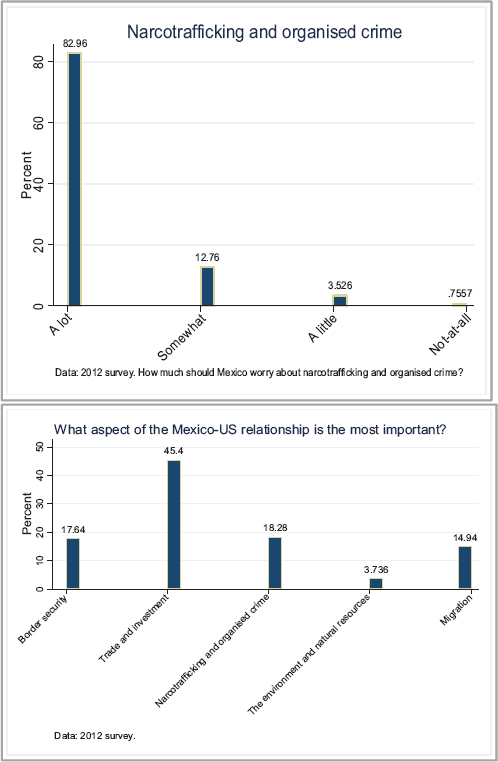
Mexicans’ Attitudes toward Organized Crime
Moreover, it makes sense not only to explore how this important policy issue shapes the sentiments of the average Mexican toward the US, but also whether there are significant differences between those with and without migratory experience. This is because globalization has a “dark side”, and illicit flows of goods and people have emerged to take advantage of advances in communication and the relaxation of barriers to trade and business (Ashby 2014: 484; Andreas 2011). The fact that immigration and remittances have occupied center stage in the combat against terrorism and drug-related violence is certainly not good news for the millions of immigrants and their families, who see their lives as being closely scrutinized and their presence in the US observed with suspicion. 4 Part of that close scrutiny affects the activities of remitters, since large sums of money associated with drug trafficking are thought to be laundered using remesadoras (Vlcek 2011, 2013). According to some estimates, 42 percent of exchange offices (casas de cambio) that operate in Mexico may be supported by drug trafficking organizations. 5
In particular, informal methods of remittance sending, widely used in some countries among certain ethnic groups, have attracted the attention of regulators who fear that these systems may be used to finance terrorist groups. See Passas (2003) for a discussion of the well-known hawala transfer system.
See <www.elagora.com.mx/Vinculan-a-centros-cambiarios-con,16976.html> (20 June 2017).
Some real cases help illustrate the connection between migrant remittances and organized crime. In Spain, internet cafés have been used to launder drug money. Gangs sometimes set up these businesses for this purpose or resort to existing ones, “compensating” the owner for the services. The funds arrive disguised as remittances to relatives of immigrants settled in Spain, but end up in the hands of drug cartels. When the owner of the internet café is not involved, “the criminals employ the details of citizens who send legal transfers, mixing them up with the illegal ones.” A Dominican couple “Jorge el Terrible” and his wife set up “La Real Envíos”, in which they used the details of citizens legally sending wire transfers to launder at least 100 million Euros. On other occasions, criminals recruit the owners of existing internet cafés to help with this process. 6
In Colombia, Mario Aranguren, director of financial information and the Analysis Unit, explained that investigations revealed the use of false identity documents to send remittances from abroad. Small but excessively frequent remittances were arriving at the departments of Antioquia, Risaralda, and Valle del Cauca, regions well known for a strong presence of drug trafficking. According to Aranguren, in only six months “some 15,000 people have been reported to Colombian judicial authorities for lending their names to receive remittances in exchange for commissions.” 7 Finally, in El Salvador, new financial regulations have been put in place to supervise companies involved in remittance sending and to align the El Salvadoran legal system with international regulations on the fight against money laundering. And although regulators insist that the supervision is put in place to “benefit the clean money obtained from the hard work of all our compatriots in the United States” and to prevent clean money from mixing with dirty money, a deputy from the conservative ARENA Party raised the concern that these regulations and enhanced scrutiny may put “receiving remittances into jeopardy.” 8
Regarding Mexico, O'Neil (2009: 75) stated that “illicit profits can be hidden in the flow of honestly earned money going back to Mexico, complicating efforts against money laundering.” As Hussain and Schiavon (2013) showed, many of the Mexican companies blacklisted for having cartel connections happened to be money exchange centers. As those authors put it, “remittances and laundered money intertwine” (Hussain and Schiavon 2013: 22), and Hussain added,
as a migrant lure, remittances breed post-Westphalian cottage industries (cross-border dynamics explode, family-based mom-and-pop stores spring [sic], gang membership climbs, drug trafficking expands, human smuggling spirals), more in Mexico's south than in the US south. (Hussain 2013: 120)
Other examples outside Latin America help illustrate the damaging effect that the criminalization of migration has on remittance senders’ activities. For instance, Horst et al. (2014) explored the connection in the media and in policymaking between informal remittances and crime, which has affected “migrants’ freedom about their money transfers” (Horst et al. 2014: 518). In their fieldwork among several migrant communities in Norway, Horst et al. perceived “that remittances are a sensitive issue for migrants to talk about because of the strong societal focus on their association with illegal activities” (Horst et al. 2014: 517). The same authors concluded:
The public scrutiny of remittances in relation to terrorism and crime has an impact on migrants’ daily lives because it affects their ability to send remittances. In periods of increased suspicion and attention, triggered by events in the country of origin or settlement, it can be difficult or impossible to transfer money. Money transfer businesses have had to close down or suspend their operations temporarily […]. Furthermore, remittance senders are increasingly hesitant to transfer money to certain regions because of the suspicion it may arouse. (Horst et al. 2014: 520)
Framing the combat against terrorism, drug trafficking, and associated illicit activities as a “war” does not help build bridges with the migrant community and their relatives (Carpenter 2013: 144–145). This type of framing invites adversarial rather than collaborative positions and makes any further progress in advancing the cause of the Mexican diaspora in the US highly unlikely. We hypothesize that given the close scrutiny and sometimes overt criminalization of immigrants and remittance flows, remittance recipients will be particularly wary of deepening collaboration between the Mexican government and the US in the War on Drugs. We argue that, among remittance recipients, generic positive opinions and trust in the US derived from a closer knowledge of the country and the direct experience of the material benefits of this relationship can co-exist with a strong rejection of giving a larger role to the US in combating criminal activities. This is more likely to be the case if that presence is perceived as a threat to the integrity of emigrants or to the resources they send back home.
Thus, from this discussion we seek to test two hypotheses:
H1: Remittance recipients will hold more positive sentiments toward the United States than non-remittance recipients.
But:
H2: Remittance recipients will show more apprehension about United States involvement in fighting drug violence in Mexico than non-remittance recipients.
To test our hypotheses, we rely on the 2010 and 2012 waves of the Mexico and the World public opinion survey carried out by the Center for Research and Teaching in Economics (CIDE) (2014) in Mexico City. These surveys are based on a nationally representative sample of interviewees selected through three-stage stratified random sampling. The 2010 survey covers 31 Mexican states and 173 municipalities, while the 2012 wave covers 32 states and 177 municipalities. Each year, 2,400 individuals aged 18 or more were interviewed in person and asked a range of questions related to their perceptions of the relationship between Mexico and the US and about cooperation with the US in the fight against drug trafficking. The survey's sample size allows analysis of the results at both national and regional levels. Interviews were administered “face to face” to one resident of each household. The surveys also collected information on the socio-demographic characteristics of the respondents, including whether they receive remittances.
This study considers five dependent variables to assess the effect of remittances on opinions toward the US. Tables A1 in the Appendix shows the survey items and explains the variable recoding. The first two variables capture generic opinions toward the US. The first variable we consider, Trust, is a dichotomous variable that equals 1 if the respondent said he or she trusted the US, and zero otherwise. Close to 42 percent of respondents trust the US in our sample. The second variable, Admire, is also binary and is equal to 1 for individuals stating that they admire the US. Forty seven percent of interviewees reported that they admire the US. 9
While the Cronbach alpha is quite high (0.70), we believe that these two variables capture different dimensions of the perception of the US, as the results below demonstrate.
Next, we focus on three dependent variables capturing interviewees’ opinions about what the relationship between Mexico and the US should be with respect to cooperation against drug-related violence. The variable Money is equal to 1 when respondents say they are in favor of Mexico receiving financial assistance from the US to combat drug trafficking. More than half of respondents are in favor of such assistance. The next variable, Supervision, is a dummy variable that equals 1 if individuals report being in favor of the US supervising the use of these financial resources devoted to combat drug crime in Mexico. A sizeable 70 percent share of respondents reported being in favor of US control of the financial support. The last dependent variable examined is Troops, a binary indicator equal to 1 if respondents are in favor of the US sending its troops to Mexico to fight drug trafficking. Approximately 60 percent of interviewees said they were in favor of US presence. 10 All in all, the US does not seem to inspire overwhelming trust or admiration among the Mexican public. However, a solid majority support its involvement in the fight against cartel violence against the expectations of sovereign–nationalist concerns. But does this support differ between respondents with migrant connections and those without them? A simple test of equality of means of these dependent variables comparing those who receive remittances to those who do not suggests that while remittance recipients exhibit more positive sentiments with respect to the US, they are not, on average, more supportive of active US involvement in the fight against drug trafficking (see Appendix Tables A3).
There is little reason to collapse these three dependent variables, which clearly capture different aspects of the bilateral Mexico–US relationship. Their Cronbach alpha is low at 0.44.
Our main independent variable, Remittances, equals 1 for respondents who report receiving remittances. In the sample, 10.4 percent of the surveyed adults live in a household that receives financial assistance from abroad, but many more report having a relative abroad (about half of the 2012 wave's respondents). Thus, a large number of Mexican households experience out-migration. Remittances capture one aspect of the material benefits of economic integration with the US that should, in principle, be positively correlated with more trust and admiration. However, for the reasons discussed above, we remain skeptical as to whether out-migration experience will make these respondents more supportive of closer collaboration with the US.
To control for the possibility that perception of Mexico's economic situation may impact attitudes toward the US, we included an indicator capturing the opinions of individuals regarding whether Mexico's macro-economic situation over the last 12 months has worsened, stagnated, or improved (Sociotropic). According to material theories of anti-American sentiment, to the extent that the economic fate of Latin American countries is seen as inextricably linked to the economic performance of the US, some respondents may transfer the responsibility for bad figures to the economic policies of the neighbor of the north, thereby affecting their assessment of the United States. Mexico is the US's third-closest trading partner and the source of over USD 25 billion in remittances in 2015 (Ashby 2014; World Bank 2016). Thus, the Mexican economy and its communities and households are highly dependent on the state of the US economy. Consequently, respondents with a better perception of the Mexico's economic situation are expected to hold more positive views of the US.
We also incorporated an indicator of political ideology measuring the self-placement of respondents on a zero-to-10 scale (the variable is Ideology, with zero being at the extreme left and 10 at the extreme right). Theories of anti-Americanism have clear expectations about where anti-American feeling is more likely to fall in the ideological spectrum; namely, on the left. There are several reasons for this. First, the US has a long legacy of intervening in the region to try to overturn what it regarded as radical leftists, revolutionary, and communist movements and governments, backing rightist governments and dictators instead (Radu 2004). Second, the US is often regarded as embracing neo-liberal economic policies that predicate the virtues of a limited role of the state in the economy. Those located toward the left of the ideological spectrum and supporting a more prominent role for the state in welfare provision and wealth redistribution will be less likely to show enthusiasm for US economic policies (Morris 2005; Chiozza 2007; Azpuru and Boniface 2015). The average value of the Ideology variable across the Mexican sample is 5.9 (center right).
We also controlled for several other determinants of attitudes toward the US. We included the respondents’ years of education, age, and age squared in order to capture possible non-linearities, a gender indicator (male), and a dummy variable measuring whether the respondent is economically active. In our sample, 50.6 percent of the individuals are women and 51.1 percent are working. The average respondent is 41.3 years old and has completed 8.9 years of education; that is, up to middle school. As a proxy for socio-economic status, we add as a control for income a categorical variable reporting whether the individual considers her economic situation to be very difficult, difficult, decent, or comfortable. Tables A2 in the Appendix provides descriptive statistics for these variables.
Baseline Models
For ease of interpretation, we estimate linear probability models to uncover the influence of international remittances on attitudes toward the US. It should be emphasized that our main results are robust to using a logistic regression model and so are our predicted probabilities (see Tables A4 in the Appendix). Thus, using a linear probability model does not affect our results. The general model for explaining our five alternative dependent variables – two measures of sentiment and three measures of opinions regarding concrete instances of cooperation – takes the following form:

The questions about the supervision of resources and presence of troops were asked of the respondents who supported US financial aid. Thus, the last two questions are nested within the first one. We ran a Heckman sample selection model using as identification several variables correlated with support for US aid, but uncorrelated with support for supervision and troops. The test of independent equations could not be rejected, suggesting that the nested character of the question does not preclude treating these answers as independent.
Table 1 shows the results of our five baseline models. The first two columns refer to generic sentiments toward the US, while the last three ask about concrete issues concerning the bilateral relationship. In line with the “material benefits” hypothesis, respondents who receive remittances are approximately 6–10 percentage points (pp) more likely to hold positive views about the US than non-remittance recipients. Concretely, remittance recipients are more likely to trust and admire the US. However, when it comes to endorsing close cooperation with the US in the fight against drug trafficking, the gains from remittances are not enough to transform these recipients into a support coalition for greater cooperation. Whereas remittance recipients are about 6 pp more likely to support financial assistance from the US to combat drug trafficking, they are approximately 8 pp more opposed to this financial assistance if it entails the presence of US troops in Mexican territory. They are also no more likely than non-remittance recipients to support the financial aid if it entails the supervision of resources by the US.
Remittances, Pro-American Sentiment, and Cooperation
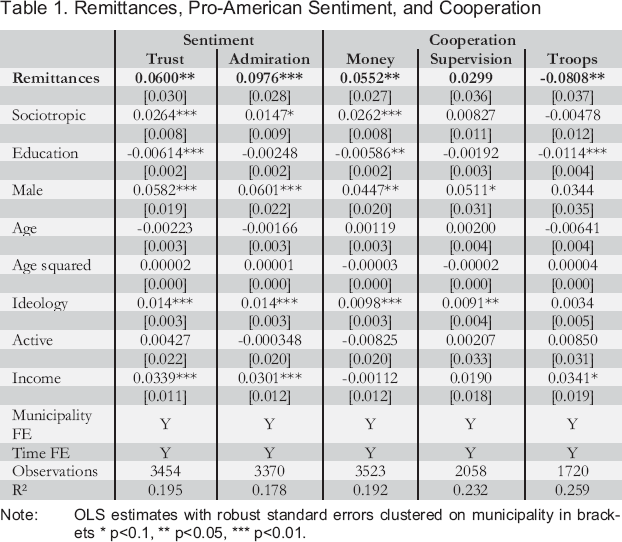
Note: OLS estimates with robust standard errors clustered on municipality in brackets
p<0.1,
p<0.05,
p<0.01.
The control variables are in line with theoretical expectations inspired by other empirical research. Individuals who regard the overall economic situation as good are more likely to hold views of trust and admiration, but they are not more likely to support collaboration with the US if this entails active supervision or US military presence. Those respondents who lean toward the right, the economically better-off, and male respondents are also more likely to hold positive views of the US. Interestingly, additional years of education have a negative and significant effect on four out of five models: trusting the US and in several scenarios of collaboration with the US regarding the fight against drug trafficking.
The above analysis assumes that the allocation of remittances across respondents is random, conditional on our covariates. However, this assumption might be false in reality. In particular, both reverse-causation and omitted variable bias could affect the validity of our findings. For instance, households with positive opinions toward the US in the first place might be more likely to encourage one of their members to emigrate and only subsequently receive remittances. To address this concern, we employed the coarsened exact matching (CEM) method, a nonparametric matching method that reduces the imbalance between treated and untreated groups (in our case, remittance-receiving respondents). To create a valid control group, the method temporarily coarsens each pre-treatment covariate into meaningful groups and matches observations on these coarsened data. Once matching is achieved, only the original values of covariates are retained. Also, CEM automatically restricts the matched data to areas of common support among covariates (Iacus, King, and Porro 2012; see Ahmed (2013) for a similar application of the CEM matching method).
We considered five pre-treatment covariates that are likely to predict the reception of remittances and individual opinions. These are gender, the respondent's age (and its square), the level of education, a dummy indicating whether the interviewee speaks an indigenous language, and a dummy for residence in a Mexican border state. 12 Respondents’ gender, age, and education are typically included as covariates that explain the reception of remittances. Speaking an indigenous language may be correlated with marginalization from Mexican modern society and may therefore affect remittance receipt and attitudes toward the US. Living in one of Mexico's northern border states may influence opinions regarding various elements of the relationship with the US and also affect the likelihood of receiving remittances. These variables are unlikely to be determined by receiving remittances. 13 After matching the data, we ran the same linear probability models to uncover the average treatment effect on the treated (ATT), namely of remittances, on our five dependent variables.
The border states are Baja California, Sonora, Chihuahua, Coahuila, Nuevo León, and Tamaulipas.
The inclusion of education in the selection equation could be seen as problematic given that remittances have been proven to have an impact on incentives to acquire education; that is, remittances can impact educational outcomes. In Mexico, the evidence is mixed (Sawyer 2016). In any case, removing education from the selection equation does not alter our results. Also, the main weakness of CEM is that it assumes that the treatment assignment is ignorable conditional on covariates. In other words, it assumes the absence of any unmeasured confounders.
Coefficient estimates of CEM regression models for US sentiment variables are presented in Table 2 and plotted in Figures 2 and 3. Accounting for the possible non-random character of remittances, our main results are somewhat stronger and substantively the same in sign as those from Table 1. In line with the material gains hypothesis, individuals who receive remittances are more likely to have positive perceptions of the US (between 10 and 11 pp more); as before, however, these individuals are not more likely to support greater cooperation with the US if this cooperation entails a greater scrutiny of resources. Moreover, remittance recipients are clearly opposed to receiving financial support if this entails greater US military presence in Mexico (about 9 pp less supportive). As before, men who self-identify with the right and have positive perceptions of Mexico's economic situation are the ones who are most likely to have positive views of the US, but more educated respondents are less likely to exhibit positive views of the US.
Remittances, Pro-American Sentiment and Cooperation Coarsened Exact Matching (CEM) Models
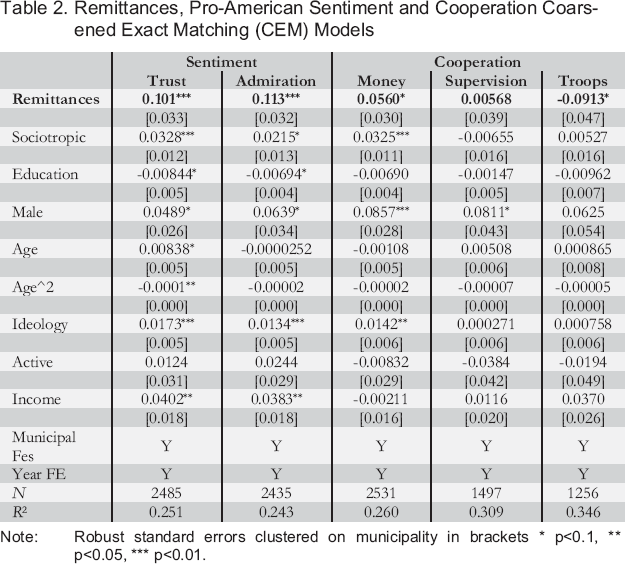
Note: Robust standard errors clustered on municipality in brackets
p<0.1,
p<0.05,
p<0.01.
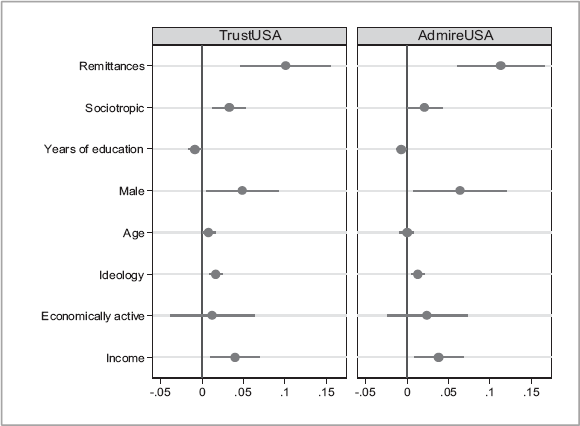
Marginal Effect of Covariates on Sentiments toward the US, CEM Estimates (90 percent confidence intervals)
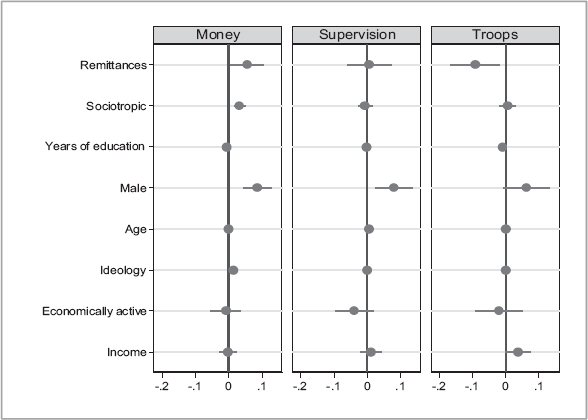
Marginal Effect of Covariates on Cooperation with the US, CEM Estimates (90 percent confidence intervals)
In the theory section, we explained that emigration and financial remittances associated with it represent a different kind of material gains than those from trade because they are affected by anti-drug-trafficking policies in a potentially direct way. If our claim is correct, other forms of economic interaction should not spur the same degree of opposition to collaboration with the US in the fight against drug violence. To verify this, we ran a series of models controlling for the respondents’ opinions about the benefits that international trade has made to their lives. We chose this variable considering that international trade and imports from the US in particular have been shown to boost pro-American sentiment (Baker and Cupery 2013). Thus, this issue provides a good point of comparison.
While individuals who receive remittances may see the inflow of money threatened by increased supervision and scrutiny, and may therefore be more hostile to cooperation with the US in cracking down on drug-related crime, respondents’ support for free trade should be positively related or unrelated to opinions on collaboration with the US in the war on drugs. Approximately 64 percent of respondents in our sample stated that free trade is beneficial for them.
We also controlled for a couple of geographic variables that may mediate the relationship between remittances and attitudes toward the US. First, we included an indicator of whether the recipient is located in a border state. Residence in a border state is likely to exacerbate the perception of both the advantages and the disadvantages of nearness to the US. Second, unfortunately, the survey did not include questions about individual levels of crime victimization. Instead, we included an indicator of state levels of cartel violence as measured by a dummy variable indicating whether the respondent lives in a state that is a territory disputed by at least two criminal organizations (Phillips 2015). 14 Border states are disputed territories, but many other Mexican states are also subject to cartel violence. 15 For instance, in 2012, 15 non-border states were disputed territories, and some of them (for instance, Guanajuato, Michoacán, and Guerrero) are also high emigration intensity states. Since we controlled for state level variables, we ran multilevel models that account for the hierarchical nature of the data (individuals nested in states).
See also his documentation at <https://sites.google.com/site/brianjphillips/research> (21 June 2017).
The correlation between border states and disputed territories is positive, but low (0.12).
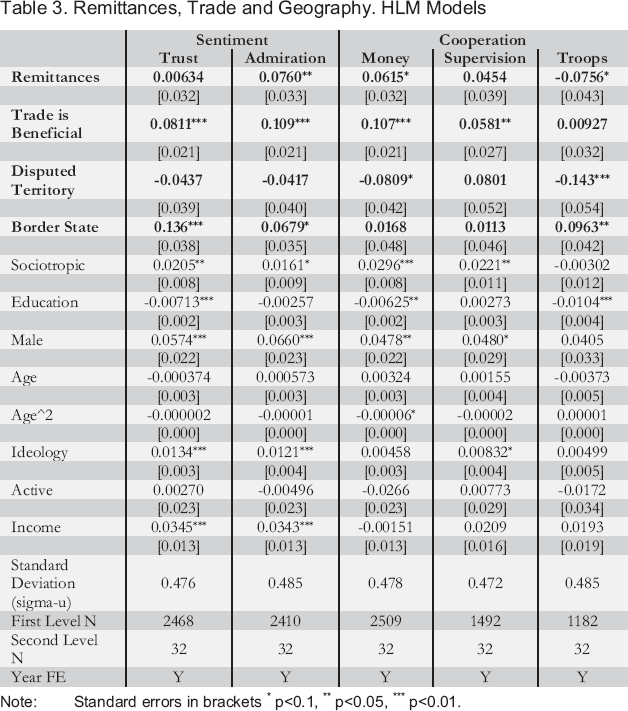
Table 3 summarizes the results of the hierarchical models. Belief that trade with the US increases respondents’ living standards is strongly correlated with trusting and admiring the US. After we controlled for attitudes toward trade, which clearly boost pro-American sentiment, the reception of remittances is only associated with feelings of admiration for the northern neighbor. Thus, in line with Baker and Cupery (2013), we find that perceptions about the benefits of trade do have more leverage in shaping pro-American sentiment than the reception of remittances. Positive opinions regarding trade are strongly correlated with supporting US financial aid, even with support for supervision of these resources. However, believing that trade is beneficial is not enough to make these respondents more supportive of the presence of US troops to fight cartel violence.
Residence in a border state increases trust and admiration for the US and makes residents more supportive of the presence of troops. However, residence in a disputed territory has the opposite effect, substantively decreasing support for US military involvement by 14 pp. In the Appendix Tables A5, we control for whether the respondent is based in a border state, and interact remittances with border state and disputed territory. These interactions are not statistically significant. After controlling for individual attitudes toward trade and for state levels of violence, remittance recipients continue to be about 8 pp less likely than non-remittance recipients to support the presence of troops in exchange of financial support to crack down on cartel activity.
Remittances, Trade and Geography. HLM Models
Note: Standard errors in brackets
p<0.1,
p<0.05,
p<0.01.
The presence of US troops in the country is a clear red line to cooperation among remittance recipients, even after controlling for their views on trade, disputed territories, or border states.
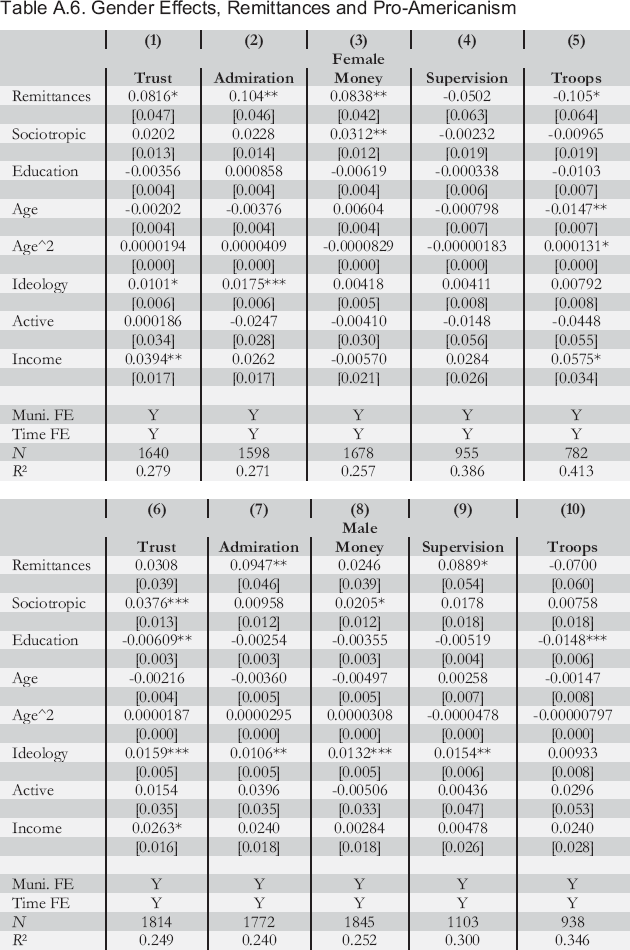
To assess whether our results vary across gender, we ran separate regressions for men and women based on the linear probability model in Table 1; results can be found in Appendix Tables A6. Overall, our findings are not greatly affected when heterogeneous gender effects are estimated. The impact of remittances on all outcomes tends to be of the same sign and order of magnitude. However, we did lose some degree of statistical significance. This is mainly due to the smaller samples we work with when we split our dataset along the gender dimension. On the whole, our findings are not compromised by this robustness check.
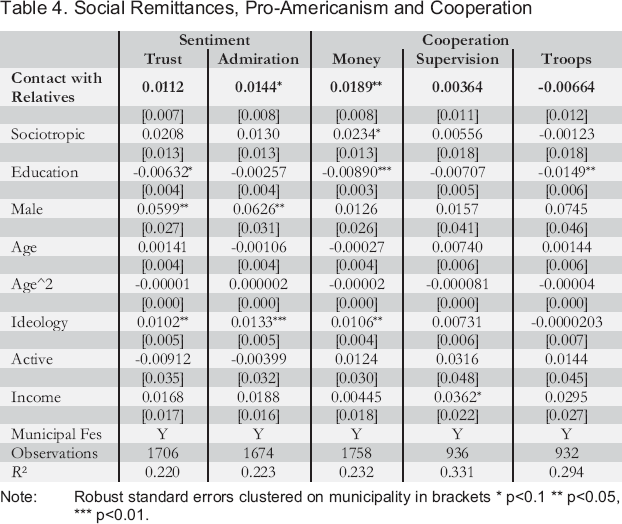
Finally, while this research focuses on financial remittances, Table 4 explores the role of social remittances – the “ideas, behaviors, identities, and social capital that flow from receiving to sending country communities” (Levitt 1998: 927) – by looking at the impact that contact with relatives abroad has in shaping sentiment and views about collaboration with the United States. The ordinal variable “Contact with Relatives” captures whether the respondent has no relatives, or has relatives but no contact with them, and how frequently contact happens (rarely, sometimes, frequently, and daily contact). The question about contact was asked in the 2012 wave only. That year, about half of Mexicans surveyed reported having relatives abroad and about 30 percent reported being in touch with them sometimes, frequently, or daily.
Social Remittances, Pro-Americanism and Cooperation
Note: Robust standard errors clustered on municipality in brackets
p<0.1
p<0.05,
p<0.01.
Interestingly, research on social remittances has shown that communication with relatives has a positive influence on political attitudes (Pérez-Armendáriz and Crow 2010; Pérez-Armendáriz 2014) and political behaviors (Córdova and Hiskey 2015) as diverse as identifying with political parties, persuading others in political conversations, participating in local politics, protesting, and other forms of non-electoral political participation. In her research on trans-border communication between Mexicans and their émigré relatives, Pérez Armendáriz (2014) showed that views about democratic institutions, respect for the rule of law, and individual human rights are conveyed through trans-border conversations, shaping the behaviors of those back home.
The distinctiveness of the migratory phenomenon is again made evident in these results: Trans-border conversations hardly shape in any meaningful way either sentiment or views on collaboration with the United States in combating drug trafficking. The coefficient for contact with relatives is statistically significant in only two out of five models, and the predicted probabilities for each of the categories of contact are not significantly different from each other. This suggests that the flow of information arriving from the other side of the border does not portray the involvement of the US in fighting cartel violence in Mexico as positive or desirable.
Indirectly, we verify that the information arriving from emigrants regarding collaboration with the US is not particularly positive by looking at a few items in the Survey of Latinos, June 2006 (Pew Hispanic Center) concerning border protection. 16 This survey contains a couple of questions about support or opposition to two border control measures: increasing the number of border patrol agents and sending National Guard troops to the border. Opposition to both policies is high among Latinos, and even higher among the 513 Mexicans (the largest Latino group) included in the sample. While 52 percent oppose increasing the number of border patrol agents, 73 percent oppose sending National Guard troops to protect the border. When the same questions are answered by Latinos born in Mexico, the response rates rise to 72 percent, and a very high 89 percent, respectively. Interestingly, there are statistically significant differences between those respondents with and without contact with relatives back in Mexico: those with contact with their families south of the border are significantly more opposed to increasing the number of border patrol agents. Among the whole Latino sample, opposition to more border patrol agents and to sending national guard troops is significantly greater among those who send financial remittances and who have contact with their relatives than among Latinos without those linkages. 17 Therefore, despite the monetary and social connections with their emigrant relatives, it is not surprising pro-American feelings receive so little support among Mexicans left behind, in contrast with the prediction of the “contact-and-information hypothesis”.
See <www.people-press.org/2011/01/20/economy-dominates-publics-agenda-dims-hopes-for-the-future/> (21 June 2017).
In the entire Latino (Mexican-born) sample, about 47 percent (52 percent) send remittances and 72 percent (71 percent) are in touch with their families one or two times a month, once a week, or more than once a week.
All in all, pro-American sentiment, more in the form of admiration than of trust, co-exists with anti-American feelings among families left behind. We attribute this mismatch to the linkage between the war on drugs, the criminalization of migration, and a closer scrutiny of financial transactions associated with migration and remittances.
This paper has explored whether the material benefits of migration – namely, financial remittances – make Mexicans more pro-American. In line with previous research, we hypothesized that material benefits derived from collaboration with the US positively shape views about this country. However, we considered it necessary to add some nuance to the issue, along two lines. First, most discussions about anti- and pro-Americanism, and certainly the scant empirical research that exists on the topic, have looked at sentiments of trust and admiration or overall opinions about the US. But can we infer attitudes toward concrete instances of cooperation from generic views about the country?
Second, are all material gains the same? So far, empirical research tells us that greater trade integration and access to imports translate into more positive opinions about the US. Other scholars have used remittances as a proxy for contact and knowledge of the destination country, reporting a positive relationship between remittances and sentiments toward the US.
Our research shows, first, that stronger positive feelings toward the US do not necessarily translate into greater support for collaboration. Second, it shows that the material benefits of international migration are complex and multifaceted. We studied the attitudes of Mexican respondents with respect to greater collaboration with the US in the War on Drugs, and found that remittance recipients were particularly reluctant to support US military involvement. We interpret this finding on the basis of a perverse connection in the political and policy discourse between drug trafficking, illegal immigration, and money laundering. The connection has criminalized migration flows and has put remittances, remitters, and the remittance-sending sector at the center of the debate.
This research has clear theoretical and policy implications. Criminalizing migration has made migrants and their relatives back home wary of collaboration with the US in the fight against drug trafficking. As much as remittance recipients seem to admire (rather than trust) the US more than non-recipients, they are not particularly supportive of US presence in the country. Receiving remittances shapes opinions about collaboration in a different way than opinions about trade integration do, revealing the distinctive character of the “material benefits” argument when applied to international migration and the limits of “material benefits” theory in making individuals more pro-American.
Successful bilateral collaboration in the war against drugs will very likely demand the cooperation of migrants, their families, migrant organizations, and the remittance sector. Therefore, we believe that the US should water down its criminalization discourse around migration, while the Mexican government should reassure migrants and remittance recipients that fighting cartel violence will not threaten the honest flow of remittances to families left behind.
Footnotes
Appendix
Gender Effects, Remittances and Pro-Americanism
| (1) Trust | (2) Admiration | (3) Female Money | (4) Supervision | (5) Troops | |
|---|---|---|---|---|---|
| Remittances |
0.0816* {0.047] |
0.104** {0.046] |
0.0838** {0.042] |
-0.0502 {0.063] |
-0.105* {0.064] |
| Sociotropic |
0.0202 {0.013] |
0.0228 {0.014] |
0.0312** {0.012] |
-0.00232 {0.019] |
-0.00965 {0.019] |
| Education |
-0.00356 {0.004] |
0.000858 {0.004] |
-0.00619 {0.004] |
-0.000338 {0.006] |
-0.0103 {0.007] |
| Age |
-0.00202 {0.004] |
-0.00376 {0.004] |
0.00604 {0.004] |
-0.000798 {0.007] |
-0.0147** {0.007] |
| Age^2 |
0.0000194 {0.000] |
0.0000409 {0.000] |
-0.0000829 {0.000] |
-0.00000183 {0.000] |
0.000131* {0.000] |
| Ideology |
0.0101* {0.006] |
0.0175*** {0.006] |
0.00418 {0.005] |
0.00411 {0.008] |
0.00792 {0.008] |
| Active |
0.000186 {0.034] |
-0.0247 {0.028] |
-0.00410 {0.030] |
-0.0148 {0.056] |
-0.0448 {0.055] |
| Income |
0.0394** {0.017] |
0.0262 {0.017] |
-0.00570 {0.021] |
0.0284 {0.026] |
0.0575* {0.034] |
| Muni. FE | Y | Y | Y | Y | Y |
| Time FE | Y | Y | Y | Y | Y |
| N | 1640 | 1598 | 1678 | 955 | 782 |
| R 2 | 0.279 | 0.271 | 0.257 | 0.386 | 0.413 |
|
|
|
|
|
|
|
| Remittances |
0.0308 {0.039] |
0.0947** {0.046] |
0.0246 {0.039] |
0.0889* {0.054] |
-0.0700 {0.060] |
| Sociotropic |
0.0376*** {0.013] |
0.00958 {0.012] |
0.0205* {0.012] |
0.0178 {0.018] |
0.00758 {0.018] |
| Education |
-0.00609** {0.003] |
-0.00254 {0.003] |
-0.00355 {0.003] |
-0.00519 {0.004] |
-0.0148*** {0.006] |
| Age |
-0.00216 {0.004] |
-0.00360 {0.005] |
-0.00497 {0.005] |
0.00258 {0.007] |
-0.00147 {0.008] |
| Age^2 |
0.0000187 {0.000] |
0.0000295 {0.000] |
0.0000308 {0.000] |
-0.0000478 {0.000] |
-0.00000797 {0.000] |
| Ideology |
0.0159*** {0.005] |
0.0106** {0.005] |
0.0132*** {0.005] |
0.0154** {0.006] |
0.00933 {0.008] |
| Active |
0.0154 {0.035] |
0.0396 {0.035] |
-0.00506 {0.033] |
0.00436 {0.047] |
0.0296 {0.053] |
| Income |
0.0263* {0.016] |
0.0240 {0.018] |
0.00284 {0.018] |
0.00478 {0.026] |
0.0240 {0.028] |
| Muni. FE | Y | Y | Y | Y | Y |
| Time FE | Y | Y | Y | Y | Y |
| N | 1814 | 1772 | 1845 | 1103 | 938 |
| R 2 | 0.249 | 0.240 | 0.252 | 0.300 | 0.346 |