




Abstract
Pandemic violence and criminality are anathema to a democratic society. And yet, in Latin America, both operate side by side. Illicit activity has propagated precisely because the democratic states of the region have been ineffective at establishing and maintaining the rule of law via public security mechanisms like the police. This ineffectiveness has significant consequences for public support of police forces. Hence, an important question for students of state-building and democratisation is: What factors explain public perceptions of the police? We argue that police forces that are local and unprofessional will be less trusted and viewed as less effective than their more centralised and professional counterparts of state and federal police. In short, we find that centralisation and professionalisation mitigate the impact of crime victimisation and police corruption on the public opinion of the police in Mexico. These findings are drawn from an analysis of the National Survey of Victimisation and Perceptions of Public Security (ENVIPE) in Mexico for 2012 and 2018.
Introduction
Violence and criminality, coupled with police malfeasance, prove a volatile mix that undermines trust in the state, the rule of law, and democratic legitimacy. This is particularly true in Mexico, which experienced over 200,000 drug-related deaths from 2006 to 2017 (Agren, 2017). At the core of these social ills is a broken police system that lacks professionalisation and is riddled with corruption. In this context of democratic development and rampant crime, we ask two questions. First, how do crime victimisation and experience with corruption change how police are viewed? How do the institutional differences between municipal, state, and local police factor into public opinion of the police? In this research note, we argue that the level of centralisation and professionalisation play an essential role in shaping the relationship between corruption, crime victimisation, and public support for the police. Using data from the National Survey of Victimization and Perception of Public Security (ENVIPE) (2018) (ENVIPE) in Mexico for 2012 and 2018, we find that perceptions of corruption and crime victimisation are important predictors of public perceptions of Mexican police but this varies based on the level of policing involved.
The rest of this research note is organised as follows. The second section introduces the conceptual and theoretical framework of the study. The third section presents our research design and statistical findings. The fourth section discusses the implications of our findings and provides concluding remarks.
Conceptual and Theoretical Framework
Effective Policing in Comparative Perspective
Only a few scholars have studied how the structure of law enforcement influences police behaviour and public opinion (Eitle et al., 2014; Mastrofski, 2004: 103). One essential structural characteristic rests on how police are organised at the local, sub-national, or national level. Some scholars have argued that heavily localised police outperformed more centralised ones (Ostrom et al., 1973). These scholars have emphasised “decentralisation over centralised authority and locally tailored rather than globally rationalised solutions” (Sklansky, 2013). More recent scholarship has found that a decentralised police system is positively associated with higher levels of citizen trust in the police (Lowatcharin and Stallmann, 2017). These scholars have also been critical of centralised policing, as they blame national police models for making oversight more difficult, reducing community trust, and increasing malfeasance (Skogan, 2006).
Conversely, Cardona (2008) argues that decentralisation incentivises local patrimonialism. Further, sub-national “executive appointment of police chiefs […] has led to patronage appointments, poor policies, and a lack of continuity in reform efforts” (Sabet, 2012: 266). Instead, some researchers argue that police unification may be beneficial for policing because they can ensure consistent training in penal codes, due process, and human rights, and may be able to better coordinate anti-crime activity, but also have more resources to deal with asymmetric threats and improve professionalisation (Lutterbeck, 2004; Naritomi et al., 2007; Pion-Berlin and Trinkunas, 2011; Esparza and Bruneau, 2019). For instance, Diego Esparza notes that the historical process of police centralisation from 1800 to the present in both Chile and Colombia has strengthened the efficacy of the police force over time, while the continued fragmentation of the Mexican decentralised police system engenders politicisation of the police as well as permeability to corruption (Esparza, 2015).
Another critical structural variable is police professionalism. Professionalism is defined by how a particular labour field structures its remuneration, training, and oversight. While countries with substantial compensation, adequate training, and robust and redundant monitoring tend to feature more professional police systems, those that do not pay police a living wage, provide minimal training, and do not have oversight mechanisms tend to be less professional and more malfeasant (Botello et al., 2000; Celador, 2005; Garner, 2005; Goldsmith, 1999; Mas, 2006; Mastrofski, 2004).
In addition to these important structural factors, we also consider key individual characteristics and experiences that the literature suggests are important factors in explaining the support of police forces. Studies have shown that efforts to reduce police corruption are positively correlated with public confidence in the police (Bradford et al., 2009; Tankebe, 2010). Indeed, if citizens observe officers acting unethically, they tend to lose faith in the police (Sunshine and Tyler, 2003). This factor is particularly worrisome in contemporary Mexico, which features pervasive corruption (Morris, 2013). Sabet (2012): 23) analysis of police in Mexico shows that direct experience with both police corruption and crime victimisation are negatively correlated with trust in these forces.
Scholars have found that increased levels of crime victimisation affect several areas of political life such as voter participation (Shirk and Wallman, 2015; Trelles and Carreras, 2012) and public perceptions of political institutions (Ceobanu et al., 2011). Furthermore, Bateson, 2012 has shown how victims of crime have lower levels of confidence in the judicial system and law enforcement compared to non-victims. As a result, we expect crime victimisation to play an essential role in explaining perceptions of the police, as well as an operationalised way to measure how public opinion changes depending on which level of policing is being assessed.
Policing in Mexico
Mexico is a crucial case in the Americas, as it provides unique opportunities to study policing. For one, Mexico is one of only a handful of Latin American countries with federal systems. While Argentina, Brazil, and Venezuela are federal systems, it is just in Mexico that we see preventative, uniformed police officers at the federal, state, and municipal levels. This feature presents an ideal opportunity to conduct a within-case analysis between local, state, and national police institutions while controlling for other important contextual factors. In effect, Mexico is one of the few cases other than the United States that can provide a real test of the impact of full-fledged decentralisation of policing and its impact on police service.
The Mexican case is also compelling because of the complex nature of policing in the country. Mexican police are divided into policías preventivas and policías judiciales. The former includes uniformed law enforcement officers charged with deterring crime and stopping crime in flagrante, while the latter are non-uniformed officers charged with investigations related to prosecutorial matters. Concerning total personnel numbers, there are roughly 430,000 police officers in total in Mexico, with about 40,000 personnel at the federal level, 227,000 at the state level, and 164,000 staff at the municipal level (Torres, 2009). The current study focuses on preventative police forces (policías preventivas), which include roughly 2,000 police organisations at the municipal level, 32 agencies at the state level, and one federal police organisation.
While local preventative police forces are most common in Mexico, most are from poor cities and small departments with very few officers. For instance, 1,100 municipalities (52.4 percent) feature less than 20 police personnel, 530 towns had between 21 and 50 police officers, and 210 municipalities count on 51–100 police officers. Only 250 cities have more than 100 police (Moloeznik and Garay, 2012). Moreover, 400 cities have gone 10 years without a police force (CNN, 2010). Overall, the realities of decentralisation and smaller police departments often result in lower levels of professionalisation and greater susceptibility to corruption. In addition to the sparse number of police forces and officers, the municipal police force in Mexico also features poor pay and educational achievement. For instance, 85 percent of the municipal police officers earn less than USD 500 per month (Encuesta Nacional sobre Inseguridad (ENSI), 2010). Further, while 64 percent of all municipal police have secondary education or less ( 0 to 9 years), only 30 percent have a high school diploma, and only 3 percent have a college or advanced degree (CNGMD, 2013).
Historically, Mexican states have had judicial police in charge of helping state prosecutors in investigating crimes and state highway patrol in charge of maintaining stranded motorist and policing traffic offences. However, until recently, states have not had police with traditional police roles of patrolling and crime prevention at a state-level jurisdiction. All Mexican states have started to build these types of police forces to bolster weak police at the municipal level except for Nayarit, Queretaro, Sinaloa, and Zacatecas. These police forces tend to be more professional than their municipal counterparts due to better pay and retirement provisions. In 2011, the average pay for state police officers was USD 711 per month (ENVIPE, 2011). Most states offer retirement after the agents turn fifty-five to sixty years old with twenty-five to thirty years of service (INFOMEX-Mexican Federal Police, 2014 2014). Upon meeting these requirements, the agents receive a monthly pension equal to 100 percent of their last monthly salary.
At the federal level, the primary police force is called the Policia Federal Preventiva. The federal police’s jurisdiction encapsulates all the national territory, and it is tasked with enforcing federal law. Its primary mission is to prevent crimes and administrative offences against federal legislation, including anti-drug trafficking laws. One of the federal police’s central goals is to participate in aid of national, state, and local authorities in the investigation and prosecution of crimes and the arrest of individuals. They can also collaborate, when requested, with local governments. Much like the state police, the size and the importance of the federal police has increased since 1997. For instance, the federal police had 9,036 personnel in 2000, but by 2014 this had risen to 39,711 (Delgado and Barbara, 2015). Federal police forces are also characterised by higher levels of professionalism than their state and municipal counterparts, which is due in large part to the higher salaries and better benefits but also better training and education. The entry ranks of federal police receive USD 964 as their monthly base salary (INFOMEX-Mexican Federal Police, 2014 2014). After thirty years of service, federal police have a right to a pension of 100 percent of their last salary. Candidates must also have a minimum high school education to enter the Federal Police force.
A final consideration worth highlighting in understanding the context of policing in Mexico is the ongoing war on drugs. Fighting narco-violence in Mexico has engulfed security institutions at all levels of government: the military, federal police, state police, and municipal police all engage in patrolling, arresting, and fighting cartels and criminal associates alike (Ugues and Esparza, 2018). Sometimes these institutions engage in joint operations, and in other cases, each of these agencies is operating independently but with the same purpose of public security: patrolling, preventing crime, seizing individuals, and arresting people. Given this reality, it is reasonable to think that for the many Mexican citizens, confusion may arise as to the relative differences between police forces.
Theoretical Expectations
Given the realities of policing in Mexico as well as insights of the literature on this topic, we offer some theoretical expectations that are critical to this debate. We argue that when police are controlled by national or state-level authorities there tends to be a reduction in police abuse and corruption and thus a general improvement in perceptions of the police (Cardona, 2008; Lutterbeck, 2004; Naritomi et al., 2007; Pion-Berlin and Trinkunas, 2011). In these contexts, politicians have more reasons to avoid controversies and the illicit use of police forces for politicised purposes, though it still occurs. Furthermore, national and state-level governments tend to have stronger coercive power and taxation capacity and hence have more available resources to develop high-quality police forces. In short, countries with a national police force or one that is more centralised around states or provinces are better off than those with local police forces. Second, the way a country structures its police labour has pronounced effects on public perception of that behaviour (Esparza, 2015; Sabet, 2012). When police labour is structured with strong welfare, development, and oversight systems, police will also be less likely to engage in mischief and therefore garner higher levels of trust from citizens as revealed by public opinion.
Specifically, we argue that citizens utilise different logics to evaluate their police agencies depending on the level of professionalism and type of police (local, state, and federal). In this way, there is an ethical and practical framework that shapes public perceptions of Mexican police. Regarding the ethical framework, the empirical evidence suggests that professionalism is lowest amongst local and state-level police forces, which often results in less public support for these forces. These realities often prime citizens for what we call the ethical expectation. Citizens expect a higher ethical and moral compass in more professional police bodies. Local and state police have developed less trust in society than their federal counterparts because they are less professional. As such, perceptions of corruption will do the most damage to the level of police with the highest expectation of moral behaviour: the federal police. The observable implication of this is that citizens will already have established opinions about the professionalism of each force. In essence, police corruption is more likely to be expected behaviour from local and state police than the federal police, and this normalisation appears to be the source of the differential impact amongst the three levels of policing. Formally, we expect the following:
Regarding the practical framework, we argue that citizens place blame for transgressions on the people who they rightfully view as more responsible. In this respect, local police are perceived to be part of the crime problem, due to the lack of professionalism, their susceptibility to corruption, and the frequency with which they have been known to work with local drug cartels. In contrast, due to their more centralised structure and higher levels of professionalism, federal and state police are perceived as less corruptible and therefore less likely to engage in criminal activity. As such, federal and state police are thought of as the solution, given their much better training capacity than local police. From a practical framework, we have reason to believe that crime victims are likely to blame all police for their plight; however, these citizens are more likely to blame their local police force as they realise that local police ineptitude facilitates crime victimisation, whereas state and federal police are thought of as more likely to be doing something about the criminal activity in their society. Hence, we expect the following:
The following section presents the data and methods used to analyse these theoretical expectations, as well as our key findings.
Research Design and Findings
Data and Methods
This study employs data from a variety of sources, including the Encuesta Nacional de Victimización y Percepción sobre Seguridad Pública (ENVIPE), , and the Censo Nacional de Gobiernos Municipales y Delegacionales. We also utilise freedom of information request Mexican Federal Police, 2014 2014 (INFOMEX) to gather information about police training, salaries, pension, oversight, and recruitment standards at the state and federal levels. We use each of these data sources to provide accuracy and precision in our analyses; however, to test our hypotheses, we utilise data from the ENVIPE study for 2012 and 2018. ENVIPE is a national survey used to collect public opinion data on crime victimisation, including the types and frequency of crime, as well as perceptions of public security in Mexico and the institutions responsible for public safety and justice.
To evaluate our hypotheses regarding corruption and crime victimisation on public support of Mexico’s police forces, we explore two key dependent variables: (1) trust in the police and (2) perceptions of effective police performance. Trust in the police is based on the following survey items: How much trust do the municipal/state/federal police inspire in you – a lot (1), some (2), a little (3), or not at all (4)? Each item was recoded in reverse order for ease of interpretation. We model trust in the police as a function of crime victimisation and perceptions of police corruption. Crime victimisation is a variable that measures whether respondents reported being a victim of crime in the previous year (1) or not (0). Corruption in the police (federal, state, and municipal) is a variable that measures whether respondents believe that the police forces are corrupt (1) or not (0).
To control for individual-level characteristics we include the following variables: male (1 for male respondents and 0 for female respondents); age (ranging from 18 to 97 years); education (ranging from 0 for no schooling to 10 for postgraduate training); urban (equal to 1 for those who live in an urban/mixed area and 0 if they live in a rural area); perceptions of neighbourhood security (equal to 1 if respondents believe that their neighbourhood is safe or 0 if not safe), information I (equal to 0 for those who never watch or listen to the news, 1 if they do so once a month, 2 for once a week, 3 for three times a week, and 4 for those who watch or listen to the news daily); and information II (equal to 0 for respondents who never read the news in newspapers or on the Internet, 1 for those who do so once a month, 2 for once a week, 3 for three times a week, and 4 for those who read the news in newspapers or on the Internet daily). The information variables are not included for the 2018 analyses since these items were not included in the survey. Ordered logit regression is used in each model estimation.
In addition, we model perceptions of the effective performance of the police as a function of crime victimisation and perceptions of police corruption. In this set of models, the dependent variable performance of the police is taken from the following survey items: How effective do you believe the performance of the municipal/state/federal police is – very effective (1), somewhat effective (2), slightly effective (3), or not effective (4)? As with the first three models, each item was recoded in reverse order for ease of interpretation. These models use the same predictors and covariates of the previous model estimations. Ordered logit regression is used in each model estimation.
Empirical Findings
Amongst police forces, the more centralised and professional federal police are trusted at higher levels and are viewed as more effective than state and municipal police. For instance, approximately 21 percent of respondents trusted federal police a lot, while nearly 12 percent trusted state police a lot and only 8 percent trusted local police at the same level (Tables 1 and 2). Concerning effectiveness, we see the same trend. Approximately 17 percent of respondents viewed the federal police as very effective, while 9 percent viewed state police as very effective, and almost 6 percent viewed municipal police as effective. These trends lend support to our understanding of police structure and professionalisation: the more centralised and professional police services are trusted at a higher level than more local and less professionalised counterparts. The structural and professional differences amongst local, state, and federal police seem to correlate with the differences in public opinion.
Trust in Mexico’s Police Forces (2012).
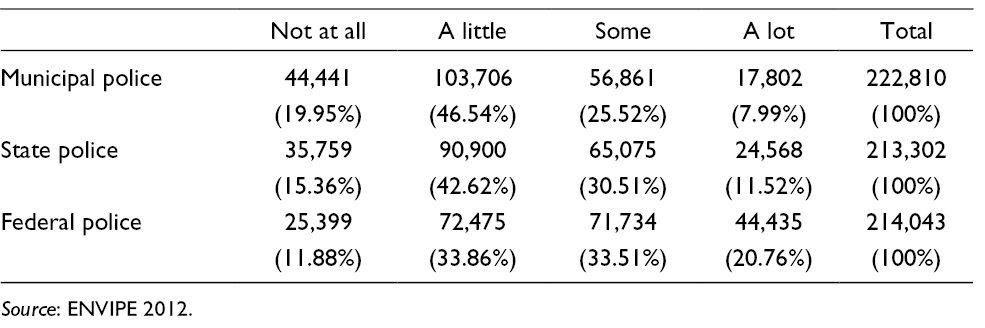
Source: ENVIPE 2012.
Perceptions of Effective Performance in Mexico’s Police Forces (2012).
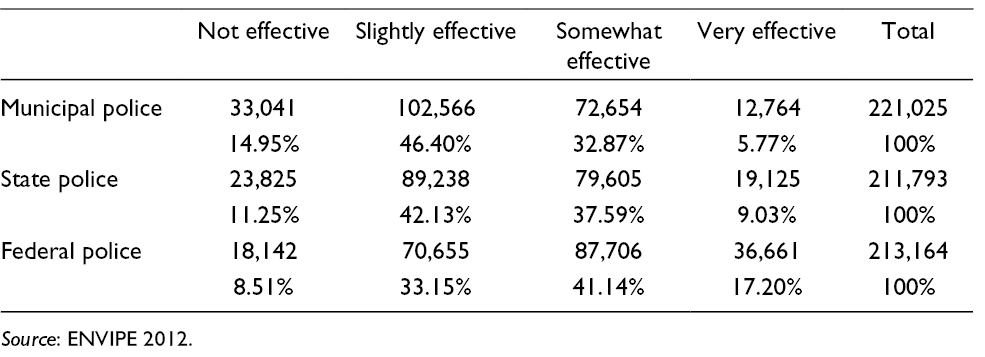
Source: ENVIPE 2012.
While these descriptive analyses provide insight into our theoretical predictions, multivariate analyses are needed in order to evaluate our hypotheses. Table 3 presents the results of multivariate analyses of trust in municipal, state, and federal police. The results provide strong support for our expectations regarding corruption and trust in the police; the findings indicate that perceptions of corruption are significant predictors of trust in all three police forces for both years analysed. The negative and significant coefficients for municipal, state, and federal forces in 2012 and 2018, respectively, suggest that corruption significantly undermines public trust in all of Mexico’s police forces. Predicted probabilities indicate that respondents who believe that Mexico’s municipal police are corrupt have only a 4 percent chance of expressing “a lot” of trust in municipal police in 2012 and only about 3 percent chance in 2018. These probabilities increase for state and federal police, but not by much. For instance, respondents who believe that Mexico’s state police are corrupt have about a 5 percent chance of expressing “a lot” of trust in the state police in 2012 and about a 4 percent chance in 2018. These same trends for the federal police stand at about 9 percent in 2012 and 6 percent in 2018. In contrast, when the police are perceived as not corrupt, respondents express much greater confidence in them. For instance, respondents have about a 20 percent chance of expressing high levels of trust in local forces in 2012 and about an 18 percent chance in 2018 when local forces are believed to be not corrupt. For state police, these trends were 26 percent in 2012 and 22 percent in 2018. Finally, respondents have about a 40 percent chance of expressing “a lot” of trust in federal police in 2012 and about a 34 percent chance in 2018 when this police force is viewed as not corrupt. Given the significant negative relationship between perceptions of corruption and public trust in Mexico’s police forces, the findings lend strong support to Hypothesis 1. The impact of corruption is more significant on the more professional forces at the state and federal police levels than on the municipal police (Figure 1).
Trust in Mexican Police Forces.
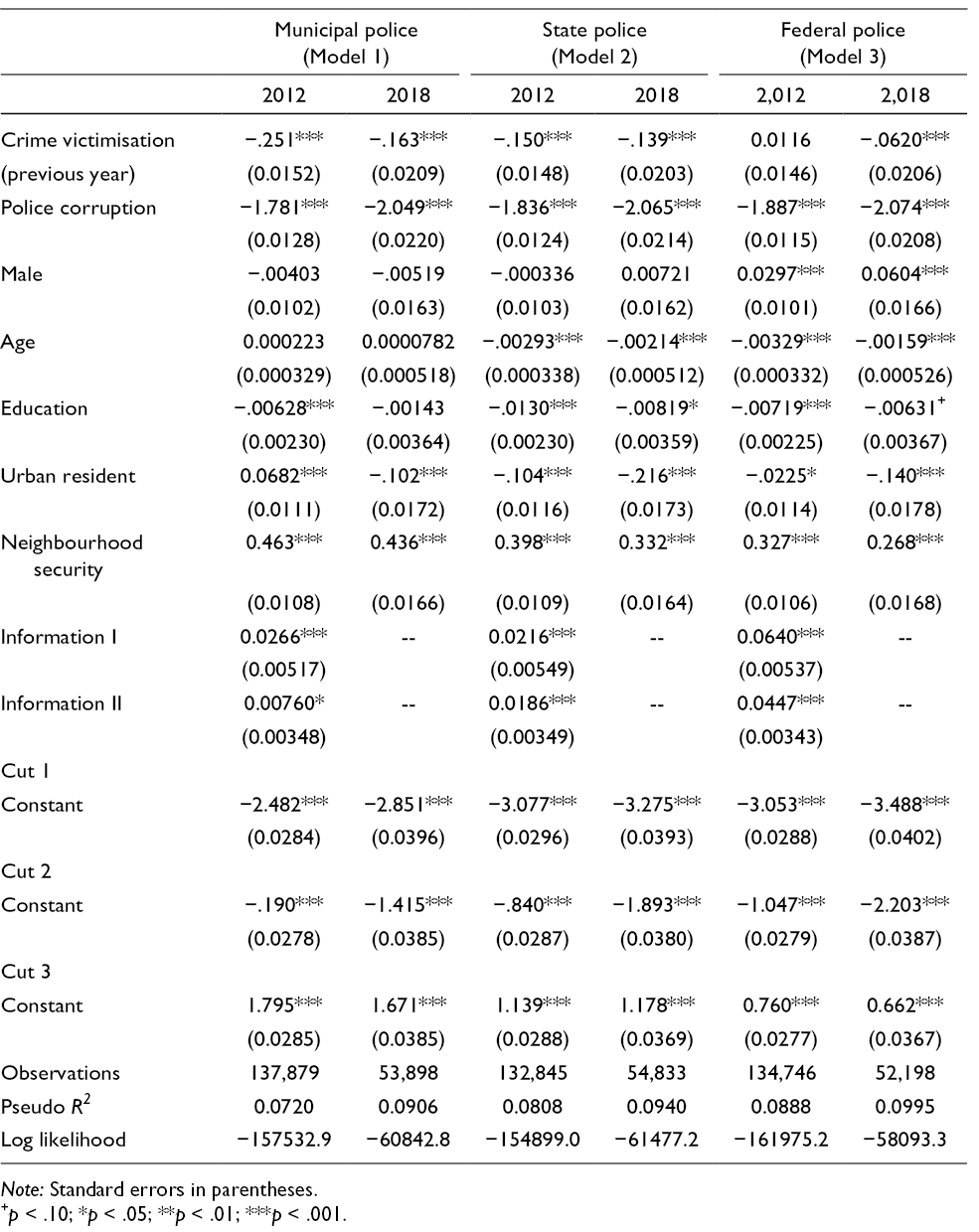
Note: Standard errors in parentheses.
+ p < .10; *p < .05; **p < .01; ***p < .001.
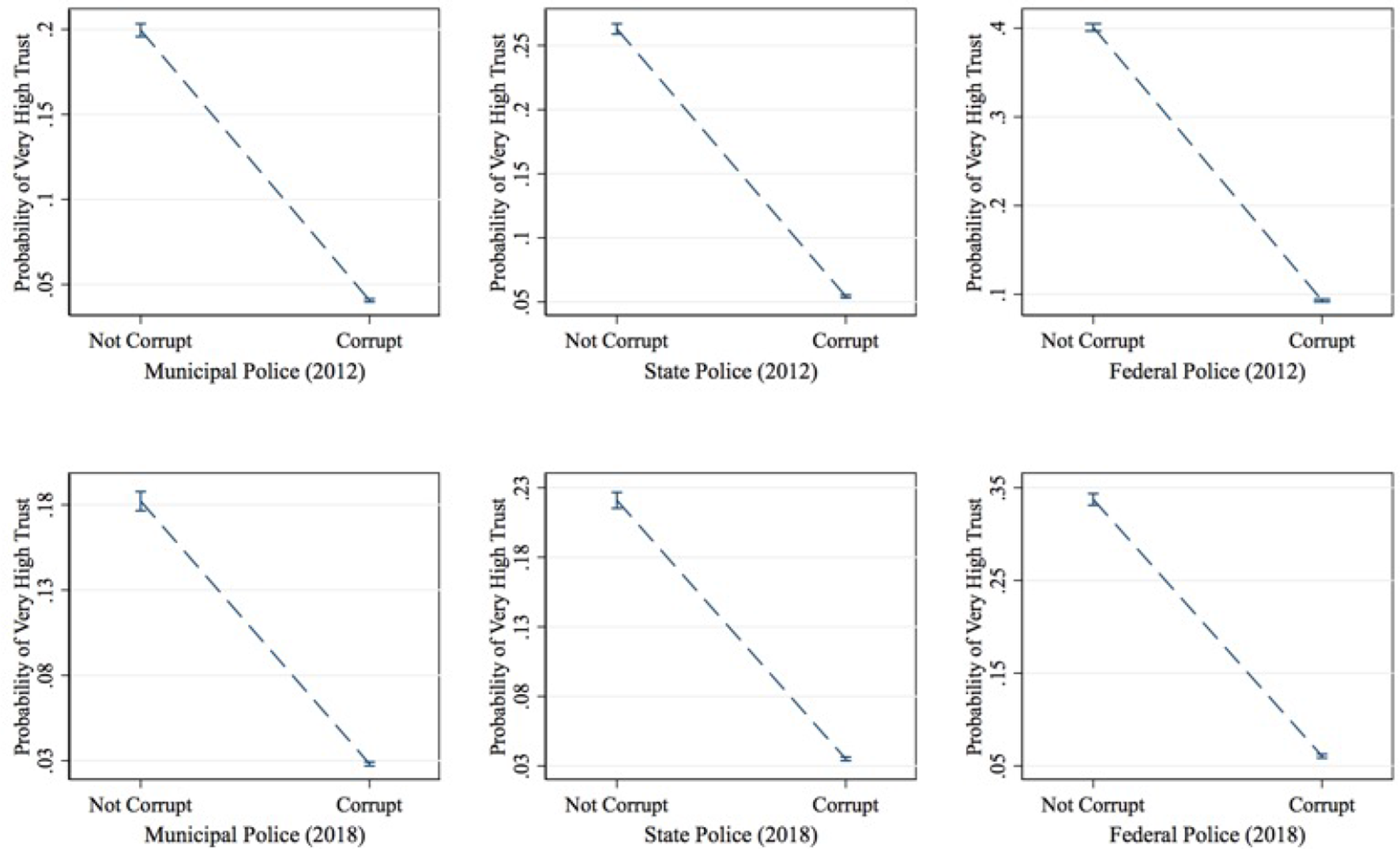
Corruption and Trust in Mexican Police Forces.
The results also show that, except for federal police in 2012, crime victimisation is an essential predictor of trust; however, the impact of crime victimisation varies depending on the level of policing. For instance, the coefficients for crime victimisation is negative and significant for municipal police and state police in both 2012 and 2018, suggesting that crime victimisation undermines public trust in municipal and state forces. The findings are mixed with federal police. In 2012, the coefficient failed to reach statistical significance and was positive, which runs counter to expectations. In 2018, the negative and significant coefficient was consistent with our expectations, suggesting that crime victims are less likely to express trust in the police. Overall, the findings lend support to Hypothesis 2. The opinion of municipal and state police seems to be undermined by reports of crime victimisation, but the impact of crime victimisation seems to attenuate as we move up the ladder of policing, from municipal to federal forces.
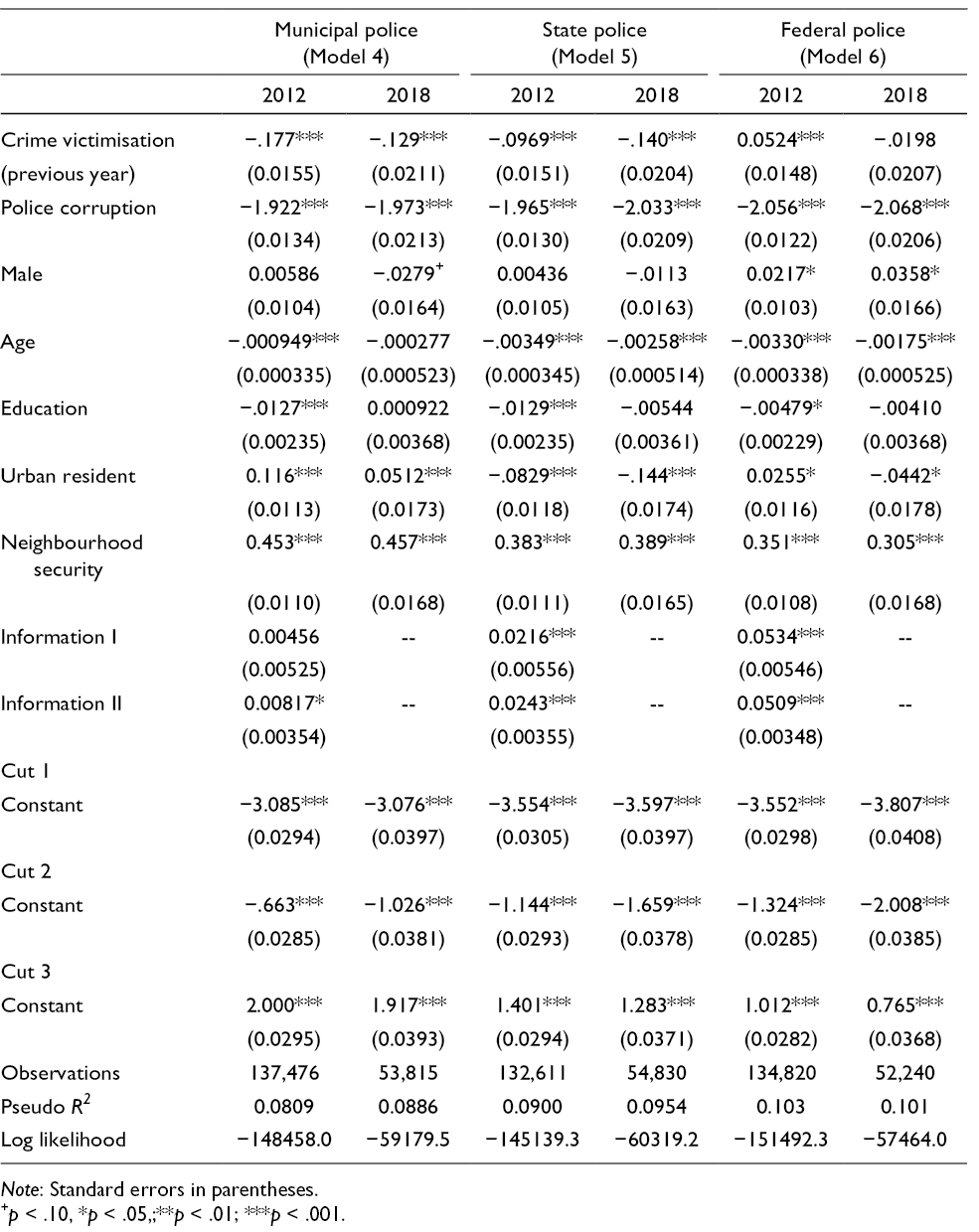
Table 4 presents the results of the analysis of perceptions of effective performance for municipal, state, and federal police. As with our analysis of trust, the results provide support for our expectations. First, the results indicate that corruption is an important predictor of public perception of police effectiveness. The negative and significant coefficients for municipal, state, and federal police suggest that corruption significantly undermines perceptions of effectiveness in Mexico’s police forces in 2012 and 2018. Substantively, respondents who believe that municipal police are corrupt have only about a 3 percent chance of believing that the municipal police are very effective. Perceptions of corruption in state police result in a 4 percent chance in 2012 and a 3 percent chance in 2018 in believing that state police are very effective. These same trends for the federal police stand at about 7 percent in 2012 and 6 percent in 2018. On the other hand, when the municipal police are viewed as not corrupt, respondents have a 15 percent chance of believing that the municipal police are very effective in 2012 and a 16 percent chance in 2018. When state police are perceived to be not corrupt, respondents have a 22 percent chance of believing they are very effective in 2012 and a 21 percent chance in 2018. Finally, respondents have about a 35 percent chance of believing that federal police are very effective in 2012 and about a 33 percent chance in 2018 when this police force is viewed as not corrupt. Overall, these findings provide strong support for Hypothesis 1 (Figure 2).
Effectiveness of Mexican Police.
Note: Standard errors in parentheses.
+ p < .10, *p < .05,;**p < .01; ***p < .001.
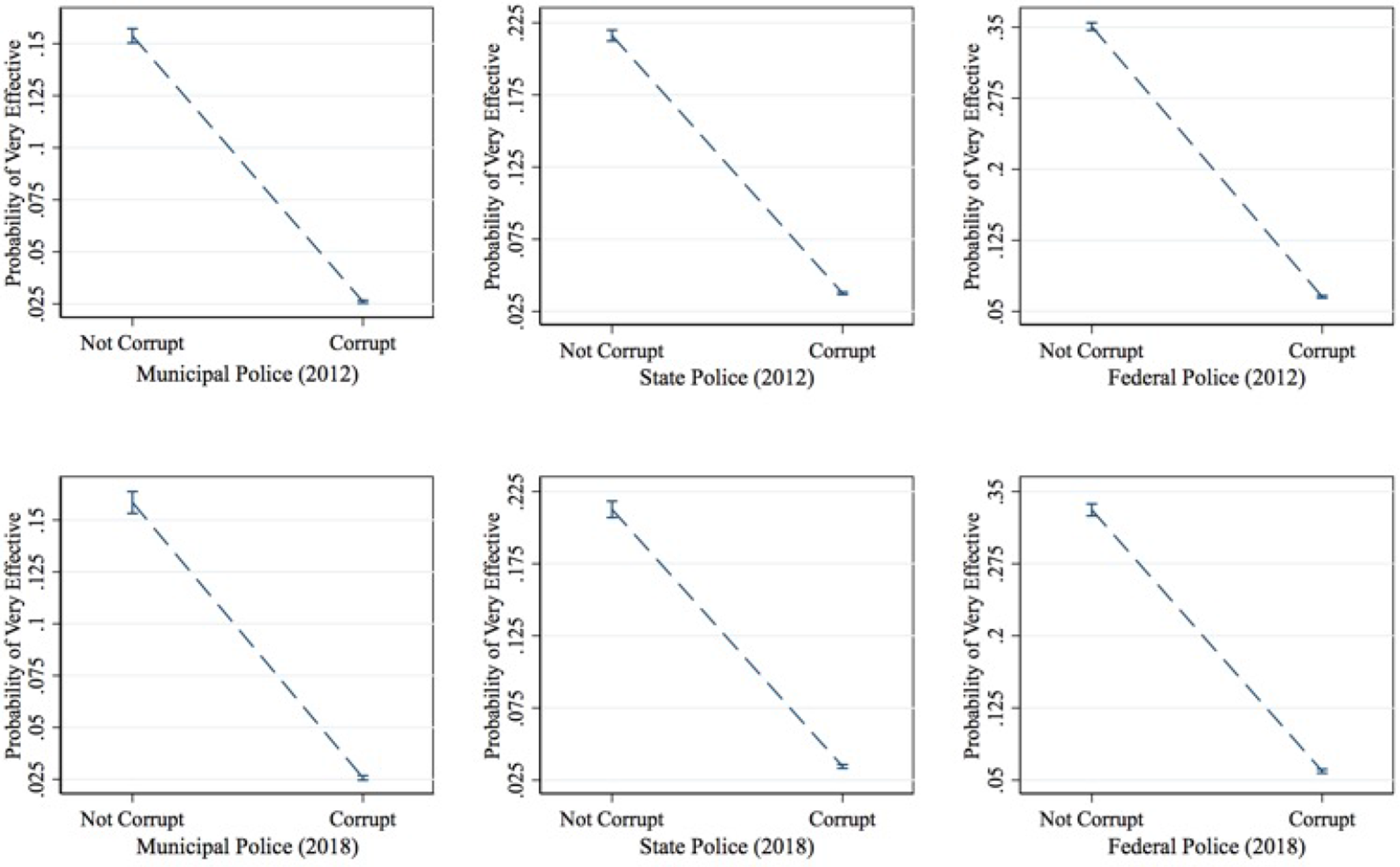
Corruption and Effectiveness in Mexican Police Forces.
Second, the results also indicate that crime victimisation is negatively associated with perceptions of effective performance for municipal and state police in 2012 and 2018, which suggests that crime victims are less likely to believe that these police forces perform effectively. However, this relationship varies for federal police from positive and significant in 2012 to negative (but not significant) in 2018. Overall, the findings lend mixed support for Hypothesis 2.
Discussion and Concluding Remarks
What are the practical implications of these findings? First, while crime victimisation has a negative relationship with the public perception of the police, perceptions of corruption seem to be much more critical. As such, any police reform initiative in Mexico should prioritise reducing corruption. One of the critical deficiencies of the Mexican police system concerning controlling corruption at all levels is the absence of oversight mechanisms. The critical internal oversight mechanism within the police is the internal one established through the hierarchical rank structure. At the local level, this is problematic because the line officers (enlisted ranks) and command-line officers (the equivalent of commissioned officers) are often blurred. Each new election of a local candidate will give rise to the rank shake-up, whereby commanders from the previous administration not loyal to the newly elected candidate are demoted, while those enlisted loyal officers are moved up in rank. This politicisation and constant rotation completely undermine the core disciplinary structure of the police. The lack of discipline often translates to a lack of accountability and, in turn, corrupt policing. Further, the lack of oversight, significant power, plus the low salaries of police produce the conditions that are ripe for corruption.
Unfortunately, external oversight bodies are rare in Mexico (Guzmán-Sánchez and Espriu-Guerra, 2014). These bodies are critical for the reduction of corruption as their independent investigative power can both remove corrupt police officers from service and dissuade other fraudulent activities. It is fundamentally important that there be more than one oversight body, increasing redundancies, and so that each oversight body can hold each other accountable. Although more civilian oversight bodies and independent monitoring bodies are being created in some major cities like Tijuana, Nogales, and Ciudad Juarez, most of the smaller 2,000 municipalities in Mexico will continue to operate without such institutions. This remains important, albeit sparingly funded, a policy that would reduce corruption and increase trust in all police forces.
Second, attempts to centralise the Mexican police are likely to be effective in attenuating the impact of crime victimisation. These policy reforms have been called Mando Unico, and it was based on the idea that a more centralised police system would facilitate better use of resources to improve training, recruitment, oversight, and the salary of officers as required in a modern police force. Although this policy initiative was born during the presidency of Felipe Calderon (2006–2012) and was at one point a campaign promise from Enrique Peña Nieto (2012–2018), it never fully materialised. The new president of Mexico, Andres Manuel Lopez Obrador has already started to implement a new type of national police, called the Guardia Nacional. The new force unified elements from the federal police and armed forces and coupled with constitutional changes that empower this force to enforce the law. This new force was created on an ad hoc basis, with little foresight as to training, development, or oversight.
The area of Mando Unico in Mexico is ripe for future study, but at the present moment, any potential study is bound to be complicated by the instability and shifting terrain in terms of policing in Mexico. One problem is related to the incompleteness of Mando Unico. Some states that have implemented this policy and others have not, and yet others have only partially centralised in allowing major municipalities to keep their police forces. Where centralisation has taken place, it is likely superficial in nature: local municipal police and their commanders were simply absorbed, without additional training, into the state police framework. Their uniforms did change and the decals on their vehicles, but not much else. In the long run, incorporating these police into a single structure will allow state trained police to percolate throughout the system and will have the intended effects. At present, it is too soon to study how ongoing police consolidation in Mexico impacts police behaviour or public perceptions of the police.
Would centralisation and professionalisation help the federal police regarding public opinion? As we discussed earlier, the reason for this is likely rooted in increased expectations that citizens placed on these more professional forces. The capacity for disappointment, once corrupt practices surface in the more professionalised bodies, can do real damage to public trust in the institutions. In short, the stakes of corruption are much higher as we move up the ladder of centralisation. This implies two things. First, as discussed above, there must be a more concerted effort to establish internal and external oversight mechanisms to reduce corruption in the aggregate. Second, this implies the importance of investing in public and media relations teams for the more professional bodies. Our findings for the 2012 analysis indicate that increased media consumption increases positive public perceptions of each institution and is statistically significant, while beyond the scope of this study, we suggest that effective police centralisation and professionalisation should be accompanied by a substantial investment in effective public relations and media campaigns. In short, if the media and public relations campaigns begin to portray the police in a better light at the same time that processes of police professionalisation occur, we assert that the police will be more effective in candidate recruitment and thus improve the general profile of the institution over time.
Looking forward, it is important to consider how to understand better public perceptions of policing. Future cross-national studies on policing should differentiate between federal and unitary police systems in their analyses as this would provide for a richer understanding of how the structural organisation of police forces changes both police behaviour and shifts in public opinion. Second, future research should also focus on understanding the historical evolution of policing, and how the process of centralisation and professionalisation tracks with changes in police behaviour, public opinion, and efficacy. Third, we suggest the need to explore the impact of police abuse and human rights abuses on perceptions of the police. Given that interview experiences with other projects on policing Mexico have highlighted the pervasiveness of physical abuse by police (Human Rights Watch, 2019), we are interested in the ways in which structural and institutional variables mitigate the likelihood of experiences of abuse. Lastly, given that some scholars have noted that police protection of criminals undermines trust in governments (Solar, 2015), we believe that future research should focus on parsing out how different experiences of corruption and different types of police victimisation might change perceptions of the police.
Footnotes
Acknowledgements
This is to acknowledge that there are no financial interests or benefits that have arisen from the direct applications of our research.
Data Availability Statement
The data that support the findings of this study are openly available at: 1) Nacional de Victimización y Percepción sobre Seguridad Pública (ENVIPE); 2) https://www.inegi.org.mx/programas/envipe/2018/; and 3) Censo Nacional de Gobiernos Municipales y Delegacionales: 
Declaration of Conflicting Interests
The author(s) declared no potential conflicts of interest with respect to the research, authorship, and/or publication of this article.
Funding
The author(s) received no financial support for the research, authorship, and/or publication of this article.
Author Biographies
E-mail: