



Abstract
Between 2005 and 2015, organized criminal groups murdered 209 politicians in Mexico. This paper explains why. It argues that the two interwoven trends of political and criminal pluralization in Mexico fostered the conditions for a new type of criminal violence against politicians. Mexican politicians are now targeted for accepting illicit money as well as for standing up to criminals. Moreover, this violence is evidence of an alarming and persistent pattern in Mexico of politicians enlisting criminal organizations to eliminate their political competition. Using a zero-inflated negative binomial model, this paper shows there is a strong statistical relationship between the increase in assassinations and the increases in political pluralization and criminal fragmentation. The article concludes that the failure to protect local public officials creates greater opportunities for the emergence of subnational authoritarian enclaves and threatens democratic consolidation.
Introduction
When Servando Gómez Martínez was arrested on 27 February 2015, a former head of Mexican intelligence stated that the Caballeros Templarios (Knights Templar) kingpin had used the “‘law of lead or silver’ against Michoacán's politicians” (The Economist 2015). The “law of lead or silver,” more commonly referred to in Spanish as plata o plomo, was coined by the infamous Colombian drug lord Pablo Escobar to describe his approach to dealing with public officials. In essence, organized crime wields two main means of influencing the state: corruption and coercion. These two approaches seem mutually exclusive as politicians can either accept illicit money and cooperate or risk assassination. It has been argued that Mexico's democratization and increased electoral competition have compounded the potential for illicit money in campaigns (Curzio 2000, 2013; Velasco 2005; Morris 2009; Casas-Zamora 2010, 2013). Yet, if there is more money flowing from the cartels to the politicians, it seems surprising that an unprecedented number of them are being assassinated – 209 between 2005 and 2015. Moreover, organized crime is not new to Mexico and existed peacefully for years under the hegemonic Partido Revolucionario Institucional (PRI). What caused this shift toward violence?
This paper 1 argues that the two interwoven trends of political pluralization and criminal fragmentation in Mexico fostered the conditions for a new type of criminal violence against political figures. I argue that assassinations are far more likely in states with higher levels of criminal pluralization. This is because when criminal syndicates fragment, even cooperating politicians are at risk of getting caught in the midst of intracartel battles or being targeted by a rival. At the same time, heightened electoral competition and rising support for opposition parties increases the chances of politicians being compelled to accept illicit money, which makes them more susceptible to attacks by fragmenting criminal organizations. Increased political competition also guarantees that stable agreements between politicians and narcos, such as the ones that existed under PRI hegemony, are not possible. Finally, increased electoral competition offers politicians with the incentive to employ more desperate means to suppress their opponents. In this regard, the violence against politicians is also evidence of an alarming and persistent pattern of Mexican politicians enlisting criminal organizations to carry out their dirty work.
For their feedback on previous drafts, I would like to thank Taylor Boas, David Scott Palmer, Pilar Giannini, Erin Huebert, Karla León, and two anonymous reviewers, as well as the panelists and audience members from the 2015 panel “Mexican Politics” at the New England Council of Latin American Studies and the 2016 Junior Scholar Symposium “Corruption and Crime in Latin America” at the Midwest Political Science Association.
This paper begins by examining the historical context of state– criminal dynamics in Mexico and reviewing the relevant literature on this topic. Next, I outline the methods and datasets used to empirically test my predictions. Then, I present results from an original dataset of Mexican political figures murdered between 2005 and 2015 (N = 209). Combining this data with two measures of criminal pluralization and data on the electoral success of opposition parties, I use a zero-inflated negative binomial model to test the relationship between criminal fragmentation and political pluralization, on the one hand, and the assassinations of politicians at the state level (N = 310), on the other hand. Confirming my theoretical expectations, I find strong statistical evidence that both criminal fragmentation and political pluralization increase the number of political assassinations. Building on Trejo and Ley's (2016) theory about the importance of copartisanship and the targeting of leftist politicians by the Partido de Acción Nacional (PAN), I find evidence that the leftist Partido Revoluationario Democratica (PRD) is being disproportionately targeted and that this trend has increased under the PRI administration of Enrique Peña Nieto. I show how the targeting of politicians from the PRD (which has a history of being the target of political assassinations) is merely one of several persistent patterns unfolding in Mexico (Schatz 2006, 2008). Moreover, I find that criminal groups that emerged under PRI hegemony are less likely to assassinate politicians compared to their newer counterparts. I argue that the most likely explanation for this is both (i) the legacy of ties between these criminal organizations and the political elite and (ii) the fact that these cartels rose to prominence under the informally institutionalized “old rules of the game” that governed state–criminal interactions for decades.
In discussing the empirical results, I use cases of recent assassinations to highlight the three main reasons politicians are currently being killed: (1) accepting illicit money from a criminal organization and becoming a target for rivals and/or getting caught in the middle of intracartel fighting; (2) refusing to cooperate with criminal organizations; (3) having a political opponent with narco-connections. I conclude by discussing the implications for democratization and the risks posed by the growing threat of subnational authoritarian narco-enclaves.
Nicknamed the “perfect dictatorship,” the PRI ruled Mexico for 71 years. The party's hegemonic control and longevity was largely attributable to its ability to mollify political opposition through incorporating key social groups (e.g., business, labor, and peasants) into the party's structure (Magaloni 2008; Collier 1992). During the first phase of licit labor incorporation in Mexico, the United States was experimenting with prohibition, which spurred the expansion of nascent illicit networks across the US–Mexico border. Leaving control of this bourgeoning criminal sector solely in the hands of local strongmen could have posed a threat to PRI hegemony, so the PRI incorporated the narcos just as they did legitimate business. It was not that narcos infiltrated the state institutions; rather a system of top-down control over the criminal industry was established (Shirk and Wallman 2015; Flores Pérez 2009).
In fact, the PRI's centralized control over the illicit industry mirrored the party's top-down control or “authoritarian corporatism” over legal business (Velasco 2005). This control allowed the PRI to get their cut of the illicit profits and it also enabled them to keep narcos from behaving in politically unpopular ways, which kept violence relatively low (Rios 2012; Osorio 2013; Snyder and Duran-Martinez 2009). In exchange for compliance, narcos could purchase licenses from local officials enabling them to carry out their business (Lupsha 1991: 179). They also would report noncompliant criminal syndicates to authorities, making arrests easy for law enforcement and concurrently eliminating their market competition (Lupsha 1991: 182). Given its symbiotic nature, this narco-corporatist arrangement would prove stable for decades (Lupsha 1991: 182; Osorio 2013; Snyder and Duran-Martinez 2009).
In 1968 the PRI showed its first signs of weakness when it failed to use cooptation and resorted to brutally repressing student protests. The Tlatelolco massacre hurt the legitimacy of the PRI and was the beginning of a period of increased repression. Subsequently, the PRI increasingly targeted political dissidents and “in those days it was more dangerous to be a guerilla, or a political dissident than a drug trafficker” (Hernández 2013: 64). Moreover, by some accounts, it seems that political repression and collusion with the narco-industry were inherently interwoven phenomenon. For instance, Reuter and Ronfeldt (1992: 14) claim that
the DFS [Dirección Federal de Seguridad] resorted to using local drug producers and traffickers as operatives, exchanging tolerance of their criminal activities for assistance with paramilitary operations.
Thus, starting in the 1970s, the narcos not only paid their dues to the party, they also became the party's unofficial agents to suppress the opposition.
Throughout the 1980s and 1990s, numerous factors contributed to the demise of the narco-corporatist system. The first was the torture and murder of Drug Enforcement Agency (DEA) agent Enrique “Kiki” Camarena by the Guadalajara cartel. In the aftermath of the Camarena affair, Mexico's Federal Security Directorate (DFS) was dissolved. This was significant because since its formation in 1947, the DFS had been the main intermediary between the PRI party and the narcos (Osorio 2013: 214; Lupsha 1991: 180; Astroga 2000: 79). Following the dissolution of the DFS, the PRI lost its main oversight and control mechanism for the illicit industry (Osorio 2013: 243). The fallout from the Camarena affair also started a revolving door between former state agents and criminal enterprises that contributed to the militarization of the criminal organizations (Osorio 2013: 242).
In addition to growing more politically autonomous and beginning to acquire their own means of enforcement, the narcos were also seeing increased profits due to US crackdowns on Colombian traffickers and the rising demand for cocaine (Hyland 2011; Reuter and Ronfeldt 1992: 2). Criminal profits continued to grow, getting another boost with the passage of the North Atlantic Free Trade Agreement (NAFTA) in 1994 (Shelley 2001: 217). Yet, as profits increased, so did the competition. Another result of the Camarena affair was the arrests of Rafael Caro Quintero, Ernesto Fonseca Carillo, and Miguel Ángel Félix Gallardo (“El Padrino”) and the subsequent breakup of the Guadalajara cartel. Where there had been two primary cartels (the Gulf and Guadalajara cartels), there were now four key organizations in the criminal world (the Gulf, Sinaloa, Tijuana, and Juarez cartels).
At the same time, Mexico was undergoing a period of market liberalization. In 1982, in the wake of Mexico's debt default, the country entered into a period of serious market and economic reform. There were extensive efforts to privatize state-owned enterprises, which saw the number of state-owned firms decrease from 1,155 to a mere 226 between 1982 and 1993. However, these reforms had unintended consequences, as families with fortunes made in the illicit sectors “were able to acquire formerly state-owned businesses, allowing them to mingle criminal money with the legitimate economy” (Shelley 2001: 218). In addition, links grew between the banking industry and traffickers (and still exist today), which were essential for facilitating money laundering (Hernández 2013: 111–112; Aristegui Noticias 2016). Overall, market liberalization fostered an environment in which the rising financial elites interconnected with the narco-elites, who were simultaneously gaining increased power and autonomy.
Meanwhile, the PRI was facing increased competition from opposition parties, especially at the lower levels of government. With rising electoral competition, there was more of a need for money – even illicit money – to pay for campaigns (Morris 2009; Casas-Zamora 2010; Casas-Zamora 2013). This coincided with and furthered the fundamental shift in the norms of interaction between the state and criminal organizations that was taking place (Hernández 2013: 93). The shift was from the system of political control to one characterized by significantly higher levels of drug-money in politics: “No more ‘paying taxes’: now you had to offer hefty bribes, enough to make the fortunes of politicians and businessmen overnight” (Hernández 2013: 93). As the cartels gained autonomy and capitalized on the new liberalized economic policies, the political–criminal dynamic in Mexico began to resemble a form of marketized corruption.
Concurrently, there was also a greater need to appear to be working against cartels as democratization drew more attention to corruption (Morris 2009). As its power declined, the PRI resorted to more desperate means of maintaining control. Schatz (2006, 2008) documents the party's campaign of political assassinations against the leftist PRD, murders that were often carried out with hired guns. Although the PRI lost its monopoly on power at the state level (starting with the governorship in Baja California in 1989 and ending with the presidency in 2000, which was won by Vicente Fox of the Partido de Acción Nacional [PAN]), the PRI remained the only game in town in many municipalities. Thus, the PRI was able to maintain subnational enclaves of autocratic control within the context of federal democracy (Gibson 2010, 2013).
In sum, the PRI incorporated the narco-industry the same way it incorporated legal business. Narco-corporatism allowed the illicit sector to grow with low levels of violence. However, in the 1980s and 1990s, the dynamics of state–criminal interaction shifted toward a more individualistic pattern of marketized corruption, paralleling the broader political and economic shifts that were occurring in the country. This shift to marketized corruption is a necessary antecedent factor in the explanation of why criminals are now targeting politicians. Lastly, the symbiotic nature of the relationship between the PRI and the narcos under narco-corporatism also established a historical precedent for criminal syndicates being hired to target the political opposition – a pattern that is unfortunately continuing today.
This paper builds upon the existing theories of why narco-related violence dramatically increased in Mexico during the middle of the first decade of the twenty-first century. Democratization and decentralization in Mexico resulted in the deterioration of government-sponsored protection rackets (Snyder and Duran-Martinez 2009), generated new coordination problems between layers of government (Rios 2015; Duran-Martinez 2015; Shirk and Wallman 2015), and ultimately led to the collapse of the former political order (Rios 2012, 2015; Osorio 2013). My argument about the implications of political pluralization complements these theories of violence in Mexico and extends them to a specific form of narco-violence, the targeting of elected officials.
Narco-assassinations of politicians are arguably the most direct way that criminal organizations can undermine democratic processes; they have blatant consequences for democratic governance. Schedler (2014) discusses the threat posed by “candidate cleansing” in his examination of the impact criminal violence has on Mexico's democracy. However, there has been relatively limited scholarly attention to the recent increase in narco-related assassinations of Mexican politicians. Rios (2011) looks at 29 cases of mayoral assassination and claims that the practice of plata o plomo does not apply to the Mexican case. She argues that decentralization has made municipal politicians relevant to traffickers and thus put them at risk of being “punished” despite the fact that mayors are still unable to actually control enforcement, which can be sent from higher levels (Rios 2011). In addition to the impacts of decentralization, Rios (2011) notes that the cartels’ expansion into the domestic drug market has made local politicians all the more valuable to the cartels. In contrast, I do not find evidence for the idea that larger local drug markets increase the rate at which politicians are targeted.
Trejo and Ley (2015) look at politicians who were threatened, kidnapped, attacked, and killed between 1995 and 2014. They contend that there are three main factors that make politicians likelier targets: they come from (i) municipalities that have higher levels of intracartel violence associated with controlling trafficking routes, (ii) municipalities that have more fiscal autonomy and increased tax revenue, or (iii) leftist opposition–led municipalities where the central government does not offer protection to officials who have been threatened by organized crime (Trejo and Ley 2015). Expanding on this, Trejo and Ley (2016) challenge the dominant narrative that coordination problems contributed to increased narco-violence in Mexico under President Calderón (Duran-Martinez 2015; Snyder and Duran-Martinez 2009; Osorio 2013; Rios 2012; Rios 2015). They explore the relationship between copartisans and levels of violence and argue that,
Mexican national authorities developed coordinated interventions in subnational regions under the control of the president's conservative party but adopted confrontational strategies in states ruled by leftist subnational authorities, who belonged to the party that persistently denied the president's legitimacy as an elected authority. (Trejo and Ley 2016: 12)
This suggests that the contested 2006 presidential elections renewed the systematic targeting of PRD politicians, which Schatz (2006, 2008) notes has a long history in Mexico.
I find evidence for Ley and Trejo's theory about copartisanship, but this does not mean that merely restoring one-party control or consistency in politicians’ party affiliations at various levels would reduce violence and reestablish the prior order (Shirk and Wallman 2015). The parties have taken different policy stances toward organized crime; therefore, consistent control by the PAN may have very different implications than those produced by consistent control by the PRI. Dell (2015) shows that violence increases in municipalities following close victories by PAN candidates. Her explanation for this phenomenon is that PAN coordination increases the probability of government enforcement in those areas, thus weakening incumbent cartels and inviting rival competition.
This paper seeks to build on these previous works by utilizing new data and methods to further academic understanding of the motivations behind the assassinations of politicians in Mexico. While Rios focused solely on the assassinations of mayors (Rios 2011), it seemed appropriate to extend that scope and include officials at all levels of government, ranging from local council members to national party leaders. Unlike some studies (Guerrero-Gutiérrez 2011: 45), my dataset excludes officials who were part of law enforcement. The reasoning for this is simple: cartels have a more obvious reason to target law enforcement officials who are working (or at least supposed to be working) in direct conflict with the cartels’ objectives. As a result, it is argued that the murder of a police chief has different motivations and implications than the murder of a mayor, councilmember, or campaign manager. Lastly, I chose to limit my data to the most extreme form of narco-violence: assassination. This decision was made based on the feasibility of obtaining reliable data, as threats and attacks are far more subject to underreporting.
Theoretically building on Rios’ work on why cartels “punish” politicians, I argue that one motivation for cartels is a result of criminal pluralization: new cartels move into a territory, or an old alliance fractures, and the politician is caught in the middle of the resulting narco-conflict. This explains why corruption and coercion cannot be seen as mutually exclusive tactics in Mexico. In fact, they are self-reinforcing, and political pluralization only increases the risk of narco-money in politics (Casas-Zamora 2013). As Morris states, when the stakes are higher and the competition greater, there is also “the greater likelihood of employing illegal campaign contributions” (Morris 2009: 29). While Mexico has taken efforts to tighten campaign finance regulations, these efforts have been limited to national politics. Furthermore, there is enormous regional disparity in terms of compliance with election finance rules (Curzio 2013: 158), while criminal organizations have been able to achieve significant influence at the local level (Manaut 2013: 156). Yet, this motivation for criminals to assassinate politicians only explains those who are intentionally or accidently complicit with the cartels. As Trejo and Ley (2015: 2) point out, “Sería un error, también, olvidar a los alcaldes y candidatos asesinados por negarse a servir al crimen organizado” (It would be a mistake, too, to forget the mayors and candidates killed for refusing to serve organized crime). Thus, failing to comply with cartels or taking a strong stance against them is the second key motivation for cartels killing politicians.
Both of these motivations (cooperating with criminals and refusing to cooperate) are “new” in the sense that before the shift from narco-corporatism to marketized corruption, neither would have occurred. However, the third motivation I highlight (politicians using criminal groups to kill opponents) has a historical legacy. A theme in the literature on Latin American politics is persistent patterns. Democratization increased cartels’ opportunities to become involved in politics and generated “new” forms of corruption while simultaneously allowing old forms of corruption to persist (Morris 2009; Velasco 2005). Similarly, political pluralization and criminal fragmentation have generated new forms of violence against politicians, while old forms also have endured and reinvented themselves.
Data and Methods
To test the relationship between pluralization and the assassination of politicians, I first collated a dataset on all assassinations of political figures in Mexico between 2005 and 2015. The dataset collated names, dates, current and/or former political positions, locations, party affiliations, and brief synopses of the attacks. If the politician was “disappeared” and the body was not found, the case was only included in the dataset if the politician was widely presumed dead, had been missing for over a year, and was reported to have been kidnapped (i.e., there was no chance he merely ran off). To verify that the list was comprehensive, several Mexican and international news sources were monitored on a regular basis, and numerous LexisNexis and Google queries were run in both English and Spanish. Next, I utilized this data to construct a panel dataset where the unit of analysis is state-years. This dataset includes the number of assassinations, measures of political and criminal pluralization, and numerous control variables. This dataset contains data from the period 2005–2015 and includes all states except for the Federal District (N = 341).
Political pluralization is operationalized as the share of votes for opposition parties in the most recent municipal elections – that is, the percent of the vote lost by the incumbent governor's party. For example, if the state has a PRI governor and in the last municipal elections the PRI won 40 percent of the vote, then the political pluralization score would be 60 percent. This operationalization is based on the theoretical expectation that differences in party affiliation generate coordination problems across the layers of government, undermining pacts between politicians and criminals. It is also based on the idea that rising electoral competition generates incentives to accept narco-money or even to use narcos to target one's opponents. Given that the majority of the violence is concentrated at the lower levels of government (municipal and state), it was assumed that growing fragmentation mattered the most at these levels as opposed to disconnects between federal and state or federal and local governments. Finally, the measure of political pluralization is lagged because of theoretical expectations about the direction of causality, due to the fact that Mexican states hold elections at different times of the year, and to avoid the risk of endogeneity. Due to this being a lagged variable, N is reduced to 310 in all the statistical models.
This paper uses two measures of criminal fragmentation: the total number of cartels operating in a state (“TotalCartels”) and a dummy variable indicating the removal of prominent cartel leaders due to arrest, extradition, or death (“Kingpin”). These two variables were coded using data from Animal Político's new resource NarcoData and information from Insight Crime reports. Prior research has demonstrated that the removal of a criminal syndicate's leader increases violence because it becomes more susceptible to intracartel leadership battles and splintering, on the one hand, and attacks from rivals hoping to exploit their moment of weakness, on the other (Dickenson 2014; Philips 2015; Calderón et al. 2015). The total number of criminal organizations is also important since the more groups there are, the more competitive the criminal environment will be, and the greater the risk of violence will be.
Due to allegations of collusion between the PAN and Sinaloa cartel (Hernández 2013; Shelley 2001), I controlled for states where the Sinaloa cartel operates and where the PAN controlled the governorship or the majority of the municipal governments to see if there were lower numbers of assassinations in these states. In addition, I controlled for the homicide rate (y), the per capita rate of state income from taxes (INEGI), whether there were elections at the state or local level, whether there was a federal level crackdown on organized crime in the state (NarcoData), the total number of agents per capita from the Ministerio Público, and – to measure states’ internal drug markets – arrests for possession of narcotics (PGR 2015). I also controlled for the number of municipalities in a state, since states with more municipalities simply have more politicians who could potentially be targets. In addition, all models included year fixed effects and standard errors were clustered by state. Finally, to explore the impacts of having begun operations under the old rules of narco-corporatism, I test for differences between the cartels that emerged prior to the early 1990s and those that emerged in recent years.
For all the models, the outcome of interest is the number of assassinations in a state during a given year. As the summary statistics in Table 1 show, the variance and standard deviation of the number of assassinations is greater than the mean. This suggests a Poisson model would not be a good choice. However, negative binomial models are appropriate for count variables with overdispersion. Zero-inflated models are often appropriate when there are excessive zeros. Out of 341 state-year pairs, 240 are zeros. That means 70.38 percent of the total dataset is a nonevent outcome. More important than the number of zeros in the data is the fact that the assumptions about the data-generating process are slightly different for the two models. While the standard negative binomial model assumes that all units of observation have the potential for a positive count outcome, this may be a specious assumption. In some cases the number of assassinations is almost certain to be zero. In essence, there are two processes happening: a first process that distinguishes between certain zeros and potential events and a second process that calculates the expected number of assassinations in each of the remaining state-years. The zero-inflated model reflects this process since it actually comprises a logit model to determine certain zeros and a negative binomial model to estimate the counts. Here the independent variables for the logit model are the total number of cartels in the state, a dummy for whether the governor and president are from the same party, and another dummy for whether the majority of the municipal governments are of the same party as the governor. The total number of cartels is included since if there are no cartels operating in the state, there should not be any politician–narco interaction; thus, these cases would almost certainly be zero outcomes. The two aforementioned dummy variables are based on Trejo and Ley's (2015, 2016) findings regarding the importance of copartisanship.
Summary Statistics
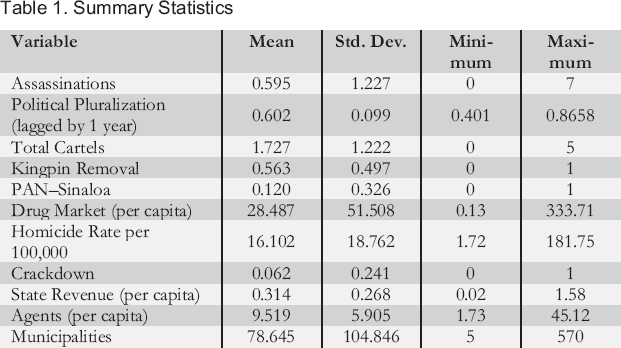
Summary Statistics
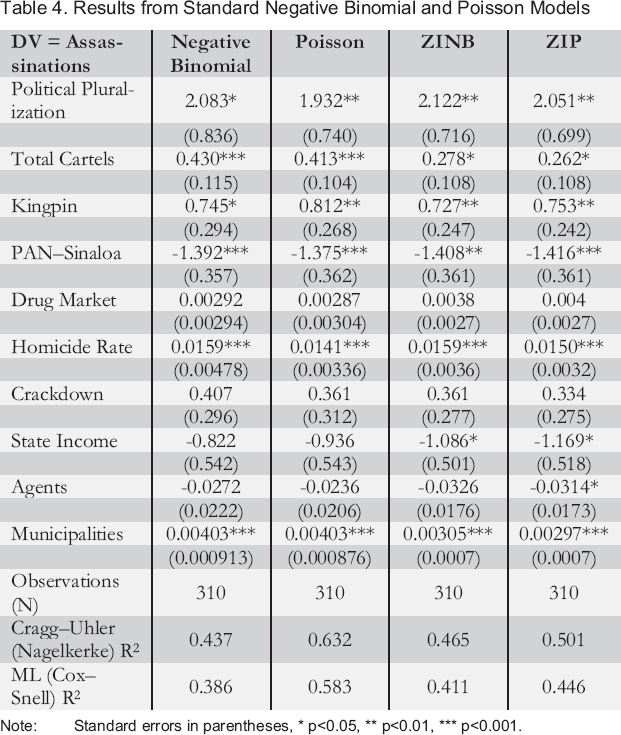
For robustness checks, I ran a zero-inflated Poisson as well as a standard negative binomial model and standard Poisson model (results from these last two models are included in the appendix). I used the likelihood ratio test of alpha equals zero to see if the negative binomial model was superior to the Poisson distribution and found it was (p = 0.009). I then used the Vuong test to see if the zero-inflated negative binomial model was a statistically significantly better fit than the standard binomial model and found that it was (p = 0.033). However, with the zero-inflated models, it seems the negative binomial model is not necessarily better than the zero-inflated Poisson model given that the likelihood ratio test of alpha equals zero was not statistically significant (p = 0.11). That said, due to the overdispersion in the data, I maintain that the negative binomial model offers the best approximation. Figure 4 (appendix) demonstrates that the zero-inflated Poisson model is more likely to underpredict zero counts and overpredict counts of one compared to the zero-inflated negative binomial model.
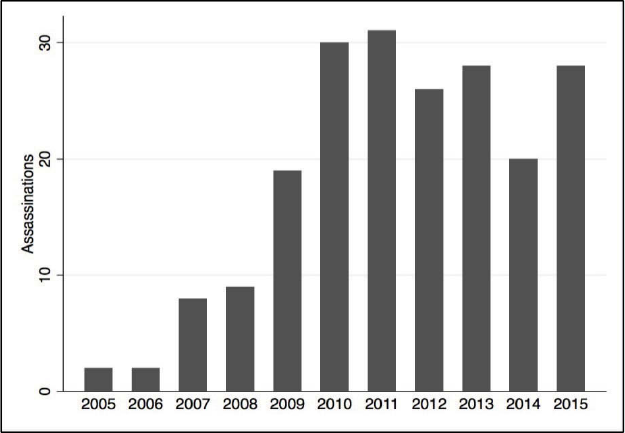
Assassinations by Year, 2005–2015
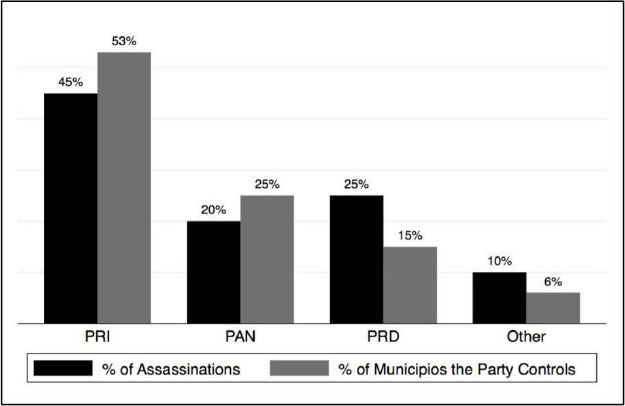
Assassinations by Partisanship Compared to Party Strength
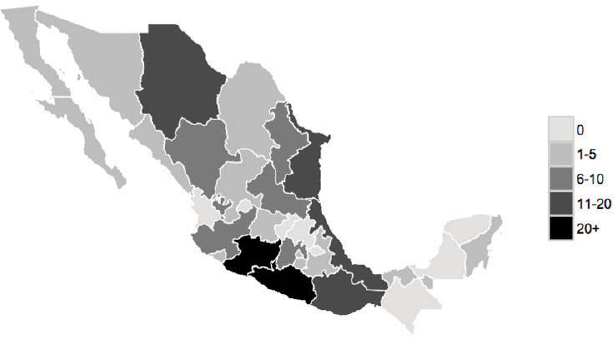
Geographical Distribution of Assassinations, 2005–2015
Between 2005 and 2015 in Mexico, 209 political figures were assassinated. In both 2005 and 2006, 2 politicians were murdered; by 2010, this number had jumped to 30.
In 83 percent of the cases the victims were municipal-level politicians. Of the total politicians assassinated, 88 were members of the PRI, 39 were members of the PAN, 49 were members of the PRD, 19 were members of other parties, and 14 did not report any party affiliation (6 percent). However, these numbers are fairly misleading since they do not account for the parties’ relative strengths at the municipal level. Despite the democratic opening at the national level, at the municipal level the PRI is still the dominant party; therefore, there are simply more PRI politicians to potentially be killed. Therefore, controlling for municipal-level party strength is important when exploring different patterns of targeting politicians based on their partisan affiliation. As illustrated in figure 2, when accounting for the share of municipalities under various parties’ control, a different picture emerges.
Although past literature emphasizes the Calderón administration's targeting of opposition politicians (Trejo and Ley 2015, 2016), I find that co-partisanship has become even more significant in determining who is assassinated under the current administration of President Enrique Peña Nieto (PRI). Under Peña Nieto, the assassination rates of PRD politicians in municipalities under PRI control have increased from 1.48 to 2.14; of PAN politicians (now in the opposition), from 0.66 to 1.15. In contrast, the targeting of PRI politicians has decreased by 0.38 and the targeting of other parties has also decreased by 0.21.
The disproportionate targeting of PRD members for political reasons has historical roots (Schatz 2006, 2008). Nevertheless, even if the PRD appear to be disproportionately targeted due to political motivations, this does not mean that narcos are not the ones carrying out the murders. The descriptions of nearly all of the murders followed certain patterns that are characteristic of organized crime. Thus, if the motivation is political, the executioners still appear to be criminals, likely hired guns for corrupt politicians.
The disproportionate targeting of the PRD also helps explain the geography of where the most politicians are murdered. As figure 3 demonstrates, the states with the highest number of murders are Michoacán and Guerrero. The southern part of Mexico has always been a region with higher levels of support for the leftist party. Moreover, there are clear socioeconomic divides between regions of Mexico, with Guerrero, Oaxaca, and Chiapas being the poorest states and neighboring Michoacán and Puebla also falling below the national average. Besides sociodemographic and partisan differences, Michoacán and Guerrero have some of the highest levels of criminal pluralization. Michoacán is where the Zetas first began establishing their autonomy from the Gulf cartel after La Familia Michoacana (LFM) publically declared war on the Zetas by infamously rolling decapitated heads onto the floor of a nightclub in Uruapan (Grayson 2010). In addition, Michoacán was the state where the autodefensas (self-defense groups, commonly considered to be vigilantes) emerged. At least one of the assassinated politicians was known to have ties to autodefensas.
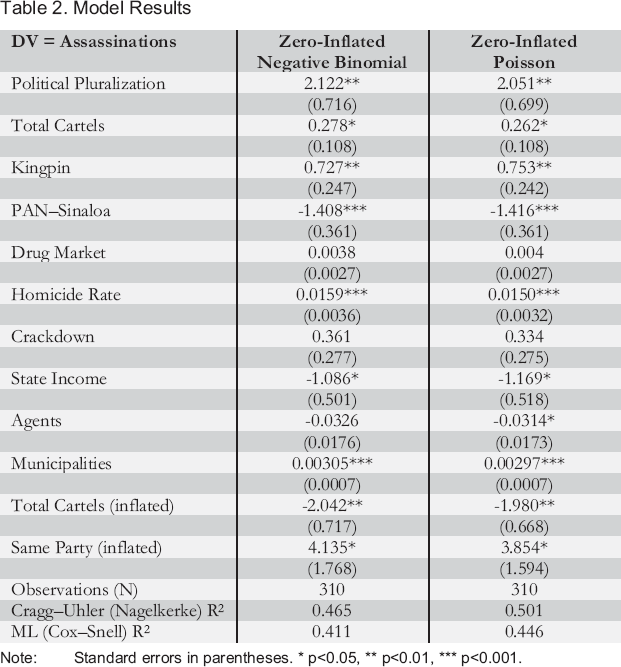
The importance of both criminal fragmentation and political pluralization are confirmed by the statistical analysis. Table 2 presents results from both the zero-inflated negative binomial and Poisson models. (The results from the standard negative binomial and Poisson model specifications are presented in Table 4 in the appendix, as are the predictive margins with confidence intervals for the three main variables of interest in figures 5, 6, and 7.)
Model Results
Model Results
Note: Standard errors in parentheses.
p<0.05,
p<0.01,
p<0.001.
Impact of Whether Criminals Emerged under New Rules versus Old Rules
Note: Standard errors in parentheses;
p<0.10,
p<0.05,
p<0.01,
p<0.001.
The results show that there are positive and statistically significant relationships between the number of assassinated politicians and both political pluralization and criminal fragmentation. These results were consistent regardless of model specification (see appendix), and both measures of criminal fragmentation (i.e., the total number of cartels and the removal of a kingpin) were positive and statistically significant predictors of assassinations. In terms of the magnitude of these results, increasing the opposition parties’ electoral support from 0 percent to 100 percent (holding everything else constant) would lead to an expected 8.35 increase in the assassination rate. Looking at the average marginal effects, increasing the share of votes for opposition parties (parties other than the current governor's party) from 50 percent to 80 percent increases the expected number of assassinations from 0.486 to 1.082. A one-unit increase in the number of criminal organizations present in a state results in an expected increase of 1.320 in the assassination rate, all else being equal. The average marginal effects suggest that increasing the number of criminal syndicates from 2 to 5 increases the expected number of assassinations from 0.710 to 1.252. The removal of a kingpin is expected to increase the number of assassinations by a rate of 2.068.
Additionally, the results offer evidence of a statistically significant and negative relationship between the number of assassinations and states with a PAN governor and where the Sinaloa cartel operates. The combined presence of the Sinaloa cartel with a PAN governor, all else being equal, decreased the assassination rate by 0.2446. This finding supports allegations that the PAN systematically protected the Sinaloa cartel while targeting their rivals (Hernández 2013). Hernández sees this as a symbiotic arrangement stemming from an alleged campaign donation paid by Sinaloa affiliates to support PAN presidential candidate Vicente Fox. An alternative and less controversial explanation is that organizations that focused primarily or exclusively on trafficking were not the main targets of the government-led crackdown (Jones 2016). Unsurprisingly, both the homicide rate and the number of municipalities were statistically significant and positively related to the number of assassinations, meaning that the greater the number of politicians in a state (more potential targets) and the more violent the state, the more likely it is that a politician will be assassinated.
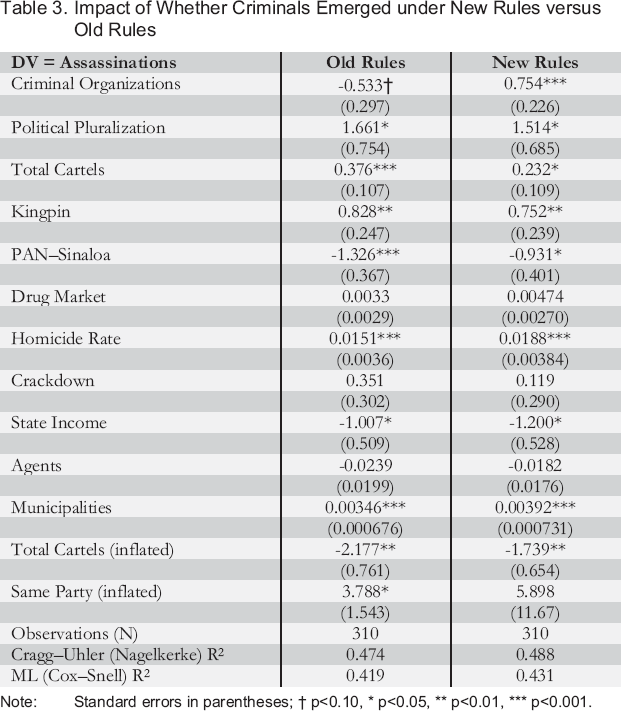
Lastly, to test the impact of evolving under the narco-corporatism system compared to the new system of individualistic marketized corruption, I examined whether criminal syndicates that emerged prior to 1995 were more or less likely to assassinate politicians compared to organizations that have emerged in recent years. I coded the following cartels as having emerged under the old rules: Gulf, Sinaloa, Milenio, Oaxaca, Tijuana, Juarez, and the Beltrán Leyva Organization. 2 Cartels emerging under the new rules include the following: the Zetas, Cártel Jalisco Nueva Generación (CJNG), La Familia Michoacana (LFM), and the Caballeros Templarios. Both variables are dummy variables that indicate whether or not any of these cartels were present in a state in a given year.
According to NarcoData, the Beltrán Leyva Organization (BLO) began in 2008. However, I coded the BLO as being part of the older generation of criminal syndicates since it was part of either the Sinaloa or Guadalajara cartels prior to 2008 and thus developed under the old rules. See the BLO profile, InSight Crime, online: www.insightcrime.org/mexico-organized-crime-news/beltran-leyva-mexico.
Table 3 presents the results from the zero-inflated negative binomial regression models, comparing the impacts of newer criminal organizations versus those of older organizations. The results confirm my theoretical expectation that organizations arising under narco-corporatism are less likely to assassinate politicians than their newer counterparts. The incidence rate ratio shows that, all else being equal, the presence of one of the older criminal groups led to a reduction in the estimated assassinations rate by 0.587, whereas the presence of newer criminal groups increased the expected assassination rate by 2.126. However, it is important not to overstate these findings. First, the p-value for the old criminal organizations dummy variable was not significant at the usual level (p = 0.072). Second, these models looked at the relationship between where various groups operate and where politicians are killed at the state level. Directly testing which groups kill more politicians would require evidence of which illegal organizations were behind each of the assassinations. Nonetheless, the results offer preliminary support that newer organizations are more likely to engage in violence than are their older rivals, which have deeper historical legacies of cooperation with the state.
Desmond Arias (2010: 245) claims that “understanding politics in [Latin America] means understanding the multiple violent actors who persistently operate in many countries and how they affect political outcomes.” Narcos are having a significant impact on politics in Mexico. While numerous studies have looked at the impacts that rising criminal violence will have on democratization (Bailey 2014; Trelles and Carreras 2012; Schedler 2014; Malone 2013; Bateson 2012; Velasco 2005), this paper has focused on a very specific kind of narco-violence: political assassinations. Narco-assassinations of elected officials arguably have the most direct impact on democratic governance. Complementing previous research on why criminal organizations in Mexico have become so violent, my empirical results show that there is a robust, statistically significant relationship between criminal fragmentation and political pluralization, on the one hand, and the number of politicians who are assassinated, on the other hand. I contend that this is because both of these factors increase the chances of politicians finding themselves in one of the three situations that is likely to motivate criminal organizations to target them.
The first motivation for a criminal syndicate to murder a politician is related to the fragmentation of criminal syndicates and “new forms” of corruption. Politicians who accept illicit money or enter into agreements with criminal actors risk assassination from rival groups or fragments of the same group should the organization splinter due to internal fighting or leadership decapitation. In 2011 Fortino Cortés Sandoval, the PRI mayor of Zacatecas, was kidnapped and killed by the Zetas, who covered his body with a message accusing him of being an informant for the Gulf cartel (CNN 2011). Until the middle of the first decade of the twenty-first century, the Zetas were merely the enforcement arm of the Gulf cartel. Officials may also be targeted by new criminal organizations for colluding with rival cartels. For instance, the order to assassinate the state minister of tourism, José de Jesús Gallegos Álvarez, allegedly came from the head of the CJNG, because the minister was supposedly laundering money for the CJNG's rival, the Caballeros Templarios (Milenio 2014). As the state minister of tourism, Gallegos Álvarez would have been in close contact with many high-end real estate and development people – a favorite industry for money laundering (Houston Chronicle 2013). So while political pluralization and increased electoral competition has increased the risk of drug money in politics, criminal pluralization has increased the chances of corrupt politicians becoming targets of assassination.
The second main motivation is that increased electoral competition and support for opposition parties produces a need for accountability and, as a result, increased political attention to corruption (Morris 2009). Many politicians with an honest desire to improve their communities have taken stances against the cartels and consequently become targets. Ygnacio Lopez Mendoza, a Michoacán mayor who was murdered in 2013, famously went on a hunger strike in Mexico City to get more funding for his district. He publically spoke out against the extortion pressure he was facing from the Caballeros Templarios cartel. Lopez Mendoza refused to meet the criminals’ demands and was later found dead on the side of a road (Sanders and Zapata 2013; Sydney Morning Herald 2013; BBC 2013; Fausset and Sanchez 2013). Edelmiro Cavazos Leal, a PAN mayor from Nuevo León, similarly advocated a crackdown on corruption and organized crime; he was later abducted by 15 men and found murdered (BBC 2010).
The third motivation is a reemergence of an old pattern of corruption and violence: state actors using criminal syndicates to carry out their dirty work and even eliminate political opponents. Although the PRD remains disproportionately targeted, under the more individualistic dynamic of marketized corruption, politically motivated assassinations span across party lines. In 2011 Régulo Cabrera Andrés, a PRI party leader from Guerrero, was shot in front of his wife and two children. His wife has accused the PRD of being responsible for the murder. José Consuelo González Xingú, a local official in Mexico state with no explicit partisan affiliation, was murdered in front of his house in 2010. Just before his assassination, he filed a complaint with the State Commission on Human Rights about intimidation, abuse of authority, and death threats from local police. His family and neighbors say the mayor was responsible; the mayor obviously denies these allegations (Dávila 2010). Nevertheless, the fact that Consuelo González had filed a complaint about death threats from the local police points to the pattern that gained attention in Iguala – one where corrupt politicians collude with criminal gangs and local law enforcement to form a sort of local authoritarian enclave of narco-politics. In such a setting, if their control is challenged by rising competition, they are all the more likely to react with repressive violence toward their opponents.
As Schedler (2014: 14) notes, “we will never know how many [Mexican politicians] have been dissuaded from ever running in the first place due to diffuse or specific threats of criminal violence.” However, given the horrific and tragic details of many politicians’ stories, it is safe to assume a lot of otherwise highly qualified candidates have decided and will decide against running for political office. Cases like that of Ignacio Domínguez Carranza, a former PAN mayoral candidate from Morelos, who was killed at his home along with his wife and 3-year-old child, highlight that the costs to politicians are rarely limited to just themselves. The case of María Santos Gorrostieta Salazar, a young mayor from Michoacán, garnered international media attention after she published photos revealing scars and a colostomy bag following two assassination attempts against her, one of which claimed the life of her husband. The narcos succeeded in their third attempt to kill Santos Gorrostieta when they ambushed her as she was taking her daughter to school. Pleading for her child to be left unharmed, she got into the vehicle of her attackers and her body was found days later with signs of torture. These stories leave observers questioning why anyone not co-opted by the cartels would want to run for office in certain municipalities. Even when valiant and sincere politicians do run, it seems that in some areas their chances of being victorious or surviving in office are low.
This raises the risk that more corrupt politicians will take their place. Once in office, corrupt politicians can use their criminal ties to squash any opposition and maintain their power. If criminals target the political opponent of a criminally affiliated politician and frame the attack as an act of narco-violence rather than political assassination, it is a win-win strategy for both parties involved: the criminals not only ensure their preferred official remains in power but also enhance their reputation for violence, while the politician secures his or her post. Many cartels actively cultivate a brand of violence to gain respect in the criminal sphere and to scare others into obedience (Williams 2009). Thus, politicians with narco-connections can obtain their own miniature political paramilitary groups, which even serve as a scapegoat for the violence. In situations where these same politicians control the local police and judiciary, there is an iron triangle of corruption and criminal impunity that has devastating consequences for democratic governance and citizen security. These are referred to as “subnational enclaves of narco-politics.”
Parallel processes of political pluralization and criminal fragmentation have resulted in an unprecedented number of politicians being murdered in Mexico today. The proliferation of narco-politics at the subnational level is directly connected to the increased assassination rate of politicians and is the result of the breakdown of the old rules that existed between the hegemonic PRI and Mexican criminal organizations. The concept of undemocratic subnational enclaves within Mexico is certainly not new (Faughnan, Hiskey, and Revey 2014; Giraudy 2010; Gibson 2010, 2013). However, what this article's exploration of narco-assassinations in Mexico has highlighted is that not only are many of these enclaves now authoritarian and undemocratic, they have also become havens of narco-politics. As was highlighted by José Luis Abarca, the former mayor of Iguala, narco-affiliated politicians in control of local forces and with ties to gangs can wreak incomprehensible damage on their communities. While the disappearance of the 43 students in Iguala garnered international media attention in September 2014, the students were not the only victims: around 130 bodies were found in and around Iguala during the 18 months afterward (Grillo 2016). Unless the Mexican government takes action to ensure the physical safety of elected officials, it is very likely that more municipalities will become narco-authoritarian enclaves and Mexico will risk undermining its new democracy from the bottom up.
Footnotes
Appendix
Results from Standard Negative Binomial and Poisson Models
| DV = Assassinations | Negative Binomial | Poisson | ZINB | ZIP |
|---|---|---|---|---|
| Political Pluralization | 2.083 * (0.836) | 1.932 ** (0.740) | 2.122 ** (0.716) | 2.051 ** (0.699) |
| Total Cartels | 0.430 *** (0.115) | 0.413 *** (0.104) | 0.278 * (0.108) | 0.262 * (0.108) |
| Kingpin | 0.745 * (0.294) | 0.812 ** (0.268) | 0.727 ** (0.247) | 0.753 ** (0.242) |
| PAN–Sinaloa | -1.392 *** (0.357) | -1.375 *** (0.362) | -1.408 ** (0.361) | -1.416 *** (0.361) |
| Drug Market | 0.00292 (0.00294) | 0.00287 (0.00304) | 0.0038 (0.0027) | 0.004 (0.0027) |
| Homicide Rate | 0.0159 *** (0.00478) | 0.0141 *** (0.00336) | 0.0159 *** (0.0036) | 0.0150 *** (0.0032) |
| Crackdown | 0.407 (0.296) | 0.361 (0.312) | 0.361 (0.277) | 0.334 (0.275) |
| State Income | -0.822 (0.542) | -0.936 (0.543) | -1.086 * (0.501) | -1.169 * (0.518) |
| Agents | -0.0272 (0.0222) | -0.0236 (0.0206) | -0.0326 (0.0176) | -0.0314 * (0.0173) |
| Municipalities | 0.00403 *** (0.000913) | 0.00403 *** (0.000876) | 0.00305 *** (0.0007) | 0.00297 *** (0.0007) |
| Observations (N) | 310 | 310 | 310 | 310 |
| Cragg–Uhler (Nagelkerke) R2 | 0.437 | 0.632 | 0.465 | 0.501 |
| ML (Cox– Snell) R2 | 0.386 | 0.583 | 0.411 | 0.446 |
Note: Standard errors in parentheses,
p<0.05,
p<0.01,
p<0.001.