



Abstract
Mexico's consolidation strategy seems to be reaching a limit. The country's transition from authoritarianism was largely based on a series of electoral reforms that leveled the playing field in elections. While this strategy was initially successful, it has failed to address several problems, especially in the electoral arena. This essay analyzes the prevalence of two such problems, vote buying and illegal campaign finance, which are closely connected. I draw evidence from available accounts of the 2012 presidential election and subsequent contests in problematic states such as Tabasco. The outcomes of the midterm elections of June 2015 are also used to assess whether previous electoral reforms have provided effective solutions to the problems analyzed here. I suggest that no legal reform will be effective while these laws are only being weakly enforced. A more comprehensive package of measures strengthening the rule of law would help Mexico transition from electoral democracy to liberal democracy.
Illegal Campaign Practices: Signs of a Merely Electoral Democracy
What role does the law play in democratization? There has long been agreement that proper laws protecting citizen rights are a prerequisite for referring to a regime as democratic (Dahl 1989). However, a critical distinction has also been made between the mere existence of certain laws on paper and their actual enforcement in practice. While numerous political freedoms and democratic processes may be written into law during the initial stages of a transition, this transition will not reach its last stages of consolidation without proper implementation of such laws. Indeed, a lot may be missing from a regime in which properly functioning institutions exist only de jure but not necessarily de facto. To underscore the difference, we can appeal to the frequently used distinction between electoral democracy and liberal democracy. While both criteria pertain to regimes that have abandoned autocracy in favor of multiparty competition, an electoral democracy is defined as having a lower level of political development than a liberal one (Schedler 2013). The difference between the two concepts has been spelled out in several useful definitions. For example, Haber, Klein, Maurer and Middlebrook consider a democracy to be liberal if it displays the following features that are often missing from electoral democracies: the rule of law should be universally enforced, in particular regarding property rights; citizens should have sanctioning mechanisms to keep their public officials accountable; and institutions should keep each other in check to limit their discretion and preserve their integrity (Haber et al. 2008: chapter 1). Emphasis on the rule of law, as in the definition by Haber et al., is particularly pertinent for the purpose of this research. Among other classic criteria for a democracy to be called “liberal” instead of merely “electoral”, a strict observation of legality is usually considered indispensable. Failure in this regard should be enough to categorize a country's democratic transition as incomplete, as in the case of Mexico, which is the focus of this essay.
Many countries became electoral democracies following the third wave of democratization, but not all of them were able to consolidate into liberal ones. According to Larry Diamond, 16 percent of the regimes in the world were classified as electoral democracies, while 38 percent were classified as liberal democracies (Diamond 2002: 26). The division was particularly sharp in Latin America and the Caribbean, where the author classified 17 countries as liberal democracies, 1 while 10 were electoral ones, 2 and 6 were classified as non-democracies. 3 Mexico, for example, according to Freedom House's measures, has never been solidly classified as a liberal democracy since it started being monitored. 4 This can be seen in Figure 1 below, which plots Mexico's democracy ratings for all available years (note that lower numbers indicate higher levels of democracy). As the figure indicates, the country's score improved steadily since 1995 but only barely reached the threshold for being considered a liberal democracy in 2002–2005. Its rating has subsequently regressed into the electoral democracy category since 2006.
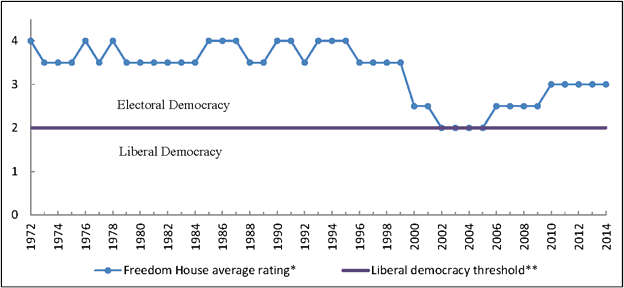
Mexico's Democracy Ratings, 1972–2014
Bahamas, Barbados, Belize, Bolivia, Chile, Costa Rica, Dominica, Dominican Republic, Grenada, Guyana, Panama, Peru, St. Kitts and Nevis, St. Lucia, St. Vincent and the Grenadines, Suriname, Uruguay.
Argentina, Brazil, Ecuador, El Salvador, Guatemala, Honduras, Jamaica, Mexico, Nicaragua, Trinidad and Tobago.
Antigua and Barbuda, Colombia, Cuba, Haiti, Paraguay, Venezuela.
For this discussion, I follow Larry Diamond's criterion that a country should be considered a liberal democracy instead of an electoral democracy if the average of its two seven-point ratings from Freedom House, Political Rights, and Civil Liberties reaches or falls below 2.0. Diamond did not provide an equally specific threshold for a country to be considered an electoral democracy instead of a non-democracy.
It is increasingly clear that countries that have initiated their transitions from authoritarianism can become stuck for a long time at intermediate levels of political development. This is unfortunate because having flawed democratic processes, such as unfair elections, can lead to serious failures of representation and accountability in these countries. What concrete challenges does an electoral democracy face in striving to become a liberal one? This essay will specifically focus on two challenges that can frequently be observed in elections across the developing world: illegal campaign finance and vote buying. In the scholarly literature, illegal finance 5 and vote buying 6 are not always studied together 7 . Yet I suggest that there are good reasons for doing so more often, given how frequently these two problems arise jointly – the cases studied in the following sections will suggest a symbiosis between illegal campaign resources and vote buying. Indeed, if a political organization wishes to buy votes, which is an unlawful activity under a well-specified electoral regulation, it needs to operate in secret, and therefore also needs to acquire resources that are unlawful too. On the other hand, if a certain campaign has raised funds illegally, it would need to spend those funds illegally as well to avoid exposure; for instance, by buying votes. This dual relationship can be expressed with an economics metaphor. If a political party is shopping for clientelistic support, illicit funds would represent its budget while vote buying would represent its consumption. As long as these two problems continue to plague elections, a regime can hardly claim to have transitioned from an electoral democracy to a liberal one.
For two detailed overviews of political corruption, including illegal campaign finance, see Gingerich (2013) and Whitehead (2002).
For some recent literature on clientelistic practices, including vote buying, see Hilgers (2011); Stokes, Dunning, Nazareno and Brusco (2013); Nichter (2014); and (Szwarcberg 2015).
For several exceptions studying the links between political corruption and clientelism see De la O (2015) and the citations therein.
A first goal of this essay is to demonstrate the tight relationship between illegal campaign finance and vote buying using concrete examples from Mexican politics. Unfortunately, instances of these two problems abound in Mexico, especially at the subnational level. As I document later, local governments still redistribute illegally-diverted resources through clientelistic networks, which can be attributed to a weak oversight of political actors. A second goal is to assess whether consolidation can come from yet more electoral legislation. For decades, Mexico's transition has relied on enacting a long sequence of election laws aimed at leveling the playing field in electoral contests. However, the returns on writing new formal rules seem to be reaching a limit, given the current political context in which those rules are not really enforced. Instead, I suggest that Mexico needs more holistic changes, which can be broadly construed as “strengthening the rule of law.” More generally, a third goal of this analysis is to shed some light on the important challenges facing electoral democracies, along with possible solutions as they strive to become liberal ones.
The next section discusses the laws that already exist in Mexico to combat manipulative practices in elections, and shows that these laws are already quite complete and detailed. I focus especially on the electoral reforms of 2014, which included new provisions against illegal financing and vote buying. Nevertheless, the three subsequent sections will demonstrate that electoral malpractice has still occurred in recent elections up to 2015; evidence of illegal campaign finance and vote buying surfaced again that year. Consequently, as I argue in the final section, such problems do not come from a lack of laws, but rather from lax enforcement of such laws. I conclude that strengthening the rule of law in several ways is the most reasonable path towards Mexico finally becoming a liberal democracy.
Abundant Laws but Scarce Enforcement: The Numerous Electoral Reforms up to 2014
There is no scarcity of laws regulating elections in Mexico. Throughout the twentieth century, virtually all the political contests for all offices used to be won by a single party, the Institutional Revolutionary Party (Partido Revolucionario Institucional – PRI). This dominant party ensured its victories combining democratic and undemocratic campaign procedures. About four decades ago, however, the country initiated a gradual transformation from one-party hegemony to vigorous multiparty competition (McCann 2012). The regime's successful and orderly democratization was largely based on several cycles of legal reforms. In effect, to enable a peaceful transition, the political class consciously adopted the strategy of writing a series of laws in Congress. Many of the negotiations with the incumbent PRI were carried out by two perseverant opposition parties, the center-left Party of the Democratic Revolution (Partido de la Revolución Democrática – PRD) and the center-right National Action Party (Partido Acción Nacional – PAN).
One of the early instances of Mexico's particular transition strategy was the law of 1977, which included sanctions for a wide array of undemocratic practices, such as creating false voting cards, stealing ballot boxes, destroying tally sheets, and voting more than once. Later, as their share of seats in Congress increased, opposition parties succeeded in pushing new legislation to further clean up the election process. In particular, a landmark norm was passed in 1990 that created an independent electoral management body along with a powerful tribunal for electoral matters (Ugues and Medina Vidal 2015). Together, these institutions ensured, for the first time, that vote counts would be accurate and transparent, which succeeded in largely eradicating ballot rigging. The subsequent reforms of 1993, 1994, and 1996 were so profound that they can be said to have transformed Mexico from a soft dictatorship into a functioning democracy. 8
For an account of these political reforms, see chapter 8 in Camp 2014.
Electoral reform has continued at a relentless pace in the 21st century. The 2007 reforms included several controversial measures that were critiqued by scholars and pundits, but they also included praiseworthy provisions aimed at restricting campaign expenditures and reducing incumbency advantage (Serra 2009). The legislative endeavor in 2014 was also ambitious. A number of Constitutional amendments were enacted in February, while ordinary laws (called “secondary laws” in Mexico) were discussed in the spring, leading to hefty new legislation in the summer of 2014. The old electoral code 9 was replaced by two separate laws regulating elections 10 and political parties, 11 respectively, and a brand new law was created to compile and expand the regulation of electoral crimes. 12 This last round of legislation encompassed a wide range of topics, such as centralizing the management of subnational elections into a single organization called the National Electoral Institute (Instituto Nacional Electoral – INE) which replaced the old Federal Electoral Institute (Instituto Federal Electoral – IFE). Creating the INE had profound consequences for conducting elections, especially at the subnational level, as has been analyzed elsewhere (Serra 2015). The present essay highlights a different set of profound changes related to vote buying and illegal campaign funding.
The Federal Code for Electoral Institutions and Procedures (COFIPE).
The General Law for Electoral Institutions and Procedures (LEGIPE).
The General Law for Political Parties (LGPP).
The General Law on the Matter of Electoral Crimes (LGMDE).
As in past reforms, the one in 2014 saw a particularly vigorous effort to regulate party finance and campaign expenses. Detailed provisions already existed: there is a precise cap on overall campaign spending, and there are firm restrictions on campaign donations. The new laws endeavored to make these restrictions more binding – in fact, the reform took them to a radical new level. The legislators in Congress decided to make the adherence to these restrictions a requisite in order for the results of the election to be valid. In other words, if a victorious candidate is found to have violated finance rules, such as exceeding the spending cap or obtaining illegal funding, the corresponding election must be annulled and a new contest must be organized. To make this outcome even more ominous, the winning candidate will not be allowed to compete in the new election. 13 To be concrete, in any close election with a victory margin lower than 5 percent, the losing candidate is allowed to file a lawsuit against the winning candidate for violating finance rules, hoping to invalidate the election and force a new one where the former victor is not allow to compete. Many pundits thought it was unlikely that these strict punishments would ever be carried out. However, as I describe in a later section, they were successfully enforced in at least one prominent case in 2015.
Article 41, base VI, of the Mexican Constitution.
Legislative efforts to deter clientelism have also been admirably perseverant. Vote buying has been classified as a crime at least since the electoral law of 1977. Its regulation became stricter and more detailed with the reform of 1990, when this infraction made it to the Federal Penal Code. The statutes against inducing voters were reinforced further in 2014, when the new laws extended the aggravating circumstances and the accompanying sanctions. As an example of how sophisticated the law has become, a new statute endeavored to cover the cheating possibilities from new technologies. Indeed, a new technique to buy votes involves political brokers asking voters to take a picture of their ballots using a cell phone. Upon showing the picture, the brokers proceed to give voters their payment. With this infraction in mind, the reform of 2014 stipulates fines and prison terms to anyone who solicits “evidence of the vote cast by a citizen,” or somehow violates the “right of a citizen to cast a secret ballot,” which are interpreted as direct references to cell phone pictures. 14
Article 7, fraction VIII, of the LGMDE.
Taken together, the series of political reforms in Mexico has resulted in world-class legislation against electoral manipulation. Most of the dubious tactics from the past are now in direct violation of the norms. Therefore, if laws were effectively observed in Mexico, we would expect such undemocratic behavior to have gradually vanished. Indeed, the initial stages of democratization were able to practically eliminate vote fraud on Election Day, such as ballot rigging during the vote count. However, as I will document in the following sections, other kinds of electoral malpractice have endured. In particular, vote buying with illegal resources can still be observed during campaigns, which might explain why measures of democracy seem to be at a standstill, as can be observed in Figure 1 above. There are even signs that Mexico is backsliding on some important aspects (Serra 2009). Therefore, one could ask whether the same strategies that allowed a transition from autocracy can now enable a continued path toward consolidation. Will more legal reforms be able to transform Mexico from an electoral democracy into a liberal one? Or would an altogether different approach be needed? It is certainly disappointing that serious foul play has survived in spite of unrelenting electoral legislation in the past four decades.
Regrettably, while the Mexican legislation looks promising in theory, its effectiveness is diluted in practice. All too often, party bosses and other powerful stakeholders have been able to co-opt or intimidate the electoral authorities to ensure soft application of the law instead of its faithful observance. Therefore, as with so many other laws in the country, the electoral ones are often ignored or weakly enforced. As the next two sections will demonstrate, the result is the persistence of undemocratic campaign practices such as illegal campaign finance and vote buying. I will thus argue that no amount of legal reform will have a deep enough impact as long as its enforcement continues to be weak.
Illegal Campaign Finance: Capturing Government Resources
Political corruption is widespread in new democracies, and Mexico is no exception. One type of corruption that tends to attract the most public attention consists of the abuse of public office for personal gain. The current administration has been embattled by media reports that have caused national and international outrage: high-ranking members, including the president, have been accused of owning several expensive properties that were sold to them cheaply by constructors who had previously been awarded lucrative public contracts (Reforma 2015a). Indeed, many observers suspect this government of granting infrastructure projects to personal friends, to the detriment of other bidders (Reforma 2015b). Corruption scandals in Mexico have not been limited to the federal executive. Legislators have been accused of accepting bribes from interest groups, and several governors are alleged to own the companies that they have given public contracts to. Some academics have even conjectured the existence of an implicit pact among all political actors to turn a blind eye to each other's murky business (Casar 2014a). Being complicit in corrupt practices might explain why other politicians, even from opposition parties, have refrained from requesting an investigation of the irregular properties of top administration officials (Casar 2014b).
While this type of corruption always causes widespread indignation, my focus in this essay is instead on a different type of corruption that is arguably even more damaging for democracy: the abuse of public resources for political campaigns. In studying Latin America, Laurence Whitehead noted that corruption is not necessarily undertaken for purposes of personal enrichment, but rather it is often aimed at buying political support in elections. Whitehead provided detailed illustrations of recent administrations acquiring illicit funds to win elections in Argentina, Brazil, Colombia, Mexico, Peru, and Venezuela, concluding that electoral democracies generate their own distinctive incentives for abuse of office, which may have more to do with political survival than with private appropriation (Whitehead 2002: chapter 5). The focus of this section is on this latter type of political corruption, which aims to increase electoral support rather than individual wealth. This problem might be larger than is commonly assumed: Freidenberg and Levitsky (2006) found that in Latin America, legal sources of campaign finance are often “dwarfed” by illicit sources coming from patronage, kickbacks, extralegal donations, and the embezzlement of money from state agencies.
Today in Mexico, public officials still have an undue influence in elections by abusing the resources they have at hand (see, for example, Faughnan, Hiskey, and Revey 2014). This is especially true in subnational politics: while oversight has significantly improved at the national level (i.e. the federal government), it is still lacking at the regional level (i.e. the state governments) and even more so at the local level (i.e. the municipalities). Governors can often deliver pivotal support in their states at election time, both because their budgets have increased in recent years and because state spending is not subject to the same scrutiny as the federal budget (Diaz-Cayeros 2004). Resources can also be diverted in municipalities, as the mayor's office frequently enjoys significant discretion to redirect social programs for political benefit. Such intervention has long been considered unlawful by the electoral regulation, but enforcement has continued to be lax. In short, inadequate oversight of public expenses has remained a serious area of vulnerability in elections, as candidates from the incumbent party may potentially enjoy a decisive advantage over their rivals who do not have access to the same government resources.
Many fingers have pointed at the PRI. Upon winning the presidential election in 2012, the PRI's candidate was accused of having benefited from abundant capital funneled by co-partisan governors. Several observers remarked that a majority of states, including some of the most politically backward ones, were governed by the PRI when the 2012 election was taking place. Of course, there exist a number of legitimate explanations for the copious vote in favor the PRI. In fact, tribunals could not find any conclusive evidence to invalidate the election's results. 15 However, many analysts and academics believe that, in one way or another, Enrique Peña Nieto's victory owed a lot to his party's expansive territorial structure and its 19 sitting governors (Wuhs 2013; Serra 2014). According to these authors, a major underlying factor explaining the PRI's victory was its disproportionate ability to leverage resources at the local level for patronage jobs, money for its agents, and advertising funds.
Possible explanations for the PRI's victory in 2012 are discussed in McCann (2015) and Serra (2013).
Suspicion of illegal campaign funding by the PRI has also been fueled by recent corruption scandals among its governors. One of the most notorious cases involved the former governor of Tabasco, Andrés Granier Melo, who was arrested in June 2013 for allegedly embezzling more than 100 million dollars. Several of his former aides in the Finance Department and the Health Department are also facing federal and state prosecution (The New York Times 2013). News outlets focused mostly on reporting the outrageous personal expenses incurred by the governor and his family during his administration, which included lavish clothes, trips, and properties (Forbes 2013). However, one should also wonder about the degree to which these resources were used to benefit his party. As I describe in the next section, there is evidence that some of these missing funds were used for electoral purposes, making their way to candidates’ campaigns.
Another scandal surfaced in 2013 during local elections in the state of Veracruz, which had a PRI governor at the time. A series of incriminating audios and videos were leaked to the press consisting of conversations among state officials and party leaders discussing the misappropriation of government resources. 16 At meetings that were supposed to be secret, the Finance Secretary of Veracruz laid out plans to use the largest federal antipoverty program, called Oportunidades, to benefit his party in the upcoming elections. His exceptional bluntness is worth quoting:
The main video leaked to the press can be found at <http://aristeguinoticias.com/1804/mexico/video-que-presento-el-pan-para-denunciar-la-red-electoral-del-pri-en-veracruz/> (10 August 2014).
Fortunately, thanks to the change in power, thanks to the PRI's arrival to the federal government, we now control the state delegation of the Department of Social Development. […] I want to tell you that there are plenty of ‘opportunities’ to take advantage off, precisely because I am referring to the Oportunidades program. I invited the program administrators who are here with us today; they are the acting managers of Oportunidades in this area. The message I wish to tell you is that such an important program cannot be the sole responsibility of its staff. […] We quickly need our operatives to seize control of the program in their respective zones. (Finance Secretary of the State of Veracruz, author's translation)
Other government officials at the confidential meetings took turns describing strategies to control a range of social programs, which they referred to as “solid gold.” Government personnel, public infrastructure, and even hospitals were alleged to be at the party's disposal. One question that comes immediately to mind is how these resources would be used once those officials secured control over them. As it turns out, the conversations were equally explicit in revealing the intended misuse of those programs to the PRI's advantage in the election, as I document in the next section.
It is worth pointing out that the PRI is not the only party suspected of using illicit resources for campaigns. In the 2012 presidential elections, authorities investigated all of the large parties for illegal financing. A visible scandal involved the PRD, when the press uncovered a secret fundraiser on behalf of its presidential candidate, Andrés Manuel López Obrador (El Universal 2012a). Some of López Obrador's closest aides were caught organizing a secret dinner with prominent Mexican entrepreneurs asking them for 6 million USD each in undisclosed campaign donations (El Universal 2012b).
The third large party, the PAN, managed to stay fairly clear of fiscal controversies of this magnitude in 2012, having received only a few fines for small spending offences. Nevertheless, in 2013 the party became embroiled in a large corruption scandal involving its federal legislators. It is alleged that the PAN's caucus in the Chamber of Deputies, which has discretionary control over millions of pesos from the federal budget, began asking for favors and money from several mayors in exchange for assigning federal transfers to their municipalities (Reforma 2013). The monetary request consisted of asking mayors for a percentage of the federal transfer. In Mexico, grabbing a chunk of someone else's windfall is colloquially called a “moche”; so this scandal came to be known popularly as the PAN's “moches”. The money and other favors requested from the mayors would reportedly be used to support the political campaign of the PAN's president, Gustavo Madero, who was seeking to be re-elected at the head of his party (A.M. de León 2014).
Unfortunately, the prosecution of campaign-finance infractions has proved ineffective. A main shortcoming has been the lack of determination from the electoral authorities, which have been unwilling to apply the law to its full extent, often condoning or reducing the sanctions earned by candidates and parties (Serra 2009). As a result, spending limits have been systematically violated: the spending cap for a presidential campaign is officially MXN 336 million (USD 19 million), but it is widely believed that all frontrunners exceed this limit. A substantial part of the 2014 reforms was devoted to campaign finance, in recognition of its urgent need for attention. The new sanctions are severe, but as I argued in the previous section, their severity in theory is often diluted by a soft implementation in practice. In an environment where all political elites condone unlawfulness, the authorities have difficulty enforcing the rule of law. This is also true about the flip-side of this problem, namely the use of these acquired resources to buy votes.
Vote Buying: Using Captured Resources
The manipulation of voters using clientelistic methods is common throughout Latin America (Szwarcberg 2015). Clientelism remains a relatively vague concept that is used somewhat differently by different scholars. As an umbrella term, it usually includes a menu of practices to distort vote intentions improperly using economic resources (Hilgers 2011; Nichter 2014). Therefore, clientelism is commonly considered a hurdle in democratic transitions, especially where large fractions of the population are in poverty. Here, I focus on one such practice, vote buying, which I will understand as the explicit exchange of gifts or favors to induce individuals to vote a certain way. In a sense, this practice corresponds to the flip-side of another problem analyzed in the previous section: illegal financing. Indeed, as illicit resources are suspected to be captured by political parties for their campaigns, we must wonder what those resources are used for. It is likely that, upon breaking the law a first time to acquire extra funds, parties will break the law a second time to spend such funds to purchase electoral support.
Vote buying did not disappear with Mexico's transition to democracy. In its hegemonic period, the PRI is known to have employed a variety of techniques for obtaining votes undemocratically (Lean 2010). As it turns out, political brokers still carry out this operation in several ways. While votes are secret in Mexico because we use the Australian ballot system, a few means to monitor the voter's decision have been devised. In the past, it was common to ask a child hired by the broker to accompany the adult voter into the booth to corroborate the voter's mark on the ballot. Nowadays, it is more common to simply ask the voter to take a picture of his ballot with a cell phone, which must be shown to the broker before payment of the promised benefit. As mentioned above, this practice was explicitly forbidden by law in 2014; but there is evidence that it still occurred the following year (Elizondo 2015).
The concept of vote buying did make it into Mexican law during democratization. In particular, since 1990, the Federal Penal Code established a large fine and a prison term of between six months and three years for anyone who “solicits votes in exchange for payment, gifts, rewards or the promise thereof.” 17 However, enforcement of this prohibition has been very patchy, with few accusations leading to a conviction. For instance, impunity seems to have prevailed in one of the cases studied in this essay: Tabasco.
Article 403, fractions VI and XI, of the Federal Penal Code.
The previous section documented that a significant portion of the state of Tabasco's budget between 2007–2013 was allegedly diverted by Governor Andrés Granier. As it turns out, beyond showering himself and his family with luxurious goods, some evidence surfaced that he used part of the bounty for electoral purposes. There were in fact reports of a parallel operation in charge of reinforcing political clienteles for the PRI in the state: upon moving to his official residence as governor, a large mansion, Granier reportedly set up an office in the backyard for family members to run non-official business. From this back office, the governor's son was building political coalitions on behalf of his father. Despite not having any position in government, it was known in the local area that “Granier Junior” was “helping” with governing duties (La Verdad del Sureste 2011). More precisely, he was using government resources at his disposal in exchange for political support: he pardoned traffic tickets, he condoned tax payments, he gave away driving licenses for free, and he granted permits to bars, discotheques, and cantinas. He also assigned government jobs to friends and allies who asked for them. And, more in line with a classic understanding of vote buying, the governor's son secured the sympathy of community leaders and social activists commanding blocs of votes by handing them loads of money (Proceso 2013). Since then, Granier Junior has been facing charges of money laundering, tax evasion and corruption while his father was governor. He was finally arrested on April, 2016 (Tabasco Hoy 2016).
The dual relationship between illicit financing and vote buying is also illustrated by scandals in Veracruz involving its PRI governor. The previous section relayed conversations that were recently disclosed between government officials and PRI leaders in the state about capturing substantive government resources. The conversations leaked to the media also reveal that such misappropriated resources were indeed intended for vote buying, which confirms the premise in this essay. In preparation for local elections in 2013, the treasury secretary of Veracruz gave instructions that all benefits from the well-known antipoverty program Oportunidades should actually be delivered by party representatives instead of nonpartisan government employees. 18 Oportunidades is federally funded, but the secretary gave orders to clearly tell the 4000 recipients that benefits came from local PRI candidates in exchange for their support in the election. At a party meeting, he explained his rationale in the following way:
The video that contains these conversations can be seen at <http://aristeguinoticias.com/1804/mexico/video-que-presento-el-pan-para-denunciar-la-red-electoral-del-pri-en-veracruz/> (10 August 2014).
If our operators delivering the benefits are at the same time keeping tabs on the good behavior of the recipients of Oportunidades, if we commit to that, I am sure those recipients will be on our side. […] At the end of the day, we are handing out scholarships for kids, but we could also call them salaries, couldn't we? Imagine having four thousand people on our payroll, it is enormous! […] This is how the network gets started. (Finance Secretary of the State of Veracruz, author's translation)
These shocking words confirmed the public perception that many political actors are guided by cynicism. Among the established Mexican parties, the PRI is generally considered the most adept at the type of illegal or borderline-legal practices described above. Yet, one should not believe that other parties are exempt from abusing public resources for electoral profit. PRD officials are mentioned particularly often as misusing their budgets in Mexico City. During fieldwork in PRD bastions, Tina Hilgers documented the resources that local governments commonly use to procure support from specific groups of citizens that have electoral strength. Some PRD factions were particularly successful at inducing the political participation of senior citizens: in several municipalities, these factions organized gatherings at government community halls to provide baskets of basic food items to the elderly. However, according to the author, only those senior citizens whose signatures figured in attendance lists of party meetings and rallies were given the food. Seniors who chose not to involve themselves with the party went empty-handed (Hilgers 2008).
The PAN is also suspected of engaging in clientelism, albeit to a lesser degree. Nichter and Palmer-Rubin (2015) suggested that the PAN prefers not to engage in vote buying for fear of turning off its base of middle-class voters, who are less amenable to clientelist offers. Nonetheless, several accusations have recently come to light. The phone conversations of the regional head of Oportunidades in the state of Veracruz (immediately before the scandals by PRI members mentioned above) were secretly taped at the beginning of 2012 to be leaked to the media. The discussions from the program's regional director, a member of the PAN designated by the PAN's federal administration, seem to suggest an attempt to manipulate the program: he can be heard offering to hire party sympathizers as program operatives. The recordings do not state an explicit goal, but it is presumed that such operatives served as party brokers while delivering the program's benefits (Animal Político 2013).
To be sure, these examples are probably part of a pervasive pattern across regions in Mexico rather than just being isolated cases. It can actually be shown that localities that are prone to corruption will also be prone to clientelism. To be more precise, De la O (2015) showed statistically that vote buying can be expected to be higher in communities where public officials are highly corrupt. Using several measures of government corruption at the state level (including data from the Mexican branch of Transparency International), De la O found that an increase in such measures causes an increase in vote buying (as measured by survey responses from the Mexico 2012 Panel Study). De la O's research thus provides clean evidence of the close link that I am emphasizing between illegal campaign finance and clientelism. Regrettably, these two problems have not shown any signs of subsiding in recent elections.
The 2015 Elections: More Vote Buying with Illegal Resources
Illegal campaign financing and vote buying were also apparent in the midterm elections of 2015. On 7 June, the Chamber of Deputies, which is the lower house of Congress, was fully renovated. Concurrently, there were elections for governors in nine states, and seven other states renovated their state legislatures. These were the first contests to be held under supposedly stricter rules for parties and candidates based on the 2014 reforms. A normative evaluation of this democratic process must be mixed. The national electoral institutions were again successful at conducting a timely, clean, and transparent tally of the votes. However, the weeks and months before Election Day were full of accusations of illegal campaign funding (El Economista 2015) and vote buying (La Jornada 2015) on behalf of parties and candidates, which seems to suggest that such problems did not diminish at all. In fact, more legal complaints were filed to the electoral tribunals in these campaigns than ever before (Casar 2015).
Overall, these midterm elections provide evidence in favor of my main argument here; namely, that problems persist in Mexico not from a scarcity of electoral laws, but rather from a lax implementation of these laws. This concern was epitomized by the recent actions of the Green Ecological Party of Mexico (Partido Verde Ecologista de México – PVEM). This ambitious medium-size party was able to increase its vote share with an aggressive campaign that overtly infringed upon many regulations (Aparicio 2015). The party exceeded the legal deadlines by starting its campaign advertisements too early and ending them too late. It violated rules against vote buying by distributing expensive paraphernalia among low-income voters, such as backpacks and wrist watches with the party logo. It also broke the restriction on television airtime by negotiating favorable coverage with one of the large TV networks (Milenio 2015). Money for these extralegal activities is presumed to have come from the southern state of Chiapas, which has a governor from the PVEM (Raphael 2015). Confirming a main argument in this paper, the authorities’ response to these blatant affronts was slow and tepid. The INE took weeks to decide on punitive actions against the Green Party and, when it finally gave it large fines, these fines were subsequently eliminated or reduced by the electoral tribunal. Such hesitation on behalf of the electoral authorities was interpreted as a feeble commitment to enforcing the law, which shapes the type of conclusions we can draw about improving the quality of Mexican democracy.
To their credit, it must be noted that the electoral authorities did enforce the new laws in some key instances. Notably, in a spectacular ruling on 22 October, the electoral tribunal annulled the gubernatorial election in the state of Colima, citing the new sanctions on violating campaign-spending regulations described at the beginning of this essay (CNN en Español 2015). A new election was subsequently held with tighter monitoring of campaign expenditures. This event should convey that Mexican laws can be effective on those occasions when they are properly applied.
Beyond Electoral Reform: Finishing the Transition via the Rule of Law
Can legal reform alone transform an electoral democracy into a liberal one? With the third wave of democratization, many regimes abandoned autocracy only to achieve barely minimal standards of electoral competition. In Mexico, for example, this meant abandoning the most egregious manipulation practices, such as stuffing ballot boxes, harassing candidates, and suppressing opposition parties. These were notable achievements, but other obstacles have remained. The nature of the remaining obstacles in these new democracies is so different from the initial ones that an altogether different strategy might be needed in order to finish the transition that was previously started. In particular, becoming a full polyarchy requires citizens’ rights and freedoms to be “effectively enforced,” which entails imposing the rule of law (Dahl 1989).
Today, illegal campaign finance and vote buying represent two serious obstacles to the consolidation of many new democracies. These problems should be seen as two sides of the same coin: if a political broker is in the market for political support, he is likely to break the law a first time to acquire illicit funds precisely because he wishes to break the law a second time to purchase votes. Illegal funding and vote buying are not usually analyzed jointly in academic research, but this essay attempted to articulate the value in doing so. These two phenomena reinforce each other to become considerable challenges in young democracies with unfinished transitions. 19 As a case in point, Mexico illustrates that exclusively writing election laws is an insufficient solution. As pointed out by Haber et al. (2008), voting rules can be erased “with the stroke of a pen,” but corrupt practices by rent-seekers cannot.
A similar argument calling for a unified analysis of corruption and clientelism was made by Gingerich (2013).
Qualitative evidence from subnational regions in the country provides support for these claims. One of the states that I focused on, Tabasco, is considered to have a “low democratic development” as it still suffers from serious structural and institutional insufficiencies. 20 After Granier had left government and a different party, the PRD, came to power, the government of Tabasco was still being accused of overspending and lacking transparency. Granier, from the PRI, had increased the state's debt to historical levels; but in 2013, his successor from the PRD, returned Tabasco again to its position as the state acquiring the most new debt in the country. That same year, the PRD government decreased the government's accountability by passing a law restricting the disclosure of legislature's expenditures, which allowed legislators to preserve the confidentiality of their expenses for a period of two extra years. This law, it should be noted, fell below the national standards of transparency (Somuano and Ortega 2014). Such evidence confirms that problems in many Mexican states are profoundly structural rather than simply electoral.
According to the Index of Democratic Development in Mexico (IDD-Mex) available at <http://idd-mex.org> (5 April 2016).
Hence the efforts at finding solutions should focus on changing the legal culture. The long series of electoral reforms until 2014 are destined to fail otherwise. Instead of continually writing new laws, Mexico should find ways to properly enforce its existing ones. For this purpose, checks and balances should be reinforced by a real separation of powers between governors and their state legislatures. Local judiciaries should be granted more independence from the incumbent officials who are currently controlling them. The newly created Office of the Attorney General 21 should take electoral crimes more seriously than its predecessor. 22 Finally, the federal anti-corruption agency currently being discussed in Congress should be given strong enough teeth. In broad terms, Mexico must find the means for a more rigorous observation of the rule of law by all political actors.
Fiscalía General de la República, created on paper as part of the 2014 reforms.
Procuraduría General de la República (PGR), still in place as of 2016.
These remarks are consistent with the conclusions of Haber, Klein, Maurer, and Middlebrook, who blamed a weak rule of law for Mexico's lack of consolidation. They lamented the country's “incomplete” transition as follows:
Why has electoral democracy not produced rule of law? […] Mexico has become more democratic in terms of electoral competition. […] However, as the country's post-2000 experience clearly shows, electoral democratization has not automatically strengthened the rule of law or brought about other changes required to consolidate liberal democracy. In fact, many legacies of Mexico's authoritarian past continue to weigh heavily on the country. (Haber et al. 2008)
Prescribing a stronger rule of law is not only germane to Mexico, but might be applicable more broadly to other electoral democracies that are also placing their hopes on a continual stream of legal reforms. The Mexican experience illustrates that electoral legislation can indeed have remarkable success in dismantling a state apparatus for vote fraud. However, the extra steps toward liberal democracy seem to require an effective implementation of the existing laws rather than the continual creation of new ones. Indeed, the initial strategy of writing campaign rules will necessarily reach a limit once the legal framework is sufficiently sophisticated. In many regards, the remarkable Mexican laws would be sufficient if only the political class found the courage to enforce them.