



Abstract
We examine the electoral alliances between two Mexican political parties – the Partido Revolucionario Institucional (PRI) and the Partido Verde Ecologista de México (PVEM). Despite the PRI's electoral dominance, it has entered into preelection agreements with the PVEM since 2003. These electoral pacts are unusual for several reasons: the parties do not share an ideology; their bases of support come from different social sectors; and the PRI's survival as a party does not depend on these pacts. Using electoral data from 2006 to 2015, we examine the electoral districts in which the PRI and the PVEM ran joint candidates in federal legislative elections. We find that the ultimate goals of each party, their past electoral performances at the legislative district level, and the presence of PRI-PVEM alliances in gubernatorial elections explain the parties’ choices to collaborate in certain districts. Our findings have important implications for understanding the behavior of parties in newer democracies.
Introduction
Regardless of context, we know that political parties behave instrumentally. 1 Their behavior reflects their ultimate goal, whether that be office, votes, or policy (Strøm 1990). However, we observe differences in the behavior of parties in more established democracies in comparison to parties in newer democracies. Parties in established democracies, for example, tend to be more programmatic, while those in newer democracies are typically more clientelistic in their relationships with voters (Kitschelt 2000; Kitschelt and Wilkinson 2007). Moreover, parties in newer democracies may work with parties that are ideologically different in order to secure their dominance in the system or to survive as a party. The electoral alliances between the dominant Partido Revolucionario Institucional (Institutional Revolutionary Party, PRI) and the smaller Partido Verde Ecologista de México (Ecological Green Party of Mexico, PVEM) 2 are one such example.
We thank Allyson Benton, Karleen West, Jeffrey Weldon and the JPLA reviewers for their excellent comments and suggestions. All errors remain our own.
See Partido Verde Ecologista de México, online: <www.partidoverde.org.mx/> (27 June 2017).
Unlike other green parties, the PVEM has been an office-seeking (Downs 1957; Riker 1962; Strøm 1990) party since its inception, allying itself with the party that will best enable it to get elected or reap the greatest benefits. In the first presidential elections following Mexico's democratization in 2000, the PVEM allied with the larger Partido Acción Nacional (National Action Party, PAN) to ensure its survival. Since 2003, the PVEM has formed electoral alliances with the PRI – the most electorally successful party in Mexico, having previously held the presidency for nearly 70 consecutive years. Following their 2012 alliance, which saw Enrique Peña Nieto win the presidency, the PVEM and the PRI ran together in the 2015 legislative elections, standing joint candidates in 250 of the 300 single-member districts (SMDs). 3 Importantly, however, the electoral pacts between the PRI and the PVEM are unusual for several reasons: the parties do not share an ideology; their bases of support come from different social sectors; and the PRI's survival as a party does not depend on these pacts. Why, then, would the PRI enter into an electoral pact with the smaller PVEM? And more specifically, on what basis do the PRI and the PVEM decide to enter into an alliance and run a single candidate in a specific district? 4
We use the terms “joint candidate,” “single candidate,” and “common candidate” interchangeably to refer to a candidate that has the support of both the PRI and the PVEM in a legislative district.
We refer to the overall strategy of parties choosing to work together in a given election as an “electoral pact” or “electoral agreement.” We refer to the individual districts in which the parties run a joint candidate as “alliance districts.”
These two questions are the focus of this paper. The first question is what motivates our research; the second is what we empirically address here. Although researchers have examined parties’ strategic entries and coordination (e.g., Cox 1997), preelection alliances in parliamentary systems (e.g., Strøm, Budge, and Laver 1994; Golder 2006; Allern and Aylott 2009), preelection alliances that result in a single or common candidate in legislative elections (e.g., Tsebelis 1990; Blais and Indridason 2007; Spoon 2011), and alliances in presidential elections (e.g., Chasquetti 2001; Aléman and Tsebelis 2011; Spoon and West 2015a; Kellam forthcoming), to our knowledge, no extant scholarship examines the legislative pact between the PRI and the PVEM or what determines where the parties decide to run a joint candidate in an SMD. 5
One notable exception is Montero (2015). In this paper, he examines the effect of the PRI–PVEM alliance in 2015 on voter behavior, campaign spending, and election outcomes.
We argue that the PRI and the PVEM's decision to run joint candidates in a given electoral district is influenced by each party's ultimate goal. For the PRI, this is a desire to maximize its winning potential; for the PVEM, this is a desire to survive as an individual party in the Mexican political system. Based on these goals, the PRI and the PVEM will run joint candidates if they have performed poorly individually in the prior legislative election. Conversely, if the parties have run a common candidate and performed well, the PRI will seek to run an alliance candidate again, whereas the PVEM will run alone. Finally, if the PRI–PVEM alliance has performed well in gubernatorial elections, the parties will extend this alliance to districts in legislative elections. To test our argument, we examine the PRI–PVEM alliances in the 300 SMDs in elections for the Mexican Cámara de Diputados (Chamber of Deputies) in 2009, 2012, and 2015. Including three elections allows us to study these alliances both over time and across districts. Our findings have important implications for understanding party competition and party strategy in developing democracies.
This paper proceeds as follows: In the next section, we discuss the literature on party behavior in developing democracies. We then develop our three hypotheses for predicting PRI–PVEM alliances. After that, we discuss our research design and methods. In the final section, we present our results and consider their implications.
Party Behavior in New Democracies
As linkage organizations, political parties are one of the first civil society organizations to form when a country democratizes (Huntington 1968; Lawson 1980). They serve as an important intermediary institution between citizens and the government. Unlike parties in developed democracies, however, parties in newer democracies either are often not ideologically based or are ideologically more fluid (O'Donnell 1994). They are typically vote- and office-seekers, not policy-seekers (Downs 1957; Riker 1962; Strøm 1990). To this end, party organizations are often weak and party switching among legislators is common (Mainwaring and Scully 1995; Desposato 2006). Moreover, instead of being motivated by policies or programs, these parties are often driven by their desire to develop clientelistic relationships with the electorate for votes (Kitschelt 2000; Kitschelt and Wilkinson 2007). Relationships between parties and voters are often grounded in parties’ abilities to provide electors with patronage in the form of selective benefits (e.g., Greene 2010). In some instances, parties use different strategies to appeal to different constituencies, which may often include providing selective benefits to supporters, in order to maximize their vote shares (see, e.g., Luna 2014 on the Frente Amplio in Uruguay and Unión Demócrata Independiente in Chile and Thachil 2014 on the Bharatiya Janata Party [BJP] in India).
Smaller parties in newer democracies often developed as policy vehicles for issues and groups that may have been previously unaddressed or underrepresented (Bruhn 1997; Dominguez and Poiré 1999; Van Cott 2005; Madrid 2005). However, even these parties did not always stay focused on their initial goals; instead, they became more concerned with improving their electoral performance and increasing their credibility in the political system (see, e.g., West and Spoon 2013). Research has demonstrated that even candidates from parties that claim to have more programmatic interests often select the strategy that offers the best chance of electoral success, even though it may not necessarily reflect the interests of the group they represent (see, e.g., West 2011 for an illustration of this with Pachukutik candidates in Ecuador).
In sum, given the nature of both established and newer parties in developing countries, we expect to see patterns of coordination between parties that differ from what we would see in the party systems of developed democracies. Such patterns may include parties with different policy positions and ideologies working together on campaigns and in the legislature or government.
Using this framework of party behavior in developing countries can help us to understand the underlying logic of the PRI–PVEM electoral pacts in Mexico. After it was founded in 1929, the PRI won over 70 percent of the vote in every presidential election until 1982 and held the presidency until 2000. After losing to the PAN in 2000 and 2006, it regained the presidency in 2012 (see Serra 2013 for a discussion on the reasons that may explain the return of the PRI in 2012). The PVEM was founded as the Partido Verde Méxicano (Mexican Green Party) in 1986 by a former member of the PRI, Jorge González Torres. It participated in the 1988 federal elections as part of the Frente Democrático Nacional (National Democratic Front), which brought together several left-wing parties to support a single candidate for president, Cuauhtémoc Cárdenas. In 1991 it ran independently as the Partido Verde Méxicano but only won 1.4 percent of the vote. Having failed to reach the threshold needed to remain an official party, it reorganized and renamed itself the Partido Verde Ecologista de México in 1993. In 2001 Jorge Emilio González Martínez, González's son, assumed the party leadership. 6 Since being reestablished in 1993, the PVEM has retained its official-party status with the Instituto Federal Electoral (IFE) by running with other parties in legislative elections. Montero (2015) shows that the formation of coalitions may have several benefits, such as financial gains, more efficient campaign expenditures, and positive electoral outcomes.
See <www.partidoverde.org.mx> for more on the history of the PVEM.
Although the two parties share a desire to gain office, the PVEM and the PRI have little else in common in terms of ideology, policy, or their support bases. 7 The PRI, the former hegemonic party, started as a mass party. According to Langston (2003: 297), the PRI had the support of the “workers, peasants and popular,” whereas the PVEM emerged in the wealthy areas of Mexico City (Cedillo 2007). These electoral agreements are a function of electoral competition and help the parties to maintain power (Casar 2008; Reynoso 2011). They ensure the PRI's dominance and the PVEM's survival. 8 However, as we argue below, the PVEM must run alone in some legislative districts in order to remain a credible party.
Based on their manifestos, the Manifestos Research Group (MRG) has given each party a left–right score (Volkens et al. 2015). In 2012 the PRI was much further to the left than the PVEM. In fact, if the PRI were to have chosen alliance partners based on ideological proximity, the PRD or the PT would have been its natural partners. The MRG left–right score ranges from −100 (furthest left) to 100 (furthest right). The PRI's, the PVEM's, the PRD's, and the PT's 2012 scores were −20.06, −6.09, −19.44, and −22.09, respectively. This further demonstrates how electoral alliances work differently in newer democracies. See Serra (2014) for an alternate perspective on the ideological positions of the PRI and the PVEM. By allying with a party that attracts a different subset of voters, the PRI improves its chances of winning. Unlike the electoral agreements between the PRI and the PVEM, the agreements between the PRD, the PT, and the Movimiento Ciudadano (Citizens’ Movement, formerly Convergencia [Convergence]) bring together parties with similar ideologies. Future research should examine the districts in which these parties ran joint candidates versus those in which each party ran its own candidate.
The PVEM benefits when it is part of a district-level alliance that wins. Not only does it receive money from the federal government, but the votes the alliance receives contribute to its overall vote share in the multimember proportional representation constituencies.
A central feature of the legislative electoral agreements between the PRI and the PVEM is that they do not necessarily entail agreements to select joint candidates in all legislative districts. 9 Rather, the national parties decide on the districts in which they will run joint candidates or field their own candidates. Since the legislative alliances between the two parties began in 2003, they have only once, in 2006, run common candidates in all legislative districts. In the legislative districts in which the PRI and the PVEM have run joint candidates, the vast majority have been from the PRI. 10 However, the percentage of PVEM candidates in these alliance districts has increased over time, from 9.5 percent in 2009 to 23.2 percent in 2015 (see Table 1). On what basis do the PRI and the PVEM choose a joint candidate for a specific district? It is to this question that we now turn.
The electoral laws concerning electoral agreements between parties have evolved since the mid-1980s. Beginning in 1996, parties could run in partial coalitions in the legislative elections (IFE 2008).
Explaining PRI–PVEM Alliance Districts
As a means to get elected in plurality legislative elections, two or more parties will often run a single candidate (Strøm, Budge, and Laver 1994; Golder 2006). The logic behind these preelection agreements is that electing a candidate from one of these parties is preferred to a win by the opposition party. In France, for example, the Parti Socialiste (Socialist Party) has run joint candidates with Les Verts (the Greens) in legislative elections from the first round since 1997. For both parties, electing a left-wing candidate is preferred to a win by the right or extreme right (Blais and Indridason 2007; Spoon 2011). In the Mexican case, the PRI and the PVEM are concerned not only with minimizing the electoral success of the PAN but also with gaining office (and not necessarily advancing a set of policies). For example, Méndez de Hoyos (2012) finds that Mexican parties are more likely to form coalitions prior to gubernatorial elections if they face high levels of electoral competition. Thus, unlike the ideological similarities that underlie the electoral agreements between the Parti Socialiste and Les Verts in France, the PRI and the PVEM have come together for purely instrumental reasons: to win votes and ultimately seats.
It is important to note that we are interested in the districts where the parties run joint candidates and not in the candidates’ party affiliation. This is a topic for future research.
It is not hard to understand why the PVEM – like other small parties (e.g., Izquierda Unida in Spain, the Progressive Democrats in Ireland, and the Partido Liberal in Brazil (Golder 2006; Spoon and West 2015a)) – would run a joint candidate with a larger party (the PRI) in a given legislative district. Similar to other smaller parties that have run candidates with larger parties, all of the seats won in the Cámara de Diputados by the PVEM since 2003 have been in alliance districts. The PVEM has not won a single seat in the lower house independent of the PRI. More importantly, it is only through the alliances with the PRI that the PVEM has been able to maintain its status as an official party. 11 However, in addition to securing seats and, in turn, retaining its official party status, the PVEM needs to maintain its standing as an independent party in the eyes of the voters. Therefore, if the PVEM has performed better alone in the previous elections, it will continue to run candidates by itself. 12 Conversely, if the PVEM has run alone and done poorly in the previous legislative election, it is more likely to run with the PRI in the subsequent election in order to access the PRI's resources and expanded voter base. If, the PVEM has run in an alliance in a given district and performed well, it is more likely to run with the PRI again – which will further the party's goal of survival. These scenarios highlight the PVEM's desire to survive and increase its legitimacy as a political actor in Mexican politics. Thus, our first two hypotheses are as follows:
Since the 2007 electoral reform, each candidate on the ballot in an alliance district appears three times: as the PRI, the PVEM, and the alliance candidate. We can speculate that the PRI backed this reform to demonstrate its support for transparency. Voters thus have the option to vote for the same candidate three different ways (IFE 2008). As we discuss below, since we are focused on the districts in which the parties choose to run joint candidates (rather than the voters’ specific choices or which party the candidate is from), the nature of the ballot does not influence our analysis.
We recognize that we are not explaining the negotiation process between the leaders of the PRI and the PVEM. Scholars have identified candidate selection as a black box, in that it is difficult to know how the decisions are made within the organizations of these parties (e.g., Gallagher and Marsh 1988). To fully understand the process, we would need further evidence, such as interviews with party leaders. Moreover, it is beyond the scope of this paper to understand the negotiations between party leaders.
H1a: If the vote share of the PVEM in a nonalliance district increased in the previous legislative election, the probability that the PRI and the PVEM will enter into an alliance in the district decreases.
H1b: If the vote share of the PVEM in an alliance district increased in the previous legislative election, the probability that the PRI and the PVEM will enter into an alliance in the district increases.
However, why does the PRI run common candidates with the PVEM? One could argue that this decision may have been quite costly for the PRI, since the PVEM has been involved in several acts of corruption (Serra 2016). However, we argue that the PRI, as an office-seeking party, is focused on its dominance in the Cámara de Diputados. We thus contend that if the PRI has performed poorly by itself in the previous legislative election in a given district, it will be more likely to join forces with the PVEM in the subsequent election. By allying with the PVEM, the PRI increases its chances of winning that seat. Given their ultimate focus on winning seats, the PRI and the PVEM will be more likely to run together again in a given legislative district if they perform well in an alliance in the previous election. Nevertheless, both parties have different goals: the PRI wants to maximize its seat share and, ultimately, its dominance, whereas the PVEM wants to ensure its survival. Thus, our next two hypotheses are as follows:
H2a: If the vote share of the PRI in a nonalliance district increased in the previous legislative election, the probability that the PRI and the PVEM will enter into an alliance in the district decreases.
H2b: If the vote share of the PRI in an alliance district increased in the previous legislative election, the probability that the PRI and the PVEM will enter into an alliance in the district increases.
Finally, research has demonstrated that parties use subnational politics to improve their electoral fortunes (see, e.g., Garman, Haggard, and Willis 2001; Boone 2003; Escobar-Lemmon 2003; O'Neill 2003; Vlahos 2013; Meguid n.y.). Moreover, party behavior at the subnational level can influence behavior at the national level (see, e.g., Hicken and Stoll 2008; Spoon and West 2015b). In federal states, such as Mexico, party performance at the gubernatorial level may influence electoral decisions at the federal level (Carlson et al. 2009). Furthermore, parties often use subnational elections as a testing ground for national elections. More specifically, subnational elections can give parties the experience and resources required to run nationally (Jones 1997; Moreno 2003; Van Cott 2005). For example, Spoon and West (2015b) find that parties’ electoral performances and presence in subnational elections influence their likelihood of entering the presidential race. If a strategy works at the subnational level, parties may decide to use it in legislative or presidential elections. Similarly, they may choose to use a successful national-level strategy at the subnational level. Likewise, voters can use subnational elections to send signals to parties about their policy preferences (Alesina and Rosenthal 1989; Kedar 2009). Kedar (2009) demonstrates that in Germany, for instance, parties that are in the national government almost always lose state-election votes from citizens who wish to change policy. Following this logic, Mexican parties have engaged in multilevel strategies, running joint candidates in both legislative and gubernatorial elections. In the gubernatorial elections that preceded the 2015 legislative elections, for example, the PRI and the PVEM ran a single candidate in 28 of the 31 states plus the Federal District. Only in Campeche, Colima, Durango, and Querétaro did the parties not run together. Our fifth hypothesis adheres to this logic of multilevel party behavior and is as follows:
H3: If the vote share of the PRI–PVEM alliance increased in the previous gubernatorial election, the probability that the PRI and the PVEM will enter into an alliance in a given district increases.
Data and Methods
To test our hypotheses on why the PRI and the PVEM choose to run together in some districts but not in others, we use electoral data for the 300 SMDs in the Mexican Cámara de Diputados for the legislative elections in 2009, 2012, and 2015. 13 This gives us panel data with 900 observations. The unit of analysis is the district-year. We do not include the 2006 elections as there was a PRI–PVEM alliance in all electoral districts; therefore, there was no variation across districts.
Mexico's Cámara de Diputados has 500 members, of which 300 are elected in SMDs and 200 are elected through closed-list proportional representation. Unlike in other mixed-member systems, Mexican voters have one vote. The 200 proportional representation members are chosen based on the number of votes that each party wins in the SMDs.
The dependent variable is a dichotomous variable indicating whether or not there is an electoral alliance between the PRI and the PVEM in a given district in a given election. This variable is coded 1 if there is an alliance and 0 if not. The number of districts in which these two parties ran together varies; however, the number has increased in every election. In 2009 they ran together in 21 percent of the districts; in 2012, in 66 percent of the districts; and in 2015, in 83.3 percent of the districts (see table 1 for an overview of the alliances). The alliance agreements between the PRI and the PVEM can be found on the website of the Instituto Nacional Electoral (INE).
PRI–PVEM Alliances by Year
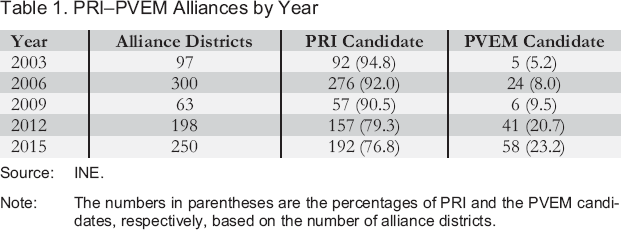
Source: INE.
Note: The numbers in parentheses are the percentages of PRI and the PVEM candidates, respectively, based on the number of alliance districts.
Our key independent variables relate to each party's performance in the previous legislative and gubernatorial elections. First, we look at the electoral performance of both parties in legislative elections. We include two different variables for the vote shares of the PRI and the PVEM. The first variables, vote share PRI (t-1) and vote share PVEM (t-1), refer to the votes that these parties received in all districts (both alliance and nonalliance districts) in the previous election. The second set of variables are interaction terms between whether or not there was an alliance in the previous legislative election and the vote shares that the PRI and the PVEM won in the previous election. These electoral data are from the IFE.
Because of the nature of the Mexican ballot, we include two different specifications for the parties’ lagged vote shares in 2009, 2012, and 2015. In 2009 and 2012 voters had the opportunity to cast their vote for the same candidate three different ways (see footnote 11). We can use the case of Benjamin Castillo Valdez, a joint PRI–PVEM candidate in the First Federal Electoral District of Baja California in 2012, to illustrate this. Valdez was on the ballot as a PRI candidate, as a PVEM candidate, and as a coalition candidate. He won 29.89 percent of the vote under the PRI label, 3.47 percent under the PVEM label, and 7.5 percent under the PRI–PVEM alliance label. Together, Valdez, the PRI–PVEM alliance candidate won 40.86 percent of the vote. In 2015 we thus have two different values for the PRI and the PVEM lagged vote shares: the values that each party won on its own (PRI with 29.89 percent and the PVEM with 3.47 percent) and the combined coalition vote share for both the PRI and the PVEM (40.86 percent). Conversely, in 2006 people who voted for the PRI–PVEM coalition could only vote for the alliance candidate. To determine the vote percentage each party received, we used the parties’ agreed-upon distribution of the coalition's total vote share. We use this agreement as a proxy to determine the individual vote for each party in a given district. 14 Importantly, although the agreement was based on the coalition's total national vote share, we use it to determine each party's vote share in a given district to avoid losing observations (see appendix for discussion on how we calculated each party's vote share). Because we are interested in the districts in which the parties have chosen to run joint candidates and not whether the candidate is from the PRI or the PVEM, the fact that voters were presented with three different ways to support a single candidate on the 2009 and 2012 ballots does not influence our analysis.
We recognize that there are some potential issues with the 2006 vote-share specification. However, the changes to the ballot structure in the 2007 electoral reform does not allow us to have the same estimate that we have for the individual vote shares of the parties in 2012 and 2015. In order to keep 2009 in our sample, we use this proxy. To ensure that the 2009 observations do not determine our results, however, we include a dummy variable to control for the possible 2009 effect. As table A.3 shows, the results are similar except for the variable that captures the previous vote share of the PVEM in alliance districts. The direction is positive, but the results are not significant. This could be due to the poor electoral performance of the coalition in the 2006 elections. The PRI–PVEM coalition finished in third place in both the presidential and the legislative elections, with 22.26 percent and 28.21 percent of the vote share, respectively.
Second, to test our hypothesis on the multilevel nature of party behavior, we use strength of the PRI–PVEM alliance at the gubernatorial level. This variable captures how strong the PRI–PVEM alliance was in the previous gubernatorial elections in each federal legislative district. To calculate this variable, we collected the gubernatorial results at the municipal level and created a variable that reflects the percentage of municipalities that the PRI–PVEM alliance won in each legislative district. For example, the PRI–PVEM alliance won in 8 out of 10 municipalities in the First Federal Electoral District of Aguascalientes in the gubernatorial elections preceding the 2012 election. Thus, the strength of the PRI– PVEM alliance in this federal district is 0.8. These data are from the IFE.
We also include several control variables. First, we employ two variables for the strength of the other two major parties in gubernatorial elections: the PAN and the Partido de la Revolución Democrática (Party of the Democratic Revolution, PRD). We expect the strength of the PAN to affect the alliance decision. The PVEM was a coalition partner with the PAN in 2000 and, as Shirk (2005: 161) points out, “provided Fox with a coalition partner and enabled him to bill his candidacy as a pact for an alliance of change.” The coalition between the PRI and the PVEM may be used as a way to promote the same idea of change. Therefore, we expect that the better the PAN did at the state level, the more likely the PRI and the PVEM are to run together in the federal legislative elections to maximize their winning potential. We also include a variable measuring the electoral strength of the PRD. We similarly expect that the stronger the PRD is, the more likely the PRI and the PVEM are to form an alliance. These variables were collected and coded using electoral information from the IFE.
Second, we control for socioeconomic features of the population by including a marginalization index created by the Consejo Nacional de Poblacíon (CONAPO). This index measures four different dimensions: levels of education, living conditions (whether or not people have access to public services such as water and electricity), population size, and population income. The unit of analysis of this index is the municipality. We thus collected the index for each municipality and then we aggregated it to the federal legislative district and calculated the average. We expect marginalization to have some effect on the parties’ decision to run joint candidates. In districts with high levels of marginalization, we expect parties to be less likely to enter into an alliance because they may have better electoral strategies, such as patron–client relations or clientelism. As the literature on developing countries shows (e.g., Magaloni et al. 2006; Díaz-Cayeros, Estévez, and Magaloni 2012), poverty creates favorable conditions for politicians to practice clientelism. Therefore, we expect that in districts with high levels of marginalization, the electoral success of parties may not rely on the electoral alliance but on other factors, such as patron–client relations.
Third, we control for voter turnout. We use concurrent voter turnout and not lagged turnout because the legislative elections are held every three years, some simultaneously alongside presidential elections. Therefore, if we use the number of votes from the previous election, the nature of the election could be quite different. Although having a presidential election the same day as the legislative election increases turnout (De Remes 2006), we use concurrent turnout for all elections for consistency. These data are also from the IFE. We expect that as voter turnout increases in a given district, so will the probability that the PRI and the PVEM will run a joint candidate. If turnout is low, the proportion of voters who represent the voto duro 15 of the traditional parties, like the PRI, will be high (Crespo 2010). However, increased turnout is likely to involve newer and more independent voters, thus creating more electoral uncertainty for the parties. By running in an alliance with the PVEM, the PRI is able to mobilize more voters, thereby ensuring electoral success for both parties.
Crespo (2010) defines the voto duro as an ideological vote. Voters who represent the voto duro have strong familial, emotional, or patronage ties with the party and tend to go to the polls consistently and frequently.
Finally, we include the lagged dependent variable as the previous alliance may be a strong predictor of future alliances, especially if parties are interested in building electoral relationships with other parties (see table A.1 in the appendix for the descriptive statistics of all variables included in the analysis).
As our dependent variable is dichotomous, we use a logistic model to determine the probability of the electoral alliances between the PRI and the PVEM. We use robust standard errors to account for potential heteroscedasticity.
Results
Table 2 presents the results from our logistic regression analysis. Model 1 uses the vote shares the PRI and the PVEM won individually in alliance districts. Model 2 uses the total vote share of the PRI–PVEM coalition in alliance districts. As our results are substantively similar for both models, we only discuss the results for Model 1 below. 16 Our results support all of our hypotheses except H1b.
As we are focused on the districts selected and not the candidate's party in this analysis, it is not problematic that we do not identify the candidate's party.
Predicting PRI–PVEM Alliances
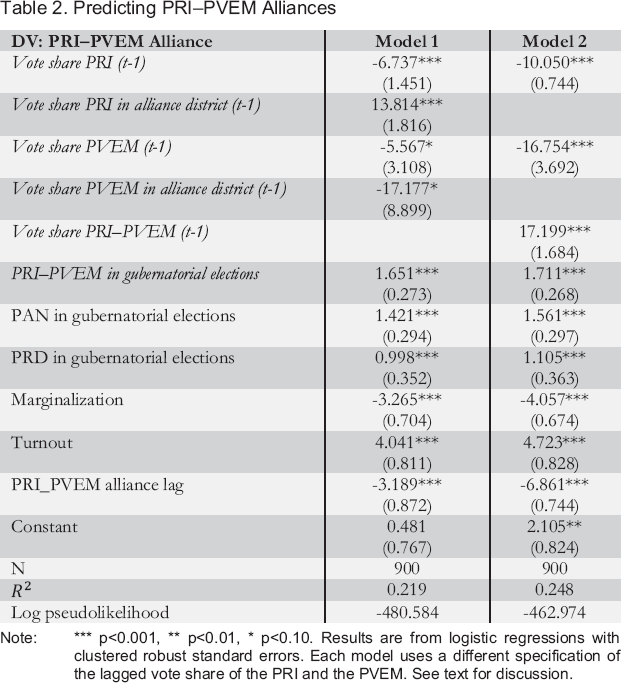
Note:
p<0.001,
p<0.01,
p<0.10. Results are from logistic regressions with clustered robust standard errors. Each model uses a different specification of the lagged vote share of the PRI and the PVEM. See text for discussion.
First, our results show that the PVEM is more likely to enter into an alliance in a given district if it did poorly in the previous election in both nonalliance (H1a) and alliance districts (H1b). Although the results in alliance districts run counter to our expectations, both sets of results demonstrate that the PVEM is balancing its desire for office with that of survival. Second, we find that previous electoral performance influences the PRI's decision to join an alliance in both nonalliance (H2a) and alliance (H2b) districts. As the PRI's vote share in nonalliance districts increases, the probability that it will enter into an alliance with the PVEM decreases (H2a). Conversely, if the PRI's vote share increased in alliance districts in the previous election, the probability of an alliance will also increase (H2b). These results highlight the office-seeking nature of the PRI: it will identify the best strategy in a given electoral context to maximize its winning potential. Finally, we find that if there is strong support for the PRI–PVEM alliance at the state level, the PRI and the PVEM are more likely to enter into an alliance in the legislative elections (H3). This finding clearly demonstrates the multilevel nature of the parties’ strategies.
To show the substantive effect of our results, we simulate and plot predicted probabilities. Figures 1–3 illustrate these effects. The dependent variable for all of the figures is the probability of an alliance. The dashed lines represent the 95 percent confidence intervals and the tick marks along the X-axis denote the distribution of the independent variable.
Figure 1 illustrates the influence of the PVEM's previous electoral performance on the probability of entering into an alliance. Figure 1a shows that there is a significant relationship between the PVEM vote share in nonalliance districts and the probability of an alliance when the PVEM's previous vote share was between 10 percent and 20 percent; however, the substantive effect is rather small. Figure 1b similarly demonstrates that as the PVEM's vote share increases in alliance districts, so does the probability of an alliance – although the confidence intervals are quite large. To increase its legitimacy as a party, maintain its status as an official party, and increase its chance of winning, entering into an alliance in districts where it performed poorly in the previous legislative election is the logical choice for the PVEM.
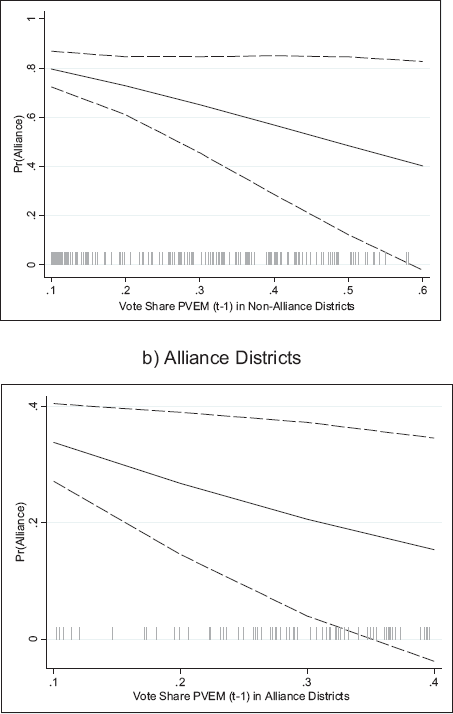
Probability of PRI–PVEM Alliance for the PVEM
Figure 2a demonstrates that as the PRI's previous vote share decreases in a nonalliance district, so does its probability of running in an alliance. Holding all other variables at their means, the probability of the PRI joining forces with the PVEM is 88.6 percent if the PRI's previous vote share is 10 percent; this probability drops to 60 percent if the PRI's previous vote share is 50 percent. The PRI's decision to join an alliance is arguably based on two phenomena in Mexican party politics: party identification and social segmentation. According to Moreno and Méndez (2007), the percentage of the electorate that voted according to party identification dropped from 65 percent in 2000 to 59 percent in 2006. One of the reasons for this decrease was generational change in Mexican society. Moreover, it shows that voters’ identification with the PRI was the most affected by this change.
Moreno (2009) further argues that the 3.3 million undecided voters in the 2006 elections reflected a lack of party identification among the Mexican electorate. According to Moreno's predictions, citizens who do not identify with a party would again play a key role in the 2012 elections. It is quite reasonable then that the alliance with the PVEM is a strategy to recover some of the electorate that no longer strongly identifies with the PRI. Second, the PVEM represents a different social segment from the PRI. According to Parametría (2015), those who vote for the PVEM are between 18 and 25 years old. Women are also more likely to vote for the PVEM. Conversely, men over 56 years old are more likely to vote for the PRI. The PVEM thus represents a new generation of young people with postmaterialist values (Inglehart 1997). Due to the volatility of the Mexican electorate since 2000, it is thus quite rational for the PRI to want to form alliances with the PVEM in the districts where it has performed poorly.
Figure 2b shows a strong relationship between the PRI's previous vote share in alliance districts and the probability of joining an alliance. Holding all other variables at their means, when the PRI's previous vote share is similarly held at its mean of 15.8 percent, its likelihood of entering into an alliance with the PVEM is 52 percent. Increasing the PRI's vote share to the maximum value of 56.2 percent increases the probability of an alliance to over 95 percent. This demonstrates the PRI's office-seeking nature and its willingness to reuse a strategy that has worked well in the past.
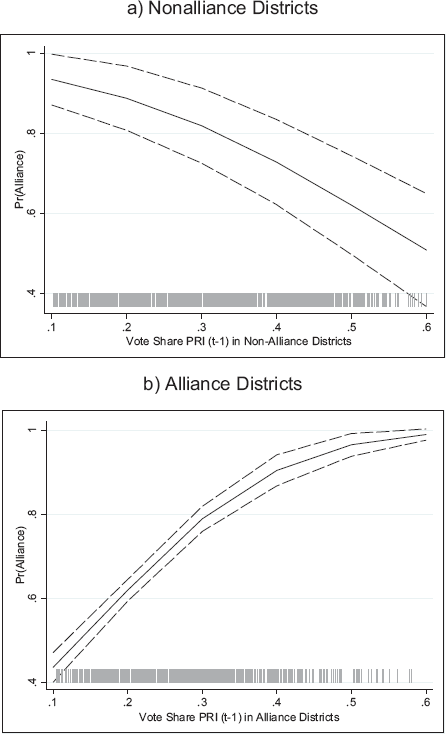
Probability of PRI–PVEM Alliance for the PRI
Finally, figure 3 demonstrates that as the PRI–PVEM alliance's gubernatorial electoral success increases, so does the probability that the parties will form an alliance in the federal legislative elections.
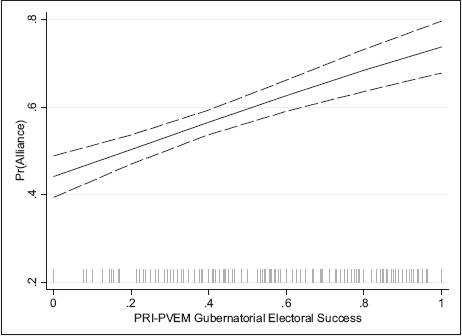
Influence of PRI–PVEM Gubernatorial Success on PRI–PVEM Alliances
If the alliance did not win any municipalities in a given district, the probability of a federal legislative alliance is 42.4 percent. However, if the alliance won all of the municipalities in the legislative district, the probability of an alliance increases to 79.3 percent. Thus, figure 3 clearly shows that the parties engage in a multilevel electoral strategy. Several scholars (e.g., Langston 2003; De Remes 2006; Hicken and Stoll 2008; Spoon and West 2015b) argue that parties’ performances and behavior at the state level influence their choice of electoral strategy at the federal level.
Several of our control variables are also significant. First, if the PAN is strong at the state level, the probability of the PRI and the PVEM running together in the legislative elections increases. This shows that if there is a threat from the other major party at the gubernatorial level, the PRI and the PVEM are more likely to join together to maximize their vote share in the legislative election. Like the PVEM, the PAN has historically been more conservative than the PRI. The PAN emerged in 1939 as a reaction to cardenismo, which was considered a socialist ideology (Loaeza 1974). The PVEM similarly appeals to a more conservative electorate. Support for the death penalty and life imprisonment are two examples of the parties’ policies. 17 Thus, by allying with the PVEM, the PRI may be able to appeal to voters that it would not be able to if it ran alone. Second, we also find that when the PRD was strong at the state level, alliances were more likely. Along with the PAN, the PRD has been the main opposition to the PRI since 2000. In 2006 the PRI dropped to third place in both the legislative and presidential elections, while the PAN and the PRD finished first and second, respectively. Because the left-wing PRD was founded by former PRI members, forming an electoral coalition allowed the PRI to maximize its probability of winning. Third, the marginalization index is negative and significant. As we expected, in districts with high levels of marginalization, the PRI and the PVEM are less likely to run together. This could be related to the strategies used by parties to win elections in newer democracies. In regions with high levels of marginalization, clientelism could be the best strategy to win votes (e.g., Magaloni et al. 2006). In more marginalized districts the existence of an electoral alliance may be irrelevant for voters. Parties can individually appeal to voters with material goods and future promises. The effect of the alliance could thus have only a marginal effect on a voter's decision. Finally, turnout is positive and significant as we predicted. The higher the level of turnout, the more likely the PRI and the PVEM are to run together. One of the reasons for this finding is that increased turnout is a result of an expanded electorate. These newer voters are young people who may be more attracted to the PVEM than a mass-based party like the PRI. Therefore, when the parties run together, turnout increases.
See Tuckman 2015 and <www.partidoverde.org.mx> (27 June 2017).
Conclusion
In this paper, we have sought to further understand the nature of parties in newer democracies by conducting the first systematic analysis of the electoral alliances in legislative elections between the PRI and the PVEM. We find that the PRI and the PVEM are more likely to run common candidates in a given legislative district if they each performed poorly in previous legislative elections. However, given the PRI's ultimate goal of winning office and the PVEM's objective of balancing survival with winning office, the probability of running together in alliance districts differs. For the PRI, if an alliance candidate has done well, it will use the same strategy again. For the PVEM, however, if an alliance candidate has performed well, it will be less likely to repeat this strategy. In addition, an alliance is more likely if the PRI–PVEM gubernatorial alliances were electorally successful. These findings reveal the strategic behavior both political parties use to maximize their own electoral success and minimize the success of the opposition.
Importantly, these alliances benefit both parties. By running joint candidates with the PRI, the PVEM has been able to increase its legitimacy and maintain its official status as a political party. 18 Its pact with the PRI has also seen the PVEM profit more from public funding than it would have done fielding its own candidates (see table A.3). 19 For the PRI, these alliances have helped it to win and maintain office in the new political and electoral reality ushered in by democratization – one where the PRI now has to form electoral coalitions to maintain its dominance. Moreover, the coalitions have the advantage of reducing campaign spending as both parties share the costs.
The threshold to maintain a party's official status was increased from 2 percent to 3 percent in 2014 (see Diario Oficial de la Federación, article 116, incise f (Congreso de la Unión 2014)).
Public funding in Mexico is distributed following a 30/70 formula: 30 percent of the available funding is equally distributed among the official political parties, while the other 70 percent is distributed according to vote shares in the previous federal elections. Parties can also take private donations, but they cannot be higher than 10 percent of the total public money that the parties receive (IFE 2009).
Our results have important implications for understanding party behavior in newer democracies. First, following other research on electoral alliances in Latin America (see, e.g., Spoon and West 2015a; Kellam forthcoming), we show that in newer democracies electoral pacts have a different logic than in consolidated democracies. In the case of the PRI– PVEM pact, both parties behave as office-seeking organizations, and their main goal is to win elections (Downs 1957; Riker 1962). They do not appear to be interested in building long-term relationships based on policy interests. The primary variable that affects their decision to run common candidates in a given district is past electoral performance. Thus, we may see future electoral agreements between parties based solely on a desire to increase their vote share.
Second, our findings have implications for understanding the role that small parties play in newer democracies. In consolidated democracies small parties often challenge the dominance of the major parties and their way of participating in the political system. They are typically policy-seeking and ideologically focused parties (see, e.g., Cox 1997). When they do work with other parties, they collaborate with those they are ideologically proximate to (see, e.g., Blais and Indridason 2007; Spoon 2011). However, in newer democracies – especially those in Latin America – smaller parties can be quite different. While some have argued that these parties can bring about democratic reforms by raising issues that the major parties do not (see, e.g., Bruhn 1997; Dominguez and Poiré 1999; Madrid 2005; West and Spoon 2013), they may not represent a specific constituency at all but rather may have emerged as a family business (as the PVEM did). They may even simply be alternative organizations that the big parties use to maintain their power. If this is the case, it calls into question the nature and quality of representation that newer democracies are creating.
Although this paper is an important first step toward understanding the electoral agreements in Mexico and what they tell us about party behavior in newer democracies, more research is needed. First, to better understand the alliance between the PRI and the PVEM, it is necessary to examine the electoral pacts between other parties, such as the one between the PRD, the PT and Convergencia. Do the same factors explain how the PRD and the PT decide on which districts to run joint candidates? Second, further research is needed on the nature of the PRI– PVEM alliances and on which candidates run under which label. Looking at candidates’ profiles, specifically their backgrounds, could provide a more complete explanation about the incentives to form an alliance in a given district. For example, it is well known that several PVEM candidates are former PRI members; however, there has been no systematic investigation into whether the PRI is using the PVEM to nominate candidates who are loyal to the PRI. 20
These individuals are often referred to as sandías (watermelons) because they are green on the outside and red on the inside. One such example is Maria Elena Barrera Tapia, who is currently a Green senator and former PRI politician. Between 2009 and 2012, she won the local elections in the municipality of Toluca (in the state of México) under the PRI label and was elected as presidente municipal.
Footnotes
Appendix
Based on the agreement, if the total vote share for the coalition is equal to 30.9 percent or less, the PVEM will receive 6.6 percent of the vote share, and the remaining vote share will be allocated to the PRI (up to 24.3 percent). For each extra point up to 33 percent, the PVEM will receive an extra 0.5 percent, and the remaining vote share will go to the PRI. For example, if the coalition's vote share is 32 percent, 7.6 percent will go to the PVEM, and 24.4 percent will go to the PRI. If the coalition receives between 33.01 percent and 38.9 percent of the vote share, the PVEM receives 8.1 percent, and the remainder goes to the PRI. If the coalition wins more than 38.9 percent, for each extra point, the PVEM will get 0.3 percent extra, and the rest will go to the PRI (INE 2006). For example, in district 2 in the state of Nuevo León, the coalition won 45.14 percent. Based on this agreement, we allocated 34.94 percent to the PRI and 10.2 percent to the PVEM.